

For-Exx Kripto 1
435 Posts

For-Exx Kripto 1
Report
Block User
Cryptocurrency Reviews / Technical and Fundamental Analysis / Important Market News
0 Following
44 Followers
34 Liked
Posts
All
Videos
# Why Did Gold Plunge? Is Its Safe-Haven Status at Risk?
Gold’s sharp selloff challenged its safe-haven image. In late October, it fell below $3,900; on Oct. 30, it dropped 3.5% to its lowest since October 2025. Silver fell over 6%, below $50.
# Drivers of the Selloff
Inflation, Fed expectations, energy prices and equity losses converged. US September PCE rose 0.5% monthly and 3.6% annually; core PCE increased 3.1%. Persistent inflation revived December rate-hike expectations,despite the Fed holding rates in October.
Higher rates raise gold’s opportunity cost and make interest-bearing assets more attractive.
Brent topped $113 amid Middle East tensions and Hormuz risks. Geopolitical stress can support gold, but higher energy costs may keep rates elevated,offsetting safe-haven demand.
Technology losses and AI-spending concerns increased cash needs. Investors facing margin calls may sell liquid assets,including gold. This does not prove gold has lost its safe-haven role.
# Is Gold Still a Safe Haven?
Gold does not rise during every shock. Tight liquidity, rate repricing and forced selling can weigh on prices. The World Gold Council reported ~$10B (67 tonnes) of global gold ETF inflows in September despite falling prices,while futures positioning contracted.
# What Turkish Investors Should Watch
Gram gold reflects global prices and USD/TRY. A weaker ounce price may be offset by a rising exchange rate; if both fall, gram gold faces greater pressure. Local spreads matter.
Watch Treasury yields, the dollar,Fed expectations,oil,central-bank purchases and ETF/futures flows.
Gold fell from its January record near $5,595 to below $3,900 in October,~30% lower. Whether pressure persists depends on temporary liquidations or a lasting demand shift. Lower rates,a weaker dollar and central-bank buying could support prices; persistent inflation and tight policy could weigh on gold.
Even safe havens are not immune to global liquidity. $XAUt $XAG
# Why Did Gold Plunge? Is Its Safe-Haven Status at Risk?
Gold’s sharp selloff challenged its safe-haven image. In late October, it fell below $3,900; on Oct. 30, it dropped 3.5% to its lowest since October 2025. Silver fell over 6%, below $50.
# Drivers of the Selloff
Inflation, Fed expectations, energy prices and equity losses converged. US September PCE rose 0.5% monthly and 3.6% annually; core PCE increased 3.1%. Persistent inflation revived December rate-hike expectations,despite the Fed holding rates in October.
Higher rates raise gold’s opportunity cost and make interest-bearing assets more attractive.
Brent topped $113 amid Middle East tensions and Hormuz risks. Geopolitical stress can support gold, but higher energy costs may keep rates elevated,offsetting safe-haven demand.
Technology losses and AI-spending concerns increased cash needs. Investors facing margin calls may sell liquid assets,including gold. This does not prove gold has lost its safe-haven role.
# Is Gold Still a Safe Haven?
Gold does not rise during every shock. Tight liquidity, rate repricing and forced selling can weigh on prices. The World Gold Council reported ~$10B (67 tonnes) of global gold ETF inflows in September despite falling prices,while futures positioning contracted.
# What Turkish Investors Should Watch
Gram gold reflects global prices and USD/TRY. A weaker ounce price may be offset by a rising exchange rate; if both fall, gram gold faces greater pressure. Local spreads matter.
Watch Treasury yields, the dollar,Fed expectations,oil,central-bank purchases and ETF/futures flows.
Gold fell from its January record near $5,595 to below $3,900 in October,~30% lower. Whether pressure persists depends on temporary liquidations or a lasting demand shift. Lower rates,a weaker dollar and central-bank buying could support prices; persistent inflation and tight policy could weigh on gold.
Even safe havens are not immune to global liquidity. $XAUt $XAG
Gold’s sharp selloff challenged its safe-haven image. In late October, it fell below $3,900; on Oct. 30, it dropped 3.5% to its lowest since October 2025. Silver fell over 6%, below $50.
# Drivers of the Selloff
Inflation, Fed expectations, energy prices and equity losses converged. US September PCE rose 0.5% monthly and 3.6% annually; core PCE increased 3.1%. Persistent inflation revived December rate-hike expectations,despite the Fed holding rates in October.
Higher rates raise gold’s opportunity cost and make interest-bearing assets more attractive.
Brent topped $113 amid Middle East tensions and Hormuz risks. Geopolitical stress can support gold, but higher energy costs may keep rates elevated,offsetting safe-haven demand.
Technology losses and AI-spending concerns increased cash needs. Investors facing margin calls may sell liquid assets,including gold. This does not prove gold has lost its safe-haven role.
# Is Gold Still a Safe Haven?
Gold does not rise during every shock. Tight liquidity, rate repricing and forced selling can weigh on prices. The World Gold Council reported ~$10B (67 tonnes) of global gold ETF inflows in September despite falling prices,while futures positioning contracted.
# What Turkish Investors Should Watch
Gram gold reflects global prices and USD/TRY. A weaker ounce price may be offset by a rising exchange rate; if both fall, gram gold faces greater pressure. Local spreads matter.
Watch Treasury yields, the dollar,Fed expectations,oil,central-bank purchases and ETF/futures flows.
Gold fell from its January record near $5,595 to below $3,900 in October,~30% lower. Whether pressure persists depends on temporary liquidations or a lasting demand shift. Lower rates,a weaker dollar and central-bank buying could support prices; persistent inflation and tight policy could weigh on gold.
Even safe havens are not immune to global liquidity. $XAUt $XAG

72
# Multichain (MULTI): $125M Bridge Crisis and Collapse
Launched as Anyswap in July 2020,Multichain became a major cross-chain bridge, supporting transfers across Ethereum,BNB Chain, Avalanche and Polygon. It adopted the Multichain name in Dec. 2021 and used multi-party computation (MPC) for security
# Growth
A $60M round led by Binance Labs in Dec. 2021 valued the project at ~$1.2B. TVL peaked near $10.45B in Jan. 2022. MULTI replaced ANY at 1:1;its 100M supply supported governance and planned fee distributions to veMULTI holders
# The 2023 Crisis
Contact with CEO Zhaojun was lost in May 2023. Critical servers were tied to his personal cloud account. Chinese police later detained him and seized his devices and recovery data,leaving the team unable to regain control
On July 6–7,over $125M in assets left bridge addresses,including WBTC,WETH,USDC and DAI. Fantom later put total cross-chain losses above $210M. Circle froze ~$63M USDC and Tether ~$2.5M USDT,but this did not cover all losses
The team said Zhaojun’s sister moved about $220M in remaining user assets to other wallets; she was also detained. Without access or funding,Multichain halted operations
# Legal Fallout and MULTI’s Collapse
Fantom Foundation sued in Singapore and obtained a default judgment in Jan. 2024. The ruling did not settle every question of responsibility or the assets ’final fate.
MULTI peaked at $33.64 in Jan. 2022. By Oct. 31, 2026,reported prices were ~$0.02–0.03,down about 99.9%. Supply,volume and market-cap data remain inconsistent;thin liquidity makes prices unreliable
# Lessons
MPC and smart-contract security are insufficient if servers,keys,recovery data and operations depend on one person. Bridges also concentrate assets and attract attacks. Governance, key management,audits,transparency and crisis readiness matter as much as TVL,network coverage and funding. Multichain exposed the gap between decentralization claims and actual control $BTC $MULTI
# Multichain (MULTI): $125M Bridge Crisis and Collapse
Launched as Anyswap in July 2020,Multichain became a major cross-chain bridge, supporting transfers across Ethereum,BNB Chain, Avalanche and Polygon. It adopted the Multichain name in Dec. 2021 and used multi-party computation (MPC) for security
# Growth
A $60M round led by Binance Labs in Dec. 2021 valued the project at ~$1.2B. TVL peaked near $10.45B in Jan. 2022. MULTI replaced ANY at 1:1;its 100M supply supported governance and planned fee distributions to veMULTI holders
# The 2023 Crisis
Contact with CEO Zhaojun was lost in May 2023. Critical servers were tied to his personal cloud account. Chinese police later detained him and seized his devices and recovery data,leaving the team unable to regain control
On July 6–7,over $125M in assets left bridge addresses,including WBTC,WETH,USDC and DAI. Fantom later put total cross-chain losses above $210M. Circle froze ~$63M USDC and Tether ~$2.5M USDT,but this did not cover all losses
The team said Zhaojun’s sister moved about $220M in remaining user assets to other wallets; she was also detained. Without access or funding,Multichain halted operations
# Legal Fallout and MULTI’s Collapse
Fantom Foundation sued in Singapore and obtained a default judgment in Jan. 2024. The ruling did not settle every question of responsibility or the assets ’final fate.
MULTI peaked at $33.64 in Jan. 2022. By Oct. 31, 2026,reported prices were ~$0.02–0.03,down about 99.9%. Supply,volume and market-cap data remain inconsistent;thin liquidity makes prices unreliable
# Lessons
MPC and smart-contract security are insufficient if servers,keys,recovery data and operations depend on one person. Bridges also concentrate assets and attract attacks. Governance, key management,audits,transparency and crisis readiness matter as much as TVL,network coverage and funding. Multichain exposed the gap between decentralization claims and actual control $BTC $MULTI
Launched as Anyswap in July 2020,Multichain became a major cross-chain bridge, supporting transfers across Ethereum,BNB Chain, Avalanche and Polygon. It adopted the Multichain name in Dec. 2021 and used multi-party computation (MPC) for security
# Growth
A $60M round led by Binance Labs in Dec. 2021 valued the project at ~$1.2B. TVL peaked near $10.45B in Jan. 2022. MULTI replaced ANY at 1:1;its 100M supply supported governance and planned fee distributions to veMULTI holders
# The 2023 Crisis
Contact with CEO Zhaojun was lost in May 2023. Critical servers were tied to his personal cloud account. Chinese police later detained him and seized his devices and recovery data,leaving the team unable to regain control
On July 6–7,over $125M in assets left bridge addresses,including WBTC,WETH,USDC and DAI. Fantom later put total cross-chain losses above $210M. Circle froze ~$63M USDC and Tether ~$2.5M USDT,but this did not cover all losses
The team said Zhaojun’s sister moved about $220M in remaining user assets to other wallets; she was also detained. Without access or funding,Multichain halted operations
# Legal Fallout and MULTI’s Collapse
Fantom Foundation sued in Singapore and obtained a default judgment in Jan. 2024. The ruling did not settle every question of responsibility or the assets ’final fate.
MULTI peaked at $33.64 in Jan. 2022. By Oct. 31, 2026,reported prices were ~$0.02–0.03,down about 99.9%. Supply,volume and market-cap data remain inconsistent;thin liquidity makes prices unreliable
# Lessons
MPC and smart-contract security are insufficient if servers,keys,recovery data and operations depend on one person. Bridges also concentrate assets and attract attacks. Governance, key management,audits,transparency and crisis readiness matter as much as TVL,network coverage and funding. Multichain exposed the gap between decentralization claims and actual control $BTC $MULTI

49
📅 WEEKLY MACRO & RISK CALENDAR | NOV 2–6, 2026 Theme: US midterms, Friday’s jobs report, RBA/BoE decisions. No Fed meeting; next Dec. 8–9. US winter time began Nov. 1; US data are 8 hours behind Istanbul. MON, NOV 2 8:00 — ISM Manufacturing PMI. 🌍 Final global manufacturing PMIs. NPC Standing Committee begins (to Nov. 6). TUE, NOV 3 06:30 — RBA decision. 10:00 — October CPI; 🇨🇭 October CPI. 18:00 — JOLTS (Sep.). Midterms: 35 Senate seats, 435 House seats, 36 governorships. Results overnight into Nov. 4. WED, NOV 4 13:00 — Eurozone flash CPI; final services/composite PMIs. 16:15 — ADP; 16:30 — trade balance/Treasury refunding; 18:00 — ISM Services. Riksbank, 🇵🇱 NBP, 🇧🇷 BCB decisions; 🇯🇵 BoJ minutes. THU, NOV 5 12:00 — Norges Bank. 15:00 — BoE decision/report. CNB, 🇲🇽 Banxico decisions. 16:30 — Jobless claims; 🇨🇦 federal budget. FRI, NOV 6 16:30 — October payrolls, unemployment, hourly earnings. 16:30 — October jobs report. 18:00 — Michigan sentiment (prelim.). Industrial production; 🇪🇺 retail sales (Sep.). ━━━ CRYPTO IMPACT & WEEKLY RISKS Midterms are the key uncertainty. Congressional control may shift tax, spending, regulation and crypto-law expectations. Overnight results create Asia-session volatility; close counts may prolong uncertainty. Friday’s NFP is key for December Fed pricing. Weak hiring may boost rate-cut bets and support crypto; strong data could lift dollar/yields and hurt risk appetite. Wednesday’s ADP and ISM Services offer earlier signals. Treasury refunding affects long-term bond supply and liquidity. RBA, Riksbank and BoE decisions matter: hawkish surprises could tighten global liquidity. BoE votes/guidance and Eurozone CPI shape rate expectations. Türkiye’s CPI may affect TCMB expectations, lira assets, local crypto volumes and USDT/TRY. Key risk windows: election night into Wednesday; Wed. 16:15–18:00 US data; Fri. 16:30 NFP. Thin liquidity can amplify moves; review leverage. $BTC $ET
📅 WEEKLY MACRO & RISK CALENDAR | NOV 2–6, 2026 Theme: US midterms, Friday’s jobs report, RBA/BoE decisions. No Fed meeting; next Dec. 8–9. US winter time began Nov. 1; US data are 8 hours behind Istanbul. MON, NOV 2 8:00 — ISM Manufacturing PMI. 🌍 Final global manufacturing PMIs. NPC Standing Committee begins (to Nov. 6). TUE, NOV 3 06:30 — RBA decision. 10:00 — October CPI; 🇨🇭 October CPI. 18:00 — JOLTS (Sep.). Midterms: 35 Senate seats, 435 House seats, 36 governorships. Results overnight into Nov. 4. WED, NOV 4 13:00 — Eurozone flash CPI; final services/composite PMIs. 16:15 — ADP; 16:30 — trade balance/Treasury refunding; 18:00 — ISM Services. Riksbank, 🇵🇱 NBP, 🇧🇷 BCB decisions; 🇯🇵 BoJ minutes. THU, NOV 5 12:00 — Norges Bank. 15:00 — BoE decision/report. CNB, 🇲🇽 Banxico decisions. 16:30 — Jobless claims; 🇨🇦 federal budget. FRI, NOV 6 16:30 — October payrolls, unemployment, hourly earnings. 16:30 — October jobs report. 18:00 — Michigan sentiment (prelim.). Industrial production; 🇪🇺 retail sales (Sep.). ━━━ CRYPTO IMPACT & WEEKLY RISKS Midterms are the key uncertainty. Congressional control may shift tax, spending, regulation and crypto-law expectations. Overnight results create Asia-session volatility; close counts may prolong uncertainty. Friday’s NFP is key for December Fed pricing. Weak hiring may boost rate-cut bets and support crypto; strong data could lift dollar/yields and hurt risk appetite. Wednesday’s ADP and ISM Services offer earlier signals. Treasury refunding affects long-term bond supply and liquidity. RBA, Riksbank and BoE decisions matter: hawkish surprises could tighten global liquidity. BoE votes/guidance and Eurozone CPI shape rate expectations. Türkiye’s CPI may affect TCMB expectations, lira assets, local crypto volumes and USDT/TRY. Key risk windows: election night into Wednesday; Wed. 16:15–18:00 US data; Fri. 16:30 NFP. Thin liquidity can amplify moves; review leverage. $BTC $ET

72
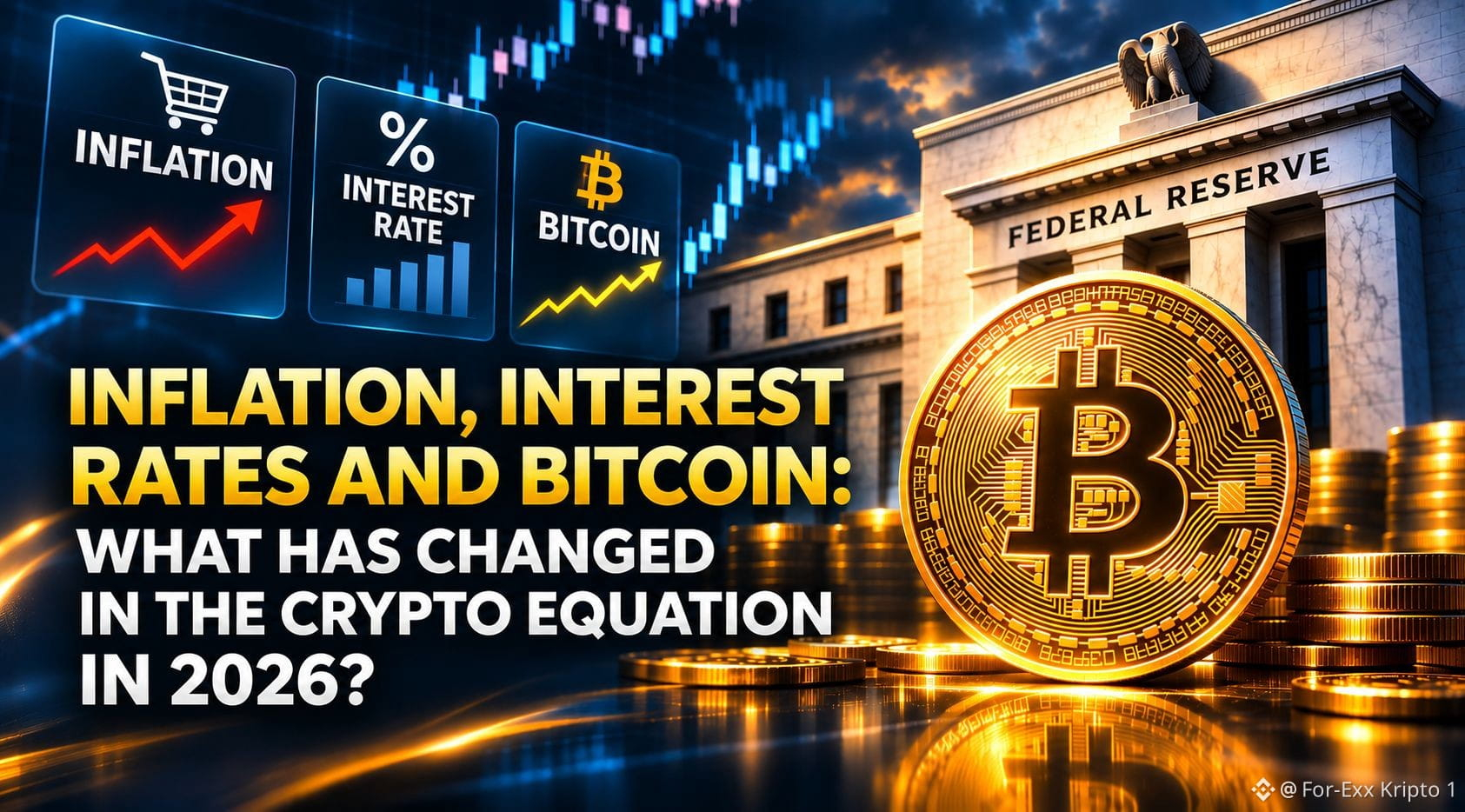
# Inflation, Rates and Bitcoin: What Changed in 2026? Inflation, Fed policy and liquidity shaped crypto markets in 2026. Renewed price pressures have made rate cuts uncertain. ## Inflation and the Fed US September CPI rose 0.6% monthly and 3.7% annually, up from 3.4% in August. Gasoline jumped 9.1%; core CPI reached 2.6%. September PCE rose 0.5% monthly and 3.6% annually; core PCE was 3.1%, above the Fed’s 2% target. On Oct. 28, the Fed held rates at 3.75%–4.00%. The 10–2 vote included two members favoring a 25-bp hike. Officials said inflation remained high; another hike remains possible. ## Rates, Liquidity and Bitcoin Higher rates make yield-bearing assets more attractive, raise borrowing costs and reduce risk appetite. Higher yields and a stronger dollar may pressure BTC; tighter conditions can trigger liquidations. Markets react to expectations and Fed guidance, not just decisions. Bitcoin’s limited supply supports its long-term store-of-value case, but short-term prices remain sensitive to liquidity, the dollar, real yields and monetary policy. Inflation can strengthen its hedge appeal while prompting tighter policy. Liquidity also depends on bank reserves and global flows. A rate hold does not automatically add liquidity; a cut does not guarantee a rally. ## ETFs and Scenarios Spot Bitcoin ETFs connect BTC to traditional portfolio flows. Assess ETF activity alongside spot demand, futures open interest, funding rates and liquidations; inflows alone do not ensure an uptrend. Persistent inflation may lift hike expectations, yields and the dollar, pressuring crypto. Disinflation may support BTC if demand strengthens. A slowdown could bring cuts, but recession fears may send investors to cash. Track CPI/PCE, Fed guidance, Treasury yields, the dollar, ETF flows, spot volume and leverage. Bitcoin’s outlook is not simply about rate cuts: real yields, liquidity and institutional flows shape demand. Sustained inflows help confirm a durable move. $BTC
# Inflation, Rates and Bitcoin: What Changed in 2026? Inflation, Fed policy and liquidity shaped crypto markets in 2026. Renewed price pressures have made rate cuts uncertain. ## Inflation and the Fed US September CPI rose 0.6% monthly and 3.7% annually, up from 3.4% in August. Gasoline jumped 9.1%; core CPI reached 2.6%. September PCE rose 0.5% monthly and 3.6% annually; core PCE was 3.1%, above the Fed’s 2% target. On Oct. 28, the Fed held rates at 3.75%–4.00%. The 10–2 vote included two members favoring a 25-bp hike. Officials said inflation remained high; another hike remains possible. ## Rates, Liquidity and Bitcoin Higher rates make yield-bearing assets more attractive, raise borrowing costs and reduce risk appetite. Higher yields and a stronger dollar may pressure BTC; tighter conditions can trigger liquidations. Markets react to expectations and Fed guidance, not just decisions. Bitcoin’s limited supply supports its long-term store-of-value case, but short-term prices remain sensitive to liquidity, the dollar, real yields and monetary policy. Inflation can strengthen its hedge appeal while prompting tighter policy. Liquidity also depends on bank reserves and global flows. A rate hold does not automatically add liquidity; a cut does not guarantee a rally. ## ETFs and Scenarios Spot Bitcoin ETFs connect BTC to traditional portfolio flows. Assess ETF activity alongside spot demand, futures open interest, funding rates and liquidations; inflows alone do not ensure an uptrend. Persistent inflation may lift hike expectations, yields and the dollar, pressuring crypto. Disinflation may support BTC if demand strengthens. A slowdown could bring cuts, but recession fears may send investors to cash. Track CPI/PCE, Fed guidance, Treasury yields, the dollar, ETF flows, spot volume and leverage. Bitcoin’s outlook is not simply about rate cuts: real yields, liquidity and institutional flows shape demand. Sustained inflows help confirm a durable move. $BTC
40
📰 NEWS BRIEF — OCT 31, 2026
━
🗺️ GLOBAL
Hormuz tensions persist after tanker incidents; Oman evacuated 25 crew from a burning ship. Qatar-mediated US-Iran talks continue, but terms remain unresolved; wider strikes after Nov. 3 remain possible. Pentagon war costs: $47.1B. Poll: Trump approval 32%; Democrats lead by 11 points. Russia struck Dnipro, killing 14; Israel’s blocs failed to win a majority.
━
📈 MARKETS
US stocks: Dow -1.06%, S&P -1.83%, Nasdaq -2.84%; tech -5%, VIX +32%. Intel and Reddit fell ~29%; Alphabet lost 12.6% weekly amid $51.3B capex and negative free cash flow. Brent $117.64 (+13.6% monthly), WTI $104.12 (+15.2%); gold $3,973.90, silver $50.09. Fed held 3.75%–4.00% (10–2); December hike odds 68–85%. BoJ held 1.25%, raised inflation forecasts.
━
₿ CRYPTO
Binance reported a ~$6.3B hack; deposits/withdrawals halted. TRM/Chainalysis linked it to North Korea’s TraderTraitor. ~$2.7–3B frozen; attacker reportedly retains ~$2.4B. BTC fell to $76,368, $ETH to $2,178; liquidations $1.5–1.7B, mostly longs.
$BTC ETFs lost $643.2M Oct. 30, largest since June; October outflows ~$516M. ETH ETFs lost $155.7M daily, ~$1.61B monthly. HYPE +15% on ICE/Trade.xyz partnership; Polymarket suspended international trading after $2.6M theft. CLARITY stalled; SEC/CFTC continue rulemaking.
━
🔓 TOKEN UNLOCKS
ENA — Nov. 1: 275M (~$56.9M; 2.05%), investors. 🟡
SUI — Nov. 1: ~$11.8–12.4M (0.32%), team/investors/community. 🟢
KITE — Nov. 1: ~$12.19M (4.25% of market cap); recipients unknown. 🟡
EIGEN — Nov. 1: ~$7.3M (3.8–4.9%); investors/early contributors. 🟡
HYPE — Nov. 6: model 9.92M (~$924M; 4.1%); October actual was ~38% of model. 🟡
AVAX — Nov. 8: ~$14.33M; details unavailable. 🟢
━
🔭 NEXT WEEK
Nov. 2: US ISM. Nov. 3: RBA, US midterms. Nov. 4: Eurozone CPI, US ADP/ISM services. Nov. 5: BoE. Nov. 6: US payrolls (55K; jobless rate 4.2%) and HYPE unlock. Nov. 8: AVAX unlock. US-Iran talks and possible post-election military moves remain risks.
📰 NEWS BRIEF — OCT 31, 2026
━
🗺️ GLOBAL
Hormuz tensions persist after tanker incidents; Oman evacuated 25 crew from a burning ship. Qatar-mediated US-Iran talks continue, but terms remain unresolved; wider strikes after Nov. 3 remain possible. Pentagon war costs: $47.1B. Poll: Trump approval 32%; Democrats lead by 11 points. Russia struck Dnipro, killing 14; Israel’s blocs failed to win a majority.
━
📈 MARKETS
US stocks: Dow -1.06%, S&P -1.83%, Nasdaq -2.84%; tech -5%, VIX +32%. Intel and Reddit fell ~29%; Alphabet lost 12.6% weekly amid $51.3B capex and negative free cash flow. Brent $117.64 (+13.6% monthly), WTI $104.12 (+15.2%); gold $3,973.90, silver $50.09. Fed held 3.75%–4.00% (10–2); December hike odds 68–85%. BoJ held 1.25%, raised inflation forecasts.
━
₿ CRYPTO
Binance reported a ~$6.3B hack; deposits/withdrawals halted. TRM/Chainalysis linked it to North Korea’s TraderTraitor. ~$2.7–3B frozen; attacker reportedly retains ~$2.4B. BTC fell to $76,368, $ETH to $2,178; liquidations $1.5–1.7B, mostly longs.
$BTC ETFs lost $643.2M Oct. 30, largest since June; October outflows ~$516M. ETH ETFs lost $155.7M daily, ~$1.61B monthly. HYPE +15% on ICE/Trade.xyz partnership; Polymarket suspended international trading after $2.6M theft. CLARITY stalled; SEC/CFTC continue rulemaking.
━
🔓 TOKEN UNLOCKS
ENA — Nov. 1: 275M (~$56.9M; 2.05%), investors. 🟡
SUI — Nov. 1: ~$11.8–12.4M (0.32%), team/investors/community. 🟢
KITE — Nov. 1: ~$12.19M (4.25% of market cap); recipients unknown. 🟡
EIGEN — Nov. 1: ~$7.3M (3.8–4.9%); investors/early contributors. 🟡
HYPE — Nov. 6: model 9.92M (~$924M; 4.1%); October actual was ~38% of model. 🟡
AVAX — Nov. 8: ~$14.33M; details unavailable. 🟢
━
🔭 NEXT WEEK
Nov. 2: US ISM. Nov. 3: RBA, US midterms. Nov. 4: Eurozone CPI, US ADP/ISM services. Nov. 5: BoE. Nov. 6: US payrolls (55K; jobless rate 4.2%) and HYPE unlock. Nov. 8: AVAX unlock. US-Iran talks and possible post-election military moves remain risks.
━
🗺️ GLOBAL
Hormuz tensions persist after tanker incidents; Oman evacuated 25 crew from a burning ship. Qatar-mediated US-Iran talks continue, but terms remain unresolved; wider strikes after Nov. 3 remain possible. Pentagon war costs: $47.1B. Poll: Trump approval 32%; Democrats lead by 11 points. Russia struck Dnipro, killing 14; Israel’s blocs failed to win a majority.
━
📈 MARKETS
US stocks: Dow -1.06%, S&P -1.83%, Nasdaq -2.84%; tech -5%, VIX +32%. Intel and Reddit fell ~29%; Alphabet lost 12.6% weekly amid $51.3B capex and negative free cash flow. Brent $117.64 (+13.6% monthly), WTI $104.12 (+15.2%); gold $3,973.90, silver $50.09. Fed held 3.75%–4.00% (10–2); December hike odds 68–85%. BoJ held 1.25%, raised inflation forecasts.
━
₿ CRYPTO
Binance reported a ~$6.3B hack; deposits/withdrawals halted. TRM/Chainalysis linked it to North Korea’s TraderTraitor. ~$2.7–3B frozen; attacker reportedly retains ~$2.4B. BTC fell to $76,368, $ETH to $2,178; liquidations $1.5–1.7B, mostly longs.
$BTC ETFs lost $643.2M Oct. 30, largest since June; October outflows ~$516M. ETH ETFs lost $155.7M daily, ~$1.61B monthly. HYPE +15% on ICE/Trade.xyz partnership; Polymarket suspended international trading after $2.6M theft. CLARITY stalled; SEC/CFTC continue rulemaking.
━
🔓 TOKEN UNLOCKS
ENA — Nov. 1: 275M (~$56.9M; 2.05%), investors. 🟡
SUI — Nov. 1: ~$11.8–12.4M (0.32%), team/investors/community. 🟢
KITE — Nov. 1: ~$12.19M (4.25% of market cap); recipients unknown. 🟡
EIGEN — Nov. 1: ~$7.3M (3.8–4.9%); investors/early contributors. 🟡
HYPE — Nov. 6: model 9.92M (~$924M; 4.1%); October actual was ~38% of model. 🟡
AVAX — Nov. 8: ~$14.33M; details unavailable. 🟢
━
🔭 NEXT WEEK
Nov. 2: US ISM. Nov. 3: RBA, US midterms. Nov. 4: Eurozone CPI, US ADP/ISM services. Nov. 5: BoE. Nov. 6: US payrolls (55K; jobless rate 4.2%) and HYPE unlock. Nov. 8: AVAX unlock. US-Iran talks and possible post-election military moves remain risks.

49
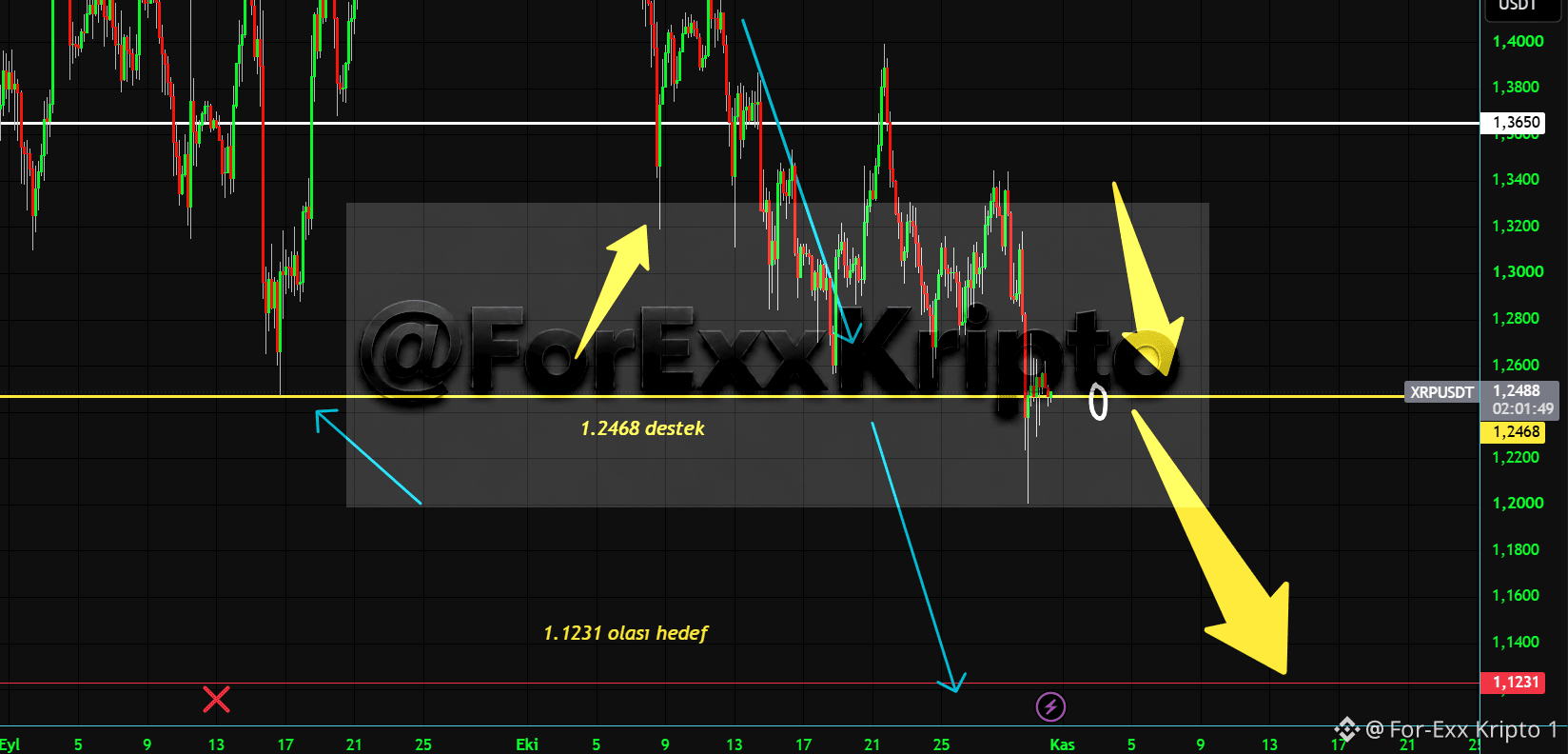
$XRP is trying to reclaim the 1.2468 pivot support but has yet to do so convincingly. With every passing hour and minute, the possibility of a move toward 1.1231 increases. A rise above 1.3650 would eliminate the downside risk, at least for now.
$XRP is trying to reclaim the 1.2468 pivot support but has yet to do so convincingly. With every passing hour and minute, the possibility of a move toward 1.1231 increases. A rise above 1.3650 would eliminate the downside risk, at least for now.
59
# Is Crypto Still Safe? October’s Security Crisis
A hardware-wallet implant and Binance’s reported $6.3B exploit made October 2026 a major crisis.
## Cold Wallets Hit
On Oct. 9, Ledger confirmed an unauthorized implant in devices sold via Malaysian reseller CryptoBilis. It allegedly captured recovery phrases and keystrokes, sending data via LTE. About $93M was reportedly stolen from 315 wallets. On Oct. 20, Keystone’s site was breached; customer data and its authentication key were stolen, putting 18,835 devices at risk. Coldcard lost $116M two months earlier.
## Binance Exploit
On Oct. 29, Binance disclosed a ~$6.3B breach; analytics firms estimated ~$6.4B. It said a compromised DevOps engineer’s laptop enabled unauthorized withdrawals. Binance reported no private-key leak and allocated over $6.34B to cover losses.
TRM Labs and Chainalysis linked the attack to North Korea’s TraderTraitor group, blamed for the Bybit hack. Stolen funds reportedly mixed with proceeds from September’s Bitget exploit (~$352–388M). Social engineering and compromised signing remain key vulnerabilities.
## Market and Trust Impact
Crypto’s value fell ~4.8% in 24 hours, wiping ~$130B. $BTC dropped 5.4% to $76,650; $ETH lost 7%, BNB 8.7%. Binance suspended withdrawals; Tether and Circle reportedly froze ~$3B.
Investors face risks at exchanges and hardware-wallet makers. Fallout could mean slower inflows, withdrawals, thinner liquidity and tighter custody rules. Confidence may recover if Binance covers losses, restores withdrawals and publishes reserve checks.
## Investor Takeaway
Buy wallets from official channels, create recovery phrases yourself, diversify custody, keep only trading funds on exchanges and beware of phishing.
October showed no storage method is absolutely safe. Security is a process, not a product. Binance’s recovery will test investor confidence. Lost funds may be replaced; lost trust takes longer.
# Is Crypto Still Safe? October’s Security Crisis
A hardware-wallet implant and Binance’s reported $6.3B exploit made October 2026 a major crisis.
## Cold Wallets Hit
On Oct. 9, Ledger confirmed an unauthorized implant in devices sold via Malaysian reseller CryptoBilis. It allegedly captured recovery phrases and keystrokes, sending data via LTE. About $93M was reportedly stolen from 315 wallets. On Oct. 20, Keystone’s site was breached; customer data and its authentication key were stolen, putting 18,835 devices at risk. Coldcard lost $116M two months earlier.
## Binance Exploit
On Oct. 29, Binance disclosed a ~$6.3B breach; analytics firms estimated ~$6.4B. It said a compromised DevOps engineer’s laptop enabled unauthorized withdrawals. Binance reported no private-key leak and allocated over $6.34B to cover losses.
TRM Labs and Chainalysis linked the attack to North Korea’s TraderTraitor group, blamed for the Bybit hack. Stolen funds reportedly mixed with proceeds from September’s Bitget exploit (~$352–388M). Social engineering and compromised signing remain key vulnerabilities.
## Market and Trust Impact
Crypto’s value fell ~4.8% in 24 hours, wiping ~$130B. $BTC dropped 5.4% to $76,650; $ETH lost 7%, BNB 8.7%. Binance suspended withdrawals; Tether and Circle reportedly froze ~$3B.
Investors face risks at exchanges and hardware-wallet makers. Fallout could mean slower inflows, withdrawals, thinner liquidity and tighter custody rules. Confidence may recover if Binance covers losses, restores withdrawals and publishes reserve checks.
## Investor Takeaway
Buy wallets from official channels, create recovery phrases yourself, diversify custody, keep only trading funds on exchanges and beware of phishing.
October showed no storage method is absolutely safe. Security is a process, not a product. Binance’s recovery will test investor confidence. Lost funds may be replaced; lost trust takes longer.
A hardware-wallet implant and Binance’s reported $6.3B exploit made October 2026 a major crisis.
## Cold Wallets Hit
On Oct. 9, Ledger confirmed an unauthorized implant in devices sold via Malaysian reseller CryptoBilis. It allegedly captured recovery phrases and keystrokes, sending data via LTE. About $93M was reportedly stolen from 315 wallets. On Oct. 20, Keystone’s site was breached; customer data and its authentication key were stolen, putting 18,835 devices at risk. Coldcard lost $116M two months earlier.
## Binance Exploit
On Oct. 29, Binance disclosed a ~$6.3B breach; analytics firms estimated ~$6.4B. It said a compromised DevOps engineer’s laptop enabled unauthorized withdrawals. Binance reported no private-key leak and allocated over $6.34B to cover losses.
TRM Labs and Chainalysis linked the attack to North Korea’s TraderTraitor group, blamed for the Bybit hack. Stolen funds reportedly mixed with proceeds from September’s Bitget exploit (~$352–388M). Social engineering and compromised signing remain key vulnerabilities.
## Market and Trust Impact
Crypto’s value fell ~4.8% in 24 hours, wiping ~$130B. $BTC dropped 5.4% to $76,650; $ETH lost 7%, BNB 8.7%. Binance suspended withdrawals; Tether and Circle reportedly froze ~$3B.
Investors face risks at exchanges and hardware-wallet makers. Fallout could mean slower inflows, withdrawals, thinner liquidity and tighter custody rules. Confidence may recover if Binance covers losses, restores withdrawals and publishes reserve checks.
## Investor Takeaway
Buy wallets from official channels, create recovery phrases yourself, diversify custody, keep only trading funds on exchanges and beware of phishing.
October showed no storage method is absolutely safe. Security is a process, not a product. Binance’s recovery will test investor confidence. Lost funds may be replaced; lost trust takes longer.

🔐 END-OF-DAY MARKET REPORT — OCT 30, 2026
━
🌐 TOP STORIES
Binance disclosed a ~$6.3B hot-wallet exploit (some reports: $5.8B), linked to North Korean groups. ~$3B frozen; withdrawals halted. Crypto cap fell 5.7% to $2.62T; liquidations hit $1.5–2B, mostly longs.
Wall Street sank: Nasdaq-100 -3.6%, Nasdaq Composite -3%, S&P -1.6%, amid AI spending concerns. Aave froze lending on 16 networks after the attacker borrowed ~$44.6M ETH against stolen USDT.
US Sep PCE: 3.6% y/y, core 3.1%; Q3 GDP +3.4%. December Fed hike odds fell to 78%. Brent >$117, WTI ~$104. BoJ held at 1.25%; ECB at 2.50%.
━
₿ BITCOIN
$BTC fell from ~$82K to $76,400, then traded near $77K. Liquidations: $520–660M, ~83% longs; OI -3%, funding positive. Support $76,300–76,500, then $74K; resistance $78K–79K, then $82K. Nov. 13 puts cluster at $74K. $10.9B Deribit options expired Friday. BTC ETFs gained $17M Thursday; October loss >7%.
━
🔷 ETH & ALTCOINS
$ETH fell to $2,170, then ~$2,200–2,240. October ETH ETF outflows topped $1.08B. ETH $2,234 (-3.9%), XRP $1.25 (-3.2%), SOL $96.8 (-3.7%), DOGE $0.076 (-3.9%), BNB $701 (-5.5%). ETH liquidations $360–460M; $2,000 puts led Nov. 13 options. BTC dominance >59%; Altcoin Season Index 45; Fear & Greed 29–36 (fear).
━
📋 CRYPTO NEWS
Better Markets cited US regulatory gaps; Musk warned of AI-agent crypto exploits. Strategy reported $21B Q3 operating income, holding 848,517 BTC; STRC dividends start Nov. 1. Binance reportedly expects withdrawals and reserve checks within 48 hours; unconfirmed.
━
🔓 TOKEN UNLOCKS
EIGEN — Oct. 31: 36.82M (~$6.35M; 3.62%),investors/early contributors. 🟡
SUI — Nov. 1: 13.15M (~$12.11M; 0.32%),early contributors,community reserve,Mysten Labs. 🟡
━
🔭 OUTLOOK
Binance withdrawals are key. BTC must defend $76,300 and reclaim $78K–79K. US midterms Nov. 3; Circle earnings Nov. 4; payrolls ~Nov. 6;MSCI decision Nov. 11. Tech weakness and Fed hike risk may pressure crypto. Nov. 13 puts focus on $74K BTC/$2,000 ETH
🔐 END-OF-DAY MARKET REPORT — OCT 30, 2026
━
🌐 TOP STORIES
Binance disclosed a ~$6.3B hot-wallet exploit (some reports: $5.8B), linked to North Korean groups. ~$3B frozen; withdrawals halted. Crypto cap fell 5.7% to $2.62T; liquidations hit $1.5–2B, mostly longs.
Wall Street sank: Nasdaq-100 -3.6%, Nasdaq Composite -3%, S&P -1.6%, amid AI spending concerns. Aave froze lending on 16 networks after the attacker borrowed ~$44.6M ETH against stolen USDT.
US Sep PCE: 3.6% y/y, core 3.1%; Q3 GDP +3.4%. December Fed hike odds fell to 78%. Brent >$117, WTI ~$104. BoJ held at 1.25%; ECB at 2.50%.
━
₿ BITCOIN
$BTC fell from ~$82K to $76,400, then traded near $77K. Liquidations: $520–660M, ~83% longs; OI -3%, funding positive. Support $76,300–76,500, then $74K; resistance $78K–79K, then $82K. Nov. 13 puts cluster at $74K. $10.9B Deribit options expired Friday. BTC ETFs gained $17M Thursday; October loss >7%.
━
🔷 ETH & ALTCOINS
$ETH fell to $2,170, then ~$2,200–2,240. October ETH ETF outflows topped $1.08B. ETH $2,234 (-3.9%), XRP $1.25 (-3.2%), SOL $96.8 (-3.7%), DOGE $0.076 (-3.9%), BNB $701 (-5.5%). ETH liquidations $360–460M; $2,000 puts led Nov. 13 options. BTC dominance >59%; Altcoin Season Index 45; Fear & Greed 29–36 (fear).
━
📋 CRYPTO NEWS
Better Markets cited US regulatory gaps; Musk warned of AI-agent crypto exploits. Strategy reported $21B Q3 operating income, holding 848,517 BTC; STRC dividends start Nov. 1. Binance reportedly expects withdrawals and reserve checks within 48 hours; unconfirmed.
━
🔓 TOKEN UNLOCKS
EIGEN — Oct. 31: 36.82M (~$6.35M; 3.62%),investors/early contributors. 🟡
SUI — Nov. 1: 13.15M (~$12.11M; 0.32%),early contributors,community reserve,Mysten Labs. 🟡
━
🔭 OUTLOOK
Binance withdrawals are key. BTC must defend $76,300 and reclaim $78K–79K. US midterms Nov. 3; Circle earnings Nov. 4; payrolls ~Nov. 6;MSCI decision Nov. 11. Tech weakness and Fed hike risk may pressure crypto. Nov. 13 puts focus on $74K BTC/$2,000 ETH
━
🌐 TOP STORIES
Binance disclosed a ~$6.3B hot-wallet exploit (some reports: $5.8B), linked to North Korean groups. ~$3B frozen; withdrawals halted. Crypto cap fell 5.7% to $2.62T; liquidations hit $1.5–2B, mostly longs.
Wall Street sank: Nasdaq-100 -3.6%, Nasdaq Composite -3%, S&P -1.6%, amid AI spending concerns. Aave froze lending on 16 networks after the attacker borrowed ~$44.6M ETH against stolen USDT.
US Sep PCE: 3.6% y/y, core 3.1%; Q3 GDP +3.4%. December Fed hike odds fell to 78%. Brent >$117, WTI ~$104. BoJ held at 1.25%; ECB at 2.50%.
━
₿ BITCOIN
$BTC fell from ~$82K to $76,400, then traded near $77K. Liquidations: $520–660M, ~83% longs; OI -3%, funding positive. Support $76,300–76,500, then $74K; resistance $78K–79K, then $82K. Nov. 13 puts cluster at $74K. $10.9B Deribit options expired Friday. BTC ETFs gained $17M Thursday; October loss >7%.
━
🔷 ETH & ALTCOINS
$ETH fell to $2,170, then ~$2,200–2,240. October ETH ETF outflows topped $1.08B. ETH $2,234 (-3.9%), XRP $1.25 (-3.2%), SOL $96.8 (-3.7%), DOGE $0.076 (-3.9%), BNB $701 (-5.5%). ETH liquidations $360–460M; $2,000 puts led Nov. 13 options. BTC dominance >59%; Altcoin Season Index 45; Fear & Greed 29–36 (fear).
━
📋 CRYPTO NEWS
Better Markets cited US regulatory gaps; Musk warned of AI-agent crypto exploits. Strategy reported $21B Q3 operating income, holding 848,517 BTC; STRC dividends start Nov. 1. Binance reportedly expects withdrawals and reserve checks within 48 hours; unconfirmed.
━
🔓 TOKEN UNLOCKS
EIGEN — Oct. 31: 36.82M (~$6.35M; 3.62%),investors/early contributors. 🟡
SUI — Nov. 1: 13.15M (~$12.11M; 0.32%),early contributors,community reserve,Mysten Labs. 🟡
━
🔭 OUTLOOK
Binance withdrawals are key. BTC must defend $76,300 and reclaim $78K–79K. US midterms Nov. 3; Circle earnings Nov. 4; payrolls ~Nov. 6;MSCI decision Nov. 11. Tech weakness and Fed hike risk may pressure crypto. Nov. 13 puts focus on $74K BTC/$2,000 ETH

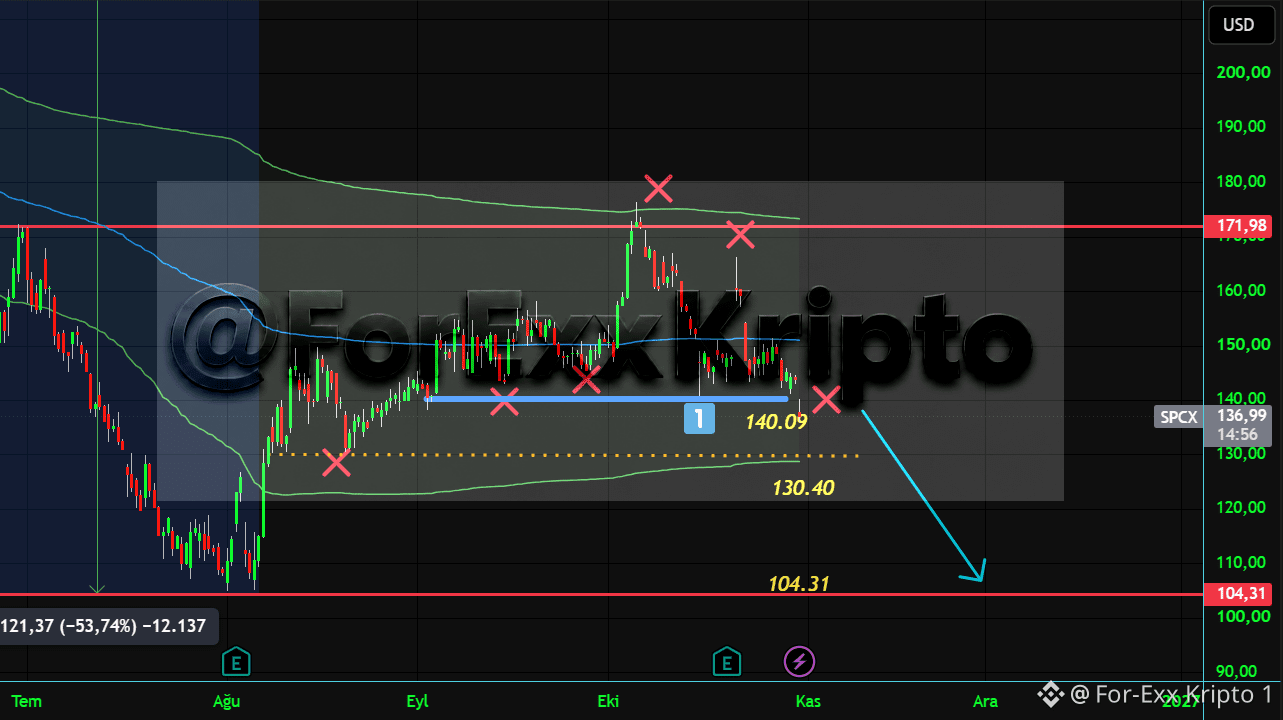
Last week, when $SPCX was trading at 148.32, I wrote that I expected it to decline to 140.09. It is now at 136.95. If it closes the day below this level, the decline could extend to 130.40, or perhaps even 104... It may be too early to buy. Let's wait and see where it closes today.
Last week, when $SPCX was trading at 148.32, I wrote that I expected it to decline to 140.09. It is now at 136.95. If it closes the day below this level, the decline could extend to 130.40, or perhaps even 104... It may be too early to buy. Let's wait and see where it closes today.
5
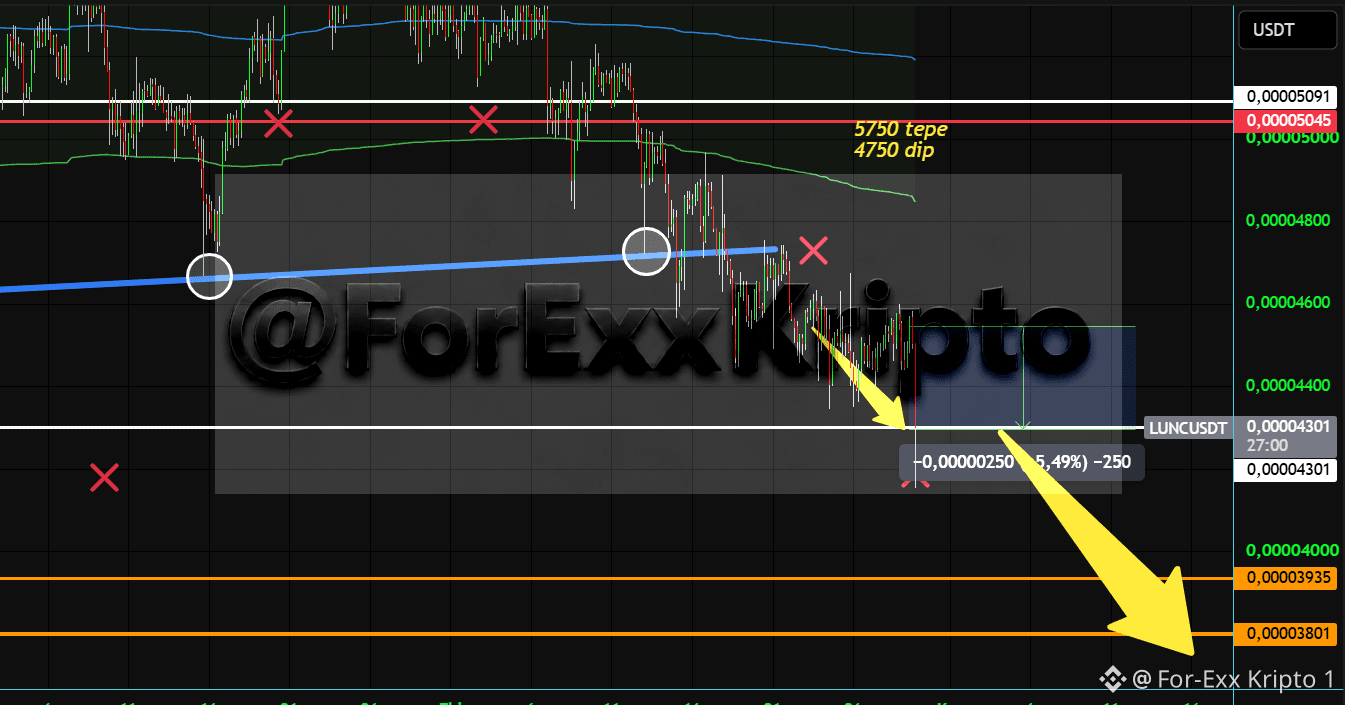
$LUNC hit the 4301 level I identified as a target, with the Binance hack adding to the pressure. If it closes the day below 4301, the path toward 3700 could open up. Let this analysis stand for now; we’ll share intraday charts.
It’s not just $LUNC. The charts for XRP, BTC, and $ETH have also deteriorated following the Binance hack, potentially setting the stage for larger declines in the coming days. Let the dust settle and the charts stabilize. We’ll make a more reliable assessment intraday.
$LUNC hit the 4301 level I identified as a target, with the Binance hack adding to the pressure. If it closes the day below 4301, the path toward 3700 could open up. Let this analysis stand for now; we’ll share intraday charts.
It’s not just $LUNC. The charts for XRP, BTC, and $ETH have also deteriorated following the Binance hack, potentially setting the stage for larger declines in the coming days. Let the dust settle and the charts stabilize. We’ll make a more reliable assessment intraday.
It’s not just $LUNC. The charts for XRP, BTC, and $ETH have also deteriorated following the Binance hack, potentially setting the stage for larger declines in the coming days. Let the dust settle and the charts stabilize. We’ll make a more reliable assessment intraday.
27
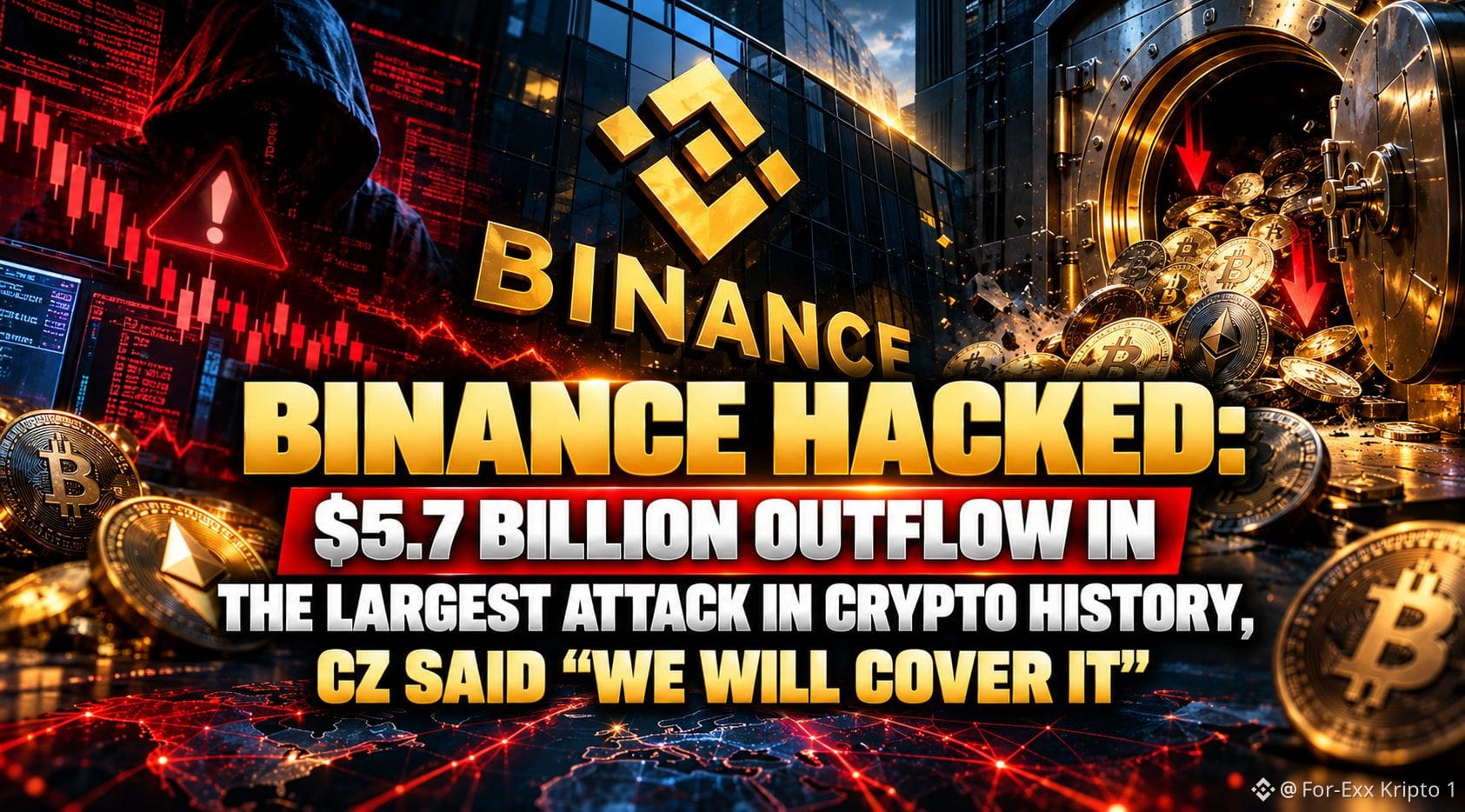
# Binance Hack: $5.7B in Transfers; CZ Says Losses Will Be Covered
On Oct. 29, on-chain data reportedly showed $5.6–5.7B moved from Binance hot wallets to new attacker addresses—nearly four times the $1.5B Bybit hack in Feb. 2025. Founder Changpeng Zhao (CZ) said net losses could exceed $1B but would be covered.
## How It Happened
Transfers began at 23:24 Istanbul time. One transaction moved 167,464 ETH and 63 tokens, including ~$1.6B USDT; 28,005 ETH followed 24 seconds later, then ~$800M USDC. The main Ethereum outflow took ~40 minutes.
Investigators suspect EIP-7702, which lets wallets delegate authority to smart-contract code. A malicious “sweep()” call reportedly emptied a wallet. How the signature was obtained remains unknown: a stolen key, compromised signing system or insider involvement are possibilities.
## Funds and Response
The initiating address was funded through three ~0.1 ETH Tornado Cash transfers. Cross-chain estimates total $5.6–5.7B: ~$1.6B USDT, $1.45B BTC, $767–823M USDC, 195K ETH/WBETH worth $450M+, $301M XRP, $234M TRX, $93M SOL, $88.5M RLUSD, $50M XAUT and other tokens. Estimates vary by network and pricing.
Tether reportedly froze over $1.567B USDT and Circle ~$823M USDC; BTC and ETH are harder to freeze. CZ said users’ funds were safe and Binance would cover net losses, potentially slightly above $1B. He cited ~$144B in Binance assets. The exchange said it was investigating; a technical explanation and whether reimbursement comes from SAFU or the company balance sheet remain unclear.
## Market Impact
Within an hour, ~$628M in positions were liquidated, ~$607M of them longs. BNB fell 8–9%; $BTC slid from ~$80,800 to below $79,000, while $ETH , XRP and SOL fell 3–5%.
Key questions: will Binance confirm the breach and explain the signing failure, will withdrawals remain open, and will frozen stablecoins be returned? Figures and the cause remain unconfirmed. Not investment advice.
# Binance Hack: $5.7B in Transfers; CZ Says Losses Will Be Covered
On Oct. 29, on-chain data reportedly showed $5.6–5.7B moved from Binance hot wallets to new attacker addresses—nearly four times the $1.5B Bybit hack in Feb. 2025. Founder Changpeng Zhao (CZ) said net losses could exceed $1B but would be covered.
## How It Happened
Transfers began at 23:24 Istanbul time. One transaction moved 167,464 ETH and 63 tokens, including ~$1.6B USDT; 28,005 ETH followed 24 seconds later, then ~$800M USDC. The main Ethereum outflow took ~40 minutes.
Investigators suspect EIP-7702, which lets wallets delegate authority to smart-contract code. A malicious “sweep()” call reportedly emptied a wallet. How the signature was obtained remains unknown: a stolen key, compromised signing system or insider involvement are possibilities.
## Funds and Response
The initiating address was funded through three ~0.1 ETH Tornado Cash transfers. Cross-chain estimates total $5.6–5.7B: ~$1.6B USDT, $1.45B BTC, $767–823M USDC, 195K ETH/WBETH worth $450M+, $301M XRP, $234M TRX, $93M SOL, $88.5M RLUSD, $50M XAUT and other tokens. Estimates vary by network and pricing.
Tether reportedly froze over $1.567B USDT and Circle ~$823M USDC; BTC and ETH are harder to freeze. CZ said users’ funds were safe and Binance would cover net losses, potentially slightly above $1B. He cited ~$144B in Binance assets. The exchange said it was investigating; a technical explanation and whether reimbursement comes from SAFU or the company balance sheet remain unclear.
## Market Impact
Within an hour, ~$628M in positions were liquidated, ~$607M of them longs. BNB fell 8–9%; $BTC slid from ~$80,800 to below $79,000, while $ETH , XRP and SOL fell 3–5%.
Key questions: will Binance confirm the breach and explain the signing failure, will withdrawals remain open, and will frozen stablecoins be returned? Figures and the cause remain unconfirmed. Not investment advice.
On Oct. 29, on-chain data reportedly showed $5.6–5.7B moved from Binance hot wallets to new attacker addresses—nearly four times the $1.5B Bybit hack in Feb. 2025. Founder Changpeng Zhao (CZ) said net losses could exceed $1B but would be covered.
## How It Happened
Transfers began at 23:24 Istanbul time. One transaction moved 167,464 ETH and 63 tokens, including ~$1.6B USDT; 28,005 ETH followed 24 seconds later, then ~$800M USDC. The main Ethereum outflow took ~40 minutes.
Investigators suspect EIP-7702, which lets wallets delegate authority to smart-contract code. A malicious “sweep()” call reportedly emptied a wallet. How the signature was obtained remains unknown: a stolen key, compromised signing system or insider involvement are possibilities.
## Funds and Response
The initiating address was funded through three ~0.1 ETH Tornado Cash transfers. Cross-chain estimates total $5.6–5.7B: ~$1.6B USDT, $1.45B BTC, $767–823M USDC, 195K ETH/WBETH worth $450M+, $301M XRP, $234M TRX, $93M SOL, $88.5M RLUSD, $50M XAUT and other tokens. Estimates vary by network and pricing.
Tether reportedly froze over $1.567B USDT and Circle ~$823M USDC; BTC and ETH are harder to freeze. CZ said users’ funds were safe and Binance would cover net losses, potentially slightly above $1B. He cited ~$144B in Binance assets. The exchange said it was investigating; a technical explanation and whether reimbursement comes from SAFU or the company balance sheet remain unclear.
## Market Impact
Within an hour, ~$628M in positions were liquidated, ~$607M of them longs. BNB fell 8–9%; $BTC slid from ~$80,800 to below $79,000, while $ETH , XRP and SOL fell 3–5%.
Key questions: will Binance confirm the breach and explain the signing failure, will withdrawals remain open, and will frozen stablecoins be returned? Figures and the cause remain unconfirmed. Not investment advice.
27
🔐 END-OF-DAY MARKET REPORT — OCT 29, 2026
━
🌐 TOP STORIES
Fed held rates at 3.75%–4.00% (10–2); two members wanted a hike. December hike odds ~80%. US Q3 GDP +3.4% vs 3.2% expected; claims 194K, core PCE +0.3% m/m. 10Y yield ~5%.
Alphabet fell ~10% on slower ad growth and $51.4B capex; Microsoft cloud revenue +48%. Brent $113–114, WTI ~$101 amid Iran tensions. CLARITY vote failed 50–49; SEC/CFTC advance separate rules. BoC hiked to 2.5%; ECB held.
━
₿ BITCOIN
$BTC traded $79,800–81,150, near $80,100. Liquidations ~$356M, mostly longs. Spot BTC ETFs gained $137M, third straight inflow day. RSI ~48; MACD negative but narrowing. Support $79,800, then $75,900; resistance $81,200/$81,700–81,950. Close above $81,700 could confirm recovery. ~$10B options expire Friday. BTC-Nasdaq correlation 0.64; oil -0.47.
━
🔷 ETH & ALTCOINS
$ETH ~$2,320, down 2–3%; October loss may reach 13.6%. ETH ETFs saw $1.35B October outflows, including $170M Oct. 26–28, led by BlackRock ETHA. Support $2,290–2,300, then $2,200/$2,150; resistance $2,400–2,500. XRP ~$1.29, SOL ~$100. Crypto cap ~$2.7T; BTC dominance 58–59%; Fear & Greed 51.
━
📋 CRYPTO NEWS
Pravang suspended services after ~$100M won was taken from its hot wallet. Hifi Finance saw a suspected ~$1M governance attack. Tether froze ~$27M USDT across 33 TRON addresses. OFAC sanctioned 10 people and one entity linked to North Korean IT workers and the $285M Drift exploit.
━
🔓 TOKEN UNLOCKS
KMNO — Oct. 30: 229.17M (~$9.7M; 2.7% of supply), stakeholders/advisers and contributors. 🟡 Unverified.
SUI — Nov. 1: 13.15M (~$12.1M; 0.32%), early contributors, community reserve and Mysten Labs. 🟢 Routine.
━
🔭 OUTLOOK
Friday: ~$10B BTC options expiry, BoJ decision (1.25% hold expected) and eurozone inflation. US midterms Nov. 3; payrolls Nov. 6; Fed Dec. 9. High oil, 10Y yields near 5% and December hike bets pressure risk assets. Iran peace progress could lift BTC toward $81,700–82,000; below $79,800 risks $75,900.
🔐 END-OF-DAY MARKET REPORT — OCT 29, 2026
━
🌐 TOP STORIES
Fed held rates at 3.75%–4.00% (10–2); two members wanted a hike. December hike odds ~80%. US Q3 GDP +3.4% vs 3.2% expected; claims 194K, core PCE +0.3% m/m. 10Y yield ~5%.
Alphabet fell ~10% on slower ad growth and $51.4B capex; Microsoft cloud revenue +48%. Brent $113–114, WTI ~$101 amid Iran tensions. CLARITY vote failed 50–49; SEC/CFTC advance separate rules. BoC hiked to 2.5%; ECB held.
━
₿ BITCOIN
$BTC traded $79,800–81,150, near $80,100. Liquidations ~$356M, mostly longs. Spot BTC ETFs gained $137M, third straight inflow day. RSI ~48; MACD negative but narrowing. Support $79,800, then $75,900; resistance $81,200/$81,700–81,950. Close above $81,700 could confirm recovery. ~$10B options expire Friday. BTC-Nasdaq correlation 0.64; oil -0.47.
━
🔷 ETH & ALTCOINS
$ETH ~$2,320, down 2–3%; October loss may reach 13.6%. ETH ETFs saw $1.35B October outflows, including $170M Oct. 26–28, led by BlackRock ETHA. Support $2,290–2,300, then $2,200/$2,150; resistance $2,400–2,500. XRP ~$1.29, SOL ~$100. Crypto cap ~$2.7T; BTC dominance 58–59%; Fear & Greed 51.
━
📋 CRYPTO NEWS
Pravang suspended services after ~$100M won was taken from its hot wallet. Hifi Finance saw a suspected ~$1M governance attack. Tether froze ~$27M USDT across 33 TRON addresses. OFAC sanctioned 10 people and one entity linked to North Korean IT workers and the $285M Drift exploit.
━
🔓 TOKEN UNLOCKS
KMNO — Oct. 30: 229.17M (~$9.7M; 2.7% of supply), stakeholders/advisers and contributors. 🟡 Unverified.
SUI — Nov. 1: 13.15M (~$12.1M; 0.32%), early contributors, community reserve and Mysten Labs. 🟢 Routine.
━
🔭 OUTLOOK
Friday: ~$10B BTC options expiry, BoJ decision (1.25% hold expected) and eurozone inflation. US midterms Nov. 3; payrolls Nov. 6; Fed Dec. 9. High oil, 10Y yields near 5% and December hike bets pressure risk assets. Iran peace progress could lift BTC toward $81,700–82,000; below $79,800 risks $75,900.
━
🌐 TOP STORIES
Fed held rates at 3.75%–4.00% (10–2); two members wanted a hike. December hike odds ~80%. US Q3 GDP +3.4% vs 3.2% expected; claims 194K, core PCE +0.3% m/m. 10Y yield ~5%.
Alphabet fell ~10% on slower ad growth and $51.4B capex; Microsoft cloud revenue +48%. Brent $113–114, WTI ~$101 amid Iran tensions. CLARITY vote failed 50–49; SEC/CFTC advance separate rules. BoC hiked to 2.5%; ECB held.
━
₿ BITCOIN
$BTC traded $79,800–81,150, near $80,100. Liquidations ~$356M, mostly longs. Spot BTC ETFs gained $137M, third straight inflow day. RSI ~48; MACD negative but narrowing. Support $79,800, then $75,900; resistance $81,200/$81,700–81,950. Close above $81,700 could confirm recovery. ~$10B options expire Friday. BTC-Nasdaq correlation 0.64; oil -0.47.
━
🔷 ETH & ALTCOINS
$ETH ~$2,320, down 2–3%; October loss may reach 13.6%. ETH ETFs saw $1.35B October outflows, including $170M Oct. 26–28, led by BlackRock ETHA. Support $2,290–2,300, then $2,200/$2,150; resistance $2,400–2,500. XRP ~$1.29, SOL ~$100. Crypto cap ~$2.7T; BTC dominance 58–59%; Fear & Greed 51.
━
📋 CRYPTO NEWS
Pravang suspended services after ~$100M won was taken from its hot wallet. Hifi Finance saw a suspected ~$1M governance attack. Tether froze ~$27M USDT across 33 TRON addresses. OFAC sanctioned 10 people and one entity linked to North Korean IT workers and the $285M Drift exploit.
━
🔓 TOKEN UNLOCKS
KMNO — Oct. 30: 229.17M (~$9.7M; 2.7% of supply), stakeholders/advisers and contributors. 🟡 Unverified.
SUI — Nov. 1: 13.15M (~$12.1M; 0.32%), early contributors, community reserve and Mysten Labs. 🟢 Routine.
━
🔭 OUTLOOK
Friday: ~$10B BTC options expiry, BoJ decision (1.25% hold expected) and eurozone inflation. US midterms Nov. 3; payrolls Nov. 6; Fed Dec. 9. High oil, 10Y yields near 5% and December hike bets pressure risk assets. Iran peace progress could lift BTC toward $81,700–82,000; below $79,800 risks $75,900.

41
US Elections and Markets: Stocks, Bitcoin, Gold and the Dollar
Ahead of the Nov. 3, 2026 midterms, markets are focused on uncertainty. Trading often stalls 2–4 weeks before elections, then rebounds 1–3 days after results clarify. After 2–3 months, Fed policy, inflation and liquidity matter more.
Presidential Elections
In 2016, stocks fell before Trump’s win, then rallied; yields and the dollar rose, while gold dropped ~12%. BTC climbed from $703 on election day to nearly $20,000 in Dec. 2017.
In 2020, the S&P 500 rose ~7% during election week; vaccine news later drove November’s ~11% gain. BTC rose from ~$13,500 on election day to $29,000 by year-end.
In 2024, the S&P 500 gained 2.5% the next day,small caps 5.8%, and BTC topped $75,000. Gold initially fell ~8%.
BTC rallies overlapped with post-halving cycles; elections may have been catalysts, not the main cause.
Midterms
Since 1950, the S&P 500 was positive in the 12 months after every midterm, averaging ~15%. Midterm years average 9.2% returns versus 13.3% in other years,with peak-to-trough declines of 17–19%.
BTC bear-market lows came within 0–3 months after the 2014, 2018 and 2022 midterms, likely reflecting cycle timing; the sample is small.
Nov. 3, 2026: What Matters
By early October, prediction markets priced >60% odds of Democrats winning both chambers, up from ~35% in February. A priced-in result may bring limited reaction. A surprise Republican hold could lift the dollar and yields,support small caps and crypto, and pressure gold.
The Oct. 28 Fed decision,early-November jobs data and mid-month inflation may outweigh election headlines.
Key Takeaway
Elections often bring short-term volatility and relief rallies, not lasting trends. Equities have historically performed well in the year after midterms,but exceptions occur. For $BTC , the four-year halving cycle appears more important than election outcomes. Historical patterns are not guarantees or investment advice. $XAUt
US Elections and Markets: Stocks, Bitcoin, Gold and the Dollar
Ahead of the Nov. 3, 2026 midterms, markets are focused on uncertainty. Trading often stalls 2–4 weeks before elections, then rebounds 1–3 days after results clarify. After 2–3 months, Fed policy, inflation and liquidity matter more.
Presidential Elections
In 2016, stocks fell before Trump’s win, then rallied; yields and the dollar rose, while gold dropped ~12%. BTC climbed from $703 on election day to nearly $20,000 in Dec. 2017.
In 2020, the S&P 500 rose ~7% during election week; vaccine news later drove November’s ~11% gain. BTC rose from ~$13,500 on election day to $29,000 by year-end.
In 2024, the S&P 500 gained 2.5% the next day,small caps 5.8%, and BTC topped $75,000. Gold initially fell ~8%.
BTC rallies overlapped with post-halving cycles; elections may have been catalysts, not the main cause.
Midterms
Since 1950, the S&P 500 was positive in the 12 months after every midterm, averaging ~15%. Midterm years average 9.2% returns versus 13.3% in other years,with peak-to-trough declines of 17–19%.
BTC bear-market lows came within 0–3 months after the 2014, 2018 and 2022 midterms, likely reflecting cycle timing; the sample is small.
Nov. 3, 2026: What Matters
By early October, prediction markets priced >60% odds of Democrats winning both chambers, up from ~35% in February. A priced-in result may bring limited reaction. A surprise Republican hold could lift the dollar and yields,support small caps and crypto, and pressure gold.
The Oct. 28 Fed decision,early-November jobs data and mid-month inflation may outweigh election headlines.
Key Takeaway
Elections often bring short-term volatility and relief rallies, not lasting trends. Equities have historically performed well in the year after midterms,but exceptions occur. For $BTC , the four-year halving cycle appears more important than election outcomes. Historical patterns are not guarantees or investment advice. $XAUt
Ahead of the Nov. 3, 2026 midterms, markets are focused on uncertainty. Trading often stalls 2–4 weeks before elections, then rebounds 1–3 days after results clarify. After 2–3 months, Fed policy, inflation and liquidity matter more.
Presidential Elections
In 2016, stocks fell before Trump’s win, then rallied; yields and the dollar rose, while gold dropped ~12%. BTC climbed from $703 on election day to nearly $20,000 in Dec. 2017.
In 2020, the S&P 500 rose ~7% during election week; vaccine news later drove November’s ~11% gain. BTC rose from ~$13,500 on election day to $29,000 by year-end.
In 2024, the S&P 500 gained 2.5% the next day,small caps 5.8%, and BTC topped $75,000. Gold initially fell ~8%.
BTC rallies overlapped with post-halving cycles; elections may have been catalysts, not the main cause.
Midterms
Since 1950, the S&P 500 was positive in the 12 months after every midterm, averaging ~15%. Midterm years average 9.2% returns versus 13.3% in other years,with peak-to-trough declines of 17–19%.
BTC bear-market lows came within 0–3 months after the 2014, 2018 and 2022 midterms, likely reflecting cycle timing; the sample is small.
Nov. 3, 2026: What Matters
By early October, prediction markets priced >60% odds of Democrats winning both chambers, up from ~35% in February. A priced-in result may bring limited reaction. A surprise Republican hold could lift the dollar and yields,support small caps and crypto, and pressure gold.
The Oct. 28 Fed decision,early-November jobs data and mid-month inflation may outweigh election headlines.
Key Takeaway
Elections often bring short-term volatility and relief rallies, not lasting trends. Equities have historically performed well in the year after midterms,but exceptions occur. For $BTC , the four-year halving cycle appears more important than election outcomes. Historical patterns are not guarantees or investment advice. $XAUt

92
# Bitcoin’s Power Shift: China’s Mining to US ETFs
China once controlled over two-thirds of Bitcoin mining; it is now third. The US leads mining and, via ETFs, companies and government reserves, holds over 2.5M $BTC —about one-eighth of supply. Is this global hegemony?
Bitcoin remains decentralized, but influence shifted from China’s mining base (2017–2021) toward Wall Street since 2024.
Mining Map
China held ~65% of global hashrate in Q1 2021. Its crackdown triggered a historic miner migration, yet Bitcoin kept operating. Hashrate Index (Aug. 2026): US 36.7%, Russia 17.2%, China 12.2%, Paraguay 4.7%, UAE 3%. Some US miners shift power to AI/data centers.
ETFs and Companies
US spot BTC ETFs held ~1.29M BTC (~$107B) on Oct. 8, 2026. BlackRock IBIT held ~806K BTC (62.3% of ETF holdings); FBTC ~182K, GBTC ~127K and Mini BTC ~63K. ETF flows increasingly shape demand versus new supply.
By June, 170–199 public companies held ~1.27M BTC (~6% of supply). $MSTR held 848,517 BTC on Oct. 25, acquired for $64.02B at an average $75,446. It formalized limited BTC sales to fund preferred dividends and buybacks; sales remain below 1% of holdings.
US Government Reserve
A March 2025 order created a reserve mainly from seized BTC. The US reportedly holds ~328K BTC across agencies, including ~198K in the reserve. No market purchases have occurred; the BITCOIN Act has not passed, and a future administration could reverse the reserve.
Hegemony or Concentration?
Combined holdings exceed 2.5M BTC, but ETF coins belong to investors, not the government. Eight of 10 ETF issuers reportedly use Coinbase for custody, creating concentration risks. No government can change Bitcoin’s rules without node consensus.
Bottom Line
Influence shifted from energy and hardware to capital and regulation. The US shapes institutional flows and price discovery, but does not control Bitcoin’s protocol. Watch ETF flows, Strategy’s cost basis and possible US market purchases.
# Bitcoin’s Power Shift: China’s Mining to US ETFs
China once controlled over two-thirds of Bitcoin mining; it is now third. The US leads mining and, via ETFs, companies and government reserves, holds over 2.5M $BTC —about one-eighth of supply. Is this global hegemony?
Bitcoin remains decentralized, but influence shifted from China’s mining base (2017–2021) toward Wall Street since 2024.
Mining Map
China held ~65% of global hashrate in Q1 2021. Its crackdown triggered a historic miner migration, yet Bitcoin kept operating. Hashrate Index (Aug. 2026): US 36.7%, Russia 17.2%, China 12.2%, Paraguay 4.7%, UAE 3%. Some US miners shift power to AI/data centers.
ETFs and Companies
US spot BTC ETFs held ~1.29M BTC (~$107B) on Oct. 8, 2026. BlackRock IBIT held ~806K BTC (62.3% of ETF holdings); FBTC ~182K, GBTC ~127K and Mini BTC ~63K. ETF flows increasingly shape demand versus new supply.
By June, 170–199 public companies held ~1.27M BTC (~6% of supply). $MSTR held 848,517 BTC on Oct. 25, acquired for $64.02B at an average $75,446. It formalized limited BTC sales to fund preferred dividends and buybacks; sales remain below 1% of holdings.
US Government Reserve
A March 2025 order created a reserve mainly from seized BTC. The US reportedly holds ~328K BTC across agencies, including ~198K in the reserve. No market purchases have occurred; the BITCOIN Act has not passed, and a future administration could reverse the reserve.
Hegemony or Concentration?
Combined holdings exceed 2.5M BTC, but ETF coins belong to investors, not the government. Eight of 10 ETF issuers reportedly use Coinbase for custody, creating concentration risks. No government can change Bitcoin’s rules without node consensus.
Bottom Line
Influence shifted from energy and hardware to capital and regulation. The US shapes institutional flows and price discovery, but does not control Bitcoin’s protocol. Watch ETF flows, Strategy’s cost basis and possible US market purchases.
China once controlled over two-thirds of Bitcoin mining; it is now third. The US leads mining and, via ETFs, companies and government reserves, holds over 2.5M $BTC —about one-eighth of supply. Is this global hegemony?
Bitcoin remains decentralized, but influence shifted from China’s mining base (2017–2021) toward Wall Street since 2024.
Mining Map
China held ~65% of global hashrate in Q1 2021. Its crackdown triggered a historic miner migration, yet Bitcoin kept operating. Hashrate Index (Aug. 2026): US 36.7%, Russia 17.2%, China 12.2%, Paraguay 4.7%, UAE 3%. Some US miners shift power to AI/data centers.
ETFs and Companies
US spot BTC ETFs held ~1.29M BTC (~$107B) on Oct. 8, 2026. BlackRock IBIT held ~806K BTC (62.3% of ETF holdings); FBTC ~182K, GBTC ~127K and Mini BTC ~63K. ETF flows increasingly shape demand versus new supply.
By June, 170–199 public companies held ~1.27M BTC (~6% of supply). $MSTR held 848,517 BTC on Oct. 25, acquired for $64.02B at an average $75,446. It formalized limited BTC sales to fund preferred dividends and buybacks; sales remain below 1% of holdings.
US Government Reserve
A March 2025 order created a reserve mainly from seized BTC. The US reportedly holds ~328K BTC across agencies, including ~198K in the reserve. No market purchases have occurred; the BITCOIN Act has not passed, and a future administration could reverse the reserve.
Hegemony or Concentration?
Combined holdings exceed 2.5M BTC, but ETF coins belong to investors, not the government. Eight of 10 ETF issuers reportedly use Coinbase for custody, creating concentration risks. No government can change Bitcoin’s rules without node consensus.
Bottom Line
Influence shifted from energy and hardware to capital and regulation. The US shapes institutional flows and price discovery, but does not control Bitcoin’s protocol. Watch ETF flows, Strategy’s cost basis and possible US market purchases.

133
# JPMorgan Sees 10% Annual Bitcoin Returns, but Volatility Is a Major Hurdle JPMorgan Asset Management projects $BTC could return 10% annually over the next decade, but warns volatility may make gains hard to realize. Bitcoin has its own forecast in the firm’s long-term market assumptions for the first time, reflecting its potential and risks. ## Bitcoin’s 10% Return Scenario The base case projects annualized returns of 10% for Bitcoin, 7.5% for US large-cap stocks, 7.7% for small caps and 5.5% for gold. US bonds are forecast at 5.6%–6.6%. These are projections, not guarantees. ## The Biggest Risk: 55% Volatility Bitcoin’s projected annual volatility is 55%, versus 18% for US large-cap stocks and 17.2% for gold. Sharp swings erode compounded returns: after a 50% loss, an asset must rise 100% to recover. Results also depend on price moves and entry points. ## Why Bitcoin Is Excluded From Core Portfolios JPMorgan excludes Bitcoin from core portfolio models because of its volatility and unstable relationship with other assets. Though sometimes called “digital gold,” it can move with risk assets during market stress, limiting its value as a diversifier. The firm sees it mainly as a speculative asset and potential hedge against expected monetary easing. A broader diversification role would require more predictable price behavior and correlations. ## Bear and Bull Cases Diverge JPMorgan’s scenarios range from -9.7% annualized returns in the bearish case to 17% in the bullish case, versus 10% in the base case. This spread highlights uncertainty and the need to assess downside risk, not just average returns. ## What It Means Bitcoin’s inclusion in JPMorgan’s long-term forecasts signals its growing place in traditional financial analysis, but does not change its risk profile. Regulation, liquidity, adoption and global money supply may shape future performance. The key question: how much loss and volatility must investors tolerate to pursue potential returns.
# JPMorgan Sees 10% Annual Bitcoin Returns, but Volatility Is a Major Hurdle JPMorgan Asset Management projects $BTC could return 10% annually over the next decade, but warns volatility may make gains hard to realize. Bitcoin has its own forecast in the firm’s long-term market assumptions for the first time, reflecting its potential and risks. ## Bitcoin’s 10% Return Scenario The base case projects annualized returns of 10% for Bitcoin, 7.5% for US large-cap stocks, 7.7% for small caps and 5.5% for gold. US bonds are forecast at 5.6%–6.6%. These are projections, not guarantees. ## The Biggest Risk: 55% Volatility Bitcoin’s projected annual volatility is 55%, versus 18% for US large-cap stocks and 17.2% for gold. Sharp swings erode compounded returns: after a 50% loss, an asset must rise 100% to recover. Results also depend on price moves and entry points. ## Why Bitcoin Is Excluded From Core Portfolios JPMorgan excludes Bitcoin from core portfolio models because of its volatility and unstable relationship with other assets. Though sometimes called “digital gold,” it can move with risk assets during market stress, limiting its value as a diversifier. The firm sees it mainly as a speculative asset and potential hedge against expected monetary easing. A broader diversification role would require more predictable price behavior and correlations. ## Bear and Bull Cases Diverge JPMorgan’s scenarios range from -9.7% annualized returns in the bearish case to 17% in the bullish case, versus 10% in the base case. This spread highlights uncertainty and the need to assess downside risk, not just average returns. ## What It Means Bitcoin’s inclusion in JPMorgan’s long-term forecasts signals its growing place in traditional financial analysis, but does not change its risk profile. Regulation, liquidity, adoption and global money supply may shape future performance. The key question: how much loss and volatility must investors tolerate to pursue potential returns.

29
# Switzerland Approves Landmark Bitcoin ETF for Retail Investors FINMA approved Switzerland’s first locally domiciled ETF that invests directly in $BTC and is open to retail investors, expanding access through traditional financial products. The fund is classified as an alternative investment fund with special risks. FINMA exempted it from standard diversification rules, citing Bitcoin’s long trading history and high trading volume compared with other crypto assets. ## A New Investment Channel Crypto products already trade in Switzerland, but this fund directly invests in Bitcoin under local fund law. Some existing products are debt-based exchange-traded instruments. Approval does not mean trading has begun. ## Custody and Investor Protection FINMA allowed the fund to focus on Bitcoin, based on its trading history and liquidity, while retaining other investor-protection obligations. Managers must safeguard holdings, mitigate operational risks and disclose potential losses. Retail suitability rules also apply, adding safeguards compared with direct crypto purchases. ## Volatility Risk Remains Approval does not remove Bitcoin’s price risk. Volatility can sharply affect the fund’s value, and investors may lose a substantial part of their capital. Approval is not a return guarantee or a declaration that Bitcoin is safe; performance depends on its price. Risk tolerance, investment horizon and ability to absorb losses remain important. ## More Swiss Crypto Funds Possible FINMA says other providers have applied for Bitcoin ETFs or announced plans to develop products. The first approval may set a precedent, but future applications depend on each fund’s structure, custody arrangements and investor protections. The decision advances Bitcoin access through regulated funds. The launch date and other applications will be watched closely. Switzerland’s move could deepen crypto’s integration with traditional finance, but volatility and capital-loss risks remain.
# Switzerland Approves Landmark Bitcoin ETF for Retail Investors FINMA approved Switzerland’s first locally domiciled ETF that invests directly in $BTC and is open to retail investors, expanding access through traditional financial products. The fund is classified as an alternative investment fund with special risks. FINMA exempted it from standard diversification rules, citing Bitcoin’s long trading history and high trading volume compared with other crypto assets. ## A New Investment Channel Crypto products already trade in Switzerland, but this fund directly invests in Bitcoin under local fund law. Some existing products are debt-based exchange-traded instruments. Approval does not mean trading has begun. ## Custody and Investor Protection FINMA allowed the fund to focus on Bitcoin, based on its trading history and liquidity, while retaining other investor-protection obligations. Managers must safeguard holdings, mitigate operational risks and disclose potential losses. Retail suitability rules also apply, adding safeguards compared with direct crypto purchases. ## Volatility Risk Remains Approval does not remove Bitcoin’s price risk. Volatility can sharply affect the fund’s value, and investors may lose a substantial part of their capital. Approval is not a return guarantee or a declaration that Bitcoin is safe; performance depends on its price. Risk tolerance, investment horizon and ability to absorb losses remain important. ## More Swiss Crypto Funds Possible FINMA says other providers have applied for Bitcoin ETFs or announced plans to develop products. The first approval may set a precedent, but future applications depend on each fund’s structure, custody arrangements and investor protections. The decision advances Bitcoin access through regulated funds. The launch date and other applications will be watched closely. Switzerland’s move could deepen crypto’s integration with traditional finance, but volatility and capital-loss risks remain.

43
🔐 END-OF-DAY MARKET REPORT — OCT 20, 2026
━━━
🌐 TOP STORIES
Brent near $110, highest since May, amid renewed Hormuz attacks. Gulf crude exports recovered to ~80% of prewar levels.
Nasdaq +1.1%, S&P 500 +0.4%; chip index +2.5%. U.S. 10Y yield 5.14%, 2Y 4.77%. Fed expected to hold Oct. 28; markets price ~89% odds of a December hike.
CoreWeave hit a 52-week low; its 2032 bond yields ~14.9%. GM beat Q3 estimates, but shares fell ~5% premarket after narrowing its outlook.
SEC’s “Regulation Crypto Assets” comment period ended (~140 submissions). Crypto cap ~$2.7T; BTC dominance 60.3%.
━━━
₿ BITCOIN
$BTC ~$81,400, down 1.3–1.6% daily. Support: $80,000–79,700, then $77,500–78,000 and $76,000. Resistance: $82,000, $82,600, $83,450.
Spot BTC ETFs saw $526.6M net inflows Monday, including $665M into IBIT, its biggest daily inflow since Oct. 2025. Yet demand remains weak for a sustained rally; derivatives drive selling.
━━━
🔷 ETH & ALTS
ETH ~$2,380, down 1.6–2% daily, ~6% weekly. Support $2,313–2,357; resistance $2,405, then $2,535. $BNB $727, SOL $104, XRP $1.29, DOGE $0.079, ADA $0.216. 65/88 assets fell. WLD +8.6%; NEAR -6.5%.
━━━
📋 CRYPTO HEADLINES
BlackRock filed for an IBIT downside-protection ETF. Strive bought $335M BTC using $369M raised. SkyAI sold all SOL and launched a $201M buyback. CFTC rejected CME’s position on perpetual futures. Mesh partnered with Visa.
━━━
🔓 TOKEN UNLOCKS
AERO — Oct. 22, ~02:58 Türkiye time: ~4.4M (~$3.54M; 0.30% of supply). Pressure 🟢; Aerodrome–Velodrome merger begins Oct. 21.
SCR — around Oct. 22, time unconfirmed: ~86M (~$1.72M); reported ~20% ratio unverified. Pressure 🟡.
━━━
🔭 OUTLOOK
Oil above $110 and rising yields cap risk assets. BTC failed to clear $82K despite ETF inflows. Holding $79,700–80K favors range trading; a daily close below could expose $77,500. SpaceX results due 23:30 Türkiye time. FOMC meets Oct. 27–28; hawkish guidance could hit ETH/alts harder than BTC.
🔐 END-OF-DAY MARKET REPORT — OCT 20, 2026
━━━
🌐 TOP STORIES
Brent near $110, highest since May, amid renewed Hormuz attacks. Gulf crude exports recovered to ~80% of prewar levels.
Nasdaq +1.1%, S&P 500 +0.4%; chip index +2.5%. U.S. 10Y yield 5.14%, 2Y 4.77%. Fed expected to hold Oct. 28; markets price ~89% odds of a December hike.
CoreWeave hit a 52-week low; its 2032 bond yields ~14.9%. GM beat Q3 estimates, but shares fell ~5% premarket after narrowing its outlook.
SEC’s “Regulation Crypto Assets” comment period ended (~140 submissions). Crypto cap ~$2.7T; BTC dominance 60.3%.
━━━
₿ BITCOIN
$BTC ~$81,400, down 1.3–1.6% daily. Support: $80,000–79,700, then $77,500–78,000 and $76,000. Resistance: $82,000, $82,600, $83,450.
Spot BTC ETFs saw $526.6M net inflows Monday, including $665M into IBIT, its biggest daily inflow since Oct. 2025. Yet demand remains weak for a sustained rally; derivatives drive selling.
━━━
🔷 ETH & ALTS
ETH ~$2,380, down 1.6–2% daily, ~6% weekly. Support $2,313–2,357; resistance $2,405, then $2,535. $BNB $727, SOL $104, XRP $1.29, DOGE $0.079, ADA $0.216. 65/88 assets fell. WLD +8.6%; NEAR -6.5%.
━━━
📋 CRYPTO HEADLINES
BlackRock filed for an IBIT downside-protection ETF. Strive bought $335M BTC using $369M raised. SkyAI sold all SOL and launched a $201M buyback. CFTC rejected CME’s position on perpetual futures. Mesh partnered with Visa.
━━━
🔓 TOKEN UNLOCKS
AERO — Oct. 22, ~02:58 Türkiye time: ~4.4M (~$3.54M; 0.30% of supply). Pressure 🟢; Aerodrome–Velodrome merger begins Oct. 21.
SCR — around Oct. 22, time unconfirmed: ~86M (~$1.72M); reported ~20% ratio unverified. Pressure 🟡.
━━━
🔭 OUTLOOK
Oil above $110 and rising yields cap risk assets. BTC failed to clear $82K despite ETF inflows. Holding $79,700–80K favors range trading; a daily close below could expose $77,500. SpaceX results due 23:30 Türkiye time. FOMC meets Oct. 27–28; hawkish guidance could hit ETH/alts harder than BTC.
━━━
🌐 TOP STORIES
Brent near $110, highest since May, amid renewed Hormuz attacks. Gulf crude exports recovered to ~80% of prewar levels.
Nasdaq +1.1%, S&P 500 +0.4%; chip index +2.5%. U.S. 10Y yield 5.14%, 2Y 4.77%. Fed expected to hold Oct. 28; markets price ~89% odds of a December hike.
CoreWeave hit a 52-week low; its 2032 bond yields ~14.9%. GM beat Q3 estimates, but shares fell ~5% premarket after narrowing its outlook.
SEC’s “Regulation Crypto Assets” comment period ended (~140 submissions). Crypto cap ~$2.7T; BTC dominance 60.3%.
━━━
₿ BITCOIN
$BTC ~$81,400, down 1.3–1.6% daily. Support: $80,000–79,700, then $77,500–78,000 and $76,000. Resistance: $82,000, $82,600, $83,450.
Spot BTC ETFs saw $526.6M net inflows Monday, including $665M into IBIT, its biggest daily inflow since Oct. 2025. Yet demand remains weak for a sustained rally; derivatives drive selling.
━━━
🔷 ETH & ALTS
ETH ~$2,380, down 1.6–2% daily, ~6% weekly. Support $2,313–2,357; resistance $2,405, then $2,535. $BNB $727, SOL $104, XRP $1.29, DOGE $0.079, ADA $0.216. 65/88 assets fell. WLD +8.6%; NEAR -6.5%.
━━━
📋 CRYPTO HEADLINES
BlackRock filed for an IBIT downside-protection ETF. Strive bought $335M BTC using $369M raised. SkyAI sold all SOL and launched a $201M buyback. CFTC rejected CME’s position on perpetual futures. Mesh partnered with Visa.
━━━
🔓 TOKEN UNLOCKS
AERO — Oct. 22, ~02:58 Türkiye time: ~4.4M (~$3.54M; 0.30% of supply). Pressure 🟢; Aerodrome–Velodrome merger begins Oct. 21.
SCR — around Oct. 22, time unconfirmed: ~86M (~$1.72M); reported ~20% ratio unverified. Pressure 🟡.
━━━
🔭 OUTLOOK
Oil above $110 and rising yields cap risk assets. BTC failed to clear $82K despite ETF inflows. Holding $79,700–80K favors range trading; a daily close below could expose $77,500. SpaceX results due 23:30 Türkiye time. FOMC meets Oct. 27–28; hawkish guidance could hit ETH/alts harder than BTC.

96
$XRP is approaching the important $1.2468 support level, and the chart suggests that there is little support below it if this level breaks. A move toward $1.1231 or even $1.00 could be possible in the initial stage. For my previous $0.80 target, a break below $1.1231 is critically important. From a technical perspective, $0.80 must eventually be reached, and it will be.
$XRP is approaching the important $1.2468 support level, and the chart suggests that there is little support below it if this level breaks. A move toward $1.1231 or even $1.00 could be possible in the initial stage. For my previous $0.80 target, a break below $1.1231 is critically important. From a technical perspective, $0.80 must eventually be reached, and it will be.
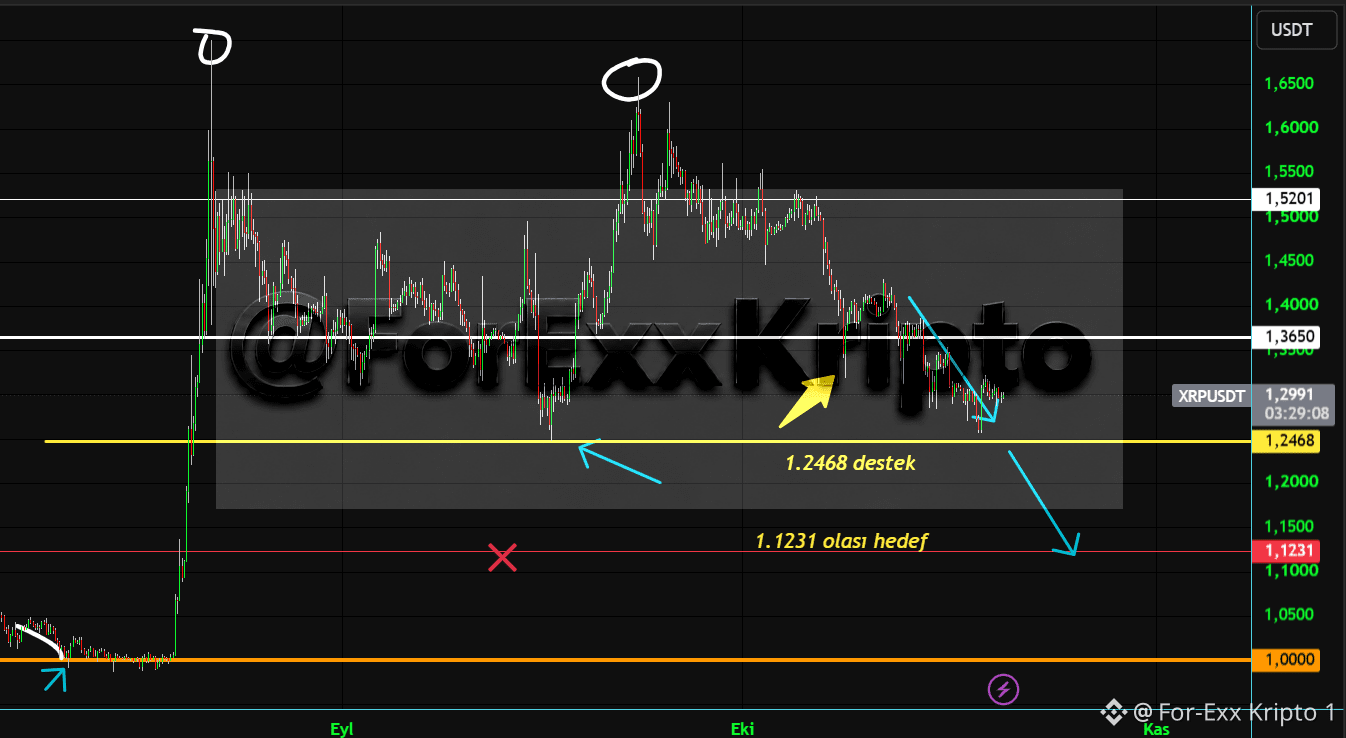
71
🔐 END-OF-DAY MARKET REPORT — OCT 19, 2026
━━━
🌐 TOP STORIES
Fed blackout began; markets price ~84% odds of no change and ~15% for a hike Oct. 27–28. Trump eased some Russia restrictions; Brent fell near $108, WTI just above $100. U.S. 10Y yield: 5.06–5.11%; dollar index: 101.6–101.9; gold: ~$4,180.
Nasdaq fell 2.1%, S&P 500 1.1% Friday. China Q3 growth beat forecasts at 4.5%; U.S. NAHB index hit 29, lowest since 2012. Crypto ETFs lost ~$1.29B last week; BTC/ETH funds lost over $1B in October.
━━━
₿ BITCOIN
BTC: $82,000–82,600 (+~1%/24h). Support: $80,750–81,000; resistance: $82,500–83,000, then $84,000 and $86,000–86,500. ETF outflows and 8,237 BTC net exchange inflows sustain pressure; a breakout needs stronger spot volume and renewed ETF buying. Range: $80K–86K.
━━━
🔷 ETH & ALTS
$ETH : ~$2,400–2,425. Ether ETFs logged nine straight outflow sessions since Sept. 29 (~$700M); BlackRock ETHA accounted for $477M of weekly outflows. XRP near $1.30 (+~2%). Solana ETFs lost $25M, Zcash funds $30.8M and Hyperliquid products $9.4M. PEPE rose ~4% on an unconfirmed report.
━━━
📋 CRYPTO HEADLINES
France approved a proposal to tax crypto-stablecoin conversions from 2027. Samsung Wallet plans USDC transfers to 60+ countries for U.S. Galaxy users. DTCC tokenization starts with 25 securities. Dormant wallets moved 416.69 BTC (~$33.8M).
━━━
🔓 TOKEN UNLOCK
LayerZero (ZRO) — Oct. 20, ~03:00 Türkiye time: 23.28M ZRO (~$43.5M), estimated at 2.4–3.8% of circulating supply. Pressure: 🟡.
━━━
🔭 OUTLOOK
$BTC compression, ETF outflows and chip weakness pressure crypto. Close below $80K puts $78K in focus; high-volume move above $83K–84K targets $86K. Calendar: Canada CPI today; U.S. ADP/housing Tuesday; UK CPI/tech earnings Wednesday; U.S. jobless claims Thursday; flash PMIs/Michigan sentiment Friday. FOMC: Oct. 28.
🔐 END-OF-DAY MARKET REPORT — OCT 19, 2026
━━━
🌐 TOP STORIES
Fed blackout began; markets price ~84% odds of no change and ~15% for a hike Oct. 27–28. Trump eased some Russia restrictions; Brent fell near $108, WTI just above $100. U.S. 10Y yield: 5.06–5.11%; dollar index: 101.6–101.9; gold: ~$4,180.
Nasdaq fell 2.1%, S&P 500 1.1% Friday. China Q3 growth beat forecasts at 4.5%; U.S. NAHB index hit 29, lowest since 2012. Crypto ETFs lost ~$1.29B last week; BTC/ETH funds lost over $1B in October.
━━━
₿ BITCOIN
BTC: $82,000–82,600 (+~1%/24h). Support: $80,750–81,000; resistance: $82,500–83,000, then $84,000 and $86,000–86,500. ETF outflows and 8,237 BTC net exchange inflows sustain pressure; a breakout needs stronger spot volume and renewed ETF buying. Range: $80K–86K.
━━━
🔷 ETH & ALTS
$ETH : ~$2,400–2,425. Ether ETFs logged nine straight outflow sessions since Sept. 29 (~$700M); BlackRock ETHA accounted for $477M of weekly outflows. XRP near $1.30 (+~2%). Solana ETFs lost $25M, Zcash funds $30.8M and Hyperliquid products $9.4M. PEPE rose ~4% on an unconfirmed report.
━━━
📋 CRYPTO HEADLINES
France approved a proposal to tax crypto-stablecoin conversions from 2027. Samsung Wallet plans USDC transfers to 60+ countries for U.S. Galaxy users. DTCC tokenization starts with 25 securities. Dormant wallets moved 416.69 BTC (~$33.8M).
━━━
🔓 TOKEN UNLOCK
LayerZero (ZRO) — Oct. 20, ~03:00 Türkiye time: 23.28M ZRO (~$43.5M), estimated at 2.4–3.8% of circulating supply. Pressure: 🟡.
━━━
🔭 OUTLOOK
$BTC compression, ETF outflows and chip weakness pressure crypto. Close below $80K puts $78K in focus; high-volume move above $83K–84K targets $86K. Calendar: Canada CPI today; U.S. ADP/housing Tuesday; UK CPI/tech earnings Wednesday; U.S. jobless claims Thursday; flash PMIs/Michigan sentiment Friday. FOMC: Oct. 28.
━━━
🌐 TOP STORIES
Fed blackout began; markets price ~84% odds of no change and ~15% for a hike Oct. 27–28. Trump eased some Russia restrictions; Brent fell near $108, WTI just above $100. U.S. 10Y yield: 5.06–5.11%; dollar index: 101.6–101.9; gold: ~$4,180.
Nasdaq fell 2.1%, S&P 500 1.1% Friday. China Q3 growth beat forecasts at 4.5%; U.S. NAHB index hit 29, lowest since 2012. Crypto ETFs lost ~$1.29B last week; BTC/ETH funds lost over $1B in October.
━━━
₿ BITCOIN
BTC: $82,000–82,600 (+~1%/24h). Support: $80,750–81,000; resistance: $82,500–83,000, then $84,000 and $86,000–86,500. ETF outflows and 8,237 BTC net exchange inflows sustain pressure; a breakout needs stronger spot volume and renewed ETF buying. Range: $80K–86K.
━━━
🔷 ETH & ALTS
$ETH : ~$2,400–2,425. Ether ETFs logged nine straight outflow sessions since Sept. 29 (~$700M); BlackRock ETHA accounted for $477M of weekly outflows. XRP near $1.30 (+~2%). Solana ETFs lost $25M, Zcash funds $30.8M and Hyperliquid products $9.4M. PEPE rose ~4% on an unconfirmed report.
━━━
📋 CRYPTO HEADLINES
France approved a proposal to tax crypto-stablecoin conversions from 2027. Samsung Wallet plans USDC transfers to 60+ countries for U.S. Galaxy users. DTCC tokenization starts with 25 securities. Dormant wallets moved 416.69 BTC (~$33.8M).
━━━
🔓 TOKEN UNLOCK
LayerZero (ZRO) — Oct. 20, ~03:00 Türkiye time: 23.28M ZRO (~$43.5M), estimated at 2.4–3.8% of circulating supply. Pressure: 🟡.
━━━
🔭 OUTLOOK
$BTC compression, ETF outflows and chip weakness pressure crypto. Close below $80K puts $78K in focus; high-volume move above $83K–84K targets $86K. Calendar: Canada CPI today; U.S. ADP/housing Tuesday; UK CPI/tech earnings Wednesday; U.S. jobless claims Thursday; flash PMIs/Michigan sentiment Friday. FOMC: Oct. 28.

📅 WEEKLY MACRO & RISK CALENDAR | OCT 19–23, 2026 🎯 Main theme The Fed’s blackout runs Oct. 17–29, with no speeches or major U.S. data before the Oct. 28 FOMC decision. Focus shifts to Thursday’s CBRT decision, inflation in Canada, the UK and Japan, Friday’s flash PMIs, and Big Tech earnings. 🗓 Daily calendar (Türkiye time) Mon, Oct. 19 China Q3 GDP/September activity | 05:00 Canada CPI | 15:30 META, TSLA and NFLX report during the week. Tue, Oct. 20 China LPR decision | 04:00 Germany PPI / 🇬🇧 UK labor data | 09:00 ZEW survey | 12:00 Housing starts/building permits | 15:30 Wed, Oct. 21 Japan trade balance | 02:50 UK CPI | 09:00 No major data Thu, Oct. 22 Bank of Korea rate decision | 04:00 SNB September minutes CBRT rate decision | 14:00 Jobless claims | 15:30; KC Fed survey | 18:00 Fri, Oct. 23 Japan CPI | 02:30 UK retail sales | 09:00 Eurozone/UK flash PMIs | ~11:00 Bank of Russia rate decision S&P Global flash PMIs | 16:45; Michigan sentiment | 17:00 Moody’s reviews France’s rating ⚠️ Crypto impact & key risks During the Fed blackout, markets lack fresh rate guidance and rely on data and last week’s CPI/PPI. Tech stocks and Oct. 28 FOMC expectations may drive crypto volatility. UK CPI Wednesday and Japan CPI Friday are key inflation signals; Canada CPI could set Monday’s tone. Hot inflation may lift the dollar and yields, pressuring risk assets. A Japanese surprise could trigger yen-related unwinds. Thursday’s 14:00 CBRT decision is key for Türkiye. The bank held rates at 37% on Sept. 10, pledging tight policy until price stability. Its statement may affect local crypto volumes and TRY pairs. Friday’s PMIs and Michigan sentiment could fuel stagflation fears. Moody’s France review may move European bonds. Thin weekend liquidity may amplify Friday’s moves. Takeaway: inflation early week, CBRT Thursday, PMIs and France’s rating review Friday; Fed silence until Oct. 28. $BTC $XRP
📅 WEEKLY MACRO & RISK CALENDAR | OCT 19–23, 2026 🎯 Main theme The Fed’s blackout runs Oct. 17–29, with no speeches or major U.S. data before the Oct. 28 FOMC decision. Focus shifts to Thursday’s CBRT decision, inflation in Canada, the UK and Japan, Friday’s flash PMIs, and Big Tech earnings. 🗓 Daily calendar (Türkiye time) Mon, Oct. 19 China Q3 GDP/September activity | 05:00 Canada CPI | 15:30 META, TSLA and NFLX report during the week. Tue, Oct. 20 China LPR decision | 04:00 Germany PPI / 🇬🇧 UK labor data | 09:00 ZEW survey | 12:00 Housing starts/building permits | 15:30 Wed, Oct. 21 Japan trade balance | 02:50 UK CPI | 09:00 No major data Thu, Oct. 22 Bank of Korea rate decision | 04:00 SNB September minutes CBRT rate decision | 14:00 Jobless claims | 15:30; KC Fed survey | 18:00 Fri, Oct. 23 Japan CPI | 02:30 UK retail sales | 09:00 Eurozone/UK flash PMIs | ~11:00 Bank of Russia rate decision S&P Global flash PMIs | 16:45; Michigan sentiment | 17:00 Moody’s reviews France’s rating ⚠️ Crypto impact & key risks During the Fed blackout, markets lack fresh rate guidance and rely on data and last week’s CPI/PPI. Tech stocks and Oct. 28 FOMC expectations may drive crypto volatility. UK CPI Wednesday and Japan CPI Friday are key inflation signals; Canada CPI could set Monday’s tone. Hot inflation may lift the dollar and yields, pressuring risk assets. A Japanese surprise could trigger yen-related unwinds. Thursday’s 14:00 CBRT decision is key for Türkiye. The bank held rates at 37% on Sept. 10, pledging tight policy until price stability. Its statement may affect local crypto volumes and TRY pairs. Friday’s PMIs and Michigan sentiment could fuel stagflation fears. Moody’s France review may move European bonds. Thin weekend liquidity may amplify Friday’s moves. Takeaway: inflation early week, CBRT Thursday, PMIs and France’s rating review Friday; Fed silence until Oct. 28. $BTC $XRP

Log in to explore more content
Join global crypto users on Binance Square
⚡️ Get latest and useful information about crypto.
💬 Trusted by the world’s largest crypto exchange.
👍 Discover real insights from verified creators.
Email / Phone number
Trending Topics
BinanceProcesses$4.65BWithdrawals
52,329 views
219 Discussing
Binance Processes $4.65 Billion in Withdrawals After Reopening, Net Outflow of $3.64 Billion Equals 2.1% of Its $171 Billion in Assets
Binance News
·56 Likes
·18.8k views
WithdrawalsBack: 15 networks live
11,505 views
171 Discussing
EthereumSurpasses$2300
605 views
39 Discussing