
Crypto Paws
434 Posts
Crypto Paws
Report
Block User
Exploring crypto, sharing insights, and following every market move. One paw at a time.
167 Following
1.0K+ Followers
298 Liked
Posts
All
Quotes
Live
·
--
Partly True
The more I looked at @Dusk_Foundation ’s validator selection, the more interesting one contradiction became to me: the result needs to be reproducible, but future participants shouldn’t be predictable too early.
That’s where the seed matters. Dusk updates the seed from the current block generator’s signature over the previous seed, then uses that evolving value in the deterministic selection process. Once the required information exists, everyone can independently reproduce the result. But beforehand, future selections shouldn’t be easy to calculate.
I like that distinction because deterministic doesn’t necessarily mean predictable.
Still, it makes me focus on the seed itself. If future committee selection depends on an unpredictable input, then the assumptions around how that input is produced become part of the security model.
So I’m wondering: does Dusk’s seeded sortition strike the right balance between reproducibility and unpredictability, or does the seed become a security boundary that deserves just as much scrutiny as the selection algorithm itself?
$DUSK
{future}(DUSKUSDT)
$BTR
{future}(BTRUSDT)
$BTW
{future}(BTWUSDT)
@Dusk_Foundation #dusk
🧐 What’s the key challenge in Dusk’s seeded sortition?
The more I looked at @Dusk ’s validator selection, the more interesting one contradiction became to me: the result needs to be reproducible, but future participants shouldn’t be predictable too early.
That’s where the seed matters. Dusk updates the seed from the current block generator’s signature over the previous seed, then uses that evolving value in the deterministic selection process. Once the required information exists, everyone can independently reproduce the result. But beforehand, future selections shouldn’t be easy to calculate.
I like that distinction because deterministic doesn’t necessarily mean predictable.
Still, it makes me focus on the seed itself. If future committee selection depends on an unpredictable input, then the assumptions around how that input is produced become part of the security model.
So I’m wondering: does Dusk’s seeded sortition strike the right balance between reproducibility and unpredictability, or does the seed become a security boundary that deserves just as much scrutiny as the selection algorithm itself?
$DUSK
$BTR
$BTW
@Dusk #dusk
🧐 What’s the key challenge in Dusk’s seeded sortition?
That’s where the seed matters. Dusk updates the seed from the current block generator’s signature over the previous seed, then uses that evolving value in the deterministic selection process. Once the required information exists, everyone can independently reproduce the result. But beforehand, future selections shouldn’t be easy to calculate.
I like that distinction because deterministic doesn’t necessarily mean predictable.
Still, it makes me focus on the seed itself. If future committee selection depends on an unpredictable input, then the assumptions around how that input is produced become part of the security model.
So I’m wondering: does Dusk’s seeded sortition strike the right balance between reproducibility and unpredictability, or does the seed become a security boundary that deserves just as much scrutiny as the selection algorithm itself?
$DUSK
$BTR
$BTW
@Dusk #dusk
🧐 What’s the key challenge in Dusk’s seeded sortition?
🔄 Reproducible selection
0%
🎲 Unpredictable selection
34%
⚖️ Both equally
33%
🔐 Seed security
33%
3 votes • Voting closed
1
1.1k
·
--
#dusk $DUSK @Dusk_Foundation
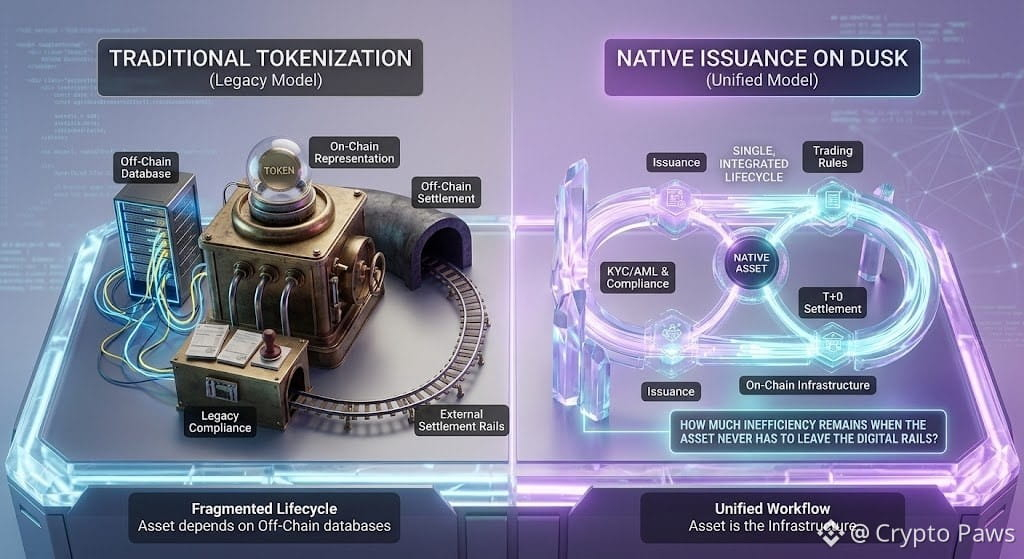
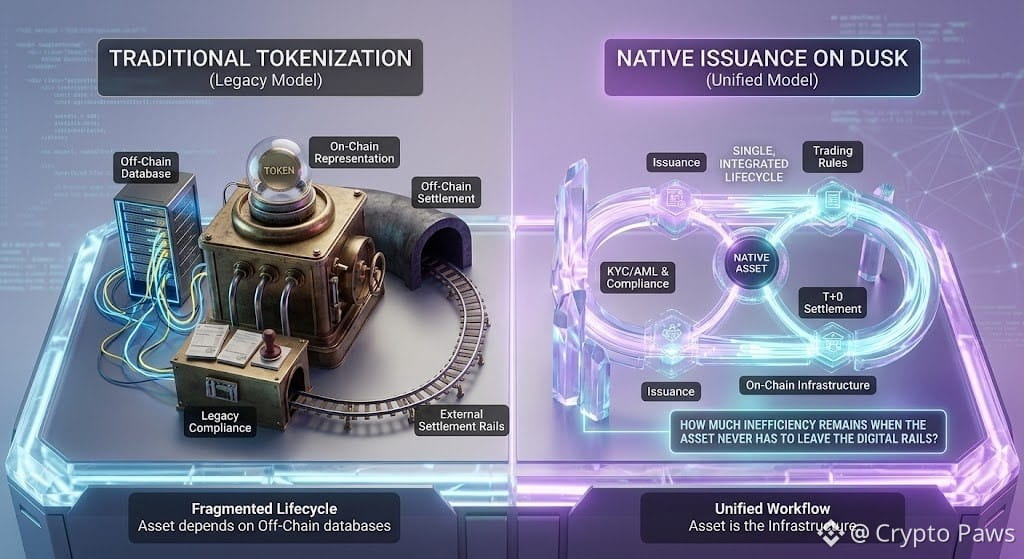
Tokenization can put an asset onchain without actually moving its financial lifecycle there.
That distinction is what makes Dusk interesting to me.
A traditional tokenized asset can still depend on off-chain databases, legacy compliance processes, and external settlement rails. The blockchain may represent the asset, while the underlying workflow remains largely unchanged.
Native issuance takes a different approach.
On Dusk, the asset is created directly onchain, allowing issuance, KYC/AML, compliance, trading rules, and settlement to become part of the same lifecycle.
That changes the role of the blockchain.
Instead of being another layer sitting above existing infrastructure, it can become the infrastructure itself—with private, compliant secondary trading and T+0 settlement available 24/7.
The bigger question is:
How much inefficiency remains when the asset never has to leave the digital rails?
$ONT
{future}(ONTUSDT)
$SOLV
#dusk $DUSK @Dusk
Tokenization can put an asset onchain without actually moving its financial lifecycle there.
That distinction is what makes Dusk interesting to me.
A traditional tokenized asset can still depend on off-chain databases, legacy compliance processes, and external settlement rails. The blockchain may represent the asset, while the underlying workflow remains largely unchanged.
Native issuance takes a different approach.
On Dusk, the asset is created directly onchain, allowing issuance, KYC/AML, compliance, trading rules, and settlement to become part of the same lifecycle.
That changes the role of the blockchain.
Instead of being another layer sitting above existing infrastructure, it can become the infrastructure itself—with private, compliant secondary trading and T+0 settlement available 24/7.
The bigger question is:
How much inefficiency remains when the asset never has to leave the digital rails?
$ONT
$SOLV
Tokenization can put an asset onchain without actually moving its financial lifecycle there.
That distinction is what makes Dusk interesting to me.
A traditional tokenized asset can still depend on off-chain databases, legacy compliance processes, and external settlement rails. The blockchain may represent the asset, while the underlying workflow remains largely unchanged.
Native issuance takes a different approach.
On Dusk, the asset is created directly onchain, allowing issuance, KYC/AML, compliance, trading rules, and settlement to become part of the same lifecycle.
That changes the role of the blockchain.
Instead of being another layer sitting above existing infrastructure, it can become the infrastructure itself—with private, compliant secondary trading and T+0 settlement available 24/7.
The bigger question is:
How much inefficiency remains when the asset never has to leave the digital rails?
$ONT
$SOLV
1
70
·
--
Tokenization can put an asset onchain without actually moving its financial lifecycle there.
That distinction is what makes Dusk interesting to me.
A traditional tokenized asset can still depend on off-chain databases, legacy compliance processes, and external settlement rails. The blockchain may represent the asset, while the underlying workflow remains largely unchanged.
Native issuance takes a different approach.
On Dusk, the asset is created directly onchain, allowing issuance, KYC/AML, compliance, trading rules, and settlement to become part of the same lifecycle.
That changes the role of the blockchain.
Instead of being another layer sitting above existing infrastructure, it can become the infrastructure itself—with private, compliant secondary trading and T+0 settlement available 24/7.
The bigger question is:
How much inefficiency remains when the asset never has to leave the digital rails?
$SOLV
{future}(SOLVUSDT)
$ONT
{future}(ONTUSDT)
$DUSK
{future}(DUSKUSDT)
Tokenization can put an asset onchain without actually moving its financial lifecycle there.
That distinction is what makes Dusk interesting to me.
A traditional tokenized asset can still depend on off-chain databases, legacy compliance processes, and external settlement rails. The blockchain may represent the asset, while the underlying workflow remains largely unchanged.
Native issuance takes a different approach.
On Dusk, the asset is created directly onchain, allowing issuance, KYC/AML, compliance, trading rules, and settlement to become part of the same lifecycle.
That changes the role of the blockchain.
Instead of being another layer sitting above existing infrastructure, it can become the infrastructure itself—with private, compliant secondary trading and T+0 settlement available 24/7.
The bigger question is:
How much inefficiency remains when the asset never has to leave the digital rails?
$SOLV
$ONT
$DUSK
That distinction is what makes Dusk interesting to me.
A traditional tokenized asset can still depend on off-chain databases, legacy compliance processes, and external settlement rails. The blockchain may represent the asset, while the underlying workflow remains largely unchanged.
Native issuance takes a different approach.
On Dusk, the asset is created directly onchain, allowing issuance, KYC/AML, compliance, trading rules, and settlement to become part of the same lifecycle.
That changes the role of the blockchain.
Instead of being another layer sitting above existing infrastructure, it can become the infrastructure itself—with private, compliant secondary trading and T+0 settlement available 24/7.
The bigger question is:
How much inefficiency remains when the asset never has to leave the digital rails?
$SOLV
$ONT
$DUSK
140
·
--
I used to think transaction finality was basically binary: confirmed or not confirmed.
Looking at @Dusk_Foundation made me reconsider that assumption.
A transaction can move through four distinct states: Accepted, Confirmed, Stable, and finally Final.
Accepted means it has entered the chain. Confirmed means more blocks have built around it. Stable signals deeper settlement confidence. Final is the point where cryptographic finality is reached and reversal is no longer possible.
What I find interesting is the information this progression gives users.
Instead of treating every transaction as equally settled, Dusk exposes how confidence develops over time.
That makes “finality” less like a switch and more like a measurable journey.
The question I’d ask is:
Could this staged model make settlement risk easier to understand in real-world financial applications?
$PROM
{future}(PROMUSDT)
$CATI
{future}(CATIUSDT)
$DUSK
{future}(DUSKUSDT)
#dusk @Dusk_Foundation
What matters most when judging a transaction’s finality?
I used to think transaction finality was basically binary: confirmed or not confirmed.
Looking at @Dusk made me reconsider that assumption.
A transaction can move through four distinct states: Accepted, Confirmed, Stable, and finally Final.
Accepted means it has entered the chain. Confirmed means more blocks have built around it. Stable signals deeper settlement confidence. Final is the point where cryptographic finality is reached and reversal is no longer possible.
What I find interesting is the information this progression gives users.
Instead of treating every transaction as equally settled, Dusk exposes how confidence develops over time.
That makes “finality” less like a switch and more like a measurable journey.
The question I’d ask is:
Could this staged model make settlement risk easier to understand in real-world financial applications?
$PROM
$CATI
$DUSK
#dusk @Dusk
What matters most when judging a transaction’s finality?
Looking at @Dusk made me reconsider that assumption.
A transaction can move through four distinct states: Accepted, Confirmed, Stable, and finally Final.
Accepted means it has entered the chain. Confirmed means more blocks have built around it. Stable signals deeper settlement confidence. Final is the point where cryptographic finality is reached and reversal is no longer possible.
What I find interesting is the information this progression gives users.
Instead of treating every transaction as equally settled, Dusk exposes how confidence develops over time.
That makes “finality” less like a switch and more like a measurable journey.
The question I’d ask is:
Could this staged model make settlement risk easier to understand in real-world financial applications?
$PROM
$CATI
$DUSK
#dusk @Dusk
What matters most when judging a transaction’s finality?
⚡ Fast confirmation
0%
🛡️ Deep settlement confidence
0%
🔒 Irreversibility
0%
📊 Clear finality stages
0%
0 votes • Voting closed
1
106
·
--
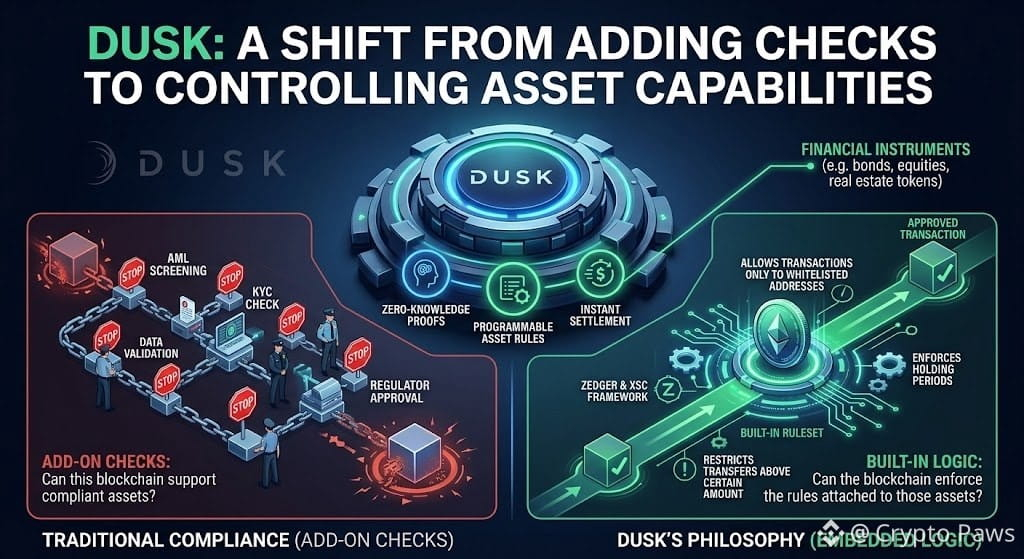
One thing I find easy to miss about @Dusk_Foundation is that its compliance story isn’t really about adding more checks.
It’s about controlling what an asset is allowed to do.
That’s a very different design philosophy.
With Zedger and the XSC framework, Dusk approaches regulated assets at the transaction and contract level—where permissions, eligible participants, and specific asset actions can become part of the system’s logic.
That changes the question from:
“Can this blockchain support compliant assets?”
to:
“Can the blockchain enforce the rules attached to those assets?”
That distinction becomes increasingly important when the target isn’t just crypto-native tokens, but regulated financial instruments.
I think that’s one of the more underrated ideas behind @Dusk_Foundation
#dusk
$LINK
{future}(LINKUSDT)
$ADA
{future}(ADAUSDT)
$DUSK
{future}(DUSKUSDT)
One thing I find easy to miss about @Dusk is that its compliance story isn’t really about adding more checks.
It’s about controlling what an asset is allowed to do.
That’s a very different design philosophy.
With Zedger and the XSC framework, Dusk approaches regulated assets at the transaction and contract level—where permissions, eligible participants, and specific asset actions can become part of the system’s logic.
That changes the question from:
“Can this blockchain support compliant assets?”
to:
“Can the blockchain enforce the rules attached to those assets?”
That distinction becomes increasingly important when the target isn’t just crypto-native tokens, but regulated financial instruments.
I think that’s one of the more underrated ideas behind @Dusk
#dusk
$LINK
$ADA
$DUSK
It’s about controlling what an asset is allowed to do.
That’s a very different design philosophy.
With Zedger and the XSC framework, Dusk approaches regulated assets at the transaction and contract level—where permissions, eligible participants, and specific asset actions can become part of the system’s logic.
That changes the question from:
“Can this blockchain support compliant assets?”
to:
“Can the blockchain enforce the rules attached to those assets?”
That distinction becomes increasingly important when the target isn’t just crypto-native tokens, but regulated financial instruments.
I think that’s one of the more underrated ideas behind @Dusk
#dusk
$LINK
$ADA
$DUSK
1
129
·
--
What really catches my attention about stake-based consensus isn’t the capital being locked—it’s how that capital can quietly determine who holds the most influence.
When economic commitment becomes part of consensus security, participants have a clear reason to protect the network. Their stake gives them something meaningful to lose, which can make honest behavior more rational.
But security and influence are not exactly the same thing.
If a small group controls a large share of the total stake, their economic position may translate into greater participation opportunities and stronger influence over consensus.
That creates a deeper design challenge: a network can remain technically secure while becoming less balanced economically.
For me, the real measure of decentralization is not just how many participants exist, but whether meaningful consensus influence remains broadly distributed.
$MOVE
{future}(MOVEUSDT)
$POL
{future}(POLUSDT)
$DUSK
{future}(DUSKUSDT)
#dusk
@Dusk_Foundation
When stake gives participants more influence in consensus, what should matter most?
What really catches my attention about stake-based consensus isn’t the capital being locked—it’s how that capital can quietly determine who holds the most influence.
When economic commitment becomes part of consensus security, participants have a clear reason to protect the network. Their stake gives them something meaningful to lose, which can make honest behavior more rational.
But security and influence are not exactly the same thing.
If a small group controls a large share of the total stake, their economic position may translate into greater participation opportunities and stronger influence over consensus.
That creates a deeper design challenge: a network can remain technically secure while becoming less balanced economically.
For me, the real measure of decentralization is not just how many participants exist, but whether meaningful consensus influence remains broadly distributed.
$MOVE
$POL
$DUSK
#dusk
@Dusk
When stake gives participants more influence in consensus, what should matter most?
When economic commitment becomes part of consensus security, participants have a clear reason to protect the network. Their stake gives them something meaningful to lose, which can make honest behavior more rational.
But security and influence are not exactly the same thing.
If a small group controls a large share of the total stake, their economic position may translate into greater participation opportunities and stronger influence over consensus.
That creates a deeper design challenge: a network can remain technically secure while becoming less balanced economically.
For me, the real measure of decentralization is not just how many participants exist, but whether meaningful consensus influence remains broadly distributed.
$MOVE
$POL
$DUSK
#dusk
@Dusk
When stake gives participants more influence in consensus, what should matter most?
Maximum network security
0%
Wider stake distribution
0%
Equal participation opportunty
0%
Strong limits on concentration
0%
0 votes • Voting closed
1
155
·
--
When I first looked at Dusk, I saw another privacy-focused Layer-1. But its architecture made me rethink that view.
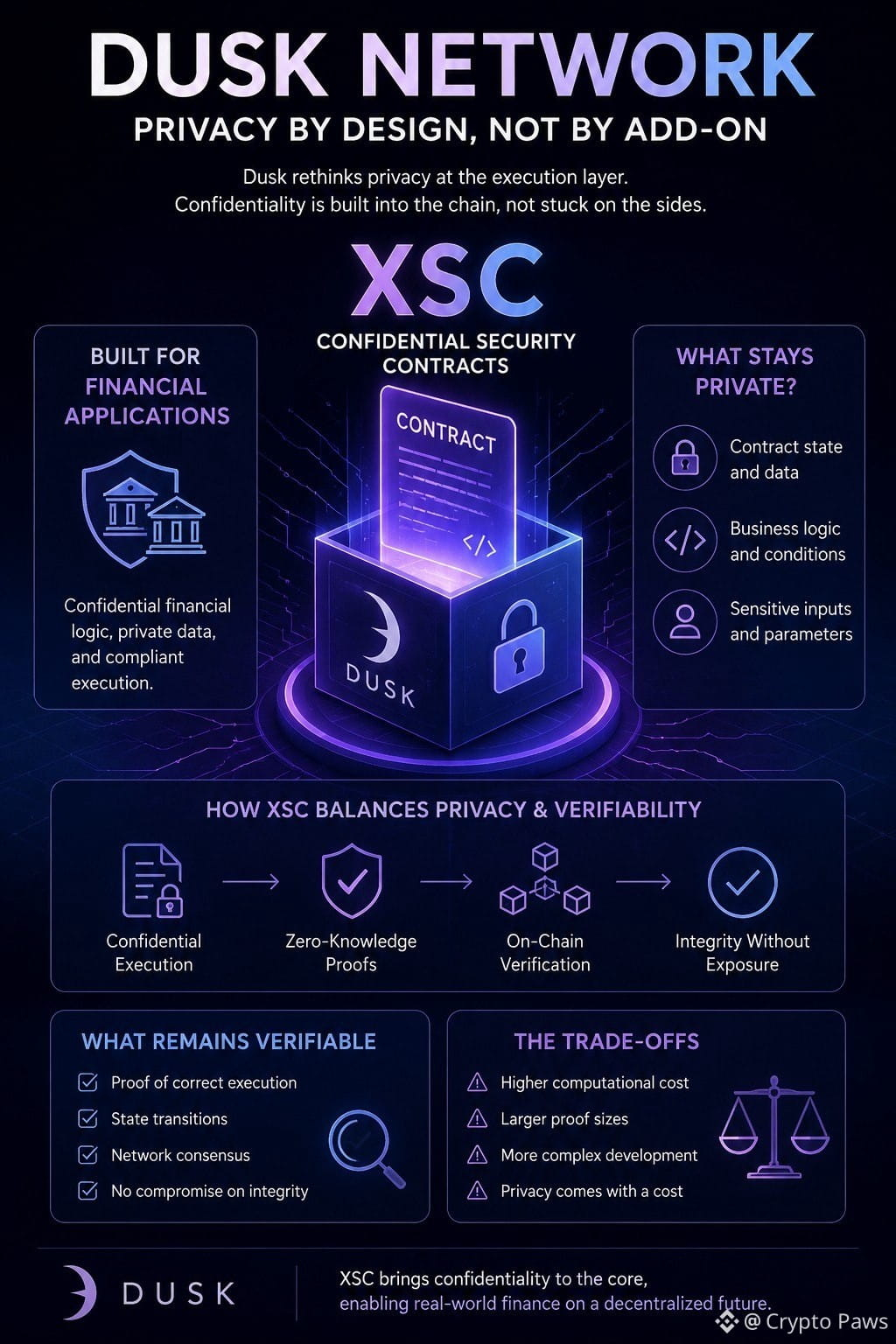
The standout idea is XSC — Confidential Security Contracts.
Rather than treating privacy as something added around smart contracts, Dusk brings confidentiality closer to the execution layer. That matters for financial applications, where sensitive information may include not only balances or transactions, but also the logic and conditions being executed.
This creates an important challenge: how can a blockchain keep financial logic private while still allowing the network to verify that execution is correct?
Traditional blockchains rely heavily on transparency. Confidential execution takes the opposite approach by limiting what becomes publicly visible. The interesting part is finding a balance between those two goals.
That is why I think XSC deserves more attention. If sensitive inputs and contract logic can remain protected while the network can still verify valid execution, privacy becomes more than a feature.
It becomes part of the infrastructure itself.
For me, that makes Dusk more interesting to study—not simply as a privacy chain, but as an attempt to rethink how confidential financial applications can work on a public blockchain.
$TUT
{future}(TUTUSDT)
$ZEC
{future}(ZECUSDT)
$DUSK #dusk @Dusk_Foundation
When I first looked at Dusk, I saw another privacy-focused Layer-1. But its architecture made me rethink that view.
The standout idea is XSC — Confidential Security Contracts.
Rather than treating privacy as something added around smart contracts, Dusk brings confidentiality closer to the execution layer. That matters for financial applications, where sensitive information may include not only balances or transactions, but also the logic and conditions being executed.
This creates an important challenge: how can a blockchain keep financial logic private while still allowing the network to verify that execution is correct?
Traditional blockchains rely heavily on transparency. Confidential execution takes the opposite approach by limiting what becomes publicly visible. The interesting part is finding a balance between those two goals.
That is why I think XSC deserves more attention. If sensitive inputs and contract logic can remain protected while the network can still verify valid execution, privacy becomes more than a feature.
It becomes part of the infrastructure itself.
For me, that makes Dusk more interesting to study—not simply as a privacy chain, but as an attempt to rethink how confidential financial applications can work on a public blockchain.
$TUT
$ZEC
$DUSK #dusk @Dusk
The standout idea is XSC — Confidential Security Contracts.
Rather than treating privacy as something added around smart contracts, Dusk brings confidentiality closer to the execution layer. That matters for financial applications, where sensitive information may include not only balances or transactions, but also the logic and conditions being executed.
This creates an important challenge: how can a blockchain keep financial logic private while still allowing the network to verify that execution is correct?
Traditional blockchains rely heavily on transparency. Confidential execution takes the opposite approach by limiting what becomes publicly visible. The interesting part is finding a balance between those two goals.
That is why I think XSC deserves more attention. If sensitive inputs and contract logic can remain protected while the network can still verify valid execution, privacy becomes more than a feature.
It becomes part of the infrastructure itself.
For me, that makes Dusk more interesting to study—not simply as a privacy chain, but as an attempt to rethink how confidential financial applications can work on a public blockchain.
$TUT
$ZEC
$DUSK #dusk @Dusk
63
2
2.8k
·
--
What if privacy isn’t about disappearing, but deciding what people get to see?
That’s the part of @Dusk_Foundation I find interesting. With DUSK, a profile can connect to both a public and a shielded address, creating different lanes for different situations.
Some activity may need transparency. Other activity may deserve privacy.
Instead of forcing one choice across everything, Dusk gives the user more control over how their activity is exposed.
That feels closer to how real financial life actually works.
Would you prefer one address for everything, or separate public and private lanes depending on the situation?
$DUSK #dusk
$NEIRO
{future}(NEIROUSDT)
$ENA
{future}(ENAUSDT)
If @Dusk_Foundation lets you decide between public and shielded activity, what would matter most to you?
What if privacy isn’t about disappearing, but deciding what people get to see?
That’s the part of @Dusk I find interesting. With DUSK, a profile can connect to both a public and a shielded address, creating different lanes for different situations.
Some activity may need transparency. Other activity may deserve privacy.
Instead of forcing one choice across everything, Dusk gives the user more control over how their activity is exposed.
That feels closer to how real financial life actually works.
Would you prefer one address for everything, or separate public and private lanes depending on the situation?
$DUSK #dusk
$NEIRO
$ENA
If @Dusk lets you decide between public and shielded activity, what would matter most to you?
That’s the part of @Dusk I find interesting. With DUSK, a profile can connect to both a public and a shielded address, creating different lanes for different situations.
Some activity may need transparency. Other activity may deserve privacy.
Instead of forcing one choice across everything, Dusk gives the user more control over how their activity is exposed.
That feels closer to how real financial life actually works.
Would you prefer one address for everything, or separate public and private lanes depending on the situation?
$DUSK #dusk
$NEIRO
$ENA
If @Dusk lets you decide between public and shielded activity, what would matter most to you?
Maximum transparency
63%
Maximum privacy
25%
Switch based on context
0%
Keep both options available
12%
8 votes • Voting closed
43
4
2.9k
·
--
The part of Phoenix that changed how I think about private transfers is that the privacy starts with the structure of the transaction itself.
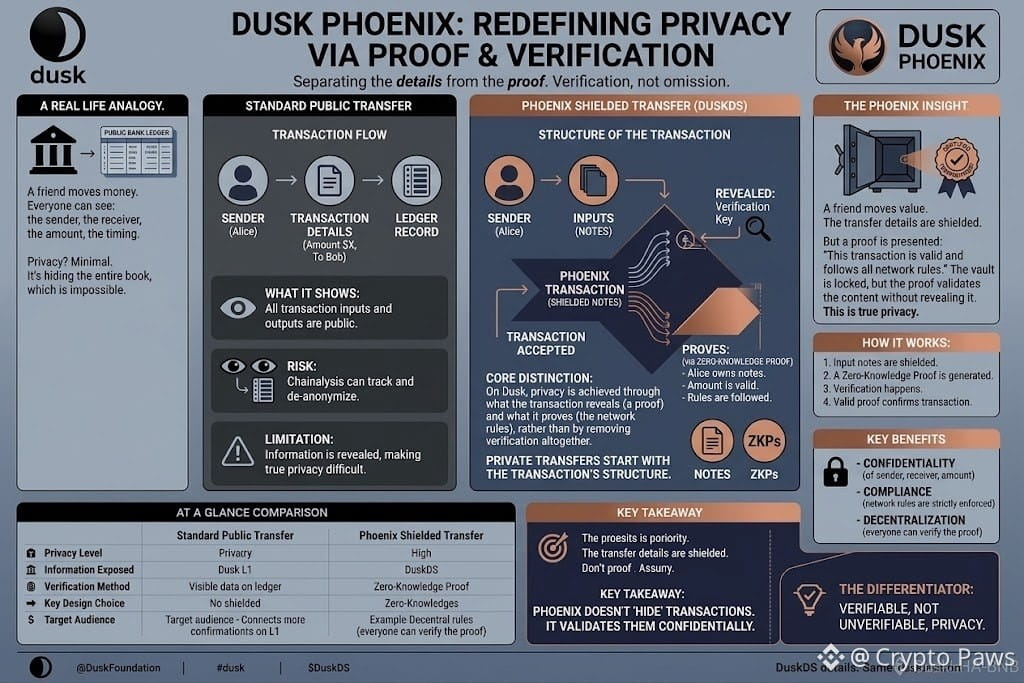
After reading the Dusk documentation, I understand Phoenix as a shielded transfer model on DuskDS built around notes and zero-knowledge proofs. Instead of exposing the usual transfer details, the transaction can prove that the transfer is valid without revealing the underlying information publicly.
What I find important is that this is not simply “hiding a transaction.” The network still needs to verify that the rules are followed. Phoenix separates the information that needs to remain confidential from the proof that allows the network to validate the transaction.
That distinction is the core insight I took away: on DuskDS, privacy is achieved through what the transaction reveals and what it proves, rather than by removing verification altogether.
For me, that makes Phoenix a particularly interesting piece of Dusk’s transaction design.
$DUSK #dusk @Dusk_Foundation
$RE
{future}(REUSDT)
$TREE
{future}(TREEUSDT)
#zec
#WLD
#MUBARAK
The part of Phoenix that changed how I think about private transfers is that the privacy starts with the structure of the transaction itself.
After reading the Dusk documentation, I understand Phoenix as a shielded transfer model on DuskDS built around notes and zero-knowledge proofs. Instead of exposing the usual transfer details, the transaction can prove that the transfer is valid without revealing the underlying information publicly.
What I find important is that this is not simply “hiding a transaction.” The network still needs to verify that the rules are followed. Phoenix separates the information that needs to remain confidential from the proof that allows the network to validate the transaction.
That distinction is the core insight I took away: on DuskDS, privacy is achieved through what the transaction reveals and what it proves, rather than by removing verification altogether.
For me, that makes Phoenix a particularly interesting piece of Dusk’s transaction design.
$DUSK #dusk @Dusk
$RE
$TREE
#zec
#WLD
#MUBARAK
After reading the Dusk documentation, I understand Phoenix as a shielded transfer model on DuskDS built around notes and zero-knowledge proofs. Instead of exposing the usual transfer details, the transaction can prove that the transfer is valid without revealing the underlying information publicly.
What I find important is that this is not simply “hiding a transaction.” The network still needs to verify that the rules are followed. Phoenix separates the information that needs to remain confidential from the proof that allows the network to validate the transaction.
That distinction is the core insight I took away: on DuskDS, privacy is achieved through what the transaction reveals and what it proves, rather than by removing verification altogether.
For me, that makes Phoenix a particularly interesting piece of Dusk’s transaction design.
$DUSK #dusk @Dusk
$RE
$TREE
#zec
#WLD
#MUBARAK
54
3
2k
·
--
I used to think transaction privacy was mainly about choosing between “public” and “private.” After reading Dusk’s documentation, I see Phoenix and Moonlight differently: they are two transaction models built for different information requirements, but they share the same settlement layer.
$DUSK #dusk @Dusk_Foundation
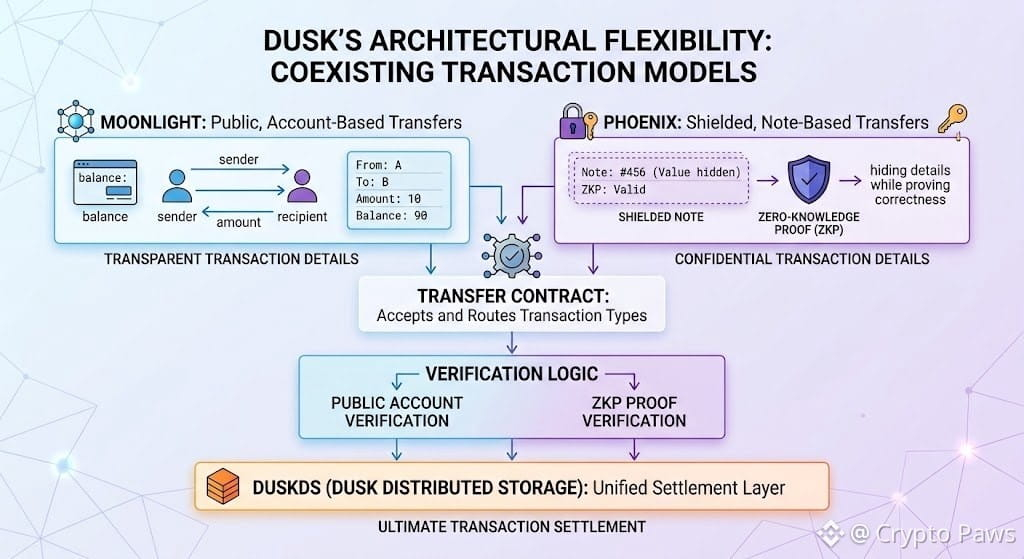
Moonlight uses public, account-based transfers where balances, sender, recipient and amount are visible. Phoenix takes the opposite approach with shielded, note-based transfers and zero-knowledge proofs, hiding transaction details while still proving correctness.
What I find most interesting is that Dusk does not force one model onto every use case. The Transfer Contract can accept both transaction types and route them through the appropriate verification logic, while both ultimately settle on DuskDS.
To me, the overlooked insight is architectural flexibility: transparency and confidentiality can coexist at the transaction-model level without requiring separate settlement systems.
That makes @Dusk_Foundation ’s design more nuanced than simply calling it a “privacy blockchain.”
#DASH
#WLD
#VIXFallsTo2026Low
#EthereumFoundationLaunchesGlamsterdamTestnet $DASH
{future}(DASHUSDT)
$WLD
{future}(WLDUSDT)
I used to think transaction privacy was mainly about choosing between “public” and “private.” After reading Dusk’s documentation, I see Phoenix and Moonlight differently: they are two transaction models built for different information requirements, but they share the same settlement layer.
$DUSK #dusk @Dusk
Moonlight uses public, account-based transfers where balances, sender, recipient and amount are visible. Phoenix takes the opposite approach with shielded, note-based transfers and zero-knowledge proofs, hiding transaction details while still proving correctness.
What I find most interesting is that Dusk does not force one model onto every use case. The Transfer Contract can accept both transaction types and route them through the appropriate verification logic, while both ultimately settle on DuskDS.
To me, the overlooked insight is architectural flexibility: transparency and confidentiality can coexist at the transaction-model level without requiring separate settlement systems.
That makes @Dusk ’s design more nuanced than simply calling it a “privacy blockchain.”
#DASH
#WLD
#VIXFallsTo2026Low
#EthereumFoundationLaunchesGlamsterdamTestnet $DASH
$WLD
$DUSK #dusk @Dusk
Moonlight uses public, account-based transfers where balances, sender, recipient and amount are visible. Phoenix takes the opposite approach with shielded, note-based transfers and zero-knowledge proofs, hiding transaction details while still proving correctness.
What I find most interesting is that Dusk does not force one model onto every use case. The Transfer Contract can accept both transaction types and route them through the appropriate verification logic, while both ultimately settle on DuskDS.
To me, the overlooked insight is architectural flexibility: transparency and confidentiality can coexist at the transaction-model level without requiring separate settlement systems.
That makes @Dusk ’s design more nuanced than simply calling it a “privacy blockchain.”
#DASH
#WLD
#VIXFallsTo2026Low
#EthereumFoundationLaunchesGlamsterdamTestnet $DASH
$WLD
74
2
107
·
--
#dusk $DUSK @Dusk_Foundation
I used to think tokenizing a financial asset was mainly about putting ownership onchain. After reading Dusk’s market-infrastructure documentation, I see the harder problem differently: the asset has to move through an entire workflow, not just a transaction.
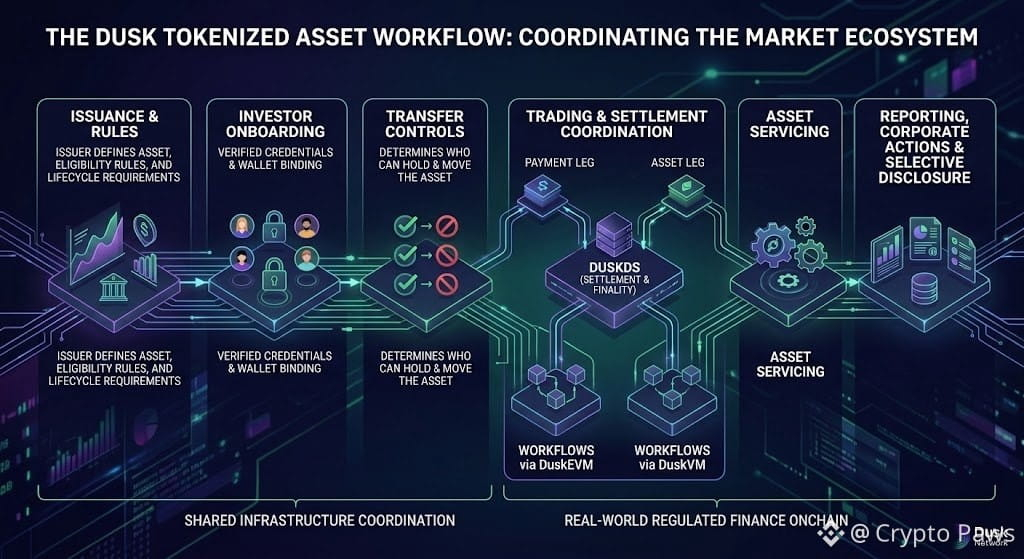
On @Dusk_Foundation , that journey can start with an issuer defining the asset, eligibility rules, and lifecycle requirements. From there, investors can be onboarded through verified credentials or wallet binding, while transfer controls determine who can actually hold or move the asset.
What I find more interesting is what happens after that. Trading has to coordinate with settlement, and the asset leg may need to settle alongside a payment leg. DuskDS provides the settlement and finality foundation, while DuskEVM or DuskVM can support the application logic depending on the workflow.
Then the lifecycle continues with servicing, reporting, corporate actions, and selective disclosure.
That changed how I look at Dusk. The interesting part is not simply moving a financial asset onto a blockchain; it is trying to coordinate the surrounding market workflow on shared infrastructure.
For me, that is a much more meaningful way to think about bringing regulated finance onchain.
$ACE
{future}(ACEUSDT)
$PORTAL
{future}(PORTALUSDT)
#SECReviewsSix3xLeveragedCommodityETFs #GPS
#Portal
#ACE
#dusk $DUSK @Dusk
I used to think tokenizing a financial asset was mainly about putting ownership onchain. After reading Dusk’s market-infrastructure documentation, I see the harder problem differently: the asset has to move through an entire workflow, not just a transaction.
On @Dusk , that journey can start with an issuer defining the asset, eligibility rules, and lifecycle requirements. From there, investors can be onboarded through verified credentials or wallet binding, while transfer controls determine who can actually hold or move the asset.
What I find more interesting is what happens after that. Trading has to coordinate with settlement, and the asset leg may need to settle alongside a payment leg. DuskDS provides the settlement and finality foundation, while DuskEVM or DuskVM can support the application logic depending on the workflow.
Then the lifecycle continues with servicing, reporting, corporate actions, and selective disclosure.
That changed how I look at Dusk. The interesting part is not simply moving a financial asset onto a blockchain; it is trying to coordinate the surrounding market workflow on shared infrastructure.
For me, that is a much more meaningful way to think about bringing regulated finance onchain.
$ACE
$PORTAL
#SECReviewsSix3xLeveragedCommodityETFs #GPS
#Portal
#ACE
I used to think tokenizing a financial asset was mainly about putting ownership onchain. After reading Dusk’s market-infrastructure documentation, I see the harder problem differently: the asset has to move through an entire workflow, not just a transaction.
On @Dusk , that journey can start with an issuer defining the asset, eligibility rules, and lifecycle requirements. From there, investors can be onboarded through verified credentials or wallet binding, while transfer controls determine who can actually hold or move the asset.
What I find more interesting is what happens after that. Trading has to coordinate with settlement, and the asset leg may need to settle alongside a payment leg. DuskDS provides the settlement and finality foundation, while DuskEVM or DuskVM can support the application logic depending on the workflow.
Then the lifecycle continues with servicing, reporting, corporate actions, and selective disclosure.
That changed how I look at Dusk. The interesting part is not simply moving a financial asset onto a blockchain; it is trying to coordinate the surrounding market workflow on shared infrastructure.
For me, that is a much more meaningful way to think about bringing regulated finance onchain.
$ACE
$PORTAL
#SECReviewsSix3xLeveragedCommodityETFs #GPS
#Portal
#ACE
56
4
982
·
--
Verified
$DUSK #dusk @Dusk_Foundation
Putting an asset onchain is easy to describe. Getting regulated market infrastructure to actually connect with blockchain settlement is the harder step—and that is what caught my attention about @Dusk_Foundation .
From my reading, Dusk is working with EU-licensed institutions, including NPEX, an AFM-regulated venue licensed as an MTF, Broker and ECSP. NPEX plans to bring 300M+ EUR of assets onchain via Dusk. I see the significance less in the headline number and more in the infrastructure behind it.
The second-order effect I find interesting is that blockchain settlement can become connected to an existing regulated market framework rather than operating beside it. If that connection works, the conversation shifts from “can assets be tokenized?” to “how can regulated financial processes become more efficient once settlement is onchain?”
That is a much more meaningful test for institutional adoption.
$CHIP
{future}(CHIPUSDT)
$DOS
{future}(DOSUSDT)
#beat
#BOME
#SP500TopsRecord7800
#COWRises55.77%In24h
What matters most when regulated markets move onchain?
$DUSK #dusk @Dusk
Putting an asset onchain is easy to describe. Getting regulated market infrastructure to actually connect with blockchain settlement is the harder step—and that is what caught my attention about @Dusk .
From my reading, Dusk is working with EU-licensed institutions, including NPEX, an AFM-regulated venue licensed as an MTF, Broker and ECSP. NPEX plans to bring 300M+ EUR of assets onchain via Dusk. I see the significance less in the headline number and more in the infrastructure behind it.
The second-order effect I find interesting is that blockchain settlement can become connected to an existing regulated market framework rather than operating beside it. If that connection works, the conversation shifts from “can assets be tokenized?” to “how can regulated financial processes become more efficient once settlement is onchain?”
That is a much more meaningful test for institutional adoption.
$CHIP
$DOS
#beat
#BOME
#SP500TopsRecord7800
#COWRises55.77%In24h
What matters most when regulated markets move onchain?
Putting an asset onchain is easy to describe. Getting regulated market infrastructure to actually connect with blockchain settlement is the harder step—and that is what caught my attention about @Dusk .
From my reading, Dusk is working with EU-licensed institutions, including NPEX, an AFM-regulated venue licensed as an MTF, Broker and ECSP. NPEX plans to bring 300M+ EUR of assets onchain via Dusk. I see the significance less in the headline number and more in the infrastructure behind it.
The second-order effect I find interesting is that blockchain settlement can become connected to an existing regulated market framework rather than operating beside it. If that connection works, the conversation shifts from “can assets be tokenized?” to “how can regulated financial processes become more efficient once settlement is onchain?”
That is a much more meaningful test for institutional adoption.
$CHIP
$DOS
#beat
#BOME
#SP500TopsRecord7800
#COWRises55.77%In24h
What matters most when regulated markets move onchain?
🏛️ Licensed institutions
67%
🔗 Blockchain settlement
11%
📋 Regulatory authorization
11%
⚙️ Better market workflows
11%
9 votes • Voting closed
71
7
4.8k
·
--
$DUSK #dusk @Dusk_Foundation
Hedger changed how I think about confidential EVM execution. It isn't simply about hiding data; it separates privacy from verification.
Homomorphic encryption keeps values encrypted while computation happens. Zero-knowledge proofs handle another job: proving the computation followed the rules without exposing plaintext.
So I see it as:
ONE PROTECTS THE DATA. THE OTHER CHECKS THE WORK.
That distinction matters. HE can keep values unreadable, but it doesn't by itself prove the result is correct. ZK can verify correctness, but without encryption the data may still be visible.
This makes Hedger from @Dusk interesting to me. The two primitives are complementary in confidential EVM workflows.
But there is a trade-off.
Cryptographic computation and proving create extra workload. For regulated financial applications, that overhead may be justified.
The question I keep coming back to is:
Can confidential EVM execution preserve privacy without making the workflow too expensive at scale?
What would you prioritize in confidential EVM execution?
$DUSK #dusk @Dusk
Hedger changed how I think about confidential EVM execution. It isn't simply about hiding data; it separates privacy from verification.
Homomorphic encryption keeps values encrypted while computation happens. Zero-knowledge proofs handle another job: proving the computation followed the rules without exposing plaintext.
So I see it as:
ONE PROTECTS THE DATA. THE OTHER CHECKS THE WORK.
That distinction matters. HE can keep values unreadable, but it doesn't by itself prove the result is correct. ZK can verify correctness, but without encryption the data may still be visible.
This makes Hedger from @Dusk interesting to me. The two primitives are complementary in confidential EVM workflows.
But there is a trade-off.
Cryptographic computation and proving create extra workload. For regulated financial applications, that overhead may be justified.
The question I keep coming back to is:
Can confidential EVM execution preserve privacy without making the workflow too expensive at scale?
What would you prioritize in confidential EVM execution?
Hedger changed how I think about confidential EVM execution. It isn't simply about hiding data; it separates privacy from verification.
Homomorphic encryption keeps values encrypted while computation happens. Zero-knowledge proofs handle another job: proving the computation followed the rules without exposing plaintext.
So I see it as:
ONE PROTECTS THE DATA. THE OTHER CHECKS THE WORK.
That distinction matters. HE can keep values unreadable, but it doesn't by itself prove the result is correct. ZK can verify correctness, but without encryption the data may still be visible.
This makes Hedger from @Dusk interesting to me. The two primitives are complementary in confidential EVM workflows.
But there is a trade-off.
Cryptographic computation and proving create extra workload. For regulated financial applications, that overhead may be justified.
The question I keep coming back to is:
Can confidential EVM execution preserve privacy without making the workflow too expensive at scale?
What would you prioritize in confidential EVM execution?
🔘 Maximum privacy
33%
🔘 Lower computation cost
17%
🔘 Balanced performance
33%
🔘 Proven scalability
17%
6 votes • Voting closed
45
2
241
·
--
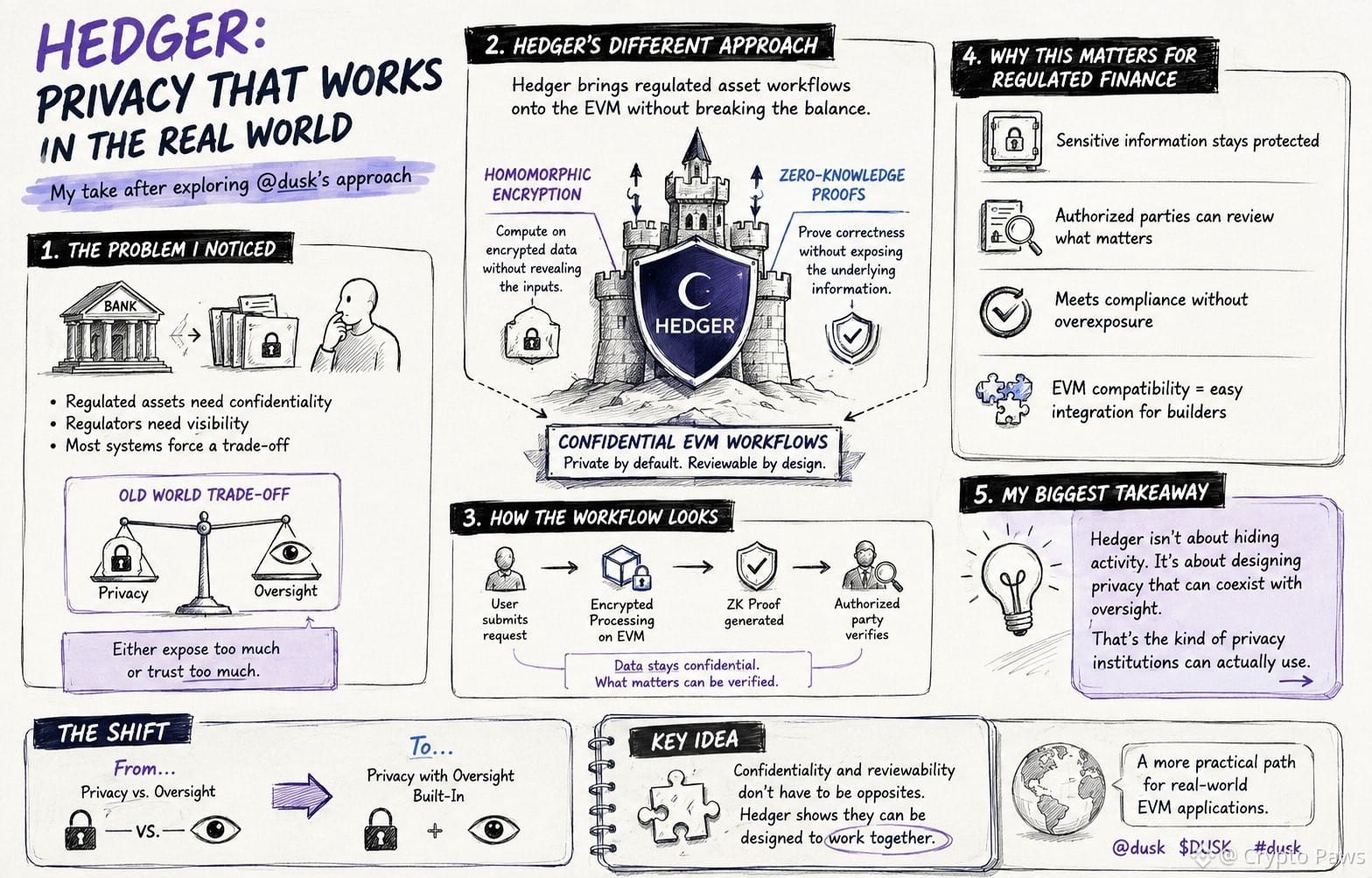
What caught my attention when I looked into Hedger wasn’t simply the word “privacy.” It was the idea of carrying regulated asset workflows into an EVM environment without treating confidentiality and reviewability as opposites.
My reading of @Dusk_Foundation 's approach is that Hedger uses homomorphic encryption alongside zero-knowledge proofs to support confidential EVM workflows where authorized parties can still review what matters. That distinction is important for regulated financial applications: sensitive information can remain protected while the workflow retains a path toward verification.
To me, that makes Hedger less about hiding activity and more about designing privacy that can coexist with oversight. That is a much more practical problem for institutional EVM applications.
$DUSK #dusk @Dusk_Foundation
$DOLO
$ALICE
#OilEdgesHigher
#AnthropicIPOMeetingsSkipFinancialsValuation #KalshiOrderedToSuspendWashingtonOperations #ProCapFilesBitcoinTreasuryDiscountETF
What caught my attention when I looked into Hedger wasn’t simply the word “privacy.” It was the idea of carrying regulated asset workflows into an EVM environment without treating confidentiality and reviewability as opposites.
My reading of @Dusk 's approach is that Hedger uses homomorphic encryption alongside zero-knowledge proofs to support confidential EVM workflows where authorized parties can still review what matters. That distinction is important for regulated financial applications: sensitive information can remain protected while the workflow retains a path toward verification.
To me, that makes Hedger less about hiding activity and more about designing privacy that can coexist with oversight. That is a much more practical problem for institutional EVM applications.
$DUSK #dusk @Dusk
$DOLO
$ALICE
#OilEdgesHigher
#AnthropicIPOMeetingsSkipFinancialsValuation #KalshiOrderedToSuspendWashingtonOperations #ProCapFilesBitcoinTreasuryDiscountETF
My reading of @Dusk 's approach is that Hedger uses homomorphic encryption alongside zero-knowledge proofs to support confidential EVM workflows where authorized parties can still review what matters. That distinction is important for regulated financial applications: sensitive information can remain protected while the workflow retains a path toward verification.
To me, that makes Hedger less about hiding activity and more about designing privacy that can coexist with oversight. That is a much more practical problem for institutional EVM applications.
$DUSK #dusk @Dusk
$DOLO
$ALICE
#OilEdgesHigher
#AnthropicIPOMeetingsSkipFinancialsValuation #KalshiOrderedToSuspendWashingtonOperations #ProCapFilesBitcoinTreasuryDiscountETF
52
4
1.2k
·
--
I keep coming back to one part of @Dusk_Foundation that feels strategically important: DuskEVM is not asking developers to abandon the EVM mindset. By giving Solidity builders a familiar route into @Dusk_Foundation , it lowers the barrier to building financial applications on a network designed for regulated markets. What makes this more interesting is Hedger. Its use of homomorphic encryption and zero-knowledge proofs points toward confidential EVM workflows where privacy does not mean losing the ability to review activity. For me, that is the real story behind $DUSK : programmable privacy becoming infrastructure, not a feature added later. #dusk
#USJulyCPI&PPIDueThisWeek #SheinSaidToLaunchHKIPOSubscriptionAroundAug20 $APR
$EDEN
Which DuskEVM feature matters most for regulated onchain finance?
I keep coming back to one part of @Dusk that feels strategically important: DuskEVM is not asking developers to abandon the EVM mindset. By giving Solidity builders a familiar route into @Dusk , it lowers the barrier to building financial applications on a network designed for regulated markets. What makes this more interesting is Hedger. Its use of homomorphic encryption and zero-knowledge proofs points toward confidential EVM workflows where privacy does not mean losing the ability to review activity. For me, that is the real story behind $DUSK : programmable privacy becoming infrastructure, not a feature added later. #dusk
#USJulyCPI&PPIDueThisWeek #SheinSaidToLaunchHKIPOSubscriptionAroundAug20 $APR
$EDEN
Which DuskEVM feature matters most for regulated onchain finance?
#USJulyCPI&PPIDueThisWeek #SheinSaidToLaunchHKIPOSubscriptionAroundAug20 $APR
$EDEN
Which DuskEVM feature matters most for regulated onchain finance?
🔐 Confidential EVM workflows
75%
🧩 Solidity/EVM compatibility
25%
🧾 Reviewable ZK privacy
0%
🏦 Institutional access
0%
4 votes • Voting closed
51
2
201
·
--
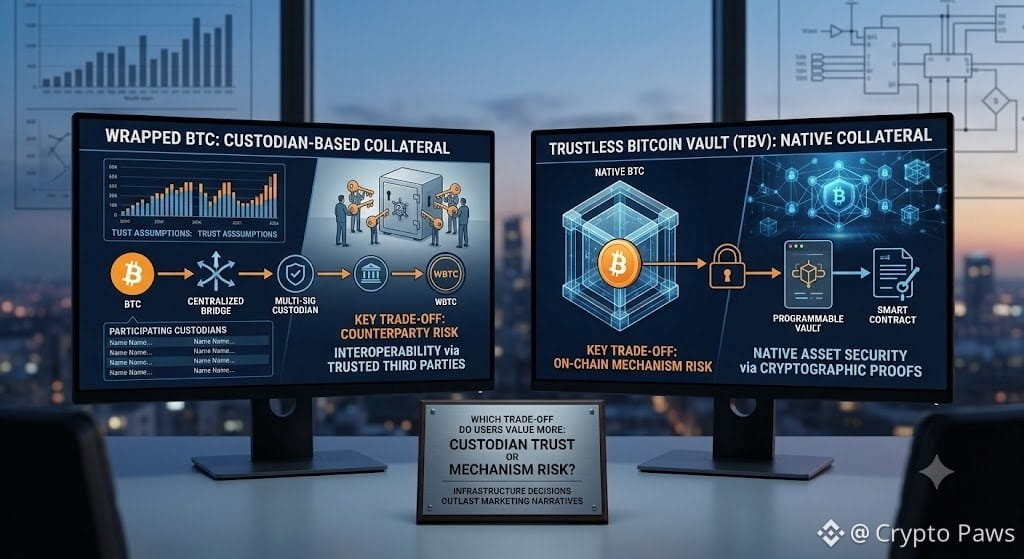
After spending time comparing Bitcoin collateral models, I came away thinking the real difference isn't wrapped BTC versus native BTC—it's the trust assumptions each design asks users to accept. Wrapped BTC has played an important role in expanding interoperability, but it generally depends on custodians or bridge mechanisms that become part of the security model. Trustless Bitcoin Vaults (TBV) approaches the problem differently by keeping native Bitcoin as the collateral while connecting it to borrowing infrastructure. That changes custody without eliminating interoperability as the goal. I don't see this as one model replacing the other. Wrapped BTC may remain practical where broad ecosystem compatibility matters most, while TBV offers an alternative for users who prioritize minimizing intermediary trust. Reading the architecture reminded me that infrastructure decisions often outlast marketing narratives because they shape how risk is distributed. As native Bitcoin collateral evolves, which trade-off do you think users will value most over time? @babylonlabs_io $BABY #baby
$TUT
$BICO
#BICO
#Epic
#zec
#lorenzoprotocol
After spending time comparing Bitcoin collateral models, I came away thinking the real difference isn't wrapped BTC versus native BTC—it's the trust assumptions each design asks users to accept. Wrapped BTC has played an important role in expanding interoperability, but it generally depends on custodians or bridge mechanisms that become part of the security model. Trustless Bitcoin Vaults (TBV) approaches the problem differently by keeping native Bitcoin as the collateral while connecting it to borrowing infrastructure. That changes custody without eliminating interoperability as the goal. I don't see this as one model replacing the other. Wrapped BTC may remain practical where broad ecosystem compatibility matters most, while TBV offers an alternative for users who prioritize minimizing intermediary trust. Reading the architecture reminded me that infrastructure decisions often outlast marketing narratives because they shape how risk is distributed. As native Bitcoin collateral evolves, which trade-off do you think users will value most over time? @BabylonLabs_io $BABY #baby
$TUT
$BICO
#BICO
#Epic
#zec
#lorenzoprotocol
$TUT
$BICO
#BICO
#Epic
#zec
#lorenzoprotocol
1
194
·
--
I spent part of my evening tracing how Trustless Bitcoin Vaults (TBV) moves native BTC through its borrowing workflow instead of just reading the headline features. What stood out wasn't a single transaction, but how each stage is designed to preserve Bitcoin's native properties.The journey begins when native BTC is deposited as collateral and verified by the protocol. Instead of converting it into a wrapped representation,
TBV keeps the collateral anchored to Bitcoin while enabling a borrowing position through Aave v4 on Ethereum. From there, the collateral remains continuously monitored so the loan stays properly secured as market conditions change.If the collateral ratio falls too far, liquidation becomes part of the lifecycle rather than an exception. The protocol coordinates settlement while preserving a path back to native Bitcoin redemption instead of relying on permanent wrapped assets.
That entire flow made me appreciate why avoiding bridges and custodians isn't just a security preference—@babylonlabs_io fundamentally changes how collateral travels through the system. After following this lifecycle end to end, I'm left wondering: could this become the model for bringing native Bitcoin into DeFi without compromising what makes Bitcoin unique? @babylonlabs_io $BABY #baby
#dexe
#UNI📈
#EUL
#bank
$BANK
{future}(BANKUSDT)
$ZEC
{future}(ZECUSDT)
Which stage of the TBV collateral lifecycle matters most for Bitcoin-native DeFi?
Vote below and explain why you chose that stage. 👇
I spent part of my evening tracing how Trustless Bitcoin Vaults (TBV) moves native BTC through its borrowing workflow instead of just reading the headline features. What stood out wasn't a single transaction, but how each stage is designed to preserve Bitcoin's native properties.The journey begins when native BTC is deposited as collateral and verified by the protocol. Instead of converting it into a wrapped representation,
TBV keeps the collateral anchored to Bitcoin while enabling a borrowing position through Aave v4 on Ethereum. From there, the collateral remains continuously monitored so the loan stays properly secured as market conditions change.If the collateral ratio falls too far, liquidation becomes part of the lifecycle rather than an exception. The protocol coordinates settlement while preserving a path back to native Bitcoin redemption instead of relying on permanent wrapped assets.
That entire flow made me appreciate why avoiding bridges and custodians isn't just a security preference—@BabylonLabs_io fundamentally changes how collateral travels through the system. After following this lifecycle end to end, I'm left wondering: could this become the model for bringing native Bitcoin into DeFi without compromising what makes Bitcoin unique? @BabylonLabs_io $BABY #baby
#dexe
#UNI📈
#EUL
#bank
$BANK
$ZEC
Which stage of the TBV collateral lifecycle matters most for Bitcoin-native DeFi?
Vote below and explain why you chose that stage. 👇
TBV keeps the collateral anchored to Bitcoin while enabling a borrowing position through Aave v4 on Ethereum. From there, the collateral remains continuously monitored so the loan stays properly secured as market conditions change.If the collateral ratio falls too far, liquidation becomes part of the lifecycle rather than an exception. The protocol coordinates settlement while preserving a path back to native Bitcoin redemption instead of relying on permanent wrapped assets.
That entire flow made me appreciate why avoiding bridges and custodians isn't just a security preference—@BabylonLabs_io fundamentally changes how collateral travels through the system. After following this lifecycle end to end, I'm left wondering: could this become the model for bringing native Bitcoin into DeFi without compromising what makes Bitcoin unique? @BabylonLabs_io $BABY #baby
#dexe
#UNI📈
#EUL
#bank
$BANK
$ZEC
Which stage of the TBV collateral lifecycle matters most for Bitcoin-native DeFi?
Vote below and explain why you chose that stage. 👇
🟠 Native BTC Deposit
0%
🔒 Continuous Risk Monitoring
50%
⚡ Permissionless Liquidation
50%
♻️ Native BTC Redemption
0%
2 votes • Voting closed
4
3
2.8k
·
--
$BABY #baby @babylonlabs_io
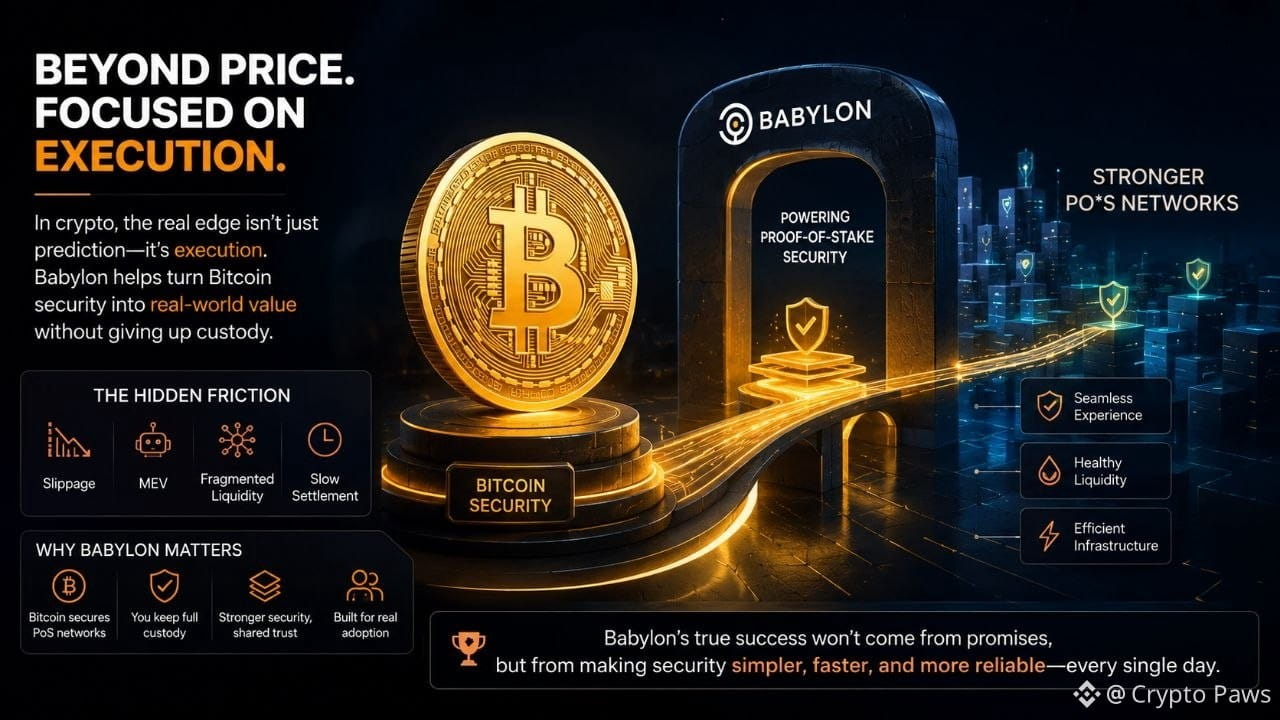
The deeper I get into crypto, the more I think the biggest obstacle isn't market swings—it's execution quality. Every trade faces hidden friction through slippage, MEV, fragmented liquidity, and slow settlement, all of which quietly erode performance. That's one reason Babylon stands out to me. Allowing Bitcoin holders to strengthen PoS security while keeping full control of their assets solves a problem that has existed for years. But a compelling architecture is only the beginning. Real adoption depends on dependable infrastructure, healthy liquidity, and an experience that feels seamless every day. In the long run, Babylon's success won't be measured by bold promises, but by whether users consistently find it easier, more efficient, and more trustworthy than competing ecosystems.
$BABY #baby @BabylonLabs_io
The deeper I get into crypto, the more I think the biggest obstacle isn't market swings—it's execution quality. Every trade faces hidden friction through slippage, MEV, fragmented liquidity, and slow settlement, all of which quietly erode performance. That's one reason Babylon stands out to me. Allowing Bitcoin holders to strengthen PoS security while keeping full control of their assets solves a problem that has existed for years. But a compelling architecture is only the beginning. Real adoption depends on dependable infrastructure, healthy liquidity, and an experience that feels seamless every day. In the long run, Babylon's success won't be measured by bold promises, but by whether users consistently find it easier, more efficient, and more trustworthy than competing ecosystems.
The deeper I get into crypto, the more I think the biggest obstacle isn't market swings—it's execution quality. Every trade faces hidden friction through slippage, MEV, fragmented liquidity, and slow settlement, all of which quietly erode performance. That's one reason Babylon stands out to me. Allowing Bitcoin holders to strengthen PoS security while keeping full control of their assets solves a problem that has existed for years. But a compelling architecture is only the beginning. Real adoption depends on dependable infrastructure, healthy liquidity, and an experience that feels seamless every day. In the long run, Babylon's success won't be measured by bold promises, but by whether users consistently find it easier, more efficient, and more trustworthy than competing ecosystems.
2
3
88
·
--
Verified
$BABY #baby @babylonlabs_io
For years, one assumption seemed unavoidable: if you wanted to use Bitcoin in DeFi, you first had to transform it into something else. Wrapped assets, cross-chain bridges, and custodial solutions expanded utility, but they also introduced additional trust and complexity that many Bitcoin users never wanted.
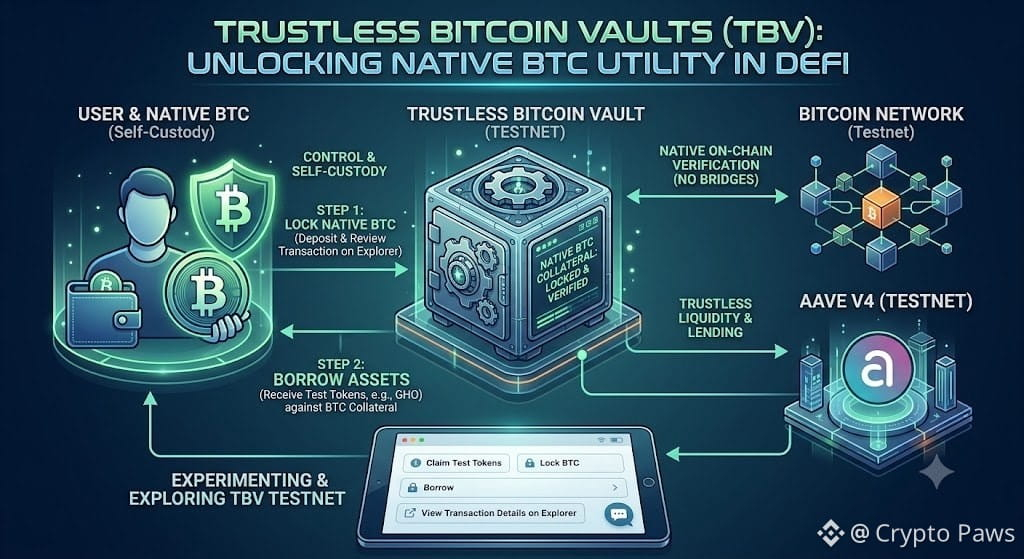
Trustless Bitcoin Vaults (TBV) proposes a different foundation. Rather than replacing native BTC with a synthetic version, it explores whether Bitcoin itself can remain the underlying collateral while users retain self-custody. Its first implementation, built with Aave v4, demonstrates a model for borrowing against native Bitcoin without relying on centralized intermediaries.
Instead of relying only on documentation, I explored the public testnet. Claiming test tokens, interacting with the vault, testing the borrowing process, reviewing transactions through the explorer, and sharing feedback gave me a much clearer understanding of the design. The experience felt less like another lending protocol and more like an experiment in preserving Bitcoin's core principles while expanding its financial utility.
It's still early, and long-term adoption will depend on security, usability, and proven reliability. Even so, I find the direction compelling because it focuses on minimizing trust assumptions instead of creating new ones. If you're curious about the next stage of Bitcoin infrastructure, the TBV testnet is worth exploring firsthand before forming an opinion.
$BABY #baby @BabylonLabs_io
For years, one assumption seemed unavoidable: if you wanted to use Bitcoin in DeFi, you first had to transform it into something else. Wrapped assets, cross-chain bridges, and custodial solutions expanded utility, but they also introduced additional trust and complexity that many Bitcoin users never wanted.
Trustless Bitcoin Vaults (TBV) proposes a different foundation. Rather than replacing native BTC with a synthetic version, it explores whether Bitcoin itself can remain the underlying collateral while users retain self-custody. Its first implementation, built with Aave v4, demonstrates a model for borrowing against native Bitcoin without relying on centralized intermediaries.
Instead of relying only on documentation, I explored the public testnet. Claiming test tokens, interacting with the vault, testing the borrowing process, reviewing transactions through the explorer, and sharing feedback gave me a much clearer understanding of the design. The experience felt less like another lending protocol and more like an experiment in preserving Bitcoin's core principles while expanding its financial utility.
It's still early, and long-term adoption will depend on security, usability, and proven reliability. Even so, I find the direction compelling because it focuses on minimizing trust assumptions instead of creating new ones. If you're curious about the next stage of Bitcoin infrastructure, the TBV testnet is worth exploring firsthand before forming an opinion.
For years, one assumption seemed unavoidable: if you wanted to use Bitcoin in DeFi, you first had to transform it into something else. Wrapped assets, cross-chain bridges, and custodial solutions expanded utility, but they also introduced additional trust and complexity that many Bitcoin users never wanted.
Trustless Bitcoin Vaults (TBV) proposes a different foundation. Rather than replacing native BTC with a synthetic version, it explores whether Bitcoin itself can remain the underlying collateral while users retain self-custody. Its first implementation, built with Aave v4, demonstrates a model for borrowing against native Bitcoin without relying on centralized intermediaries.
Instead of relying only on documentation, I explored the public testnet. Claiming test tokens, interacting with the vault, testing the borrowing process, reviewing transactions through the explorer, and sharing feedback gave me a much clearer understanding of the design. The experience felt less like another lending protocol and more like an experiment in preserving Bitcoin's core principles while expanding its financial utility.
It's still early, and long-term adoption will depend on security, usability, and proven reliability. Even so, I find the direction compelling because it focuses on minimizing trust assumptions instead of creating new ones. If you're curious about the next stage of Bitcoin infrastructure, the TBV testnet is worth exploring firsthand before forming an opinion.
74
3
111
·
--
$BABY #baby @babylonlabs_io
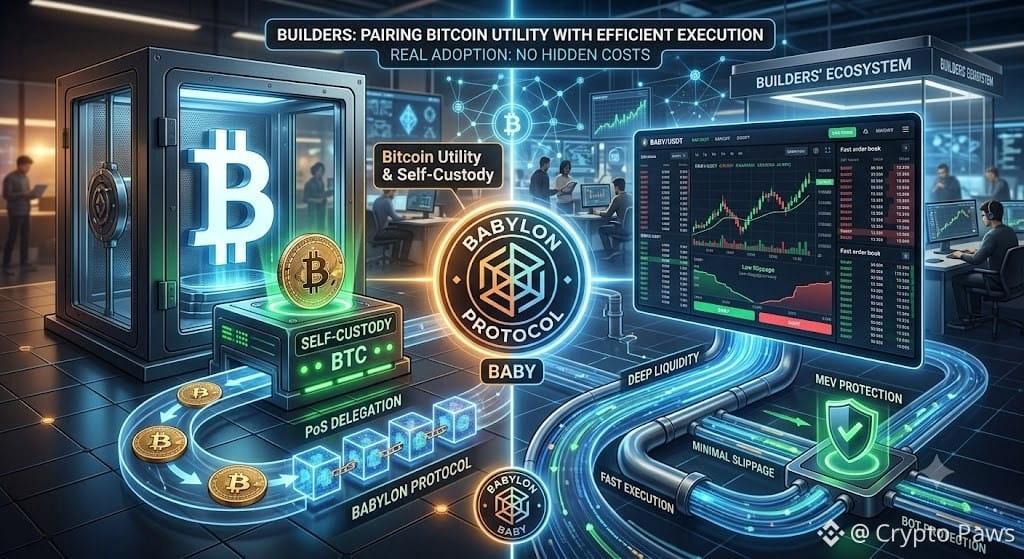
Most crypto conversations start with price, but I usually pay more attention to whether a protocol solves a real problem. That's what made Babylon stand out to me. Letting Bitcoin stay in self-custody while contributing to PoS security feels like a practical use case instead of another wrapped-BTC narrative. Still, strong infrastructure alone isn't enough. The biggest frustration begins when it's time to trade. Slippage widens entries, MEV extracts value, bots react faster than humans, and fragmented liquidity turns a good setup into a worse fill within seconds. Those invisible costs often hurt more than an incorrect market prediction. That's why I'm watching the ecosystem around BABY as much as the token itself. If builders can pair Bitcoin utility with efficient execution, deeper liquidity, and a smoother trading experience, the network becomes far more compelling. Real adoption happens when the technology works well without making users pay hidden costs every time they interact.
$BABY #baby @BabylonLabs_io
Most crypto conversations start with price, but I usually pay more attention to whether a protocol solves a real problem. That's what made Babylon stand out to me. Letting Bitcoin stay in self-custody while contributing to PoS security feels like a practical use case instead of another wrapped-BTC narrative. Still, strong infrastructure alone isn't enough. The biggest frustration begins when it's time to trade. Slippage widens entries, MEV extracts value, bots react faster than humans, and fragmented liquidity turns a good setup into a worse fill within seconds. Those invisible costs often hurt more than an incorrect market prediction. That's why I'm watching the ecosystem around BABY as much as the token itself. If builders can pair Bitcoin utility with efficient execution, deeper liquidity, and a smoother trading experience, the network becomes far more compelling. Real adoption happens when the technology works well without making users pay hidden costs every time they interact.
Most crypto conversations start with price, but I usually pay more attention to whether a protocol solves a real problem. That's what made Babylon stand out to me. Letting Bitcoin stay in self-custody while contributing to PoS security feels like a practical use case instead of another wrapped-BTC narrative. Still, strong infrastructure alone isn't enough. The biggest frustration begins when it's time to trade. Slippage widens entries, MEV extracts value, bots react faster than humans, and fragmented liquidity turns a good setup into a worse fill within seconds. Those invisible costs often hurt more than an incorrect market prediction. That's why I'm watching the ecosystem around BABY as much as the token itself. If builders can pair Bitcoin utility with efficient execution, deeper liquidity, and a smoother trading experience, the network becomes far more compelling. Real adoption happens when the technology works well without making users pay hidden costs every time they interact.
2
2
82
Log in to explore more content
Join global crypto users on Binance Square
⚡️ Get latest and useful information about crypto.
💬 Trusted by the world’s largest crypto exchange.
👍 Discover real insights from verified creators.
Email / Phone number
Trending Topics
AIStocksWhatNext
1.1M views
7,330 Discussing
Share & Win Traffic Reward in our Trending Hashtag Campaign
✨Topic: What Other Investment Opportunities Remain as AI Stocks Keep Rising?
👉How to Join:
Publish a short post or article with hashtag #AIStocksWhatNext
Share whether you’re bullish or bearish, and post your AI stock holdings or trade — using the trade widget may improve your eligibility.
You can also strengthen your post by sharing data or charts, and avoiding AI-generated images.
✍️Create content based on the below angles:
- Nvidia says chip sales will double next year, and top AI companies keep hitting record revenue, the compute spend behind it is just as staggering. Is AI demand really taking off? And how long can it last? AI stocks are up across the board. Is this a real breakout, or just a short-term bounce?
- Industry leaders are calling to slow down AI development, while Trump plans to build an “AI Force”, claiming AI could account for 25% of U.S. GDP in the future. Whose side are you on? Will state-level backing be a long-term win for AI stocks?
- Are you buying AI stocks? Share your AI-related trade/holdings with our trade sharing widget.
⏰Campaign Period:
- 2026-09-22 7:00 - 2026-09-24 4:00 UTC
🎁Reward:
- Qualified posts that comply with the above guidelines and contain more than 100 words will be reviewed and may receive a random traffic boost of 500 to 3,000 views. You will receive a notification from your feed secretary if your post is selected.
- Get a chance to have your article featured on Binance Square Official
Need ideas for your post? Visit the topic page #AIStocksWhatNext or the Square Guide on How to Post for Better Reach.
Binance Square Official
·627 Likes
·1.9M views
USWeighsPromotingDollarStablecoinsAbroad
7 views
5 Discussing
US10YTreasuryYieldHits19YearHigh
311 views
29 Discussing