
Bit Bull 1
128 Posts

Bit Bull 1
Report
Block User
Be greedy when others are afraid | Educational Chic —
Dm ~ http://t.me/AkaBullGurl
0 Following
0 Followers
23 Liked
Posts
·
--
Zora Takes Just Went LIVE 🟢 CT is full of unhinged predictions, questionable calls, and legendary memes. Now imagine attaching all that chaos to an actual trade. 💀 That's what Zora just unlocked. Your wildest market theories, hottest takes, and most cursed memes can now live alongside your trades. Text, images, GIFs, videos. Pick your weapon. I can already see the degens having an absolute field day with this one. The timeline meets the trading terminal, and I'm here for the chaos. Live on Web, iOS, and Android. Time to put those hot takes to work 👇 https://zora.co/
Zora Takes Just Went LIVE 🟢 CT is full of unhinged predictions, questionable calls, and legendary memes. Now imagine attaching all that chaos to an actual trade. 💀 That's what Zora just unlocked. Your wildest market theories, hottest takes, and most cursed memes can now live alongside your trades. Text, images, GIFs, videos. Pick your weapon. I can already see the degens having an absolute field day with this one. The timeline meets the trading terminal, and I'm here for the chaos. Live on Web, iOS, and Android. Time to put those hot takes to work 👇 https://zora.co/
·
--
On-Chain Governance Doesn't Need To Expose Every Vote 🗳️
$UNI helped establish token-based governance as a familiar part of DeFi. $NIGHT brings privacy technology that expands what governance applications can support.
Public voting provides transparency.
But it can also expose individual preferences, sensitive business positions and decisions that participants would rather keep confidential.
For some organizations, that creates a serious limitation.
Imagine a governance system where participants can prove they're eligible to vote without publicly revealing their identities.
Or where individual votes remain private while the final result is verifiable.
Midnight's programmable privacy architecture gives developers tools to build these kinds of systems.
Sensitive information stays protected.
Zero-knowledge proofs verify that required conditions were followed.
And applications disclose only the information their governance model requires.
The next generation of governance combines privacy with accountability.
Midnight is building the infrastructure for it.
#Governance #Privacy
60
·
--
2,000+ Connections Changes The Edge Story 📈
For anyone following active DeFi markets like $UNI , the $2Z story is increasingly about distribution, not just individual feeds.
DoubleZero Edge has recorded more than 2,000 user connections to date.
That matters for both sides of the network.
Consumers get access to an expanding catalog of information.
Data publishers get infrastructure capable of reaching an existing connected base.
That's the flywheel worth watching.
A new feed makes Edge more useful to users.
More users make Edge more interesting to publishers.
2,000+ connections is a strong foundation for that loop to keep expanding.
#MarketData #DeFi
53
·
--
Crypto needs better ways to disagree 🧠
$ARB and $OP remind me that every large Web3 ecosystem eventually develops competing opinions about what should happen next.
Online platforms often reward fast reactions and public certainty, making disagreement feel more divisive than it needs to be.
Physical occasions create a different social pace because people can understand the person behind an opinion.
The scheduled November 22 $Trump Coin Club gala is worth considering from that perspective.
People do not need identical views to spend time together or belong to the same community.
I think strong clubs are partly defined by their ability to remain connected through disagreement.
That kind of social resilience is difficult to measure through a feed 🔥
#Altcoin Season#
54
·
--
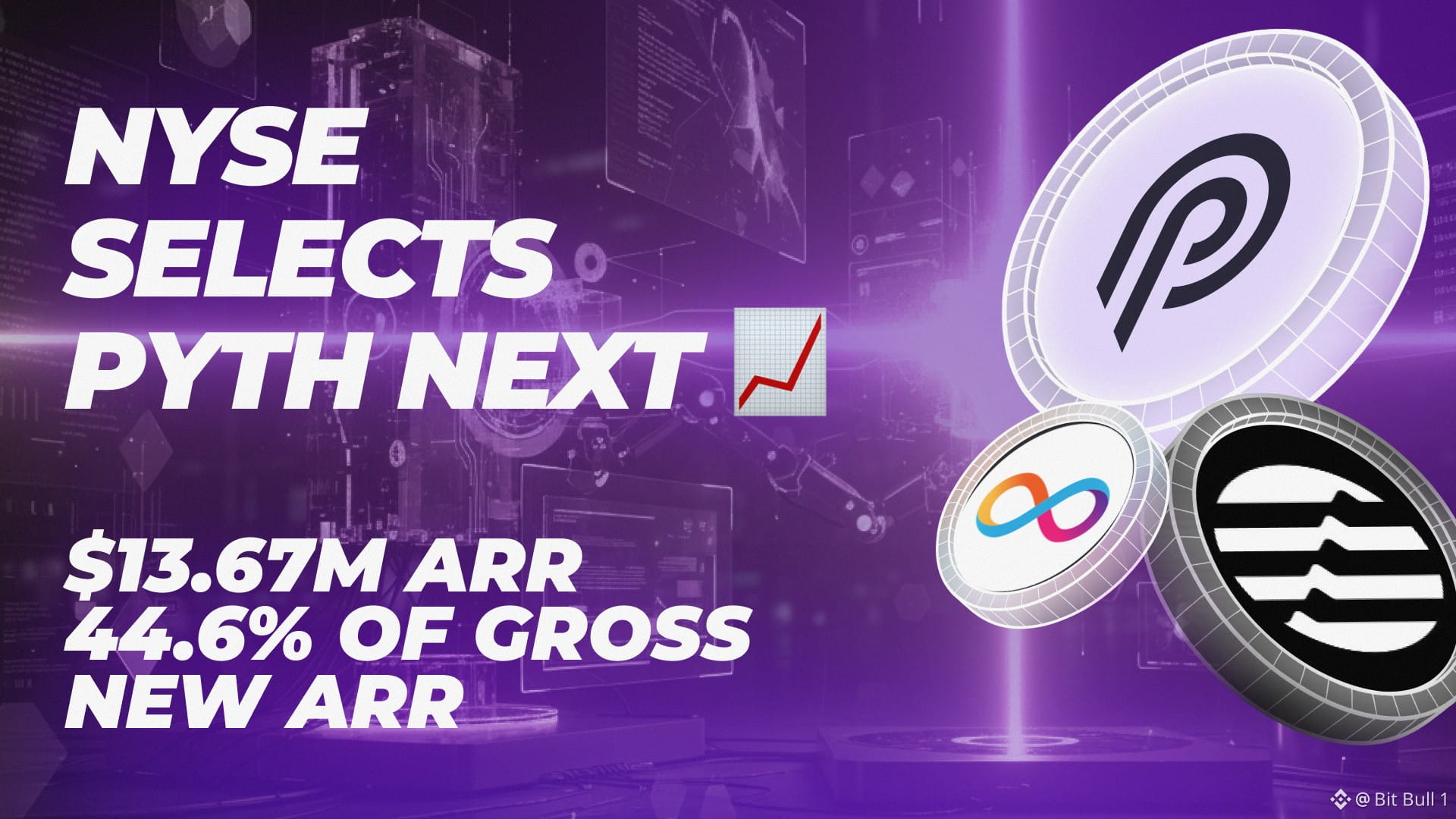
332 Paying Accounts. NYSE Selects Pyth Next 📈
When people discuss scalable apps on $APT or full-stack software infrastructure on $ICP , they tend to focus on what developers can build.
I'm increasingly interested in the financial-data services those developers need once the applications start handling real markets.
Pyth's latest NYSE announcement is a good example.
NYSE BQT is now available through the Pyth Data Marketplace, giving appropriately licensed applications access to real-time equity information from five NYSE Group exchanges.
Consider what a team building an equity-linked trading product might need.
First, a reference price to support the product's market logic. It may also need the underlying exchange's official quotes and closing prices, market-status information, and corporate-action data to understand stock splits or dividends.
Pyth has built products addressing these different requirements.
Pyth Pro delivers aggregated market prices. Pyth Indices provides constructed benchmarks. The Marketplace distributes institutional datasets, while Pyth's corporate-action offering supplies additional context for supported U.S. equities.
NYSE strengthens the Marketplace part of that offering.
And the customer base is already growing.
Pyth finished October with 332 paying accounts and $13.67M ARR, with existing customer expansion contributing 44.6% of gross new ARR.
To me, this is how Pyth can become more commercially important to builders: supporting a wider range of financial-data requirements as their applications grow.
NYSE selecting Pyth provides a powerful new institutional reference for that strategy.
#Altcoin Season# #RWA
53
·
--
October CPI lands today and every trader suddenly has a precise prediction for $BTC and $ETH 👀
A few seconds after the release, most of those predictions could already be outdated.
I care less about calling the number perfectly and more about how the market responds once the uncertainty is gone, because even a hot print can produce a weak sell-off while a cooler print can still fail to hold a rally.
That’s also when the choice of instrument matters.
A perp gives direct exposure to the reaction but keeps funding and liquidation in play, while a bought option defines the risk through its premium but needs the move to happen before expiry.
Aevo offers both, letting traders wait for the reaction before choosing the payoff that fits what the market is actually doing.
The number matters, but the reaction usually tells the better story.
#Macro Insights#

70
·
--
The Next Generation Of DeFi Protects Its Users 🔐
$UNI made decentralized trading accessible to anyone. $NIGHT brings an important capability to the next generation of financial applications: programmable privacy.
Public blockchains made financial activity verifiable.
But they also made wallet balances, transaction histories and trading patterns visible to anyone watching.
For everyday users, that's a privacy concern.
For professional traders, it's a competitive disadvantage.
Midnight changes the design possibilities.
Its zero-knowledge architecture allows developers to build applications that protect sensitive information while proving that required rules were followed.
Imagine financial markets where positions remain confidential without sacrificing verification.
Where participants can demonstrate eligibility without exposing their entire identity.
Where trading applications don't automatically reveal every sensitive input.
The future of DeFi isn't just faster execution. It's financial privacy built into the infrastructure.
That's the opportunity Midnight is building toward.
#DeFi #Privacy
58
·
--
The Hidden Cost Of Renting AI 🔍
Here's something I think more AI builders should understand.
Two teams can pay the same hourly rate for GPUs and still end up in completely different positions.
Why? Because who owns the hardware matters just as much as the price.
B3IQ's model makes the difference easy to see:
A team rents GPU compute from a cloud provider every month.
The longer it runs, the more it pays, and when the contract ends it owns nothing.
But if that team buys a bare-metal NVIDIA machine through B3IQ, the machine stays theirs, and idle capacity can be rented out so it helps pay for itself.
Now add scarce chips, frontier labs locking up capacity years in advance, and smaller teams waiting in line.
The cost of not owning becomes considerably higher.
As ecosystems like $TAO push decentralized AI forward, I think ownership of the underlying compute will become an important part of the conversation.
$B3 's approach is interesting because it covers the stack from the metal to the agents, with B3OS letting agents execute onchain with real funds.
The rental price remains a choice. Owning the machine becomes an option.
#Altcoin Season#
66
·
--
One DNA Test Covers The Whole Family 🧬
Sending a saliva sample to a genetics company is a decision one person makes for an entire family, because a genome describes parents, siblings and children who never signed anything.
It is also why the research value is so high. Large, varied genetic datasets surface disease links that small ones miss, and the biggest datasets sit with companies, hospitals and national programmes that cannot legally pool them.
Apps on $SOL hit the same limit from the other side, since a program can only work on an input it receives whole, and nobody is putting a genome somewhere it stays readable forever.
$ARX runs the analysis on records nobody receives. Each dataset is split into fragments across a cluster of nodes, no single node holds a readable sequence, and the statistics the researchers asked for still come back correct.
Blackthorn, opened to selected users on October 21, carries that to AI models running on GPUs, with the keys for each session held as fragments across independent nodes instead of trusted to the machine in the middle.
Results settle on Solana as ordinary public transactions, so a study can prove what it ran without the sequences behind it ever being gathered in one place.
The families inside those datasets never agreed to be published, and the research that respects that is also the research that finally gets to use all of it.
#AI #Solana
65
·
--
AI Is Making Privacy One Of Crypto's Biggest Opportunities 🤖
$TAO is building an economy around machine intelligence. $NIGHT is bringing programmable privacy to the infrastructure that increasingly autonomous applications need.
As AI agents become more capable, they'll process more financial information, interact with more services and make more decisions without constant human involvement.
But there's a problem.
Public blockchains create permanent records of activity that increasingly powerful AI models can analyze.
Wallet relationships.
Financial positions.
Transaction histories.
Sensitive business information.
Midnight changes what developers can build.
Its programmable privacy architecture lets applications protect sensitive data while using zero-knowledge proofs to verify that required conditions were met.
That means AI-powered applications can be designed to prove an action was valid without exposing every private input behind it.
The next generation of autonomous finance needs both intelligence and confidentiality.
AI is scaling what software can do.
Midnight is building the privacy infrastructure that makes those capabilities more useful for the real world.
#AI #Altcoin Season#
·
--
The Hidden Fee Trap 🔍
Here's something I think more DeFi investors should understand.
Two investment vaults can advertise the same 20% performance fee and still produce different outcomes.
Why?
Because the fee calculation matters just as much as the percentage.
Space and Time's latest vault analysis gives a simple example:
A vault uses a $100-per-share high-water mark.
If the applicable share value rises to $110, a 20% performance fee produces a $2 charge per eligible share, assuming no other adjustments.
But if the value stays below $100, that policy produces no performance fee.
Now add investor deposits, withdrawals, share dilution, and changing valuations.
The accounting becomes considerably more complicated.
As ecosystems like $AVAX support increasingly sophisticated DeFi applications, I think independently verifiable calculations will become an important part of investor transparency.
Space and Time's approach is interesting because Proof of SQL can verify supported fee calculations against committed data without requiring every computation to happen inside a smart contract.
The fee policy remains a choice. The arithmetic becomes independently checkable.
#Altcoin Season#
60
·
--
Memes Are Becoming Markets 🐸
The popularity of $PEPE and $WIF demonstrated how powerful internet culture can become when it meets liquid crypto markets.
Neither started with a complicated financial product.
Their appeal came from recognizable ideas that communities could spread almost instantly.
But here's what I find interesting.
Not every cultural moment needs to develop into a massive memecoin before people can participate in its momentum.
Sometimes a particular topic, trend or viral moment attracts attention for only a short period.
Traditional memecoin markets aren't always designed to capture those smaller narratives.
Zora's Tags provide a different approach.
Users can create markets around topics, memes and ideas.
Related posts can then connect with those broader trends.
This introduces a more granular way of participating in cultural narratives.
Instead of requiring every idea to become a standalone community with enormous ambitions, markets can emerge around individual moments.
Of course, short-lived attention can also mean short-lived liquidity.
That's the trade-off.
But I think this category becomes interesting as more internet-native users discover onchain markets.
Zora already has experience turning digital content into tradable assets.
Extending that model toward more specific cultural trends creates another potential source of trading activity.
I'm keeping an eye on how this develops.
#Memecoins #Altcoin Season#
67
·
--
Read The Split Before You Read The Chart 🧮
Launch mechanics are published numbers, and almost nobody checks them before they commit. $CAKE holders learned to read fee structures the hard way, and $CRV turned fee design into an entire political system, so the precedent for caring about this is well established.
Here is what the structure actually says.
Trading activity carries a 0.7 percent swap fee. Of that fee, 95 percent goes to the creator and 5 percent to the protocol. The creator allocation is 15 percent of supply, vesting across a year behind a thirty day cliff, and vesting can be switched off entirely at launch. The remaining 85 percent seeds the pool at deployment.
Read what that arrangement is designed to do rather than what it pays. A thirty day cliff means the person who launched cannot sell into your first month. A year of vesting means their position resolves on a timescale where the thing has to still exist. And an optional disable means a creator can choose to hold nothing, which is a signal you can check rather than a claim you have to believe.
None of this tells you whether a given launch is any good. Structure is not quality. But it tells you how the person on the other side gets paid, and in DeFi that is usually the most informative sentence available.
The numbers are public. Read them first.
#DeFi #Altcoin
68
·
--
The Next Payment Revolution Is Private 💳
$XLM has spent years building infrastructure around moving value efficiently.
$NIGHT addresses another major requirement for digital payments: confidentiality.
Think about how payments work outside crypto.
A merchant doesn't automatically receive a customer's complete financial history.
A supplier doesn't get access to every other business relationship a company maintains.
But transparent blockchain payments can expose information that neither party intended to share.
Midnight gives developers a different model.
Sensitive transaction information can remain protected while cryptographic proofs verify that required conditions were satisfied.
That opens opportunities for:
→ Confidential business payments
→ Private customer transactions
→ Selective financial disclosures
→ Verifiable settlement with less exposure
Payments need to be efficient.
They need to be reliable.
And they need to respect financial privacy.
The next generation of payment infrastructure brings all three together.
Midnight is building the privacy tools for that future.
#Meme Alpha# #Privacy
47
·
--
Wall Street Just Made A Big Blockchain Move 👀
Everyone's looking for the next institutional catalyst, but one of the biggest developments might be happening behind the scenes.
DTCC custodies $114T in securities and now they're working with ZKsync to provide privacy infrastructure through Prividium.
If that's not a major institutional endorsement of ZKsync tech, then I don't know what is.
It's been a big week for privacy with $ZEC upgrades and growing demand for $NEAR 's confidential transactions built on Intents. But ZKsync may be the underdog no one saw coming.
Now ZKsync is positioning itself as critical infrastructure that allows institutions to manage collateral onchain while maintaining the confidentiality and control their operations require.
Still early.
#Altcoin Season#
68
·
--
The Best Infrastructure Goes Where The Activity Goes 📡
$2Z Edge expands around the markets traders actually care about. $HYPE is a good example of that demand-driven approach.
Crypto activity moves constantly.
Different venues dominate different narratives.
Different ecosystems capture liquidity at different times.
DoubleZero Edge gives the same underlying connection access to an expanding set of market-data sources.
That means the infrastructure can become more useful as trader attention shifts rather than forcing users to start over every time the market rotates.
Altseason rotates.
Good infrastructure adapts with it.
#Altcoin Season# #Macro Insights#
85
·
--
$PYTH ARR Up 86%, DAO Commits 100% To Reserve 📈
If you've followed $LINK for its role in DeFi infrastructure, the commercial numbers coming out of Pyth deserve a serious look. The new DAO policy commits every dollar it receives from Pyth products to accumulating PYTH.
Here's what makes the timing so interesting.
At the end of Q1, Pyth had $2.95M in annual recurring revenue. By Q2, that number had climbed to $6.16M, and Q3 closed at $11.49M.
That's $5.33M in net new ARR during a single quarter.
Now imagine evaluating that same growth curve alongside a standing monthly accumulation mechanism.
Under OP-PIP-136, funds received by the DAO from Pyth products are committed entirely to the PYTH Reserve. Stablecoins are used to purchase PYTH on the open market, while PYTH received directly is added to the Reserve.
The distinction is important: the policy covers funds received by the DAO, rather than Pyth's entire gross revenue.
I find this particularly compelling because the underlying business already has 276 paying accounts and supplied prices for $2.04T of tracked RWA perp volume last quarter.
There is a commercial business here that investors can actually analyze.
The PYTH Reserve currently holds 42M tokens, with acquisitions documented through onchain transaction proofs and monthly reporting.
I'm watching how quickly the size of those acquisitions changes as the business grows. That relationship between commercial income and Reserve activity may become one of the most useful metrics for evaluating PYTH.
Most people will watch the price chart. I'll be watching the monthly Reserve reports alongside it.
#Altcoin Season# #RWA
66
·
--
Three Payment Apps, One Compute Layer 🧱
Categories get interesting when several teams independently pick the same bottom layer, and payments on $SOL is where that is happening right now.
Umbra runs a confidential wallet for shielded transfers and swaps, public since March. Stealf is building a confidential financial system for payments and stablecoins. Dinaro is building confidential global payments with local off ramps.
Three products, three different users, one compute layer underneath, which is worth more as a signal than any single launch.
What they share is the problem. A payment is a transfer with an amount attached to an address, so a wallet doubles as a statement, and no app can fix that on its own.
$ARX gives each of them its own cluster. A job is split into fragments across the nodes in that cluster, no single node holds a readable copy of the input, and the correct result goes back to the program that asked.
Every one of those results settles on Solana as an ordinary public transaction, so the apps stay auditable while the inputs never were.
Fifteen teams now sit on Arcium's ecosystem page, and C-SPL, which seals the amount inside an ordinary token transfer, has not shipped yet.
A year ago this was a research category with no products, and the payments shelf alone now has three.
#Payments #Solana
86
·
--
Your Agent Can Run On A Frontier Model And Pay In Crypto 🧠
$NEAR is doing the private execution work and $BNKR is doing the billing, which is the half nobody writes about.
The Bankr LLM Gateway puts the major models behind one interface. Gemini 4 Argon is the newest addition, alongside Claude, GPT and Grok, with OpenAI and Anthropic compatible endpoints so existing code keeps working.
The part that matters for anyone building is payment.
Inference is normally gated behind a corporate billing relationship. A card, an account, an invoice address, a legal entity. That is a solved problem for a company and a genuine wall for an agent, a solo builder, or anyone outside the jurisdictions those systems serve smoothly.
Paying from crypto already in a wallet removes the wall. Paying from fees a launch generated removes it further, because the thing funding the model is the thing the model helps run.
Caveats worth stating. A gateway routes your request to a provider, and that provider's policies apply to what you send. Model availability and pricing move. And one interface across many models is a convenience, not a guarantee that any of them suits your task.
The structural read is simple though. Compute you can pay for without a bank account is a different market from compute you cannot.
#AI #Infrastructure
70
·
--
Trading fees should change token supply 🔥
Following $UNI and $AAVE taught me to look beyond whether a protocol earns fees, and I want to know what those fees actually do once they enter the system.
Trading activity can grow while the token remains completely disconnected from it, which weakens the reason to hold the asset as the product expands.
For me, the more interesting model is one where product use creates fees and part of that value changes the token’s supply.
Aevo does this through its monthly buyback and burn program.
In October, another 1m AEVO was bought back using exchange trading fees and permanently burned.
That brought the total removed through AGP-3 and the monthly program to 78m AEVO.
That is 7.8% of the original supply ⚡️
#Altcoin Season#
91
Log in to explore more content
Join global crypto users on Binance Square
⚡️ Get latest and useful information about crypto.
💬 Trusted by the world’s largest crypto exchange.
👍 Discover real insights from verified creators.
Email / Phone number
Trending Topics
NvidiaBeatsEstimatesAICloudStocksRiseAfterHours
8,004 views
92 Discussing
Nvidia Beats With $115.8 Billion in Revenue, Guides to $130 Billion and Adds $150 Billion Buyback
Binance News
·11 Likes
·12.9k views
A Packed Week of Earnings and Data Tests Markets
155,374 views
668 Discussing
AnthropicIPOTestsInvestorAppetiteForAI
342,867 views
2,945 Discussing