
Insight EN
1.3k Posts

Insight EN
Report
Block User
1 Following
14 Followers
36 Liked
Posts
·
--
Black Friday is here, and Adobe expects US shoppers to spend a record $12.9 billion online today, up 9.2% from last year.
Cyber Monday on November 30 is forecast to go further, with $15.1 billion in a single day, up 6.2%, the first $15 billion online shopping day ever. The full five day Cyber Week is set to drive $47.5 billion, up 7.4%.
For the whole holiday season, Adobe expects US online sales of $275.1 billion, up 6.7% from 2025.
17
·
--
Bitcoin slips below $60,000 in a sharp late drop
Bitcoin fell below $60,000 on Friday, sliding about 3% in an hour to around $59,600 as sellers pushed the largest cryptocurrency through the closely watched level.
Ether also fell, trading near $1,656. The drop extends a brutal month for crypto. Bitcoin is down about 24% over the past 30 days and touched a 52 week low near $55,150 on November 21.
US spot Bitcoin ETFs have lost a net $5.39 billion in November through November 25, the largest monthly outflow since the funds debuted in January 2024, according to SoSoValue data.
Short term holders now sit on average unrealized losses of about 15% against a cost basis near $71,600, according to CryptoQuant data.
$BTC $ETH
66
·
--
US equity funds saw net outflows of $30.57 billion in the week to November 25, the largest weekly outflow since September 9, LSEG Lipper data showed.
Technology sector funds led the selling with $9.27 billion in net sales as investors questioned the returns on massive AI infrastructure spending. Hawkish commentary from Federal Reserve officials added to the pressure on risk assets.
Global equity funds lost $22.73 billion in the same week, the biggest weekly outflow in 14 months, while European funds drew in $7.29 billion.
80
·
--
While Wall Street slept, the AI worry moved into credit
US markets were shut Thursday for Thanksgiving, so the AI selloff found another outlet: credit.
SoftBank, the biggest bellwether for AI spending through its OpenAI stake, saw the cost of insuring its debt jump for a second straight session on Thursday. Its five year credit default swap widened more than 20 basis points to 534.6, a four year high, Reuters reported. The implied default probability now sits at 34.8%.
The worry is simple: vast AI infrastructure spending may not pay off fast enough to service the debt behind it. SoftBank stocks and bonds have both come under pressure this week as that question gets louder.
Wall Street reopens Friday for a short session, closing early at 18:00 UTC. If the credit market is right, the equity rebound may face a fresh test.
35
·
--
Goldman Sachs turns bullish on Hong Kong stocks, sees China up 10% next year
Goldman Sachs has turned bullish on Hong Kong stocks. At its annual outlook briefing on Wednesday, November 25, chief China strategist Liu Jinjin upgraded Hong Kong listed Chinese shares to overweight from neutral, and cut mainland A shares to neutral. The bank expects the MSCI China Index to rise 23% by the end of 2027, and set a 4,500 target for the CSI 300, implying a gain of about 10%.
The call rests on earnings, not valuation. Goldman expects Hong Kong earnings to grow about 15% next year, up from 8% this year, with internet profits swinging from a 3% decline to 18% growth. The MSCI China Index trades at 9.8 times forward earnings, about one standard deviation below its ten year average. The bank also expects about $100 billion of mainland money to flow into Hong Kong stocks next year through Stock Connect, and upgraded semiconductors, pharmaceuticals and consumer services to overweight.
Hong Kong stocks rose on Thursday, the day after the briefing. The Hang Seng Index closed 1.19% higher at 22,227, ending a seven session slide, while the Hang Seng Tech Index gained 1.16%.
Why it matters: Chinese equities have had a disappointing 2026, and Goldman is now betting the trade shifts from AI hardware momentum to earnings growth and cash returns. The bank still warns of a volatile start to 2027, with two more Federal Reserve hikes expected in December and March.
52
·
--
Wall Street claws it back: the Dow erases a 1,100 point plunge
Wall Street staged a sharp reversal on Wednesday. The Dow Jones Industrial Average fell more than 1,100 points in the morning, turned positive by about 2pm in New York, up 261 points, or 0.5%, and finished up 164 points, or 0.3%, at 50,183. The S&P 500 cut a drop of as much as 3.2% to 0.25% lower at the close, finishing at 7,183, while the Nasdaq Composite narrowed a 4.6% plunge to a 0.6% loss, closing at 23,586.
The VIX climbed above 33 in the morning, then eased to 28.29 at the close.
Gold and silver joined the rebound. Gold futures bounced about $170 off the intraday low near $3,426 to settle at about $3,597. Silver fell more than 5% in the morning, then recovered to about $41.35 by the close.
Nvidia slid as much as 8% at the open and was still down about 6% in the afternoon, but closed down 3.9% at $149.30, with chip stocks still under pressure even as the broader market recovered.
Why it matters: US markets are closed Thursday for Thanksgiving, and Friday is a half day, so the final hours of Wednesday set the tone for a thin holiday week. The question now is whether this was real dip buying or just a holiday bounce.
399
·
--
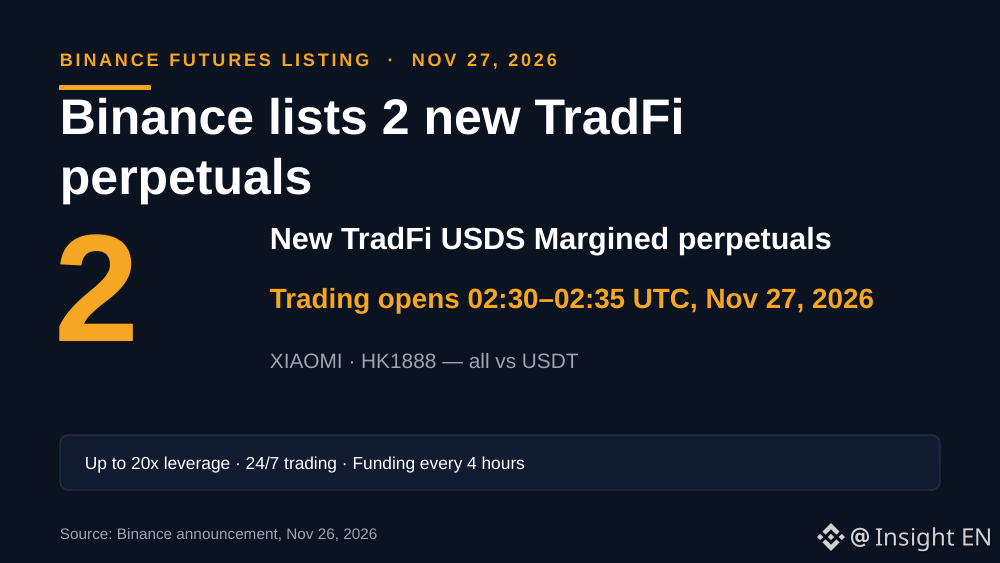
Binance Futures Listing: 2 New TradFi Perpetual Contracts
Binance Futures will launch two new TradFi USDS Margined perpetual contracts on 27 Nov 2026:
• $XIAOMI — XIAOMI/USDT, Xiaomi Corporation (HKEX: 1810), opens 02:30 UTC
• $HK1888 — HK1888/USDT, Kingboard Laminates Holdings (HKEX: 1888), opens 02:35 UTC
Both are USDT settled, trade 24/7, offer up to 20x leverage, with funding fees settled every four hours and capped at +1.00% / -1.00%.
#Binance #Futures
106
·
--
Brent's Gulf rally fades: January crude ends lower at $90
Oil's Gulf rally did not survive the day. January Brent crude spiked as high as $93.53 on Wednesday after Yemen's Houthis said they had attacked Saudi Arabia's Ras Tanura refinery, a claim Reuters said has not been independently confirmed. But US inventory data turned the market around, and Brent closed down about 1.4% at $90.09, below Tuesday's $91.40 settle.
US crude went the other way. WTI closed at $83.49, up 1.75% on the day.
The EIA reported US crude stocks rose 1.1 million barrels last week, adding to the surplus case. The API had reported a much smaller build of just 126,000 barrels, far below the 1.5 million analysts expected.
The failed rally still leaves Brent more than a fifth below its October 30 close near $118.
Why it matters: the next test comes on Sunday, when OPEC+ meets to decide 2027 output policy. Until then, the market is caught between war risk and a surplus that has not gone away.
305
·
--
The Nasdaq 100 touched bear market territory, then stepped back
Wall Street's AI selloff deepened on Wednesday, and the Nasdaq 100 briefly crossed the line investors fear most.
The index fell as much as 4.7% in the session and touched 20% below its record close of 31,224 on October 6, dipping to an intraday low near 24,971. It then bounced back above the bear market line near 24,980, so the bear market is not confirmed. That takes a close below the line.
Monday's rally is gone. The index had jumped after Nvidia brought Jensen Huang back as chief executive, but Wednesday's drop wiped out those gains and left the gauge down about 0.6% for the year.
Anthropic added to the gloom. Shares in the AI developer, which went public last week at $83, fell to about $78 on Wednesday, below the IPO price. Bloomberg puts the value erased across the rout at more than $8.5 trillion.
Why it matters: a close below 20% would mark the first Nasdaq 100 bear market since April 2025. Until then, Wednesday was a warning, not a verdict.
186
·
--
Hot inflation, strong growth, and a Fed hike that is now near certain
US inflation came in hot and growth came in strong on Wednesday, and together they leave the Federal Reserve with little room to wait.
Core PCE, the Fed's preferred inflation gauge, rose 3.3% from a year earlier in October, above the 3.2% forecast and up from 3.1% in September. It is the highest reading since November 2023. Headline PCE rose to 3.8%, up from 3.6% and in line with forecasts.
The economy grew at a 4.3% annual pace in the third quarter, revised up from 3.4% and nearly double the 2.2% pace in the second quarter. Jobless claims fell to 189,000 last week, below the 200,000 forecast.
Traders now put the odds of a December hike at 97.8%, with the Fed meeting on December 9. Gold slid about 2.7% to $3,458 as the hike case hardened, and silver fell 5.4% to $38.70.
Why it matters: hot inflation plus strong growth is the combination that keeps a hike on the table. The question is no longer whether the Fed moves in December, but how many more hikes follow in 2027.
#fed
152
·
--
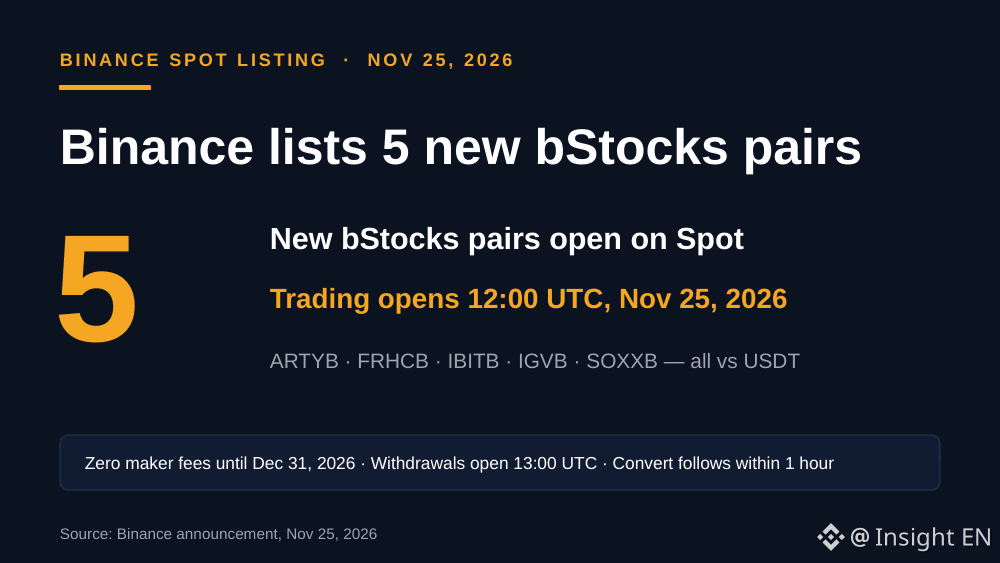
Binance Spot Listing: 5 New bStocks Pairs
Binance will open trading for five new bStocks pairs on Spot at 12:00 UTC, 25 Nov 2026:
• $ARTYB — ARTYB/USDT
• $IBITB — IBITB/USDT
• $SOXXB — SOXXB/USDT
• FRHCB and IGVB — also vs USDT
Zero maker fees on these pairs until 31 Dec 2026, 23:59 UTC. Withdrawals open at 13:00 UTC, and Convert trading follows within one hour of the Spot listing.
#Binance #Spot
115
·
--
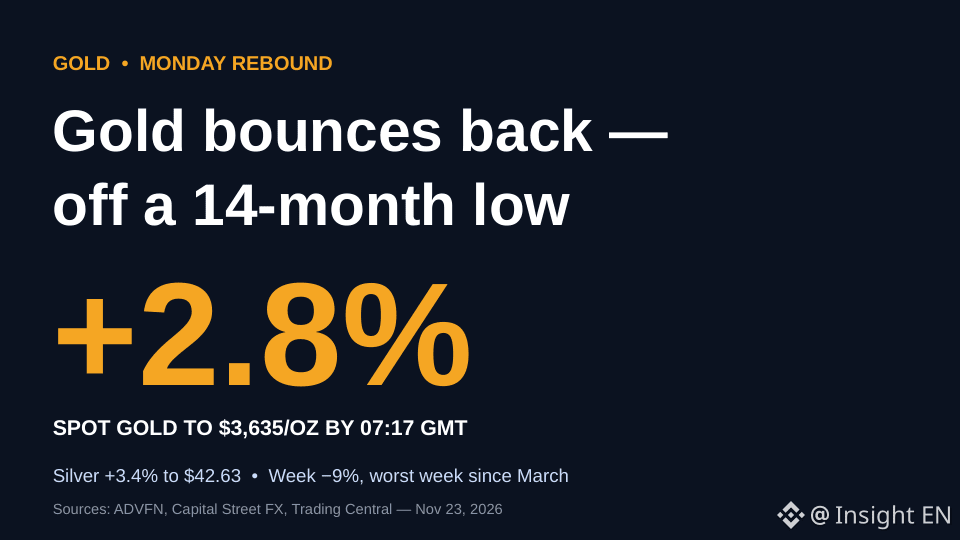
Gold bounces 3% off a 14-month low — the selloff pauses, not ends
Gold snapped back on Monday. Spot prices rose 2.8% to $3,635 an ounce by 07:17 GMT (ADVFN) and touched about $3,690 in the session — after hitting its lowest since September 2025 on Friday, a 14-month low.
Friday was brutal: gold closed near $3,538, down 2.4% on the day, capping an ~9% weekly loss, its worst week since March. Silver joined the bounce, up 3.4% to $42.63.
The driver is the same tech sell-off rattling stocks: money rotating into safety while equities wobble. But one green day doesn't erase a 9% week — and Wednesday's PCE and GDP (13:30 UTC) decide whether the bounce holds.
445
·
--
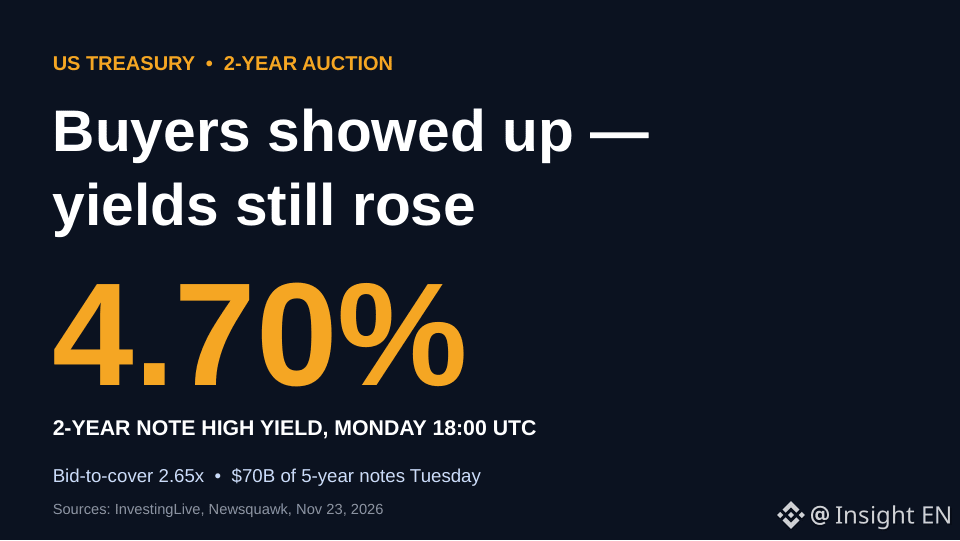
Bond buyers showed up — and yields still rose
The Treasury sold $69 billion of 2-year notes on Monday (18:00 UTC) at a high yield of 4.700% — a touch below the 4.703% when-issued level — with bids covering the sale 2.65 times, up from 2.59 times at the last auction (InvestingLive).
Solid demand, in other words. But the 2-year yield still climbed about 7 basis points to 4.69% on the day. Buyers wanted the paper — they just wanted to be paid more to hold it.
That is the market pricing the same story stocks are trying to ignore: the Fed leaning toward a December hike, with Wednesday's PCE and GDP (13:30 UTC) the next test.
The supply keeps coming: $70 billion of 5-year notes on Tuesday, then $44 billion of 7-year notes on Wednesday. If demand holds through that wall of paper, the rebound has room. If it doesn't, yields do the talking.
SHYETF-0.04%
IEFETF-0.38%
39
·
--
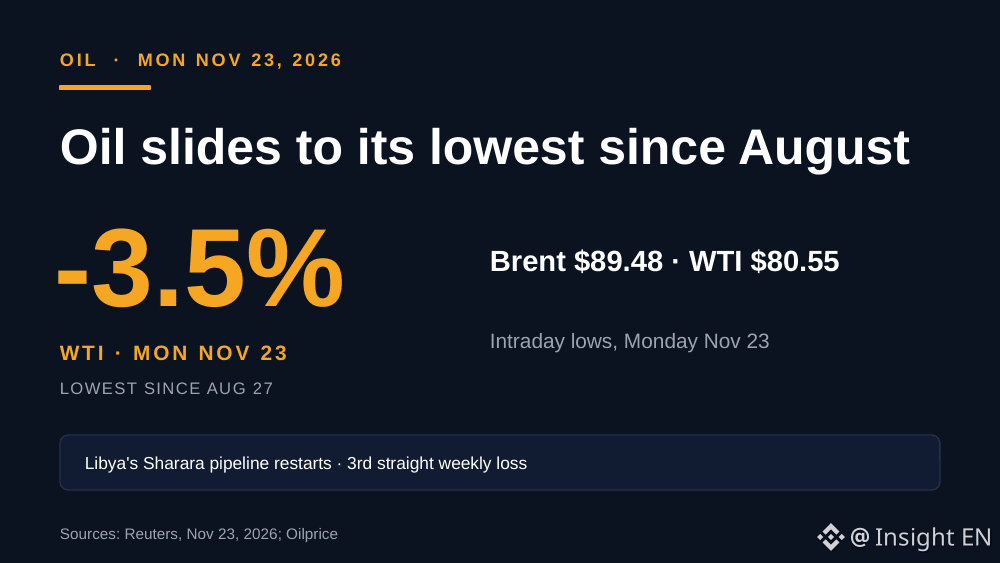
Oil slides to its lowest since August — even as stocks rebound
While Wall Street cheered Jensen Huang's return to NVIDIA, oil went the other way — hard.
Brent fell to $89.48 a barrel on Monday, its lowest in two weeks, and WTI touched $80.55, its weakest since August 27 (Reuters). By mid-morning in New York, WTI was down 3.5% at $80.50 and Brent down 3.6% at $89.23.
The driver is supply, not demand. Flows from the Middle East are rising, and Libya's Sharara pipeline has restarted — the head of the National Oil Corporation told Reuters on Monday, with crude already flowing into storage at Zawiya. That outweighed another day of attacks on Gulf shipping and refineries linked to the war with Iran.
It is oil's third straight week of losses, and the slide came on the same day Nasdaq-100 futures jumped 3.5%. The market is pricing more barrels, not more fear.
Watch Wednesday: the same PCE and GDP data that will decide whether Monday's stock rebound holds could move crude too — a hot inflation print would strengthen the case for the Fed's December hike and a firmer dollar, both headwinds for oil.
423
·
--
Verified
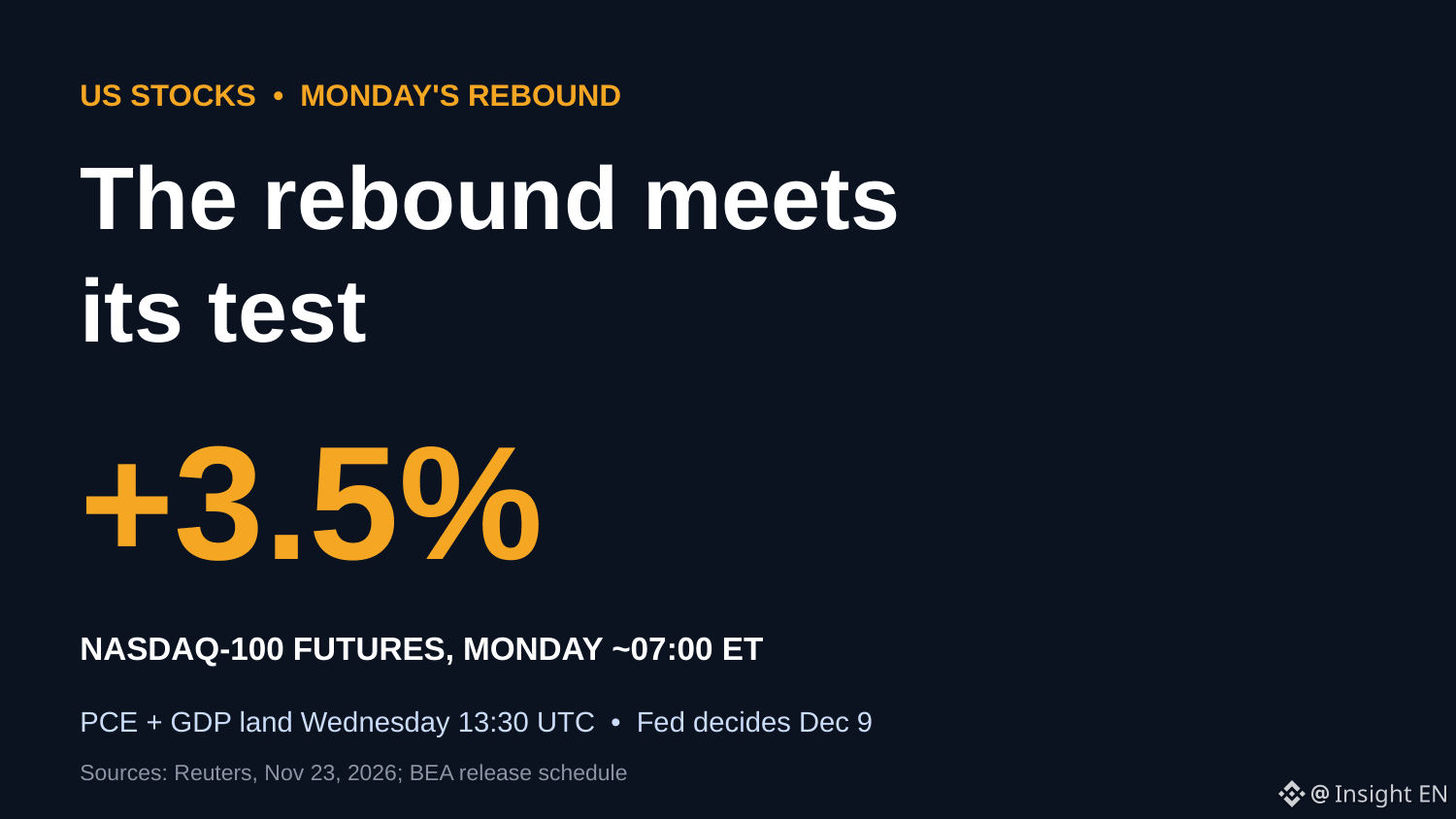
The rebound meets its test: Wednesday's PCE and GDP decide if Monday's snapback holds
After the worst week for the Nasdaq-100 since March 2020, Monday brought relief — and a test.
US futures bounced before the open: Nasdaq-100 +3.5%, S&P 500 +2.8%, Dow +2.0% (Reuters, about 07:00 ET Monday). Chip stocks led — Nvidia +8.7% premarket, AMD +5.8%, Broadcom +5.7%, Micron +7% — after a week that left the Nasdaq-100 down 19.8% from its October 6 high, just short of a bear market.
Gold joined the rebound, up about 3% to roughly $3,620 an ounce after a 9% weekly drop to a 14-month low. Silver rose about 3% to $42.40 after falling 15% last week. Oil went the other way: Brent near $92 and WTI near $83, both slightly lower on Monday.
The rebound now meets its test. Wednesday, November 25, at 13:30 UTC brings the October PCE report — the Fed's preferred inflation gauge, forecast +0.3% for the month, which would lift the annual rate to about 3.8% — plus the second estimate of third-quarter GDP (first read: +3.4%) and jobless claims. The Fed's Beige Book follows at 19:00 UTC.
Then Thanksgiving thins trading, and attention turns to the Fed's decision on December 9, with markets pricing about a 91% chance of a quarter-point hike. If Wednesday's data runs hot, Monday's snapback may not hold.
#fed
563
·
--
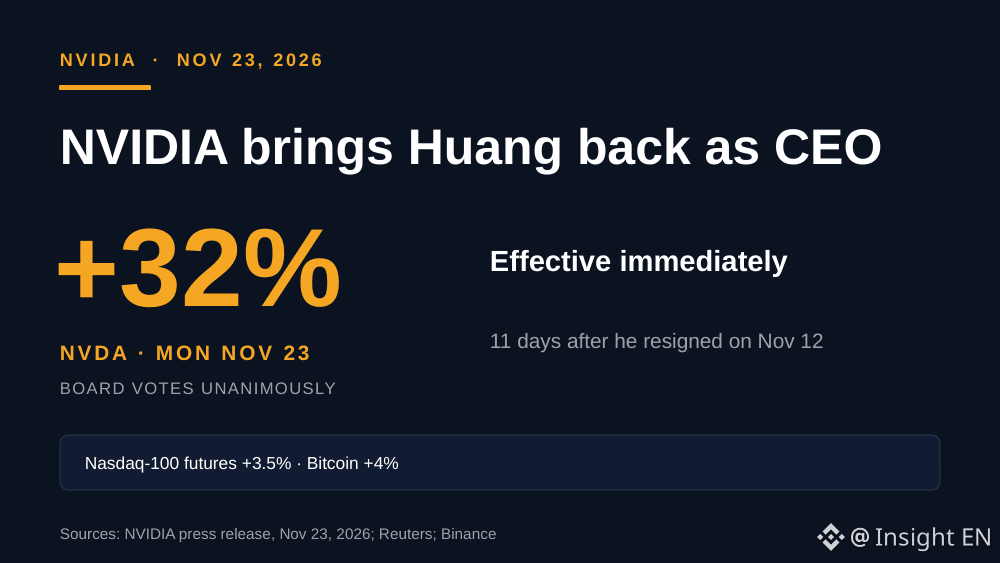
NVIDIA brings Jensen Huang back as CEO — and the market is buying the comeback
NVIDIA's board voted unanimously to reinstate Jensen Huang as President and CEO, effective immediately. Huang resigned on November 12, just 11 days ago. The board says it is satisfied with his candor and leadership, and — after input from senior US government officials — is confident his return poses no national security risk. Its independent investigation continues. Harvey Jones stays on as board chair; Colette Kress, interim CEO since the resignation, returns to her CFO role full time.
The market cheered. NVIDIA shares surged about 32% to roughly $166, from Friday's close of $125.53. US futures were already green — Nasdaq-100 +3.5%, S&P 500 +2.8%, Dow +2.0% (Reuters, about 07:00 ET Monday) — after the worst week for the Nasdaq-100 since March 2020. Bitcoin rose about 4% to about $63,400, and gold held near $3,620, up about 3%.
The reinstatement caps a remarkable 11-day reversal — just days after the board chair said the company would not bring Huang back. President Trump had publicly backed his return.
$NVDA $BTC
77
·
--
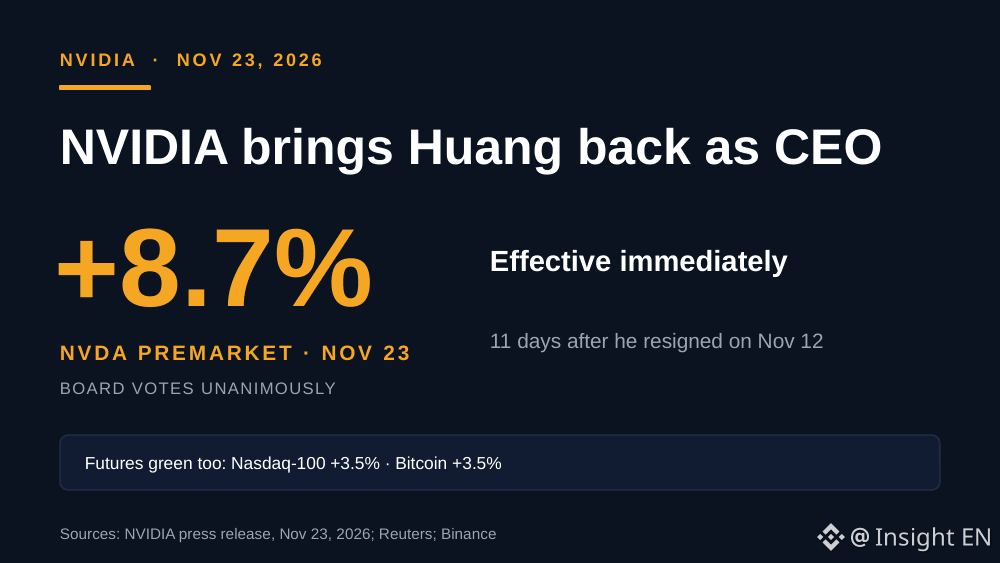
NVIDIA brings Jensen Huang back as CEO — and the market is buying the comeback
NVIDIA's board voted unanimously to reinstate Jensen Huang as President and CEO, effective immediately. Huang resigned on November 12, just 11 days ago. The board says it is satisfied with his candor and leadership, and — after input from senior US government officials — is confident his return poses no national security risk. Its independent investigation continues. Harvey Jones stays on as board chair; Colette Kress, interim CEO since the resignation, returns to her CFO role full time.
The market cheered. NVIDIA shares jumped 8.7% in premarket trading. US futures were already green — Nasdaq-100 +3.5%, S&P 500 +2.8%, Dow +2.0% (Reuters, about 07:00 ET Monday) — after the worst week for the Nasdaq-100 since March 2020. Bitcoin rose 3.5% to about $62,970, and gold held near $3,620, up about 3%.
The reinstatement caps a remarkable 11-day reversal — just days after the board chair said the company would not bring Huang back. President Trump had publicly backed his return.
$NVDA $BTC
107
·
--
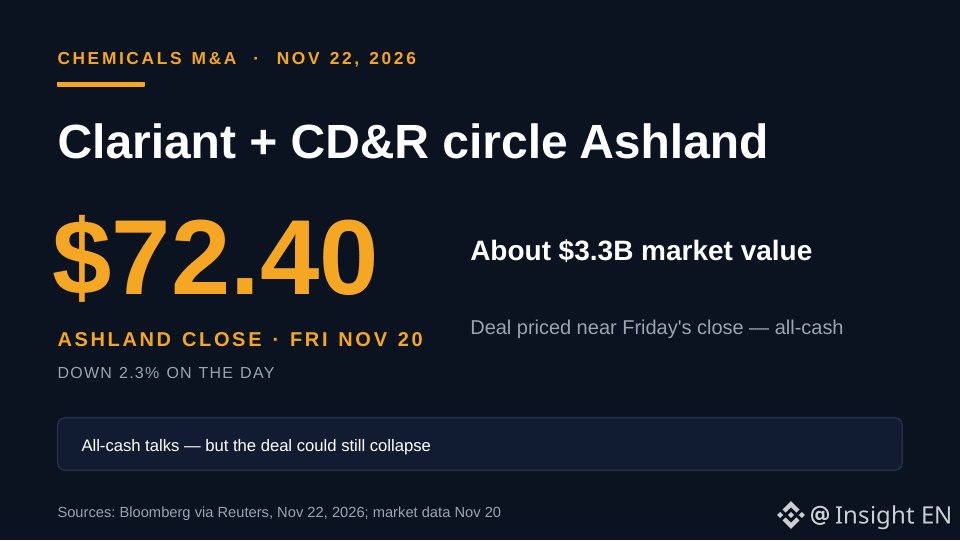
Clariant and CD&R are circling Ashland — a deal could land within days
Swiss chemicals maker Clariant and private equity firm Clayton, Dubilier & Rice are in talks to buy US specialty chemicals company Ashland in an all-cash deal, Bloomberg reported on Sunday, November 22, citing people familiar with the matter. Reuters said it could not immediately verify the report.
The two sides are discussing a deal valuing Ashland at close to its Friday closing price. Ashland shares closed at $72.40 on Friday, November 20, down 2.3% on the day, giving the company a market value of about $3.3 billion.
A deal could be reached within days, according to the report — but nothing is final. The talks could still collapse, and other bidders could join.
The approach follows months of pressure. Activist investor Ancora, which holds about 4.2% of Ashland, has pushed for a sale since June, arguing the shares are undervalued. Apollo and Carlyle have also been linked to the process, while Evonik's interest has cooled, according to Bloomberg.
For now, Ashland is a reluctant seller — and buyers are circling anyway.
#mergers #chemicals
CGUS+3.17%
38
·
--
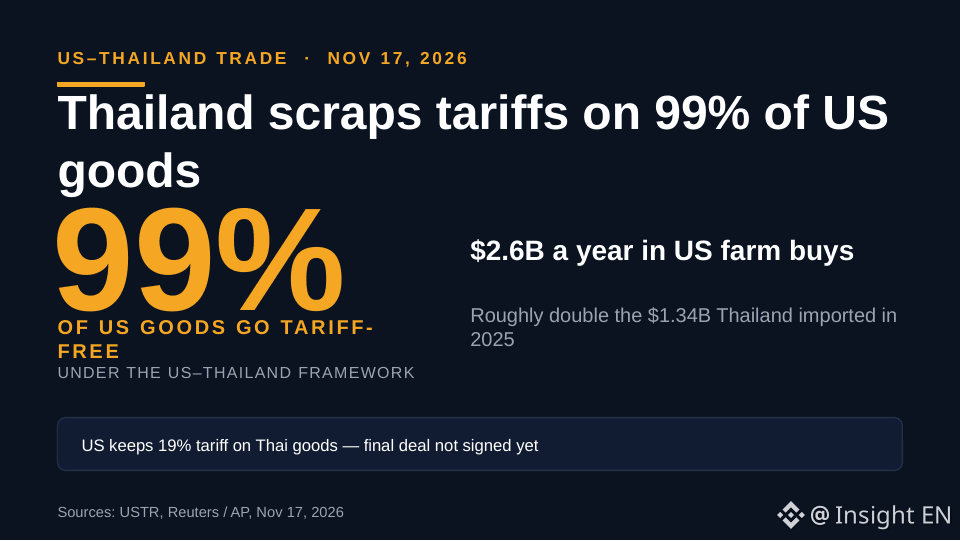
Thailand to scrap tariffs on 99% of US goods — but the deal isn't signed yet
The United States and Thailand signed a joint statement on November 17 in Manila, wrapping up negotiations on a reciprocal trade deal — but the final agreement still isn't signed.
Under the framework, first set out by the US Trade Representative in October 2025, Thailand will eliminate tariffs on 99% of American goods, covering industrial and farm products. Bangkok will also drop non-tariff barriers on US cars, medical devices, pharmaceuticals, ethanol and poultry.
In return, Thailand agreed to buy about $2.6 billion a year in additional US farm products — roughly double the $1.34 billion it imported in 2025.
The catch: the US keeps its 19% reciprocal tariff on most Thai goods, and the final text is still going through legal checks. It is expected to be finalised in early 2027.
The stakes are lopsided: the US exported $19.6 billion to Thailand in 2025 but imported $91.3 billion.
A win for US exporters — if the signatures follow.
#trade #tariffs
345
·
--
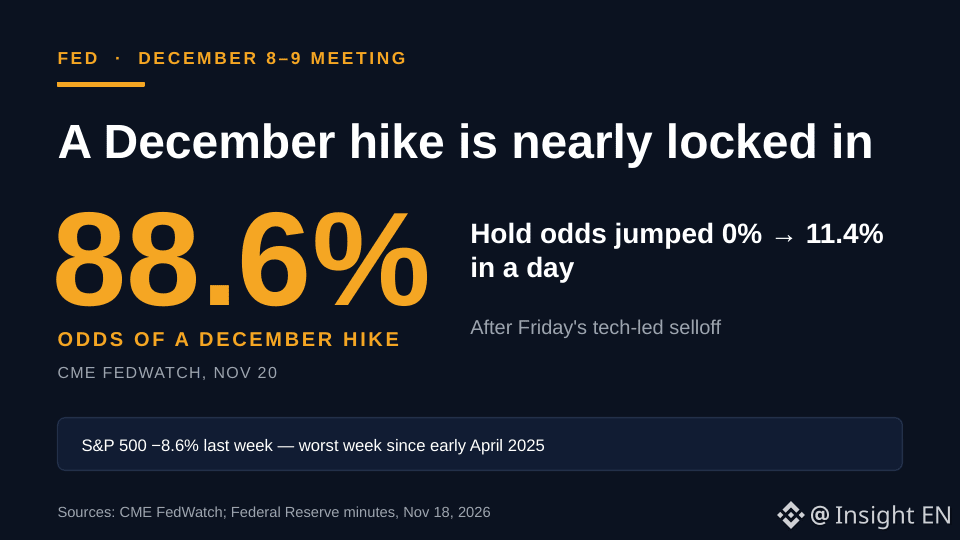
The Fed is leaning toward a December hike — the selloff isn't stopping it
Federal Reserve officials are leaning toward another rate hike in December — and some are openly talking about more after that.
Minutes from the Fed's October 27–28 meeting, released November 18, show nearly all officials expect a quarter-point hike in December. Two even floated a half-point move.
Governor Lisa Cook went further on November 20, saying financial conditions remain too loose and hikes could extend beyond December. Waiting too long, she warned, could force bigger increases later.
Markets are listening — but not without a wobble. After Friday's tech-led selloff, CME FedWatch put the odds of a December hike at 88.6%, with the chance of no move jumping from zero to 11.4% in a single day. A Reuters poll of 101 economists still expects a quarter-point rise.
The S&P 500 fell 8.6% last week and the Nasdaq 10% — the market's worst week since early April 2025. The Fed meets December 8–9, with rates at 3.75%–4.00%.
The question is no longer whether the Fed hikes in December. It's whether it stops there.
#fed #markets
158
Log in to explore more content
Join global crypto users on Binance Square
⚡️ Get latest and useful information about crypto.
💬 Trusted by the world’s largest crypto exchange.
👍 Discover real insights from verified creators.
Email / Phone number
Trending Topics
MoneroFalls13%OnDelistings
13,043 views
204 Discussing
🚨 BREAKING: MONERO DROPS 11%+ — KUCOIN DELISTING SPARKS SELL-OFF!
Monero (XMR) is facing a sharp sell-off as another major exchange moves to remove the privacy-focused cryptocurrency. 📉
📊 HERE'S WHAT HAPPENED:
▪️XMR dropped around 13% in 24 hours on November 27.
▪️KuCoin announced it will delist all four XMR spot trading pairs on November 30.
▪️MEXC had already removed XMR spot trading earlier this month.
▪️KuCoin withdrawals are scheduled to remain available until December 31.
⚠️ WHY DOES THIS MATTER?
Fewer exchange listings can reduce trading access and liquidity, potentially leading to wider spreads and sharper price swings.
🔍 WHAT'S NEXT FOR XMR?
The market will be watching whether Monero can stabilize or face further pressure as the delisting deadline approaches.
💬 Is this just a temporary setback for Monero, or could more exchange delistings follow? 👀
$PORTAL - $HAEDAL - $BULLA
#Monero #XMR #CryptoNews
#MoneroFalls13%OnDelistings
"Can XMR recover from this sell-off"!?⚡
GirlyHub
·1 Likes
·120 views
EvolveAtBinanceBlockchainWeek
1.2M views
13,841 Discussing
CanMarketsReboundAfterThanksgiving?
434,569 views
3,323 Discussing