

Celo has always felt a little different from chains that arrive with a grand theory about changing everything. Its idea was modest, perhaps more useful: make moving money on a phone cheap and uncomplicated for people without easy access to financial services.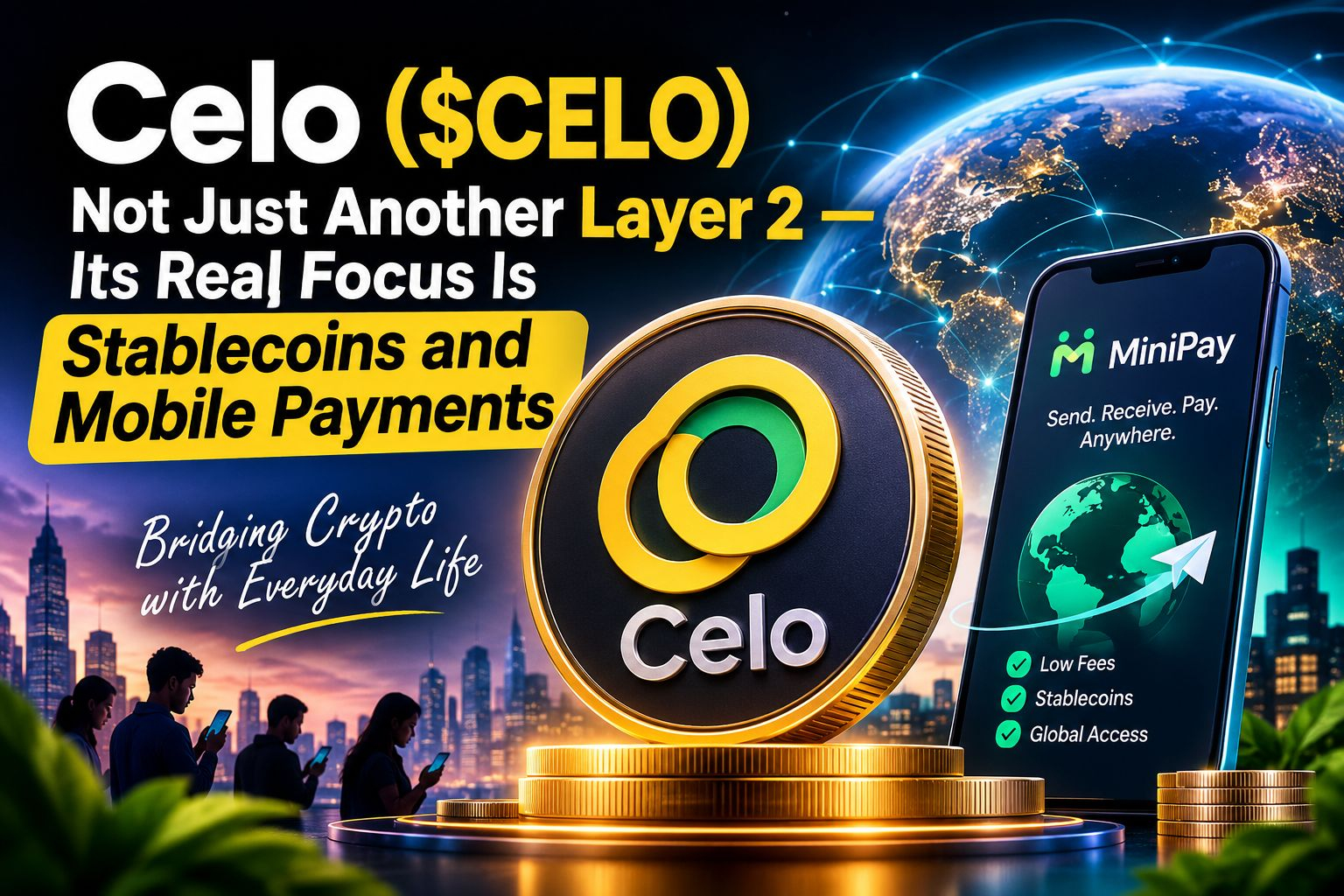
One detail matters first. Celo began as an independent Layer 1, but migrated to an Ethereum Layer 2 on March 26, 2025, using the OP Stack. Calling it a Layer 1 today misses an important change. What remained consistent was its focus on stablecoins and mobile payments.
After years in this market, another chain announcement does not automatically make me curious. We have heard enough about faster execution, limitless scalability, a new internet, and lately whatever can be attached to AI. Most sound convincing until real people use them at once. Blockchains are not tested by a clean demo or a quiet weekend. They are tested when traffic arrives, fees move, apps become popular, and users expect things to work without caring what consensus mechanism sits underneath.
Solana is a useful comparison. It can feel remarkably smooth when conditions are good, and that experience has helped it attract real activity. Heavy demand has at times caused congestion and a rougher user experience, even though later record bursts were handled without network downtime. That is not a reason to dismiss Solana. It is a reminder that performance claims mean less than how a network behaves when people depend on it.
Celo chose a narrower problem. Stablecoins are not exciting like a fresh token narrative, but in many places a digital dollar that can be sent cheaply may be more practical than another complicated financial app. Its mobile-first approach, and the ability to pay transaction fees in supported stablecoins instead of keeping a separate gas token, address small annoyances that become real obstacles for ordinary users. MiniPay gives the idea a distribution channel instead of leaving it as a white-paper concept.
There are signs of traction. In November 2026, MiniPay reported more than 20 million wallet activations and over 600 million transactions across more than 70 countries. Those figures are worth noticing, though activations are not regularly active people, and transaction counts alone do not tell us how useful the product is in daily life.
The move to an Ethereum Layer 2 is a trade-off. Celo gave up some independence as a separate Layer 1, while gaining closer ties to Ethereum’s ecosystem and security model. That may be sensible, but it does not settle adoption. Will users return? Will liquidity follow? Can local payment access, stablecoin reliability, and cashing out work smoothly enough that people do not need to think about the blockchain?
I still have doubts. Payment networks depend on trust, regulation, distribution, and local realities as much as low fees. But Celo is focused on a problem people already have, rather than inventing a reason to use a chain. That makes it worth watching, not blindly believing.
It might work. Or nobody shows up.