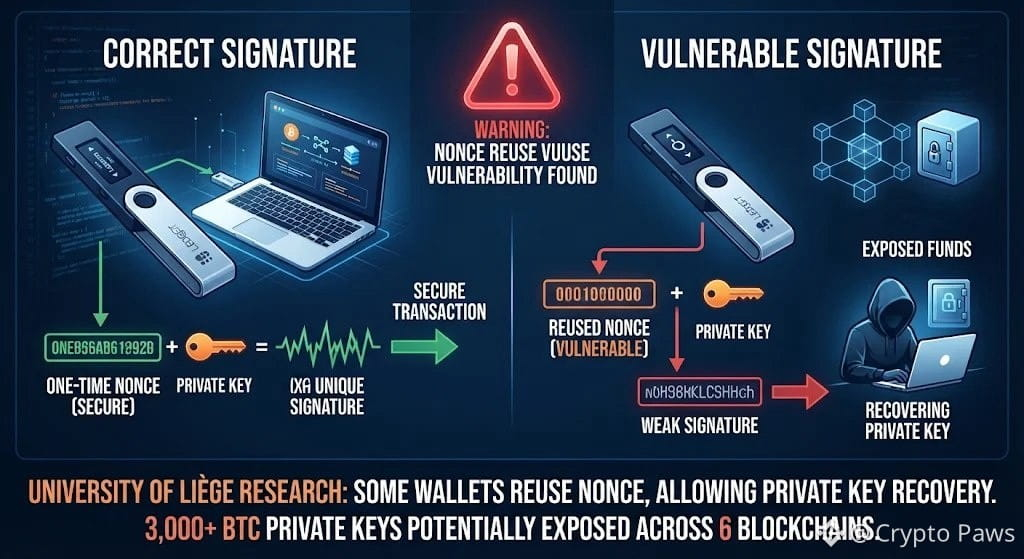
YOUR BITCOIN MAY BE SAFE—BUT IS YOUR WALLET SIGNING IT RIGHT?
University of Liège researchers found that some wallets reused a one-time number called a "nonce" when signing transactions.
Reusing a nonce with the same private key lets attackers mathematically recover the private key.
Key findings:
🔴 3,620 private keys recovered across 6 blockchains (3,278 on Bitcoin).
🔴 Vulnerable test wallets drew automated attackers within seconds.
🔴 Affected addresses held ~$106M in combined historical peak balances—an estimated exposure, not confirmed stolen funds.
The takeaway: security isn't just about protecting your seed phrase or picking a trusted chain; the software generating your signatures matters just as much.
Cryptography only works as well as its implementation.
Do you trust your wallet's security completely, or do you see wallet software as one of crypto's biggest hidden risks?
$SOXL
$SOXS
$EVAA