
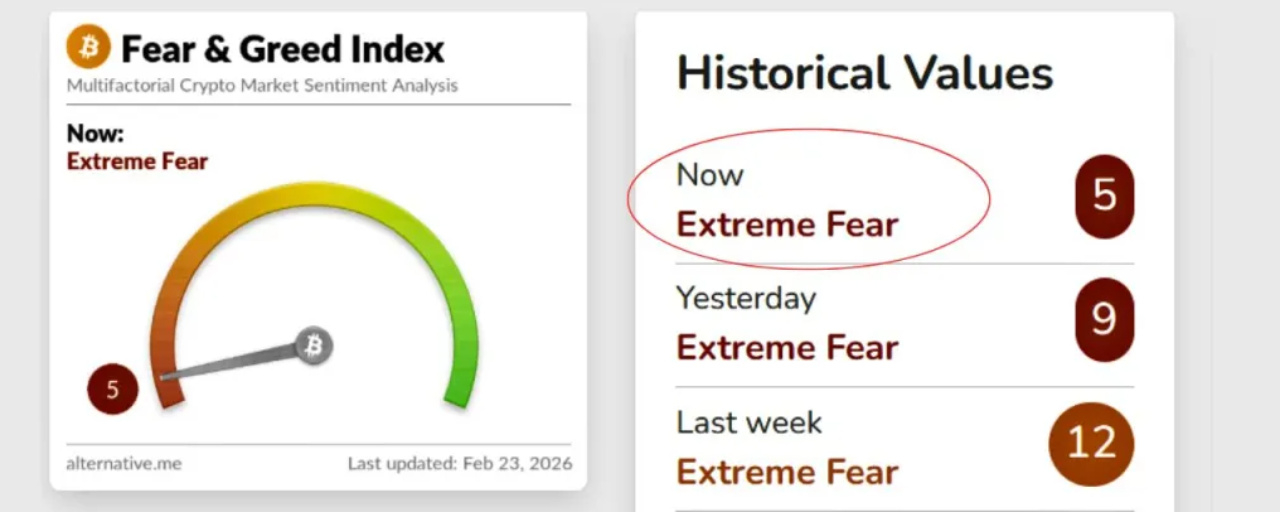

In traditional finance, a 15% drawdown is a headline-grabbing correction. In crypto, it is a Tuesday.
Because digital assets trade 24/7/365 without circuit breakers, global liquidity shocks, macro headlines, and leverage cascades hit the market instantaneously. This structure transforms crypto into a live behavioral laboratory where human psychology—specifically loss aversion—is magnified in real time. Behavioral finance shows that humans feel the pain of a financial loss roughly twice as intensely as the pleasure of an equivalent gain. When red candles stack up on a Sunday night, rational valuation models go out the window, and the Fear Cycle takes the wheel.
Understanding how fear cycles form, how they are measured, and how they structurally resolve is the single highest-leverage skill for surviving—and profiting from—crypto volatility.
1. The Four Phases of a Crypto Fear Cycle
Fear cycles rarely happen all at once. They follow a predictable psychological and mechanical arc:
Complacency & Denial (The First Crack): Following a period of euphoria, prices pull back 10–15%. Retail traders view this as a routine "buy the dip" opportunity. Funding rates remain positive, and social media stays overwhelmingly bullish.
Anxiety & Narrative Shift: Support levels break. Suddenly, the exact same fundamentals that were praised a month ago are reframed as existential threats. Search volume for terms like "crypto crash" or "market manipulation" spikes, and capital begins rotating out of speculative altcoins back into Bitcoin and stablecoins.
Forced Liquidation & Capitulation (Peak Fear): This is the mechanical climax. Over-leveraged long positions hit margin calls, triggering automated sell orders that push prices down further, liquidating the next tier of leverage. Retail holders, exhausted by watching their portfolios bleed, panic-sell at the bottom just to make the emotional pain stop.
Apathy & Quiet Accumulation: The market goes dead. Trading volume dries up, timelines go silent, and volatility compresses. While retail investors swear off crypto entirely, institutional desks and long-term allocators quietly absorb the discounted supply before the next uptrend begins.
2. How Market Fear Is Measured
Rather than guessing how panicked the market feels, analysts rely on composite sentiment trackers—most notably the Crypto Fear & Greed Index, which scores market emotion from 0 (Extreme Fear) to 100 (Extreme Greed).
Signal ComponentWeighting (Typical)What It Captures During a Fear CycleVolatility & Drawdowns~25%Compares current price swings against 30- and 90-day averages; abnormal spikes signal acute market stress.Momentum & Volume~25%Tracks heavy sell-side volume relative to recent baselines, confirming whether a drop has conviction.Derivatives & Options~15–20%Measures Put/Call ratios and perpetual funding rates. Negative funding and heavy put buying show traders paying a premium for downside protection.Social & Search Trends~15–25%Monitors engagement velocity on X/Reddit and Google Trends spikes for fear-driven queries.Bitcoin Dominance / SSR~10%Measures capital flight into Bitcoin (rising BTC dominance) and stablecoin dry powder (Stablecoin Supply Ratio).
Note: Historically, the market spends roughly 40–45% of its time in Fear or Extreme Fear, compared to less than 5% in Extreme Greed—proving that panic is fast and acute, while optimism builds slowly.
3. Historical Precedents: What Happens After "Extreme Fear"?
Whenever the Fear & Greed Index plunges into single digits or the low teens (such as the March 2020 liquidity crash when the index hit 3, or the deep macro-driven pullbacks seen throughout 2022 and 2026), two truths consistently emerge:
Extreme Fear is a reliable zone, not a precise timer. A reading of 10 does not mean the exact bottom is in that afternoon. Fear regimes can linger for weeks or months while leverage flushes out and macro headwinds settle.
Asymmetric forward returns. Every single period of prolonged Extreme Fear in Bitcoin's history has eventually resolved into a significant recovery. Because forced sellers liquidate without regard to price, assets temporarily trade well below their long-term network value—creating the exact discount that fuels the next cycle.
4. How to Navigate a Fear Cycle Without Getting Wiped Out
When the market enters a fear spiral, your goal isn't to catch the exact bottom—it's to keep emotion from dictating your execution.
Audit your leverage: Spot holders can wait out a 40% drawdown; leveraged traders get liquidated and miss the recovery. In high-volatility regimes, survival is the only edge that matters.
Automate entries with tiered DCA: Trying to time a V-shaped bottom usually leads to hesitation. Splitting capital into tranches deployed at specific Fear & Greed thresholds (e.g., buying small tranches whenever the index drops below 20, and larger tranches below 12) removes guesswork.
Watch stablecoin reserves and BTC dominance: True bottoms rarely form while altcoins are still outperforming. Look for Bitcoin dominance to stabilize and stablecoin inflows on exchanges to rise—a sign that sidelined cash is preparing to step back in.
Step away from the 1-minute chart: Continuous price checking triggers dopamine and cortisol loops that force impulsive decisions. If your thesis hasn't changed on a multi-year timeframe, intraday noise is purely a distraction.