

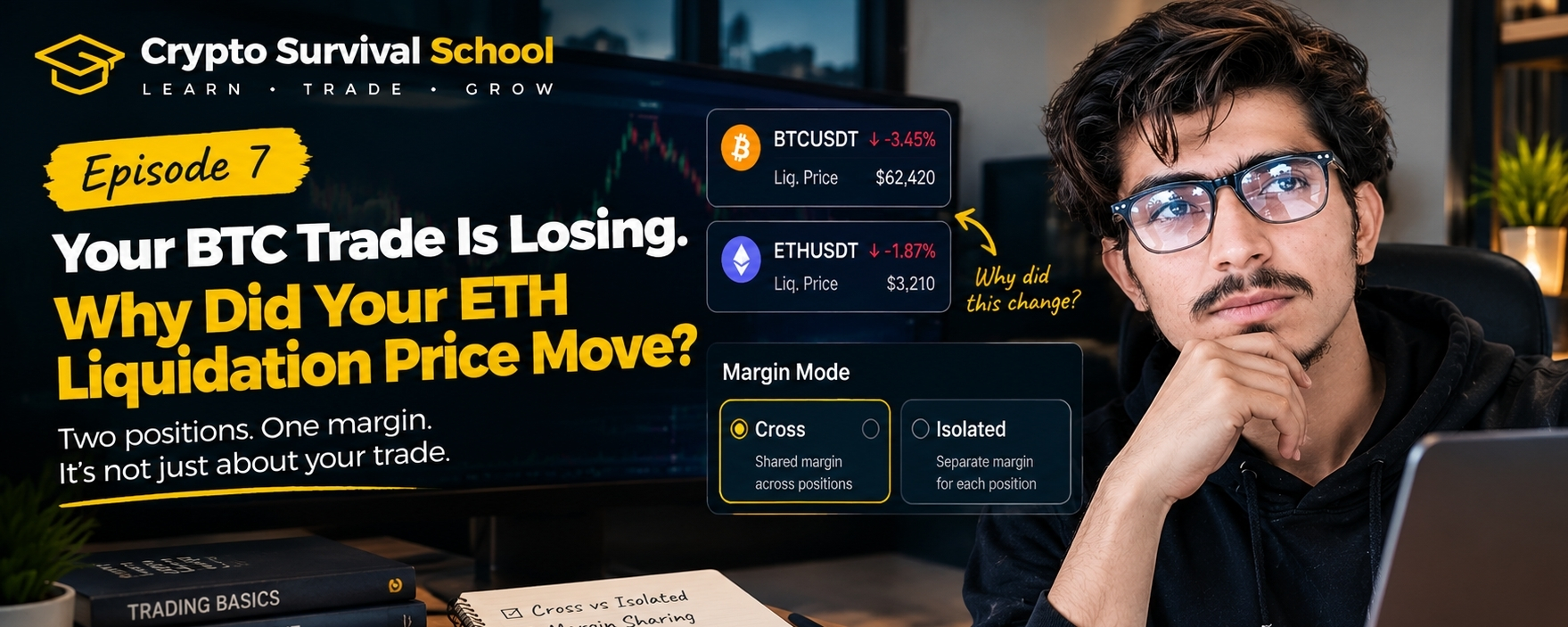

YOUR BTC TRADE IS LOSING. WHY DID YOUR ETH LIQUIDATION PRICE MOVE?
Imagine you've opened two Futures trades.
Your BTC trade is going against you. You're watching it closely, hoping the price will turn around.
Then you check your ETH position.
You haven't added to it. You haven't changed its leverage. You haven't even placed another order.
Yet its estimated liquidation price has changed.
What happened?
You might think the exchange has changed something unexpectedly. But there's another explanation that beginners often overlook:
Your positions might be sharing the same margin.
And that depends on one setting you should understand before opening a Futures trade.
TWO POSITIONS DON'T ALWAYS MEAN TWO SEPARATE SAFETY NETS.
On Binance Futures, you'll encounter two margin modes: Cross and Isolated.
They may look like small options on the trading screen, but they change how your margin supports a position.
Let's say you have $10 USDT in your Futures wallet and open BTCUSDT and ETHUSDT positions.
For simplicity, imagine both positions use Cross Margin.
Your eligible margin isn't divided into two completely independent safety boxes. Cross Margin allows eligible margin to be shared across positions using the same asset type.
If BTC starts losing money, that loss can reduce the margin cushion supporting your other Cross positions. Their estimated liquidation prices can change as the account's margin balance changes.
Here's the part worth remembering:
You can manage each trade separately on the chart while the exchange manages their margin together.
That's why looking at each position in isolation can give you an incomplete picture of your risk.
WHAT CHANGES WITH ISOLATED MARGIN?
With Isolated Margin, a specific amount of margin is allocated to an individual position.
Think of it as giving each trade its own designated risk budget.
If your isolated BTC position is liquidated, that liquidation doesn't directly liquidate a separate isolated ETH position. Each position's margin is managed independently.
But don't misunderstand this as protection against losses.
An isolated position can still be liquidated. You can also choose to add more margin to it, increasing the amount of funds you have committed.
Isolated Margin helps separate position risk. It doesn't make a bad trade safe.
SO, WHICH ONE SHOULD A BEGINNER USE?
There's no single setting that's best for every trader.
Cross Margin can be useful when someone deliberately wants positions to share available margin. But that flexibility comes with an important trade-off: losses in one position can affect the margin available to support others.
Isolated Margin makes it easier to see how much margin you've allocated to an individual position. For a beginner learning to control risk one trade at a time, that separation can be easier to understand.
Neither setting replaces sensible position sizing, a trading plan, or a clear exit strategy.
And neither prevents every liquidation.
DO THIS BEFORE YOUR NEXT BINANCE FUTURES TRADE.
Open the Futures trading screen and look at the margin mode displayed for the contract.
Don't assume it's Isolated just because you intended to use it.
Binance's help documentation explains that Futures contracts and positions default to Cross Margin. It also explains that changing the mode applies to the selected contract, and you cannot switch modes while that contract has open orders or positions.
Then ask yourself three questions:
1. What funds support this position?
2. Could a loss in another position affect its available margin?
3. If this trade goes wrong, how much of my account am I prepared to lose?
Those questions matter more than choosing a setting simply because its name sounds safer.
Because here's the real lesson:
You don't just need to know where your trade might go wrong. You need to understand what else could be affected when it does.
ONE QUESTION BEFORE YOU LEAVE:
If you had two Futures trades open, would you rather keep their margin separate or let them share it?
And more importantly, do you know which mode you're using right now?
Share your experience in the comments. Someone learning Futures might avoid a costly mistake by reading your answer.
Crypto Survival School is educational content, not financial advice. Futures trading involves substantial risk, and leverage can magnify losses.