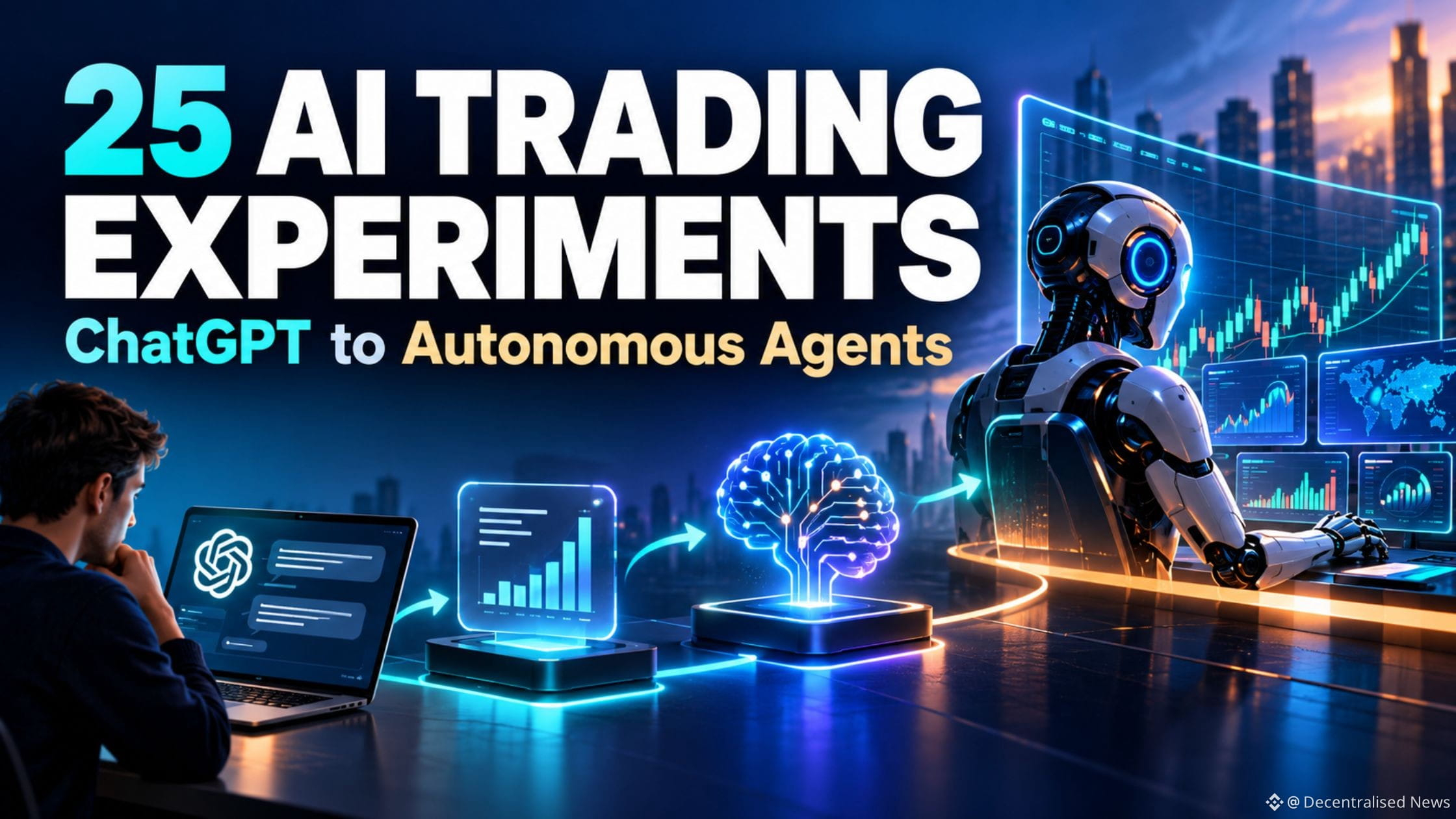
The 25 Best AI Trading Experiments to Try in 2027: From ChatGPT to Fully Autonomous Agents
Everyone wants to know:
**“What is the best AI trading bot?”**
That may be the wrong question.
Before handing an AI access to real capital, there are dozens of lower-risk experiments you can run first.
We mapped **25 AI trading experiments for 2027**, progressing from:
AI market research
↓
trade-thesis red teaming
↓
AI trading journals
↓
market-regime monitoring
↓
TradingView alerts
↓
paper trading
↓
AI-generated strategies
↓
ChatGPT-connected trading tools
↓
human-approved execution
↓
trade-only API bots
↓
multi-agent trading desks
↓
bounded wallet agents
↓
fully autonomous trading agents
The important variable is not just how intelligent the AI is.
It is how much **authority** you give it.
We call this:
**Authority Surface.**
A research assistant cannot directly lose your portfolio.
A trade-enabled bot can.
An agent that can transfer assets creates an even larger failure surface.
That leads to another DN framework:
**Agent Blast Radius.**
If the agent makes the worst mistake permitted by its current access, what can actually happen?
This is why the smartest path into AI trading is not:
Human → autonomous AI trader.
It is:
**Research → Monitor → Simulate → Approve → Automate → Agent.**
We also built the **DN AI Trading Pathfinder**, which recommends the lowest-authority experiment capable of achieving your objective based on:
• experience
• capital
• technical ability
• desired automation
• machine authority
AI trading is becoming real.
But the winning architecture may not be:
**“Let the smartest model control the money.”**
It may be:
**probabilistic reasoning upstream, deterministic risk control downstream.**
Let AI interpret messy information.
Let code decide what AI is allowed to do with capital.
Read the full Decentralised News research on our main site.
#AITrading
Everyone wants to know:
**“What is the best AI trading bot?”**
That may be the wrong question.
Before handing an AI access to real capital, there are dozens of lower-risk experiments you can run first.
We mapped **25 AI trading experiments for 2027**, progressing from:
AI market research
↓
trade-thesis red teaming
↓
AI trading journals
↓
market-regime monitoring
↓
TradingView alerts
↓
paper trading
↓
AI-generated strategies
↓
ChatGPT-connected trading tools
↓
human-approved execution
↓
trade-only API bots
↓
multi-agent trading desks
↓
bounded wallet agents
↓
fully autonomous trading agents
The important variable is not just how intelligent the AI is.
It is how much **authority** you give it.
We call this:
**Authority Surface.**
A research assistant cannot directly lose your portfolio.
A trade-enabled bot can.
An agent that can transfer assets creates an even larger failure surface.
That leads to another DN framework:
**Agent Blast Radius.**
If the agent makes the worst mistake permitted by its current access, what can actually happen?
This is why the smartest path into AI trading is not:
Human → autonomous AI trader.
It is:
**Research → Monitor → Simulate → Approve → Automate → Agent.**
We also built the **DN AI Trading Pathfinder**, which recommends the lowest-authority experiment capable of achieving your objective based on:
• experience
• capital
• technical ability
• desired automation
• machine authority
AI trading is becoming real.
But the winning architecture may not be:
**“Let the smartest model control the money.”**
It may be:
**probabilistic reasoning upstream, deterministic risk control downstream.**
Let AI interpret messy information.
Let code decide what AI is allowed to do with capital.
Read the full Decentralised News research on our main site.
#AITrading