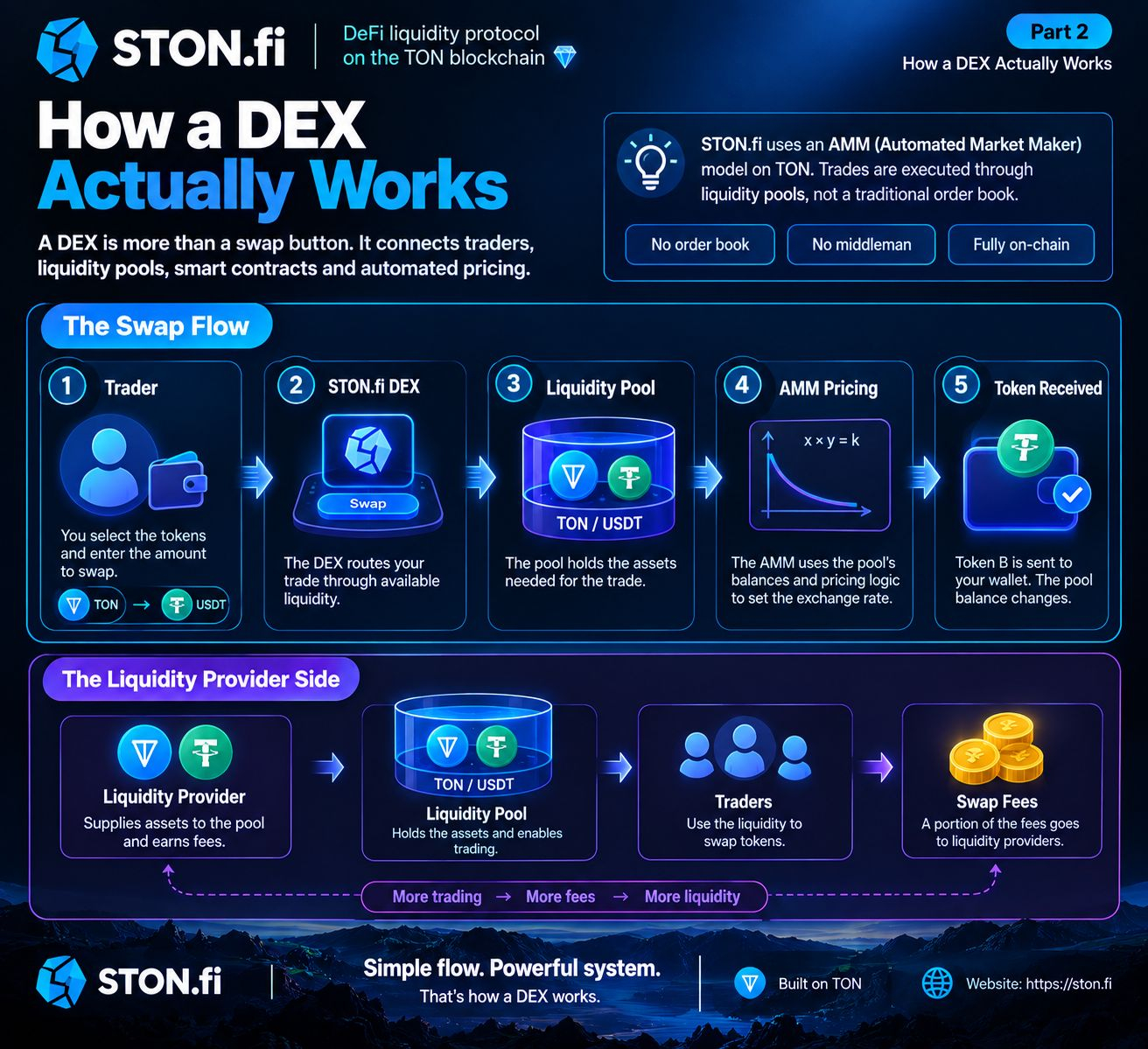
How does a DEX actually execute your swap?
You click Swap.
But underneath, several things happen.
Trader
↓
STON.fi DEX
↓
Liquidity Pool
↓
AMM Pricing
↓
Token Received
STON.fi operates as a non-custodial AMM protocol on TON. Instead of relying on a traditional order book, swaps use liquidity pools and smart contracts.
The pool contains the assets traders need.
When a swap happens, the balance between those assets changes, which affects the pool’s pricing.
That is why liquidity matters.
More importantly, there are two sides of the system:
Liquidity Providers supply assets.
Traders use that liquidity.
The protocol executes the swap through smart contracts.
A simple swap interface hides a complete on-chain liquidity system.
STON.fi — DeFi liquidity protocol on the TON blockchain 💎 | Website: https://ston.fi
#TON #DeFi #STONfi
You click Swap.
But underneath, several things happen.
Trader
↓
STON.fi DEX
↓
Liquidity Pool
↓
AMM Pricing
↓
Token Received
STON.fi operates as a non-custodial AMM protocol on TON. Instead of relying on a traditional order book, swaps use liquidity pools and smart contracts.
The pool contains the assets traders need.
When a swap happens, the balance between those assets changes, which affects the pool’s pricing.
That is why liquidity matters.
More importantly, there are two sides of the system:
Liquidity Providers supply assets.
Traders use that liquidity.
The protocol executes the swap through smart contracts.
A simple swap interface hides a complete on-chain liquidity system.
STON.fi — DeFi liquidity protocol on the TON blockchain 💎 | Website: https://ston.fi
#TON #DeFi #STONfi