
DUSK Treasury: The Signal Hiding in Plain Sight
I started looking at DUSK’s treasury expecting the usual “hold the native token and show maximum alignment” story. Instead, I found something more interesting.
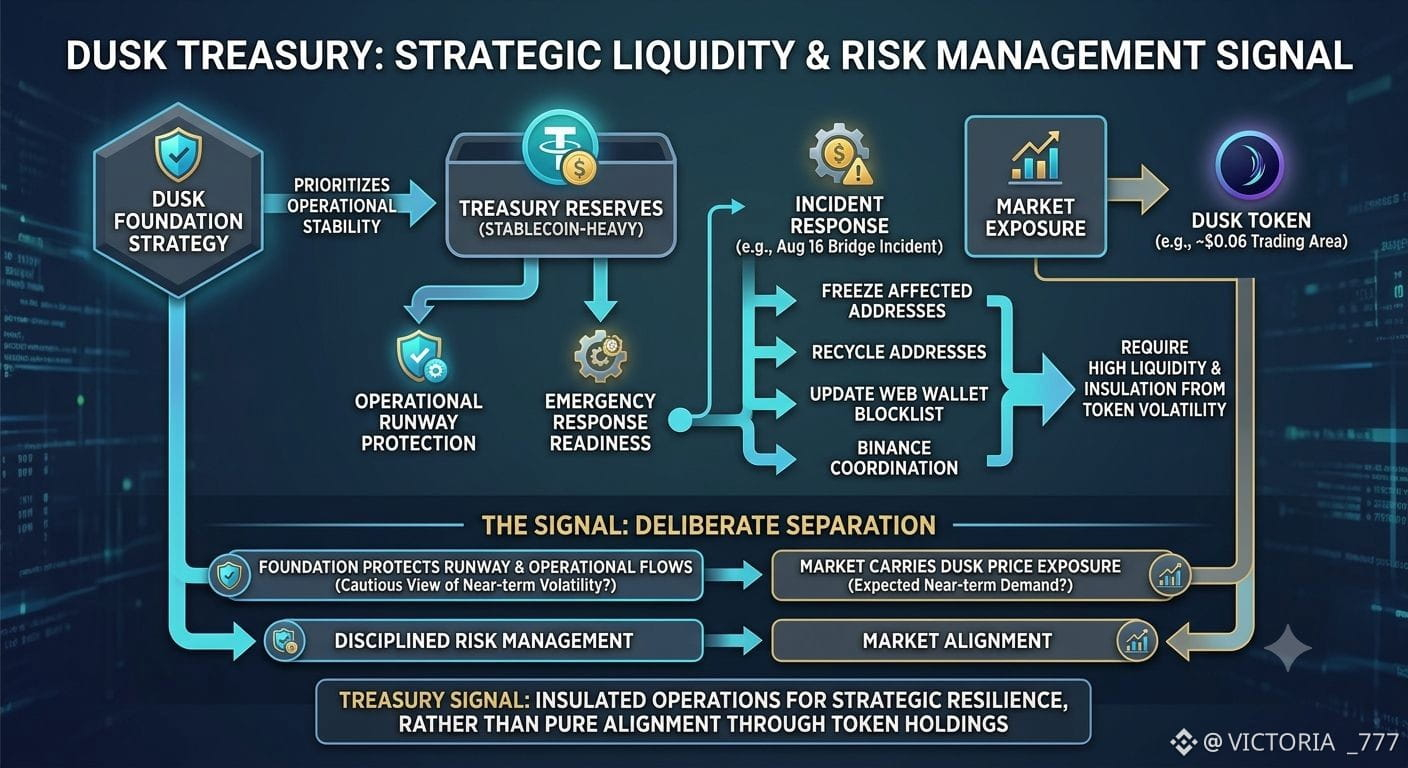
The foundation appears to favor stablecoin-heavy reserves while DUSK trades around the $0.06 area. At first glance, that feels like a contradiction. But after revisiting the Aug. 16 bridge incident, the logic becomes much sharper.
When suspicious activity was detected, the team moved quickly: affected addresses were frozen and recycled, a Web Wallet recipient blocklist was pushed, and Binance was brought into the flow. That kind of response requires operational liquidity—not a treasury that is constantly exposed to its own token volatility.
That’s the part I find fascinating.
I see the stablecoin strategy as a deliberate separation: the foundation protects the runway, while the market carries DUSK exposure.
But there’s a second layer.
If the team truly expects strong near-term demand for DUSK, why keep treasury operations insulated from it? Is this simply disciplined risk management, or is the treasury quietly revealing a more cautious view of near-term token demand?
I wouldn’t call it bearish.
I’d call it a signal worth watching.
Because sometimes the most revealing treasury decision is the asset a team chooses not to hold.
@Dusk #DUSK $DUSK
I started looking at DUSK’s treasury expecting the usual “hold the native token and show maximum alignment” story. Instead, I found something more interesting.
The foundation appears to favor stablecoin-heavy reserves while DUSK trades around the $0.06 area. At first glance, that feels like a contradiction. But after revisiting the Aug. 16 bridge incident, the logic becomes much sharper.
When suspicious activity was detected, the team moved quickly: affected addresses were frozen and recycled, a Web Wallet recipient blocklist was pushed, and Binance was brought into the flow. That kind of response requires operational liquidity—not a treasury that is constantly exposed to its own token volatility.
That’s the part I find fascinating.
I see the stablecoin strategy as a deliberate separation: the foundation protects the runway, while the market carries DUSK exposure.
But there’s a second layer.
If the team truly expects strong near-term demand for DUSK, why keep treasury operations insulated from it? Is this simply disciplined risk management, or is the treasury quietly revealing a more cautious view of near-term token demand?
I wouldn’t call it bearish.
I’d call it a signal worth watching.
Because sometimes the most revealing treasury decision is the asset a team chooses not to hold.
@Dusk #DUSK $DUSK