#binancep2pantoan @Binance Vietnam
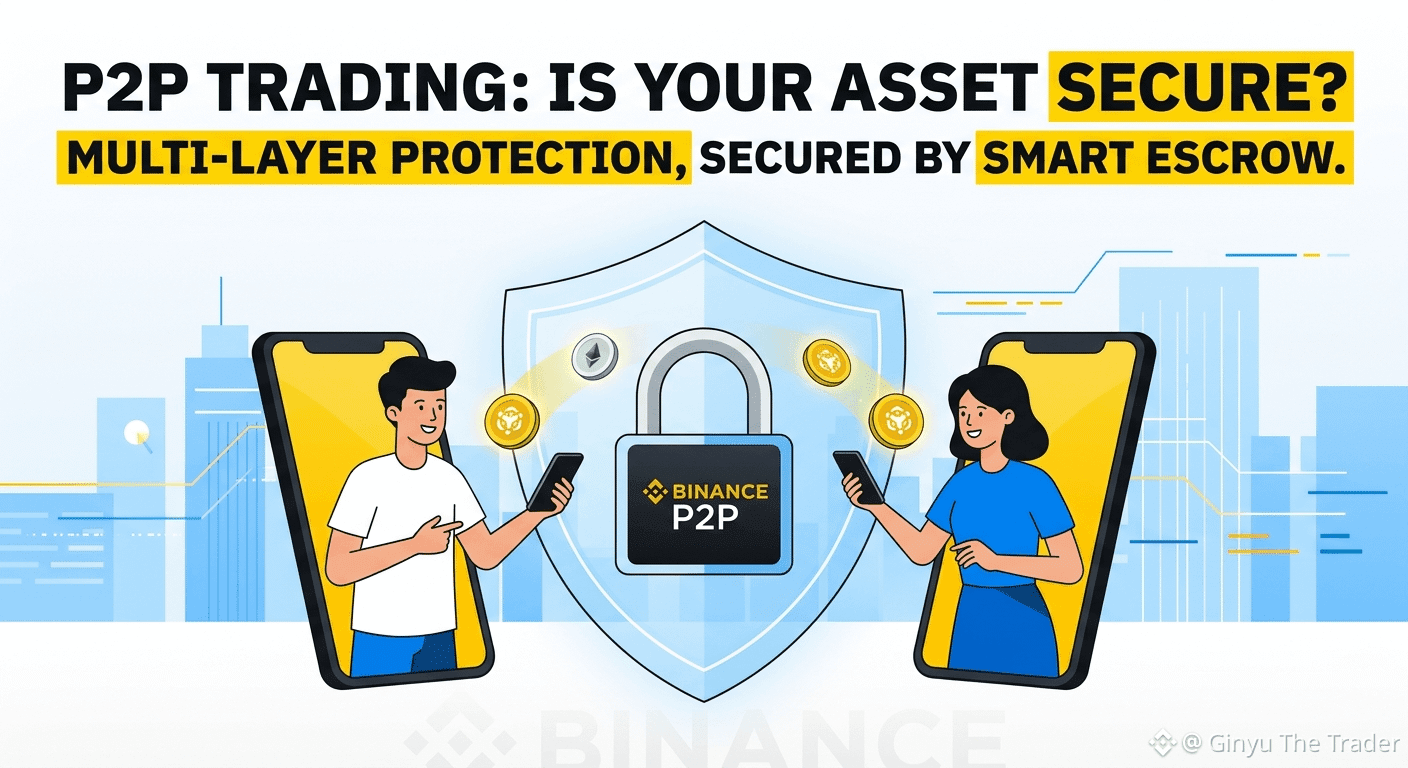
New traders often assume Binance P2P protects them automatically from every kind of loss, and that single assumption can end up being costly.
The protections are real, but they work with the trader, not instead of the trader. KYC verification means every account belongs to an identity Binance can trace, which discourages a lot of bad behavior but does not physically stop someone from trying to scam another user through the chat. Escrow holds a seller's crypto until payment is confirmed, which is one of the strongest protections on the platform, but confirming that payment is still the seller's own responsibility, not something that happens automatically in the background. Checking a counterparty's profile matters for exactly this reason: account age, completion rate, and order history together give a much clearer picture than KYC status alone, since a verified identity can still belong to someone acting in bad faith. Support and the dispute process exist as a backstop, not a replacement for basic caution during the trade itself.
I have talked to newer traders who released crypto based purely on a payment notification, assuming that because Binance P2P is a protected system, nothing could really go wrong on their end. That is not how it works in practice. The platform structures the trade safely, but each side still has to do their part: verify the profile, confirm real payment before releasing, keep everything inside the chat, and archive proof of what happened. If a step ever feels uncertain, Binance support is there to help, and reaching out early is always better than assuming the system alone will catch a problem after the fact. Protection on Binance P2P is a partnership, not an autopilot. Understanding that distinction early would have saved me some uneasy moments as a newer trader, and it is the single idea I try hardest to pass along to anyone just getting started on the platform now.
New traders often assume Binance P2P protects them automatically from every kind of loss, and that single assumption can end up being costly.
The protections are real, but they work with the trader, not instead of the trader. KYC verification means every account belongs to an identity Binance can trace, which discourages a lot of bad behavior but does not physically stop someone from trying to scam another user through the chat. Escrow holds a seller's crypto until payment is confirmed, which is one of the strongest protections on the platform, but confirming that payment is still the seller's own responsibility, not something that happens automatically in the background. Checking a counterparty's profile matters for exactly this reason: account age, completion rate, and order history together give a much clearer picture than KYC status alone, since a verified identity can still belong to someone acting in bad faith. Support and the dispute process exist as a backstop, not a replacement for basic caution during the trade itself.
I have talked to newer traders who released crypto based purely on a payment notification, assuming that because Binance P2P is a protected system, nothing could really go wrong on their end. That is not how it works in practice. The platform structures the trade safely, but each side still has to do their part: verify the profile, confirm real payment before releasing, keep everything inside the chat, and archive proof of what happened. If a step ever feels uncertain, Binance support is there to help, and reaching out early is always better than assuming the system alone will catch a problem after the fact. Protection on Binance P2P is a partnership, not an autopilot. Understanding that distinction early would have saved me some uneasy moments as a newer trader, and it is the single idea I try hardest to pass along to anyone just getting started on the platform now.