
Malik Shabi ul Hassan
29k Posts

Malik Shabi ul Hassan
 Square Verified+
Content Creator ll Spot Trader ll X @malik_shabi5
1.3K+ Following
36.0K+ Followers
38.3K+ Liked
Posts
All
Videos
Live
The 3H Market Radar is Blasting Off! Here Is the Ultimate Setup Breakdown
Momentum is shifting rapidly across the board and the latest volume scanners just locked onto a fresh wave of high-potential movers.
No repetitive fluff - just raw direct performance tracking for the next 3-hour window:
The 100% Max-Confidence Elite:
BTTC : +4.10% (100% Confidence)
NIL: +3.72% (100% Confidence)
The Heavy Surge Leaders:
ZKP: +9.81% (68.18% Conf) - Top Percentage Gainer
PROM: +8.00% (85.71% Conf) - Massive Bullish Momentum
HEMI: +5.08% (83.33% Conf)
The High-Conviction Watchlist:
MIRA: +4.11% with an incredible 95.45% Confidence!
OG: +4.41% (80% Conf)
ZKC: +4.93% (73.91% Conf)
TNSR: +3.53% (78.26% Conf)
SCRT: +3.60% (75% Conf)
Market Takeaway:
When absolute 100% confidence locks onto steady movers like BTTC & NIL while heavy hitters like ZKP (+9.81%) and MIRA (95.45% confidence) capture liquidity short-term breakouts fire off instantly. Keep your risk tightly managed and eyes glued to the charts
#BinanceSquare #cryptotrading #BullishMomentum. #altcoins
$NIL $OG $ZKP
Which of these setups are you riding for today's explosive move? Drop your top pick below
Momentum is shifting rapidly across the board and the latest volume scanners just locked onto a fresh wave of high-potential movers.
No repetitive fluff - just raw direct performance tracking for the next 3-hour window:
The 100% Max-Confidence Elite:
BTTC : +4.10% (100% Confidence)
NIL: +3.72% (100% Confidence)
The Heavy Surge Leaders:
ZKP: +9.81% (68.18% Conf) - Top Percentage Gainer
PROM: +8.00% (85.71% Conf) - Massive Bullish Momentum
HEMI: +5.08% (83.33% Conf)
The High-Conviction Watchlist:
MIRA: +4.11% with an incredible 95.45% Confidence!
OG: +4.41% (80% Conf)
ZKC: +4.93% (73.91% Conf)
TNSR: +3.53% (78.26% Conf)
SCRT: +3.60% (75% Conf)
Market Takeaway:
When absolute 100% confidence locks onto steady movers like BTTC & NIL while heavy hitters like ZKP (+9.81%) and MIRA (95.45% confidence) capture liquidity short-term breakouts fire off instantly. Keep your risk tightly managed and eyes glued to the charts
#BinanceSquare #cryptotrading #BullishMomentum. #altcoins
$NIL $OG $ZKP
Which of these setups are you riding for today's explosive move? Drop your top pick below
BTTC + NIL + ZKP
72%
PROM + HEMI
20%
MIRA + OG + ZKC
8%
TRNS + SCRT
0%
36 votes • Voting closed
The 3H AI Heatmap just dropped & the momentum rotation is looking spicy!
I was just scanning the latest algorithmic signals for the upcoming window & these numbers tell an interesting story of where capital is sneaking in right now. No fluff just pure data from the board:
The Front-Runners:
HEMI is leading the charge at +8.34% with solid 83.87% confidence.
TUT following right behind at +6.00% (62.5% conf).
AMP printing steady strength at +5.33% (80% conf).
The Mid-Tier Stealth Movers:
MOVR: +5.30% (73.53% conf)
EDEN: +5.08% pushing high conviction at 84.62% conf!
CHIP: +4.74% with a massive 88% confidence score.
ONG: +4.45% (68.75% conf)
The Steady Accumulation Zone:
MANTRA: +4.19% (70.83% conf)
BMT: +4.06% (74.07% conf)
DEXE: +3.76% (75% conf)
My Take: EDEN (84.62%) and CHIP (88%) are quietly holding some of the highest conviction scores on this board despite slightly lower percentage moves. Those are usually the ones that catch people off guard.
#BinanceSquare #AISignals #cryptotrading #altcoins
Which of these are you holding in your portfolio for today's session? Let’s discuss below! 👇
$DEXE $MANTRA $EDEN
I was just scanning the latest algorithmic signals for the upcoming window & these numbers tell an interesting story of where capital is sneaking in right now. No fluff just pure data from the board:
The Front-Runners:
HEMI is leading the charge at +8.34% with solid 83.87% confidence.
TUT following right behind at +6.00% (62.5% conf).
AMP printing steady strength at +5.33% (80% conf).
The Mid-Tier Stealth Movers:
MOVR: +5.30% (73.53% conf)
EDEN: +5.08% pushing high conviction at 84.62% conf!
CHIP: +4.74% with a massive 88% confidence score.
ONG: +4.45% (68.75% conf)
The Steady Accumulation Zone:
MANTRA: +4.19% (70.83% conf)
BMT: +4.06% (74.07% conf)
DEXE: +3.76% (75% conf)
My Take: EDEN (84.62%) and CHIP (88%) are quietly holding some of the highest conviction scores on this board despite slightly lower percentage moves. Those are usually the ones that catch people off guard.
#BinanceSquare #AISignals #cryptotrading #altcoins
Which of these are you holding in your portfolio for today's session? Let’s discuss below! 👇
$DEXE $MANTRA $EDEN
DEXE + BMT + MANTRA
55%
ONG + CHIP + EDEN
29%
MOVR + TUT
8%
AMP + HEMI
8%
38 votes • Voting closed
AI ALERTS: The 3H Momentum Wave is Pumping Hard!
The live market scanners just locked in & the algorithmic conviction is incredibly strong right now. If you're hunting short-term alpha look at how the leaderboard is exploding:
CHIP leading the pack with massive 92% CONFIDENCE!
🥇 HEMI printing huge strength at 89.47% Confidence (+11.54% - Top Gainer!)
🥈 TRUMP locked at 85.19% Confidence (+5.10%)
🥉 MOVR showing solid conviction at 80% Confidence (+6.57%)
The Rest of the Hot 3H Watchlist:
PROM: +4.36% (80.56% Conf)
BICO: +4.33% (77.27% Conf)
BMT: +7.50% (75.86% Conf)
ONG: +4.72% (72.41% Conf)
AMP: +3.55% (68.97% Conf)
TUT: +6.66% (68.18% Conf)
When high-confidence metrics combine with volatile runners like HEMI & BMT momentum accelerates instantly. Keep your execution tight and watch for quick moves!
#BinanceSquare #AIsignals #TRUMP #BullishMomentum
$TRUMP
$CHIP $AMP
Which of these AI-picked setups are you trading right now? Drop your picks below! 👇
The live market scanners just locked in & the algorithmic conviction is incredibly strong right now. If you're hunting short-term alpha look at how the leaderboard is exploding:
CHIP leading the pack with massive 92% CONFIDENCE!
🥇 HEMI printing huge strength at 89.47% Confidence (+11.54% - Top Gainer!)
🥈 TRUMP locked at 85.19% Confidence (+5.10%)
🥉 MOVR showing solid conviction at 80% Confidence (+6.57%)
The Rest of the Hot 3H Watchlist:
PROM: +4.36% (80.56% Conf)
BICO: +4.33% (77.27% Conf)
BMT: +7.50% (75.86% Conf)
ONG: +4.72% (72.41% Conf)
AMP: +3.55% (68.97% Conf)
TUT: +6.66% (68.18% Conf)
When high-confidence metrics combine with volatile runners like HEMI & BMT momentum accelerates instantly. Keep your execution tight and watch for quick moves!
#BinanceSquare #AIsignals #TRUMP #BullishMomentum
$TRUMP
$CHIP $AMP
Which of these AI-picked setups are you trading right now? Drop your picks below! 👇
CHIP + TRUMP + TUT
100%
HEMI + MOVR
0%
PROM + BICO
0%
BMT + ONG + AMP
0%
1 votes • Voting closed
AI ALERTS: The 3H Momentum Wave is Exploding!
Algorithms just scanned the live market & absolute heavyweights are flashing max-conviction signals right now.
If you are hunting short-term alpha look at how the leaderboard is stacking up:
💎 BICO & MOVR leading with absolute 100% CONFIDENCE!
🥇 CHIP flashing a massive 90.91% Confidence (+5.92%)
🥈 HEMI printing strong strength at 86.36% Confidence (+10.82%)
🥉 VET locked at 83.33% Confidence (+6.22%)
The Rest of the Hot 3H Watchlist:
BEAMX: +7.08% (80% Conf)
TUT: +5.29% (78.26% Conf)
ONG: +10.90% (74.07% Conf - Top % Gainer!)
BMT: +8.15% (67.86% Conf)
SNXXB: +3.74% (Momentum Active)
When 100% conviction lines up with high-percentage runners like HEMI & ONG, velocity spikes instantly. Keep your eyes sharp and execution tight!
Which of these setups are you trading right now? Drop your bags below! 👇
#BinanceSquare #AIsignals #cryptotrading #BullishMomentum
$HEMI $CHIP $VET
Algorithms just scanned the live market & absolute heavyweights are flashing max-conviction signals right now.
If you are hunting short-term alpha look at how the leaderboard is stacking up:
💎 BICO & MOVR leading with absolute 100% CONFIDENCE!
🥇 CHIP flashing a massive 90.91% Confidence (+5.92%)
🥈 HEMI printing strong strength at 86.36% Confidence (+10.82%)
🥉 VET locked at 83.33% Confidence (+6.22%)
The Rest of the Hot 3H Watchlist:
BEAMX: +7.08% (80% Conf)
TUT: +5.29% (78.26% Conf)
ONG: +10.90% (74.07% Conf - Top % Gainer!)
BMT: +8.15% (67.86% Conf)
SNXXB: +3.74% (Momentum Active)
When 100% conviction lines up with high-percentage runners like HEMI & ONG, velocity spikes instantly. Keep your eyes sharp and execution tight!
Which of these setups are you trading right now? Drop your bags below! 👇
#BinanceSquare #AIsignals #cryptotrading #BullishMomentum
$HEMI $CHIP $VET
BICO + MOVR
74%
CHIP + HEMI + SNXXB
9%
VET + BEAMX
1%
TUT + ONG + BMT
16%
90 votes • Voting closed
AI Market Radar: Next 3H Momentum Plays
The algorithmic scanners just updated & a fresh wave of capital is rotating into these specific mid-to-high conviction setups. Here is how the leaderboard looks right now:
Top Gainers & Leaders:
BMT: +11.88% (79.17% Confidence)
ONG: +9.12% (85.71% Confidence)
PORTAL: +7.21% (61.54% Confidence)
High-Confidence Breakout Watch:
BICO: +6.81% (84.38% Confidence)
GLMR: +6.19% (87.1% Confidence)
TUT: +5.65% (87.1% Confidence)
Steady Accumulation Zone:
SCRT: +5.60% (70% Confidence)
MTL: +4.50% (73.68% Confidence)
LSK: +4.43% (78.26% Confidence)
STORJ: +3.84% (66.67% Confidence)
Key Takeaway: GLMR and TUT are holding the strongest algorithmic conviction at 87.1%, while BMT leads the raw percentage surge. Short-term momentum moves fast here - manage your entries well!
STORJ
#BinanceSquare #AIsignals #cryptotrading #altcoins
Are you riding the momentum on any of these today? Drop your pick below! 👇
The algorithmic scanners just updated & a fresh wave of capital is rotating into these specific mid-to-high conviction setups. Here is how the leaderboard looks right now:
Top Gainers & Leaders:
BMT: +11.88% (79.17% Confidence)
ONG: +9.12% (85.71% Confidence)
PORTAL: +7.21% (61.54% Confidence)
High-Confidence Breakout Watch:
BICO: +6.81% (84.38% Confidence)
GLMR: +6.19% (87.1% Confidence)
TUT: +5.65% (87.1% Confidence)
Steady Accumulation Zone:
SCRT: +5.60% (70% Confidence)
MTL: +4.50% (73.68% Confidence)
LSK: +4.43% (78.26% Confidence)
STORJ: +3.84% (66.67% Confidence)
Key Takeaway: GLMR and TUT are holding the strongest algorithmic conviction at 87.1%, while BMT leads the raw percentage surge. Short-term momentum moves fast here - manage your entries well!
STORJ
#BinanceSquare #AIsignals #cryptotrading #altcoins
Are you riding the momentum on any of these today? Drop your pick below! 👇
BMT + ONG + LSK
38%
BICO + GLMR
11%
TUT + SCRT + MLT
39%
STORJ + PORTAL
12%
56 votes • Voting closed
One Dusk number caught my attention today:
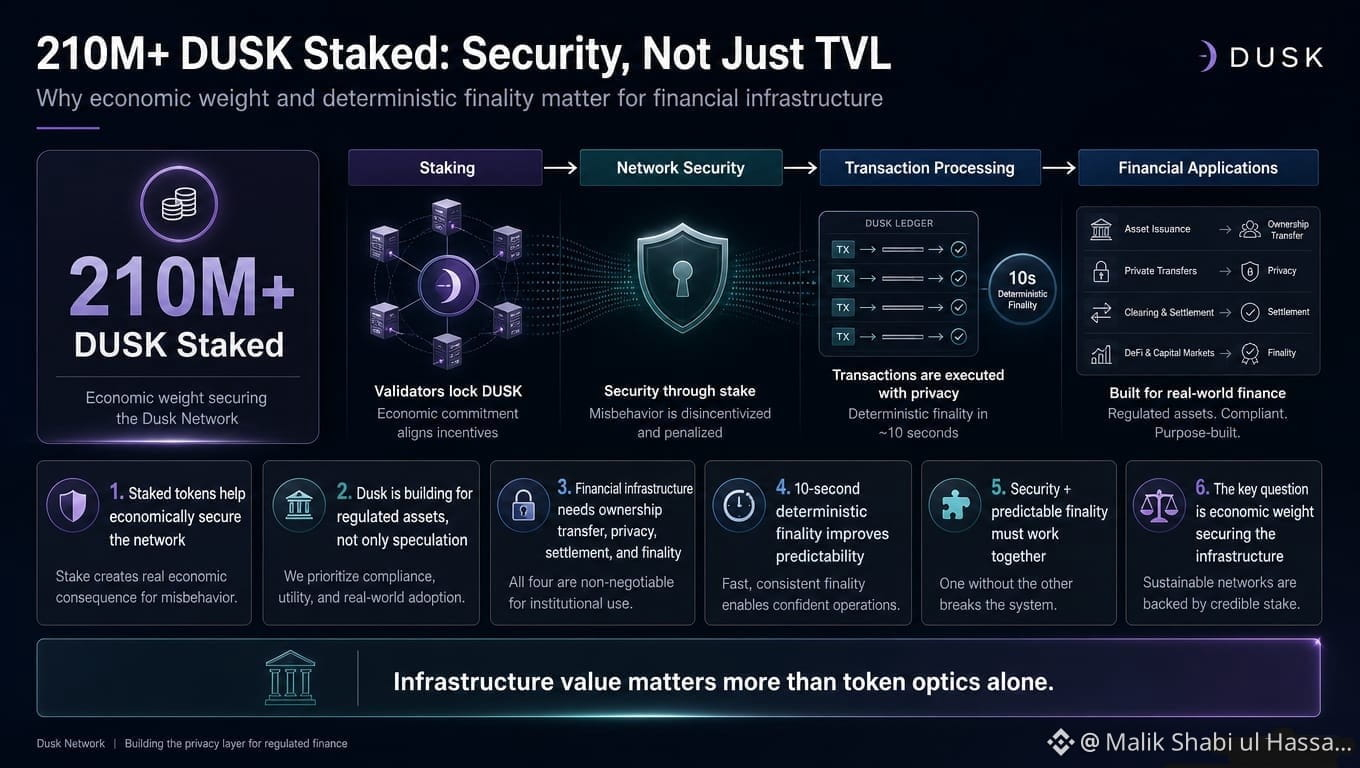
210M+ DUSK is currently staked.
I donot look at that number as simply TVL.
Staked tokens have a different job.
They are part of the economic security securing the network.
And that matters because Dusk isnot positioning itself as just another chain for speculative tokens.
It is building infrastructure around regulated assets where the underlying network may eventually be responsible for:
ownership changes
1. transfers
2. privacy rules
3. settlement
4. finality.
That makes network security a much more important part of the story.
The interesting relationship is:
DUSK
A. staking
B. network security
C. transaction processing
D. financial applications.
So when I see 210M+ DUSK staked my 1st question isnot:
How much money is locked?
It is: How much economic weight is actually securing the infrastructure that applications are building on?
& there is another number worth watching alongside it.
Dusk currently targets roughly 10-second deterministic finality.
For financial infrastructure those two ideas belong in the same conversation:
security
+
predictable finality.
Because a network handling financial assets needs both.
Fast settlement isnot very useful if the underlying network is not secure.
& strong security isnot enough if applications canot get predictable settlement.
That is why I am more interested in Dusk's network economics as infrastructure rather than looking at $DUSK purely as an ecosystem token.
#dusk
@Dusk
210M+ DUSK is currently staked.
I donot look at that number as simply TVL.
Staked tokens have a different job.
They are part of the economic security securing the network.
And that matters because Dusk isnot positioning itself as just another chain for speculative tokens.
It is building infrastructure around regulated assets where the underlying network may eventually be responsible for:
ownership changes
1. transfers
2. privacy rules
3. settlement
4. finality.
That makes network security a much more important part of the story.
The interesting relationship is:
DUSK
A. staking
B. network security
C. transaction processing
D. financial applications.
So when I see 210M+ DUSK staked my 1st question isnot:
How much money is locked?
It is: How much economic weight is actually securing the infrastructure that applications are building on?
& there is another number worth watching alongside it.
Dusk currently targets roughly 10-second deterministic finality.
For financial infrastructure those two ideas belong in the same conversation:
security
+
predictable finality.
Because a network handling financial assets needs both.
Fast settlement isnot very useful if the underlying network is not secure.
& strong security isnot enough if applications canot get predictable settlement.
That is why I am more interested in Dusk's network economics as infrastructure rather than looking at $DUSK purely as an ecosystem token.
#dusk
@Dusk
AI market scanners are flashing green & the next 3H momentum window is looking intense!
Checking the live AI Signals leaderboard these top assets are catching massive attention right now:
TUT (+6.66% | 73.08% Conf)
ONG (+6.19% | 83.87% Conf)
AMP (+4.71% | 79.17% Conf)
HEMI (+4.53% | 68.42% Conf)
STORJ (+4.46% | 69.57% Conf)
PORTAL (+4.44% | 75% Conf)
PROM (+4.07% | 100% Conf)
PEOPLE (+3.89% | 60% Conf)
FF (+3.83% | 85% Conf)
ICX (+3.55% | 100% Conf)
When AI highlights high-confidence setups like PROM and ICX at 100%, or strong movers like TUT & ONG shortterm breakouts move fast. Always keep strict risk management in place!
PROMICX ONGPORTAL #BinanceSquare #AIsignals #cryptotrading #BullishMomentum
$TUT $ICX $FF
Which of these coins are you trading today? Drop your top pick below! 👇
Checking the live AI Signals leaderboard these top assets are catching massive attention right now:
TUT (+6.66% | 73.08% Conf)
ONG (+6.19% | 83.87% Conf)
AMP (+4.71% | 79.17% Conf)
HEMI (+4.53% | 68.42% Conf)
STORJ (+4.46% | 69.57% Conf)
PORTAL (+4.44% | 75% Conf)
PROM (+4.07% | 100% Conf)
PEOPLE (+3.89% | 60% Conf)
FF (+3.83% | 85% Conf)
ICX (+3.55% | 100% Conf)
When AI highlights high-confidence setups like PROM and ICX at 100%, or strong movers like TUT & ONG shortterm breakouts move fast. Always keep strict risk management in place!
PROMICX ONGPORTAL #BinanceSquare #AIsignals #cryptotrading #BullishMomentum
$TUT $ICX $FF
Which of these coins are you trading today? Drop your top pick below! 👇
TUT + ONG
81%
AMP + HEMI + FF
5%
STORJ + POTAL
5%
PROM + ICX + PEOPLE
9%
42 votes • Voting closed
Everyone is talking about AI tokens, but nobody
is looking at the real physical bottleneck:
CoreWeave just flexed a massive $104 Billion revenue backlog! 🤯
Yahoo Finance’s new neocloud ETF discussion put CRWV in the spotlight reporting Q2 revenue hitting $2.6B (up 112% YoY) with over $25B in new customer commitments in Q3.
Why it matters:
AI isn0t just code - itz heavy hardware, compute rent, and massive energy. Their 59% adjusted EBITDA margin shows scale is turning into real operating leverage.
The real challenge ahead:
Converting a $104B backlog into actual cash flow. Markets will watch:
GPU access & energy availability
Financing rates & expansions
Customer concentration
If they execute, the compute-rental play wins. If funding slips, sentiment flips fast.
#binancesquareofficial #BTCETH #CoreWeave #Neocloud #BinanceSquare
$CRWV
Where is the real future of AI compute? Vote below! 👇
is looking at the real physical bottleneck:
CoreWeave just flexed a massive $104 Billion revenue backlog! 🤯
Yahoo Finance’s new neocloud ETF discussion put CRWV in the spotlight reporting Q2 revenue hitting $2.6B (up 112% YoY) with over $25B in new customer commitments in Q3.
Why it matters:
AI isn0t just code - itz heavy hardware, compute rent, and massive energy. Their 59% adjusted EBITDA margin shows scale is turning into real operating leverage.
The real challenge ahead:
Converting a $104B backlog into actual cash flow. Markets will watch:
GPU access & energy availability
Financing rates & expansions
Customer concentration
If they execute, the compute-rental play wins. If funding slips, sentiment flips fast.
#binancesquareofficial #BTCETH #CoreWeave #Neocloud #BinanceSquare
$CRWV
Where is the real future of AI compute? Vote below! 👇
Traditional Cloud
100%
DePIN / Crypto AI
0%
1 votes • Voting closed
I think I finally understand what Dusk is trying to solve with Citadel 2.
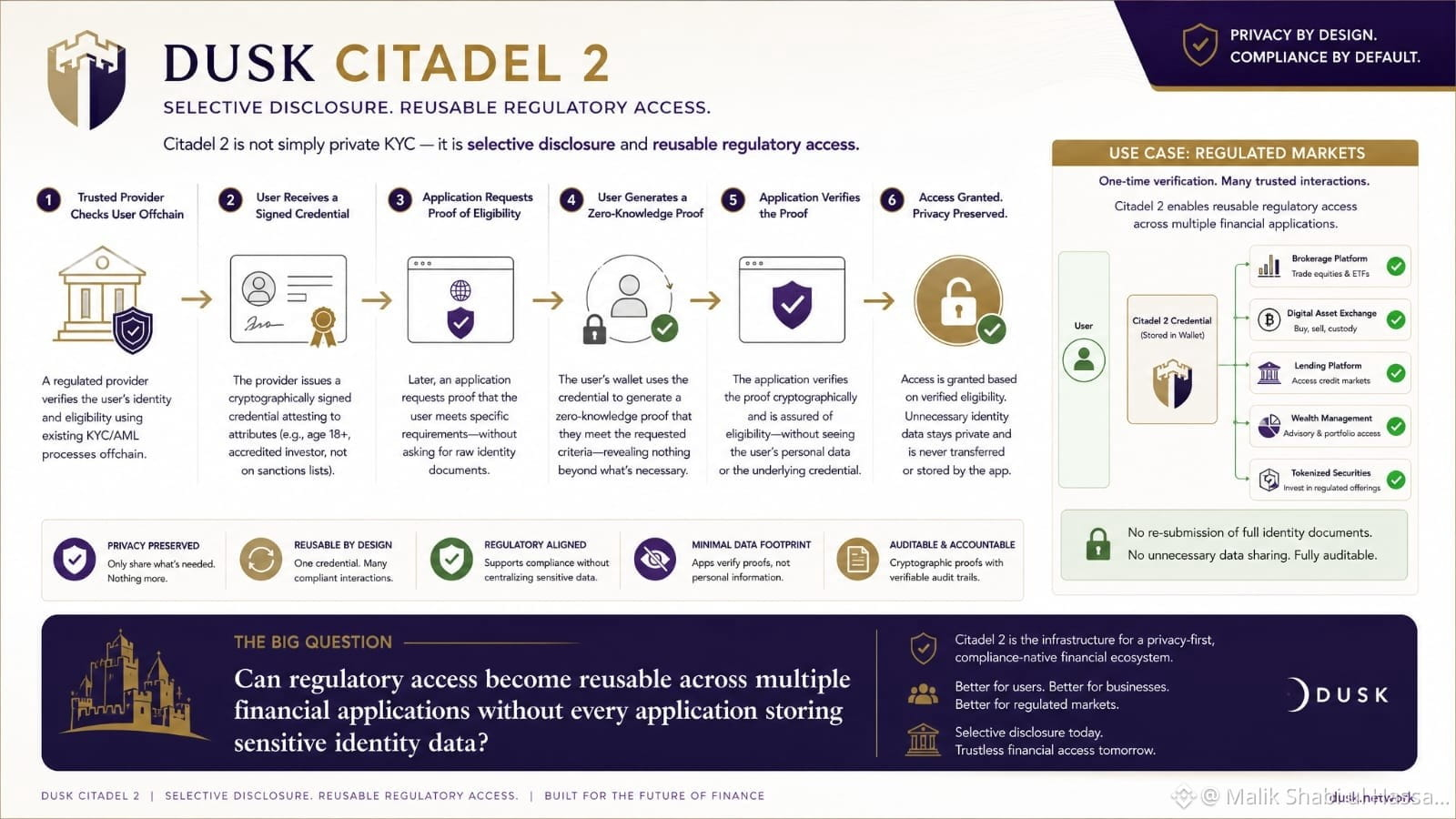
It is not simply private KYC.
The more interesting idea is being able to prove that you have the required credential without putting your personal details or the exact credential onchain.
Here is how I understand the flow:
A trusted provider checks you offchain.
You receive a signed credential.
Later when a application needs to verify your eligibility you generate a zero-knowledge proof showing that you hold a valid credential.
The application can verify the proof without needing to saw the underlying personal information.
That is a very different model from repeatedly handing over the same documents.
& this matters for regulated markets.
Imagine I want access to several financial applications.
If every application needs my complete identity information again compliance becomes a new data-sharing problem every time.
Citadel 2 points toward another approach:
verify the required attribute
prove the credential is valid
grant access
keep unnecessary identity data private.
That is what makes selective disclosure interesting to me.
Privacy is not being used to avoid compliance.
It is being used to make compliance more precise.
The question I find most interesting now is:
Can this model make regulatory access reusable across multiple financial applications without turning every application into another place where sensitive identity data has to live??
If yes that is a much bigger idea than simply private KYC.
#dusk $DUSK @Dusk
It is not simply private KYC.
The more interesting idea is being able to prove that you have the required credential without putting your personal details or the exact credential onchain.
Here is how I understand the flow:
A trusted provider checks you offchain.
You receive a signed credential.
Later when a application needs to verify your eligibility you generate a zero-knowledge proof showing that you hold a valid credential.
The application can verify the proof without needing to saw the underlying personal information.
That is a very different model from repeatedly handing over the same documents.
& this matters for regulated markets.
Imagine I want access to several financial applications.
If every application needs my complete identity information again compliance becomes a new data-sharing problem every time.
Citadel 2 points toward another approach:
verify the required attribute
prove the credential is valid
grant access
keep unnecessary identity data private.
That is what makes selective disclosure interesting to me.
Privacy is not being used to avoid compliance.
It is being used to make compliance more precise.
The question I find most interesting now is:
Can this model make regulatory access reusable across multiple financial applications without turning every application into another place where sensitive identity data has to live??
If yes that is a much bigger idea than simply private KYC.
#dusk $DUSK @Dusk
One thing I started asking myself while researching Dusk:
Who decides what actually changes when a blockchain upgrades?
Because developers pushed an update isnot a satisfying answer when the network is supposed to support financial infrastructure.
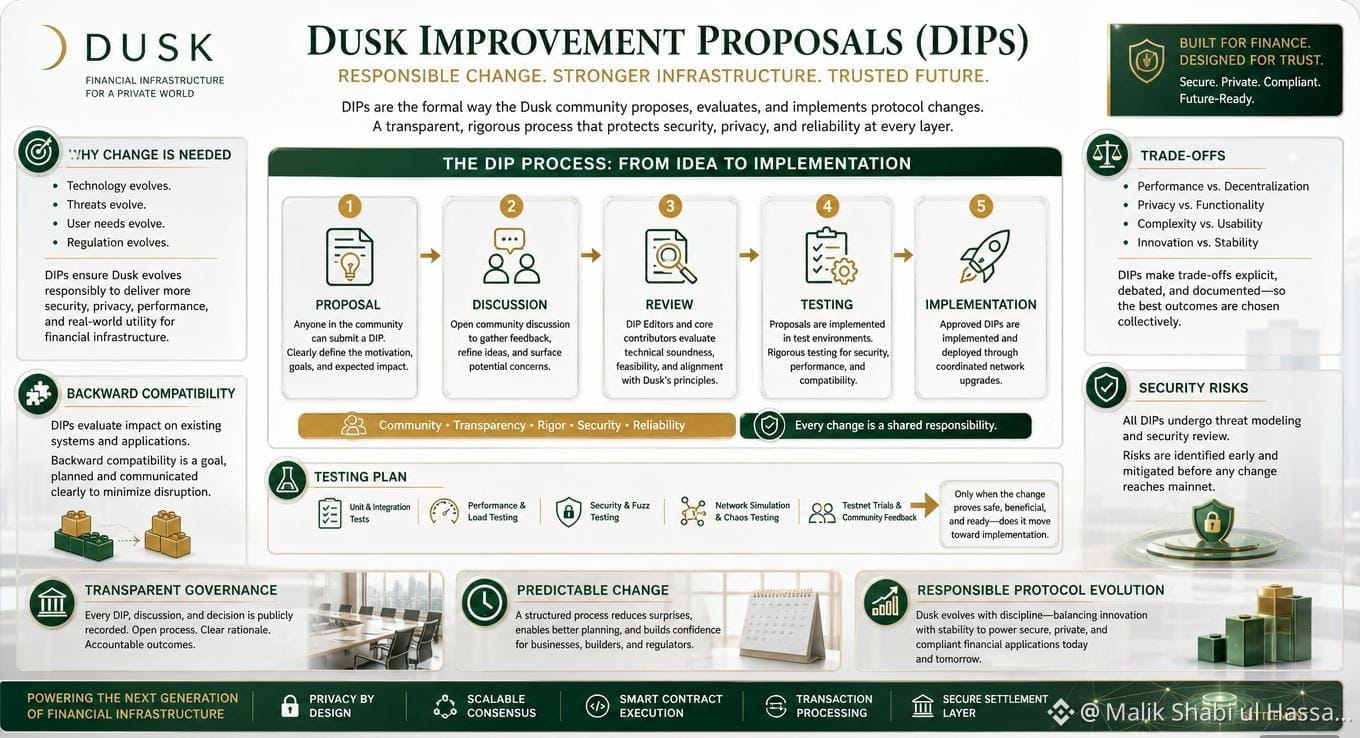
Thats where Dusk Improvement Proposals - DIPs - become interesting.
A DIP is basically a structured way of proposing a meaningful change to the protocol.
But here is the part I found useful:
its not supposed to be just a technical description.
A serious proposal needs to explain things like:
Why is this change needed?
What are the trade-offs?
Will older systems remain compatible?
How will it be tested?
What security risks need to be considered?
That is important because changing a blockchain's rules can have consequences far beyond the code itself.
Imagine changing something related to:
transaction processing
consensus
smart-contract execution
privacy
settlement.
An institution building on top of that infrastructure needs to understand what changed & why.
So I actually think the DIP process is part of the infrastructure story.
Not because governance sounds exciting.
But because predictable change matters when people are building financial systems on top of you.
You donot want protocol evolution to feel like:
Surprise, the rules changed.
You want:
proposal
discussion
review
testing
implementation.
Thats a much healthier way to evolve critical infrastructure.
& the question I am watching is:
As Dusk's ecosystem grows, can this process stay transparent & rigorous while protocol changes become more complex?
Because eventually the quality of a blockchain isnot only measured by what it can do.
Its also measured by how responsibly it changes.
#dusk $DUSK @Dusk
Who decides what actually changes when a blockchain upgrades?
Because developers pushed an update isnot a satisfying answer when the network is supposed to support financial infrastructure.
Thats where Dusk Improvement Proposals - DIPs - become interesting.
A DIP is basically a structured way of proposing a meaningful change to the protocol.
But here is the part I found useful:
its not supposed to be just a technical description.
A serious proposal needs to explain things like:
Why is this change needed?
What are the trade-offs?
Will older systems remain compatible?
How will it be tested?
What security risks need to be considered?
That is important because changing a blockchain's rules can have consequences far beyond the code itself.
Imagine changing something related to:
transaction processing
consensus
smart-contract execution
privacy
settlement.
An institution building on top of that infrastructure needs to understand what changed & why.
So I actually think the DIP process is part of the infrastructure story.
Not because governance sounds exciting.
But because predictable change matters when people are building financial systems on top of you.
You donot want protocol evolution to feel like:
Surprise, the rules changed.
You want:
proposal
discussion
review
testing
implementation.
Thats a much healthier way to evolve critical infrastructure.
& the question I am watching is:
As Dusk's ecosystem grows, can this process stay transparent & rigorous while protocol changes become more complex?
Because eventually the quality of a blockchain isnot only measured by what it can do.
Its also measured by how responsibly it changes.
#dusk $DUSK @Dusk
The $500M Bloodbath: Why Crypto Leverage is a Death Trap!
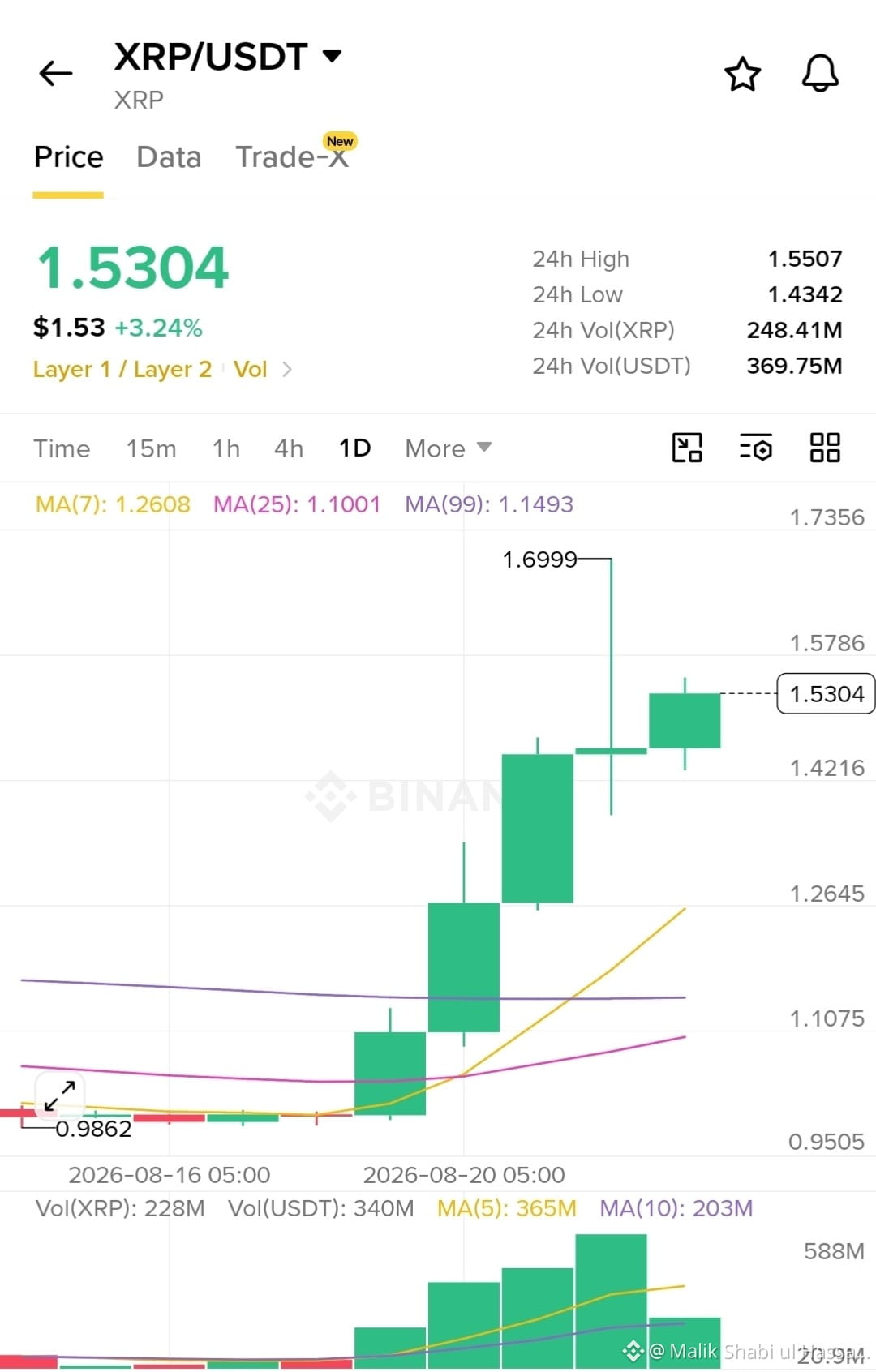
The recent $XRP move gave the entire market a ruthless masterclass in how fast fortunes vanish:
The FOMO Trap: XRP rockets 70% ($1.00 to $1.70) driven by $39.78M in weekly ETF inflows and massive regulatory hype from Brad Garlinghouse. Retail jumps in blind.
The Slaughterhouse: A sudden 37% flash crash wipes out a staggering $500M in leveraged longs in a heartbeat.
This is what happens when order book liquidity gets shredded and greedy leverage takes the wheel. Institutional demand is real, but the market always punishes over-exposure.
Are you trading strictly on spot to sleep
peacefully, or still gambling with high leverage? Drop your thoughts below! 👇
#xrp #cryptotrading #BinanceSquare #Liquidations #RiskManagement
The recent $XRP move gave the entire market a ruthless masterclass in how fast fortunes vanish:
The FOMO Trap: XRP rockets 70% ($1.00 to $1.70) driven by $39.78M in weekly ETF inflows and massive regulatory hype from Brad Garlinghouse. Retail jumps in blind.
The Slaughterhouse: A sudden 37% flash crash wipes out a staggering $500M in leveraged longs in a heartbeat.
This is what happens when order book liquidity gets shredded and greedy leverage takes the wheel. Institutional demand is real, but the market always punishes over-exposure.
Are you trading strictly on spot to sleep
peacefully, or still gambling with high leverage? Drop your thoughts below! 👇
#xrp #cryptotrading #BinanceSquare #Liquidations #RiskManagement
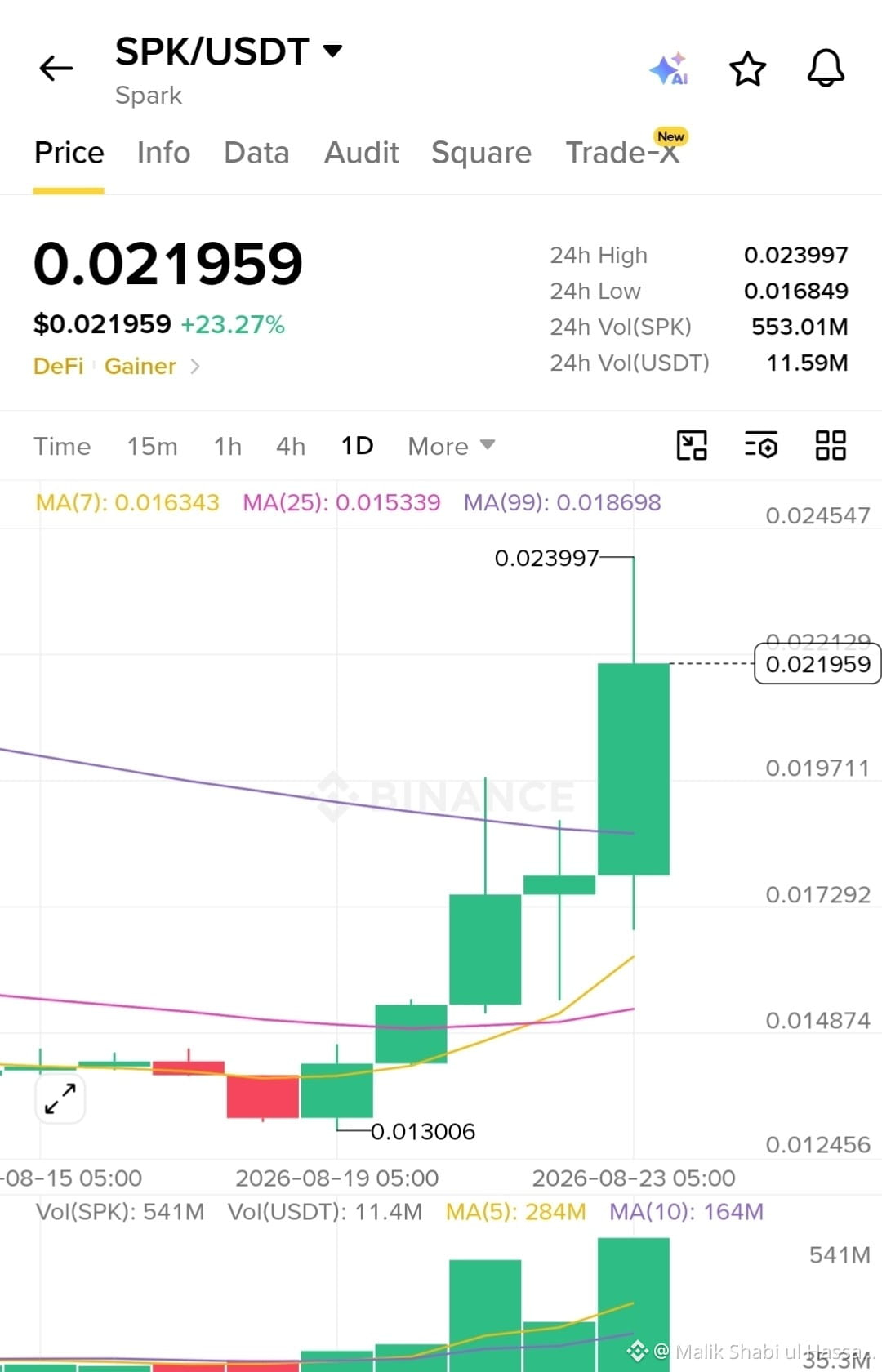
$SPK is setting up for a massive move!
The order books and sentiment metrics right now are screaming high conviction:
100% Bullish Sentiment: Absolute zero bearish resistance on the board.
Whale Accumulation: Long/short ratio hitting 1.53 with aggressive volume expansion.
The Setup: Holding critical support at $0.0222 / $0.0225 eyes locked in the $0.0235 breakout to smash through to $0.0240.
Bonus Yield: Flexible Simple Earn sitting at +8.42% APR while holding the bag.
Are you riding this momentum wave on SPK, or waiting for a pullback? Drop your thoughts below! 👇
#SPK #BinanceSquare #cryptotrading #BullishRun
The order books and sentiment metrics right now are screaming high conviction:
100% Bullish Sentiment: Absolute zero bearish resistance on the board.
Whale Accumulation: Long/short ratio hitting 1.53 with aggressive volume expansion.
The Setup: Holding critical support at $0.0222 / $0.0225 eyes locked in the $0.0235 breakout to smash through to $0.0240.
Bonus Yield: Flexible Simple Earn sitting at +8.42% APR while holding the bag.
Are you riding this momentum wave on SPK, or waiting for a pullback? Drop your thoughts below! 👇
#SPK #BinanceSquare #cryptotrading #BullishRun
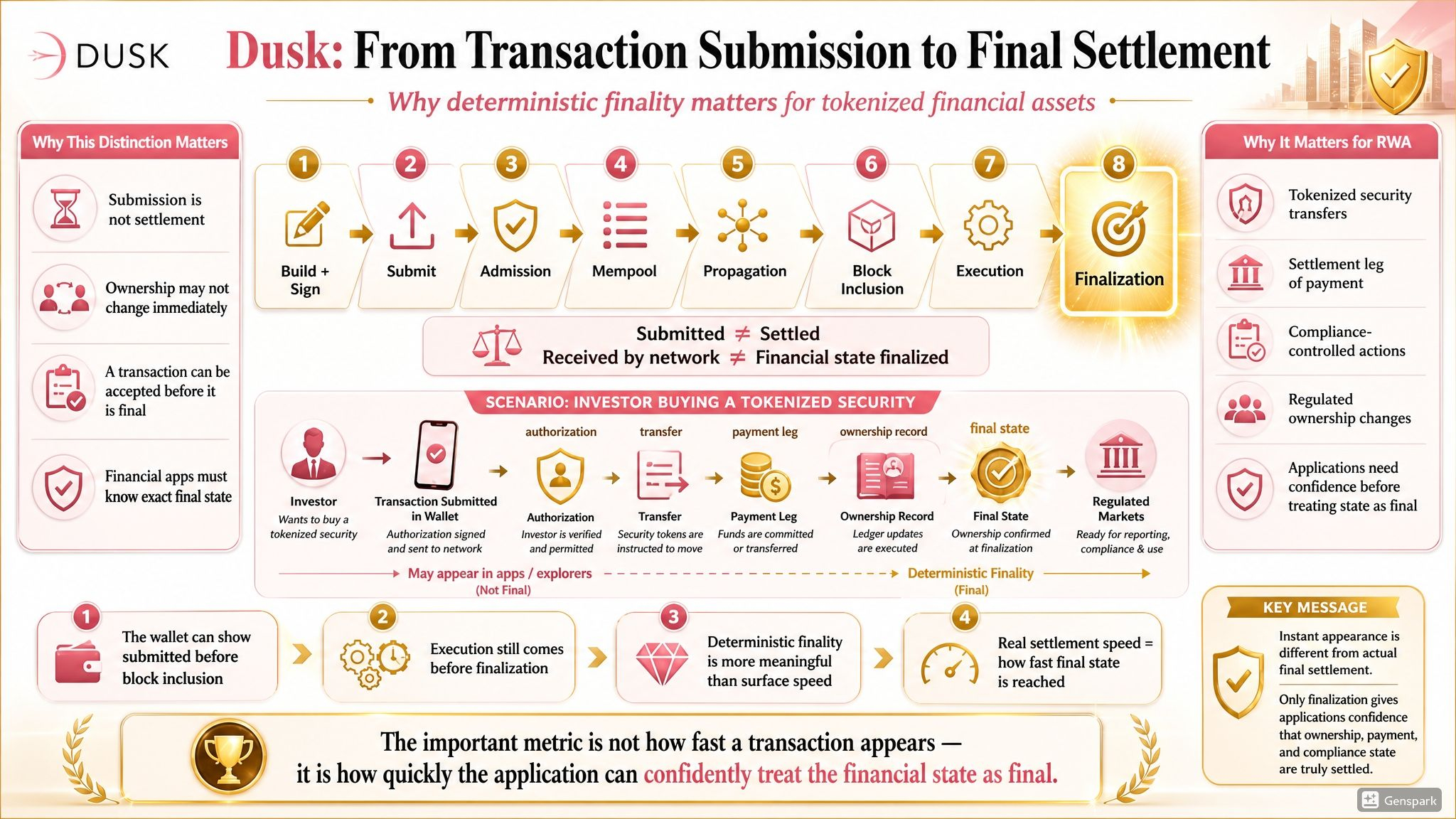
One thing I learned while digging into Dusk's transaction lifecycle completely changed how I look at the phrase instant settlement.
A transaction being submitted is NOT the same thing as a transaction being settled.
On @Dusk there are several steps between the two:
build + sign
submit
admission
mempool
propagation
block inclusion
execution
finalization.
That distinction sounds technical until you put a financial asset behind the transaction.
Imagine an investor buys a tokenized security.
The wallet says the transaction was submitted.
Does that mean ownership has changed?
Not necessarily.
The transaction still needs to be accepted / included / executed & ultimately finalized.
& Dusk makes that distinction explicit.
Even a successful submission response did not mean the transaction is already in a block.
That is important because financial applications shouldnot confuse:
the network received my transaction
with: the network has finalized the financial state.
For ordinary crypto transfers people may not think much about that difference.
For regulated securities it becomes much more important.
A transfer can represent a change in ownership.
A payment can represent the settlement leg.
A compliance-controlled action can determine whether the transfer was even permitted.
So the application needs to know exactly when the underlying state is final.
Thats why I find Dusk's deterministic-finality design interesting.
The important metric isn't simply:
How fast did the transaction appear?
It is: How quickly can the application reach a state where it can confidently treat the transaction as final?
That is a much more meaningful definition of settlement speed to me.
& honestly this is the kind of infrastructure detail I want to see more of from RWA projects.
Not just: assets are going onchain.
But: What happens to those assets at every step between authorization and final settlement?
That is where the real infrastructure story begins.
Do retail users care about true determinism, or is it strictly an institutional need?
#dusk $DUSK
A transaction being submitted is NOT the same thing as a transaction being settled.
On @Dusk there are several steps between the two:
build + sign
submit
admission
mempool
propagation
block inclusion
execution
finalization.
That distinction sounds technical until you put a financial asset behind the transaction.
Imagine an investor buys a tokenized security.
The wallet says the transaction was submitted.
Does that mean ownership has changed?
Not necessarily.
The transaction still needs to be accepted / included / executed & ultimately finalized.
& Dusk makes that distinction explicit.
Even a successful submission response did not mean the transaction is already in a block.
That is important because financial applications shouldnot confuse:
the network received my transaction
with: the network has finalized the financial state.
For ordinary crypto transfers people may not think much about that difference.
For regulated securities it becomes much more important.
A transfer can represent a change in ownership.
A payment can represent the settlement leg.
A compliance-controlled action can determine whether the transfer was even permitted.
So the application needs to know exactly when the underlying state is final.
Thats why I find Dusk's deterministic-finality design interesting.
The important metric isn't simply:
How fast did the transaction appear?
It is: How quickly can the application reach a state where it can confidently treat the transaction as final?
That is a much more meaningful definition of settlement speed to me.
& honestly this is the kind of infrastructure detail I want to see more of from RWA projects.
Not just: assets are going onchain.
But: What happens to those assets at every step between authorization and final settlement?
That is where the real infrastructure story begins.
Do retail users care about true determinism, or is it strictly an institutional need?
#dusk $DUSK
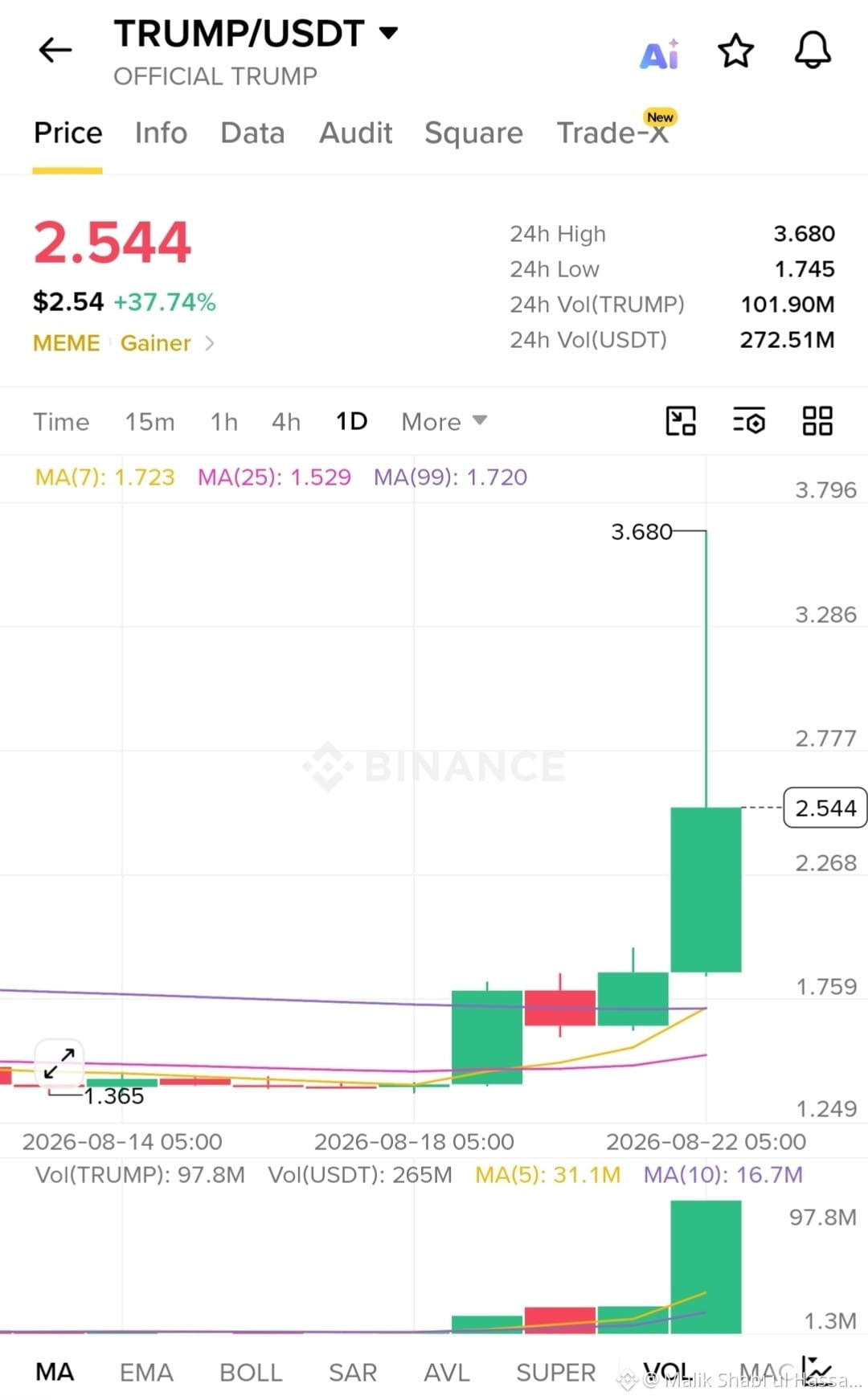
Taking a close look at the current setup on $TRUMP reveals some very interesting positioning building up across the order books.
Beyond just the daily price action a few key metrics stand out:
Whale Bias: We are seeing a long/short ratio of 1.10 backed by roughly 4.04M in whale longs, indicating a strong directional bias and momentum building up.
Market Structure: Price reclaiming $2.53 above the recent $2.42 low confirms a solid short-term bullish structure, with the next clear risk/reward target sitting at $2.74.
Risk Management: Rather than chasing blindly waiting for a clean retest and hold of $2.53 is the smarter play to filter out fakeouts and secure better entry precision.
With market sentiment sitting comfortably around 64.79% bullish & staking options like Flexible Simple Earn offering a steady ~3.32% APR the broader ecosystem backdrop remains active.
But the real test is whether momentum has enough strength to clear that overhead target cleanly.
Are you looking to long TRUMP on a retest here, or waiting for confirmation? Let me know below! 👇
#TRUMP #cryptotrading #BinanceSquare #MemeCoin
Beyond just the daily price action a few key metrics stand out:
Whale Bias: We are seeing a long/short ratio of 1.10 backed by roughly 4.04M in whale longs, indicating a strong directional bias and momentum building up.
Market Structure: Price reclaiming $2.53 above the recent $2.42 low confirms a solid short-term bullish structure, with the next clear risk/reward target sitting at $2.74.
Risk Management: Rather than chasing blindly waiting for a clean retest and hold of $2.53 is the smarter play to filter out fakeouts and secure better entry precision.
With market sentiment sitting comfortably around 64.79% bullish & staking options like Flexible Simple Earn offering a steady ~3.32% APR the broader ecosystem backdrop remains active.
But the real test is whether momentum has enough strength to clear that overhead target cleanly.
Are you looking to long TRUMP on a retest here, or waiting for confirmation? Let me know below! 👇
#TRUMP #cryptotrading #BinanceSquare #MemeCoin
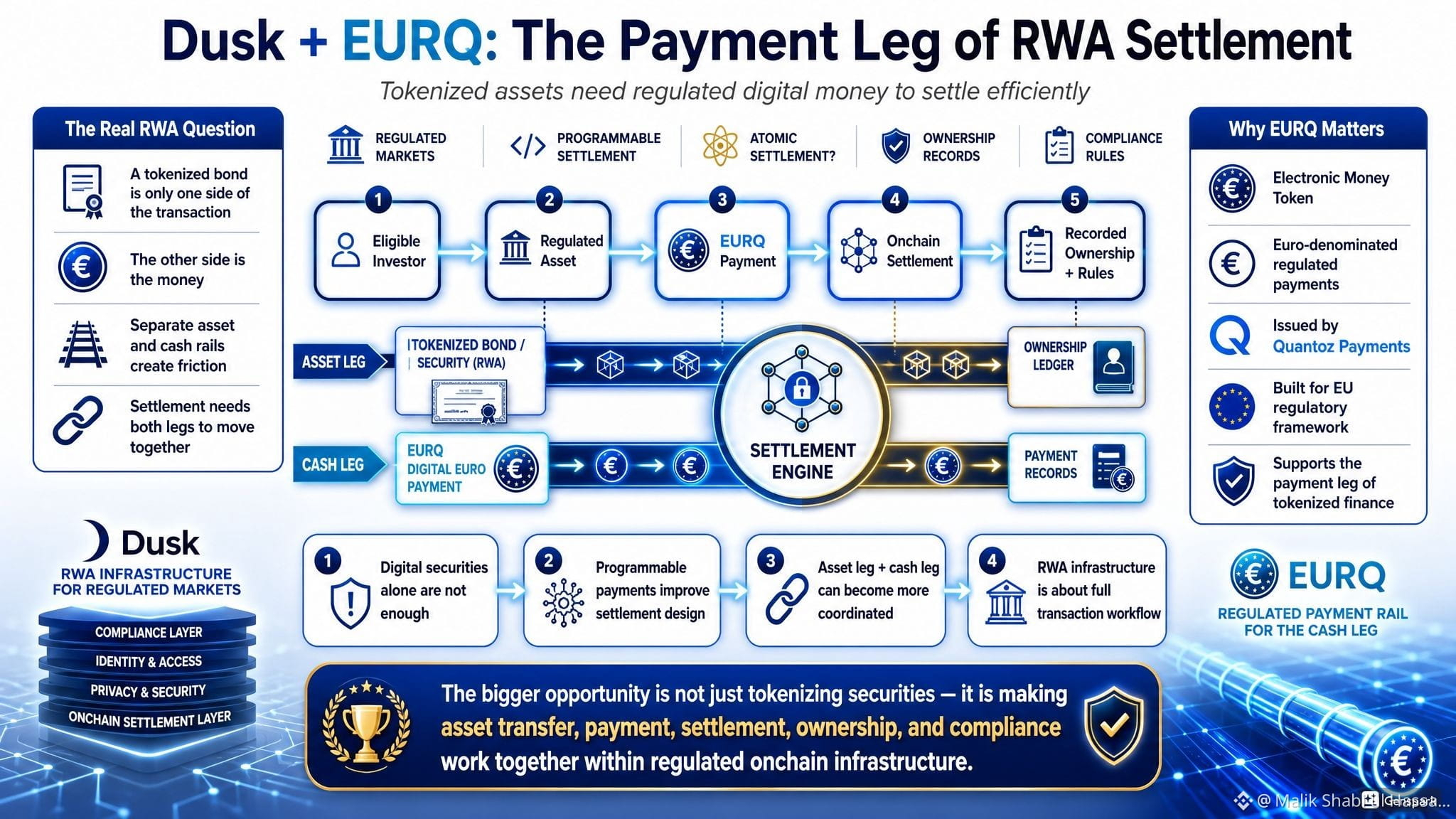
I have been looking at Dusk's RWA stack from the settlement side & I think I was focusing too much on the asset itself.
A tokenized bond is only 1 side of a transaction.
The other side is the money.
& this is where EURQ becomes interesting.
Imagine an investor buying a tokenized security.
You need two things to move together:
the security
the payment.
If the asset settles onchain but the payment still has to move through a completely separate system you are still coordinating two financial rails.
That is why I find the Dusk + EURQ direction more interesting than another stablecoin on a blockchain announcement.
EURQ is an Electronic Money Token designed for euro-denominated payments & is issued by Quantoz Payments under the EU regulatory framework.
The bigger idea is that a regulated digital euro can provide the payment leg alongside tokenized financial assets.
So the workflow starts looking like:
eligible investor → regulated asset → EURQ payment → onchain settlement.
And this is where I think the real RWA infrastructure story begins.
Because the goal isn0t simply to make securities digital.
Its to make the transaction around those securities more programmable.
Buy the asset.
Transfer the payment.
Settle both sides.
Record ownership.
Apply the relevant rules.
All within infrastructure designed for regulated markets.
That is a much harder problem than minting an asset token.
& there is one question I still want to see answered in practice:
Can regulated digital money & regulated tokenized securities eventually settle atomically enough that the traditional separation between the asset leg & cash leg becomes much less important?
If that happens the efficiency gain could be much bigger than simply putting securities onchain.
That is the part of Dusk's RWA stack I am watching now.
Do you think combining tokenized assets with regulated digital currencies like EURQ is the real key to scaling RWA adoption?
#dusk $DUSK @Dusk
A tokenized bond is only 1 side of a transaction.
The other side is the money.
& this is where EURQ becomes interesting.
Imagine an investor buying a tokenized security.
You need two things to move together:
the security
the payment.
If the asset settles onchain but the payment still has to move through a completely separate system you are still coordinating two financial rails.
That is why I find the Dusk + EURQ direction more interesting than another stablecoin on a blockchain announcement.
EURQ is an Electronic Money Token designed for euro-denominated payments & is issued by Quantoz Payments under the EU regulatory framework.
The bigger idea is that a regulated digital euro can provide the payment leg alongside tokenized financial assets.
So the workflow starts looking like:
eligible investor → regulated asset → EURQ payment → onchain settlement.
And this is where I think the real RWA infrastructure story begins.
Because the goal isn0t simply to make securities digital.
Its to make the transaction around those securities more programmable.
Buy the asset.
Transfer the payment.
Settle both sides.
Record ownership.
Apply the relevant rules.
All within infrastructure designed for regulated markets.
That is a much harder problem than minting an asset token.
& there is one question I still want to see answered in practice:
Can regulated digital money & regulated tokenized securities eventually settle atomically enough that the traditional separation between the asset leg & cash leg becomes much less important?
If that happens the efficiency gain could be much bigger than simply putting securities onchain.
That is the part of Dusk's RWA stack I am watching now.
Do you think combining tokenized assets with regulated digital currencies like EURQ is the real key to scaling RWA adoption?
#dusk $DUSK @Dusk
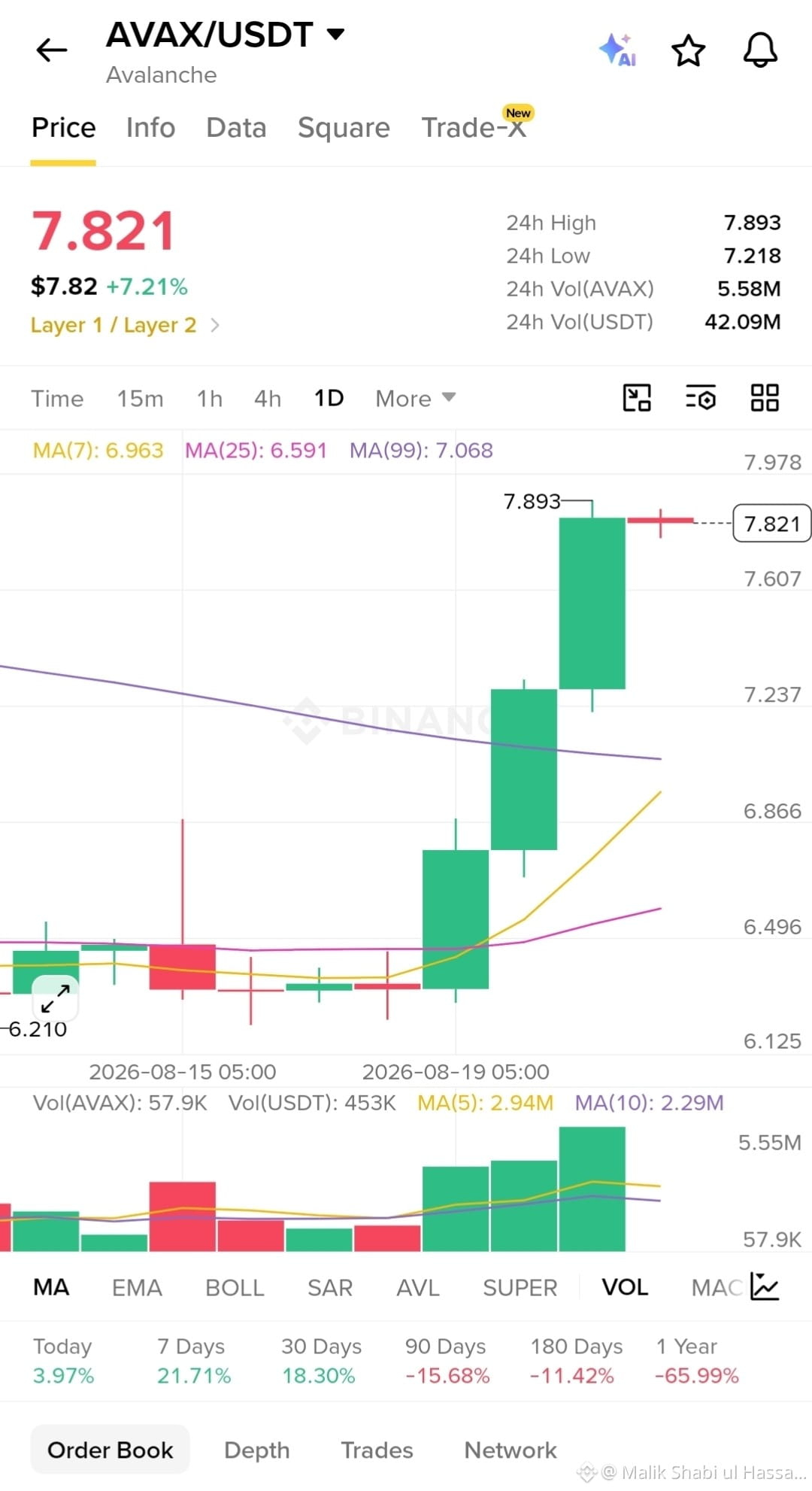
Lately looking at the AVAX/USDT 1D chart & order book setup reveals a very interesting dynamic building up.
Price is currently sitting around $7.82pushing right near the 24h high of $7.89 with strong green volume candles breaking above the moving averages.
Instead of just chasing green candlesa few technical details on the chart caught my attention:
Momentum & Resistance: Price holding strong above previous levels confirms active buyer control. A clean, decisive break above the $7.89 resistance level could trigger a larger impulsive continuation wave.
Order Book & Sentiment: Order book pressure is leaning towards buyers (~56.56% buy side) showing steady demand beneath current levels.
Execution Strategy: Rather than FOMOing right at the resistance, waiting for a healthy retest and confirmation of support flip remains the cleaner play to avoid local fakeouts.
But the real question isn0t just about catching the next short-term bounce on the chart.
Itz whether current buyer momentum has enough weight to clear overhead resistance sustainably.
Are you positioning for a breakout on AVAX here, or waiting for a deeper pullback? Let me know below! 👇
#AVAX #Avalanche #cryptotrading #BinanceSquare $AVAX
Price is currently sitting around $7.82pushing right near the 24h high of $7.89 with strong green volume candles breaking above the moving averages.
Instead of just chasing green candlesa few technical details on the chart caught my attention:
Momentum & Resistance: Price holding strong above previous levels confirms active buyer control. A clean, decisive break above the $7.89 resistance level could trigger a larger impulsive continuation wave.
Order Book & Sentiment: Order book pressure is leaning towards buyers (~56.56% buy side) showing steady demand beneath current levels.
Execution Strategy: Rather than FOMOing right at the resistance, waiting for a healthy retest and confirmation of support flip remains the cleaner play to avoid local fakeouts.
But the real question isn0t just about catching the next short-term bounce on the chart.
Itz whether current buyer momentum has enough weight to clear overhead resistance sustainably.
Are you positioning for a breakout on AVAX here, or waiting for a deeper pullback? Let me know below! 👇
#AVAX #Avalanche #cryptotrading #BinanceSquare $AVAX
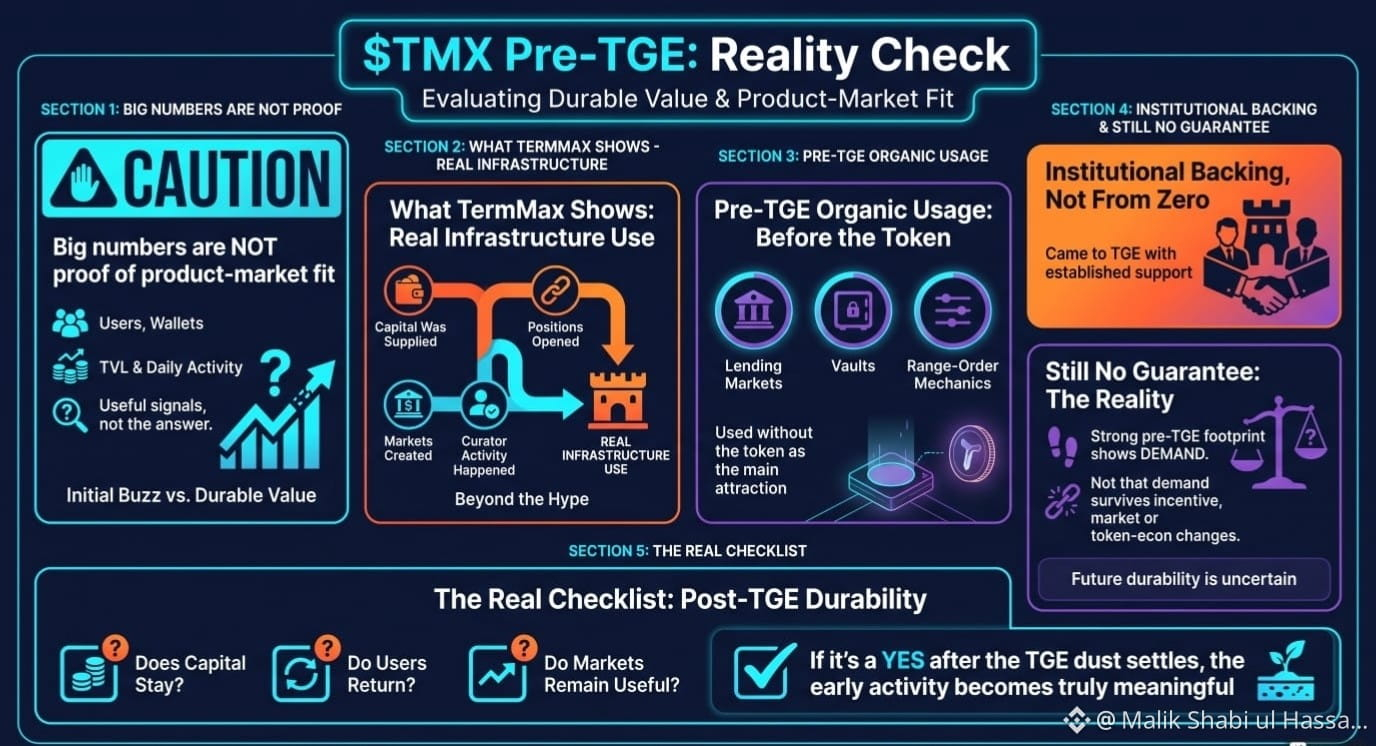
#termmax @TermMax One thing I did be careful about with TermMax before the TGE is treating every big number as proof of product-market fit.
Users / wallets / TVL & daily activity are useful signals.
But they donot answer the harder question:
How much of that activity is economically durable?
That is where I find TermMax more interesting to examine.
The protocol has already gone through a period where users could interact with its lending markets, vaults & range-order mechanics without having to rely on the token itself as the main attraction.
That gives us something useful to observe.
Not just how many wallets arrived, but what people actually did with the infrastructure.
Capital was supplied. Positions were opened. Markets were created. Curator activity happened.
& the project also came into the TGE with institutional backing rather than starting from zero.
Still I wouldnot treat any of that as a guarantee.
A strong pre-TGE footprint can show that there is demand.
It doesnot automatically show that the same demand survives a change in incentives market conditions or token economics.
So my real checklist for $TMX is pretty simple:
Does capital stay?
Do users return?
Do markets remain useful?
If the answer is yes after the TGE excitement settles then the earlier activity becomes much more meaningful.
That is the signal I care about more than the launch-day numbers.
Do you usually get hyped for TGEs, or do you wait to see how protocols perform after the initial launch dust settles?
Users / wallets / TVL & daily activity are useful signals.
But they donot answer the harder question:
How much of that activity is economically durable?
That is where I find TermMax more interesting to examine.
The protocol has already gone through a period where users could interact with its lending markets, vaults & range-order mechanics without having to rely on the token itself as the main attraction.
That gives us something useful to observe.
Not just how many wallets arrived, but what people actually did with the infrastructure.
Capital was supplied. Positions were opened. Markets were created. Curator activity happened.
& the project also came into the TGE with institutional backing rather than starting from zero.
Still I wouldnot treat any of that as a guarantee.
A strong pre-TGE footprint can show that there is demand.
It doesnot automatically show that the same demand survives a change in incentives market conditions or token economics.
So my real checklist for $TMX is pretty simple:
Does capital stay?
Do users return?
Do markets remain useful?
If the answer is yes after the TGE excitement settles then the earlier activity becomes much more meaningful.
That is the signal I care about more than the launch-day numbers.
Do you usually get hyped for TGEs, or do you wait to see how protocols perform after the initial launch dust settles?
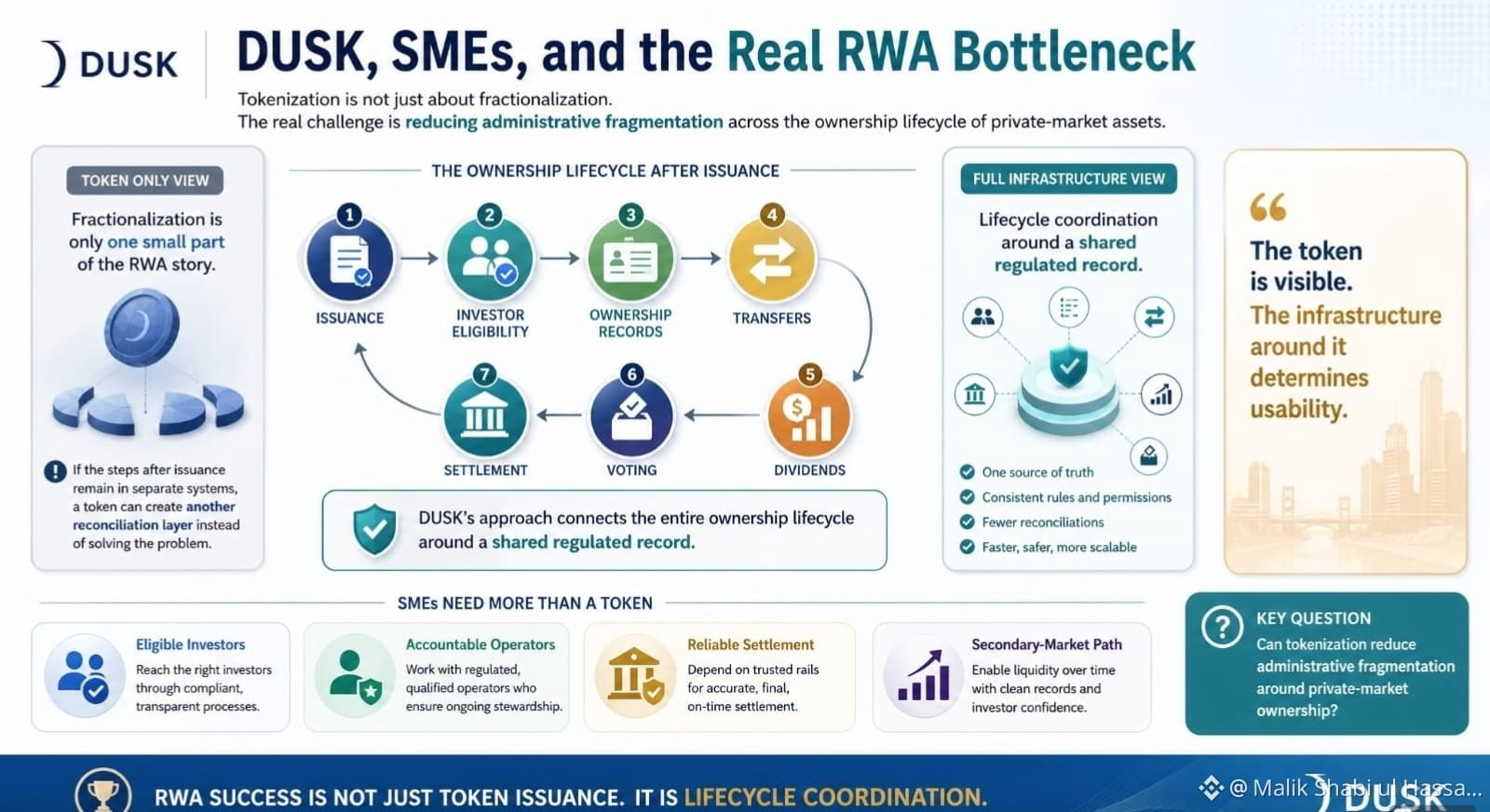
I was reading Dusk's latest piece on tokenization for SMEs & one sentence basically changed how I think about the whole RWA narrative.
I used to assume the main benefit was making private-market assets smaller and easier to buy.
But fractionalization is actually only one small part.
Think about what happens after a security is issued:
investor eligibility
ownership records
transfers
dividends
voting
settlement
If every one of those steps still lives in a different system putting a token in the middle does not magically fix the problem.
It can actually create another reconciliation layer.
That is why Dusk's latest approach caught my attention.
The idea is to connect the ownership lifecycle around a shared regulated record instead of treating the token as the entire solution.
& this matters even more for SMEs.
A smaller company doesnot just need a token.
It needs access to eligible investors / accountable operators / reliable settlement & eventually a path toward secondary-market activity.
That is a much bigger problem than how do we tokenize this asset?
& honestly I think this is where the RWA narrative gets too focused on the token itself.
The token is visible.
The infrastructure around it is what actually determines whether the asset becomes usable.
So the question I am watching with Dusk isnot:
How many assets can be tokenized?
It is:
Can tokenization actually reduce the administrative fragmentation around private-market ownership?
That is the part I find interesting.
Do you think tokenizing private assets will actually fix administrative friction, or are we just moving paperwork on-chain?
#dusk $DUSK @Dusk
I used to assume the main benefit was making private-market assets smaller and easier to buy.
But fractionalization is actually only one small part.
Think about what happens after a security is issued:
investor eligibility
ownership records
transfers
dividends
voting
settlement
If every one of those steps still lives in a different system putting a token in the middle does not magically fix the problem.
It can actually create another reconciliation layer.
That is why Dusk's latest approach caught my attention.
The idea is to connect the ownership lifecycle around a shared regulated record instead of treating the token as the entire solution.
& this matters even more for SMEs.
A smaller company doesnot just need a token.
It needs access to eligible investors / accountable operators / reliable settlement & eventually a path toward secondary-market activity.
That is a much bigger problem than how do we tokenize this asset?
& honestly I think this is where the RWA narrative gets too focused on the token itself.
The token is visible.
The infrastructure around it is what actually determines whether the asset becomes usable.
So the question I am watching with Dusk isnot:
How many assets can be tokenized?
It is:
Can tokenization actually reduce the administrative fragmentation around private-market ownership?
That is the part I find interesting.
Do you think tokenizing private assets will actually fix administrative friction, or are we just moving paperwork on-chain?
#dusk $DUSK @Dusk
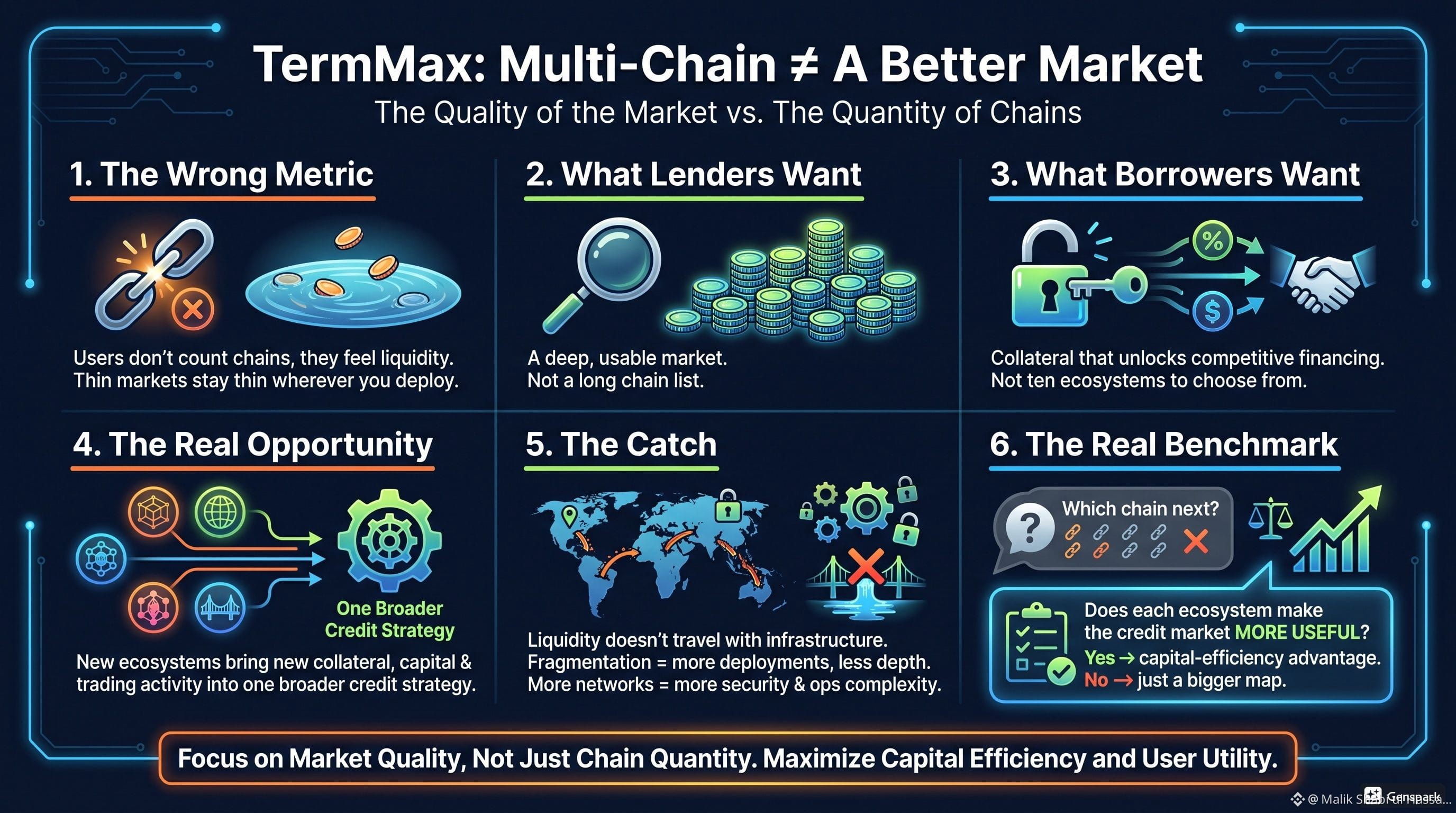
One thing I am starting to care about more with TermMax isn0t the number of chains it reaches.
It is whether moving across chains actually changes the quality of the market.
A lender didnot really care that a protocol is multi-chain if the market they want has thin liquidity.
A borrower doesnot gain much from having ten ecosystems available if the collateral they hold still can not access competitive financing.
That is why I see the multi-chain question differently.
The opportunity is potentially much bigger than simply giving users another place to connect their wallet. Different ecosystems can bring different collateral, capital and trading activity into the same broader credit strategy.
But there is a catch: liquidity doesn0t automatically travel just because infrastructure does.
Fragmented markets can create the opposite result - more deployments but less depth where it actually matters.
& spreading a credit system across networks also means the security and operational assumptions become more complicated.
So my benchmark for TermMax isnot:
Which chain comes next?
It is:-
Does each new ecosystem make the credit market more useful than it was before?
If the answer keeps being yes, multi-chain becomes a capital-efficiency advantage.
If not its just a bigger map.
Do you think protocols should focus on deep liquidity on fewer chains or expand everywhere first? Drop your thoughts below
#termmax @TermMax
It is whether moving across chains actually changes the quality of the market.
A lender didnot really care that a protocol is multi-chain if the market they want has thin liquidity.
A borrower doesnot gain much from having ten ecosystems available if the collateral they hold still can not access competitive financing.
That is why I see the multi-chain question differently.
The opportunity is potentially much bigger than simply giving users another place to connect their wallet. Different ecosystems can bring different collateral, capital and trading activity into the same broader credit strategy.
But there is a catch: liquidity doesn0t automatically travel just because infrastructure does.
Fragmented markets can create the opposite result - more deployments but less depth where it actually matters.
& spreading a credit system across networks also means the security and operational assumptions become more complicated.
So my benchmark for TermMax isnot:
Which chain comes next?
It is:-
Does each new ecosystem make the credit market more useful than it was before?
If the answer keeps being yes, multi-chain becomes a capital-efficiency advantage.
If not its just a bigger map.
Do you think protocols should focus on deep liquidity on fewer chains or expand everywhere first? Drop your thoughts below
#termmax @TermMax
Verified
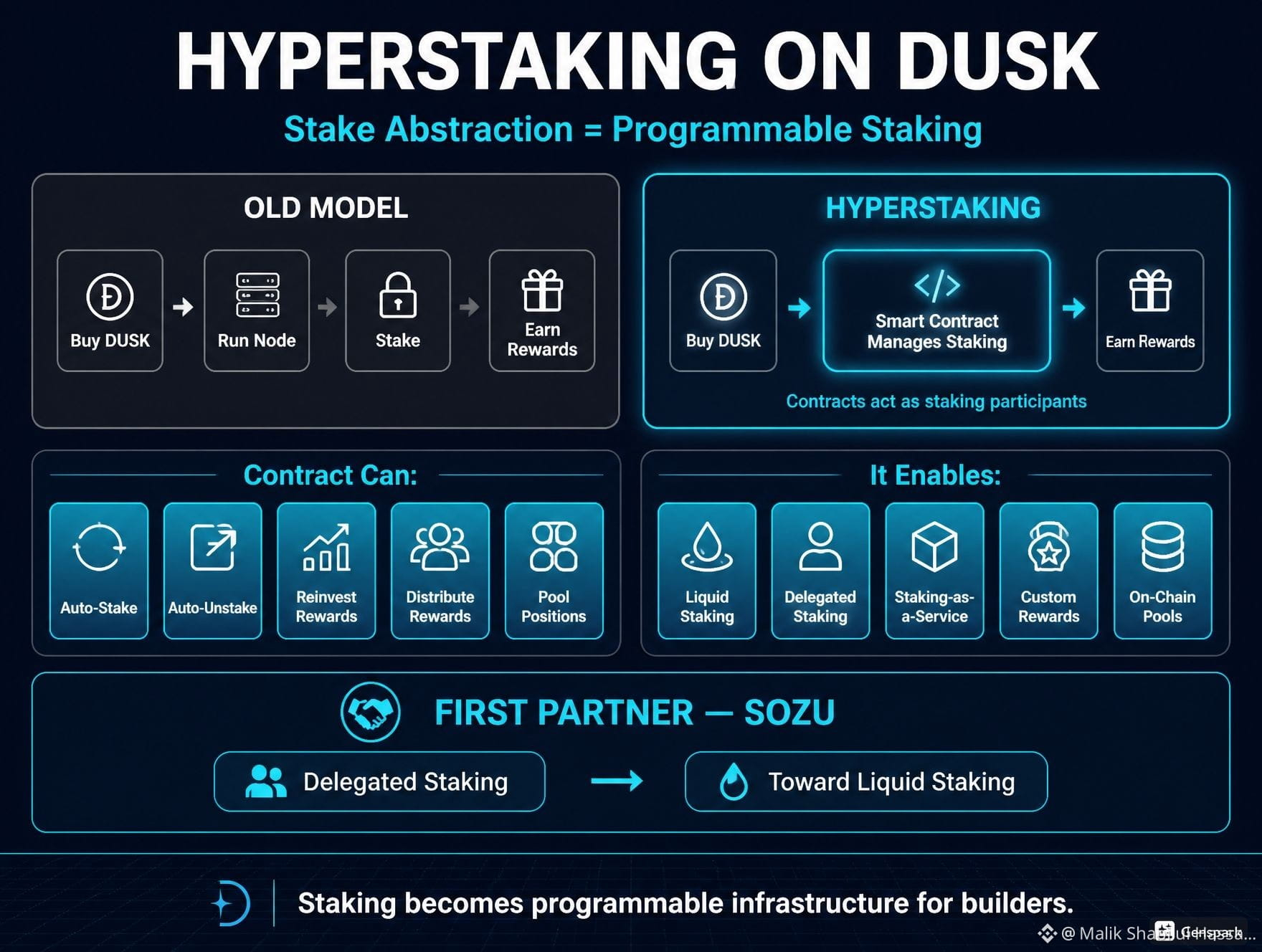
I used to think staking on Dusk was basically the standard model:
buy DUSK → run a node → stake → earn rewards.
Then I found Hyperstaking.
& honestly this is one of those smaller technical features that becomes more interesting when you think about what it enables.
Dusk's Hyperstaking is based on Stake Abstraction.
The key idea:
smart contracts can participate in staking on behalf of users.
That means staking doesnot necessarily have to be a manual process where every user understands node operation.
A smart contract can:
stake automatically
unstake according to predefined logic
reinvest rewards
distribute rewards
pool staking positions
& that is where it gets interesting for me.
Because now staking becomes something applications can build around.
Liquid staking.
Delegated staking.
Staking-as-a-service.
Custom reward mechanisms.
The first Hyperstaking partner Dusk announced was Sozu, with delegated staking as an initial step toward liquid staking.
So DUSK staking isnot necessarily limited to people who want to operate infrastructure themselves.
The protocol is giving developers a way to make staking programmable.
& that creates a different question.
If smart contracts can manage network-security participation how many financial products can eventually be built around that primitive?
That is the part I want to see in practice.
Because Hyperstaking isn0t just:
another way to earn staking rewards.
The more interesting idea is:
turning staking itself into programmable infrastructure.
How many financial products can eventually be built around that primitive?
What do you think? Will Stake Abstraction become the standard for Layer 1s? Let me know below! 👇
#dusk $DUSK @Dusk
buy DUSK → run a node → stake → earn rewards.
Then I found Hyperstaking.
& honestly this is one of those smaller technical features that becomes more interesting when you think about what it enables.
Dusk's Hyperstaking is based on Stake Abstraction.
The key idea:
smart contracts can participate in staking on behalf of users.
That means staking doesnot necessarily have to be a manual process where every user understands node operation.
A smart contract can:
stake automatically
unstake according to predefined logic
reinvest rewards
distribute rewards
pool staking positions
& that is where it gets interesting for me.
Because now staking becomes something applications can build around.
Liquid staking.
Delegated staking.
Staking-as-a-service.
Custom reward mechanisms.
The first Hyperstaking partner Dusk announced was Sozu, with delegated staking as an initial step toward liquid staking.
So DUSK staking isnot necessarily limited to people who want to operate infrastructure themselves.
The protocol is giving developers a way to make staking programmable.
& that creates a different question.
If smart contracts can manage network-security participation how many financial products can eventually be built around that primitive?
That is the part I want to see in practice.
Because Hyperstaking isn0t just:
another way to earn staking rewards.
The more interesting idea is:
turning staking itself into programmable infrastructure.
How many financial products can eventually be built around that primitive?
What do you think? Will Stake Abstraction become the standard for Layer 1s? Let me know below! 👇
#dusk $DUSK @Dusk
Log in to explore more content