I went looking for how vaultBTC moves on-chain, expecting it to behave like WBTC. It doesn't.
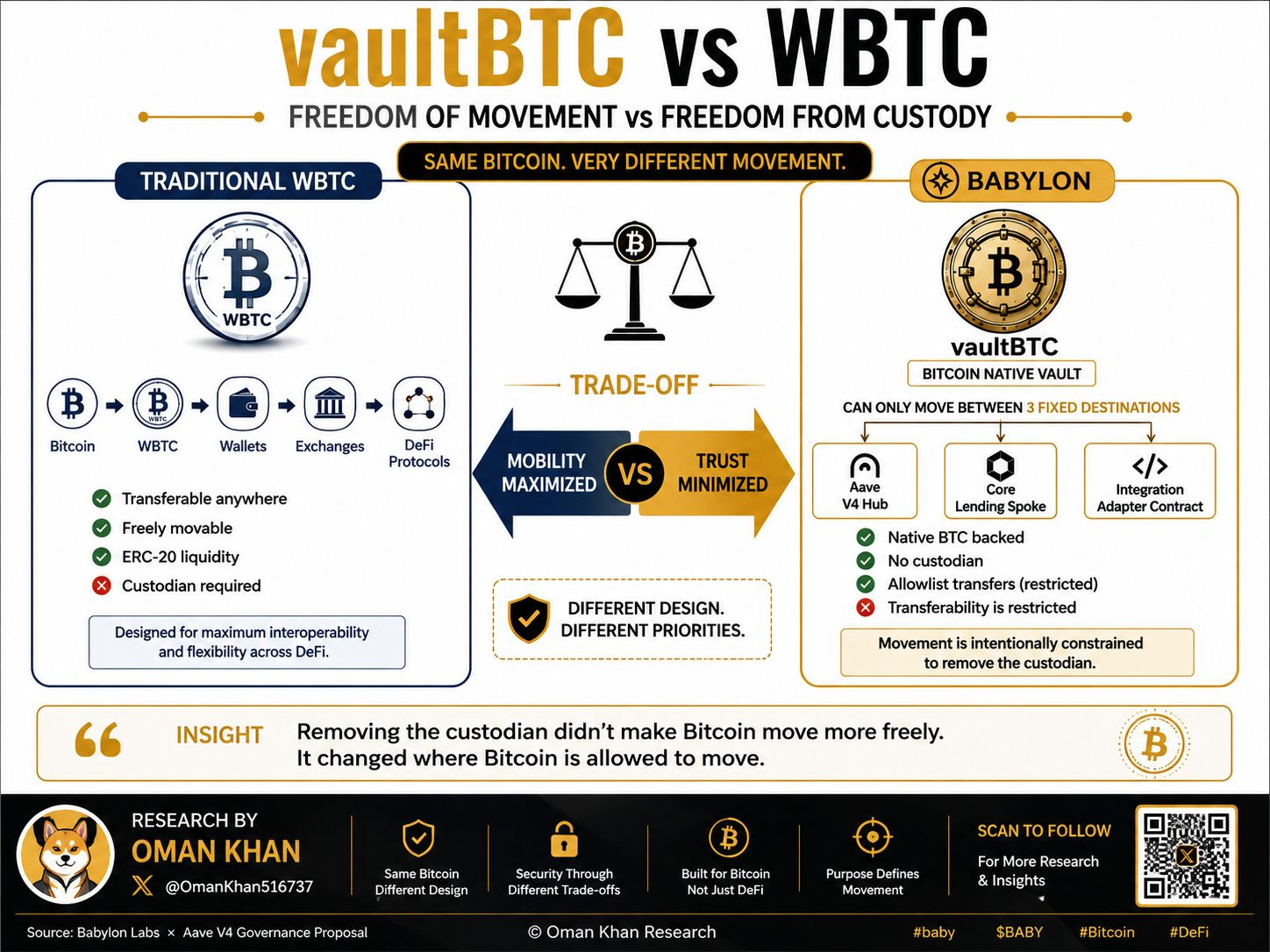
WBTC can move almost anywhere—wallets, exchanges, and DeFi protocols. That flexibility is one of its biggest strengths, but it also comes with a custodian behind it.
According to @BabylonLabs_io's Aave proposal, vaultBTC follows a very different design.
Instead of maximizing transferability, vaultBTC is transfer-restricted. It can only move between three predefined destinations:
• Aave V4 Hub
• Core Lending Spoke
• Integration Adapter Contract
Nowhere else.
The proposal explains why.
Those restrictions are what allow the system to avoid introducing a trusted custodian. Instead of trusting a third party, the protocol limits where the asset is allowed to move.
It's a different trade-off.
WBTC prioritizes mobility.
vaultBTC prioritizes trust minimization.
Neither design is inherently "better." They solve different problems.
One question stayed with me:
If removing the custodian requires restricting transferability, where should Bitcoin's freedom really be measured—by who controls it, or by where it's allowed to move?
@BabylonLabs_io
#baby $BABY #Bitcoin #defi
WBTC can move almost anywhere—wallets, exchanges, and DeFi protocols. That flexibility is one of its biggest strengths, but it also comes with a custodian behind it.
According to @BabylonLabs_io's Aave proposal, vaultBTC follows a very different design.
Instead of maximizing transferability, vaultBTC is transfer-restricted. It can only move between three predefined destinations:
• Aave V4 Hub
• Core Lending Spoke
• Integration Adapter Contract
Nowhere else.
The proposal explains why.
Those restrictions are what allow the system to avoid introducing a trusted custodian. Instead of trusting a third party, the protocol limits where the asset is allowed to move.
It's a different trade-off.
WBTC prioritizes mobility.
vaultBTC prioritizes trust minimization.
Neither design is inherently "better." They solve different problems.
One question stayed with me:
If removing the custodian requires restricting transferability, where should Bitcoin's freedom really be measured—by who controls it, or by where it's allowed to move?
@BabylonLabs_io
#baby $BABY #Bitcoin #defi