
🎯Exploring Omnichain: What Is It, Benefits & Differences:
📌As many of you will know, blockchain technology promised a decentralized future—one where users could transact freely, own their assets outright, and build a more open financial system. But over the years, that vision has become fragmented. We now have a sprawling ecosystem of Layer 1s, Layer 2s, sidechains, and rollups, each operating in their own silos with limited communication between them. And while this explosion of innovation has brought us scalability and choice, it’s also introduced complexity, inefficiency and isolation.
📌Interoperability has long been considered the holy grail of Web3—and while cross-chain and multichain solutions have taken meaningful steps forward, they still fall short in one crucial area: seamlessness. This is where the concept of omnichain enters the picture. Not just another buzzword, but a fundamental rethinking of how blockchains should communicate, coordinate and coexist.
📌In this article, we’ll explore what omnichains are, how they differ from cross-chain and multichain approaches, the technology powering them, and why they could be the key to unlocking the full potential of a truly unified Web3.
📌To understand the need for omnichains, we first need to examine the fragmented state of the blockchain ecosystem as it exists today. Despite the rapid growth of blockchain networks, what we’re left with is less a cohesive system and more a patchwork of isolated digital islands—each with its own architecture, user base, and set of rules.
📌The source of this fragmentation lies in the very foundation of blockchain design. As many readers will be aware, the blockchain trilemma—the challenge of simultaneously achieving scalability, security, and decentralization—has forced developers to make trade-offs. Bitcoin, for instance, offers unrivalled security and decentralization but suffers in terms of transaction speed and throughput. Ethereum, while more flexible and programmable, has long grappled with congestion and high fees.
📌In response, we’ve seen the rise of Layer 2 networks, sidechains, and entirely new Layer 1s—each attempting to overcome these limitations in their own way. While this has led to innovation at breakneck speed, it’s also created a serious problem: interoperability. Most of these networks simply don’t speak the same language.
📌As a result, assets and data cannot move freely between chains. A token on Ethereum isn’t natively recognized on Solana. A smart contract deployed on Avalanche won’t function on Cosmos. Users must rely on third-party bridges, wrapped tokens, or centralized exchanges to move value across chains—often at the cost of speed, security, and decentralization.
📌This fragmentation doesn't just create friction for users. It splinters liquidity, hampers composability, and limits the scalability of decentralized applications. In other words, it prevents the blockchain space from functioning as a unified digital economy.
📌You might be asking yourself: why hasn’t this been solved already? The truth is developers have tried. Cross-chain bridges and multichain deployments have provided stopgap solutions. But as we’ll explore shortly, these approaches come with limitations.
🎯Cross-Chain vs Multichain vs Omnichain:
When discussing interoperability in crypto, three terms are often thrown around interchangeably: cross-chain, multichain, and omnichain. But despite sounding similar, they represent fundamentally different approaches—and understanding these differences is crucial if we want to grasp where the industry is heading.
🎯The Cross-Chain Approach:
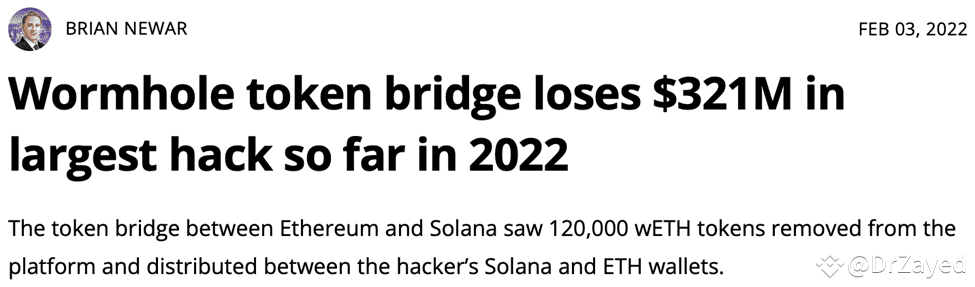
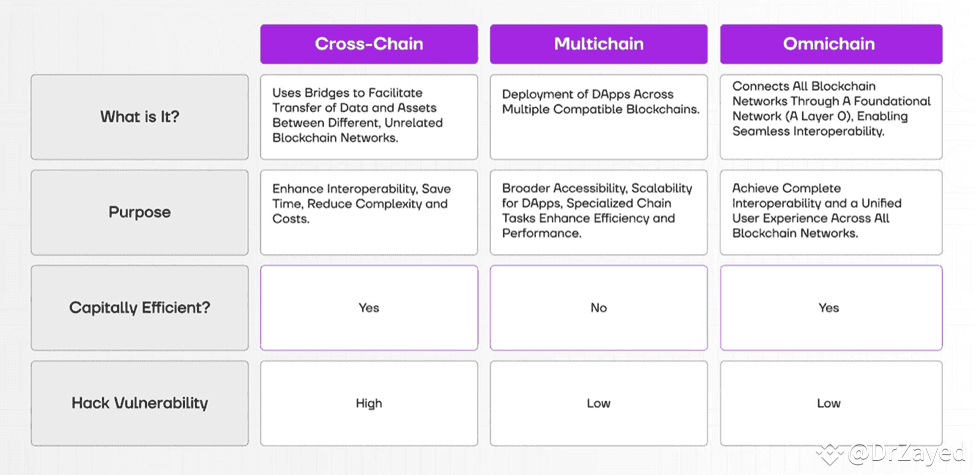
📌Let’s start with cross-chain solutions. At their core, these rely on bridge protocols that allow tokens or data to move between distinct blockchains. The mechanism typically involves locking or burning an asset on the source chain, and minting or unlocking a corresponding asset on the destination chain.
📌While this sounds simple enough, the underlying architecture can be quite complex—and, more importantly, vulnerable. Cross-chain bridges often rely on centralized intermediaries or limited validator sets to confirm transactions, creating a single point of failure. It’s no coincidence that some of the largest exploits in crypto history have involved cross-chain bridge failures.
🎯The Multichain Approach:
📌Then there’s the multichain model. Here, a decentralized application (or DApp) is deployed independently on several different blockchains—usually those that are compatible with the Ethereum Virtual Machine (EVM). Think of it as cloning the same app across multiple ecosystems: one version on Ethereum, another on Polygon, a third on Arbitrum, and so on.
📌The benefit? Broader market reach and lower transaction costs. But the downside? Fragmentation. Each version of the DApp operates in a silo, with separate liquidity pools, disconnected user bases, and duplicate logic. From a user experience and capital efficiency perspective, it’s far from ideal. Imagine having to switch networks every time you wanted to access a different part of the same application—it’s clunky, confusing, and inefficient.
🎯The Omnichain Vision:
📌Finally, we arrive at omnichain.
📌Unlike cross-chain and multichain models, omnichain systems are built from the ground up to support native communication between blockchains, regardless of their underlying architecture. This means assets and data can move seamlessly—not through wrappers or duplicate deployments, but via a unified messaging layer that spans multiple networks.
📌Think of it as the internet of blockchains: an infrastructure where chains are no longer isolated silos, but interconnected nodes in a cohesive, permissionless web. Omnichain technology allows a single smart contract to interact with multiple blockchains simultaneously—without having to compromise on security, composability, or user experience.
📌It’s a powerful concept—and as we’ll see next, the underlying mechanics are just as fascinating.
🎯How Omnichain Technology Works:
📌Now that we’ve defined what omnichain means, it’s time to unpack how it works under the hood. While the mechanics can vary slightly between implementations, the underlying principles remain the same.
🎯The Messaging Layer – The Heart of the Omnichain:
📌At the core of any omnichain system is a cross-chain messaging layer—an infrastructure protocol that allows smart contracts on separate blockchains to communicate, coordinate, and operate as a single application.
📌This messaging layer enables data and transaction logic to move fluidly across blockchains, supporting functions such as cross-chain token transfers, inter-chain contract calls, asset rebalancing, and even on-chain governance actions. Crucially, it allows developers to maintain one unified application logic that spans multiple chains—rather than duplicating code and fragmenting state.
🎯Execution Without Wrapping:
📌What truly sets omnichain apart is its ability to support native asset movement without wrapping. In traditional cross-chain setups, assets often need to be wrapped—essentially a synthetic version of the original—before they can function on a new chain. This adds layers of complexity and risk.
📌Omnichain systems eliminate that. Using a unified framework, a token can be minted on one chain and recognized across others, with liquidity, ownership, and metadata intact. No wrappers. No bridges. No roundabout workarounds.
🎯Modular Security:
📌Omnichain also takes a different approach in how it handles security. Instead of depending on a single bridge or central group of validators—which, as we’ve seen, can be risky—developers now have far more control. They can choose from a range of independent verifiers, set their own gas rules, and even run their own infrastructure if they want to.
📌If one of these verifiers goes offline, or turns out to be unreliable, the system doesn’t break. The message just waits to be delivered until another verifier picks it up. No lost funds. No frozen dApps. Just a pause—until it’s safe to proceed.
🎯Composability Across Chains:
📌Just as DeFi earned its “money Lego” nickname for composability within Ethereum, omnichain brings that same principle across chains. Smart contracts can trigger follow-up actions not only on the same chain but across multiple networks—mint on Ethereum, stake on Arbitrum, airdrop on Avalanche, and even route back to Ethereum—all in one transaction.
📌This unlocks a new design space for developers and sets the stage for what can only be described as a truly unified multichain experience.
🎯Use Cases of Omnichain Technology:
📌As omnichain infrastructure continues to evolve, it’s opening the door to a variety of practical applications across the Web3 landscape. While the technology is still maturing, early implementations are already showing promise in several key areas—from decentralized finance to NFTs and cross-chain smart contracts.
📌Let’s explore where omnichain is making an impact.
🎯Decentralized Finance (DeFi):
📌One of the most immediate beneficiaries of Omnichain infrastructure is DeFi, where liquidity, composability, and efficient capital movement are critical.
📌Omnichain liquidity pools offer a more flexible alternative to traditional, siloed pools. Rather than fragmenting capital across multiple chains, liquidity can be shared or aggregated, helping reduce slippage and improving price discovery. This is particularly useful for decentralized exchanges (DEXs) looking to offer competitive trading experiences across ecosystems.
📌In lending and borrowing, interoperable protocols allow users to supply collateral on one chain and borrow against it on another—eliminating the need for bridging or moving assets manually. This creates more capital-efficient systems and gives users access to a broader range of markets and opportunities, without locking them into a single chain’s economy.
🎯NFTs & Digital Asset Ownership:
📌Non-fungible tokens (NFTs) have become one of the more visible parts of Web3, but ownership and functionality are often limited by the chain they were minted on. Omnichain infrastructure seeks to address that.
📌With Omnichain NFTs, ownership can extend across multiple blockchains simultaneously. This allows for a more fluid experience—whether that means showcasing assets across different marketplaces, accessing NFT-gated content on various chains, or integrating assets into multichain gaming environments.
📌Omnichain messaging also enhances authentication and verification, making it easier to confirm provenance and enforce royalties across ecosystems. For creators and collectors alike, this expands utility while helping maintain control over how assets are used and transferred.
🎯Cross-Chain Smart Contracts:
📌Smart contracts are the backbone of decentralized applications—but until recently, their scope has been limited to the blockchain they were deployed on. Omnichain messaging layers are changing that.
📌With cross-chain smart contracts, developers can coordinate logic across multiple blockchains—allowing one contract to trigger actions on another, or enabling different parts of an application to live on different chains while maintaining a shared state.
📌In practice, this opens up a wide range of possibilities: from cross-chain DAOs managing proposals and votes across ecosystems, to real-time asset transfers, lending platforms, and omnichain DEXs. Projects like Layer Zero, Entangle, and others are already enabling these types of applications, setting the stage for a more connected and composable Web3.
🎯Real-World Assets:
📌Projects like Ondo Finance are leveraging omnichain architecture to bring tokenized Treasury bonds, gold, and other real-world assets to Web3 in a way that’s scalable, compliant, and secure.
📌By enabling RWAs to move freely across chains, Omnichain protocols allow institutions and individuals alike to interact with these assets wherever they’re needed—whether for staking, lending, or collateralization—without compromising on regulatory integrity or operational efficiency.
🎯Projects Leading the Omnichain Charge:
With the concept of omnichain gaining traction, several projects have stepped up to build the infrastructure necessary to make this vision a reality. While each takes a slightly different approach, they’re all working toward the same goal: a seamless, interconnected blockchain ecosystem where users and developers are no longer bound by the limits of a single chain.