
#sharedsecurity
sharedsecurity
1,341 views
19 Discussing
Hot
Latest

·
--
@babylonlabs_io #baby $BABY
A few hours ago, my son asked me a question I wasn't expecting.
If Bitcoin is the security behind Babylon, why does everyone keep celebrating TVL?
I paused because I realized I'd been looking at the protocol through the same lens as every other DeFi project.
The more I study Babylon, the more I think TVL is only measuring the raw material, not the product. Bitcoin is the input. Security is the output.
That distinction matters.
Babylon isn't trying to maximize the amount of BTC sitting idle. Its architecture is designed to let Bitcoin's economic security secure external systems while BTC remains under Bitcoin's own security model. If the same pool of BTC ends up protecting more consumer chains, finality providers, and economic activity over time, the protocol has become more valuable even if TVL barely changes.
This creates an interesting measurement problem.
Two protocols can report identical TVL, yet deliver completely different amounts of security. One simply stores collateral. The other exports security as infarstructure. Looking only at capital locked makes those two systems appear equivalent when their economic function is fundamentally different.
That also changes how I think about valuation. Instead of asking how much BTC is locked, we may eventually ask how much security is being consumed, how many networks depend on it, how much economic value those networks protect, and how expensive it would be to compromise them. Those metrics are much closer to what Babylon is actually building.
TVL will always remain an important indicator of liquidity and market confidence. But if Babylon succeeds, its defining KPI may resemble cloud infrastructure utilization more than traditional DeFi liquidity.
If Bitcoin-backed security becomes a service that multiple networks consume, what metric would best capture the value of that service before the market eventually prices it correctly?🧐
#TVL #BitcoinSecurity #SharedSecurity
$BTC
@BabylonLabs_io #baby $BABY
A few hours ago, my son asked me a question I wasn't expecting.
If Bitcoin is the security behind Babylon, why does everyone keep celebrating TVL?
I paused because I realized I'd been looking at the protocol through the same lens as every other DeFi project.
The more I study Babylon, the more I think TVL is only measuring the raw material, not the product. Bitcoin is the input. Security is the output.
That distinction matters.
Babylon isn't trying to maximize the amount of BTC sitting idle. Its architecture is designed to let Bitcoin's economic security secure external systems while BTC remains under Bitcoin's own security model. If the same pool of BTC ends up protecting more consumer chains, finality providers, and economic activity over time, the protocol has become more valuable even if TVL barely changes.
This creates an interesting measurement problem.
Two protocols can report identical TVL, yet deliver completely different amounts of security. One simply stores collateral. The other exports security as infarstructure. Looking only at capital locked makes those two systems appear equivalent when their economic function is fundamentally different.
That also changes how I think about valuation. Instead of asking how much BTC is locked, we may eventually ask how much security is being consumed, how many networks depend on it, how much economic value those networks protect, and how expensive it would be to compromise them. Those metrics are much closer to what Babylon is actually building.
TVL will always remain an important indicator of liquidity and market confidence. But if Babylon succeeds, its defining KPI may resemble cloud infrastructure utilization more than traditional DeFi liquidity.
If Bitcoin-backed security becomes a service that multiple networks consume, what metric would best capture the value of that service before the market eventually prices it correctly?🧐
#TVL #BitcoinSecurity #SharedSecurity
$BTC

56
19
682

·
--
Cross-chain interoperability is often discussed in terms of bridges, but the deeper story is about shared security architectures — and $DOT pioneered this conversation.
Polkadot's parachain model lets independent chains lease security from the Relay Chain rather than bootstrapping their own validator sets from scratch. The result: a new chain doesn't need years of validator growth to be secure on day one. It inherits cryptoeconomic guarantees immediately.
This matters because validator bootstrapping is one of the most underestimated moats in crypto. Starting a new L1 means competing for stake, which means competing for staking yield, which means inflating supply. Most new chains quietly dilute early holders to pay for security. Polkadot's shared-security model breaks that cycle.
$ETH is heading in a similar direction with based rollups sharing Ethereum's validator set — not by design copy, but by convergent logic. When security is expensive to produce independently, pooling it makes economic sense.
$AVAX subnets took a different path: opt-in validator overlap. Each approach reveals a deeper architectural philosophy about who should own security costs.
The common thread across every serious L1 ecosystem: the validator cold-start problem is being solved, just differently. Shared security isn't a niche feature — it's an infrastructure primitive that will define which ecosystems attract the next wave of builders.
Watch where validator incentive design goes. That's where ecosystems either compound or fragment.
#Polkadot #CrossChain #SharedSecurity #CryptoInfrastructure #Web3
140
·
--
Polkadot's Shared Security Model Is More Relevant Than Ever
Most blockchain debates center on speed and fees. But one of the most structurally underrated innovations in crypto is Polkadot's shared security model — and it deserves more attention as the multi-chain era matures.
Here's the core idea: parachains on $DOT don't need to bootstrap their own validator sets from scratch. They rent economic security from the Relay Chain, inheriting the full weight of $DOT staked by validators. For a new protocol, the difference between "secure from day one" and "waiting years to accumulate enough stake" is enormous.
Compare this to alternative ecosystems. App-chains on $ETH via rollups inherit sequencer security but still depend on data availability and settlement layers. Subnets on $AVAX require their own validator staking, meaning security scales with the subnet's own token value.
Polkadot's pooled model is a different bet: aggregate security benefits every chain in the ecosystem simultaneously. As more parachains go live — gaming, DeFi, identity, enterprise — the shared security pool becomes a public good that compounds.
With the upcoming Polkadot 2.0 coretime model, parachain slot auctions shift to flexible blockspace purchasing. This lowers barriers further and makes DOT's security layer more accessible to early-stage teams.
Shared security isn't flashy. But infrastructure that makes the whole ecosystem safer is exactly the kind of long-term bet that compounds quietly — and then suddenly matters a lot.
$DOT $ETH $AVAX
#Polkadot #CrossChain #SharedSecurity #CryptoInfrastructure #Web3
116
·
--
Polkadot’s shared security model is one of the most underappreciated architectural bets in crypto.
Most blockchains bootstrap security from scratch — they launch a token, spin up validators, and hope economic incentives are strong enough to deter attacks. For new chains this is brutally expensive and slow. One exploit on a weakly-secured young chain can erase years of ecosystem building.
Polkadot flips this logic. Parachains lease a slot and inherit the full security of the Relay Chain’s validator set from day one. They don’t need to grow their own staking base — they rent battle-hardened consensus. It’s like a startup moving into a co-working space with enterprise-grade security instead of building a data center alone.
$DOT’s Agile Coretime (replacing slot auctions) is the next evolution: rather than year-long parachain leases, teams purchase blockspace in shorter windows. This moves the model closer to cloud-style resource provisioning — elastic, pay-as-you-go blockspace.
Contrast this with $ETH’s re-staking thesis (EigenLayer) or $AVAX’s subnet model — each is a distinct answer to the same cold-start security problem. No single solution has won. But the shared security design space is heating up fast, and chains that solve cold-start security elegantly will attract serious builders.
Watch the Agile Coretime adoption curve — it’s a leading signal.
#Polkadot #SharedSecurity #CrossChain #Web3Infrastructure #CryptoInsight
Polkadot’s shared security model is one of the most underappreciated architectural bets in crypto.
Most blockchains bootstrap security from scratch — they launch a token, spin up validators, and hope economic incentives are strong enough to deter attacks. For new chains this is brutally expensive and slow. One exploit on a weakly-secured young chain can erase years of ecosystem building.
Polkadot flips this logic. Parachains lease a slot and inherit the full security of the Relay Chain’s validator set from day one. They don’t need to grow their own staking base — they rent battle-hardened consensus. It’s like a startup moving into a co-working space with enterprise-grade security instead of building a data center alone.
$DOT ’s Agile Coretime (replacing slot auctions) is the next evolution: rather than year-long parachain leases, teams purchase blockspace in shorter windows. This moves the model closer to cloud-style resource provisioning — elastic, pay-as-you-go blockspace.
Contrast this with $ETH ’s re-staking thesis (EigenLayer) or $AVAX ’s subnet model — each is a distinct answer to the same cold-start security problem. No single solution has won. But the shared security design space is heating up fast, and chains that solve cold-start security elegantly will attract serious builders.
Watch the Agile Coretime adoption curve — it’s a leading signal.
#Polkadot #SharedSecurity #CrossChain #Web3Infrastructure #CryptoInsight
104
·
--
Polkadot JAM Is Rewriting the Shared-Security Playbook
Most investors still think of $DOT as a parachain auction story. That chapter is evolving fast.
JAM — the Join-Accumulate Machine — is Polkadot's next-generation core protocol. Where the current relay chain validates a fixed set of parachains in sequence, JAM parallelizes execution across 341 cores, each processing independent state transitions simultaneously. The result is not just more throughput — it is a fundamentally different trust model.
Here's why it matters beyond Polkadot:
Shared security is crypto's hardest unsolved problem. Every L1 that spins up an ecosystem eventually asks the same question: how do new chains borrow validator credibility without building from scratch? $ETH restaking via EigenLayer is one answer. JAM is another — and arguably a more structurally native one, since the security budget flows directly from DOT staking rather than being bolted on.
The strategic implication: chains that solve shared security at the protocol layer — not the middleware layer — end up with a deeper validator moat. $SOL has monolithic scale. $ETH has modular restaking. Polkadot's JAM positions it as the programmable security substrate for sovereign chains that need validator sets without bootstrapping one.
Most investors will notice JAM after the price moves. The time to understand the architecture is now.
#Polkadot #SharedSecurity #JAM #Web3Infrastructure #CryptoInfrastructure
178
·
--
Polkadot’s Shared Security Model Is Underappreciated
Most multi-chain narratives focus on bridges — moving assets between isolated networks. $DOT took a fundamentally different approach: shared security from day one.
Here’s the core insight. Polkadot’s relay chain doesn’t just connect parachains — it provides them economic security directly. A parachain launching on $DOT inherits the full validator set and bond of the relay chain. Compare that to a standalone L1 or even most L2s, where bootstrapping validator/sequencer security is the hardest cold-start problem in crypto.
Why does this matter in 2026? Application-specific chains are becoming the dominant deployment pattern. $ETH rollups, $AVAX subnets, opBNB — everyone wants sovereign execution. But sovereign execution usually means sovereign security, which means fragmented trust assumptions and complex bridge surfaces.
Polkadot’s parachain model says: keep execution sovereign, but pool the security. It’s a different answer to the same problem — and one that becomes more valuable as the number of app-chains scales.
The underrated metric to watch: parachain slot utilization and cross-chain message (XCM) volume. When parachains start routing meaningful value through XCM without bridges, that’s the thesis being validated in real time.
Shared security isn’t flashy. But in a world of fragmented chains, it might be the most durable infrastructure bet.
$DOT $ETH $AVAX
#Polkadot #SharedSecurity #MultiChain #AppChain #DeFi
163
·
--
Polkadot’s Shared Security Model Is Underrated
Most Layer 1 comparisons focus on TPS benchmarks and fee markets. But there’s a deeper architectural question that rarely gets enough attention: how does a new chain bootstrap security without spending years accumulating its own validator set?
$DOT solves this with a shared security architecture. Parachains lease blockspace from the Relay Chain and inherit Polkadot’s full validator set from day one. No cold-start problem. No bootstrapping a native staking economy from scratch. The security budget is shared across all parachains simultaneously.
Contrast that with $ETH L2s — which rely on Ethereum’s security through fraud or validity proofs — or standalone L1s like $SOL that each must build and maintain independent validator economics. Both approaches work, but they carry different trust and cost structures.
What this means practically:
• New parachains can launch with institutional-grade security from genesis
• The parachain slot model concentrates DOT staking demand
• Cross-parachain composability shares a security root — critical for DeFi protocols spanning multiple execution environments
The tradeoff is flexibility: parachains operate within Polkadot’s governance and upgrade cycles. Sovereignty costs security budget.
Shared security isn’t the only valid model — but it’s a genuinely different solution to a hard bootstrapping problem, and one worth understanding before dismissing $DOT as just another L1.
#Polkadot #SharedSecurity #Web3Infrastructure #DeFi #CryptoInvesting
200
·
--
Polkadot's shared-security model is one of the most underappreciated infrastructure bets in crypto right now.
Most L1 ecosystems silo their blockchains. Projects launch their own chains, source their own validators, and hope token incentives sustain security long enough to build an ecosystem. The result is fragmented security budgets fighting over the same validator pool — a race to the bottom.
$DOT took a different path. Parachains lease security from the Relay Chain, inheriting battle-tested validator coverage on day one. A new parachain does not need to bootstrap $50M in staked capital just to be credible — it plugs into pooled economic security immediately.
The underrated part: as the DOT-denominated security pool grows, every parachain benefits proportionally. It's a positive-sum flywheel. More parachains → higher parachain slot demand → higher DOT bond utilization → stronger security for all participants.
Compare that to launching an isolated app-chain and spending 60% of your runway on validator incentives before writing a single line of product code.
Where this intersects broader crypto: $ETH restaking is trying to solve the same problem from the top down, and $AVAX subnets are exploring elastic validation. The shared-security thesis is converging across ecosystems — which validates Polkadot's original architectural intuition.
Infrastructure moats are slow to build and slow to erode. DOT's flywheel is still early.
#Polkadot #SharedSecurity #Web3Infrastructure #CryptoInvesting #DeFi
88
·
--
Polkadot’s Shared Security Model Deserves a Second Look
In the race to build a multi-chain world, most attention goes to Ethereum rollups and Cosmos IBC. But $DOT’s parachain architecture offers something distinct: pooled security from day one.
Here’s the core idea: parachains lease block space on the Relay Chain and inherit its validator set. A new parachain doesn’t need to bootstrap its own economic security from scratch — it borrows Polkadot’s. That’s a meaningful head start against a long-tail chain that must attract validators before it can be trusted.
Compare this to $ETH L2s, which rely on Ethereum’s security through fraud or validity proofs, and $AVAX subnets, which require their own validator subsets. Each model involves a trade-off between sovereignty and security subsidy.
Polkadot’s recent pivot to Agile Coretime — replacing fixed parachain slot auctions with flexible, on-demand block-space purchasing — lowers the barrier even further. Teams can now rent coretime for hours, not years. This is a meaningful UX and capital efficiency upgrade.
The broader lesson: shared security isn’t one-size-fits-all. Ethereum’s restaking stack and Polkadot’s coretime model are both experiments in the same problem space — how do you extend cryptoeconomic guarantees to an expanding ecosystem without fragmenting trust?
Worth watching which model attracts serious app developers over the next 12 months. Developer gravity tends to predict where value accrues.
#Polkadot #CrossChain #SharedSecurity #Web3Infrastructure #CryptoInvesting
Polkadot’s Shared Security Model Deserves a Second Look
In the race to build a multi-chain world, most attention goes to Ethereum rollups and Cosmos IBC. But $DOT ’s parachain architecture offers something distinct: pooled security from day one.
Here’s the core idea: parachains lease block space on the Relay Chain and inherit its validator set. A new parachain doesn’t need to bootstrap its own economic security from scratch — it borrows Polkadot’s. That’s a meaningful head start against a long-tail chain that must attract validators before it can be trusted.
Compare this to $ETH L2s, which rely on Ethereum’s security through fraud or validity proofs, and $AVAX subnets, which require their own validator subsets. Each model involves a trade-off between sovereignty and security subsidy.
Polkadot’s recent pivot to Agile Coretime — replacing fixed parachain slot auctions with flexible, on-demand block-space purchasing — lowers the barrier even further. Teams can now rent coretime for hours, not years. This is a meaningful UX and capital efficiency upgrade.
The broader lesson: shared security isn’t one-size-fits-all. Ethereum’s restaking stack and Polkadot’s coretime model are both experiments in the same problem space — how do you extend cryptoeconomic guarantees to an expanding ecosystem without fragmenting trust?
Worth watching which model attracts serious app developers over the next 12 months. Developer gravity tends to predict where value accrues.
#Polkadot #CrossChain #SharedSecurity #Web3Infrastructure #CryptoInvesting
182
·
--
Polkadot’s Shared Security Model Is Quietly Solving One of Crypto’s Hardest Problems
Bootstrapping security is the silent killer of new blockchains. Most Layer 1s launch with a small validator set, thin stake, and a real attack surface — until years of incentives build a defensive moat. $DOT solves this from day one.
Polkadot’s relay chain leases security to parachains. A new parachain doesn’t need its own validator set, its own token emission schedule, or years of network growth to be safe. It inherits the full cryptoeconomic weight of the relay chain from the moment it goes live. That’s a fundamentally different threat model than launching a standalone L1.
Why it matters now:
• Modular architecture is winning. $ETH rollups and $BNB app-chains are all moving toward shared-resource models. Polkadot had this thesis at genesis.
• The Polkadot 2.0 upgrade (Agile Coretime) replaces the parachain slot auction with blockspace purchased on-demand — dramatically lowering the cost to build.
• DOT’s role shifts from “governance token” to “blockspace commodity” — a cleaner economic narrative.
Shared security isn’t just an architectural choice. It’s a network effect compounding over every chain that joins. The market hasn’t fully priced DOT’s Coretime pivot yet.
$DOT $ETH $BNB
#Polkadot #SharedSecurity #ModularBlockchain #Web3Infrastructure #CryptoInvesting
147
·
--
Polkadot’s relay chain architecture solves a problem most multi-chain ecosystems quietly ignore: shared security at inception.
Most new blockchains launch with a tiny, bootstrapped validator set. That means weak economic security during the exact window when a chain is most vulnerable — early, low-value, easily attacked. Polkadot’s parachain model lets new chains lease security from the relay chain’s full validator set from day one. You don’t earn security over years. You inherit it immediately.
This matters more than people realize. Security is a network effect. Ethereum accrued tens of billions in staked value over years. Cosmos chains each bootstrap independently. Polkadot parachains borrow the parent network’s battle-tested security while building their own user base.
The trade-off is real: parachain slot auctions require capital lockup, and the relay chain becomes a coordination bottleneck. Ethereum rollups chose a different path — inherit security via proof, not consensus membership. Both are valid architectures for different threat models.
What’s underappreciated about $DOT is that its shared security thesis is a direct response to the fragmentation risk that plagues independent chains that must each grow validator trust from scratch.
As multi-chain adoption scales, shared security frameworks will become a key differentiator in institutional chain selection. The future isn’t one dominant chain — it’s chains smart enough to share the burden of staying safe.
$BNB $DOT
#Polkadot #MultiChain #SharedSecurity #Web3Infrastructure #Crypto
132
·
--
Restaking Is Quietly Rewiring Crypto Security
For years, security in crypto was siloed. Each chain bootstrapped its own validator set, staked its own tokens, and hoped it was enough. That model worked — until it became a bottleneck. New protocols needed security before they had value. The bootstrapping problem was real.
Restaking flips the model. Instead of building validator sets from scratch, protocols can rent battle-tested economic security from established chains like $ETH. The staked capital is already there — restaking lets it secure multiple systems simultaneously. It is efficient by design.
But efficiency and risk are two sides of the same coin. A validator running restaking commitments across five systems faces slashing exposure across all five. Security amplification is also risk amplification if you are not careful about what you opt into.
The deeper shift is architectural. $DOT pioneered shared security with its parachain model years ago. Now Ethereum is layering restaking natively on top of its base settlement guarantee, while $BNB builds parallel infrastructure through BNB Greenfield and opBNB.
The endgame: security becomes a commodity that the most credibly neutral, most decentralized base layers supply. Winning that competition matters enormously for long-term protocol value.
Restaking is not a feature. It is a structural reordering of where security comes from in crypto.
#Restaking #CryptoSecurity #SharedSecurity #BlockchainInfrastructure #CryptoInsights
Restaking Is Quietly Rewiring Crypto Security
For years, security in crypto was siloed. Each chain bootstrapped its own validator set, staked its own tokens, and hoped it was enough. That model worked — until it became a bottleneck. New protocols needed security before they had value. The bootstrapping problem was real.
Restaking flips the model. Instead of building validator sets from scratch, protocols can rent battle-tested economic security from established chains like $ETH . The staked capital is already there — restaking lets it secure multiple systems simultaneously. It is efficient by design.
But efficiency and risk are two sides of the same coin. A validator running restaking commitments across five systems faces slashing exposure across all five. Security amplification is also risk amplification if you are not careful about what you opt into.
The deeper shift is architectural. $DOT pioneered shared security with its parachain model years ago. Now Ethereum is layering restaking natively on top of its base settlement guarantee, while $BNB builds parallel infrastructure through BNB Greenfield and opBNB.
The endgame: security becomes a commodity that the most credibly neutral, most decentralized base layers supply. Winning that competition matters enormously for long-term protocol value.
Restaking is not a feature. It is a structural reordering of where security comes from in crypto.
#Restaking #CryptoSecurity #SharedSecurity #BlockchainInfrastructure #CryptoInsights
1
56

·
--
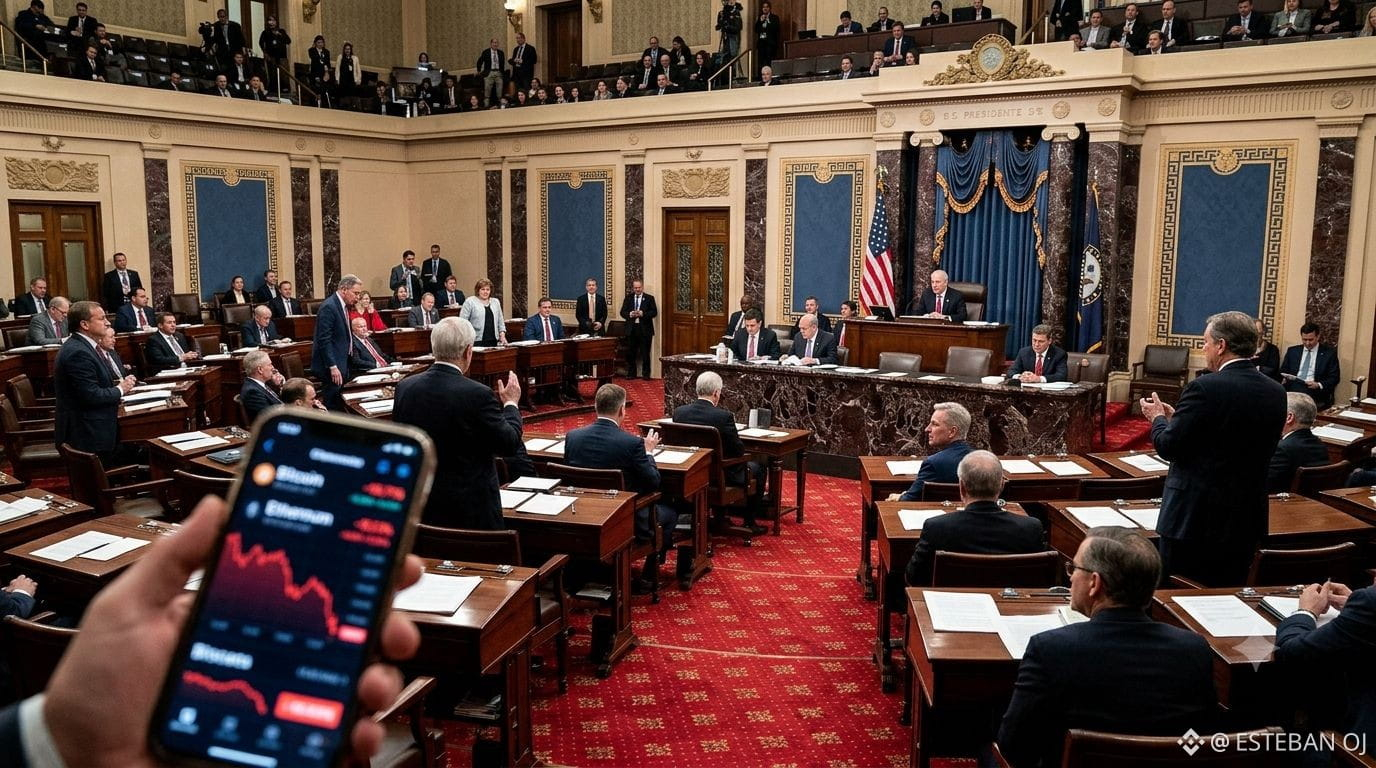
🚨 ALERTA: Cierre masivo de posiciones tras bloqueo de la ley regulatoria "CLARITY Act" en EE. UU.
#1 ¿Qué ocurrió? La Cámara del Senado de EE. UU. bloqueó sorpresivamente el avance de la ley regulatoria CLARITY Act (voto 50-49, sin alcanzar el umbral de 60 votes), congelando el marco regulatorio integral para activos digitales previsto para este año.
#2 Reacción del Mercado: La noticia desató pánico inmediato en los mercados con más de 600 millones en liquidaciones brutales de derivados.[span_3](end_span)BTC cayó rápidamente hacia el soporte de los 75,000, mientras $ETH retrocedió hasta la zona de los $2,400. Altcoins líderes como $SOL sufrieron pérdidas en cadena de hasta un 8% en pocas horas.
#3 Consecuencias Directas: Las acciones vinculadas a cripto en Wall Street cayeron un 10%, sumando presión macroeconómica ante la inminente decisión de tipos de interés de la Reserva Federal.
⚠️ RIESGO O POSIBLE ESCENARIO: Si $BTC no sostiene el nivel clave de $75,000, los analistas prevén una cascada adicional hacia la zona de $72,000. Mantengan cautela con el apalancamiento excesivo en derivados.
#newsdaily #SharedSecurity #Alert🔴
1
210
Log in to explore more content
Join global crypto users on Binance Square
⚡️ Get latest and useful information about crypto.
💬 Trusted by the world’s largest crypto exchange.
👍 Discover real insights from verified creators.
Email / Phone number
Trending Topics
1
#BinanceReopensWithdrawalsForMoreAssets
1.1M views
5,925 Discussing
2
#$2TWipedOutHedgeFundsFaceLiquidation
1,354 views
35 Discussing
3
#AnthropicIPOValuationDoubts
18,343 views
443 Discussing
4
#USMidtermsCouldShakeUpUS-IranTies
0 views
1 Discussing
5
#RussiaInvestigativeCommitteeProposesAddingCryptoToAMLSystem
18 views
3 Discussing
6
#SouthKoreaDelaysCryptoTaxationUntil2029
2,624 views
80 Discussing
7
#HongKongPlansTaxIncentivesCoveringDigitalAssets
2,432 views
54 Discussing
8
#ECBTargetsDigitalEuroIssuanceIn2029
2,311 views
64 Discussing
9
#ChainalysisBreachExposedPasswordHashesAndLiveTokens
325 views
14 Discussing
10
#UkraineCentralBankOpposesCurrentCryptoAssetBill
3,230 views
85 Discussing