
#saidbnb
saidbnb
26,090 views
188 Discussing
Hot
Latest


·
--

Article
This is Why the Most Powerful Crypto Infrastructure Is the One You Can't SeeThe era of the narrative-driven market is ending. For years, the "old game" in crypto was transparently simple: you bought a story, waited for the crowd to adopt that same story, and hoped for the resulting price flows. It was a game of musical chairs played with marketing scripts rather than technological substance.
But the music is changing.
The conversation is quietly but decisively shifting from what a project says to what a project supports.
This isn't just an evolution; it's a fundamental re-architecting of value. As a strategic analyst, I see the market pivoting away from speculative promises toward foundational systems.
In this new landscape, BNB’s true value isn't found in its role as a speculative asset or an exchange token—it lies in its role as the invisible, essential infrastructure of the modern digital economy.
1. The Death of the Narrative Era
Market psychology has hit a wall. The "narrative era" relied on the strength of a story to attract capital, regardless of whether that story had a functional ending. That era is being replaced by a more sober reality where the market demands systems over scripts.
We are witnessing the end of the hype cycle and the birth of the utility cycle. Investors are becoming less interested in the utopian promises of whitepapers and more interested in the underlying support structures that allow the industry to function. This shift signifies that crypto is finally growing up; the focus is no longer on the "story" of the coin, but on the durability of the network.
2. The Birth of the Utility Cycle
The shift toward system-building is driven by a change in user behavior. A few years ago, users entered the crypto space to buy coins. Today, they enter to use products. They are looking for:
Stablecoins and PaymentsGaming and Artificial IntelligenceTokenized AssetsTrading PlatformsOn-chain Applications
This transition marks a move from pure speculation toward actual utility. As institutional participation scales and regulatory frameworks crystallize, the "why" behind blockchain adoption has changed. We are no longer chasing narratives; we are building the pipes that make these sophisticated applications possible.
3. The Advantage of Being "Invisible"
In technology, the most powerful systems are the ones we forget exist. Consider the essential grids of the modern world:
Electricity: You don’t discuss the power grid while booting up your laptop.Internet Cables: You don't consider the undersea fiber optics while streaming a video.Payment Rails: You don't analyze the settlement layer while tapping your card for a coffee.
Blockchain is currently following this path toward invisibility. We often ignore the very things that make our lives possible, yet that is where the true power resides.
"In technology, invisible infrastructure is often the most powerful infrastructure."
A mature ecosystem operates in total silence. It functions without needing permission from social media, without requiring a new weekly trend to stay relevant, and without needing to be the center of attention. While the "attention economy" dictates that an asset dies if people stop tweeting about it, utility infrastructure continues to settle transactions and host applications even when the headlines are looking elsewhere.
4. Why "Usefulness" Is the Most Underrated Metric
In a market obsessed with the "next big thing," usefulness is a surprisingly underrated metric. There is a sharp divide between what captures headlines and what achieves longevity. While the loudest trends dominate the news cycle, the strongest infrastructure quietly becomes impossible to replace.
Markets are historically late to notice infrastructure value. The pattern is always the same: investors chase the story first, only to later discover the infrastructure that was enabling that story and creating value the entire time. Being "impossible to replace" is a far more sustainable value proposition than being "temporarily viral."
5. Reframing the Question for Scale
Most traders are asking the wrong questions. They focus on short-term performance and monthly outperformance. A strategic analyst looks further ahead. The better question is: What role does BNB play if the crypto market becomes ten times larger than it is today?
Growth at that scale doesn't depend on narratives. It depends on the fundamental components of a functioning network:
LiquidityUser baseApplication diversityDevelopersSettlement layersReal activity
As the industry expands, these practical factors—not social media hype—become the primary drivers of value.
"Usefulness has become surprisingly underrated" in a narrative-obsessed world.
6. Conclusion: The Longevity of Utility
The crypto industry is navigating a high-stakes transition from high-hype speculation to quiet, essential utility. While narratives will always provide short-term volatility, the assets that survive every cycle are those that provide the infrastructure necessary for the rest of the market to function.
As we move forward, the most significant value won't be found in the projects that shout the loudest, but in the systems that have become so integrated into the fabric of the market that they have become invisible.
The question for the future is simple: Would you rather own the narrative that captures today’s headlines, or the invisible system that becomes impossible to replace?
#Binance $BNB
{future}(BNBUSDT)
#bnb #SaidBNB
This is Why the Most Powerful Crypto Infrastructure Is the One You Can't See
The era of the narrative-driven market is ending. For years, the "old game" in crypto was transparently simple: you bought a story, waited for the crowd to adopt that same story, and hoped for the resulting price flows. It was a game of musical chairs played with marketing scripts rather than technological substance.
But the music is changing.
The conversation is quietly but decisively shifting from what a project says to what a project supports.
This isn't just an evolution; it's a fundamental re-architecting of value. As a strategic analyst, I see the market pivoting away from speculative promises toward foundational systems.
In this new landscape, BNB’s true value isn't found in its role as a speculative asset or an exchange token—it lies in its role as the invisible, essential infrastructure of the modern digital economy.
1. The Death of the Narrative Era
Market psychology has hit a wall. The "narrative era" relied on the strength of a story to attract capital, regardless of whether that story had a functional ending. That era is being replaced by a more sober reality where the market demands systems over scripts.
We are witnessing the end of the hype cycle and the birth of the utility cycle. Investors are becoming less interested in the utopian promises of whitepapers and more interested in the underlying support structures that allow the industry to function. This shift signifies that crypto is finally growing up; the focus is no longer on the "story" of the coin, but on the durability of the network.
2. The Birth of the Utility Cycle
The shift toward system-building is driven by a change in user behavior. A few years ago, users entered the crypto space to buy coins. Today, they enter to use products. They are looking for:
Stablecoins and PaymentsGaming and Artificial IntelligenceTokenized AssetsTrading PlatformsOn-chain Applications
This transition marks a move from pure speculation toward actual utility. As institutional participation scales and regulatory frameworks crystallize, the "why" behind blockchain adoption has changed. We are no longer chasing narratives; we are building the pipes that make these sophisticated applications possible.
3. The Advantage of Being "Invisible"
In technology, the most powerful systems are the ones we forget exist. Consider the essential grids of the modern world:
Electricity: You don’t discuss the power grid while booting up your laptop.Internet Cables: You don't consider the undersea fiber optics while streaming a video.Payment Rails: You don't analyze the settlement layer while tapping your card for a coffee.
Blockchain is currently following this path toward invisibility. We often ignore the very things that make our lives possible, yet that is where the true power resides.
"In technology, invisible infrastructure is often the most powerful infrastructure."
A mature ecosystem operates in total silence. It functions without needing permission from social media, without requiring a new weekly trend to stay relevant, and without needing to be the center of attention. While the "attention economy" dictates that an asset dies if people stop tweeting about it, utility infrastructure continues to settle transactions and host applications even when the headlines are looking elsewhere.
4. Why "Usefulness" Is the Most Underrated Metric
In a market obsessed with the "next big thing," usefulness is a surprisingly underrated metric. There is a sharp divide between what captures headlines and what achieves longevity. While the loudest trends dominate the news cycle, the strongest infrastructure quietly becomes impossible to replace.
Markets are historically late to notice infrastructure value. The pattern is always the same: investors chase the story first, only to later discover the infrastructure that was enabling that story and creating value the entire time. Being "impossible to replace" is a far more sustainable value proposition than being "temporarily viral."
5. Reframing the Question for Scale
Most traders are asking the wrong questions. They focus on short-term performance and monthly outperformance. A strategic analyst looks further ahead. The better question is: What role does BNB play if the crypto market becomes ten times larger than it is today?
Growth at that scale doesn't depend on narratives. It depends on the fundamental components of a functioning network:
LiquidityUser baseApplication diversityDevelopersSettlement layersReal activity
As the industry expands, these practical factors—not social media hype—become the primary drivers of value.
"Usefulness has become surprisingly underrated" in a narrative-obsessed world.
6. Conclusion: The Longevity of Utility
The crypto industry is navigating a high-stakes transition from high-hype speculation to quiet, essential utility. While narratives will always provide short-term volatility, the assets that survive every cycle are those that provide the infrastructure necessary for the rest of the market to function.
As we move forward, the most significant value won't be found in the projects that shout the loudest, but in the systems that have become so integrated into the fabric of the market that they have become invisible.
The question for the future is simple: Would you rather own the narrative that captures today’s headlines, or the invisible system that becomes impossible to replace?
#Binance $BNB
#bnb #SaidBNB
1
182
·
--
Article
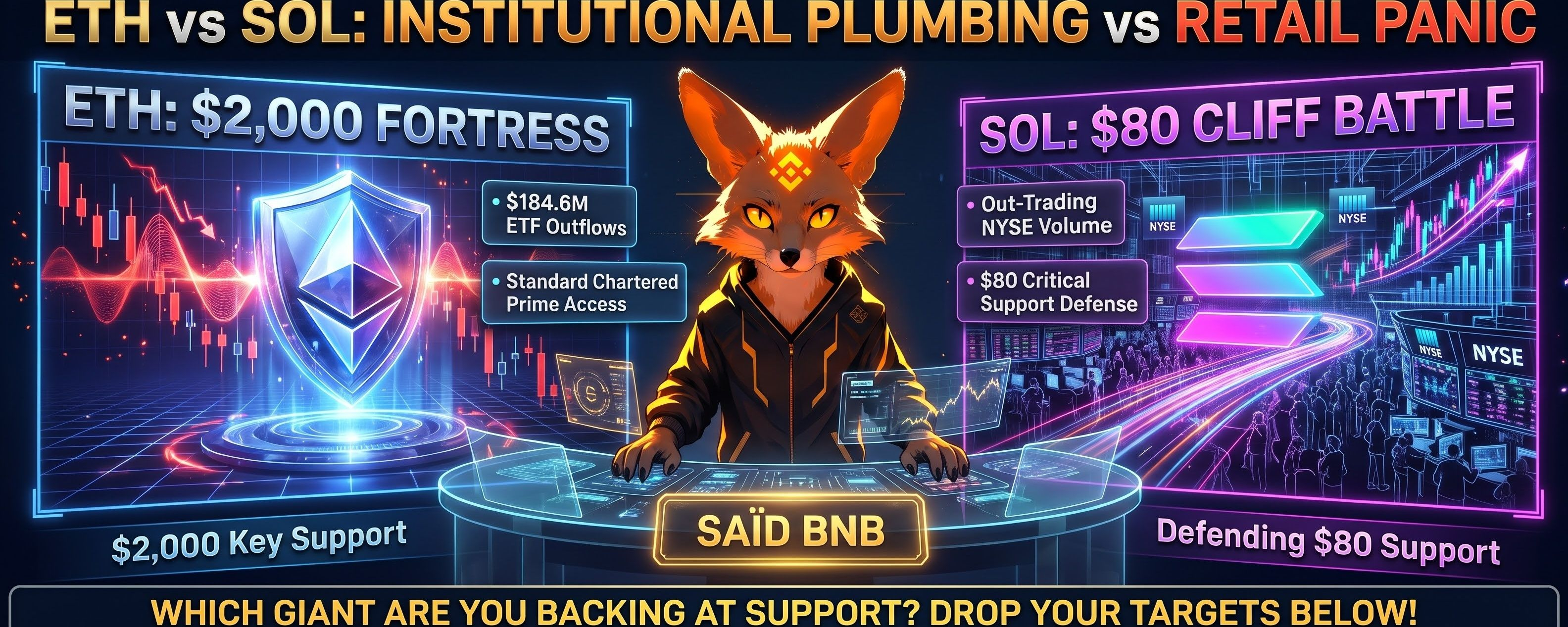
🚨$ETH Clings 2,000 $SOL Battles $80 Cliff: Institutional Plumbing Flashing Green as Retail panic🚨I have been watching the liquidation feeds roll across my screens all morning after a brutal $913 million forced long wipeout shook the market to its core, and the psychological divide between retail traders and Wall Street institutions has never looked wider.
Bitcoin dominance has marched up to 60.5%, sucking the oxygen out of the altcoin room and leaving everyone asking if capital is permanently abandoning the Layer-1 giants. Over the past 30 days, Ethereum ($ETH ) has bled out nearly 17% to 20% and Solana ($SOL ) has dropped 23% to 26%, pushing both charts straight onto the edge of psychological cliffs that have traders frozen in fear.
If you know how I approach this market, you already know I do not trade based on timeline panic. When you strip away the leveraged washouts and look directly at the institutional plumbing being installed behind the scenes, a completely different story emerges—one where Wall Street banks and brokerage titans are quietly opening the floodgates while ETF tourists sprint for the exits.
Let us break down what is actually happening inside the Ethereum ($ETH ) machine, because the battle around the $2,000 psychological fortress is the ultimate test of conviction. Right now, $ETH is changing hands around $2,050 to $2,054 after six straight weeks of downward pressure, trading beneath both its 50-week and 200-week moving averages.
The near-term culprit is right there in the fund flow data: U.S. spot Ether ETFs just logged $184.6 million in net outflows—marking their third consecutive day of withdrawals, led by $119.3 million exiting BlackRock’s ETHA.
Yet, while ETF paper hands are selling into weakness, global banking giant Standard Chartered officially expanded its institutional prime brokerage access to Ether via the 24X platform, acting as the central counterparty so major institutions can execute ETH and FX trades under one roof. At the protocol level, Paradigm’s Reth team just rolled out the Reth v2.10.0 state root security patch to harden node infrastructure, while core developers are pushing toward the Glamsterdam Base Layer Scaling Upgrade—which introduces block-level access lists for parallel execution alongside a raised 60M default gas limit.
My technical roadmap for $ETH is straightforward: options markets are pricing in an 8.5% volatility swing, and bulls must defend the $2,000 floor at all costs.
If $2,000 holds and absorbs this ETF outflow wave, we have a clean mean-reversion setup; however, if a daily candle snaps cleanly below $2,000, prepare your dry powder for a liquidity sweep down to the August low of $1,874, with the one-year floor sitting deep at $1,566.
Now, shift your focus to Solana ($SOL), where the contrast between depressed price action and mind-blowing network dominance is arguably even more extreme.
On the chart, $SOL has taken a beating, trading between $82.50 and $85—sitting 8.3% below its 200-day moving average ($89) and 16.8% below its 20-day average ($96), pressured by $7.7 million in spot Solana ETF outflows and lingering regulatory scrutiny out of Asia.
Retail sees an asset down 72% from its cycle peak and assumes the ecosystem is dying. Meanwhile, Fidelity Digital Assets just dropped a bombshell report revealing that Solana’s weekly trade count officially surpassed the New York Stock Exchange (NYSE), capturing a staggering 15% of major U.S. exchange flows (up from just 0.30% in 2022)! On top of that, Charles Schwab now lets clients trade Solana, Galaxy and Exodus shares are slated to trade directly on Solana’s rails, and the network’s new Privacy Rings launch is bringing institutional-grade confidentiality to high-speed DeFi. Right now, $SOL is locked inside a make-or-break trading band between $79.69 and $86.73, with options traders pricing in a 9.3% move.
If bulls defend the $80 round-number support and reclaim the 200-day average at $89, momentum flips rapidly back toward $96.
But if $80 gives way on a daily close, the trapdoor opens straight to the August close at $75, with the ultimate one-year macro floor waiting at $62.
How am I navigating this bloodbath across my own portfolio while Bitcoin dominance hovers near 61%? I am treating 2,000 onETH and 80 onSOL as the two most important line-in-the-sand battlegrounds in crypto right now.
When Standard Chartered builds prime brokerage rails for Ethereum and Solana out-trades the New York Stock Exchange while retail is getting liquidated out of leveraged longs, you are watching a textbook transfer of assets from impatient speculators to long-term infrastructure giants.
I am not trying to catch a falling knife with high leverage; instead, I am setting staggered spot limit orders right at these structural support zones and waiting for ETF outflows to exhaust themselves before sizing up.
I want to hear from the real survivors in my community down in the comments: If you had to deploy fresh capital at these exact support levels, are you backing Ethereum’s $2,000 fortress with Standard Chartered stepping in, or Solana’s $80 battleground after out-trading the NYSE—or are you waiting for $1,874 ETH and $75 SOL?
Drop your entries and honest thoughts below, hit that follow button for zero-hype on-chain analysis, and let’s conquer this market together! 🔥👇
#ETH #SOL #Ethereum #Solana #SaidBNB
🚨$ETH Clings 2,000 $SOL Battles $80 Cliff: Institutional Plumbing Flashing Green as Retail panic🚨
I have been watching the liquidation feeds roll across my screens all morning after a brutal $913 million forced long wipeout shook the market to its core, and the psychological divide between retail traders and Wall Street institutions has never looked wider.
Bitcoin dominance has marched up to 60.5%, sucking the oxygen out of the altcoin room and leaving everyone asking if capital is permanently abandoning the Layer-1 giants. Over the past 30 days, Ethereum ($ETH ) has bled out nearly 17% to 20% and Solana ($SOL ) has dropped 23% to 26%, pushing both charts straight onto the edge of psychological cliffs that have traders frozen in fear.
If you know how I approach this market, you already know I do not trade based on timeline panic. When you strip away the leveraged washouts and look directly at the institutional plumbing being installed behind the scenes, a completely different story emerges—one where Wall Street banks and brokerage titans are quietly opening the floodgates while ETF tourists sprint for the exits.
Let us break down what is actually happening inside the Ethereum ($ETH ) machine, because the battle around the $2,000 psychological fortress is the ultimate test of conviction. Right now, $ETH is changing hands around $2,050 to $2,054 after six straight weeks of downward pressure, trading beneath both its 50-week and 200-week moving averages.
The near-term culprit is right there in the fund flow data: U.S. spot Ether ETFs just logged $184.6 million in net outflows—marking their third consecutive day of withdrawals, led by $119.3 million exiting BlackRock’s ETHA.
Yet, while ETF paper hands are selling into weakness, global banking giant Standard Chartered officially expanded its institutional prime brokerage access to Ether via the 24X platform, acting as the central counterparty so major institutions can execute ETH and FX trades under one roof. At the protocol level, Paradigm’s Reth team just rolled out the Reth v2.10.0 state root security patch to harden node infrastructure, while core developers are pushing toward the Glamsterdam Base Layer Scaling Upgrade—which introduces block-level access lists for parallel execution alongside a raised 60M default gas limit.
My technical roadmap for $ETH is straightforward: options markets are pricing in an 8.5% volatility swing, and bulls must defend the $2,000 floor at all costs.
If $2,000 holds and absorbs this ETF outflow wave, we have a clean mean-reversion setup; however, if a daily candle snaps cleanly below $2,000, prepare your dry powder for a liquidity sweep down to the August low of $1,874, with the one-year floor sitting deep at $1,566.
Now, shift your focus to Solana ($SOL ), where the contrast between depressed price action and mind-blowing network dominance is arguably even more extreme.
On the chart, $SOL has taken a beating, trading between $82.50 and $85—sitting 8.3% below its 200-day moving average ($89) and 16.8% below its 20-day average ($96), pressured by $7.7 million in spot Solana ETF outflows and lingering regulatory scrutiny out of Asia.
Retail sees an asset down 72% from its cycle peak and assumes the ecosystem is dying. Meanwhile, Fidelity Digital Assets just dropped a bombshell report revealing that Solana’s weekly trade count officially surpassed the New York Stock Exchange (NYSE), capturing a staggering 15% of major U.S. exchange flows (up from just 0.30% in 2022)! On top of that, Charles Schwab now lets clients trade Solana, Galaxy and Exodus shares are slated to trade directly on Solana’s rails, and the network’s new Privacy Rings launch is bringing institutional-grade confidentiality to high-speed DeFi. Right now, $SOL is locked inside a make-or-break trading band between $79.69 and $86.73, with options traders pricing in a 9.3% move.
If bulls defend the $80 round-number support and reclaim the 200-day average at $89, momentum flips rapidly back toward $96.
But if $80 gives way on a daily close, the trapdoor opens straight to the August close at $75, with the ultimate one-year macro floor waiting at $62.
How am I navigating this bloodbath across my own portfolio while Bitcoin dominance hovers near 61%? I am treating 2,000 onETH and 80 onSOL as the two most important line-in-the-sand battlegrounds in crypto right now.
When Standard Chartered builds prime brokerage rails for Ethereum and Solana out-trades the New York Stock Exchange while retail is getting liquidated out of leveraged longs, you are watching a textbook transfer of assets from impatient speculators to long-term infrastructure giants.
I am not trying to catch a falling knife with high leverage; instead, I am setting staggered spot limit orders right at these structural support zones and waiting for ETF outflows to exhaust themselves before sizing up.
I want to hear from the real survivors in my community down in the comments: If you had to deploy fresh capital at these exact support levels, are you backing Ethereum’s $2,000 fortress with Standard Chartered stepping in, or Solana’s $80 battleground after out-trading the NYSE—or are you waiting for $1,874 ETH and $75 SOL?
Drop your entries and honest thoughts below, hit that follow button for zero-hype on-chain analysis, and let’s conquer this market together! 🔥👇
#ETH #SOL #Ethereum #Solana #SaidBNB
200
·
--
Article
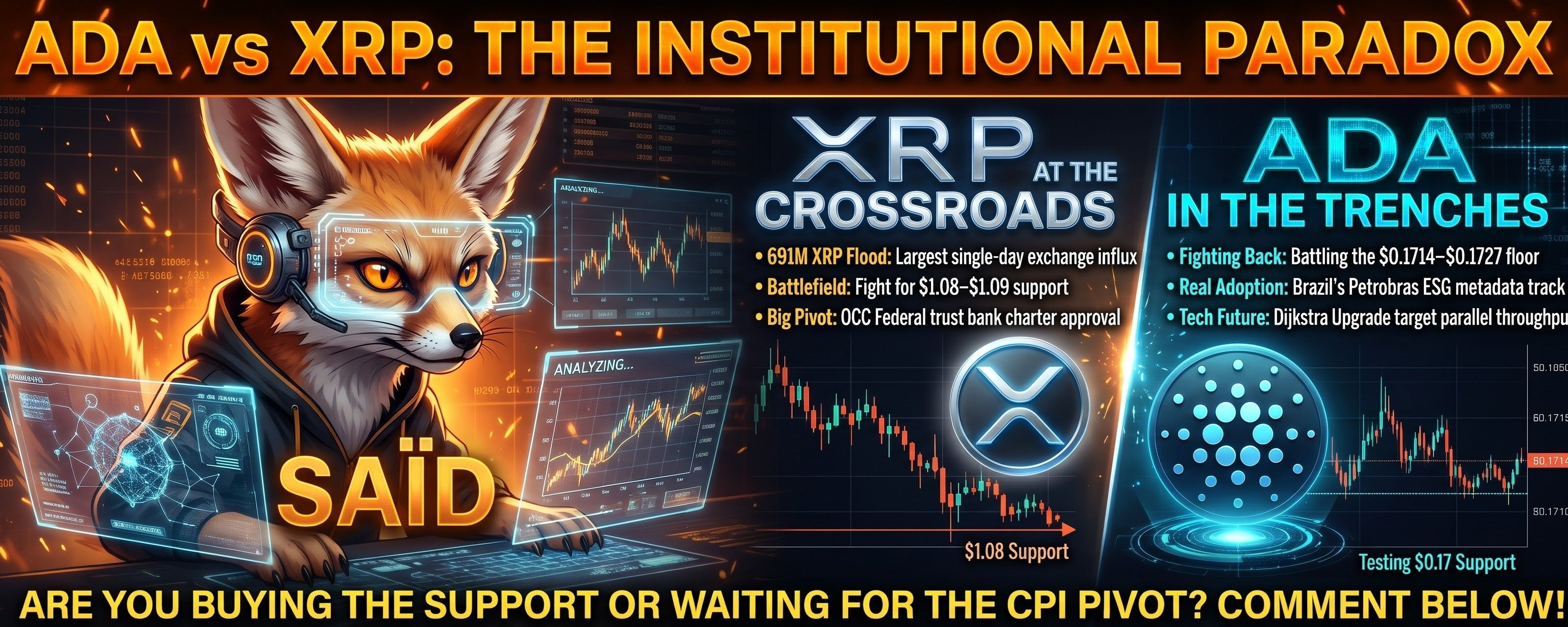
🚨 691 M XRP Floods Exchanges While ADA Fights the $0.17 Trenches m, Institutional Paradox No 1 👀I spent my entire morning analyzing on-chain order books and institutional filings while the rest of the timeline was panicking over red candles, and what I uncovered on $XRP and $ADA is one of the biggest market disconnects of the year.
Whenever retail traders see legacy Layer-1 giants bleeding out after a rough week of macro uncertainty, their immediate instinct is to capitulate at the exact bottom.
But if you have been following my work, you know I never look at price action in isolation—I look at where the smart money is moving while the crowd is distracted.
Right now, both Ripple and Cardano are caught in a violent tug-of-war between brutal short-term chart pressure and massive, real-world institutional adoption happening quietly behind the scenes.
If you do not understand the difference between temporary exchange liquidity dumps and long-term structural positioning, this market will shake you out right before the real move begins.
Let us start with the elephant in the room on $XRP, because the data hitting the terminals is nothing short of historic.
Over a 24-hour period, whales moved a staggering 691 million XRP directly onto Binance—marking the largest single-day exchange influx since 2024 and pushing the 90-day moving average of whale transfers past $100 million.
That wave of supply, combined with jitters ahead of the US CPI inflation print and stalled progress on the CLARITY Act following the US midterm elections, dragged XRP down below its $1.15 support to test the critical $1.08–$1.09 zone. Yet, at the exact same moment retail is terrified of those whale inflows, Ripple just secured its full federal trust bank charter approval from the OCC, cementing its institutional credibility alongside recent XRPL upgrades like Lending Protocol v1.1 (enabling structured term-based vaults).
My technical breakdown for $XRP is crystal clear: the immediate battlefield sits between $1.0365 and $1.1803. If bulls defend the $1.08 August low and absorb this pre-CPI whale supply to reclaim $1.15–$1.18, the path opens straight back to the high-volume $1.32–$1.48 resistance zone (with institutional year-end models targeting $2.80 even under stalled legislation).
However, if a hot CPI print forces a daily close below $1.0365, prepare your limit orders for a liquidity sweep of the psychological $1.00 level.
Now, turn your eyes to $ADA (Cardano), where the exact same battle between depressed charts and enterprise reality is playing out in real time.
On the surface, the bears have been in full control: $ADA dipped to test $0.1714–$0.1727 before fighting back toward $0.181 on Binance, weighed down by a drop in DeFi TVL to $50 million (well below the $290 million PRIME liquidity target) and sitting underneath a heavy EMA cluster at $0.209–$0.232. Most traders look at that chart and walk away, completely missing the bombshell news that just dropped: Brazil’s state-controlled oil giant, Petrobras, officially adopted the Cardano blockchain to track Sustainable Aviation Fuel (SAF) emissions metadata, right as the Cardano Foundation joined Switzerland’s CMTA alongside banking titans like UBS.
Even bigger for network speed is the Dijkstra Upgrade (Phase 1 targeting code completion in Q4 2026), which introduces Ouroboros Linear Leios (CIP-164) and Endorser Blocks to multiply parallel transaction throughput.
With $ADA’s RSI flashing deeply oversold readings between 28.79 and 32 right at the lower Bollinger Band, a technical relief spring is coiling tightly.
If $ADA clears immediate horizontal resistance at $0.183 and reclaims the $0.20 psychological barrier, we are looking at a swift mean-reversion squeeze toward $0.209–$0.232; conversely, losing the $0.17 floor opens a trapdoor down to structural support at $0.156.
How am I playing this setup across my own watchlist as we head into the CPI volatility window? I am refusing to let whale scare tactics or oversold red candles blind me to real enterprise adoption, but I am also respecting the technical levels with strict risk management. When state oil giants like Petrobras build on $ADA and $XRP locks in federal OCC bank charters while their RSI indicators sit in extreme oversold territory, history shows that patient accumulators gradually absorb the panic from emotional sellers. I am watching the $1.08 support on $XRP and the $0.17–$0.183 range on $ADA like a hawk for high-volume confirmation before scaling in, keeping dry powder ready in case macro data triggers one final stop-hunt.
Now I want to pass the mic to my community in the comments because this is where real traders separate themselves from the noise: Between $XRP at 1.08 andADA at $0.18, which giant has the stronger asymmetric bounce setup for the rest of 2026—or are you waiting for the US CPI numbers before touching either chart?
Drop your price targets below, share your honest take, and make sure you are following for daily, data-backed market breakdowns! 🔥👇
#XRP #ADA #Cardano #Ripple #SaidBNB
🚨 691 M XRP Floods Exchanges While ADA Fights the $0.17 Trenches m, Institutional Paradox No 1 👀
I spent my entire morning analyzing on-chain order books and institutional filings while the rest of the timeline was panicking over red candles, and what I uncovered on $XRP and $ADA is one of the biggest market disconnects of the year.
Whenever retail traders see legacy Layer-1 giants bleeding out after a rough week of macro uncertainty, their immediate instinct is to capitulate at the exact bottom.
But if you have been following my work, you know I never look at price action in isolation—I look at where the smart money is moving while the crowd is distracted.
Right now, both Ripple and Cardano are caught in a violent tug-of-war between brutal short-term chart pressure and massive, real-world institutional adoption happening quietly behind the scenes.
If you do not understand the difference between temporary exchange liquidity dumps and long-term structural positioning, this market will shake you out right before the real move begins.
Let us start with the elephant in the room on $XRP , because the data hitting the terminals is nothing short of historic.
Over a 24-hour period, whales moved a staggering 691 million XRP directly onto Binance—marking the largest single-day exchange influx since 2024 and pushing the 90-day moving average of whale transfers past $100 million.
That wave of supply, combined with jitters ahead of the US CPI inflation print and stalled progress on the CLARITY Act following the US midterm elections, dragged XRP down below its $1.15 support to test the critical $1.08–$1.09 zone. Yet, at the exact same moment retail is terrified of those whale inflows, Ripple just secured its full federal trust bank charter approval from the OCC, cementing its institutional credibility alongside recent XRPL upgrades like Lending Protocol v1.1 (enabling structured term-based vaults).
My technical breakdown for $XRP is crystal clear: the immediate battlefield sits between $1.0365 and $1.1803. If bulls defend the $1.08 August low and absorb this pre-CPI whale supply to reclaim $1.15–$1.18, the path opens straight back to the high-volume $1.32–$1.48 resistance zone (with institutional year-end models targeting $2.80 even under stalled legislation).
However, if a hot CPI print forces a daily close below $1.0365, prepare your limit orders for a liquidity sweep of the psychological $1.00 level.
Now, turn your eyes to $ADA (Cardano), where the exact same battle between depressed charts and enterprise reality is playing out in real time.
On the surface, the bears have been in full control: $ADA dipped to test $0.1714–$0.1727 before fighting back toward $0.181 on Binance, weighed down by a drop in DeFi TVL to $50 million (well below the $290 million PRIME liquidity target) and sitting underneath a heavy EMA cluster at $0.209–$0.232. Most traders look at that chart and walk away, completely missing the bombshell news that just dropped: Brazil’s state-controlled oil giant, Petrobras, officially adopted the Cardano blockchain to track Sustainable Aviation Fuel (SAF) emissions metadata, right as the Cardano Foundation joined Switzerland’s CMTA alongside banking titans like UBS.
Even bigger for network speed is the Dijkstra Upgrade (Phase 1 targeting code completion in Q4 2026), which introduces Ouroboros Linear Leios (CIP-164) and Endorser Blocks to multiply parallel transaction throughput.
With $ADA ’s RSI flashing deeply oversold readings between 28.79 and 32 right at the lower Bollinger Band, a technical relief spring is coiling tightly.
If $ADA clears immediate horizontal resistance at $0.183 and reclaims the $0.20 psychological barrier, we are looking at a swift mean-reversion squeeze toward $0.209–$0.232; conversely, losing the $0.17 floor opens a trapdoor down to structural support at $0.156.
How am I playing this setup across my own watchlist as we head into the CPI volatility window? I am refusing to let whale scare tactics or oversold red candles blind me to real enterprise adoption, but I am also respecting the technical levels with strict risk management. When state oil giants like Petrobras build on $ADA and $XRP locks in federal OCC bank charters while their RSI indicators sit in extreme oversold territory, history shows that patient accumulators gradually absorb the panic from emotional sellers. I am watching the $1.08 support on $XRP and the $0.17–$0.183 range on $ADA like a hawk for high-volume confirmation before scaling in, keeping dry powder ready in case macro data triggers one final stop-hunt.
Now I want to pass the mic to my community in the comments because this is where real traders separate themselves from the noise: Between $XRP at 1.08 andADA at $0.18, which giant has the stronger asymmetric bounce setup for the rest of 2026—or are you waiting for the US CPI numbers before touching either chart?
Drop your price targets below, share your honest take, and make sure you are following for daily, data-backed market breakdowns! 🔥👇
#XRP #ADA #Cardano #Ripple #SaidBNB
健康资本:
all in web3
1
10
6.5k
·
--
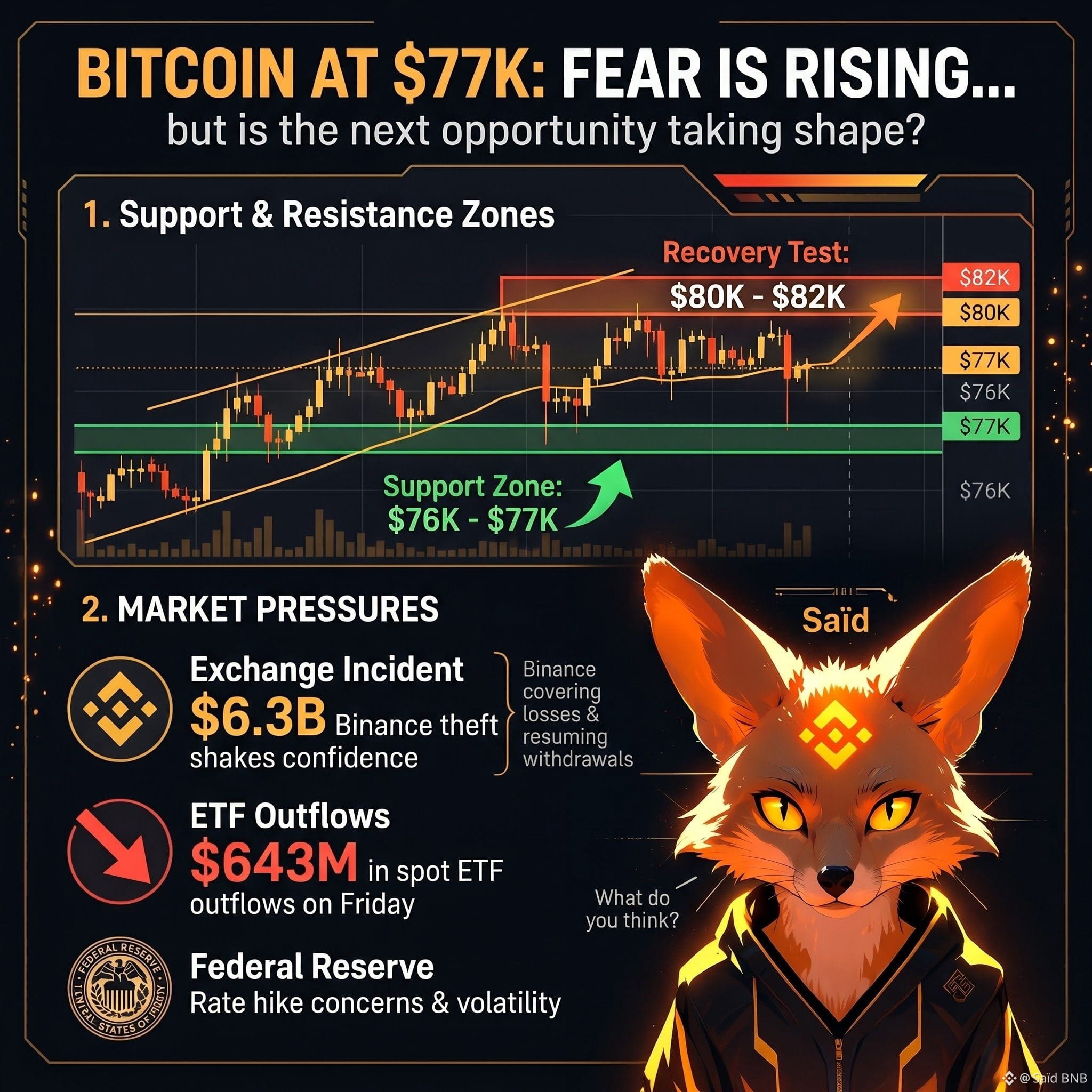
Bitcoin at $77K: Fear Is Rising, but Is the Next Opportunity Taking Shape?
I’ve been watching Bitcoin closely, and the latest developments remind me why patience matters more than emotion in this market. After a difficult October, $BTC is hovering around $77,000, pressured by a major exchange security incident, ETF outflows, and growing concerns about another Federal Reserve rate hike.
The recent $6.3 billion Binance theft has shaken confidence, but the exchange says it is covering the losses and has resumed withdrawals for some assets. Meanwhile, Bitcoin spot ETFs recorded $643 million in outflows on Friday, showing how quickly sentiment can change.
My outlook? The $76K–$77K zone is worth watching for potential support, while $80K–$82K could be the first major recovery test. A sustained rebound with renewed ETF inflows would strengthen the bullish case. Until then, volatility and caution remain the dominant themes.
Bitcoin's next move may depend less on headlines and more on whether buyers return when fear is highest.
What do you think: recovery ahead, or another leg down?
#BinanceToResumePhaseOneOfWithdrawals
#BinanceUpdatesProofofReservesAddresses
#BTC走势分析
#SaidBNB
180
·
--

Article
Everyone Is Panicking Over Solana At $95, While BIG Names Are Building The Future on itI sat at my desk this morning staring at the charts, watching the red candles bleed across the screen as the entire crypto market reacted to the recent macro tech sell-off and industry security headlines. Whenever the market takes a sudden dip and Bitcoin tests everyone's patience around the $77,000 zone, my timeline fills up with the exact same panic I have seen in every single cycle. Retail traders are staring at Solana hovering between $93 and $95, wondering if the momentum is gone, while completely missing the giant structural shift happening right under their noses. As someone who spends every single day analyzing on-chain data and tracking ecosystem upgrades, I want to tell you a completely different story today—one backed strictly by real numbers, fresh institutional moves, and code that is shipping right now.
If you want to know where an asset is actually going, you have to stop looking at the 15-minute price chart and start looking at who is walking through the front door. Just in the final week of October 2026, Samsung officially rolled out support for native USDC cross-border transfers on Solana across 82 million U.S. Galaxy devices through Samsung Wallet. Think about that number for a second. For years, we talked about how hard it was to onboard everyday users into Web3, and suddenly, tens of millions of regular phone owners have Solana payment rails sitting right in their pockets without needing to understand seed phrases or complex bridges. At the exact same time, on October 31, Google Cloud updated its institutional Multi-Party Computation service to list Solana signing support as coming soon, opening the floodgates for massive enterprises to custody and transact on the network with institutional-grade security.
The story gets even bigger when you look toward Asia and global banking. On October 30, the Solana Foundation joined Anchorpoint’s Tokenised Money Adoption Programme alongside PwC as a strategic partner. This move makes Solana the very first public blockchain network to natively mint and redeem HKDAP, a regulated Hong Kong dollar stablecoin. While the timeline is arguing over short-term support levels, global financial hubs are literally wiring their regulated fiat currencies and tokenized assets directly into Solana’s liquidity engine. This is no longer a network driven purely by retail speculation; it is rapidly becoming the settlement layer for global finance.
Look at the hard data from the ecosystem over the past few weeks, because the numbers read like something out of a future textbook. Stablecoin supply on Solana recently climbed to an all-time high of $17.51 billion, and real-world assets on the network have surged to $4.6 billion across more than 3,000 different tokenized assets. Over a million individual wallets now hold tokenized stocks on Solana, generating around $4.4 billion in monthly trading volume as everyday investors trade equities on-chain. In a single quarter, the network processed 8.78 billion non-vote transactions, while decentralized exchange volume hit $78.33 billion in a single month. Even U.S. Solana ETFs saw $188.1 million in net inflows within a single late-September week, proving that traditional capital is accumulating whenever the market gives them an entry.
What makes me stay so focused on Solana, however, is not just the partnerships—it is the relentless obsession of the core engineers. On October 29, developers rolled out crucial optimizations to both the primary Agave validator client and Jump Crypto’s independent Firedancer client, cutting down memory usage and streamlining custom thread pools so validators run leaner and faster than ever. They also decoupled the core CLI and introduced native off-chain message signing, allowing apps to verify user actions and logins without charging a single cent in gas fees. Having already brought slot times down from 400 milliseconds to a blistering 250 milliseconds, the network is now pushing toward the Alpenglow consensus upgrade, which targets around 150-millisecond finality. At that speed, trading and paying on Solana feels instantaneous, matching the responsiveness of centralized Wall Street servers while staying completely decentralized.
Now let us talk honestly about the price action and what lies ahead as we head into Solana Breakpoint in London from November 15 to 17, where leaders from Revolut, Mastercard, DTCC, and Bitwise are taking the stage. Right now, $SOL is fighting a tug-of-war around the $93.78 to $95.00 zone. On the derivatives side, the futures market is heavily leaning bullish, with roughly 3.38 long accounts for every short account and positive funding rates showing that traders are refusing to give up on the upside. The critical line in the sand that I am watching today is $92.64. As long as bulls defend that $92.64 support level, the crowded long side acts as fuel for a sharp recovery bounce back above the $100 psychological barrier as pre-Breakpoint excitement builds. However, because the long-to-short ratio is above 3.0, we have to stay disciplined: if $92.64 breaks cleanly on high volume, we could see a quick long-squeeze flush to clear out over-leveraged traders before the real institutional leg up begins.
My personal strategy in moments like this has never changed. I do not chase green candles with high leverage, and I certainly do not panic-sell my spot bags when tech giants like Samsung, Google Cloud, and PwC are actively integrating the network. Price always lags behind fundamentals during market shakeouts, and right now, the gap between Solana's real-world adoption and its temporary pullback is wider than it has been all year. Watch the $92.64 support closely, keep your eyes on the massive institutional announcements coming out of London this month, and let me know in the comments below: are you accumulating $SOL at these levels, or waiting for the Breakpoint catalysts to kick in?
#solana #Market_Update
#SaidBNB
Everyone Is Panicking Over Solana At $95, While BIG Names Are Building The Future on it
I sat at my desk this morning staring at the charts, watching the red candles bleed across the screen as the entire crypto market reacted to the recent macro tech sell-off and industry security headlines. Whenever the market takes a sudden dip and Bitcoin tests everyone's patience around the $77,000 zone, my timeline fills up with the exact same panic I have seen in every single cycle. Retail traders are staring at Solana hovering between $93 and $95, wondering if the momentum is gone, while completely missing the giant structural shift happening right under their noses. As someone who spends every single day analyzing on-chain data and tracking ecosystem upgrades, I want to tell you a completely different story today—one backed strictly by real numbers, fresh institutional moves, and code that is shipping right now.
If you want to know where an asset is actually going, you have to stop looking at the 15-minute price chart and start looking at who is walking through the front door. Just in the final week of October 2026, Samsung officially rolled out support for native USDC cross-border transfers on Solana across 82 million U.S. Galaxy devices through Samsung Wallet. Think about that number for a second. For years, we talked about how hard it was to onboard everyday users into Web3, and suddenly, tens of millions of regular phone owners have Solana payment rails sitting right in their pockets without needing to understand seed phrases or complex bridges. At the exact same time, on October 31, Google Cloud updated its institutional Multi-Party Computation service to list Solana signing support as coming soon, opening the floodgates for massive enterprises to custody and transact on the network with institutional-grade security.
The story gets even bigger when you look toward Asia and global banking. On October 30, the Solana Foundation joined Anchorpoint’s Tokenised Money Adoption Programme alongside PwC as a strategic partner. This move makes Solana the very first public blockchain network to natively mint and redeem HKDAP, a regulated Hong Kong dollar stablecoin. While the timeline is arguing over short-term support levels, global financial hubs are literally wiring their regulated fiat currencies and tokenized assets directly into Solana’s liquidity engine. This is no longer a network driven purely by retail speculation; it is rapidly becoming the settlement layer for global finance.
Look at the hard data from the ecosystem over the past few weeks, because the numbers read like something out of a future textbook. Stablecoin supply on Solana recently climbed to an all-time high of $17.51 billion, and real-world assets on the network have surged to $4.6 billion across more than 3,000 different tokenized assets. Over a million individual wallets now hold tokenized stocks on Solana, generating around $4.4 billion in monthly trading volume as everyday investors trade equities on-chain. In a single quarter, the network processed 8.78 billion non-vote transactions, while decentralized exchange volume hit $78.33 billion in a single month. Even U.S. Solana ETFs saw $188.1 million in net inflows within a single late-September week, proving that traditional capital is accumulating whenever the market gives them an entry.
What makes me stay so focused on Solana, however, is not just the partnerships—it is the relentless obsession of the core engineers. On October 29, developers rolled out crucial optimizations to both the primary Agave validator client and Jump Crypto’s independent Firedancer client, cutting down memory usage and streamlining custom thread pools so validators run leaner and faster than ever. They also decoupled the core CLI and introduced native off-chain message signing, allowing apps to verify user actions and logins without charging a single cent in gas fees. Having already brought slot times down from 400 milliseconds to a blistering 250 milliseconds, the network is now pushing toward the Alpenglow consensus upgrade, which targets around 150-millisecond finality. At that speed, trading and paying on Solana feels instantaneous, matching the responsiveness of centralized Wall Street servers while staying completely decentralized.
Now let us talk honestly about the price action and what lies ahead as we head into Solana Breakpoint in London from November 15 to 17, where leaders from Revolut, Mastercard, DTCC, and Bitwise are taking the stage. Right now, $SOL is fighting a tug-of-war around the $93.78 to $95.00 zone. On the derivatives side, the futures market is heavily leaning bullish, with roughly 3.38 long accounts for every short account and positive funding rates showing that traders are refusing to give up on the upside. The critical line in the sand that I am watching today is $92.64. As long as bulls defend that $92.64 support level, the crowded long side acts as fuel for a sharp recovery bounce back above the $100 psychological barrier as pre-Breakpoint excitement builds. However, because the long-to-short ratio is above 3.0, we have to stay disciplined: if $92.64 breaks cleanly on high volume, we could see a quick long-squeeze flush to clear out over-leveraged traders before the real institutional leg up begins.
My personal strategy in moments like this has never changed. I do not chase green candles with high leverage, and I certainly do not panic-sell my spot bags when tech giants like Samsung, Google Cloud, and PwC are actively integrating the network. Price always lags behind fundamentals during market shakeouts, and right now, the gap between Solana's real-world adoption and its temporary pullback is wider than it has been all year. Watch the $92.64 support closely, keep your eyes on the massive institutional announcements coming out of London this month, and let me know in the comments below: are you accumulating $SOL at these levels, or waiting for the Breakpoint catalysts to kick in?
#solana #Market_Update
#SaidBNB
SOL+0.06%
GOOGUS+0.15%
319
·
--
Bearish
Security this days matters more than anything .
Some people use Ai in a good way , but some others are using it as a weapon to chase a chance , like hacks .
the Future is scary for traders , talking about how you keep wallet safe no matter what happens
#SaidBNB
Security this days matters more than anything .
Some people use Ai in a good way , but some others are using it as a weapon to chase a chance , like hacks .
the Future is scary for traders , talking about how you keep wallet safe no matter what happens
#SaidBNB
Some people use Ai in a good way , but some others are using it as a weapon to chase a chance , like hacks .
the Future is scary for traders , talking about how you keep wallet safe no matter what happens
#SaidBNB
1
206
·
--
Bearish
this Downfall will make so many rich , use it wisely , take your positions , the opportunity don't come much
$BTC
{future}(BTCUSDT)
#SaidBNB
this Downfall will make so many rich , use it wisely , take your positions , the opportunity don't come much
$BTC
#SaidBNB
$BTC
#SaidBNB
1
151
·
--
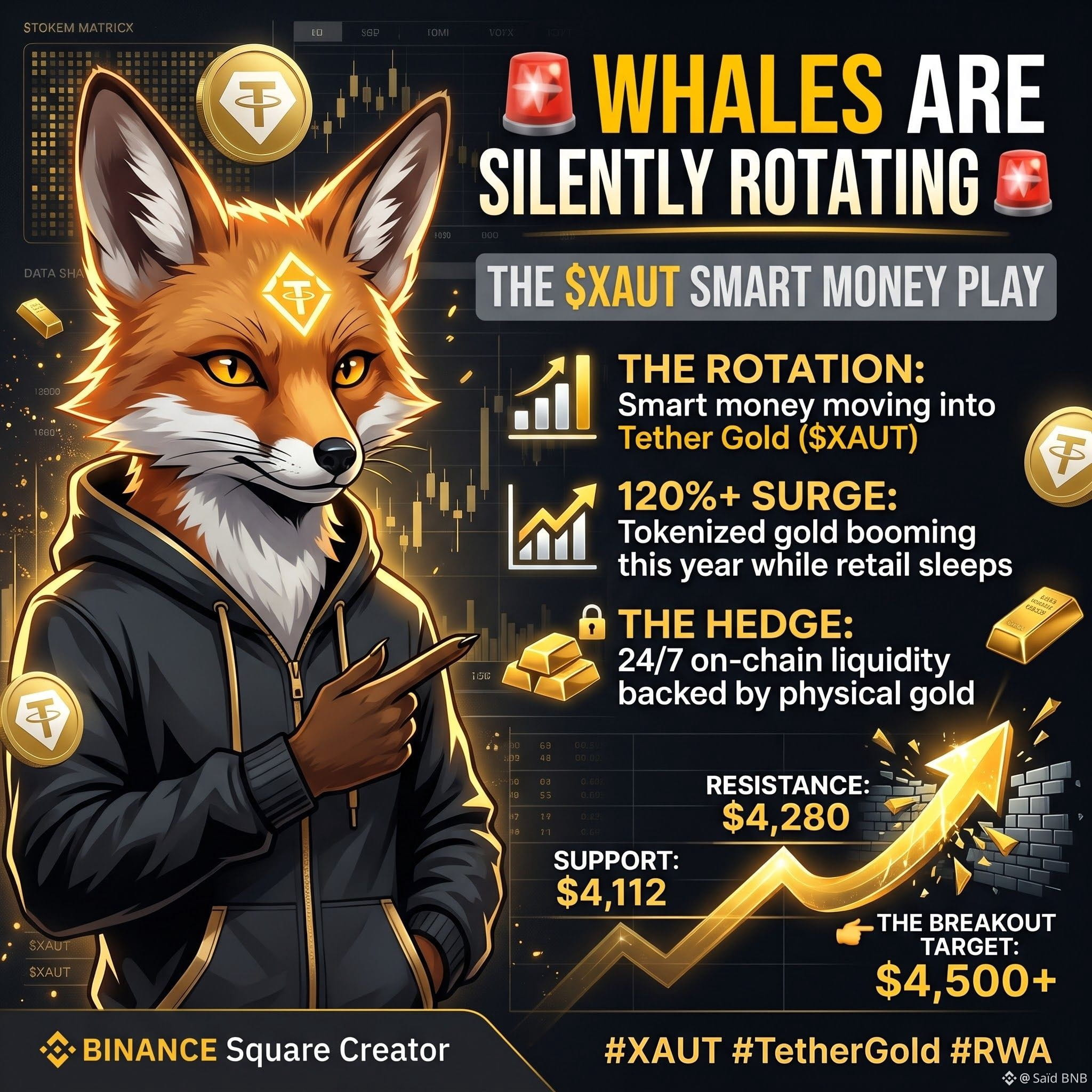
🚨 WHALES ARE SILENTLY ROTATING 🚨
While everyone’s staring at boring weekend ranges, massive crypto smart money is quietly making a major move.
They aren’t chasing pump-and-dump altcoins—they’re rotating into Tether Gold ($XAUT ).
Tokenized gold has surged over 120% this year, and while retail sleeps, big players are using the current $4,140 tier to absorb supply before a massive breakout.
Why? It’s the ultimate hedging play: 24/7 on-chain liquidity backed by physical gold, ready to deploy instantly back into $BTC when the macro triggers.
If we hold the $4,112 Support, expect an explosive run toward the $4,280 Resistance. Once that breaks, the pathway to $4,500+ is wide open.
Are you hedging in stables, or stacking $XAUT with the whales? 👇
#XAUT #TetherGold #RWA #SaidBNB #Crypto
4
793
·
--
Article
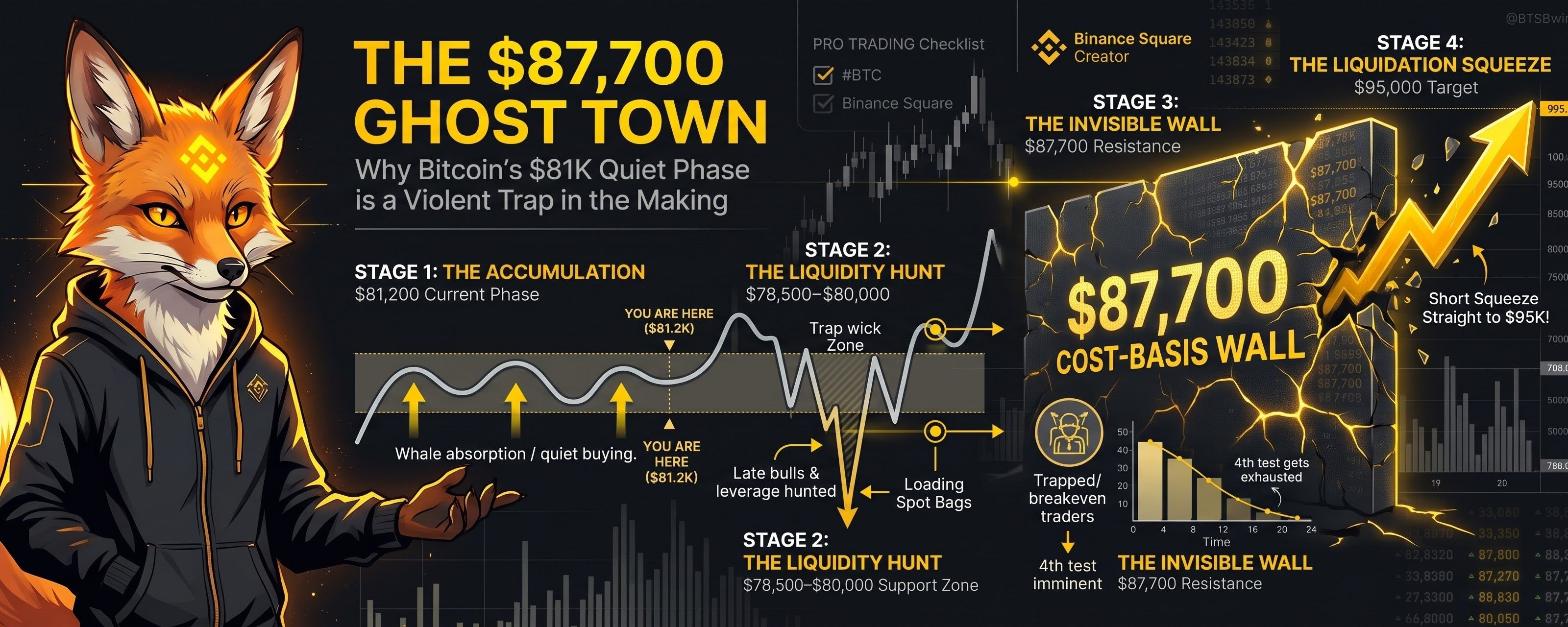
The $87,700 Ghost Town: Why Bitcoin’s Quiet Walk Around $81,000 Is Setting Up the Most Violent TrapI woke up this morning, poured a black coffee, and stared at the 4-hour Bitcoin chart sitting right around $81,200. If you scroll through your feed today, you can practically smell the boredom mixed with quiet anxiety. Just a couple of days ago, everyone was high-fiving as we pushed past $83,400, talking about how $100k was right around the corner. Now, we drop a couple thousand dollars into the weekend, and suddenly the timeline is dead silent. Having traded through enough of these cycles, I can tell you that this exact silence is the biggest tell in the market. When retail traders get bored and start looking elsewhere because Bitcoin moves sideways for seventy-two hours, that is usually when the real money starts positioning for the next massive leg.
To understand where $BTC is going next week, you have to stop looking at the 15-minute candles and start looking at the psychology of the people who are currently trapped. On-chain data is showing a massive, invisible wall sitting right at $87,700. Why does that specific number matter so much? Because according to Glassnode’s cost-basis data, $87,700 is the average entry price for a huge wave of recent buyers who bought the top and have been underwater ever since. We already tried to break that ceiling three times lately—peaking at $87,397, then $87,283, and again at $87,249 earlier this month. Every single time we got close, those trapped buyers panicked, hit the sell button just to break even, and sent us right back down.
Right now, we are sitting in the middle of a psychological tug-of-war between $80,000 and $84,000. The market makers know that retail is terrified of another rejection at $87k, and they also know that impatient traders are over-leveraging on shorts thinking we are going to lose the $80,000 support. Look at what is happening under the hood while everyone is complaining about this choppy price action: large wallet holders have been quietly absorbing every single dip over the last 90 days. They aren't letting the price crash below the high $70k zone because they want those weak hands at $87,700 to exhaust themselves before the real breakout happens.
Here is my honest prediction and how I am playing this setup over the coming days. I am not touching high-leverage longs in the middle of this $81,000 chop, because the market loves to wick down and hunt liquidity right around the $78,500 to $80,000 psychological zone just to shake out the late bulls. If we get that quick flush into the high $70s, I am treating it as a gift to load up my spot bags. Why? Because the fourth time a major resistance wall gets tested after months of whale accumulation, it doesn't just break—it shatters. Once we finally absorb that $87,700 breakeven sell wall, there is almost no historical resistance left to stop a violent short squeeze straight toward $95,000.
The worst thing you can do right now is let a slow weekend chart trick you into giving up your position or chasing random pumpsout of boredom. Trading isn't about predicting every tiny $500 move; it is about seeing where the crowd is trapped and waiting for the spring to uncoil. I am keeping my alerts set at $79,500 for a dip-buy and $87,800 for the breakout confirmation, and until then, I am letting the impatient traders pay the funding fees. What is your gut telling you on this weekend move—are we flushing $80,000 first, or have the whales already bought enough to send $BTC straight through that $87,700 wall? Drop your chart thoughts below, let's see who is actually paying attention.
#BTC #bitcoin #CryptoMarketMoves t#tradingpsychology #SaidBNB
The $87,700 Ghost Town: Why Bitcoin’s Quiet Walk Around $81,000 Is Setting Up the Most Violent Trap
I woke up this morning, poured a black coffee, and stared at the 4-hour Bitcoin chart sitting right around $81,200. If you scroll through your feed today, you can practically smell the boredom mixed with quiet anxiety. Just a couple of days ago, everyone was high-fiving as we pushed past $83,400, talking about how $100k was right around the corner. Now, we drop a couple thousand dollars into the weekend, and suddenly the timeline is dead silent. Having traded through enough of these cycles, I can tell you that this exact silence is the biggest tell in the market. When retail traders get bored and start looking elsewhere because Bitcoin moves sideways for seventy-two hours, that is usually when the real money starts positioning for the next massive leg.
To understand where $BTC is going next week, you have to stop looking at the 15-minute candles and start looking at the psychology of the people who are currently trapped. On-chain data is showing a massive, invisible wall sitting right at $87,700. Why does that specific number matter so much? Because according to Glassnode’s cost-basis data, $87,700 is the average entry price for a huge wave of recent buyers who bought the top and have been underwater ever since. We already tried to break that ceiling three times lately—peaking at $87,397, then $87,283, and again at $87,249 earlier this month. Every single time we got close, those trapped buyers panicked, hit the sell button just to break even, and sent us right back down.
Right now, we are sitting in the middle of a psychological tug-of-war between $80,000 and $84,000. The market makers know that retail is terrified of another rejection at $87k, and they also know that impatient traders are over-leveraging on shorts thinking we are going to lose the $80,000 support. Look at what is happening under the hood while everyone is complaining about this choppy price action: large wallet holders have been quietly absorbing every single dip over the last 90 days. They aren't letting the price crash below the high $70k zone because they want those weak hands at $87,700 to exhaust themselves before the real breakout happens.
Here is my honest prediction and how I am playing this setup over the coming days. I am not touching high-leverage longs in the middle of this $81,000 chop, because the market loves to wick down and hunt liquidity right around the $78,500 to $80,000 psychological zone just to shake out the late bulls. If we get that quick flush into the high $70s, I am treating it as a gift to load up my spot bags. Why? Because the fourth time a major resistance wall gets tested after months of whale accumulation, it doesn't just break—it shatters. Once we finally absorb that $87,700 breakeven sell wall, there is almost no historical resistance left to stop a violent short squeeze straight toward $95,000.
The worst thing you can do right now is let a slow weekend chart trick you into giving up your position or chasing random pumpsout of boredom. Trading isn't about predicting every tiny $500 move; it is about seeing where the crowd is trapped and waiting for the spring to uncoil. I am keeping my alerts set at $79,500 for a dip-buy and $87,800 for the breakout confirmation, and until then, I am letting the impatient traders pay the funding fees. What is your gut telling you on this weekend move—are we flushing $80,000 first, or have the whales already bought enough to send $BTC straight through that $87,700 wall? Drop your chart thoughts below, let's see who is actually paying attention.
#BTC #bitcoin #CryptoMarketMoves t#tradingpsychology #SaidBNB
1
2
774
·
--
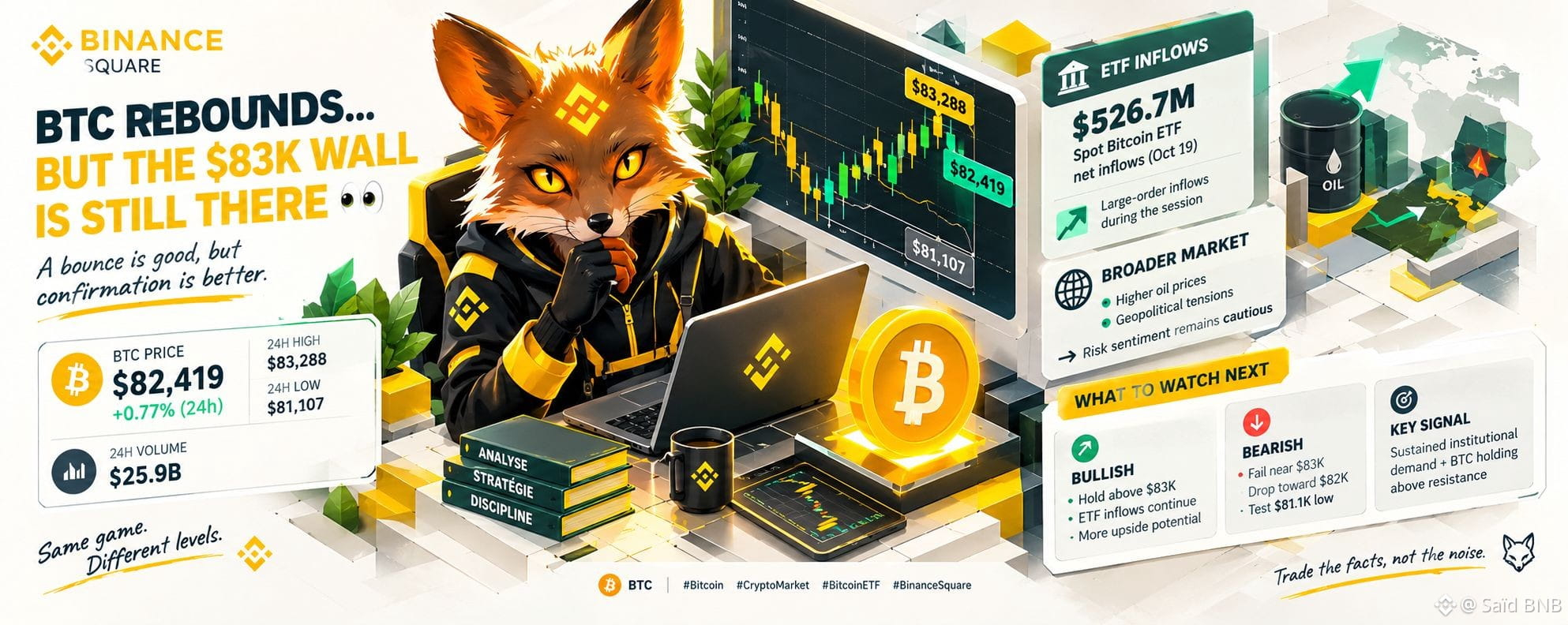
$BTC REBOUNDS… BUT THE $83K WALL IS STILL THERE 👀
I’ve been watching Bitcoin’s latest move, and one thing stands out to me: the bounce is encouraging, but the real story is whether buyers can sustain it.
On October 20, BTC climbed back toward $83,300 after dipping to around $81,107. It’s now trading near $82,419, up 0.77% over 24 hours, with roughly $25.9B in trading volume.
But here’s what caught my attention.
The rebound comes after a reported $526.7M in spot Bitcoin ETF net inflows on October 19. That’s a meaningful signal of institutional demand, and it helps explain why buyers stepped in after the pullback.
Still, I’m not ready to call this a confirmed breakout.
Bitcoin has pushed back toward $83K, but holding above that area is a different challenge. Meanwhile, rising oil prices and geopolitical uncertainty continue to put pressure on broader risk sentiment. That creates a market where buyers may be willing to defend dips, but not yet confident enough to push prices decisively higher.
Here’s what I’m watching next:
🔹 Bullish scenario: BTC holds its rebound, ETF inflows remain strong, and buyers reclaim $83K with conviction. That would strengthen the case for further upside.
🔹 Bearish scenario: BTC repeatedly fails near $83K and starts losing momentum toward $82K and the $81.1K daily low. That would suggest the rebound is losing strength.
🔹 The key signal: Whether institutional demand continues while Bitcoin tests resistance.
One positive session is encouraging; sustained buying is what matters.
Personally, I’m more interested in what Bitcoin does after the bounce than in the bounce itself.
Markets can recover quickly, but confirmation takes time. I’d rather watch the price action and follow the flows than get carried away by one green candle.
What’s your read?
Are we seeing the beginning of a stronger BTC recovery, or is this just a temporary bounce before another test of $81K?
Drop your scenario below. 👇
#Bitcoin #BTC #CryptoMarket #BitcoinETF #SaidBNB
2
126
·
--

Article
🚨 7 Trading mistakes to avoid for profitlet me tell you something, the market doesn’t have a pulse, but it has a memory
are You Trading for Profit, or Just Funding Someone Else’s Exit Liquidity?
i remember sitting in front of my monitors during a massive liquidity reset. The candles were bleeding red, the liquidations were flashing like a strobe light, and the "moon-boys" on social media had gone silent. It was in that moment of absolute stillness that I realized the difference between those who survive in this game and those who are merely "donating" to the whales.
On Binance, we see it every day: brilliant minds losing it all because they treat the most complex financial frontier like a casino.
If you want to stop being the exit liquidity and start being the one who profits from the architecture of this market, you need to avoid these seven deadly sins.
1. The "High Leverage" Mirage
We’ve all seen the screenshots—100x gains that look like a ticket to freedom. But here is the reality: Leverage is a tool, not a strategy.
When you use extreme leverage, you aren't trading the asset; you are trading the noise. A 1% "liquidity wick"—a common occurrence in the crypto market structure—can wipe you out before the price even begins its actual move. Successful trading isn't about how much you can win in one trade; it’s about how many "resets" you can survive.
2. Falling for the FOMO Echo Chamber
The hardest thing to do in crypto is to stay seated while everyone else is dancing.
When a project is trending, and every influencer is screaming about a "100x gem," the smart money is already looking for the exit. If you’re buying because the chart is vertical, you aren't an investor; you’re a buyer of someone else’s profit.
I’ve learned that the most profitable entries are found in the architecture of confidentiality and infrastructure—long before the hype reaches the masses.
3. Ignoring the "Liquidity Resets"
Most traders see a 20% correction and panic. They call it a crash. I call it a liquidity reset.
The market needs to breathe. It needs to flush out the over-leveraged "weak hands" to build a healthy floor for the next leg up. If you avoid understanding market cycles and macro-liquidity flows, you will always sell at the bottom and buy at the top. Stop fearing the red; start analyzing the structure behind it.
"In the machine-to-machine economy, the market doesn't care about your feelings. It only cares about execution and determinism."
4. Revenge Trading: The Silent Account Killer
You just lost a trade.
Your ego is bruised.
Your immediate instinct is to "get it back."
This is the fastest way to zero.
Revenge trading is emotional, and emotions are the enemy of execution.
When you trade to "break even," your logic is gone.
You take worse setups with higher risk.
The market is a sea of opportunities; if you miss one, wait for the next "verifiable" setup. The market isn't going anywhere.
5. Trading Without a "Safety Net"
I’ve audited countless portfolios, and the number one commonality in failed accounts is the absence of a Stop Loss.
Trading without a stop loss is like driving a car without brakes because you "believe" you won't hit anything.
"Hope" is not a technical indicator.
A stop loss is your insurance policy.
It allows you to be wrong, take a small hit, and live to trade another day.
Remember: Protecting your capital is more important than growing it.
6. Chasing Hype Over Infrastructure
Speculation is fun, but sustainability is found in protocol architecture.
Many traders get caught up in the latest meme-coin frenzy while ignoring the foundational shifts in the industry—like the transition to machine-economic infrastructure or verifiable AI.
If you don't understand why a protocol exists or how it handles coordination layers, you are gambling on a narrative that could vanish overnight.
Diversify into what matters, not just what’s loud.
7. Over-trading: The Quality vs. Quantity Trap
rewards depth and authority, and the market rewards the same in your trading.
You don't need to be in a trade 24/7.
In fact, some of the most profitable days I’ve had involved doing absolutely nothing.
Over-trading leads to fatigue, and fatigue leads to mistakes. Focus on the high-probability setups that align with the macro trend.
One well-researched, patient trade is worth more than ten "boredom" trades.
My Final Advice
The crypto market is a transfer of wealth from the impatient to the patient, and from the emotional to the structural.
As a creator and analyst, my goal isn't to give you fish; it’s to show you how the ocean works.
Avoid these seven traps, respect the liquidity resets, and focus on the architecture of the future.
Stay grounded, stay logical, and let the market come to you.
What’s the one mistake that cost you the most in your trading journey? Let’s discuss it in the comments—transparency is the first step to mastery.
#TradingSignals
#LearnFromMistakes
#Binance
#SaidBNB
🚨 7 Trading mistakes to avoid for profit
let me tell you something, the market doesn’t have a pulse, but it has a memory
are You Trading for Profit, or Just Funding Someone Else’s Exit Liquidity?
i remember sitting in front of my monitors during a massive liquidity reset. The candles were bleeding red, the liquidations were flashing like a strobe light, and the "moon-boys" on social media had gone silent. It was in that moment of absolute stillness that I realized the difference between those who survive in this game and those who are merely "donating" to the whales.
On Binance, we see it every day: brilliant minds losing it all because they treat the most complex financial frontier like a casino.
If you want to stop being the exit liquidity and start being the one who profits from the architecture of this market, you need to avoid these seven deadly sins.
1. The "High Leverage" Mirage
We’ve all seen the screenshots—100x gains that look like a ticket to freedom. But here is the reality: Leverage is a tool, not a strategy.
When you use extreme leverage, you aren't trading the asset; you are trading the noise. A 1% "liquidity wick"—a common occurrence in the crypto market structure—can wipe you out before the price even begins its actual move. Successful trading isn't about how much you can win in one trade; it’s about how many "resets" you can survive.
2. Falling for the FOMO Echo Chamber
The hardest thing to do in crypto is to stay seated while everyone else is dancing.
When a project is trending, and every influencer is screaming about a "100x gem," the smart money is already looking for the exit. If you’re buying because the chart is vertical, you aren't an investor; you’re a buyer of someone else’s profit.
I’ve learned that the most profitable entries are found in the architecture of confidentiality and infrastructure—long before the hype reaches the masses.
3. Ignoring the "Liquidity Resets"
Most traders see a 20% correction and panic. They call it a crash. I call it a liquidity reset.
The market needs to breathe. It needs to flush out the over-leveraged "weak hands" to build a healthy floor for the next leg up. If you avoid understanding market cycles and macro-liquidity flows, you will always sell at the bottom and buy at the top. Stop fearing the red; start analyzing the structure behind it.
"In the machine-to-machine economy, the market doesn't care about your feelings. It only cares about execution and determinism."
4. Revenge Trading: The Silent Account Killer
You just lost a trade.
Your ego is bruised.
Your immediate instinct is to "get it back."
This is the fastest way to zero.
Revenge trading is emotional, and emotions are the enemy of execution.
When you trade to "break even," your logic is gone.
You take worse setups with higher risk.
The market is a sea of opportunities; if you miss one, wait for the next "verifiable" setup. The market isn't going anywhere.
5. Trading Without a "Safety Net"
I’ve audited countless portfolios, and the number one commonality in failed accounts is the absence of a Stop Loss.
Trading without a stop loss is like driving a car without brakes because you "believe" you won't hit anything.
"Hope" is not a technical indicator.
A stop loss is your insurance policy.
It allows you to be wrong, take a small hit, and live to trade another day.
Remember: Protecting your capital is more important than growing it.
6. Chasing Hype Over Infrastructure
Speculation is fun, but sustainability is found in protocol architecture.
Many traders get caught up in the latest meme-coin frenzy while ignoring the foundational shifts in the industry—like the transition to machine-economic infrastructure or verifiable AI.
If you don't understand why a protocol exists or how it handles coordination layers, you are gambling on a narrative that could vanish overnight.
Diversify into what matters, not just what’s loud.
7. Over-trading: The Quality vs. Quantity Trap
rewards depth and authority, and the market rewards the same in your trading.
You don't need to be in a trade 24/7.
In fact, some of the most profitable days I’ve had involved doing absolutely nothing.
Over-trading leads to fatigue, and fatigue leads to mistakes. Focus on the high-probability setups that align with the macro trend.
One well-researched, patient trade is worth more than ten "boredom" trades.
My Final Advice
The crypto market is a transfer of wealth from the impatient to the patient, and from the emotional to the structural.
As a creator and analyst, my goal isn't to give you fish; it’s to show you how the ocean works.
Avoid these seven traps, respect the liquidity resets, and focus on the architecture of the future.
Stay grounded, stay logical, and let the market come to you.
What’s the one mistake that cost you the most in your trading journey? Let’s discuss it in the comments—transparency is the first step to mastery.
#TradingSignals
#LearnFromMistakes
#Binance
#SaidBNB
1
143
·
--

Article
Is Trump Driving Crypto—or Creating Risk?i was watching the charts, Bitcoin holding steady, volatility slowing down… but the headlines were getting louder.
War tensions rising.
Oil moving aggressively.
Legal conflicts unfolding.
And right in the middle of all that—.
That’s when it became clear:
this market is no longer just about crypto.
Conflict Is Now a Market Factor
The current geopolitical tension, especially around the U.S. and Iran, is not just background noise anymore.
It’s directly affecting:
Energy pricesGlobal liquidityRisk appetite
And crypto is reacting to it in real time.
This is a shift.
Crypto is no longer isolated—it’s connected to global events.
Trump Is No Longer Outside Crypto
At the same time, Trump isn’t just influencing markets politically.
He’s involved in crypto-related activity and conflicts that are now public:
Legal disputesToken-related controversiesPower struggles inside emerging financial systems
This creates something new:
a direct link between politics and crypto infrastructure.
This Matters because We’re entering a phase where:
Politics can move tokensConflict can shift liquidityNarratives can impact price faster than fundamentals
That changes how this market behaves.
It becomes less predictable… but more structured.
What the Market Is Showing
Despite all the tension:
Bitcoin is holding key levelsPanic selling is limitedLiquidity is still active
This doesn’t look like fear.
It looks like adaptation.
The question is no longer just about price.
It’s about influence.
Is Trump’s presence in this space:
a sign of growth
ora new layer of risk?
Because if politics and crypto fully merge,
this market will not follow old patterns anymore.
And the ones who understand that early
will see the difference first.
#TrumpUnveilsPlanToEscortHormuzShips
#USAndIranTradeShotInTheStraitOfHormuz
#BTCSurpasses$80K
#bitcoin
#SaidBNB
$BTC
{future}(BTCUSDT)
Is Trump Driving Crypto—or Creating Risk?
i was watching the charts, Bitcoin holding steady, volatility slowing down… but the headlines were getting louder.
War tensions rising.
Oil moving aggressively.
Legal conflicts unfolding.
And right in the middle of all that—.
That’s when it became clear:
this market is no longer just about crypto.
Conflict Is Now a Market Factor
The current geopolitical tension, especially around the U.S. and Iran, is not just background noise anymore.
It’s directly affecting:
Energy pricesGlobal liquidityRisk appetite
And crypto is reacting to it in real time.
This is a shift.
Crypto is no longer isolated—it’s connected to global events.
Trump Is No Longer Outside Crypto
At the same time, Trump isn’t just influencing markets politically.
He’s involved in crypto-related activity and conflicts that are now public:
Legal disputesToken-related controversiesPower struggles inside emerging financial systems
This creates something new:
a direct link between politics and crypto infrastructure.
This Matters because We’re entering a phase where:
Politics can move tokensConflict can shift liquidityNarratives can impact price faster than fundamentals
That changes how this market behaves.
It becomes less predictable… but more structured.
What the Market Is Showing
Despite all the tension:
Bitcoin is holding key levelsPanic selling is limitedLiquidity is still active
This doesn’t look like fear.
It looks like adaptation.
The question is no longer just about price.
It’s about influence.
Is Trump’s presence in this space:
a sign of growth
ora new layer of risk?
Because if politics and crypto fully merge,
this market will not follow old patterns anymore.
And the ones who understand that early
will see the difference first.
#TrumpUnveilsPlanToEscortHormuzShips
#USAndIranTradeShotInTheStraitOfHormuz
#BTCSurpasses$80K
#bitcoin
#SaidBNB
$BTC
2
218
·
--
Bullish
$SOL SOLANA ANALYSIS — “The Level That Wakes the Beast” 🔥
Solana is coiling for a major move.
After holding the $133 support, SOL is building strength for a breakout toward $155 — the level that decides the next explosive leg. A clean daily close above it opens the gates to $180 → $200.
On-chain momentum is improving, network uptime remains flawless, and upcoming upgrades (Firedancer + Alpenglow) keep Solana among the strongest L1s heading into Q4/Q1.
If the market wicks down first, buyers will likely defend $125–110, the biggest demand zone on the chart.
Bias: Bullish as long as SOL stays above $133.
Breakout trigger: $155.
Danger zone: Below $110.
{spot}(SOLUSDT)
#CryptoRally
#solana
#SaidBNB
$SOL SOLANA ANALYSIS — “The Level That Wakes the Beast” 🔥
Solana is coiling for a major move.
After holding the $133 support, SOL is building strength for a breakout toward $155 — the level that decides the next explosive leg. A clean daily close above it opens the gates to $180 → $200.
On-chain momentum is improving, network uptime remains flawless, and upcoming upgrades (Firedancer + Alpenglow) keep Solana among the strongest L1s heading into Q4/Q1.
If the market wicks down first, buyers will likely defend $125–110, the biggest demand zone on the chart.
Bias: Bullish as long as SOL stays above $133.
Breakout trigger: $155.
Danger zone: Below $110.
#CryptoRally
#solana
#SaidBNB

719
329
72
719
·
--
Never Underestimate RISK MANAGEMENT, it's your key to be safe , to keep you Capital Safe.
Chose your entry zone carefully.
Never forget your stop loss and put it wisely.
#SaidBNB
Never Underestimate RISK MANAGEMENT, it's your key to be safe , to keep you Capital Safe.
Chose your entry zone carefully.
Never forget your stop loss and put it wisely.
#SaidBNB
Chose your entry zone carefully.
Never forget your stop loss and put it wisely.
#SaidBNB
3
402
·
--
Bearish
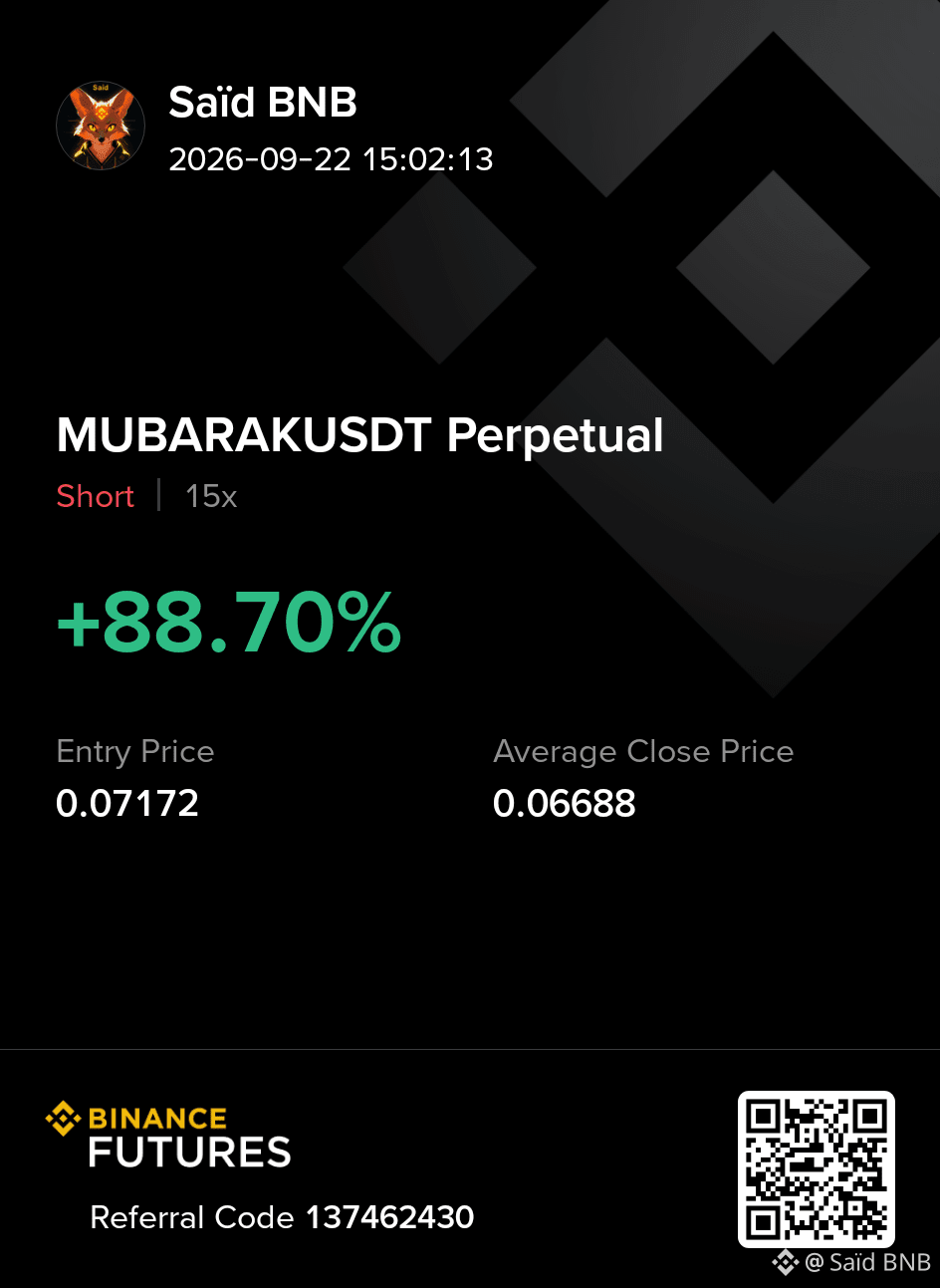
Catching Opportunitys like a Fennec 🤑😎
$MUBARAK Will fall or will keep up ? tell us in the comments 👇
#SaidBNB
Catching Opportunitys like a Fennec 🤑😎
$MUBARAK Will fall or will keep up ? tell us in the comments 👇
#SaidBNB
$MUBARAK Will fall or will keep up ? tell us in the comments 👇
#SaidBNB
1
358
·
--
Bullish
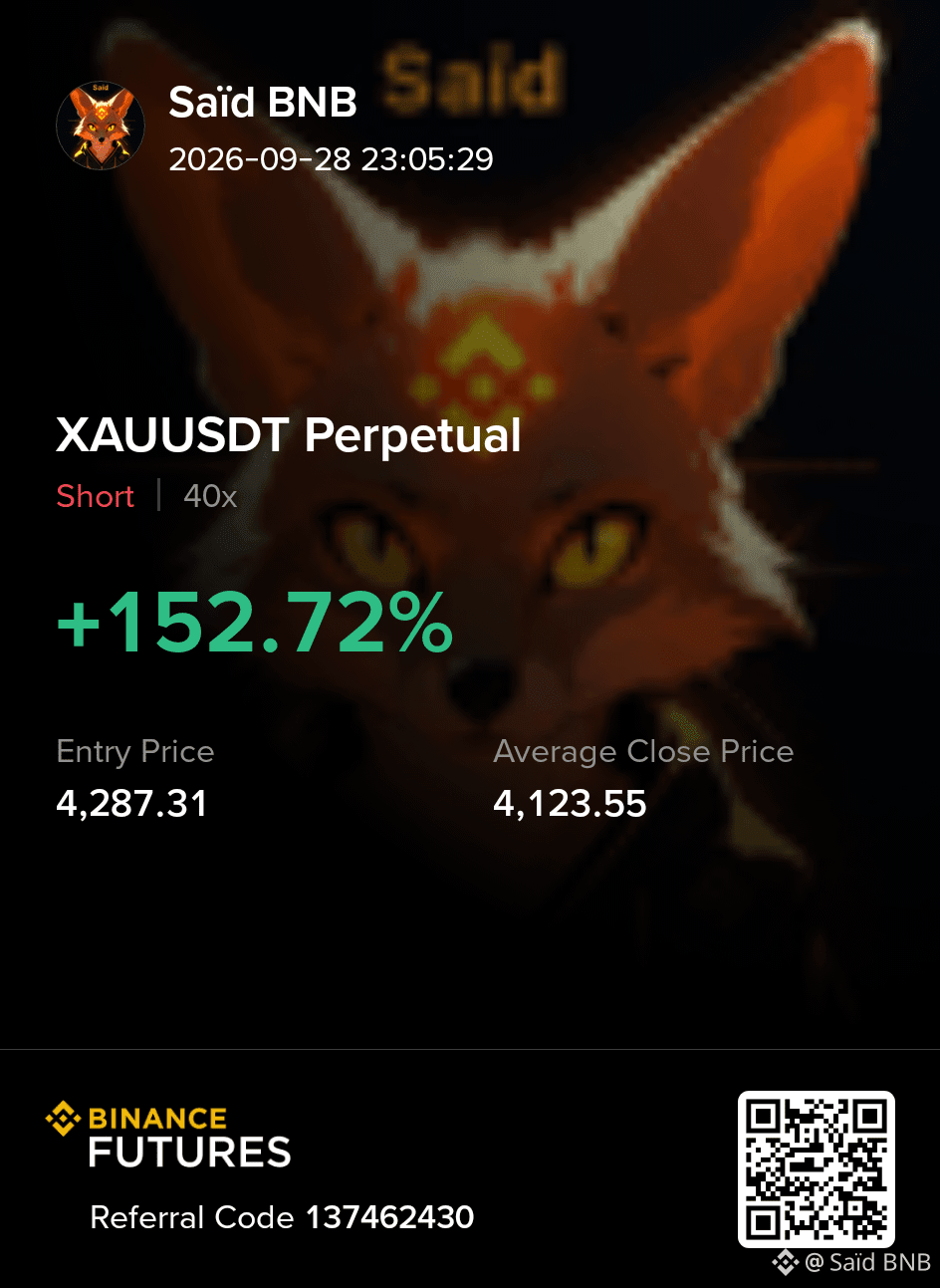
After this beautiful Downfall , I think $XAUT is going to reverse , Let's see what's Coming.
And don't forget trade wisely and DYOR
#SaidBNB
{future}(XAUTUSDT)
After this beautiful Downfall , I think $XAUT is going to reverse , Let's see what's Coming.
And don't forget trade wisely and DYOR
#SaidBNB
And don't forget trade wisely and DYOR
#SaidBNB
4
482
·
--

Article
🛑 The Web3 Gaming Illusion is Dead, Here is Why $PIXEL Just Changed the Rules of the Game 🎮Let’s have a real, unfiltered conversation about the state of Web3 gaming today.
If you are still hunting for the next project where you can blindly click a button fifty times a day to buy a Lambo by next month, you are stuck in 2021.
The market has grown up.
The "wen moon" crowd is exhausted, and traditional Play-to-Earn (P2E) economies are bleeding out as funding dries up and studios quietly close their doors.
But right in the middle of this sector-wide identity crisis, something fascinating is happening on the Ronin Network.
@pixels isn't just surviving the chop; it is aggressively evolving. And if you are only looking at the daily price charts instead of diving into their brand-new "Stacked" ecosystem and deep staking mechanics, you are leaving serious opportunities on the table.
Here is the untold story of how Pixels is quietly engineering the biggest comeback narrative in the GameFi space, and how you can position yourself to capitalize on it.
Erasing the "Crypto" to Save the Game
Most crypto games fail because they feel like decentralized finance spreadsheets with a chat box glued on top.
They over-financialize every single click until the "game" feels like unpaid digital labor.
Pixels realized this trap early on.
Their masterstroke wasn't a flashy marketing campaign; it was a painful, necessary economic surgery. By phasing out their highly inflationary secondary token ($BERRY) and consolidating the entire economy around $PIXEL, they successfully eliminated the toxic "farm and dump" loop.
They stopped building for short-term speculators and started building for actual players.
When you walk through Terra Villa today, you don't feel the sterile, empty environment of a dying DeFi protocol.
You see thousands of avatars running around, managing resources, crafting, and engaging in community drama.
It feels lived-in. It feels chaotic in the best way possible.
"Stacked" Ecosystem: The Real Game-Changer
If you've been hearing whispers across Binance Square about the "stacking" or Stacked ecosystem, this is exactly where the alpha is. In April 2026, Pixels dropped a nuke on the Web3 space by launching "Stacked"—an all-in-one application designed to solve the massive headaches that have plagued the industry for years.
The hardest part of Web3 gaming was never putting assets on-chain; it was managing incentive alignment and making the user experience frictionless.
The Stacked ecosystem fixes this entirely.
One Hub to Rule Them All: Stacked brings together Pixels, Pixels Dungeons, Sleepagotchi, and Chubkins under one unified roof.Frictionless Rewards: You can now play games, build daily streaks, complete cross-game missions, and cash out your earnings across a growing ecosystem without juggling five different wallets or dealing with messy, expensive withdrawal systems.Redistributing Value: The ultimate goal of Stacked is to push the value directly back to the players, bypassing the traditional platforms that usually eat your margins.
This isn't just a minor patch update.
It’s a massive infrastructure play.
@pixels is positioning itself to be the ultimate decentralized gaming hub, powered natively by $PIXEL.
Staking & The Invisible Shift from "Gamer" to "Governor"
So, where does the real money flow? Token hype might bring retail players in, but the deep economic layer is what makes them stay.
We are witnessing a massive psychological transition right now.
The meta is no longer about manual grinding; it’s about strategic ecosystem governance. The system is intentionally designed to reward the "Governors"—those who understand that $PIXEL is a tool for long-term control, not just a digital asset to sell for a quick 10% flip.
The Power of Staking: By staking your $PIXEL, you aren't just earning passive yield. You are unlocking vital VIP access, securing gameplay boosts, and gaining exclusive ecosystem perks that put you leagues ahead of free-to-play users.Chapter 3 Dynamics: With the introduction of Unions and Yieldstones, staking and resource pooling have become tribal. Players are now forced to pick a side, invest their resources into their faction's Hearth, and compete for massive prize pools. It is a seasonal tug-of-war where your staked assets dictate your actual influence in the world.The Binance Synergy: For the smart money, holding $PIXEL idle in a spot wallet is a rookie mistake. Binance Simple Earn frequently offers competitive APRs for $PIXEL, allowing you to compound your holdings while the in-game ecosystem matures.
Smart Money is Positioning
Look at the on-chain data.
We are seeing massive daily trading volumes compared to the overall market cap.
There is a massive divergence right now between what the charts show on a 15-minute timeframe and what is happening under the hood.
While the tourists complain about minor daily dips, the veterans are quietly moving their $PIXEL into staking contracts, upgrading their land efficiency, and dominating the Union leaderboards. They know that when the next major wave of retail capital enters the GameFi sector, projects with proven daily active users and frictionless ecosystems—like Stacked—will capture the lion's share of the liquidity.
Pixels isn't just a crypto game anymore, and that is exactly why it is winning.
It has become an onboarding layer disguised as pure entertainment.
If you are just logging in to click a few virtual crops and sell your daily yield, you are playing the game wrong.
The real generational wealth in the $PIXEL ecosystem will be captured by the players who transition into governors, utilize the new Stacked app, and actively stake their claim in the digital economy.
If you are ready to stop playing the short game and start building real Web3 influence, it is time to look beyond the charts.
#pixel
#pixels
#Binance
#SaidBNB
🛑 The Web3 Gaming Illusion is Dead, Here is Why $PIXEL Just Changed the Rules of the Game 🎮
Let’s have a real, unfiltered conversation about the state of Web3 gaming today.
If you are still hunting for the next project where you can blindly click a button fifty times a day to buy a Lambo by next month, you are stuck in 2021.
The market has grown up.
The "wen moon" crowd is exhausted, and traditional Play-to-Earn (P2E) economies are bleeding out as funding dries up and studios quietly close their doors.
But right in the middle of this sector-wide identity crisis, something fascinating is happening on the Ronin Network.
@Pixels isn't just surviving the chop; it is aggressively evolving. And if you are only looking at the daily price charts instead of diving into their brand-new "Stacked" ecosystem and deep staking mechanics, you are leaving serious opportunities on the table.
Here is the untold story of how Pixels is quietly engineering the biggest comeback narrative in the GameFi space, and how you can position yourself to capitalize on it.
Erasing the "Crypto" to Save the Game
Most crypto games fail because they feel like decentralized finance spreadsheets with a chat box glued on top.
They over-financialize every single click until the "game" feels like unpaid digital labor.
Pixels realized this trap early on.
Their masterstroke wasn't a flashy marketing campaign; it was a painful, necessary economic surgery. By phasing out their highly inflationary secondary token ($BERRY) and consolidating the entire economy around $PIXEL , they successfully eliminated the toxic "farm and dump" loop.
They stopped building for short-term speculators and started building for actual players.
When you walk through Terra Villa today, you don't feel the sterile, empty environment of a dying DeFi protocol.
You see thousands of avatars running around, managing resources, crafting, and engaging in community drama.
It feels lived-in. It feels chaotic in the best way possible.
"Stacked" Ecosystem: The Real Game-Changer
If you've been hearing whispers across Binance Square about the "stacking" or Stacked ecosystem, this is exactly where the alpha is. In April 2026, Pixels dropped a nuke on the Web3 space by launching "Stacked"—an all-in-one application designed to solve the massive headaches that have plagued the industry for years.
The hardest part of Web3 gaming was never putting assets on-chain; it was managing incentive alignment and making the user experience frictionless.
The Stacked ecosystem fixes this entirely.
One Hub to Rule Them All: Stacked brings together Pixels, Pixels Dungeons, Sleepagotchi, and Chubkins under one unified roof.Frictionless Rewards: You can now play games, build daily streaks, complete cross-game missions, and cash out your earnings across a growing ecosystem without juggling five different wallets or dealing with messy, expensive withdrawal systems.Redistributing Value: The ultimate goal of Stacked is to push the value directly back to the players, bypassing the traditional platforms that usually eat your margins.
This isn't just a minor patch update.
It’s a massive infrastructure play.
@Pixels is positioning itself to be the ultimate decentralized gaming hub, powered natively by $PIXEL .
Staking & The Invisible Shift from "Gamer" to "Governor"
So, where does the real money flow? Token hype might bring retail players in, but the deep economic layer is what makes them stay.
We are witnessing a massive psychological transition right now.
The meta is no longer about manual grinding; it’s about strategic ecosystem governance. The system is intentionally designed to reward the "Governors"—those who understand that $PIXEL is a tool for long-term control, not just a digital asset to sell for a quick 10% flip.
The Power of Staking: By staking your $PIXEL , you aren't just earning passive yield. You are unlocking vital VIP access, securing gameplay boosts, and gaining exclusive ecosystem perks that put you leagues ahead of free-to-play users.Chapter 3 Dynamics: With the introduction of Unions and Yieldstones, staking and resource pooling have become tribal. Players are now forced to pick a side, invest their resources into their faction's Hearth, and compete for massive prize pools. It is a seasonal tug-of-war where your staked assets dictate your actual influence in the world.The Binance Synergy: For the smart money, holding $PIXEL idle in a spot wallet is a rookie mistake. Binance Simple Earn frequently offers competitive APRs for $PIXEL , allowing you to compound your holdings while the in-game ecosystem matures.
Smart Money is Positioning
Look at the on-chain data.
We are seeing massive daily trading volumes compared to the overall market cap.
There is a massive divergence right now between what the charts show on a 15-minute timeframe and what is happening under the hood.
While the tourists complain about minor daily dips, the veterans are quietly moving their $PIXEL into staking contracts, upgrading their land efficiency, and dominating the Union leaderboards. They know that when the next major wave of retail capital enters the GameFi sector, projects with proven daily active users and frictionless ecosystems—like Stacked—will capture the lion's share of the liquidity.
Pixels isn't just a crypto game anymore, and that is exactly why it is winning.
It has become an onboarding layer disguised as pure entertainment.
If you are just logging in to click a few virtual crops and sell your daily yield, you are playing the game wrong.
The real generational wealth in the $PIXEL ecosystem will be captured by the players who transition into governors, utilize the new Stacked app, and actively stake their claim in the digital economy.
If you are ready to stop playing the short game and start building real Web3 influence, it is time to look beyond the charts.
#pixel
#pixels
#Binance
#SaidBNB
3
6
243
Log in to explore more content
Join global crypto users on Binance Square
⚡️ Get latest and useful information about crypto.
💬 Trusted by the world’s largest crypto exchange.
👍 Discover real insights from verified creators.
Email / Phone number
Trending Topics
1
#StrategyFaces$2.8BSelloffRiskFromMSCIRemoval
30,041 views
189 Discussing
2
#ZcashFallsBelow$1000ForFirstTimeSinceSeptember
17,314 views
111 Discussing
3
#AnthropicRejectsIPODelayValuationinQuestion
399,286 views
3,392 Discussing
4
#HotCPIDecemberHikePriced
404,314 views
3,494 Discussing
5
#TradFiForBeginners
471,194 views
3,094 Discussing
6
#BitcoinETFsLose$1.6BInNovember
14,044 views
70 Discussing
7
#AnthropicDisclosesOver$10BNewComputeDeals
2,742 views
37 Discussing
8
#CoreWeaveJumps10%On168%RevenueGrowth
34,971 views
568 Discussing
9
#CanNvidiaEarningsEaseMarketConcerns?
129,567 views
1,489 Discussing
10
#BarclaysRaisesBlackRockBitcoinETFStake48%
29,125 views
415 Discussing