
#cryptotax
cryptotax
622,032 views
1,544 Discussing
Hot
Latest

·
--
What happened: Greece will now tax crypto profits at 10% and money earned from DeFi (lending crypto for interest) at 15%, with a 12-month grace period to report old gains penalty-free.
What it means for you: If you live in Greece and cash out crypto profits or earn interest from DeFi, part of that is now owed as tax, but you get a year to declare past earnings without extra fines; for everyone outside Greece, nothing changes.
😏 Governments spent years ignoring crypto, then showed up right when it was time to collect.
#cryptotax

·
--
#HongKongPlansTaxIncentivesCoveringDigitalAssets
🏦 HK$240M Floor Puts Digital Assets on the Tax-Free List
Hong Kong expands fund and family-office tax breaks so digital assets count as qualifying investments from YOA 2025/26.
📊 Digital assets added as Schedule 16C qualifying investments
📅 Enhanced concessions from assessment year 2025/26
🏦 FIHV floor stays at HK$240M of qualifying assets
⚠️ Separate VA bill (deal, custody, advisory, manage) by year-end
The catch: HK$240M bar is for funds, not retail.
Tax from 2025/26 first, or wait for year-end VA bill? 👇
$BTC $ETH
#HongKongPlansTaxIncentivesCoveringDigitalAssets #HongKong #CryptoTax


·
--
$BTC | Hong Kong is dangling tax incentives for crypto capital. Australia is not matching it; crypto here still runs through the plain ATO CGT regime, no carve-out. On the desk, the real question is not whether Canberra follows Hong Kong, it is what you control under the rules we have. The ATO applies losses to non-discounted gains before discounted ones, under section 115 of the ITAA 1997, preserving more of your 50 percent discount than most assume. My read: a sell settling 1 July instead of 30 June costs more than any tax break saves. SatoshiMacro's calculator models the carryforward under section 102-15. Educational, not tax advice.
https://satoshimacro.com/tools/crypto/calculators/tax-loss-harvesting-calculator/?utm_source=binance_square&utm_medium=social&utm_campaign=autopilot_trend
#SatoshiMacro #HongKongPlansTaxIncentivesCoveringDigitalAssets #CryptoTax #Bitcoin
https://satoshimacro.com/tools/crypto/calculators/tax-loss-harvesting-calculator/?utm_source=binance_square&utm_medium=social&utm_campaign=autopilot_trend
#SatoshiMacro #HongKongPlansTaxIncentivesCoveringDigitalAssets #CryptoTax #Bitcoin
3

·
--
🚨 JUST IN: Greece approves a 10% tax on cryptocurrency profits! 🇬🇷
Under the new crypto tax framework, annual gains of up to €500 will remain tax-free. Any profits exceeding €500 will be subject to a 10% capital gains tax.
Another country introduces clear rules for crypto taxation! 📊
#Crypto #Bitcoin $CYBER $ERA $UVXYB #Greece #CryptoTax #BTC
Under the new crypto tax framework, annual gains of up to €500 will remain tax-free. Any profits exceeding €500 will be subject to a 10% capital gains tax.
Another country introduces clear rules for crypto taxation! 📊
#Crypto #Bitcoin $CYBER $ERA $UVXYB #Greece #CryptoTax #BTC

1
76
·
--
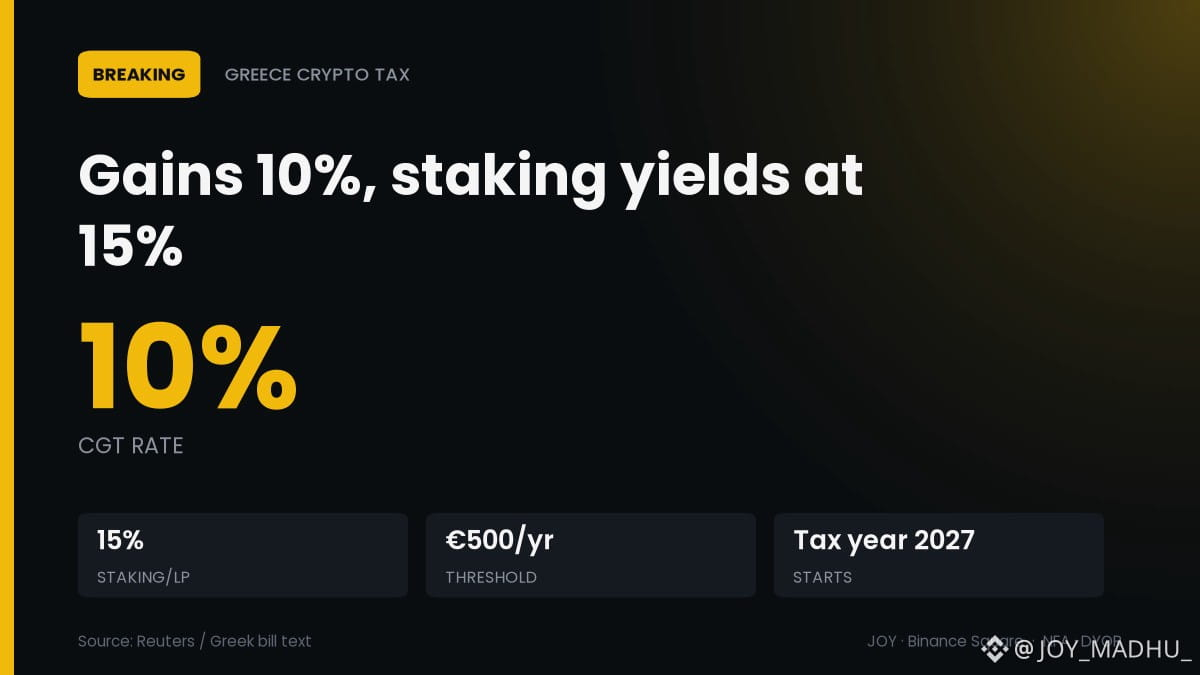
#GreekParliamentPasses10%CryptoCapitalGainsTaxBill
⚖️ Gains at 10%, Staking Yields Taxed at 15%
Greece's parliament passed its first full crypto tax framework: 10% on gains, higher on yield.
📅 Plenary approved Nov 5; main rules from tax year 2027
📊 10% CGT; €500/year net-gain threshold (Reuters)
⚠️ Staking, lending, DeFi LP yields taxed as interest at 15%
🏦 Crypto-to-crypto swaps not taxed; losses carry 5 years
The catch: most Greek investors use platforms abroad, so revenue is hard to project.
Is 10% fair for 2027, or still steep vs the €500 threshold? 👇
$BTC $ETH
#GreekParliamentPasses10%CryptoCapitalGainsTaxBill #CryptoTax #Greece
26

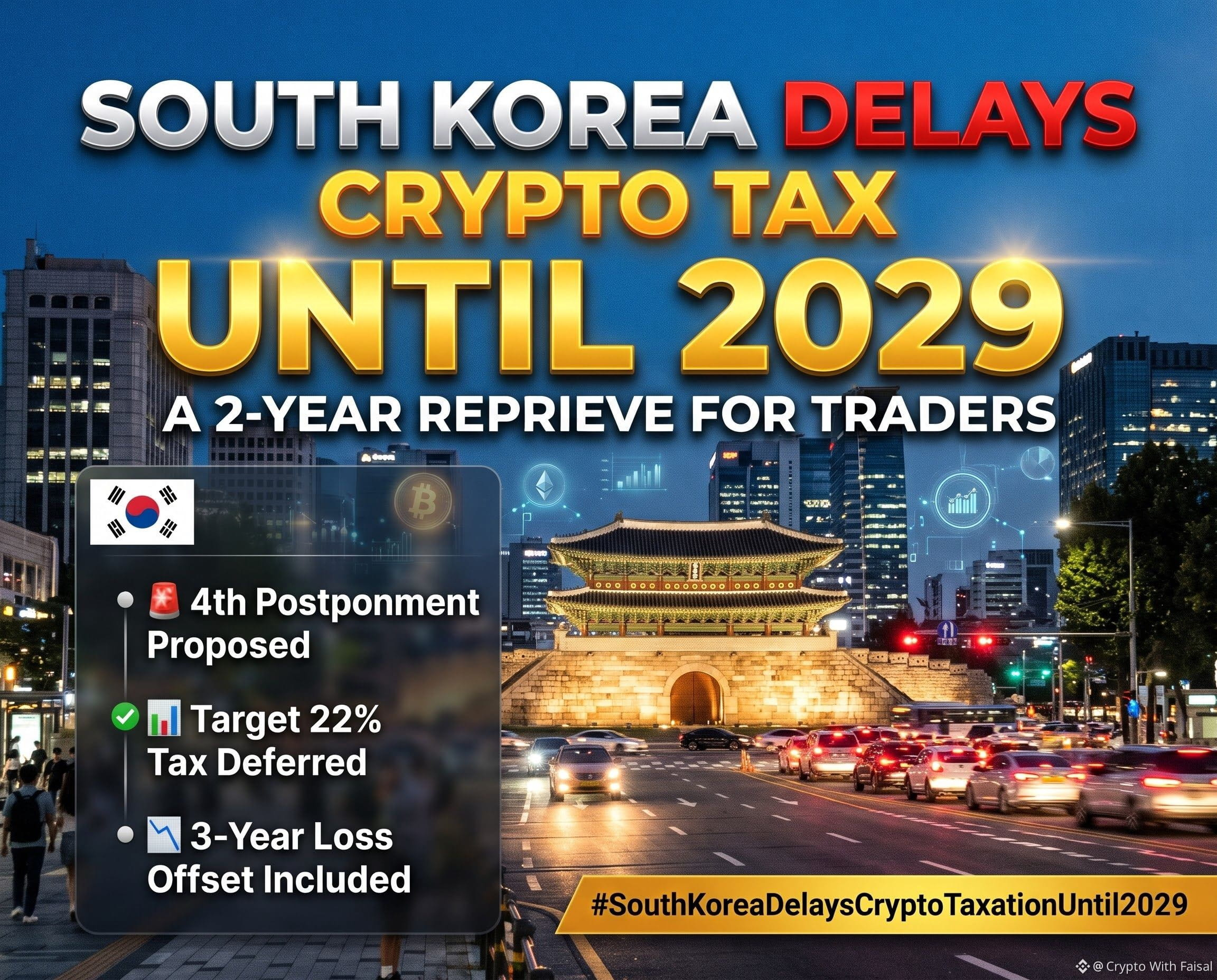
South Korea just pushed its crypto tax to 2029! 🇰🇷📉
If you’ve been watching the Asian crypto markets, this is massive news. Seoul has officially proposed delaying its controversial 22% crypto gains tax by another two years, moving the target start date from January 2027 to 2029.
This marks the FOURTH delay since the tax law was first introduced in 2020.
Here is exactly what you need to know:
✅ The Delay: The government wants two more years to establish a solid digital asset regulatory framework and prepare for cross-border transaction data sharing, specifically with the United States.
✅ The Tax Details: When it finally goes live, the policy will levy a 22% tax on annual crypto profits exceeding 2.5 million won (roughly $1,870).
✅ The Big Bonus: They are proposing a new three-year loss carryforward! This means traders will be able to use past losses to offset future taxable gains—a massive win for retail investors and risk management.
Why does this matter?
While other regions are aggressively tightening up their reporting laws, South Korea is giving its booming retail market and domestic exchanges crucial breathing room to adapt. A clear, carefully built market without rushed taxation is exactly what smart money looks for before deploying capital.
(Note: The National Assembly still needs to officially pass the amendment before January for this delay to become law.)
What’s your take? Is this delay a bullish signal for the broader crypto market, or just kicking the regulatory can down the road? Let me know in the comments! 👇
$ZEC
{future}(ZECUSDT)
$TRUMP
{future}(TRUMPUSDT)
$SOL
{future}(SOLUSDT)
#SouthKoreaDelaysCryptoTaxationUntil2029 #CryptoTax #SouthKorea #CryptoRegulation
South Korea just pushed its crypto tax to 2029! 🇰🇷📉
If you’ve been watching the Asian crypto markets, this is massive news. Seoul has officially proposed delaying its controversial 22% crypto gains tax by another two years, moving the target start date from January 2027 to 2029.
This marks the FOURTH delay since the tax law was first introduced in 2020.
Here is exactly what you need to know:
✅ The Delay: The government wants two more years to establish a solid digital asset regulatory framework and prepare for cross-border transaction data sharing, specifically with the United States.
✅ The Tax Details: When it finally goes live, the policy will levy a 22% tax on annual crypto profits exceeding 2.5 million won (roughly $1,870).
✅ The Big Bonus: They are proposing a new three-year loss carryforward! This means traders will be able to use past losses to offset future taxable gains—a massive win for retail investors and risk management.
Why does this matter?
While other regions are aggressively tightening up their reporting laws, South Korea is giving its booming retail market and domestic exchanges crucial breathing room to adapt. A clear, carefully built market without rushed taxation is exactly what smart money looks for before deploying capital.
(Note: The National Assembly still needs to officially pass the amendment before January for this delay to become law.)
What’s your take? Is this delay a bullish signal for the broader crypto market, or just kicking the regulatory can down the road? Let me know in the comments! 👇
$ZEC
$TRUMP
$SOL
#SouthKoreaDelaysCryptoTaxationUntil2029 #CryptoTax #SouthKorea #CryptoRegulation
1
67
·
--
Does Australia Get the Same Crypto Tax Grace Period South Korea Just Took?$BTC | Does Australia get the same crypto tax grace period South Korea just took?
No. South Korea is reportedly pushing its crypto capital gains tax start date out to 2029. Australia got no such delay. The ATO has treated every crypto disposal as a capital gains tax event since 2014, AUSTRAC-registered exchanges already feed the ATO's data-matching program, and the only decision left for an Australian holder is whether their tax software actually understands what they did with their coins, not whether tax applies at all.
## Why does one country get until 2029 and Australia does not?
On the desk this kind of headline always triggers the same question from clients who also trade offshore: can I just wait too? No. Australia's crypto CGT regime is already live and the 31 October self-lodgement window for this year has closed. Late or inaccurate reporting against ATO data-matching, not a future legislative start date, is the actual AU risk. South Korea's delay is a policy choice for a market that has not yet switched its tax engine on. Australia switched it on more than a decade ago, and the data-matching pipeline runs quietly in the background every year regardless of what other jurisdictions decide to do with their own timelines.
## What does Koinly actually get right for an AU return?
SatoshiMacro's Koinly review rates the platform 4.7 on accuracy and calculations, 4.7 on pricing value, and 4.4 specifically on Australian rule handling. It applies the 50 percent CGT discount automatically once a parcel clears 12 months, and it offers an SMSF one-third discount when the account is configured as a super fund. It connects directly to ten Australian exchanges including Swyftx, CoinSpot and Independent Reserve via API, plus 800 plus exchanges, wallets and blockchains in total, and outputs a myTax-formatted summary rather than a generic CSV. Koinly is not AUSTRAC registered, because it is not a financial institution or exchange; it is the AUSTRAC-registered exchanges behind it that actually feed the ATO's matching program.
## Where does the coverage genuinely run out?
This is the part a glossy pricing page will not volunteer. Koinly covers roughly 200 plus DeFi protocols against Summ's 1,500 plus, so a reader running multiple yield loops across newer chains will hit more manual reclassification than a reader doing plain staking. Bridges can double count a transfer if left unconfigured. And the page itself disclosed a December 2025 Mixpanel incident that exposed email addresses, which is why its own security score sits lower than its accuracy score. None of that makes Koinly unsuitable. It makes the DeFi-coverage question the one to ask before paying, not after.
## Is Koinly actually the cheapest option?
The review page calls Koinly the cheapest entry point among the three AU-focused platforms it compares, then its own pricing table and FAQ list Syla's entry tier at AUD 59, four dollars under Koinly's AUD 64 Newbie tier. That is not a reason to avoid Koinly. It is a reason to read past the headline claim on any comparison page, including this one, and check the actual table before picking a plan. Pair that with the page's reported Trustpilot score of 4.6 across more than 2,252 reviews, and the honest picture is a platform with a strong reputation and competitive, rather than uniquely cheap, pricing.
## How does this actually play out on a return?
Take a Hodler-tier user on the AUD 103 a year plan, 1,000 transactions, doing straightforward PoS staking plus a long-held core BTC position. Say they picked up AUD 12,000 of staking rewards through the year. That is ordinary income, taxed at marginal rates the moment it hits the wallet, no discount available. Separately, they sell part of that core BTC position 14 months after buying it for a AUD 9,000 gain. Held past 12 months, that gain qualifies for the automatic 50 percent CGT discount, so only AUD 4,500 is assessable. Two line items, two different tax treatments, inside one tax year. That distinction is exactly where a spreadsheet or a memory-based estimate quietly goes wrong, and it is the whole reason a dedicated AU engine earns its subscription over a free export.
My read is the DeFi-coverage gap matters more than the headline sticker price for anyone running more than one or two protocols at once. Pricing starts at AUD 64 on the Newbie tier and climbs to AUD 239 on Pro; the cheaper tier is irrelevant if it cannot classify what you actually did. Match the plan to your transaction shape and protocol count first, then worry about the four-dollar gap against Syla.
A platform's own security disclosure also tells you something about how it handles bad news. Koinly reported the Mixpanel exposure itself rather than waiting to be caught, and the review marked its security score down for it. On the desk, a vendor that downgrades its own rating after an incident earns more trust from me than one that stays silent. That is a small signal, not a guarantee, but it is the kind of detail that separates a marketing page from an actual audit trail.
This comparison is built from Koinly's own published pricing, ratings and FAQ content, not a live test run against a personal return, so treat any edge-case DeFi behaviour as indicative rather than guaranteed, and this is not personal tax advice.
https://satoshimacro.com/reviews/crypto/koinly-review/?utm_source=binance_square&utm_medium=social&utm_campaign=autopilot_article
#SatoshiMacro #SouthKoreaSeeksCryptoTaxDelayUntil2029 #CryptoTax #Bitcoin
Does Australia Get the Same Crypto Tax Grace Period South Korea Just Took?
$BTC | Does Australia get the same crypto tax grace period South Korea just took?
No. South Korea is reportedly pushing its crypto capital gains tax start date out to 2029. Australia got no such delay. The ATO has treated every crypto disposal as a capital gains tax event since 2014, AUSTRAC-registered exchanges already feed the ATO's data-matching program, and the only decision left for an Australian holder is whether their tax software actually understands what they did with their coins, not whether tax applies at all.
## Why does one country get until 2029 and Australia does not?
On the desk this kind of headline always triggers the same question from clients who also trade offshore: can I just wait too? No. Australia's crypto CGT regime is already live and the 31 October self-lodgement window for this year has closed. Late or inaccurate reporting against ATO data-matching, not a future legislative start date, is the actual AU risk. South Korea's delay is a policy choice for a market that has not yet switched its tax engine on. Australia switched it on more than a decade ago, and the data-matching pipeline runs quietly in the background every year regardless of what other jurisdictions decide to do with their own timelines.
## What does Koinly actually get right for an AU return?
SatoshiMacro's Koinly review rates the platform 4.7 on accuracy and calculations, 4.7 on pricing value, and 4.4 specifically on Australian rule handling. It applies the 50 percent CGT discount automatically once a parcel clears 12 months, and it offers an SMSF one-third discount when the account is configured as a super fund. It connects directly to ten Australian exchanges including Swyftx, CoinSpot and Independent Reserve via API, plus 800 plus exchanges, wallets and blockchains in total, and outputs a myTax-formatted summary rather than a generic CSV. Koinly is not AUSTRAC registered, because it is not a financial institution or exchange; it is the AUSTRAC-registered exchanges behind it that actually feed the ATO's matching program.
## Where does the coverage genuinely run out?
This is the part a glossy pricing page will not volunteer. Koinly covers roughly 200 plus DeFi protocols against Summ's 1,500 plus, so a reader running multiple yield loops across newer chains will hit more manual reclassification than a reader doing plain staking. Bridges can double count a transfer if left unconfigured. And the page itself disclosed a December 2025 Mixpanel incident that exposed email addresses, which is why its own security score sits lower than its accuracy score. None of that makes Koinly unsuitable. It makes the DeFi-coverage question the one to ask before paying, not after.
## Is Koinly actually the cheapest option?
The review page calls Koinly the cheapest entry point among the three AU-focused platforms it compares, then its own pricing table and FAQ list Syla's entry tier at AUD 59, four dollars under Koinly's AUD 64 Newbie tier. That is not a reason to avoid Koinly. It is a reason to read past the headline claim on any comparison page, including this one, and check the actual table before picking a plan. Pair that with the page's reported Trustpilot score of 4.6 across more than 2,252 reviews, and the honest picture is a platform with a strong reputation and competitive, rather than uniquely cheap, pricing.
## How does this actually play out on a return?
Take a Hodler-tier user on the AUD 103 a year plan, 1,000 transactions, doing straightforward PoS staking plus a long-held core BTC position. Say they picked up AUD 12,000 of staking rewards through the year. That is ordinary income, taxed at marginal rates the moment it hits the wallet, no discount available. Separately, they sell part of that core BTC position 14 months after buying it for a AUD 9,000 gain. Held past 12 months, that gain qualifies for the automatic 50 percent CGT discount, so only AUD 4,500 is assessable. Two line items, two different tax treatments, inside one tax year. That distinction is exactly where a spreadsheet or a memory-based estimate quietly goes wrong, and it is the whole reason a dedicated AU engine earns its subscription over a free export.
My read is the DeFi-coverage gap matters more than the headline sticker price for anyone running more than one or two protocols at once. Pricing starts at AUD 64 on the Newbie tier and climbs to AUD 239 on Pro; the cheaper tier is irrelevant if it cannot classify what you actually did. Match the plan to your transaction shape and protocol count first, then worry about the four-dollar gap against Syla.
A platform's own security disclosure also tells you something about how it handles bad news. Koinly reported the Mixpanel exposure itself rather than waiting to be caught, and the review marked its security score down for it. On the desk, a vendor that downgrades its own rating after an incident earns more trust from me than one that stays silent. That is a small signal, not a guarantee, but it is the kind of detail that separates a marketing page from an actual audit trail.
This comparison is built from Koinly's own published pricing, ratings and FAQ content, not a live test run against a personal return, so treat any edge-case DeFi behaviour as indicative rather than guaranteed, and this is not personal tax advice.
https://satoshimacro.com/reviews/crypto/koinly-review/?utm_source=binance_square&utm_medium=social&utm_campaign=autopilot_article
#SatoshiMacro #SouthKoreaSeeksCryptoTaxDelayUntil2029 #CryptoTax #Bitcoin
97

·
--
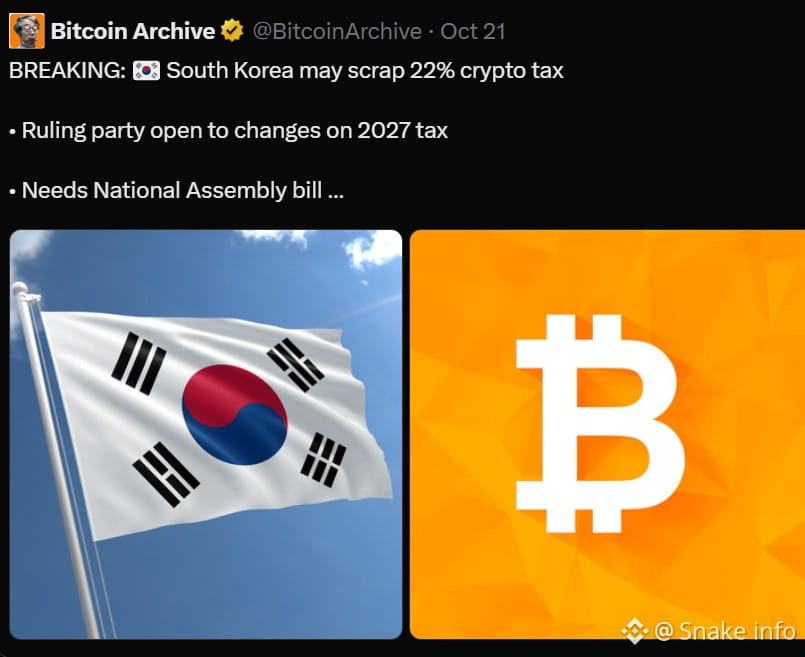
🇰🇷 SOUTH KOREA MAY SCRAP ITS 22% CRYPTO TAX! 🚨
South Korea is moving closer to reconsidering its controversial 22% cryptocurrency capital gains tax, potentially delaying or even scrapping the plan.
Here's what you need to know:
🔹 Tax Delay: The government has discussed postponing the 22% crypto tax until 2029.
🔹 Ruling Party Support: The ruling party is reportedly open to changes to the planned 2027 tax policy.
🔹 November Review: Further discussions and reviews are expected in November.
🔹 Final Approval Needed: Any major change will require legislation through South Korea's National Assembly.
📊 Why Does This Matter for Crypto?
South Korea is one of Asia's important cryptocurrency markets. A lower tax burden could encourage more retail participation, improve investor sentiment, and potentially support trading activity.
⚠️ But Nothing Is Final Yet! Investors should wait for official legislative confirmation before treating this as a confirmed tax cancellation.
🔥 What do you think?
Should South Korea completely remove the 22% crypto tax, or should crypto profits still be taxed?
Share your thoughts below! 👇
#SouthKorea #CryptoTax #Bitcoin #BTC
CLICK TO BELOW TRADE👇
$BTC $ETH $BNB
{future}(BNBUSDT)
{future}(ETHUSDT)
{future}(BTCUSDT)
🇰🇷 SOUTH KOREA MAY SCRAP ITS 22% CRYPTO TAX! 🚨
South Korea is moving closer to reconsidering its controversial 22% cryptocurrency capital gains tax, potentially delaying or even scrapping the plan.
Here's what you need to know:
🔹 Tax Delay: The government has discussed postponing the 22% crypto tax until 2029.
🔹 Ruling Party Support: The ruling party is reportedly open to changes to the planned 2027 tax policy.
🔹 November Review: Further discussions and reviews are expected in November.
🔹 Final Approval Needed: Any major change will require legislation through South Korea's National Assembly.
📊 Why Does This Matter for Crypto?
South Korea is one of Asia's important cryptocurrency markets. A lower tax burden could encourage more retail participation, improve investor sentiment, and potentially support trading activity.
⚠️ But Nothing Is Final Yet! Investors should wait for official legislative confirmation before treating this as a confirmed tax cancellation.
🔥 What do you think?
Should South Korea completely remove the 22% crypto tax, or should crypto profits still be taxed?
Share your thoughts below! 👇
#SouthKorea #CryptoTax #Bitcoin #BTC
CLICK TO BELOW TRADE👇
$BTC $ETH $BNB
51
·
--
#SouthKoreaSeeksCryptoTaxDelayUntil2029
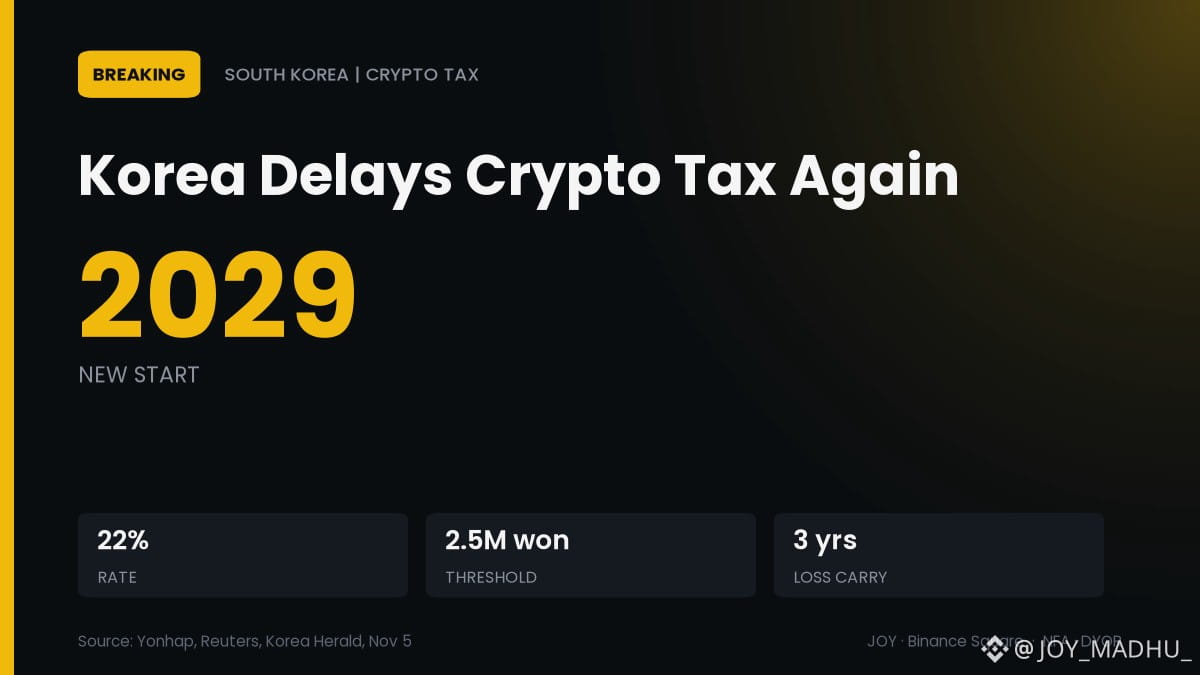
⏳ Korea's Crypto Tax Slips a 4th Time, Now to 2029
Seoul formally asked for a two-year delay today and added a loss carryforward for traders.
📅 Start moves from Jan 2027 to 2029, pending an Assembly vote
📊 22% rate (incl. local tax) on gains above 2.5M won (~$1,869)
📉 New: losses carry forward 3 years, offsetting gains through 2032
🏦 Reason: US crypto data sharing only starts in 2029
Watch next: the Assembly must amend the Income Tax Act before January.
Tax start: 2029 delay passes, or Jan 1, 2027 stands? 👇
$BTC
#Korea #CryptoTax #SouthKoreaSeeksCryptoTaxDelayUntil2029
11

#southkoreaseekscryptotaxdelayuntil2029
🚨 SOUTH KOREA JUST GAVE CRYPTO INVESTORS A POTENTIAL LIFELINE — TAXES MAY BE DELAYED UNTIL 2029!
South Korea is once again considering pushing back its cryptocurrency tax implementation, potentially giving crypto investors until 2029 before the planned tax rules take effect.
And this is bigger than just a tax delay.
🔥 What's Happening?
South Korea is seeking another delay to its planned crypto taxation.
The proposed timeline could push implementation to January 2029.
The move would give investors, exchanges, and regulators more time to prepare.
South Korea has one of the world's most active crypto trading communities.
📈 Why Does This Matter?
A crypto tax delay could be positive news for South Korean traders who have been waiting for regulatory clarity.
More time before taxation could also help maintain investor participation in the market and reduce uncertainty around crypto trading.
But here's the bigger question: Will this delay actually encourage more crypto adoption, or is South Korea simply postponing a decision it cannot avoid?
One thing is certain: South Korea's crypto policy could become an important signal for the wider Asian market.
The crypto industry is growing, and governments are still figuring out how to regulate it.
#SouthKorea #cryptotax #CryptoNews
1.2k

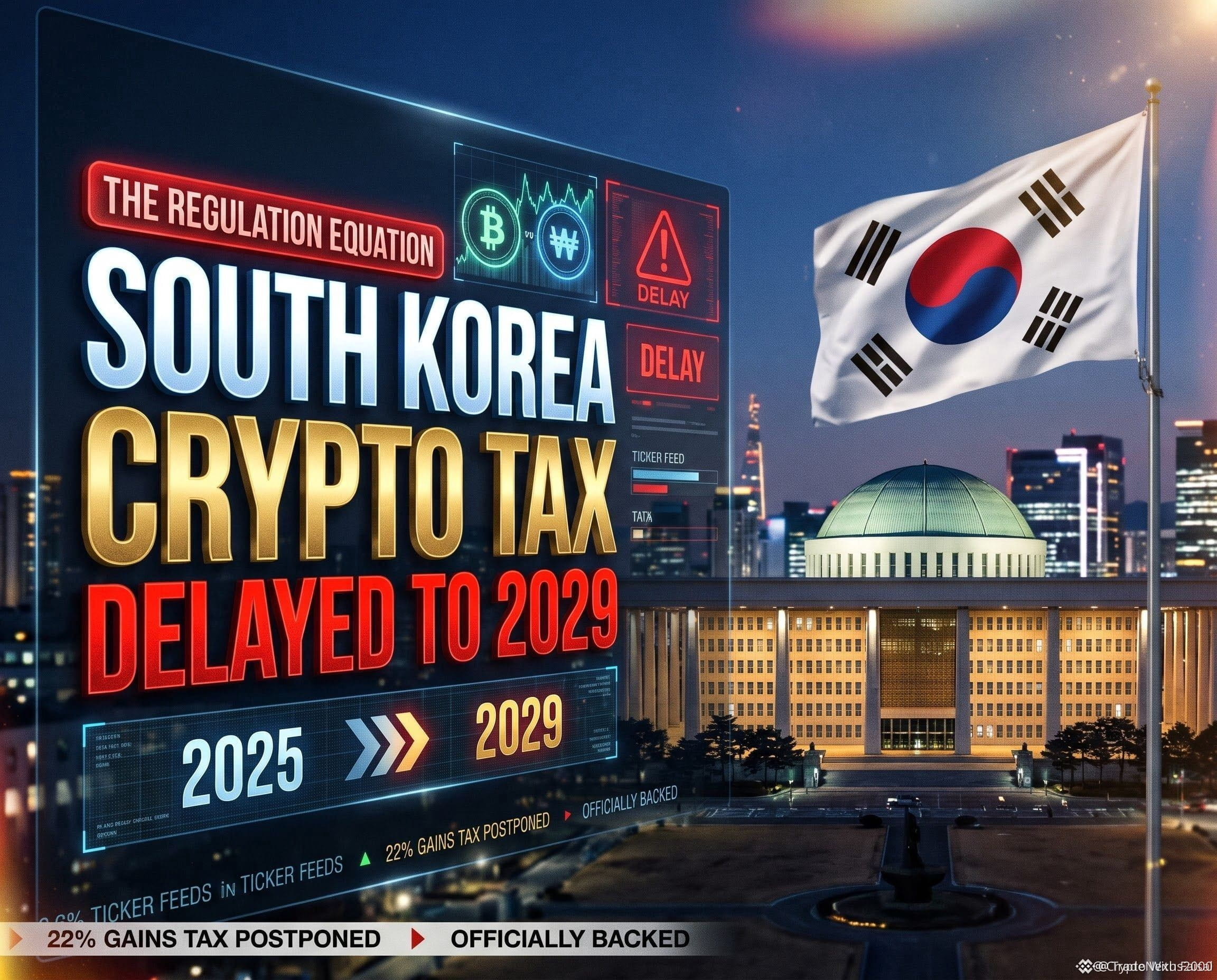
🚨 $BTC REACTS TO SOUTH KOREA TAX DELAY TILL 2029 🦈
South Korea's fourth postponement of the 22% crypto gains levy aligns with the 2029 US data‑sharing timeline, preserving domestic liquidity while the Digital Asset Basic Act catches up. 📊 Institutional eyes are scanning the move as a liquidity buffer, signaling smart‑money patience.
With the threshold set at 2.5 million won (~$1,860), the market anticipates a muted sell‑pressure wave, but any parliamentary green light could re‑ignite short‑term volatility. ⚡ How will this regulatory cadence shape the next swing in $BTC , $ETH , and $SOL ? 💬
⚠️ Not financial advice. Always manage your risk. 🛡️
🏷️ #BTC #CryptoTax #Regulation #SouthKorea #Crypto
🚀 🔥
15
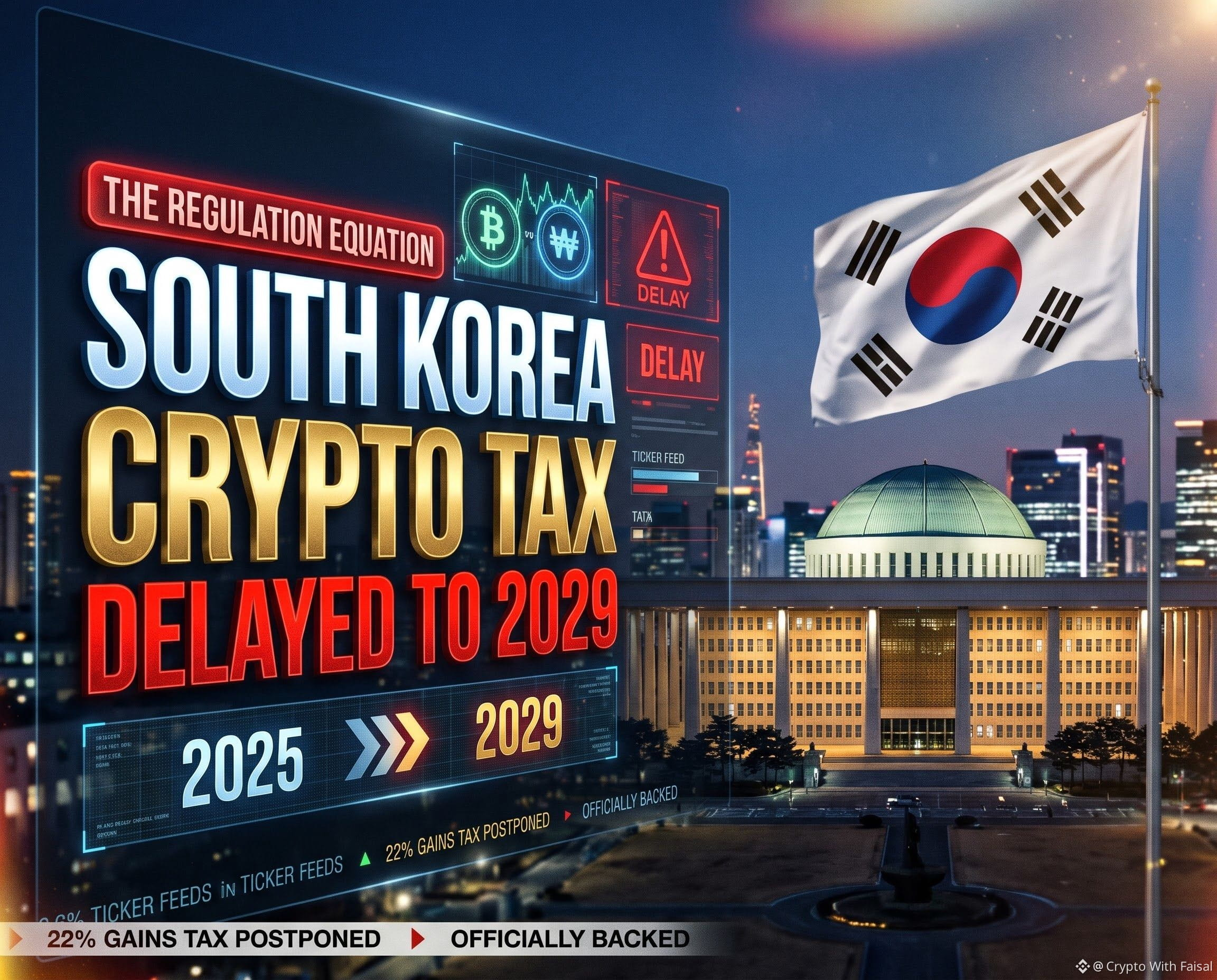
🚨 THE REGULATION EQUATION: Tax Delayed to 2029 🚨
#southkoreaseekscryptotaxdelayuntil2029 The government just officially backed a massive delay for crypto taxation. Let's calculate the policy math 🧮👇
(Unfinished Laws) + (US Data Delays) = Tax Postponed 🛑
The Input:
(The Catalyst) = Following a proposal by Democratic Party leader Kim Min-seok, Finance Minister Lee Hyoung-il announced the government supports pushing the 22% crypto gains tax to 2029.
The Deliverable:
(The Reality) ➔ If parliament approves, this marks the fourth delay since the tax's introduction. The planned 22% levy targets annual crypto profits over 2.5 million won (~$1,860).
The Breakdown:
The delay boils down to infrastructure. Officials cite the need to enact the Digital Asset Basic Act first and align with the 2029 US timeline for international tax data sharing. Imposing taxes before global data exchanges begin would put domestic markets at a severe disadvantage.
Will South Korea eventually implement this tax, or will these rolling delays lead to it being completely scrapped? ❓👇💬
$BTC
{future}(BTCUSDT)
$ETH
{future}(ETHUSDT)
$SOL
{future}(SOLUSDT)
#SouthKorea #CryptoTax #CryptoRegulation
🚨 THE REGULATION EQUATION: Tax Delayed to 2029 🚨
#southkoreaseekscryptotaxdelayuntil2029 The government just officially backed a massive delay for crypto taxation. Let's calculate the policy math 🧮👇
(Unfinished Laws) + (US Data Delays) = Tax Postponed 🛑
The Input:
(The Catalyst) = Following a proposal by Democratic Party leader Kim Min-seok, Finance Minister Lee Hyoung-il announced the government supports pushing the 22% crypto gains tax to 2029.
The Deliverable:
(The Reality) ➔ If parliament approves, this marks the fourth delay since the tax's introduction. The planned 22% levy targets annual crypto profits over 2.5 million won (~$1,860).
The Breakdown:
The delay boils down to infrastructure. Officials cite the need to enact the Digital Asset Basic Act first and align with the 2029 US timeline for international tax data sharing. Imposing taxes before global data exchanges begin would put domestic markets at a severe disadvantage.
Will South Korea eventually implement this tax, or will these rolling delays lead to it being completely scrapped? ❓👇💬
$BTC
$ETH
$SOL
#SouthKorea #CryptoTax #CryptoRegulation
2
642

·
--
A 458-0 vote just wiped France's new crypto tax ideas off the 2027 budget, at least for now.
• French lawmakers rejected the 2027 budget's revenue section 458-0 (two abstentions) on Nov 4
• Crypto amendments adopted earlier, including a crypto-to-stablecoin gains tax and €100,000 self-custody reporting, fall away
Why it matters: Taxing stablecoin swaps and reporting self-custody wallets would have set an EU precedent.
Source: Cointelegraph / crypto.news / Journal du Coin
Not financial advice.
💬 Should self-custody wallets ever be reportable to tax authorities?
#France #Stablecoins #CryptoTax
2

·
--
🚨 South Korea pushes its 22% crypto tax to 2029, delaying the January 2027 implementation. This extension signals ongoing regulatory uncertainty and likely dampens short-term market momentum.
Market Implication: Expect delayed institutional entry and potential altcoin rotation into safer assets as clarity emerges.
💡 What does this delay mean for your altcoin strategy? #CryptoTax
$KORUB #TradingSignal #CryptoAnalysis
Market Implication: Expect delayed institutional entry and potential altcoin rotation into safer assets as clarity emerges.
💡 What does this delay mean for your altcoin strategy? #CryptoTax
$KORUB #TradingSignal #CryptoAnalysis

4

·
--
Hong Kong just wrote crypto tax reporting into law.
Passed Nov 4 (COINOTAG):
• Exchanges must collect customer data from 2027
• Tax information exchanges start in 2028
Same week $BTC bounced back above $80,000. Markets are watching the rules as closely as the price.
My take: reporting rules like this usually mean less anonymity but more institutional comfort. Hubs that set clear rules early tend to attract licensed players.
Does clearer tax reporting make you more or less likely to use a regulated exchange in Asia? Why?
#HongKong #CryptoRegulation #CryptoTax $ETH
1

·
--
Why does a two-year tax delay in Seoul matter to every crypto trader watching Asia? 🇰🇷
South Korea just confirmed it: the 22% tax on crypto gains is delayed for a fourth time, from January 2027 to 2029. Finance Minister Lee Hyoung-il announced the plan at a briefing in Seoul today (Nov 5), and the government will work with the National Assembly to change the law. (Korea JoongAng Daily)
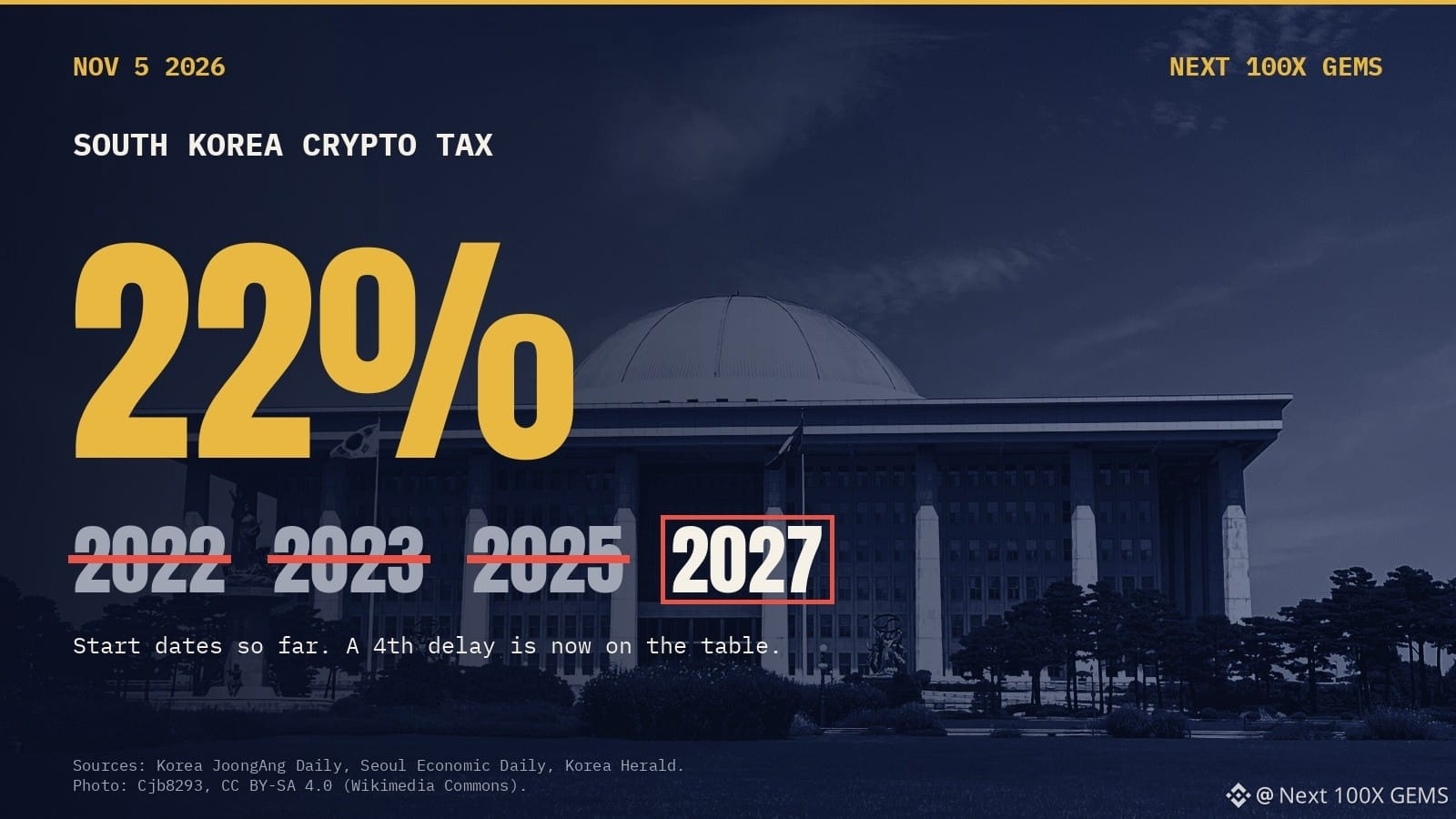
The numbers: a 22% rate (20% national + 2% local) on annual gains above 2.5 million won, about $1,870. The tax was first scheduled for January 2022. It has now been pushed back four times: 2022, 2023, 2025, 2027, 2029.
The delay was widely expected since late October, so the decision itself is not the story. The variable is what comes with it. Seoul says the real blocker is enforcement: the country starts exchanging crypto transaction data under the OECD's CARF framework in 2027, but the US does not join until 2029. Taxing domestic traders before overseas trades are visible would punish local exchanges and push volume offshore. The two-year window also buys time for a 3-year loss carryforward, letting losses offset future gains.
My take: this is bigger than two tax-free years. It is Korea admitting it cannot tax what it cannot see, and choosing to keep its traders onshore instead of driving them to overseas venues.
But a delay is not an abolition. The principle that crypto income gets taxed still stands, and 2029 is a deadline, not a pardon. The real test now is execution, not promises: National Assembly approval, detailed guidelines due in the first half of 2028, and the CARF data exchange actually starting in 2029.
📊 What to watch:
- National Assembly vote on the amendment
- Detailed tax guidelines, H1 2028
- US CARF participation in 2029, the real enforcement trigger
$BTC held $80,382 (+2.5%) and $ETH $2,416 (+4.0%) as the news landed, with fear and greed at 50, neutral. (Binance spot data)
Is Korea's delay a blueprint other countries will copy, or does it just kick the can down the road? 👇
Not financial advice. DYOR.
#crypto #SouthKorea #CryptoTax #regulation
45

·
--
Bullish
🚨 SOUTH KOREA DELAYS ITS 22% CRYPTO TAX UNTIL 2029!
A major development for South Korea's crypto investors.
The government plans to push the tax deadline from January 2027 to 2029, pending parliamentary approval.
Here's why it matters:
🔹 FOURTH postponement since the original 2022 deadline.
🔹 The proposed 22% tax applies to annual crypto profits exceeding 2.5 million won ($1,900).
🔹 Crypto transaction data sharing with the US isn't expected to begin until 2029.
🔹 Authorities fear domestic exchange users could face unequal tax treatment compared with overseas traders.
The bigger picture?
South Korea is giving its crypto market more time before the proposed tax takes effect.
If approved, investors get another two years before facing this taxation framework.
A significant policy development for one of Asia's biggest crypto markets.
#Bitcoin #Crypto #SouthKorea #CryptoTax #CryptoNews $BTC $SOL $XRP

1
9
·
--
🚨 BREAKING: South Korea Postpones Crypto Tax Until 2029! 🇰🇷
South Korea has delayed its planned cryptocurrency tax for another two years, marking the fourth postponement of the policy.
Officials cite inadequate tax infrastructure and delays in sharing crypto transaction data with the United States.
The proposed 22% tax on annual crypto profits exceeding 2.5 million won remains on the table.
⏳ Crypto investors get more time before the tax rules take effect!
#CryptoNews $FOGO $BEAMX $BTC #SouthKorea #Bitcoin #CryptoTax #Cryptocurrency

1
92
·
--
Korea's finance minister: push crypto gains tax from 2027 to 2029 — fourth delay since 2020.
• Govt will seek Assembly approval to move the 22% crypto tax (incl. local) from Jan 1, 2027 to Jan 1, 2029
• Also proposes 3-year loss carryforward so prior crypto losses can offset later gains
• Fourth delay since 2020; cites US tax-info exchange from 2029 and a pending digital asset law
Why it matters: Korean retail crypto gains stay untaxed longer if the Assembly passes the delay.
Source: Korea.kr / MOFE
Not financial advice.
💬 Delay again to 2029, or tax crypto gains on schedule?
#CryptoTax #SouthKorea
9


South Korea wrote a 22% crypto tax into law in 2020. It has collected zero won so far.
The first start date was Jan 1, 2022, the day $BTC opened at about $46,200.
Then it slid to 2023. Then 2025. Then Jan 1, 2027, which is 57 days away.
On Wednesday the ruling Democratic Party formally asked the government to push it back a fourth time. Party leader Kim Min-seok wants the Digital Asset Basic Act passed first, and the tax office still struggles to see trades on overseas exchanges. One DP lawmaker has already filed a bill that moves the date to Jan 1, 2029.
The rule on paper hasn't moved: 22% on yearly gains above 2.5 million won, about $1,860.
Quick maths in dollar terms for one coin bought on that first start date and sold today at about $80,400: roughly $34,100 of gain. With the tax in force, about $7,100 would go to the government. The real bill for that trade so far is zero.
The longest hold in Korean crypto belongs to the tax itself.
#CryptoTax #SouthKorea
NFA. DYOR.
1.3k
Log in to explore more content
Join global crypto users on Binance Square
⚡️ Get latest and useful information about crypto.
💬 Trusted by the world’s largest crypto exchange.
👍 Discover real insights from verified creators.
Email / Phone number
Trending Topics
1
#BinanceReopensWithdrawalsForMoreAssets
1.1M views
5,961 Discussing
2
#$2TWipedOutHedgeFundsFaceLiquidation
2,178 views
37 Discussing
3
#AnthropicIPOValuationDoubts
20,886 views
457 Discussing
4
#USMidtermsCouldShakeUpUS-IranTies
307 views
12 Discussing
5
#Nasdaq100FuturesRise1.4%
0 views
3 Discussing
6
#RussiaInvestigativeCommitteeProposesAddingCryptoToAMLSystem
160 views
5 Discussing
7
#SouthKoreaDelaysCryptoTaxationUntil2029
3,489 views
88 Discussing
8
#HongKongPlansTaxIncentivesCoveringDigitalAssets
3,003 views
60 Discussing
9
#ECBTargetsDigitalEuroIssuanceIn2029
2,903 views
68 Discussing
10
#ChainalysisBreachExposedPasswordHashesAndLiveTokens
368 views
14 Discussing