
#consensusmechanisms
consensusmechanisms
22 views
6 Discussing
Hot
Latest

·
--
Article
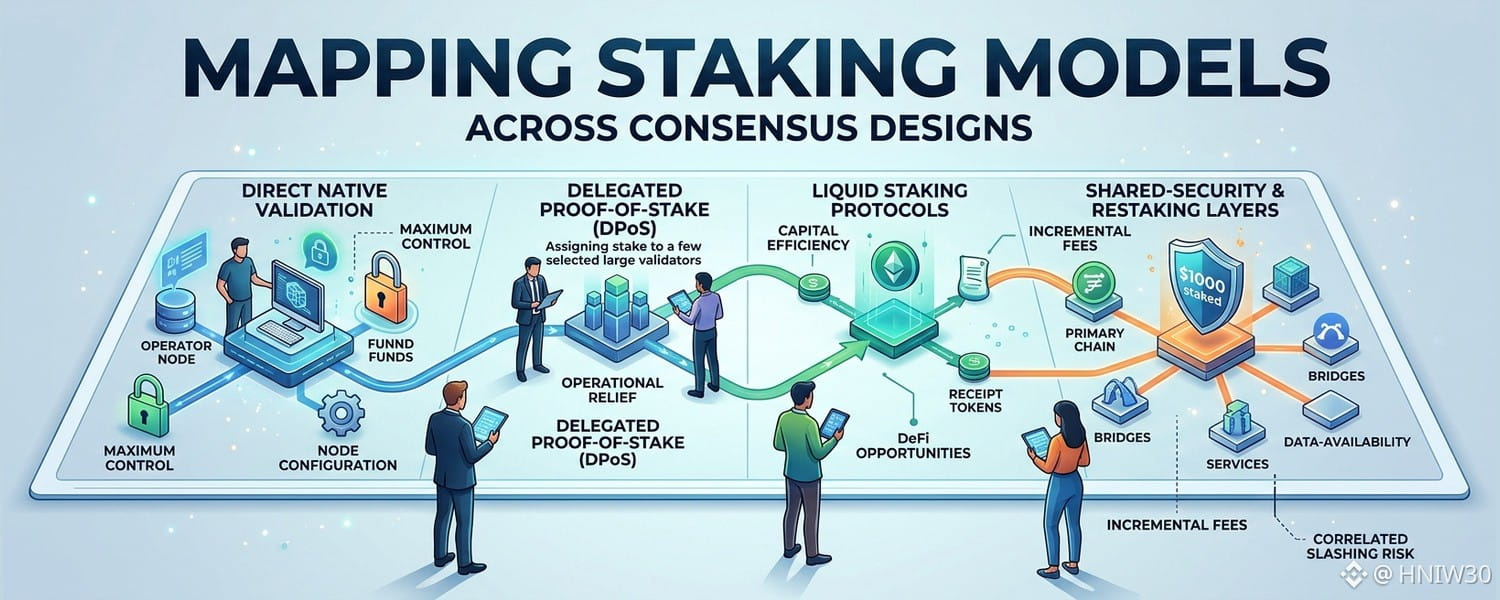
Mapping Staking Models Across Consensus DesignsConsensus design determines how a decentralized network orders transactions, secures its ledger, and prices participation. In proof-of-stake (PoS) systems, bonded capital replaces raw computing power as the primary defense against fake validator identities, turning asset allocation into an operational choice. Mapping this landscape by practical applicability helps advanced participants match specific staking structures to their latency tolerance, liquidity needs, and governance objectives.
At the base layer sits direct native validation, where operators bond assets, run signing nodes, and earn issuance plus transaction fees. This path maximizes control over node configuration and governance voting without intermediary contract risk. It applies best to technically capable teams able to maintain continuous uptime, secure signing keys, and absorb hardware costs alongside potential slashing penalties for double-signing or extended downtime.
Delegated proof-of-stake (DPoS) and non-custodial pooling separate capital ownership from node execution. Holders assign stake to external validators while retaining asset control, trading a commission fee for operational relief. This model suits passive allocators seeking network rewards without server overhead, provided they accept validator-selection risk, potential fee adjustments, and unbonding queues that restrict liquidity during market stress.
Liquid staking protocols address capital lockups by issuing transferable receipt tokens against staked collateral. Holders can deploy those receipts across decentralized finance (DeFi) venues while validators continue securing the base chain. This model fits active treasuries optimizing capital efficiency, yet added smart-contract exposure, oracle reliance, and secondary-market price divergence from net asset value can amplify stress during rapid redemptions.
Shared-security and restaking layers extend base-layer stake to protect auxiliary services such as bridges, oracles, or data-availability networks. New modules can inherit economic security without building isolated validator sets, while operators earn incremental service fees. In practice, this design suits advanced risk-takers, as correlated slashing conditions mean a fault in one auxiliary module can impair principal collateral across multiple layers.
Beneath every staking interface lies a core consensus tradeoff between deterministic finality and continuous liveness. Finality-focused designs halt block confirmation if too much stake disconnects, favoring settlement certainty over uptime. Liveness-focused designs keep extending the chain during network partitions, which supports continuous application availability while requiring participants to accept probabilistic settlement and longer confirmation buffers.
Evaluating practical fit requires weighing reward drivers, exit latency, and operational overhead together. Networks with elevated token issuance can dilute passive holders, making staking essential to preserve proportional share even when net returns look modest. Networks anchored in transaction-fee demand tie staking economics directly to blockspace activity, which reduces dilution pressure while introducing greater variability across usage cycles.
Ultimately, staking and consensus mechanisms form a spectrum of risk-transfer arrangements rather than uniform yield products. Direct validation trades technical burden for sovereignty, delegation trades a fee slice for simplicity, liquid wrappers trade contract safety for composability, and restaking trades correlated downside for layered income. Mapping these boundaries before committing capital enables disciplined alignment between network mechanics and operational constraints.
#ProofOfStake
#ConsensusMechanisms
Mapping Staking Models Across Consensus Designs
Consensus design determines how a decentralized network orders transactions, secures its ledger, and prices participation. In proof-of-stake (PoS) systems, bonded capital replaces raw computing power as the primary defense against fake validator identities, turning asset allocation into an operational choice. Mapping this landscape by practical applicability helps advanced participants match specific staking structures to their latency tolerance, liquidity needs, and governance objectives.
At the base layer sits direct native validation, where operators bond assets, run signing nodes, and earn issuance plus transaction fees. This path maximizes control over node configuration and governance voting without intermediary contract risk. It applies best to technically capable teams able to maintain continuous uptime, secure signing keys, and absorb hardware costs alongside potential slashing penalties for double-signing or extended downtime.
Delegated proof-of-stake (DPoS) and non-custodial pooling separate capital ownership from node execution. Holders assign stake to external validators while retaining asset control, trading a commission fee for operational relief. This model suits passive allocators seeking network rewards without server overhead, provided they accept validator-selection risk, potential fee adjustments, and unbonding queues that restrict liquidity during market stress.
Liquid staking protocols address capital lockups by issuing transferable receipt tokens against staked collateral. Holders can deploy those receipts across decentralized finance (DeFi) venues while validators continue securing the base chain. This model fits active treasuries optimizing capital efficiency, yet added smart-contract exposure, oracle reliance, and secondary-market price divergence from net asset value can amplify stress during rapid redemptions.
Shared-security and restaking layers extend base-layer stake to protect auxiliary services such as bridges, oracles, or data-availability networks. New modules can inherit economic security without building isolated validator sets, while operators earn incremental service fees. In practice, this design suits advanced risk-takers, as correlated slashing conditions mean a fault in one auxiliary module can impair principal collateral across multiple layers.
Beneath every staking interface lies a core consensus tradeoff between deterministic finality and continuous liveness. Finality-focused designs halt block confirmation if too much stake disconnects, favoring settlement certainty over uptime. Liveness-focused designs keep extending the chain during network partitions, which supports continuous application availability while requiring participants to accept probabilistic settlement and longer confirmation buffers.
Evaluating practical fit requires weighing reward drivers, exit latency, and operational overhead together. Networks with elevated token issuance can dilute passive holders, making staking essential to preserve proportional share even when net returns look modest. Networks anchored in transaction-fee demand tie staking economics directly to blockspace activity, which reduces dilution pressure while introducing greater variability across usage cycles.
Ultimately, staking and consensus mechanisms form a spectrum of risk-transfer arrangements rather than uniform yield products. Direct validation trades technical burden for sovereignty, delegation trades a fee slice for simplicity, liquid wrappers trade contract safety for composability, and restaking trades correlated downside for layered income. Mapping these boundaries before committing capital enables disciplined alignment between network mechanics and operational constraints.
#ProofOfStake
#ConsensusMechanisms
111

·
--
Consensus mechanisms are crucial for blockchain networks. Proof of Work, or PoW, is used by $BTC and $ETH. It requires significant computational power to validate transactions. Proof of Stake, or PoS, is another mechanism that uses validators to secure the network. Delegated Proof of Stake, or DPoS, is used by some blockchains to improve efficiency. Proof of Authority, or PoA, and Raft are other mechanisms used to achieve consensus. For example, $ETH is sitting at over 100,000 validators. Understanding these mechanisms is key to grasping blockchain infrastructure. Blockchain networks rely on these mechanisms to operate securely. blockchainprotocols #consensusmechanisms #cryptotechnology
Consensus mechanisms are crucial for blockchain networks. Proof of Work, or PoW, is used by $BTC and $ETH . It requires significant computational power to validate transactions. Proof of Stake, or PoS, is another mechanism that uses validators to secure the network. Delegated Proof of Stake, or DPoS, is used by some blockchains to improve efficiency. Proof of Authority, or PoA, and Raft are other mechanisms used to achieve consensus. For example, $ETH is sitting at over 100,000 validators. Understanding these mechanisms is key to grasping blockchain infrastructure. Blockchain networks rely on these mechanisms to operate securely. blockchainprotocols #consensusmechanisms #cryptotechnology
16
·
--
Consensus mechanisms are crucial for blockchain networks. Proof of Work, or PoW, is used by $BTC and $ETH. It requires significant computational power to solve complex math problems. In contrast, Proof of Stake, or PoS, uses validators who hold a certain amount of coins. Delegated Proof of Stake, or DPoS, is used by some blockchains, where users vote for validators. Proof of Authority, or PoA, relies on a reputation system. Raft is a consensus mechanism used in some distributed systems. For example, $ETH is sitting at a high level of security due to its consensus mechanism. Blockchain networks rely on these mechanisms to secure their transactions. blockchainprotocols #consensusmechanisms #cryptotechnology
Consensus mechanisms are crucial for blockchain networks. Proof of Work, or PoW, is used by $BTC and $ETH . It requires significant computational power to solve complex math problems. In contrast, Proof of Stake, or PoS, uses validators who hold a certain amount of coins. Delegated Proof of Stake, or DPoS, is used by some blockchains, where users vote for validators. Proof of Authority, or PoA, relies on a reputation system. Raft is a consensus mechanism used in some distributed systems. For example, $ETH is sitting at a high level of security due to its consensus mechanism. Blockchain networks rely on these mechanisms to secure their transactions. blockchainprotocols #consensusmechanisms #cryptotechnology
18

·
--
La théorie des jeux joue un rôle crucial dans la conception des mécanismes de consensus blockchain, influençant la sécurité et la décentralisation. Elle aide à modéliser les comportements des validateurs et des mineurs, garantissant ainsi l'intégrité de la blockchain. #GameTheory #Blockchain #ConsensusMechanisms
La théorie des jeux joue un rôle crucial dans la conception des mécanismes de consensus blockchain, influençant la sécurité et la décentralisation. Elle aide à modéliser les comportements des validateurs et des mineurs, garantissant ainsi l'intégrité de la blockchain. #GameTheory #Blockchain #ConsensusMechanisms
90
Log in to explore more content
Join global crypto users on Binance Square
⚡️ Get latest and useful information about crypto.
💬 Trusted by the world’s largest crypto exchange.
👍 Discover real insights from verified creators.
Email / Phone number
Trending Topics
1
#HotCPIDecemberHikePriced
209,174 views
2,200 Discussing
2
#StrategyFaces$2.8BSelloffRiskFromMSCIRemoval
6,149 views
69 Discussing
3
#AnthropicRejectsIPODelayValuationinQuestion
299,230 views
2,528 Discussing
4
#AnthropicDisclosesOver$10BNewComputeDeals
0 views
0 Discussing
5
#CoreWeaveJumps10%On168%RevenueGrowth
0 views
4 Discussing
6
#CanNvidiaEarningsEaseMarketConcerns?
73,097 views
937 Discussing
7
#BarclaysRaisesBlackRockBitcoinETFStake48%
287 views
16 Discussing
8
#BitmineReports$6.3BFiscal2026Loss
1,573 views
10 Discussing
9
#SouthKoreaPartiesTentativelyAgreeToDelayCryptoTax
1,865 views
48 Discussing
10
#FSBUrgesTurkeyToEstablishStablecoinFramework
5,596 views
60 Discussing