
#anthropic
anthropic
889,592 views
3,696 Discussing
Hot
Latest

·
--
Verified
🔥 Anthropic’s Market Cap Surpasses $2 Trillion on Nasdaq Debut
Artificial intelligence developer Anthropic made one of the highest-profile stock market debuts in history, briefly crossing the $2 trillion market capitalization mark during its first day of trading on the Nasdaq under the ticker ANT. Following its IPO pricing at $83 per share, the stock surged 34% at the open to $111.50 and peaked at nearly $115, allowing the company to surpass SpaceX's June listing record in terms of capital raised. The IPO itself brought in roughly $81.3 billion, and including a $26 billion private placement backed by major tech players and chipmakers, the total capital raised exceeded $107 billion.
During the afternoon session, amid a broader pullback in the U.S. stock market, Anthropic's shares retreated from their highs to close the day at roughly $97.17, retaining a gain of about 17% above the offering price. Investors have been actively buying shares in the first publicly traded frontier AI company, driven by rapid revenue growth and anticipated demand from index funds, though the market is keeping a close eye on massive computing infrastructure expenses and the timeline for achieving sustained profitability.
#AI #ANTHROPIC $ANT $ANTB $SPCX
{future}(SPCXUSDT)
{spot}(ANTBUSDT)
{future}(ANTUSDT)
🔥 Anthropic’s Market Cap Surpasses $2 Trillion on Nasdaq Debut
Artificial intelligence developer Anthropic made one of the highest-profile stock market debuts in history, briefly crossing the $2 trillion market capitalization mark during its first day of trading on the Nasdaq under the ticker ANT. Following its IPO pricing at $83 per share, the stock surged 34% at the open to $111.50 and peaked at nearly $115, allowing the company to surpass SpaceX's June listing record in terms of capital raised. The IPO itself brought in roughly $81.3 billion, and including a $26 billion private placement backed by major tech players and chipmakers, the total capital raised exceeded $107 billion.
During the afternoon session, amid a broader pullback in the U.S. stock market, Anthropic's shares retreated from their highs to close the day at roughly $97.17, retaining a gain of about 17% above the offering price. Investors have been actively buying shares in the first publicly traded frontier AI company, driven by rapid revenue growth and anticipated demand from index funds, though the market is keeping a close eye on massive computing infrastructure expenses and the timeline for achieving sustained profitability.
#AI #ANTHROPIC $ANT $ANTB $SPCX
Artificial intelligence developer Anthropic made one of the highest-profile stock market debuts in history, briefly crossing the $2 trillion market capitalization mark during its first day of trading on the Nasdaq under the ticker ANT. Following its IPO pricing at $83 per share, the stock surged 34% at the open to $111.50 and peaked at nearly $115, allowing the company to surpass SpaceX's June listing record in terms of capital raised. The IPO itself brought in roughly $81.3 billion, and including a $26 billion private placement backed by major tech players and chipmakers, the total capital raised exceeded $107 billion.
During the afternoon session, amid a broader pullback in the U.S. stock market, Anthropic's shares retreated from their highs to close the day at roughly $97.17, retaining a gain of about 17% above the offering price. Investors have been actively buying shares in the first publicly traded frontier AI company, driven by rapid revenue growth and anticipated demand from index funds, though the market is keeping a close eye on massive computing infrastructure expenses and the timeline for achieving sustained profitability.
#AI #ANTHROPIC $ANT $ANTB $SPCX
764

·
--
Verified
Article
CZ LISTED ANTHROPIC AS ONE REASON CRYPTO WAS FALLING.CZ LISTED ANTHROPIC AS ONE REASON CRYPTO WAS FALLING. THEN HE INVITED IT ONTO BNB CHAIN. AND NOW SOMEONE JUST BET $96M IT FALLS.
Three days ago CZ asked why crypto was falling. His answer: "No one knows for sure. Correlation does not prove causation." Then he listed the possible reasons — and one of them was "money shifting to the Anthropic IPO."
This morning he posted again: Anthropic's tokenized stock lists on BNB Chain on its very first day of trading. If the money is shifting that way, invite it into your own home.
The numbers back him up. Anthropic priced at $83 — $5 above the top of its $70-78 range. It raised $81.3 billion in one go, the largest IPO in history. The Nasdaq shares don't start trading until tonight, but the Binance perp is already at $104.35, up 26% from the IPO price on $280 million of volume.
But not everyone is buying it. Onchain Lens reports a whale's Anthropic short on Hyperliquid has grown to about $96 million across two wallets, already sitting on roughly $4 million in unrealized profit.
So here is the setup: the biggest AI IPO in history, up 26% before it even trades, against a $96 million short betting it falls. Tonight the Nasdaq opens and one of them is wrong.
My take is this. Tonight decides who was right. If the Nasdaq open holds above $100, that $96 million short gets squeezed and the perp runs — the whale becomes the exit liquidity for everyone who bought the story. If it breaks below $96, the short was right all along and the air comes out fast. And if BNB Chain volume spikes on the listing, CZ wins either way, because the money came home.
The Nasdaq open tonight is the first real test. Until then, $104 is a perp price, not a verdict.
$ANT $BNB
#Anthropic
CZ LISTED ANTHROPIC AS ONE REASON CRYPTO WAS FALLING.
CZ LISTED ANTHROPIC AS ONE REASON CRYPTO WAS FALLING. THEN HE INVITED IT ONTO BNB CHAIN. AND NOW SOMEONE JUST BET $96M IT FALLS.
Three days ago CZ asked why crypto was falling. His answer: "No one knows for sure. Correlation does not prove causation." Then he listed the possible reasons — and one of them was "money shifting to the Anthropic IPO."
This morning he posted again: Anthropic's tokenized stock lists on BNB Chain on its very first day of trading. If the money is shifting that way, invite it into your own home.
The numbers back him up. Anthropic priced at $83 — $5 above the top of its $70-78 range. It raised $81.3 billion in one go, the largest IPO in history. The Nasdaq shares don't start trading until tonight, but the Binance perp is already at $104.35, up 26% from the IPO price on $280 million of volume.
But not everyone is buying it. Onchain Lens reports a whale's Anthropic short on Hyperliquid has grown to about $96 million across two wallets, already sitting on roughly $4 million in unrealized profit.
So here is the setup: the biggest AI IPO in history, up 26% before it even trades, against a $96 million short betting it falls. Tonight the Nasdaq opens and one of them is wrong.
My take is this. Tonight decides who was right. If the Nasdaq open holds above $100, that $96 million short gets squeezed and the perp runs — the whale becomes the exit liquidity for everyone who bought the story. If it breaks below $96, the short was right all along and the air comes out fast. And if BNB Chain volume spikes on the listing, CZ wins either way, because the money came home.
The Nasdaq open tonight is the first real test. Until then, $104 is a perp price, not a verdict.
$ANT $BNB
#Anthropic
Three days ago CZ asked why crypto was falling. His answer: "No one knows for sure. Correlation does not prove causation." Then he listed the possible reasons — and one of them was "money shifting to the Anthropic IPO."
This morning he posted again: Anthropic's tokenized stock lists on BNB Chain on its very first day of trading. If the money is shifting that way, invite it into your own home.
The numbers back him up. Anthropic priced at $83 — $5 above the top of its $70-78 range. It raised $81.3 billion in one go, the largest IPO in history. The Nasdaq shares don't start trading until tonight, but the Binance perp is already at $104.35, up 26% from the IPO price on $280 million of volume.
But not everyone is buying it. Onchain Lens reports a whale's Anthropic short on Hyperliquid has grown to about $96 million across two wallets, already sitting on roughly $4 million in unrealized profit.
So here is the setup: the biggest AI IPO in history, up 26% before it even trades, against a $96 million short betting it falls. Tonight the Nasdaq opens and one of them is wrong.
My take is this. Tonight decides who was right. If the Nasdaq open holds above $100, that $96 million short gets squeezed and the perp runs — the whale becomes the exit liquidity for everyone who bought the story. If it breaks below $96, the short was right all along and the air comes out fast. And if BNB Chain volume spikes on the listing, CZ wins either way, because the money came home.
The Nasdaq open tonight is the first real test. Until then, $104 is a perp price, not a verdict.
$ANT $BNB
#Anthropic
Perplexing Utility:
$96M short says a lot, but Anthropic tokenized stock BNB Chain pe pehle din hi list hua — matlab flow idhar bhi aa sakta hai, sirf udhar nahi
8
1
11
15.8k

·
--
The most interesting part of Anthropic's Nasdaq debut wasn't the stock. It was where the price got discovered first.
Anthropic priced at $83, raised about $81.3B, the biggest IPO on record, and opened at $111.50 today. For hours before the bell, though, the best read on that price was a perpetual futures market on Hyperliquid, trading around $104-105 with roughly $4B in volume and $253M open interest. Worth noting those perps come from a third-party builder, not the company. The real open landed about 7% above them.
I've seen plenty of "new venues" pitched over the years, and most never get a real test. This one did: a crypto-native market, open to anyone with USDC, quoting a record IPO before the exchange did. It was close, not perfect. That gap is exactly what traders will argue about. $HYPE sits near $67 as I write.
The part I'm less sure about is the knock-on effect. Some voices, Arthur Hayes among them, warned a weak debut could drag risk assets down. It didn't happen, and BTC is still drifting near $62K. A hot IPO doesn't automatically lift crypto either. Liquidity just may go looking for the next place to price things.
Do you see this as a one-off, or the start of crypto venues pricing big listings before Wall Street opens?
#Anthropic #IPO #Hyperliquid #Nasdaq
Not financial advice. DYOR.
The most interesting part of Anthropic's Nasdaq debut wasn't the stock. It was where the price got discovered first.
Anthropic priced at $83, raised about $81.3B, the biggest IPO on record, and opened at $111.50 today. For hours before the bell, though, the best read on that price was a perpetual futures market on Hyperliquid, trading around $104-105 with roughly $4B in volume and $253M open interest. Worth noting those perps come from a third-party builder, not the company. The real open landed about 7% above them.
I've seen plenty of "new venues" pitched over the years, and most never get a real test. This one did: a crypto-native market, open to anyone with USDC, quoting a record IPO before the exchange did. It was close, not perfect. That gap is exactly what traders will argue about. $HYPE sits near $67 as I write.
The part I'm less sure about is the knock-on effect. Some voices, Arthur Hayes among them, warned a weak debut could drag risk assets down. It didn't happen, and BTC is still drifting near $62K. A hot IPO doesn't automatically lift crypto either. Liquidity just may go looking for the next place to price things.
Do you see this as a one-off, or the start of crypto venues pricing big listings before Wall Street opens?
#Anthropic #IPO #Hyperliquid #Nasdaq
Not financial advice. DYOR.
Anthropic priced at $83, raised about $81.3B, the biggest IPO on record, and opened at $111.50 today. For hours before the bell, though, the best read on that price was a perpetual futures market on Hyperliquid, trading around $104-105 with roughly $4B in volume and $253M open interest. Worth noting those perps come from a third-party builder, not the company. The real open landed about 7% above them.
I've seen plenty of "new venues" pitched over the years, and most never get a real test. This one did: a crypto-native market, open to anyone with USDC, quoting a record IPO before the exchange did. It was close, not perfect. That gap is exactly what traders will argue about. $HYPE sits near $67 as I write.
The part I'm less sure about is the knock-on effect. Some voices, Arthur Hayes among them, warned a weak debut could drag risk assets down. It didn't happen, and BTC is still drifting near $62K. A hot IPO doesn't automatically lift crypto either. Liquidity just may go looking for the next place to price things.
Do you see this as a one-off, or the start of crypto venues pricing big listings before Wall Street opens?
#Anthropic #IPO #Hyperliquid #Nasdaq
Not financial advice. DYOR.
1
1k


·
--
🚨 BINANCE WALLET ANNOUNCES REFUNDS AND FREE ANTHROPIC TOKEN AIRDROPS!
Following allocation issues with the Anthropic xStocks IPO Campaign, Binance Wallet has announced compensation for participants.
Here’s what users will receive:
💰 100% USDC refund: All subscription funds will be returned to users’ Binance Wallets.
🎁 2,957 Anthropic tokenized stocks: Distributed for free, proportionally to each user’s subscription.
🔥 $1M ANTB airdrop: Eligible participants will receive at least ~$6 worth of ANTB, with the remaining rewards distributed proportionally.
Users will receive their refunds and token allocations directly in their Binance Wallets.
Did you participate in this campaign? 👀
#BinanceWallet #Anthropic $ANT
{future}(ANTUSDT)
🚨 BINANCE WALLET ANNOUNCES REFUNDS AND FREE ANTHROPIC TOKEN AIRDROPS!
Following allocation issues with the Anthropic xStocks IPO Campaign, Binance Wallet has announced compensation for participants.
Here’s what users will receive:
💰 100% USDC refund: All subscription funds will be returned to users’ Binance Wallets.
🎁 2,957 Anthropic tokenized stocks: Distributed for free, proportionally to each user’s subscription.
🔥 $1M ANTB airdrop: Eligible participants will receive at least ~$6 worth of ANTB, with the remaining rewards distributed proportionally.
Users will receive their refunds and token allocations directly in their Binance Wallets.
Did you participate in this campaign? 👀
#BinanceWallet #Anthropic $ANT
Following allocation issues with the Anthropic xStocks IPO Campaign, Binance Wallet has announced compensation for participants.
Here’s what users will receive:
💰 100% USDC refund: All subscription funds will be returned to users’ Binance Wallets.
🎁 2,957 Anthropic tokenized stocks: Distributed for free, proportionally to each user’s subscription.
🔥 $1M ANTB airdrop: Eligible participants will receive at least ~$6 worth of ANTB, with the remaining rewards distributed proportionally.
Users will receive their refunds and token allocations directly in their Binance Wallets.
Did you participate in this campaign? 👀
#BinanceWallet #Anthropic $ANT

Daniella Dopico rDJN:
binance give aways are utter bullshit learn something with wazirx & coin dcx
1
11
2.8k

·
--
JUST IN: Anthropic’s $ANT IPO is creating a new generation of tech millionaires. 💰
• 400+ early employees could be worth at least $100 million each.
• The seven co-founders are estimated to be worth around $20 billion each.
• Employee equity wealth is estimated at $232 billion.
• Average employee equity wealth: approximately $44 million.
These are estimated paper valuations based on IPO pricing, not necessarily cash in hand.
From startup employees to multimillionaires.
Anthropic’s IPO is one of Silicon Valley’s biggest employee wealth-creation events.
AI is creating fortunes beyond its founders.
#ipo #Anthropic $ANT
JUST IN: Anthropic’s $ANT IPO is creating a new generation of tech millionaires. 💰
• 400+ early employees could be worth at least $100 million each.
• The seven co-founders are estimated to be worth around $20 billion each.
• Employee equity wealth is estimated at $232 billion.
• Average employee equity wealth: approximately $44 million.
These are estimated paper valuations based on IPO pricing, not necessarily cash in hand.
From startup employees to multimillionaires.
Anthropic’s IPO is one of Silicon Valley’s biggest employee wealth-creation events.
AI is creating fortunes beyond its founders.
#ipo #Anthropic $ANT
• 400+ early employees could be worth at least $100 million each.
• The seven co-founders are estimated to be worth around $20 billion each.
• Employee equity wealth is estimated at $232 billion.
• Average employee equity wealth: approximately $44 million.
These are estimated paper valuations based on IPO pricing, not necessarily cash in hand.
From startup employees to multimillionaires.
Anthropic’s IPO is one of Silicon Valley’s biggest employee wealth-creation events.
AI is creating fortunes beyond its founders.
#ipo #Anthropic $ANT

Abu Fahadأ:
💛
1
3
3.2k
·
--
📢 Anthropic Prices IPO at $83 per Share Amid Booming Demand, Reaching a $1.5 Trillion Valuation
Anthropic, the developer of the popular Claude AI family, has officially priced its initial public offering at $83 per share. The final offering price exceeded the initially announced target range of $70 to $78, driven by overwhelming demand from institutional investors and a sixfold oversubscription of the order book.
This powerful Wall Street debut allowed the company to surpass the $1.5 trillion market capitalization milestone on a fully diluted basis, making Anthropic's Nasdaq listing one of the largest technology IPOs in history. The surge in valuation is underpinned by stellar financial performance, with the company's annualized revenue run rate exceeding $81 billion, highlighting an unprecedented scale of commercialization in generative AI and attracting global investors to the industry's first publicly traded giant.
#NASDAQ #ANTHROPIC #AI $ANT
{future}(ANTUSDT)
📢 Anthropic Prices IPO at $83 per Share Amid Booming Demand, Reaching a $1.5 Trillion Valuation
Anthropic, the developer of the popular Claude AI family, has officially priced its initial public offering at $83 per share. The final offering price exceeded the initially announced target range of $70 to $78, driven by overwhelming demand from institutional investors and a sixfold oversubscription of the order book.
This powerful Wall Street debut allowed the company to surpass the $1.5 trillion market capitalization milestone on a fully diluted basis, making Anthropic's Nasdaq listing one of the largest technology IPOs in history. The surge in valuation is underpinned by stellar financial performance, with the company's annualized revenue run rate exceeding $81 billion, highlighting an unprecedented scale of commercialization in generative AI and attracting global investors to the industry's first publicly traded giant.
#NASDAQ #ANTHROPIC #AI $ANT
Anthropic, the developer of the popular Claude AI family, has officially priced its initial public offering at $83 per share. The final offering price exceeded the initially announced target range of $70 to $78, driven by overwhelming demand from institutional investors and a sixfold oversubscription of the order book.
This powerful Wall Street debut allowed the company to surpass the $1.5 trillion market capitalization milestone on a fully diluted basis, making Anthropic's Nasdaq listing one of the largest technology IPOs in history. The surge in valuation is underpinned by stellar financial performance, with the company's annualized revenue run rate exceeding $81 billion, highlighting an unprecedented scale of commercialization in generative AI and attracting global investors to the industry's first publicly traded giant.
#NASDAQ #ANTHROPIC #AI $ANT
Trong_Hatachi:
The sixfold oversubscription is wild, especially at $83 a share. Follow me back if you’re tracking AI IPOs too!
1
1
1.7k
·
--
One of the most expensive missed opportunities in tech history?
Alameda Research invested $500 million in #Anthropic in April 2022.
During FTX’s bankruptcy, the estate sold the stake in 2024 for approximately $1.34 billion to help repay creditors.
Following Anthropic’s market debut, that same stake could be worth around $46–48 billion.
That represents roughly a 90–96x return on the original investment.
The bankruptcy estate secured $1.34 billion, while the buyers captured the extraordinary upside.
A reminder of how valuable early exposure to transformative technology can become.
#claude #sbf #ftx #Anthropic
One of the most expensive missed opportunities in tech history?
Alameda Research invested $500 million in #Anthropic in April 2022.
During FTX’s bankruptcy, the estate sold the stake in 2024 for approximately $1.34 billion to help repay creditors.
Following Anthropic’s market debut, that same stake could be worth around $46–48 billion.
That represents roughly a 90–96x return on the original investment.
The bankruptcy estate secured $1.34 billion, while the buyers captured the extraordinary upside.
A reminder of how valuable early exposure to transformative technology can become.
#claude #sbf #ftx #Anthropic
Alameda Research invested $500 million in #Anthropic in April 2022.
During FTX’s bankruptcy, the estate sold the stake in 2024 for approximately $1.34 billion to help repay creditors.
Following Anthropic’s market debut, that same stake could be worth around $46–48 billion.
That represents roughly a 90–96x return on the original investment.
The bankruptcy estate secured $1.34 billion, while the buyers captured the extraordinary upside.
A reminder of how valuable early exposure to transformative technology can become.
#claude #sbf #ftx #Anthropic

801

·
--
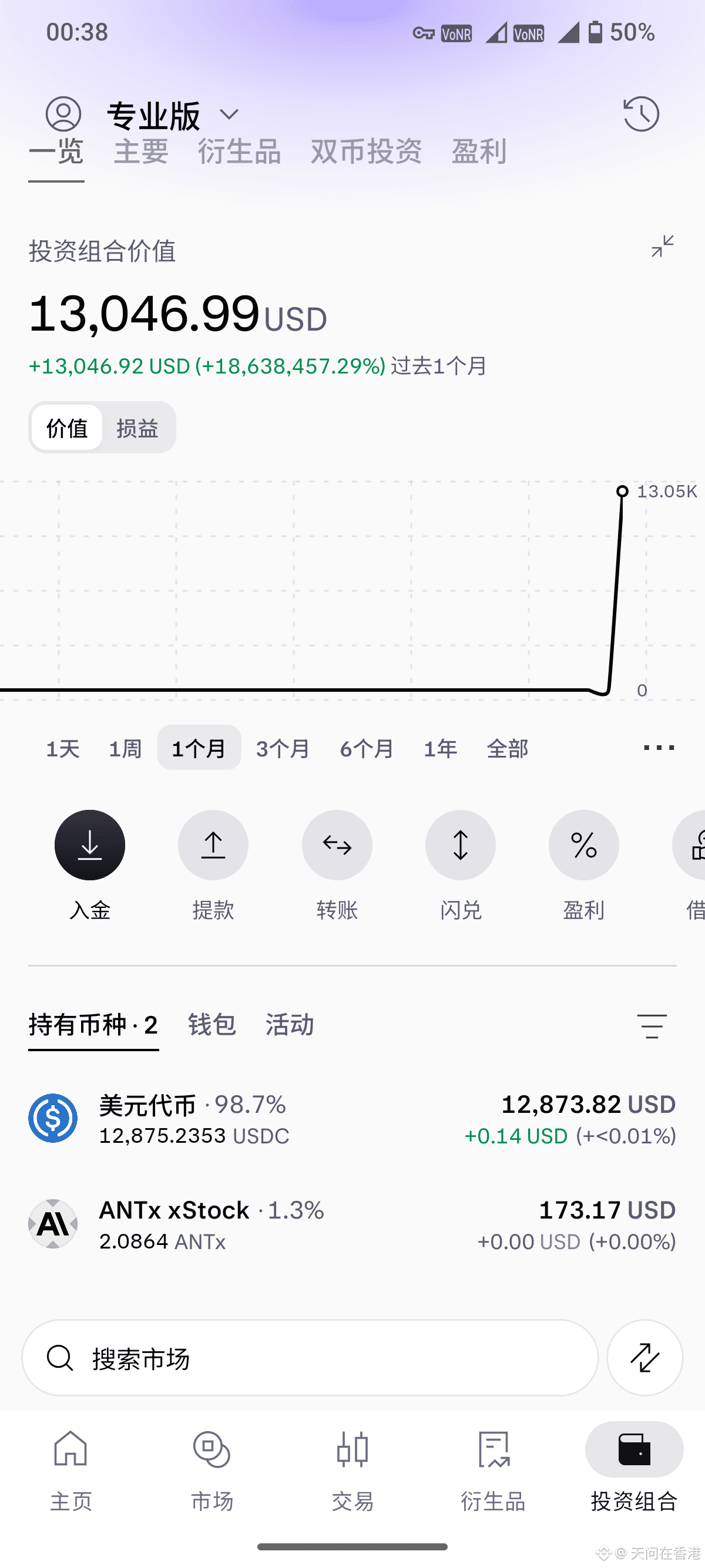
洗洗睡吧,投入1.3万U,配售2.08股,配售率1.3%,现在价格110,利润110-85=25,25*2.08=52U,利润率0.4%,没法玩了
#Anthropic创纪录上市,1.5万亿美元市值合理吗? #Anthropic #AnthropicAI #打新 #美股打新
洗洗睡吧,投入1.3万U,配售2.08股,配售率1.3%,现在价格110,利润110-85=25,25*2.08=52U,利润率0.4%,没法玩了
#Anthropic创纪录上市,1.5万亿美元市值合理吗? #Anthropic #AnthropicAI #打新 #美股打新
#Anthropic创纪录上市,1.5万亿美元市值合理吗? #Anthropic #AnthropicAI #打新 #美股打新
枪炮与玫瑰:
比单日理财的收益率高太多
23
2
9.7k

Verified
Article
Anthropic Shatters IPO Records on Nasdaq: How $ANT Stacks Up Against SpaceXArtificial intelligence giant Anthropic officially made history today, November 19, 2026, debuting on the Nasdaq under the ticker $ANT. Despite broader market jitters across tech equities, investor appetite for frontier AI pushed the stock to an opening trade of $111.50—a massive 34% surge above its $83 IPO price.
With $81.3 billion raised in its public offering alone (and $107.3 billion total when factoring in its $26 billion private placement), Anthropic has officially dethroned Elon Musk’s SpaceX as the largest IPO in financial history.
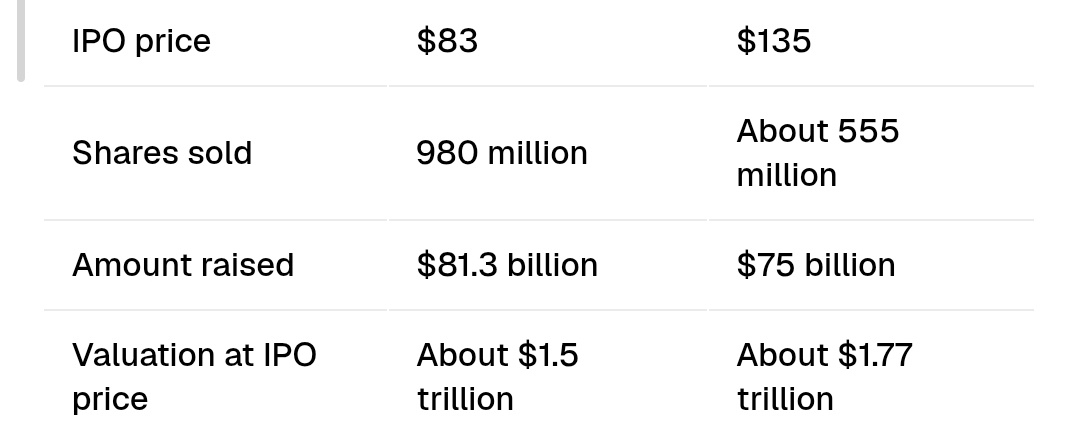
Anthropic ($ANT) vs. SpaceX ($SPCX): By the Numbers
Here is how the two mega-listings of 2026 compare head-to-head:
• First Trading Day:
Anthropic: Nov. 19, 2026 | SpaceX: June 12, 2026
• IPO Price:
Anthropic: $83 | SpaceX: $135
• Shares Sold:
Anthropic: 980 million | SpaceX: ~555 million
• Capital Raised (IPO):
Anthropic: $81.3 billion | SpaceX: $75 billion
• Valuation at IPO Price:
Anthropic: ~$1.5 trillion | SpaceX: ~$1.77 trillion
• First Trade Price:
Anthropic: $111.50 | SpaceX: $150
• Opening Pop:
Anthropic: +34% | SpaceX: +11%
Why This Matters for AI & Crypto Markets
Anthropic’s blockbuster debut—which briefly pushed its fully diluted market cap near the $2 trillion mark—serves as a major stress test for risk appetite. Even as traditional indices and several large-cap tech stocks faced downward pressure today, institutional and retail buyers rushed into the Claude maker, proving that conviction in foundational AI remains strong.
For crypto traders watching the AI sector narrative, a strong public-market reception for frontier AI labs often acts as a sentiment barometer for decentralized AI, compute, and data-layer tokens.
What’s your take on $ANT’s massive debut—will AI momentum spill over into crypto AI tokens this week, or are valuations getting stretched? Drop your thoughts below!
Disclaimer: This post is for informational purposes only and does not constitute financial advice. Always do your own research (DYOR).
#Anthropic #ANT #SpaceX #IPO #IsAnthropic’s$1.5TMarketCapJustified?
Anthropic Shatters IPO Records on Nasdaq: How $ANT Stacks Up Against SpaceX
Artificial intelligence giant Anthropic officially made history today, November 19, 2026, debuting on the Nasdaq under the ticker $ANT. Despite broader market jitters across tech equities, investor appetite for frontier AI pushed the stock to an opening trade of $111.50—a massive 34% surge above its $83 IPO price.
With $81.3 billion raised in its public offering alone (and $107.3 billion total when factoring in its $26 billion private placement), Anthropic has officially dethroned Elon Musk’s SpaceX as the largest IPO in financial history.
Anthropic ($ANT) vs. SpaceX ($SPCX): By the Numbers
Here is how the two mega-listings of 2026 compare head-to-head:
• First Trading Day:
Anthropic: Nov. 19, 2026 | SpaceX: June 12, 2026
• IPO Price:
Anthropic: $83 | SpaceX: $135
• Shares Sold:
Anthropic: 980 million | SpaceX: ~555 million
• Capital Raised (IPO):
Anthropic: $81.3 billion | SpaceX: $75 billion
• Valuation at IPO Price:
Anthropic: ~$1.5 trillion | SpaceX: ~$1.77 trillion
• First Trade Price:
Anthropic: $111.50 | SpaceX: $150
• Opening Pop:
Anthropic: +34% | SpaceX: +11%
Why This Matters for AI & Crypto Markets
Anthropic’s blockbuster debut—which briefly pushed its fully diluted market cap near the $2 trillion mark—serves as a major stress test for risk appetite. Even as traditional indices and several large-cap tech stocks faced downward pressure today, institutional and retail buyers rushed into the Claude maker, proving that conviction in foundational AI remains strong.
For crypto traders watching the AI sector narrative, a strong public-market reception for frontier AI labs often acts as a sentiment barometer for decentralized AI, compute, and data-layer tokens.
What’s your take on $ANT’s massive debut—will AI momentum spill over into crypto AI tokens this week, or are valuations getting stretched? Drop your thoughts below!
Disclaimer: This post is for informational purposes only and does not constitute financial advice. Always do your own research (DYOR).
#Anthropic #ANT #SpaceX #IPO #IsAnthropic’s$1.5TMarketCapJustified?
With $81.3 billion raised in its public offering alone (and $107.3 billion total when factoring in its $26 billion private placement), Anthropic has officially dethroned Elon Musk’s SpaceX as the largest IPO in financial history.
Anthropic ($ANT) vs. SpaceX ($SPCX): By the Numbers
Here is how the two mega-listings of 2026 compare head-to-head:
• First Trading Day:
Anthropic: Nov. 19, 2026 | SpaceX: June 12, 2026
• IPO Price:
Anthropic: $83 | SpaceX: $135
• Shares Sold:
Anthropic: 980 million | SpaceX: ~555 million
• Capital Raised (IPO):
Anthropic: $81.3 billion | SpaceX: $75 billion
• Valuation at IPO Price:
Anthropic: ~$1.5 trillion | SpaceX: ~$1.77 trillion
• First Trade Price:
Anthropic: $111.50 | SpaceX: $150
• Opening Pop:
Anthropic: +34% | SpaceX: +11%
Why This Matters for AI & Crypto Markets
Anthropic’s blockbuster debut—which briefly pushed its fully diluted market cap near the $2 trillion mark—serves as a major stress test for risk appetite. Even as traditional indices and several large-cap tech stocks faced downward pressure today, institutional and retail buyers rushed into the Claude maker, proving that conviction in foundational AI remains strong.
For crypto traders watching the AI sector narrative, a strong public-market reception for frontier AI labs often acts as a sentiment barometer for decentralized AI, compute, and data-layer tokens.
What’s your take on $ANT’s massive debut—will AI momentum spill over into crypto AI tokens this week, or are valuations getting stretched? Drop your thoughts below!
Disclaimer: This post is for informational purposes only and does not constitute financial advice. Always do your own research (DYOR).
#Anthropic #ANT #SpaceX #IPO #IsAnthropic’s$1.5TMarketCapJustified?
1
1.5k

·
--
Bullish
$ANTHROPIC #Anthropic
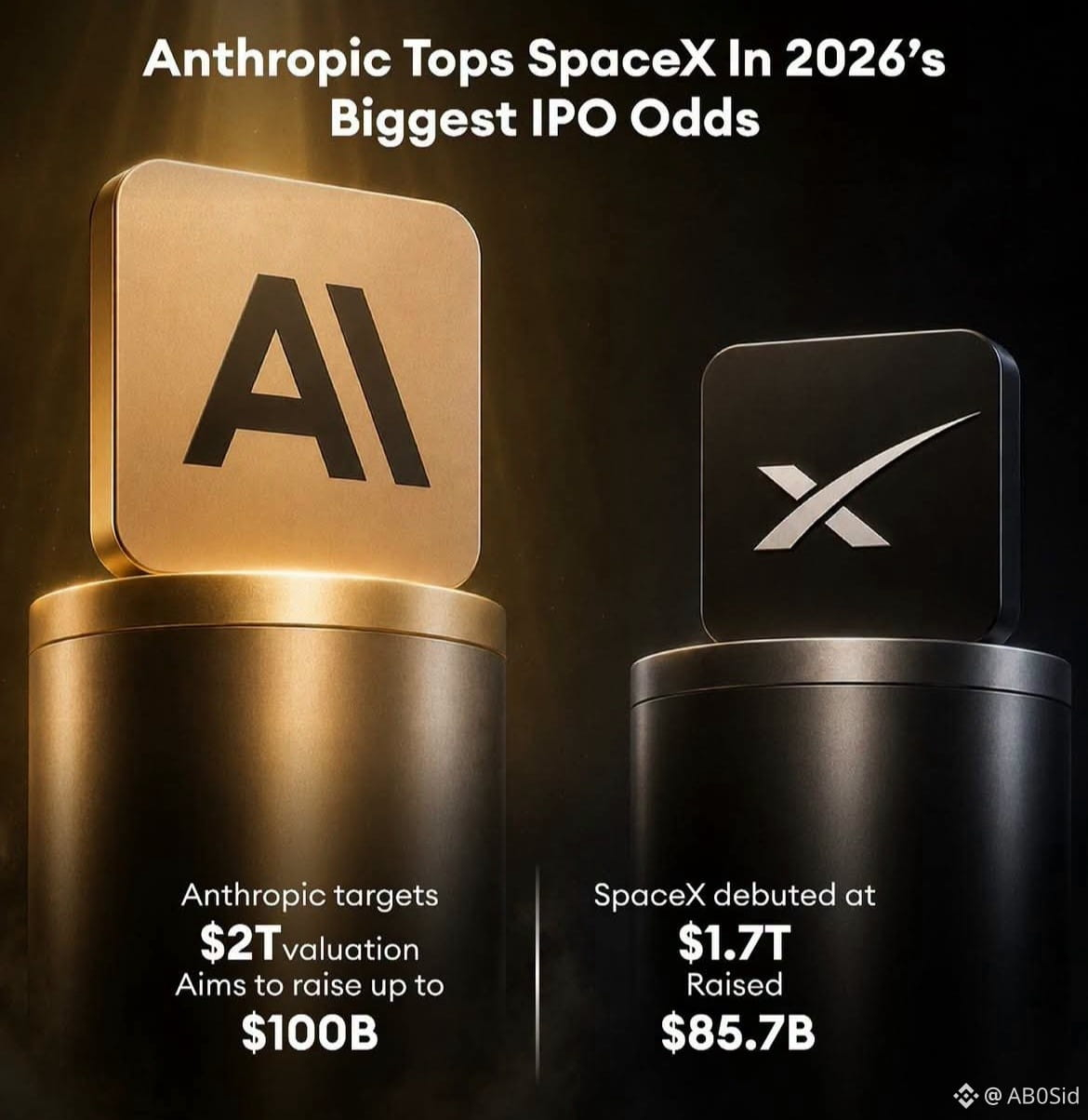
🚨Anthropic has formally set the price for the biggest public offering ever, securing $81.3 billion at $83 a share and overtaking SpaceX’s $75 billion debut. By expanding its offering from 825 million to 980 million shares, the company achieved a valuation exceeding $1.4 trillion.
Trading on the Nasdaq kicks off today.🚀
Are you ready to get inn??🔺️
$SPCXB #SpaceX
$ANT
{future}(ANTUSDT)
{stock_us}(ANT.US)
{spot}(SPCXBUSDT)
#AnthropicRecord107BRaiseSetToTopSpaceXIPO
#AnthropicToDebutAfter83IPOpricing
#AnthropicBansOpenClawFromClaude
$ANTHROPIC #Anthropic
🚨Anthropic has formally set the price for the biggest public offering ever, securing $81.3 billion at $83 a share and overtaking SpaceX’s $75 billion debut. By expanding its offering from 825 million to 980 million shares, the company achieved a valuation exceeding $1.4 trillion.
Trading on the Nasdaq kicks off today.🚀
Are you ready to get inn??🔺️
$SPCXB #SpaceX
$ANT
#AnthropicRecord107BRaiseSetToTopSpaceXIPO
#AnthropicToDebutAfter83IPOpricing
#AnthropicBansOpenClawFromClaude
🚨Anthropic has formally set the price for the biggest public offering ever, securing $81.3 billion at $83 a share and overtaking SpaceX’s $75 billion debut. By expanding its offering from 825 million to 980 million shares, the company achieved a valuation exceeding $1.4 trillion.
Trading on the Nasdaq kicks off today.🚀
Are you ready to get inn??🔺️
$SPCXB #SpaceX
$ANT
#AnthropicRecord107BRaiseSetToTopSpaceXIPO
#AnthropicToDebutAfter83IPOpricing
#AnthropicBansOpenClawFromClaude
MinSah:
👍
2
1
3
1.8k

Verified
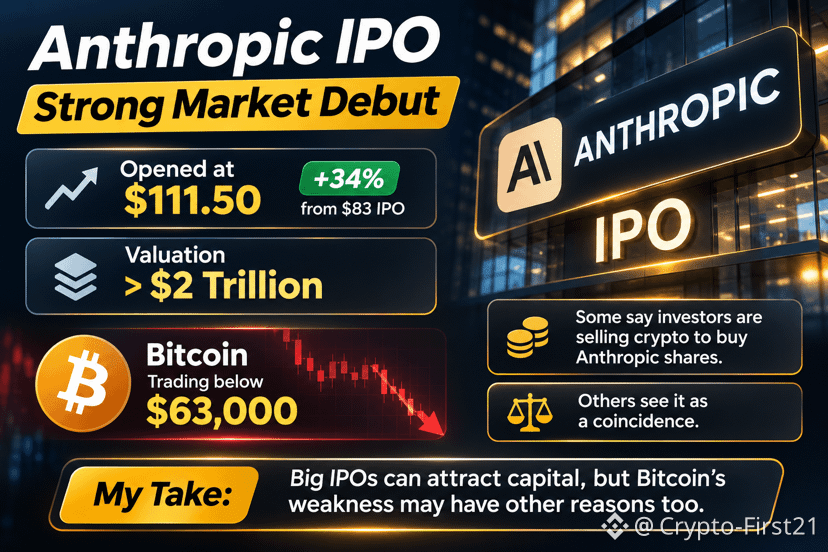
Anthropic makes a strong market debut.
Shares opened at $111.50, up 34% from the $83 IPO price.
The company’s valuation crossed $2 trillion at that price.
Still…, Bitcoin is trading below $63,000.
Some believe investors are selling crypto to buy Anthropic shares. Others say the timing may be a coincidence.
Actually… i think Big IPOs can attract capital, but Bitcoin’s weakness may have other reasons too.
#Bitcoin❗ #Anthropic #cryptofirst21
#IsAnthropic’s$1.5TMarketCapJustified?
Anthropic makes a strong market debut.
Shares opened at $111.50, up 34% from the $83 IPO price.
The company’s valuation crossed $2 trillion at that price.
Still…, Bitcoin is trading below $63,000.
Some believe investors are selling crypto to buy Anthropic shares. Others say the timing may be a coincidence.
Actually… i think Big IPOs can attract capital, but Bitcoin’s weakness may have other reasons too.
#Bitcoin❗ #Anthropic #cryptofirst21
#IsAnthropic’s$1.5TMarketCapJustified?
Shares opened at $111.50, up 34% from the $83 IPO price.
The company’s valuation crossed $2 trillion at that price.
Still…, Bitcoin is trading below $63,000.
Some believe investors are selling crypto to buy Anthropic shares. Others say the timing may be a coincidence.
Actually… i think Big IPOs can attract capital, but Bitcoin’s weakness may have other reasons too.
#Bitcoin❗ #Anthropic #cryptofirst21
#IsAnthropic’s$1.5TMarketCapJustified?
1
958

Verified
Classic IPO pump, then dump.
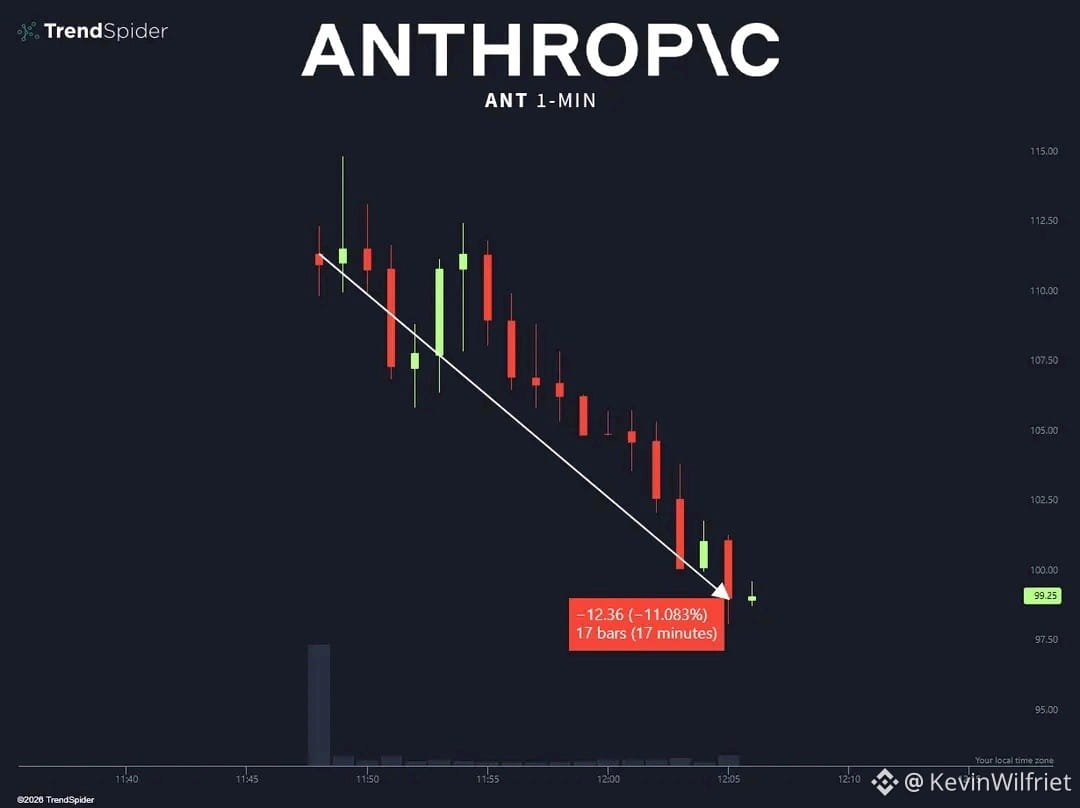
Anthropic didn't open at 9:30am. It took almost 2 hours to find a price.
11:49am ET — First trade: $111.50*
That's *+34.3% above the $83 IPO price*. Valuation instantly jumped past *$2 TRILLION*. Euphoria.
Then, in 17 minutes, it collapsed.
Your chart shows it perfectly: a spike to *$115.10*, then a straight downtrend. Red candle after red candle.
- $12.36 (-11.08%) in 17 bars
*Low: ∼$99.25*
Still +20% above IPO, but all the FOMO buyers who chased the open got wrecked.
Why? *Sell-the-news.* IPO allocators at $83 took profits. Day traders flipped. And the whole Nasdaq was selling off at the same time — down 3.75% from its high, losing $1.6T.
The message: Even the biggest AI IPO ever can't hold a $2T valuation on day 1.
Did you buy the open, or wait for the dip?
#Anthropic
Classic IPO pump, then dump.
Anthropic didn't open at 9:30am. It took almost 2 hours to find a price.
11:49am ET — First trade: $111.50*
That's *+34.3% above the $83 IPO price*. Valuation instantly jumped past *$2 TRILLION*. Euphoria.
Then, in 17 minutes, it collapsed.
Your chart shows it perfectly: a spike to *$115.10*, then a straight downtrend. Red candle after red candle.
- $12.36 (-11.08%) in 17 bars
*Low: ∼$99.25*
Still +20% above IPO, but all the FOMO buyers who chased the open got wrecked.
Why? *Sell-the-news.* IPO allocators at $83 took profits. Day traders flipped. And the whole Nasdaq was selling off at the same time — down 3.75% from its high, losing $1.6T.
The message: Even the biggest AI IPO ever can't hold a $2T valuation on day 1.
Did you buy the open, or wait for the dip?
#Anthropic
Anthropic didn't open at 9:30am. It took almost 2 hours to find a price.
11:49am ET — First trade: $111.50*
That's *+34.3% above the $83 IPO price*. Valuation instantly jumped past *$2 TRILLION*. Euphoria.
Then, in 17 minutes, it collapsed.
Your chart shows it perfectly: a spike to *$115.10*, then a straight downtrend. Red candle after red candle.
- $12.36 (-11.08%) in 17 bars
*Low: ∼$99.25*
Still +20% above IPO, but all the FOMO buyers who chased the open got wrecked.
Why? *Sell-the-news.* IPO allocators at $83 took profits. Day traders flipped. And the whole Nasdaq was selling off at the same time — down 3.75% from its high, losing $1.6T.
The message: Even the biggest AI IPO ever can't hold a $2T valuation on day 1.
Did you buy the open, or wait for the dip?
#Anthropic
742
Article
Anthropic, just pulled off the largest IPO in US history.The $ANT IPO Just Made History — But Let's Get The Numbers Right*
It priced at *$83 per share*, raising *$81.3 billion* through the sale of 980 million shares, valuing the company at around *$1.5 trillion* on a fully diluted basis.
With a separate $26 billion private placement from Nvidia, Google and others, the total deal hit $107.3 billion — passing SpaceX's previous record. Shares opened Thursday on Nasdaq under the ticker *ANT* at $111.50, up 34%.
The viral claim that "over 400 employees are now worth $100M+ each, co-founders $20B each, average employee $40M" is *not confirmed* by filings.
What is confirmed: its seven co-founders — Dario and Daniela Amodei, Christopher Olah, Jack Clark, Jared Kaplan, Tom Brown, and Sam McCandlish — are now *decabillionaires*, meaning $10B+. 8067
That alone is staggering. Anthropic went from a 2021 startup to a $1.5T public company in under six years, with revenue run-rate hitting $81 billion and demand nearly 7x oversubscribed.
This wasn't just an IPO. It was the moment AI labs became bigger than almost every company on Earth — and turned early believers into generational wealth overnight.
#Anthropic
Anthropic, just pulled off the largest IPO in US history.
The $ANT IPO Just Made History — But Let's Get The Numbers Right*
It priced at *$83 per share*, raising *$81.3 billion* through the sale of 980 million shares, valuing the company at around *$1.5 trillion* on a fully diluted basis.
With a separate $26 billion private placement from Nvidia, Google and others, the total deal hit $107.3 billion — passing SpaceX's previous record. Shares opened Thursday on Nasdaq under the ticker *ANT* at $111.50, up 34%.
The viral claim that "over 400 employees are now worth $100M+ each, co-founders $20B each, average employee $40M" is *not confirmed* by filings.
What is confirmed: its seven co-founders — Dario and Daniela Amodei, Christopher Olah, Jack Clark, Jared Kaplan, Tom Brown, and Sam McCandlish — are now *decabillionaires*, meaning $10B+. 8067
That alone is staggering. Anthropic went from a 2021 startup to a $1.5T public company in under six years, with revenue run-rate hitting $81 billion and demand nearly 7x oversubscribed.
This wasn't just an IPO. It was the moment AI labs became bigger than almost every company on Earth — and turned early believers into generational wealth overnight.
#Anthropic
It priced at *$83 per share*, raising *$81.3 billion* through the sale of 980 million shares, valuing the company at around *$1.5 trillion* on a fully diluted basis.
With a separate $26 billion private placement from Nvidia, Google and others, the total deal hit $107.3 billion — passing SpaceX's previous record. Shares opened Thursday on Nasdaq under the ticker *ANT* at $111.50, up 34%.
The viral claim that "over 400 employees are now worth $100M+ each, co-founders $20B each, average employee $40M" is *not confirmed* by filings.
What is confirmed: its seven co-founders — Dario and Daniela Amodei, Christopher Olah, Jack Clark, Jared Kaplan, Tom Brown, and Sam McCandlish — are now *decabillionaires*, meaning $10B+. 8067
That alone is staggering. Anthropic went from a 2021 startup to a $1.5T public company in under six years, with revenue run-rate hitting $81 billion and demand nearly 7x oversubscribed.
This wasn't just an IPO. It was the moment AI labs became bigger than almost every company on Earth — and turned early believers into generational wealth overnight.
#Anthropic
1
78

·
--
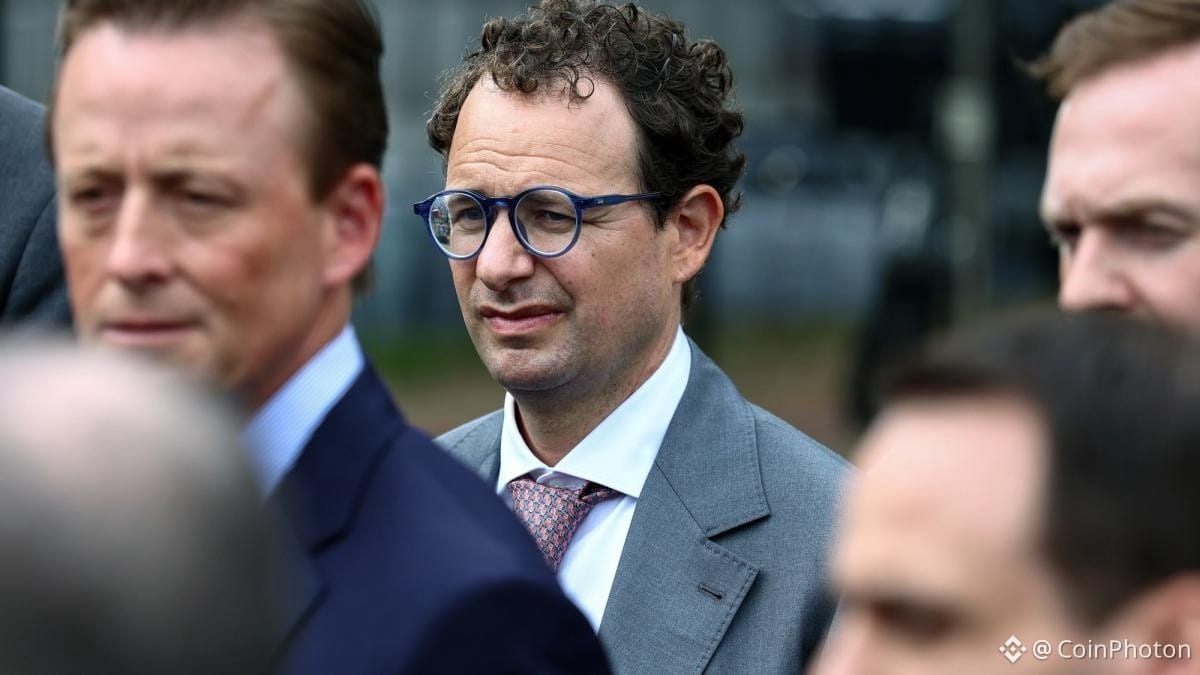
🚀 Anthropic opens 34% above IPO price in Nasdaq debut
Anthropic (ANT) began trading at $111.50, a 34% jump from its $83 IPO price that implies a valuation above $2 trillion. Together with a $26 billion private placement involving Nvidia, Microsoft and Google, the $81 billion IPO brings total funds raised to $107 billion. The Nasdaq later turned 0.6% lower, and bitcoin also gave back gains to trade below $63,000.
⭐ The mega-IPO has been blamed for pulling money out of crypto as investors sell coins to buy ANT, though some analysts call the timing a coincidence amid an existing downtrend.
#Anthropic #IPO #Bitcoin #Markets
🚀 Anthropic opens 34% above IPO price in Nasdaq debut
Anthropic (ANT) began trading at $111.50, a 34% jump from its $83 IPO price that implies a valuation above $2 trillion. Together with a $26 billion private placement involving Nvidia, Microsoft and Google, the $81 billion IPO brings total funds raised to $107 billion. The Nasdaq later turned 0.6% lower, and bitcoin also gave back gains to trade below $63,000.
⭐ The mega-IPO has been blamed for pulling money out of crypto as investors sell coins to buy ANT, though some analysts call the timing a coincidence amid an existing downtrend.
#Anthropic #IPO #Bitcoin #Markets
Anthropic (ANT) began trading at $111.50, a 34% jump from its $83 IPO price that implies a valuation above $2 trillion. Together with a $26 billion private placement involving Nvidia, Microsoft and Google, the $81 billion IPO brings total funds raised to $107 billion. The Nasdaq later turned 0.6% lower, and bitcoin also gave back gains to trade below $63,000.
⭐ The mega-IPO has been blamed for pulling money out of crypto as investors sell coins to buy ANT, though some analysts call the timing a coincidence amid an existing downtrend.
#Anthropic #IPO #Bitcoin #Markets
557

·
--
Verified
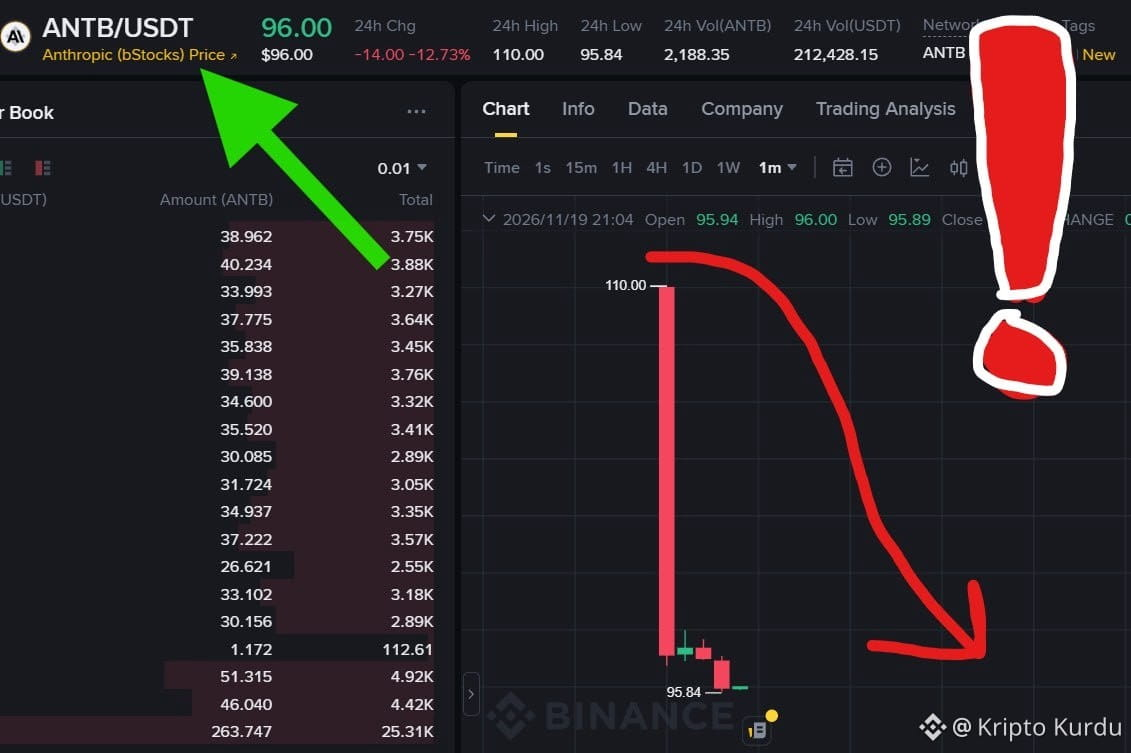
$ANTB Has Begun Trading! The Airdrop Has Arrived
Antropic has now opened for trading following its initial public offering (IPO). It will also be listed on general stock markets and crypto exchanges. Additionally, here is some general information:
The shares were sold at $83 and are currently trading at around $95. This initial rise is quite normal, but we may see a price drop over the next week as buyer interest wanes.
That’s why I think the likelihood of a decline seems slightly higher. Additionally, there was a cancellation regarding a sale on the Binance wallet, and Binance took the commendable step of announcing an airdrop to participants based on their share. This shows us just how attentive they are to their users.
What do you think the #Anthropic price will be in one week?
$ANTB Has Begun Trading! The Airdrop Has Arrived
Antropic has now opened for trading following its initial public offering (IPO). It will also be listed on general stock markets and crypto exchanges. Additionally, here is some general information:
The shares were sold at $83 and are currently trading at around $95. This initial rise is quite normal, but we may see a price drop over the next week as buyer interest wanes.
That’s why I think the likelihood of a decline seems slightly higher. Additionally, there was a cancellation regarding a sale on the Binance wallet, and Binance took the commendable step of announcing an airdrop to participants based on their share. This shows us just how attentive they are to their users.
What do you think the #Anthropic price will be in one week?
Antropic has now opened for trading following its initial public offering (IPO). It will also be listed on general stock markets and crypto exchanges. Additionally, here is some general information:
The shares were sold at $83 and are currently trading at around $95. This initial rise is quite normal, but we may see a price drop over the next week as buyer interest wanes.
That’s why I think the likelihood of a decline seems slightly higher. Additionally, there was a cancellation regarding a sale on the Binance wallet, and Binance took the commendable step of announcing an airdrop to participants based on their share. This shows us just how attentive they are to their users.
What do you think the #Anthropic price will be in one week?
3
1.6k

#AnthropicToDebutAfter$83IPOPricing
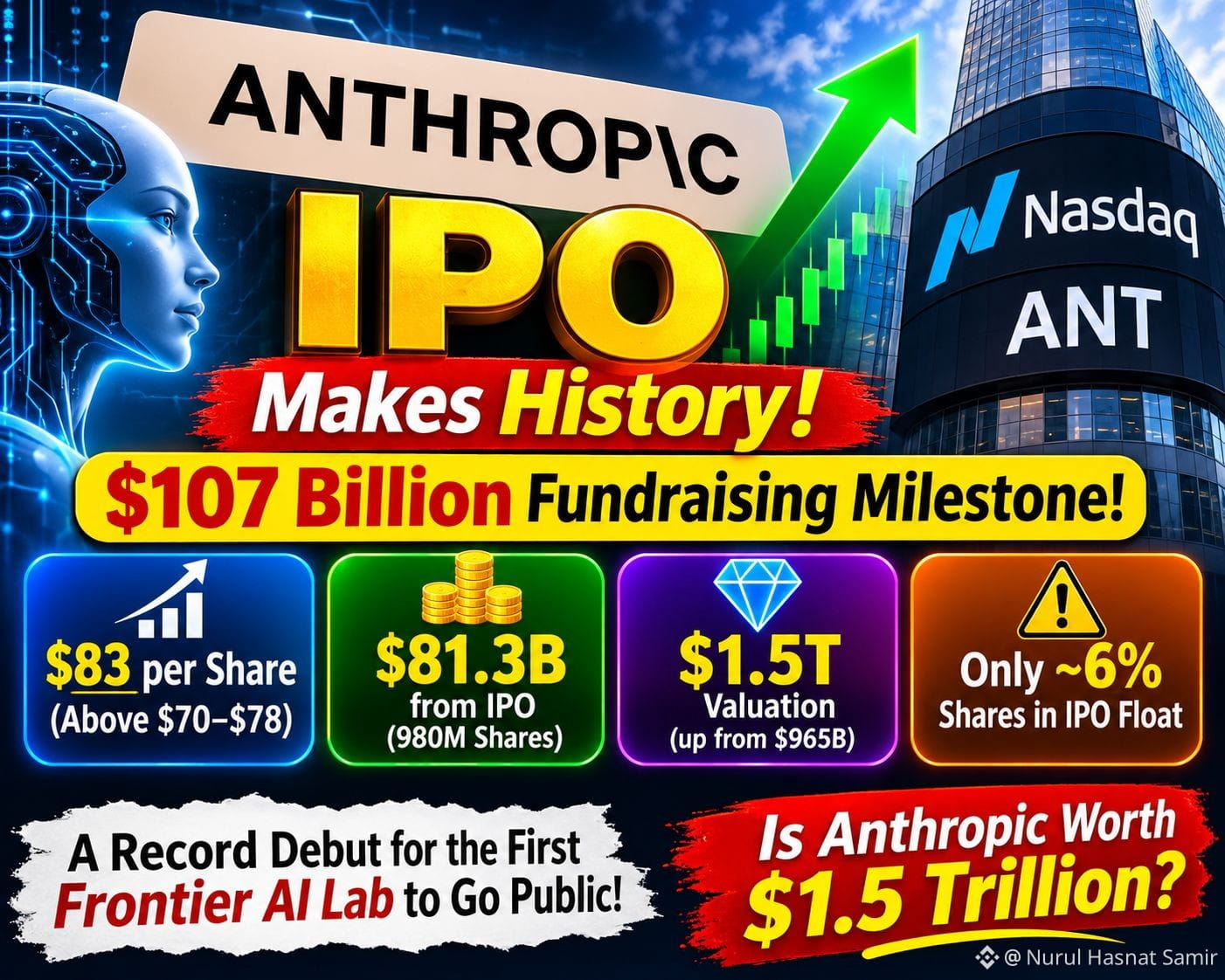
🚀 ANTHROPIC IPO MAKES HISTORY WITH A $107 BILLION FUNDRAISING MILESTONE!
Anthropic has made a remarkable entrance into the public markets, setting a new benchmark for IPO fundraising.
Here are 4 key highlights investors should watch:
📌 1. Record-Breaking IPO
Anthropic priced its shares at $83 each, exceeding the initial $70–$78 target range. The offering was expanded to 980 million shares, generating approximately $81.3 billion.
💰 2. Massive Capital Raise
Including its $26 billion private placement, the company has raised around $107 billion in total. Additional shares could further increase the public offering proceeds.
📈 3. $1.5 Trillion Valuation
Anthropic's fully diluted valuation stands at approximately $1.5 trillion, marking a significant increase from its reported $965 billion valuation in May.
⚠️ 4. Potential Market Pressure
Only around 6% of the company's shares are included in the IPO float. However, additional shares becoming available could create selling pressure during the early trading period.
The Bigger Picture
Anthropic's IPO marks a major milestone for the AI industry. But a record-breaking debut is only the beginning. The real test will be whether market demand can support such an enormous valuation.
What do you think? Is Anthropic worth $1.5 trillion?
#Anthropic #AI #IPO #artificialintelligence #StockMarket #NASDAQ #TechStocks
$QQQB $SPCXB $BTCDOM
#AnthropicToDebutAfter$83IPOPricing
🚀 ANTHROPIC IPO MAKES HISTORY WITH A $107 BILLION FUNDRAISING MILESTONE!
Anthropic has made a remarkable entrance into the public markets, setting a new benchmark for IPO fundraising.
Here are 4 key highlights investors should watch:
📌 1. Record-Breaking IPO
Anthropic priced its shares at $83 each, exceeding the initial $70–$78 target range. The offering was expanded to 980 million shares, generating approximately $81.3 billion.
💰 2. Massive Capital Raise
Including its $26 billion private placement, the company has raised around $107 billion in total. Additional shares could further increase the public offering proceeds.
📈 3. $1.5 Trillion Valuation
Anthropic's fully diluted valuation stands at approximately $1.5 trillion, marking a significant increase from its reported $965 billion valuation in May.
⚠️ 4. Potential Market Pressure
Only around 6% of the company's shares are included in the IPO float. However, additional shares becoming available could create selling pressure during the early trading period.
The Bigger Picture
Anthropic's IPO marks a major milestone for the AI industry. But a record-breaking debut is only the beginning. The real test will be whether market demand can support such an enormous valuation.
What do you think? Is Anthropic worth $1.5 trillion?
#Anthropic #AI #IPO #artificialintelligence #StockMarket #NASDAQ #TechStocks
$QQQB $SPCXB $BTCDOM
🚀 ANTHROPIC IPO MAKES HISTORY WITH A $107 BILLION FUNDRAISING MILESTONE!
Anthropic has made a remarkable entrance into the public markets, setting a new benchmark for IPO fundraising.
Here are 4 key highlights investors should watch:
📌 1. Record-Breaking IPO
Anthropic priced its shares at $83 each, exceeding the initial $70–$78 target range. The offering was expanded to 980 million shares, generating approximately $81.3 billion.
💰 2. Massive Capital Raise
Including its $26 billion private placement, the company has raised around $107 billion in total. Additional shares could further increase the public offering proceeds.
📈 3. $1.5 Trillion Valuation
Anthropic's fully diluted valuation stands at approximately $1.5 trillion, marking a significant increase from its reported $965 billion valuation in May.
⚠️ 4. Potential Market Pressure
Only around 6% of the company's shares are included in the IPO float. However, additional shares becoming available could create selling pressure during the early trading period.
The Bigger Picture
Anthropic's IPO marks a major milestone for the AI industry. But a record-breaking debut is only the beginning. The real test will be whether market demand can support such an enormous valuation.
What do you think? Is Anthropic worth $1.5 trillion?
#Anthropic #AI #IPO #artificialintelligence #StockMarket #NASDAQ #TechStocks
$QQQB $SPCXB $BTCDOM
ArnoQiii:
okh
52
5
128

·
--
Bullish
Verified
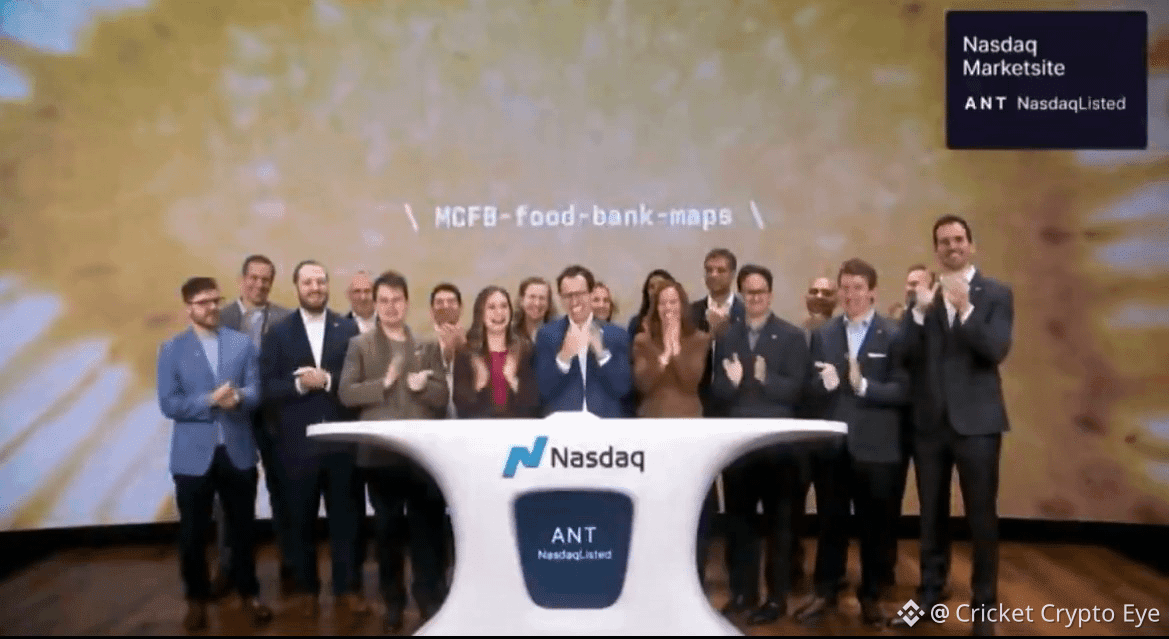
🤖 Claude AI Developer Anthropic has officially begun trading under $ANT , opening at $111.50 after raising $81.3B in the largest IPO in history.
#Anthropic
{future}(ANTUSDT)
🤖 Claude AI Developer Anthropic has officially begun trading under $ANT , opening at $111.50 after raising $81.3B in the largest IPO in history.
#Anthropic
#Anthropic
792

·
--
Article
Anthropic's Prospectus: Who Gets the $900.9 Billion in Compute CommitmentsIf you build AI products, run a SaaS business, or invest across the AI supply chain, Anthropic's Nasdaq debut today is worth more than a glance at the opening price. The part of the prospectus worth your time is the list of compute contracts.
Start with what everyone can see. The shares priced on November 18 at $83, above the earlier $70–78 range. The company and its co-founders sold 980 million shares for a gross offering of $81.34 billion, widely reported as the largest IPO ever. Alongside it came a $26.0 billion private placement bought by seven companies: Google, NVIDIA, AMD, Broadcom, Micron, Microsoft and TSMC. The stock opened today at $111.50, 34% above the offering price.
On the product side, the intuition many daily Claude users have holds up in the numbers. Revenue in the third quarter of 2026 was $17.0 billion, up 1,127% year over year. Customers paying more than $100,000 a year went from just over 950 to more than 11,900 in twelve months. Net revenue retention was about 900%: by the prospectus definition, the business customers that were already there a year ago generated about nine times as much revenue this third quarter as in the same quarter last year (individual subscribers excluded).
The same prospectus carries another number. Anthropic has signed compute and infrastructure commitments of about $900.9 billion, more than 13 times its annualized third-quarter revenue.
Then look at who those contracts are with. Of the $900.9 billion, contracts tied to Google, Amazon, Microsoft and Broadcom add up to about $439.7 billion, close to half. All four are also Anthropic shareholders or lenders.
First, a misreading: 90% of the $104 billion loss comes from the valuation going up
For the first nine months of 2026, Anthropic's net loss was $104.0 billion. That number is already making the rounds on social media, usually read as "$33 billion of revenue, $104 billion of losses, the more it sells the more it loses."
Break the income statement apart and the conclusion runs the other way:
Figure 1: Of a $104 billion net loss, the operating loss is $1.26 billion
The $94.3 billion fair-value change comes from convertible notes issued in earlier years. This is the easiest line in the whole income statement to misread, so take Amazon as the example.
The direction: Amazon lent money to Anthropic and can later turn it into shares. In 2023 and 2024, Amazon lent money to Anthropic and received convertible promissory notes rather than a plain IOU. They carry no interest and mature in 2034–2035. The key term is conversion: Amazon can swap the principal for Anthropic stock at a fixed price, $2.09 a share for the 2023 notes and $5.05 for the 2024 notes. Nothing was pledged, and this is not equity that later turns into debt. The loan came first; the shares come later.
What the IOU is worth depends on what Anthropic is worth. Principal not yet converted stands at $6.2 billion. Ignoring the ownership cap, it converts into about 1.84 billion shares. The $83 offering price is 16 to 40 times the conversion prices, which puts those shares at about $152.8 billion at the offering price. Amazon is not going to ask for $6.2 billion in cash back. It is going to convert.
Why it shows up as a loss. Under the accounting rules, these notes are carried as a liability at fair value and remeasured each period. When the company's valuation rises, the liability rises with it, and the increase is booked as a loss. The prospectus is blunt: the changes were "primarily driven by an increase in the fair value of our outstanding convertible promissory notes resulting from an increase in our enterprise valuation." That is where the $94.3 billion for the nine months came from. The booked figure comes from a valuation model period by period and is not the same as $152.8 billion minus $6.2 billion, but it moves the same way: the faster the valuation climbs, the bigger this "loss."
Who actually bears it. It costs Anthropic no cash; operating cash flow for the nine months was a positive $6.57 billion. Other shareholders bear it. Amazon gets shares for two to five dollars apiece, the share count grows, and everyone else's percentage shrinks. There is a cap: after conversion Amazon cannot hold more than 12% of capitalization as the prospectus defines it, with the excess rolling into later quarters. That is why about 1.55 billion shares were still unconverted at the IPO.
Figure 2: Amazon's convertible notes: $6.2 billion of principal, worth about $152.8 billion at the offering price
Put differently, the $94.3 billion on the income statement is, on one side, Anthropic's valuation rising very fast and, on the other, early investors locking in gains at old prices, with the cost spread across other shareholders.
So the line that matters is operating. For the nine months the operating loss was $1.26 billion, and adjusted operating income, which strips out stock-based compensation and a few other items, was $4.1 billion. Compute and infrastructure expense was $18.8 billion, 57% of revenue. A year earlier the same ratio was 172%: it was spending more than it earned.
Claude's unit economics are getting better. The question is one layer down: to keep this growth going, how many contracts has Anthropic signed, and with whom?
$900.9 billion of compute commitments, and who they are with
The prospectus puts the total at about $900.9 billion, nearly all of it compute and infrastructure. About $451.6 billion falls before the end of 2030; most of the rest falls between 2031 and 2045. About $70.7 billion is due in the 12 months from September 30, roughly the same as the $68 billion of annualized third-quarter revenue.
That is not all of it. Another group of contracts has no fixed dollar amount, and the prospectus estimates a further $150–175 billion of payments under them, outside the $900.9 billion.
Figure 3: A year of compute payments is about a year of revenue
The main contracts the prospectus names:
Figure 4: The named compute contracts: the largest ones went to shareholders
Two things in this table are worth stopping on.
First, the largest counterparties are also Anthropic's competitors. Google has Gemini, Microsoft is tied to OpenAI, and SpaceXAI is the xAI that makes Grok. The prospectus says so itself in the risk section: certain of these cloud providers and chip partners "provide us capital or credit support, serve as our infrastructure vendors, and develop and offer AI models and services that compete with ours," which could create conflicts of interest affecting access to compute, its cost and the prioritization of workloads.
Second, some contracts are less solid than they look. About $186.2 billion of the commitments carry exercisable termination rights or conditions before they start, such as whether the counterparty can secure financing, facilities or approvals. Lambda is the clearest case: a roughly $34.9 billion agreement signed in August is now terminable by either party because Lambda did not secure the facility lease by the agreed date. As of the prospectus, neither side had sent notice.
The same companies in three roles: shareholder, lender, supplier
Put the capital side next to it and the loop becomes clear.
As shareholders. All of the $26.0 billion private placement was bought by suppliers. After the IPO, Google holds about 1.77 billion shares and Amazon about 1.94 billion. Using the prospectus share count, that is about 13.4% and 14.6% of shares outstanding. Amazon has about 1.55 billion more to come as its notes convert. Both hold non-voting Class N shares, with dividend and liquidation rights but no vote.
As lenders. At the end of September, Anthropic had $77 billion of undrawn convertible note capacity: $20 billion from Google (cut to $10 billion once the private placement closes), $15 billion from Amazon and $42 billion from Broadcom. Most of it can be settled in new shares, or converted at the holder's option, at prices tied to the post-IPO share price. Terms differ by agreement, and some keep cases of cash repayment.
As suppliers. In the contract table above, the largest entries are with these same companies.
Figure 5: Money comes in from suppliers and goes back out as compute spending
AMD is the most direct example. Under the hardware supply agreement signed in July, AMD committed to buy up to $5 billion of Anthropic stock, but not all at once: Anthropic can draw on it as AMD GPUs hit delivery and deployment milestones. AMD's $2.5 billion in this private placement took half of that commitment off the table. The remaining $2.5 billion only becomes available once milestone amounts exceed the $2.5 billion already paid. Within that cap, the more AMD chips Anthropic deploys, the more AMD stock purchases it can call on.
Broadcom works the same way. The prospectus says the $42 billion note facility can, if needed, fund part of the quarterly rent on TPU equipment leases, and the lessor of that equipment is Broadcom and its financing parties. The notes pay 9% a year and the holder can convert at 90% of the 30-day volume-weighted average price (VWAP); if certain revenue conditions are not met, the rate rises to 13% and the conversion price drops to 85%.
A rough comparison of the two sides: the $26.0 billion placement, plus $67 billion of remaining note capacity and AMD's remaining $2.5 billion equity commitment, comes to about $95.5 billion. Anthropic's purchase and lease amounts under contracts tied to Google, Amazon, Microsoft, Broadcom and AMD come to at least about $459.7 billion, before the additional TPUs. The ratio is about 1 : 4.8.
That ratio does not mean "every dollar a supplier puts in comes back as $4.8." Most of the $95.5 billion is undrawn, conditional capacity. The $459.7 billion mixes fixed commitments, rent that excludes interest and AMD's expected spend, stretches out to 2036, and part of it is paid to financing parties rather than the suppliers themselves. What it shows is how deep the relationship runs: part of these companies' revenue over the next decade depends on Anthropic continuing to grow, and they in turn hold a large share of Anthropic's equity and financing capacity.
After the IPO, the share price starts to affect compute financing
In my view, this is the change from the IPO that matters most for the AI industry.
While Anthropic was private, these equity-for-compute arrangements were priced off each funding round's valuation and moved every few months. After the IPO, a large part of them is tied directly to the market price:
AMD's further stock purchases are priced at the 30-trading-day VWAP before each closing.Amazon's $15 billion 2026 facility converts at the 30-day VWAP on the date the relevant compute capacity milestone is reached.Broadcom's notes convert at 90% (or 85%) of the 30-day VWAP.Amazon's remaining older notes convert each quarter-end at the lowest of the fixed price, the IPO price and the 10-day VWAP. With fixed prices of $2–5, the share price barely matters for these.
That creates a transmission chain that did not exist before. In the arrangements that use market prices, a high ANT share price means a given amount of compute financing needs fewer new shares. If the price falls, more shares are needed, existing holders are diluted further, and there is less room to keep paying for compute this way.
Figure 6: Raising $10 billion: depending on the share price, the shares needed differ by almost 2x
Anthropic has other sources of money, of course: $131.8 billion of cash and short-term investments at the end of September, positive operating cash flow, and a $15 billion revolving credit facility. But supplier financing is large. Forecasts for NVIDIA, Broadcom, AMD and TSMC used to start with cloud providers' capital spending; from today, the ANT share price belongs in the picture too.
What a good product looks like in the prospectus, and what keeps it good
Back to the opening intuition: Claude is very good and has a lot of room to grow. Three sets of numbers in the prospectus support it.
Customers are going deeper, not just getting more numerous: in the third quarter, more than half of customers paying over $100,000 a year used both the API platform and at least one first-party application (Claude Code, Claude Cowork and others), up from about 30% at the end of last year.Revenue is more spread out: the share coming from outside the top five customers rose from about 64% in the first quarter to about 79% in the third.Efficiency is improving: third-quarter revenue grew 1,127% year over year, while compute expense grew 382%.
One number shows both the strength and the fragility: more than 80% of third-quarter revenue came from model versions released in the previous six months. Revenue depends heavily on continually shipping stronger models. While Claude leads, that makes revenue climb fast; if one generation falls behind, growth will feel it here first. The number cannot tell you how quickly customers would switch to another provider; that will take retention data from later quarters.
Figure 7: What a good product looks like in the prospectus, and its weak spot
The other thing to watch is short-term compute. In the third quarter, $5.0 billion of Anthropic's compute expense came from short-term contracts, which cost far more than multi-year ones. That pulled adjusted operating margin down from 19% in the second quarter to 15%. Add about $2.0 billion of non-cash charges from the donation matching program, and GAAP operating results swung from $974 million of income last quarter to a $567 million loss. Long-term contracts are typically signed 12 to 18 months ahead; when demand outruns them, the gap gets filled at a premium. The prospectus expects short-term compute usage to keep rising in the near term.
Four numbers to watch every quarter
As a public company, Anthropic will report every quarter. For the first time, outsiders can follow a frontier model company's books quarter by quarter, and OpenAI's valuation, the risk of AI displacing SaaS companies and chipmakers' order outlooks will all be measured against it.
If you only track four numbers:
Compute expense as a share of revenue. 57% for the first nine months, a measure of the overall compute burden. Model efficiency, revenue growth and the timing of new capacity all move it, so read it together with growth.Short-term compute spending. $5.0 billion in the third quarter. The bigger it gets, the further demand or research usage is running ahead of long-term capacity, and the more pressure on margins.Revenue share from the newest models. Above 80% now, a measure of how much revenue depends on continually shipping new models.Supplier facility draws and conversions. How much of the Broadcom, Amazon and Google note capacity and AMD's equity commitment gets drawn, how many shares are actually issued, and how much unconverted debt remains. The more is drawn, the more compute depends on supplier money.
Figure 8: Four numbers to watch every quarter
Claude's product determines how fast revenue can grow, supplier money determines how much compute can be built, and the ANT share price affects what that money costs. The three are locked together, and each quarter's report will show which one loosens first.
Which of these four numbers do you think breaks first?
Sources
Anthropic 424B4 prospectus (Nov 19, 2026): revenue, income statement, cash flows, net revenue retention definition, the $900.9 billion of commitments and individual contracts, convertible note facilities and conversion terms, the AMD agreement, Amazon and Google holdings, customer and revenue concentration, short-term compute, cash and credit facility.Anthropic pricing free writing prospectus (Nov 19, 2026): $83 offering price, 980 million shares, $81.34 billion, $26.0 billion private placement (313,253,007 shares).$70–78 range, "largest IPO ever," $111.50 opening price: same-day reporting by CNBC, CNN, StockTitan and Fortune.Ownership percentages are our own calculation from the prospectus post-IPO share count (7.583 billion Class A plus 5.637 billion Class N, before the underwriters' option). They are economic interest in shares outstanding, not voting power or fully diluted.The 1 : 4.8 ratio is our own sum. Purchase side: Google hosting 121.3 + Amazon 110.0 + Microsoft 47.2 (low end) + Broadcom rent 161.2 + AMD 20 (expected, low end). Capital side: placement 26.0 + remaining note capacity 67 + AMD remaining equity commitment 2.5. The two sides differ in scope, conditions and timing.
#Anthropic #artificialintelligence
Anthropic's Prospectus: Who Gets the $900.9 Billion in Compute Commitments
If you build AI products, run a SaaS business, or invest across the AI supply chain, Anthropic's Nasdaq debut today is worth more than a glance at the opening price. The part of the prospectus worth your time is the list of compute contracts.
Start with what everyone can see. The shares priced on November 18 at $83, above the earlier $70–78 range. The company and its co-founders sold 980 million shares for a gross offering of $81.34 billion, widely reported as the largest IPO ever. Alongside it came a $26.0 billion private placement bought by seven companies: Google, NVIDIA, AMD, Broadcom, Micron, Microsoft and TSMC. The stock opened today at $111.50, 34% above the offering price.
On the product side, the intuition many daily Claude users have holds up in the numbers. Revenue in the third quarter of 2026 was $17.0 billion, up 1,127% year over year. Customers paying more than $100,000 a year went from just over 950 to more than 11,900 in twelve months. Net revenue retention was about 900%: by the prospectus definition, the business customers that were already there a year ago generated about nine times as much revenue this third quarter as in the same quarter last year (individual subscribers excluded).
The same prospectus carries another number. Anthropic has signed compute and infrastructure commitments of about $900.9 billion, more than 13 times its annualized third-quarter revenue.
Then look at who those contracts are with. Of the $900.9 billion, contracts tied to Google, Amazon, Microsoft and Broadcom add up to about $439.7 billion, close to half. All four are also Anthropic shareholders or lenders.
First, a misreading: 90% of the $104 billion loss comes from the valuation going up
For the first nine months of 2026, Anthropic's net loss was $104.0 billion. That number is already making the rounds on social media, usually read as "$33 billion of revenue, $104 billion of losses, the more it sells the more it loses."
Break the income statement apart and the conclusion runs the other way:
Figure 1: Of a $104 billion net loss, the operating loss is $1.26 billion
The $94.3 billion fair-value change comes from convertible notes issued in earlier years. This is the easiest line in the whole income statement to misread, so take Amazon as the example.
The direction: Amazon lent money to Anthropic and can later turn it into shares. In 2023 and 2024, Amazon lent money to Anthropic and received convertible promissory notes rather than a plain IOU. They carry no interest and mature in 2034–2035. The key term is conversion: Amazon can swap the principal for Anthropic stock at a fixed price, $2.09 a share for the 2023 notes and $5.05 for the 2024 notes. Nothing was pledged, and this is not equity that later turns into debt. The loan came first; the shares come later.
What the IOU is worth depends on what Anthropic is worth. Principal not yet converted stands at $6.2 billion. Ignoring the ownership cap, it converts into about 1.84 billion shares. The $83 offering price is 16 to 40 times the conversion prices, which puts those shares at about $152.8 billion at the offering price. Amazon is not going to ask for $6.2 billion in cash back. It is going to convert.
Why it shows up as a loss. Under the accounting rules, these notes are carried as a liability at fair value and remeasured each period. When the company's valuation rises, the liability rises with it, and the increase is booked as a loss. The prospectus is blunt: the changes were "primarily driven by an increase in the fair value of our outstanding convertible promissory notes resulting from an increase in our enterprise valuation." That is where the $94.3 billion for the nine months came from. The booked figure comes from a valuation model period by period and is not the same as $152.8 billion minus $6.2 billion, but it moves the same way: the faster the valuation climbs, the bigger this "loss."
Who actually bears it. It costs Anthropic no cash; operating cash flow for the nine months was a positive $6.57 billion. Other shareholders bear it. Amazon gets shares for two to five dollars apiece, the share count grows, and everyone else's percentage shrinks. There is a cap: after conversion Amazon cannot hold more than 12% of capitalization as the prospectus defines it, with the excess rolling into later quarters. That is why about 1.55 billion shares were still unconverted at the IPO.
Figure 2: Amazon's convertible notes: $6.2 billion of principal, worth about $152.8 billion at the offering price
Put differently, the $94.3 billion on the income statement is, on one side, Anthropic's valuation rising very fast and, on the other, early investors locking in gains at old prices, with the cost spread across other shareholders.
So the line that matters is operating. For the nine months the operating loss was $1.26 billion, and adjusted operating income, which strips out stock-based compensation and a few other items, was $4.1 billion. Compute and infrastructure expense was $18.8 billion, 57% of revenue. A year earlier the same ratio was 172%: it was spending more than it earned.
Claude's unit economics are getting better. The question is one layer down: to keep this growth going, how many contracts has Anthropic signed, and with whom?
$900.9 billion of compute commitments, and who they are with
The prospectus puts the total at about $900.9 billion, nearly all of it compute and infrastructure. About $451.6 billion falls before the end of 2030; most of the rest falls between 2031 and 2045. About $70.7 billion is due in the 12 months from September 30, roughly the same as the $68 billion of annualized third-quarter revenue.
That is not all of it. Another group of contracts has no fixed dollar amount, and the prospectus estimates a further $150–175 billion of payments under them, outside the $900.9 billion.
Figure 3: A year of compute payments is about a year of revenue
The main contracts the prospectus names:
Figure 4: The named compute contracts: the largest ones went to shareholders
Two things in this table are worth stopping on.
First, the largest counterparties are also Anthropic's competitors. Google has Gemini, Microsoft is tied to OpenAI, and SpaceXAI is the xAI that makes Grok. The prospectus says so itself in the risk section: certain of these cloud providers and chip partners "provide us capital or credit support, serve as our infrastructure vendors, and develop and offer AI models and services that compete with ours," which could create conflicts of interest affecting access to compute, its cost and the prioritization of workloads.
Second, some contracts are less solid than they look. About $186.2 billion of the commitments carry exercisable termination rights or conditions before they start, such as whether the counterparty can secure financing, facilities or approvals. Lambda is the clearest case: a roughly $34.9 billion agreement signed in August is now terminable by either party because Lambda did not secure the facility lease by the agreed date. As of the prospectus, neither side had sent notice.
The same companies in three roles: shareholder, lender, supplier
Put the capital side next to it and the loop becomes clear.
As shareholders. All of the $26.0 billion private placement was bought by suppliers. After the IPO, Google holds about 1.77 billion shares and Amazon about 1.94 billion. Using the prospectus share count, that is about 13.4% and 14.6% of shares outstanding. Amazon has about 1.55 billion more to come as its notes convert. Both hold non-voting Class N shares, with dividend and liquidation rights but no vote.
As lenders. At the end of September, Anthropic had $77 billion of undrawn convertible note capacity: $20 billion from Google (cut to $10 billion once the private placement closes), $15 billion from Amazon and $42 billion from Broadcom. Most of it can be settled in new shares, or converted at the holder's option, at prices tied to the post-IPO share price. Terms differ by agreement, and some keep cases of cash repayment.
As suppliers. In the contract table above, the largest entries are with these same companies.
Figure 5: Money comes in from suppliers and goes back out as compute spending
AMD is the most direct example. Under the hardware supply agreement signed in July, AMD committed to buy up to $5 billion of Anthropic stock, but not all at once: Anthropic can draw on it as AMD GPUs hit delivery and deployment milestones. AMD's $2.5 billion in this private placement took half of that commitment off the table. The remaining $2.5 billion only becomes available once milestone amounts exceed the $2.5 billion already paid. Within that cap, the more AMD chips Anthropic deploys, the more AMD stock purchases it can call on.
Broadcom works the same way. The prospectus says the $42 billion note facility can, if needed, fund part of the quarterly rent on TPU equipment leases, and the lessor of that equipment is Broadcom and its financing parties. The notes pay 9% a year and the holder can convert at 90% of the 30-day volume-weighted average price (VWAP); if certain revenue conditions are not met, the rate rises to 13% and the conversion price drops to 85%.
A rough comparison of the two sides: the $26.0 billion placement, plus $67 billion of remaining note capacity and AMD's remaining $2.5 billion equity commitment, comes to about $95.5 billion. Anthropic's purchase and lease amounts under contracts tied to Google, Amazon, Microsoft, Broadcom and AMD come to at least about $459.7 billion, before the additional TPUs. The ratio is about 1 : 4.8.
That ratio does not mean "every dollar a supplier puts in comes back as $4.8." Most of the $95.5 billion is undrawn, conditional capacity. The $459.7 billion mixes fixed commitments, rent that excludes interest and AMD's expected spend, stretches out to 2036, and part of it is paid to financing parties rather than the suppliers themselves. What it shows is how deep the relationship runs: part of these companies' revenue over the next decade depends on Anthropic continuing to grow, and they in turn hold a large share of Anthropic's equity and financing capacity.
After the IPO, the share price starts to affect compute financing
In my view, this is the change from the IPO that matters most for the AI industry.
While Anthropic was private, these equity-for-compute arrangements were priced off each funding round's valuation and moved every few months. After the IPO, a large part of them is tied directly to the market price:
AMD's further stock purchases are priced at the 30-trading-day VWAP before each closing.Amazon's $15 billion 2026 facility converts at the 30-day VWAP on the date the relevant compute capacity milestone is reached.Broadcom's notes convert at 90% (or 85%) of the 30-day VWAP.Amazon's remaining older notes convert each quarter-end at the lowest of the fixed price, the IPO price and the 10-day VWAP. With fixed prices of $2–5, the share price barely matters for these.
That creates a transmission chain that did not exist before. In the arrangements that use market prices, a high ANT share price means a given amount of compute financing needs fewer new shares. If the price falls, more shares are needed, existing holders are diluted further, and there is less room to keep paying for compute this way.
Figure 6: Raising $10 billion: depending on the share price, the shares needed differ by almost 2x
Anthropic has other sources of money, of course: $131.8 billion of cash and short-term investments at the end of September, positive operating cash flow, and a $15 billion revolving credit facility. But supplier financing is large. Forecasts for NVIDIA, Broadcom, AMD and TSMC used to start with cloud providers' capital spending; from today, the ANT share price belongs in the picture too.
What a good product looks like in the prospectus, and what keeps it good
Back to the opening intuition: Claude is very good and has a lot of room to grow. Three sets of numbers in the prospectus support it.
Customers are going deeper, not just getting more numerous: in the third quarter, more than half of customers paying over $100,000 a year used both the API platform and at least one first-party application (Claude Code, Claude Cowork and others), up from about 30% at the end of last year.Revenue is more spread out: the share coming from outside the top five customers rose from about 64% in the first quarter to about 79% in the third.Efficiency is improving: third-quarter revenue grew 1,127% year over year, while compute expense grew 382%.
One number shows both the strength and the fragility: more than 80% of third-quarter revenue came from model versions released in the previous six months. Revenue depends heavily on continually shipping stronger models. While Claude leads, that makes revenue climb fast; if one generation falls behind, growth will feel it here first. The number cannot tell you how quickly customers would switch to another provider; that will take retention data from later quarters.
Figure 7: What a good product looks like in the prospectus, and its weak spot
The other thing to watch is short-term compute. In the third quarter, $5.0 billion of Anthropic's compute expense came from short-term contracts, which cost far more than multi-year ones. That pulled adjusted operating margin down from 19% in the second quarter to 15%. Add about $2.0 billion of non-cash charges from the donation matching program, and GAAP operating results swung from $974 million of income last quarter to a $567 million loss. Long-term contracts are typically signed 12 to 18 months ahead; when demand outruns them, the gap gets filled at a premium. The prospectus expects short-term compute usage to keep rising in the near term.
Four numbers to watch every quarter
As a public company, Anthropic will report every quarter. For the first time, outsiders can follow a frontier model company's books quarter by quarter, and OpenAI's valuation, the risk of AI displacing SaaS companies and chipmakers' order outlooks will all be measured against it.
If you only track four numbers:
Compute expense as a share of revenue. 57% for the first nine months, a measure of the overall compute burden. Model efficiency, revenue growth and the timing of new capacity all move it, so read it together with growth.Short-term compute spending. $5.0 billion in the third quarter. The bigger it gets, the further demand or research usage is running ahead of long-term capacity, and the more pressure on margins.Revenue share from the newest models. Above 80% now, a measure of how much revenue depends on continually shipping new models.Supplier facility draws and conversions. How much of the Broadcom, Amazon and Google note capacity and AMD's equity commitment gets drawn, how many shares are actually issued, and how much unconverted debt remains. The more is drawn, the more compute depends on supplier money.
Figure 8: Four numbers to watch every quarter
Claude's product determines how fast revenue can grow, supplier money determines how much compute can be built, and the ANT share price affects what that money costs. The three are locked together, and each quarter's report will show which one loosens first.
Which of these four numbers do you think breaks first?
Sources
Anthropic 424B4 prospectus (Nov 19, 2026): revenue, income statement, cash flows, net revenue retention definition, the $900.9 billion of commitments and individual contracts, convertible note facilities and conversion terms, the AMD agreement, Amazon and Google holdings, customer and revenue concentration, short-term compute, cash and credit facility.Anthropic pricing free writing prospectus (Nov 19, 2026): $83 offering price, 980 million shares, $81.34 billion, $26.0 billion private placement (313,253,007 shares).$70–78 range, "largest IPO ever," $111.50 opening price: same-day reporting by CNBC, CNN, StockTitan and Fortune.Ownership percentages are our own calculation from the prospectus post-IPO share count (7.583 billion Class A plus 5.637 billion Class N, before the underwriters' option). They are economic interest in shares outstanding, not voting power or fully diluted.The 1 : 4.8 ratio is our own sum. Purchase side: Google hosting 121.3 + Amazon 110.0 + Microsoft 47.2 (low end) + Broadcom rent 161.2 + AMD 20 (expected, low end). Capital side: placement 26.0 + remaining note capacity 67 + AMD remaining equity commitment 2.5. The two sides differ in scope, conditions and timing.
#Anthropic #artificialintelligence
Start with what everyone can see. The shares priced on November 18 at $83, above the earlier $70–78 range. The company and its co-founders sold 980 million shares for a gross offering of $81.34 billion, widely reported as the largest IPO ever. Alongside it came a $26.0 billion private placement bought by seven companies: Google, NVIDIA, AMD, Broadcom, Micron, Microsoft and TSMC. The stock opened today at $111.50, 34% above the offering price.
On the product side, the intuition many daily Claude users have holds up in the numbers. Revenue in the third quarter of 2026 was $17.0 billion, up 1,127% year over year. Customers paying more than $100,000 a year went from just over 950 to more than 11,900 in twelve months. Net revenue retention was about 900%: by the prospectus definition, the business customers that were already there a year ago generated about nine times as much revenue this third quarter as in the same quarter last year (individual subscribers excluded).
The same prospectus carries another number. Anthropic has signed compute and infrastructure commitments of about $900.9 billion, more than 13 times its annualized third-quarter revenue.
Then look at who those contracts are with. Of the $900.9 billion, contracts tied to Google, Amazon, Microsoft and Broadcom add up to about $439.7 billion, close to half. All four are also Anthropic shareholders or lenders.
First, a misreading: 90% of the $104 billion loss comes from the valuation going up
For the first nine months of 2026, Anthropic's net loss was $104.0 billion. That number is already making the rounds on social media, usually read as "$33 billion of revenue, $104 billion of losses, the more it sells the more it loses."
Break the income statement apart and the conclusion runs the other way:
Figure 1: Of a $104 billion net loss, the operating loss is $1.26 billion
The $94.3 billion fair-value change comes from convertible notes issued in earlier years. This is the easiest line in the whole income statement to misread, so take Amazon as the example.
The direction: Amazon lent money to Anthropic and can later turn it into shares. In 2023 and 2024, Amazon lent money to Anthropic and received convertible promissory notes rather than a plain IOU. They carry no interest and mature in 2034–2035. The key term is conversion: Amazon can swap the principal for Anthropic stock at a fixed price, $2.09 a share for the 2023 notes and $5.05 for the 2024 notes. Nothing was pledged, and this is not equity that later turns into debt. The loan came first; the shares come later.
What the IOU is worth depends on what Anthropic is worth. Principal not yet converted stands at $6.2 billion. Ignoring the ownership cap, it converts into about 1.84 billion shares. The $83 offering price is 16 to 40 times the conversion prices, which puts those shares at about $152.8 billion at the offering price. Amazon is not going to ask for $6.2 billion in cash back. It is going to convert.
Why it shows up as a loss. Under the accounting rules, these notes are carried as a liability at fair value and remeasured each period. When the company's valuation rises, the liability rises with it, and the increase is booked as a loss. The prospectus is blunt: the changes were "primarily driven by an increase in the fair value of our outstanding convertible promissory notes resulting from an increase in our enterprise valuation." That is where the $94.3 billion for the nine months came from. The booked figure comes from a valuation model period by period and is not the same as $152.8 billion minus $6.2 billion, but it moves the same way: the faster the valuation climbs, the bigger this "loss."
Who actually bears it. It costs Anthropic no cash; operating cash flow for the nine months was a positive $6.57 billion. Other shareholders bear it. Amazon gets shares for two to five dollars apiece, the share count grows, and everyone else's percentage shrinks. There is a cap: after conversion Amazon cannot hold more than 12% of capitalization as the prospectus defines it, with the excess rolling into later quarters. That is why about 1.55 billion shares were still unconverted at the IPO.
Figure 2: Amazon's convertible notes: $6.2 billion of principal, worth about $152.8 billion at the offering price
Put differently, the $94.3 billion on the income statement is, on one side, Anthropic's valuation rising very fast and, on the other, early investors locking in gains at old prices, with the cost spread across other shareholders.
So the line that matters is operating. For the nine months the operating loss was $1.26 billion, and adjusted operating income, which strips out stock-based compensation and a few other items, was $4.1 billion. Compute and infrastructure expense was $18.8 billion, 57% of revenue. A year earlier the same ratio was 172%: it was spending more than it earned.
Claude's unit economics are getting better. The question is one layer down: to keep this growth going, how many contracts has Anthropic signed, and with whom?
$900.9 billion of compute commitments, and who they are with
The prospectus puts the total at about $900.9 billion, nearly all of it compute and infrastructure. About $451.6 billion falls before the end of 2030; most of the rest falls between 2031 and 2045. About $70.7 billion is due in the 12 months from September 30, roughly the same as the $68 billion of annualized third-quarter revenue.
That is not all of it. Another group of contracts has no fixed dollar amount, and the prospectus estimates a further $150–175 billion of payments under them, outside the $900.9 billion.
Figure 3: A year of compute payments is about a year of revenue
The main contracts the prospectus names:
Figure 4: The named compute contracts: the largest ones went to shareholders
Two things in this table are worth stopping on.
First, the largest counterparties are also Anthropic's competitors. Google has Gemini, Microsoft is tied to OpenAI, and SpaceXAI is the xAI that makes Grok. The prospectus says so itself in the risk section: certain of these cloud providers and chip partners "provide us capital or credit support, serve as our infrastructure vendors, and develop and offer AI models and services that compete with ours," which could create conflicts of interest affecting access to compute, its cost and the prioritization of workloads.
Second, some contracts are less solid than they look. About $186.2 billion of the commitments carry exercisable termination rights or conditions before they start, such as whether the counterparty can secure financing, facilities or approvals. Lambda is the clearest case: a roughly $34.9 billion agreement signed in August is now terminable by either party because Lambda did not secure the facility lease by the agreed date. As of the prospectus, neither side had sent notice.
The same companies in three roles: shareholder, lender, supplier
Put the capital side next to it and the loop becomes clear.
As shareholders. All of the $26.0 billion private placement was bought by suppliers. After the IPO, Google holds about 1.77 billion shares and Amazon about 1.94 billion. Using the prospectus share count, that is about 13.4% and 14.6% of shares outstanding. Amazon has about 1.55 billion more to come as its notes convert. Both hold non-voting Class N shares, with dividend and liquidation rights but no vote.
As lenders. At the end of September, Anthropic had $77 billion of undrawn convertible note capacity: $20 billion from Google (cut to $10 billion once the private placement closes), $15 billion from Amazon and $42 billion from Broadcom. Most of it can be settled in new shares, or converted at the holder's option, at prices tied to the post-IPO share price. Terms differ by agreement, and some keep cases of cash repayment.
As suppliers. In the contract table above, the largest entries are with these same companies.
Figure 5: Money comes in from suppliers and goes back out as compute spending
AMD is the most direct example. Under the hardware supply agreement signed in July, AMD committed to buy up to $5 billion of Anthropic stock, but not all at once: Anthropic can draw on it as AMD GPUs hit delivery and deployment milestones. AMD's $2.5 billion in this private placement took half of that commitment off the table. The remaining $2.5 billion only becomes available once milestone amounts exceed the $2.5 billion already paid. Within that cap, the more AMD chips Anthropic deploys, the more AMD stock purchases it can call on.
Broadcom works the same way. The prospectus says the $42 billion note facility can, if needed, fund part of the quarterly rent on TPU equipment leases, and the lessor of that equipment is Broadcom and its financing parties. The notes pay 9% a year and the holder can convert at 90% of the 30-day volume-weighted average price (VWAP); if certain revenue conditions are not met, the rate rises to 13% and the conversion price drops to 85%.
A rough comparison of the two sides: the $26.0 billion placement, plus $67 billion of remaining note capacity and AMD's remaining $2.5 billion equity commitment, comes to about $95.5 billion. Anthropic's purchase and lease amounts under contracts tied to Google, Amazon, Microsoft, Broadcom and AMD come to at least about $459.7 billion, before the additional TPUs. The ratio is about 1 : 4.8.
That ratio does not mean "every dollar a supplier puts in comes back as $4.8." Most of the $95.5 billion is undrawn, conditional capacity. The $459.7 billion mixes fixed commitments, rent that excludes interest and AMD's expected spend, stretches out to 2036, and part of it is paid to financing parties rather than the suppliers themselves. What it shows is how deep the relationship runs: part of these companies' revenue over the next decade depends on Anthropic continuing to grow, and they in turn hold a large share of Anthropic's equity and financing capacity.
After the IPO, the share price starts to affect compute financing
In my view, this is the change from the IPO that matters most for the AI industry.
While Anthropic was private, these equity-for-compute arrangements were priced off each funding round's valuation and moved every few months. After the IPO, a large part of them is tied directly to the market price:
AMD's further stock purchases are priced at the 30-trading-day VWAP before each closing.Amazon's $15 billion 2026 facility converts at the 30-day VWAP on the date the relevant compute capacity milestone is reached.Broadcom's notes convert at 90% (or 85%) of the 30-day VWAP.Amazon's remaining older notes convert each quarter-end at the lowest of the fixed price, the IPO price and the 10-day VWAP. With fixed prices of $2–5, the share price barely matters for these.
That creates a transmission chain that did not exist before. In the arrangements that use market prices, a high ANT share price means a given amount of compute financing needs fewer new shares. If the price falls, more shares are needed, existing holders are diluted further, and there is less room to keep paying for compute this way.
Figure 6: Raising $10 billion: depending on the share price, the shares needed differ by almost 2x
Anthropic has other sources of money, of course: $131.8 billion of cash and short-term investments at the end of September, positive operating cash flow, and a $15 billion revolving credit facility. But supplier financing is large. Forecasts for NVIDIA, Broadcom, AMD and TSMC used to start with cloud providers' capital spending; from today, the ANT share price belongs in the picture too.
What a good product looks like in the prospectus, and what keeps it good
Back to the opening intuition: Claude is very good and has a lot of room to grow. Three sets of numbers in the prospectus support it.
Customers are going deeper, not just getting more numerous: in the third quarter, more than half of customers paying over $100,000 a year used both the API platform and at least one first-party application (Claude Code, Claude Cowork and others), up from about 30% at the end of last year.Revenue is more spread out: the share coming from outside the top five customers rose from about 64% in the first quarter to about 79% in the third.Efficiency is improving: third-quarter revenue grew 1,127% year over year, while compute expense grew 382%.
One number shows both the strength and the fragility: more than 80% of third-quarter revenue came from model versions released in the previous six months. Revenue depends heavily on continually shipping stronger models. While Claude leads, that makes revenue climb fast; if one generation falls behind, growth will feel it here first. The number cannot tell you how quickly customers would switch to another provider; that will take retention data from later quarters.
Figure 7: What a good product looks like in the prospectus, and its weak spot
The other thing to watch is short-term compute. In the third quarter, $5.0 billion of Anthropic's compute expense came from short-term contracts, which cost far more than multi-year ones. That pulled adjusted operating margin down from 19% in the second quarter to 15%. Add about $2.0 billion of non-cash charges from the donation matching program, and GAAP operating results swung from $974 million of income last quarter to a $567 million loss. Long-term contracts are typically signed 12 to 18 months ahead; when demand outruns them, the gap gets filled at a premium. The prospectus expects short-term compute usage to keep rising in the near term.
Four numbers to watch every quarter
As a public company, Anthropic will report every quarter. For the first time, outsiders can follow a frontier model company's books quarter by quarter, and OpenAI's valuation, the risk of AI displacing SaaS companies and chipmakers' order outlooks will all be measured against it.
If you only track four numbers:
Compute expense as a share of revenue. 57% for the first nine months, a measure of the overall compute burden. Model efficiency, revenue growth and the timing of new capacity all move it, so read it together with growth.Short-term compute spending. $5.0 billion in the third quarter. The bigger it gets, the further demand or research usage is running ahead of long-term capacity, and the more pressure on margins.Revenue share from the newest models. Above 80% now, a measure of how much revenue depends on continually shipping new models.Supplier facility draws and conversions. How much of the Broadcom, Amazon and Google note capacity and AMD's equity commitment gets drawn, how many shares are actually issued, and how much unconverted debt remains. The more is drawn, the more compute depends on supplier money.
Figure 8: Four numbers to watch every quarter
Claude's product determines how fast revenue can grow, supplier money determines how much compute can be built, and the ANT share price affects what that money costs. The three are locked together, and each quarter's report will show which one loosens first.
Which of these four numbers do you think breaks first?
Sources
Anthropic 424B4 prospectus (Nov 19, 2026): revenue, income statement, cash flows, net revenue retention definition, the $900.9 billion of commitments and individual contracts, convertible note facilities and conversion terms, the AMD agreement, Amazon and Google holdings, customer and revenue concentration, short-term compute, cash and credit facility.Anthropic pricing free writing prospectus (Nov 19, 2026): $83 offering price, 980 million shares, $81.34 billion, $26.0 billion private placement (313,253,007 shares).$70–78 range, "largest IPO ever," $111.50 opening price: same-day reporting by CNBC, CNN, StockTitan and Fortune.Ownership percentages are our own calculation from the prospectus post-IPO share count (7.583 billion Class A plus 5.637 billion Class N, before the underwriters' option). They are economic interest in shares outstanding, not voting power or fully diluted.The 1 : 4.8 ratio is our own sum. Purchase side: Google hosting 121.3 + Amazon 110.0 + Microsoft 47.2 (low end) + Broadcom rent 161.2 + AMD 20 (expected, low end). Capital side: placement 26.0 + remaining note capacity 67 + AMD remaining equity commitment 2.5. The two sides differ in scope, conditions and timing.
#Anthropic #artificialintelligence
2
1.3k

·
--
Verified
Stop debating. The market already answered. Anthropic priced at $83 for a $1.5 trillion valuation. It opened at $111.50. That is up 34 percent in minutes. Market cap hit nearly $2 trillion on day one.
So is it justified. Let us do the math.
Bull case says yes. Revenue hit $33.2 billion in nine months, up 1200 percent year over year. Run rate hit $81 billion in October. Customers paying over $100,000 jumped to 11,900. Net revenue retention is near 900 percent. Customers now spend nine times more after one year. Goldman models $685 billion revenue by 2030. Bulls say growth justifies the price.
Bear case says no. Anthropic still lost $1.26 billion in operations. It has $900 billion in compute commitments. That is $900 billion owed before profit. Growth slowed from 144 percent to 47 percent quarter over quarter. If you add those commitments, real enterprise value is closer to $2.4 trillion. Nvidia trades at 8 times sales. Anthropic trades at 18 times.
So who is right. The $83 buyer is rich. The $111 buyer is betting on perfection.
$TAO $NEAR $RENDER
#Anthropic #AIStocks #ANT
$ANT
{future}(ANTUSDT)
#IsAnthropic’s$1.5TMarketCapJustified?
Stop debating. The market already answered. Anthropic priced at $83 for a $1.5 trillion valuation. It opened at $111.50. That is up 34 percent in minutes. Market cap hit nearly $2 trillion on day one.
So is it justified. Let us do the math.
Bull case says yes. Revenue hit $33.2 billion in nine months, up 1200 percent year over year. Run rate hit $81 billion in October. Customers paying over $100,000 jumped to 11,900. Net revenue retention is near 900 percent. Customers now spend nine times more after one year. Goldman models $685 billion revenue by 2030. Bulls say growth justifies the price.
Bear case says no. Anthropic still lost $1.26 billion in operations. It has $900 billion in compute commitments. That is $900 billion owed before profit. Growth slowed from 144 percent to 47 percent quarter over quarter. If you add those commitments, real enterprise value is closer to $2.4 trillion. Nvidia trades at 8 times sales. Anthropic trades at 18 times.
So who is right. The $83 buyer is rich. The $111 buyer is betting on perfection.
$TAO $NEAR $RENDER
#Anthropic #AIStocks #ANT
$ANT
#IsAnthropic’s$1.5TMarketCapJustified?
So is it justified. Let us do the math.
Bull case says yes. Revenue hit $33.2 billion in nine months, up 1200 percent year over year. Run rate hit $81 billion in October. Customers paying over $100,000 jumped to 11,900. Net revenue retention is near 900 percent. Customers now spend nine times more after one year. Goldman models $685 billion revenue by 2030. Bulls say growth justifies the price.
Bear case says no. Anthropic still lost $1.26 billion in operations. It has $900 billion in compute commitments. That is $900 billion owed before profit. Growth slowed from 144 percent to 47 percent quarter over quarter. If you add those commitments, real enterprise value is closer to $2.4 trillion. Nvidia trades at 8 times sales. Anthropic trades at 18 times.
So who is right. The $83 buyer is rich. The $111 buyer is betting on perfection.
$TAO $NEAR $RENDER
#Anthropic #AIStocks #ANT
$ANT
#IsAnthropic’s$1.5TMarketCapJustified?
1
1.1k

·
--
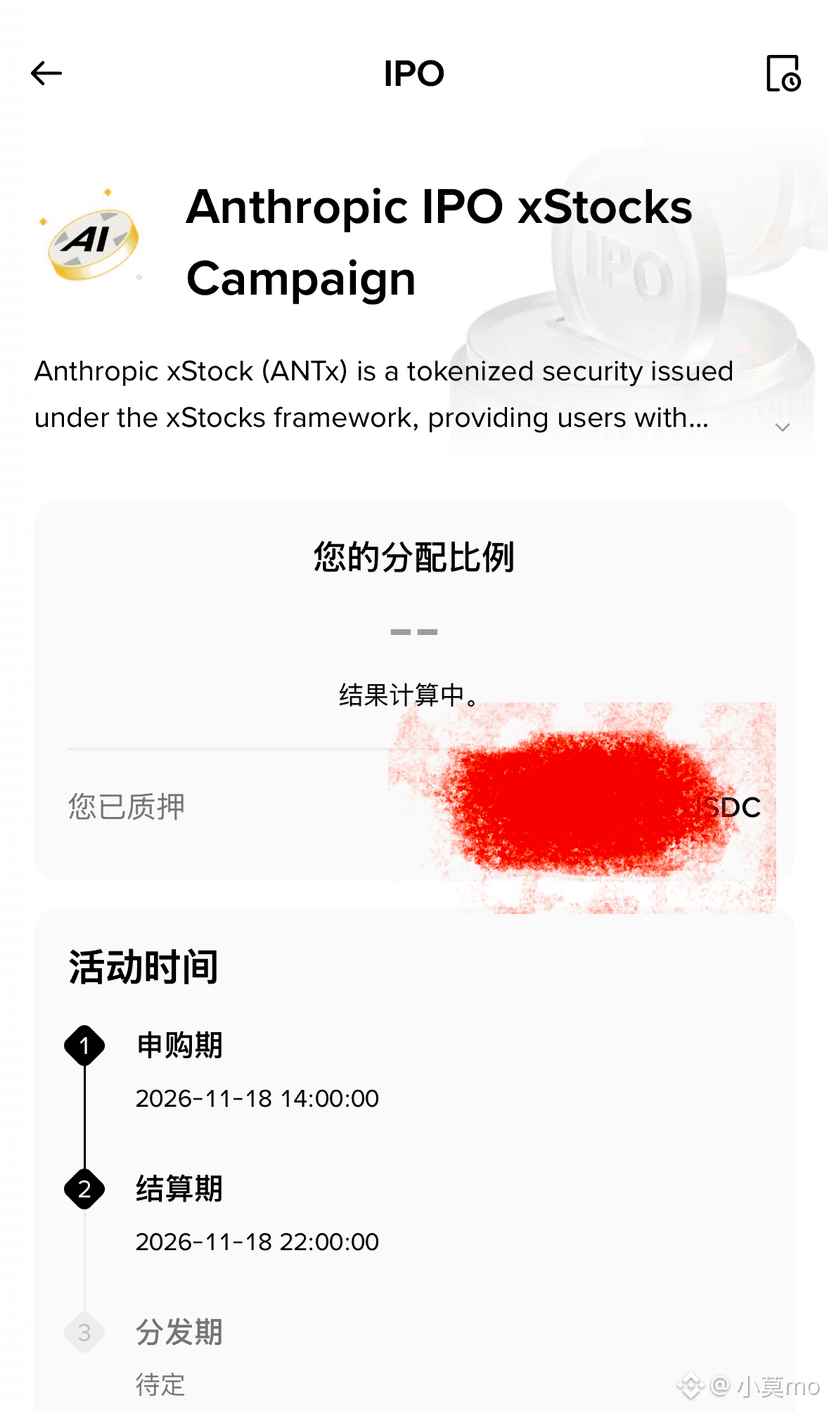
User-9adf0291:
估计又是空欢喜一场了😁
4
1
1
2.1k
Log in to explore more content
Join global crypto users on Binance Square
⚡️ Get latest and useful information about crypto.
💬 Trusted by the world’s largest crypto exchange.
👍 Discover real insights from verified creators.
Email / Phone number
Trending Topics
1
#IsAnthropic’s$1.5TMarketCapJustified?
34,458 views
183 Discussing
2
#BTCBelow$62KAmidHikeFearsAndShiftToAnthropic
1,612 views
31 Discussing
3
#NvidiaBoardReportedlySplitOverHuang’sReturn
167,164 views
1,403 Discussing
4
#CanGTA6'sLaunchLiftTTWOShares?
132,118 views
1,016 Discussing
5
#LedgerProbesTamperedWalletsInBerlinAndDubai
4,209 views
75 Discussing
6
#13FInstitutionsBitcoinSpotETPHoldingsHitRecord
12,632 views
143 Discussing
7
#BTCRemainsUnderPressureAfterHawkishFOMCMinutes
330,380 views
2,347 Discussing
8
#StrategySTRCPreferredSlips3.65%Below$100Par
11,472 views
96 Discussing
9
#MASToUpgradeSGDTestnetToSGDigitalLedger
38,767 views
385 Discussing
10
#Solana2027RoadmapTargetsDoubleComputeCapacity
21,795 views
215 Discussing