
Crypto Roadmap27
120 Posts

Crypto Roadmap27
Report
Block User
🚀 Daily Crypto Market Insights | Bitcoin • Ethereum • Solana • AI • RWA | Simple Analysis, No Hype | DYOR 📈
4 Following
1 Followers
4 Liked
Posts
All
Quotes
Zcash Just Broke $800 — Is ZEC Becoming Crypto’s Next ETF Breakout?Zcash is suddenly back in the spotlight.
The privacy-focused cryptocurrency has delivered one of the strongest rallies in the market, breaking above $800 and briefly reaching the $850 area—its highest level since 2018.
But the price explosion is only one part of the story.
Behind the move are three major catalysts:
🏦 Grayscale’s push toward a spot ZEC ETF
🔐 Renewed interest in privacy-focused crypto
📊 Billions of dollars in ZEC derivatives activity
So the real question isn't simply:
“Can ZEC keep pumping?”
It's:
Could Zcash become the next crypto asset to benefit from the ETF wave?
🔥 ZEC Has Suddenly Become One of Crypto’s Biggest Movers
ZEC's recent performance has been extraordinary.
The token climbed roughly 22% in Saturday trading, briefly approaching $850, after already experiencing a much larger move earlier in the week.
CoinGecko's latest data shows ZEC up approximately 61% over seven days, dramatically outperforming the broader cryptocurrency market. Its market capitalization has risen to roughly $13 billion, putting Zcash around the top 15 cryptocurrencies by market cap.
That kind of move naturally attracts momentum traders.
But there is something more interesting happening underneath.
🏦 The ETF Story Is Driving Attention
The biggest catalyst behind the current ZEC narrative is Grayscale.
Grayscale has been working to convert its existing Zcash Trust into a U.S.-listed spot ETF.
The company submitted another amendment to the SEC on Friday, bringing the proposed product closer to a spot ETF structure. If eventually approved and launched, it would provide a regulated investment vehicle giving investors direct exposure to ZEC without needing to hold the token themselves.
This is significant because ETFs have completely changed how institutional investors can access major crypto assets.
Bitcoin already demonstrated the potential impact.
Ethereum followed.
Now the market is asking:
Could Zcash be next?
⚠️ But Don't Call It an Approved ETF Yet
This distinction is extremely important.
Grayscale's filing is not the same thing as SEC approval.
The current story is about regulatory filings and progress toward a potential ETF—not a confirmed approval.
That means traders buying ZEC today are partly positioning for a future event that still carries regulatory and execution risk.
And this creates a classic crypto setup:
Huge expectations + limited supply + strong momentum = potentially massive upside
But also:
Huge expectations + leveraged trading = massive downside if the catalyst disappoints.
📊 The Derivatives Market Is Going Crazy
The ZEC rally isn't happening only in spot markets.
CoinGlass data cited by The Block showed approximately $9.54 billion in 24-hour ZEC futures volume, with open interest around $1.76 billion.
That's enormous compared with the size of the underlying asset.
And it tells us something important:
Leverage is playing a major role in the current move.
When futures traders pile into an asset during a breakout, the move can accelerate rapidly.
But the same mechanism works in reverse.
If the price suddenly falls, leveraged longs can be liquidated, creating additional selling pressure.
So the current ZEC rally is powerful—but it is also fragile.
🔐 Why Is the Privacy Narrative Returning?
For years, privacy coins were treated by much of the crypto market as a regulatory headache.
Now the narrative is changing.
Zcash offers a different approach to privacy through zero-knowledge cryptography, allowing users to make shielded transactions while preserving the option for transparent activity.
That creates a potentially interesting use case in a world where:
Blockchain surveillance is increasingOn-chain identity is becoming more importantInstitutions want privacy for certain transactionsUsers increasingly care about financial confidentiality
The market may be starting to realize that privacy doesn't necessarily have to mean “unregulated.”
Instead, the bigger question becomes:
Can privacy technology coexist with institutional finance?
That's where Zcash becomes particularly interesting.
🧩 ZEC's ETF Story Is Different From Bitcoin's
Bitcoin's ETF narrative was relatively straightforward:
Digital gold → institutional investment product.
Zcash has a more complicated story.
The potential thesis is:
Privacy infrastructure → institutional investment product.
That's a much smaller and more specialized market.
But specialization can also create scarcity.
If demand for privacy-focused assets increases while only a handful of major projects can provide that exposure, ZEC could potentially benefit disproportionately.
💰 Another Interesting Development: Potential Institutional Accumulation
The ETF filing story becomes even more interesting because an earlier Grayscale amendment disclosed that a subsidiary of Digital Currency Group was considering acquiring approximately 200,000 ZEC through the trust.
That doesn't mean the purchase is guaranteed.
But the possibility itself adds another institutional angle to the Zcash narrative.
And when you combine:
ETF demand expectations
potential institutional accumulation
strong retail momentum
limited maximum supply
you get a very different market structure from the average altcoin.
📈 Could ZEC Become the Next ETF Winner?
This is the bullish thesis.
Imagine Grayscale eventually receives the necessary regulatory clearance.
A spot ZEC ETF would create another traditional-market gateway into the asset.
That could potentially bring:
🏦 Institutional exposure
💰 New capital flows
📊 Greater liquidity
🌐 More mainstream awareness
And because ZEC is much smaller than Bitcoin or Ethereum, even relatively modest new demand could have a larger percentage impact on the market.
But that's also why investors need to be careful.
Small market = bigger upside potential
but also
Small market = bigger volatility.
⚠️ The Biggest Risk: The Rally May Be Too Fast
ZEC has moved incredibly quickly.
That creates a major risk of profit-taking.
Some traders who bought before the breakout now have enormous unrealized gains.
Eventually, some of them will want to sell.
And because derivatives activity is so large, a relatively small price reversal could trigger a chain reaction.
The market could move from:
FOMO → leverage → liquidation → panic
very quickly.
This is why chasing a vertical candle can be dangerous.
🔴 What Could Break the Bull Case?
There are several things ZEC bulls should watch.
1️⃣ ETF progress stalls
If the regulatory process slows or expectations change, some of the current premium could disappear.
2️⃣ Leverage unwinds
With billions in derivatives volume and large open interest, a sharp correction could accelerate quickly.
3️⃣ Bitcoin reverses
ZEC is outperforming the market, but it is still part of the broader crypto ecosystem.
A major BTC reversal could pull liquidity out of altcoins.
4️⃣ Profit-taking increases
After such a powerful rally, early holders have strong incentives to lock in gains.
5️⃣ Privacy regulation becomes a problem
The same privacy characteristics that make Zcash attractive could also create regulatory challenges in some jurisdictions.
👀 What I'm Watching Next
For me, these are the five most important ZEC indicators:
🏦 1. Grayscale's ETF progress
Any additional SEC filing or regulatory development could immediately affect sentiment.
📊 2. Futures open interest
If price rises while leverage becomes excessive, the risk of a violent correction increases.
💰 3. Spot volume
A healthy breakout should ideally be supported by genuine spot demand rather than derivatives alone.
🔐 4. Privacy adoption
If privacy becomes a bigger theme across crypto, Zcash could benefit from being one of the best-known assets in the sector.
₿ 5. Bitcoin's trend
If the broader crypto market remains risk-on, ZEC's momentum has a better environment to continue.
🚀 The Bigger Question: Is Privacy Back?
This may ultimately be the most interesting part of the entire story.
The ZEC rally could turn out to be more than an isolated coin pump.
It could be an early signal that the market is beginning to rotate into specialized crypto narratives.
We've already seen cycles where capital moves from:
Bitcoin → Ethereum → DeFi → Layer-1s → smaller narratives.
Could the next rotation be:
Privacy + institutional crypto infrastructure?
If so, Zcash is suddenly positioned in an interesting place.
🧠 My Take
I'm not most interested in ZEC simply because it went above $800.
I'm interested in why the market is willing to value it so aggressively right now.
The combination is unusual:
A major ETF catalyst
institutional interest
privacy narrative
massive derivatives activity
strong momentum
That's enough to make ZEC one of the most interesting altcoins to watch right now.
But there's a major difference between:
“ZEC has a strong narrative”
and
“ZEC must keep going higher.”
The first statement is supported by current developments.
The second is speculation.
The next major test will be whether ZEC can maintain elevated demand after the initial ETF excitement and leverage-driven buying cool down.
If it can, this rally could represent something much bigger than a short-term breakout.
If it can't, today's vertical move could eventually become one of the year's most dramatic examples of crypto momentum reversing.
The ETF story provided the spark.
Leverage poured fuel on the fire.
Now the market has to prove there is enough real demand to keep ZEC burning. 🔥
💬 What Do YOU Think?
ZEC just broke above $800 — what's next? 👀
🟢 ETF could send ZEC much higher 🚀
🔵 Privacy narrative is just getting started
🔴 This rally is dangerously overextended
🟡 Need confirmation before getting bullish
👇 Vote and tell me your reason.
#Zcash #ZEC #Crypto #PrivacyCoins #CryptoETF #Grayscale #Bitcoin #Altcoins #CryptoMarket #DeFi #BinanceSquare
Zcash Just Broke $800 — Is ZEC Becoming Crypto’s Next ETF Breakout?
Zcash is suddenly back in the spotlight.
The privacy-focused cryptocurrency has delivered one of the strongest rallies in the market, breaking above $800 and briefly reaching the $850 area—its highest level since 2018.
But the price explosion is only one part of the story.
Behind the move are three major catalysts:
🏦 Grayscale’s push toward a spot ZEC ETF
🔐 Renewed interest in privacy-focused crypto
📊 Billions of dollars in ZEC derivatives activity
So the real question isn't simply:
“Can ZEC keep pumping?”
It's:
Could Zcash become the next crypto asset to benefit from the ETF wave?
🔥 ZEC Has Suddenly Become One of Crypto’s Biggest Movers
ZEC's recent performance has been extraordinary.
The token climbed roughly 22% in Saturday trading, briefly approaching $850, after already experiencing a much larger move earlier in the week.
CoinGecko's latest data shows ZEC up approximately 61% over seven days, dramatically outperforming the broader cryptocurrency market. Its market capitalization has risen to roughly $13 billion, putting Zcash around the top 15 cryptocurrencies by market cap.
That kind of move naturally attracts momentum traders.
But there is something more interesting happening underneath.
🏦 The ETF Story Is Driving Attention
The biggest catalyst behind the current ZEC narrative is Grayscale.
Grayscale has been working to convert its existing Zcash Trust into a U.S.-listed spot ETF.
The company submitted another amendment to the SEC on Friday, bringing the proposed product closer to a spot ETF structure. If eventually approved and launched, it would provide a regulated investment vehicle giving investors direct exposure to ZEC without needing to hold the token themselves.
This is significant because ETFs have completely changed how institutional investors can access major crypto assets.
Bitcoin already demonstrated the potential impact.
Ethereum followed.
Now the market is asking:
Could Zcash be next?
⚠️ But Don't Call It an Approved ETF Yet
This distinction is extremely important.
Grayscale's filing is not the same thing as SEC approval.
The current story is about regulatory filings and progress toward a potential ETF—not a confirmed approval.
That means traders buying ZEC today are partly positioning for a future event that still carries regulatory and execution risk.
And this creates a classic crypto setup:
Huge expectations + limited supply + strong momentum = potentially massive upside
But also:
Huge expectations + leveraged trading = massive downside if the catalyst disappoints.
📊 The Derivatives Market Is Going Crazy
The ZEC rally isn't happening only in spot markets.
CoinGlass data cited by The Block showed approximately $9.54 billion in 24-hour ZEC futures volume, with open interest around $1.76 billion.
That's enormous compared with the size of the underlying asset.
And it tells us something important:
Leverage is playing a major role in the current move.
When futures traders pile into an asset during a breakout, the move can accelerate rapidly.
But the same mechanism works in reverse.
If the price suddenly falls, leveraged longs can be liquidated, creating additional selling pressure.
So the current ZEC rally is powerful—but it is also fragile.
🔐 Why Is the Privacy Narrative Returning?
For years, privacy coins were treated by much of the crypto market as a regulatory headache.
Now the narrative is changing.
Zcash offers a different approach to privacy through zero-knowledge cryptography, allowing users to make shielded transactions while preserving the option for transparent activity.
That creates a potentially interesting use case in a world where:
Blockchain surveillance is increasingOn-chain identity is becoming more importantInstitutions want privacy for certain transactionsUsers increasingly care about financial confidentiality
The market may be starting to realize that privacy doesn't necessarily have to mean “unregulated.”
Instead, the bigger question becomes:
Can privacy technology coexist with institutional finance?
That's where Zcash becomes particularly interesting.
🧩 ZEC's ETF Story Is Different From Bitcoin's
Bitcoin's ETF narrative was relatively straightforward:
Digital gold → institutional investment product.
Zcash has a more complicated story.
The potential thesis is:
Privacy infrastructure → institutional investment product.
That's a much smaller and more specialized market.
But specialization can also create scarcity.
If demand for privacy-focused assets increases while only a handful of major projects can provide that exposure, ZEC could potentially benefit disproportionately.
💰 Another Interesting Development: Potential Institutional Accumulation
The ETF filing story becomes even more interesting because an earlier Grayscale amendment disclosed that a subsidiary of Digital Currency Group was considering acquiring approximately 200,000 ZEC through the trust.
That doesn't mean the purchase is guaranteed.
But the possibility itself adds another institutional angle to the Zcash narrative.
And when you combine:
ETF demand expectations
potential institutional accumulation
strong retail momentum
limited maximum supply
you get a very different market structure from the average altcoin.
📈 Could ZEC Become the Next ETF Winner?
This is the bullish thesis.
Imagine Grayscale eventually receives the necessary regulatory clearance.
A spot ZEC ETF would create another traditional-market gateway into the asset.
That could potentially bring:
🏦 Institutional exposure
💰 New capital flows
📊 Greater liquidity
🌐 More mainstream awareness
And because ZEC is much smaller than Bitcoin or Ethereum, even relatively modest new demand could have a larger percentage impact on the market.
But that's also why investors need to be careful.
Small market = bigger upside potential
but also
Small market = bigger volatility.
⚠️ The Biggest Risk: The Rally May Be Too Fast
ZEC has moved incredibly quickly.
That creates a major risk of profit-taking.
Some traders who bought before the breakout now have enormous unrealized gains.
Eventually, some of them will want to sell.
And because derivatives activity is so large, a relatively small price reversal could trigger a chain reaction.
The market could move from:
FOMO → leverage → liquidation → panic
very quickly.
This is why chasing a vertical candle can be dangerous.
🔴 What Could Break the Bull Case?
There are several things ZEC bulls should watch.
1️⃣ ETF progress stalls
If the regulatory process slows or expectations change, some of the current premium could disappear.
2️⃣ Leverage unwinds
With billions in derivatives volume and large open interest, a sharp correction could accelerate quickly.
3️⃣ Bitcoin reverses
ZEC is outperforming the market, but it is still part of the broader crypto ecosystem.
A major BTC reversal could pull liquidity out of altcoins.
4️⃣ Profit-taking increases
After such a powerful rally, early holders have strong incentives to lock in gains.
5️⃣ Privacy regulation becomes a problem
The same privacy characteristics that make Zcash attractive could also create regulatory challenges in some jurisdictions.
👀 What I'm Watching Next
For me, these are the five most important ZEC indicators:
🏦 1. Grayscale's ETF progress
Any additional SEC filing or regulatory development could immediately affect sentiment.
📊 2. Futures open interest
If price rises while leverage becomes excessive, the risk of a violent correction increases.
💰 3. Spot volume
A healthy breakout should ideally be supported by genuine spot demand rather than derivatives alone.
🔐 4. Privacy adoption
If privacy becomes a bigger theme across crypto, Zcash could benefit from being one of the best-known assets in the sector.
₿ 5. Bitcoin's trend
If the broader crypto market remains risk-on, ZEC's momentum has a better environment to continue.
🚀 The Bigger Question: Is Privacy Back?
This may ultimately be the most interesting part of the entire story.
The ZEC rally could turn out to be more than an isolated coin pump.
It could be an early signal that the market is beginning to rotate into specialized crypto narratives.
We've already seen cycles where capital moves from:
Bitcoin → Ethereum → DeFi → Layer-1s → smaller narratives.
Could the next rotation be:
Privacy + institutional crypto infrastructure?
If so, Zcash is suddenly positioned in an interesting place.
🧠 My Take
I'm not most interested in ZEC simply because it went above $800.
I'm interested in why the market is willing to value it so aggressively right now.
The combination is unusual:
A major ETF catalyst
institutional interest
privacy narrative
massive derivatives activity
strong momentum
That's enough to make ZEC one of the most interesting altcoins to watch right now.
But there's a major difference between:
“ZEC has a strong narrative”
and
“ZEC must keep going higher.”
The first statement is supported by current developments.
The second is speculation.
The next major test will be whether ZEC can maintain elevated demand after the initial ETF excitement and leverage-driven buying cool down.
If it can, this rally could represent something much bigger than a short-term breakout.
If it can't, today's vertical move could eventually become one of the year's most dramatic examples of crypto momentum reversing.
The ETF story provided the spark.
Leverage poured fuel on the fire.
Now the market has to prove there is enough real demand to keep ZEC burning. 🔥
💬 What Do YOU Think?
ZEC just broke above $800 — what's next? 👀
🟢 ETF could send ZEC much higher 🚀
🔵 Privacy narrative is just getting started
🔴 This rally is dangerously overextended
🟡 Need confirmation before getting bullish
👇 Vote and tell me your reason.
#Zcash #ZEC #Crypto #PrivacyCoins #CryptoETF #Grayscale #Bitcoin #Altcoins #CryptoMarket #DeFi #BinanceSquare
The privacy-focused cryptocurrency has delivered one of the strongest rallies in the market, breaking above $800 and briefly reaching the $850 area—its highest level since 2018.
But the price explosion is only one part of the story.
Behind the move are three major catalysts:
🏦 Grayscale’s push toward a spot ZEC ETF
🔐 Renewed interest in privacy-focused crypto
📊 Billions of dollars in ZEC derivatives activity
So the real question isn't simply:
“Can ZEC keep pumping?”
It's:
Could Zcash become the next crypto asset to benefit from the ETF wave?
🔥 ZEC Has Suddenly Become One of Crypto’s Biggest Movers
ZEC's recent performance has been extraordinary.
The token climbed roughly 22% in Saturday trading, briefly approaching $850, after already experiencing a much larger move earlier in the week.
CoinGecko's latest data shows ZEC up approximately 61% over seven days, dramatically outperforming the broader cryptocurrency market. Its market capitalization has risen to roughly $13 billion, putting Zcash around the top 15 cryptocurrencies by market cap.
That kind of move naturally attracts momentum traders.
But there is something more interesting happening underneath.
🏦 The ETF Story Is Driving Attention
The biggest catalyst behind the current ZEC narrative is Grayscale.
Grayscale has been working to convert its existing Zcash Trust into a U.S.-listed spot ETF.
The company submitted another amendment to the SEC on Friday, bringing the proposed product closer to a spot ETF structure. If eventually approved and launched, it would provide a regulated investment vehicle giving investors direct exposure to ZEC without needing to hold the token themselves.
This is significant because ETFs have completely changed how institutional investors can access major crypto assets.
Bitcoin already demonstrated the potential impact.
Ethereum followed.
Now the market is asking:
Could Zcash be next?
⚠️ But Don't Call It an Approved ETF Yet
This distinction is extremely important.
Grayscale's filing is not the same thing as SEC approval.
The current story is about regulatory filings and progress toward a potential ETF—not a confirmed approval.
That means traders buying ZEC today are partly positioning for a future event that still carries regulatory and execution risk.
And this creates a classic crypto setup:
Huge expectations + limited supply + strong momentum = potentially massive upside
But also:
Huge expectations + leveraged trading = massive downside if the catalyst disappoints.
📊 The Derivatives Market Is Going Crazy
The ZEC rally isn't happening only in spot markets.
CoinGlass data cited by The Block showed approximately $9.54 billion in 24-hour ZEC futures volume, with open interest around $1.76 billion.
That's enormous compared with the size of the underlying asset.
And it tells us something important:
Leverage is playing a major role in the current move.
When futures traders pile into an asset during a breakout, the move can accelerate rapidly.
But the same mechanism works in reverse.
If the price suddenly falls, leveraged longs can be liquidated, creating additional selling pressure.
So the current ZEC rally is powerful—but it is also fragile.
🔐 Why Is the Privacy Narrative Returning?
For years, privacy coins were treated by much of the crypto market as a regulatory headache.
Now the narrative is changing.
Zcash offers a different approach to privacy through zero-knowledge cryptography, allowing users to make shielded transactions while preserving the option for transparent activity.
That creates a potentially interesting use case in a world where:
Blockchain surveillance is increasingOn-chain identity is becoming more importantInstitutions want privacy for certain transactionsUsers increasingly care about financial confidentiality
The market may be starting to realize that privacy doesn't necessarily have to mean “unregulated.”
Instead, the bigger question becomes:
Can privacy technology coexist with institutional finance?
That's where Zcash becomes particularly interesting.
🧩 ZEC's ETF Story Is Different From Bitcoin's
Bitcoin's ETF narrative was relatively straightforward:
Digital gold → institutional investment product.
Zcash has a more complicated story.
The potential thesis is:
Privacy infrastructure → institutional investment product.
That's a much smaller and more specialized market.
But specialization can also create scarcity.
If demand for privacy-focused assets increases while only a handful of major projects can provide that exposure, ZEC could potentially benefit disproportionately.
💰 Another Interesting Development: Potential Institutional Accumulation
The ETF filing story becomes even more interesting because an earlier Grayscale amendment disclosed that a subsidiary of Digital Currency Group was considering acquiring approximately 200,000 ZEC through the trust.
That doesn't mean the purchase is guaranteed.
But the possibility itself adds another institutional angle to the Zcash narrative.
And when you combine:
ETF demand expectations
potential institutional accumulation
strong retail momentum
limited maximum supply
you get a very different market structure from the average altcoin.
📈 Could ZEC Become the Next ETF Winner?
This is the bullish thesis.
Imagine Grayscale eventually receives the necessary regulatory clearance.
A spot ZEC ETF would create another traditional-market gateway into the asset.
That could potentially bring:
🏦 Institutional exposure
💰 New capital flows
📊 Greater liquidity
🌐 More mainstream awareness
And because ZEC is much smaller than Bitcoin or Ethereum, even relatively modest new demand could have a larger percentage impact on the market.
But that's also why investors need to be careful.
Small market = bigger upside potential
but also
Small market = bigger volatility.
⚠️ The Biggest Risk: The Rally May Be Too Fast
ZEC has moved incredibly quickly.
That creates a major risk of profit-taking.
Some traders who bought before the breakout now have enormous unrealized gains.
Eventually, some of them will want to sell.
And because derivatives activity is so large, a relatively small price reversal could trigger a chain reaction.
The market could move from:
FOMO → leverage → liquidation → panic
very quickly.
This is why chasing a vertical candle can be dangerous.
🔴 What Could Break the Bull Case?
There are several things ZEC bulls should watch.
1️⃣ ETF progress stalls
If the regulatory process slows or expectations change, some of the current premium could disappear.
2️⃣ Leverage unwinds
With billions in derivatives volume and large open interest, a sharp correction could accelerate quickly.
3️⃣ Bitcoin reverses
ZEC is outperforming the market, but it is still part of the broader crypto ecosystem.
A major BTC reversal could pull liquidity out of altcoins.
4️⃣ Profit-taking increases
After such a powerful rally, early holders have strong incentives to lock in gains.
5️⃣ Privacy regulation becomes a problem
The same privacy characteristics that make Zcash attractive could also create regulatory challenges in some jurisdictions.
👀 What I'm Watching Next
For me, these are the five most important ZEC indicators:
🏦 1. Grayscale's ETF progress
Any additional SEC filing or regulatory development could immediately affect sentiment.
📊 2. Futures open interest
If price rises while leverage becomes excessive, the risk of a violent correction increases.
💰 3. Spot volume
A healthy breakout should ideally be supported by genuine spot demand rather than derivatives alone.
🔐 4. Privacy adoption
If privacy becomes a bigger theme across crypto, Zcash could benefit from being one of the best-known assets in the sector.
₿ 5. Bitcoin's trend
If the broader crypto market remains risk-on, ZEC's momentum has a better environment to continue.
🚀 The Bigger Question: Is Privacy Back?
This may ultimately be the most interesting part of the entire story.
The ZEC rally could turn out to be more than an isolated coin pump.
It could be an early signal that the market is beginning to rotate into specialized crypto narratives.
We've already seen cycles where capital moves from:
Bitcoin → Ethereum → DeFi → Layer-1s → smaller narratives.
Could the next rotation be:
Privacy + institutional crypto infrastructure?
If so, Zcash is suddenly positioned in an interesting place.
🧠 My Take
I'm not most interested in ZEC simply because it went above $800.
I'm interested in why the market is willing to value it so aggressively right now.
The combination is unusual:
A major ETF catalyst
institutional interest
privacy narrative
massive derivatives activity
strong momentum
That's enough to make ZEC one of the most interesting altcoins to watch right now.
But there's a major difference between:
“ZEC has a strong narrative”
and
“ZEC must keep going higher.”
The first statement is supported by current developments.
The second is speculation.
The next major test will be whether ZEC can maintain elevated demand after the initial ETF excitement and leverage-driven buying cool down.
If it can, this rally could represent something much bigger than a short-term breakout.
If it can't, today's vertical move could eventually become one of the year's most dramatic examples of crypto momentum reversing.
The ETF story provided the spark.
Leverage poured fuel on the fire.
Now the market has to prove there is enough real demand to keep ZEC burning. 🔥
💬 What Do YOU Think?
ZEC just broke above $800 — what's next? 👀
🟢 ETF could send ZEC much higher 🚀
🔵 Privacy narrative is just getting started
🔴 This rally is dangerously overextended
🟡 Need confirmation before getting bullish
👇 Vote and tell me your reason.
#Zcash #ZEC #Crypto #PrivacyCoins #CryptoETF #Grayscale #Bitcoin #Altcoins #CryptoMarket #DeFi #BinanceSquare
205
Article
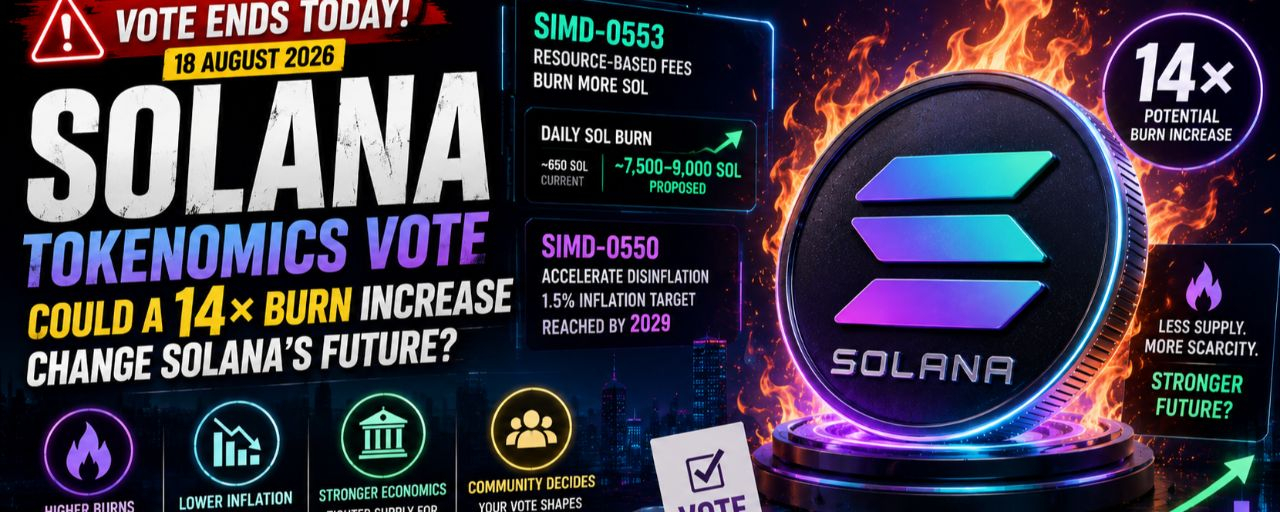
SOL Faces a Major Tokenomics Vote Today — Could a 14× Burn Increase Change Solana Forever?Solana is approaching a potentially important turning point.
Today, August 18, the governance window for proposals aimed at changing SOL's supply economics is closing.
One proposal could dramatically increase the amount of SOL burned through transaction fees, while another would accelerate the network's long-term reduction in new SOL issuance.
At first glance, this sounds extremely bullish.
But there is a catch:
More burns do not automatically mean SOL becomes deflationary overnight.
And that's where the real story begins.
🔥 The 14× Burn Proposal
The main proposal, SIMD-0553, would change how Solana charges for computational resources.
Instead of relying primarily on a flat transaction fee, the proposal would introduce resource-based fees.
The portion tied to resource consumption would be burned, permanently removing SOL from circulation.
Current daily SOL burns are roughly 650 SOL.
Under the proposed system, estimates put potential burns at around 7,500–9,000 SOL per day once the highest fee phase is reached.
That's potentially around a 12–14× increase.
And naturally, the crypto market is asking:
Could this become a major supply shock for SOL?
📉 But Here's What Many Traders Could Miss
Even if Solana reaches a 9,000 SOL daily burn rate, the network would not immediately become deflationary.
Why?
Because Solana currently issues substantially more new SOL than the proposed burn would destroy.
One recent analysis estimates current issuance at around 60,000 SOL per day.
So the simplified picture looks like this:
New SOL entering circulation → ~60K/day
Potential SOL burned → ~9K/day
That still leaves net positive issuance.
Therefore, the proposal is better understood as:
“Reducing the rate of supply expansion”
rather than:
“SOL becomes instantly deflationary.”
That's an important distinction.
⚡ SIMD-0550 Could Change the Other Side of the Equation
The burn proposal isn't the only change being discussed.
SIMD-0550 proposes doubling Solana's annual disinflation rate from 15% to 30%.
According to the proposal's own modelling, this could bring Solana's long-term 1.5% inflation rate forward from roughly H1 2032 to H1 2029.
The modelling estimates approximately 18.9 million fewer SOL issued over six years compared with the existing schedule.
So Solana is effectively attacking supply from two directions:
🔥 SIMD-0553
More SOL gets burned
📉 SIMD-0550
Less new SOL gets created
Together, that's much more significant than either proposal on its own.
🏦 Why Does This Matter for SOL Holders?
Tokenomics matters because long-term asset value isn't determined by demand alone.
Supply matters too.
Imagine two networks with identical demand.
If Network A continually creates large amounts of new tokens while Network B gradually reduces issuance and burns more tokens, their long-term supply dynamics can look very different.
That's the thesis behind these Solana proposals.
The objective isn't necessarily to create an immediate price pump.
It's to make SOL's supply curve tighter over time.
🚨 But There Is a Risk Bulls Shouldn't Ignore
Lower issuance sounds great for token holders.
But staking rewards are partly tied to SOL issuance.
If inflation falls faster, staking yields can also decline.
The SIMD-0550 proposal models nominal staking yields falling faster under the accelerated disinflation schedule.
That creates a trade-off:
Lower inflation = potentially better supply dynamics
but also:
Lower staking rewards = potentially less incentive for some validators/stakers.
The proposal's own modelling estimates that some validators could become unprofitable faster under the accelerated schedule.
So this isn't a free lunch.
⚔️ The Real Battle: Supply vs Demand
Here's the most important point for investors:
Reducing supply does not guarantee higher prices.
If demand remains weak, a lower inflation rate alone may not be enough to create a major rally.
This is why the Solana thesis ultimately depends on both sides:
Supply
🔥 More burns
📉 Lower issuance
💎 Tighter long-term supply
Demand
👥 More users
💰 More economic activity
🏦 Institutional adoption
📊 More fees
🌐 More applications
If supply becomes tighter while demand continues growing, the long-term setup becomes much more interesting.
📈 Could This Become a Catalyst for SOL?
Potentially—but traders should separate short-term reaction from long-term fundamentals.
The market could initially react to the headline:
“SOL burn could increase 14×.”
That sounds extremely bullish.
But sophisticated investors will probably look deeper.
They'll ask:
How much SOL is actually burned?How quickly does the new fee system reach its terminal phase?Does network activity continue growing?How much issuance remains?What happens to staking participation?Does SOL demand increase alongside the supply changes?
Those questions matter more than the headline number.
👀 The Vote Is the Immediate Catalyst
The governance process is what makes today's story particularly interesting.
The vote window is scheduled to close on August 18, 2026.
That means traders are watching for a clear outcome:
🟢 If the proposals advance
The market could interpret it as a major step toward tighter SOL tokenomics.
🔴 If support weakens
Expectations for the supply changes could be pushed back.
🟡 If the outcome is uncertain
SOL could remain driven primarily by Bitcoin, liquidity and broader altcoin sentiment.
And remember:
A governance proposal is not the same thing as an implemented protocol change.
Even if approved, implementation would occur through future network upgrades and phased activation.
🧠 What I'm Watching After the Vote
For me, the most important signals aren't just the headline.
I'd watch these five things:
1️⃣ Final governance outcome
Does the proposal receive enough support?
2️⃣ Actual implementation timeline
When do the proposed fee changes become active?
3️⃣ SOL burn rate
Does the network actually approach the projected levels?
4️⃣ SOL issuance
How quickly does new supply decline?
5️⃣ Network demand
Does Solana continue attracting users, applications and economic activity?
The fifth point may ultimately be the most important.
Because scarcity without demand isn't enough.
🚀 My Take
Solana's tokenomics proposals are interesting because they represent a shift in how the network thinks about SOL's long-term economics.
SIMD-0553 could dramatically increase SOL burns.
SIMD-0550 could accelerate disinflation.
Together, they could make the long-term supply curve meaningfully tighter.
But I wouldn't call this an automatic “SOL price explosion” catalyst.
The proposals still have to translate into something much more important:
More sustainable economic demand for SOL.
If Solana can combine tighter supply with continued network growth, the long-term tokenomics story could become much stronger.
If demand doesn't keep up, however, lower issuance alone may not be enough.
That's why today's vote is important—but what happens to Solana's actual usage afterward could matter even more.
💬 What Do YOU Think?
If Solana's proposals increase burns and accelerate disinflation, what happens to SOL over the next 1–2 years? 👀
🟢 Major bullish catalyst 🚀
🔵 Long-term positive, but slow
🔴 Supply changes won't matter without demand
🟡 Too early to tell
👇 Vote and tell me WHY.
#Solana #SOL #Crypto #SolanaNews #Tokenomics #DeFi #Altcoins #CryptoMarket #Blockchain #BinanceSquare
SOL Faces a Major Tokenomics Vote Today — Could a 14× Burn Increase Change Solana Forever?
Solana is approaching a potentially important turning point.
Today, August 18, the governance window for proposals aimed at changing SOL's supply economics is closing.
One proposal could dramatically increase the amount of SOL burned through transaction fees, while another would accelerate the network's long-term reduction in new SOL issuance.
At first glance, this sounds extremely bullish.
But there is a catch:
More burns do not automatically mean SOL becomes deflationary overnight.
And that's where the real story begins.
🔥 The 14× Burn Proposal
The main proposal, SIMD-0553, would change how Solana charges for computational resources.
Instead of relying primarily on a flat transaction fee, the proposal would introduce resource-based fees.
The portion tied to resource consumption would be burned, permanently removing SOL from circulation.
Current daily SOL burns are roughly 650 SOL.
Under the proposed system, estimates put potential burns at around 7,500–9,000 SOL per day once the highest fee phase is reached.
That's potentially around a 12–14× increase.
And naturally, the crypto market is asking:
Could this become a major supply shock for SOL?
📉 But Here's What Many Traders Could Miss
Even if Solana reaches a 9,000 SOL daily burn rate, the network would not immediately become deflationary.
Why?
Because Solana currently issues substantially more new SOL than the proposed burn would destroy.
One recent analysis estimates current issuance at around 60,000 SOL per day.
So the simplified picture looks like this:
New SOL entering circulation → ~60K/day
Potential SOL burned → ~9K/day
That still leaves net positive issuance.
Therefore, the proposal is better understood as:
“Reducing the rate of supply expansion”
rather than:
“SOL becomes instantly deflationary.”
That's an important distinction.
⚡ SIMD-0550 Could Change the Other Side of the Equation
The burn proposal isn't the only change being discussed.
SIMD-0550 proposes doubling Solana's annual disinflation rate from 15% to 30%.
According to the proposal's own modelling, this could bring Solana's long-term 1.5% inflation rate forward from roughly H1 2032 to H1 2029.
The modelling estimates approximately 18.9 million fewer SOL issued over six years compared with the existing schedule.
So Solana is effectively attacking supply from two directions:
🔥 SIMD-0553
More SOL gets burned
📉 SIMD-0550
Less new SOL gets created
Together, that's much more significant than either proposal on its own.
🏦 Why Does This Matter for SOL Holders?
Tokenomics matters because long-term asset value isn't determined by demand alone.
Supply matters too.
Imagine two networks with identical demand.
If Network A continually creates large amounts of new tokens while Network B gradually reduces issuance and burns more tokens, their long-term supply dynamics can look very different.
That's the thesis behind these Solana proposals.
The objective isn't necessarily to create an immediate price pump.
It's to make SOL's supply curve tighter over time.
🚨 But There Is a Risk Bulls Shouldn't Ignore
Lower issuance sounds great for token holders.
But staking rewards are partly tied to SOL issuance.
If inflation falls faster, staking yields can also decline.
The SIMD-0550 proposal models nominal staking yields falling faster under the accelerated disinflation schedule.
That creates a trade-off:
Lower inflation = potentially better supply dynamics
but also:
Lower staking rewards = potentially less incentive for some validators/stakers.
The proposal's own modelling estimates that some validators could become unprofitable faster under the accelerated schedule.
So this isn't a free lunch.
⚔️ The Real Battle: Supply vs Demand
Here's the most important point for investors:
Reducing supply does not guarantee higher prices.
If demand remains weak, a lower inflation rate alone may not be enough to create a major rally.
This is why the Solana thesis ultimately depends on both sides:
Supply
🔥 More burns
📉 Lower issuance
💎 Tighter long-term supply
Demand
👥 More users
💰 More economic activity
🏦 Institutional adoption
📊 More fees
🌐 More applications
If supply becomes tighter while demand continues growing, the long-term setup becomes much more interesting.
📈 Could This Become a Catalyst for SOL?
Potentially—but traders should separate short-term reaction from long-term fundamentals.
The market could initially react to the headline:
“SOL burn could increase 14×.”
That sounds extremely bullish.
But sophisticated investors will probably look deeper.
They'll ask:
How much SOL is actually burned?How quickly does the new fee system reach its terminal phase?Does network activity continue growing?How much issuance remains?What happens to staking participation?Does SOL demand increase alongside the supply changes?
Those questions matter more than the headline number.
👀 The Vote Is the Immediate Catalyst
The governance process is what makes today's story particularly interesting.
The vote window is scheduled to close on August 18, 2026.
That means traders are watching for a clear outcome:
🟢 If the proposals advance
The market could interpret it as a major step toward tighter SOL tokenomics.
🔴 If support weakens
Expectations for the supply changes could be pushed back.
🟡 If the outcome is uncertain
SOL could remain driven primarily by Bitcoin, liquidity and broader altcoin sentiment.
And remember:
A governance proposal is not the same thing as an implemented protocol change.
Even if approved, implementation would occur through future network upgrades and phased activation.
🧠 What I'm Watching After the Vote
For me, the most important signals aren't just the headline.
I'd watch these five things:
1️⃣ Final governance outcome
Does the proposal receive enough support?
2️⃣ Actual implementation timeline
When do the proposed fee changes become active?
3️⃣ SOL burn rate
Does the network actually approach the projected levels?
4️⃣ SOL issuance
How quickly does new supply decline?
5️⃣ Network demand
Does Solana continue attracting users, applications and economic activity?
The fifth point may ultimately be the most important.
Because scarcity without demand isn't enough.
🚀 My Take
Solana's tokenomics proposals are interesting because they represent a shift in how the network thinks about SOL's long-term economics.
SIMD-0553 could dramatically increase SOL burns.
SIMD-0550 could accelerate disinflation.
Together, they could make the long-term supply curve meaningfully tighter.
But I wouldn't call this an automatic “SOL price explosion” catalyst.
The proposals still have to translate into something much more important:
More sustainable economic demand for SOL.
If Solana can combine tighter supply with continued network growth, the long-term tokenomics story could become much stronger.
If demand doesn't keep up, however, lower issuance alone may not be enough.
That's why today's vote is important—but what happens to Solana's actual usage afterward could matter even more.
💬 What Do YOU Think?
If Solana's proposals increase burns and accelerate disinflation, what happens to SOL over the next 1–2 years? 👀
🟢 Major bullish catalyst 🚀
🔵 Long-term positive, but slow
🔴 Supply changes won't matter without demand
🟡 Too early to tell
👇 Vote and tell me WHY.
#Solana #SOL #Crypto #SolanaNews #Tokenomics #DeFi #Altcoins #CryptoMarket #Blockchain #BinanceSquare
Today, August 18, the governance window for proposals aimed at changing SOL's supply economics is closing.
One proposal could dramatically increase the amount of SOL burned through transaction fees, while another would accelerate the network's long-term reduction in new SOL issuance.
At first glance, this sounds extremely bullish.
But there is a catch:
More burns do not automatically mean SOL becomes deflationary overnight.
And that's where the real story begins.
🔥 The 14× Burn Proposal
The main proposal, SIMD-0553, would change how Solana charges for computational resources.
Instead of relying primarily on a flat transaction fee, the proposal would introduce resource-based fees.
The portion tied to resource consumption would be burned, permanently removing SOL from circulation.
Current daily SOL burns are roughly 650 SOL.
Under the proposed system, estimates put potential burns at around 7,500–9,000 SOL per day once the highest fee phase is reached.
That's potentially around a 12–14× increase.
And naturally, the crypto market is asking:
Could this become a major supply shock for SOL?
📉 But Here's What Many Traders Could Miss
Even if Solana reaches a 9,000 SOL daily burn rate, the network would not immediately become deflationary.
Why?
Because Solana currently issues substantially more new SOL than the proposed burn would destroy.
One recent analysis estimates current issuance at around 60,000 SOL per day.
So the simplified picture looks like this:
New SOL entering circulation → ~60K/day
Potential SOL burned → ~9K/day
That still leaves net positive issuance.
Therefore, the proposal is better understood as:
“Reducing the rate of supply expansion”
rather than:
“SOL becomes instantly deflationary.”
That's an important distinction.
⚡ SIMD-0550 Could Change the Other Side of the Equation
The burn proposal isn't the only change being discussed.
SIMD-0550 proposes doubling Solana's annual disinflation rate from 15% to 30%.
According to the proposal's own modelling, this could bring Solana's long-term 1.5% inflation rate forward from roughly H1 2032 to H1 2029.
The modelling estimates approximately 18.9 million fewer SOL issued over six years compared with the existing schedule.
So Solana is effectively attacking supply from two directions:
🔥 SIMD-0553
More SOL gets burned
📉 SIMD-0550
Less new SOL gets created
Together, that's much more significant than either proposal on its own.
🏦 Why Does This Matter for SOL Holders?
Tokenomics matters because long-term asset value isn't determined by demand alone.
Supply matters too.
Imagine two networks with identical demand.
If Network A continually creates large amounts of new tokens while Network B gradually reduces issuance and burns more tokens, their long-term supply dynamics can look very different.
That's the thesis behind these Solana proposals.
The objective isn't necessarily to create an immediate price pump.
It's to make SOL's supply curve tighter over time.
🚨 But There Is a Risk Bulls Shouldn't Ignore
Lower issuance sounds great for token holders.
But staking rewards are partly tied to SOL issuance.
If inflation falls faster, staking yields can also decline.
The SIMD-0550 proposal models nominal staking yields falling faster under the accelerated disinflation schedule.
That creates a trade-off:
Lower inflation = potentially better supply dynamics
but also:
Lower staking rewards = potentially less incentive for some validators/stakers.
The proposal's own modelling estimates that some validators could become unprofitable faster under the accelerated schedule.
So this isn't a free lunch.
⚔️ The Real Battle: Supply vs Demand
Here's the most important point for investors:
Reducing supply does not guarantee higher prices.
If demand remains weak, a lower inflation rate alone may not be enough to create a major rally.
This is why the Solana thesis ultimately depends on both sides:
Supply
🔥 More burns
📉 Lower issuance
💎 Tighter long-term supply
Demand
👥 More users
💰 More economic activity
🏦 Institutional adoption
📊 More fees
🌐 More applications
If supply becomes tighter while demand continues growing, the long-term setup becomes much more interesting.
📈 Could This Become a Catalyst for SOL?
Potentially—but traders should separate short-term reaction from long-term fundamentals.
The market could initially react to the headline:
“SOL burn could increase 14×.”
That sounds extremely bullish.
But sophisticated investors will probably look deeper.
They'll ask:
How much SOL is actually burned?How quickly does the new fee system reach its terminal phase?Does network activity continue growing?How much issuance remains?What happens to staking participation?Does SOL demand increase alongside the supply changes?
Those questions matter more than the headline number.
👀 The Vote Is the Immediate Catalyst
The governance process is what makes today's story particularly interesting.
The vote window is scheduled to close on August 18, 2026.
That means traders are watching for a clear outcome:
🟢 If the proposals advance
The market could interpret it as a major step toward tighter SOL tokenomics.
🔴 If support weakens
Expectations for the supply changes could be pushed back.
🟡 If the outcome is uncertain
SOL could remain driven primarily by Bitcoin, liquidity and broader altcoin sentiment.
And remember:
A governance proposal is not the same thing as an implemented protocol change.
Even if approved, implementation would occur through future network upgrades and phased activation.
🧠 What I'm Watching After the Vote
For me, the most important signals aren't just the headline.
I'd watch these five things:
1️⃣ Final governance outcome
Does the proposal receive enough support?
2️⃣ Actual implementation timeline
When do the proposed fee changes become active?
3️⃣ SOL burn rate
Does the network actually approach the projected levels?
4️⃣ SOL issuance
How quickly does new supply decline?
5️⃣ Network demand
Does Solana continue attracting users, applications and economic activity?
The fifth point may ultimately be the most important.
Because scarcity without demand isn't enough.
🚀 My Take
Solana's tokenomics proposals are interesting because they represent a shift in how the network thinks about SOL's long-term economics.
SIMD-0553 could dramatically increase SOL burns.
SIMD-0550 could accelerate disinflation.
Together, they could make the long-term supply curve meaningfully tighter.
But I wouldn't call this an automatic “SOL price explosion” catalyst.
The proposals still have to translate into something much more important:
More sustainable economic demand for SOL.
If Solana can combine tighter supply with continued network growth, the long-term tokenomics story could become much stronger.
If demand doesn't keep up, however, lower issuance alone may not be enough.
That's why today's vote is important—but what happens to Solana's actual usage afterward could matter even more.
💬 What Do YOU Think?
If Solana's proposals increase burns and accelerate disinflation, what happens to SOL over the next 1–2 years? 👀
🟢 Major bullish catalyst 🚀
🔵 Long-term positive, but slow
🔴 Supply changes won't matter without demand
🟡 Too early to tell
👇 Vote and tell me WHY.
#Solana #SOL #Crypto #SolanaNews #Tokenomics #DeFi #Altcoins #CryptoMarket #Blockchain #BinanceSquare
54
The crypto industry is evolving beyond trading.
Users are accessing broader markets, using stablecoins as financial infrastructure, and increasingly spending crypto in everyday life.
Innovation matters most when it gives people practical, secure, and meaningful access to opportunity.
The crypto industry is evolving beyond trading.
Users are accessing broader markets, using stablecoins as financial infrastructure, and increasingly spending crypto in everyday life.
Innovation matters most when it gives people practical, secure, and meaningful access to opportunity.
Users are accessing broader markets, using stablecoins as financial infrastructure, and increasingly spending crypto in everyday life.
Innovation matters most when it gives people practical, secure, and meaningful access to opportunity.
42
🚨 HYPE Is Moving… But the Real Story May Be RWA 👀
Bitcoin is still hovering around the $63K–$64K zone, but Hyperliquid (HYPE) is getting fresh attention this week.
Here's the part I find interesting:
🏦 RWA activity attracted 169K wallets in H1 2026
📊 RWA-related activity accounted for 31.7% of new Hyperliquid users
🔥 HYPE is showing stronger momentum while BTC remains range-bound.
So the question isn't just:
“Can HYPE pump?”
It's:
“Could real-world assets become Hyperliquid's next major growth engine?” 👀
🟢 Yes — RWA could be huge
🔴 Too much competition
🟡 Still too early
What's your take? 👇
#HYPE #Hyperliquid #RWA #Crypto #Altcoins #DeFi #Bitcoin #CryptoMarket #BinanceSquare
🚨 HYPE Is Moving… But the Real Story May Be RWA 👀
Bitcoin is still hovering around the $63K–$64K zone, but Hyperliquid (HYPE) is getting fresh attention this week.
Here's the part I find interesting:
🏦 RWA activity attracted 169K wallets in H1 2026
📊 RWA-related activity accounted for 31.7% of new Hyperliquid users
🔥 HYPE is showing stronger momentum while BTC remains range-bound.
So the question isn't just:
“Can HYPE pump?”
It's:
“Could real-world assets become Hyperliquid's next major growth engine?” 👀
🟢 Yes — RWA could be huge
🔴 Too much competition
🟡 Still too early
What's your take? 👇
#HYPE #Hyperliquid #RWA #Crypto #Altcoins #DeFi #Bitcoin #CryptoMarket #BinanceSquare
Bitcoin is still hovering around the $63K–$64K zone, but Hyperliquid (HYPE) is getting fresh attention this week.
Here's the part I find interesting:
🏦 RWA activity attracted 169K wallets in H1 2026
📊 RWA-related activity accounted for 31.7% of new Hyperliquid users
🔥 HYPE is showing stronger momentum while BTC remains range-bound.
So the question isn't just:
“Can HYPE pump?”
It's:
“Could real-world assets become Hyperliquid's next major growth engine?” 👀
🟢 Yes — RWA could be huge
🔴 Too much competition
🟡 Still too early
What's your take? 👇
#HYPE #Hyperliquid #RWA #Crypto #Altcoins #DeFi #Bitcoin #CryptoMarket #BinanceSquare
131
Article
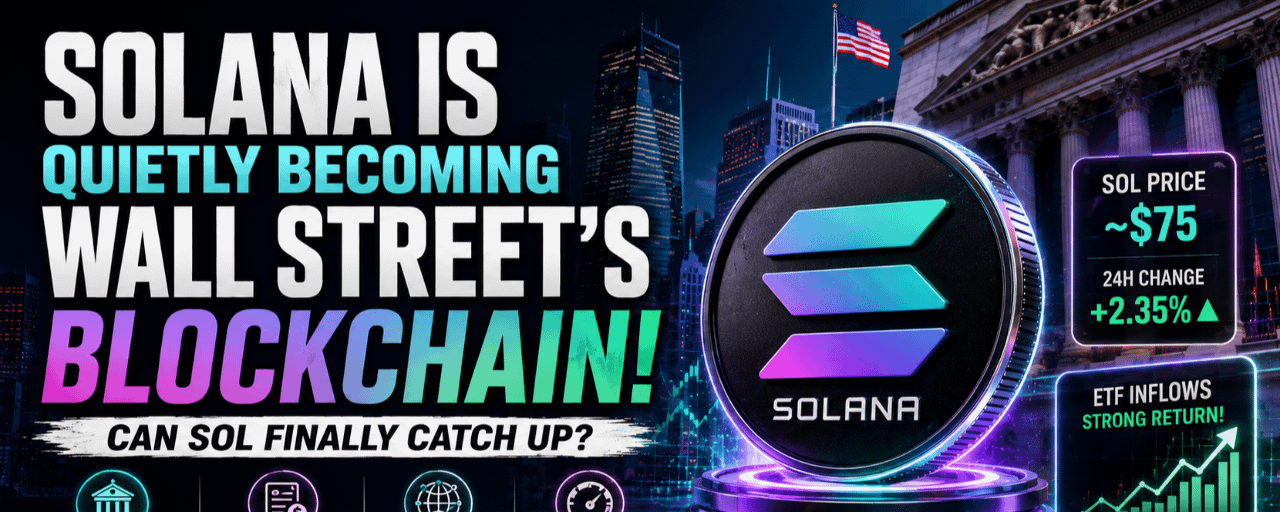
Solana Is Quietly Becoming Wall Street’s Blockchain — Can SOL Finally Catch Up?Solana's price isn't making explosive moves right now.
But underneath the price chart, something much more interesting may be happening.
Institutional money is returning.
Tokenized real-world assets are expanding.
And Solana is continuing to upgrade its infrastructure.
That raises an important question:
Is SOL being overlooked while the network quietly builds one of crypto's strongest institutional narratives?
🏦 ETF Demand Is Coming Back
One of the biggest signals catching traders' attention is the renewed demand for Solana investment products.
Recent data showed Solana spot ETFs recording their strongest single-day inflow since May, with approximately $8.8 million entering on August 10.
Weekly flows have also made Solana stand out among major crypto assets.
Recent market data showed SOL leading weekly crypto ETF inflows during the August 10–15 period, even while the broader market remained relatively quiet.
That's important because price alone doesn't tell the entire story.
If institutional capital is increasing exposure while SOL remains around the mid-$70s, traders have to ask:
Is accumulation happening before the next major move?
💰 But ETF Flows Aren't the Most Interesting Part
The bigger story may actually be tokenization.
Solana is increasingly being used as infrastructure for assets that traditionally live inside financial markets.
And the latest numbers are catching attention.
According to RWA.xyz-linked data, Solana recorded approximately $378 million in net inflows into tokenized U.S. Treasury activity over the latest 30-day period, the largest increase among blockchain networks during that period.
Meanwhile, the broader tokenized Treasury market reached approximately $16.23 billion in distributed value as of August 15.
This changes the Solana narrative.
It's no longer only:
memecoins + DeFi + fast transactions.
The conversation is increasingly becoming:
Treasuries + equities + stablecoins + institutional finance.
🌎 Solana Is Moving Deeper Into Real-World Assets
Solana's own ecosystem reporting has already highlighted strong RWA growth.
In May, Solana reported that its RWA ecosystem had crossed $2.8 billion, while tokenized-equity activity reached a 97% share of cumulative on-chain tokenized-equities spot trading volume at that time.
And the expansion hasn't stopped.
Tokenized stocks and ETFs are increasingly appearing across multiple blockchain networks, with Solana becoming one of the major venues for this activity.
That's potentially a much bigger long-term narrative than another short-lived altcoin pump.
Because if traditional assets increasingly move on-chain, the blockchain providing the infrastructure could become strategically important.
⚡ Another Catalyst: Solana's Agave 4.2 Upgrade
There's another development worth watching this week.
Solana's Agave 4.2 upgrade has a feature-activation window around the week of August 17.
The upgrade is aimed at reducing slot times from roughly 400ms toward 350ms, with a longer-term target around 200ms, while also reducing storage costs.
Why does that matter?
Because institutional adoption doesn't only require liquidity.
It requires infrastructure that can handle increasing demand efficiently.
If Solana can continue improving performance while attracting financial assets, its institutional narrative becomes stronger.
🤔 So Why Isn't SOL Already Exploding?
This is the question bulls need to answer.
SOL is currently around $75, while its previous all-time high was far above today's level.
Yet despite:
ETF inflowsRWA growthTokenized Treasury activityNetwork upgradesStablecoin growth
SOL isn't currently experiencing a massive breakout.
That could mean two things.
🟢 Bullish interpretation
The market hasn't fully priced in Solana's institutional growth yet.
🔴 Bearish interpretation
The positive developments may already be reflected in valuations, while broader crypto liquidity remains weak.
And this is exactly where the debate becomes interesting.
📊 The Biggest Question: Does Network Growth Actually Benefit SOL?
There's an important distinction investors shouldn't ignore.
Solana the network ≠ SOL the token.
A blockchain can attract more assets, users and transactions without the native token necessarily rising immediately.
That's because the market ultimately needs to determine how much of that ecosystem growth translates into sustainable demand for SOL.
This is one of the biggest questions facing the Solana thesis.
Recent analysis has similarly highlighted that strong network activity doesn't automatically translate one-for-one into value flowing to SOL holders.
So the bullish case needs more than impressive adoption statistics.
It needs a stronger connection between:
network growth → economic activity → SOL demand.
🏦 Could Solana Become a Major RWA Settlement Layer?
This may be the most important long-term question.
Imagine a future where:
Treasury bills are tokenized.
Stocks trade on-chain.
Funds settle through blockchain infrastructure.
Stablecoins move billions of dollars globally.
And financial institutions need a fast, scalable network underneath all of it.
If Solana captures even a meaningful portion of that activity, its role in crypto could look very different.
It would no longer be viewed simply as another Layer-1.
It could increasingly be viewed as financial-market infrastructure.
Solana itself describes its network as infrastructure for internet capital markets, payments and crypto applications.
⚠️ But There Are Still Risks
The bullish story isn't guaranteed.
1️⃣ Broader crypto weakness
If Bitcoin and the wider market remain weak, SOL can struggle regardless of fundamentals.
2️⃣ ETF flows can reverse
One strong week doesn't establish a permanent institutional trend.
3️⃣ Competition
Ethereum, BNB Chain and other networks are also competing for tokenized assets.
4️⃣ Valuation
Strong fundamentals don't automatically mean SOL is cheap.
5️⃣ Token-value capture
The biggest question remains how much network growth ultimately benefits SOL itself.
👀 The 5 Things I'm Watching This Week
If I were tracking SOL closely, these would be my main indicators:
1️⃣ ETF flows
Does institutional demand continue?
2️⃣ Tokenized Treasury growth
Can Solana maintain its recent RWA momentum?
3️⃣ Agave 4.2 activation
Does the upgrade deliver the expected infrastructure improvements?
4️⃣ SOL price structure
Can SOL move decisively above its current range?
5️⃣ Bitcoin liquidity
Can the broader market support an altcoin rotation?
These five signals together could tell us much more than simply watching the SOL price.
🚀 Final Take
Solana's most interesting story right now may not be its price.
It's what is happening around the price.
ETF demand has started showing signs of returning.
Tokenized U.S. Treasury activity is accelerating.
The broader RWA ecosystem continues expanding.
And Solana is entering another important infrastructure-upgrade phase.
That creates a fascinating setup.
The network is building.
Institutions are watching.
Tokenized assets are growing.
But SOL still needs to prove that this ecosystem growth can translate into sustained token demand.
That's the real investment debate.
Is Solana quietly building the financial infrastructure of the next crypto cycle — while the market is still focused on the price chart? 👀
💬 What Do YOU Think?
Can Solana become one of the biggest blockchain winners from institutional RWA adoption?
🟢 Yes — SOL is still undervalued 🚀
🔵 Institutional adoption will take time
🔴 Too much is already priced in
🟡 ETH will dominate RWA instead
👇 Vote and tell me your reason.
#Solana #SOL #RWA #Tokenization #CryptoETF #DeFi #Altcoins #Bitcoin #Ethereum #CryptoMarket #BinanceSquare
Solana Is Quietly Becoming Wall Street’s Blockchain — Can SOL Finally Catch Up?
Solana's price isn't making explosive moves right now.
But underneath the price chart, something much more interesting may be happening.
Institutional money is returning.
Tokenized real-world assets are expanding.
And Solana is continuing to upgrade its infrastructure.
That raises an important question:
Is SOL being overlooked while the network quietly builds one of crypto's strongest institutional narratives?
🏦 ETF Demand Is Coming Back
One of the biggest signals catching traders' attention is the renewed demand for Solana investment products.
Recent data showed Solana spot ETFs recording their strongest single-day inflow since May, with approximately $8.8 million entering on August 10.
Weekly flows have also made Solana stand out among major crypto assets.
Recent market data showed SOL leading weekly crypto ETF inflows during the August 10–15 period, even while the broader market remained relatively quiet.
That's important because price alone doesn't tell the entire story.
If institutional capital is increasing exposure while SOL remains around the mid-$70s, traders have to ask:
Is accumulation happening before the next major move?
💰 But ETF Flows Aren't the Most Interesting Part
The bigger story may actually be tokenization.
Solana is increasingly being used as infrastructure for assets that traditionally live inside financial markets.
And the latest numbers are catching attention.
According to RWA.xyz-linked data, Solana recorded approximately $378 million in net inflows into tokenized U.S. Treasury activity over the latest 30-day period, the largest increase among blockchain networks during that period.
Meanwhile, the broader tokenized Treasury market reached approximately $16.23 billion in distributed value as of August 15.
This changes the Solana narrative.
It's no longer only:
memecoins + DeFi + fast transactions.
The conversation is increasingly becoming:
Treasuries + equities + stablecoins + institutional finance.
🌎 Solana Is Moving Deeper Into Real-World Assets
Solana's own ecosystem reporting has already highlighted strong RWA growth.
In May, Solana reported that its RWA ecosystem had crossed $2.8 billion, while tokenized-equity activity reached a 97% share of cumulative on-chain tokenized-equities spot trading volume at that time.
And the expansion hasn't stopped.
Tokenized stocks and ETFs are increasingly appearing across multiple blockchain networks, with Solana becoming one of the major venues for this activity.
That's potentially a much bigger long-term narrative than another short-lived altcoin pump.
Because if traditional assets increasingly move on-chain, the blockchain providing the infrastructure could become strategically important.
⚡ Another Catalyst: Solana's Agave 4.2 Upgrade
There's another development worth watching this week.
Solana's Agave 4.2 upgrade has a feature-activation window around the week of August 17.
The upgrade is aimed at reducing slot times from roughly 400ms toward 350ms, with a longer-term target around 200ms, while also reducing storage costs.
Why does that matter?
Because institutional adoption doesn't only require liquidity.
It requires infrastructure that can handle increasing demand efficiently.
If Solana can continue improving performance while attracting financial assets, its institutional narrative becomes stronger.
🤔 So Why Isn't SOL Already Exploding?
This is the question bulls need to answer.
SOL is currently around $75, while its previous all-time high was far above today's level.
Yet despite:
ETF inflowsRWA growthTokenized Treasury activityNetwork upgradesStablecoin growth
SOL isn't currently experiencing a massive breakout.
That could mean two things.
🟢 Bullish interpretation
The market hasn't fully priced in Solana's institutional growth yet.
🔴 Bearish interpretation
The positive developments may already be reflected in valuations, while broader crypto liquidity remains weak.
And this is exactly where the debate becomes interesting.
📊 The Biggest Question: Does Network Growth Actually Benefit SOL?
There's an important distinction investors shouldn't ignore.
Solana the network ≠ SOL the token.
A blockchain can attract more assets, users and transactions without the native token necessarily rising immediately.
That's because the market ultimately needs to determine how much of that ecosystem growth translates into sustainable demand for SOL.
This is one of the biggest questions facing the Solana thesis.
Recent analysis has similarly highlighted that strong network activity doesn't automatically translate one-for-one into value flowing to SOL holders.
So the bullish case needs more than impressive adoption statistics.
It needs a stronger connection between:
network growth → economic activity → SOL demand.
🏦 Could Solana Become a Major RWA Settlement Layer?
This may be the most important long-term question.
Imagine a future where:
Treasury bills are tokenized.
Stocks trade on-chain.
Funds settle through blockchain infrastructure.
Stablecoins move billions of dollars globally.
And financial institutions need a fast, scalable network underneath all of it.
If Solana captures even a meaningful portion of that activity, its role in crypto could look very different.
It would no longer be viewed simply as another Layer-1.
It could increasingly be viewed as financial-market infrastructure.
Solana itself describes its network as infrastructure for internet capital markets, payments and crypto applications.
⚠️ But There Are Still Risks
The bullish story isn't guaranteed.
1️⃣ Broader crypto weakness
If Bitcoin and the wider market remain weak, SOL can struggle regardless of fundamentals.
2️⃣ ETF flows can reverse
One strong week doesn't establish a permanent institutional trend.
3️⃣ Competition
Ethereum, BNB Chain and other networks are also competing for tokenized assets.
4️⃣ Valuation
Strong fundamentals don't automatically mean SOL is cheap.
5️⃣ Token-value capture
The biggest question remains how much network growth ultimately benefits SOL itself.
👀 The 5 Things I'm Watching This Week
If I were tracking SOL closely, these would be my main indicators:
1️⃣ ETF flows
Does institutional demand continue?
2️⃣ Tokenized Treasury growth
Can Solana maintain its recent RWA momentum?
3️⃣ Agave 4.2 activation
Does the upgrade deliver the expected infrastructure improvements?
4️⃣ SOL price structure
Can SOL move decisively above its current range?
5️⃣ Bitcoin liquidity
Can the broader market support an altcoin rotation?
These five signals together could tell us much more than simply watching the SOL price.
🚀 Final Take
Solana's most interesting story right now may not be its price.
It's what is happening around the price.
ETF demand has started showing signs of returning.
Tokenized U.S. Treasury activity is accelerating.
The broader RWA ecosystem continues expanding.
And Solana is entering another important infrastructure-upgrade phase.
That creates a fascinating setup.
The network is building.
Institutions are watching.
Tokenized assets are growing.
But SOL still needs to prove that this ecosystem growth can translate into sustained token demand.
That's the real investment debate.
Is Solana quietly building the financial infrastructure of the next crypto cycle — while the market is still focused on the price chart? 👀
💬 What Do YOU Think?
Can Solana become one of the biggest blockchain winners from institutional RWA adoption?
🟢 Yes — SOL is still undervalued 🚀
🔵 Institutional adoption will take time
🔴 Too much is already priced in
🟡 ETH will dominate RWA instead
👇 Vote and tell me your reason.
#Solana #SOL #RWA #Tokenization #CryptoETF #DeFi #Altcoins #Bitcoin #Ethereum #CryptoMarket #BinanceSquare
But underneath the price chart, something much more interesting may be happening.
Institutional money is returning.
Tokenized real-world assets are expanding.
And Solana is continuing to upgrade its infrastructure.
That raises an important question:
Is SOL being overlooked while the network quietly builds one of crypto's strongest institutional narratives?
🏦 ETF Demand Is Coming Back
One of the biggest signals catching traders' attention is the renewed demand for Solana investment products.
Recent data showed Solana spot ETFs recording their strongest single-day inflow since May, with approximately $8.8 million entering on August 10.
Weekly flows have also made Solana stand out among major crypto assets.
Recent market data showed SOL leading weekly crypto ETF inflows during the August 10–15 period, even while the broader market remained relatively quiet.
That's important because price alone doesn't tell the entire story.
If institutional capital is increasing exposure while SOL remains around the mid-$70s, traders have to ask:
Is accumulation happening before the next major move?
💰 But ETF Flows Aren't the Most Interesting Part
The bigger story may actually be tokenization.
Solana is increasingly being used as infrastructure for assets that traditionally live inside financial markets.
And the latest numbers are catching attention.
According to RWA.xyz-linked data, Solana recorded approximately $378 million in net inflows into tokenized U.S. Treasury activity over the latest 30-day period, the largest increase among blockchain networks during that period.
Meanwhile, the broader tokenized Treasury market reached approximately $16.23 billion in distributed value as of August 15.
This changes the Solana narrative.
It's no longer only:
memecoins + DeFi + fast transactions.
The conversation is increasingly becoming:
Treasuries + equities + stablecoins + institutional finance.
🌎 Solana Is Moving Deeper Into Real-World Assets
Solana's own ecosystem reporting has already highlighted strong RWA growth.
In May, Solana reported that its RWA ecosystem had crossed $2.8 billion, while tokenized-equity activity reached a 97% share of cumulative on-chain tokenized-equities spot trading volume at that time.
And the expansion hasn't stopped.
Tokenized stocks and ETFs are increasingly appearing across multiple blockchain networks, with Solana becoming one of the major venues for this activity.
That's potentially a much bigger long-term narrative than another short-lived altcoin pump.
Because if traditional assets increasingly move on-chain, the blockchain providing the infrastructure could become strategically important.
⚡ Another Catalyst: Solana's Agave 4.2 Upgrade
There's another development worth watching this week.
Solana's Agave 4.2 upgrade has a feature-activation window around the week of August 17.
The upgrade is aimed at reducing slot times from roughly 400ms toward 350ms, with a longer-term target around 200ms, while also reducing storage costs.
Why does that matter?
Because institutional adoption doesn't only require liquidity.
It requires infrastructure that can handle increasing demand efficiently.
If Solana can continue improving performance while attracting financial assets, its institutional narrative becomes stronger.
🤔 So Why Isn't SOL Already Exploding?
This is the question bulls need to answer.
SOL is currently around $75, while its previous all-time high was far above today's level.
Yet despite:
ETF inflowsRWA growthTokenized Treasury activityNetwork upgradesStablecoin growth
SOL isn't currently experiencing a massive breakout.
That could mean two things.
🟢 Bullish interpretation
The market hasn't fully priced in Solana's institutional growth yet.
🔴 Bearish interpretation
The positive developments may already be reflected in valuations, while broader crypto liquidity remains weak.
And this is exactly where the debate becomes interesting.
📊 The Biggest Question: Does Network Growth Actually Benefit SOL?
There's an important distinction investors shouldn't ignore.
Solana the network ≠ SOL the token.
A blockchain can attract more assets, users and transactions without the native token necessarily rising immediately.
That's because the market ultimately needs to determine how much of that ecosystem growth translates into sustainable demand for SOL.
This is one of the biggest questions facing the Solana thesis.
Recent analysis has similarly highlighted that strong network activity doesn't automatically translate one-for-one into value flowing to SOL holders.
So the bullish case needs more than impressive adoption statistics.
It needs a stronger connection between:
network growth → economic activity → SOL demand.
🏦 Could Solana Become a Major RWA Settlement Layer?
This may be the most important long-term question.
Imagine a future where:
Treasury bills are tokenized.
Stocks trade on-chain.
Funds settle through blockchain infrastructure.
Stablecoins move billions of dollars globally.
And financial institutions need a fast, scalable network underneath all of it.
If Solana captures even a meaningful portion of that activity, its role in crypto could look very different.
It would no longer be viewed simply as another Layer-1.
It could increasingly be viewed as financial-market infrastructure.
Solana itself describes its network as infrastructure for internet capital markets, payments and crypto applications.
⚠️ But There Are Still Risks
The bullish story isn't guaranteed.
1️⃣ Broader crypto weakness
If Bitcoin and the wider market remain weak, SOL can struggle regardless of fundamentals.
2️⃣ ETF flows can reverse
One strong week doesn't establish a permanent institutional trend.
3️⃣ Competition
Ethereum, BNB Chain and other networks are also competing for tokenized assets.
4️⃣ Valuation
Strong fundamentals don't automatically mean SOL is cheap.
5️⃣ Token-value capture
The biggest question remains how much network growth ultimately benefits SOL itself.
👀 The 5 Things I'm Watching This Week
If I were tracking SOL closely, these would be my main indicators:
1️⃣ ETF flows
Does institutional demand continue?
2️⃣ Tokenized Treasury growth
Can Solana maintain its recent RWA momentum?
3️⃣ Agave 4.2 activation
Does the upgrade deliver the expected infrastructure improvements?
4️⃣ SOL price structure
Can SOL move decisively above its current range?
5️⃣ Bitcoin liquidity
Can the broader market support an altcoin rotation?
These five signals together could tell us much more than simply watching the SOL price.
🚀 Final Take
Solana's most interesting story right now may not be its price.
It's what is happening around the price.
ETF demand has started showing signs of returning.
Tokenized U.S. Treasury activity is accelerating.
The broader RWA ecosystem continues expanding.
And Solana is entering another important infrastructure-upgrade phase.
That creates a fascinating setup.
The network is building.
Institutions are watching.
Tokenized assets are growing.
But SOL still needs to prove that this ecosystem growth can translate into sustained token demand.
That's the real investment debate.
Is Solana quietly building the financial infrastructure of the next crypto cycle — while the market is still focused on the price chart? 👀
💬 What Do YOU Think?
Can Solana become one of the biggest blockchain winners from institutional RWA adoption?
🟢 Yes — SOL is still undervalued 🚀
🔵 Institutional adoption will take time
🔴 Too much is already priced in
🟡 ETH will dominate RWA instead
👇 Vote and tell me your reason.
#Solana #SOL #RWA #Tokenization #CryptoETF #DeFi #Altcoins #Bitcoin #Ethereum #CryptoMarket #BinanceSquare
82
🚨 Bitcoin Is Quiet… But SOL Is Getting Attention 👀
BTC is still struggling around the $63K zone.
Meanwhile, Solana is standing out as it leads weekly crypto ETF inflows. 🏦🔥
That raises an interesting question:
Could SOL outperform Bitcoin if the next altcoin rotation begins?
🟢 SOL leads the next move 🚀
🔴 BTC still dominates 📈
🟡 Altcoins need more confirmation
🔵 Market stays sideways
What’s your pick? 👇
#Solana #SOL #Bitcoin #BTC #Crypto #Altcoins #CryptoMarket #BinanceSquare
🚨 Bitcoin Is Quiet… But SOL Is Getting Attention 👀
BTC is still struggling around the $63K zone.
Meanwhile, Solana is standing out as it leads weekly crypto ETF inflows. 🏦🔥
That raises an interesting question:
Could SOL outperform Bitcoin if the next altcoin rotation begins?
🟢 SOL leads the next move 🚀
🔴 BTC still dominates 📈
🟡 Altcoins need more confirmation
🔵 Market stays sideways
What’s your pick? 👇
#Solana #SOL #Bitcoin #BTC #Crypto #Altcoins #CryptoMarket #BinanceSquare
BTC is still struggling around the $63K zone.
Meanwhile, Solana is standing out as it leads weekly crypto ETF inflows. 🏦🔥
That raises an interesting question:
Could SOL outperform Bitcoin if the next altcoin rotation begins?
🟢 SOL leads the next move 🚀
🔴 BTC still dominates 📈
🟡 Altcoins need more confirmation
🔵 Market stays sideways
What’s your pick? 👇
#Solana #SOL #Bitcoin #BTC #Crypto #Altcoins #CryptoMarket #BinanceSquare
69
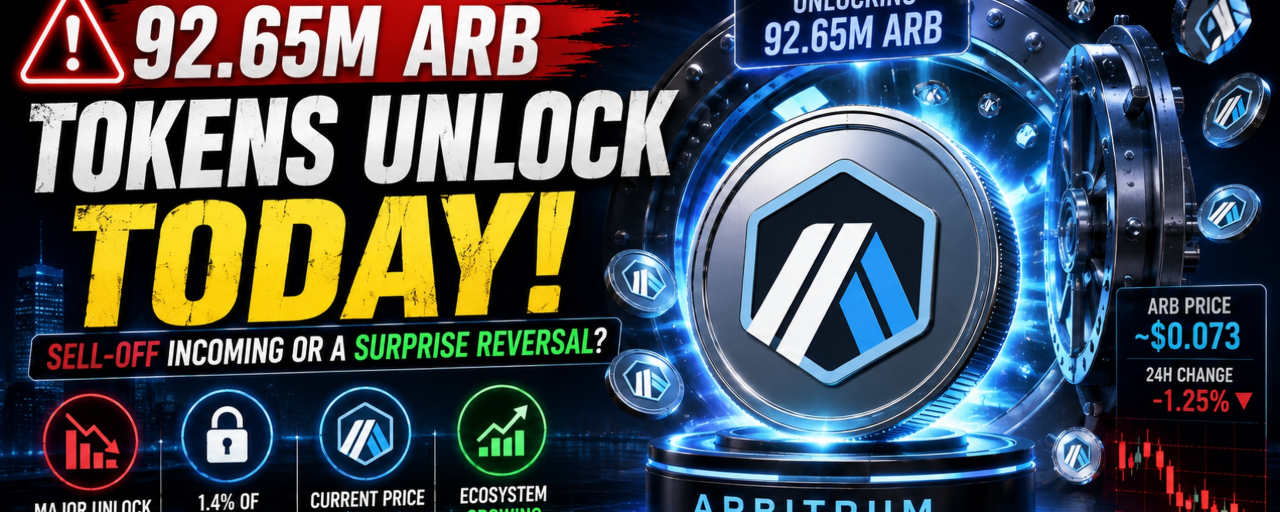
Article
92.65M ARB Tokens Unlock Today — Sell-Off Incoming or Is Arbitrum Finally Nearing a Reversal?Arbitrum is facing another major supply test.
Around 92.65 million ARB tokens are being reported for release around August 16, worth roughly $7 million at current prices. That represents about 1.4% of circulating supply, making today's event one of the key short-term catalysts for ARB traders.
But here's where the story gets interesting:
ARB is already trading near $0.07 — close to historically depressed levels.
So the question isn't simply whether the unlock is bearish.
The bigger question is:
Has the market already priced in the new supply?
📉 ARB Has Been Under Pressure for a Long Time
ARB has struggled through a prolonged downtrend, and recent analysis describes its market structure as still bearish.
However, there are some early signs that the trend could be changing.
Recent technical analysis points to higher lows and bullish RSI divergence around the $0.07 area, suggesting that some buyers may be starting to accumulate while broader market interest remains weak.
That creates an unusual setup:
Price is weak — but the underlying Arbitrum ecosystem is not standing still.
⚠️ Why Today's Unlock Matters
Token unlocks increase the amount of an asset available in the market.
If recipients decide to sell, additional supply can create selling pressure.
For ARB, this has become an important issue because scheduled releases continue to be part of its tokenomics.
This creates a simple battle:
🔴 Bears
More tokens entering circulation could create additional supply pressure.
🟢 Bulls
If most of the unlock is absorbed without a major price decline, traders could interpret that as evidence that selling pressure is being absorbed.
And that's why price reaction after the unlock may matter more than the unlock itself.
🏗️ But Arbitrum's Network Story Is Getting More Interesting
Here's the part that ARB bears shouldn't ignore.
Arbitrum has been attracting increasing attention in the real-world assets and tokenized-stock sector.
Recent reporting showed the market capitalization of tokenized stocks on Arbitrum rising 476% to around $173 million.
That is significant because tokenized equities are becoming one of the most interesting bridges between traditional finance and blockchain infrastructure.
Arbitrum has also already been used for tokenized stock and ETF products through Robinhood's blockchain initiatives. Arbitrum's own transparency report highlights the expansion of tokenized equities on Arbitrum One and continued network growth.
So while ARB's token price has struggled, the network itself continues developing new use cases.
🤔 Why Isn't Network Growth Automatically Bullish for ARB?
This is one of the most important questions for investors.
A blockchain can experience strong adoption while its native token performs poorly.
Why?
Because network usage and token economics aren't always perfectly aligned.
ARB is primarily a governance token rather than the gas token users need for transactions.
That means increasing activity on Arbitrum doesn't automatically create direct buying pressure for ARB.
This is why investors need to watch both:
Arbitrum adoption
AND
ARB tokenomics.
🔥 Today's Unlock Creates a Critical Test
There are basically three scenarios from here.
🟢 Scenario 1 — The Unlock Gets Absorbed
If ARB remains stable or even rises despite the additional supply, that could be an encouraging signal.
It would suggest buyers are strong enough to absorb the new tokens.
A successful defense of the ~$0.07 area could then become interesting for traders watching for a reversal.
🔴 Scenario 2 — Sellers Take Control
If ARB breaks below recent support after the unlock, traders could interpret the move as confirmation that supply pressure remains dominant.
That could keep ARB trapped in its long-term downtrend.
🟡 Scenario 3 — Nothing Happens
This may actually be the most interesting scenario.
If ARB barely reacts, the market could be telling us that the unlock was already priced in.
In that case, attention could shift back toward Arbitrum's fundamentals, tokenized assets and broader altcoin liquidity.
👀 The $0.07 Area Is Becoming Important
ARB is currently trading around $0.073, with recent intraday trading roughly between $0.072 and $0.075.
That puts the token very close to the psychologically important $0.07 zone.
For bulls, holding this area could become the first step toward building a bottom.
For bears, losing it could reinforce the argument that the long-term downtrend isn't finished.
So rather than blindly predicting a pump or dump, I'm watching:
$0.07 support → unlock absorption → volume → open interest → broader altcoin sentiment.
📊 Could Tokenized Stocks Become ARB's Bigger Story?
This may ultimately be more important than today's unlock.
Arbitrum is increasingly positioning itself as infrastructure for real-world assets and tokenized financial products.
The growth of tokenized stocks on the network suggests that traditional financial assets are becoming a meaningful part of the ecosystem.
If that trend continues, Arbitrum could benefit from a much larger narrative:
Blockchain infrastructure for traditional finance.
But again, the key question remains:
Will that ecosystem growth eventually translate into stronger demand for ARB itself?
That's the part the market still needs to prove.
🧠 What I'm Watching After the Unlock
Instead of focusing only on the number of tokens released, these are the signals I'd watch:
1️⃣ ARB price reaction
Does ARB hold $0.07?
2️⃣ Trading volume
Does volume increase as the unlock hits?
3️⃣ Selling pressure
Do large holders distribute?
4️⃣ Arbitrum ecosystem activity
Does tokenized-asset adoption continue growing?
5️⃣ Broader altcoin market
Can ARB outperform if altcoin liquidity improves?
These signals will tell us much more than the unlock headline alone.
🚀 Final Take
92.65M ARB entering circulation sounds bearish at first glance.
And yes, additional supply can create short-term selling pressure.
But ARB is already trading near historically depressed levels, while the Arbitrum ecosystem continues expanding into areas such as tokenized stocks and real-world assets.
That creates a fascinating battle.
Weak token price vs. growing ecosystem.
New supply vs. potential accumulation.
Long-term bearish structure vs. early signs of stabilization.
So today's unlock shouldn't automatically be viewed as a guaranteed crash catalyst.
The more important signal may come after the unlock.
If ARB absorbs the new supply and holds the $0.07 region, traders could start asking a very different question:
What if ARB's worst selling pressure is finally being absorbed?
But if support breaks decisively, the bearish trend could remain firmly in control.
The unlock is the catalyst.
The price reaction is the real story. 👀
💬 What Do YOU Think?
What happens to ARB after today's unlock?
🟢 ARB absorbs the supply & reverses 🚀
🔴 More selling pressure 📉
🟡 Already priced in — sideways
🔵 Too early to tell
👇 Vote and tell me your reason.
#Arbitrum #ARB #Ethereum #Layer2 #Crypto #Altcoins #RWA #TokenizedStocks #DeFi #CryptoMarket #BinanceSquare
92.65M ARB Tokens Unlock Today — Sell-Off Incoming or Is Arbitrum Finally Nearing a Reversal?
Arbitrum is facing another major supply test.
Around 92.65 million ARB tokens are being reported for release around August 16, worth roughly $7 million at current prices. That represents about 1.4% of circulating supply, making today's event one of the key short-term catalysts for ARB traders.
But here's where the story gets interesting:
ARB is already trading near $0.07 — close to historically depressed levels.
So the question isn't simply whether the unlock is bearish.
The bigger question is:
Has the market already priced in the new supply?
📉 ARB Has Been Under Pressure for a Long Time
ARB has struggled through a prolonged downtrend, and recent analysis describes its market structure as still bearish.
However, there are some early signs that the trend could be changing.
Recent technical analysis points to higher lows and bullish RSI divergence around the $0.07 area, suggesting that some buyers may be starting to accumulate while broader market interest remains weak.
That creates an unusual setup:
Price is weak — but the underlying Arbitrum ecosystem is not standing still.
⚠️ Why Today's Unlock Matters
Token unlocks increase the amount of an asset available in the market.
If recipients decide to sell, additional supply can create selling pressure.
For ARB, this has become an important issue because scheduled releases continue to be part of its tokenomics.
This creates a simple battle:
🔴 Bears
More tokens entering circulation could create additional supply pressure.
🟢 Bulls
If most of the unlock is absorbed without a major price decline, traders could interpret that as evidence that selling pressure is being absorbed.
And that's why price reaction after the unlock may matter more than the unlock itself.
🏗️ But Arbitrum's Network Story Is Getting More Interesting
Here's the part that ARB bears shouldn't ignore.
Arbitrum has been attracting increasing attention in the real-world assets and tokenized-stock sector.
Recent reporting showed the market capitalization of tokenized stocks on Arbitrum rising 476% to around $173 million.
That is significant because tokenized equities are becoming one of the most interesting bridges between traditional finance and blockchain infrastructure.
Arbitrum has also already been used for tokenized stock and ETF products through Robinhood's blockchain initiatives. Arbitrum's own transparency report highlights the expansion of tokenized equities on Arbitrum One and continued network growth.
So while ARB's token price has struggled, the network itself continues developing new use cases.
🤔 Why Isn't Network Growth Automatically Bullish for ARB?
This is one of the most important questions for investors.
A blockchain can experience strong adoption while its native token performs poorly.
Why?
Because network usage and token economics aren't always perfectly aligned.
ARB is primarily a governance token rather than the gas token users need for transactions.
That means increasing activity on Arbitrum doesn't automatically create direct buying pressure for ARB.
This is why investors need to watch both:
Arbitrum adoption
AND
ARB tokenomics.
🔥 Today's Unlock Creates a Critical Test
There are basically three scenarios from here.
🟢 Scenario 1 — The Unlock Gets Absorbed
If ARB remains stable or even rises despite the additional supply, that could be an encouraging signal.
It would suggest buyers are strong enough to absorb the new tokens.
A successful defense of the ~$0.07 area could then become interesting for traders watching for a reversal.
🔴 Scenario 2 — Sellers Take Control
If ARB breaks below recent support after the unlock, traders could interpret the move as confirmation that supply pressure remains dominant.
That could keep ARB trapped in its long-term downtrend.
🟡 Scenario 3 — Nothing Happens
This may actually be the most interesting scenario.
If ARB barely reacts, the market could be telling us that the unlock was already priced in.
In that case, attention could shift back toward Arbitrum's fundamentals, tokenized assets and broader altcoin liquidity.
👀 The $0.07 Area Is Becoming Important
ARB is currently trading around $0.073, with recent intraday trading roughly between $0.072 and $0.075.
That puts the token very close to the psychologically important $0.07 zone.
For bulls, holding this area could become the first step toward building a bottom.
For bears, losing it could reinforce the argument that the long-term downtrend isn't finished.
So rather than blindly predicting a pump or dump, I'm watching:
$0.07 support → unlock absorption → volume → open interest → broader altcoin sentiment.
📊 Could Tokenized Stocks Become ARB's Bigger Story?
This may ultimately be more important than today's unlock.
Arbitrum is increasingly positioning itself as infrastructure for real-world assets and tokenized financial products.
The growth of tokenized stocks on the network suggests that traditional financial assets are becoming a meaningful part of the ecosystem.
If that trend continues, Arbitrum could benefit from a much larger narrative:
Blockchain infrastructure for traditional finance.
But again, the key question remains:
Will that ecosystem growth eventually translate into stronger demand for ARB itself?
That's the part the market still needs to prove.
🧠 What I'm Watching After the Unlock
Instead of focusing only on the number of tokens released, these are the signals I'd watch:
1️⃣ ARB price reaction
Does ARB hold $0.07?
2️⃣ Trading volume
Does volume increase as the unlock hits?
3️⃣ Selling pressure
Do large holders distribute?
4️⃣ Arbitrum ecosystem activity
Does tokenized-asset adoption continue growing?
5️⃣ Broader altcoin market
Can ARB outperform if altcoin liquidity improves?
These signals will tell us much more than the unlock headline alone.
🚀 Final Take
92.65M ARB entering circulation sounds bearish at first glance.
And yes, additional supply can create short-term selling pressure.
But ARB is already trading near historically depressed levels, while the Arbitrum ecosystem continues expanding into areas such as tokenized stocks and real-world assets.
That creates a fascinating battle.
Weak token price vs. growing ecosystem.
New supply vs. potential accumulation.
Long-term bearish structure vs. early signs of stabilization.
So today's unlock shouldn't automatically be viewed as a guaranteed crash catalyst.
The more important signal may come after the unlock.
If ARB absorbs the new supply and holds the $0.07 region, traders could start asking a very different question:
What if ARB's worst selling pressure is finally being absorbed?
But if support breaks decisively, the bearish trend could remain firmly in control.
The unlock is the catalyst.
The price reaction is the real story. 👀
💬 What Do YOU Think?
What happens to ARB after today's unlock?
🟢 ARB absorbs the supply & reverses 🚀
🔴 More selling pressure 📉
🟡 Already priced in — sideways
🔵 Too early to tell
👇 Vote and tell me your reason.
#Arbitrum #ARB #Ethereum #Layer2 #Crypto #Altcoins #RWA #TokenizedStocks #DeFi #CryptoMarket #BinanceSquare
Around 92.65 million ARB tokens are being reported for release around August 16, worth roughly $7 million at current prices. That represents about 1.4% of circulating supply, making today's event one of the key short-term catalysts for ARB traders.
But here's where the story gets interesting:
ARB is already trading near $0.07 — close to historically depressed levels.
So the question isn't simply whether the unlock is bearish.
The bigger question is:
Has the market already priced in the new supply?
📉 ARB Has Been Under Pressure for a Long Time
ARB has struggled through a prolonged downtrend, and recent analysis describes its market structure as still bearish.
However, there are some early signs that the trend could be changing.
Recent technical analysis points to higher lows and bullish RSI divergence around the $0.07 area, suggesting that some buyers may be starting to accumulate while broader market interest remains weak.
That creates an unusual setup:
Price is weak — but the underlying Arbitrum ecosystem is not standing still.
⚠️ Why Today's Unlock Matters
Token unlocks increase the amount of an asset available in the market.
If recipients decide to sell, additional supply can create selling pressure.
For ARB, this has become an important issue because scheduled releases continue to be part of its tokenomics.
This creates a simple battle:
🔴 Bears
More tokens entering circulation could create additional supply pressure.
🟢 Bulls
If most of the unlock is absorbed without a major price decline, traders could interpret that as evidence that selling pressure is being absorbed.
And that's why price reaction after the unlock may matter more than the unlock itself.
🏗️ But Arbitrum's Network Story Is Getting More Interesting
Here's the part that ARB bears shouldn't ignore.
Arbitrum has been attracting increasing attention in the real-world assets and tokenized-stock sector.
Recent reporting showed the market capitalization of tokenized stocks on Arbitrum rising 476% to around $173 million.
That is significant because tokenized equities are becoming one of the most interesting bridges between traditional finance and blockchain infrastructure.
Arbitrum has also already been used for tokenized stock and ETF products through Robinhood's blockchain initiatives. Arbitrum's own transparency report highlights the expansion of tokenized equities on Arbitrum One and continued network growth.
So while ARB's token price has struggled, the network itself continues developing new use cases.
🤔 Why Isn't Network Growth Automatically Bullish for ARB?
This is one of the most important questions for investors.
A blockchain can experience strong adoption while its native token performs poorly.
Why?
Because network usage and token economics aren't always perfectly aligned.
ARB is primarily a governance token rather than the gas token users need for transactions.
That means increasing activity on Arbitrum doesn't automatically create direct buying pressure for ARB.
This is why investors need to watch both:
Arbitrum adoption
AND
ARB tokenomics.
🔥 Today's Unlock Creates a Critical Test
There are basically three scenarios from here.
🟢 Scenario 1 — The Unlock Gets Absorbed
If ARB remains stable or even rises despite the additional supply, that could be an encouraging signal.
It would suggest buyers are strong enough to absorb the new tokens.
A successful defense of the ~$0.07 area could then become interesting for traders watching for a reversal.
🔴 Scenario 2 — Sellers Take Control
If ARB breaks below recent support after the unlock, traders could interpret the move as confirmation that supply pressure remains dominant.
That could keep ARB trapped in its long-term downtrend.
🟡 Scenario 3 — Nothing Happens
This may actually be the most interesting scenario.
If ARB barely reacts, the market could be telling us that the unlock was already priced in.
In that case, attention could shift back toward Arbitrum's fundamentals, tokenized assets and broader altcoin liquidity.
👀 The $0.07 Area Is Becoming Important
ARB is currently trading around $0.073, with recent intraday trading roughly between $0.072 and $0.075.
That puts the token very close to the psychologically important $0.07 zone.
For bulls, holding this area could become the first step toward building a bottom.
For bears, losing it could reinforce the argument that the long-term downtrend isn't finished.
So rather than blindly predicting a pump or dump, I'm watching:
$0.07 support → unlock absorption → volume → open interest → broader altcoin sentiment.
📊 Could Tokenized Stocks Become ARB's Bigger Story?
This may ultimately be more important than today's unlock.
Arbitrum is increasingly positioning itself as infrastructure for real-world assets and tokenized financial products.
The growth of tokenized stocks on the network suggests that traditional financial assets are becoming a meaningful part of the ecosystem.
If that trend continues, Arbitrum could benefit from a much larger narrative:
Blockchain infrastructure for traditional finance.
But again, the key question remains:
Will that ecosystem growth eventually translate into stronger demand for ARB itself?
That's the part the market still needs to prove.
🧠 What I'm Watching After the Unlock
Instead of focusing only on the number of tokens released, these are the signals I'd watch:
1️⃣ ARB price reaction
Does ARB hold $0.07?
2️⃣ Trading volume
Does volume increase as the unlock hits?
3️⃣ Selling pressure
Do large holders distribute?
4️⃣ Arbitrum ecosystem activity
Does tokenized-asset adoption continue growing?
5️⃣ Broader altcoin market
Can ARB outperform if altcoin liquidity improves?
These signals will tell us much more than the unlock headline alone.
🚀 Final Take
92.65M ARB entering circulation sounds bearish at first glance.
And yes, additional supply can create short-term selling pressure.
But ARB is already trading near historically depressed levels, while the Arbitrum ecosystem continues expanding into areas such as tokenized stocks and real-world assets.
That creates a fascinating battle.
Weak token price vs. growing ecosystem.
New supply vs. potential accumulation.
Long-term bearish structure vs. early signs of stabilization.
So today's unlock shouldn't automatically be viewed as a guaranteed crash catalyst.
The more important signal may come after the unlock.
If ARB absorbs the new supply and holds the $0.07 region, traders could start asking a very different question:
What if ARB's worst selling pressure is finally being absorbed?
But if support breaks decisively, the bearish trend could remain firmly in control.
The unlock is the catalyst.
The price reaction is the real story. 👀
💬 What Do YOU Think?
What happens to ARB after today's unlock?
🟢 ARB absorbs the supply & reverses 🚀
🔴 More selling pressure 📉
🟡 Already priced in — sideways
🔵 Too early to tell
👇 Vote and tell me your reason.
#Arbitrum #ARB #Ethereum #Layer2 #Crypto #Altcoins #RWA #TokenizedStocks #DeFi #CryptoMarket #BinanceSquare
130
🚨 Bitcoin Isn't Falling Because of Inflation… So What's Holding BTC Back? 👀
BTC is hovering around $63K, even after softer U.S. inflation data.
Now two things are grabbing traders' attention:
📉 Weaker ETF demand
🏛️ SEC crypto-rules meeting cancelled
The market has the macro relief it wanted — but Bitcoin still can't build strong upside momentum.
Is regulation + weak institutional demand becoming the bigger problem for BTC?
🟢 Temporary weakness — breakout coming 🚀
🔴 More downside first 📉
🟡 BTC stays range-bound
What's your view? 👇
#Bitcoin #BTC #Crypto #BitcoinETF #SEC #CryptoMarket #BinanceSquare
🚨 Bitcoin Isn't Falling Because of Inflation… So What's Holding BTC Back? 👀
BTC is hovering around $63K, even after softer U.S. inflation data.
Now two things are grabbing traders' attention:
📉 Weaker ETF demand
🏛️ SEC crypto-rules meeting cancelled
The market has the macro relief it wanted — but Bitcoin still can't build strong upside momentum.
Is regulation + weak institutional demand becoming the bigger problem for BTC?
🟢 Temporary weakness — breakout coming 🚀
🔴 More downside first 📉
🟡 BTC stays range-bound
What's your view? 👇
#Bitcoin #BTC #Crypto #BitcoinETF #SEC #CryptoMarket #BinanceSquare
BTC is hovering around $63K, even after softer U.S. inflation data.
Now two things are grabbing traders' attention:
📉 Weaker ETF demand
🏛️ SEC crypto-rules meeting cancelled
The market has the macro relief it wanted — but Bitcoin still can't build strong upside momentum.
Is regulation + weak institutional demand becoming the bigger problem for BTC?
🟢 Temporary weakness — breakout coming 🚀
🔴 More downside first 📉
🟡 BTC stays range-bound
What's your view? 👇
#Bitcoin #BTC #Crypto #BitcoinETF #SEC #CryptoMarket #BinanceSquare
71
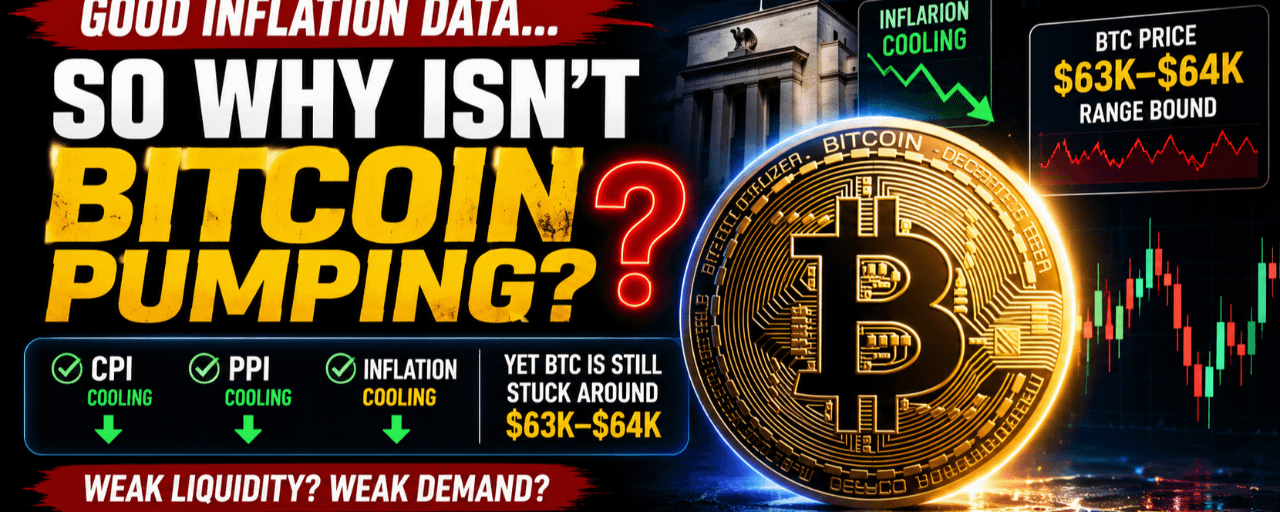
Article
Bitcoin Failed to Rally on Good Inflation Data — Are ETF Outflows the Real Problem Now?Bitcoin Got the Macro Catalyst. The Market Still Sold.
Bitcoin entered this week with a clear catalyst.
Inflation data was relatively friendly.
U.S. July CPI came in at 3.4% year over year, while producer prices were unchanged in July instead of rising as economists had expected. That should have created a more supportive environment for risk assets.
But Bitcoin didn't deliver the breakout bulls were waiting for.
Instead, BTC has slipped toward $62.8K, giving back much of last week's recovery.
And that raises a much more important question:
Is macro no longer the biggest problem for Bitcoin?
🟠 The CPI Test Is Already Over
For days, traders were focused on the U.S. inflation report.
The expectation was simple:
Cooler inflation → lower rate fears → stronger risk appetite → Bitcoin breakout.
But the actual market reaction was very different.
Bitcoin failed to reclaim the $64K area decisively, and the market moved lower instead.
That tells us something important.
A positive macro headline isn't enough when actual crypto demand isn't following.
💰 ETF Flows Are Becoming the Bigger Signal
This may be the most important development to watch.
Spot Bitcoin ETFs recorded back-to-back daily outflows, the first such streak since late July.
One recent session saw approximately $131 million in Bitcoin ETF outflows, according to market reports.
And data covering August 7–14 shows Bitcoin down around 2.39%, with ETF outflows reaching approximately $332 million during that period.
This creates a very different picture from earlier in the month.
Institutional demand had helped support BTC.
Now that support appears less reliable.
📉 Why This Matters
Bitcoin's ETF market has changed the way BTC responds to demand.
When large amounts of capital enter spot ETFs, institutions can gain Bitcoin exposure without directly holding coins on exchanges.
But the opposite is also true.
When investors redeem ETF shares, selling pressure can become an important part of the market's short-term structure.
That's why traders are watching ETF flows almost as closely as price.
And right now:
Price is weakening.
ETF flows are negative.
Volatility is relatively compressed.
That combination deserves attention.
🇺🇸 There's Another Problem: U.S. Crypto Regulation
The market also received disappointing regulatory news.
The U.S. SEC unexpectedly cancelled a scheduled meeting that was expected to address proposed crypto rules, citing an unforeseen scheduling issue. No replacement date has been announced.
Meanwhile, the Senate's CLARITY Act process has been pushed into September after lawmakers failed to complete the process before the August recess.
This matters because clearer rules are widely viewed as an important step toward greater institutional participation.
So Bitcoin is now facing two different questions:
Will institutional money keep flowing?
And:
Will the U.S. regulatory environment become clearer?
🧩 The Strange Part: Stocks Are Doing Fine
Here's where the divergence becomes interesting.
The S&P 500 recently reached a record high, while U.S. equity funds attracted $2.58 billion in net inflows during the week ending August 12.
So this isn't simply a case of every risk asset collapsing.
Traditional markets are showing strength.
Bitcoin isn't.
That makes the crypto-specific factors more important.
ETF flows.
Regulation.
Crypto positioning.
And market liquidity.
👀 What Could Happen Next?
There are two major scenarios.
🟢 Bullish Scenario
If Bitcoin stabilizes around the current area and ETF outflows reverse, buyers could regain confidence.
A move back above the $64K area would be important because BTC has repeatedly struggled to establish momentum above it.
If that happens alongside renewed ETF inflows, the current weakness could eventually look like consolidation rather than the start of a deeper decline.
🔴 Bearish Scenario
If ETF outflows continue and BTC loses the current support zone, sentiment could deteriorate further.
The danger is that traders who bought the earlier rebound may start reducing positions.
That could increase selling pressure.
⚠️ The Biggest Mistake Would Be Chasing the Weekend Move
Bitcoin is trading in a relatively quiet weekend environment.
That means a move lower doesn't automatically confirm a major bear trend.
But it also doesn't mean the weakness should be ignored.
The better signal will be what happens when traditional markets reopen and ETF flows update.
Weekend price action can be noisy.
Institutional flows are harder to ignore.
🔥 What I'm Watching Now
For the next few sessions, I'd focus on five things:
1️⃣ BTC around $62K–$64K
Can Bitcoin reclaim the upper part of this range?
2️⃣ Spot Bitcoin ETF flows
Do outflows continue or reverse?
3️⃣ U.S. regulatory developments
Does the SEC announce a new date?
4️⃣ Ethereum and major altcoins
Can they show relative strength while BTC consolidates?
5️⃣ Traditional risk markets
Does the stock-market rally continue?
These signals together should give us a much clearer picture.
🚀 Final Thoughts
Bitcoin didn't get the clean breakout catalyst traders wanted.
Inflation cooled.
Producer prices were soft.
U.S. stocks remained strong.
Yet BTC still moved toward $62.8K and ETF outflows returned.
That makes the current market much more interesting than a simple bullish-versus-bearish debate.
The key question isn't:
“Will Bitcoin pump tomorrow?”
It's:
“Where will the next real source of demand come from?”
If ETF buyers return, Bitcoin could regain momentum.
If outflows continue, the market may need to find a new source of liquidity before another sustainable rally begins.
And with U.S. crypto regulation also facing delays, the next few weeks could be much more important than one CPI report.
💬 What Do YOU Think?
What is Bitcoin's biggest problem right now? 👀
🟢 ETF outflows
🔴 Regulatory uncertainty
🟡 Weak crypto demand
🔵 BTC is simply consolidating
👇 Vote and tell me your reason.
#Bitcoin #BTC #BitcoinETF #Crypto #CryptoMarket #Ethereum #CryptoRegulation #CLARITYAct #BinanceSquare
Dost, ye angle mujhe aaj ke liye sabse strong lag raha hai because it combines price action + ETF money + macro + regulation instead of another repetitive BTC prediction article.
Bitcoin Failed to Rally on Good Inflation Data — Are ETF Outflows the Real Problem Now?
Bitcoin Got the Macro Catalyst. The Market Still Sold.
Bitcoin entered this week with a clear catalyst.
Inflation data was relatively friendly.
U.S. July CPI came in at 3.4% year over year, while producer prices were unchanged in July instead of rising as economists had expected. That should have created a more supportive environment for risk assets.
But Bitcoin didn't deliver the breakout bulls were waiting for.
Instead, BTC has slipped toward $62.8K, giving back much of last week's recovery.
And that raises a much more important question:
Is macro no longer the biggest problem for Bitcoin?
🟠 The CPI Test Is Already Over
For days, traders were focused on the U.S. inflation report.
The expectation was simple:
Cooler inflation → lower rate fears → stronger risk appetite → Bitcoin breakout.
But the actual market reaction was very different.
Bitcoin failed to reclaim the $64K area decisively, and the market moved lower instead.
That tells us something important.
A positive macro headline isn't enough when actual crypto demand isn't following.
💰 ETF Flows Are Becoming the Bigger Signal
This may be the most important development to watch.
Spot Bitcoin ETFs recorded back-to-back daily outflows, the first such streak since late July.
One recent session saw approximately $131 million in Bitcoin ETF outflows, according to market reports.
And data covering August 7–14 shows Bitcoin down around 2.39%, with ETF outflows reaching approximately $332 million during that period.
This creates a very different picture from earlier in the month.
Institutional demand had helped support BTC.
Now that support appears less reliable.
📉 Why This Matters
Bitcoin's ETF market has changed the way BTC responds to demand.
When large amounts of capital enter spot ETFs, institutions can gain Bitcoin exposure without directly holding coins on exchanges.
But the opposite is also true.
When investors redeem ETF shares, selling pressure can become an important part of the market's short-term structure.
That's why traders are watching ETF flows almost as closely as price.
And right now:
Price is weakening.
ETF flows are negative.
Volatility is relatively compressed.
That combination deserves attention.
🇺🇸 There's Another Problem: U.S. Crypto Regulation
The market also received disappointing regulatory news.
The U.S. SEC unexpectedly cancelled a scheduled meeting that was expected to address proposed crypto rules, citing an unforeseen scheduling issue. No replacement date has been announced.
Meanwhile, the Senate's CLARITY Act process has been pushed into September after lawmakers failed to complete the process before the August recess.
This matters because clearer rules are widely viewed as an important step toward greater institutional participation.
So Bitcoin is now facing two different questions:
Will institutional money keep flowing?
And:
Will the U.S. regulatory environment become clearer?
🧩 The Strange Part: Stocks Are Doing Fine
Here's where the divergence becomes interesting.
The S&P 500 recently reached a record high, while U.S. equity funds attracted $2.58 billion in net inflows during the week ending August 12.
So this isn't simply a case of every risk asset collapsing.
Traditional markets are showing strength.
Bitcoin isn't.
That makes the crypto-specific factors more important.
ETF flows.
Regulation.
Crypto positioning.
And market liquidity.
👀 What Could Happen Next?
There are two major scenarios.
🟢 Bullish Scenario
If Bitcoin stabilizes around the current area and ETF outflows reverse, buyers could regain confidence.
A move back above the $64K area would be important because BTC has repeatedly struggled to establish momentum above it.
If that happens alongside renewed ETF inflows, the current weakness could eventually look like consolidation rather than the start of a deeper decline.
🔴 Bearish Scenario
If ETF outflows continue and BTC loses the current support zone, sentiment could deteriorate further.
The danger is that traders who bought the earlier rebound may start reducing positions.
That could increase selling pressure.
⚠️ The Biggest Mistake Would Be Chasing the Weekend Move
Bitcoin is trading in a relatively quiet weekend environment.
That means a move lower doesn't automatically confirm a major bear trend.
But it also doesn't mean the weakness should be ignored.
The better signal will be what happens when traditional markets reopen and ETF flows update.
Weekend price action can be noisy.
Institutional flows are harder to ignore.
🔥 What I'm Watching Now
For the next few sessions, I'd focus on five things:
1️⃣ BTC around $62K–$64K
Can Bitcoin reclaim the upper part of this range?
2️⃣ Spot Bitcoin ETF flows
Do outflows continue or reverse?
3️⃣ U.S. regulatory developments
Does the SEC announce a new date?
4️⃣ Ethereum and major altcoins
Can they show relative strength while BTC consolidates?
5️⃣ Traditional risk markets
Does the stock-market rally continue?
These signals together should give us a much clearer picture.
🚀 Final Thoughts
Bitcoin didn't get the clean breakout catalyst traders wanted.
Inflation cooled.
Producer prices were soft.
U.S. stocks remained strong.
Yet BTC still moved toward $62.8K and ETF outflows returned.
That makes the current market much more interesting than a simple bullish-versus-bearish debate.
The key question isn't:
“Will Bitcoin pump tomorrow?”
It's:
“Where will the next real source of demand come from?”
If ETF buyers return, Bitcoin could regain momentum.
If outflows continue, the market may need to find a new source of liquidity before another sustainable rally begins.
And with U.S. crypto regulation also facing delays, the next few weeks could be much more important than one CPI report.
💬 What Do YOU Think?
What is Bitcoin's biggest problem right now? 👀
🟢 ETF outflows
🔴 Regulatory uncertainty
🟡 Weak crypto demand
🔵 BTC is simply consolidating
👇 Vote and tell me your reason.
#Bitcoin #BTC #BitcoinETF #Crypto #CryptoMarket #Ethereum #CryptoRegulation #CLARITYAct #BinanceSquare
Dost, ye angle mujhe aaj ke liye sabse strong lag raha hai because it combines price action + ETF money + macro + regulation instead of another repetitive BTC prediction article.
Bitcoin entered this week with a clear catalyst.
Inflation data was relatively friendly.
U.S. July CPI came in at 3.4% year over year, while producer prices were unchanged in July instead of rising as economists had expected. That should have created a more supportive environment for risk assets.
But Bitcoin didn't deliver the breakout bulls were waiting for.
Instead, BTC has slipped toward $62.8K, giving back much of last week's recovery.
And that raises a much more important question:
Is macro no longer the biggest problem for Bitcoin?
🟠 The CPI Test Is Already Over
For days, traders were focused on the U.S. inflation report.
The expectation was simple:
Cooler inflation → lower rate fears → stronger risk appetite → Bitcoin breakout.
But the actual market reaction was very different.
Bitcoin failed to reclaim the $64K area decisively, and the market moved lower instead.
That tells us something important.
A positive macro headline isn't enough when actual crypto demand isn't following.
💰 ETF Flows Are Becoming the Bigger Signal
This may be the most important development to watch.
Spot Bitcoin ETFs recorded back-to-back daily outflows, the first such streak since late July.
One recent session saw approximately $131 million in Bitcoin ETF outflows, according to market reports.
And data covering August 7–14 shows Bitcoin down around 2.39%, with ETF outflows reaching approximately $332 million during that period.
This creates a very different picture from earlier in the month.
Institutional demand had helped support BTC.
Now that support appears less reliable.
📉 Why This Matters
Bitcoin's ETF market has changed the way BTC responds to demand.
When large amounts of capital enter spot ETFs, institutions can gain Bitcoin exposure without directly holding coins on exchanges.
But the opposite is also true.
When investors redeem ETF shares, selling pressure can become an important part of the market's short-term structure.
That's why traders are watching ETF flows almost as closely as price.
And right now:
Price is weakening.
ETF flows are negative.
Volatility is relatively compressed.
That combination deserves attention.
🇺🇸 There's Another Problem: U.S. Crypto Regulation
The market also received disappointing regulatory news.
The U.S. SEC unexpectedly cancelled a scheduled meeting that was expected to address proposed crypto rules, citing an unforeseen scheduling issue. No replacement date has been announced.
Meanwhile, the Senate's CLARITY Act process has been pushed into September after lawmakers failed to complete the process before the August recess.
This matters because clearer rules are widely viewed as an important step toward greater institutional participation.
So Bitcoin is now facing two different questions:
Will institutional money keep flowing?
And:
Will the U.S. regulatory environment become clearer?
🧩 The Strange Part: Stocks Are Doing Fine
Here's where the divergence becomes interesting.
The S&P 500 recently reached a record high, while U.S. equity funds attracted $2.58 billion in net inflows during the week ending August 12.
So this isn't simply a case of every risk asset collapsing.
Traditional markets are showing strength.
Bitcoin isn't.
That makes the crypto-specific factors more important.
ETF flows.
Regulation.
Crypto positioning.
And market liquidity.
👀 What Could Happen Next?
There are two major scenarios.
🟢 Bullish Scenario
If Bitcoin stabilizes around the current area and ETF outflows reverse, buyers could regain confidence.
A move back above the $64K area would be important because BTC has repeatedly struggled to establish momentum above it.
If that happens alongside renewed ETF inflows, the current weakness could eventually look like consolidation rather than the start of a deeper decline.
🔴 Bearish Scenario
If ETF outflows continue and BTC loses the current support zone, sentiment could deteriorate further.
The danger is that traders who bought the earlier rebound may start reducing positions.
That could increase selling pressure.
⚠️ The Biggest Mistake Would Be Chasing the Weekend Move
Bitcoin is trading in a relatively quiet weekend environment.
That means a move lower doesn't automatically confirm a major bear trend.
But it also doesn't mean the weakness should be ignored.
The better signal will be what happens when traditional markets reopen and ETF flows update.
Weekend price action can be noisy.
Institutional flows are harder to ignore.
🔥 What I'm Watching Now
For the next few sessions, I'd focus on five things:
1️⃣ BTC around $62K–$64K
Can Bitcoin reclaim the upper part of this range?
2️⃣ Spot Bitcoin ETF flows
Do outflows continue or reverse?
3️⃣ U.S. regulatory developments
Does the SEC announce a new date?
4️⃣ Ethereum and major altcoins
Can they show relative strength while BTC consolidates?
5️⃣ Traditional risk markets
Does the stock-market rally continue?
These signals together should give us a much clearer picture.
🚀 Final Thoughts
Bitcoin didn't get the clean breakout catalyst traders wanted.
Inflation cooled.
Producer prices were soft.
U.S. stocks remained strong.
Yet BTC still moved toward $62.8K and ETF outflows returned.
That makes the current market much more interesting than a simple bullish-versus-bearish debate.
The key question isn't:
“Will Bitcoin pump tomorrow?”
It's:
“Where will the next real source of demand come from?”
If ETF buyers return, Bitcoin could regain momentum.
If outflows continue, the market may need to find a new source of liquidity before another sustainable rally begins.
And with U.S. crypto regulation also facing delays, the next few weeks could be much more important than one CPI report.
💬 What Do YOU Think?
What is Bitcoin's biggest problem right now? 👀
🟢 ETF outflows
🔴 Regulatory uncertainty
🟡 Weak crypto demand
🔵 BTC is simply consolidating
👇 Vote and tell me your reason.
#Bitcoin #BTC #BitcoinETF #Crypto #CryptoMarket #Ethereum #CryptoRegulation #CLARITYAct #BinanceSquare
Dost, ye angle mujhe aaj ke liye sabse strong lag raha hai because it combines price action + ETF money + macro + regulation instead of another repetitive BTC prediction article.
74
🚨 Bitcoin Got GOOD Inflation Data… So Why Isn’t BTC Pumping? 👀
CPI ✅
PPI ✅
Inflation cooling ✅
Yet Bitcoin is still struggling around $63K–$64K.
That’s the interesting part.
If good macro news can't push BTC higher, is weak liquidity and demand becoming the bigger problem? 📉
The next move could be more important than the current price.
👇 What do you think?
🟢 Breakout is coming 🚀
🔴 Another drop first
🟡 More sideways
#Bitcoin #BTC #Crypto #CryptoMarket #BitcoinETF #Altcoins #BinanceSquare
🚨 Bitcoin Got GOOD Inflation Data… So Why Isn’t BTC Pumping? 👀
CPI ✅
PPI ✅
Inflation cooling ✅
Yet Bitcoin is still struggling around $63K–$64K.
That’s the interesting part.
If good macro news can't push BTC higher, is weak liquidity and demand becoming the bigger problem? 📉
The next move could be more important than the current price.
👇 What do you think?
🟢 Breakout is coming 🚀
🔴 Another drop first
🟡 More sideways
#Bitcoin #BTC #Crypto #CryptoMarket #BitcoinETF #Altcoins #BinanceSquare
CPI ✅
PPI ✅
Inflation cooling ✅
Yet Bitcoin is still struggling around $63K–$64K.
That’s the interesting part.
If good macro news can't push BTC higher, is weak liquidity and demand becoming the bigger problem? 📉
The next move could be more important than the current price.
👇 What do you think?
🟢 Breakout is coming 🚀
🔴 Another drop first
🟡 More sideways
#Bitcoin #BTC #Crypto #CryptoMarket #BitcoinETF #Altcoins #BinanceSquare
58
BTC is still moving sideways around the $63K–$64K zone.
But one altcoin narrative is standing out today:
🔥 Hyperliquid (HYPE)
With attention growing around Hyperliquid's push into the U.S. perpetual-contract market, traders are watching whether HYPE can continue outperforming while major coins remain quiet.
Is HYPE becoming the altcoin to watch while BTC consolidates? 👀
🟢 Yes — HYPE is just getting started
🔴 No — BTC will lead the next move
👇 What's your take?
#HYPE #Hyperliquid #Crypto #Altcoins #BTC #BinanceSquare
BTC is still moving sideways around the $63K–$64K zone.
But one altcoin narrative is standing out today:
🔥 Hyperliquid (HYPE)
With attention growing around Hyperliquid's push into the U.S. perpetual-contract market, traders are watching whether HYPE can continue outperforming while major coins remain quiet.
Is HYPE becoming the altcoin to watch while BTC consolidates? 👀
🟢 Yes — HYPE is just getting started
🔴 No — BTC will lead the next move
👇 What's your take?
#HYPE #Hyperliquid #Crypto #Altcoins #BTC #BinanceSquare
But one altcoin narrative is standing out today:
🔥 Hyperliquid (HYPE)
With attention growing around Hyperliquid's push into the U.S. perpetual-contract market, traders are watching whether HYPE can continue outperforming while major coins remain quiet.
Is HYPE becoming the altcoin to watch while BTC consolidates? 👀
🟢 Yes — HYPE is just getting started
🔴 No — BTC will lead the next move
👇 What's your take?
#HYPE #Hyperliquid #Crypto #Altcoins #BTC #BinanceSquare
109
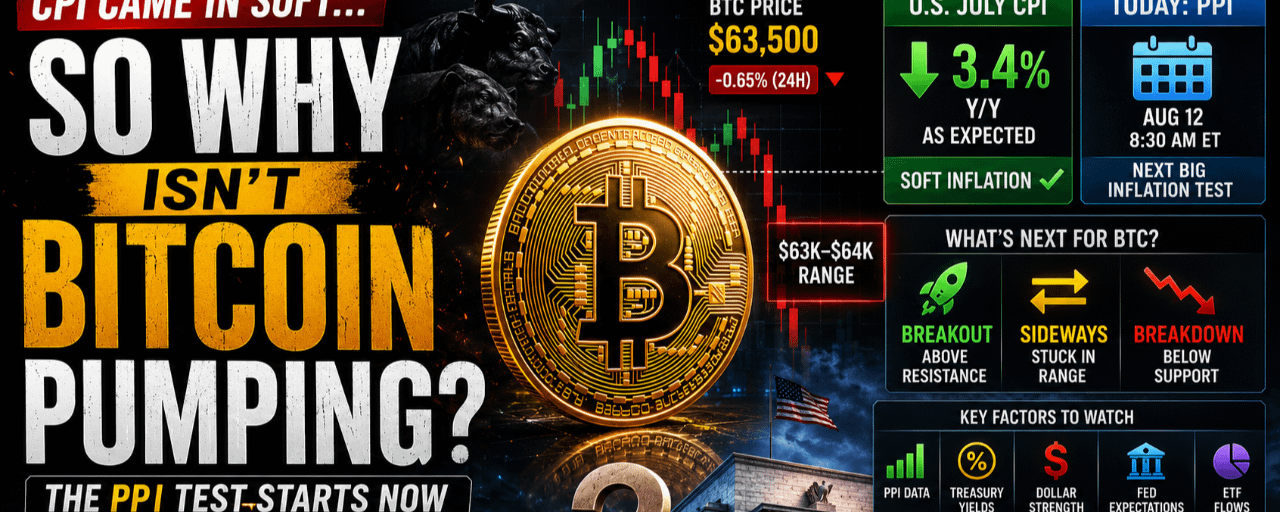
Article
CPI Came in Soft — So Why Isn’t Bitcoin Pumping? The PPI Test Starts Now🚨 CPI Came in Soft — So Why Isn’t Bitcoin Pumping?
The inflation report was good. Bitcoin still didn't break out. Here's what the market may be missing.
Bitcoin traders were waiting for the U.S. CPI report to provide the catalyst for the next major move.
The number finally arrived.
July headline CPI came in at 3.4% year over year, broadly in line with expectations.
But instead of a major Bitcoin rally, BTC remains around the $63K–$64K area.
That reaction is telling us something important:
A cooler inflation number alone may no longer be enough to push Bitcoin higher.
🟠 Why Didn't BTC Rally After CPI?
A softer inflation reading normally improves expectations for easier monetary policy.
That can be positive for risk assets.
But Bitcoin's reaction was surprisingly muted.
BTC slipped toward roughly $63.5K after the CPI release, while traders shifted their attention toward the Federal Reserve's next decisions and upcoming economic data.
This suggests the market may already have priced in much of the good inflation news.
In other words:
The CPI surprise wasn't big enough to change the entire rate outlook.
📊 The Market Is Now Looking at PPI
And this is where today's story gets interesting.
The U.S. July Producer Price Index (PPI) is due today.
PPI measures price pressures at the producer level and can provide another indication of where inflationary pressure is heading.
For crypto traders, it creates another macro test:
🟢 Cooler PPI
Could strengthen the argument that inflation is cooling.
That may support lower yields and improve risk appetite.
🔴 Hotter PPI
Could push Treasury yields and rate expectations higher.
That could create another headwind for Bitcoin.
🟡 In-line PPI
Could leave BTC stuck in its current range while traders wait for stronger catalysts.
💥 Bitcoin Is Facing a Bigger Problem Than CPI
The biggest takeaway from yesterday isn't that CPI was bullish or bearish.
It's this:
Bitcoin needs more than one good inflation report to start a sustainable breakout.
Recent market data shows BTC has been stuck around the same area for weeks, with ETF demand helping offset selling pressure.
That creates a battle between two forces:
🟢 Buyers
Institutional ETF demandImproving inflation dataLong-term adoptionStrong Bitcoin dominance
🔴 Sellers
Higher Treasury yieldsFirmer dollarUncertainty around Fed policyResistance above the current range
Until one side wins, Bitcoin could continue moving sideways.
🏦 What About Bitcoin ETFs?
ETF flows remain one of the most important signals to watch.
Recent weeks have shown that institutional demand can provide support even when Bitcoin's price momentum is weak.
But there's an important distinction:
ETF buying can prevent a major breakdown without necessarily creating a breakout.
That's exactly what makes the current market interesting.
Institutions may still be accumulating exposure, while traders wait for a stronger macro catalyst.
👀 Could ETH and Altcoins Move First?
Another interesting signal is that Ethereum has shown periods of relative strength even while Bitcoin remains stuck.
That raises an important possibility:
If BTC eventually stabilizes and macro conditions improve, capital could rotate toward ETH and selected large-cap altcoins.
But if BTC loses support, altcoins could experience much greater downside volatility.
So for now:
BTC direction remains the key signal for the broader market.
📈 The Levels I'm Watching
Instead of predicting an exact Bitcoin price, I'm watching the current range.
🔥 Above the range
A convincing move above resistance with strong volume could indicate that buyers are finally taking control.
⚠️ Inside the range
Continued movement around $63K–$64K would suggest the market is still waiting.
🚨 Below support
A decisive breakdown could shift sentiment from accumulation to risk reduction.
The important part isn't one candle.
It's whether the move is sustained.
🧠 What Today's PPI Could Tell Us
Yesterday's CPI answered one question:
Is consumer inflation getting worse?
Today's PPI can provide another piece of the puzzle:
Are producer-level price pressures also cooling?
If both reports point toward softer inflation, markets may become more confident that monetary conditions could eventually become friendlier.
But if PPI surprises higher, the market may start questioning whether the CPI improvement is enough.
That's why today's report matters.
⚠️ Don't Chase the First Move
One of the biggest mistakes during macro events is buying or selling immediately after the first candle.
Bitcoin can move sharply in both directions before settling.
A better approach is to watch:
PPI → Treasury yields → dollar → BTC reaction → ETF flows
If those signals align, the market's direction becomes much clearer.
🚀 Final Thoughts
Yesterday's CPI gave Bitcoin a favorable inflation headline.
But BTC didn't break out.
That tells us the market is demanding more confirmation.
Now attention moves to PPI, Treasury yields and Federal Reserve expectations.
If inflation continues cooling and yields eventually ease, Bitcoin could get the macro environment it needs for a stronger move.
But if yields remain elevated, BTC may continue struggling to escape its current range.
The next Bitcoin move may therefore depend less on one CPI number and more on the entire inflation + liquidity picture.
CPI didn't give Bitcoin the breakout traders wanted.
Now PPI gets the spotlight. 👀
💬 What Do You Think?
What's more likely for Bitcoin after today's PPI?
🟢 Breakout 🚀
🔴 Breakdown 📉
🟡 More sideways action
🔵 Too early to tell
👇 Vote and explain your view.
#Bitcoin #BTC #PPI #CPI #Crypto #BitcoinETF #Fed #Ethereum #CryptoMarket #BinanceSquare
CPI Came in Soft — So Why Isn’t Bitcoin Pumping? The PPI Test Starts Now
🚨 CPI Came in Soft — So Why Isn’t Bitcoin Pumping?
The inflation report was good. Bitcoin still didn't break out. Here's what the market may be missing.
Bitcoin traders were waiting for the U.S. CPI report to provide the catalyst for the next major move.
The number finally arrived.
July headline CPI came in at 3.4% year over year, broadly in line with expectations.
But instead of a major Bitcoin rally, BTC remains around the $63K–$64K area.
That reaction is telling us something important:
A cooler inflation number alone may no longer be enough to push Bitcoin higher.
🟠 Why Didn't BTC Rally After CPI?
A softer inflation reading normally improves expectations for easier monetary policy.
That can be positive for risk assets.
But Bitcoin's reaction was surprisingly muted.
BTC slipped toward roughly $63.5K after the CPI release, while traders shifted their attention toward the Federal Reserve's next decisions and upcoming economic data.
This suggests the market may already have priced in much of the good inflation news.
In other words:
The CPI surprise wasn't big enough to change the entire rate outlook.
📊 The Market Is Now Looking at PPI
And this is where today's story gets interesting.
The U.S. July Producer Price Index (PPI) is due today.
PPI measures price pressures at the producer level and can provide another indication of where inflationary pressure is heading.
For crypto traders, it creates another macro test:
🟢 Cooler PPI
Could strengthen the argument that inflation is cooling.
That may support lower yields and improve risk appetite.
🔴 Hotter PPI
Could push Treasury yields and rate expectations higher.
That could create another headwind for Bitcoin.
🟡 In-line PPI
Could leave BTC stuck in its current range while traders wait for stronger catalysts.
💥 Bitcoin Is Facing a Bigger Problem Than CPI
The biggest takeaway from yesterday isn't that CPI was bullish or bearish.
It's this:
Bitcoin needs more than one good inflation report to start a sustainable breakout.
Recent market data shows BTC has been stuck around the same area for weeks, with ETF demand helping offset selling pressure.
That creates a battle between two forces:
🟢 Buyers
Institutional ETF demandImproving inflation dataLong-term adoptionStrong Bitcoin dominance
🔴 Sellers
Higher Treasury yieldsFirmer dollarUncertainty around Fed policyResistance above the current range
Until one side wins, Bitcoin could continue moving sideways.
🏦 What About Bitcoin ETFs?
ETF flows remain one of the most important signals to watch.
Recent weeks have shown that institutional demand can provide support even when Bitcoin's price momentum is weak.
But there's an important distinction:
ETF buying can prevent a major breakdown without necessarily creating a breakout.
That's exactly what makes the current market interesting.
Institutions may still be accumulating exposure, while traders wait for a stronger macro catalyst.
👀 Could ETH and Altcoins Move First?
Another interesting signal is that Ethereum has shown periods of relative strength even while Bitcoin remains stuck.
That raises an important possibility:
If BTC eventually stabilizes and macro conditions improve, capital could rotate toward ETH and selected large-cap altcoins.
But if BTC loses support, altcoins could experience much greater downside volatility.
So for now:
BTC direction remains the key signal for the broader market.
📈 The Levels I'm Watching
Instead of predicting an exact Bitcoin price, I'm watching the current range.
🔥 Above the range
A convincing move above resistance with strong volume could indicate that buyers are finally taking control.
⚠️ Inside the range
Continued movement around $63K–$64K would suggest the market is still waiting.
🚨 Below support
A decisive breakdown could shift sentiment from accumulation to risk reduction.
The important part isn't one candle.
It's whether the move is sustained.
🧠 What Today's PPI Could Tell Us
Yesterday's CPI answered one question:
Is consumer inflation getting worse?
Today's PPI can provide another piece of the puzzle:
Are producer-level price pressures also cooling?
If both reports point toward softer inflation, markets may become more confident that monetary conditions could eventually become friendlier.
But if PPI surprises higher, the market may start questioning whether the CPI improvement is enough.
That's why today's report matters.
⚠️ Don't Chase the First Move
One of the biggest mistakes during macro events is buying or selling immediately after the first candle.
Bitcoin can move sharply in both directions before settling.
A better approach is to watch:
PPI → Treasury yields → dollar → BTC reaction → ETF flows
If those signals align, the market's direction becomes much clearer.
🚀 Final Thoughts
Yesterday's CPI gave Bitcoin a favorable inflation headline.
But BTC didn't break out.
That tells us the market is demanding more confirmation.
Now attention moves to PPI, Treasury yields and Federal Reserve expectations.
If inflation continues cooling and yields eventually ease, Bitcoin could get the macro environment it needs for a stronger move.
But if yields remain elevated, BTC may continue struggling to escape its current range.
The next Bitcoin move may therefore depend less on one CPI number and more on the entire inflation + liquidity picture.
CPI didn't give Bitcoin the breakout traders wanted.
Now PPI gets the spotlight. 👀
💬 What Do You Think?
What's more likely for Bitcoin after today's PPI?
🟢 Breakout 🚀
🔴 Breakdown 📉
🟡 More sideways action
🔵 Too early to tell
👇 Vote and explain your view.
#Bitcoin #BTC #PPI #CPI #Crypto #BitcoinETF #Fed #Ethereum #CryptoMarket #BinanceSquare
The inflation report was good. Bitcoin still didn't break out. Here's what the market may be missing.
Bitcoin traders were waiting for the U.S. CPI report to provide the catalyst for the next major move.
The number finally arrived.
July headline CPI came in at 3.4% year over year, broadly in line with expectations.
But instead of a major Bitcoin rally, BTC remains around the $63K–$64K area.
That reaction is telling us something important:
A cooler inflation number alone may no longer be enough to push Bitcoin higher.
🟠 Why Didn't BTC Rally After CPI?
A softer inflation reading normally improves expectations for easier monetary policy.
That can be positive for risk assets.
But Bitcoin's reaction was surprisingly muted.
BTC slipped toward roughly $63.5K after the CPI release, while traders shifted their attention toward the Federal Reserve's next decisions and upcoming economic data.
This suggests the market may already have priced in much of the good inflation news.
In other words:
The CPI surprise wasn't big enough to change the entire rate outlook.
📊 The Market Is Now Looking at PPI
And this is where today's story gets interesting.
The U.S. July Producer Price Index (PPI) is due today.
PPI measures price pressures at the producer level and can provide another indication of where inflationary pressure is heading.
For crypto traders, it creates another macro test:
🟢 Cooler PPI
Could strengthen the argument that inflation is cooling.
That may support lower yields and improve risk appetite.
🔴 Hotter PPI
Could push Treasury yields and rate expectations higher.
That could create another headwind for Bitcoin.
🟡 In-line PPI
Could leave BTC stuck in its current range while traders wait for stronger catalysts.
💥 Bitcoin Is Facing a Bigger Problem Than CPI
The biggest takeaway from yesterday isn't that CPI was bullish or bearish.
It's this:
Bitcoin needs more than one good inflation report to start a sustainable breakout.
Recent market data shows BTC has been stuck around the same area for weeks, with ETF demand helping offset selling pressure.
That creates a battle between two forces:
🟢 Buyers
Institutional ETF demandImproving inflation dataLong-term adoptionStrong Bitcoin dominance
🔴 Sellers
Higher Treasury yieldsFirmer dollarUncertainty around Fed policyResistance above the current range
Until one side wins, Bitcoin could continue moving sideways.
🏦 What About Bitcoin ETFs?
ETF flows remain one of the most important signals to watch.
Recent weeks have shown that institutional demand can provide support even when Bitcoin's price momentum is weak.
But there's an important distinction:
ETF buying can prevent a major breakdown without necessarily creating a breakout.
That's exactly what makes the current market interesting.
Institutions may still be accumulating exposure, while traders wait for a stronger macro catalyst.
👀 Could ETH and Altcoins Move First?
Another interesting signal is that Ethereum has shown periods of relative strength even while Bitcoin remains stuck.
That raises an important possibility:
If BTC eventually stabilizes and macro conditions improve, capital could rotate toward ETH and selected large-cap altcoins.
But if BTC loses support, altcoins could experience much greater downside volatility.
So for now:
BTC direction remains the key signal for the broader market.
📈 The Levels I'm Watching
Instead of predicting an exact Bitcoin price, I'm watching the current range.
🔥 Above the range
A convincing move above resistance with strong volume could indicate that buyers are finally taking control.
⚠️ Inside the range
Continued movement around $63K–$64K would suggest the market is still waiting.
🚨 Below support
A decisive breakdown could shift sentiment from accumulation to risk reduction.
The important part isn't one candle.
It's whether the move is sustained.
🧠 What Today's PPI Could Tell Us
Yesterday's CPI answered one question:
Is consumer inflation getting worse?
Today's PPI can provide another piece of the puzzle:
Are producer-level price pressures also cooling?
If both reports point toward softer inflation, markets may become more confident that monetary conditions could eventually become friendlier.
But if PPI surprises higher, the market may start questioning whether the CPI improvement is enough.
That's why today's report matters.
⚠️ Don't Chase the First Move
One of the biggest mistakes during macro events is buying or selling immediately after the first candle.
Bitcoin can move sharply in both directions before settling.
A better approach is to watch:
PPI → Treasury yields → dollar → BTC reaction → ETF flows
If those signals align, the market's direction becomes much clearer.
🚀 Final Thoughts
Yesterday's CPI gave Bitcoin a favorable inflation headline.
But BTC didn't break out.
That tells us the market is demanding more confirmation.
Now attention moves to PPI, Treasury yields and Federal Reserve expectations.
If inflation continues cooling and yields eventually ease, Bitcoin could get the macro environment it needs for a stronger move.
But if yields remain elevated, BTC may continue struggling to escape its current range.
The next Bitcoin move may therefore depend less on one CPI number and more on the entire inflation + liquidity picture.
CPI didn't give Bitcoin the breakout traders wanted.
Now PPI gets the spotlight. 👀
💬 What Do You Think?
What's more likely for Bitcoin after today's PPI?
🟢 Breakout 🚀
🔴 Breakdown 📉
🟡 More sideways action
🔵 Too early to tell
👇 Vote and explain your view.
#Bitcoin #BTC #PPI #CPI #Crypto #BitcoinETF #Fed #Ethereum #CryptoMarket #BinanceSquare
91
🚨 Bitcoin Is Waiting for the CPI Trigger 👀
BTC is still stuck around the $63K zone, while traders wait for today's U.S. inflation data.
The interesting part?
ETF demand is providing support, but macro uncertainty is keeping buyers cautious.
One CPI surprise could change the market mood quickly. ⚡
Will BTC finally break out of its range today?
🟢 Bullish breakout
🔴 Breakdown
🟡 More sideways action
#Bitcoin #BTC #CPI #CryptoMarket #BitcoinETF #BinanceSquare
🚨 Bitcoin Is Waiting for the CPI Trigger 👀
BTC is still stuck around the $63K zone, while traders wait for today's U.S. inflation data.
The interesting part?
ETF demand is providing support, but macro uncertainty is keeping buyers cautious.
One CPI surprise could change the market mood quickly. ⚡
Will BTC finally break out of its range today?
🟢 Bullish breakout
🔴 Breakdown
🟡 More sideways action
#Bitcoin #BTC #CPI #CryptoMarket #BitcoinETF #BinanceSquare
BTC is still stuck around the $63K zone, while traders wait for today's U.S. inflation data.
The interesting part?
ETF demand is providing support, but macro uncertainty is keeping buyers cautious.
One CPI surprise could change the market mood quickly. ⚡
Will BTC finally break out of its range today?
🟢 Bullish breakout
🔴 Breakdown
🟡 More sideways action
#Bitcoin #BTC #CPI #CryptoMarket #BitcoinETF #BinanceSquare
64
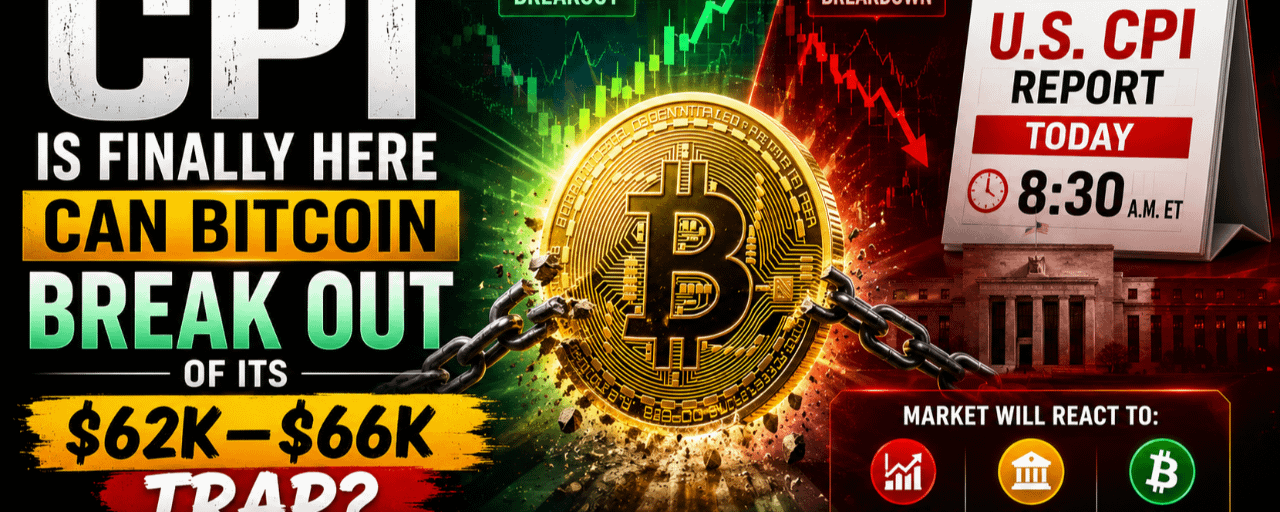
Article
CPI Is Finally Here — Can Bitcoin Break Out of Its $62K–$66K Trap?🚨 CPI Is Finally Here — Can Bitcoin Break Out of Its $62K–$66K Trap?
Bitcoin Is Waiting for One of the Biggest Macro Catalysts of the Week
Bitcoin is entering a crucial market session.
BTC is trading around the $63K area, while the broader market is waiting for today's U.S. July CPI report.
The data is scheduled for release at 8:30 a.m. ET on August 12, and economists are expecting headline inflation around 3.4% year over year and core CPI around 2.5%. citeturn0search12turn0news4
That means today's CPI number could become an important catalyst for Bitcoin, Ethereum and the wider crypto market.
🟠 Why CPI Matters for Bitcoin
Crypto traders increasingly watch U.S. inflation data because it can influence expectations for Federal Reserve policy.
If inflation comes in softer than expected, markets could interpret it as more supportive of future monetary easing.
That could potentially improve sentiment toward risk assets such as Bitcoin and other cryptocurrencies.
But if inflation is hotter than expected, traders could become more cautious.
The key isn't simply whether CPI rises or falls.
The real question is whether the actual number beats or misses expectations.
📊 Bitcoin Is Stuck in an Important Range
Bitcoin has been moving inside a relatively narrow range, with the $62K–$66K zone becoming an important area for traders.
Recent market analysis identified roughly $63K as an on-chain demand area, while higher levels around $69K represent a significant holder resistance zone. citeturn0news9
This creates a simple setup:
🚀 Bullish scenario
A softer-than-expected CPI could improve risk appetite.
If buyers return strongly, BTC could attempt to reclaim the upper part of its recent range.
📉 Bearish scenario
A hotter-than-expected CPI could increase pressure on risk assets.
If BTC loses important support, the market could start looking for lower levels.
🟡 Neutral scenario
CPI could come close to expectations, leaving traders waiting for additional economic data before making a major move.
💰 Institutional Demand Is Still an Important Signal
There is another reason today's setup is interesting.
U.S. spot Bitcoin ETFs attracted approximately $853.5 million in net inflows during the week ending August 7, the strongest weekly inflow figure since April according to recent market data. citeturn0search20turn0search25
BlackRock's IBIT accounted for a large portion of those flows.
That suggests institutional demand has not disappeared.
But ETF inflows alone cannot guarantee that Bitcoin will break higher.
Today's CPI reaction will help determine whether that institutional demand continues to translate into stronger price momentum.
🔥 The Biggest Question: Soft CPI or Hot CPI?
The market currently expects July headline CPI to rise around 3.4% year over year, compared with 3.5% in June.
Core CPI is expected around 2.5% annually. citeturn0news4turn0news46
That gives traders three important possibilities.
🟢 CPI Below Expectations
This could strengthen hopes for easier monetary conditions and potentially support BTC.
🔴 CPI Above Expectations
This could increase concerns about persistent inflation and put pressure on risk assets.
🟡 CPI In Line
Bitcoin may initially react sharply and then return to waiting mode as traders assess the details.
🧠 Don't Watch Only the Headline Number
One mistake traders can make is focusing only on the headline CPI.
The core CPI number is also important because it removes food and energy prices and provides another view of underlying inflation.
Markets will also watch the details behind the report.
Housing.
Services.
Transportation.
Energy.
Goods.
A headline number can look positive while individual components create a different picture.
That's why Bitcoin's reaction immediately after the release could be volatile.
📈 What Could Happen to ETH and Altcoins?
Bitcoin won't be the only asset affected.
Ethereum and large-cap altcoins could also react as traders reassess overall risk appetite.
Recent ETF data shows Ethereum also attracted meaningful institutional flows, with about $244.9 million in net inflows during August through August 7. citeturn0search20
If BTC breaks higher and risk appetite expands, capital could potentially rotate into ETH and major altcoins.
But if BTC breaks down after a hot inflation reading, higher-risk altcoins could experience significantly larger volatility.
👀 The 5 Things I'm Watching Today
Instead of reacting emotionally to the first green or red candle, I'm watching:
1️⃣ U.S. headline CPI
Does it beat or miss expectations?
2️⃣ Core CPI
Does underlying inflation remain sticky?
3️⃣ BTC reaction
Does Bitcoin reclaim the upper part of its range or lose support?
4️⃣ ETF flows
Does institutional demand continue?
5️⃣ ETH + altcoin strength
Does the market broaden beyond Bitcoin?
These signals together should provide a clearer picture than the CPI number alone.
⚠️ One Important Warning
A softer CPI does not automatically mean Bitcoin will pump.
Markets can move in unexpected ways because traders may have already priced in a particular outcome.
The same applies to a hotter CPI.
Bitcoin could initially fall and then recover if investors interpret the broader economic picture differently.
That's why today's event should be treated as a volatility catalyst, not a guaranteed direction.
🚀 Final Thoughts
Bitcoin is entering today's session with traders watching the $62K–$66K range, while institutional flows have recently provided a more constructive signal.
Now the market gets its next major test:
U.S. inflation.
The July CPI report is scheduled for today, with expectations around 3.4% headline inflation and 2.5% core inflation. citeturn0news4
A meaningful surprise could push Bitcoin out of its current range.
But whether that move becomes a genuine trend will depend on what happens next.
ETF flows.
Fed expectations.
BTC structure.
And broader risk appetite.
The next big Bitcoin move may be closer than it looks. 👀
💬 What Do You Think?
What will today's U.S. CPI mean for Bitcoin?
🟢 Bullish — BTC breaks higher
🔴 Bearish — BTC breaks lower
🟡 Sideways — no major move
🔵 Too unpredictable
👇 Vote and tell me your reasoning.
#Bitcoin #BTC #CPI #Crypto #BitcoinETF #Ethereum #ETH #CryptoMarket #Fed #BinanceSquare
CPI Is Finally Here — Can Bitcoin Break Out of Its $62K–$66K Trap?
🚨 CPI Is Finally Here — Can Bitcoin Break Out of Its $62K–$66K Trap?
Bitcoin Is Waiting for One of the Biggest Macro Catalysts of the Week
Bitcoin is entering a crucial market session.
BTC is trading around the $63K area, while the broader market is waiting for today's U.S. July CPI report.
The data is scheduled for release at 8:30 a.m. ET on August 12, and economists are expecting headline inflation around 3.4% year over year and core CPI around 2.5%. citeturn0search12turn0news4
That means today's CPI number could become an important catalyst for Bitcoin, Ethereum and the wider crypto market.
🟠 Why CPI Matters for Bitcoin
Crypto traders increasingly watch U.S. inflation data because it can influence expectations for Federal Reserve policy.
If inflation comes in softer than expected, markets could interpret it as more supportive of future monetary easing.
That could potentially improve sentiment toward risk assets such as Bitcoin and other cryptocurrencies.
But if inflation is hotter than expected, traders could become more cautious.
The key isn't simply whether CPI rises or falls.
The real question is whether the actual number beats or misses expectations.
📊 Bitcoin Is Stuck in an Important Range
Bitcoin has been moving inside a relatively narrow range, with the $62K–$66K zone becoming an important area for traders.
Recent market analysis identified roughly $63K as an on-chain demand area, while higher levels around $69K represent a significant holder resistance zone. citeturn0news9
This creates a simple setup:
🚀 Bullish scenario
A softer-than-expected CPI could improve risk appetite.
If buyers return strongly, BTC could attempt to reclaim the upper part of its recent range.
📉 Bearish scenario
A hotter-than-expected CPI could increase pressure on risk assets.
If BTC loses important support, the market could start looking for lower levels.
🟡 Neutral scenario
CPI could come close to expectations, leaving traders waiting for additional economic data before making a major move.
💰 Institutional Demand Is Still an Important Signal
There is another reason today's setup is interesting.
U.S. spot Bitcoin ETFs attracted approximately $853.5 million in net inflows during the week ending August 7, the strongest weekly inflow figure since April according to recent market data. citeturn0search20turn0search25
BlackRock's IBIT accounted for a large portion of those flows.
That suggests institutional demand has not disappeared.
But ETF inflows alone cannot guarantee that Bitcoin will break higher.
Today's CPI reaction will help determine whether that institutional demand continues to translate into stronger price momentum.
🔥 The Biggest Question: Soft CPI or Hot CPI?
The market currently expects July headline CPI to rise around 3.4% year over year, compared with 3.5% in June.
Core CPI is expected around 2.5% annually. citeturn0news4turn0news46
That gives traders three important possibilities.
🟢 CPI Below Expectations
This could strengthen hopes for easier monetary conditions and potentially support BTC.
🔴 CPI Above Expectations
This could increase concerns about persistent inflation and put pressure on risk assets.
🟡 CPI In Line
Bitcoin may initially react sharply and then return to waiting mode as traders assess the details.
🧠 Don't Watch Only the Headline Number
One mistake traders can make is focusing only on the headline CPI.
The core CPI number is also important because it removes food and energy prices and provides another view of underlying inflation.
Markets will also watch the details behind the report.
Housing.
Services.
Transportation.
Energy.
Goods.
A headline number can look positive while individual components create a different picture.
That's why Bitcoin's reaction immediately after the release could be volatile.
📈 What Could Happen to ETH and Altcoins?
Bitcoin won't be the only asset affected.
Ethereum and large-cap altcoins could also react as traders reassess overall risk appetite.
Recent ETF data shows Ethereum also attracted meaningful institutional flows, with about $244.9 million in net inflows during August through August 7. citeturn0search20
If BTC breaks higher and risk appetite expands, capital could potentially rotate into ETH and major altcoins.
But if BTC breaks down after a hot inflation reading, higher-risk altcoins could experience significantly larger volatility.
👀 The 5 Things I'm Watching Today
Instead of reacting emotionally to the first green or red candle, I'm watching:
1️⃣ U.S. headline CPI
Does it beat or miss expectations?
2️⃣ Core CPI
Does underlying inflation remain sticky?
3️⃣ BTC reaction
Does Bitcoin reclaim the upper part of its range or lose support?
4️⃣ ETF flows
Does institutional demand continue?
5️⃣ ETH + altcoin strength
Does the market broaden beyond Bitcoin?
These signals together should provide a clearer picture than the CPI number alone.
⚠️ One Important Warning
A softer CPI does not automatically mean Bitcoin will pump.
Markets can move in unexpected ways because traders may have already priced in a particular outcome.
The same applies to a hotter CPI.
Bitcoin could initially fall and then recover if investors interpret the broader economic picture differently.
That's why today's event should be treated as a volatility catalyst, not a guaranteed direction.
🚀 Final Thoughts
Bitcoin is entering today's session with traders watching the $62K–$66K range, while institutional flows have recently provided a more constructive signal.
Now the market gets its next major test:
U.S. inflation.
The July CPI report is scheduled for today, with expectations around 3.4% headline inflation and 2.5% core inflation. citeturn0news4
A meaningful surprise could push Bitcoin out of its current range.
But whether that move becomes a genuine trend will depend on what happens next.
ETF flows.
Fed expectations.
BTC structure.
And broader risk appetite.
The next big Bitcoin move may be closer than it looks. 👀
💬 What Do You Think?
What will today's U.S. CPI mean for Bitcoin?
🟢 Bullish — BTC breaks higher
🔴 Bearish — BTC breaks lower
🟡 Sideways — no major move
🔵 Too unpredictable
👇 Vote and tell me your reasoning.
#Bitcoin #BTC #CPI #Crypto #BitcoinETF #Ethereum #ETH #CryptoMarket #Fed #BinanceSquare
Bitcoin Is Waiting for One of the Biggest Macro Catalysts of the Week
Bitcoin is entering a crucial market session.
BTC is trading around the $63K area, while the broader market is waiting for today's U.S. July CPI report.
The data is scheduled for release at 8:30 a.m. ET on August 12, and economists are expecting headline inflation around 3.4% year over year and core CPI around 2.5%. citeturn0search12turn0news4
That means today's CPI number could become an important catalyst for Bitcoin, Ethereum and the wider crypto market.
🟠 Why CPI Matters for Bitcoin
Crypto traders increasingly watch U.S. inflation data because it can influence expectations for Federal Reserve policy.
If inflation comes in softer than expected, markets could interpret it as more supportive of future monetary easing.
That could potentially improve sentiment toward risk assets such as Bitcoin and other cryptocurrencies.
But if inflation is hotter than expected, traders could become more cautious.
The key isn't simply whether CPI rises or falls.
The real question is whether the actual number beats or misses expectations.
📊 Bitcoin Is Stuck in an Important Range
Bitcoin has been moving inside a relatively narrow range, with the $62K–$66K zone becoming an important area for traders.
Recent market analysis identified roughly $63K as an on-chain demand area, while higher levels around $69K represent a significant holder resistance zone. citeturn0news9
This creates a simple setup:
🚀 Bullish scenario
A softer-than-expected CPI could improve risk appetite.
If buyers return strongly, BTC could attempt to reclaim the upper part of its recent range.
📉 Bearish scenario
A hotter-than-expected CPI could increase pressure on risk assets.
If BTC loses important support, the market could start looking for lower levels.
🟡 Neutral scenario
CPI could come close to expectations, leaving traders waiting for additional economic data before making a major move.
💰 Institutional Demand Is Still an Important Signal
There is another reason today's setup is interesting.
U.S. spot Bitcoin ETFs attracted approximately $853.5 million in net inflows during the week ending August 7, the strongest weekly inflow figure since April according to recent market data. citeturn0search20turn0search25
BlackRock's IBIT accounted for a large portion of those flows.
That suggests institutional demand has not disappeared.
But ETF inflows alone cannot guarantee that Bitcoin will break higher.
Today's CPI reaction will help determine whether that institutional demand continues to translate into stronger price momentum.
🔥 The Biggest Question: Soft CPI or Hot CPI?
The market currently expects July headline CPI to rise around 3.4% year over year, compared with 3.5% in June.
Core CPI is expected around 2.5% annually. citeturn0news4turn0news46
That gives traders three important possibilities.
🟢 CPI Below Expectations
This could strengthen hopes for easier monetary conditions and potentially support BTC.
🔴 CPI Above Expectations
This could increase concerns about persistent inflation and put pressure on risk assets.
🟡 CPI In Line
Bitcoin may initially react sharply and then return to waiting mode as traders assess the details.
🧠 Don't Watch Only the Headline Number
One mistake traders can make is focusing only on the headline CPI.
The core CPI number is also important because it removes food and energy prices and provides another view of underlying inflation.
Markets will also watch the details behind the report.
Housing.
Services.
Transportation.
Energy.
Goods.
A headline number can look positive while individual components create a different picture.
That's why Bitcoin's reaction immediately after the release could be volatile.
📈 What Could Happen to ETH and Altcoins?
Bitcoin won't be the only asset affected.
Ethereum and large-cap altcoins could also react as traders reassess overall risk appetite.
Recent ETF data shows Ethereum also attracted meaningful institutional flows, with about $244.9 million in net inflows during August through August 7. citeturn0search20
If BTC breaks higher and risk appetite expands, capital could potentially rotate into ETH and major altcoins.
But if BTC breaks down after a hot inflation reading, higher-risk altcoins could experience significantly larger volatility.
👀 The 5 Things I'm Watching Today
Instead of reacting emotionally to the first green or red candle, I'm watching:
1️⃣ U.S. headline CPI
Does it beat or miss expectations?
2️⃣ Core CPI
Does underlying inflation remain sticky?
3️⃣ BTC reaction
Does Bitcoin reclaim the upper part of its range or lose support?
4️⃣ ETF flows
Does institutional demand continue?
5️⃣ ETH + altcoin strength
Does the market broaden beyond Bitcoin?
These signals together should provide a clearer picture than the CPI number alone.
⚠️ One Important Warning
A softer CPI does not automatically mean Bitcoin will pump.
Markets can move in unexpected ways because traders may have already priced in a particular outcome.
The same applies to a hotter CPI.
Bitcoin could initially fall and then recover if investors interpret the broader economic picture differently.
That's why today's event should be treated as a volatility catalyst, not a guaranteed direction.
🚀 Final Thoughts
Bitcoin is entering today's session with traders watching the $62K–$66K range, while institutional flows have recently provided a more constructive signal.
Now the market gets its next major test:
U.S. inflation.
The July CPI report is scheduled for today, with expectations around 3.4% headline inflation and 2.5% core inflation. citeturn0news4
A meaningful surprise could push Bitcoin out of its current range.
But whether that move becomes a genuine trend will depend on what happens next.
ETF flows.
Fed expectations.
BTC structure.
And broader risk appetite.
The next big Bitcoin move may be closer than it looks. 👀
💬 What Do You Think?
What will today's U.S. CPI mean for Bitcoin?
🟢 Bullish — BTC breaks higher
🔴 Bearish — BTC breaks lower
🟡 Sideways — no major move
🔵 Too unpredictable
👇 Vote and tell me your reasoning.
#Bitcoin #BTC #CPI #Crypto #BitcoinETF #Ethereum #ETH #CryptoMarket #Fed #BinanceSquare
79
🚨 What happens to Bitcoin after the U.S. CPI? 👀
🟢 BTC pumps 🚀
🔴 BTC dumps 📉
🟡 Sideways / no major move
🔵 Too unpredictable
Caption:
BTC is under pressure near $64K, while traders are waiting for the CPI number. One report could change the market mood quickly. 👀
What’s your call? 👇
#Bitcoin #BTC #CPI #Crypto #CryptoMarket #BinanceSquare
🚨 What happens to Bitcoin after the U.S. CPI? 👀
🟢 BTC pumps 🚀
🔴 BTC dumps 📉
🟡 Sideways / no major move
🔵 Too unpredictable
Caption:
BTC is under pressure near $64K, while traders are waiting for the CPI number. One report could change the market mood quickly. 👀
What’s your call? 👇
#Bitcoin #BTC #CPI #Crypto #CryptoMarket #BinanceSquare
🟢 BTC pumps 🚀
🔴 BTC dumps 📉
🟡 Sideways / no major move
🔵 Too unpredictable
Caption:
BTC is under pressure near $64K, while traders are waiting for the CPI number. One report could change the market mood quickly. 👀
What’s your call? 👇
#Bitcoin #BTC #CPI #Crypto #CryptoMarket #BinanceSquare
54
🚨 Crypto Traders Are Waiting for ONE Number 👀
Bitcoin slipped below $64K as traders turned cautious ahead of Wednesday's U.S. CPI report.
Meanwhile, Bitcoin ETFs just saw $144.6M in net outflows after five straight inflow sessions.
Now the big question:
🔥 Will CPI trigger the next BTC breakout — or another sell-off?
I'm watching BTC + ETF flows + inflation closely.
👇 Bullish or bearish after CPI?
#Bitcoin #BTC #CPI #CryptoMarket #BitcoinETF #BinanceSquare
🚨 Crypto Traders Are Waiting for ONE Number 👀
Bitcoin slipped below $64K as traders turned cautious ahead of Wednesday's U.S. CPI report.
Meanwhile, Bitcoin ETFs just saw $144.6M in net outflows after five straight inflow sessions.
Now the big question:
🔥 Will CPI trigger the next BTC breakout — or another sell-off?
I'm watching BTC + ETF flows + inflation closely.
👇 Bullish or bearish after CPI?
#Bitcoin #BTC #CPI #CryptoMarket #BitcoinETF #BinanceSquare
Bitcoin slipped below $64K as traders turned cautious ahead of Wednesday's U.S. CPI report.
Meanwhile, Bitcoin ETFs just saw $144.6M in net outflows after five straight inflow sessions.
Now the big question:
🔥 Will CPI trigger the next BTC breakout — or another sell-off?
I'm watching BTC + ETF flows + inflation closely.
👇 Bullish or bearish after CPI?
#Bitcoin #BTC #CPI #CryptoMarket #BitcoinETF #BinanceSquare
62
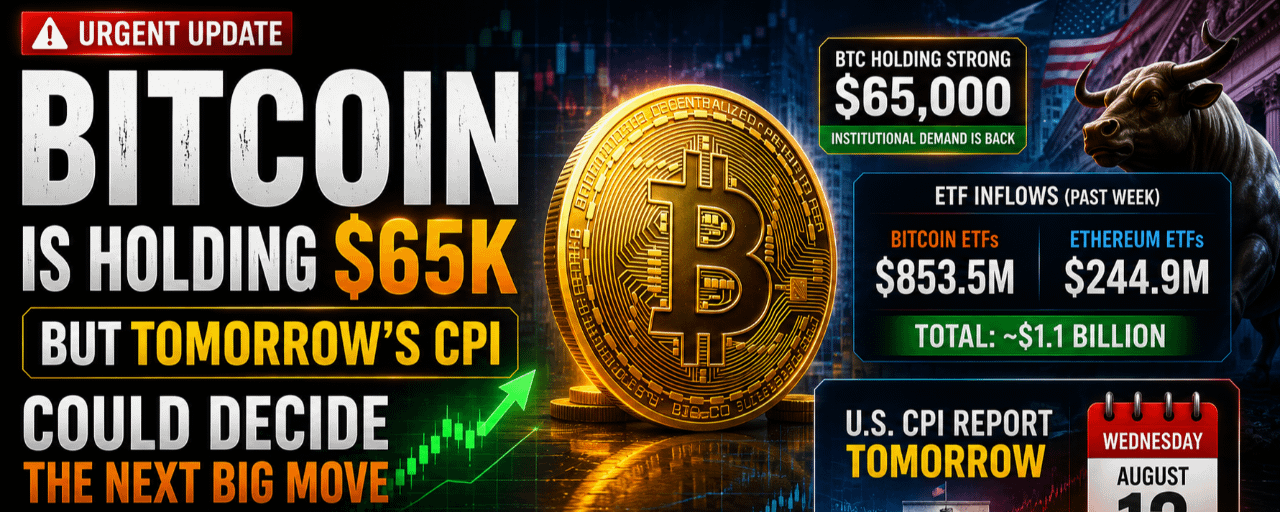
Article
Bitcoin Is Holding $65K — But Tomorrow’s CPI Could Decide the Next Big MoveThe crypto market is entering a crucial macro week.
Bitcoin is currently holding around the $65,000 area, while recent institutional flows have improved market sentiment.
But traders now have another major event to watch:
The upcoming U.S. CPI report.
This could become one of the biggest short-term catalysts for Bitcoin, Ethereum and the broader crypto market.
💰 The Institutional Bid Is Back
One of the most interesting developments is the return of money into U.S. spot crypto ETFs.
Bitcoin and Ether ETFs together attracted approximately $1.1 billion in net inflows over the past week, according to recent market reporting.
Bitcoin ETF inflows accounted for the larger share, with recent data showing about $853.5 million of Bitcoin ETF inflows in August, while Ethereum ETFs attracted roughly $244.9 million.
This matters because ETF flows provide a useful window into institutional demand.
The market isn't simply being driven by retail traders chasing short-term pumps.
There is still significant institutional capital looking for crypto exposure.
🟠 Why $65K Matters for Bitcoin
Bitcoin has been trading around the $65K region after a volatile period.
The important question now isn't simply whether BTC can move higher.
It's:
Can Bitcoin hold this level if macroeconomic data creates another wave of volatility?
Recent market coverage noted that BTC briefly moved above $65,000 as ETF inflows strengthened, while traders shifted their attention toward the upcoming CPI report.
That creates an interesting setup.
Positive scenario:
If inflation comes in softer than expected, markets could interpret that as supportive for risk assets.
That could potentially strengthen:
BTC → ETH → large-cap altcoins
Negative scenario:
If inflation comes in hotter than expected, traders could become more cautious about interest-rate expectations.
That could pressure:
BTC + ETH + higher-risk altcoins
The reaction will depend not only on the CPI number itself, but also on how markets interpret the data.
📊 Ethereum Could Be the Interesting Second Story
Bitcoin is getting most of the attention, but Ethereum shouldn't be ignored.
ETH ETFs have also attracted meaningful recent inflows, with August inflows reported around $244.9 million.
That suggests institutional interest isn't limited to Bitcoin.
If macro conditions become more favorable for risk assets, Ethereum could potentially benefit from this renewed institutional positioning.
And Ethereum remains deeply connected to the broader crypto infrastructure narrative through:
StablecoinsDeFiTokenized assetsInstitutional financeLayer-2 ecosystems
So the CPI reaction could be important for both BTC and ETH.
🌎 Why CPI Matters So Much for Crypto
Crypto has increasingly become connected to traditional financial markets.
When investors expect tighter monetary conditions, speculative assets can come under pressure.
When financial conditions become more supportive, risk appetite can increase.
This is why macroeconomic releases such as CPI can cause significant moves in crypto.
Interestingly, academic research has also found evidence that crypto assets respond to macroeconomic signals such as inflation data, reinforcing the growing connection between digital assets and traditional markets.
🔥 The Real Question: Is This a New Rally?
This is where investors need to be careful.
ETF inflows are encouraging.
BTC holding $65K is encouraging.
But that doesn't automatically mean a new bull run has started.
The market still needs confirmation.
I'd watch three things:
1️⃣ ETF flows
Do inflows continue after the CPI release?
2️⃣ Bitcoin's reaction
Does BTC hold its current range during volatility?
3️⃣ Altcoin participation
Does capital eventually rotate into ETH and major altcoins?
If all three improve together, the market structure could become much more interesting.
⚠️ Don't Ignore the Risk
A bullish ETF-flow narrative can quickly change if macro data surprises markets.
That's why traders should avoid treating one positive indicator as a guarantee of higher prices.
Crypto remains highly volatile.
A strong CPI surprise could create sharp moves in either direction.
And even if Bitcoin holds up, smaller altcoins could still experience much larger volatility.
👀 What I'm Watching Next
For the next few sessions, these are the signals I would put at the top of the watchlist:
🟠 Bitcoin around $65K
💰 U.S. spot ETF flows
📊 Wednesday's U.S. CPI
🔵 Ethereum's institutional demand
🔥 Altcoin market breadth
The combination will tell us whether the recent improvement in sentiment is becoming a stronger trend—or simply another short-term bounce.
🚀 Final Thoughts
Bitcoin's current setup is interesting because institutional demand and macro uncertainty are colliding at the same time.
On one side, roughly $1.1 billion of combined Bitcoin and Ether ETF inflows shows that institutional appetite has improved.
On the other side, the upcoming U.S. CPI could determine how markets think about inflation, interest rates and risk appetite.
That means the next major crypto move may not come from a new coin narrative.
It could come from a single economic number.
Bitcoin is holding $65K.
Institutions are buying.
Now the market is waiting for CPI. 👀
💬 What Do You Think?
What will happen to Bitcoin after the U.S. CPI report?
🟢 BTC breaks higher
🔵 BTC stays around $65K
🔴 BTC drops
🟡 Too early to tell
👇 Vote and tell me your reason in the comments.
🔖 Hashtags
#Bitcoin #BTC #Crypto #CPI #BitcoinETF #Ethereum #ETH #CryptoMarket #InstitutionalCrypto #BinanceSquare
🎯 FINAL TITLE — isi ko use karna:
Bitcoin Is Holding $65K — But Tomorrow’s CPI Could Decide the Next Big Move
The crypto market is entering a crucial macro week.
Bitcoin is currently holding around the $65,000 area, while recent institutional flows have improved market sentiment.
But traders now have another major event to watch:
The upcoming U.S. CPI report.
This could become one of the biggest short-term catalysts for Bitcoin, Ethereum and the broader crypto market.
💰 The Institutional Bid Is Back
One of the most interesting developments is the return of money into U.S. spot crypto ETFs.
Bitcoin and Ether ETFs together attracted approximately $1.1 billion in net inflows over the past week, according to recent market reporting.
Bitcoin ETF inflows accounted for the larger share, with recent data showing about $853.5 million of Bitcoin ETF inflows in August, while Ethereum ETFs attracted roughly $244.9 million.
This matters because ETF flows provide a useful window into institutional demand.
The market isn't simply being driven by retail traders chasing short-term pumps.
There is still significant institutional capital looking for crypto exposure.
🟠 Why $65K Matters for Bitcoin
Bitcoin has been trading around the $65K region after a volatile period.
The important question now isn't simply whether BTC can move higher.
It's:
Can Bitcoin hold this level if macroeconomic data creates another wave of volatility?
Recent market coverage noted that BTC briefly moved above $65,000 as ETF inflows strengthened, while traders shifted their attention toward the upcoming CPI report.
That creates an interesting setup.
Positive scenario:
If inflation comes in softer than expected, markets could interpret that as supportive for risk assets.
That could potentially strengthen:
BTC → ETH → large-cap altcoins
Negative scenario:
If inflation comes in hotter than expected, traders could become more cautious about interest-rate expectations.
That could pressure:
BTC + ETH + higher-risk altcoins
The reaction will depend not only on the CPI number itself, but also on how markets interpret the data.
📊 Ethereum Could Be the Interesting Second Story
Bitcoin is getting most of the attention, but Ethereum shouldn't be ignored.
ETH ETFs have also attracted meaningful recent inflows, with August inflows reported around $244.9 million.
That suggests institutional interest isn't limited to Bitcoin.
If macro conditions become more favorable for risk assets, Ethereum could potentially benefit from this renewed institutional positioning.
And Ethereum remains deeply connected to the broader crypto infrastructure narrative through:
StablecoinsDeFiTokenized assetsInstitutional financeLayer-2 ecosystems
So the CPI reaction could be important for both BTC and ETH.
🌎 Why CPI Matters So Much for Crypto
Crypto has increasingly become connected to traditional financial markets.
When investors expect tighter monetary conditions, speculative assets can come under pressure.
When financial conditions become more supportive, risk appetite can increase.
This is why macroeconomic releases such as CPI can cause significant moves in crypto.
Interestingly, academic research has also found evidence that crypto assets respond to macroeconomic signals such as inflation data, reinforcing the growing connection between digital assets and traditional markets.
🔥 The Real Question: Is This a New Rally?
This is where investors need to be careful.
ETF inflows are encouraging.
BTC holding $65K is encouraging.
But that doesn't automatically mean a new bull run has started.
The market still needs confirmation.
I'd watch three things:
1️⃣ ETF flows
Do inflows continue after the CPI release?
2️⃣ Bitcoin's reaction
Does BTC hold its current range during volatility?
3️⃣ Altcoin participation
Does capital eventually rotate into ETH and major altcoins?
If all three improve together, the market structure could become much more interesting.
⚠️ Don't Ignore the Risk
A bullish ETF-flow narrative can quickly change if macro data surprises markets.
That's why traders should avoid treating one positive indicator as a guarantee of higher prices.
Crypto remains highly volatile.
A strong CPI surprise could create sharp moves in either direction.
And even if Bitcoin holds up, smaller altcoins could still experience much larger volatility.
👀 What I'm Watching Next
For the next few sessions, these are the signals I would put at the top of the watchlist:
🟠 Bitcoin around $65K
💰 U.S. spot ETF flows
📊 Wednesday's U.S. CPI
🔵 Ethereum's institutional demand
🔥 Altcoin market breadth
The combination will tell us whether the recent improvement in sentiment is becoming a stronger trend—or simply another short-term bounce.
🚀 Final Thoughts
Bitcoin's current setup is interesting because institutional demand and macro uncertainty are colliding at the same time.
On one side, roughly $1.1 billion of combined Bitcoin and Ether ETF inflows shows that institutional appetite has improved.
On the other side, the upcoming U.S. CPI could determine how markets think about inflation, interest rates and risk appetite.
That means the next major crypto move may not come from a new coin narrative.
It could come from a single economic number.
Bitcoin is holding $65K.
Institutions are buying.
Now the market is waiting for CPI. 👀
💬 What Do You Think?
What will happen to Bitcoin after the U.S. CPI report?
🟢 BTC breaks higher
🔵 BTC stays around $65K
🔴 BTC drops
🟡 Too early to tell
👇 Vote and tell me your reason in the comments.
🔖 Hashtags
#Bitcoin #BTC #Crypto #CPI #BitcoinETF #Ethereum #ETH #CryptoMarket #InstitutionalCrypto #BinanceSquare
🎯 FINAL TITLE — isi ko use karna:
Bitcoin is currently holding around the $65,000 area, while recent institutional flows have improved market sentiment.
But traders now have another major event to watch:
The upcoming U.S. CPI report.
This could become one of the biggest short-term catalysts for Bitcoin, Ethereum and the broader crypto market.
💰 The Institutional Bid Is Back
One of the most interesting developments is the return of money into U.S. spot crypto ETFs.
Bitcoin and Ether ETFs together attracted approximately $1.1 billion in net inflows over the past week, according to recent market reporting.
Bitcoin ETF inflows accounted for the larger share, with recent data showing about $853.5 million of Bitcoin ETF inflows in August, while Ethereum ETFs attracted roughly $244.9 million.
This matters because ETF flows provide a useful window into institutional demand.
The market isn't simply being driven by retail traders chasing short-term pumps.
There is still significant institutional capital looking for crypto exposure.
🟠 Why $65K Matters for Bitcoin
Bitcoin has been trading around the $65K region after a volatile period.
The important question now isn't simply whether BTC can move higher.
It's:
Can Bitcoin hold this level if macroeconomic data creates another wave of volatility?
Recent market coverage noted that BTC briefly moved above $65,000 as ETF inflows strengthened, while traders shifted their attention toward the upcoming CPI report.
That creates an interesting setup.
Positive scenario:
If inflation comes in softer than expected, markets could interpret that as supportive for risk assets.
That could potentially strengthen:
BTC → ETH → large-cap altcoins
Negative scenario:
If inflation comes in hotter than expected, traders could become more cautious about interest-rate expectations.
That could pressure:
BTC + ETH + higher-risk altcoins
The reaction will depend not only on the CPI number itself, but also on how markets interpret the data.
📊 Ethereum Could Be the Interesting Second Story
Bitcoin is getting most of the attention, but Ethereum shouldn't be ignored.
ETH ETFs have also attracted meaningful recent inflows, with August inflows reported around $244.9 million.
That suggests institutional interest isn't limited to Bitcoin.
If macro conditions become more favorable for risk assets, Ethereum could potentially benefit from this renewed institutional positioning.
And Ethereum remains deeply connected to the broader crypto infrastructure narrative through:
StablecoinsDeFiTokenized assetsInstitutional financeLayer-2 ecosystems
So the CPI reaction could be important for both BTC and ETH.
🌎 Why CPI Matters So Much for Crypto
Crypto has increasingly become connected to traditional financial markets.
When investors expect tighter monetary conditions, speculative assets can come under pressure.
When financial conditions become more supportive, risk appetite can increase.
This is why macroeconomic releases such as CPI can cause significant moves in crypto.
Interestingly, academic research has also found evidence that crypto assets respond to macroeconomic signals such as inflation data, reinforcing the growing connection between digital assets and traditional markets.
🔥 The Real Question: Is This a New Rally?
This is where investors need to be careful.
ETF inflows are encouraging.
BTC holding $65K is encouraging.
But that doesn't automatically mean a new bull run has started.
The market still needs confirmation.
I'd watch three things:
1️⃣ ETF flows
Do inflows continue after the CPI release?
2️⃣ Bitcoin's reaction
Does BTC hold its current range during volatility?
3️⃣ Altcoin participation
Does capital eventually rotate into ETH and major altcoins?
If all three improve together, the market structure could become much more interesting.
⚠️ Don't Ignore the Risk
A bullish ETF-flow narrative can quickly change if macro data surprises markets.
That's why traders should avoid treating one positive indicator as a guarantee of higher prices.
Crypto remains highly volatile.
A strong CPI surprise could create sharp moves in either direction.
And even if Bitcoin holds up, smaller altcoins could still experience much larger volatility.
👀 What I'm Watching Next
For the next few sessions, these are the signals I would put at the top of the watchlist:
🟠 Bitcoin around $65K
💰 U.S. spot ETF flows
📊 Wednesday's U.S. CPI
🔵 Ethereum's institutional demand
🔥 Altcoin market breadth
The combination will tell us whether the recent improvement in sentiment is becoming a stronger trend—or simply another short-term bounce.
🚀 Final Thoughts
Bitcoin's current setup is interesting because institutional demand and macro uncertainty are colliding at the same time.
On one side, roughly $1.1 billion of combined Bitcoin and Ether ETF inflows shows that institutional appetite has improved.
On the other side, the upcoming U.S. CPI could determine how markets think about inflation, interest rates and risk appetite.
That means the next major crypto move may not come from a new coin narrative.
It could come from a single economic number.
Bitcoin is holding $65K.
Institutions are buying.
Now the market is waiting for CPI. 👀
💬 What Do You Think?
What will happen to Bitcoin after the U.S. CPI report?
🟢 BTC breaks higher
🔵 BTC stays around $65K
🔴 BTC drops
🟡 Too early to tell
👇 Vote and tell me your reason in the comments.
🔖 Hashtags
#Bitcoin #BTC #Crypto #CPI #BitcoinETF #Ethereum #ETH #CryptoMarket #InstitutionalCrypto #BinanceSquare
🎯 FINAL TITLE — isi ko use karna:
71
📊 POLL
🚨 Can Solana become a major financial blockchain?
🟢 Yes — SOL is just getting started
🔵 Maybe — Ethereum leads
🟣 Too early to tell
🟡 Another chain will win
Caption:
Tokenized assets, stablecoins and payments are moving on-chain. 👀 Which blockchain will capture the biggest share?
#Solana #SOL #Crypto #RWA #Blockchain #BinanceSquare
📊 POLL
🚨 Can Solana become a major financial blockchain?
🟢 Yes — SOL is just getting started
🔵 Maybe — Ethereum leads
🟣 Too early to tell
🟡 Another chain will win
Caption:
Tokenized assets, stablecoins and payments are moving on-chain. 👀 Which blockchain will capture the biggest share?
#Solana #SOL #Crypto #RWA #Blockchain #BinanceSquare
🚨 Can Solana become a major financial blockchain?
🟢 Yes — SOL is just getting started
🔵 Maybe — Ethereum leads
🟣 Too early to tell
🟡 Another chain will win
Caption:
Tokenized assets, stablecoins and payments are moving on-chain. 👀 Which blockchain will capture the biggest share?
#Solana #SOL #Crypto #RWA #Blockchain #BinanceSquare
81
🚨 Solana's Story Is Getting Bigger Than SOL's Price 👀
While crypto traders focus on charts, Solana is seeing something more interesting:
🏦 Institutional tokenization
💵 Growing stablecoin activity
📈 Tokenized equities
🌎 Global payment infrastructure
⚡ 1B+ weekly non-vote transactions
The real question isn't “Can SOL pump?”
It's:
“Can Solana become a major financial settlement layer?”
👀 Bullish on the long-term Solana narrative or still skeptical?
#Solana #SOL #Crypto #RWA #Stablecoins #Tokenization #BinanceSquare
🚨 Solana's Story Is Getting Bigger Than SOL's Price 👀
While crypto traders focus on charts, Solana is seeing something more interesting:
🏦 Institutional tokenization
💵 Growing stablecoin activity
📈 Tokenized equities
🌎 Global payment infrastructure
⚡ 1B+ weekly non-vote transactions
The real question isn't “Can SOL pump?”
It's:
“Can Solana become a major financial settlement layer?”
👀 Bullish on the long-term Solana narrative or still skeptical?
#Solana #SOL #Crypto #RWA #Stablecoins #Tokenization #BinanceSquare
While crypto traders focus on charts, Solana is seeing something more interesting:
🏦 Institutional tokenization
💵 Growing stablecoin activity
📈 Tokenized equities
🌎 Global payment infrastructure
⚡ 1B+ weekly non-vote transactions
The real question isn't “Can SOL pump?”
It's:
“Can Solana become a major financial settlement layer?”
👀 Bullish on the long-term Solana narrative or still skeptical?
#Solana #SOL #Crypto #RWA #Stablecoins #Tokenization #BinanceSquare
86
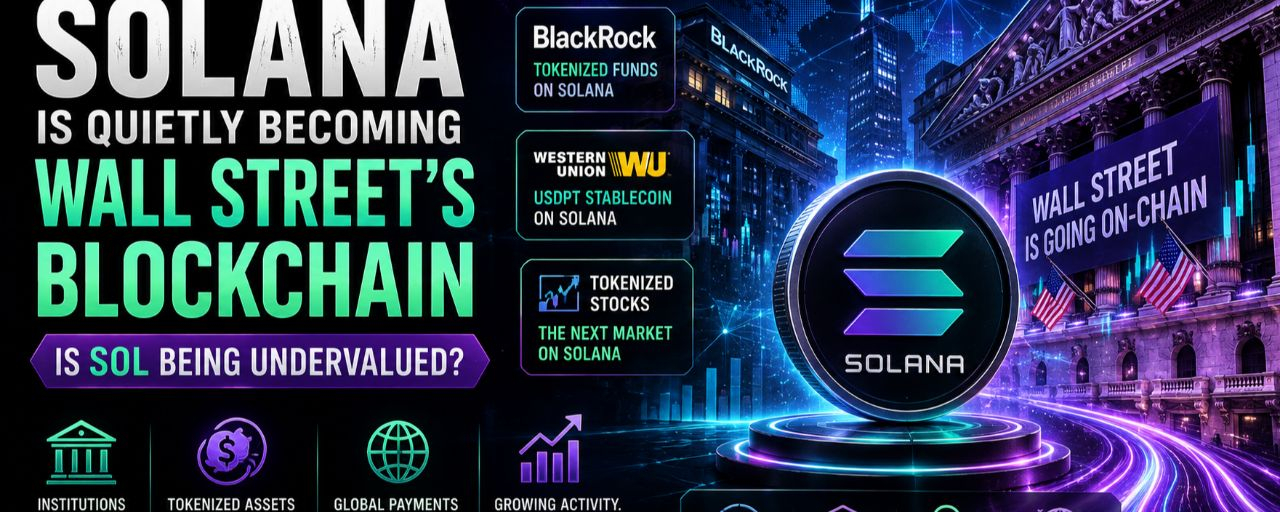
Article
Solana Is Quietly Becoming Wall Street’s Blockchain — Is SOL Being Undervalued?While Bitcoin Dominates Headlines, Solana Is Building Something Bigger
The crypto market often moves from one narrative to another.
Bitcoin dominates the headlines.
Ethereum remains a major smart-contract platform.
But underneath the noise, Solana is increasingly positioning itself as infrastructure for payments, tokenized assets and institutional finance.
And recent developments suggest this narrative deserves much more attention.
🏦 Wall Street Is Moving On-Chain
One of the biggest developments is the growing presence of traditional financial institutions on Solana.
BlackRock has expanded its tokenized money-market strategy onto Solana, adding another major institutional name to the network's growing financial ecosystem.
This matters because tokenization isn't simply about putting a digital version of an asset on a blockchain.
The real opportunity is creating infrastructure where assets can be:
Issued on-chainTraded 24/7Settled quicklyUsed as collateralIntegrated with other financial applications
If that model scales, blockchains could become part of the infrastructure behind traditional markets.
💵 Western Union Is Bringing Payments to Solana
The institutional story isn't limited to investment products.
Western Union launched USDPT, a U.S. dollar-denominated payment stablecoin issued by Anchorage Digital Bank and built on Solana.
That's significant because Western Union isn't a crypto-native startup.
It's a global payments company with a massive existing financial network.
The bigger question becomes:
What happens when traditional payment companies start using public blockchains as settlement infrastructure?
That could be far more important for SOL's long-term narrative than a short-term price rally.
📈 Tokenized Stocks Are Becoming a Real Market
Solana's ecosystem is also seeing increasing activity around tokenized equities.
Recent ecosystem data highlights tokenized equity activity involving major companies, alongside significant growth in tokenized-equity trading and holders.
This creates a completely different use case for blockchain.
Instead of crypto being an isolated financial market, blockchain could become the rail connecting traditional assets with digital markets.
Stocks.
Treasuries.
Stablecoins.
Funds.
All potentially moving through the same on-chain infrastructure.
⚡ The Activity Is Also Scaling
Solana recently reported more than 1 billion non-vote transactions in a single week, showing the network is handling substantial activity beyond simple speculative trading.
Of course, transaction counts alone don't guarantee that SOL will outperform.
But they do provide an important signal:
There is increasing activity being built around the network.
For long-term investors, that may be more meaningful than one day's price movement.
🧩 Why SOL Could Benefit
If Solana becomes a major settlement layer for tokenized assets and digital payments, demand for the network could potentially come from several directions:
1️⃣ Tokenized assets
More assets moving on-chain could mean more network activity.
2️⃣ Stablecoins
Stablecoins can create recurring transaction demand.
3️⃣ Payments
Companies such as Western Union are testing blockchain-based payment infrastructure.
4️⃣ Institutional finance
Asset managers are experimenting with tokenized financial products.
5️⃣ DeFi
Tokenized real-world assets can eventually interact with decentralized financial applications.
This creates a much broader thesis than simply:
"SOL might pump."
The thesis becomes:
"Solana could become financial infrastructure."
⚠️ But There Are Still Risks
Investors shouldn't ignore the other side.
Solana faces:
Competition from Ethereum and other high-throughput networksRegulatory uncertaintySmart-contract and infrastructure risksNetwork adoption risksCompetition for tokenized assetsCrypto market volatility
And most importantly:
Institutional adoption does not automatically translate into higher SOL prices.
The market still needs to determine how much economic value ultimately accrues to the SOL token itself.
👀 What Should Investors Watch Next?
If you're following Solana, I would watch these five indicators:
1. Institutional tokenization
Are more major financial institutions choosing Solana?
2. Stablecoin activity
Does stablecoin usage continue growing?
3. Tokenized equity volume
Are tokenized stocks becoming a real market rather than a niche experiment?
4. Payments adoption
Do more payment companies use Solana for settlement?
5. Real economic activity
Is network growth coming from genuine users and financial applications rather than speculation alone?
These signals could tell us whether the Solana institutional narrative is actually becoming a long-term trend.
🚀 Final Thoughts
The most interesting part of Solana's story isn't necessarily today's SOL price.
It's what's being built around the network.
A major asset manager moving tokenized funds onto Solana.
A global payments company using Solana for a regulated dollar stablecoin.
Tokenized equities gaining traction.
And growing on-chain activity.
These developments suggest Solana is increasingly competing for something much bigger than crypto trading:
the infrastructure of digital finance.
If that trend continues, SOL could become one of the most closely watched assets of the next phase of blockchain adoption.
But the key question remains:
Will Solana become a genuine financial settlement layer—or will another blockchain capture that role?
💬 What Do You Think?
Can Solana become one of the leading blockchains for institutional finance?
🟢 Yes — SOL is becoming financial infrastructure
🔵 Maybe — Ethereum still has the advantage
🟣 Too early to tell
🟡 Another blockchain will win
👇 Vote and tell me WHY.
🔖 Hashtags
#Solana #SOL #Crypto #Tokenization #RWA #Stablecoins #BlackRock #Blockchain #InstitutionalCrypto #BinanceSquare
Solana Is Quietly Becoming Wall Street’s Blockchain — Is SOL Being Undervalued?
While Bitcoin Dominates Headlines, Solana Is Building Something Bigger
The crypto market often moves from one narrative to another.
Bitcoin dominates the headlines.
Ethereum remains a major smart-contract platform.
But underneath the noise, Solana is increasingly positioning itself as infrastructure for payments, tokenized assets and institutional finance.
And recent developments suggest this narrative deserves much more attention.
🏦 Wall Street Is Moving On-Chain
One of the biggest developments is the growing presence of traditional financial institutions on Solana.
BlackRock has expanded its tokenized money-market strategy onto Solana, adding another major institutional name to the network's growing financial ecosystem.
This matters because tokenization isn't simply about putting a digital version of an asset on a blockchain.
The real opportunity is creating infrastructure where assets can be:
Issued on-chainTraded 24/7Settled quicklyUsed as collateralIntegrated with other financial applications
If that model scales, blockchains could become part of the infrastructure behind traditional markets.
💵 Western Union Is Bringing Payments to Solana
The institutional story isn't limited to investment products.
Western Union launched USDPT, a U.S. dollar-denominated payment stablecoin issued by Anchorage Digital Bank and built on Solana.
That's significant because Western Union isn't a crypto-native startup.
It's a global payments company with a massive existing financial network.
The bigger question becomes:
What happens when traditional payment companies start using public blockchains as settlement infrastructure?
That could be far more important for SOL's long-term narrative than a short-term price rally.
📈 Tokenized Stocks Are Becoming a Real Market
Solana's ecosystem is also seeing increasing activity around tokenized equities.
Recent ecosystem data highlights tokenized equity activity involving major companies, alongside significant growth in tokenized-equity trading and holders.
This creates a completely different use case for blockchain.
Instead of crypto being an isolated financial market, blockchain could become the rail connecting traditional assets with digital markets.
Stocks.
Treasuries.
Stablecoins.
Funds.
All potentially moving through the same on-chain infrastructure.
⚡ The Activity Is Also Scaling
Solana recently reported more than 1 billion non-vote transactions in a single week, showing the network is handling substantial activity beyond simple speculative trading.
Of course, transaction counts alone don't guarantee that SOL will outperform.
But they do provide an important signal:
There is increasing activity being built around the network.
For long-term investors, that may be more meaningful than one day's price movement.
🧩 Why SOL Could Benefit
If Solana becomes a major settlement layer for tokenized assets and digital payments, demand for the network could potentially come from several directions:
1️⃣ Tokenized assets
More assets moving on-chain could mean more network activity.
2️⃣ Stablecoins
Stablecoins can create recurring transaction demand.
3️⃣ Payments
Companies such as Western Union are testing blockchain-based payment infrastructure.
4️⃣ Institutional finance
Asset managers are experimenting with tokenized financial products.
5️⃣ DeFi
Tokenized real-world assets can eventually interact with decentralized financial applications.
This creates a much broader thesis than simply:
"SOL might pump."
The thesis becomes:
"Solana could become financial infrastructure."
⚠️ But There Are Still Risks
Investors shouldn't ignore the other side.
Solana faces:
Competition from Ethereum and other high-throughput networksRegulatory uncertaintySmart-contract and infrastructure risksNetwork adoption risksCompetition for tokenized assetsCrypto market volatility
And most importantly:
Institutional adoption does not automatically translate into higher SOL prices.
The market still needs to determine how much economic value ultimately accrues to the SOL token itself.
👀 What Should Investors Watch Next?
If you're following Solana, I would watch these five indicators:
1. Institutional tokenization
Are more major financial institutions choosing Solana?
2. Stablecoin activity
Does stablecoin usage continue growing?
3. Tokenized equity volume
Are tokenized stocks becoming a real market rather than a niche experiment?
4. Payments adoption
Do more payment companies use Solana for settlement?
5. Real economic activity
Is network growth coming from genuine users and financial applications rather than speculation alone?
These signals could tell us whether the Solana institutional narrative is actually becoming a long-term trend.
🚀 Final Thoughts
The most interesting part of Solana's story isn't necessarily today's SOL price.
It's what's being built around the network.
A major asset manager moving tokenized funds onto Solana.
A global payments company using Solana for a regulated dollar stablecoin.
Tokenized equities gaining traction.
And growing on-chain activity.
These developments suggest Solana is increasingly competing for something much bigger than crypto trading:
the infrastructure of digital finance.
If that trend continues, SOL could become one of the most closely watched assets of the next phase of blockchain adoption.
But the key question remains:
Will Solana become a genuine financial settlement layer—or will another blockchain capture that role?
💬 What Do You Think?
Can Solana become one of the leading blockchains for institutional finance?
🟢 Yes — SOL is becoming financial infrastructure
🔵 Maybe — Ethereum still has the advantage
🟣 Too early to tell
🟡 Another blockchain will win
👇 Vote and tell me WHY.
🔖 Hashtags
#Solana #SOL #Crypto #Tokenization #RWA #Stablecoins #BlackRock #Blockchain #InstitutionalCrypto #BinanceSquare
The crypto market often moves from one narrative to another.
Bitcoin dominates the headlines.
Ethereum remains a major smart-contract platform.
But underneath the noise, Solana is increasingly positioning itself as infrastructure for payments, tokenized assets and institutional finance.
And recent developments suggest this narrative deserves much more attention.
🏦 Wall Street Is Moving On-Chain
One of the biggest developments is the growing presence of traditional financial institutions on Solana.
BlackRock has expanded its tokenized money-market strategy onto Solana, adding another major institutional name to the network's growing financial ecosystem.
This matters because tokenization isn't simply about putting a digital version of an asset on a blockchain.
The real opportunity is creating infrastructure where assets can be:
Issued on-chainTraded 24/7Settled quicklyUsed as collateralIntegrated with other financial applications
If that model scales, blockchains could become part of the infrastructure behind traditional markets.
💵 Western Union Is Bringing Payments to Solana
The institutional story isn't limited to investment products.
Western Union launched USDPT, a U.S. dollar-denominated payment stablecoin issued by Anchorage Digital Bank and built on Solana.
That's significant because Western Union isn't a crypto-native startup.
It's a global payments company with a massive existing financial network.
The bigger question becomes:
What happens when traditional payment companies start using public blockchains as settlement infrastructure?
That could be far more important for SOL's long-term narrative than a short-term price rally.
📈 Tokenized Stocks Are Becoming a Real Market
Solana's ecosystem is also seeing increasing activity around tokenized equities.
Recent ecosystem data highlights tokenized equity activity involving major companies, alongside significant growth in tokenized-equity trading and holders.
This creates a completely different use case for blockchain.
Instead of crypto being an isolated financial market, blockchain could become the rail connecting traditional assets with digital markets.
Stocks.
Treasuries.
Stablecoins.
Funds.
All potentially moving through the same on-chain infrastructure.
⚡ The Activity Is Also Scaling
Solana recently reported more than 1 billion non-vote transactions in a single week, showing the network is handling substantial activity beyond simple speculative trading.
Of course, transaction counts alone don't guarantee that SOL will outperform.
But they do provide an important signal:
There is increasing activity being built around the network.
For long-term investors, that may be more meaningful than one day's price movement.
🧩 Why SOL Could Benefit
If Solana becomes a major settlement layer for tokenized assets and digital payments, demand for the network could potentially come from several directions:
1️⃣ Tokenized assets
More assets moving on-chain could mean more network activity.
2️⃣ Stablecoins
Stablecoins can create recurring transaction demand.
3️⃣ Payments
Companies such as Western Union are testing blockchain-based payment infrastructure.
4️⃣ Institutional finance
Asset managers are experimenting with tokenized financial products.
5️⃣ DeFi
Tokenized real-world assets can eventually interact with decentralized financial applications.
This creates a much broader thesis than simply:
"SOL might pump."
The thesis becomes:
"Solana could become financial infrastructure."
⚠️ But There Are Still Risks
Investors shouldn't ignore the other side.
Solana faces:
Competition from Ethereum and other high-throughput networksRegulatory uncertaintySmart-contract and infrastructure risksNetwork adoption risksCompetition for tokenized assetsCrypto market volatility
And most importantly:
Institutional adoption does not automatically translate into higher SOL prices.
The market still needs to determine how much economic value ultimately accrues to the SOL token itself.
👀 What Should Investors Watch Next?
If you're following Solana, I would watch these five indicators:
1. Institutional tokenization
Are more major financial institutions choosing Solana?
2. Stablecoin activity
Does stablecoin usage continue growing?
3. Tokenized equity volume
Are tokenized stocks becoming a real market rather than a niche experiment?
4. Payments adoption
Do more payment companies use Solana for settlement?
5. Real economic activity
Is network growth coming from genuine users and financial applications rather than speculation alone?
These signals could tell us whether the Solana institutional narrative is actually becoming a long-term trend.
🚀 Final Thoughts
The most interesting part of Solana's story isn't necessarily today's SOL price.
It's what's being built around the network.
A major asset manager moving tokenized funds onto Solana.
A global payments company using Solana for a regulated dollar stablecoin.
Tokenized equities gaining traction.
And growing on-chain activity.
These developments suggest Solana is increasingly competing for something much bigger than crypto trading:
the infrastructure of digital finance.
If that trend continues, SOL could become one of the most closely watched assets of the next phase of blockchain adoption.
But the key question remains:
Will Solana become a genuine financial settlement layer—or will another blockchain capture that role?
💬 What Do You Think?
Can Solana become one of the leading blockchains for institutional finance?
🟢 Yes — SOL is becoming financial infrastructure
🔵 Maybe — Ethereum still has the advantage
🟣 Too early to tell
🟡 Another blockchain will win
👇 Vote and tell me WHY.
🔖 Hashtags
#Solana #SOL #Crypto #Tokenization #RWA #Stablecoins #BlackRock #Blockchain #InstitutionalCrypto #BinanceSquare
80
Log in to explore more content
Join global crypto users on Binance Square
⚡️ Get latest and useful information about crypto.
💬 Trusted by the world’s largest crypto exchange.
👍 Discover real insights from verified creators.
Email / Phone number
Trending Topics
SECSendsCryptoCustodyRuleToWhiteHouse
3,822 views
200 Discussing
#secsendscryptocustodyruletowhitehouse
🔥 SEC’s Custody Twist: Freedom for US Whales! 🔓
The SEC just sent a new crypto custody rule to the White House, and it's officially labeled "Deregulatory"! 🎉 This means big US investment advisors can finally hold real spot crypto directly, instead of hiding behind paper ETFs.
You might ask: "So US whales get all the fun? When is this coming to my country?!" 🌍 Well, while you wait for your local regulators to wake up, remember this: when Phố Wall pumps real cash into actual crypto wallets, the whole global market flies! 📈🚀
What’s the play, traders?
✨ Be patient: This rule takes a few months to clear, but the structural bull case is massive.
💼 Follow the smart money: Accumulate spot assets alongside the giants.
⚠️ Not financial advice.
Ready to trade before the institutions front-run you? Sign up with code VINHTOCDO or click: https://www.binance.com/register?ref=VINHTOCDO
#SEC #CryptoRegulation #InstitutionalMoney #VINHTOCDO
$BTC
$ETH
$BNB
Vinhtocdo
·1 Likes
·1.9k views
BitcoinFaces$6.4BOptionsExpiry
2,388 views
76 Discussing
IranSaysHormuzOmanDealNotFinalized
4,768 views
197 Discussing