
文哥web3社区
1.8k Posts
文哥web3社区
web3爱好者,国内某排名前五985本硕(工学本科,金融硕士),CPA,13年二级市场投资经验。擅长项目研究,链上数据分析

BNB Holder
High-Frequency Trader
5.4 Years
96 Following
582 Followers
2.8K+ Liked
Posts
All
Quotes
PINNED
Verified
The market is about to turn. Here are the five most important data releases to watch over the next week, in order of importance:
1. On September 11 (this Friday), the U.S. will release August CPI. This is the last major data point before the interest-rate meeting, and it will directly affect whether the Federal Reserve raises rates on September 16. At present, the data appears to be building toward a result; if it is too high, you know what that means.
2. On September 10 (this Thursday), the U.S. will release August PPI (Producer Price Index). If this data resonates with the next day's September 11 data, it will put significant pressure on the Federal Reserve's rate-hike decision.
3. On September 10 (this Thursday), the European Central Bank will announce its interest-rate decision. Based on the current situation, a 25-basis-point hike is highly likely. This hike has already been priced in by the market; what matters more is whether this will be the last hike in this cycle and whether rate cuts will begin afterward.
4. On September 8 (this Tuesday), Japan will release the first revised estimate of Q2 GDP. This will directly affect the Bank of Japan's assessment of Japan's economic condition, as well as its rate-hike plan for the second half of the year (a rate hike is certain, but this will affect the pace).
5. On September 9 (this Wednesday), China's National Bureau of Statistics will release CPI and PPI. These data will reflect whether China's deflationary situation has improved. With domestic economic growth clearly slowing, these figures will play an important role in determining whether the Chinese government will introduce stronger monetary stimulus policies to support economic growth.
1. On September 11 (this Friday), the U.S. will release August CPI. This is the last major data point before the interest-rate meeting, and it will directly affect whether the Federal Reserve raises rates on September 16. At present, the data appears to be building toward a result; if it is too high, you know what that means.
2. On September 10 (this Thursday), the U.S. will release August PPI (Producer Price Index). If this data resonates with the next day's September 11 data, it will put significant pressure on the Federal Reserve's rate-hike decision.
3. On September 10 (this Thursday), the European Central Bank will announce its interest-rate decision. Based on the current situation, a 25-basis-point hike is highly likely. This hike has already been priced in by the market; what matters more is whether this will be the last hike in this cycle and whether rate cuts will begin afterward.
4. On September 8 (this Tuesday), Japan will release the first revised estimate of Q2 GDP. This will directly affect the Bank of Japan's assessment of Japan's economic condition, as well as its rate-hike plan for the second half of the year (a rate hike is certain, but this will affect the pace).
5. On September 9 (this Wednesday), China's National Bureau of Statistics will release CPI and PPI. These data will reflect whether China's deflationary situation has improved. With domestic economic growth clearly slowing, these figures will play an important role in determining whether the Chinese government will introduce stronger monetary stimulus policies to support economic growth.
Verified
$RAY surged, with a 24-hour gain of over 60%. It has a bit of the feel of altcoin season—you sing the chorus, and I jump in!
What happened?
The direct trigger for RAY’s sharp surge is: StoneFun has launched on Raydium LaunchLab. StoneFun is a token issuance platform on the Solana chain, which means all future new token deployments from StoneFun will go through LaunchLab. This can directly bring huge trading traffic and liquidity to Raydium, which is a substantial positive for RAY.
What happened?
The direct trigger for RAY’s sharp surge is: StoneFun has launched on Raydium LaunchLab. StoneFun is a token issuance platform on the Solana chain, which means all future new token deployments from StoneFun will go through LaunchLab. This can directly bring huge trading traffic and liquidity to Raydium, which is a substantial positive for RAY.
Brothers, do you all think this bull market is normal?
Looking back, this round of the “bull” was brought about by Robinhood chain. The original official intention was to build an RWA public chain that would allow global users to trade tokenized stocks and ETFs 24/7, but what actually exploded was meme coins. We once again saw the scene that only appears in the “tail end” of a bull run, with memes flying everywhere. Its meme launch platform, pons, even surged by tens of thousands of times in just two months, leaving people like us, the bystanders, speechless. In addition, the heat around Rb also spilled over to old coins like uni and arb. Since these coins are all beneficiaries of the meme frenzy, they also soared several times in a short period.
At present, it seems that the limited funds have basically all been attracted into this kind of meme carnival, while the liquidity of other tokens has fallen to freezing point, including BTC and ETH. This is frightening. Although the illusion of prosperity is still continuing, perhaps very soon a plunge will come. Perhaps we are about to see the broader crypto market fall by more than 10% to 50%.
By then, perhaps the tide will have gone out, the dross will have been washed away, and a healthy “bull” market will begin.
Looking back, this round of the “bull” was brought about by Robinhood chain. The original official intention was to build an RWA public chain that would allow global users to trade tokenized stocks and ETFs 24/7, but what actually exploded was meme coins. We once again saw the scene that only appears in the “tail end” of a bull run, with memes flying everywhere. Its meme launch platform, pons, even surged by tens of thousands of times in just two months, leaving people like us, the bystanders, speechless. In addition, the heat around Rb also spilled over to old coins like uni and arb. Since these coins are all beneficiaries of the meme frenzy, they also soared several times in a short period.
At present, it seems that the limited funds have basically all been attracted into this kind of meme carnival, while the liquidity of other tokens has fallen to freezing point, including BTC and ETH. This is frightening. Although the illusion of prosperity is still continuing, perhaps very soon a plunge will come. Perhaps we are about to see the broader crypto market fall by more than 10% to 50%.
By then, perhaps the tide will have gone out, the dross will have been washed away, and a healthy “bull” market will begin.
#币安安全星期四
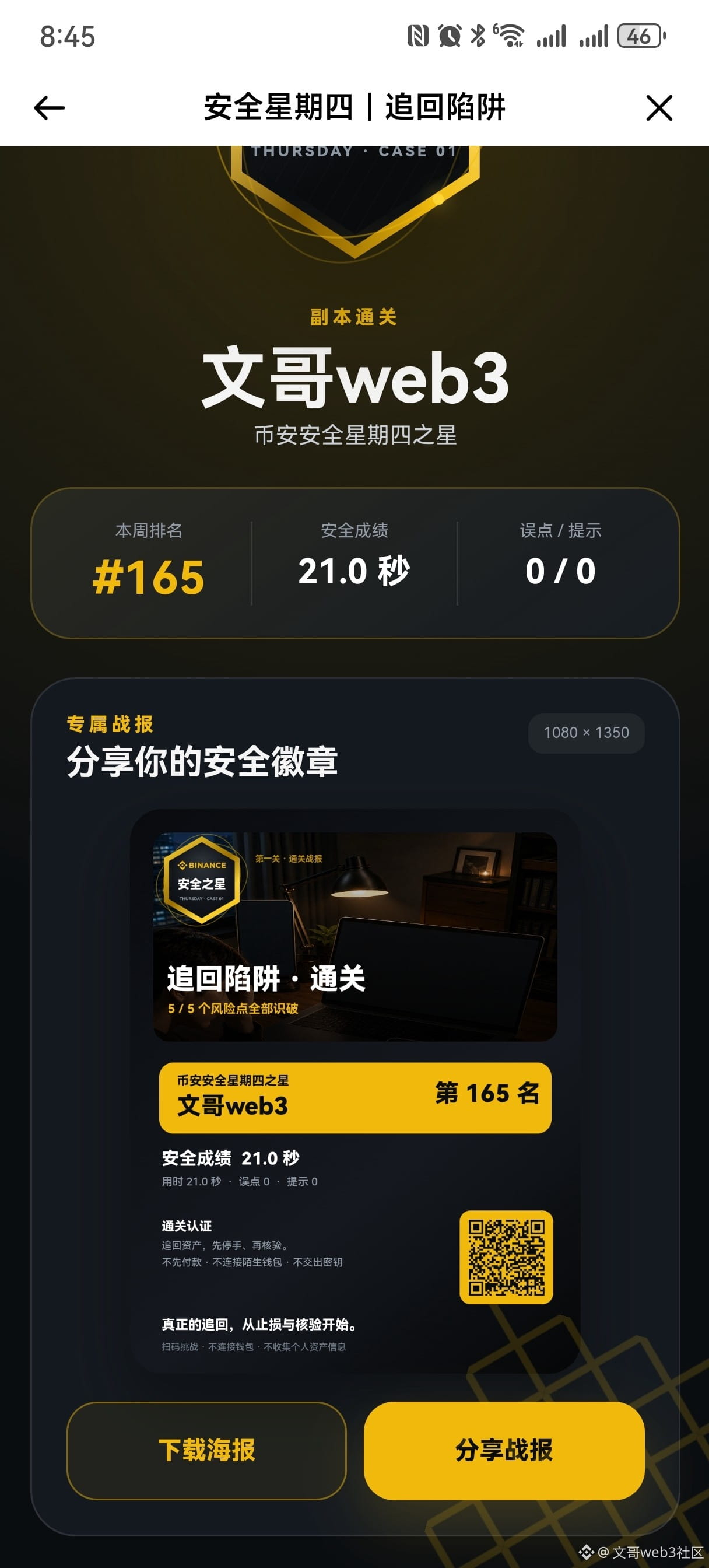
This event is very educational. It’s very important to learn wallet anti-theft knowledge. Overall, I cleared the levels twice: the first time took nearly two minutes in total, and the second time took nearly 20 seconds (entering the nickname took 5 seconds). I’m really happy with this result, haha😄.
This event is very educational. It’s very important to learn wallet anti-theft knowledge. Overall, I cleared the levels twice: the first time took nearly two minutes in total, and the second time took nearly 20 seconds (entering the nickname took 5 seconds). I’m really happy with this result, haha😄.


币安Binance华语
·
--
“Don’t laugh—you won’t find the 4th one either 😨”
🪤 They say this is the hardest #币安安全星期四 challenge in history: in the shortest time, can you find all the traps?
👉 点击参与实景陷阱追踪挑战, compete for a spot on the leaderboard 🏆
The top 10 on the leaderboard each get a 100U detective reward, and the top 3 also receive a themed gift box!
Share it and post your clear-through screenshot in the comments, and then 15 people will be selected to receive 44U 🧧
🪤 They say this is the hardest #币安安全星期四 challenge in history: in the shortest time, can you find all the traps?
👉 点击参与实景陷阱追踪挑战, compete for a spot on the leaderboard 🏆
The top 10 on the leaderboard each get a 100U detective reward, and the top 3 also receive a themed gift box!
Share it and post your clear-through screenshot in the comments, and then 15 people will be selected to receive 44U 🧧
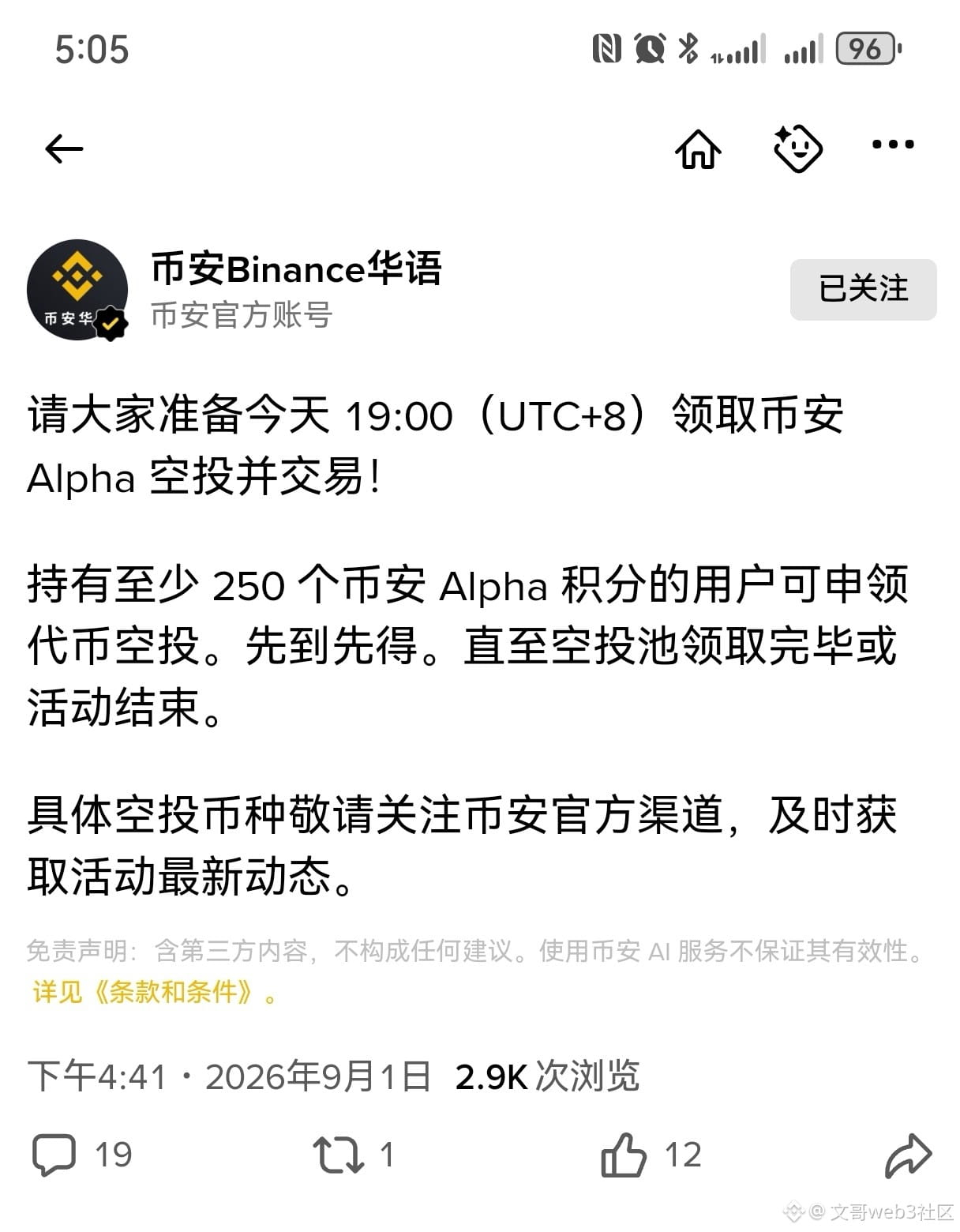
Tonight at 19:00—airdrop raid (probably old coins). It’s back to 250 points again. This score is one I can’t reach. Wishing my fellow buddies who can grab it to go big!
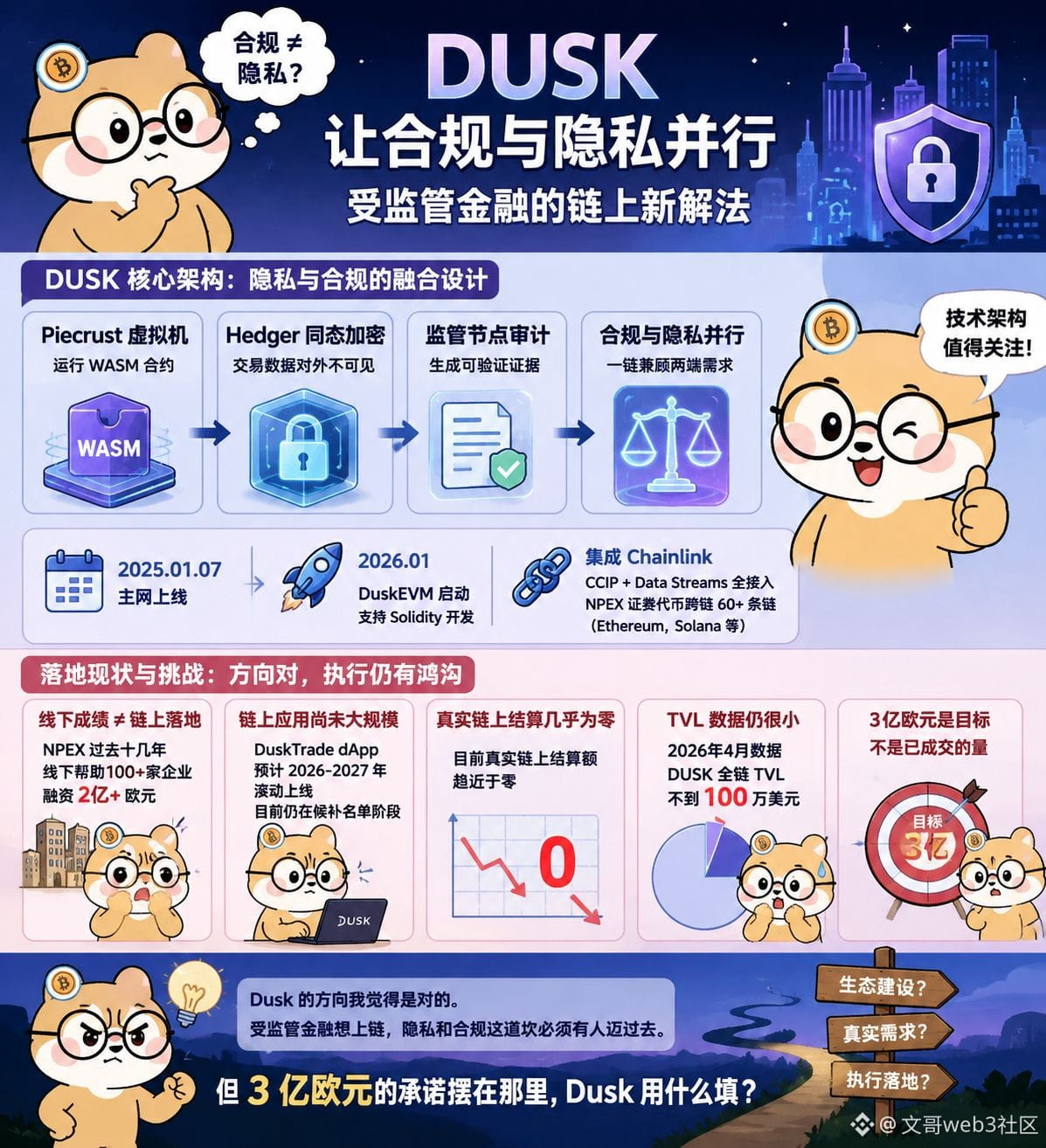
I used to always think that “compliance” and “privacy” on blockchain were two forces working against each other: if you want to be compliant, you need transparency; if you want privacy, you have to be anonymous—so you can only take care of one side. It wasn’t until I studied the architecture behind @Dusk in detail that I realized what it aims to do is completely different. From the ground up, Dusk is designed to blend compliance and privacy together.
The Piecrust virtual machine runs WASM contracts. Hedger uses homomorphic encryption so transaction data is not visible to the outside, but regulator nodes can generate verifiable audit evidence at any time. The mainnet goes live on January 7, 2025. In January 2026, DuskEVM officially kicks off, so Solidity developers can directly deploy applications. On top of that, by integrating Chainlink for CCIP and Data Streams, NPEX security tokens can be extended across 60+ chains including Ethereum and Solana. From a technical architecture standpoint, this combination really is worth paying attention to.
But there’s an issue you can’t get around: architecture is one thing—execution is another. In the past decade or more, NPEX helped more than 100 small and mid-sized enterprises raise over €200 million offline under traditional law. Those were equity under conventional regulations, not on-chain tokens. The DuskTrade dApp is expected to roll out between 2026 and 2027, and right now it’s still on the waitlist stage. Real on-chain settlement volume is effectively zero. Data from April 2026 shows DUSK’s all-chain TVL is under $1 million. €300 million is the goal, not a figure already closed.
I think Dusk’s direction is right. Regulated finance wants to move on-chain, and someone has to clear the hurdle of privacy and compliance. But between “the direction is correct” and “it has already been achieved” there’s a huge execution gap. With the commitment of €300 million standing there, what will Dusk use to fill it?
#dusk $DUSK @Dusk
The Piecrust virtual machine runs WASM contracts. Hedger uses homomorphic encryption so transaction data is not visible to the outside, but regulator nodes can generate verifiable audit evidence at any time. The mainnet goes live on January 7, 2025. In January 2026, DuskEVM officially kicks off, so Solidity developers can directly deploy applications. On top of that, by integrating Chainlink for CCIP and Data Streams, NPEX security tokens can be extended across 60+ chains including Ethereum and Solana. From a technical architecture standpoint, this combination really is worth paying attention to.
But there’s an issue you can’t get around: architecture is one thing—execution is another. In the past decade or more, NPEX helped more than 100 small and mid-sized enterprises raise over €200 million offline under traditional law. Those were equity under conventional regulations, not on-chain tokens. The DuskTrade dApp is expected to roll out between 2026 and 2027, and right now it’s still on the waitlist stage. Real on-chain settlement volume is effectively zero. Data from April 2026 shows DUSK’s all-chain TVL is under $1 million. €300 million is the goal, not a figure already closed.
I think Dusk’s direction is right. Regulated finance wants to move on-chain, and someone has to clear the hurdle of privacy and compliance. But between “the direction is correct” and “it has already been achieved” there’s a huge execution gap. With the commitment of €300 million standing there, what will Dusk use to fill it?
#dusk $DUSK @Dusk
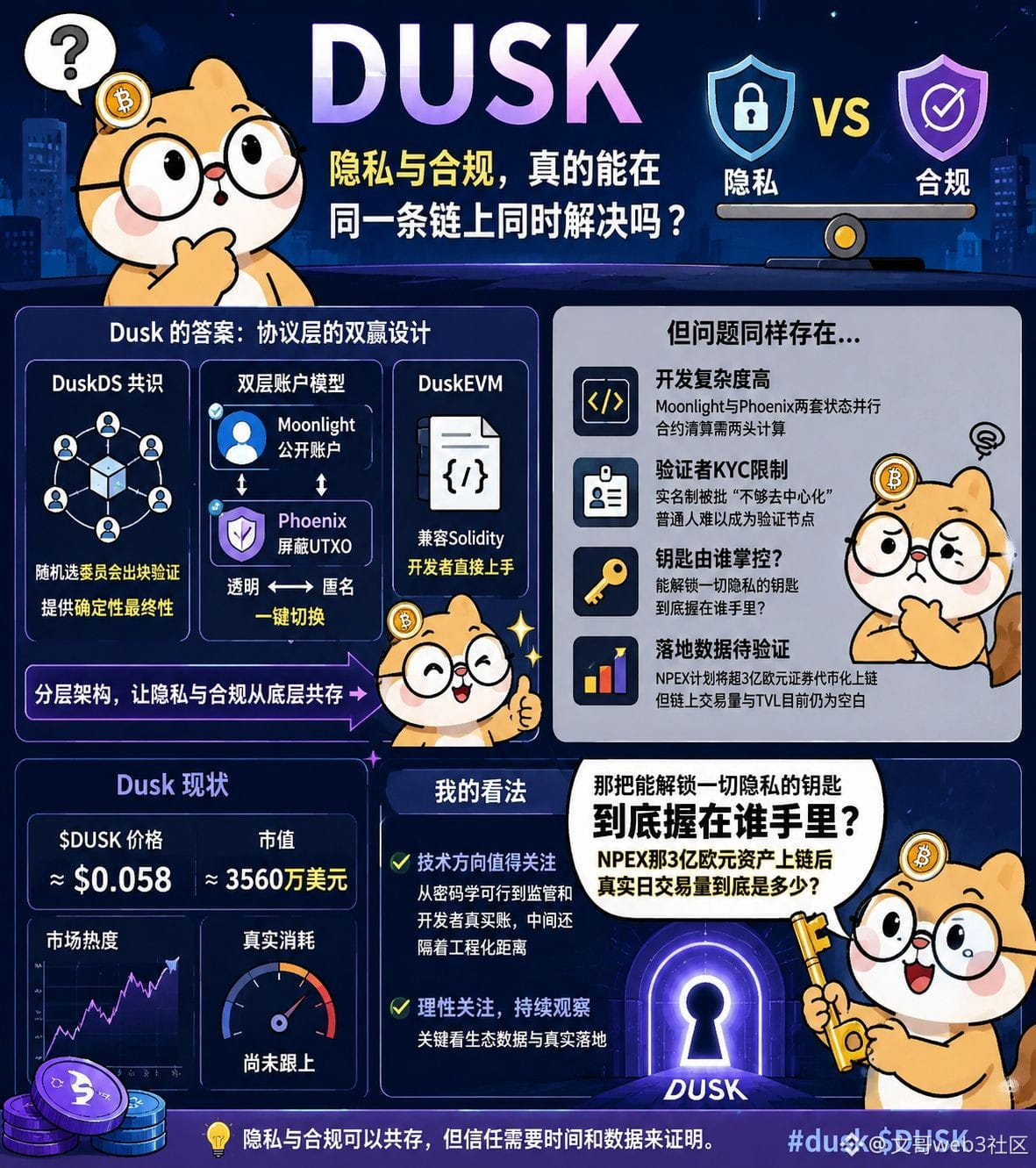
I was first paying attention to @Dusk , and honestly, it started with a question: can privacy and compliance—these two things that seem to clash—really be solved on the same chain at the same time? Most projects either choose transparency and let institutions go “bare” while exposing themselves, or choose anonymity and keep regulators out.
Dusk’s answer really piqued my interest. It didn’t pick a side between the two; instead, it embeds both into the protocol from the ground up. In DuskDS, the Succinct Attestation consensus randomly selects a committee to propose and verify blocks. What I care about is that it provides RWA with the missing piece: deterministic finality—once a securities trade is confirmed, it can’t be rolled back. Moonlight manages public accounts, and Phoenix uses zero-knowledge proofs to shield UTXOs, allowing users to switch with a single click between transparency and anonymity. On top of that, DuskEVM lets Solidity developers get started directly. This layered design feels more solid than I expected.
But what I don’t fully agree with is that a pretty document doesn’t equal real-world product delivery. Developers have to handle two sets of state logic—both Moonlight and Phoenix. Account balances and encrypted notes run in parallel, so when writing and clearing a lending contract, you end up calculating both sides. The documentation says “choose as needed,” but in practice it shifts the complexity onto the ecosystem. Verifier KYC requires real-name identification, and it has been criticized as “not decentralized enough.” I understand that institutions may need to know who to contact if something goes wrong, but the cost is that ordinary people basically don’t get a meaningful chance to become validator nodes. So is this a “regulation-friendly consensus,” or is it a permissioned network wearing the outer shell of a public chain?
What worries me even more is another detail: the news that NPEX plans to tokenize over €300 million in securities onto the blockchain has been widely publicized, but currently on-chain real trading volume and TVL data are still blank. There’s a noticeable gap between the numbers announced and the execution so far. At the moment, $DUSK is priced at about $0.058, with a market cap of roughly $35.6 million. Market interest is there, but the real consumption hasn’t caught up.
So, when looking at Dusk now, I won’t become blindly optimistic just because it claims to resolve the “privacy vs compliance” contradiction. The technical direction is worth attention, but from cryptographic feasibility to whether regulators and developers truly buy in—there’s still an engineering gap in between. What I really want to know is: who holds the “key” that unlocks all privacy? And after those €300 million assets go on-chain through NPEX, what is the actual number of daily transactions in real terms?
#dusk $DUSK @Dusk
Dusk’s answer really piqued my interest. It didn’t pick a side between the two; instead, it embeds both into the protocol from the ground up. In DuskDS, the Succinct Attestation consensus randomly selects a committee to propose and verify blocks. What I care about is that it provides RWA with the missing piece: deterministic finality—once a securities trade is confirmed, it can’t be rolled back. Moonlight manages public accounts, and Phoenix uses zero-knowledge proofs to shield UTXOs, allowing users to switch with a single click between transparency and anonymity. On top of that, DuskEVM lets Solidity developers get started directly. This layered design feels more solid than I expected.
But what I don’t fully agree with is that a pretty document doesn’t equal real-world product delivery. Developers have to handle two sets of state logic—both Moonlight and Phoenix. Account balances and encrypted notes run in parallel, so when writing and clearing a lending contract, you end up calculating both sides. The documentation says “choose as needed,” but in practice it shifts the complexity onto the ecosystem. Verifier KYC requires real-name identification, and it has been criticized as “not decentralized enough.” I understand that institutions may need to know who to contact if something goes wrong, but the cost is that ordinary people basically don’t get a meaningful chance to become validator nodes. So is this a “regulation-friendly consensus,” or is it a permissioned network wearing the outer shell of a public chain?
What worries me even more is another detail: the news that NPEX plans to tokenize over €300 million in securities onto the blockchain has been widely publicized, but currently on-chain real trading volume and TVL data are still blank. There’s a noticeable gap between the numbers announced and the execution so far. At the moment, $DUSK is priced at about $0.058, with a market cap of roughly $35.6 million. Market interest is there, but the real consumption hasn’t caught up.
So, when looking at Dusk now, I won’t become blindly optimistic just because it claims to resolve the “privacy vs compliance” contradiction. The technical direction is worth attention, but from cryptographic feasibility to whether regulators and developers truly buy in—there’s still an engineering gap in between. What I really want to know is: who holds the “key” that unlocks all privacy? And after those €300 million assets go on-chain through NPEX, what is the actual number of daily transactions in real terms?
#dusk $DUSK @Dusk
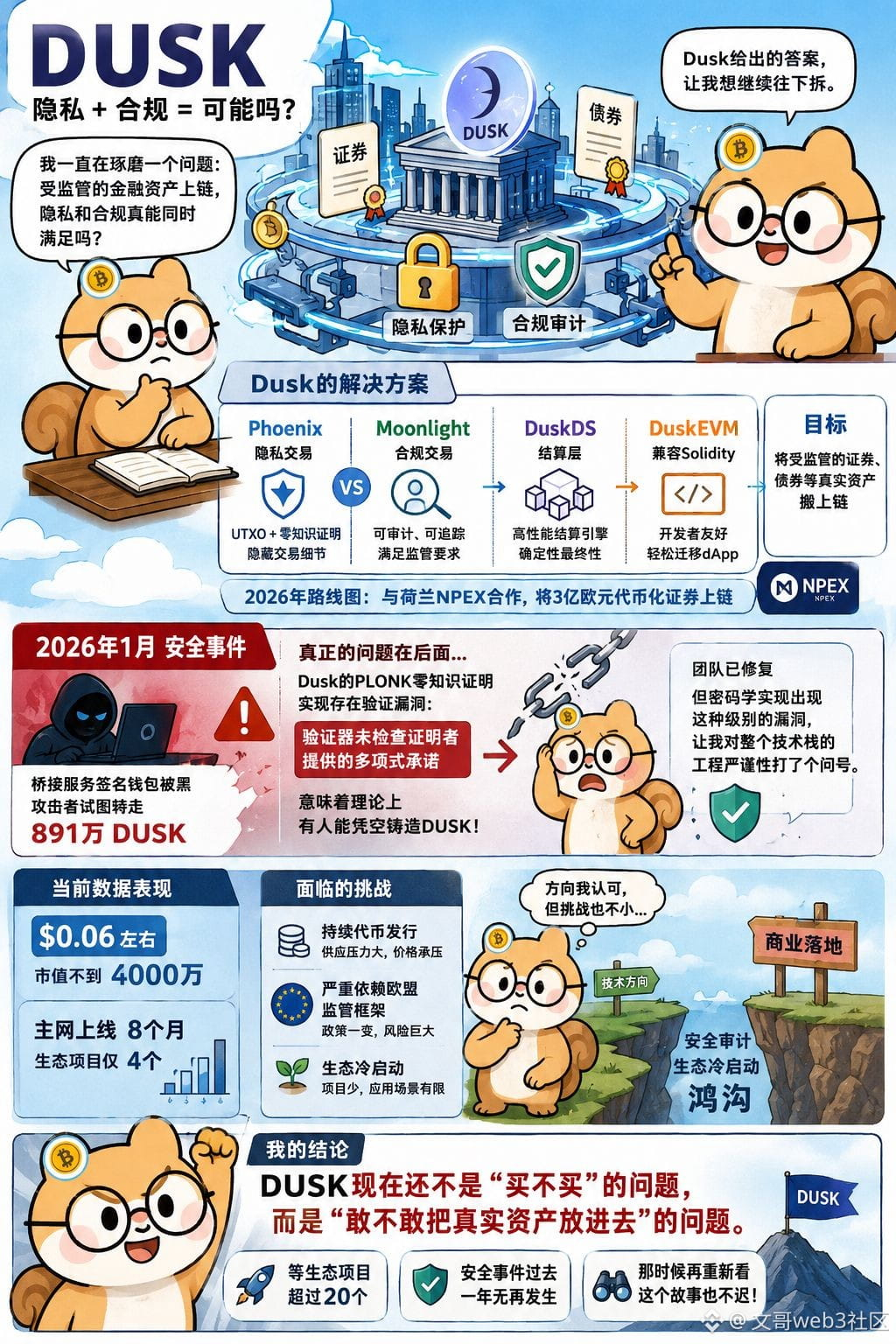
I’ve been mulling over a question: can privacy and compliance really be achieved at the same time when regulated financial assets are put on-chain? The answer given by @Dusk makes me want to keep unpacking it.
What Dusk wants to do is undeniably compelling. Using the Phoenix and Moonlight dual-trading model to solve the old “privacy vs. compliance” problem, then adding the DuskDS settlement layer and the DuskEVM compatible with Solidity—with the goal of moving regulated securities and bonds onto the blockchain. In the 2026 roadmap, tokenized securities worth €300 million being put on-chain in cooperation with the Dutch NPEX also sounds like it could be on the right track.
But what truly made me pause was something else.
In the January 2026 security incident, the headline was that a bridge service’s signing wallet was hacked and the attacker attempted to move 8.91 million DUSK. What I care about more, though, is the subsequent disclosure: Dusk’s implementation of the PLONK zero-knowledge proof contains a verification flaw— the verifier didn’t actually check the polynomial commitments provided by the prover. What does that mean? In theory, someone could mint DUSK out of thin air. The team later patched it, but after all, for a cryptographic implementation to have a vulnerability at this level, to be honest, it makes me question the engineering rigor of the entire tech stack.
Let’s look at the data, too. $DUSK is around $0.06 now, with a market cap of less than $40 million. An L1 that’s been on mainnet for 8 months, and its ecosystem has only 4 projects. Ongoing token issuance creates continuous supply pressure, which has been weighing on the price. And its architecture relies heavily on the EU regulatory framework—if policy changes, the whole story may need to be rewritten.
I acknowledge Dusk’s direction. The positioning of privacy + compliance is definitely precise. But between the technical direction and commercial rollout, there’s an entire gap of security audits and ecosystem cold-start.
For me, the question with DUSK right now isn’t whether to buy it—it’s whether I’d dare to put real assets into it. When the ecosystem projects exceed 20 and no further security incidents have happened for a year, then it won’t be too late to revisit this story.
#dusk
What Dusk wants to do is undeniably compelling. Using the Phoenix and Moonlight dual-trading model to solve the old “privacy vs. compliance” problem, then adding the DuskDS settlement layer and the DuskEVM compatible with Solidity—with the goal of moving regulated securities and bonds onto the blockchain. In the 2026 roadmap, tokenized securities worth €300 million being put on-chain in cooperation with the Dutch NPEX also sounds like it could be on the right track.
But what truly made me pause was something else.
In the January 2026 security incident, the headline was that a bridge service’s signing wallet was hacked and the attacker attempted to move 8.91 million DUSK. What I care about more, though, is the subsequent disclosure: Dusk’s implementation of the PLONK zero-knowledge proof contains a verification flaw— the verifier didn’t actually check the polynomial commitments provided by the prover. What does that mean? In theory, someone could mint DUSK out of thin air. The team later patched it, but after all, for a cryptographic implementation to have a vulnerability at this level, to be honest, it makes me question the engineering rigor of the entire tech stack.
Let’s look at the data, too. $DUSK is around $0.06 now, with a market cap of less than $40 million. An L1 that’s been on mainnet for 8 months, and its ecosystem has only 4 projects. Ongoing token issuance creates continuous supply pressure, which has been weighing on the price. And its architecture relies heavily on the EU regulatory framework—if policy changes, the whole story may need to be rewritten.
I acknowledge Dusk’s direction. The positioning of privacy + compliance is definitely precise. But between the technical direction and commercial rollout, there’s an entire gap of security audits and ecosystem cold-start.
For me, the question with DUSK right now isn’t whether to buy it—it’s whether I’d dare to put real assets into it. When the ecosystem projects exceed 20 and no further security incidents have happened for a year, then it won’t be too late to revisit this story.
#dusk
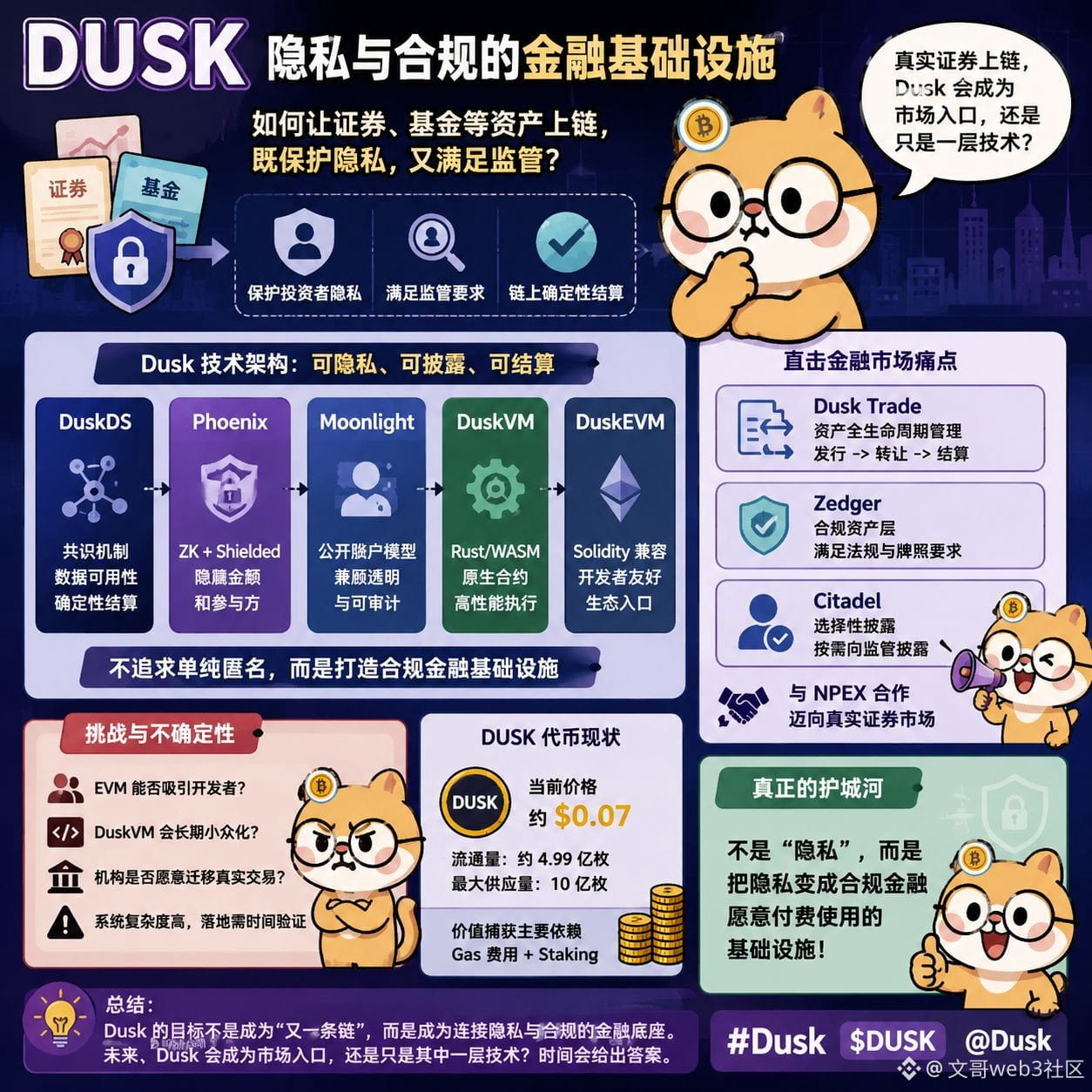
When I was researching @Dusk , what I cared about most wasn’t really “yet another privacy chain,” but a more realistic problem: once securities and funds are put on-chain, you can’t fully disclose investors’ information, and regulators also can’t see nothing. How exactly is this supposed to be solved?
Dusk’s answer is pretty interesting. Phoenix uses ZK for shielded transfers, hiding both the amounts and the participating parties; Moonlight keeps the public-account model. In the end, both of them settle on DuskDS. Citadel then adds selective disclosures at the identity layer. Investors can prove attributes like residence, age range, and whether they’re qualified investors—without having to expose all of their identity information.
I quite agree with the rationale behind this design, because it finally pulls “privacy” back from anonymous storytelling into actual financial business: privacy isn’t simply “nobody can see,” but rather “who should see, and how much they should see” becomes part of the protocol. Dusk Trade, Zedger/Hedger are also continuing to focus on the real processes around investor access, issuance of regulated assets, and transfer and settlement.
But that’s exactly where a bigger issue is buried. The more financial rules are written into code, the more deterministic execution becomes; yet real-world rules have always kept changing. When investor eligibility changes, assets are frozen, or regulatory requirements are updated, who updates the on-chain state? And after it’s updated, what happens to assets that have already been issued? I think this is more worth studying than whether the chain has enough TPS.
DUSK is currently mainly used for Gas and Staking, with a maximum supply of 1 billion. The official mechanism will also include transaction fees in block rewards. But what’s truly worth watching is: as the scale of financial assets grows in the future, can it form sustained demand—$DUSK —rather than just narrative growth.
So when I look at Dusk now, I’m not just wondering whether it can deliver privacy well. I want to see one thing instead: when real-world rules keep changing, can it let code evolve with them—without turning financial assets into a set of “dead rules” that nobody dares to modify?
#dusk $DUSK @Dusk
Dusk’s answer is pretty interesting. Phoenix uses ZK for shielded transfers, hiding both the amounts and the participating parties; Moonlight keeps the public-account model. In the end, both of them settle on DuskDS. Citadel then adds selective disclosures at the identity layer. Investors can prove attributes like residence, age range, and whether they’re qualified investors—without having to expose all of their identity information.
I quite agree with the rationale behind this design, because it finally pulls “privacy” back from anonymous storytelling into actual financial business: privacy isn’t simply “nobody can see,” but rather “who should see, and how much they should see” becomes part of the protocol. Dusk Trade, Zedger/Hedger are also continuing to focus on the real processes around investor access, issuance of regulated assets, and transfer and settlement.
But that’s exactly where a bigger issue is buried. The more financial rules are written into code, the more deterministic execution becomes; yet real-world rules have always kept changing. When investor eligibility changes, assets are frozen, or regulatory requirements are updated, who updates the on-chain state? And after it’s updated, what happens to assets that have already been issued? I think this is more worth studying than whether the chain has enough TPS.
DUSK is currently mainly used for Gas and Staking, with a maximum supply of 1 billion. The official mechanism will also include transaction fees in block rewards. But what’s truly worth watching is: as the scale of financial assets grows in the future, can it form sustained demand—$DUSK —rather than just narrative growth.
So when I look at Dusk now, I’m not just wondering whether it can deliver privacy well. I want to see one thing instead: when real-world rules keep changing, can it let code evolve with them—without turning financial assets into a set of “dead rules” that nobody dares to modify?
#dusk $DUSK @Dusk
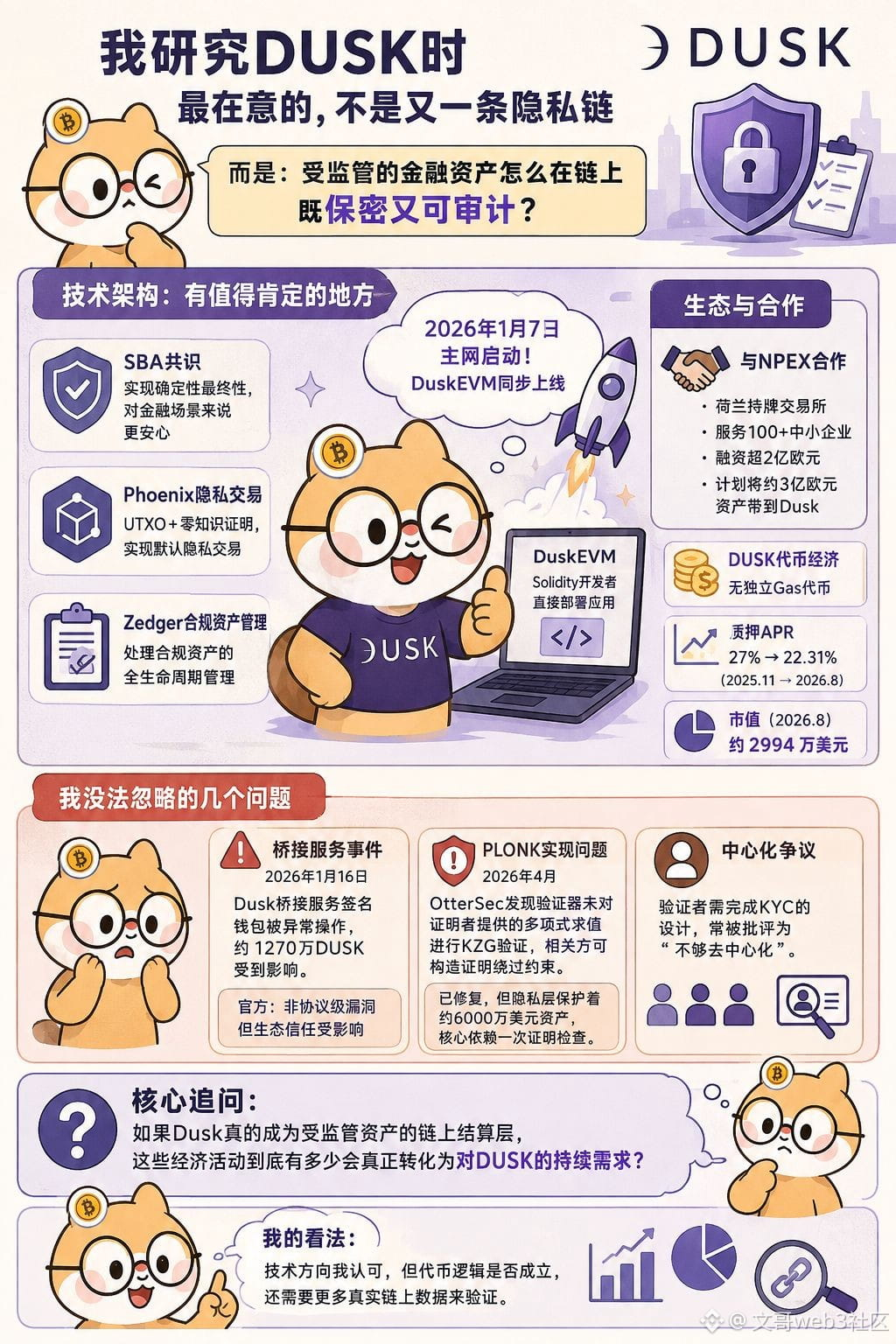
What I care about most when studying @Dusk isn’t yet another label on a privacy chain, but rather the more practical question it tries to answer: how do regulated financial assets stay confidential yet still be auditable on-chain?
Dusk’s technical architecture genuinely has aspects worth praising. The SBA consensus achieves deterministic finality; for financial use cases, that feels more reassuring than probabilistic finality. Phoenix uses UTXO plus zero-knowledge proofs for default private transactions, and Zedger handles end-to-end lifecycle management of compliant assets. Mainnet is scheduled to launch on January 7, 2026, with DuskEVM rolling out in sync—Solidity developers can deploy applications directly. The partnership with NPEX is also worth noting: this Dutch licensed exchange has served more than 100 SMEs, raised over €200 million, and plans to bring around €300 million in assets to Dusk. DUSK did not introduce a separate Gas token; staking APR dropped from about 27% in November 2025 to 22.31%, and its market cap is around $29.94 million as of August 2026.
But I can’t ignore a few issues.
On January 16, 2026, the Dusk bridge’s signed wallet experienced abnormal operations, affecting approximately 1270万$DUSK . The official statement emphasizes that this is not a protocol-level vulnerability, but since the bridge is an entry point into the ecosystem, the impact on ecosystem trust is very real. What concerns me even more is a PLONK implementation issue found by the OtterSec team in April 2026: the verifier does not perform KZG verification on multiple polynomial evaluations provided by the prover, allowing relevant parties to construct proofs that bypass constraints. Although it has been fixed, Dusk’s privacy layer protects roughly $60 million in assets, and its core security relies on a single proof check. In addition, the design that requires validators to complete KYC is often criticized as “not decentralized enough.”
So my question is this: if Dusk truly becomes an on-chain settlement layer for regulated assets, how much of these economic activities will actually translate into sustained demand for DUSK? I agree with the technical direction, but whether the token economics are valid still needs more real on-chain data to verify.
#dusk $DUSK @Dusk
Dusk’s technical architecture genuinely has aspects worth praising. The SBA consensus achieves deterministic finality; for financial use cases, that feels more reassuring than probabilistic finality. Phoenix uses UTXO plus zero-knowledge proofs for default private transactions, and Zedger handles end-to-end lifecycle management of compliant assets. Mainnet is scheduled to launch on January 7, 2026, with DuskEVM rolling out in sync—Solidity developers can deploy applications directly. The partnership with NPEX is also worth noting: this Dutch licensed exchange has served more than 100 SMEs, raised over €200 million, and plans to bring around €300 million in assets to Dusk. DUSK did not introduce a separate Gas token; staking APR dropped from about 27% in November 2025 to 22.31%, and its market cap is around $29.94 million as of August 2026.
But I can’t ignore a few issues.
On January 16, 2026, the Dusk bridge’s signed wallet experienced abnormal operations, affecting approximately 1270万$DUSK . The official statement emphasizes that this is not a protocol-level vulnerability, but since the bridge is an entry point into the ecosystem, the impact on ecosystem trust is very real. What concerns me even more is a PLONK implementation issue found by the OtterSec team in April 2026: the verifier does not perform KZG verification on multiple polynomial evaluations provided by the prover, allowing relevant parties to construct proofs that bypass constraints. Although it has been fixed, Dusk’s privacy layer protects roughly $60 million in assets, and its core security relies on a single proof check. In addition, the design that requires validators to complete KYC is often criticized as “not decentralized enough.”
So my question is this: if Dusk truly becomes an on-chain settlement layer for regulated assets, how much of these economic activities will actually translate into sustained demand for DUSK? I agree with the technical direction, but whether the token economics are valid still needs more real on-chain data to verify.
#dusk $DUSK @Dusk
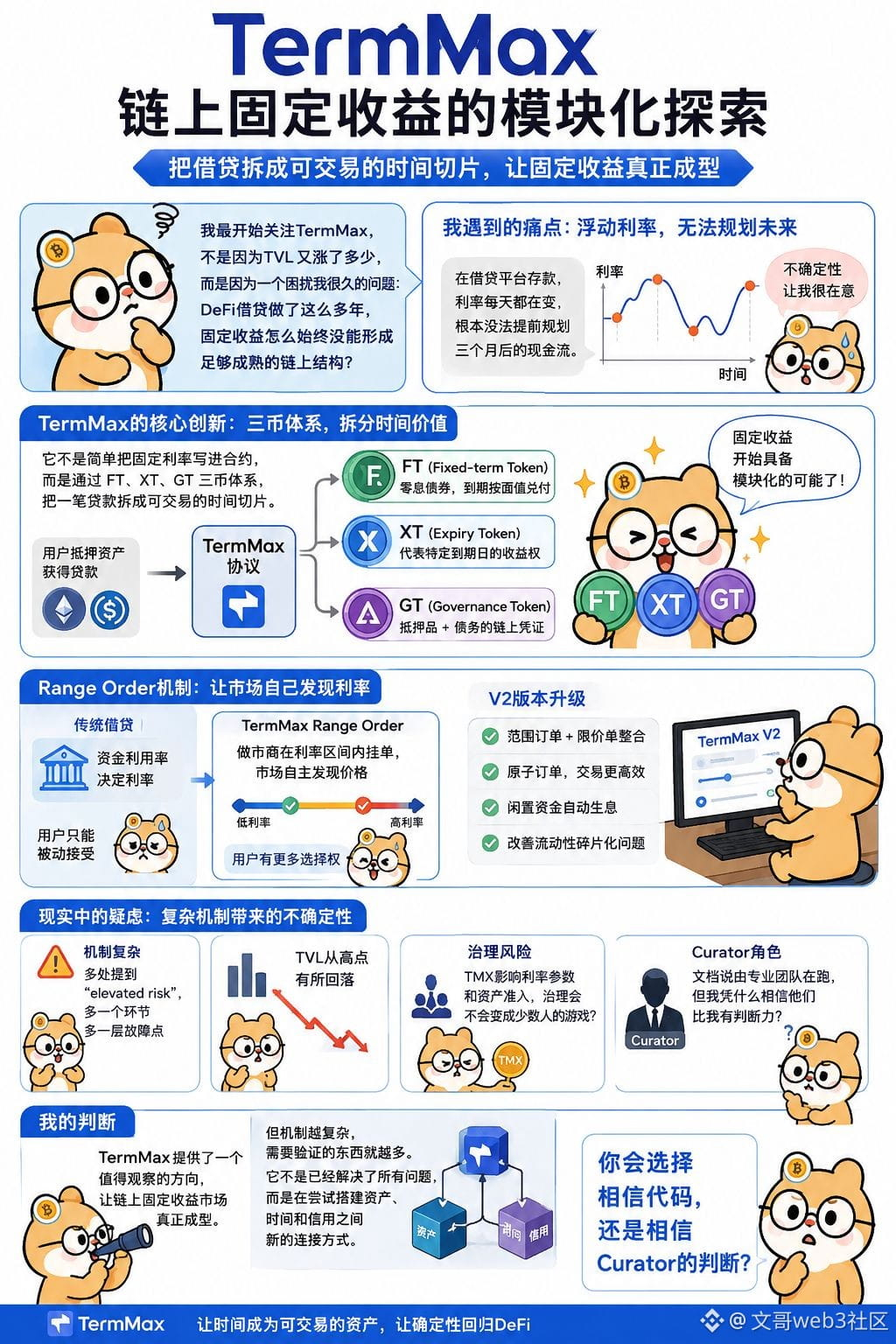
I first started paying attention to @TermMax , not because its TVL had grown by how much, but because of a question that has always bothered me: after so many years of DeFi lending, why hasn’t fixed-income still been able to form a sufficiently mature on-chain structure?
I tried depositing on lending platforms—the interest rates change every day, making it impossible to plan cash flows three months in advance. That kind of uncertainty really gets to me.
After digging deeper, I found that TermMax is doing something quite special. It isn’t just writing a fixed interest rate into a contract. Instead, using this three-coin setup—FT, XT, and GT—it breaks a loan into tradable time slices. FT is like a zero-coupon bond, settled at face value upon maturity; GT bundles collateral and debt into on-chain credentials. Only then did I realize that fixed income might be starting to become modular.
Range Order is another design that made me stop and look more closely. Traditional lending adjusts rates based on capital utilization, so users can only passively accept whatever comes. TermMax, however, lets market makers place orders within a range of interest rates, so the market discovers the price itself. V2 further integrates range orders and limit orders, and combines atomic orders with idle capital automatically earning yield. The issue of fragmented liquidity is indeed improving.
But to be honest, I still have concerns. TermMax’s mechanism is more complex than most lending protocols, with multiple mentions of “elevated risk.” More steps mean more potential failure points—under extreme market conditions, are these constraints enough? I’m not sure. TVL has also fallen somewhat from its peak. TMX, as the governance token: if large holders can influence interest-rate parameters and asset eligibility, will governance end up becoming a game for a few? The role of Curator is described in the docs as being run by a professional team, but why should I trust that they make better judgments than I do?
My take is this: TermMax provides a direction worth watching—one that may help the on-chain fixed-income market truly take shape. But the more complex the mechanism is, the more things need to be validated. It hasn’t solved everything yet; it’s simply trying to build new connections between assets, time, and credit.
Would you choose to trust the code, or trust Curator’s judgment? #termmax @TermMax
I tried depositing on lending platforms—the interest rates change every day, making it impossible to plan cash flows three months in advance. That kind of uncertainty really gets to me.
After digging deeper, I found that TermMax is doing something quite special. It isn’t just writing a fixed interest rate into a contract. Instead, using this three-coin setup—FT, XT, and GT—it breaks a loan into tradable time slices. FT is like a zero-coupon bond, settled at face value upon maturity; GT bundles collateral and debt into on-chain credentials. Only then did I realize that fixed income might be starting to become modular.
Range Order is another design that made me stop and look more closely. Traditional lending adjusts rates based on capital utilization, so users can only passively accept whatever comes. TermMax, however, lets market makers place orders within a range of interest rates, so the market discovers the price itself. V2 further integrates range orders and limit orders, and combines atomic orders with idle capital automatically earning yield. The issue of fragmented liquidity is indeed improving.
But to be honest, I still have concerns. TermMax’s mechanism is more complex than most lending protocols, with multiple mentions of “elevated risk.” More steps mean more potential failure points—under extreme market conditions, are these constraints enough? I’m not sure. TVL has also fallen somewhat from its peak. TMX, as the governance token: if large holders can influence interest-rate parameters and asset eligibility, will governance end up becoming a game for a few? The role of Curator is described in the docs as being run by a professional team, but why should I trust that they make better judgments than I do?
My take is this: TermMax provides a direction worth watching—one that may help the on-chain fixed-income market truly take shape. But the more complex the mechanism is, the more things need to be validated. It hasn’t solved everything yet; it’s simply trying to build new connections between assets, time, and credit.
Would you choose to trust the code, or trust Curator’s judgment? #termmax @TermMax
I used to trade within institutions, and what I found most frustrating was that the order book was always watched closely by the counterparty—prices wouldn’t even get placed before the market already started moving. On the blockchain, it gets even worse: every transaction record is public, and anyone can see how much is in each wallet at a glance. Transparency is a double-edged sword, but with large-volume capital moves, who would dare to run like that?
So when I saw @Dusk , my first reaction wasn’t, “Here comes another privacy project,” but rather, “Someone is taking seriously the idea of putting financial assets on-chain.”
First, let’s talk about what I appreciate. Dusk didn’t treat privacy as a toggle switch—it keeps two models at the same time: Phoenix for privacy-preserving transfers based on UTXO, and Moonlight as a transparent account. Users can choose based on the scenario, because in finance the needs for confidentiality and openness are simply not the same. Technically, Dusk has just upgraded to a three-layer modular design: the bottom layer handles consensus and settlement, the middle layer maintains compatibility with the Ethereum ecosystem, and the top layer provides privacy-preserving application functionality. On top of that, Zedger manages the securities lifecycle, and Citadel performs zero-knowledge identity verification. The whole system redesigns compliance, privacy, and settlement together.
In terms of rollout, the mainnet is scheduled to launch in January 2025, in partnership with the Netherlands’ NPEX exchange, with plans to put hundreds of millions of euros in securities on-chain. These are the timelines—there are already clear dates.
But the issues are also obvious. The biggest thing that makes me cautious is centralized risk: the EVM layer is driven by a single sequencer, similar to the “backbone” of Ethereum L2. While the sequencer is cheap, it’s also fragile—and it’s the thing you’re tied to. If a regulatory committee were summoned through a legal entity, decentralization would be hard to guarantee. Another problem is that the market isn’t buying it. Right now, on-chain activity is still dominated by old playbooks like spot trading and lending. Privacy-and-compliance isn’t a must-have need for most people, so the technical advantages don’t yet map to real demand.
My view is that Dusk hasn’t taken the wrong direction, but we’re in the “technology waiting for the market” stage. I’ll put it near the top of my watchlist, waiting for NPEX assets to truly pick up momentum—and for the real usage share of privacy-preserving transactions.
When major financial institutions’ clearing systems run on a public chain, do you think they’ll choose full transparency or privacy with tiered levels? Let’s discuss in the comments.
#dusk $DUSK @Dusk
So when I saw @Dusk , my first reaction wasn’t, “Here comes another privacy project,” but rather, “Someone is taking seriously the idea of putting financial assets on-chain.”
First, let’s talk about what I appreciate. Dusk didn’t treat privacy as a toggle switch—it keeps two models at the same time: Phoenix for privacy-preserving transfers based on UTXO, and Moonlight as a transparent account. Users can choose based on the scenario, because in finance the needs for confidentiality and openness are simply not the same. Technically, Dusk has just upgraded to a three-layer modular design: the bottom layer handles consensus and settlement, the middle layer maintains compatibility with the Ethereum ecosystem, and the top layer provides privacy-preserving application functionality. On top of that, Zedger manages the securities lifecycle, and Citadel performs zero-knowledge identity verification. The whole system redesigns compliance, privacy, and settlement together.
In terms of rollout, the mainnet is scheduled to launch in January 2025, in partnership with the Netherlands’ NPEX exchange, with plans to put hundreds of millions of euros in securities on-chain. These are the timelines—there are already clear dates.
But the issues are also obvious. The biggest thing that makes me cautious is centralized risk: the EVM layer is driven by a single sequencer, similar to the “backbone” of Ethereum L2. While the sequencer is cheap, it’s also fragile—and it’s the thing you’re tied to. If a regulatory committee were summoned through a legal entity, decentralization would be hard to guarantee. Another problem is that the market isn’t buying it. Right now, on-chain activity is still dominated by old playbooks like spot trading and lending. Privacy-and-compliance isn’t a must-have need for most people, so the technical advantages don’t yet map to real demand.
My view is that Dusk hasn’t taken the wrong direction, but we’re in the “technology waiting for the market” stage. I’ll put it near the top of my watchlist, waiting for NPEX assets to truly pick up momentum—and for the real usage share of privacy-preserving transactions.
When major financial institutions’ clearing systems run on a public chain, do you think they’ll choose full transparency or privacy with tiered levels? Let’s discuss in the comments.
#dusk $DUSK @Dusk
#Binance Safety Thursday
Choose C.
After stolen on-chain assets are recovered, the success rate is extremely low. The “experts” who proactively private-message you are basically second-time scammers. Instead of risking it to verify, it’s better to block them directly, keep the evidence, and report to the authorities. Ironclad rules for survival in the crypto world: don’t pay, don’t give out private keys, and don’t hold onto fantasies.
Choose C.
After stolen on-chain assets are recovered, the success rate is extremely low. The “experts” who proactively private-message you are basically second-time scammers. Instead of risking it to verify, it’s better to block them directly, keep the evidence, and report to the authorities. Ironclad rules for survival in the crypto world: don’t pay, don’t give out private keys, and don’t hold onto fantasies.
币安Binance华语
·
--
😈 “Bro, your wallet got stolen? I know some blockchain gurus—your assets can still be recovered!”
What would you do❓
A. Great, it’s a guru—my wallet’s saved. Send the seed phrase directly 🤝
B. Wait, I want to verify the card: who are you? Where are you from? How do you recover it?👀
C. ❌ Don’t trust any asset-recovery channel—block immediately!
⬇️ Follow the account, share, and leave your choice and reasons. 3 winners will be selected to receive a 40U security reward #币安安全星期四
What would you do❓
A. Great, it’s a guru—my wallet’s saved. Send the seed phrase directly 🤝
B. Wait, I want to verify the card: who are you? Where are you from? How do you recover it?👀
C. ❌ Don’t trust any asset-recovery channel—block immediately!
⬇️ Follow the account, share, and leave your choice and reasons. 3 winners will be selected to receive a 40U security reward #币安安全星期四
When I looked at privacy projects before, I always felt something was off. Either it’s as fully anonymous as Monero—so regulators take one look and shake their heads. Or it’s like Zcash’s “selective disclosure,” but in practice the bar is too high, and institutions can’t really play with it. It wasn’t until I saw how traditional financial institutions handle equities and bonds—wanting privacy while still needing compliance—that I realized where the problem actually was. Most blockchains treat “privacy” and “compliance” as a binary choice, but the real financial world needs both.
What caught my attention about Dusk is that it doesn’t dodge this contradiction. It uses Phoenix for privacy transactions on UTXOs, and Moonlight runs transparent accounts—two legs, both moving. Zedger manages the issuance and lifecycle of regulated assets, while Citadel enables zero-knowledge identity selective disclosure. DuskEVM is compatible with the Ethereum ecosystem, lowering the development barrier. This architecture weaves privacy, compliance, and auditability together. @Dusk
But on the flip side, I also have concerns. First, the performance cost of zero-knowledge proofs—whether generating proofs’ speed and the Gas fees can support large-scale adoption is still a big question. Second, the idea that validators need KYC has been criticized by many as “not decentralized enough.” But from another perspective, that’s precisely the prerequisite for institutions to actually enter the space—when problems happen, you know who to contact. Third, and biggest of all, the RWA track hasn’t really taken off yet. No matter how refined the technology is, without a massive amount of real assets being put on-chain, it’s still just an “overbuilt test highway.” Dusk’s mainnet has been live for over a year, and its market cap is currently under $30 million—suggesting the market is still watching from the sidelines.
When I look at Dusk, I’m not looking at how big it is right now—I’m looking at whether the direction it’s betting on is right: writing compliance into the protocol layer, not patching it on after the fact. Its collaboration with NPEX is already pushing Europe’s first blockchain securities trading platform. If this path works, the value logic won’t be the same as that of “privacy coins” anymore. When one day Wall Street’s clearing system truly runs on a public chain, do you think they’ll choose full transparency—or this kind of privacy-tiered approach? Let’s talk in the comments. #dusk $DUSK
What caught my attention about Dusk is that it doesn’t dodge this contradiction. It uses Phoenix for privacy transactions on UTXOs, and Moonlight runs transparent accounts—two legs, both moving. Zedger manages the issuance and lifecycle of regulated assets, while Citadel enables zero-knowledge identity selective disclosure. DuskEVM is compatible with the Ethereum ecosystem, lowering the development barrier. This architecture weaves privacy, compliance, and auditability together. @Dusk
But on the flip side, I also have concerns. First, the performance cost of zero-knowledge proofs—whether generating proofs’ speed and the Gas fees can support large-scale adoption is still a big question. Second, the idea that validators need KYC has been criticized by many as “not decentralized enough.” But from another perspective, that’s precisely the prerequisite for institutions to actually enter the space—when problems happen, you know who to contact. Third, and biggest of all, the RWA track hasn’t really taken off yet. No matter how refined the technology is, without a massive amount of real assets being put on-chain, it’s still just an “overbuilt test highway.” Dusk’s mainnet has been live for over a year, and its market cap is currently under $30 million—suggesting the market is still watching from the sidelines.
When I look at Dusk, I’m not looking at how big it is right now—I’m looking at whether the direction it’s betting on is right: writing compliance into the protocol layer, not patching it on after the fact. Its collaboration with NPEX is already pushing Europe’s first blockchain securities trading platform. If this path works, the value logic won’t be the same as that of “privacy coins” anymore. When one day Wall Street’s clearing system truly runs on a public chain, do you think they’ll choose full transparency—or this kind of privacy-tiered approach? Let’s talk in the comments. #dusk $DUSK
The first time I came across @Dusk was because while bouncing back and forth between traditional finance and the crypto world, I got stuck on one thing for a long time: compliance and privacy—on-chain it seems like you can only choose one or the other. Until early 2026, when the DuskEVM mainnet launched, I finally felt like there might be a different solution.
Let me start with what really convinced me it had potential. What impressed me most about Dusk is its modular design. DuskDS handles consensus and settlement; DuskEVM is Solidity-compatible, so developers can migrate directly; and there will be a DuskVM dedicated privacy layer. The three layers are clearly分工ed—each does its job, instead of stuffing everything into a single layer like some other chains. It also has two transaction modes: Moonlight is transparent and publicly verifiable, while Phoenix uses zero-knowledge proofs to protect privacy. I think this dual-track approach is practical: be transparent when you need transparency, and keep things confidential when you need confidentiality. What I care about even more is Hedger, which uses homomorphic encryption and zero-knowledge proofs—protecting transaction details while still leaving audit entry points. This isn’t just “hide data”; it’s about letting data flow according to rules. Its collaboration with NPEX also suggests this isn’t just talk.
But I can’t ignore the unsettling things. In April 2026, OtterSec discovered a serious vulnerability in Dusk’s PLONK implementation: the verifier wasn’t verifying four polynomial commitments provided by the prover, which theoretically could allow $DUSK to be minted out of thin air. Although the team fixed it quickly, it made me question the premise behind “privacy protection.” If even the underlying cryptography implementation can have such oversights, can those claims of “absolute security” really be trusted? Also, its entire narrative is almost tied to the EU regulatory framework. That positioning is both a moat and a weak point: if the regulatory environment changes—or if institutions adopt it slower than expected—then all the designs up to that point could get stuck at the final step.
So my take is: Dusk’s technical approach is worth watching. It tries to fit privacy, compliance, and usability into one unified architecture. But whether it can truly work in practice doesn’t depend on how flashy the technology is—it depends on whether the cryptography implementation can stand up to continuous scrutiny, and whether the regulatory narrative can actually translate into meaningful usage by institutions. There are no shortcuts on this path. What do you think?
#dusk
Let me start with what really convinced me it had potential. What impressed me most about Dusk is its modular design. DuskDS handles consensus and settlement; DuskEVM is Solidity-compatible, so developers can migrate directly; and there will be a DuskVM dedicated privacy layer. The three layers are clearly分工ed—each does its job, instead of stuffing everything into a single layer like some other chains. It also has two transaction modes: Moonlight is transparent and publicly verifiable, while Phoenix uses zero-knowledge proofs to protect privacy. I think this dual-track approach is practical: be transparent when you need transparency, and keep things confidential when you need confidentiality. What I care about even more is Hedger, which uses homomorphic encryption and zero-knowledge proofs—protecting transaction details while still leaving audit entry points. This isn’t just “hide data”; it’s about letting data flow according to rules. Its collaboration with NPEX also suggests this isn’t just talk.
But I can’t ignore the unsettling things. In April 2026, OtterSec discovered a serious vulnerability in Dusk’s PLONK implementation: the verifier wasn’t verifying four polynomial commitments provided by the prover, which theoretically could allow $DUSK to be minted out of thin air. Although the team fixed it quickly, it made me question the premise behind “privacy protection.” If even the underlying cryptography implementation can have such oversights, can those claims of “absolute security” really be trusted? Also, its entire narrative is almost tied to the EU regulatory framework. That positioning is both a moat and a weak point: if the regulatory environment changes—or if institutions adopt it slower than expected—then all the designs up to that point could get stuck at the final step.
So my take is: Dusk’s technical approach is worth watching. It tries to fit privacy, compliance, and usability into one unified architecture. But whether it can truly work in practice doesn’t depend on how flashy the technology is—it depends on whether the cryptography implementation can stand up to continuous scrutiny, and whether the regulatory narrative can actually translate into meaningful usage by institutions. There are no shortcuts on this path. What do you think?
#dusk
In the past few years working on blockchain, what I fear most isn’t that the technology isn’t mature—it’s that project teams put “compliance” on their lips, while their architecture diagrams can’t stand up to scrutiny. Who is responsible for data availability? Where exactly are the audit boundaries? Will privacy protection be vetoed by regulators? If these aren’t clarified, who would dare to put real assets on-chain?
Following this line of thought, take @Dusk . The point that truly concerns me is that it doesn’t treat privacy and compliance as two mutually exclusive directions. Instead, it tries to find a path that allows both to work together. It handles the contradiction using zero-knowledge proofs: transactions remain private on-chain, but when needed, it can prove that it satisfies compliance requirements. This “reverse-engineering technical design from regulatory rules” approach is far more solid than the patchwork method of writing code first and fixing it later.
If you break down the architecture in detail: DuskDS handles consensus, settlement, and data availability; DuskEVM is compatible with the Solidity ecosystem; and in the future, DuskVM will support stronger privacy applications at the layer above. The three layers each do their own job, allowing institutions to port the EVM toolchain directly. Mainnet is scheduled to go live in January 2026, and NPEX’s dApp is already running, targeting a scale of hundreds of millions of euros.
But I’ve kept some questions too. Modularity increases complexity. As assets flow between layers, cross-layer mechanisms are required. In recent years, the incidents caused by cross-layer design have been far more numerous than those caused by the virtual machine itself. Also, will nodes eventually concentrate among a small group? The Provisioner requires a minimum stake of 1000 coins $DUSK , and rewards depend on your share in the network-wide staking pool—large holders naturally have an advantage. As on-chain data grows, hardware costs will eventually rise; once the barrier gets high enough, decentralization may slowly lose its original meaning.
Can the on-chain native compliance path outperform today’s centralized settlement system? Leave your choice in the comments
#dusk
Following this line of thought, take @Dusk . The point that truly concerns me is that it doesn’t treat privacy and compliance as two mutually exclusive directions. Instead, it tries to find a path that allows both to work together. It handles the contradiction using zero-knowledge proofs: transactions remain private on-chain, but when needed, it can prove that it satisfies compliance requirements. This “reverse-engineering technical design from regulatory rules” approach is far more solid than the patchwork method of writing code first and fixing it later.
If you break down the architecture in detail: DuskDS handles consensus, settlement, and data availability; DuskEVM is compatible with the Solidity ecosystem; and in the future, DuskVM will support stronger privacy applications at the layer above. The three layers each do their own job, allowing institutions to port the EVM toolchain directly. Mainnet is scheduled to go live in January 2026, and NPEX’s dApp is already running, targeting a scale of hundreds of millions of euros.
But I’ve kept some questions too. Modularity increases complexity. As assets flow between layers, cross-layer mechanisms are required. In recent years, the incidents caused by cross-layer design have been far more numerous than those caused by the virtual machine itself. Also, will nodes eventually concentrate among a small group? The Provisioner requires a minimum stake of 1000 coins $DUSK , and rewards depend on your share in the network-wide staking pool—large holders naturally have an advantage. As on-chain data grows, hardware costs will eventually rise; once the barrier gets high enough, decentralization may slowly lose its original meaning.
Can the on-chain native compliance path outperform today’s centralized settlement system? Leave your choice in the comments
#dusk
After a few years working on backend systems, the hardest part isn’t that the transaction volume is high—it’s that when something goes wrong, you can’t find anyone. If an exchange is down, a certain settlement gets stuck, or balances don’t match, everyone’s first reaction is to look at the code, look at the logs, and look at which node signed it. But who’s behind that node? Nobody knows. In an anonymous network, financial incidents happen with no accountability mechanism—there’s not even a hand to point at. That’s why when I saw <t-2/>@Dusk </t-2/> saying validators should first do KYC, my first reaction wasn’t “breaking decentralization,” but “finally, there’s someone you can reach.”
Dusk’s logic goes the other way around. Validators stake 1000 units of <a>$DUSK </a> and submit identity information. A random committee is selected to produce blocks, running consensus through the Succinct Attestation stack. In plain language: once a transaction is finalized, it’s locked in—no forks, no rollbacks. It’s totally different from Bitcoin’s “wait for another 6 blocks and see.” The mainnet launched in January 2026. DuskEVM is compatible with Ethereum, so Solidity code can be ported directly. Citadel handles the identity layer: users obtain a “I’m compliant” credential using zero-knowledge proofs, without putting their passport and bank statements on the table. On the NPEX side, there’s a €200 million pool. The collaboration direction is tokenizing stocks and bonds on-chain. Logically, it adds up.
But I won’t sugarcoat it. As of August 2026, there are only 206 active validators. The staking threshold is 1000 DUSK plus being online for 24 hours—on a home network, jump once to a new IP and you miss a round of voting. Most small players are basically screened out. The on-chain TVL is low, the liquidity pools are shallow. NPEX shows a €200 million figure, but that’s platform fundraising capacity, not actual on-chain transaction volume. Between the words “collaboration” and “real assets being settled on-chain,” there’s still a huge execution gap. Citadel’s credentials revocation—up to now, there’s no fully landed case. If an institution disappears, what happens to old credentials? No answer. Differences in laws across jurisdictions are even more hypothetical. The hard technical work is done; what remains is all business negotiation and regulatory communication—and that’s exactly the slowest part.
My take: Dusk’s direction is right—regulated assets on-chain, where compliance and privacy must be solved together. But the question is whether requiring validators to do KYC is a smart trade-off or excessive compromise. Don’t just read the whitepaper; look at whether NPEX can produce a real on-chain transaction next. If it can’t, then this architecture is just a high-end prop.
#dusk
Dusk’s logic goes the other way around. Validators stake 1000 units of <a>$DUSK </a> and submit identity information. A random committee is selected to produce blocks, running consensus through the Succinct Attestation stack. In plain language: once a transaction is finalized, it’s locked in—no forks, no rollbacks. It’s totally different from Bitcoin’s “wait for another 6 blocks and see.” The mainnet launched in January 2026. DuskEVM is compatible with Ethereum, so Solidity code can be ported directly. Citadel handles the identity layer: users obtain a “I’m compliant” credential using zero-knowledge proofs, without putting their passport and bank statements on the table. On the NPEX side, there’s a €200 million pool. The collaboration direction is tokenizing stocks and bonds on-chain. Logically, it adds up.
But I won’t sugarcoat it. As of August 2026, there are only 206 active validators. The staking threshold is 1000 DUSK plus being online for 24 hours—on a home network, jump once to a new IP and you miss a round of voting. Most small players are basically screened out. The on-chain TVL is low, the liquidity pools are shallow. NPEX shows a €200 million figure, but that’s platform fundraising capacity, not actual on-chain transaction volume. Between the words “collaboration” and “real assets being settled on-chain,” there’s still a huge execution gap. Citadel’s credentials revocation—up to now, there’s no fully landed case. If an institution disappears, what happens to old credentials? No answer. Differences in laws across jurisdictions are even more hypothetical. The hard technical work is done; what remains is all business negotiation and regulatory communication—and that’s exactly the slowest part.
My take: Dusk’s direction is right—regulated assets on-chain, where compliance and privacy must be solved together. But the question is whether requiring validators to do KYC is a smart trade-off or excessive compromise. Don’t just read the whitepaper; look at whether NPEX can produce a real on-chain transaction next. If it can’t, then this architecture is just a high-end prop.
#dusk
Previously handling cross-border payments and clearing, the thing I feared most was “funds arrived but not final settlement.” A single payment would pass through several layers of transfer; at each stop, funds got locked up and the counterparty default risk stayed with it. So Dusk? My first question goes straight to it: once the transaction is done, does it truly mean it’s dead—i.e., finalized?
It uses a Succinct Attestation. Put simply, it finalizes in seconds after blocks are produced, with none of that probability game of “waiting for six confirmations.” For financial settlement, that’s a hard requirement. Being three minutes late versus one day late are two different categories in accounting.
But fast comes with a price. Deterministic consensus requires validators to be online at all times—one IP hop on my home network and I miss an entire round of votes. Institutional-grade guarantees require institutional-grade node quality, and the supporting infrastructure can’t be solved by marketing alone. The sharper cut: Dusk forces validators to undergo KYC, often criticized as “not decentralized enough.” But flip it around—when an institution runs into trouble with large-amount assets, who do they hold accountable? Without an accountable entity, nobody dares to put real money on-chain. You’re trading off decentralization for accountability—whether it’s worth it depends on which side you’re on.
There’s another layer: three-second on-chain confirmation, but the other end of the asset is connected to traditional custody and clearing. Final settlement still waits for the slowest link. That’s not Dusk’s fault—it’s the reality of the whole interconnection layer. The long-term costs of token distribution like $DUSK and the EU regulatory framework also weigh on ecosystem expansion.
That said, I have to admit: its design for privacy and compliance is serious. Zero-knowledge proofs are embedded into the transaction layer; sensitive transactions are encrypted, and it can also generate compliance proofs. The direction is right, but the hard work is all outside the chain: node monitoring, incident handling, and cross-border coordination.
Calling out second-level confirmations is easy; keeping it stable is another matter. I’m more concerned with the latter. Has anyone actually run large-amount asset settlement on Dusk? What’s the experience like?
@Dusk #dusk
It uses a Succinct Attestation. Put simply, it finalizes in seconds after blocks are produced, with none of that probability game of “waiting for six confirmations.” For financial settlement, that’s a hard requirement. Being three minutes late versus one day late are two different categories in accounting.
But fast comes with a price. Deterministic consensus requires validators to be online at all times—one IP hop on my home network and I miss an entire round of votes. Institutional-grade guarantees require institutional-grade node quality, and the supporting infrastructure can’t be solved by marketing alone. The sharper cut: Dusk forces validators to undergo KYC, often criticized as “not decentralized enough.” But flip it around—when an institution runs into trouble with large-amount assets, who do they hold accountable? Without an accountable entity, nobody dares to put real money on-chain. You’re trading off decentralization for accountability—whether it’s worth it depends on which side you’re on.
There’s another layer: three-second on-chain confirmation, but the other end of the asset is connected to traditional custody and clearing. Final settlement still waits for the slowest link. That’s not Dusk’s fault—it’s the reality of the whole interconnection layer. The long-term costs of token distribution like $DUSK and the EU regulatory framework also weigh on ecosystem expansion.
That said, I have to admit: its design for privacy and compliance is serious. Zero-knowledge proofs are embedded into the transaction layer; sensitive transactions are encrypted, and it can also generate compliance proofs. The direction is right, but the hard work is all outside the chain: node monitoring, incident handling, and cross-border coordination.
Calling out second-level confirmations is easy; keeping it stable is another matter. I’m more concerned with the latter. Has anyone actually run large-amount asset settlement on Dusk? What’s the experience like?
@Dusk #dusk
At midnight I read the @Dusk whitepaper, and the more I read, the harder it is to sleep. The sentence in the opening summary—“bridging the gap between decentralized platforms and traditional finance markets by providing a privacy-focused, compliance-ready blockchain”—nailed me to the wall. Dusk never intended to win over crypto-native users; it’s targeting traditional finance people.
The dual-trading model of Moonlight and Phoenix is pretty interesting. Moonlight uses public accounts, while Phoenix uses privacy-protecting UTXO; the two tracks hang on the same chain for settlement. The official documentation is blunt: both settle on the same chain, but intentionally expose different information depending on what the market needs. The word “intentionally” is so precise—this isn’t a technical compromise, it’s deliberate.
But the part about Phoenix left me increasingly conflicted. The docs say it adds the function of “identifying the sender,” turning Phoenix from an anonymous protocol into a privacy-preserving protocol that complies with EU regulation. Dusk actively downgrades “anonymity” into “privacy protection” in order to get through MiCA. I can understand this as the cost of compliance, but who exactly holds the right to “identify the sender”? The whitepaper doesn’t give the answer.
Zedger and the XSC standard codify everything—dividend distribution, voting, and transfer limits—into contract logic. Dusk is betting that traditional financial institutions are willing to give up “absolute privacy” for “auditable privacy.” The 2026 roadmap really is bold. DuskEVM mainnet goes live, and NPEX needs to move more than 300 million euros worth of securities on-chain. But “compliance-ready,” at the end of the day, is just a stance of “we’re ready”—whether regulators recognize it is another matter.
I think Dusk’s biggest hurdle isn’t the technology; it’s governance. Who controls the key to “selective disclosure,” and how much power that key has—the whitepaper leaves all of it blank.
#dusk $DUSK
The dual-trading model of Moonlight and Phoenix is pretty interesting. Moonlight uses public accounts, while Phoenix uses privacy-protecting UTXO; the two tracks hang on the same chain for settlement. The official documentation is blunt: both settle on the same chain, but intentionally expose different information depending on what the market needs. The word “intentionally” is so precise—this isn’t a technical compromise, it’s deliberate.
But the part about Phoenix left me increasingly conflicted. The docs say it adds the function of “identifying the sender,” turning Phoenix from an anonymous protocol into a privacy-preserving protocol that complies with EU regulation. Dusk actively downgrades “anonymity” into “privacy protection” in order to get through MiCA. I can understand this as the cost of compliance, but who exactly holds the right to “identify the sender”? The whitepaper doesn’t give the answer.
Zedger and the XSC standard codify everything—dividend distribution, voting, and transfer limits—into contract logic. Dusk is betting that traditional financial institutions are willing to give up “absolute privacy” for “auditable privacy.” The 2026 roadmap really is bold. DuskEVM mainnet goes live, and NPEX needs to move more than 300 million euros worth of securities on-chain. But “compliance-ready,” at the end of the day, is just a stance of “we’re ready”—whether regulators recognize it is another matter.
I think Dusk’s biggest hurdle isn’t the technology; it’s governance. Who controls the key to “selective disclosure,” and how much power that key has—the whitepaper leaves all of it blank.
#dusk $DUSK
I first noticed Dusk while chatting with a friend of mine who works in traditional brokerage. He said something that really stuck with me: “It’s not that we don’t want to put things on-chain. The moment we do, the counterparty sees the cards—then this business can’t be done anymore.”
Later, after reading the whitepaper for @Dusk , I realized what it truly wants to build is to turn “auditable privacy” into a foundational capability. On-chain, privacy and compliance naturally clash. Most projects choose one side. Dusk, however, embeds this contradiction into the protocol layer.
When I read the documentation, I noticed that its consensus mechanism splits participants into two categories of nodes: the block producers don’t need to expose their identities, while the verifying nodes are responsible for confirming 【Chapter 5 of the Whitepaper】. For privacy, it uses the PLNOK zero-knowledge proof system. For transaction handling, it adopts a dual-track design: Phoenix handles private transactions, and Moonlight handles public transactions 【Chapter 4 of the Whitepaper】. This design is quite clever—it lets users choose based on their scenario.
What truly made me ponder repeatedly is the modular architecture. DuskDS handles settlement and data availability, while DuskEVM is the execution layer built on OP Stack—but the settlement is handled by DuskDS. This kind of separation is especially friendly to institutions. How execution runs is one thing; where settlement ultimately happens and how verification is carried out is another.
With the mainnet launching in January 2026, DuskEVM goes live in synchronization. The Netherlands-licensed exchange NPEX already has hundreds of millions of euros’ worth of securitized assets issued on-chain 【2026 roadmap】. This isn’t a PPT story—it’s real and already running.
But I also have my doubts. At scale, the computational cost of zero-knowledge proofs and the secondary liquidity of the first batch of assets still need time to be proven. Moreover, some analysis points out that the project faces ongoing pressure from continuous token issuance and token-locking requirements. Ecological rollout is slower than expected, and in a market where the narrative cycle turns extremely fast, the speed at which a story is actually delivered is a real issue.
I think the question Dusk answers isn’t “how to make transactions more anonymous,” but rather “how can traditional finance use the efficiency of blockchain without exposing commercial secrets?” Whether this path can work depends on three things: whether ZK costs can be reduced to a level institutions can accept, whether regulators can provide enough room, and whether real-world assets going on-chain can really start to roll.
I wonder what everyone thinks: can this “auditable privacy” path truly persuade traditional financial institutions to move their core business onto a public chain?
#dusk $DUSK
Later, after reading the whitepaper for @Dusk , I realized what it truly wants to build is to turn “auditable privacy” into a foundational capability. On-chain, privacy and compliance naturally clash. Most projects choose one side. Dusk, however, embeds this contradiction into the protocol layer.
When I read the documentation, I noticed that its consensus mechanism splits participants into two categories of nodes: the block producers don’t need to expose their identities, while the verifying nodes are responsible for confirming 【Chapter 5 of the Whitepaper】. For privacy, it uses the PLNOK zero-knowledge proof system. For transaction handling, it adopts a dual-track design: Phoenix handles private transactions, and Moonlight handles public transactions 【Chapter 4 of the Whitepaper】. This design is quite clever—it lets users choose based on their scenario.
What truly made me ponder repeatedly is the modular architecture. DuskDS handles settlement and data availability, while DuskEVM is the execution layer built on OP Stack—but the settlement is handled by DuskDS. This kind of separation is especially friendly to institutions. How execution runs is one thing; where settlement ultimately happens and how verification is carried out is another.
With the mainnet launching in January 2026, DuskEVM goes live in synchronization. The Netherlands-licensed exchange NPEX already has hundreds of millions of euros’ worth of securitized assets issued on-chain 【2026 roadmap】. This isn’t a PPT story—it’s real and already running.
But I also have my doubts. At scale, the computational cost of zero-knowledge proofs and the secondary liquidity of the first batch of assets still need time to be proven. Moreover, some analysis points out that the project faces ongoing pressure from continuous token issuance and token-locking requirements. Ecological rollout is slower than expected, and in a market where the narrative cycle turns extremely fast, the speed at which a story is actually delivered is a real issue.
I think the question Dusk answers isn’t “how to make transactions more anonymous,” but rather “how can traditional finance use the efficiency of blockchain without exposing commercial secrets?” Whether this path can work depends on three things: whether ZK costs can be reduced to a level institutions can accept, whether regulators can provide enough room, and whether real-world assets going on-chain can really start to roll.
I wonder what everyone thinks: can this “auditable privacy” path truly persuade traditional financial institutions to move their core business onto a public chain?
#dusk $DUSK
Log in to explore more content