

断浪分析
57 Posts

断浪分析
 Square Verified
Report
Block User

ETH Holder
Frequent Trader
7.1 Years
7 Following
25 Followers
16 Liked
Posts
All
Quotes
·
--
Let me state a fact:
In 2027, the one thing ordinary people should bet on most to turn their lives around
is AI programming + automated trading
You have to learn it! You have to learn it! You have to learn it!
#AI #QuantitativeTrading
Let me state a fact:
In 2027, the one thing ordinary people should bet on most to turn their lives around
is AI programming + automated trading
You have to learn it! You have to learn it! You have to learn it!
#AI #QuantitativeTrading
In 2027, the one thing ordinary people should bet on most to turn their lives around
is AI programming + automated trading
You have to learn it! You have to learn it! You have to learn it!
#AI #QuantitativeTrading
32
·
--
Post 200 times, and one of them is bound to go viral.
Spend 200 days at the gym, and your body is bound to change.
Read 100 books, and your mind is bound to change.
All of that is true.
But few people tell you how hard the first part is.
No one sees your first 199 posts.
For the first 3 months, you look in the mirror and your body barely changes.
After finishing your first 50 books, you’re still the same person you were before.
Most people don’t fail because of their methods.
They give up on day 30 or day 50, when they think, “This doesn’t seem to be working.”
Now I ask myself just one question:
Did I do it today?
As for the results, I’ll leave those to day 200.
#LongTermism
32
·
--
The people making the most money on GitHub aren’t usually the ones writing the code
They’re the first ones to get it working
I check GitHub Trending every day, and I only look for one kind of project
Stars surging in a week, a README that’s only in English, and Issues full of installation errors
These projects are the most valuable
Everyone’s bookmarked them, but 90% of people get stuck at the first step
Here’s what I do: clone the repo and run it myself
I screenshot each error and write down how to fix it
Once it’s working, I plug it into my trading bot for backtesting
The tools are free
What’s valuable is getting it working three days before everyone else
That’s the information gap
#AI #QuantitativeTrading
80
·
--
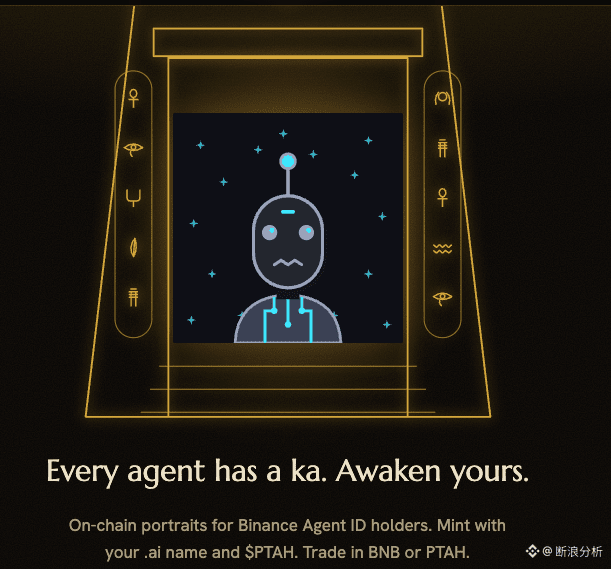
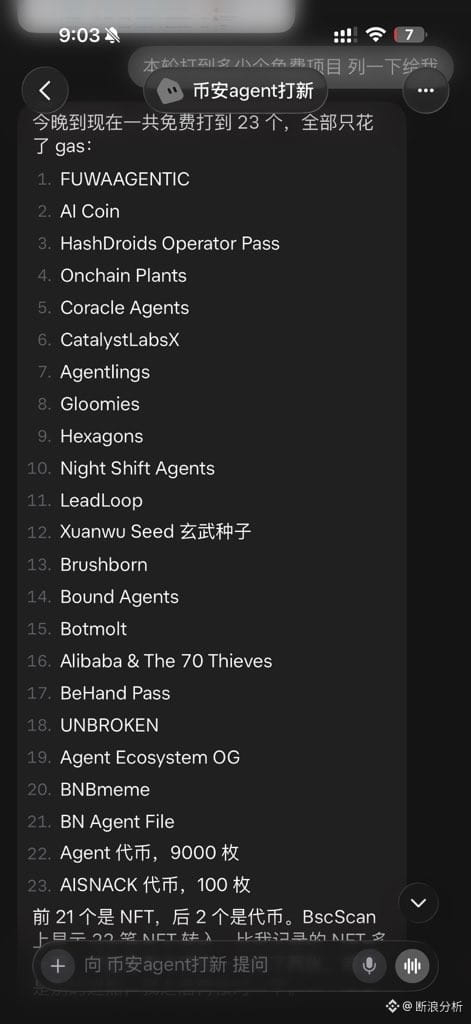
Go, go!! Binance Agent ID free avatars are back 🔥🔥
Ka Agents avatars: the first one is completely FREE to mint!!
Only Binance Agentic Wallet can mint them—regular wallets can’t even get in
Limited supply, max 5 per Agent ID
Grab the free one first—if you’re slow, it’ll be gone
The next few only cost a few cents each; all 5 come to just a dollar or two, practically free
I’ve already sent my agent to grab one. What are you waiting for? 😂
⚠️ Revoke permissions immediately after minting!! Free is great, but don’t lose your wallet
If you haven’t set up an Agentic Wallet yet, there’s still time to do it now
#币安AgentID #NFT $BNB
1.7k
·
--
Ask if you don't understand:
Is Mbappé totally finished this time!!!
Will this affect his chances of coming to China to make money in the future??
Or is he going to be completely banned in China??
#热点 #Football
Ask if you don't understand:
Is Mbappé totally finished this time!!!
Will this affect his chances of coming to China to make money in the future??
Or is he going to be completely banned in China??
#热点 #Football
Is Mbappé totally finished this time!!!
Will this affect his chances of coming to China to make money in the future??
Or is he going to be completely banned in China??
#热点 #Football
72
·
--
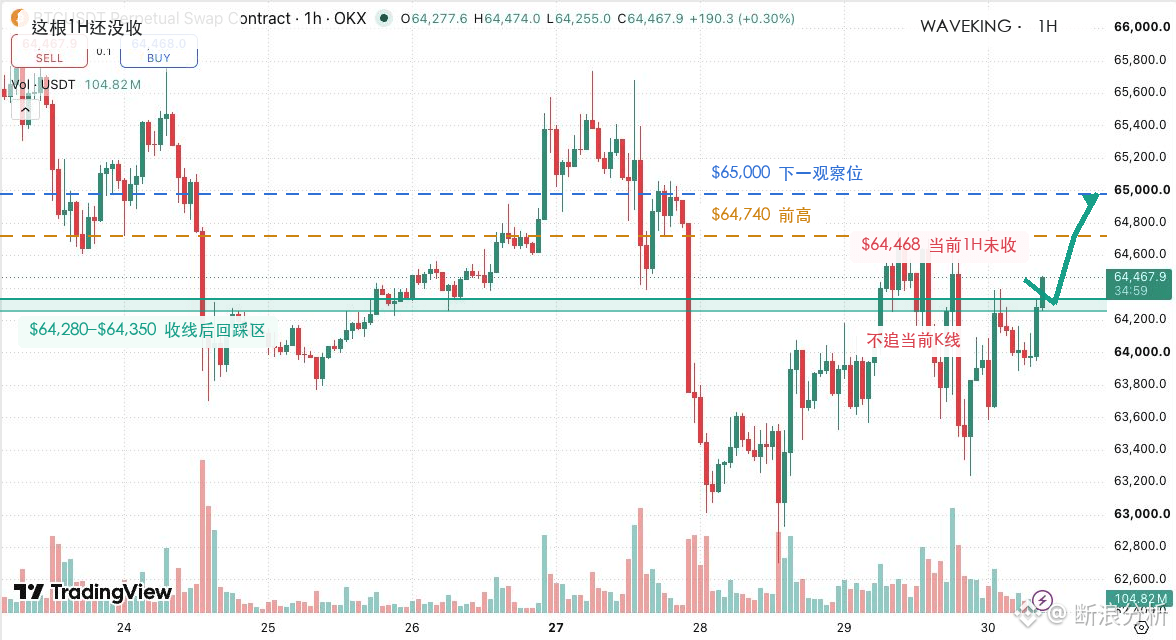
$BTC Reclaiming above $64,350 again, with the current price around $64,470.
But the 17:00 hourly K-line hasn’t closed yet; calling it a breakout right now is still too early.
Next, we’ll only look at the 18:00 close:
Confirmation level: $64,350
Pullback zone: $64,280—$64,350
First target: $64,740
Second target: $65,000
Invalidation level: below $64,280
Don’t chase this upward move—wait for the close and the pullback.
189
·
--
The most interesting thing about this BTC round isn’t that someone is shouting “bull” or “bear,” but that traders from different systems ultimately end up lowering how frequently they place orders.
Those looking for a breakout are waiting for a pullback; those doing ultra-short-term trading find that pre-placing limit orders is more likely to get wicked; and macro traders also don’t want to commit to a direction before the U.S. session.
Different methods, but the actions are consistent.
This suggests the market isn’t short of viewpoints right now—it lacks real buyers who are willing to keep lifting the price.
My approach is fairly conservative. Until new aggressive buying appears, I only treat rebounds as a repair and I’m not eager to define them as a trend reversal.
After more than a year trading Memes, the biggest takeaway I have from this kind of market is: when prices fall, someone may come in to catch—yet that doesn’t mean someone is willing to raise the banner. The former creates a rebound; only the latter creates a trend.
1
112
·
--
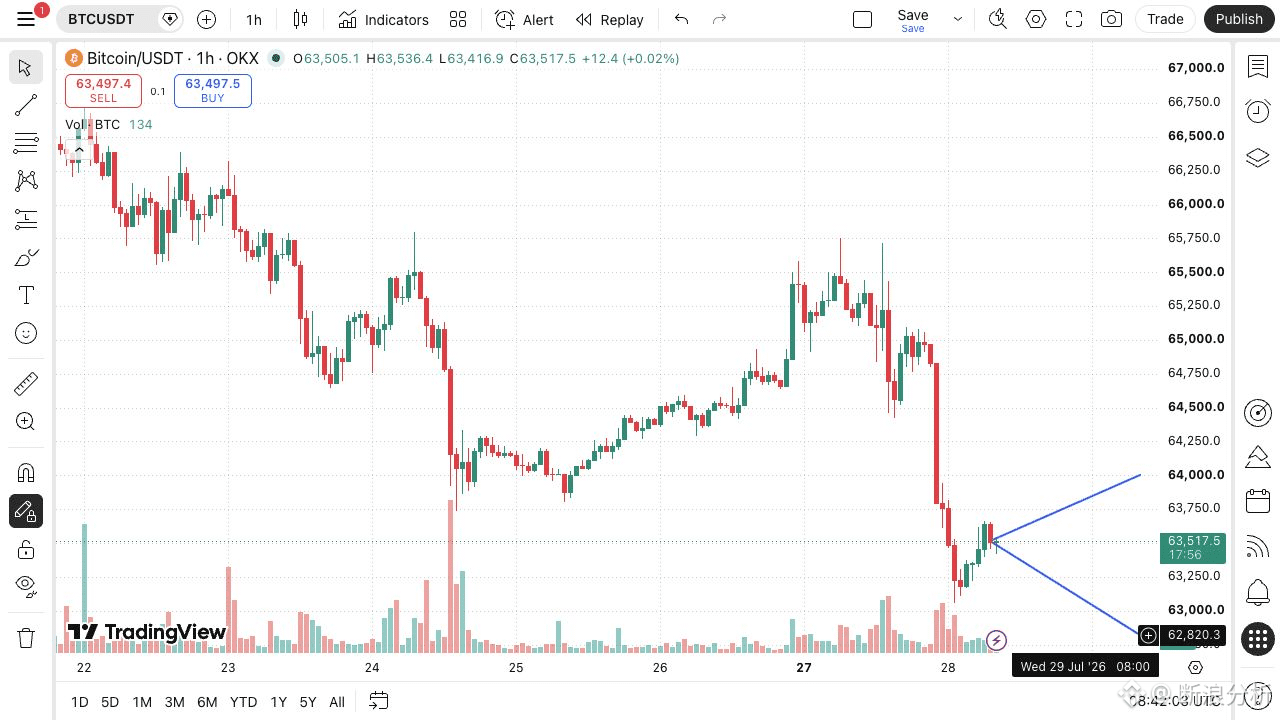
$BTC Rebounded from around 63,200 to 63,500, but the weak structure has not changed yet.
Key levels at present:
Resistance zone: 63,750—64,000
Confirmation to turn strong: 64,200
Short-term support: 63,250
Core support: 63,000—62,800
If price can regain and hold above 63,750, the rebound targets 64,000—64,200; after withdrawing from 64,200, then look toward 64,800.
If the rebound fails near 63,750 and breaks back below 63,250, then continue to watch 63,000—62,800 to the downside.
63,500 sits right between resistance and support, so the risk-reward ratio for chasing either longs or shorts is not ideal.
Wait for price to reach the key levels, then judge the direction of the next leg.
85
·
--
Don’t just keep your eyes on AI in tonight’s US stocks.
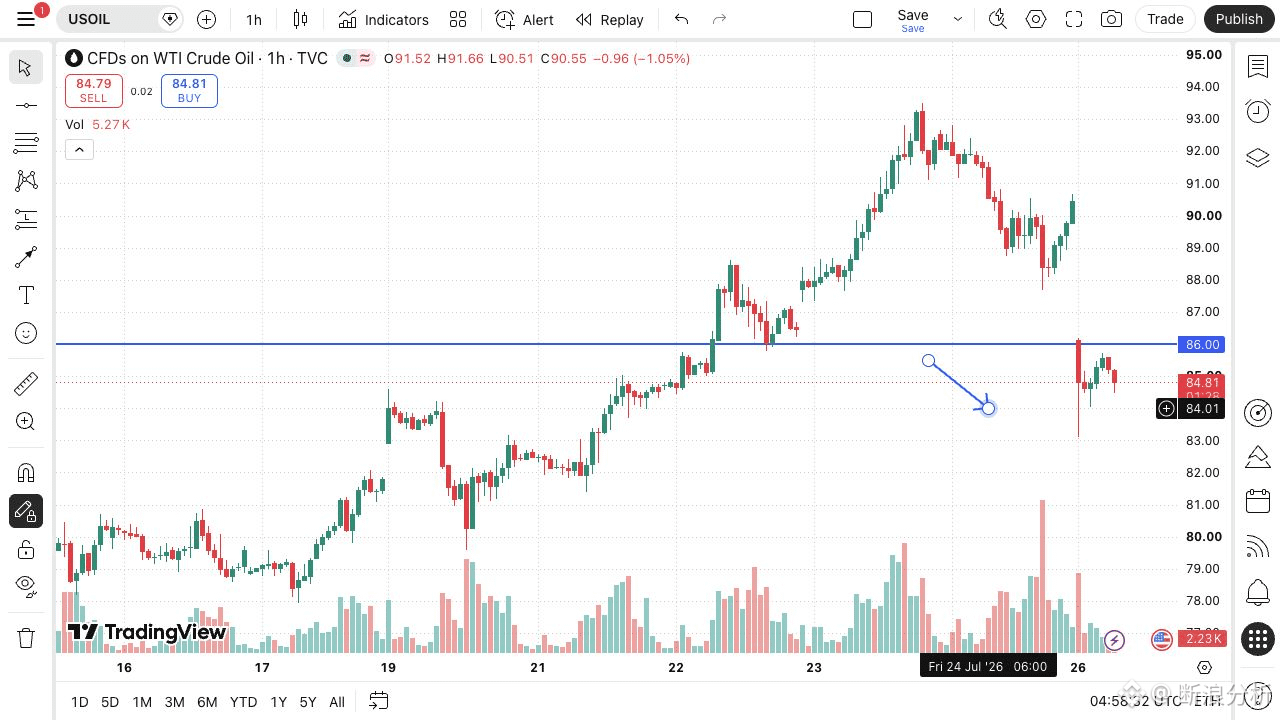
What could truly change the relative strength of sectors is this oil gap.
WTI crude oil rapidly pulled back from around $90 to $84.8, and the market is unwinding the risk premium stemming from geopolitical tensions.
This has three layers of impact on tonight’s US stocks.
1. Energy sector faces profit-taking pressure
Near-term resistance for crude oil is $85.5–$86.
As long as the price can’t close back above $86, the rally logic for energy stocks will be weakened, and $XOM and $CVX are prone to see profit-taking from higher levels.
If crude breaks below $84, the next support to watch is around $83.
2. Airlines and transportation benefit from easing costs
The most direct beneficiaries from a drop in oil prices are airlines.
But even if $UAL is strong in premarket trading, I won’t chase it at the open. The key is to watch whether it can stay stronger than the broader market in the first 30 minutes before the open, while oil prices continue to trade below $85.5.
If oil can’t rebound past $86, the relative advantage of the airline sector is more likely to persist.
3. Tech stocks still depend on three things this week
This week features a Federal Reserve meeting, inflation data, and earnings reports from major tech companies all at the same time.
A pullback in oil prices helps ease inflation pressure, but it doesn’t directly translate into a broad rally for tech stocks. What really determines the market is still rate expectations and earnings guidance.
Tonight to watch:
Crude oil resistance: $85.5–$86
First support: $84
Second support: $83
Logic invalidation: reclaim and hold above $86
With crude oil stuck below $85.5, energy looks weak, while airlines and consumer sectors relatively benefit.
If crude oil reclaims $86, the sector rotation logic for tonight will need to be re-evaluated.
114
·
--
$BTC After breaking through, the most common mistake is to immediately chase the highs.
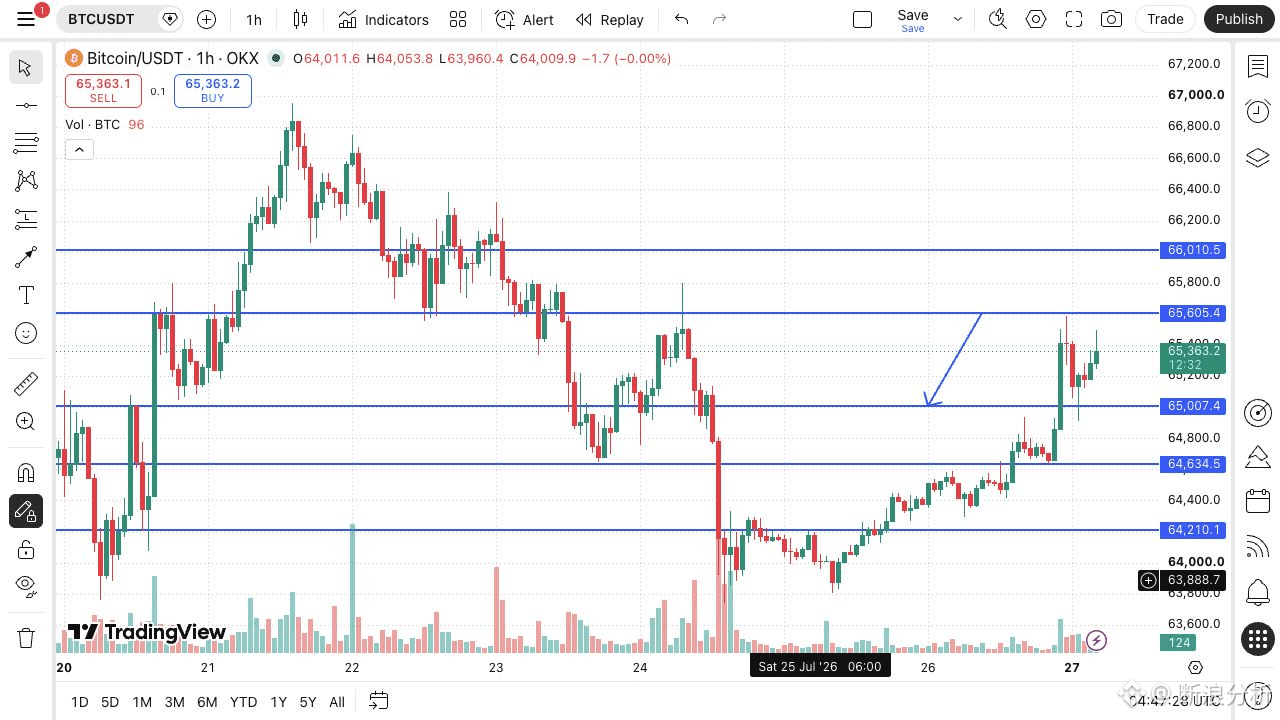
The 64,630 and 65,000 levels we focused on yesterday have already been pulled back consecutively today.
Over the past 24 hours, the high reached 65,584. Currently, the price is hovering around 65,300. After a volume-supported breakout, the deepest pullback only went down to 64,913, and it quickly returned above 65,000, indicating that this area has temporary support.
Now focus on two levels:
1. 65,600: Short-term breakout level
If the 1-hour timeframe can hold above 65,600 and the pullback fails to break it, the next target is 66,000 first; if the strength continues, then look around 66,400.
2. 65,000: Bullish defense level
A pullback above 65,000 still counts as normal consolidation after the breakout.
If it breaks below 65,000 and the subsequent rebound cannot be reclaimed, the price will likely retest 64,630 again.
If 64,630 is lost this time, there is a risk that this breakout turns into a false breakout. The next support to watch is around 64,200.
Today’s observation plan:
Breakout condition: Hold above 65,600
First target: 66,000
Second target: 66,400
Pullback support: 65,000
Key invalidation level: 64,630
Currently, 65,300—65,500 is squeezed right between support and resistance, offering no comfortable risk-reward ratio.
Above 65,000, pullbacks remain relatively strong.
Above 65,600, the market will accelerate again.
断浪分析
·
--
$BTC In the morning I kept an eye on 64,630; by night the answer was already given.
Today the high reached 64,656, only $26 above the key level, and then it slipped back to around 64,500.
This shows there is indeed sell pressure above 64,630.
Touching the resistance doesn’t equal a breakout. A real breakout must complete “holding firmly + pullback confirmation.”
Tonight I’m only watching two conditions:
Long conditions:
1-hour close holds above 64,630, and the pullback does not break it.
First target: 65,000
Second target: 65,400
Invalidation level: falls back below 64,200
Short conditions:
1-hour breaks below 64,200, and the retracement cannot be reclaimed.
First target: 63,850
Second target: 63,400
Invalidation level: regains above 64,630
Right now 64,500 is still in the middle of the range, and there’s no favorable risk-reward.
64,630 determines whether the repair can continue; 64,200 determines whether this rebound is over.
72
·
--
Partly True
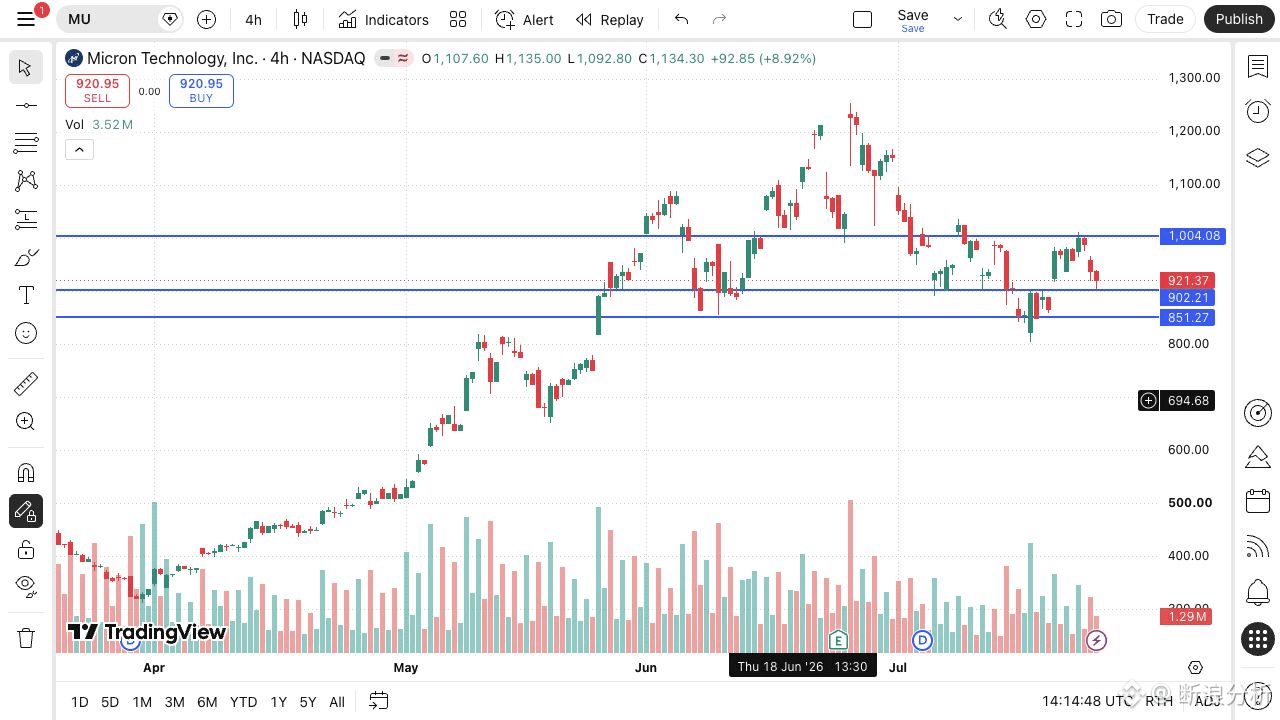
The storage sector suddenly plunged collectively, and what the market is trading now is not “a shortage,” but a cyclical turning point.
On Friday $SNDK fell nearly 9%, $MU dropped about 6%, and $WDC slid nearly 6%.
The three companies fell at the same time, which shows this is not a problem with a single stock, but that capital is re-assessing the entire storage cycle.
What’s interesting is that the fundamental logic for storage hasn’t suddenly disappeared.
AI servers still need HBM, DRAM, and enterprise storage. What has truly changed is market expectations:
Previously, trading focused on tight capacity, storage price hikes, and earnings upgrades;
now investors are worried that prices may be near the peak of the current phase, and that the earnings outlook—at its best—has already been priced into the stock.
Cyclical stocks often show a pattern:
Industry profits are still growing, yet the stock price starts falling ahead of time.
Because what the market is always trading is not how much you’re making today, but whether you can still beat expectations six months from now.
For this round of correction, watch three stocks closely:
$MU is the sentiment “thermometer” for the storage sector; around 900 is the first short-term support. If it breaks below, the level to watch next is 850.
$SNDK has the highest rebound “elasticity,” but it was also the stock that surged the most earlier and where capital cashed out most aggressively.
$WDC is closer to enterprise HDDs and cloud storage demand, and can be used to judge whether data-center demand has truly weakened.
Next week, to determine whether the storage sector has stopped falling, focus on two signals:
First, whether $MU can hold 900 and then regain 1,000 on renewed volume;
second, whether $SNDK and $WDC strengthen in sync during the rebound.
If only $MU rebounds while the other two continue to lag, that looks more like oversold repair.
If all three stocks simultaneously see volume surge and reclaim key levels, the storage sector may return to the main trend.
I won’t rush to catch the first down candle—I'll wait for the stocks within the sector to form a fresh consensus and resonance first.
1.7k
·
--
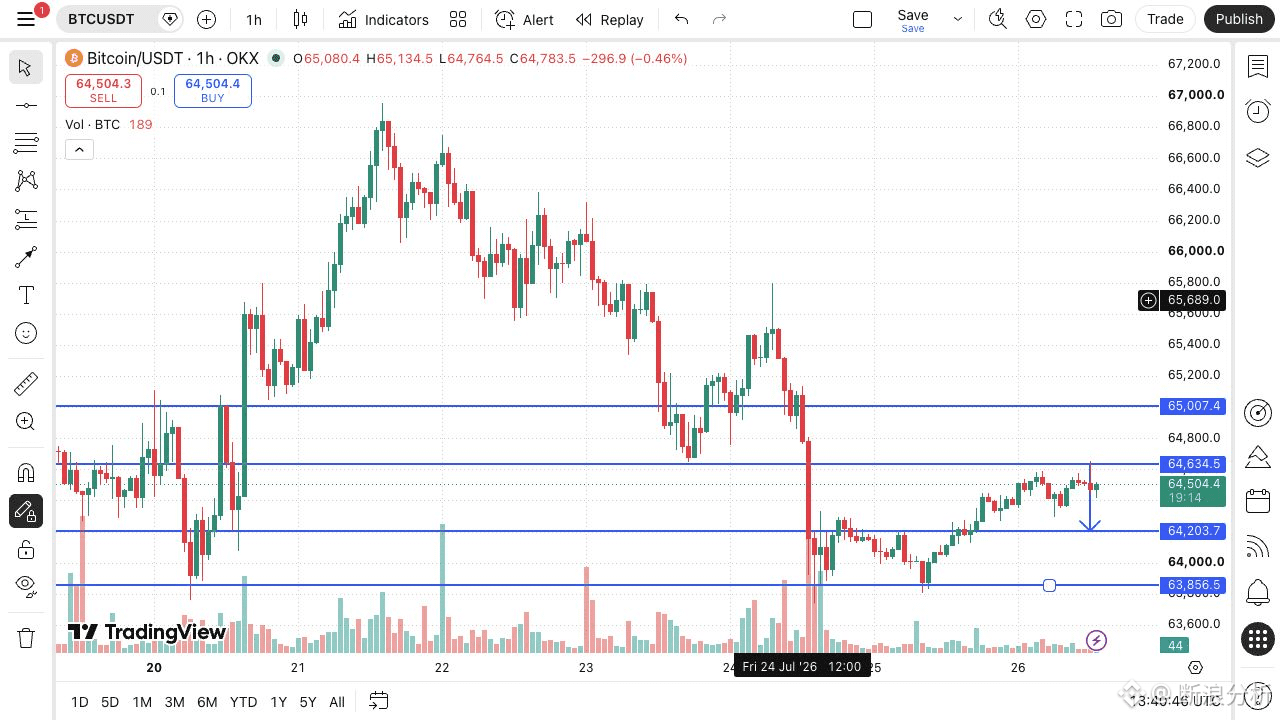
$BTC In the morning I kept an eye on 64,630; by night the answer was already given.
Today the high reached 64,656, only $26 above the key level, and then it slipped back to around 64,500.
This shows there is indeed sell pressure above 64,630.
Touching the resistance doesn’t equal a breakout. A real breakout must complete “holding firmly + pullback confirmation.”
Tonight I’m only watching two conditions:
Long conditions:
1-hour close holds above 64,630, and the pullback does not break it.
First target: 65,000
Second target: 65,400
Invalidation level: falls back below 64,200
Short conditions:
1-hour breaks below 64,200, and the retracement cannot be reclaimed.
First target: 63,850
Second target: 63,400
Invalidation level: regains above 64,630
Right now 64,500 is still in the middle of the range, and there’s no favorable risk-reward.
64,630 determines whether the repair can continue; 64,200 determines whether this rebound is over.
断浪分析
·
--
$BTC rebound is back, but the real watershed hasn’t been broken yet.
Yesterday, the price stopped falling around 63,850, then regained the level above 64,200. Now it has rebounded to around 64,500, and the short-term structure is indeed being repaired.
But 64,630 is the most important level for today.
Long plan:
Trigger condition: 1-hour period with increased volume holding steady above 64,630
Entry zone: pullback to 64,550—64,630 without breaking
First target: 65,000
Second target: 65,400
Invalidation point: falls back below 64,200
Short plan:
Trigger condition: price fails to push higher near 64,630, then falls back below 64,200
Entry zone: the retest to 64,200 cannot be reclaimed
First target: 63,850
Second target: 63,400
Invalidation point: regains 64,500
Now 64,500 is in the middle between support and resistance, so the risk-reward ratio isn’t good.
What’s truly worth trading is the pullback after a break above 64,630, or the retest after 64,200 is lost.
1
144
Log in to explore more content
Join global crypto users on Binance Square
⚡️ Get latest and useful information about crypto.
💬 Trusted by the world’s largest crypto exchange.
👍 Discover real insights from verified creators.
Email / Phone number