

Taha 14 比特币
5.4k Posts

Taha 14 比特币
 Square Verified+
Report
Block User
LIving Between Chart and Blockchain.
Open Trade
Frequent Trader
1.5 Years
1.6K+ Following
54.3K+ Followers
63.1K+ Liked
Posts
Portfolio
All
Quotes
Videos
Live
·
--
How Sign Protocol Standardizes Trust Across ChainsAt first, I brushed off Sign Protocol as just another "on-chain certificate" tool. You know the type: digital badges, social proof, basic stuff that honestly goes nowhere because it stays trapped in its own little ecosystem.
But then I started looking at the architecture behind Sign Protocol and TokenTable. Once I traced the logic back to the core problem of "fragmented trust," it stopped feeling like a simple dapp.
It felt like a fundamental shift.
The core realization is simple but profound: Trust shouldn't be trapped on one chain. If I verify an identity or a legal contract on Ethereum, that "proof" shouldn't be invisible to a protocol on Polygon or BNB Chain. Sign Protocol isn't trying to build a better database; it’s building a universal Evidence Layer.
That one decision—standardizing attestations—echoes through their entire design.
Usually, bootstrapping "trust" on a new project is a mess. You rely on centralized middlemen or hope your community is honest. Sign Protocol doesn't play that game. It uses Attestations as Infrastructure.
By creating a standardized schema (the "blueprint" for a piece of data), it ensures that every claim is structured, verifiable, and permanent. It doesn't fight for trust; it encodes it into the data itself.
This is where things usually fall apart in token management. When projects try to distribute tokens to thousands of users based on specific milestones, it’s a manual, error-prone headache.
TokenTable is their answer to that "execution jam." It links the trust layer directly to the distribution layer.
* Sign Protocol verifies the milestone (The Proof).
* TokenTable triggers the unlock (The Action).
It manages how state updates happen so the system doesn't freeze or require a human to sign off on every tiny step. It’s making the "intent" of a contract real.
Most "perfect" on-chain designs ignore reality. They assume everyone will use the same wallet or the same chain. Sign Protocol doesn't chase that kind of perfection. It works within the reality of an omni-chain world.
It assumes users and assets are everywhere. It allows you to "anchor" an attestation on one chain and have it recognized elsewhere. It doesn't try to force everyone into one room; it just builds a bridge so they can talk to each other.
When you look at SIGN, it’s not just about speculation. It’s about securing the network of verifiers and ensuring the longevity of the data.
Most chains tie utility to tokens that swing wildly in price. But by standardizing the cost of creating an attestation, Sign Protocol is trying to make trust predictable. Imagine being able to plan your legal or financial verification costs without worrying about a 20% price spike overnight.
Most teams chase the current cycle—hype, narratives, quick wins. This feels different. This feels like research finally becoming a system.
* Standardized Schemas.
* Omni-chain Anchoring.
* Automated Distribution.
* Trust as an Asset.
It all connects. Sign Protocol isn't trying to sound impressive; it’s trying to fix the parts of the internet that we never quite learned to trust.
Have any of you tried setting up a custom schema on the Sign Protocol devnet yet? I’m curious to see how the indexing speed compares when you’re pulling attestations across different chains. Drop your thoughts below.
$STO
$SIGN @SignOfficial #SignDigitalSovereignInfra
How Sign Protocol Standardizes Trust Across Chains
At first, I brushed off Sign Protocol as just another "on-chain certificate" tool. You know the type: digital badges, social proof, basic stuff that honestly goes nowhere because it stays trapped in its own little ecosystem.
But then I started looking at the architecture behind Sign Protocol and TokenTable. Once I traced the logic back to the core problem of "fragmented trust," it stopped feeling like a simple dapp.
It felt like a fundamental shift.
The core realization is simple but profound: Trust shouldn't be trapped on one chain. If I verify an identity or a legal contract on Ethereum, that "proof" shouldn't be invisible to a protocol on Polygon or BNB Chain. Sign Protocol isn't trying to build a better database; it’s building a universal Evidence Layer.
That one decision—standardizing attestations—echoes through their entire design.
Usually, bootstrapping "trust" on a new project is a mess. You rely on centralized middlemen or hope your community is honest. Sign Protocol doesn't play that game. It uses Attestations as Infrastructure.
By creating a standardized schema (the "blueprint" for a piece of data), it ensures that every claim is structured, verifiable, and permanent. It doesn't fight for trust; it encodes it into the data itself.
This is where things usually fall apart in token management. When projects try to distribute tokens to thousands of users based on specific milestones, it’s a manual, error-prone headache.
TokenTable is their answer to that "execution jam." It links the trust layer directly to the distribution layer.
* Sign Protocol verifies the milestone (The Proof).
* TokenTable triggers the unlock (The Action).
It manages how state updates happen so the system doesn't freeze or require a human to sign off on every tiny step. It’s making the "intent" of a contract real.
Most "perfect" on-chain designs ignore reality. They assume everyone will use the same wallet or the same chain. Sign Protocol doesn't chase that kind of perfection. It works within the reality of an omni-chain world.
It assumes users and assets are everywhere. It allows you to "anchor" an attestation on one chain and have it recognized elsewhere. It doesn't try to force everyone into one room; it just builds a bridge so they can talk to each other.
When you look at SIGN, it’s not just about speculation. It’s about securing the network of verifiers and ensuring the longevity of the data.
Most chains tie utility to tokens that swing wildly in price. But by standardizing the cost of creating an attestation, Sign Protocol is trying to make trust predictable. Imagine being able to plan your legal or financial verification costs without worrying about a 20% price spike overnight.
Most teams chase the current cycle—hype, narratives, quick wins. This feels different. This feels like research finally becoming a system.
* Standardized Schemas.
* Omni-chain Anchoring.
* Automated Distribution.
* Trust as an Asset.
It all connects. Sign Protocol isn't trying to sound impressive; it’s trying to fix the parts of the internet that we never quite learned to trust.
Have any of you tried setting up a custom schema on the Sign Protocol devnet yet? I’m curious to see how the indexing speed compares when you’re pulling attestations across different chains. Drop your thoughts below.
$STO
$SIGN @SignOfficial #SignDigitalSovereignInfra
But then I started looking at the architecture behind Sign Protocol and TokenTable. Once I traced the logic back to the core problem of "fragmented trust," it stopped feeling like a simple dapp.
It felt like a fundamental shift.
The core realization is simple but profound: Trust shouldn't be trapped on one chain. If I verify an identity or a legal contract on Ethereum, that "proof" shouldn't be invisible to a protocol on Polygon or BNB Chain. Sign Protocol isn't trying to build a better database; it’s building a universal Evidence Layer.
That one decision—standardizing attestations—echoes through their entire design.
Usually, bootstrapping "trust" on a new project is a mess. You rely on centralized middlemen or hope your community is honest. Sign Protocol doesn't play that game. It uses Attestations as Infrastructure.
By creating a standardized schema (the "blueprint" for a piece of data), it ensures that every claim is structured, verifiable, and permanent. It doesn't fight for trust; it encodes it into the data itself.
This is where things usually fall apart in token management. When projects try to distribute tokens to thousands of users based on specific milestones, it’s a manual, error-prone headache.
TokenTable is their answer to that "execution jam." It links the trust layer directly to the distribution layer.
* Sign Protocol verifies the milestone (The Proof).
* TokenTable triggers the unlock (The Action).
It manages how state updates happen so the system doesn't freeze or require a human to sign off on every tiny step. It’s making the "intent" of a contract real.
Most "perfect" on-chain designs ignore reality. They assume everyone will use the same wallet or the same chain. Sign Protocol doesn't chase that kind of perfection. It works within the reality of an omni-chain world.
It assumes users and assets are everywhere. It allows you to "anchor" an attestation on one chain and have it recognized elsewhere. It doesn't try to force everyone into one room; it just builds a bridge so they can talk to each other.
When you look at SIGN, it’s not just about speculation. It’s about securing the network of verifiers and ensuring the longevity of the data.
Most chains tie utility to tokens that swing wildly in price. But by standardizing the cost of creating an attestation, Sign Protocol is trying to make trust predictable. Imagine being able to plan your legal or financial verification costs without worrying about a 20% price spike overnight.
Most teams chase the current cycle—hype, narratives, quick wins. This feels different. This feels like research finally becoming a system.
* Standardized Schemas.
* Omni-chain Anchoring.
* Automated Distribution.
* Trust as an Asset.
It all connects. Sign Protocol isn't trying to sound impressive; it’s trying to fix the parts of the internet that we never quite learned to trust.
Have any of you tried setting up a custom schema on the Sign Protocol devnet yet? I’m curious to see how the indexing speed compares when you’re pulling attestations across different chains. Drop your thoughts below.
$STO
$SIGN @SignOfficial #SignDigitalSovereignInfra
10
125
·
--
Sign Protocol: Everyone Talks About Verified Data—Nobody Talks About the InfrastructureWhen I think about Sign Protocol and its architecture, I don't go straight to the $SIGN charts. I just don't. That whole "number go up" mindset feels… shallow here. I keep circling back to the structure.
Because honestly, building a world where data can be trusted isn't just about "signing" a PDF. It’s not that simple. You’re trying to build a system where digital claims—identities, contracts, credentials—can be checked, questioned, and held accountable across any blockchain. That’s a different game.
Sign Protocol is tackling this head-on. Their angle is an omni-chain attestation framework. It’s basically wiring a "truth layer" into the internet so actions don’t just happen—they get proven. Every claim follows a specific Schema, and every Attestation is a verifiable pulse on a shared system.
Sounds great, right? And yeah, in theory, it fits perfectly with where Web3 is heading. You remove blind trust. You replace it with cryptographic proof. Clean idea.
But here’s the thing...
Verification doesn't fix the "garbage in, garbage out" problem. A system can prove a claim was signed… but it doesn't automatically mean the person signing it was telling the truth. A protocol doesn’t suddenly gain morality just because you log an attestation on-chain. It follows the logic of its Schemas. That’s it.
And that’s where it gets interesting. Because people hear "verified" and think "true." Not the same thing. Not even close.
Now let’s talk about something people avoid: The Registry.
Who defines the schemas? That matters. A lot. If the blueprints for "truth" are controlled by a tiny group, the whole decentralization story starts to wobble. I’ve seen this before—systems that sound open at the start but slowly tighten until only a few "authorized" entities can set the rules.
Then there’s the Hooks. They run the whole show.
Hooks allow smart contracts to execute the moment an attestation is made. If a schema says "User is over 18," the Hook triggers the payout. But if those Hooks are poorly coded or manipulated, you don't need a master plan for things to break—just basic human error or bad incentives. That’s how systemic risk sneaks in.
And we haven’t even touched the "Real World" bridge.
If Sign Protocol actually wants to plug into traditional legal systems and institutions—and let’s be real, that’s the goal with things like EthSign—they won't get to ignore regulators. No chance. They’ll need proper audit trails and real-world accountability. "Trust the code" only goes so far when a legal deed is on the line. Trust here isn’t just technical; it’s institutional. People underestimate that.
Anyway, zoom out for a second.
The real question isn’t whether Sign Protocol's architecture sounds smart. It does. The Schema -> Attestation -> Hook flow makes perfect sense. I’m not arguing that.
The question is whether it stays genuinely open over time. Not on paper. In reality.
Who gets to participate?Who controls the schemas?Who makes the calls when a digital identity is compromised?
That’s the part that actually matters. Because our digital lives are only getting bigger. That train isn't stopping. And people won’t trust a system just because someone says, "Don’t worry, it’s on-chain."
They’ll trust it when the system proves it can handle the messiness of human truth. Slowly. Over time.
No shortcuts.
#SignDigitalSovereignInfra
$STO
@SignOfficial $SIGN
Sign Protocol: Everyone Talks About Verified Data—Nobody Talks About the Infrastructure
When I think about Sign Protocol and its architecture, I don't go straight to the $SIGN charts. I just don't. That whole "number go up" mindset feels… shallow here. I keep circling back to the structure.
Because honestly, building a world where data can be trusted isn't just about "signing" a PDF. It’s not that simple. You’re trying to build a system where digital claims—identities, contracts, credentials—can be checked, questioned, and held accountable across any blockchain. That’s a different game.
Sign Protocol is tackling this head-on. Their angle is an omni-chain attestation framework. It’s basically wiring a "truth layer" into the internet so actions don’t just happen—they get proven. Every claim follows a specific Schema, and every Attestation is a verifiable pulse on a shared system.
Sounds great, right? And yeah, in theory, it fits perfectly with where Web3 is heading. You remove blind trust. You replace it with cryptographic proof. Clean idea.
But here’s the thing...
Verification doesn't fix the "garbage in, garbage out" problem. A system can prove a claim was signed… but it doesn't automatically mean the person signing it was telling the truth. A protocol doesn’t suddenly gain morality just because you log an attestation on-chain. It follows the logic of its Schemas. That’s it.
And that’s where it gets interesting. Because people hear "verified" and think "true." Not the same thing. Not even close.
Now let’s talk about something people avoid: The Registry.
Who defines the schemas? That matters. A lot. If the blueprints for "truth" are controlled by a tiny group, the whole decentralization story starts to wobble. I’ve seen this before—systems that sound open at the start but slowly tighten until only a few "authorized" entities can set the rules.
Then there’s the Hooks. They run the whole show.
Hooks allow smart contracts to execute the moment an attestation is made. If a schema says "User is over 18," the Hook triggers the payout. But if those Hooks are poorly coded or manipulated, you don't need a master plan for things to break—just basic human error or bad incentives. That’s how systemic risk sneaks in.
And we haven’t even touched the "Real World" bridge.
If Sign Protocol actually wants to plug into traditional legal systems and institutions—and let’s be real, that’s the goal with things like EthSign—they won't get to ignore regulators. No chance. They’ll need proper audit trails and real-world accountability. "Trust the code" only goes so far when a legal deed is on the line. Trust here isn’t just technical; it’s institutional. People underestimate that.
Anyway, zoom out for a second.
The real question isn’t whether Sign Protocol's architecture sounds smart. It does. The Schema -> Attestation -> Hook flow makes perfect sense. I’m not arguing that.
The question is whether it stays genuinely open over time. Not on paper. In reality.
Who gets to participate?Who controls the schemas?Who makes the calls when a digital identity is compromised?
That’s the part that actually matters. Because our digital lives are only getting bigger. That train isn't stopping. And people won’t trust a system just because someone says, "Don’t worry, it’s on-chain."
They’ll trust it when the system proves it can handle the messiness of human truth. Slowly. Over time.
No shortcuts.
#SignDigitalSovereignInfra
$STO
@SignOfficial $SIGN
Because honestly, building a world where data can be trusted isn't just about "signing" a PDF. It’s not that simple. You’re trying to build a system where digital claims—identities, contracts, credentials—can be checked, questioned, and held accountable across any blockchain. That’s a different game.
Sign Protocol is tackling this head-on. Their angle is an omni-chain attestation framework. It’s basically wiring a "truth layer" into the internet so actions don’t just happen—they get proven. Every claim follows a specific Schema, and every Attestation is a verifiable pulse on a shared system.
Sounds great, right? And yeah, in theory, it fits perfectly with where Web3 is heading. You remove blind trust. You replace it with cryptographic proof. Clean idea.
But here’s the thing...
Verification doesn't fix the "garbage in, garbage out" problem. A system can prove a claim was signed… but it doesn't automatically mean the person signing it was telling the truth. A protocol doesn’t suddenly gain morality just because you log an attestation on-chain. It follows the logic of its Schemas. That’s it.
And that’s where it gets interesting. Because people hear "verified" and think "true." Not the same thing. Not even close.
Now let’s talk about something people avoid: The Registry.
Who defines the schemas? That matters. A lot. If the blueprints for "truth" are controlled by a tiny group, the whole decentralization story starts to wobble. I’ve seen this before—systems that sound open at the start but slowly tighten until only a few "authorized" entities can set the rules.
Then there’s the Hooks. They run the whole show.
Hooks allow smart contracts to execute the moment an attestation is made. If a schema says "User is over 18," the Hook triggers the payout. But if those Hooks are poorly coded or manipulated, you don't need a master plan for things to break—just basic human error or bad incentives. That’s how systemic risk sneaks in.
And we haven’t even touched the "Real World" bridge.
If Sign Protocol actually wants to plug into traditional legal systems and institutions—and let’s be real, that’s the goal with things like EthSign—they won't get to ignore regulators. No chance. They’ll need proper audit trails and real-world accountability. "Trust the code" only goes so far when a legal deed is on the line. Trust here isn’t just technical; it’s institutional. People underestimate that.
Anyway, zoom out for a second.
The real question isn’t whether Sign Protocol's architecture sounds smart. It does. The Schema -> Attestation -> Hook flow makes perfect sense. I’m not arguing that.
The question is whether it stays genuinely open over time. Not on paper. In reality.
Who gets to participate?Who controls the schemas?Who makes the calls when a digital identity is compromised?
That’s the part that actually matters. Because our digital lives are only getting bigger. That train isn't stopping. And people won’t trust a system just because someone says, "Don’t worry, it’s on-chain."
They’ll trust it when the system proves it can handle the messiness of human truth. Slowly. Over time.
No shortcuts.
#SignDigitalSovereignInfra
$STO
@SignOfficial $SIGN
1
11
294
·
--
Article
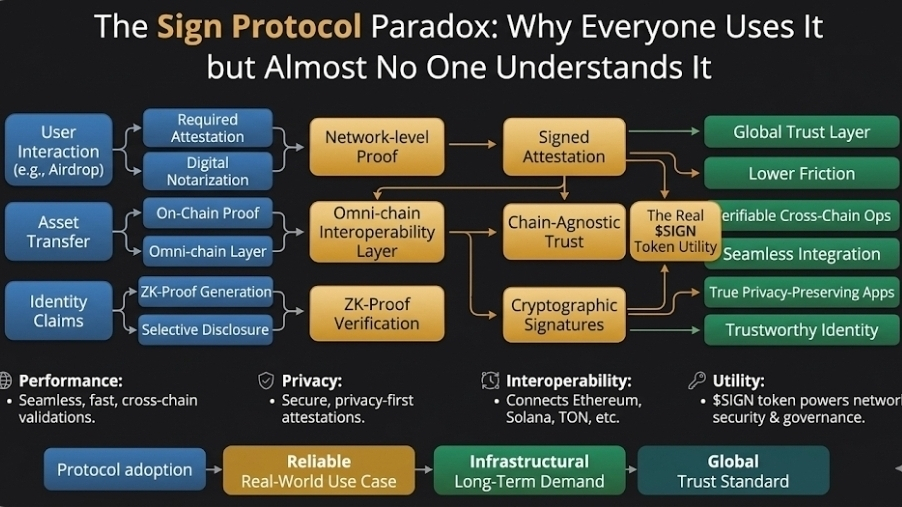
Everyone Uses Sign Protocol - Almost No One Understands ItI've been thinking... Nowadays, everyone is just chasing charts and hype in cryptocurrency, but very few people are aware of the technology behind the scenes that is transforming the entire ecosystem. One such project is Sign Protocol. You may have heard the name; many are using it for various airdrops or verifications, but the funny thing is—most people don't actually know what it is or why it's so crucial for the future.
Everyone Uses Sign Protocol - Almost No One Understands It
I've been thinking... Nowadays, everyone is just chasing charts and hype in cryptocurrency, but very few people are aware of the technology behind the scenes that is transforming the entire ecosystem. One such project is Sign Protocol. You may have heard the name; many are using it for various airdrops or verifications, but the funny thing is—most people don't actually know what it is or why it's so crucial for the future.
4
11
129
·
--
Bullish
I've been looking into Sign Protocol, and their tech is all about proving things are true without needing to show every single detail. By using cryptographically signed "attestations," the proof stays compact and quick to verify. This is a game-changer because blockchains usually get bogged down when they have to process too much data. They’ve built it as an omni-chain layer, meaning you can stack these proofs across different networks, building a layer of trust without starting from scratch every time.
What really catches my interest is how they link chains like Ethereum, Solana, and TON. Most chains are siloed and don’t talk to each other well, and privacy is often an afterthought. If Sign Protocol can pull off these "omni-chain" attestations that actually work across different ecosystems, it’s straight-up useful for the whole industry.
Privacy is the part I’m most excited about. Standard smart contracts often spill too much info, but Sign uses zero-knowledge proofs (ZKPs) and selective disclosure to let you share only what’s necessary. This could open up real-world uses like private identity verification or business logic that stays out of the public eye while remaining verifiable.
I’m keeping it honest, though—I’m a bit skeptical because cross-chain connections always sound smooth on paper but are a pain to actually implement. Balancing that with privacy and speed is even harder. Plenty of projects talk a big game but don't deliver. At least they’re starting from a solid foundation as an infrastructure layer rather than just another app, but they’re still in an important growth phase.
I think Sign Protocol is going in the right direction by not trying to reinvent the entire blockchain. Instead, they’re making privacy and trust work together as a "Global Trust Layer." If they keep things practical and don’t overcomplicate it, this could actually matter. Don’t just trust the hype—watch if they ship real working integrations and cross-chain use cases.
$SIGN @SignOfficial #SignDigitalSovereignInfra
$D $NOM
I've been looking into Sign Protocol, and their tech is all about proving things are true without needing to show every single detail. By using cryptographically signed "attestations," the proof stays compact and quick to verify. This is a game-changer because blockchains usually get bogged down when they have to process too much data. They’ve built it as an omni-chain layer, meaning you can stack these proofs across different networks, building a layer of trust without starting from scratch every time.
What really catches my interest is how they link chains like Ethereum, Solana, and TON. Most chains are siloed and don’t talk to each other well, and privacy is often an afterthought. If Sign Protocol can pull off these "omni-chain" attestations that actually work across different ecosystems, it’s straight-up useful for the whole industry.
Privacy is the part I’m most excited about. Standard smart contracts often spill too much info, but Sign uses zero-knowledge proofs (ZKPs) and selective disclosure to let you share only what’s necessary. This could open up real-world uses like private identity verification or business logic that stays out of the public eye while remaining verifiable.
I’m keeping it honest, though—I’m a bit skeptical because cross-chain connections always sound smooth on paper but are a pain to actually implement. Balancing that with privacy and speed is even harder. Plenty of projects talk a big game but don't deliver. At least they’re starting from a solid foundation as an infrastructure layer rather than just another app, but they’re still in an important growth phase.
I think Sign Protocol is going in the right direction by not trying to reinvent the entire blockchain. Instead, they’re making privacy and trust work together as a "Global Trust Layer." If they keep things practical and don’t overcomplicate it, this could actually matter. Don’t just trust the hype—watch if they ship real working integrations and cross-chain use cases.
$SIGN @SignOfficial #SignDigitalSovereignInfra
$D $NOM
What really catches my interest is how they link chains like Ethereum, Solana, and TON. Most chains are siloed and don’t talk to each other well, and privacy is often an afterthought. If Sign Protocol can pull off these "omni-chain" attestations that actually work across different ecosystems, it’s straight-up useful for the whole industry.
Privacy is the part I’m most excited about. Standard smart contracts often spill too much info, but Sign uses zero-knowledge proofs (ZKPs) and selective disclosure to let you share only what’s necessary. This could open up real-world uses like private identity verification or business logic that stays out of the public eye while remaining verifiable.
I’m keeping it honest, though—I’m a bit skeptical because cross-chain connections always sound smooth on paper but are a pain to actually implement. Balancing that with privacy and speed is even harder. Plenty of projects talk a big game but don't deliver. At least they’re starting from a solid foundation as an infrastructure layer rather than just another app, but they’re still in an important growth phase.
I think Sign Protocol is going in the right direction by not trying to reinvent the entire blockchain. Instead, they’re making privacy and trust work together as a "Global Trust Layer." If they keep things practical and don’t overcomplicate it, this could actually matter. Don’t just trust the hype—watch if they ship real working integrations and cross-chain use cases.
$SIGN @SignOfficial #SignDigitalSovereignInfra
$D $NOM
1
9
153
·
--
Schemas, Attestations, and Power: Inside Sign ProtocolOne thing has been on my mind for a while now… All the talk about Sign Protocol is finally shifting from "middleware" to the actual backbone of verifiable trust. While other networks focus on the launch of a single chain, Sign Protocol is building an omni-chain layer—a digital notary that doesn't care if you are on Ethereum, Solana, or TON.
The truth is—as much as we discuss attestations, identity, and the SIGN token, these are just concepts until they are integrated into real-world workflows.
To me, the "Schema" is the most underrated superpower here. We often think of data as just numbers or text, but in Sign Protocol, a schema is the blueprint. It’s a shared language. Without a standardized schema, one app’s "identity" is another app’s "junk data."
When you define a schema, you aren’t just making a form; you’re setting the rules for what is true. This creates a ripple effect:
Interoperability: A "KYC verified" attestation from one provider becomes structurally identical to another.
The "Schema Hooks" Factor: This is where the real power lies. You can create smart contracts that gate who can attest, charge fees, or trigger logic the moment an attestation is created. It moves from "static data" to "programmable trust."
The core unit—the Attestation—is the real test of this system. It’s a signed statement, a digital stamp of approval. But the technical flexibility is what makes it practical.
Storage Strategies: Not everything belongs on-chain. Sign handles this by allowing high-value meta-data to stay on-chain for security, while offloading large datasets to Arweave or IPFS.
Selective Disclosure: Using formats like XDR, the protocol allows for selective disclosure. You can prove a field is true without revealing the entire dataset. This is the "middle ground" we always talk about—privacy that doesn't break the system's utility.
The $SIGN Utility: Powering the Infrastructure
Then there is the token model. SIGN isn't just a ticker; it’s the fuel for this entire engine.
Fee Payment & Security: It powers the creation and management of attestations.
Governance: It gives the community a say in how the standards evolve.
On paper, it’s a standard utility model, but in practice, its value depends on the density of the "Trust Graph." The more attestations that reference these schemas, the more vital the token becomes to the security of that data.
Sign’s "Keep It Simple, Signer" philosophy is a smart move. By using TypeScript-based SDKs and standard APIs, they are lowering the barrier for traditional developers. But the real-world test remains: Will users and institutions actually trust a decentralized attestation over a centralized one?
The compliance part is the most sensitive. Sign Protocol allows for auditability without exposure—bridging the gap between strict regulation and the need for privacy. It’s a balance that sounds perfect in theory, but as the "Trust Graph" grows, we will see if the decentralized architecture can handle the scale of global nations and enterprise-grade contracts.
Sign Protocol is standing at a turning point. It’s no longer just about "signing a PDF" via EthSign; it’s about creating a universal standard for every claim made online.
Schemas, Attestations, and Power—these three elements are coming together to prove whether we can actually move away from "just trust me" to "here is the cryptographic proof."
The infrastructure is there. Now, the real-world usage will tell the rest of the story.
$SIGN @SignOfficial #SignDigitalSovereignInfra
Schemas, Attestations, and Power: Inside Sign Protocol
One thing has been on my mind for a while now… All the talk about Sign Protocol is finally shifting from "middleware" to the actual backbone of verifiable trust. While other networks focus on the launch of a single chain, Sign Protocol is building an omni-chain layer—a digital notary that doesn't care if you are on Ethereum, Solana, or TON.
The truth is—as much as we discuss attestations, identity, and the SIGN token, these are just concepts until they are integrated into real-world workflows.
To me, the "Schema" is the most underrated superpower here. We often think of data as just numbers or text, but in Sign Protocol, a schema is the blueprint. It’s a shared language. Without a standardized schema, one app’s "identity" is another app’s "junk data."
When you define a schema, you aren’t just making a form; you’re setting the rules for what is true. This creates a ripple effect:
Interoperability: A "KYC verified" attestation from one provider becomes structurally identical to another.
The "Schema Hooks" Factor: This is where the real power lies. You can create smart contracts that gate who can attest, charge fees, or trigger logic the moment an attestation is created. It moves from "static data" to "programmable trust."
The core unit—the Attestation—is the real test of this system. It’s a signed statement, a digital stamp of approval. But the technical flexibility is what makes it practical.
Storage Strategies: Not everything belongs on-chain. Sign handles this by allowing high-value meta-data to stay on-chain for security, while offloading large datasets to Arweave or IPFS.
Selective Disclosure: Using formats like XDR, the protocol allows for selective disclosure. You can prove a field is true without revealing the entire dataset. This is the "middle ground" we always talk about—privacy that doesn't break the system's utility.
The $SIGN Utility: Powering the Infrastructure
Then there is the token model. SIGN isn't just a ticker; it’s the fuel for this entire engine.
Fee Payment & Security: It powers the creation and management of attestations.
Governance: It gives the community a say in how the standards evolve.
On paper, it’s a standard utility model, but in practice, its value depends on the density of the "Trust Graph." The more attestations that reference these schemas, the more vital the token becomes to the security of that data.
Sign’s "Keep It Simple, Signer" philosophy is a smart move. By using TypeScript-based SDKs and standard APIs, they are lowering the barrier for traditional developers. But the real-world test remains: Will users and institutions actually trust a decentralized attestation over a centralized one?
The compliance part is the most sensitive. Sign Protocol allows for auditability without exposure—bridging the gap between strict regulation and the need for privacy. It’s a balance that sounds perfect in theory, but as the "Trust Graph" grows, we will see if the decentralized architecture can handle the scale of global nations and enterprise-grade contracts.
Sign Protocol is standing at a turning point. It’s no longer just about "signing a PDF" via EthSign; it’s about creating a universal standard for every claim made online.
Schemas, Attestations, and Power—these three elements are coming together to prove whether we can actually move away from "just trust me" to "here is the cryptographic proof."
The infrastructure is there. Now, the real-world usage will tell the rest of the story.
$SIGN @SignOfficial #SignDigitalSovereignInfra
The truth is—as much as we discuss attestations, identity, and the SIGN token, these are just concepts until they are integrated into real-world workflows.
To me, the "Schema" is the most underrated superpower here. We often think of data as just numbers or text, but in Sign Protocol, a schema is the blueprint. It’s a shared language. Without a standardized schema, one app’s "identity" is another app’s "junk data."
When you define a schema, you aren’t just making a form; you’re setting the rules for what is true. This creates a ripple effect:
Interoperability: A "KYC verified" attestation from one provider becomes structurally identical to another.
The "Schema Hooks" Factor: This is where the real power lies. You can create smart contracts that gate who can attest, charge fees, or trigger logic the moment an attestation is created. It moves from "static data" to "programmable trust."
The core unit—the Attestation—is the real test of this system. It’s a signed statement, a digital stamp of approval. But the technical flexibility is what makes it practical.
Storage Strategies: Not everything belongs on-chain. Sign handles this by allowing high-value meta-data to stay on-chain for security, while offloading large datasets to Arweave or IPFS.
Selective Disclosure: Using formats like XDR, the protocol allows for selective disclosure. You can prove a field is true without revealing the entire dataset. This is the "middle ground" we always talk about—privacy that doesn't break the system's utility.
The $SIGN Utility: Powering the Infrastructure
Then there is the token model. SIGN isn't just a ticker; it’s the fuel for this entire engine.
Fee Payment & Security: It powers the creation and management of attestations.
Governance: It gives the community a say in how the standards evolve.
On paper, it’s a standard utility model, but in practice, its value depends on the density of the "Trust Graph." The more attestations that reference these schemas, the more vital the token becomes to the security of that data.
Sign’s "Keep It Simple, Signer" philosophy is a smart move. By using TypeScript-based SDKs and standard APIs, they are lowering the barrier for traditional developers. But the real-world test remains: Will users and institutions actually trust a decentralized attestation over a centralized one?
The compliance part is the most sensitive. Sign Protocol allows for auditability without exposure—bridging the gap between strict regulation and the need for privacy. It’s a balance that sounds perfect in theory, but as the "Trust Graph" grows, we will see if the decentralized architecture can handle the scale of global nations and enterprise-grade contracts.
Sign Protocol is standing at a turning point. It’s no longer just about "signing a PDF" via EthSign; it’s about creating a universal standard for every claim made online.
Schemas, Attestations, and Power—these three elements are coming together to prove whether we can actually move away from "just trust me" to "here is the cryptographic proof."
The infrastructure is there. Now, the real-world usage will tell the rest of the story.
$SIGN @SignOfficial #SignDigitalSovereignInfra
1
6
285
·
--
Bullish
I’ve been looking into Sign Protocol and their omnichain attestation approach. Most verification systems are stuck on a single chain or rely on centralized databases to prove who you are or what you own.
Sign Protocol mixes several layers—on-chain attestations, off-chain storage (like IPFS/Arweave), and cross-chain indexing.
They all count when creating a "Schema" to verify a claim. I like the idea. It feels more robust—one entity can't just shut down a single database or manipulate a single chain to fake an identity or a contract. It could make Web3 much more reliable for real-world stuff like legal docs and KYC.
I'm still a bit doubtful—syncing attestations across Ethereum, Solana, and TON sounds complicated. How do they keep everything consistent without high gas fees? What if it ends up favoring users on cheaper chains while leaving others behind? I've seen too many "universal" protocols fail once they hit actual scale.
Still, it gets me a bit excited. If they get the "Schema" system right, it might work better than the usual fragmented systems that keep struggling to talk to each other.
One thing I'll say: watch the SIGN tokenomics and the SignScan performance closely before diving in. See how the omnichain framework handles real pressure. Don’t put serious resources into it until the cross-chain verification holds up under stress.
$SIGN @SignOfficial #SignDigitalSovereignInfra
I’ve been looking into Sign Protocol and their omnichain attestation approach. Most verification systems are stuck on a single chain or rely on centralized databases to prove who you are or what you own.
Sign Protocol mixes several layers—on-chain attestations, off-chain storage (like IPFS/Arweave), and cross-chain indexing.
They all count when creating a "Schema" to verify a claim. I like the idea. It feels more robust—one entity can't just shut down a single database or manipulate a single chain to fake an identity or a contract. It could make Web3 much more reliable for real-world stuff like legal docs and KYC.
I'm still a bit doubtful—syncing attestations across Ethereum, Solana, and TON sounds complicated. How do they keep everything consistent without high gas fees? What if it ends up favoring users on cheaper chains while leaving others behind? I've seen too many "universal" protocols fail once they hit actual scale.
Still, it gets me a bit excited. If they get the "Schema" system right, it might work better than the usual fragmented systems that keep struggling to talk to each other.
One thing I'll say: watch the SIGN tokenomics and the SignScan performance closely before diving in. See how the omnichain framework handles real pressure. Don’t put serious resources into it until the cross-chain verification holds up under stress.
$SIGN @SignOfficial #SignDigitalSovereignInfra
Sign Protocol mixes several layers—on-chain attestations, off-chain storage (like IPFS/Arweave), and cross-chain indexing.
They all count when creating a "Schema" to verify a claim. I like the idea. It feels more robust—one entity can't just shut down a single database or manipulate a single chain to fake an identity or a contract. It could make Web3 much more reliable for real-world stuff like legal docs and KYC.
I'm still a bit doubtful—syncing attestations across Ethereum, Solana, and TON sounds complicated. How do they keep everything consistent without high gas fees? What if it ends up favoring users on cheaper chains while leaving others behind? I've seen too many "universal" protocols fail once they hit actual scale.
Still, it gets me a bit excited. If they get the "Schema" system right, it might work better than the usual fragmented systems that keep struggling to talk to each other.
One thing I'll say: watch the SIGN tokenomics and the SignScan performance closely before diving in. See how the omnichain framework handles real pressure. Don’t put serious resources into it until the cross-chain verification holds up under stress.
$SIGN @SignOfficial #SignDigitalSovereignInfra
2
8
171
·
--
Sign Protocol Unlocks Cross-Chain Verification at ScaleData breaches continue to plague companies of all sizes. The root cause is almost always the same: we store data in massive, centralized silos. When everything sits in one database, attackers have a clear target. They only need to break in once to grab everything.
Sign Protocol is changing this dynamic. It isn't just another database; it’s an omni-chain attestation protocol that decentralizes how we verify and trust information. By moving away from centralized "notaries" and toward a system of verifiable, cross-chain claims, it fundamentally lowers the stakes of a data breach.
Most apps today rely on a central server. All user data - names, emails, legal documents, and credentials—is funneled there. This creates a "honeypot." If a hacker compromises that single entry point, they gain access to the entire dataset. In this model, a single successful attack can expose millions of records instantly.
Sign Protocol replaces central storage with Decentralized Attestations.
Instead of a company holding your raw sensitive data to prove you are "verified," they issue an attestation—a digital, tamper-proof "stamp" of a claim.
No Single Honey Pot: Data is no longer concentrated in one vulnerable server. It is spread across a decentralized infrastructure.
Omni-Chain Verification: Traditionally, data on one blockchain is invisible to another. Sign Protocol allows these "stamps" of trust to travel across Ethereum, Solana, TON, and more.
Verification Without Exposure: You can prove a fact (like "I am over 18" or "I signed this contract") without ever revealing the underlying private data to the person asking for it.
Unlike standard transparent blockchains where everyone can see every detail, Sign Protocol uses privacy-preserving technology like Zero-Knowledge Proofs (ZKP) and Encryption.
Transactions are verifiable, but the underlying data stays hidden.
Selective Disclosure means you only share the specific piece of info needed for a task, rather than your entire profile.
Even if someone monitors the network, they see that a verification happened, but they can't "read" the sensitive details. This minimizes the amount of usable information available to steal.
In a traditional system, a breach is a catastrophe. With Sign Protocol, the impact is mitigated:
Data is Fragmented: There is no "master list" for an attacker to download.
Sensitive Details are Encrypted: Even if an attacker gains partial access to an attestation, the actual private information is shielded by cryptographic proofs.
Trust is Decoupled from Storage: Systems rely on verifying a signature rather than storing a copy of the original document.
Decentralization doesn’t stop every attack.
Bugs in application code, social engineering, or poor private key management by users can still lead to issues.
However, it removes the single biggest weakness in modern security: the giant central database.
By shifting from "trusting a company to keep your data safe" to "verifying claims through a decentralized protocol," Sign Protocol makes data breaches much harder to execute and significantly less damaging when they do happen. It’s not just about making systems work together—it’s about making sure your data isn't all in one place when a hacker comes knocking.
$SIGN @SignOfficial #SignDigitalSovereignInfra
Sign Protocol Unlocks Cross-Chain Verification at Scale
Data breaches continue to plague companies of all sizes. The root cause is almost always the same: we store data in massive, centralized silos. When everything sits in one database, attackers have a clear target. They only need to break in once to grab everything.
Sign Protocol is changing this dynamic. It isn't just another database; it’s an omni-chain attestation protocol that decentralizes how we verify and trust information. By moving away from centralized "notaries" and toward a system of verifiable, cross-chain claims, it fundamentally lowers the stakes of a data breach.
Most apps today rely on a central server. All user data - names, emails, legal documents, and credentials—is funneled there. This creates a "honeypot." If a hacker compromises that single entry point, they gain access to the entire dataset. In this model, a single successful attack can expose millions of records instantly.
Sign Protocol replaces central storage with Decentralized Attestations.
Instead of a company holding your raw sensitive data to prove you are "verified," they issue an attestation—a digital, tamper-proof "stamp" of a claim.
No Single Honey Pot: Data is no longer concentrated in one vulnerable server. It is spread across a decentralized infrastructure.
Omni-Chain Verification: Traditionally, data on one blockchain is invisible to another. Sign Protocol allows these "stamps" of trust to travel across Ethereum, Solana, TON, and more.
Verification Without Exposure: You can prove a fact (like "I am over 18" or "I signed this contract") without ever revealing the underlying private data to the person asking for it.
Unlike standard transparent blockchains where everyone can see every detail, Sign Protocol uses privacy-preserving technology like Zero-Knowledge Proofs (ZKP) and Encryption.
Transactions are verifiable, but the underlying data stays hidden.
Selective Disclosure means you only share the specific piece of info needed for a task, rather than your entire profile.
Even if someone monitors the network, they see that a verification happened, but they can't "read" the sensitive details. This minimizes the amount of usable information available to steal.
In a traditional system, a breach is a catastrophe. With Sign Protocol, the impact is mitigated:
Data is Fragmented: There is no "master list" for an attacker to download.
Sensitive Details are Encrypted: Even if an attacker gains partial access to an attestation, the actual private information is shielded by cryptographic proofs.
Trust is Decoupled from Storage: Systems rely on verifying a signature rather than storing a copy of the original document.
Decentralization doesn’t stop every attack.
Bugs in application code, social engineering, or poor private key management by users can still lead to issues.
However, it removes the single biggest weakness in modern security: the giant central database.
By shifting from "trusting a company to keep your data safe" to "verifying claims through a decentralized protocol," Sign Protocol makes data breaches much harder to execute and significantly less damaging when they do happen. It’s not just about making systems work together—it’s about making sure your data isn't all in one place when a hacker comes knocking.
$SIGN @SignOfficial #SignDigitalSovereignInfra
Sign Protocol is changing this dynamic. It isn't just another database; it’s an omni-chain attestation protocol that decentralizes how we verify and trust information. By moving away from centralized "notaries" and toward a system of verifiable, cross-chain claims, it fundamentally lowers the stakes of a data breach.
Most apps today rely on a central server. All user data - names, emails, legal documents, and credentials—is funneled there. This creates a "honeypot." If a hacker compromises that single entry point, they gain access to the entire dataset. In this model, a single successful attack can expose millions of records instantly.
Sign Protocol replaces central storage with Decentralized Attestations.
Instead of a company holding your raw sensitive data to prove you are "verified," they issue an attestation—a digital, tamper-proof "stamp" of a claim.
No Single Honey Pot: Data is no longer concentrated in one vulnerable server. It is spread across a decentralized infrastructure.
Omni-Chain Verification: Traditionally, data on one blockchain is invisible to another. Sign Protocol allows these "stamps" of trust to travel across Ethereum, Solana, TON, and more.
Verification Without Exposure: You can prove a fact (like "I am over 18" or "I signed this contract") without ever revealing the underlying private data to the person asking for it.
Unlike standard transparent blockchains where everyone can see every detail, Sign Protocol uses privacy-preserving technology like Zero-Knowledge Proofs (ZKP) and Encryption.
Transactions are verifiable, but the underlying data stays hidden.
Selective Disclosure means you only share the specific piece of info needed for a task, rather than your entire profile.
Even if someone monitors the network, they see that a verification happened, but they can't "read" the sensitive details. This minimizes the amount of usable information available to steal.
In a traditional system, a breach is a catastrophe. With Sign Protocol, the impact is mitigated:
Data is Fragmented: There is no "master list" for an attacker to download.
Sensitive Details are Encrypted: Even if an attacker gains partial access to an attestation, the actual private information is shielded by cryptographic proofs.
Trust is Decoupled from Storage: Systems rely on verifying a signature rather than storing a copy of the original document.
Decentralization doesn’t stop every attack.
Bugs in application code, social engineering, or poor private key management by users can still lead to issues.
However, it removes the single biggest weakness in modern security: the giant central database.
By shifting from "trusting a company to keep your data safe" to "verifying claims through a decentralized protocol," Sign Protocol makes data breaches much harder to execute and significantly less damaging when they do happen. It’s not just about making systems work together—it’s about making sure your data isn't all in one place when a hacker comes knocking.
$SIGN @SignOfficial #SignDigitalSovereignInfra
7
14
227
·
--
Bullish
I've been looking into Sign Protocol and how they handle 'omni-chain attestations.' Most verification systems are stuck on one chain, but Sign is building a universal trust layer that works across Ethereum, Solana, and even TON.
Instead of just shifting tokens, SIGN is the backbone for creating 'blueprints' (schemas) for any kind of data—like a digital ID or a contract. It uses zero-knowledge proofs so you can prove something is true (like being over 18) without actually handing over your private documents.
I’m genuinely impressed by the real-world traction they already hit $15M in revenue and have live government pilots for digital IDs and CBDCs in places like the UAE and Sierra Leone. It makes the tech feel less like a 'clever upgrade' and more like a functional tool.
Still, I’m keeping my 'skeptic' hat on for a bit. There’s a major token unlock coming in late April 2026 that could put a lot of pressure on the price. Balancing that much new supply while keeping the network stable isn't easy.
My plan? I’m watching the SIGN ecosystem and their 'Sovereign Infrastructure' rollouts through the next month. If they can handle the April unlock without losing momentum, it might prove they’ve got the right balance for the long haul. Don’t put serious time or money into it until the performance under that 'real pressure' is clear.
$SIGN @SignOfficial #SignDigitalSovereignInfra
I've been looking into Sign Protocol and how they handle 'omni-chain attestations.' Most verification systems are stuck on one chain, but Sign is building a universal trust layer that works across Ethereum, Solana, and even TON.
Instead of just shifting tokens, SIGN is the backbone for creating 'blueprints' (schemas) for any kind of data—like a digital ID or a contract. It uses zero-knowledge proofs so you can prove something is true (like being over 18) without actually handing over your private documents.
I’m genuinely impressed by the real-world traction they already hit $15M in revenue and have live government pilots for digital IDs and CBDCs in places like the UAE and Sierra Leone. It makes the tech feel less like a 'clever upgrade' and more like a functional tool.
Still, I’m keeping my 'skeptic' hat on for a bit. There’s a major token unlock coming in late April 2026 that could put a lot of pressure on the price. Balancing that much new supply while keeping the network stable isn't easy.
My plan? I’m watching the SIGN ecosystem and their 'Sovereign Infrastructure' rollouts through the next month. If they can handle the April unlock without losing momentum, it might prove they’ve got the right balance for the long haul. Don’t put serious time or money into it until the performance under that 'real pressure' is clear.
$SIGN @SignOfficial #SignDigitalSovereignInfra
Instead of just shifting tokens, SIGN is the backbone for creating 'blueprints' (schemas) for any kind of data—like a digital ID or a contract. It uses zero-knowledge proofs so you can prove something is true (like being over 18) without actually handing over your private documents.
I’m genuinely impressed by the real-world traction they already hit $15M in revenue and have live government pilots for digital IDs and CBDCs in places like the UAE and Sierra Leone. It makes the tech feel less like a 'clever upgrade' and more like a functional tool.
Still, I’m keeping my 'skeptic' hat on for a bit. There’s a major token unlock coming in late April 2026 that could put a lot of pressure on the price. Balancing that much new supply while keeping the network stable isn't easy.
My plan? I’m watching the SIGN ecosystem and their 'Sovereign Infrastructure' rollouts through the next month. If they can handle the April unlock without losing momentum, it might prove they’ve got the right balance for the long haul. Don’t put serious time or money into it until the performance under that 'real pressure' is clear.
$SIGN @SignOfficial #SignDigitalSovereignInfra
3
11
183
·
--
Sign’s Ecosystem Is Built for Long-Term GrowthI’ve taken the structure and tone of your post about Midnight and reframed it to tell the story of Sign Protocol.
While Midnight focuses on the "Privacy vs. Compliance" contradiction through a specific ZK-blockchain, Sign Protocol addresses the "Trust vs. Scalability" contradiction as an omni-chain attestation layer.
Here is the modified post:
I keep thinking about a persistent challenge in the digital world.
Trust and scalability. Most of the time, it feels like you have to choose one.
If a system is strictly centralized, it’s fast, but you have to trust a single authority to tell the truth.
If a system is fully decentralized, it’s transparent, but information becomes fragmented across a dozen different blockchains and off-chain silos.
The two ideas start to pull in opposite directions.
That’s where Sign Protocol takes a different approach.
Instead of forcing data into one box, the ecosystem is built to turn any piece of information into a verifiable attestation. The idea is simple.
A system doesn’t need to hold all the data to trust it.
It only needs to know that the data has been signed and verified by a reliable source.
Sign Protocol uses a modular framework to make this possible.
With Attestations, a user or application can demonstrate that a claim—like an identity, a contract, or a payment—is valid across any blockchain, from Ethereum to Solana and beyond.
So instead of moving massive amounts of raw data, the system moves proof of truth. That changes how long-term growth works for an ecosystem.
A business might need to prove it’s compliant across multiple regions. It doesn’t need to rebuild its infrastructure for every new chain.
A developer might need to verify a user’s reputation. They don’t need to access private databases; they just check the attestation.
The verification still happens.
But the ecosystem remains omni-chain and fluid. This is what makes the Sign model different from older "oracle" or "bridge" systems.
In many earlier designs, trust was either a closed loop or a bottleneck. You were stuck in one ecosystem or forced to rely on slow, expensive middlemen.
Sign is built around a more flexible idea: The Evidence Layer. Data is structured through Schemas—blueprints that ensure everyone speaks the same language.
This data can live on-chain for maximum security, or off-chain (via Arweave or IPFS) for cost-efficiency.
But it is always verifiable.
That balance is critical for the next era of the web.
Real-world systems—like institutional finance, global supply chains, and decentralized identity—require both high-speed performance and unquestionable accountability. Without both, the system won't scale.
Sign Protocol is exploring whether a universal "Trust Layer" can unite these fragmented worlds.
Not by forcing everything onto one chain.
And not by letting data stay siloed and unverified.
But by making truth portable. It’s an evolution in how we think about blockchain growth.
Maybe the goal isn’t building a bigger wall around one network.
It’s designing a system where trust can exist everywhere at the same time.
$SIGN @SignOfficial #SignDigitalSovereignInfra
Sign’s Ecosystem Is Built for Long-Term Growth
I’ve taken the structure and tone of your post about Midnight and reframed it to tell the story of Sign Protocol.
While Midnight focuses on the "Privacy vs. Compliance" contradiction through a specific ZK-blockchain, Sign Protocol addresses the "Trust vs. Scalability" contradiction as an omni-chain attestation layer.
Here is the modified post:
I keep thinking about a persistent challenge in the digital world.
Trust and scalability. Most of the time, it feels like you have to choose one.
If a system is strictly centralized, it’s fast, but you have to trust a single authority to tell the truth.
If a system is fully decentralized, it’s transparent, but information becomes fragmented across a dozen different blockchains and off-chain silos.
The two ideas start to pull in opposite directions.
That’s where Sign Protocol takes a different approach.
Instead of forcing data into one box, the ecosystem is built to turn any piece of information into a verifiable attestation. The idea is simple.
A system doesn’t need to hold all the data to trust it.
It only needs to know that the data has been signed and verified by a reliable source.
Sign Protocol uses a modular framework to make this possible.
With Attestations, a user or application can demonstrate that a claim—like an identity, a contract, or a payment—is valid across any blockchain, from Ethereum to Solana and beyond.
So instead of moving massive amounts of raw data, the system moves proof of truth. That changes how long-term growth works for an ecosystem.
A business might need to prove it’s compliant across multiple regions. It doesn’t need to rebuild its infrastructure for every new chain.
A developer might need to verify a user’s reputation. They don’t need to access private databases; they just check the attestation.
The verification still happens.
But the ecosystem remains omni-chain and fluid. This is what makes the Sign model different from older "oracle" or "bridge" systems.
In many earlier designs, trust was either a closed loop or a bottleneck. You were stuck in one ecosystem or forced to rely on slow, expensive middlemen.
Sign is built around a more flexible idea: The Evidence Layer. Data is structured through Schemas—blueprints that ensure everyone speaks the same language.
This data can live on-chain for maximum security, or off-chain (via Arweave or IPFS) for cost-efficiency.
But it is always verifiable.
That balance is critical for the next era of the web.
Real-world systems—like institutional finance, global supply chains, and decentralized identity—require both high-speed performance and unquestionable accountability. Without both, the system won't scale.
Sign Protocol is exploring whether a universal "Trust Layer" can unite these fragmented worlds.
Not by forcing everything onto one chain.
And not by letting data stay siloed and unverified.
But by making truth portable. It’s an evolution in how we think about blockchain growth.
Maybe the goal isn’t building a bigger wall around one network.
It’s designing a system where trust can exist everywhere at the same time.
$SIGN @SignOfficial #SignDigitalSovereignInfra
While Midnight focuses on the "Privacy vs. Compliance" contradiction through a specific ZK-blockchain, Sign Protocol addresses the "Trust vs. Scalability" contradiction as an omni-chain attestation layer.
Here is the modified post:
I keep thinking about a persistent challenge in the digital world.
Trust and scalability. Most of the time, it feels like you have to choose one.
If a system is strictly centralized, it’s fast, but you have to trust a single authority to tell the truth.
If a system is fully decentralized, it’s transparent, but information becomes fragmented across a dozen different blockchains and off-chain silos.
The two ideas start to pull in opposite directions.
That’s where Sign Protocol takes a different approach.
Instead of forcing data into one box, the ecosystem is built to turn any piece of information into a verifiable attestation. The idea is simple.
A system doesn’t need to hold all the data to trust it.
It only needs to know that the data has been signed and verified by a reliable source.
Sign Protocol uses a modular framework to make this possible.
With Attestations, a user or application can demonstrate that a claim—like an identity, a contract, or a payment—is valid across any blockchain, from Ethereum to Solana and beyond.
So instead of moving massive amounts of raw data, the system moves proof of truth. That changes how long-term growth works for an ecosystem.
A business might need to prove it’s compliant across multiple regions. It doesn’t need to rebuild its infrastructure for every new chain.
A developer might need to verify a user’s reputation. They don’t need to access private databases; they just check the attestation.
The verification still happens.
But the ecosystem remains omni-chain and fluid. This is what makes the Sign model different from older "oracle" or "bridge" systems.
In many earlier designs, trust was either a closed loop or a bottleneck. You were stuck in one ecosystem or forced to rely on slow, expensive middlemen.
Sign is built around a more flexible idea: The Evidence Layer. Data is structured through Schemas—blueprints that ensure everyone speaks the same language.
This data can live on-chain for maximum security, or off-chain (via Arweave or IPFS) for cost-efficiency.
But it is always verifiable.
That balance is critical for the next era of the web.
Real-world systems—like institutional finance, global supply chains, and decentralized identity—require both high-speed performance and unquestionable accountability. Without both, the system won't scale.
Sign Protocol is exploring whether a universal "Trust Layer" can unite these fragmented worlds.
Not by forcing everything onto one chain.
And not by letting data stay siloed and unverified.
But by making truth portable. It’s an evolution in how we think about blockchain growth.
Maybe the goal isn’t building a bigger wall around one network.
It’s designing a system where trust can exist everywhere at the same time.
$SIGN @SignOfficial #SignDigitalSovereignInfra
5
16
156
·
--
Why SIGN Is Bringing Real-World Assets On-Chain SecurelyTo be honest, SIGN (the native token of Sign Protocol) is one of those projects that cannot be skipped just by looking at the headline. To understand it, one has to focus on the mechanism. When seen that way, after multiple market cycles, excitement naturally decreases—but here, the structure of the "SIGN Token" and the "Attestation Layer" directly addresses the core problem of real-world systems: how to bring tangible assets on-chain without sacrificing security or legal validity.
The narrative of Real-World Assets (RWAs) often remains just at the surface. From the outside, the system appears "tokenized." Go inside, and it’s the same old model: a digital wrapper with no real proof of what’s backing it. Here, the approach of Sign Protocol (@sign_global) seemed different to me. Roles are clearly separated. The SIGN token is the visible layer the interface where incentives, fees, and network signals live—while the Attestation Layer (the "evidence layer") is what ensures that every asset is backed by verifiable, tamper-proof data.
If I share my experience, a token is not just a tradable asset; it's the trust anchor of a network. But the problem starts when you try to bring a house, a bond, or a credit score on-chain. If the data isn't secure and verifiable, the "asset" is just a ghost. This is why many RWA projects fail to reach institutional usage. Data is fragmented. Authenticity is questionable.
Understand this with a simple example. If a business tokenizes its invoices on-chain but cannot prove the validity of those invoices through a cryptographically signed "attestation," the risk of fraud remains high. This is where Sign Protocol’s role becomes critical. It provides the "Smart Hooks"—programmable triggers that allow a smart contract to "listen" for a verified legal deed or credit score before a transaction ever happens.
On the other hand, bringing RWAs on-chain is a balance of transparency and protection. If everything is hidden, you lose the benefit of a public ledger; if everything is exposed without verification, the system is brittle. Sign’s model creates a practical middle ground. Here, "Trust" does not become a slogan; it becomes a functional component through S.I.G.N. (Sovereign Infrastructure for Global Nations).
Another shift is visible here. Earlier systems relied only on a single asset layer. Sign handles the visible utility with the SIGN token, while the Attestation Layer protects the operating layer—the actual proof of ownership. This separation makes the system realistic for governments and enterprises who need "Sovereign-grade" infrastructure.
If you look at it from a builder’s mindset, the questions change. It’s not just about how much the token will pump. The question is: how does the system allow a bank or a government to move value on-chain with cryptographic certainty? Sign is trying to provide this answer through its Omni-chain design, allowing attestations to flow across Bitcoin, Ethereum, and BNB Chain seamlessly.
However, such a layered model is not immediately understood. The market quickly prices simple "RWA" narratives. Comprehensive trust protocols take time. The SIGN token grabs attention first as the fuel for the ecosystem, but the value of the Attestation Layer—the "Google of Truth" for assets—becomes apparent when the $16 Trillion RWA economy actually starts moving.
In the end, my takeaway is simple. Sign is not just talking about tokenization. It is rethinking the Evidence Layer of the blockchain. The SIGN token provides the visible structure and incentive. The Attestation framework ensures that the real-world link is secure and immutable. The real test is not just putting an asset on a ledger; the real test is proving it belongs there.
$SIGN @SignOfficial #SignDigitalSovereignInfra
Why SIGN Is Bringing Real-World Assets On-Chain Securely
To be honest, SIGN (the native token of Sign Protocol) is one of those projects that cannot be skipped just by looking at the headline. To understand it, one has to focus on the mechanism. When seen that way, after multiple market cycles, excitement naturally decreases—but here, the structure of the "SIGN Token" and the "Attestation Layer" directly addresses the core problem of real-world systems: how to bring tangible assets on-chain without sacrificing security or legal validity.
The narrative of Real-World Assets (RWAs) often remains just at the surface. From the outside, the system appears "tokenized." Go inside, and it’s the same old model: a digital wrapper with no real proof of what’s backing it. Here, the approach of Sign Protocol (@sign_global) seemed different to me. Roles are clearly separated. The SIGN token is the visible layer the interface where incentives, fees, and network signals live—while the Attestation Layer (the "evidence layer") is what ensures that every asset is backed by verifiable, tamper-proof data.
If I share my experience, a token is not just a tradable asset; it's the trust anchor of a network. But the problem starts when you try to bring a house, a bond, or a credit score on-chain. If the data isn't secure and verifiable, the "asset" is just a ghost. This is why many RWA projects fail to reach institutional usage. Data is fragmented. Authenticity is questionable.
Understand this with a simple example. If a business tokenizes its invoices on-chain but cannot prove the validity of those invoices through a cryptographically signed "attestation," the risk of fraud remains high. This is where Sign Protocol’s role becomes critical. It provides the "Smart Hooks"—programmable triggers that allow a smart contract to "listen" for a verified legal deed or credit score before a transaction ever happens.
On the other hand, bringing RWAs on-chain is a balance of transparency and protection. If everything is hidden, you lose the benefit of a public ledger; if everything is exposed without verification, the system is brittle. Sign’s model creates a practical middle ground. Here, "Trust" does not become a slogan; it becomes a functional component through S.I.G.N. (Sovereign Infrastructure for Global Nations).
Another shift is visible here. Earlier systems relied only on a single asset layer. Sign handles the visible utility with the SIGN token, while the Attestation Layer protects the operating layer—the actual proof of ownership. This separation makes the system realistic for governments and enterprises who need "Sovereign-grade" infrastructure.
If you look at it from a builder’s mindset, the questions change. It’s not just about how much the token will pump. The question is: how does the system allow a bank or a government to move value on-chain with cryptographic certainty? Sign is trying to provide this answer through its Omni-chain design, allowing attestations to flow across Bitcoin, Ethereum, and BNB Chain seamlessly.
However, such a layered model is not immediately understood. The market quickly prices simple "RWA" narratives. Comprehensive trust protocols take time. The SIGN token grabs attention first as the fuel for the ecosystem, but the value of the Attestation Layer—the "Google of Truth" for assets—becomes apparent when the $16 Trillion RWA economy actually starts moving.
In the end, my takeaway is simple. Sign is not just talking about tokenization. It is rethinking the Evidence Layer of the blockchain. The SIGN token provides the visible structure and incentive. The Attestation framework ensures that the real-world link is secure and immutable. The real test is not just putting an asset on a ledger; the real test is proving it belongs there.
$SIGN @SignOfficial #SignDigitalSovereignInfra
The narrative of Real-World Assets (RWAs) often remains just at the surface. From the outside, the system appears "tokenized." Go inside, and it’s the same old model: a digital wrapper with no real proof of what’s backing it. Here, the approach of Sign Protocol (@sign_global) seemed different to me. Roles are clearly separated. The SIGN token is the visible layer the interface where incentives, fees, and network signals live—while the Attestation Layer (the "evidence layer") is what ensures that every asset is backed by verifiable, tamper-proof data.
If I share my experience, a token is not just a tradable asset; it's the trust anchor of a network. But the problem starts when you try to bring a house, a bond, or a credit score on-chain. If the data isn't secure and verifiable, the "asset" is just a ghost. This is why many RWA projects fail to reach institutional usage. Data is fragmented. Authenticity is questionable.
Understand this with a simple example. If a business tokenizes its invoices on-chain but cannot prove the validity of those invoices through a cryptographically signed "attestation," the risk of fraud remains high. This is where Sign Protocol’s role becomes critical. It provides the "Smart Hooks"—programmable triggers that allow a smart contract to "listen" for a verified legal deed or credit score before a transaction ever happens.
On the other hand, bringing RWAs on-chain is a balance of transparency and protection. If everything is hidden, you lose the benefit of a public ledger; if everything is exposed without verification, the system is brittle. Sign’s model creates a practical middle ground. Here, "Trust" does not become a slogan; it becomes a functional component through S.I.G.N. (Sovereign Infrastructure for Global Nations).
Another shift is visible here. Earlier systems relied only on a single asset layer. Sign handles the visible utility with the SIGN token, while the Attestation Layer protects the operating layer—the actual proof of ownership. This separation makes the system realistic for governments and enterprises who need "Sovereign-grade" infrastructure.
If you look at it from a builder’s mindset, the questions change. It’s not just about how much the token will pump. The question is: how does the system allow a bank or a government to move value on-chain with cryptographic certainty? Sign is trying to provide this answer through its Omni-chain design, allowing attestations to flow across Bitcoin, Ethereum, and BNB Chain seamlessly.
However, such a layered model is not immediately understood. The market quickly prices simple "RWA" narratives. Comprehensive trust protocols take time. The SIGN token grabs attention first as the fuel for the ecosystem, but the value of the Attestation Layer—the "Google of Truth" for assets—becomes apparent when the $16 Trillion RWA economy actually starts moving.
In the end, my takeaway is simple. Sign is not just talking about tokenization. It is rethinking the Evidence Layer of the blockchain. The SIGN token provides the visible structure and incentive. The Attestation framework ensures that the real-world link is secure and immutable. The real test is not just putting an asset on a ledger; the real test is proving it belongs there.
$SIGN @SignOfficial #SignDigitalSovereignInfra
1
14
213
·
--
Bullish
Yesterday, just hours after the latest snapshot window closed, I found myself replaying a simulation - not of machine sovereignty, but of verifiable trust. I was stress-testing agent-to-agent settlement flows, specifically looking at how the SIGN Protocol acts as the evidence layer for these interactions.
The premise felt real: confidential AI commerce secured by ZK-proofs and asymmetrical encryption. But the trace logs told a more complex story. I tracked a test transfer where the attestation wasn’t just a record of "what happened," but a cryptographically signed proof of "why it was allowed."
The pause came when I looked at the utility of the SIGN token within this loop. In other , we worry about the "audit hatch"—that moment where a viewing key reintroduces human authority. But with SIGN, the focus shifts toward Sovereign Infrastructure. It’s not just about hiding; it’s about creating a universal standard for attestations that remains tamper-proof across multiple chains (from BNB to Arweave).
The contrast that stuck with me is how SIGN powers this:
Economic Alignment: It’s the native gas for the attestation layer, ensuring that every claim—from KYC to airdrop eligibility has a cost and a value.
Compared to the open graphs of other AI protocols, this feels like the "Digital Notary" the robot economy actually needs to scale.
The honest part I keep returning to is this: If we are building a future where "verify" replaces "trust," the SIGN token isn't just a speculative asset—it’s the collateral for digital truth. We aren't just empowering machines; we are building the infrastructure to ensure we can actually believe them.
Still pondering the ripple: Are we just automating bureaucracy, or finally giving code the ability to be legally and economically "honest"?
$SIGN @SignOfficial #SignDigitalSovereignInfra
Yesterday, just hours after the latest snapshot window closed, I found myself replaying a simulation - not of machine sovereignty, but of verifiable trust. I was stress-testing agent-to-agent settlement flows, specifically looking at how the SIGN Protocol acts as the evidence layer for these interactions.
The premise felt real: confidential AI commerce secured by ZK-proofs and asymmetrical encryption. But the trace logs told a more complex story. I tracked a test transfer where the attestation wasn’t just a record of "what happened," but a cryptographically signed proof of "why it was allowed."
The pause came when I looked at the utility of the SIGN token within this loop. In other , we worry about the "audit hatch"—that moment where a viewing key reintroduces human authority. But with SIGN, the focus shifts toward Sovereign Infrastructure. It’s not just about hiding; it’s about creating a universal standard for attestations that remains tamper-proof across multiple chains (from BNB to Arweave).
The contrast that stuck with me is how SIGN powers this:
Economic Alignment: It’s the native gas for the attestation layer, ensuring that every claim—from KYC to airdrop eligibility has a cost and a value.
Compared to the open graphs of other AI protocols, this feels like the "Digital Notary" the robot economy actually needs to scale.
The honest part I keep returning to is this: If we are building a future where "verify" replaces "trust," the SIGN token isn't just a speculative asset—it’s the collateral for digital truth. We aren't just empowering machines; we are building the infrastructure to ensure we can actually believe them.
Still pondering the ripple: Are we just automating bureaucracy, or finally giving code the ability to be legally and economically "honest"?
$SIGN @SignOfficial #SignDigitalSovereignInfra
The premise felt real: confidential AI commerce secured by ZK-proofs and asymmetrical encryption. But the trace logs told a more complex story. I tracked a test transfer where the attestation wasn’t just a record of "what happened," but a cryptographically signed proof of "why it was allowed."
The pause came when I looked at the utility of the SIGN token within this loop. In other , we worry about the "audit hatch"—that moment where a viewing key reintroduces human authority. But with SIGN, the focus shifts toward Sovereign Infrastructure. It’s not just about hiding; it’s about creating a universal standard for attestations that remains tamper-proof across multiple chains (from BNB to Arweave).
The contrast that stuck with me is how SIGN powers this:
Economic Alignment: It’s the native gas for the attestation layer, ensuring that every claim—from KYC to airdrop eligibility has a cost and a value.
Compared to the open graphs of other AI protocols, this feels like the "Digital Notary" the robot economy actually needs to scale.
The honest part I keep returning to is this: If we are building a future where "verify" replaces "trust," the SIGN token isn't just a speculative asset—it’s the collateral for digital truth. We aren't just empowering machines; we are building the infrastructure to ensure we can actually believe them.
Still pondering the ripple: Are we just automating bureaucracy, or finally giving code the ability to be legally and economically "honest"?
$SIGN @SignOfficial #SignDigitalSovereignInfra
3
16
255
·
--
Why Sign’s Attestation System Is Critical for Compliance and KYCI’ve been tracking Sign Protocol’s on-chain data and attestation metrics for weeks, and honestly, the thing that keeps pulling me back isn’t just the "decentralized notary" story or the EthSign pedigree. It’s the way the omnichain attestation framework has quietly turned the protocol into a critical infrastructure layer for the next wave of institutional adoption.
People aren’t just hoping for apps; they are looking at a system where a single "KYC-passed" attestation can power a user's entire journey across Ethereum, Solana, and TON without them ever having to resubmit raw sensitive data. I swear the broader market hasn't fully grasped how ruthlessly this standardizes trust.
The first thing that hit me is the Schema Registry. Right now, there are hundreds of custom schemas being deployed, and the count is climbing. Every new schema acts as a shared language for claims whether it’s a government ID, a bank statement, or a professional credential.
In a traditional setup, KYC is a bottleneck. With Sign, a regulated provider issues an attestation once, and the user carries that cryptographic proof to any DeFi platform or launchpad. The apps verify the attestation via Sign’s indexing service without ever touching the raw PII (Personally Identifiable Information). This organic stickiness is rare; the more a user builds their "Sign Profile," the harder it becomes to switch to a fragmented system where they have to start their reputation from scratch.
The usage numbers back this up. We’ve seen over $2 billion in tokens distributed through platforms like TokenTable, which runs entirely on Sign’s attestation engine to verify unlocks and vesting. This isn't speculative "testnet" volume; it’s real-world capital being managed through auditable, on-chain evidence.
When you look at the 40 million+ wallets reached globally, you realize this isn't just a niche tool. Holders and developers seem to view Sign as the "evidence layer" for the internet. Any jump in RWA (Real World Asset) activity or regulated DeFi will only force more protocols to integrate these schemas to stay compliant, creating a steady demand for the infrastructure that the current market cap hasn't fully reflected.
The protocol's growth tells a quiet story of resilience. Despite the usual market shakes, the adoption of SignPass which bridges real-world credentials like those from the UAE and Sierra Leone continues to scale. Most identity projects bleed out because they can't find product-market fit. Sign’s stability comes from the fact that its attestations are omnichain. It doesn't matter which L1 "wins"; Sign sits underneath them all as the universal verification platform.
Then there’s the technical side. Smart contract deployments utilizing Sign’s Schema Hooks have seen significant growth. These hooks allow developers to trigger custom logic like checking a "Qualified Electronic Signature" (QES) before allowing a trade to execute.
This flips the script on compliance:
Privacy-Aware: Using ZK-proofs and selective disclosure, you prove you're over 18 or live in a certain region without revealing your birth date or address.
Legally Binding: EthSign ensures signatures are legally recognized in jurisdictions like the US and Australia, making the attestations "inspection-ready" for regulators.
Of course, there’s a real risk. If the "Agentic Economy" and institutional DeFi don't move past the pilot phase, these millions of attestations remain "ghost claims." If real-world volume never migrates to these verifiable rails, the attestation incentive stays unproven, and the protocol could become a highly sophisticated solution looking for a problem.
The evidence will settle this. I’ll know the thesis is playing out if we see:
Cross-chain attestation volume double in the next quarter as users move between ecosystems.
Institutional partnerships for "permissioned pools" moving from "announced" to "live."
Sign Profile integrations becoming the standard for DAO governance and credit-based lending.
Sign isn’t waiting for a hype wave. It’s building the "Sovereign-grade digital infrastructure" that the market will eventually realize it can't live without. The gap closes the moment the cost of "trusting" becomes higher than the cost of "verifying."
$SIGN @SignOfficial #SignDigitalSovereignInfra
Why Sign’s Attestation System Is Critical for Compliance and KYC
I’ve been tracking Sign Protocol’s on-chain data and attestation metrics for weeks, and honestly, the thing that keeps pulling me back isn’t just the "decentralized notary" story or the EthSign pedigree. It’s the way the omnichain attestation framework has quietly turned the protocol into a critical infrastructure layer for the next wave of institutional adoption.
People aren’t just hoping for apps; they are looking at a system where a single "KYC-passed" attestation can power a user's entire journey across Ethereum, Solana, and TON without them ever having to resubmit raw sensitive data. I swear the broader market hasn't fully grasped how ruthlessly this standardizes trust.
The first thing that hit me is the Schema Registry. Right now, there are hundreds of custom schemas being deployed, and the count is climbing. Every new schema acts as a shared language for claims whether it’s a government ID, a bank statement, or a professional credential.
In a traditional setup, KYC is a bottleneck. With Sign, a regulated provider issues an attestation once, and the user carries that cryptographic proof to any DeFi platform or launchpad. The apps verify the attestation via Sign’s indexing service without ever touching the raw PII (Personally Identifiable Information). This organic stickiness is rare; the more a user builds their "Sign Profile," the harder it becomes to switch to a fragmented system where they have to start their reputation from scratch.
The usage numbers back this up. We’ve seen over $2 billion in tokens distributed through platforms like TokenTable, which runs entirely on Sign’s attestation engine to verify unlocks and vesting. This isn't speculative "testnet" volume; it’s real-world capital being managed through auditable, on-chain evidence.
When you look at the 40 million+ wallets reached globally, you realize this isn't just a niche tool. Holders and developers seem to view Sign as the "evidence layer" for the internet. Any jump in RWA (Real World Asset) activity or regulated DeFi will only force more protocols to integrate these schemas to stay compliant, creating a steady demand for the infrastructure that the current market cap hasn't fully reflected.
The protocol's growth tells a quiet story of resilience. Despite the usual market shakes, the adoption of SignPass which bridges real-world credentials like those from the UAE and Sierra Leone continues to scale. Most identity projects bleed out because they can't find product-market fit. Sign’s stability comes from the fact that its attestations are omnichain. It doesn't matter which L1 "wins"; Sign sits underneath them all as the universal verification platform.
Then there’s the technical side. Smart contract deployments utilizing Sign’s Schema Hooks have seen significant growth. These hooks allow developers to trigger custom logic like checking a "Qualified Electronic Signature" (QES) before allowing a trade to execute.
This flips the script on compliance:
Privacy-Aware: Using ZK-proofs and selective disclosure, you prove you're over 18 or live in a certain region without revealing your birth date or address.
Legally Binding: EthSign ensures signatures are legally recognized in jurisdictions like the US and Australia, making the attestations "inspection-ready" for regulators.
Of course, there’s a real risk. If the "Agentic Economy" and institutional DeFi don't move past the pilot phase, these millions of attestations remain "ghost claims." If real-world volume never migrates to these verifiable rails, the attestation incentive stays unproven, and the protocol could become a highly sophisticated solution looking for a problem.
The evidence will settle this. I’ll know the thesis is playing out if we see:
Cross-chain attestation volume double in the next quarter as users move between ecosystems.
Institutional partnerships for "permissioned pools" moving from "announced" to "live."
Sign Profile integrations becoming the standard for DAO governance and credit-based lending.
Sign isn’t waiting for a hype wave. It’s building the "Sovereign-grade digital infrastructure" that the market will eventually realize it can't live without. The gap closes the moment the cost of "trusting" becomes higher than the cost of "verifying."
$SIGN @SignOfficial #SignDigitalSovereignInfra
People aren’t just hoping for apps; they are looking at a system where a single "KYC-passed" attestation can power a user's entire journey across Ethereum, Solana, and TON without them ever having to resubmit raw sensitive data. I swear the broader market hasn't fully grasped how ruthlessly this standardizes trust.
The first thing that hit me is the Schema Registry. Right now, there are hundreds of custom schemas being deployed, and the count is climbing. Every new schema acts as a shared language for claims whether it’s a government ID, a bank statement, or a professional credential.
In a traditional setup, KYC is a bottleneck. With Sign, a regulated provider issues an attestation once, and the user carries that cryptographic proof to any DeFi platform or launchpad. The apps verify the attestation via Sign’s indexing service without ever touching the raw PII (Personally Identifiable Information). This organic stickiness is rare; the more a user builds their "Sign Profile," the harder it becomes to switch to a fragmented system where they have to start their reputation from scratch.
The usage numbers back this up. We’ve seen over $2 billion in tokens distributed through platforms like TokenTable, which runs entirely on Sign’s attestation engine to verify unlocks and vesting. This isn't speculative "testnet" volume; it’s real-world capital being managed through auditable, on-chain evidence.
When you look at the 40 million+ wallets reached globally, you realize this isn't just a niche tool. Holders and developers seem to view Sign as the "evidence layer" for the internet. Any jump in RWA (Real World Asset) activity or regulated DeFi will only force more protocols to integrate these schemas to stay compliant, creating a steady demand for the infrastructure that the current market cap hasn't fully reflected.
The protocol's growth tells a quiet story of resilience. Despite the usual market shakes, the adoption of SignPass which bridges real-world credentials like those from the UAE and Sierra Leone continues to scale. Most identity projects bleed out because they can't find product-market fit. Sign’s stability comes from the fact that its attestations are omnichain. It doesn't matter which L1 "wins"; Sign sits underneath them all as the universal verification platform.
Then there’s the technical side. Smart contract deployments utilizing Sign’s Schema Hooks have seen significant growth. These hooks allow developers to trigger custom logic like checking a "Qualified Electronic Signature" (QES) before allowing a trade to execute.
This flips the script on compliance:
Privacy-Aware: Using ZK-proofs and selective disclosure, you prove you're over 18 or live in a certain region without revealing your birth date or address.
Legally Binding: EthSign ensures signatures are legally recognized in jurisdictions like the US and Australia, making the attestations "inspection-ready" for regulators.
Of course, there’s a real risk. If the "Agentic Economy" and institutional DeFi don't move past the pilot phase, these millions of attestations remain "ghost claims." If real-world volume never migrates to these verifiable rails, the attestation incentive stays unproven, and the protocol could become a highly sophisticated solution looking for a problem.
The evidence will settle this. I’ll know the thesis is playing out if we see:
Cross-chain attestation volume double in the next quarter as users move between ecosystems.
Institutional partnerships for "permissioned pools" moving from "announced" to "live."
Sign Profile integrations becoming the standard for DAO governance and credit-based lending.
Sign isn’t waiting for a hype wave. It’s building the "Sovereign-grade digital infrastructure" that the market will eventually realize it can't live without. The gap closes the moment the cost of "trusting" becomes higher than the cost of "verifying."
$SIGN @SignOfficial #SignDigitalSovereignInfra
2
28
159
·
--
Why Midnight Is Ideal for Regulated DeFiI'll be honest with you.I almost did not write this piece.
Not because Midnight is boring - it is anything but. I almost skipped it because every time I sit down to write about "Regulated DeFi," I know exactly what kind of comments I am going to get. Half the people will call me a proponent of "surveillance tech." The other half will tell me that "regulated" and "decentralized" are a contradiction in terms. Neither group is particularly interested in the actual technical architecture.
But I kept coming back to something specific about the Midnight Network that I could not shake. In a world where we are constantly told we must choose between total transparency (which institutions hate) and total anonymity (which regulators hate), Midnight is attempting a "Third Way."
Here is what kept pulling me back: Midnight isn’t just another privacy coin; it is a data protection layer. The core of the protocol is built on a dual-token model (NIGHT and DUST) and a programming paradigm that treats privacy as a programmable asset rather than a binary switch.
When I first dug into the documentation, I realized they aren’t trying to hide everything. They are building for Selective Disclosure. The logic is elegant: a user can prove they are a "Verified Investor" or that they "Live in the EU" using Zero-Knowledge Proofs (ZKPs) without ever revealing their name, address, or specific tax ID to the public ledger. For a bank or a DeFi protocol looking to stay compliant with AML/KYC laws without creating a honey-pot of leaked user data, this is the first design I’ve seen that feels like it was built by adults.
Then I looked at the roadmap Kukolu, Mohalu, and Hua and I felt that specific kind of tension that comes from watching a high-conviction idea move through its phases.
The network is currently in its early stages. We are watching the transition into the Kukolu phase (the federated mainnet). Right now, the infrastructure is being stress-tested. The "engine" is being tuned. But the vision for Mohalu (decentralized staking) and Hua (omnichain interoperability) later in 2026 is where the real utility lives. If Midnight can successfully bridge to other ecosystems allowing a user on a different chain to prove a fact using Midnight’s privacy tech - it changes the "walled garden" problem of private blockchains.
The math behind the dual-token system matters here too. You have $NIGHT as the unshielded governance and utility token, and $DUST used for shielded transaction fees. It’s a resource model designed to separate the volatility of a governance asset from the predictable cost of using the network. In a regulated environment, "gas" costs need to be predictable. Institutions cannot have their operational overhead swinging 20% in an afternoon because of a speculative pump. This structure shows a level of institutional foresight that most "move fast and break things" protocols ignore.
I keep hearing people say that "DeFi doesn't need regulation." But look at the friction right now. Large-scale liquidity is sitting on the sidelines because it cannot risk interacting with "tainted" wallets or violating privacy laws like GDPR. Midnight’s use of Compact their smart contract language allows developers to define exactly what is public and what is private. It’s not about hiding from the law; it’s about giving users and institutions a "Data Sovereign" way to comply with it.
The governance design is equally focused on long-term stability. As the network matures, NIGHT holders will govern the very thresholds that define the network’s quality and security. It is a clean mechanism for aligning those who want a stable, compliant infrastructure with the network’s actual evolution.
My honest uncertainty isn't about the tech the cryptography coming out of IOG is some of the most rigorous in the space. My question is about adoption speed. Will developers trade the "easy" transparency of existing chains for the "necessary" complexity of data protection?
Three things would confirm the thesis for me:
Direct Proofs: Seeing a third-party DeFi protocol successfully use a Midnight ZK-proof to verify a user’s "permissioned" status without the user's data ever hitting a public database.
Interoperability: The successful launch of the "Hua" phase, proving that Midnight isn't an island but a privacy service for the entire Web3 ecosystem.
Developer Inertia: Watching the "Compact" library grow to the point where writing a private smart contract is as intuitive as writing a public one.
The signal I keep returning to is simple. We are moving toward a world of "Agentic Economics" and machine coordination where data is the most valuable and dangerous asset. Midnight isn't broken, and it isn't a "surveillance" tool. It is a well-designed protocol that understands that for DeFi to actually scale to the trillions, it has to stop acting like a wild west and start acting like a professional financial system.
The distance between "Anarchic DeFi" and "Regulated DeFi" is exactly what Midnight is trying to bridge. Whether the market is ready to cross that bridge in 2026 is the only question that remains.
$NIGHT #night @MidnightNetwork
Why Midnight Is Ideal for Regulated DeFi
I'll be honest with you.I almost did not write this piece.
Not because Midnight is boring - it is anything but. I almost skipped it because every time I sit down to write about "Regulated DeFi," I know exactly what kind of comments I am going to get. Half the people will call me a proponent of "surveillance tech." The other half will tell me that "regulated" and "decentralized" are a contradiction in terms. Neither group is particularly interested in the actual technical architecture.
But I kept coming back to something specific about the Midnight Network that I could not shake. In a world where we are constantly told we must choose between total transparency (which institutions hate) and total anonymity (which regulators hate), Midnight is attempting a "Third Way."
Here is what kept pulling me back: Midnight isn’t just another privacy coin; it is a data protection layer. The core of the protocol is built on a dual-token model (NIGHT and DUST) and a programming paradigm that treats privacy as a programmable asset rather than a binary switch.
When I first dug into the documentation, I realized they aren’t trying to hide everything. They are building for Selective Disclosure. The logic is elegant: a user can prove they are a "Verified Investor" or that they "Live in the EU" using Zero-Knowledge Proofs (ZKPs) without ever revealing their name, address, or specific tax ID to the public ledger. For a bank or a DeFi protocol looking to stay compliant with AML/KYC laws without creating a honey-pot of leaked user data, this is the first design I’ve seen that feels like it was built by adults.
Then I looked at the roadmap Kukolu, Mohalu, and Hua and I felt that specific kind of tension that comes from watching a high-conviction idea move through its phases.
The network is currently in its early stages. We are watching the transition into the Kukolu phase (the federated mainnet). Right now, the infrastructure is being stress-tested. The "engine" is being tuned. But the vision for Mohalu (decentralized staking) and Hua (omnichain interoperability) later in 2026 is where the real utility lives. If Midnight can successfully bridge to other ecosystems allowing a user on a different chain to prove a fact using Midnight’s privacy tech - it changes the "walled garden" problem of private blockchains.
The math behind the dual-token system matters here too. You have $NIGHT as the unshielded governance and utility token, and $DUST used for shielded transaction fees. It’s a resource model designed to separate the volatility of a governance asset from the predictable cost of using the network. In a regulated environment, "gas" costs need to be predictable. Institutions cannot have their operational overhead swinging 20% in an afternoon because of a speculative pump. This structure shows a level of institutional foresight that most "move fast and break things" protocols ignore.
I keep hearing people say that "DeFi doesn't need regulation." But look at the friction right now. Large-scale liquidity is sitting on the sidelines because it cannot risk interacting with "tainted" wallets or violating privacy laws like GDPR. Midnight’s use of Compact their smart contract language allows developers to define exactly what is public and what is private. It’s not about hiding from the law; it’s about giving users and institutions a "Data Sovereign" way to comply with it.
The governance design is equally focused on long-term stability. As the network matures, NIGHT holders will govern the very thresholds that define the network’s quality and security. It is a clean mechanism for aligning those who want a stable, compliant infrastructure with the network’s actual evolution.
My honest uncertainty isn't about the tech the cryptography coming out of IOG is some of the most rigorous in the space. My question is about adoption speed. Will developers trade the "easy" transparency of existing chains for the "necessary" complexity of data protection?
Three things would confirm the thesis for me:
Direct Proofs: Seeing a third-party DeFi protocol successfully use a Midnight ZK-proof to verify a user’s "permissioned" status without the user's data ever hitting a public database.
Interoperability: The successful launch of the "Hua" phase, proving that Midnight isn't an island but a privacy service for the entire Web3 ecosystem.
Developer Inertia: Watching the "Compact" library grow to the point where writing a private smart contract is as intuitive as writing a public one.
The signal I keep returning to is simple. We are moving toward a world of "Agentic Economics" and machine coordination where data is the most valuable and dangerous asset. Midnight isn't broken, and it isn't a "surveillance" tool. It is a well-designed protocol that understands that for DeFi to actually scale to the trillions, it has to stop acting like a wild west and start acting like a professional financial system.
The distance between "Anarchic DeFi" and "Regulated DeFi" is exactly what Midnight is trying to bridge. Whether the market is ready to cross that bridge in 2026 is the only question that remains.
$NIGHT #night @MidnightNetwork
Not because Midnight is boring - it is anything but. I almost skipped it because every time I sit down to write about "Regulated DeFi," I know exactly what kind of comments I am going to get. Half the people will call me a proponent of "surveillance tech." The other half will tell me that "regulated" and "decentralized" are a contradiction in terms. Neither group is particularly interested in the actual technical architecture.
But I kept coming back to something specific about the Midnight Network that I could not shake. In a world where we are constantly told we must choose between total transparency (which institutions hate) and total anonymity (which regulators hate), Midnight is attempting a "Third Way."
Here is what kept pulling me back: Midnight isn’t just another privacy coin; it is a data protection layer. The core of the protocol is built on a dual-token model (NIGHT and DUST) and a programming paradigm that treats privacy as a programmable asset rather than a binary switch.
When I first dug into the documentation, I realized they aren’t trying to hide everything. They are building for Selective Disclosure. The logic is elegant: a user can prove they are a "Verified Investor" or that they "Live in the EU" using Zero-Knowledge Proofs (ZKPs) without ever revealing their name, address, or specific tax ID to the public ledger. For a bank or a DeFi protocol looking to stay compliant with AML/KYC laws without creating a honey-pot of leaked user data, this is the first design I’ve seen that feels like it was built by adults.
Then I looked at the roadmap Kukolu, Mohalu, and Hua and I felt that specific kind of tension that comes from watching a high-conviction idea move through its phases.
The network is currently in its early stages. We are watching the transition into the Kukolu phase (the federated mainnet). Right now, the infrastructure is being stress-tested. The "engine" is being tuned. But the vision for Mohalu (decentralized staking) and Hua (omnichain interoperability) later in 2026 is where the real utility lives. If Midnight can successfully bridge to other ecosystems allowing a user on a different chain to prove a fact using Midnight’s privacy tech - it changes the "walled garden" problem of private blockchains.
The math behind the dual-token system matters here too. You have $NIGHT as the unshielded governance and utility token, and $DUST used for shielded transaction fees. It’s a resource model designed to separate the volatility of a governance asset from the predictable cost of using the network. In a regulated environment, "gas" costs need to be predictable. Institutions cannot have their operational overhead swinging 20% in an afternoon because of a speculative pump. This structure shows a level of institutional foresight that most "move fast and break things" protocols ignore.
I keep hearing people say that "DeFi doesn't need regulation." But look at the friction right now. Large-scale liquidity is sitting on the sidelines because it cannot risk interacting with "tainted" wallets or violating privacy laws like GDPR. Midnight’s use of Compact their smart contract language allows developers to define exactly what is public and what is private. It’s not about hiding from the law; it’s about giving users and institutions a "Data Sovereign" way to comply with it.
The governance design is equally focused on long-term stability. As the network matures, NIGHT holders will govern the very thresholds that define the network’s quality and security. It is a clean mechanism for aligning those who want a stable, compliant infrastructure with the network’s actual evolution.
My honest uncertainty isn't about the tech the cryptography coming out of IOG is some of the most rigorous in the space. My question is about adoption speed. Will developers trade the "easy" transparency of existing chains for the "necessary" complexity of data protection?
Three things would confirm the thesis for me:
Direct Proofs: Seeing a third-party DeFi protocol successfully use a Midnight ZK-proof to verify a user’s "permissioned" status without the user's data ever hitting a public database.
Interoperability: The successful launch of the "Hua" phase, proving that Midnight isn't an island but a privacy service for the entire Web3 ecosystem.
Developer Inertia: Watching the "Compact" library grow to the point where writing a private smart contract is as intuitive as writing a public one.
The signal I keep returning to is simple. We are moving toward a world of "Agentic Economics" and machine coordination where data is the most valuable and dangerous asset. Midnight isn't broken, and it isn't a "surveillance" tool. It is a well-designed protocol that understands that for DeFi to actually scale to the trillions, it has to stop acting like a wild west and start acting like a professional financial system.
The distance between "Anarchic DeFi" and "Regulated DeFi" is exactly what Midnight is trying to bridge. Whether the market is ready to cross that bridge in 2026 is the only question that remains.
$NIGHT #night @MidnightNetwork
5
30
213
·
--
Bullish
I’ll be honest, I scrolled past Sign more than once. Felt like another attestation layer with good marketing and some "omni-chain" buzzwords attached.
Then I looked at the actual infrastructure and who is backing this.
Binance Labs, Etc . These aren't names that show up because of a cold email. They show up after months of due diligence and internal sign-offs from people whose entire job is to say no to 99% of the space.
The price doesn't reflect the scale of what’s being built right now. With the initial 12% unlock and a multi-year vesting schedule, the chart has that typical early-stage look, and the broader "identity/credential" sector is carrying baggage it doesn't fully deserve. I get why people are walking away to chase the next shiny object.
But I keep asking myself one question. When was the last time you saw a protocol at this stage processing millions of attestations and securing billions in value through TokenTable before the "omni-chain trust" narrative has even gone mainstream?
The only thing I'm watching now is the pace of third-party application integration by Q3. Everything else the backers, the tech stack, and the actual usage metrics already exceeded what I expected.
$SIGN @SignOfficial #SignDigitalSovereignInfra
I’ll be honest, I scrolled past Sign more than once. Felt like another attestation layer with good marketing and some "omni-chain" buzzwords attached.
Then I looked at the actual infrastructure and who is backing this.
Binance Labs, Etc . These aren't names that show up because of a cold email. They show up after months of due diligence and internal sign-offs from people whose entire job is to say no to 99% of the space.
The price doesn't reflect the scale of what’s being built right now. With the initial 12% unlock and a multi-year vesting schedule, the chart has that typical early-stage look, and the broader "identity/credential" sector is carrying baggage it doesn't fully deserve. I get why people are walking away to chase the next shiny object.
But I keep asking myself one question. When was the last time you saw a protocol at this stage processing millions of attestations and securing billions in value through TokenTable before the "omni-chain trust" narrative has even gone mainstream?
The only thing I'm watching now is the pace of third-party application integration by Q3. Everything else the backers, the tech stack, and the actual usage metrics already exceeded what I expected.
$SIGN @SignOfficial #SignDigitalSovereignInfra
Then I looked at the actual infrastructure and who is backing this.
Binance Labs, Etc . These aren't names that show up because of a cold email. They show up after months of due diligence and internal sign-offs from people whose entire job is to say no to 99% of the space.
The price doesn't reflect the scale of what’s being built right now. With the initial 12% unlock and a multi-year vesting schedule, the chart has that typical early-stage look, and the broader "identity/credential" sector is carrying baggage it doesn't fully deserve. I get why people are walking away to chase the next shiny object.
But I keep asking myself one question. When was the last time you saw a protocol at this stage processing millions of attestations and securing billions in value through TokenTable before the "omni-chain trust" narrative has even gone mainstream?
The only thing I'm watching now is the pace of third-party application integration by Q3. Everything else the backers, the tech stack, and the actual usage metrics already exceeded what I expected.
$SIGN @SignOfficial #SignDigitalSovereignInfra
4
24
319
·
--
Bullish
I keep thinking the NIGHT token isn’t just about holding an asset. That’s just the entry point. What’s actually interesting is how it creates a "battery" for the network through DUST.
Schemas and zero-knowledge proofs might sound like abstract technical moats, but they are the templates for how trust moves. If every system agrees on the structure of a proof, the "reputation" you build on one dApp doesn't break when you carry it to another.
On most chains, you "burn" your stake (gas) to interact, effectively depleting your presence. With NIGHT, you don't spend the token to transact. You hold the NIGHT, and it generates DUST a shielded, non-transferable resource. Trust becomes a renewable resource rather than a shrinking balance
By the time we hit the Hua phase later this year, this trust won't just move within Midnight. It becomes a privacy layer that can be embedded into other chains. Your credentials and behavior move with you, verified by NIGHT-backed proofs, but never exposed to the public ledger.
It feels like we are finally improving the UX of trust itself.
When your history moves with you- instead of being rebuilt every time you show up somewhere new.
That’s when the real moat forms.
$NIGHT #night @MidnightNetwork
I keep thinking the NIGHT token isn’t just about holding an asset. That’s just the entry point. What’s actually interesting is how it creates a "battery" for the network through DUST.
Schemas and zero-knowledge proofs might sound like abstract technical moats, but they are the templates for how trust moves. If every system agrees on the structure of a proof, the "reputation" you build on one dApp doesn't break when you carry it to another.
On most chains, you "burn" your stake (gas) to interact, effectively depleting your presence. With NIGHT, you don't spend the token to transact. You hold the NIGHT, and it generates DUST a shielded, non-transferable resource. Trust becomes a renewable resource rather than a shrinking balance
By the time we hit the Hua phase later this year, this trust won't just move within Midnight. It becomes a privacy layer that can be embedded into other chains. Your credentials and behavior move with you, verified by NIGHT-backed proofs, but never exposed to the public ledger.
It feels like we are finally improving the UX of trust itself.
When your history moves with you- instead of being rebuilt every time you show up somewhere new.
That’s when the real moat forms.
$NIGHT #night @MidnightNetwork
Schemas and zero-knowledge proofs might sound like abstract technical moats, but they are the templates for how trust moves. If every system agrees on the structure of a proof, the "reputation" you build on one dApp doesn't break when you carry it to another.
On most chains, you "burn" your stake (gas) to interact, effectively depleting your presence. With NIGHT, you don't spend the token to transact. You hold the NIGHT, and it generates DUST a shielded, non-transferable resource. Trust becomes a renewable resource rather than a shrinking balance
By the time we hit the Hua phase later this year, this trust won't just move within Midnight. It becomes a privacy layer that can be embedded into other chains. Your credentials and behavior move with you, verified by NIGHT-backed proofs, but never exposed to the public ledger.
It feels like we are finally improving the UX of trust itself.
When your history moves with you- instead of being rebuilt every time you show up somewhere new.
That’s when the real moat forms.
$NIGHT #night @MidnightNetwork
4
21
238
·
--
Why SIGN Is Positioned at the Intersection of Identity and FinanceI want to be honest about something upfront. I have been watching SIGN bleed from its highs around $0.131 down to where it sits right now at approximately $0.053, and most of the takes I have read are either people celebrating the collapse or cheerleading through it. Neither of those is useful to me. So let me tell you what I actually think, as someone who has spent time trying to understand if the price reflects the reality of a global trust infrastructure.
The first thing that struck me is the violent volume story. In early March 2026, the trading volume of SIGN spiked over $260 million in a single 24-hour period against a market cap that was under $80 million. That is not normal behavior. That is the kind of turnover you see when a huge portion of holders have no attachment to the project. They likely received tokens through the Binance HODLER airdrops or early ecosystem incentives, saw a number they could sell at, and they are selling.
But here is where I think the market is making a mistake. It is reading that seller behavior as a verdict on the asset, when it’s really just a verdict on the distribution method. These are motivated sellers with zero cost basis. Meanwhile, the holder count is growing, recently crossing 16,000 unique wallets, and the project is positioning itself as "digital sovereign infrastructure." There is a subset of holders staying through this drawdown because they see something beyond the price chart.
What keeps me interested is the shift from "identity as a profile" to identity as an attestation. The protocol lets a government like Sierra Leone or the National Bank of the Kyrgyz Republic issue digital IDs or verify financial credentials without ever exposing sensitive underlying data. That is not a niche use case. Every institutional blockchain project of the last decade failed because a public ledger and GDPR/compliance are structurally incompatible. Sign solves this at the protocol level with Schema Hooks and Zero-Knowledge Proofs, allowing facts to be proven (like "this person is a citizen") without storing the passport on-chain.
The SIGN token mechanics are where the "infrastructure" argument becomes real. The token isn't just for governance; it’s the native utility for the omni-chain attestation framework. If you want to create a standardized, verifiable claim across Ethereum, Solana, or TON, you need SIGN to pay for those attestations and register schemas.The recently launched "Orange Basic Income" (OBI) initiative is a fascinating experiment in changing holder behavior. By allocating 100 million SIGN to reward those who keep their tokens in self-custody rather than on centralized exchanges, the protocol is explicitly trying to build a base of "long-term sovereign holders." It's an attempt to turn the token into a "digital lifeboat" asset rather than a speculative chip.
I try to hold myself accountable to the counterargument. With only about 16.4% of the 10 billion total supply currently circulating, and a significant unlock of 100 million tokens scheduled for March 28, 2026, the supply overhang is real. If the "Sovereign Infrastructure" play moves at the speed of government - which is slow and bogged down by procurement then the unlock pressure might win by default.
What gives me confidence is the caliber of current integration. When you see the Abu Dhabi Blockchain Center and national banks exploring this for CBDCs and digital ID, those aren't "hype" partnerships; they are risk-vetted infrastructure decisions.
The next 90 days are the real test. We need to see if the Sign SuperApp and the expanded use of TokenTable for institutional distributions create organic, non-incentivized demand. If we see a transition from "airdrop farming" to actual governments and businesses consuming attestations, the thesis holds. If usage remains event-driven and drops once the OBI rewards are distributed, then we're just looking at another elegant technical solution looking for a problem.Don't just watch the price. Watch the attestation count. In this market, the systems that matter aren't the ones that talk about trust; they are the ones where trust is being cryptographically signed every second, even when no one is paying attention.
$SIGN @SignOfficial #SignDigitalSovereignInfra
Why SIGN Is Positioned at the Intersection of Identity and Finance
I want to be honest about something upfront. I have been watching SIGN bleed from its highs around $0.131 down to where it sits right now at approximately $0.053, and most of the takes I have read are either people celebrating the collapse or cheerleading through it. Neither of those is useful to me. So let me tell you what I actually think, as someone who has spent time trying to understand if the price reflects the reality of a global trust infrastructure.
The first thing that struck me is the violent volume story. In early March 2026, the trading volume of SIGN spiked over $260 million in a single 24-hour period against a market cap that was under $80 million. That is not normal behavior. That is the kind of turnover you see when a huge portion of holders have no attachment to the project. They likely received tokens through the Binance HODLER airdrops or early ecosystem incentives, saw a number they could sell at, and they are selling.
But here is where I think the market is making a mistake. It is reading that seller behavior as a verdict on the asset, when it’s really just a verdict on the distribution method. These are motivated sellers with zero cost basis. Meanwhile, the holder count is growing, recently crossing 16,000 unique wallets, and the project is positioning itself as "digital sovereign infrastructure." There is a subset of holders staying through this drawdown because they see something beyond the price chart.
What keeps me interested is the shift from "identity as a profile" to identity as an attestation. The protocol lets a government like Sierra Leone or the National Bank of the Kyrgyz Republic issue digital IDs or verify financial credentials without ever exposing sensitive underlying data. That is not a niche use case. Every institutional blockchain project of the last decade failed because a public ledger and GDPR/compliance are structurally incompatible. Sign solves this at the protocol level with Schema Hooks and Zero-Knowledge Proofs, allowing facts to be proven (like "this person is a citizen") without storing the passport on-chain.
The SIGN token mechanics are where the "infrastructure" argument becomes real. The token isn't just for governance; it’s the native utility for the omni-chain attestation framework. If you want to create a standardized, verifiable claim across Ethereum, Solana, or TON, you need SIGN to pay for those attestations and register schemas.The recently launched "Orange Basic Income" (OBI) initiative is a fascinating experiment in changing holder behavior. By allocating 100 million SIGN to reward those who keep their tokens in self-custody rather than on centralized exchanges, the protocol is explicitly trying to build a base of "long-term sovereign holders." It's an attempt to turn the token into a "digital lifeboat" asset rather than a speculative chip.
I try to hold myself accountable to the counterargument. With only about 16.4% of the 10 billion total supply currently circulating, and a significant unlock of 100 million tokens scheduled for March 28, 2026, the supply overhang is real. If the "Sovereign Infrastructure" play moves at the speed of government - which is slow and bogged down by procurement then the unlock pressure might win by default.
What gives me confidence is the caliber of current integration. When you see the Abu Dhabi Blockchain Center and national banks exploring this for CBDCs and digital ID, those aren't "hype" partnerships; they are risk-vetted infrastructure decisions.
The next 90 days are the real test. We need to see if the Sign SuperApp and the expanded use of TokenTable for institutional distributions create organic, non-incentivized demand. If we see a transition from "airdrop farming" to actual governments and businesses consuming attestations, the thesis holds. If usage remains event-driven and drops once the OBI rewards are distributed, then we're just looking at another elegant technical solution looking for a problem.Don't just watch the price. Watch the attestation count. In this market, the systems that matter aren't the ones that talk about trust; they are the ones where trust is being cryptographically signed every second, even when no one is paying attention.
$SIGN @SignOfficial #SignDigitalSovereignInfra
The first thing that struck me is the violent volume story. In early March 2026, the trading volume of SIGN spiked over $260 million in a single 24-hour period against a market cap that was under $80 million. That is not normal behavior. That is the kind of turnover you see when a huge portion of holders have no attachment to the project. They likely received tokens through the Binance HODLER airdrops or early ecosystem incentives, saw a number they could sell at, and they are selling.
But here is where I think the market is making a mistake. It is reading that seller behavior as a verdict on the asset, when it’s really just a verdict on the distribution method. These are motivated sellers with zero cost basis. Meanwhile, the holder count is growing, recently crossing 16,000 unique wallets, and the project is positioning itself as "digital sovereign infrastructure." There is a subset of holders staying through this drawdown because they see something beyond the price chart.
What keeps me interested is the shift from "identity as a profile" to identity as an attestation. The protocol lets a government like Sierra Leone or the National Bank of the Kyrgyz Republic issue digital IDs or verify financial credentials without ever exposing sensitive underlying data. That is not a niche use case. Every institutional blockchain project of the last decade failed because a public ledger and GDPR/compliance are structurally incompatible. Sign solves this at the protocol level with Schema Hooks and Zero-Knowledge Proofs, allowing facts to be proven (like "this person is a citizen") without storing the passport on-chain.
The SIGN token mechanics are where the "infrastructure" argument becomes real. The token isn't just for governance; it’s the native utility for the omni-chain attestation framework. If you want to create a standardized, verifiable claim across Ethereum, Solana, or TON, you need SIGN to pay for those attestations and register schemas.The recently launched "Orange Basic Income" (OBI) initiative is a fascinating experiment in changing holder behavior. By allocating 100 million SIGN to reward those who keep their tokens in self-custody rather than on centralized exchanges, the protocol is explicitly trying to build a base of "long-term sovereign holders." It's an attempt to turn the token into a "digital lifeboat" asset rather than a speculative chip.
I try to hold myself accountable to the counterargument. With only about 16.4% of the 10 billion total supply currently circulating, and a significant unlock of 100 million tokens scheduled for March 28, 2026, the supply overhang is real. If the "Sovereign Infrastructure" play moves at the speed of government - which is slow and bogged down by procurement then the unlock pressure might win by default.
What gives me confidence is the caliber of current integration. When you see the Abu Dhabi Blockchain Center and national banks exploring this for CBDCs and digital ID, those aren't "hype" partnerships; they are risk-vetted infrastructure decisions.
The next 90 days are the real test. We need to see if the Sign SuperApp and the expanded use of TokenTable for institutional distributions create organic, non-incentivized demand. If we see a transition from "airdrop farming" to actual governments and businesses consuming attestations, the thesis holds. If usage remains event-driven and drops once the OBI rewards are distributed, then we're just looking at another elegant technical solution looking for a problem.Don't just watch the price. Watch the attestation count. In this market, the systems that matter aren't the ones that talk about trust; they are the ones where trust is being cryptographically signed every second, even when no one is paying attention.
$SIGN @SignOfficial #SignDigitalSovereignInfra
10
37
340
·
--
Why Midnight Network Stands Out in a Crowded Blockchain SpaceI remember a phase where I was overly focused on narratives around privacy protocols. At that time, anything related to zero-knowledge proofs felt like the next obvious cycle. I assumed that if a project talked about encryption and anonymity, it automatically meant long-term value. But after looking deeper, I realized most systems were built in silos. They offered privacy, yet failed to make it compatible with the requirements of the real world compliance, identity, and institutional trust. There was no bridge between total opacity and functional transparency.
That experience changed how I evaluate projects today. I no longer look at what a system promises on the surface. I look at whether privacy actually supports rather than hinders transactions and agreements. That shift in thinking is why Midnight caught my attention. Not because it talks about "shielding" data, since many projects already do that. But because it raises a more practical question: How do you protect data while remaining provably compliant?
According to the project documentation, Midnight is designed as a "programmable privacy" layer where users and organizations control exactly what data is shared, with whom, and under what conditions. Instead of treating privacy as a binary switch (all or nothing), the system treats it as "Rational Privacy." The protocol works by using zero-knowledge proofs (zk-SNARKs) to allow entities to prove specific facts like being over 18, having a certain credit score, or meeting a regulatory requirement without ever revealing the underlying sensitive data.
A simple way to think about it is like a digital envelope that proves its contents meet a criteria without being opened. Imagine a bank verifying a customer's eligibility for a loan. Instead of the bank storing a copy of the customer's entire financial history, they receive a cryptographic proof that the history meets their standards. Developers can then build applications using Compact, a TypeScript-based language, to create these selective disclosure workflows. This creates a bridge: the security of a public ledger like Cardano (which Midnight is a partner chain of) combined with a private execution environment.
The tokenomics play a critical role in coordinating this. Midnight uses a dual-token system: NIGHT and DUST. NIGHT acts as the governance and capital asset it is transparent and aligns incentives for those who secure the network. But instead of burning your capital to pay for gas, holding NIGHT generates DUST, a non-transferable resource used to fuel transactions. This decouples the cost of using the network from the volatility of the market. In a region like the Middle East, where businesses need predictable operational costs and strict data residency compliance, this separation of value and utility is more than technical. It’s economic.
The market is already showing signs of interest. Just as projects like MAGMA or RDNT demonstrate how liquidity and capital can flow across chains, Midnight adds the layer that makes those flows "legitimate" for enterprises. As of recent observations, the network is transitioning from a federated model toward full decentralization. Market expectations are forming around its ability to onboard serious players; seeing names like MoneyGram or eToro mentioned in the context of its node operators suggests that this isn't just a project for "privacy maxis," but for regulated finance.
But this is where the real test appears. The biggest challenge is not whether the protocol can generate proofs. It is whether those proofs are actually integrated into daily economic flows. Retention and usage are the defining variables. If developers build "hybrid apps" that use Midnight for private logic while staying connected to other chains, the system becomes an essential utility. But if it remains an isolated "privacy sandbox," it risks becoming a technical marvel without a market.
So what would make me more confident in this system? I would want to see consistent growth in DUST consumption across multiple sectors - finance, healthcare, and supply chain. I would look for the successful transition from its "Glacier Drop" distribution phase into a thriving ecosystem of third-party builders using Compact. I would also watch for the launch of the Hua phase, which aims to embed Midnight’s privacy into apps on other chains like Ethereum or Solana.
On the other hand, I would become more cautious if usage remains tied only to airdrop farming or if the complexity of the dual-token model slows down developer onboarding. If the "Rational Privacy" model doesn't win over regulators, the project loses its biggest advantage.
If you are watching this project, do not focus only on the NIGHT price movement. Watch the Proof Servers. Watch how often "Rational Privacy" is actually invoked within applications. In markets like this, the systems that matter are not the ones that hide everything. They are the ones that allow the economy to move forward while keeping the most sensitive parts of us in the dark.
$NIGHT #night @MidnightNetwork
Why Midnight Network Stands Out in a Crowded Blockchain Space
I remember a phase where I was overly focused on narratives around privacy protocols. At that time, anything related to zero-knowledge proofs felt like the next obvious cycle. I assumed that if a project talked about encryption and anonymity, it automatically meant long-term value. But after looking deeper, I realized most systems were built in silos. They offered privacy, yet failed to make it compatible with the requirements of the real world compliance, identity, and institutional trust. There was no bridge between total opacity and functional transparency.
That experience changed how I evaluate projects today. I no longer look at what a system promises on the surface. I look at whether privacy actually supports rather than hinders transactions and agreements. That shift in thinking is why Midnight caught my attention. Not because it talks about "shielding" data, since many projects already do that. But because it raises a more practical question: How do you protect data while remaining provably compliant?
According to the project documentation, Midnight is designed as a "programmable privacy" layer where users and organizations control exactly what data is shared, with whom, and under what conditions. Instead of treating privacy as a binary switch (all or nothing), the system treats it as "Rational Privacy." The protocol works by using zero-knowledge proofs (zk-SNARKs) to allow entities to prove specific facts like being over 18, having a certain credit score, or meeting a regulatory requirement without ever revealing the underlying sensitive data.
A simple way to think about it is like a digital envelope that proves its contents meet a criteria without being opened. Imagine a bank verifying a customer's eligibility for a loan. Instead of the bank storing a copy of the customer's entire financial history, they receive a cryptographic proof that the history meets their standards. Developers can then build applications using Compact, a TypeScript-based language, to create these selective disclosure workflows. This creates a bridge: the security of a public ledger like Cardano (which Midnight is a partner chain of) combined with a private execution environment.
The tokenomics play a critical role in coordinating this. Midnight uses a dual-token system: NIGHT and DUST. NIGHT acts as the governance and capital asset it is transparent and aligns incentives for those who secure the network. But instead of burning your capital to pay for gas, holding NIGHT generates DUST, a non-transferable resource used to fuel transactions. This decouples the cost of using the network from the volatility of the market. In a region like the Middle East, where businesses need predictable operational costs and strict data residency compliance, this separation of value and utility is more than technical. It’s economic.
The market is already showing signs of interest. Just as projects like MAGMA or RDNT demonstrate how liquidity and capital can flow across chains, Midnight adds the layer that makes those flows "legitimate" for enterprises. As of recent observations, the network is transitioning from a federated model toward full decentralization. Market expectations are forming around its ability to onboard serious players; seeing names like MoneyGram or eToro mentioned in the context of its node operators suggests that this isn't just a project for "privacy maxis," but for regulated finance.
But this is where the real test appears. The biggest challenge is not whether the protocol can generate proofs. It is whether those proofs are actually integrated into daily economic flows. Retention and usage are the defining variables. If developers build "hybrid apps" that use Midnight for private logic while staying connected to other chains, the system becomes an essential utility. But if it remains an isolated "privacy sandbox," it risks becoming a technical marvel without a market.
So what would make me more confident in this system? I would want to see consistent growth in DUST consumption across multiple sectors - finance, healthcare, and supply chain. I would look for the successful transition from its "Glacier Drop" distribution phase into a thriving ecosystem of third-party builders using Compact. I would also watch for the launch of the Hua phase, which aims to embed Midnight’s privacy into apps on other chains like Ethereum or Solana.
On the other hand, I would become more cautious if usage remains tied only to airdrop farming or if the complexity of the dual-token model slows down developer onboarding. If the "Rational Privacy" model doesn't win over regulators, the project loses its biggest advantage.
If you are watching this project, do not focus only on the NIGHT price movement. Watch the Proof Servers. Watch how often "Rational Privacy" is actually invoked within applications. In markets like this, the systems that matter are not the ones that hide everything. They are the ones that allow the economy to move forward while keeping the most sensitive parts of us in the dark.
$NIGHT #night @MidnightNetwork
That experience changed how I evaluate projects today. I no longer look at what a system promises on the surface. I look at whether privacy actually supports rather than hinders transactions and agreements. That shift in thinking is why Midnight caught my attention. Not because it talks about "shielding" data, since many projects already do that. But because it raises a more practical question: How do you protect data while remaining provably compliant?
According to the project documentation, Midnight is designed as a "programmable privacy" layer where users and organizations control exactly what data is shared, with whom, and under what conditions. Instead of treating privacy as a binary switch (all or nothing), the system treats it as "Rational Privacy." The protocol works by using zero-knowledge proofs (zk-SNARKs) to allow entities to prove specific facts like being over 18, having a certain credit score, or meeting a regulatory requirement without ever revealing the underlying sensitive data.
A simple way to think about it is like a digital envelope that proves its contents meet a criteria without being opened. Imagine a bank verifying a customer's eligibility for a loan. Instead of the bank storing a copy of the customer's entire financial history, they receive a cryptographic proof that the history meets their standards. Developers can then build applications using Compact, a TypeScript-based language, to create these selective disclosure workflows. This creates a bridge: the security of a public ledger like Cardano (which Midnight is a partner chain of) combined with a private execution environment.
The tokenomics play a critical role in coordinating this. Midnight uses a dual-token system: NIGHT and DUST. NIGHT acts as the governance and capital asset it is transparent and aligns incentives for those who secure the network. But instead of burning your capital to pay for gas, holding NIGHT generates DUST, a non-transferable resource used to fuel transactions. This decouples the cost of using the network from the volatility of the market. In a region like the Middle East, where businesses need predictable operational costs and strict data residency compliance, this separation of value and utility is more than technical. It’s economic.
The market is already showing signs of interest. Just as projects like MAGMA or RDNT demonstrate how liquidity and capital can flow across chains, Midnight adds the layer that makes those flows "legitimate" for enterprises. As of recent observations, the network is transitioning from a federated model toward full decentralization. Market expectations are forming around its ability to onboard serious players; seeing names like MoneyGram or eToro mentioned in the context of its node operators suggests that this isn't just a project for "privacy maxis," but for regulated finance.
But this is where the real test appears. The biggest challenge is not whether the protocol can generate proofs. It is whether those proofs are actually integrated into daily economic flows. Retention and usage are the defining variables. If developers build "hybrid apps" that use Midnight for private logic while staying connected to other chains, the system becomes an essential utility. But if it remains an isolated "privacy sandbox," it risks becoming a technical marvel without a market.
So what would make me more confident in this system? I would want to see consistent growth in DUST consumption across multiple sectors - finance, healthcare, and supply chain. I would look for the successful transition from its "Glacier Drop" distribution phase into a thriving ecosystem of third-party builders using Compact. I would also watch for the launch of the Hua phase, which aims to embed Midnight’s privacy into apps on other chains like Ethereum or Solana.
On the other hand, I would become more cautious if usage remains tied only to airdrop farming or if the complexity of the dual-token model slows down developer onboarding. If the "Rational Privacy" model doesn't win over regulators, the project loses its biggest advantage.
If you are watching this project, do not focus only on the NIGHT price movement. Watch the Proof Servers. Watch how often "Rational Privacy" is actually invoked within applications. In markets like this, the systems that matter are not the ones that hide everything. They are the ones that allow the economy to move forward while keeping the most sensitive parts of us in the dark.
$NIGHT #night @MidnightNetwork
7
33
293
·
--
Bullish
I’ve seen how messy business registration can get. A friend in Dubai spent weeks chasing approvals, endless forms, and back-and-forth emails. Then they tried using Zero-Knowledge proofs to verify their digital identity without exposing sensitive data, and boom everything cleared almost instantly.
It’s wild how tools like this save time and headaches, and it’s exactly why I’m watching the Night Token ($NIGHT).
The Midnight Network is moving past the "all-or-nothing" privacy model. With its dual-token system, NIGHT acts as the unshielded governance and staking asset that power the network. But the real magic is that holding NIGHT generates DUST - a renewable resource used to fuel private transactions and smart contracts.
By separating the capital asset from the operational cost, businesses get predictable fees while keeping their data secure through selective disclosure.
Digital proofs aren't just the future of "getting stuff done" they are the future of a rational, compliant, and private Agentic Economy.
$NIGHT #night @MidnightNetwork
I’ve seen how messy business registration can get. A friend in Dubai spent weeks chasing approvals, endless forms, and back-and-forth emails. Then they tried using Zero-Knowledge proofs to verify their digital identity without exposing sensitive data, and boom everything cleared almost instantly.
It’s wild how tools like this save time and headaches, and it’s exactly why I’m watching the Night Token ($NIGHT ).
The Midnight Network is moving past the "all-or-nothing" privacy model. With its dual-token system, NIGHT acts as the unshielded governance and staking asset that power the network. But the real magic is that holding NIGHT generates DUST - a renewable resource used to fuel private transactions and smart contracts.
By separating the capital asset from the operational cost, businesses get predictable fees while keeping their data secure through selective disclosure.
Digital proofs aren't just the future of "getting stuff done" they are the future of a rational, compliant, and private Agentic Economy.
$NIGHT #night @MidnightNetwork
It’s wild how tools like this save time and headaches, and it’s exactly why I’m watching the Night Token ($NIGHT ).
The Midnight Network is moving past the "all-or-nothing" privacy model. With its dual-token system, NIGHT acts as the unshielded governance and staking asset that power the network. But the real magic is that holding NIGHT generates DUST - a renewable resource used to fuel private transactions and smart contracts.
By separating the capital asset from the operational cost, businesses get predictable fees while keeping their data secure through selective disclosure.
Digital proofs aren't just the future of "getting stuff done" they are the future of a rational, compliant, and private Agentic Economy.
$NIGHT #night @MidnightNetwork
6
27
263
·
--
Bullish
I used to think trust meant having all the answers upfront. But as digital systems scale, that idea feels outdated.
Sign Protocol changed my perspective. It isn’t just about a signature; it’s about an omnichain attestation layer that turns any claim from identity to real-world contracts into a verifiable, reusable truth. It’s the infrastructure that proves a fact is real without needing a middleman to vouch for it.
Maybe the future of the web isn't just about more data... it's about better evidence. By standardizing how we issue and verify claims across every chain, we aren't just sharing information; we're building a global layer of digital trust.
$SIGN @SignOfficial #SignDigitalSovereignInfra
I used to think trust meant having all the answers upfront. But as digital systems scale, that idea feels outdated.
Sign Protocol changed my perspective. It isn’t just about a signature; it’s about an omnichain attestation layer that turns any claim from identity to real-world contracts into a verifiable, reusable truth. It’s the infrastructure that proves a fact is real without needing a middleman to vouch for it.
Maybe the future of the web isn't just about more data... it's about better evidence. By standardizing how we issue and verify claims across every chain, we aren't just sharing information; we're building a global layer of digital trust.
$SIGN @SignOfficial #SignDigitalSovereignInfra
Sign Protocol changed my perspective. It isn’t just about a signature; it’s about an omnichain attestation layer that turns any claim from identity to real-world contracts into a verifiable, reusable truth. It’s the infrastructure that proves a fact is real without needing a middleman to vouch for it.
Maybe the future of the web isn't just about more data... it's about better evidence. By standardizing how we issue and verify claims across every chain, we aren't just sharing information; we're building a global layer of digital trust.
$SIGN @SignOfficial #SignDigitalSovereignInfra
5
23
425
Log in to explore more content
Join global crypto users on Binance Square
⚡️ Get latest and useful information about crypto.
💬 Trusted by the world’s largest crypto exchange.
👍 Discover real insights from verified creators.
Email / Phone number
Trending Topics
BitcoinSpotETFsDraw$6.34BInflowsInQ3
7,375 views
109 Discussing
🚨 $6.34 BILLION JUST CHASED BITCOIN — BUT THE REAL STORY IS WHAT COMES NEXT
Bitcoin spot ETFs pulled in $6.34 billion during Q3.
That number deserves attention — but not because “institutions are buying Bitcoin” is new.
What matters is the change in money flow.
When billions move into spot ETFs within a single quarter, Bitcoin is no longer relying only on crypto-native traders. A deeper pool of capital is participating through regulated market infrastructure.
And that changes the game.
Think about it:
Bitcoin’s supply does not expand because demand increases.
There will still only ever be 21 million BTC.
So when large pools of capital compete for exposure to an asset with structurally limited supply, the important question becomes:
How much Bitcoin is actually available when everyone wants it at the same time?
That is where things can get interesting.
ETF inflows don’t guarantee the next candle will be green. Institutions can sell just as easily as they buy.
But $6.34B entering in one quarter is not background noise.
I’m watching the flows now more closely than the headlines.
Because sometimes the biggest move starts before retail realizes the money has already moved. 👀
Master CX Watch: Follow the money. Then watch the price.
$BTC #BitcoinSpotETFsDraw$6.34BInflowsInQ3
Master CX
·0 Likes
·268 views
EthereumValidatorExitQueueJumps392%
133,964 views
1,095 Discussing
IMFApprovesElSalvador$138MWithBitcoinWaiver
15,097 views
72 Discussing