
Trading Turtle
457 Posts

Trading Turtle
Report
Block User
Crypto trader sharing real trades, ideas, and lessons from the markets. Experienced in systematic strategies and building automated tools to stay disciplined.
Frequent Trader
1.1 Years
47 Following
24 Followers
51 Liked
Posts
All
Quotes
Videos
Altcoin watchlist · 19 Sep, 13:15 UTC
Here are the liquid altcoins drawing attention in this market snapshot. Changes cover the past 24 hours.
$ZEC — +4.73% over 24h. On the radar for CoinGecko search interest, heavy trading activity and recent news coverage.
$ENA — +23.67% over 24h. On the radar for CoinGecko search interest, heavy trading activity and strong upward momentum.
$AVAX — +15.31% over 24h. On the radar for CoinGecko search interest, heavy trading activity and strong upward momentum.
ZAMA/USDT — +42.36% over 24h. On the radar for CoinGecko search interest and strong upward momentum.
SUI/USDT — +6.91% over 24h. On the radar for CoinGecko search interest and heavy trading activity.
These are research candidates, not entry signals. Fast moves can reverse; check liquidity and the wider chart before drawing conclusions.
#Altcoins #CryptoWatchlist #CryptoMarkets #MarketResearch
Altcoin watchlist · 19 Sep, 13:15 UTC
Here are the liquid altcoins drawing attention in this market snapshot. Changes cover the past 24 hours.
$ZEC — +4.73% over 24h. On the radar for CoinGecko search interest, heavy trading activity and recent news coverage.
$ENA — +23.67% over 24h. On the radar for CoinGecko search interest, heavy trading activity and strong upward momentum.
$AVAX — +15.31% over 24h. On the radar for CoinGecko search interest, heavy trading activity and strong upward momentum.
ZAMA/USDT — +42.36% over 24h. On the radar for CoinGecko search interest and strong upward momentum.
SUI/USDT — +6.91% over 24h. On the radar for CoinGecko search interest and heavy trading activity.
These are research candidates, not entry signals. Fast moves can reverse; check liquidity and the wider chart before drawing conclusions.
#Altcoins #CryptoWatchlist #CryptoMarkets #MarketResearch
Here are the liquid altcoins drawing attention in this market snapshot. Changes cover the past 24 hours.
$ZEC — +4.73% over 24h. On the radar for CoinGecko search interest, heavy trading activity and recent news coverage.
$ENA — +23.67% over 24h. On the radar for CoinGecko search interest, heavy trading activity and strong upward momentum.
$AVAX — +15.31% over 24h. On the radar for CoinGecko search interest, heavy trading activity and strong upward momentum.
ZAMA/USDT — +42.36% over 24h. On the radar for CoinGecko search interest and strong upward momentum.
SUI/USDT — +6.91% over 24h. On the radar for CoinGecko search interest and heavy trading activity.
These are research candidates, not entry signals. Fast moves can reverse; check liquidity and the wider chart before drawing conclusions.
#Altcoins #CryptoWatchlist #CryptoMarkets #MarketResearch
286
Trading psychology · Lesson 27
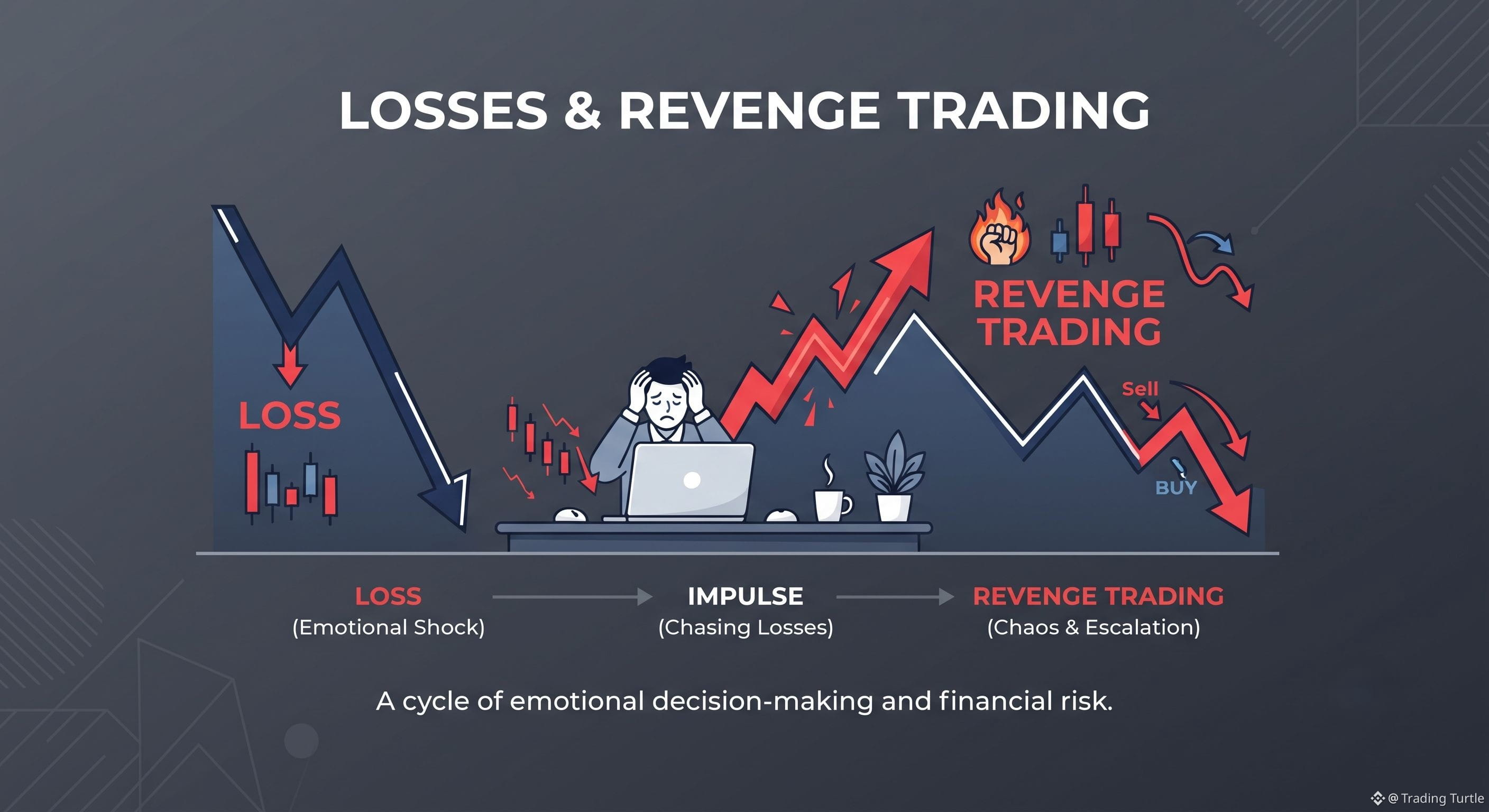
Losses and revenge trading
A loss can create pressure to recover money before the next decision has been evaluated.
A loss can create pressure to recover money immediately, leading to larger size, lower-quality setups or rule changes. Revenge trading converts one planned loss into a sequence of unplanned decisions. A predefined daily risk limit, a pause after emotionally significant losses, and a journal that records rule violations can help separate strategy performance from emotional reactions.
Imagine the next trade is larger or less selective because of the previous result. The new decision is then shaped by the desire to recover rather than the original criteria.
Describe a historical decision without using the result of the previous trade as a reason to take it.
Next in this series: Journaling and review.
#TradingEducation #PriceAction #RiskManagement #TradingTurtle
Trading psychology · Lesson 27
Losses and revenge trading
A loss can create pressure to recover money before the next decision has been evaluated.
A loss can create pressure to recover money immediately, leading to larger size, lower-quality setups or rule changes. Revenge trading converts one planned loss into a sequence of unplanned decisions. A predefined daily risk limit, a pause after emotionally significant losses, and a journal that records rule violations can help separate strategy performance from emotional reactions.
Imagine the next trade is larger or less selective because of the previous result. The new decision is then shaped by the desire to recover rather than the original criteria.
Describe a historical decision without using the result of the previous trade as a reason to take it.
Next in this series: Journaling and review.
#TradingEducation #PriceAction #RiskManagement #TradingTurtle
Losses and revenge trading
A loss can create pressure to recover money before the next decision has been evaluated.
A loss can create pressure to recover money immediately, leading to larger size, lower-quality setups or rule changes. Revenge trading converts one planned loss into a sequence of unplanned decisions. A predefined daily risk limit, a pause after emotionally significant losses, and a journal that records rule violations can help separate strategy performance from emotional reactions.
Imagine the next trade is larger or less selective because of the previous result. The new decision is then shaped by the desire to recover rather than the original criteria.
Describe a historical decision without using the result of the previous trade as a reason to take it.
Next in this series: Journaling and review.
#TradingEducation #PriceAction #RiskManagement #TradingTurtle
18
#FOMO and chasing
A fast move can create urgency before there is a clear reason to participate.
Fear of missing out often appears after a fast move, when the perceived opportunity feels more urgent than the original plan. Chasing can worsen entry quality and force a trader to use an invalidation that no longer matches the setup.
A practical response is to define acceptable entry conditions in advance and allow a trade to go without participation when those conditions are gone.
Imagine price moves away while a planned condition is absent. Chasing replaces the original decision criteria with the feeling of being left behind.
Describe the signal that would tell you urgency is replacing your plan. Write a pause rule for that situation.
#TradingEducation #PriceAction #RiskManagement
#FOMO and chasing
A fast move can create urgency before there is a clear reason to participate.
Fear of missing out often appears after a fast move, when the perceived opportunity feels more urgent than the original plan. Chasing can worsen entry quality and force a trader to use an invalidation that no longer matches the setup.
A practical response is to define acceptable entry conditions in advance and allow a trade to go without participation when those conditions are gone.
Imagine price moves away while a planned condition is absent. Chasing replaces the original decision criteria with the feeling of being left behind.
Describe the signal that would tell you urgency is replacing your plan. Write a pause rule for that situation.
#TradingEducation #PriceAction #RiskManagement
A fast move can create urgency before there is a clear reason to participate.
Fear of missing out often appears after a fast move, when the perceived opportunity feels more urgent than the original plan. Chasing can worsen entry quality and force a trader to use an invalidation that no longer matches the setup.
A practical response is to define acceptable entry conditions in advance and allow a trade to go without participation when those conditions are gone.
Imagine price moves away while a planned condition is absent. Chasing replaces the original decision criteria with the feeling of being left behind.
Describe the signal that would tell you urgency is replacing your plan. Write a pause rule for that situation.
#TradingEducation #PriceAction #RiskManagement

30
Trading psychology · Lesson 25
Planning before the trade
A decision made before a trade is easier to evaluate than an explanation invented afterwards.
A trading plan defines the setup, entry conditions, invalidation, position risk and management rules before emotions are strongest. Planning cannot remove uncertainty, but it reduces the number of decisions made impulsively after price starts moving. A useful plan is specific enough to be followed and reviewed, yet simple enough that the trader can execute it consistently.
Imagine a written plan specifies the conditions to consider and the conditions to stand aside. After the event, those criteria make the decision easier to review.
Write an observation checklist for a historical setup, including when the idea would no longer be valid.
Next in this series: FOMO and chasing.
#TradingEducation #PriceAction #RiskManagement #TradingTurtle
Trading psychology · Lesson 25
Planning before the trade
A decision made before a trade is easier to evaluate than an explanation invented afterwards.
A trading plan defines the setup, entry conditions, invalidation, position risk and management rules before emotions are strongest. Planning cannot remove uncertainty, but it reduces the number of decisions made impulsively after price starts moving. A useful plan is specific enough to be followed and reviewed, yet simple enough that the trader can execute it consistently.
Imagine a written plan specifies the conditions to consider and the conditions to stand aside. After the event, those criteria make the decision easier to review.
Write an observation checklist for a historical setup, including when the idea would no longer be valid.
Next in this series: FOMO and chasing.
#TradingEducation #PriceAction #RiskManagement #TradingTurtle
Planning before the trade
A decision made before a trade is easier to evaluate than an explanation invented afterwards.
A trading plan defines the setup, entry conditions, invalidation, position risk and management rules before emotions are strongest. Planning cannot remove uncertainty, but it reduces the number of decisions made impulsively after price starts moving. A useful plan is specific enough to be followed and reviewed, yet simple enough that the trader can execute it consistently.
Imagine a written plan specifies the conditions to consider and the conditions to stand aside. After the event, those criteria make the decision easier to review.
Write an observation checklist for a historical setup, including when the idea would no longer be valid.
Next in this series: FOMO and chasing.
#TradingEducation #PriceAction #RiskManagement #TradingTurtle

29
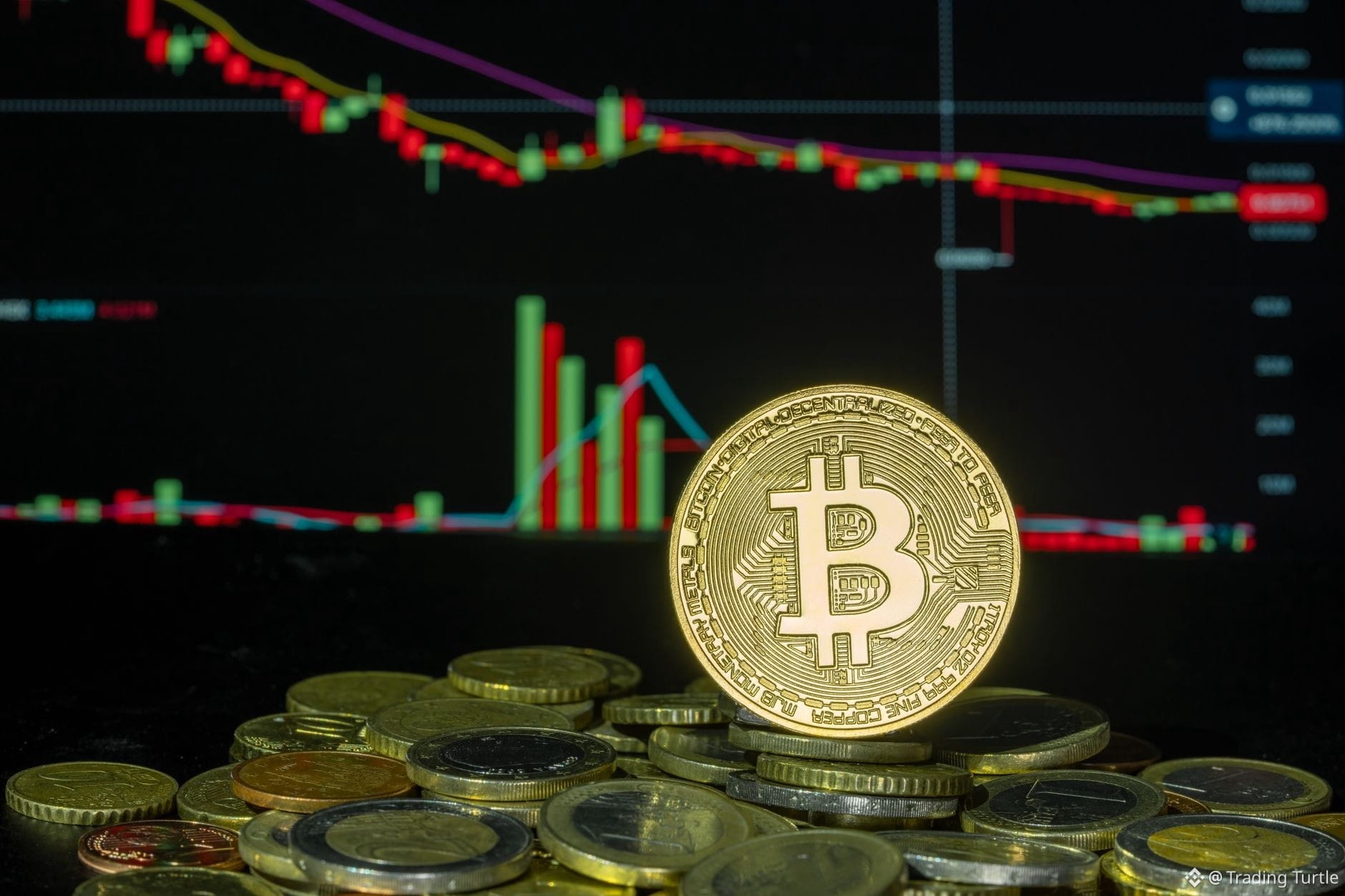
Bitcoin ($BTC) weathers September storm as rate hikes and Clarity act setback test bulls.
Bitcoin is down just 1.5% in its historically weakest month and remains on track for its first quarterly gain in a year, despite rising rates, surging oil and a stronger dollar.
#CryptoNews #DigitalAssets #Bitcoin #Bulls #Clarity
Bitcoin ($BTC ) weathers September storm as rate hikes and Clarity act setback test bulls.
Bitcoin is down just 1.5% in its historically weakest month and remains on track for its first quarterly gain in a year, despite rising rates, surging oil and a stronger dollar.
#CryptoNews #DigitalAssets #Bitcoin #Bulls #Clarity
Bitcoin is down just 1.5% in its historically weakest month and remains on track for its first quarterly gain in a year, despite rising rates, surging oil and a stronger dollar.
#CryptoNews #DigitalAssets #Bitcoin #Bulls #Clarity
58
Ether ($ETH) and $XRP ETFs post outflows as bitcoin ($BTC) moves above $77,000.
Ether funds shed money for a third straight session even as the token rose, while every major gained and zcash extended its run.
#CryptoNews #DigitalAssets #Above #Bitcoin #Etfs
Ether ($ETH ) and $XRP ETFs post outflows as bitcoin ($BTC ) moves above $77,000.
Ether funds shed money for a third straight session even as the token rose, while every major gained and zcash extended its run.
#CryptoNews #DigitalAssets #Above #Bitcoin #Etfs
Ether funds shed money for a third straight session even as the token rose, while every major gained and zcash extended its run.
#CryptoNews #DigitalAssets #Above #Bitcoin #Etfs

108
Stop Changing Timeframes to Force a Trade.
Changing timeframes until the chart agrees with the trade you want creates confirmation bias, not analysis.
Pick your timeframe before you decide what the market is doing.
Educational only - not financial advice. #TechnicalAnalysis #MarketStructure
Stop Changing Timeframes to Force a Trade.
Changing timeframes until the chart agrees with the trade you want creates confirmation bias, not analysis.
Pick your timeframe before you decide what the market is doing.
Educational only - not financial advice. #TechnicalAnalysis #MarketStructure
Changing timeframes until the chart agrees with the trade you want creates confirmation bias, not analysis.
Pick your timeframe before you decide what the market is doing.
Educational only - not financial advice. #TechnicalAnalysis #MarketStructure
24
Bitcoin ($BTC) faces 2022 parallels as Federal Reserve resumes rate increases.
Bitcoin’s drawdown mirrors its position before the Fed’s first hike in March 2022, raising questions over whether a relief rally could precede further losses.
#MarketNews #Investing #Bitcoin #Faces #Federal
Bitcoin ($BTC ) faces 2022 parallels as Federal Reserve resumes rate increases.
Bitcoin’s drawdown mirrors its position before the Fed’s first hike in March 2022, raising questions over whether a relief rally could precede further losses.
#MarketNews #Investing #Bitcoin #Faces #Federal
Bitcoin’s drawdown mirrors its position before the Fed’s first hike in March 2022, raising questions over whether a relief rally could precede further losses.
#MarketNews #Investing #Bitcoin #Faces #Federal

36
Trend and range trading · Lesson 20
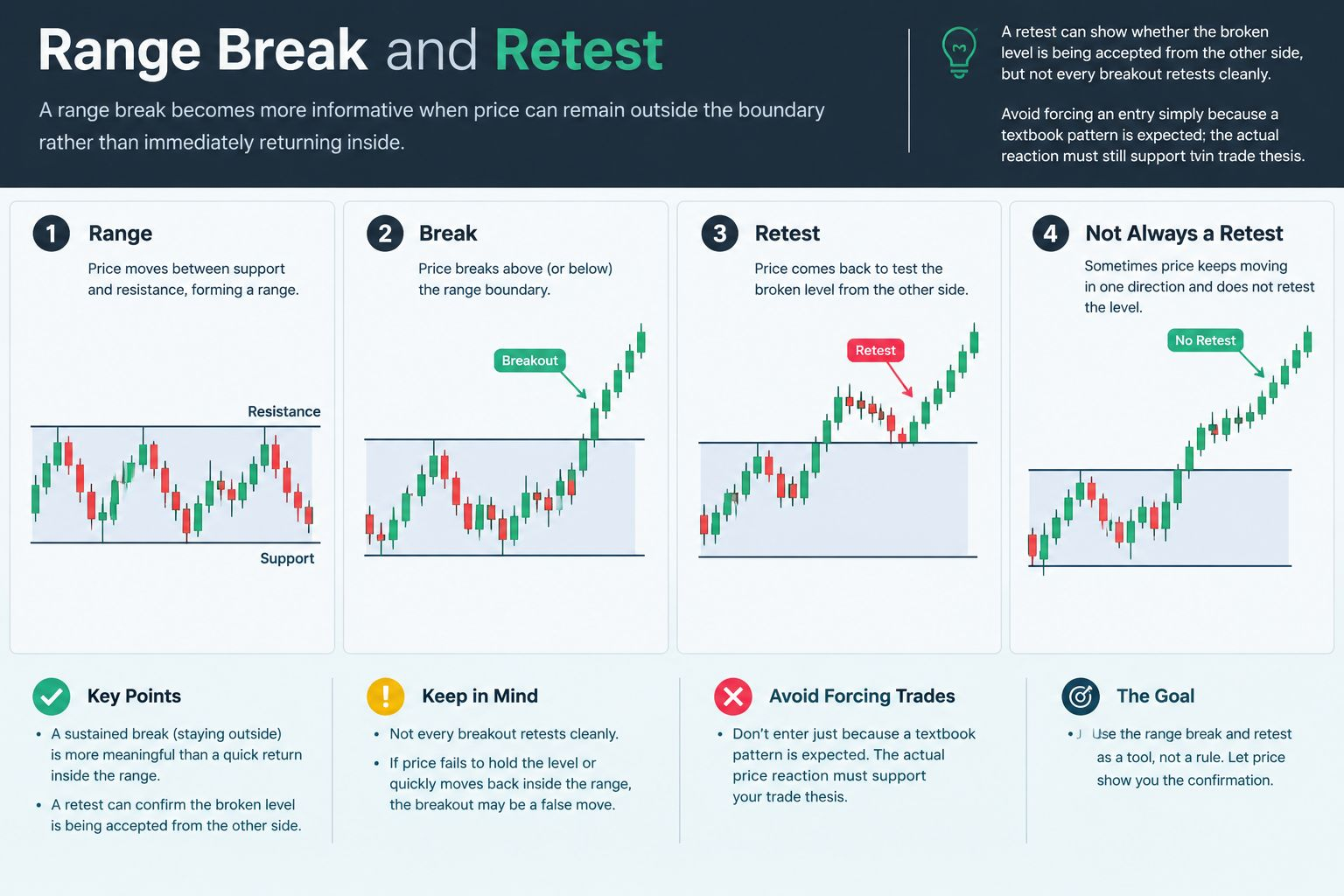
Range break and retest
Returning to a broken range boundary does not guarantee that it will hold.
A range break becomes more informative when price can remain outside the boundary rather than immediately returning inside. A retest can show whether the broken level is being accepted from the other side, but not every breakout retests cleanly. Traders should avoid forcing an entry simply because a textbook pattern is expected; the actual reaction must still support the trade thesis.
Compare a retest that stays outside the former range with one that returns inside. The reaction matters more than simply labelling the touch a retest.
Describe a historical range break and the later reaction without assuming the break had to succeed.
Next in this series: Leverage and notional exposure.
#TradingEducation #PriceAction #RiskManagement #TradingTurtle
Trend and range trading · Lesson 20
Range break and retest
Returning to a broken range boundary does not guarantee that it will hold.
A range break becomes more informative when price can remain outside the boundary rather than immediately returning inside. A retest can show whether the broken level is being accepted from the other side, but not every breakout retests cleanly. Traders should avoid forcing an entry simply because a textbook pattern is expected; the actual reaction must still support the trade thesis.
Compare a retest that stays outside the former range with one that returns inside. The reaction matters more than simply labelling the touch a retest.
Describe a historical range break and the later reaction without assuming the break had to succeed.
Next in this series: Leverage and notional exposure.
#TradingEducation #PriceAction #RiskManagement #TradingTurtle
Range break and retest
Returning to a broken range boundary does not guarantee that it will hold.
A range break becomes more informative when price can remain outside the boundary rather than immediately returning inside. A retest can show whether the broken level is being accepted from the other side, but not every breakout retests cleanly. Traders should avoid forcing an entry simply because a textbook pattern is expected; the actual reaction must still support the trade thesis.
Compare a retest that stays outside the former range with one that returns inside. The reaction matters more than simply labelling the touch a retest.
Describe a historical range break and the later reaction without assuming the break had to succeed.
Next in this series: Leverage and notional exposure.
#TradingEducation #PriceAction #RiskManagement #TradingTurtle
71
Trend and range trading · Lesson 18
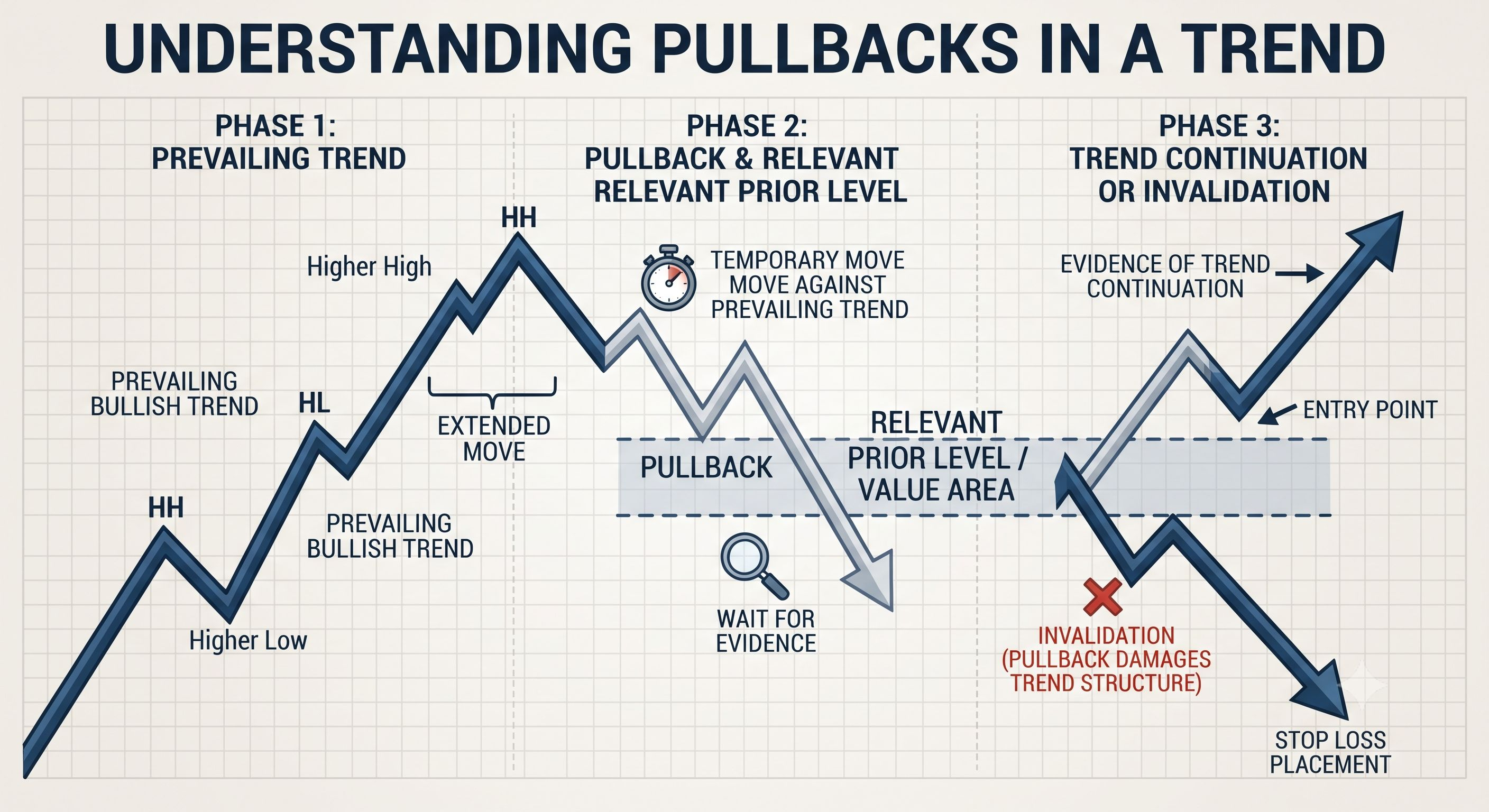
Pullbacks in a trend
Movement against a trend can be ordinary fluctuation or the start of structural damage.
A pullback is a temporary move against the prevailing trend. Rather than chasing an extended move, traders often wait to see whether price pulls back into a relevant prior level or value area and then shows evidence of trend continuation. The setup is invalid if the pullback damages the structure that defined the trend, so a pullback entry still requires a specific invalidation.
Imagine a pullback holds a meaningful prior swing, then compare one that breaks it and fails to recover. Both move against the trend, but their implications differ.
Describe a historical pullback and the swing that gives it context. Explain what evidence would change your interpretation.
Next in this series: Recognising a range.
#TradingEducation #PriceAction #RiskManagement #TradingTurtle
Trend and range trading · Lesson 18
Pullbacks in a trend
Movement against a trend can be ordinary fluctuation or the start of structural damage.
A pullback is a temporary move against the prevailing trend. Rather than chasing an extended move, traders often wait to see whether price pulls back into a relevant prior level or value area and then shows evidence of trend continuation. The setup is invalid if the pullback damages the structure that defined the trend, so a pullback entry still requires a specific invalidation.
Imagine a pullback holds a meaningful prior swing, then compare one that breaks it and fails to recover. Both move against the trend, but their implications differ.
Describe a historical pullback and the swing that gives it context. Explain what evidence would change your interpretation.
Next in this series: Recognising a range.
#TradingEducation #PriceAction #RiskManagement #TradingTurtle
Pullbacks in a trend
Movement against a trend can be ordinary fluctuation or the start of structural damage.
A pullback is a temporary move against the prevailing trend. Rather than chasing an extended move, traders often wait to see whether price pulls back into a relevant prior level or value area and then shows evidence of trend continuation. The setup is invalid if the pullback damages the structure that defined the trend, so a pullback entry still requires a specific invalidation.
Imagine a pullback holds a meaningful prior swing, then compare one that breaks it and fails to recover. Both move against the trend, but their implications differ.
Describe a historical pullback and the swing that gives it context. Explain what evidence would change your interpretation.
Next in this series: Recognising a range.
#TradingEducation #PriceAction #RiskManagement #TradingTurtle
23
·
--
Bearish
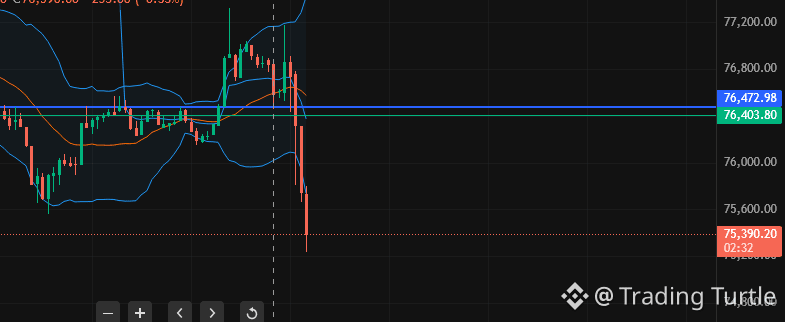
Bitcoin ($BTC ) slipped 2.99% to $76,443 on Thursday, while Ethereum ($ETH) dropped 4.21% to $2,424.21.
The tumble came as the Senate edged closer to debating the Clarity Act, a proposal that could reshape how digital assets are regulated in the United States.
Almost every major token posted losses – $BNB , XRP, $SOL and many others fell between 0.5% and over 10% – highlighting how quickly market sentiment can turn on policy uncertainty.
For traders, the episode is a reminder that legislative headlines often act as a catalyst for broad‑based price pressure across the crypto space. What do you think matters more for the next move: the outcome of the Clarity Act debate or the current multi‑coin sell‑off?
#Crypto #Bitcoin #Regulation #Marketnews #Priceaction
Bitcoin ($BTC ) slipped 2.99% to $76,443 on Thursday, while Ethereum ($ETH) dropped 4.21% to $2,424.21.
The tumble came as the Senate edged closer to debating the Clarity Act, a proposal that could reshape how digital assets are regulated in the United States.
Almost every major token posted losses – $BNB , XRP, $SOL and many others fell between 0.5% and over 10% – highlighting how quickly market sentiment can turn on policy uncertainty.
For traders, the episode is a reminder that legislative headlines often act as a catalyst for broad‑based price pressure across the crypto space. What do you think matters more for the next move: the outcome of the Clarity Act debate or the current multi‑coin sell‑off?
#Crypto #Bitcoin #Regulation #Marketnews #Priceaction
The tumble came as the Senate edged closer to debating the Clarity Act, a proposal that could reshape how digital assets are regulated in the United States.
Almost every major token posted losses – $BNB , XRP, $SOL and many others fell between 0.5% and over 10% – highlighting how quickly market sentiment can turn on policy uncertainty.
For traders, the episode is a reminder that legislative headlines often act as a catalyst for broad‑based price pressure across the crypto space. What do you think matters more for the next move: the outcome of the Clarity Act debate or the current multi‑coin sell‑off?
#Crypto #Bitcoin #Regulation #Marketnews #Priceaction
1
1.1k
Stack $BTC, the company backed by Nigel Farage, has put forward a $16 million purchase of a gold dealer.
The plan is to channel cash flow from precious‑metal sales directly into Bitcoin acquisitions, effectively turning gold revenue into digital‑currency holdings.
This approach blends traditional commodity cash streams with crypto investment, illustrating a concrete example of how firms can bridge physical and digital asset markets. It underscores the potential for existing commodity businesses to diversify without relying on external financing. By using internally generated cash rather than external capital, Stack BTC aims to grow its Bitcoin portfolio while maintaining operational independence. The strategy could appeal to investors interested in exposure to both gold and Bitcoin through a single corporate vehicle. The proposal highlights the evolving relationship between legacy asset classes and the crypto ecosystem, where cash flow from one can fund growth in the other. What implications do you see for other commodity firms considering similar crypto‑funded strategies?
#Crypto #Bitcoin #Gold #Finance #Investment
Stack $BTC , the company backed by Nigel Farage, has put forward a $16 million purchase of a gold dealer.
The plan is to channel cash flow from precious‑metal sales directly into Bitcoin acquisitions, effectively turning gold revenue into digital‑currency holdings.
This approach blends traditional commodity cash streams with crypto investment, illustrating a concrete example of how firms can bridge physical and digital asset markets. It underscores the potential for existing commodity businesses to diversify without relying on external financing. By using internally generated cash rather than external capital, Stack BTC aims to grow its Bitcoin portfolio while maintaining operational independence. The strategy could appeal to investors interested in exposure to both gold and Bitcoin through a single corporate vehicle. The proposal highlights the evolving relationship between legacy asset classes and the crypto ecosystem, where cash flow from one can fund growth in the other. What implications do you see for other commodity firms considering similar crypto‑funded strategies?
#Crypto #Bitcoin #Gold #Finance #Investment
The plan is to channel cash flow from precious‑metal sales directly into Bitcoin acquisitions, effectively turning gold revenue into digital‑currency holdings.
This approach blends traditional commodity cash streams with crypto investment, illustrating a concrete example of how firms can bridge physical and digital asset markets. It underscores the potential for existing commodity businesses to diversify without relying on external financing. By using internally generated cash rather than external capital, Stack BTC aims to grow its Bitcoin portfolio while maintaining operational independence. The strategy could appeal to investors interested in exposure to both gold and Bitcoin through a single corporate vehicle. The proposal highlights the evolving relationship between legacy asset classes and the crypto ecosystem, where cash flow from one can fund growth in the other. What implications do you see for other commodity firms considering similar crypto‑funded strategies?
#Crypto #Bitcoin #Gold #Finance #Investment

47
Log in to explore more content
Join global crypto users on Binance Square
⚡️ Get latest and useful information about crypto.
💬 Trusted by the world’s largest crypto exchange.
👍 Discover real insights from verified creators.
Email / Phone number
Trending Topics
BOJRaisesRatesTo31YearHigh
38,002 views
836 Discussing
Bitcoin Reclaims the Spotlight as Macro Pressure Fails to Break Crypto Demand
Fatima_Tariq
·10 Likes
·5.6k views
BuffettStepsDownAsBerkshireChairman
13,911 views
360 Discussing
XRPExchangeReservesHitSevenYearLow
18,029 views
368 Discussing