


TradeChartist
Daily crypto set-ups, watchlists & market breakdowns.
29 Following
21 Followers
15 Liked
Posts
All
Quotes



Crypto World Club Live
·
--
QTrust Network: Quantum Computers Aren’t Here Yet, but Your Encrypted Data Is Already Being Targeted
Everyone, today we’re diving into a topic that may sound a little technical, but it affects every one of us.
Have you ever stopped to consider this question—
Are your encrypted files, transaction records, chat data, and wallet private keys truly secure?
You might say, “Of course they are. Banks use AES-256, RSA, and elliptic-curve cryptography—what could possibly go wrong?”
A lot, as it turns out.
There is an attack strategy known as “harvest now, decrypt later.”
The idea is simple: attackers steal and store your encrypted data today, then decrypt it once sufficiently powerful quantum computers become available. Government communications, financial clearing records, energy dispatch instructions, Web3 wallet private keys, and smart contract signatures could all be exposed someday.
This is not science fiction. NIST has already published its first post-quantum cryptography standards. EuroQCI is advancing Europe’s quantum communication infrastructure, while BT, Toshiba, and HSBC have tested a quantum-secured metropolitan network in a financial setting. Post-quantum security has moved beyond a research topic—it is now an engineering challenge.
And that is precisely the problem the project we’re discussing today—QTrust Network—aims to address.
▎What Exactly Does It Do? Here’s the One-Sentence Version
QTrust Network is a Web3 trust infrastructure designed for the post-quantum era.
In plain English, it adds a future-ready layer of security and trust to existing internet infrastructure, private networks, enterprise security systems, and blockchains.
It does not replace existing systems. It enhances them.
The first phase of its core product development focuses on two solutions:
QTrust Gateway: An industry-grade security gateway deployed at the boundaries of institutional networks, enabling enterprises to adopt quantum-resistant security without rebuilding their existing systems.
QTrust Key Manager: A quantum-resistant key management platform responsible for key generation, distribution, rotation, and revocation. It supports post-quantum cryptography, or PQC, key exchange and can integrate QKD-generated quantum keys and QRNG-generated quantum randomness.
The platform will then gradually expand into decentralized identity, or DID; verifiable credentials, or VCs; zero-knowledge proofs, or ZK proofs; audit chains; and identity networks for AI agents.
▎Why Does This Matter Right Now?
There are three industry signals everyone should be paying attention to:
First, the standards are already here. NIST’s publication of the first post-quantum cryptography standards means quantum-resistant migration is no longer a question of whether it should happen, but when.
Second, the infrastructure is being built. EuroQCI is advancing a European quantum communication network. BT, Toshiba, and HSBC have tested a quantum-secured metropolitan network, while the EPB Quantum Network in the United States provides a real-world testing environment. Quantum-secured communication is moving out of the laboratory and into metropolitan networks.
Third, Web3 faces the same threat. Wallet private keys, smart contracts, cross-chain bridges, on-chain identities, DAO governance, and real-world asset credentials all depend on today’s cryptographic systems. Unless they evolve toward quantum-resistant frameworks in advance, the security foundations of the entire Web3 ecosystem could eventually be undermined.
▎The Core Logic: Trust = Identity × Security × Verification × Audit
This formula is worth unpacking:
Without identity, a connection cannot be authenticated. That is why QTrust uses DID—to provide verifiable identities for institutions, devices, users, nodes, and even AI agents.
Without security, communications cannot be protected. That is why QTrust combines PQC, QKD, and QRNG—using post-quantum cryptography as the foundation, quantum key distribution as an enhancement, and quantum random numbers to improve key quality.
Without verification, collaboration must rely on assumptions of trust. That is why QTrust uses ZK proofs—to prove that an identity is valid, an operation is compliant, or a transaction is authentic without disclosing the underlying data.
Without auditing, accountability cannot be traced. That is why QTrust uses an Audit Chain—only hashes, proofs, authorization records, and critical events are stored on-chain. The data itself remains off-chain, while the process stays verifiable.
▎Technical Architecture: Three Clear Layers
Quantum-Resistant Security Layer: PQC, QKD, QRNG, HSM, MPC, and integration with VPNs, TLS, IPsec, private networks, and API gateways.
Web3 Trust and Collaboration Layer: DID, VC, smart contract permission systems, on-chain audit ledgers, ZK proofs, cross-chain messaging protocols, and on-chain data-hash anchoring.
Industry Application Layer: Government services, finance, energy, telecommunications, data centers, Web3 identity, RWAs, cross-chain messaging, and AI agent networks.
▎Four Essential Use Cases
Government and Classified Communications: Sensitive data transmitted across departments, regions, and networks requires higher levels of identity authentication, key protection, and auditability. QTrust’s approach is straightforward—the data stays off-chain, while the process remains verifiable.
Cross-Domain Financial Transactions: This covers high-value communications among banks, clearing institutions, trading platforms, and custodians, including transaction confirmations, clearing instructions, reconciliation data, and risk-control information. QTrust provides quantum-resistant identities, key governance, transaction credential anchoring, and ZK-based compliance proofs.
Energy and Smart Grids: Future power grids will connect dispatch centers, substations, energy storage systems, charging networks, distributed energy resources, and large numbers of IoT devices. QTrust assigns DID identities to energy devices and applies quantum-resistant signatures to dispatch instructions, reducing the risks of forged commands, unauthorized access, and data tampering.
Public Mobile Communications and Digital Identity: QTrust plans to advance the Q-ID Wallet, providing individual users, Web3 participants, and AI agents with quantum-resistant identities, privacy-preserving credentials, selective disclosure, and data authorization capabilities.
▎Global Partnership Ecosystem: Not Just Brand Names, but Real Capabilities
QTrust’s partnership strategy centers on three objectives:
Integrating real security capabilities: QKD, QRNG, PQC, HSM, MPC, ZK, and security gateways.
Connecting real-world industry use cases: Financial data centers, energy networks, government communications, enterprise private networks, and mobile devices.
Building an open development ecosystem: SDKs, APIs, testnets, developer funds, and industry nodes.
Reference cases include the quantum-secured metropolitan network developed by BT, Toshiba, and HSBC; EuroQCI’s regional quantum communication infrastructure; and the EPB Quantum commercial quantum-network testing platform.
▎Roadmap: Five Steps from Prototype to a Global Trust Network
Phase One (0–6 months): Design the technical architecture, develop a PQC key-exchange demo, build a DID identity system prototype and an on-chain audit ledger, and launch MVP versions of the Key Manager and Gateway.
Phase Two (6–12 months): Release the SDK and enterprise APIs, integrate a QRNG or simulated quantum-randomness source, complete a pilot demonstration in finance, energy, or data centers, and establish the first group of test nodes.
Phase Three (12–18 months): Launch an industry testnet, introduce solutions for government, finance, and energy, support institutional and device DIDs, and release the ZK compliance module.
Phase Four (18–24 months): Launch the mainnet, open node staking, release the beta version of the Q-ID Wallet, support cross-chain messaging protocols, and establish an ecosystem fund.
Phase Five (after 24 months): Expand the network with more industry nodes, integrate additional quantum-secured gateways and QKD services, launch a mobile quantum-resistant identity wallet, and support AI agent identities and secure communications.
▎My Honest Take
QTrust Network is not the kind of project that promises, “Buy today, profit tomorrow.”
It is building infrastructure—technical, complex, and long-term work. But if it succeeds, it could become part of the foundational trust layer for digital civilization in the post-quantum era.
In the industrial age, power grids lit up cities. In the internet age, information networks connected the world. In the Web3 era, value networks have enabled assets to move freely.
In the post-quantum era, humanity will need a new trust network to protect identities, data, transactions, critical infrastructure, and digital civilization itself.
That is the network QTrust aims to build.
It does not promise “absolute security.” Instead, it is working to prepare the digital world before the quantum era fully arrives.
If you follow Web3 infrastructure, enterprise security, quantum communications, or digital identity—or simply want to understand what the “post-quantum era” really means—
The QTrust Network white paper is worth a serious read.
It is not another blockchain. It is trust infrastructure for the post-quantum world.
#QTrustNetwork #PostQuantumCryptography #PQC #QKD #Web3Security #DigitalIdentity #DID #ZeroKnowledgeProofs #QuantumCommunications #TrustInfrastructure

Quoted content has been removed

Hain Ahmad
·
--
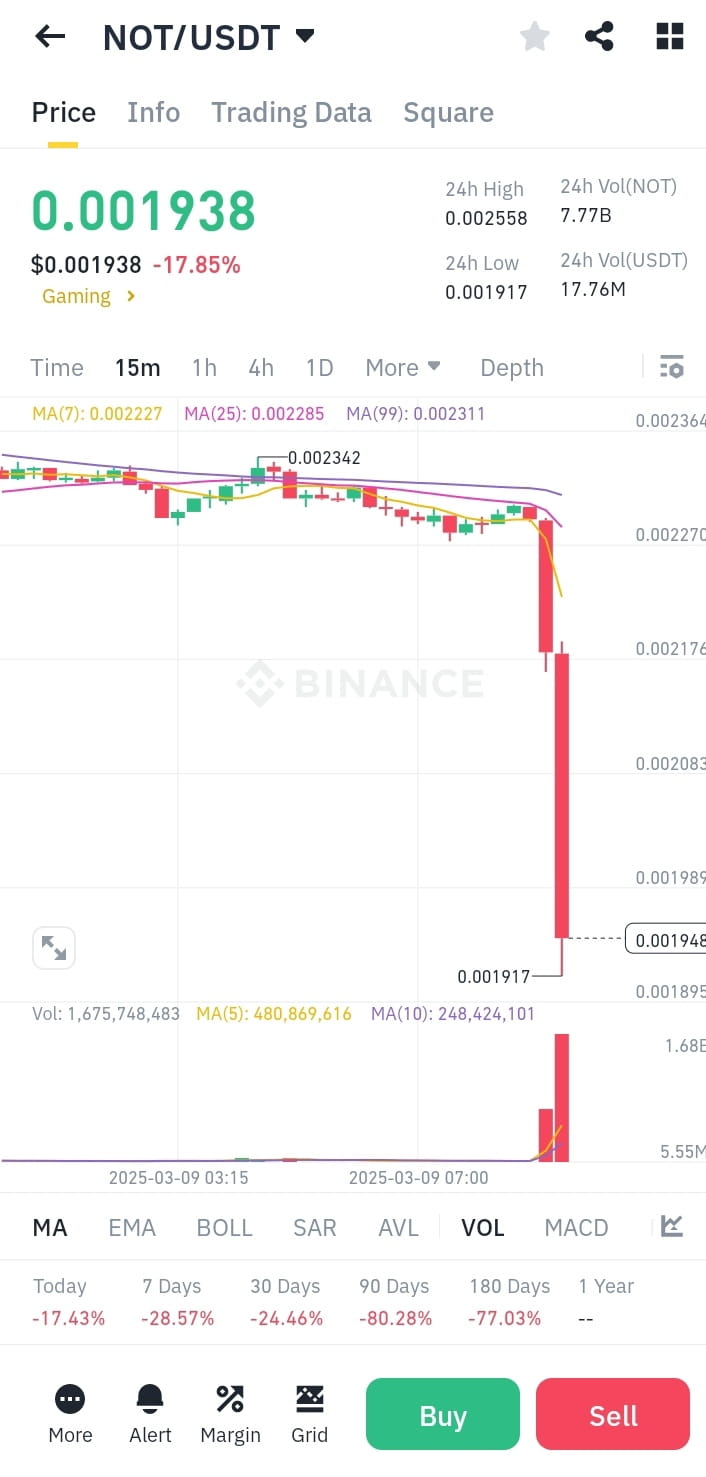
Bearish $NOT Long Liquidation: $32.371K at $0.00208 🔥
The market just saw a long liquidation at $0.00208, which means traders who were betting on price going up got stopped out. This can create a great buying opportunity if the trend reverses!
📌 What’s Next?
The price could bounce back or drop further before reversing. Here’s a smart plan to trade safely:
🛒 Buy Zone (Entry Point):
Best Buy Zone: $0.00195 - $0.00205
Safe Entry: Wait for a strong bounce near $0.00200 before entering
🎯 Target (Take Profit):
First Target (Short-term): $0.00230
Second Target (Mid-term): $0.00250
Final Target (Long-term): $0.00280
🛑 Stop Loss (Risk Management):
Stop Loss: $0.00185 (Exit if price drops below this to avoid big losses)
📊 Strategy & Tips:
✅ Wait for Confirmation: If price holds above $0.00200, it's a strong sign of recovery.
✅ Don’t Chase the Price: If it jumps too fast, wait for a dip to enter safely.
✅ Risk Management: Always use a stop loss to protect your capital.
🚀 Final Thoughts
This is a high-risk, high-re
#MarketPullback
#MarketPullback
$NOT
Log in to explore more content