

StoneFish
56 Posts

StoneFish
Report
Block User
BP-D11AD1B8CC05
Open Trade
Occasional Trader
2.4 Years
46 Following
113 Followers
120 Liked
Posts
Portfolio
All
Quotes
·
--
do you know @TermMax is the most bullish DeFi narrative right now but why?
With approaching the TGE and massive ecosystem growth, the numbers speak for themselves:
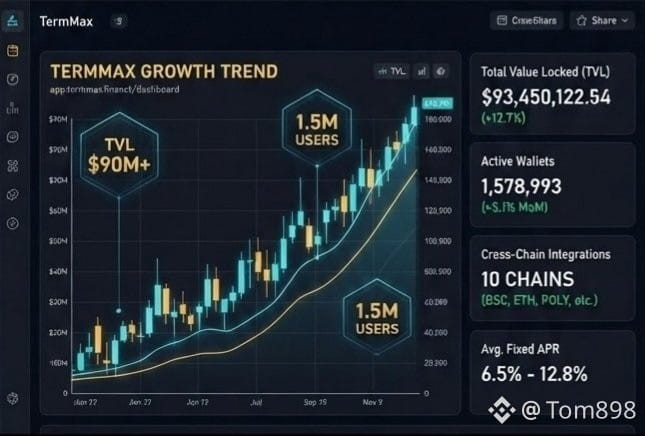
📈 TVL crossing over $90M+
🌐 1.5M+ registered wallets 🔥
🚀 Up to 170k users across 10 EVM chains!
#TermMax @TermMax
do you know @TermMax is the most bullish DeFi narrative right now but why?
With approaching the TGE and massive ecosystem growth, the numbers speak for themselves:
📈 TVL crossing over $90M+
🌐 1.5M+ registered wallets 🔥
🚀 Up to 170k users across 10 EVM chains!
#TermMax @TermMax
With approaching the TGE and massive ecosystem growth, the numbers speak for themselves:
📈 TVL crossing over $90M+
🌐 1.5M+ registered wallets 🔥
🚀 Up to 170k users across 10 EVM chains!
#TermMax @TermMax
75
·
--
The Market May Be Waiting For One More Confirmation
Crypto can look bullish while still lacking the participation needed for a stronger move.
That is why I’m watching what happens after the first push, not just the candle itself.
$BTC remains the main market filter.
If Bitcoin holds strength while volume improves, risk appetite can gradually move further down the curve.
Then $ETH becomes important.
A stronger $ETH can signal that capital is expanding beyond Bitcoin, creating room for higher-beta assets.
That is where I’m watching:
$SOL $BNB $XRP $SUI $APT $AVAX $NEAR $SEI $TIA
The key is not simply which token is green.
I want to know where liquidity is staying.
Is volume expanding?
Is the ecosystem attracting capital?
Can the move survive after attention fades?
DeFi is another area worth watching.
$AAVE $UNI $CRV $PENDLE $JUP $MKR
These protocols give the market exposure to lending, trading, liquidity and yield.
If prices rise alongside stronger activity, the signal becomes more convincing.
Infrastructure is also important.
$LINK $ARB $OP $DOT $ATOM
As on-chain activity expands, demand for data, scaling and interoperability can increase.
AI remains a major attention magnet:
$TAO $RENDER $FET $KAITO $FIL
But attention is only the first step.
The stronger projects will be those that convert attention into users, products and demand.
RWA is another sector I’m monitoring.
$ONDO $LINK $MKR $XLM
Tokenization could bring more traditional financial activity onto blockchain rails, but liquidity and adoption will matter more than headlines.
Then there is the speculative side:
$BONK $PUMP $PENGU $PEOPLE
These can move extremely fast when social attention and liquidity arrive together.
But I’m more interested in what happens after the first pump.
Does volume remain?
Does price hold?
Does liquidity stay?
That is the difference between a temporary move and a real rotation.
For me, the next strong signal is not simply a breakout.
It is a breakout followed by participation.
The Market May Be Waiting For One More Confirmation
Crypto can look bullish while still lacking the participation needed for a stronger move.
That is why I’m watching what happens after the first push, not just the candle itself.
$BTC remains the main market filter.
If Bitcoin holds strength while volume improves, risk appetite can gradually move further down the curve.
Then $ETH becomes important.
A stronger $ETH can signal that capital is expanding beyond Bitcoin, creating room for higher-beta assets.
That is where I’m watching:
$SOL $BNB $XRP $SUI $APT $AVAX $NEAR $SEI $TIA
The key is not simply which token is green.
I want to know where liquidity is staying.
Is volume expanding?
Is the ecosystem attracting capital?
Can the move survive after attention fades?
DeFi is another area worth watching.
$AAVE $UNI $CRV $PENDLE $JUP $MKR
These protocols give the market exposure to lending, trading, liquidity and yield.
If prices rise alongside stronger activity, the signal becomes more convincing.
Infrastructure is also important.
$LINK $ARB $OP $DOT $ATOM
As on-chain activity expands, demand for data, scaling and interoperability can increase.
AI remains a major attention magnet:
$TAO $RENDER $FET $KAITO $FIL
But attention is only the first step.
The stronger projects will be those that convert attention into users, products and demand.
RWA is another sector I’m monitoring.
$ONDO $LINK $MKR $XLM
Tokenization could bring more traditional financial activity onto blockchain rails, but liquidity and adoption will matter more than headlines.
Then there is the speculative side:
$BONK $PUMP $PENGU $PEOPLE
These can move extremely fast when social attention and liquidity arrive together.
But I’m more interested in what happens after the first pump.
Does volume remain?
Does price hold?
Does liquidity stay?
That is the difference between a temporary move and a real rotation.
For me, the next strong signal is not simply a breakout.
It is a breakout followed by participation.
Crypto can look bullish while still lacking the participation needed for a stronger move.
That is why I’m watching what happens after the first push, not just the candle itself.
$BTC remains the main market filter.
If Bitcoin holds strength while volume improves, risk appetite can gradually move further down the curve.
Then $ETH becomes important.
A stronger $ETH can signal that capital is expanding beyond Bitcoin, creating room for higher-beta assets.
That is where I’m watching:
$SOL $BNB $XRP $SUI $APT $AVAX $NEAR $SEI $TIA
The key is not simply which token is green.
I want to know where liquidity is staying.
Is volume expanding?
Is the ecosystem attracting capital?
Can the move survive after attention fades?
DeFi is another area worth watching.
$AAVE $UNI $CRV $PENDLE $JUP $MKR
These protocols give the market exposure to lending, trading, liquidity and yield.
If prices rise alongside stronger activity, the signal becomes more convincing.
Infrastructure is also important.
$LINK $ARB $OP $DOT $ATOM
As on-chain activity expands, demand for data, scaling and interoperability can increase.
AI remains a major attention magnet:
$TAO $RENDER $FET $KAITO $FIL
But attention is only the first step.
The stronger projects will be those that convert attention into users, products and demand.
RWA is another sector I’m monitoring.
$ONDO $LINK $MKR $XLM
Tokenization could bring more traditional financial activity onto blockchain rails, but liquidity and adoption will matter more than headlines.
Then there is the speculative side:
$BONK $PUMP $PENGU $PEOPLE
These can move extremely fast when social attention and liquidity arrive together.
But I’m more interested in what happens after the first pump.
Does volume remain?
Does price hold?
Does liquidity stay?
That is the difference between a temporary move and a real rotation.
For me, the next strong signal is not simply a breakout.
It is a breakout followed by participation.
222
·
--
⚡ ALTCOINS ARE MOVING — BUT LIQUIDITY HASN’T CHOSEN A SIDE YET
The altcoin market is showing pockets of strength, but the bigger picture remains fragmented.
Some narratives are attracting capital. Others are fading. And several tokens are moving almost entirely on short-term momentum.
That tells us one thing:
Rotation is happening, but broad participation hasn't arrived.
🟢 L1 ROTATION WATCH
$AVAX $SUI $NEAR $TIA $APT $DOT
These ecosystems could benefit if risk appetite expands beyond the majors.
🔥 RWA + DEFI
$ONDO $PENDLE $AAVE $MKR $LDO $UNI $CRV $JTO $CVX
This group deserves attention because renewed liquidity and on-chain activity could create a stronger fundamental bid.
🤖 AI / COMPUTE SELECTIVITY
$TAO $RNDR $WLD $FET $AKT $THETA $AIOZ $KAITO
The narrative remains powerful, but strength needs to become more than isolated pumps.
🔻 WEAKER L1s
$SEI $ZIL $HBAR $IOTA $XTZ
These names need stronger liquidity and market-wide risk appetite before their relative weakness can meaningfully reverse.
💀 MEME / HIGH-BETA
$PEPE $BONK $WIF $FLOKI $SHIB $BOME $TRUMP $POPCAT
This is where momentum can become extreme in either direction. Fast gains can attract FOMO—and fast reversals can erase them just as quickly.
The key isn't finding the coin that moves first.
It's identifying where liquidity remains after the first move.
Watch for:
📊 Expanding spot volume
💰 Sustained liquidity
🛡️ Buyers defending pullbacks
📈 Improving market breadth
🔄 Strength that survives $BTC volatility
That's how a speculative pump starts looking like genuine rotation.
$BTC remains the market's anchor.
But liquidity determines which narrative gets the next wave of attention.
Don't chase the candle.
Follow the capital.
Not financial advice. Manage risk first.
⚡ ALTCOINS ARE MOVING — BUT LIQUIDITY HASN’T CHOSEN A SIDE YET
The altcoin market is showing pockets of strength, but the bigger picture remains fragmented.
Some narratives are attracting capital. Others are fading. And several tokens are moving almost entirely on short-term momentum.
That tells us one thing:
Rotation is happening, but broad participation hasn't arrived.
🟢 L1 ROTATION WATCH
$AVAX $SUI $NEAR $TIA $APT $DOT
These ecosystems could benefit if risk appetite expands beyond the majors.
🔥 RWA + DEFI
$ONDO $PENDLE $AAVE $MKR $LDO $UNI $CRV $JTO $CVX
This group deserves attention because renewed liquidity and on-chain activity could create a stronger fundamental bid.
🤖 AI / COMPUTE SELECTIVITY
$TAO $RNDR $WLD $FET $AKT $THETA $AIOZ $KAITO
The narrative remains powerful, but strength needs to become more than isolated pumps.
🔻 WEAKER L1s
$SEI $ZIL $HBAR $IOTA $XTZ
These names need stronger liquidity and market-wide risk appetite before their relative weakness can meaningfully reverse.
💀 MEME / HIGH-BETA
$PEPE $BONK $WIF $FLOKI $SHIB $BOME $TRUMP $POPCAT
This is where momentum can become extreme in either direction. Fast gains can attract FOMO—and fast reversals can erase them just as quickly.
The key isn't finding the coin that moves first.
It's identifying where liquidity remains after the first move.
Watch for:
📊 Expanding spot volume
💰 Sustained liquidity
🛡️ Buyers defending pullbacks
📈 Improving market breadth
🔄 Strength that survives $BTC volatility
That's how a speculative pump starts looking like genuine rotation.
$BTC remains the market's anchor.
But liquidity determines which narrative gets the next wave of attention.
Don't chase the candle.
Follow the capital.
Not financial advice. Manage risk first.
The altcoin market is showing pockets of strength, but the bigger picture remains fragmented.
Some narratives are attracting capital. Others are fading. And several tokens are moving almost entirely on short-term momentum.
That tells us one thing:
Rotation is happening, but broad participation hasn't arrived.
🟢 L1 ROTATION WATCH
$AVAX $SUI $NEAR $TIA $APT $DOT
These ecosystems could benefit if risk appetite expands beyond the majors.
🔥 RWA + DEFI
$ONDO $PENDLE $AAVE $MKR $LDO $UNI $CRV $JTO $CVX
This group deserves attention because renewed liquidity and on-chain activity could create a stronger fundamental bid.
🤖 AI / COMPUTE SELECTIVITY
$TAO $RNDR $WLD $FET $AKT $THETA $AIOZ $KAITO
The narrative remains powerful, but strength needs to become more than isolated pumps.
🔻 WEAKER L1s
$SEI $ZIL $HBAR $IOTA $XTZ
These names need stronger liquidity and market-wide risk appetite before their relative weakness can meaningfully reverse.
💀 MEME / HIGH-BETA
$PEPE $BONK $WIF $FLOKI $SHIB $BOME $TRUMP $POPCAT
This is where momentum can become extreme in either direction. Fast gains can attract FOMO—and fast reversals can erase them just as quickly.
The key isn't finding the coin that moves first.
It's identifying where liquidity remains after the first move.
Watch for:
📊 Expanding spot volume
💰 Sustained liquidity
🛡️ Buyers defending pullbacks
📈 Improving market breadth
🔄 Strength that survives $BTC volatility
That's how a speculative pump starts looking like genuine rotation.
$BTC remains the market's anchor.
But liquidity determines which narrative gets the next wave of attention.
Don't chase the candle.
Follow the capital.
Not financial advice. Manage risk first.
192
·
--
HOT NEWS: $XAUT price breaks out strongly, reaching 4,395 USD. What’s the reason??
The $XAUT (Tether Gold) price surged to the range of 4,300 – 4,400 USD due to the operational nature of this token combined with the global economic and political context.
Main reasons causing XAUT to rise sharply
1. The global gold price ($XAU) explosion
$XAUT is a token backed 1:1 by physical gold (1 XAUT = 1 troy ounce of pure gold held in custody by Tether). Therefore, the price of $XAUT always closely follows the fluctuations of the global gold price.
When the global gold price continuously breaks historical records and moves deep into the region above 4,000 USD/ounce, the $XAUT price naturally increases correspondingly.
2. Geopolitical tensions & macroeconomic instability
Safe haven: Prolonged geopolitical conflicts along with inflation/recession risks cause global investors to flee risky assets and seek gold.
Accumulation trend: Central banks and major financial institutions increase their physical gold purchases, pushing the global gold price to new highs.
3. Capital flow shifts in the Crypto market
RWA investment shift: Many crypto investors choose to move capital into tokenized real-world assets (RWA) like $XAUT to hedge risks when the crypto market is volatile.
High flexibility: Buying $XAUT allows investors to hold gold directly on the Blockchain without worrying about storage, maintenance, or physical gold bar transportation costs.
4. Price premium phenomenon on crypto exchanges
When demand to buy $XAUT on certain exchanges surges beyond immediate liquidity supply, a price premium may appear, pushing the token price slightly above the actual spot gold price at that time.
#CPIToResetFedBets
#AIMemorySelloffEases $BTC
#BTCETHETFInflowsReturn $ETH
{spot}(BTCUSDT)
HOT NEWS: $XAUT price breaks out strongly, reaching 4,395 USD. What’s the reason??
The $XAUT (Tether Gold) price surged to the range of 4,300 – 4,400 USD due to the operational nature of this token combined with the global economic and political context.
Main reasons causing XAUT to rise sharply
1. The global gold price ($XAU) explosion
$XAUT is a token backed 1:1 by physical gold (1 XAUT = 1 troy ounce of pure gold held in custody by Tether). Therefore, the price of $XAUT always closely follows the fluctuations of the global gold price.
When the global gold price continuously breaks historical records and moves deep into the region above 4,000 USD/ounce, the $XAUT price naturally increases correspondingly.
2. Geopolitical tensions & macroeconomic instability
Safe haven: Prolonged geopolitical conflicts along with inflation/recession risks cause global investors to flee risky assets and seek gold.
Accumulation trend: Central banks and major financial institutions increase their physical gold purchases, pushing the global gold price to new highs.
3. Capital flow shifts in the Crypto market
RWA investment shift: Many crypto investors choose to move capital into tokenized real-world assets (RWA) like $XAUT to hedge risks when the crypto market is volatile.
High flexibility: Buying $XAUT allows investors to hold gold directly on the Blockchain without worrying about storage, maintenance, or physical gold bar transportation costs.
4. Price premium phenomenon on crypto exchanges
When demand to buy $XAUT on certain exchanges surges beyond immediate liquidity supply, a price premium may appear, pushing the token price slightly above the actual spot gold price at that time.
#CPIToResetFedBets
#AIMemorySelloffEases $BTC
#BTCETHETFInflowsReturn $ETH
The $XAUT (Tether Gold) price surged to the range of 4,300 – 4,400 USD due to the operational nature of this token combined with the global economic and political context.
Main reasons causing XAUT to rise sharply
1. The global gold price ($XAU) explosion
$XAUT is a token backed 1:1 by physical gold (1 XAUT = 1 troy ounce of pure gold held in custody by Tether). Therefore, the price of $XAUT always closely follows the fluctuations of the global gold price.
When the global gold price continuously breaks historical records and moves deep into the region above 4,000 USD/ounce, the $XAUT price naturally increases correspondingly.
2. Geopolitical tensions & macroeconomic instability
Safe haven: Prolonged geopolitical conflicts along with inflation/recession risks cause global investors to flee risky assets and seek gold.
Accumulation trend: Central banks and major financial institutions increase their physical gold purchases, pushing the global gold price to new highs.
3. Capital flow shifts in the Crypto market
RWA investment shift: Many crypto investors choose to move capital into tokenized real-world assets (RWA) like $XAUT to hedge risks when the crypto market is volatile.
High flexibility: Buying $XAUT allows investors to hold gold directly on the Blockchain without worrying about storage, maintenance, or physical gold bar transportation costs.
4. Price premium phenomenon on crypto exchanges
When demand to buy $XAUT on certain exchanges surges beyond immediate liquidity supply, a price premium may appear, pushing the token price slightly above the actual spot gold price at that time.
#CPIToResetFedBets
#AIMemorySelloffEases $BTC
#BTCETHETFInflowsReturn $ETH
126
·
--
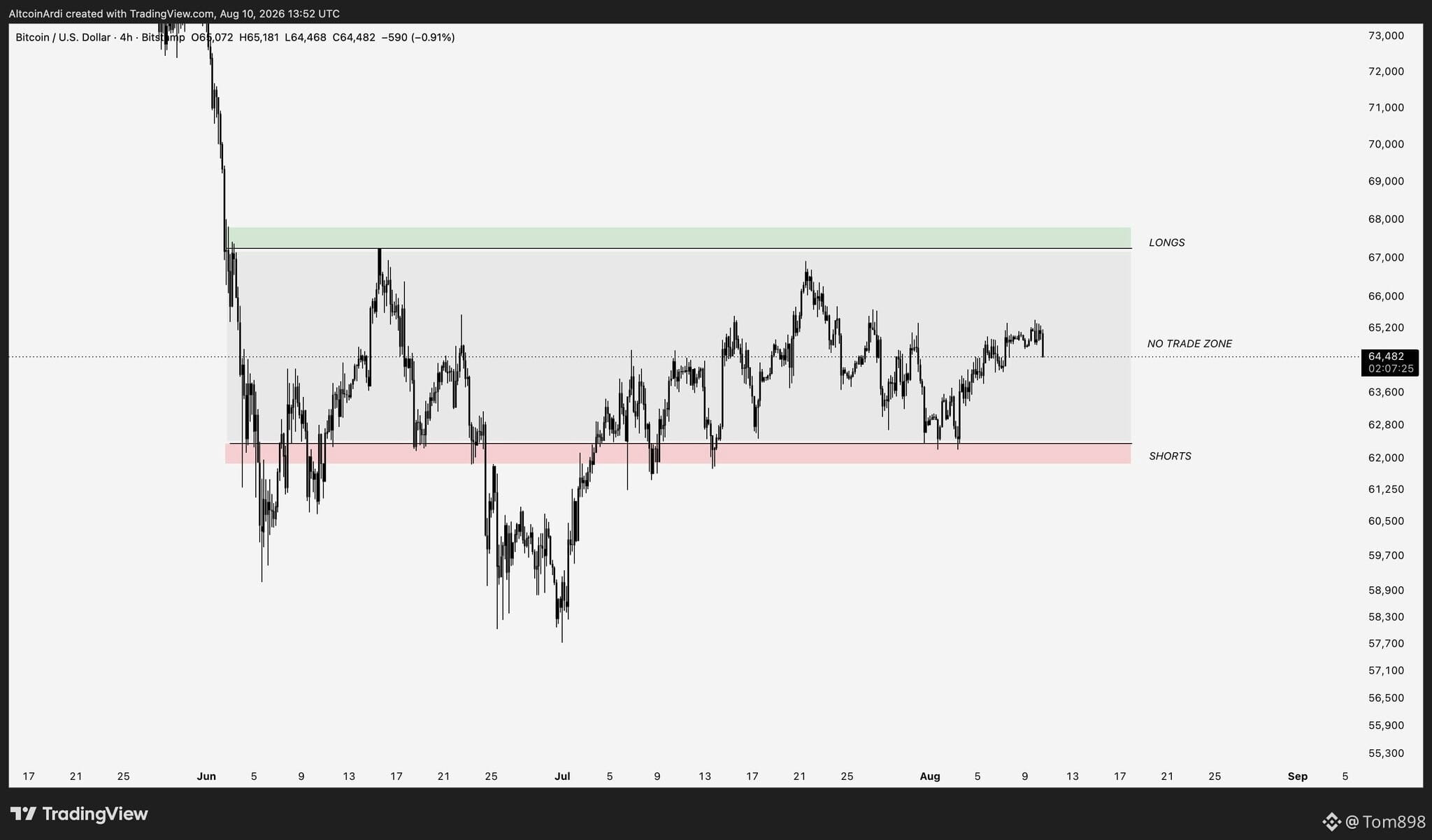
I’ll make this $BTC range simple for you all.
Trade the boundaries. Ignore everything in between.
#CPIToResetFedBets #AIMemorySelloffEases #BTCETHETFInflowsReturn
I’ll make this $BTC range simple for you all.
Trade the boundaries. Ignore everything in between.
#CPIToResetFedBets #AIMemorySelloffEases #BTCETHETFInflowsReturn
Trade the boundaries. Ignore everything in between.
#CPIToResetFedBets #AIMemorySelloffEases #BTCETHETFInflowsReturn
70
·
--
#BTCETHETFInflowsReturn BTC and ETH ETFs finally turned green together, and the inflow numbers are hard to ignore 📈
Spot Bitcoin ETFs pulled in around $865M last week — the strongest result in roughly 15 weeks. BlackRock’s IBIT contributed nearly $694M by itself. ETH ETFs added another $244M, extending their inflow streak to five weeks 👀
That feels like more than a random one-day bounce. Institutional appetite for major crypto assets is clearly returning, and ETH quietly building a longer streak may be the more interesting signal here.
Still, ETF flows alone can’t carry the whole market. Rates, broader risk sentiment and real spot demand all need to cooperate.
Is this the beginning of sustained accumulation, or are institutions simply buying a temporary macro dip? 🤔$BTC
#BTCETHETFInflowsReturn BTC and ETH ETFs finally turned green together, and the inflow numbers are hard to ignore 📈
Spot Bitcoin ETFs pulled in around $865M last week — the strongest result in roughly 15 weeks. BlackRock’s IBIT contributed nearly $694M by itself. ETH ETFs added another $244M, extending their inflow streak to five weeks 👀
That feels like more than a random one-day bounce. Institutional appetite for major crypto assets is clearly returning, and ETH quietly building a longer streak may be the more interesting signal here.
Still, ETF flows alone can’t carry the whole market. Rates, broader risk sentiment and real spot demand all need to cooperate.
Is this the beginning of sustained accumulation, or are institutions simply buying a temporary macro dip? 🤔$BTC
Spot Bitcoin ETFs pulled in around $865M last week — the strongest result in roughly 15 weeks. BlackRock’s IBIT contributed nearly $694M by itself. ETH ETFs added another $244M, extending their inflow streak to five weeks 👀
That feels like more than a random one-day bounce. Institutional appetite for major crypto assets is clearly returning, and ETH quietly building a longer streak may be the more interesting signal here.
Still, ETF flows alone can’t carry the whole market. Rates, broader risk sentiment and real spot demand all need to cooperate.
Is this the beginning of sustained accumulation, or are institutions simply buying a temporary macro dip? 🤔$BTC
71
·
--
Ethereum's Legacy: Why It Changed Blockchain History Forever
$ETH has earned its place as one of the most influential innovations in blockchain history. By introducing smart contracts, it expanded the purpose of blockchain beyond digital payments and opened the door to decentralized applications.
Over the years, Ethereum has become the foundation for major innovations, including decentralized finance (DeFi), NFTs, DAOs, Layer 2 networks, and tokenized assets. These technologies have reshaped how people interact with finance, digital ownership, and online communities.
Ethereum's open-source ecosystem has inspired thousands of developers to build new applications and has influenced the design of many newer blockchain networks.
Despite challenges such as network congestion and high transaction fees, Ethereum has continued to evolve through regular upgrades and community-driven innovation.
Today, Ethereum's legacy is defined not only by the value of ETH but also by the global ecosystem it helped create. Its impact extends far beyond cryptocurrency, making it a cornerstone of the modern Web3 movement and a key chapter in the history of blockchain technology.
#Alphabet25BBond #AIMemoryBullTest
Ethereum's Legacy: Why It Changed Blockchain History Forever
$ETH has earned its place as one of the most influential innovations in blockchain history. By introducing smart contracts, it expanded the purpose of blockchain beyond digital payments and opened the door to decentralized applications.
Over the years, Ethereum has become the foundation for major innovations, including decentralized finance (DeFi), NFTs, DAOs, Layer 2 networks, and tokenized assets. These technologies have reshaped how people interact with finance, digital ownership, and online communities.
Ethereum's open-source ecosystem has inspired thousands of developers to build new applications and has influenced the design of many newer blockchain networks.
Despite challenges such as network congestion and high transaction fees, Ethereum has continued to evolve through regular upgrades and community-driven innovation.
Today, Ethereum's legacy is defined not only by the value of ETH but also by the global ecosystem it helped create. Its impact extends far beyond cryptocurrency, making it a cornerstone of the modern Web3 movement and a key chapter in the history of blockchain technology.
#Alphabet25BBond #AIMemoryBullTest
$ETH has earned its place as one of the most influential innovations in blockchain history. By introducing smart contracts, it expanded the purpose of blockchain beyond digital payments and opened the door to decentralized applications.
Over the years, Ethereum has become the foundation for major innovations, including decentralized finance (DeFi), NFTs, DAOs, Layer 2 networks, and tokenized assets. These technologies have reshaped how people interact with finance, digital ownership, and online communities.
Ethereum's open-source ecosystem has inspired thousands of developers to build new applications and has influenced the design of many newer blockchain networks.
Despite challenges such as network congestion and high transaction fees, Ethereum has continued to evolve through regular upgrades and community-driven innovation.
Today, Ethereum's legacy is defined not only by the value of ETH but also by the global ecosystem it helped create. Its impact extends far beyond cryptocurrency, making it a cornerstone of the modern Web3 movement and a key chapter in the history of blockchain technology.
#Alphabet25BBond #AIMemoryBullTest
94
·
--
SanDisk's earnings exceeded expectations, but why did the stock price drop?
SanDisk's latest earnings report was impressive, with quarterly revenue reaching $8.97 billion and adjusted earnings per share of $39.25, both surpassing market expectations.
The core driving force behind this remains the expansion of AI infrastructure, rapid growth in high-end storage demand, and data center business becoming a key growth focus.
However, the stock price pulled back after the earnings release, mainly because the market had already priced in the AI storage growth expectations in advance.
SanDisk's stock price has surged significantly this year, and investors' expectations for future growth have become increasingly high. When the company's guidance for the next quarter did not clearly exceed these very high expectations, capital chose to take profits.
From a long-term perspective, the demand for data storage in the AI era is still in an expansion phase. Cloud computing, AI servers, and data center construction will continue to drive growth in the NAND and storage markets. The stock price may need to digest high valuation pressure in the short term, but if AI capital expenditures continue to remain strong, SanDisk still has growth potential.
At present, SanDisk appears to have strong fundamentals, but the market's overly high expectations have led to a short-term adjustment trend.
$SNDK
SanDisk's earnings exceeded expectations, but why did the stock price drop?
SanDisk's latest earnings report was impressive, with quarterly revenue reaching $8.97 billion and adjusted earnings per share of $39.25, both surpassing market expectations.
The core driving force behind this remains the expansion of AI infrastructure, rapid growth in high-end storage demand, and data center business becoming a key growth focus.
However, the stock price pulled back after the earnings release, mainly because the market had already priced in the AI storage growth expectations in advance.
SanDisk's stock price has surged significantly this year, and investors' expectations for future growth have become increasingly high. When the company's guidance for the next quarter did not clearly exceed these very high expectations, capital chose to take profits.
From a long-term perspective, the demand for data storage in the AI era is still in an expansion phase. Cloud computing, AI servers, and data center construction will continue to drive growth in the NAND and storage markets. The stock price may need to digest high valuation pressure in the short term, but if AI capital expenditures continue to remain strong, SanDisk still has growth potential.
At present, SanDisk appears to have strong fundamentals, but the market's overly high expectations have led to a short-term adjustment trend.
$SNDK
SanDisk's latest earnings report was impressive, with quarterly revenue reaching $8.97 billion and adjusted earnings per share of $39.25, both surpassing market expectations.
The core driving force behind this remains the expansion of AI infrastructure, rapid growth in high-end storage demand, and data center business becoming a key growth focus.
However, the stock price pulled back after the earnings release, mainly because the market had already priced in the AI storage growth expectations in advance.
SanDisk's stock price has surged significantly this year, and investors' expectations for future growth have become increasingly high. When the company's guidance for the next quarter did not clearly exceed these very high expectations, capital chose to take profits.
From a long-term perspective, the demand for data storage in the AI era is still in an expansion phase. Cloud computing, AI servers, and data center construction will continue to drive growth in the NAND and storage markets. The stock price may need to digest high valuation pressure in the short term, but if AI capital expenditures continue to remain strong, SanDisk still has growth potential.
At present, SanDisk appears to have strong fundamentals, but the market's overly high expectations have led to a short-term adjustment trend.
$SNDK
312
·
--
🚀 The "waiting for lower prices" narrative is becoming harder to defend.
$SOL has rebounded strongly from the $75 area, even as markets faced geopolitical uncertainty, AI-driven volatility, and pressure across global equities.
Instead of breaking down, crypto continued to hold key support levels. Now, sentiment is improving, institutional participation is picking up, and risk appetite is slowly returning.
The market rarely waits until everyone feels comfortable buying.
Maybe the cycle low is already behind us. 👀
#Bitcoin #Ethereum #Solana #Crypto #Altcoins
#SandiskBeatAndBuyback
#CircleArcLaunch
#EarningsRealityCheck
🚀 The "waiting for lower prices" narrative is becoming harder to defend.
$SOL has rebounded strongly from the $75 area, even as markets faced geopolitical uncertainty, AI-driven volatility, and pressure across global equities.
Instead of breaking down, crypto continued to hold key support levels. Now, sentiment is improving, institutional participation is picking up, and risk appetite is slowly returning.
The market rarely waits until everyone feels comfortable buying.
Maybe the cycle low is already behind us. 👀
#Bitcoin #Ethereum #Solana #Crypto #Altcoins
#SandiskBeatAndBuyback
#CircleArcLaunch
#EarningsRealityCheck
$SOL has rebounded strongly from the $75 area, even as markets faced geopolitical uncertainty, AI-driven volatility, and pressure across global equities.
Instead of breaking down, crypto continued to hold key support levels. Now, sentiment is improving, institutional participation is picking up, and risk appetite is slowly returning.
The market rarely waits until everyone feels comfortable buying.
Maybe the cycle low is already behind us. 👀
#Bitcoin #Ethereum #Solana #Crypto #Altcoins
#SandiskBeatAndBuyback
#CircleArcLaunch
#EarningsRealityCheck
81
·
--
"If you could go back six months, which token would you choose to invest in?"
That could become the same question you ask yourself six months from now.
The crypto market is entering a very different stage from previous cycles. This is no longer an environment where nearly every asset rises together. Capital is becoming increasingly selective, rewarding projects with strong fundamentals, sustainable ecosystems, and real user adoption.
The macro backdrop has improved. U.S. Treasury yields have eased following softer economic data, expectations for a more accommodative Federal Reserve remain intact, and Wall Street continues reaching new highs, led by AI and technology stocks. Together, these factors support risk assets, including crypto.
Yet liquidity remains highly concentrated.
Institutional investors increasingly favor projects with growing on-chain activity, sustainable revenue, expanding ecosystems, and long-term utility over short-lived speculation.
Current market leaders:
$BTC • $ETH • $BNB • $SOL • $LINK • $AAVE • $ONDO • $HYPE
Projects that could benefit if market participation broadens:
$SUI • $TAO • $WLD • $PENDLE • $ENA • $SEI • $KAITO • $HUMA
These ecosystems are aligned with major themes including AI, Real World Assets (RWA), next-generation DeFi, blockchain infrastructure, and on-chain finance.
Meanwhile, higher-beta assets:
$DOGE • $SHIB • $PEPE • $BONK • $WIF • $BEAT • $LAB • $MEME
could still outperform if risk appetite strengthens but will likely need fresh catalysts before leading the market again.
This cycle is no longer about buying everything—it is about identifying projects that can keep growing after the hype fades. Six months from now, many investors may say, "I wish I had bought it earlier." The real question is: Which projects are you choosing today?
Follow me for daily insights and the latest updates on the Crypto, AI, and Wall Street markets.
#EarningsRealityCheck
#SpaceXBeatEstimates
#AMDBeatsButDrops
$BTC $ETH $SOL
"If you could go back six months, which token would you choose to invest in?"
That could become the same question you ask yourself six months from now.
The crypto market is entering a very different stage from previous cycles. This is no longer an environment where nearly every asset rises together. Capital is becoming increasingly selective, rewarding projects with strong fundamentals, sustainable ecosystems, and real user adoption.
The macro backdrop has improved. U.S. Treasury yields have eased following softer economic data, expectations for a more accommodative Federal Reserve remain intact, and Wall Street continues reaching new highs, led by AI and technology stocks. Together, these factors support risk assets, including crypto.
Yet liquidity remains highly concentrated.
Institutional investors increasingly favor projects with growing on-chain activity, sustainable revenue, expanding ecosystems, and long-term utility over short-lived speculation.
Current market leaders:
$BTC • $ETH • $BNB • $SOL • $LINK • $AAVE • $ONDO • $HYPE
Projects that could benefit if market participation broadens:
$SUI • $TAO • $WLD • $PENDLE • $ENA • $SEI • $KAITO • $HUMA
These ecosystems are aligned with major themes including AI, Real World Assets (RWA), next-generation DeFi, blockchain infrastructure, and on-chain finance.
Meanwhile, higher-beta assets:
$DOGE • $SHIB • $PEPE • $BONK • $WIF • $BEAT • $LAB • $MEME
could still outperform if risk appetite strengthens but will likely need fresh catalysts before leading the market again.
This cycle is no longer about buying everything—it is about identifying projects that can keep growing after the hype fades. Six months from now, many investors may say, "I wish I had bought it earlier." The real question is: Which projects are you choosing today?
Follow me for daily insights and the latest updates on the Crypto, AI, and Wall Street markets.
#EarningsRealityCheck
#SpaceXBeatEstimates
#AMDBeatsButDrops
$BTC $ETH $SOL
That could become the same question you ask yourself six months from now.
The crypto market is entering a very different stage from previous cycles. This is no longer an environment where nearly every asset rises together. Capital is becoming increasingly selective, rewarding projects with strong fundamentals, sustainable ecosystems, and real user adoption.
The macro backdrop has improved. U.S. Treasury yields have eased following softer economic data, expectations for a more accommodative Federal Reserve remain intact, and Wall Street continues reaching new highs, led by AI and technology stocks. Together, these factors support risk assets, including crypto.
Yet liquidity remains highly concentrated.
Institutional investors increasingly favor projects with growing on-chain activity, sustainable revenue, expanding ecosystems, and long-term utility over short-lived speculation.
Current market leaders:
$BTC • $ETH • $BNB • $SOL • $LINK • $AAVE • $ONDO • $HYPE
Projects that could benefit if market participation broadens:
$SUI • $TAO • $WLD • $PENDLE • $ENA • $SEI • $KAITO • $HUMA
These ecosystems are aligned with major themes including AI, Real World Assets (RWA), next-generation DeFi, blockchain infrastructure, and on-chain finance.
Meanwhile, higher-beta assets:
$DOGE • $SHIB • $PEPE • $BONK • $WIF • $BEAT • $LAB • $MEME
could still outperform if risk appetite strengthens but will likely need fresh catalysts before leading the market again.
This cycle is no longer about buying everything—it is about identifying projects that can keep growing after the hype fades. Six months from now, many investors may say, "I wish I had bought it earlier." The real question is: Which projects are you choosing today?
Follow me for daily insights and the latest updates on the Crypto, AI, and Wall Street markets.
#EarningsRealityCheck
#SpaceXBeatEstimates
#AMDBeatsButDrops
$BTC $ETH $SOL
359
·
--
🛢️ Hormuz is about to reopen, and the war premium is drained in one breath
· Besente: It is possible to reach an agreement with Iran tomorrow to open the Strait of Hormuz
Rubio: progress in the negotiations; Iran's position softens, considering letting Europe into the Strait for mine clearance
· WTI intraday-5%, falling back to $74.66; Stoxx600 hit a new high in July
Once the oil collapses, the logic of "war = inflation = interest rate hike" becomes loose. Half a month ago, the market was afraid of oil prices pushing up inflation and forcing the Federal Reserve to not cut interest rates. Now this downward catalyst is being dismantled one by one, and risk assets collectively breathe a sigh of relief-half + 6%, Intel + 10%.
The only thing that's still pretending to sleep is encryption. $BTC is stuck at 64K, and risk assets do not follow when they rise, but they fall when they fall. This divergence of "following the decline and not following the rise" is the most important signal to focus on now-the narrative favors the bulls, but the price has not caught up.
Don't rush to translate macro positives into reasons to buy. We'll wait for BTC to get its own direction, then we'll talk about whether to follow. Walk to see 🧊$BTC $ETH
🛢️ Hormuz is about to reopen, and the war premium is drained in one breath
· Besente: It is possible to reach an agreement with Iran tomorrow to open the Strait of Hormuz
Rubio: progress in the negotiations; Iran's position softens, considering letting Europe into the Strait for mine clearance
· WTI intraday-5%, falling back to $74.66; Stoxx600 hit a new high in July
Once the oil collapses, the logic of "war = inflation = interest rate hike" becomes loose. Half a month ago, the market was afraid of oil prices pushing up inflation and forcing the Federal Reserve to not cut interest rates. Now this downward catalyst is being dismantled one by one, and risk assets collectively breathe a sigh of relief-half + 6%, Intel + 10%.
The only thing that's still pretending to sleep is encryption. $BTC is stuck at 64K, and risk assets do not follow when they rise, but they fall when they fall. This divergence of "following the decline and not following the rise" is the most important signal to focus on now-the narrative favors the bulls, but the price has not caught up.
Don't rush to translate macro positives into reasons to buy. We'll wait for BTC to get its own direction, then we'll talk about whether to follow. Walk to see 🧊$BTC $ETH
· Besente: It is possible to reach an agreement with Iran tomorrow to open the Strait of Hormuz
Rubio: progress in the negotiations; Iran's position softens, considering letting Europe into the Strait for mine clearance
· WTI intraday-5%, falling back to $74.66; Stoxx600 hit a new high in July
Once the oil collapses, the logic of "war = inflation = interest rate hike" becomes loose. Half a month ago, the market was afraid of oil prices pushing up inflation and forcing the Federal Reserve to not cut interest rates. Now this downward catalyst is being dismantled one by one, and risk assets collectively breathe a sigh of relief-half + 6%, Intel + 10%.
The only thing that's still pretending to sleep is encryption. $BTC is stuck at 64K, and risk assets do not follow when they rise, but they fall when they fall. This divergence of "following the decline and not following the rise" is the most important signal to focus on now-the narrative favors the bulls, but the price has not caught up.
Don't rush to translate macro positives into reasons to buy. We'll wait for BTC to get its own direction, then we'll talk about whether to follow. Walk to see 🧊$BTC $ETH
81
·
--
Today's is great day, TradFi session reminded me that patience is one of the strongest trading skills. Even though the market was moving quickly, I refused to jump in without confirmation. Once my setup aligned with my strategy, I entered confidently and let my plan guide every decision. Protecting capital always comes before chasing profits. Staying disciplined through changing market conditions continues to build my confidence as a trader. #ShareMyTradFi
Today's is great day, TradFi session reminded me that patience is one of the strongest trading skills. Even though the market was moving quickly, I refused to jump in without confirmation. Once my setup aligned with my strategy, I entered confidently and let my plan guide every decision. Protecting capital always comes before chasing profits. Staying disciplined through changing market conditions continues to build my confidence as a trader. #ShareMyTradFi
72
·
--
JUST IN: 🇺🇸 American Bitcoin mined 932 $BTC in Q2 2026, its highest quarterly production on record, growing total holdings to 8,002 $BTC .
🟠 @ABTC's Sats per share increased 11% to 10,989.
"Our conviction in Bitcoin remains absolute," said Co-Founder and CSO Eric Trump. 💬
$BTC
JUST IN: 🇺🇸 American Bitcoin mined 932 $BTC in Q2 2026, its highest quarterly production on record, growing total holdings to 8,002 $BTC .
🟠 @ABTC's Sats per share increased 11% to 10,989.
"Our conviction in Bitcoin remains absolute," said Co-Founder and CSO Eric Trump. 💬
$BTC
🟠 @ABTC's Sats per share increased 11% to 10,989.
"Our conviction in Bitcoin remains absolute," said Co-Founder and CSO Eric Trump. 💬
$BTC
59
·
--
During today's discussion, a difficult point about the secondary market was mentioned, and there is a consensus:
Many high FDV model tokens that ranked at the top in the previous round are heading towards chronic decline.
Among them are some we have cooperated with, trusted, and heavily invested in, making this psychological shift somewhat difficult!
In recent years, many projects have essentially packaged the exit pressure from the primary market as long-termism in the secondary market.
Low circulation, high FDV, and long unlock periods are essentially a very clever financial design:
The project team and early investors first create valuation with a very small circulating supply, then maintain the price through narratives, airdrops, KOLs, market making, and exchange liquidity, and finally, through a long unlocking period, gradually transfer the paper gains from the primary market to the secondary market.
Projects like ENA, which is about to unlock again, are the most representative of this type.
The Ethena product itself is not bad; it aggregates stablecoin demand, centralized exchange funding rates, and on-chain yield narratives, truly capturing market pain points.
But a useful product does not mean the token can always enjoy a high premium.
Good products usually have intense phase-specific market movements, but that does not necessarily mean good assets. This was one of the biggest lessons from the last DeFi wave!
Users come to arbitrage, but that does not mean they are willing to hold your token long-term;
Protocols have revenue, but that does not mean the revenue effectively benefits token holders;
TVL looks good, but it may just be capital chasing subsidies, yields, and short-term certainty, not loyalty to the protocol itself.
Simply put, much on-chain capital is migratory, not resident capital, which are two completely different things.
Even a product at Uniswap's level faces long-term token capture controversies, let alone ordinary protocols.
So the greater the "great" project, the harder it is to operate in the secondary market!
$ENA $UNI
During today's discussion, a difficult point about the secondary market was mentioned, and there is a consensus:
Many high FDV model tokens that ranked at the top in the previous round are heading towards chronic decline.
Among them are some we have cooperated with, trusted, and heavily invested in, making this psychological shift somewhat difficult!
In recent years, many projects have essentially packaged the exit pressure from the primary market as long-termism in the secondary market.
Low circulation, high FDV, and long unlock periods are essentially a very clever financial design:
The project team and early investors first create valuation with a very small circulating supply, then maintain the price through narratives, airdrops, KOLs, market making, and exchange liquidity, and finally, through a long unlocking period, gradually transfer the paper gains from the primary market to the secondary market.
Projects like ENA, which is about to unlock again, are the most representative of this type.
The Ethena product itself is not bad; it aggregates stablecoin demand, centralized exchange funding rates, and on-chain yield narratives, truly capturing market pain points.
But a useful product does not mean the token can always enjoy a high premium.
Good products usually have intense phase-specific market movements, but that does not necessarily mean good assets. This was one of the biggest lessons from the last DeFi wave!
Users come to arbitrage, but that does not mean they are willing to hold your token long-term;
Protocols have revenue, but that does not mean the revenue effectively benefits token holders;
TVL looks good, but it may just be capital chasing subsidies, yields, and short-term certainty, not loyalty to the protocol itself.
Simply put, much on-chain capital is migratory, not resident capital, which are two completely different things.
Even a product at Uniswap's level faces long-term token capture controversies, let alone ordinary protocols.
So the greater the "great" project, the harder it is to operate in the secondary market!
$ENA $UNI
Many high FDV model tokens that ranked at the top in the previous round are heading towards chronic decline.
Among them are some we have cooperated with, trusted, and heavily invested in, making this psychological shift somewhat difficult!
In recent years, many projects have essentially packaged the exit pressure from the primary market as long-termism in the secondary market.
Low circulation, high FDV, and long unlock periods are essentially a very clever financial design:
The project team and early investors first create valuation with a very small circulating supply, then maintain the price through narratives, airdrops, KOLs, market making, and exchange liquidity, and finally, through a long unlocking period, gradually transfer the paper gains from the primary market to the secondary market.
Projects like ENA, which is about to unlock again, are the most representative of this type.
The Ethena product itself is not bad; it aggregates stablecoin demand, centralized exchange funding rates, and on-chain yield narratives, truly capturing market pain points.
But a useful product does not mean the token can always enjoy a high premium.
Good products usually have intense phase-specific market movements, but that does not necessarily mean good assets. This was one of the biggest lessons from the last DeFi wave!
Users come to arbitrage, but that does not mean they are willing to hold your token long-term;
Protocols have revenue, but that does not mean the revenue effectively benefits token holders;
TVL looks good, but it may just be capital chasing subsidies, yields, and short-term certainty, not loyalty to the protocol itself.
Simply put, much on-chain capital is migratory, not resident capital, which are two completely different things.
Even a product at Uniswap's level faces long-term token capture controversies, let alone ordinary protocols.
So the greater the "great" project, the harder it is to operate in the secondary market!
$ENA $UNI
351
·
--
Inflation cooled right into a Fed that’s still acting hawkish. And now the market is fighting with itself.
June PCE: headline -0.1% MoM, first drop since 2020. Core +0.1% MoM vs 0.2% expected. YoY headline fell from 4.1% to 3.7%. Core held at 3.3%. On paper, that’s clean disinflation.
Growth tells a different story:
Q2 GDP came in weak at 1.5% vs 2.1% expected.
But final sales to private buyers jumped 3.9% — strongest since early 2023.
Claims ticked up to 197k.
Drag was from gov spending and inventories, not the consumer.
The Fed held 3.5%–3.75% for the 6th meeting. 3 voters wanted a hike. Softer prices hurt the hawk case, but strong demand keeps it alive. Sept hike odds: 64%, up from 56%.
Here’s what most miss: stocks and crypto rallied on relief. $BTC back toward 65k. S&P +1.7%.
Bonds did the opposite. 30Y Treasury broke 5.2%, highest since 2007. Long money thinks inflation isn’t beaten yet.
Two markets, two stories. They can’t both be right.
One PCE print isn’t a trend. July data decides if this is real or just an oil blip.
When stocks say "cut" and bonds say "not yet" — who do you trust?
Inflation cooled right into a Fed that’s still acting hawkish. And now the market is fighting with itself.
June PCE: headline -0.1% MoM, first drop since 2020. Core +0.1% MoM vs 0.2% expected. YoY headline fell from 4.1% to 3.7%. Core held at 3.3%. On paper, that’s clean disinflation.
Growth tells a different story:
Q2 GDP came in weak at 1.5% vs 2.1% expected.
But final sales to private buyers jumped 3.9% — strongest since early 2023.
Claims ticked up to 197k.
Drag was from gov spending and inventories, not the consumer.
The Fed held 3.5%–3.75% for the 6th meeting. 3 voters wanted a hike. Softer prices hurt the hawk case, but strong demand keeps it alive. Sept hike odds: 64%, up from 56%.
Here’s what most miss: stocks and crypto rallied on relief. $BTC back toward 65k. S&P +1.7%.
Bonds did the opposite. 30Y Treasury broke 5.2%, highest since 2007. Long money thinks inflation isn’t beaten yet.
Two markets, two stories. They can’t both be right.
One PCE print isn’t a trend. July data decides if this is real or just an oil blip.
When stocks say "cut" and bonds say "not yet" — who do you trust?
June PCE: headline -0.1% MoM, first drop since 2020. Core +0.1% MoM vs 0.2% expected. YoY headline fell from 4.1% to 3.7%. Core held at 3.3%. On paper, that’s clean disinflation.
Growth tells a different story:
Q2 GDP came in weak at 1.5% vs 2.1% expected.
But final sales to private buyers jumped 3.9% — strongest since early 2023.
Claims ticked up to 197k.
Drag was from gov spending and inventories, not the consumer.
The Fed held 3.5%–3.75% for the 6th meeting. 3 voters wanted a hike. Softer prices hurt the hawk case, but strong demand keeps it alive. Sept hike odds: 64%, up from 56%.
Here’s what most miss: stocks and crypto rallied on relief. $BTC back toward 65k. S&P +1.7%.
Bonds did the opposite. 30Y Treasury broke 5.2%, highest since 2007. Long money thinks inflation isn’t beaten yet.
Two markets, two stories. They can’t both be right.
One PCE print isn’t a trend. July data decides if this is real or just an oil blip.
When stocks say "cut" and bonds say "not yet" — who do you trust?
93
·
--
🚨 IT MAY BE A CALM AFTERNOON OUTSIDE… BUT CRYPTO IS FIGHTING A DIFFERENT BATTLE.
The weather is peaceful.
The charts? Not so much. 👀
Selling pressure is still hanging over the market as $BTC slips around 0.43% to $63.4K, struggling to build on its recent recovery.
$ETH isn't showing much strength either, down 0.55% near $1,882.
Capital inflows appear to be cooling, liquidity is getting thinner, and buyers aren't stepping in aggressively enough to absorb the profit-taking.
That's why we're seeing plenty of red across the altcoin market too.
But here's the thing:
A pullback doesn't automatically mean the bull case is dead.
Sometimes, the market simply needs to cool down, shake out weak hands, and rebalance before the next major move.
Right now, I'm watching the key support levels and, more importantly, where liquidity starts flowing next.
Because the real signal isn't the red candle.
It's what happens after it. 🧠
The battle between bulls and bears is still wide open.
Stay patient. Watch the structure. Follow the money.
$BTC
🚨 IT MAY BE A CALM AFTERNOON OUTSIDE… BUT CRYPTO IS FIGHTING A DIFFERENT BATTLE.
The weather is peaceful.
The charts? Not so much. 👀
Selling pressure is still hanging over the market as $BTC slips around 0.43% to $63.4K, struggling to build on its recent recovery.
$ETH isn't showing much strength either, down 0.55% near $1,882.
Capital inflows appear to be cooling, liquidity is getting thinner, and buyers aren't stepping in aggressively enough to absorb the profit-taking.
That's why we're seeing plenty of red across the altcoin market too.
But here's the thing:
A pullback doesn't automatically mean the bull case is dead.
Sometimes, the market simply needs to cool down, shake out weak hands, and rebalance before the next major move.
Right now, I'm watching the key support levels and, more importantly, where liquidity starts flowing next.
Because the real signal isn't the red candle.
It's what happens after it. 🧠
The battle between bulls and bears is still wide open.
Stay patient. Watch the structure. Follow the money.
$BTC
The weather is peaceful.
The charts? Not so much. 👀
Selling pressure is still hanging over the market as $BTC slips around 0.43% to $63.4K, struggling to build on its recent recovery.
$ETH isn't showing much strength either, down 0.55% near $1,882.
Capital inflows appear to be cooling, liquidity is getting thinner, and buyers aren't stepping in aggressively enough to absorb the profit-taking.
That's why we're seeing plenty of red across the altcoin market too.
But here's the thing:
A pullback doesn't automatically mean the bull case is dead.
Sometimes, the market simply needs to cool down, shake out weak hands, and rebalance before the next major move.
Right now, I'm watching the key support levels and, more importantly, where liquidity starts flowing next.
Because the real signal isn't the red candle.
It's what happens after it. 🧠
The battle between bulls and bears is still wide open.
Stay patient. Watch the structure. Follow the money.
$BTC
25
·
--
Article
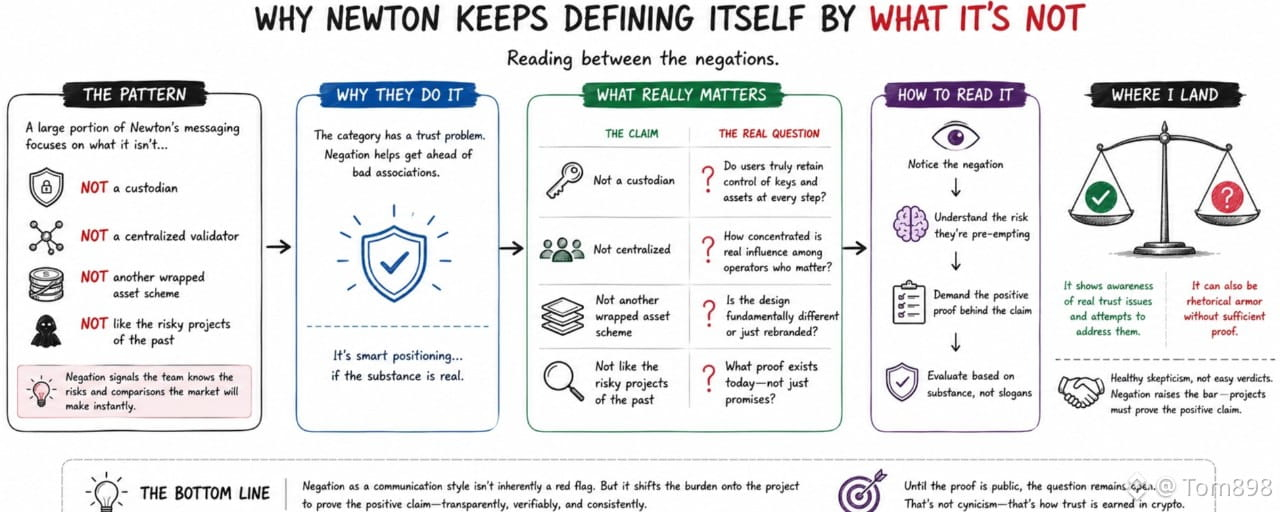
Newton Keeps Defining Itself by What It'sThis pattern isn't unique to Newton, plenty of projects do it, but seeing it this concentrated made me pause longer than usual. When a team keeps saying what something is not, it's usually because the category it sits in has a trust problem... and they're trying to pull the reader's mind away from bad associations before those associations even form. Sometimes that's just smart positioning in a space full of scams and rug pulls, not automatically dishonest. But it's worth asking, every time, whether the negation is doing real work or just doing PR work...👀
The custodian language is a good place to start. Saying "we are not a custodian" is a meaningful technical claim... if it's backed by actual non-custodial architeclaim, where users genuinely retain control of keys and assets at every step. But if the underlying system still routes trust through a small operator set that behaves functionally like a custodian, even without the legal label, then the negation becomes a semantic shield rather than a real distinction. I keep coming back to this because "not technically a custodian" and "not functionally acting like one" are two very different claims, and crypto has a long history of blurring them 🤔
Centralization gets the same treatment. (NEWT) frames itself as not centralized, and structurally there's a case for that, with several operators and distributed verification steps meant to avoid a single point of failure on paper. But centralization isn't binary, it's a spectrum, and the honest question isn't whether it's centralized or not. It's how concentrated the actual influence is among the operators who matter. A system can technically have twenty operators and still behave like it has three, if those three control the majority of stake or throughput. I haven't seen public numbers detailed enough to answer that for Newton with real confidence, and that gap bothers me more than the marketing language itself.
What I find genuinely interesting, though, is that this defining by negation pattern sometimes signals something useful. It tells you exactly which criticisms the team is anticipating. If Newton keeps saying "not another wrapped asset scheme," that tells me they know that's the comparison people will reach for instantly, and they're trying to get ahead of it. Reading a project's negations closely feels almost like reading their internal risk assessment out loud, since they're indirectly telling you what they're most afraid of being compared to.
Newton Keeps Defining Itself by What It's
This pattern isn't unique to Newton, plenty of projects do it, but seeing it this concentrated made me pause longer than usual. When a team keeps saying what something is not, it's usually because the category it sits in has a trust problem... and they're trying to pull the reader's mind away from bad associations before those associations even form. Sometimes that's just smart positioning in a space full of scams and rug pulls, not automatically dishonest. But it's worth asking, every time, whether the negation is doing real work or just doing PR work...👀
The custodian language is a good place to start. Saying "we are not a custodian" is a meaningful technical claim... if it's backed by actual non-custodial architeclaim, where users genuinely retain control of keys and assets at every step. But if the underlying system still routes trust through a small operator set that behaves functionally like a custodian, even without the legal label, then the negation becomes a semantic shield rather than a real distinction. I keep coming back to this because "not technically a custodian" and "not functionally acting like one" are two very different claims, and crypto has a long history of blurring them 🤔
Centralization gets the same treatment. (NEWT) frames itself as not centralized, and structurally there's a case for that, with several operators and distributed verification steps meant to avoid a single point of failure on paper. But centralization isn't binary, it's a spectrum, and the honest question isn't whether it's centralized or not. It's how concentrated the actual influence is among the operators who matter. A system can technically have twenty operators and still behave like it has three, if those three control the majority of stake or throughput. I haven't seen public numbers detailed enough to answer that for Newton with real confidence, and that gap bothers me more than the marketing language itself.
What I find genuinely interesting, though, is that this defining by negation pattern sometimes signals something useful. It tells you exactly which criticisms the team is anticipating. If Newton keeps saying "not another wrapped asset scheme," that tells me they know that's the comparison people will reach for instantly, and they're trying to get ahead of it. Reading a project's negations closely feels almost like reading their internal risk assessment out loud, since they're indirectly telling you what they're most afraid of being compared to.
The custodian language is a good place to start. Saying "we are not a custodian" is a meaningful technical claim... if it's backed by actual non-custodial architeclaim, where users genuinely retain control of keys and assets at every step. But if the underlying system still routes trust through a small operator set that behaves functionally like a custodian, even without the legal label, then the negation becomes a semantic shield rather than a real distinction. I keep coming back to this because "not technically a custodian" and "not functionally acting like one" are two very different claims, and crypto has a long history of blurring them 🤔
Centralization gets the same treatment. (NEWT) frames itself as not centralized, and structurally there's a case for that, with several operators and distributed verification steps meant to avoid a single point of failure on paper. But centralization isn't binary, it's a spectrum, and the honest question isn't whether it's centralized or not. It's how concentrated the actual influence is among the operators who matter. A system can technically have twenty operators and still behave like it has three, if those three control the majority of stake or throughput. I haven't seen public numbers detailed enough to answer that for Newton with real confidence, and that gap bothers me more than the marketing language itself.
What I find genuinely interesting, though, is that this defining by negation pattern sometimes signals something useful. It tells you exactly which criticisms the team is anticipating. If Newton keeps saying "not another wrapped asset scheme," that tells me they know that's the comparison people will reach for instantly, and they're trying to get ahead of it. Reading a project's negations closely feels almost like reading their internal risk assessment out loud, since they're indirectly telling you what they're most afraid of being compared to.
1
59
·
--
#newt $NEWT Let’s be real for a moment, especially with those who don’t have much to invest:💸💸💸
If you only have $100 to enter the crypto world, don’t waste it spreading it among 10 different currencies hoping that one suddenly takes off. That’s not strategy, it’s just chasing luck.
#newt $NEWT Let’s be real for a moment, especially with those who don’t have much to invest:💸💸💸
If you only have $100 to enter the crypto world, don’t waste it spreading it among 10 different currencies hoping that one suddenly takes off. That’s not strategy, it’s just chasing luck.
If you only have $100 to enter the crypto world, don’t waste it spreading it among 10 different currencies hoping that one suddenly takes off. That’s not strategy, it’s just chasing luck.
80
·
--
hello Friends
that's not something you'll run into with @grvt_io family.
It is built as a hybrid exchange running on zkSync, Ethereum's L2. trades get matched off chain for speed, but every settlement lands on chain where you can actually verify it yourself. no black box, no "trust me" moment when the market gets wild. #grvt
hello Friends
that's not something you'll run into with @grvt_io family.
It is built as a hybrid exchange running on zkSync, Ethereum's L2. trades get matched off chain for speed, but every settlement lands on chain where you can actually verify it yourself. no black box, no "trust me" moment when the market gets wild. #grvt
that's not something you'll run into with @grvt_io family.
It is built as a hybrid exchange running on zkSync, Ethereum's L2. trades get matched off chain for speed, but every settlement lands on chain where you can actually verify it yourself. no black box, no "trust me" moment when the market gets wild. #grvt
88
·
--
Article
Newton ProtocolA lot of crypto projects end up sounding the same. New narrative, bold promises, and plenty of attention before anyone knows how they'll perform when people actually start using them.
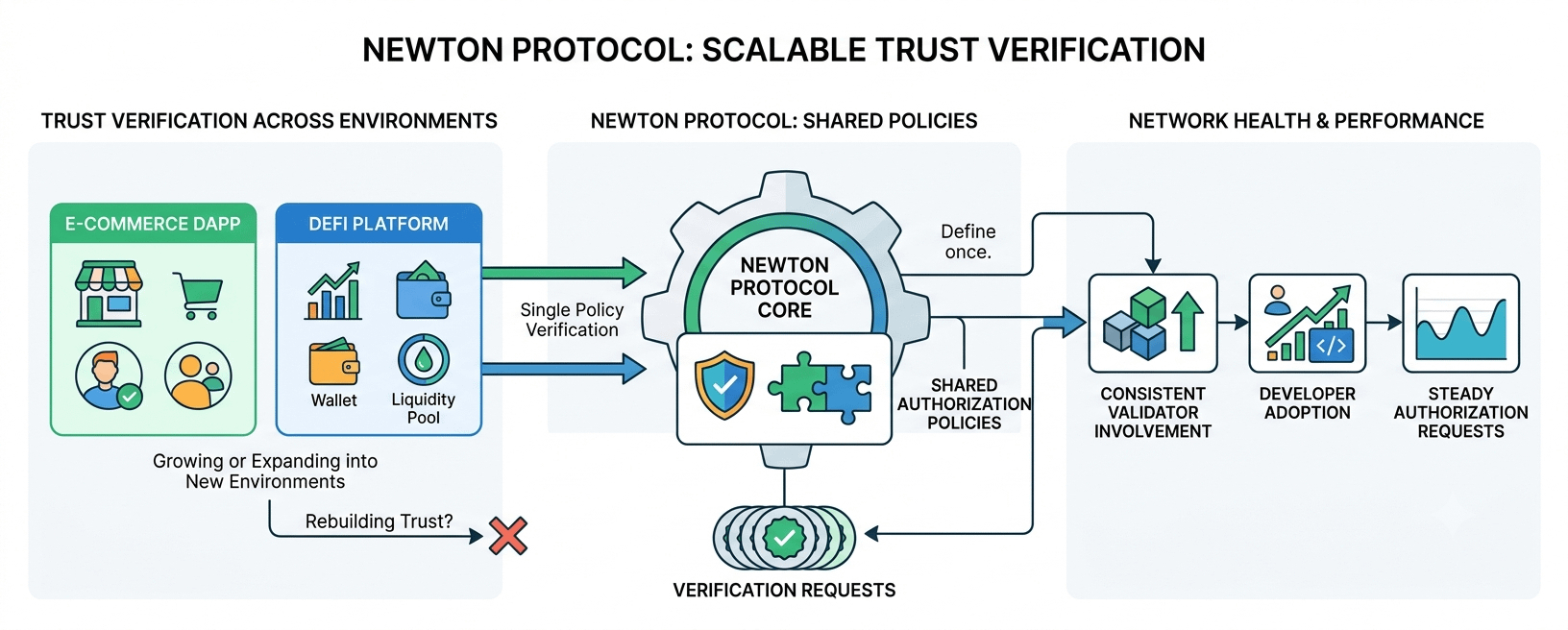
What stood out to me about Newton Protocol is that it's focused on a problem that doesn't get talked about enough. Trust isn't something you should have to rebuild every time an application grows or expands into a new environment. If authorization can be verified through shared policies, that removes a lot of unnecessary complexity.
For me, the real test isn't the technology itself. It's whether developers keep using it, validators have a reason to stay involved, and authorization requests become a steady part of the network instead of a temporary spike in activity.
That's why Newton Protocol is on my radar. If it can turn verification into something dependable rather than just another feature, I think it's worth paying attention to.
@NewtonProtocol #Newt $NEWT
Newton Protocol
A lot of crypto projects end up sounding the same. New narrative, bold promises, and plenty of attention before anyone knows how they'll perform when people actually start using them.
What stood out to me about Newton Protocol is that it's focused on a problem that doesn't get talked about enough. Trust isn't something you should have to rebuild every time an application grows or expands into a new environment. If authorization can be verified through shared policies, that removes a lot of unnecessary complexity.
For me, the real test isn't the technology itself. It's whether developers keep using it, validators have a reason to stay involved, and authorization requests become a steady part of the network instead of a temporary spike in activity.
That's why Newton Protocol is on my radar. If it can turn verification into something dependable rather than just another feature, I think it's worth paying attention to.
@NewtonProtocol #Newt $NEWT
What stood out to me about Newton Protocol is that it's focused on a problem that doesn't get talked about enough. Trust isn't something you should have to rebuild every time an application grows or expands into a new environment. If authorization can be verified through shared policies, that removes a lot of unnecessary complexity.
For me, the real test isn't the technology itself. It's whether developers keep using it, validators have a reason to stay involved, and authorization requests become a steady part of the network instead of a temporary spike in activity.
That's why Newton Protocol is on my radar. If it can turn verification into something dependable rather than just another feature, I think it's worth paying attention to.
@NewtonProtocol #Newt $NEWT
48
Log in to explore more content
Join global crypto users on Binance Square
⚡️ Get latest and useful information about crypto.
💬 Trusted by the world’s largest crypto exchange.
👍 Discover real insights from verified creators.
Email / Phone number
Trending Topics
ChinaMayLetAlibabaByteDanceBuyNvidiaChips
323 views
41 Discussing
#ChinaMayLetAlibabaByteDanceBuyNvidiaChips
Discussion
Reports say China may allow companies including Alibaba and ByteDance to purchase Nvidia’s newly released RTX PRO 5500 chips. China’s Ministry of Industry and Information Technology reportedly asked companies about planned quantities and intended uses, although the report has not been independently verified.
This is notable because:
For Nvidia: Approval could create additional China sales and maintain Nvidia’s presence in the Chinese AI ecosystem.
For Alibaba & ByteDance: More Nvidia computing capacity could support AI model development and inference amid strong demand for computing power.
For China’s chip strategy: The RTX PRO 5500 is not Nvidia’s top data-center AI accelerator, while Chinese firms are also developing domestic alternatives such as Alibaba’s own AI chips.
For markets: Confirmation of meaningful purchases could affect sentiment around Nvidia and the broader semiconductor sector, but the scale and timing of any approvals remain uncertain.
The key point is that this is a reported potential approval, not a confirmed purchase agreement. Reuters said it could not independently verify the report.
PALASH5
·0 Likes
·247 views
USChinaRelease$30BTariffCutProductLists
1 views
2 Discussing
SKoreaFSCConsidersVirtualAssetMarketMaker
1,251 views
77 Discussing