

KK_战神
82 Posts

KK_战神
Report
Block User
回测没输过,实盘没赢过。专战涨跌幅榜单,誓和狗🐶庄对着干!
18 Following
47 Followers
32 Liked
Posts
·
--
The market’s clear as day right now: money is chasing the top gainers, while on the losing side, traders are stampeding for the exits. Buyers are propping up the risers; sellers are running for their lives on the way down. Sentiment isn’t exactly cold, but the market is sharply divided.
$BSP is up nearly 24%, with its price near the top of its 24-hour range, above the 90% mark. But its volume over the past hour is only 0.75 times the full-day average, and the price has moved just over 1% in that hour. That looks like a breather after the surge, with the buying momentum starting to fade.
$W is a different story: it’s up 14.65% over the past four hours, and its hourly volume has surged to 5.28 times the full-day average. The price is also sitting around the 90% mark of its range. Real money is pushing it higher, and volume is confirming the move—it’s not just rising on fumes.
$Lobster is the scariest of the lot. Its 24-hour range is 104%, and its trading volume is still the highest of the three at 301M. Hourly volume is 1.32 times the average, while the price is down at just 9% of its range. This is a high-volume sell-off, a panic exit—not a slow bleed because there are no buyers, but people scrambling to get out. A few hours ago it was down 30%; now it’s heading toward 40% down.
With a setup like this, I’d rather sit back and watch for now: on one side, see whether selling volume eases and the price stops hugging the floor; on the other, see whether these two gainers keep attracting volume or quietly lose it. There’s no shame in watching from the sidelines until the signals show themselves.
#行情分析 #涨幅榜 #TopLosers
If I could really predict the market, I wouldn’t be here writing this. Nothing above constitutes investment advice.
The market’s clear as day right now: money is chasing the top gainers, while on the losing side, traders are stampeding for the exits. Buyers are propping up the risers; sellers are running for their lives on the way down. Sentiment isn’t exactly cold, but the market is sharply divided.
$BSP is up nearly 24%, with its price near the top of its 24-hour range, above the 90% mark. But its volume over the past hour is only 0.75 times the full-day average, and the price has moved just over 1% in that hour. That looks like a breather after the surge, with the buying momentum starting to fade.
$W is a different story: it’s up 14.65% over the past four hours, and its hourly volume has surged to 5.28 times the full-day average. The price is also sitting around the 90% mark of its range. Real money is pushing it higher, and volume is confirming the move—it’s not just rising on fumes.
$Lobster is the scariest of the lot. Its 24-hour range is 104%, and its trading volume is still the highest of the three at 301M. Hourly volume is 1.32 times the average, while the price is down at just 9% of its range. This is a high-volume sell-off, a panic exit—not a slow bleed because there are no buyers, but people scrambling to get out. A few hours ago it was down 30%; now it’s heading toward 40% down.
With a setup like this, I’d rather sit back and watch for now: on one side, see whether selling volume eases and the price stops hugging the floor; on the other, see whether these two gainers keep attracting volume or quietly lose it. There’s no shame in watching from the sidelines until the signals show themselves.
#行情分析 #涨幅榜 #TopLosers
If I could really predict the market, I wouldn’t be here writing this. Nothing above constitutes investment advice.
$BSP is up nearly 24%, with its price near the top of its 24-hour range, above the 90% mark. But its volume over the past hour is only 0.75 times the full-day average, and the price has moved just over 1% in that hour. That looks like a breather after the surge, with the buying momentum starting to fade.
$W is a different story: it’s up 14.65% over the past four hours, and its hourly volume has surged to 5.28 times the full-day average. The price is also sitting around the 90% mark of its range. Real money is pushing it higher, and volume is confirming the move—it’s not just rising on fumes.
$Lobster is the scariest of the lot. Its 24-hour range is 104%, and its trading volume is still the highest of the three at 301M. Hourly volume is 1.32 times the average, while the price is down at just 9% of its range. This is a high-volume sell-off, a panic exit—not a slow bleed because there are no buyers, but people scrambling to get out. A few hours ago it was down 30%; now it’s heading toward 40% down.
With a setup like this, I’d rather sit back and watch for now: on one side, see whether selling volume eases and the price stops hugging the floor; on the other, see whether these two gainers keep attracting volume or quietly lose it. There’s no shame in watching from the sidelines until the signals show themselves.
#行情分析 #涨幅榜 #TopLosers
If I could really predict the market, I wouldn’t be here writing this. Nothing above constitutes investment advice.
159
·
--
$HYPE There was a significant move worth talking about this morning. A few hours ago, Multicoin transferred another 67,500 tokens to Coinbase Prime. On its own, this transaction may not seem like much, but the longer-term picture is more interesting: over the past four weeks, they’ve transferred a total of more than 760,000 tokens to Coinbase Prime, worth $62.99 million.
My take: this wasn’t a random transfer. Moving funds to the same channel consistently and deliberately over four weeks is clearly a planned move, shifting holdings toward custody and trading. Coinbase Prime serves institutional clients. Large token transfers there could be related to custody adjustments, over-the-counter trading, or preparations to sell. On-chain data alone can’t tell us which one. But the scale speaks for itself: $62.99 million over four weeks. A move of this size is a signal in itself—not just a ripple caused by retail traders.
Put plainly: early large-scale investors have already started moving $HYPE ’s holdings. The activity is real, but we’ll have to wait and see what it means. Rather than making up stories, keep a close eye on this address’s next moves. On-chain data doesn’t lie; what those transfers are for will eventually become clear.
#行业动态 #Cryptocurrency
The above is a summary of news, not investment advice. Any actions you take based on it are at your own risk.
$HYPE There was a significant move worth talking about this morning. A few hours ago, Multicoin transferred another 67,500 tokens to Coinbase Prime. On its own, this transaction may not seem like much, but the longer-term picture is more interesting: over the past four weeks, they’ve transferred a total of more than 760,000 tokens to Coinbase Prime, worth $62.99 million.
My take: this wasn’t a random transfer. Moving funds to the same channel consistently and deliberately over four weeks is clearly a planned move, shifting holdings toward custody and trading. Coinbase Prime serves institutional clients. Large token transfers there could be related to custody adjustments, over-the-counter trading, or preparations to sell. On-chain data alone can’t tell us which one. But the scale speaks for itself: $62.99 million over four weeks. A move of this size is a signal in itself—not just a ripple caused by retail traders.
Put plainly: early large-scale investors have already started moving $HYPE ’s holdings. The activity is real, but we’ll have to wait and see what it means. Rather than making up stories, keep a close eye on this address’s next moves. On-chain data doesn’t lie; what those transfers are for will eventually become clear.
#行业动态 #Cryptocurrency
The above is a summary of news, not investment advice. Any actions you take based on it are at your own risk.
My take: this wasn’t a random transfer. Moving funds to the same channel consistently and deliberately over four weeks is clearly a planned move, shifting holdings toward custody and trading. Coinbase Prime serves institutional clients. Large token transfers there could be related to custody adjustments, over-the-counter trading, or preparations to sell. On-chain data alone can’t tell us which one. But the scale speaks for itself: $62.99 million over four weeks. A move of this size is a signal in itself—not just a ripple caused by retail traders.
Put plainly: early large-scale investors have already started moving $HYPE ’s holdings. The activity is real, but we’ll have to wait and see what it means. Rather than making up stories, keep a close eye on this address’s next moves. On-chain data doesn’t lie; what those transfers are for will eventually become clear.
#行业动态 #Cryptocurrency
The above is a summary of news, not investment advice. Any actions you take based on it are at your own risk.
112
·
--
In one sentence, here’s the market picture: activity is tightly concentrated, with all the money piled into one asset while everything else drifts lower on shrinking volume. It’s not panic, but buyers are clearly reluctant to step in.
$MET is the only place where volume is concentrated across the board, with $256.3M in turnover and a 56.71% range. Trading over the past hour is still 1.88 times the average, and the current price is at 83% of its 24-hour range. This rally is backed by real money, not a low-volume drift higher. The contradiction is that the price actually fell 2.91% over the past hour despite the surge in volume. Whether that’s a handoff to new buyers or someone using the volume to exit isn’t clear from the data, so I won’t jump to a conclusion.
$CAP is the exact opposite: down 17.43%, but volume is only 0.46 times its 24-hour average. The current price is at 33% of its range and still grinding lower. This isn’t panic selling—panic comes with a spike in volume. This is a classic slow bleed with nobody stepping in to buy.
$AIN is even more extreme, down 17.40% and hovering near the bottom of its range at 12%. Volume is just 0.19 times the average, and even its 0.63% rebound over the past hour came on no volume. Basically, nobody’s watching. This kind of quiet slide can be even more grueling.
With the market structured like this, I’d rather wait and watch. I’m looking for two signals: first, whether the leader can hold steady after heavy volume at the highs—volume with a stable price is what would confirm real strength; second, when trading volume in the two biggest decliners starts picking up again. A low-volume slide doesn’t end by continuing to fall; it ends when volume returns. Until it does, just watch.
#行情分析 #涨幅榜 #Top Losers
This statement itself is not investment advice, and neither is anything above.
In one sentence, here’s the market picture: activity is tightly concentrated, with all the money piled into one asset while everything else drifts lower on shrinking volume. It’s not panic, but buyers are clearly reluctant to step in.
$MET is the only place where volume is concentrated across the board, with $256.3M in turnover and a 56.71% range. Trading over the past hour is still 1.88 times the average, and the current price is at 83% of its 24-hour range. This rally is backed by real money, not a low-volume drift higher. The contradiction is that the price actually fell 2.91% over the past hour despite the surge in volume. Whether that’s a handoff to new buyers or someone using the volume to exit isn’t clear from the data, so I won’t jump to a conclusion.
$CAP is the exact opposite: down 17.43%, but volume is only 0.46 times its 24-hour average. The current price is at 33% of its range and still grinding lower. This isn’t panic selling—panic comes with a spike in volume. This is a classic slow bleed with nobody stepping in to buy.
$AIN is even more extreme, down 17.40% and hovering near the bottom of its range at 12%. Volume is just 0.19 times the average, and even its 0.63% rebound over the past hour came on no volume. Basically, nobody’s watching. This kind of quiet slide can be even more grueling.
With the market structured like this, I’d rather wait and watch. I’m looking for two signals: first, whether the leader can hold steady after heavy volume at the highs—volume with a stable price is what would confirm real strength; second, when trading volume in the two biggest decliners starts picking up again. A low-volume slide doesn’t end by continuing to fall; it ends when volume returns. Until it does, just watch.
#行情分析 #涨幅榜 #Top Losers
This statement itself is not investment advice, and neither is anything above.
$MET is the only place where volume is concentrated across the board, with $256.3M in turnover and a 56.71% range. Trading over the past hour is still 1.88 times the average, and the current price is at 83% of its 24-hour range. This rally is backed by real money, not a low-volume drift higher. The contradiction is that the price actually fell 2.91% over the past hour despite the surge in volume. Whether that’s a handoff to new buyers or someone using the volume to exit isn’t clear from the data, so I won’t jump to a conclusion.
$CAP is the exact opposite: down 17.43%, but volume is only 0.46 times its 24-hour average. The current price is at 33% of its range and still grinding lower. This isn’t panic selling—panic comes with a spike in volume. This is a classic slow bleed with nobody stepping in to buy.
$AIN is even more extreme, down 17.40% and hovering near the bottom of its range at 12%. Volume is just 0.19 times the average, and even its 0.63% rebound over the past hour came on no volume. Basically, nobody’s watching. This kind of quiet slide can be even more grueling.
With the market structured like this, I’d rather wait and watch. I’m looking for two signals: first, whether the leader can hold steady after heavy volume at the highs—volume with a stable price is what would confirm real strength; second, when trading volume in the two biggest decliners starts picking up again. A low-volume slide doesn’t end by continuing to fall; it ends when volume returns. Until it does, just watch.
#行情分析 #涨幅榜 #Top Losers
This statement itself is not investment advice, and neither is anything above.
739
·
--
There’s a new development in U.S. crypto legislation. Earlier today, French Hill, chair of the House Financial Services Committee, said that although the SEC and CFTC are both advancing crypto regulatory measures, they still fall short of the long-term stability that congressional legislation can provide. The Senate failed to pass the Digital Asset Market Clarity Act (CLARITY) last month. The two agencies have since produced rulemaking plans, but Hill’s position is clear: that’s not enough. Permanent changes to the law are necessary, or the U.S. won’t be able to hold on to its leading position in digital assets and blockchain.
The window he has in mind is the lame-duck session after the midterm elections. He wants Congress to use that period to pass CLARITY. But two major uncertainties loom: between the November elections and the start of the new Congress in 2027, the Senate has only 22 session days; and Hill himself acknowledged that the election results could directly change lawmakers’ voting positions.
Here’s my take: this isn’t news of something that can happen right away; it’s a signal about timing. The two sticking points are those 22 session days and the election results, and both are highly uncertain. Regulatory uncertainty will remain until the bill actually passes. Just keep an eye on what happens during the lame-duck session—statements and action are two different things.
#行业动态 #加密货币 #Regulation
There’s no need to act immediately after reading this; the news will still be there tomorrow. The above does not constitute investment advice.
There’s a new development in U.S. crypto legislation. Earlier today, French Hill, chair of the House Financial Services Committee, said that although the SEC and CFTC are both advancing crypto regulatory measures, they still fall short of the long-term stability that congressional legislation can provide. The Senate failed to pass the Digital Asset Market Clarity Act (CLARITY) last month. The two agencies have since produced rulemaking plans, but Hill’s position is clear: that’s not enough. Permanent changes to the law are necessary, or the U.S. won’t be able to hold on to its leading position in digital assets and blockchain.
The window he has in mind is the lame-duck session after the midterm elections. He wants Congress to use that period to pass CLARITY. But two major uncertainties loom: between the November elections and the start of the new Congress in 2027, the Senate has only 22 session days; and Hill himself acknowledged that the election results could directly change lawmakers’ voting positions.
Here’s my take: this isn’t news of something that can happen right away; it’s a signal about timing. The two sticking points are those 22 session days and the election results, and both are highly uncertain. Regulatory uncertainty will remain until the bill actually passes. Just keep an eye on what happens during the lame-duck session—statements and action are two different things.
#行业动态 #加密货币 #Regulation
There’s no need to act immediately after reading this; the news will still be there tomorrow. The above does not constitute investment advice.
The window he has in mind is the lame-duck session after the midterm elections. He wants Congress to use that period to pass CLARITY. But two major uncertainties loom: between the November elections and the start of the new Congress in 2027, the Senate has only 22 session days; and Hill himself acknowledged that the election results could directly change lawmakers’ voting positions.
Here’s my take: this isn’t news of something that can happen right away; it’s a signal about timing. The two sticking points are those 22 session days and the election results, and both are highly uncertain. Regulatory uncertainty will remain until the bill actually passes. Just keep an eye on what happens during the lame-duck session—statements and action are two different things.
#行业动态 #加密货币 #Regulation
There’s no need to act immediately after reading this; the news will still be there tomorrow. The above does not constitute investment advice.
4
·
--
At 5 a.m., this setup really stands out: there’s only one stock on the gainers list, with just over 10 million in trading volume for the whole day; the two on the losers list have combined volume of over 200 million. It’s immediately clear where the volume is: sentiment is weak, the gainer’s just a small-money burst, while the losers are where the real selling volume is coming from.
$BSP rose 22%, with real volume behind the move. Its trading volume in the past hour was more than three times its daily average, and half of its gains came in the past four hours. But there’s a contradiction worth noting: while volume surged, the price actually edged down 0.6% in the past hour. Heavy volume near the highs without a price rise deserves a question mark. Besides, it traded only a little over 10 million for the whole day, so liquidity is thin to begin with; that puts the move in perspective.
$GRIFFAIN fell nearly 32%, with a swing of over 80%. That suggests the panic-driven selling is already over, and it’s now hovering near the bottom of its range. Its trading volume in the past hour was just 0.19 times its average—a classic slow bleed with no buyers stepping in. It’s not that panic is happening now; it’s that nobody is willing to buy at all.
$MINA took the hardest hit, and it also had the highest trading volume of the three. Its price is near the bottom 10% of its daily range, and its loss has narrowed slightly compared with a few hours ago. It rebounded by a little over 2% on higher volume in the past hour, so there is some money testing the waters at these low levels. But it’s still down over the past four hours. That’s not enough to call a bottom—just some signs of buying support amid the decline.
With small caps making brief surges while larger ones bleed, I’d rather wait and watch for now, looking for two things: first, whether volume on the losers list really dries up; and second, whether buying support emerges near the lows on sustained, higher volume. Until we see either, there’s no rush to act. Better to wait and see.
#行情分析 #涨幅榜 #Losers List
These are fish-farming notes, not investment advice. The pond’s depth is yours to test for yourself.
At 5 a.m., this setup really stands out: there’s only one stock on the gainers list, with just over 10 million in trading volume for the whole day; the two on the losers list have combined volume of over 200 million. It’s immediately clear where the volume is: sentiment is weak, the gainer’s just a small-money burst, while the losers are where the real selling volume is coming from.
$BSP rose 22%, with real volume behind the move. Its trading volume in the past hour was more than three times its daily average, and half of its gains came in the past four hours. But there’s a contradiction worth noting: while volume surged, the price actually edged down 0.6% in the past hour. Heavy volume near the highs without a price rise deserves a question mark. Besides, it traded only a little over 10 million for the whole day, so liquidity is thin to begin with; that puts the move in perspective.
$GRIFFAIN fell nearly 32%, with a swing of over 80%. That suggests the panic-driven selling is already over, and it’s now hovering near the bottom of its range. Its trading volume in the past hour was just 0.19 times its average—a classic slow bleed with no buyers stepping in. It’s not that panic is happening now; it’s that nobody is willing to buy at all.
$MINA took the hardest hit, and it also had the highest trading volume of the three. Its price is near the bottom 10% of its daily range, and its loss has narrowed slightly compared with a few hours ago. It rebounded by a little over 2% on higher volume in the past hour, so there is some money testing the waters at these low levels. But it’s still down over the past four hours. That’s not enough to call a bottom—just some signs of buying support amid the decline.
With small caps making brief surges while larger ones bleed, I’d rather wait and watch for now, looking for two things: first, whether volume on the losers list really dries up; and second, whether buying support emerges near the lows on sustained, higher volume. Until we see either, there’s no rush to act. Better to wait and see.
#行情分析 #涨幅榜 #Losers List
These are fish-farming notes, not investment advice. The pond’s depth is yours to test for yourself.
$BSP rose 22%, with real volume behind the move. Its trading volume in the past hour was more than three times its daily average, and half of its gains came in the past four hours. But there’s a contradiction worth noting: while volume surged, the price actually edged down 0.6% in the past hour. Heavy volume near the highs without a price rise deserves a question mark. Besides, it traded only a little over 10 million for the whole day, so liquidity is thin to begin with; that puts the move in perspective.
$GRIFFAIN fell nearly 32%, with a swing of over 80%. That suggests the panic-driven selling is already over, and it’s now hovering near the bottom of its range. Its trading volume in the past hour was just 0.19 times its average—a classic slow bleed with no buyers stepping in. It’s not that panic is happening now; it’s that nobody is willing to buy at all.
$MINA took the hardest hit, and it also had the highest trading volume of the three. Its price is near the bottom 10% of its daily range, and its loss has narrowed slightly compared with a few hours ago. It rebounded by a little over 2% on higher volume in the past hour, so there is some money testing the waters at these low levels. But it’s still down over the past four hours. That’s not enough to call a bottom—just some signs of buying support amid the decline.
With small caps making brief surges while larger ones bleed, I’d rather wait and watch for now, looking for two things: first, whether volume on the losers list really dries up; and second, whether buying support emerges near the lows on sustained, higher volume. Until we see either, there’s no rush to act. Better to wait and see.
#行情分析 #涨幅榜 #Losers List
These are fish-farming notes, not investment advice. The pond’s depth is yours to test for yourself.
580
·
--
Earlier today, Eric Trump, the second son of Donald Trump, said at Token2049 in Singapore that massive investment in AI would ultimately become the fastest-growing driver of digital assets, with capital rotating back and forth between AI and crypto. His reasoning is that AI agents will eventually do things for people, such as booking a vacation, and payments will be settled through crypto wallets rather than fiat currency. The faster AI becomes part of everyday life, the faster the crypto industry will grow.
He also pointed to market movements as an example: Bitcoin climbing back above $80,000 is a sign that capital is flowing back from AI to crypto. He also raised two other points: the growth of dollar stablecoins could increase demand for U.S. Treasuries; and asset tokenization has public benefits, as putting high-end real estate, art, and music royalties on-chain could open them up to broader participation.
Here’s my take. $BTC climbing back above $80,000 is a concrete price datapoint, but the claim that “AI is the fastest driver of crypto” is fundamentally a narrative, not on-chain data. The speaker has a particularly notable identity—the son of the U.S. president—and remarks like this at a conference are mostly about drumming up enthusiasm for the industry. To know whether capital is actually rotating, look at the flows; don’t just take someone’s word for it. The idea that stablecoins could bolster demand for U.S. Treasuries is worth watching, though. Dollar stablecoins have grown large enough to affect Treasury demand—that’s a real channel for moving capital.
#行业动态 #Cryptocurrency
If I could make money from a single news story, I wouldn’t be writing this here. Nothing above constitutes investment advice.
Earlier today, Eric Trump, the second son of Donald Trump, said at Token2049 in Singapore that massive investment in AI would ultimately become the fastest-growing driver of digital assets, with capital rotating back and forth between AI and crypto. His reasoning is that AI agents will eventually do things for people, such as booking a vacation, and payments will be settled through crypto wallets rather than fiat currency. The faster AI becomes part of everyday life, the faster the crypto industry will grow.
He also pointed to market movements as an example: Bitcoin climbing back above $80,000 is a sign that capital is flowing back from AI to crypto. He also raised two other points: the growth of dollar stablecoins could increase demand for U.S. Treasuries; and asset tokenization has public benefits, as putting high-end real estate, art, and music royalties on-chain could open them up to broader participation.
Here’s my take. $BTC climbing back above $80,000 is a concrete price datapoint, but the claim that “AI is the fastest driver of crypto” is fundamentally a narrative, not on-chain data. The speaker has a particularly notable identity—the son of the U.S. president—and remarks like this at a conference are mostly about drumming up enthusiasm for the industry. To know whether capital is actually rotating, look at the flows; don’t just take someone’s word for it. The idea that stablecoins could bolster demand for U.S. Treasuries is worth watching, though. Dollar stablecoins have grown large enough to affect Treasury demand—that’s a real channel for moving capital.
#行业动态 #Cryptocurrency
If I could make money from a single news story, I wouldn’t be writing this here. Nothing above constitutes investment advice.
He also pointed to market movements as an example: Bitcoin climbing back above $80,000 is a sign that capital is flowing back from AI to crypto. He also raised two other points: the growth of dollar stablecoins could increase demand for U.S. Treasuries; and asset tokenization has public benefits, as putting high-end real estate, art, and music royalties on-chain could open them up to broader participation.
Here’s my take. $BTC climbing back above $80,000 is a concrete price datapoint, but the claim that “AI is the fastest driver of crypto” is fundamentally a narrative, not on-chain data. The speaker has a particularly notable identity—the son of the U.S. president—and remarks like this at a conference are mostly about drumming up enthusiasm for the industry. To know whether capital is actually rotating, look at the flows; don’t just take someone’s word for it. The idea that stablecoins could bolster demand for U.S. Treasuries is worth watching, though. Dollar stablecoins have grown large enough to affect Treasury demand—that’s a real channel for moving capital.
#行业动态 #Cryptocurrency
If I could make money from a single news story, I wouldn’t be writing this here. Nothing above constitutes investment advice.
1
·
--
At 1 a.m., the market still looks much the same: each coin is doing its own thing—one is surging on heavy volume, another is flat on the floor. Sentiment isn’t exactly good or bad; hot money is just circling around a handful of tokens while the rest are being ignored.
$SAND is seeing real buying volume this time. Its 24-hour trading volume is 416.1M, its price range is 35.5%, and it’s up 16% over the past 4 hours. Volume in the past hour is 5.94 times the 24-hour average. That kind of volume doesn’t come from retail traders piling in for fun—it’s real money changing hands. But the current price has already climbed back to 73% of its 24-hour range, and it’s down 2.77% over the past hour. Heavy trading near the highs, with the price swinging back and forth, suggests some are starting to sell while others are buying. The disagreement is growing.
$MINA is the exact opposite. It’s down 24% over 24 hours and is sitting near the bottom of its range, at the 8% mark. But it’s only down 0.13% over the past hour, and volume is just 1.2 times the average. That suggests the wave of panic selling ended a while ago. Now it’s just lying on the floor after the sell-off: nobody’s buying, nobody’s dumping, and trades are trickling in. It doesn’t even have the strength to bounce. Completely flat.
Looking at the past few hours, the top gainers and top losers keep swapping places, and individual coins are routinely swinging 30% or more. That shows the market has no real consensus; all the money is betting on individual tokens. In this kind of market, I’m not in a rush to draw conclusions. I’ll wait for two signals: first, whether the coins surging on heavy volume can sustain that volume—if it dries up, it was a one-off; second, whether the coins on the floor suddenly see a surge in volume and buyers start stepping in. Only then can we say they’ve truly found a bottom. Whichever signal comes first is the one to watch. Until then, observe and keep your hands off.
#行情分析 #涨幅榜 #TopLosers
These are just notes from the fishpond, not investment advice. How deep the water is—you’ll have to dive in and find out for yourself.
At 1 a.m., the market still looks much the same: each coin is doing its own thing—one is surging on heavy volume, another is flat on the floor. Sentiment isn’t exactly good or bad; hot money is just circling around a handful of tokens while the rest are being ignored.
$SAND is seeing real buying volume this time. Its 24-hour trading volume is 416.1M, its price range is 35.5%, and it’s up 16% over the past 4 hours. Volume in the past hour is 5.94 times the 24-hour average. That kind of volume doesn’t come from retail traders piling in for fun—it’s real money changing hands. But the current price has already climbed back to 73% of its 24-hour range, and it’s down 2.77% over the past hour. Heavy trading near the highs, with the price swinging back and forth, suggests some are starting to sell while others are buying. The disagreement is growing.
$MINA is the exact opposite. It’s down 24% over 24 hours and is sitting near the bottom of its range, at the 8% mark. But it’s only down 0.13% over the past hour, and volume is just 1.2 times the average. That suggests the wave of panic selling ended a while ago. Now it’s just lying on the floor after the sell-off: nobody’s buying, nobody’s dumping, and trades are trickling in. It doesn’t even have the strength to bounce. Completely flat.
Looking at the past few hours, the top gainers and top losers keep swapping places, and individual coins are routinely swinging 30% or more. That shows the market has no real consensus; all the money is betting on individual tokens. In this kind of market, I’m not in a rush to draw conclusions. I’ll wait for two signals: first, whether the coins surging on heavy volume can sustain that volume—if it dries up, it was a one-off; second, whether the coins on the floor suddenly see a surge in volume and buyers start stepping in. Only then can we say they’ve truly found a bottom. Whichever signal comes first is the one to watch. Until then, observe and keep your hands off.
#行情分析 #涨幅榜 #TopLosers
These are just notes from the fishpond, not investment advice. How deep the water is—you’ll have to dive in and find out for yourself.
$SAND is seeing real buying volume this time. Its 24-hour trading volume is 416.1M, its price range is 35.5%, and it’s up 16% over the past 4 hours. Volume in the past hour is 5.94 times the 24-hour average. That kind of volume doesn’t come from retail traders piling in for fun—it’s real money changing hands. But the current price has already climbed back to 73% of its 24-hour range, and it’s down 2.77% over the past hour. Heavy trading near the highs, with the price swinging back and forth, suggests some are starting to sell while others are buying. The disagreement is growing.
$MINA is the exact opposite. It’s down 24% over 24 hours and is sitting near the bottom of its range, at the 8% mark. But it’s only down 0.13% over the past hour, and volume is just 1.2 times the average. That suggests the wave of panic selling ended a while ago. Now it’s just lying on the floor after the sell-off: nobody’s buying, nobody’s dumping, and trades are trickling in. It doesn’t even have the strength to bounce. Completely flat.
Looking at the past few hours, the top gainers and top losers keep swapping places, and individual coins are routinely swinging 30% or more. That shows the market has no real consensus; all the money is betting on individual tokens. In this kind of market, I’m not in a rush to draw conclusions. I’ll wait for two signals: first, whether the coins surging on heavy volume can sustain that volume—if it dries up, it was a one-off; second, whether the coins on the floor suddenly see a surge in volume and buyers start stepping in. Only then can we say they’ve truly found a bottom. Whichever signal comes first is the one to watch. Until then, observe and keep your hands off.
#行情分析 #涨幅榜 #TopLosers
These are just notes from the fishpond, not investment advice. How deep the water is—you’ll have to dive in and find out for yourself.
535
·
--
That steady buyer, $ETH , is nearly “full”—and the news has just been made official.
BitMine, an Ethereum treasury company, has spelled it out: Chairman Tom Lee said at TOKEN2049 in Singapore that the company will stop buying once its ETH holdings reach 5% of the circulating supply. It currently holds 6,016,414 ETH, or about 4.9% of the circulating supply—roughly 100,000 ETH short of the finish line. At Wednesday’s prices, that stash is worth about $15.5 billion.
The pace is worth noting, too. Just last week, the company added about $41 million worth of ETH. At that rate, it’ll take another six to seven weeks to reach 5%. BitMine also has $643 million in cash and marketable securities on its books—more than enough to buy the rest at current prices. So reaching its target isn’t a question of whether, but when.
Think of it like this: there’s a big player at the poker table who keeps calling steadily, and gives everyone a heads-up: I’ll be leaving after a few more hands. The countdown has begun for $ETH ’s persistent buying pressure—the kind that only flows one way.
A personal take: announcing six or seven weeks in advance that it plans to stop buying feels more like giving the market fair warning than suddenly pulling the rug out. That said, its more than six million ETH haven’t moved, so there’s no selling pressure to speak of—just no more water being poured into the pool. Whether the pool stays full or runs dry will depend on whether other players are willing to step in.
#行业动态 #Crypto
This information comes from public sources. I’m sharing it, not making predictions. Nothing above constitutes investment advice.
That steady buyer, $ETH , is nearly “full”—and the news has just been made official.
BitMine, an Ethereum treasury company, has spelled it out: Chairman Tom Lee said at TOKEN2049 in Singapore that the company will stop buying once its ETH holdings reach 5% of the circulating supply. It currently holds 6,016,414 ETH, or about 4.9% of the circulating supply—roughly 100,000 ETH short of the finish line. At Wednesday’s prices, that stash is worth about $15.5 billion.
The pace is worth noting, too. Just last week, the company added about $41 million worth of ETH. At that rate, it’ll take another six to seven weeks to reach 5%. BitMine also has $643 million in cash and marketable securities on its books—more than enough to buy the rest at current prices. So reaching its target isn’t a question of whether, but when.
Think of it like this: there’s a big player at the poker table who keeps calling steadily, and gives everyone a heads-up: I’ll be leaving after a few more hands. The countdown has begun for $ETH ’s persistent buying pressure—the kind that only flows one way.
A personal take: announcing six or seven weeks in advance that it plans to stop buying feels more like giving the market fair warning than suddenly pulling the rug out. That said, its more than six million ETH haven’t moved, so there’s no selling pressure to speak of—just no more water being poured into the pool. Whether the pool stays full or runs dry will depend on whether other players are willing to step in.
#行业动态 #Crypto
This information comes from public sources. I’m sharing it, not making predictions. Nothing above constitutes investment advice.
BitMine, an Ethereum treasury company, has spelled it out: Chairman Tom Lee said at TOKEN2049 in Singapore that the company will stop buying once its ETH holdings reach 5% of the circulating supply. It currently holds 6,016,414 ETH, or about 4.9% of the circulating supply—roughly 100,000 ETH short of the finish line. At Wednesday’s prices, that stash is worth about $15.5 billion.
The pace is worth noting, too. Just last week, the company added about $41 million worth of ETH. At that rate, it’ll take another six to seven weeks to reach 5%. BitMine also has $643 million in cash and marketable securities on its books—more than enough to buy the rest at current prices. So reaching its target isn’t a question of whether, but when.
Think of it like this: there’s a big player at the poker table who keeps calling steadily, and gives everyone a heads-up: I’ll be leaving after a few more hands. The countdown has begun for $ETH ’s persistent buying pressure—the kind that only flows one way.
A personal take: announcing six or seven weeks in advance that it plans to stop buying feels more like giving the market fair warning than suddenly pulling the rug out. That said, its more than six million ETH haven’t moved, so there’s no selling pressure to speak of—just no more water being poured into the pool. Whether the pool stays full or runs dry will depend on whether other players are willing to step in.
#行业动态 #Crypto
This information comes from public sources. I’m sharing it, not making predictions. Nothing above constitutes investment advice.
·
--
Bottom line first: judging only by the volume-price action of this coin on the top losers list, the mood right now can be summed up in one word: cold—and the kind of cold where nobody is willing to step in after the drop. Active money is basically nowhere to be seen.
There’s quite a bit to glean from the data for $RLC . It fell 29.72% over 24 hours, yet its amplitude reached 56.7%, and it closed at a point just 15% up from the bottom of the day’s range. That suggests some pretty violent swings along the way, with the bulk of the volume probably concentrated in the first half of the period. Now look at the second half: it’s down just 5.17% over the last four hours, and only 0.63% over the last hour, while volume has shrunk to 0.37 times the 24-hour average. I’d characterize this combination as a slow bleed with nobody stepping in, rather than a panic sell-off in progress. The panic phase has probably already played out; what we have now is a low-volume drift down, with the price hugging the lows and sliding lower on its own. This kind of action can be even more grueling than a high-volume crash.
One contradiction is worth pointing out: the price keeps grinding lower near the lows, but volume is shrinking. That suggests neither a fresh wave of concentrated selling nor buyers stepping in. As for which side’s holdings were moving during that earlier volume spike, it’s impossible to tell from volume and price alone. I’ll admit that.
My approach comes down to one word: wait. First, see when volume returns to normal levels. Second, see whether the price can form a sideways base here without moving lower. Until both signals appear, I’ll just watch from the sidelines.
#跌幅榜 #Market Analysis
I’ve done my best, but the market doesn’t have to cooperate. The above does not constitute investment advice. DYOR.
Bottom line first: judging only by the volume-price action of this coin on the top losers list, the mood right now can be summed up in one word: cold—and the kind of cold where nobody is willing to step in after the drop. Active money is basically nowhere to be seen.
There’s quite a bit to glean from the data for $RLC . It fell 29.72% over 24 hours, yet its amplitude reached 56.7%, and it closed at a point just 15% up from the bottom of the day’s range. That suggests some pretty violent swings along the way, with the bulk of the volume probably concentrated in the first half of the period. Now look at the second half: it’s down just 5.17% over the last four hours, and only 0.63% over the last hour, while volume has shrunk to 0.37 times the 24-hour average. I’d characterize this combination as a slow bleed with nobody stepping in, rather than a panic sell-off in progress. The panic phase has probably already played out; what we have now is a low-volume drift down, with the price hugging the lows and sliding lower on its own. This kind of action can be even more grueling than a high-volume crash.
One contradiction is worth pointing out: the price keeps grinding lower near the lows, but volume is shrinking. That suggests neither a fresh wave of concentrated selling nor buyers stepping in. As for which side’s holdings were moving during that earlier volume spike, it’s impossible to tell from volume and price alone. I’ll admit that.
My approach comes down to one word: wait. First, see when volume returns to normal levels. Second, see whether the price can form a sideways base here without moving lower. Until both signals appear, I’ll just watch from the sidelines.
#跌幅榜 #Market Analysis
I’ve done my best, but the market doesn’t have to cooperate. The above does not constitute investment advice. DYOR.
There’s quite a bit to glean from the data for $RLC . It fell 29.72% over 24 hours, yet its amplitude reached 56.7%, and it closed at a point just 15% up from the bottom of the day’s range. That suggests some pretty violent swings along the way, with the bulk of the volume probably concentrated in the first half of the period. Now look at the second half: it’s down just 5.17% over the last four hours, and only 0.63% over the last hour, while volume has shrunk to 0.37 times the 24-hour average. I’d characterize this combination as a slow bleed with nobody stepping in, rather than a panic sell-off in progress. The panic phase has probably already played out; what we have now is a low-volume drift down, with the price hugging the lows and sliding lower on its own. This kind of action can be even more grueling than a high-volume crash.
One contradiction is worth pointing out: the price keeps grinding lower near the lows, but volume is shrinking. That suggests neither a fresh wave of concentrated selling nor buyers stepping in. As for which side’s holdings were moving during that earlier volume spike, it’s impossible to tell from volume and price alone. I’ll admit that.
My approach comes down to one word: wait. First, see when volume returns to normal levels. Second, see whether the price can form a sideways base here without moving lower. Until both signals appear, I’ll just watch from the sidelines.
#跌幅榜 #Market Analysis
I’ve done my best, but the market doesn’t have to cooperate. The above does not constitute investment advice. DYOR.
172
·
--
For the first time in decades, bonds can genuinely compete with stocks. That’s what Subramanian, Bank of America’s head of U.S. equity and quantitative strategy, just said. It boils down to one number: the 10-year Treasury yield has climbed above 5%, and according to BofA’s own valuation model, the S&P 500’s annualized return over the next 10 years may not even reach that level.
She also offered two cautions. First, investor sentiment is elevated. The more bullish sentiment gets, the more sensitive the market becomes to negative surprises, leaving limited room for further gains beyond expectations. Second, policymakers are watching too: the Fed and the Treasury Secretary are both keeping an eye on the long end of the yield curve and don’t want long-term rates to rise too sharply. She also pointed to demographics, suggesting that U.S. interest rates may not reach the heights seen in the 1970s and ’80s.
Here’s my take: a 5% Treasury yield is the dividing line between stocks and bonds right now. The old assumption that money should by default sit in stocks to earn returns is being called into question by a major bank’s own model. For an asset like $BTC , which pays no yield and whose valuation depends heavily on liquidity and sentiment, this kind of signal is hardly favorable. Increased volatility is a reasonable assumption at this stage, and managing position size matters more than guessing the direction.
I won’t guess where things go in the short term. But the fact that a major bank’s valuation model has put the relative value of stocks and bonds back on the table is worth noting.
#行业动态 #Macroeconomics
These are Fish-Raising Notes, not investment advice. See for yourself how deep the pond is before you dive in.
For the first time in decades, bonds can genuinely compete with stocks. That’s what Subramanian, Bank of America’s head of U.S. equity and quantitative strategy, just said. It boils down to one number: the 10-year Treasury yield has climbed above 5%, and according to BofA’s own valuation model, the S&P 500’s annualized return over the next 10 years may not even reach that level.
She also offered two cautions. First, investor sentiment is elevated. The more bullish sentiment gets, the more sensitive the market becomes to negative surprises, leaving limited room for further gains beyond expectations. Second, policymakers are watching too: the Fed and the Treasury Secretary are both keeping an eye on the long end of the yield curve and don’t want long-term rates to rise too sharply. She also pointed to demographics, suggesting that U.S. interest rates may not reach the heights seen in the 1970s and ’80s.
Here’s my take: a 5% Treasury yield is the dividing line between stocks and bonds right now. The old assumption that money should by default sit in stocks to earn returns is being called into question by a major bank’s own model. For an asset like $BTC , which pays no yield and whose valuation depends heavily on liquidity and sentiment, this kind of signal is hardly favorable. Increased volatility is a reasonable assumption at this stage, and managing position size matters more than guessing the direction.
I won’t guess where things go in the short term. But the fact that a major bank’s valuation model has put the relative value of stocks and bonds back on the table is worth noting.
#行业动态 #Macroeconomics
These are Fish-Raising Notes, not investment advice. See for yourself how deep the pond is before you dive in.
She also offered two cautions. First, investor sentiment is elevated. The more bullish sentiment gets, the more sensitive the market becomes to negative surprises, leaving limited room for further gains beyond expectations. Second, policymakers are watching too: the Fed and the Treasury Secretary are both keeping an eye on the long end of the yield curve and don’t want long-term rates to rise too sharply. She also pointed to demographics, suggesting that U.S. interest rates may not reach the heights seen in the 1970s and ’80s.
Here’s my take: a 5% Treasury yield is the dividing line between stocks and bonds right now. The old assumption that money should by default sit in stocks to earn returns is being called into question by a major bank’s own model. For an asset like $BTC , which pays no yield and whose valuation depends heavily on liquidity and sentiment, this kind of signal is hardly favorable. Increased volatility is a reasonable assumption at this stage, and managing position size matters more than guessing the direction.
I won’t guess where things go in the short term. But the fact that a major bank’s valuation model has put the relative value of stocks and bonds back on the table is worth noting.
#行业动态 #Macroeconomics
These are Fish-Raising Notes, not investment advice. See for yourself how deep the pond is before you dive in.
81
·
--
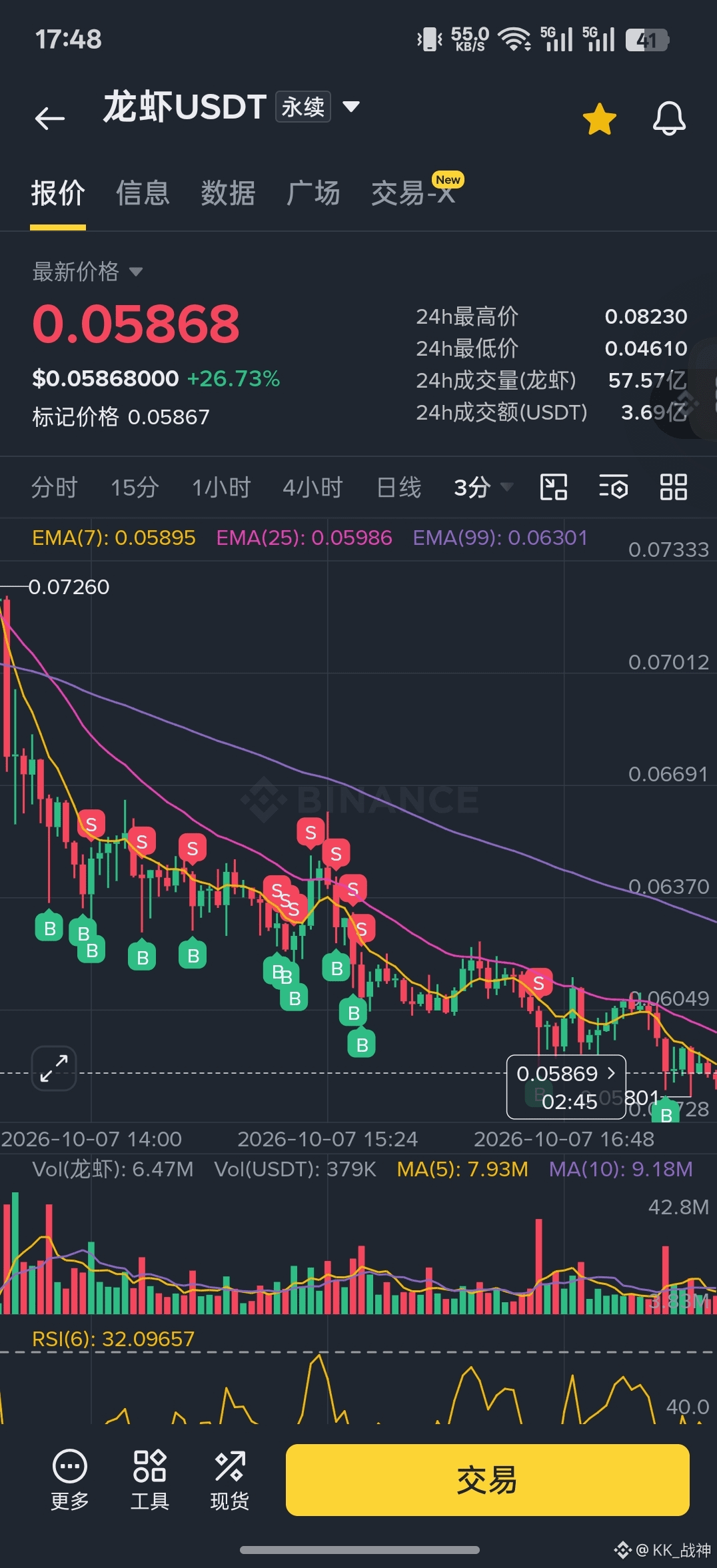
$龙虾 I heard that the faster you trade, the more you lose. Is it like that for everyone?
$龙虾 I heard that the faster you trade, the more you lose. Is it like that for everyone?
403
·
--
$TRUMP has added another classic case to the on-chain record. About a year ago, a whale address bought a total of 1.148 million tokens from Gate and OKX at a cost of roughly $11.55 million. Recently, the holder transferred the entire position to a new wallet. It’s now worth about $2.16 million, with an unrealized loss of roughly $9.39 million—a decline of 81.3%.
More than $10 million went in; a year later, only a fraction remains. When celebrity-themed coins like this were at their peak, the stories were told with great fanfare. Now the on-chain records are just as candid: what was bought and how much was lost are there in black and white for everyone to see. When the market gets carried away, everyone thinks they won’t be the last one holding the bag. Once the hype fades, they realize there’s never a shortage of people left standing guard. The script for these coins is much the same every year: they surge after launch, sentiment fades, and those who buy in next get stuck holding the bag. The only difference is a new star and a new disguise each time.
To be clear, this is still an unrealized loss, not a loss that’s been locked in. Transferring the tokens to a new wallet also suggests the holder hasn’t exited. But holding a position that’s down 80% for a year isn’t so much an act of faith as an unwillingness to admit the loss.
One calm observation: a single whale’s unrealized loss doesn’t tell us where the market is headed. But it does make one thing clear: in the end, the price paid for stories and sentiment is settled by your own account.
#加密货币 #Industry Updates
The above is for personal observation only and does not constitute investment advice. The crypto market is highly volatile; please assess the risks for yourself.
$TRUMP has added another classic case to the on-chain record. About a year ago, a whale address bought a total of 1.148 million tokens from Gate and OKX at a cost of roughly $11.55 million. Recently, the holder transferred the entire position to a new wallet. It’s now worth about $2.16 million, with an unrealized loss of roughly $9.39 million—a decline of 81.3%.
More than $10 million went in; a year later, only a fraction remains. When celebrity-themed coins like this were at their peak, the stories were told with great fanfare. Now the on-chain records are just as candid: what was bought and how much was lost are there in black and white for everyone to see. When the market gets carried away, everyone thinks they won’t be the last one holding the bag. Once the hype fades, they realize there’s never a shortage of people left standing guard. The script for these coins is much the same every year: they surge after launch, sentiment fades, and those who buy in next get stuck holding the bag. The only difference is a new star and a new disguise each time.
To be clear, this is still an unrealized loss, not a loss that’s been locked in. Transferring the tokens to a new wallet also suggests the holder hasn’t exited. But holding a position that’s down 80% for a year isn’t so much an act of faith as an unwillingness to admit the loss.
One calm observation: a single whale’s unrealized loss doesn’t tell us where the market is headed. But it does make one thing clear: in the end, the price paid for stories and sentiment is settled by your own account.
#加密货币 #Industry Updates
The above is for personal observation only and does not constitute investment advice. The crypto market is highly volatile; please assess the risks for yourself.
More than $10 million went in; a year later, only a fraction remains. When celebrity-themed coins like this were at their peak, the stories were told with great fanfare. Now the on-chain records are just as candid: what was bought and how much was lost are there in black and white for everyone to see. When the market gets carried away, everyone thinks they won’t be the last one holding the bag. Once the hype fades, they realize there’s never a shortage of people left standing guard. The script for these coins is much the same every year: they surge after launch, sentiment fades, and those who buy in next get stuck holding the bag. The only difference is a new star and a new disguise each time.
To be clear, this is still an unrealized loss, not a loss that’s been locked in. Transferring the tokens to a new wallet also suggests the holder hasn’t exited. But holding a position that’s down 80% for a year isn’t so much an act of faith as an unwillingness to admit the loss.
One calm observation: a single whale’s unrealized loss doesn’t tell us where the market is headed. But it does make one thing clear: in the end, the price paid for stories and sentiment is settled by your own account.
#加密货币 #Industry Updates
The above is for personal observation only and does not constitute investment advice. The crypto market is highly volatile; please assess the risks for yourself.
8
·
--
Bottom line first: looking at this leaderboard, this doesn’t feel like a broad-based rally. The heat is highly concentrated, with $NMR carrying the entire show. It looks more like existing capital making a quick move in a few individual assets than a market-wide ignition.
Today’s data tells quite a story: +39.77% over 24 hours, 366.5M USDT in trading volume, and a whopping 51.64% range. Taken together, that means the surge was backed by real money, not a thin-volume drift upward. But here’s the contradiction: the current price is only at 81% of its 24-hour range, having already pulled back some from the high. It’s up +3.39% over the last 4 hours, but only -2.97% over the last hour—the real strength came several hours ago. And the last hour’s volume was only 1.21 times the daily average. For a coin that just jumped nearly 40%, that means volume hasn’t dried up completely, but it’s nowhere near a second surge in volume. So the day’s rally was backed by real volume, while this past hour looks more like a cool-off near the highs and profit-taking turnover. Whether it consolidates and resumes its move or simply fizzles out isn’t clear from this snapshot, so I won’t make a hard call.
With this kind of setup, rather than rushing to pick a side, I’d watch two things: first, how volume behaves on the pullback—if it holds steady on declining volume, that suggests holders aren’t panicking; if it drops on heavy volume, that changes the picture. Second, whether a move backed by volume can push it back into the upper half of its range. I generally don’t put much stock in a rebound that rises without volume. Until a signal appears, observation is the priority.
#行情分析 #加密货币 #MarketWatch
The above is solely my personal observation and does not constitute investment advice. The crypto market is highly volatile; please assess the risks for yourself.
Bottom line first: looking at this leaderboard, this doesn’t feel like a broad-based rally. The heat is highly concentrated, with $NMR carrying the entire show. It looks more like existing capital making a quick move in a few individual assets than a market-wide ignition.
Today’s data tells quite a story: +39.77% over 24 hours, 366.5M USDT in trading volume, and a whopping 51.64% range. Taken together, that means the surge was backed by real money, not a thin-volume drift upward. But here’s the contradiction: the current price is only at 81% of its 24-hour range, having already pulled back some from the high. It’s up +3.39% over the last 4 hours, but only -2.97% over the last hour—the real strength came several hours ago. And the last hour’s volume was only 1.21 times the daily average. For a coin that just jumped nearly 40%, that means volume hasn’t dried up completely, but it’s nowhere near a second surge in volume. So the day’s rally was backed by real volume, while this past hour looks more like a cool-off near the highs and profit-taking turnover. Whether it consolidates and resumes its move or simply fizzles out isn’t clear from this snapshot, so I won’t make a hard call.
With this kind of setup, rather than rushing to pick a side, I’d watch two things: first, how volume behaves on the pullback—if it holds steady on declining volume, that suggests holders aren’t panicking; if it drops on heavy volume, that changes the picture. Second, whether a move backed by volume can push it back into the upper half of its range. I generally don’t put much stock in a rebound that rises without volume. Until a signal appears, observation is the priority.
#行情分析 #加密货币 #MarketWatch
The above is solely my personal observation and does not constitute investment advice. The crypto market is highly volatile; please assess the risks for yourself.
Today’s data tells quite a story: +39.77% over 24 hours, 366.5M USDT in trading volume, and a whopping 51.64% range. Taken together, that means the surge was backed by real money, not a thin-volume drift upward. But here’s the contradiction: the current price is only at 81% of its 24-hour range, having already pulled back some from the high. It’s up +3.39% over the last 4 hours, but only -2.97% over the last hour—the real strength came several hours ago. And the last hour’s volume was only 1.21 times the daily average. For a coin that just jumped nearly 40%, that means volume hasn’t dried up completely, but it’s nowhere near a second surge in volume. So the day’s rally was backed by real volume, while this past hour looks more like a cool-off near the highs and profit-taking turnover. Whether it consolidates and resumes its move or simply fizzles out isn’t clear from this snapshot, so I won’t make a hard call.
With this kind of setup, rather than rushing to pick a side, I’d watch two things: first, how volume behaves on the pullback—if it holds steady on declining volume, that suggests holders aren’t panicking; if it drops on heavy volume, that changes the picture. Second, whether a move backed by volume can push it back into the upper half of its range. I generally don’t put much stock in a rebound that rises without volume. Until a signal appears, observation is the priority.
#行情分析 #加密货币 #MarketWatch
The above is solely my personal observation and does not constitute investment advice. The crypto market is highly volatile; please assess the risks for yourself.
1
155
·
--
Robinhood just made a move: it added $25 million worth of Bitcoin to its balance sheet. The news came from Johann Kerbrat, the company’s senior vice president and general manager of international and crypto, earlier today.
Put simply, this trading platform is no longer just helping other people buy and sell crypto—it has also put $BTC of its own money into Bitcoin and added it to the company’s holdings.
My take: In dollar terms, $25 million isn’t an astronomical sum, so don’t get carried away just because you see the words “increased its holdings.” But the nature of this move is more worth thinking about than the amount. When a platform invests its own money, it’s effectively voting for the asset with its own funds. That suggests acceptance of Bitcoin as a reserve asset is gradually growing in mainstream finance. This kind of symbolic move matters more than the number itself.
Of course, don’t read too much into it either. A $25 million position won’t shake up the big picture, and nobody knows what prices will do in the short term. What we should really watch is whether more similar moves follow. If you’re holding a position, don’t let one news story send your emotions swinging wildly. News is just one thing to consider—stick to your own plan.
That’s the update for now. What do you think about platforms investing in these assets themselves? Let’s talk in the comments.
#行业动态 #Cryptocurrency
This is solely my personal observation and does not constitute investment advice. The crypto market is highly volatile, so please assess the risks for yourself.
Robinhood just made a move: it added $25 million worth of Bitcoin to its balance sheet. The news came from Johann Kerbrat, the company’s senior vice president and general manager of international and crypto, earlier today.
Put simply, this trading platform is no longer just helping other people buy and sell crypto—it has also put $BTC of its own money into Bitcoin and added it to the company’s holdings.
My take: In dollar terms, $25 million isn’t an astronomical sum, so don’t get carried away just because you see the words “increased its holdings.” But the nature of this move is more worth thinking about than the amount. When a platform invests its own money, it’s effectively voting for the asset with its own funds. That suggests acceptance of Bitcoin as a reserve asset is gradually growing in mainstream finance. This kind of symbolic move matters more than the number itself.
Of course, don’t read too much into it either. A $25 million position won’t shake up the big picture, and nobody knows what prices will do in the short term. What we should really watch is whether more similar moves follow. If you’re holding a position, don’t let one news story send your emotions swinging wildly. News is just one thing to consider—stick to your own plan.
That’s the update for now. What do you think about platforms investing in these assets themselves? Let’s talk in the comments.
#行业动态 #Cryptocurrency
This is solely my personal observation and does not constitute investment advice. The crypto market is highly volatile, so please assess the risks for yourself.
Put simply, this trading platform is no longer just helping other people buy and sell crypto—it has also put $BTC of its own money into Bitcoin and added it to the company’s holdings.
My take: In dollar terms, $25 million isn’t an astronomical sum, so don’t get carried away just because you see the words “increased its holdings.” But the nature of this move is more worth thinking about than the amount. When a platform invests its own money, it’s effectively voting for the asset with its own funds. That suggests acceptance of Bitcoin as a reserve asset is gradually growing in mainstream finance. This kind of symbolic move matters more than the number itself.
Of course, don’t read too much into it either. A $25 million position won’t shake up the big picture, and nobody knows what prices will do in the short term. What we should really watch is whether more similar moves follow. If you’re holding a position, don’t let one news story send your emotions swinging wildly. News is just one thing to consider—stick to your own plan.
That’s the update for now. What do you think about platforms investing in these assets themselves? Let’s talk in the comments.
#行业动态 #Cryptocurrency
This is solely my personal observation and does not constitute investment advice. The crypto market is highly volatile, so please assess the risks for yourself.
165
·
--
I took a quick look at the 24-hour leaderboard this morning. My first impression was that the market is divided, and sentiment isn’t particularly hot—there’s caution alongside disagreement. Two tokens are surging, but one is still holding near its highs while the other has started giving back gains. The one that’s down is flat on the floor with no one paying attention. Anyone who chased the highs probably isn’t feeling great right now.
First, $NMR: it’s up more than 35% over 24 hours, with a trading volume of 274.4M and a range of nearly 48%. It’s still at 77% of its 24-hour range, and it’s up more than 5% over the past four hours. The only caveat is that its volume over the past hour has fallen to 0.81 times the average. It’s eased off a bit, but hasn’t dried up. This looks more like a genuine, volume-backed rally that’s losing momentum after reaching a high—not a flimsy rise on shrinking volume.
Next, $ORCA: it’s up 26% over 24 hours, with a trading volume of 418.2M. It looks lively, but it’s down 3.87% over the past hour, and the decline has continued over the past four hours. The price has retreated from its highs to 68% of its 24-hour range, while hourly volume is still 1.07 times the average. This is a pullback on rising volume, suggesting that some holders are taking profits at higher levels. Part of that 26% gain came from the earlier surge, and now some of it is being given back.
Finally, $GTC: it’s down 26%, with the price hovering near the bottom—at 3% of its 24-hour range. Trading volume is just 69M. It’s bounced 1% over the past hour, but volume is only 0.56 times the average, and the four-hour trend is still in the red. A classic slow bleed with no buyers stepping in: even the small bounce isn’t attracting follow-through, and things are quiet down at the bottom.
With this kind of setup—disagreement among the gainers near the highs, while the losers lie dormant at the bottom—I’d rather wait and watch. For the one that surged, I’d see whether volume tapers off on a pullback and whether the price can hold at a relatively high level. For the one giving back gains, I’d watch for selling pressure to ease. As for the one at the bottom, I’d wait until volume really picks up before drawing any further conclusions. Volume doesn’t lie, so let’s give it some time.
#行情分析 #Crypto
The above is solely my personal observation and does not constitute investment advice. The crypto market is extremely volatile; please assess the risks for yourself.
I took a quick look at the 24-hour leaderboard this morning. My first impression was that the market is divided, and sentiment isn’t particularly hot—there’s caution alongside disagreement. Two tokens are surging, but one is still holding near its highs while the other has started giving back gains. The one that’s down is flat on the floor with no one paying attention. Anyone who chased the highs probably isn’t feeling great right now.
First, $NMR : it’s up more than 35% over 24 hours, with a trading volume of 274.4M and a range of nearly 48%. It’s still at 77% of its 24-hour range, and it’s up more than 5% over the past four hours. The only caveat is that its volume over the past hour has fallen to 0.81 times the average. It’s eased off a bit, but hasn’t dried up. This looks more like a genuine, volume-backed rally that’s losing momentum after reaching a high—not a flimsy rise on shrinking volume.
Next, $ORCA : it’s up 26% over 24 hours, with a trading volume of 418.2M. It looks lively, but it’s down 3.87% over the past hour, and the decline has continued over the past four hours. The price has retreated from its highs to 68% of its 24-hour range, while hourly volume is still 1.07 times the average. This is a pullback on rising volume, suggesting that some holders are taking profits at higher levels. Part of that 26% gain came from the earlier surge, and now some of it is being given back.
Finally, $GTC : it’s down 26%, with the price hovering near the bottom—at 3% of its 24-hour range. Trading volume is just 69M. It’s bounced 1% over the past hour, but volume is only 0.56 times the average, and the four-hour trend is still in the red. A classic slow bleed with no buyers stepping in: even the small bounce isn’t attracting follow-through, and things are quiet down at the bottom.
With this kind of setup—disagreement among the gainers near the highs, while the losers lie dormant at the bottom—I’d rather wait and watch. For the one that surged, I’d see whether volume tapers off on a pullback and whether the price can hold at a relatively high level. For the one giving back gains, I’d watch for selling pressure to ease. As for the one at the bottom, I’d wait until volume really picks up before drawing any further conclusions. Volume doesn’t lie, so let’s give it some time.
#行情分析 #Crypto
The above is solely my personal observation and does not constitute investment advice. The crypto market is extremely volatile; please assess the risks for yourself.
First, $NMR : it’s up more than 35% over 24 hours, with a trading volume of 274.4M and a range of nearly 48%. It’s still at 77% of its 24-hour range, and it’s up more than 5% over the past four hours. The only caveat is that its volume over the past hour has fallen to 0.81 times the average. It’s eased off a bit, but hasn’t dried up. This looks more like a genuine, volume-backed rally that’s losing momentum after reaching a high—not a flimsy rise on shrinking volume.
Next, $ORCA : it’s up 26% over 24 hours, with a trading volume of 418.2M. It looks lively, but it’s down 3.87% over the past hour, and the decline has continued over the past four hours. The price has retreated from its highs to 68% of its 24-hour range, while hourly volume is still 1.07 times the average. This is a pullback on rising volume, suggesting that some holders are taking profits at higher levels. Part of that 26% gain came from the earlier surge, and now some of it is being given back.
Finally, $GTC : it’s down 26%, with the price hovering near the bottom—at 3% of its 24-hour range. Trading volume is just 69M. It’s bounced 1% over the past hour, but volume is only 0.56 times the average, and the four-hour trend is still in the red. A classic slow bleed with no buyers stepping in: even the small bounce isn’t attracting follow-through, and things are quiet down at the bottom.
With this kind of setup—disagreement among the gainers near the highs, while the losers lie dormant at the bottom—I’d rather wait and watch. For the one that surged, I’d see whether volume tapers off on a pullback and whether the price can hold at a relatively high level. For the one giving back gains, I’d watch for selling pressure to ease. As for the one at the bottom, I’d wait until volume really picks up before drawing any further conclusions. Volume doesn’t lie, so let’s give it some time.
#行情分析 #Crypto
The above is solely my personal observation and does not constitute investment advice. The crypto market is extremely volatile; please assess the risks for yourself.
394
·
--
Annabelle Huang, co-founder and CEO of Altius Labs, just shared an insight I think is worth discussing: the crypto industry is shifting its focus from “creating new assets” to “creating new markets.”
What does that mean? In the past, the industry’s playbook was to create something new—$BTC, $ETH, NFTs, meme coins—and then build trading around those assets. Now the approach has changed: the focus is on building markets for things that already exist, and keeping them open 24/7. She gave a few examples: prediction markets, which price news events in real time; crude oil and gold perpetuals on Hyperliquid, which price commodities; and pre-IPO perpetuals, which price companies that haven’t gone public. These things either had no real-time pricing before, or were tightly constrained by trading hours, access barriers, and valuation cycles. Onchain markets bypass those walls, absorb new information at any time, and have lower barriers to entry.
In a nutshell, her point is this: blockchain isn’t just creating assets—it’s expanding the boundaries of “what can be priced.”
A couple of thoughts of my own. This direction is different from the previous race to launch new tokens. It applies onchain liquidity and efficiency to things that weren’t previously priced, which amounts to an expansion at the infrastructure level. For platforms like $HYPE that are building new markets, what really matters going forward is actual trading volume and open interest—not how compelling the story sounds. The potential of pushing the boundaries of what can be priced is much greater than that of launching yet another token.
#行业动态 #Cryptocurrency
The above is solely my personal observation and does not constitute investment advice. Crypto markets are extremely volatile; please assess the risks for yourself.
Annabelle Huang, co-founder and CEO of Altius Labs, just shared an insight I think is worth discussing: the crypto industry is shifting its focus from “creating new assets” to “creating new markets.”
What does that mean? In the past, the industry’s playbook was to create something new—$BTC , $ETH , NFTs, meme coins—and then build trading around those assets. Now the approach has changed: the focus is on building markets for things that already exist, and keeping them open 24/7. She gave a few examples: prediction markets, which price news events in real time; crude oil and gold perpetuals on Hyperliquid, which price commodities; and pre-IPO perpetuals, which price companies that haven’t gone public. These things either had no real-time pricing before, or were tightly constrained by trading hours, access barriers, and valuation cycles. Onchain markets bypass those walls, absorb new information at any time, and have lower barriers to entry.
In a nutshell, her point is this: blockchain isn’t just creating assets—it’s expanding the boundaries of “what can be priced.”
A couple of thoughts of my own. This direction is different from the previous race to launch new tokens. It applies onchain liquidity and efficiency to things that weren’t previously priced, which amounts to an expansion at the infrastructure level. For platforms like $HYPE that are building new markets, what really matters going forward is actual trading volume and open interest—not how compelling the story sounds. The potential of pushing the boundaries of what can be priced is much greater than that of launching yet another token.
#行业动态 #Cryptocurrency
The above is solely my personal observation and does not constitute investment advice. Crypto markets are extremely volatile; please assess the risks for yourself.
What does that mean? In the past, the industry’s playbook was to create something new—$BTC , $ETH , NFTs, meme coins—and then build trading around those assets. Now the approach has changed: the focus is on building markets for things that already exist, and keeping them open 24/7. She gave a few examples: prediction markets, which price news events in real time; crude oil and gold perpetuals on Hyperliquid, which price commodities; and pre-IPO perpetuals, which price companies that haven’t gone public. These things either had no real-time pricing before, or were tightly constrained by trading hours, access barriers, and valuation cycles. Onchain markets bypass those walls, absorb new information at any time, and have lower barriers to entry.
In a nutshell, her point is this: blockchain isn’t just creating assets—it’s expanding the boundaries of “what can be priced.”
A couple of thoughts of my own. This direction is different from the previous race to launch new tokens. It applies onchain liquidity and efficiency to things that weren’t previously priced, which amounts to an expansion at the infrastructure level. For platforms like $HYPE that are building new markets, what really matters going forward is actual trading volume and open interest—not how compelling the story sounds. The potential of pushing the boundaries of what can be priced is much greater than that of launching yet another token.
#行业动态 #Cryptocurrency
The above is solely my personal observation and does not constitute investment advice. Crypto markets are extremely volatile; please assess the risks for yourself.
305
Log in to explore more content
Join global crypto users on Binance Square
⚡️ Get latest and useful information about crypto.
💬 Trusted by the world’s largest crypto exchange.
👍 Discover real insights from verified creators.
Email / Phone number
Trending Topics
FedMinutesFocusOnOctoberPause
328,135 views
2,019 Discussing
🚨 HIGH ALERT ‼️ PLEASE DON’T TRADE BLINDLY FOR THE NEXT HOUR 🚨
Guys, we have FOMC Minutes coming in less than 1 hour.
And after the kind of volatility we already saw today, I really don’t want anyone opening random high-leverage positions just before this release.
The biggest reaction I’m watching will be in Gold (XAU), Silver (XAG), BTC and ETH. Then coins like SOL and other highly leveraged mid/low-cap alts can exaggerate whatever move BTC makes.
Gold and Silver are especially sensitive tonight because the market is already reacting to the US dollar + Treasury yields, and both metals have been under heavy pressure ahead of the Fed minutes.
Briefly speaking
📉Hawkish Fed Minutes → Dollar/yields can push higher → pressure on BTC, crypto, Gold & silver
📈Dovish Fed Minutes → Dollar/yields can cool → BTC, Gold, Silver and risk assets can bounce hard.
And please remember the first candle can be a trap. We can get a pump, immediate dump, liquidations on both sides, and then the real direction.
So for now, protect your positions, reduce unnecessary leverage and don’t FOMO into the first move.
Tonight I’m watching $XAU , $XAG and $BTC first. These will tell us very quickly how the market is reading the Fed.
I will Update you guys on time
Follow @Panda Traders and Turn on Your notifications right now
#FedMinutesFocusOnOctoberPause
Panda Traders
·21 Likes
·5k views
XRPSpotETFsHold$1.7BWeeklyInflowsSlow
9 views
7 Discussing
FrenchHillUrgesCLARITYActPassageInLameDuck
213 views
45 Discussing