
怪兽8号888-资讯收集箱
1.4k Posts

怪兽8号888-资讯收集箱
Report
Block User
每天更新热点,异动,盘面分析,每日总结,问就是网上扒的数据再加工给各位,哈哈!!
29 Following
120 Followers
116 Liked
Posts
All
Quotes
Bloomberg: BTC loyalists lose enthusiasm after market selloff, shifting funds to AI stocks and prediction markets
Did everyone see this? Guys, this one’s pretty significant—take a look 👀
Don’t panic when bad news hits. Check whether the market has already priced it in.
$BTC
Just my personal opinion—don’t take it too seriously.
Did everyone see this? Guys, this one’s pretty significant—take a look 👀
Don’t panic when bad news hits. Check whether the market has already priced it in.
$BTC
Just my personal opinion—don’t take it too seriously.
6
Today's self-check: Have you taken losses in this area?
Treat every loss as paying tuition once, and note down what you learned.
$XRP reports 0.908 (24h -3.97%)
Do your own research before taking action.
Today's self-check: Have you taken losses in this area?
Treat every loss as paying tuition once, and note down what you learned.
$XRP reports 0.908 (24h -3.97%)
Do your own research before taking action.
Treat every loss as paying tuition once, and note down what you learned.
$XRP reports 0.908 (24h -3.97%)
Do your own research before taking action.
2
The latest news—let’s go over a few updates.
Bitcoin treasury moves: $BTC sees another company swoop in to buy
Twenty One Capital spent another $10 million to buy 172.25 $BTC at an average price of about $58,054, bringing its total holdings to around 43,841 coins. This is already its second purchase this week. Takeaway: Repeated buying by a company looks a bit like dollar-cost averaging, suggesting some players see $BTC as a long-term reserve asset. But one institution’s buying pace doesn’t represent the market’s direction, so don’t blindly copy it.
Market anomaly: Kraken’s Canadian dollar trading pair depegs
Adam Back noted that the BTC/CAD trading pair on Kraken’s Canadian platform is trading at a significant discount. One possible reason is that local spot market makers have run out of funds, causing the price to diverge from the foreign-exchange rate of around 1.434. Takeaway: This kind of “depeg” is mostly a localized liquidity issue—like a shallow pond where prices can easily be pushed off course. Cross-market spreads may look tempting, but execution and settlement come with friction, so ordinary users shouldn’t assume arbitrage is easy.
AI investment: Lin Junyang’s company reaches a $5 billion valuation in three months
Pragmatik Labs, founded by Lin Junyang, the former technical lead of Alibaba’s Qwen team, has raised tens of millions of dollars in a new funding round, lifting its valuation to $5 billion. It was valued at $2 billion just three months ago. New investors include Huaye Tiancheng Capital. Takeaway: Valuations in the AI sector are heating up fast. A 2.5-fold jump in three months shows how fiercely investors are competing for a position. But a high valuation also means the company will eventually need to deliver on it with products and revenue. It’s fine to watch from the sidelines, but don’t get swept up in the hype.
Your turn: Which do you think is more worth ordinary investors’ attention—institutions continuing to buy BTC, or a depeg caused by insufficient market-maker liquidity?
Guys, have you seen this news? 👀
I usually start by watching whether volume confirms. $BTC Would you focus on price or trading volume?
#BTC
Just my personal take—it may not be accurate, so take it with a grain of salt.
Guys, have you seen this news? 👀
I usually start by watching whether volume confirms. $BTC Would you focus on price or trading volume?
#BTC
Just my personal take—it may not be accurate, so take it with a grain of salt.
I usually start by watching whether volume confirms. $BTC Would you focus on price or trading volume?
#BTC
Just my personal take—it may not be accurate, so take it with a grain of salt.
5
The latest news, woven together, paints quite a picture of “two extremes—ice and fire.”
First, the most painful part: $BTC is hovering around $58,000, with a market cap of about $1.17 trillion. But roughly $950 billion of invested capital is sitting on unrealized losses—the total has hit a record high, while only about $119 billion remains in profit. Take: investors who bought near the peak still haven’t broken even. This bout of “holding your breath underwater” tests patience, not courage.
Meanwhile, security incidents haven’t let up either. Hackers drained 520.2 $ETH, 3.25 million $USDC , and 758,000 USDT from Chainflip’s Ethereum vault, worth about $4.86 million. Take: The attackers used a valid signature generated with the vault’s aggregated signing key, so it was most likely a private key leak. Multisig isn’t a safe; key management is the real linchpin.
Now to traditional markets: the Nasdaq fell 5.28%, the Philadelphia Semiconductor Index plunged nearly 11%, and NVDA tumbled 14.01% in a single day. Dan Bin posted, “Woke up to a bloodbath,” and also told investors that some funds had to reduce their positions because they were nearing their liquidation thresholds. Take: The pressure on institutions heavily invested in AI hardware is plain to see. Forced selling doesn’t mean they’re bearish; the rules leave them no choice. Risk management needs room to maneuver during this pullback.
There are concerns on the USDT front, too. Citing Tether’s reserve report, an analyst pointed out that gold, BTC, and U.S. stocks make up a significant share of its non-cash reserves. If these assets continue to fall, USDT could face the risk of being undercollateralized. Take: A stablecoin’s “stability” depends on the quality of its reserves. The value of diversification really shows when assets are all moving in the same direction.
One more item from the AI world: ByteDance has reshuffled its structure again. The Seed organization has established a new Seed Model-MaaS Infra unit, while the former Volcano Engine Ark team has been renamed Seed MaaS. Both departments will be led by Wu Di. Take: By bringing models and MaaS together, ByteDance is aligning its AI infrastructure and commercialization efforts.
Markets and security have each had their ups and downs. One last question: after unrealized losses hit a new high this time around, do you think the market is forming a bottom, or headed for a second test of the lows before a rebound?
The latest news, woven together, paints quite a picture of “two extremes—ice and fire.”
First, the most painful part: $BTC is hovering around $58,000, with a market cap of about $1.17 trillion. But roughly $950 billion of invested capital is sitting on unrealized losses—the total has hit a record high, while only about $119 billion remains in profit. Take: investors who bought near the peak still haven’t broken even. This bout of “holding your breath underwater” tests patience, not courage.
Meanwhile, security incidents haven’t let up either. Hackers drained 520.2 $ETH , 3.25 million $USDC , and 758,000 USDT from Chainflip’s Ethereum vault, worth about $4.86 million. Take: The attackers used a valid signature generated with the vault’s aggregated signing key, so it was most likely a private key leak. Multisig isn’t a safe; key management is the real linchpin.
Now to traditional markets: the Nasdaq fell 5.28%, the Philadelphia Semiconductor Index plunged nearly 11%, and NVDA tumbled 14.01% in a single day. Dan Bin posted, “Woke up to a bloodbath,” and also told investors that some funds had to reduce their positions because they were nearing their liquidation thresholds. Take: The pressure on institutions heavily invested in AI hardware is plain to see. Forced selling doesn’t mean they’re bearish; the rules leave them no choice. Risk management needs room to maneuver during this pullback.
There are concerns on the USDT front, too. Citing Tether’s reserve report, an analyst pointed out that gold, BTC, and U.S. stocks make up a significant share of its non-cash reserves. If these assets continue to fall, USDT could face the risk of being undercollateralized. Take: A stablecoin’s “stability” depends on the quality of its reserves. The value of diversification really shows when assets are all moving in the same direction.
One more item from the AI world: ByteDance has reshuffled its structure again. The Seed organization has established a new Seed Model-MaaS Infra unit, while the former Volcano Engine Ark team has been renamed Seed MaaS. Both departments will be led by Wu Di. Take: By bringing models and MaaS together, ByteDance is aligning its AI infrastructure and commercialization efforts.
Markets and security have each had their ups and downs. One last question: after unrealized losses hit a new high this time around, do you think the market is forming a bottom, or headed for a second test of the lows before a rebound?
9
The latest updates, with a few key headlines grouped by topic.
Market moves and indicator swings
$BTC fell below $56,000, wiping out all gains made since Trump's election victory. Adam Kobeissi believes a liquidity crisis triggered by panic in the U.S. stock and gold markets was a major factor behind this latest sell-off. Takeaway: Giving back all the gains shows that the previous rally was driven more by sentiment; it couldn't hold up once liquidity tightened. Bitcoin's Ahr999 indicator is now at 0.2338, surpassing the low of 0.24 seen during the 2020 “3.12” crash. Takeaway: An extreme reading doesn't mean an immediate reversal, but it does show that the market has entered a historically undervalued range, and the risk of further declines should not be ignored.
Institutional holdings and costs
Strategy holds 850,849 $BTC (worth about $47.3 billion), with $16.9 billion in unrealized losses; BitMine holds 6,077,745 $ETH (worth about $9.35 billion), with $11 billion in unrealized losses. Takeaway: The larger the holdings, the more striking the unrealized losses; it's worth watching to see whether they are forced to reduce their positions. JPMorgan estimates BTC's production cost at around $86,000. The current price is well below that level, which could force high-cost miners to sell reserves or pivot to AI businesses. Takeaway: When prices fall below production costs, pressure on miners' cash flow will gradually become apparent.
Ethereum developments
An address linked to the Ethereum Foundation sold 2,500 ETH, but analyst Specter noted that there is insufficient evidence to support the attribution of some related wallets. Takeaway: Claims of “Foundation selling” should be treated with caution; inaccurate labels can easily lead to misinterpretation. ETH's market cap fell to about $190.34 billion, dropping to 105th among global assets, below companies such as McDonald's and Verizon. Takeaway: The lower ranking is a result of the price, not a new negative catalyst, but sentiment is certainly under pressure.
Market views
The community is heatedly debating why the bull market is “late,” with several analysts citing the bursting of the AI bubble as the main cause of the sharp decline since October. GMGN co-founder Haze, meanwhile, said the market has entered a “death state” again, and cycle investors may be at a point where they should look for excess returns. Takeaway: Opinions diverge most during periods of fear; it's safer to focus on the data and pay less attention to hype.
Do you think this sell-off is due to liquidity problems, or is the cycle itself cooling down? Feel free to share your thoughts.
6
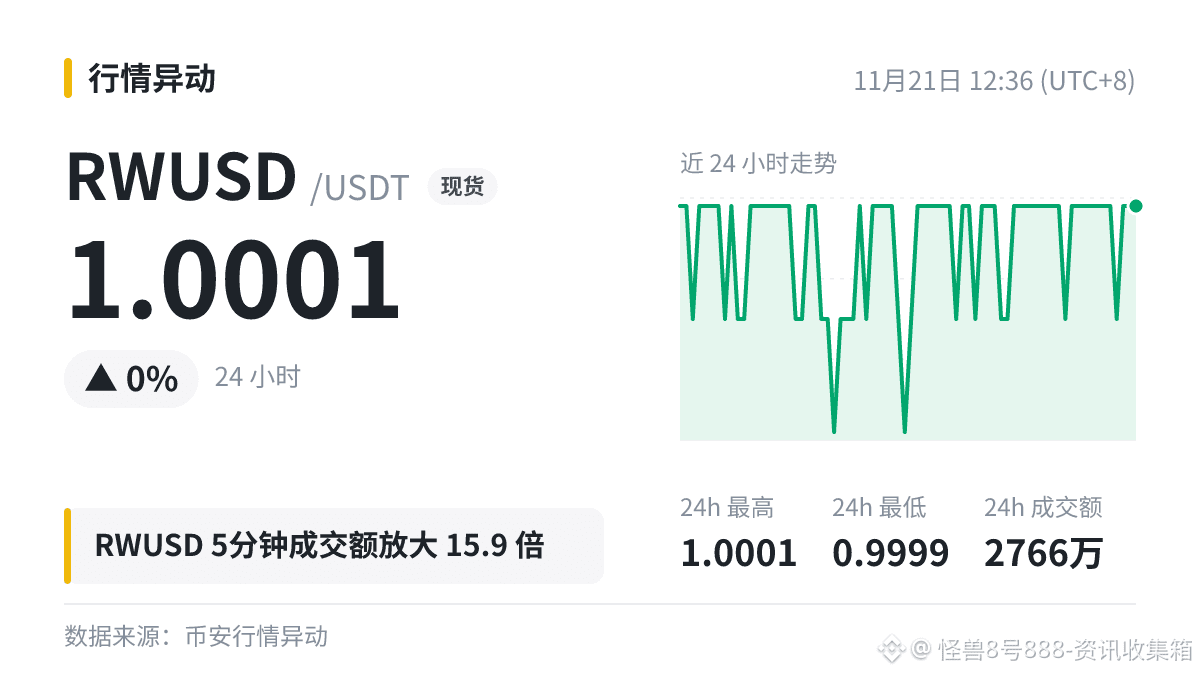
Volume anomaly: $RWUSD 5-minute volume surged 15.9 times, while the price barely moved.
How many times have you seen this kind of trend? What usually happens afterward?
Just my personal perspective; it may not be accurate, so take it with caution.
Volume anomaly: $RWUSD 5-minute volume surged 15.9 times, while the price barely moved.
How many times have you seen this kind of trend? What usually happens afterward?
Just my personal perspective; it may not be accurate, so take it with caution.
How many times have you seen this kind of trend? What usually happens afterward?
Just my personal perspective; it may not be accurate, so take it with caution.
1
$ICNT 4 hours: The MACD formed a death cross above the zero line, with opposing histogram bars persisting for 25 bars before the crossover.
Talk about what’s behind this number.
MACD was introduced by Gerald Appel. Its commonly used settings are 12, 26, and 9, and it measures price momentum using the difference between a fast and a slow EMA.
Comparing multiple indicators is more reliable than looking at just one, but even more indicators can’t provide a definitive answer.
Just a note, not investment advice.
45
Article
See translation
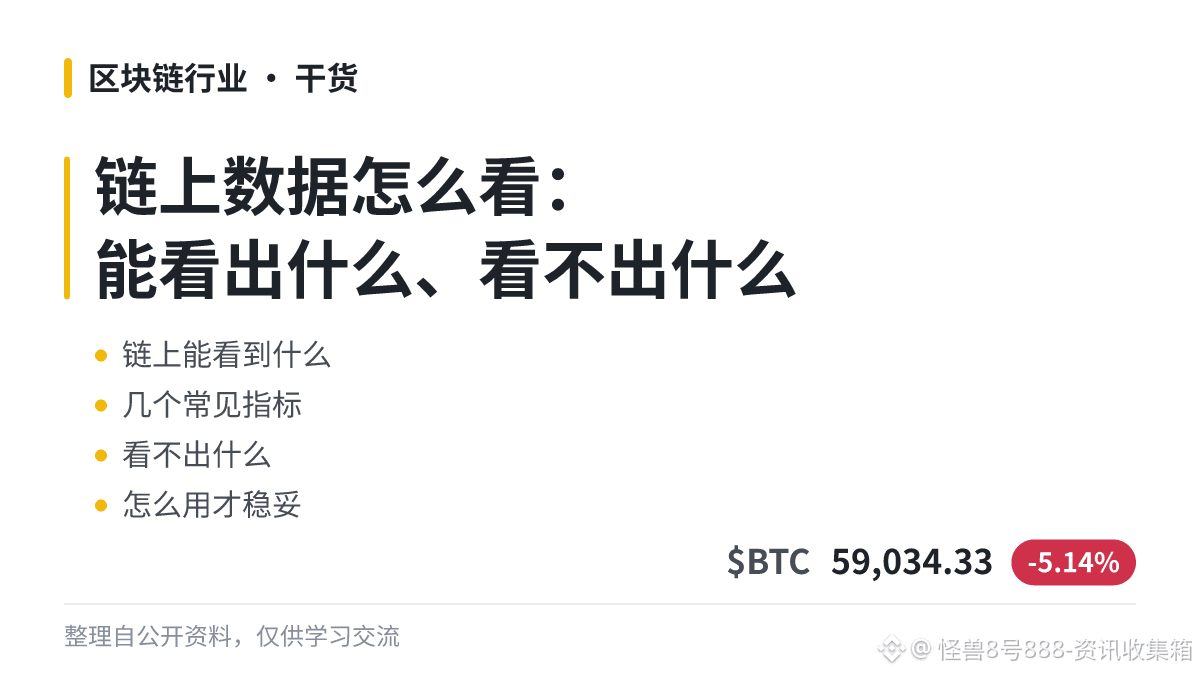
链上数据怎么看:能看出什么、看不出什么公链上的每一笔转账都公开可查,这让加密市场有了传统金融里少见的“透明账本”。但数据公开不等于结论清楚,同一组链上数据,读法不同,结论可能完全相反。
$BTC 和 $ETH 的转账都公开可查,$ARKM 是链上情报平台 Arkham 的代币。当前 59,034.33(24h -5.14%)。
■ 链上能看到什么
在区块浏览器里,可以查到任意地址的余额和转账历史,也可以查到每个区块里装了哪些交易。在这些原始记录之上,数据平台会统计出各种指标:交易所净流入、活跃地址数、大额转账、长期未动的币有多少等等。
比特币的每个未花费输出(UTXO)都能查到产生于哪个区块,也就知道这些币上一次被转动的时间,所以可以统计出有多少币很久没有动过。以太坊这类账户模型的链,则可以直接看到每个地址的余额变化。
■ 几个常见指标
交易所净流入是一段时间内转入交易所地址的币减去转出的币,常被用来观察潜在的卖压;净流出则常被解读为币被提到自己的钱包保管。
活跃地址数统计一段时间内参与过转账的地址数量,常作为衡量网络使用程度的参考。“巨鲸”一般指持有大量某种代币的地址或机构,具体多少才算巨鲸并没有统一标准。
■ 看不出什么
地址不等于人:一个人可以有很多地址,一个交易所的地址里可能装着大量用户的资产。交易所内部的买卖、场外的交易,都不会出现在链上。
一笔大额转入交易所,可能是准备卖出,也可能是拿去做合约保证金、做市商调仓,或者只是交易所在整理自己的钱包。数据平台给地址打的标签也可能出错。
■ 怎么用才稳妥
把多个指标对照着看,并和价格、成交量互相印证;看到“巨鲸异动”的快讯,先查清地址属于谁、币最后流向了哪里。链上数据是线索,不是结论,更不是下单的理由。
■ 写在最后
链上数据最大的价值是“可以自己查证”。与其相信一句话的快讯,不如学会打开区块浏览器,亲手看一眼那笔转账。投入的钱尽量只用亏了也不影响生活的那部分。
大家之前有没有误解过这一点?
只作参考,非投资建议。
链上数据怎么看:能看出什么、看不出什么
公链上的每一笔转账都公开可查,这让加密市场有了传统金融里少见的“透明账本”。但数据公开不等于结论清楚,同一组链上数据,读法不同,结论可能完全相反。
$BTC 和 $ETH 的转账都公开可查,$ARKM 是链上情报平台 Arkham 的代币。当前 59,034.33(24h -5.14%)。
■ 链上能看到什么
在区块浏览器里,可以查到任意地址的余额和转账历史,也可以查到每个区块里装了哪些交易。在这些原始记录之上,数据平台会统计出各种指标:交易所净流入、活跃地址数、大额转账、长期未动的币有多少等等。
比特币的每个未花费输出(UTXO)都能查到产生于哪个区块,也就知道这些币上一次被转动的时间,所以可以统计出有多少币很久没有动过。以太坊这类账户模型的链,则可以直接看到每个地址的余额变化。
■ 几个常见指标
交易所净流入是一段时间内转入交易所地址的币减去转出的币,常被用来观察潜在的卖压;净流出则常被解读为币被提到自己的钱包保管。
活跃地址数统计一段时间内参与过转账的地址数量,常作为衡量网络使用程度的参考。“巨鲸”一般指持有大量某种代币的地址或机构,具体多少才算巨鲸并没有统一标准。
■ 看不出什么
地址不等于人:一个人可以有很多地址,一个交易所的地址里可能装着大量用户的资产。交易所内部的买卖、场外的交易,都不会出现在链上。
一笔大额转入交易所,可能是准备卖出,也可能是拿去做合约保证金、做市商调仓,或者只是交易所在整理自己的钱包。数据平台给地址打的标签也可能出错。
■ 怎么用才稳妥
把多个指标对照着看,并和价格、成交量互相印证;看到“巨鲸异动”的快讯,先查清地址属于谁、币最后流向了哪里。链上数据是线索,不是结论,更不是下单的理由。
■ 写在最后
链上数据最大的价值是“可以自己查证”。与其相信一句话的快讯,不如学会打开区块浏览器,亲手看一眼那笔转账。投入的钱尽量只用亏了也不影响生活的那部分。
大家之前有没有误解过这一点?
只作参考,非投资建议。
62
$XAUT |Daily Consecutive Down Days Alert
Five consecutive down days, for a total decline of 8.92%. The current price is 3535.77.
The longer a one-sided candlestick trend continues, the more alert you should be for a sudden large candle. Look for signs of stabilization before trying to catch the bottom.
Not a trading signal.
Five consecutive down days, for a total decline of 8.92%. The current price is 3535.77.
The longer a one-sided candlestick trend continues, the more alert you should be for a sudden large candle. Look for signs of stabilization before trying to catch the bottom.
Not a trading signal.
87
The latest news: a few major developments, all in one place—and market sentiment is through the roof.
There’s plenty of drama in U.S. stocks and AI. Trump said he hopes Jensen Huang will apologize and return, adding that Nvidia is too important to the U.S. and that outstanding talent must be protected. That’s a pretty direct stance, and the political weight of $NVDA is clear. Meanwhile, “Big Short” investor Michael Burry halved his positions in the VanEck Semiconductor ETF and $NVDA put options. He’s taking profits after the semiconductor sell-off—a move worth watching from this market bellwether.
Crypto markets are having a “Black Friday.” $BTC plunged more than $3,000 in an hour, hitting a low of $58,700. It fell below $60,000 for the first time in 140 days, down 6.6% in 24 hours. This is a high-volume, one-way slide—don’t try to catch the falling knife.
The liquidation figures are even more painful: $770 million liquidated across the market in one hour, including $734 million in long positions. Over 24 hours, liquidations topped $1.5 billion, with $1.41 billion in longs. Bulls are taking a beating, and this round of BTC liquidations is brutal.
Pressure is building on holdings, too. Strategy holds 850,849 BTC at an average price of $75,452, with unrealized losses widening to $13.57 billion. Even big players can’t shrug off a drawdown like this—risk awareness is essential.
The liquidation map shows the key levels: if BTC falls below $57,000, cumulative long liquidation intensity on major CEXs reaches $180 million; if it rebounds above $60,000, short liquidation intensity reaches $320 million. It’s a minefield in both directions, so don’t rush in.
The S&P 500 fell 2% intraday, putting it in correction territory after dropping 10% from its October high. Risk assets are all trembling. Bessent, meanwhile, urged the Fed to look ahead and praised Anthropic’s IPO as a national AI champion. On the first day of ANT’s tokenized version, the Backpack edition led trading volume on Solana—the AI narrative is still burning.
In short: sentiment is crumbling, liquidations are heavy, and key levels are in play. First, let’s see whether BTC can reclaim $60,000. Do you think this is a shakeout or a trend reversal? Share your thoughts in the comments.
13
Latest Updates
1. Market moves: U.S. stocks and $BTC face synchronized pressure
The S&P 500’s intraday losses widened to 2%, bringing it 10% below its October high and officially into correction territory. Takeaway: Risk assets are cooling broadly, and $BTC’s drop to $59,500 is not an isolated event. Keep an eye on how macro sentiment is spreading.
2. Institutional holdings: Strategy’s unrealized losses widen
As $BTC fell to $59,500, Strategy’s 850,849 BTC holdings—with a total cost of about $64.2 billion and an average price of $75,452—saw unrealized losses widen to $13.57 billion. Takeaway: The average purchase price is well above the current price, creating real balance-sheet pressure. Whether the company adjusts its holdings will be a key test of institutional confidence.
3. Notable investor moves: Michael Burry takes partial profits
Michael Burry said he cut his put-option position in the VanEck Semiconductor ETF (SMH) by half and also sold half of his NVDA put options. Takeaway: Reducing positions after a semiconductor pullback looks more like profit-taking and risk management than a bullish turn. Don’t read too much into the direction.
Discussion: During this pullback, are you more focused on the pace of a recovery in U.S. stocks, or on whether BTC can hold key price levels?
Latest Updates
1. Market moves: U.S. stocks and $BTC face synchronized pressure
The S&P 500’s intraday losses widened to 2%, bringing it 10% below its October high and officially into correction territory. Takeaway: Risk assets are cooling broadly, and $BTC ’s drop to $59,500 is not an isolated event. Keep an eye on how macro sentiment is spreading.
2. Institutional holdings: Strategy’s unrealized losses widen
As $BTC fell to $59,500, Strategy’s 850,849 BTC holdings—with a total cost of about $64.2 billion and an average price of $75,452—saw unrealized losses widen to $13.57 billion. Takeaway: The average purchase price is well above the current price, creating real balance-sheet pressure. Whether the company adjusts its holdings will be a key test of institutional confidence.
3. Notable investor moves: Michael Burry takes partial profits
Michael Burry said he cut his put-option position in the VanEck Semiconductor ETF (SMH) by half and also sold half of his NVDA put options. Takeaway: Reducing positions after a semiconductor pullback looks more like profit-taking and risk management than a bullish turn. Don’t read too much into the direction.
Discussion: During this pullback, are you more focused on the pace of a recovery in U.S. stocks, or on whether BTC can hold key price levels?
A concise roundup of the latest key developments, to help you get up to speed on the past hour:
1. Market moves: Risk assets take a hit across the board
$BTC fell below $60,000 for the first time in 140 days, down 4.9% in 24 hours. $ETH fell below $1,700, and $SOL dropped below $70. BNB fell below $550, down 6.17% in 24 hours. Takeaway: Major cryptocurrencies are breaking down across the board. This isn’t about any one coin—it’s a broad pullback in risk appetite.
Liquidations across the crypto market topped $1 billion over the past 24 hours, including $980 million in long positions. More than $400 million was liquidated in just the past four hours. Takeaway: Long positions were too crowded, so the pullback triggered cascading liquidations. Managing positions matters more than predicting market direction.
2. Macro and market sentiment: Confidence in AI trades wavers
Global equities suffered a “Black Friday.” The MSCI World Index fell for a seventh consecutive trading day, its longest losing streak since September 2023. The emerging markets index has dropped 20% from its June high, entering a technical bear market. Takeaway: When the AI narrative starts to wobble, the bubble can deflate faster than expected.
The Nasdaq’s losses briefly widened to 2%, wiping out all its gains for the year. The Philadelphia Semiconductor Index fell nearly 7%, while ANT dropped more than 11%. U.S. stocks later rebounded after opening lower, with the Dow up 1% and ANT recovering to above $90. Takeaway: Intraday volatility was intense, with sentiment recovering and panic selling repeatedly pulling in opposite directions throughout the session.
3. Crypto security and project developments
A review of the approximately $13 million XMR1 theft: Custodian 1984.hosting was breached, exposing customer data and files on internal servers. Deployment keys had also been left on an old server that had already been deleted. Takeaway: Custody remains a weak link. “Deleting the server” doesn’t mean the keys are safe.
Sky clarified negative reports about its PSM module: More than $2 billion in USDS was converted to USDC in a single day, with the 1:1 peg maintained throughout. The amount of USDC in the module never fell below $800 million. Takeaway: Holding the peg under a stress test from heavy redemptions is a welcome boost to confidence in stablecoins.
4. Traditional finance and policy
The U.S. Senate has verbally passed the DEATH BETS Act, which would bar CFTC-registered platforms from listing or clearing contracts involving terrorism, war, or death. Takeaway: Policymakers are drawing boundaries around prediction markets, and compliance costs will only rise.
CoreWeave fell below its $40 IPO price, dropping about 11% intraday. Most crypto-related U.S. stocks also fell, with MSTR down 2.87% and BMNR down 3.42%. Takeaway: AI computing and crypto-related stocks are both under pressure, suggesting investors are pulling out of high-volatility assets.
5. Industry developments
Two former Tether executives are setting up Kintsugi Capital, a fund that plans to use market-neutral strategies to offer a yield of around 4% on the gold token XAUT. Takeaway: More asset management businesses are emerging around stablecoin giants. Whether their sources of yield are sustainable is worth watching.
Which are you more concerned about right now: BTC holding $60,000 or ETH holding $1,700? Share your thoughts in the comments.
4
The latest news: let’s run through a few key developments.
On the crypto front, Ethereum’s Glamsterdam upgrade has been confirmed as delayed, with the earliest launch now expected in mid-January 2027. The reason is a sharp increase in contract deployment costs. The Ethereum Foundation and security researchers have already contacted more than 50 affected companies. $ETH The developers would rather take their time than rush into chaos—seasoned crypto veterans know that a delayed upgrade is better than launching with bugs. In other news, Tether has burned 8 billion $USDT over the past 20 days, while the total stablecoin market cap across all chains has fallen from its late-May peak of $311.35 billion to $288.10 billion. Such a steep contraction in $USDT suggests capital is leaving the market. Don’t just watch the charts—liquidity is the real measure of market conditions.
On the institutional and macro front, Michael Saylor is back making the case for BTC, saying it is the foundation of all of Strategy’s business and that its terminal inflation rate is zero. Take that with a grain of salt. Seasoned crypto veterans know: pay attention not only to what he says, but also to what he does. BofA’s Hartnett believes U.S. stocks are likely to see a short-term technical rebound after Thanksgiving, but stressed that this would be a breather, not a reversal. Positioning has barely been cleared out, and global equity funds still saw $66.6 billion in inflows over the past week. A rebound is possible, but don’t treat it as a signal to buy the dip—being oversold doesn’t mean the market has bottomed.
There’s also a development worth watching in the markets: Nasdaq 100 futures are down 2% in premarket trading, the VIX has climbed to 30, and Anthropic is down more than 13% premarket, nearing $84. Risk appetite is clearly fading, so it’s normal for high-beta assets like BTC to wobble in the short term. Don’t make emotional decisions in a panic. Also, Cursor, a SpaceX subsidiary, is reportedly considering phasing out open-weight AI models developed in China. Composer 2 is built on Moonshot AI’s Kimi K2.5. When geopolitical pressure rises, a shift toward alternatives follows—the geopolitical risks in the AI sector are becoming increasingly apparent.
One final question: With stablecoin market cap continuing to shrink and the VIX surging to 30, do you think this is a short-term shakeout, or are funds really pulling out systematically? Let’s discuss in the comments.
4
The latest updates: let’s go over a few key developments.
【Market Moves & Whale Watch】
Arthur Hayes: bearish talk, bullish trades—a true crypto veteran. He posted that $BTC’s “next stop is Goblin Town,” telling everyone to buckle up, while receiving 15,000 $VVV worth $306,000 from Flowdesk. Takeaway: talking bearish without shorting, buying the dip without pulling punches—this move is very on-brand for him. Think it through before copying his trades.
BlackRock moves crypto: 5,400 $BTC ($331 million) and 71,597 ETH ($125 million) were deposited into Coinbase Prime. Takeaway: every on-chain move by the ETF giant gets people speculating. Whether this is portfolio rebalancing or something else, don’t rush to invent a story.
【AI Stocks】
Anthropic’s IPO is a roller coaster: it raised about $93.5 billion in its IPO, with the IPO and placement totaling about $119.5 billion. Shares closed at $97.17 on the first day, up 17.1% from the offering price, after briefly falling more than 10% in premarket trading—the first-day gains were mostly wiped out. Takeaway: however loud the AI narrative gets, a new listing still has to face the market’s verdict. If you’re chasing the hot trend, remember to buckle up. The ticker alert only listed ANT.O; if you’re unsure of the futures symbol, stick to spot for now.
【Exchange Gossip】
Yi He takes a swipe at Netflix’s new FTX series: she said SBF couldn’t control his mouth or his hands, and wondered how a vegan could get such a big belly. Takeaway: Netflix made the show, and Yi He delivered the finishing blow. Looks like there’s still more FTX drama to come.
【Community Governance】
DOT’s new strategy passes with strong support: DOT DAO referendum No. 1954 approved the new strategy with 97% support. Its core aim is to give everyday users access to a privacy-protecting product platform that requires no login, with value flowing back to the native token. Takeaway: the consensus is strong, and the direction sounds practical. Now we’ll see whether implementation can keep up with the enthusiasm behind the vote.
【Macro Risks】
Tensions in the Middle East rise again: Israel and the United States are considering a new round of attacks on Iran in the near future, and the Israeli military is on its highest state of alert. Takeaway: when news like this breaks, risk assets can all start sneezing at once. Don’t let your position sizing get carried away.
Which topic would you most like to see followed up on Binance Square: AI stocks, BTC, or DOT?
The latest updates: let’s go over a few key developments.
【Market Moves & Whale Watch】
Arthur Hayes: bearish talk, bullish trades—a true crypto veteran. He posted that $BTC ’s “next stop is Goblin Town,” telling everyone to buckle up, while receiving 15,000 $VVV worth $306,000 from Flowdesk. Takeaway: talking bearish without shorting, buying the dip without pulling punches—this move is very on-brand for him. Think it through before copying his trades.
BlackRock moves crypto: 5,400 $BTC ($331 million) and 71,597 ETH ($125 million) were deposited into Coinbase Prime. Takeaway: every on-chain move by the ETF giant gets people speculating. Whether this is portfolio rebalancing or something else, don’t rush to invent a story.
【AI Stocks】
Anthropic’s IPO is a roller coaster: it raised about $93.5 billion in its IPO, with the IPO and placement totaling about $119.5 billion. Shares closed at $97.17 on the first day, up 17.1% from the offering price, after briefly falling more than 10% in premarket trading—the first-day gains were mostly wiped out. Takeaway: however loud the AI narrative gets, a new listing still has to face the market’s verdict. If you’re chasing the hot trend, remember to buckle up. The ticker alert only listed ANT.O; if you’re unsure of the futures symbol, stick to spot for now.
【Exchange Gossip】
Yi He takes a swipe at Netflix’s new FTX series: she said SBF couldn’t control his mouth or his hands, and wondered how a vegan could get such a big belly. Takeaway: Netflix made the show, and Yi He delivered the finishing blow. Looks like there’s still more FTX drama to come.
【Community Governance】
DOT’s new strategy passes with strong support: DOT DAO referendum No. 1954 approved the new strategy with 97% support. Its core aim is to give everyday users access to a privacy-protecting product platform that requires no login, with value flowing back to the native token. Takeaway: the consensus is strong, and the direction sounds practical. Now we’ll see whether implementation can keep up with the enthusiasm behind the vote.
【Macro Risks】
Tensions in the Middle East rise again: Israel and the United States are considering a new round of attacks on Iran in the near future, and the Israeli military is on its highest state of alert. Takeaway: when news like this breaks, risk assets can all start sneezing at once. Don’t let your position sizing get carried away.
Which topic would you most like to see followed up on Binance Square: AI stocks, BTC, or DOT?
【Key points】The Polkadot Community Foundation passes a proposal supporting a new strategy for the Polkadot App
· Sentiment: somewhat bullish
· Sources: Binance News and 2 others
· Related: $DOT (24h -3.62%)
· What to watch: whether the parties involved will respond
NFA. Do your own research.
【Key points】The Polkadot Community Foundation passes a proposal supporting a new strategy for the Polkadot App
· Sentiment: somewhat bullish
· Sources: Binance News and 2 others
· Related: $DOT (24h -3.62%)
· What to watch: whether the parties involved will respond
NFA. Do your own research.
· Sentiment: somewhat bullish
· Sources: Binance News and 2 others
· Related: $DOT (24h -3.62%)
· What to watch: whether the parties involved will respond
NFA. Do your own research.
2
The latest news—several stories that are pretty interesting when you look at them together.
On the market-moves front, the trading address $AKE dumped 400 million $AKE tokens (about $3.53 million) onto Binance Alpha. The price first plunged 36%, then bounced 72%—a roller coaster that left Multipoly players saying, “That was intense.” The reflexes of those catching the falling knife were faster than their brains. Meanwhile, Glassnode says $BTC is still above its realized price, but the MVRV is only slightly above 1. Profits are paper-thin, and if the price falls below that level, holders across the network will be collectively underwater for the first time since early 2023. The bull-market faithful are starting to get a checkup.
In crypto security, the Binance hacker moved 197,460 ETH (about $346.2 million) into a mixer—a real “launder your reputation” kind of getaway. Over in BABY, a Babylon co-founder proposed shutting down the Bitcoin staking protocol by year-end and switching to TBV, citing token inflation. Stakers should keep an eye on things.
The AI sector is buzzing. OpenAI has locked down the hidden chains of thought for GPT-6.2 Astra and Sol to prevent distillation, following the same playbook as Anthropic—now they’re guarding their reasoning process, too. Meta’s AI keychain, Muse Charm, will cost $300 and include a year of 5G. The company even delayed its smartwatch for it. Zuckerberg is betting on the “wearable trinket economy.”
On industry commentary, CZ said price discovery happens on-chain first. He also cited data claiming that perpetual futures on major platforms recorded $6.6 billion in trading volume on the day Anthropic listed on Nasdaq, with Binance accounting for 47%—the implication being that on-chain is the main battleground. He also took another jab at Netflix’s new FTX series, alleging that huge sums were spent pushing a negative narrative. The show portrays him as a villain and invents a plot to frame him. CZ’s latest move is basically “standing up for himself by spoiling the plot.”
Here’s the question: With a roller coaster like AKE’s—first crashing, then rallying—do you think this is a shakeout or the final fireworks?
The latest news: here are a few key updates to catch you up.
Macro risk aversion: U.S. Treasury yields fall below 5%, fear index surges to 30
The yield on the 10-year U.S. Treasury fell to a one-week low of 4.996%, while the $VIX fear index hit 30 for the first time since March 30. Takeaway: Risk aversion is now out in the open. Risk assets may face near-term headwinds, so weigh your positions carefully.
Policy and regulation: Hong Kong gazettes draft virtual asset services bill, proposing oversight of four types of services
Hong Kong plans to regulate four types of services: virtual asset trading, advice, management, and custody. Operators will need to be licensed or registered with the Securities and Futures Commission. Takeaway: Compliance is the direction of travel. It may create short-term pressure, but in the long run it will legitimize the industry.
On-chain activity: A whale has withdrawn a total of 195,400 $LINK from Binance
After withdrawing $LINK from Binance, the whale transferred 147,600 LINK, worth about $1.3 million, to a multisig Safe wallet. Over the past nine days, the wallet has received 47,800 LINK from Binance. Takeaway: Big money is moving LINK into self-custody. Worth keeping an eye on what happens next.
Exchange news: OKX Simple Earn and Flexible Loan add support for eight tokenized stocks
The first batch includes xCRCL, xMSTR, xSPCX, xMU, xQQQ, xGOOGL, xINTC, and xNVDA. Takeaway: Tokenized stocks have gained another use case, and product offerings are becoming increasingly diverse.
AI watch: Anthropic's record-breaking IPO sets a valuation benchmark, but selling pressure persists
Anthropic's IPO brought Abu Dhabi's MGX $20 billion in gains, but its premarket share price stood at $91.21, down 6.4%, as AI stocks continued to fall in U.S. premarket trading. Takeaway: There is now a new valuation benchmark, but the market is scrutinizing governance, compliance, and returns on capital more closely. The logic behind AI trades is shifting.
AI products: OpenAI brings its 24-hour AI assistant dots down to the $20 Plus tier
A limited test is rolling out to some ChatGPT Plus users. Takeaway: AI agents are filtering down from premium subscriptions, potentially expanding the user base even further.
One last question: With risk aversion rising and AI stocks weakening, where do you think capital will flow next? Share your thoughts in the comments, and remember to manage your risk.
Log in to explore more content
Join global crypto users on Binance Square
⚡️ Get latest and useful information about crypto.
💬 Trusted by the world’s largest crypto exchange.
👍 Discover real insights from verified creators.
Email / Phone number
Trending Topics
XRPDropsToTwoYearLowNear87Cents
2,086 views
87 Discussing
🚨 XRP CRASHES TO $0.87! IS A BIGGER SELL-OFF COMING? 📉
XRP is facing another major setback as selling pressure spreads across the crypto market!
On November 21, XRP dropped to approximately $0.87, reaching its lowest level since November 2024. 👀
🔍 Here's what happened:
• Sharp decline: XRP fell around 9% in 24 hours and approximately 11.5% over the week.
• ETF pressure: US Spot XRP ETFs recorded around $4.97 million in net outflows on Friday.
• Liquidations: Approximately $18 million in XRP futures positions were liquidated, with nearly 94% coming from long positions.
• ETF assets decline: Total net assets across five US Spot XRP ETFs slipped below $1 billion.
• Oversold territory: XRP's daily RSI dropped below 30, suggesting heavy selling pressure. However, this does not guarantee an immediate recovery.
The decline is happening alongside a broader crypto market sell-off, showing that XRP is not facing pressure alone.
🔥 Can XRP recover above $1, or could sellers push the price even lower?
$XRP - $DODO - $RARE
#xrp #Ripple #CryptoMarket #XRPDropsToTwoYearLowNear87Cents
"Can XRP recover above $1 soon"!?⚡
GirlyHub
·2 Likes
·1.1k views
BitcoinFallsBelow$57KToTwoYearLow
1,206 views
19 Discussing
NvidiaLoses$2.7TrillionInMonthAndAHalf
606 views
31 Discussing