
BlockRadar-月月
2.2k Posts

BlockRadar-月月
Report
Block User
来自老韭菜的碎碎念 🥬
不喊单,只记录真实盘感和人性波动。
2.0K+ Following
2.2K+ Followers
2.4K+ Liked
Posts
PINNED
On the last day of 2025, Yueyue stands in front of the Binance backdrop, filled with anticipation for 2026~
May the new year bring everyone's wallets to shine like this '2026', and may financial freedom be achieved soon! 🚀🌕
Thanks to Binance for being with us all the way; in 2026, let's get rich together and soar! 💰
#Binance #2026见 #crypto
On the last day of 2025, Yueyue stands in front of the Binance backdrop, filled with anticipation for 2026~
May the new year bring everyone's wallets to shine like this '2026', and may financial freedom be achieved soon! 🚀🌕
Thanks to Binance for being with us all the way; in 2026, let's get rich together and soar! 💰
#Binance #2026见 #crypto
May the new year bring everyone's wallets to shine like this '2026', and may financial freedom be achieved soon! 🚀🌕
Thanks to Binance for being with us all the way; in 2026, let's get rich together and soar! 💰
#Binance #2026见 #crypto

3
12
707

Article
Robinhood, ranked 18th on the underwriting list—what it truly sells to Oura isn’t stocks, but those 5 million retail tradersIn early September, Oura filed its IPO documents. In the underwriting roster are Goldman Sachs, Morgan Stanley, JPMorgan Chase, Allen & Co., and Jefferies—then right at the end, the 18th spot goes to Robinhood Securities.
The market calls this “Robinhood officially entering the investment-banking world.” The news writes it in a very dignified way: “The app that used to serve retail investors is now starting to grab the investment bank’s share of the business.”
But if you change the subject to the 18th name on that underwriting list—and the batch of retail traders behind it who are waiting to get allocated IPO shares, the story changes completely.
Robinhood getting on this list has never been about underwriting ability. It’s about the retail traders it has in its hands. And one of the deepest secrets of the underwriting business is this: the people on the list aren’t selling stocks—they’re selling “who has the right to buy stocks.”
Robinhood, ranked 18th on the underwriting list—what it truly sells to Oura isn’t stocks, but those 5 million retail traders
In early September, Oura filed its IPO documents. In the underwriting roster are Goldman Sachs, Morgan Stanley, JPMorgan Chase, Allen & Co., and Jefferies—then right at the end, the 18th spot goes to Robinhood Securities.
The market calls this “Robinhood officially entering the investment-banking world.” The news writes it in a very dignified way: “The app that used to serve retail investors is now starting to grab the investment bank’s share of the business.”
But if you change the subject to the 18th name on that underwriting list—and the batch of retail traders behind it who are waiting to get allocated IPO shares, the story changes completely.
Robinhood getting on this list has never been about underwriting ability. It’s about the retail traders it has in its hands. And one of the deepest secrets of the underwriting business is this: the people on the list aren’t selling stocks—they’re selling “who has the right to buy stocks.”
The market calls this “Robinhood officially entering the investment-banking world.” The news writes it in a very dignified way: “The app that used to serve retail investors is now starting to grab the investment bank’s share of the business.”
But if you change the subject to the 18th name on that underwriting list—and the batch of retail traders behind it who are waiting to get allocated IPO shares, the story changes completely.
Robinhood getting on this list has never been about underwriting ability. It’s about the retail traders it has in its hands. And one of the deepest secrets of the underwriting business is this: the people on the list aren’t selling stocks—they’re selling “who has the right to buy stocks.”
104
Article
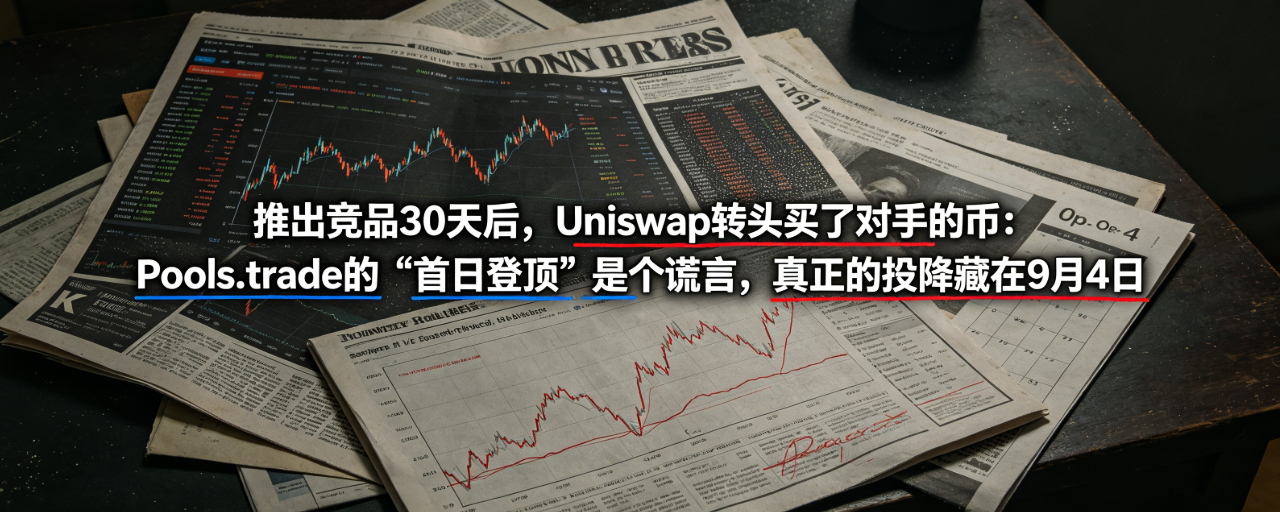
Thirty days after launching a competitor, Uniswap turned around and bought the rival’s coin: Pools.trade’s “first-day top spot” is a lie—the real surrender is hidden in September 4On August 5, Uniswap Labs launched Pools.trade on the Robinhood Chain. With lower fees, it surpassed Pons on its very first day. The market’s interpretation at the time was: “DEX giant personally stepped in to crush this little platform that makes money day and night on memecoin issuance fees.”
On September 4, Uniswap Labs bought PONS tokens. No amount was disclosed, no price was disclosed, and no wallet addresses of holdings were disclosed. There was only one line: “Long-term alignment.”
From “I’m going to take you down” to “I’m investing in you”—only 30 days passed in between.
That’s the most suspicious part of this news: if Pools.trade really won, why did Uniswap still buy the other side’s coin?
Thirty days after launching a competitor, Uniswap turned around and bought the rival’s coin: Pools.trade’s “first-day top spot” is a lie—the real surrender is hidden in September 4
On August 5, Uniswap Labs launched Pools.trade on the Robinhood Chain. With lower fees, it surpassed Pons on its very first day. The market’s interpretation at the time was: “DEX giant personally stepped in to crush this little platform that makes money day and night on memecoin issuance fees.”
On September 4, Uniswap Labs bought PONS tokens. No amount was disclosed, no price was disclosed, and no wallet addresses of holdings were disclosed. There was only one line: “Long-term alignment.”
From “I’m going to take you down” to “I’m investing in you”—only 30 days passed in between.
That’s the most suspicious part of this news: if Pools.trade really won, why did Uniswap still buy the other side’s coin?
On September 4, Uniswap Labs bought PONS tokens. No amount was disclosed, no price was disclosed, and no wallet addresses of holdings were disclosed. There was only one line: “Long-term alignment.”
From “I’m going to take you down” to “I’m investing in you”—only 30 days passed in between.
That’s the most suspicious part of this news: if Pools.trade really won, why did Uniswap still buy the other side’s coin?
265
Verified

Article
Oil Prices Hit $95, and the Market Is “Celebrating” a Fed Rate Hike: Saudi Exports Have Crashed—What’s Truly Been Broken Is the Old Belief That the Central Bank Would Come to the RescueSaudi crude oil exports fell to a 9-year low, with Brent crude trading above $95.
Based on market conditioning over the past twenty years, the next chapter of the story should be: an energy shock → inflation expectations heat up → central bank faces a dilemma over whether to act → markets start betting that the central bank “dares not raise rates” → risk assets get some breathing room.
But the reality in September 2026 is this: on the very day oil prices broke above $95, the market pushed the probability of a September Fed rate hike to 65%.
There’s no pricing for “the central bank will hesitate.” There’s no consensus that under a supply shock, rates traditionally aren’t raised. The moment markets saw energy prices surge, their reaction was—double down on the bet that the Fed will be more hawkish.
Oil Prices Hit $95, and the Market Is “Celebrating” a Fed Rate Hike: Saudi Exports Have Crashed—What’s Truly Been Broken Is the Old Belief That the Central Bank Would Come to the Rescue
Saudi crude oil exports fell to a 9-year low, with Brent crude trading above $95.
Based on market conditioning over the past twenty years, the next chapter of the story should be: an energy shock → inflation expectations heat up → central bank faces a dilemma over whether to act → markets start betting that the central bank “dares not raise rates” → risk assets get some breathing room.
But the reality in September 2026 is this: on the very day oil prices broke above $95, the market pushed the probability of a September Fed rate hike to 65%.
There’s no pricing for “the central bank will hesitate.” There’s no consensus that under a supply shock, rates traditionally aren’t raised. The moment markets saw energy prices surge, their reaction was—double down on the bet that the Fed will be more hawkish.
Based on market conditioning over the past twenty years, the next chapter of the story should be: an energy shock → inflation expectations heat up → central bank faces a dilemma over whether to act → markets start betting that the central bank “dares not raise rates” → risk assets get some breathing room.
But the reality in September 2026 is this: on the very day oil prices broke above $95, the market pushed the probability of a September Fed rate hike to 65%.
There’s no pricing for “the central bank will hesitate.” There’s no consensus that under a supply shock, rates traditionally aren’t raised. The moment markets saw energy prices surge, their reaction was—double down on the bet that the Fed will be more hawkish.
311
Article
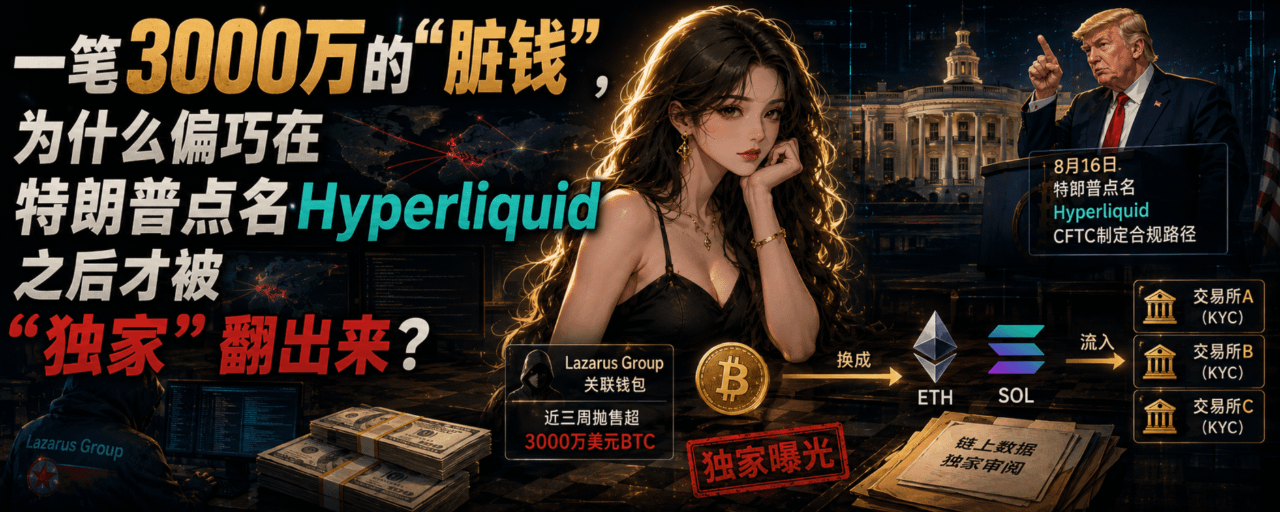
A $30 million “dirty money” trail—why was it “exclusively” unearthed only after Trump specifically mentioned Hyperliquid?In the past 8 hours, a single piece of news has sent the crypto community into an uproar: a wallet linked to North Korea’s Lazarus Group has, over the past three weeks, sold more than $30 million worth of Bitcoin on Hyperliquid, receiving Ethereum and Solana in return, before ultimately ending up in the pockets of several centralized exchanges.
On the surface, this is the usual script for “North Korean hackers laundering money.” But honestly, what really makes me feel something’s off isn’t the laundering itself—it’s the “birth time” of this news.
Pay attention to the relationship between the two timestamps. On August 16, Trump named Hyperliquid from the White House, saying the CFTC chair is drawing up a path to “full compliance, legally,” to bring it into the U.S. market. In early September, an on-chain data company, at the request of a certain long-established crypto media outlet, “exclusively” reviewed the data—and then this news broke. There are several weeks in between. But on-chain data is public; the Lazarus wallets had already been flagged. Anyone can look up this $30 million flow on-chain on any given day.
A $30 million “dirty money” trail—why was it “exclusively” unearthed only after Trump specifically mentioned Hyperliquid?
In the past 8 hours, a single piece of news has sent the crypto community into an uproar: a wallet linked to North Korea’s Lazarus Group has, over the past three weeks, sold more than $30 million worth of Bitcoin on Hyperliquid, receiving Ethereum and Solana in return, before ultimately ending up in the pockets of several centralized exchanges.
On the surface, this is the usual script for “North Korean hackers laundering money.” But honestly, what really makes me feel something’s off isn’t the laundering itself—it’s the “birth time” of this news.
Pay attention to the relationship between the two timestamps. On August 16, Trump named Hyperliquid from the White House, saying the CFTC chair is drawing up a path to “full compliance, legally,” to bring it into the U.S. market. In early September, an on-chain data company, at the request of a certain long-established crypto media outlet, “exclusively” reviewed the data—and then this news broke. There are several weeks in between. But on-chain data is public; the Lazarus wallets had already been flagged. Anyone can look up this $30 million flow on-chain on any given day.
On the surface, this is the usual script for “North Korean hackers laundering money.” But honestly, what really makes me feel something’s off isn’t the laundering itself—it’s the “birth time” of this news.
Pay attention to the relationship between the two timestamps. On August 16, Trump named Hyperliquid from the White House, saying the CFTC chair is drawing up a path to “full compliance, legally,” to bring it into the U.S. market. In early September, an on-chain data company, at the request of a certain long-established crypto media outlet, “exclusively” reviewed the data—and then this news broke. There are several weeks in between. But on-chain data is public; the Lazarus wallets had already been flagged. Anyone can look up this $30 million flow on-chain on any given day.
1
274

Article
Wosh’s hawkish “uncovered exam”: with one non-farm payrolls report, can it force out the Fed’s cards?Over the past week, the world’s financial spotlight has been almost entirely focused on one person—Kevin Wosh, Chair of the U.S. Federal Reserve. Appointed as the new Chair just in May of this year, he completed his policy debut at the Jackson Hole central bank annual symposium at the end of August. He didn’t speak much, but his words carried considerable weight. The market widely interprets this appearance as hawkish: he reiterated the 2% inflation target and said bluntly, “If inflation doesn’t ease clearly and quickly enough, the Fed still has work to do.” He even made the message explicit—what the Fed cares about right now is prices, not anything else.
Wosh’s hawkish “uncovered exam”: with one non-farm payrolls report, can it force out the Fed’s cards?
Over the past week, the world’s financial spotlight has been almost entirely focused on one person—Kevin Wosh, Chair of the U.S. Federal Reserve. Appointed as the new Chair just in May of this year, he completed his policy debut at the Jackson Hole central bank annual symposium at the end of August. He didn’t speak much, but his words carried considerable weight. The market widely interprets this appearance as hawkish: he reiterated the 2% inflation target and said bluntly, “If inflation doesn’t ease clearly and quickly enough, the Fed still has work to do.” He even made the message explicit—what the Fed cares about right now is prices, not anything else.
126

Article
40 Coins and 16 Days: Why Was cirBTC’s “Cold Reception” Re-told Before the Arc Launch?The publication time of a news item is often more worth questioning than its content.
On August 31, 2026, several media outlets reported almost simultaneously the dismal figures for Circle’s packaged Bitcoin cirBTC: on-chain circulating supply is only about 40 coins, yet reserves were overissued to 106%. The reporting styles are highly consistent, the data sources are clear, and the conclusion is unambiguous—“A perfect product loses to network effects.” Judging by the content alone, this is a competent market observation.
But there’s one detail that makes people a bit uncomfortable: cirBTC went live on Ethereum on June 9, 2026—nearly three months ago. A story about “initial launch chills”—why wasn’t it told in June, or July, but instead chosen to be collectively dredged back up on August 31?
40 Coins and 16 Days: Why Was cirBTC’s “Cold Reception” Re-told Before the Arc Launch?
The publication time of a news item is often more worth questioning than its content.
On August 31, 2026, several media outlets reported almost simultaneously the dismal figures for Circle’s packaged Bitcoin cirBTC: on-chain circulating supply is only about 40 coins, yet reserves were overissued to 106%. The reporting styles are highly consistent, the data sources are clear, and the conclusion is unambiguous—“A perfect product loses to network effects.” Judging by the content alone, this is a competent market observation.
But there’s one detail that makes people a bit uncomfortable: cirBTC went live on Ethereum on June 9, 2026—nearly three months ago. A story about “initial launch chills”—why wasn’t it told in June, or July, but instead chosen to be collectively dredged back up on August 31?
On August 31, 2026, several media outlets reported almost simultaneously the dismal figures for Circle’s packaged Bitcoin cirBTC: on-chain circulating supply is only about 40 coins, yet reserves were overissued to 106%. The reporting styles are highly consistent, the data sources are clear, and the conclusion is unambiguous—“A perfect product loses to network effects.” Judging by the content alone, this is a competent market observation.
But there’s one detail that makes people a bit uncomfortable: cirBTC went live on Ethereum on June 9, 2026—nearly three months ago. A story about “initial launch chills”—why wasn’t it told in June, or July, but instead chosen to be collectively dredged back up on August 31?
124
Article
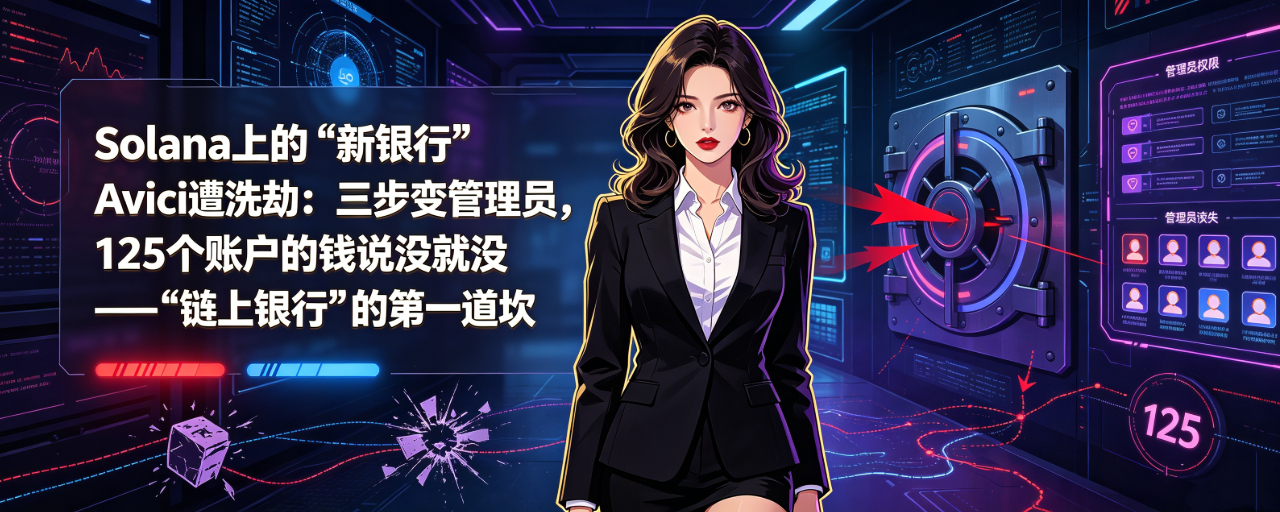
On Solana, “new bank” Avici gets looted: three steps to become an administrator—money from 125 accounts just disappears—the first hurdle for an “on-chain bank”The most ironic part of this news is that the attacker didn’t even use any advanced technology. Three steps—just three steps—and a “bank’s” collateral management authority was handed over to him.
On August 28, Avici, a Solana-based “on-chain new bank,” confirmed that it had been breached. Preliminary estimates place the losses between $600,000 and $1.02 million, affecting 125 user accounts. Its native token, AVICI, fell by about 39% in a day, and its current price is now down 96% from its all-time high. But behind these numbers, the real question is this: how could a project that controls other people’s card balances be so simply “upgraded” into giving an administrator access?
On Solana, “new bank” Avici gets looted: three steps to become an administrator—money from 125 accounts just disappears—the first hurdle for an “on-chain bank”
The most ironic part of this news is that the attacker didn’t even use any advanced technology. Three steps—just three steps—and a “bank’s” collateral management authority was handed over to him.
On August 28, Avici, a Solana-based “on-chain new bank,” confirmed that it had been breached. Preliminary estimates place the losses between $600,000 and $1.02 million, affecting 125 user accounts. Its native token, AVICI, fell by about 39% in a day, and its current price is now down 96% from its all-time high. But behind these numbers, the real question is this: how could a project that controls other people’s card balances be so simply “upgraded” into giving an administrator access?
On August 28, Avici, a Solana-based “on-chain new bank,” confirmed that it had been breached. Preliminary estimates place the losses between $600,000 and $1.02 million, affecting 125 user accounts. Its native token, AVICI, fell by about 39% in a day, and its current price is now down 96% from its all-time high. But behind these numbers, the real question is this: how could a project that controls other people’s card balances be so simply “upgraded” into giving an administrator access?
158

Article
The U.S. puts “digital assets” into a sanctions order, but deliberately draws no boundaries: will decentralized infrastructure be the next target?On August 24, the U.S. Treasury launched a new round of sanctions against Iran, officially called “Economic Isolation Actions.” Treasury Secretary Bessent’s wording was very tough, saying they would “cut off all economic lifelines supporting this despotic regime.” What really has the crypto industry on edge is that this time, unusually, “digital assets” were also included within the scope of the sanctions.
But here’s the question: who exactly is being sanctioned? Is it Iran’s exchanges and money brokers—or the decentralized infrastructure that has no center, no KYC, and no address book? The Treasury didn’t say.
This “didn’t say,” is precisely the most dangerous part of the whole affair.
The U.S. puts “digital assets” into a sanctions order, but deliberately draws no boundaries: will decentralized infrastructure be the next target?
On August 24, the U.S. Treasury launched a new round of sanctions against Iran, officially called “Economic Isolation Actions.” Treasury Secretary Bessent’s wording was very tough, saying they would “cut off all economic lifelines supporting this despotic regime.” What really has the crypto industry on edge is that this time, unusually, “digital assets” were also included within the scope of the sanctions.
But here’s the question: who exactly is being sanctioned? Is it Iran’s exchanges and money brokers—or the decentralized infrastructure that has no center, no KYC, and no address book? The Treasury didn’t say.
This “didn’t say,” is precisely the most dangerous part of the whole affair.
But here’s the question: who exactly is being sanctioned? Is it Iran’s exchanges and money brokers—or the decentralized infrastructure that has no center, no KYC, and no address book? The Treasury didn’t say.
This “didn’t say,” is precisely the most dangerous part of the whole affair.
114

Article
Mirae Asset Korea splashes $109B: backed by $1.1T in client assets—will 2027 profits be a countdown or a tightening spell?In the past 8 hours, the crypto news worth taking a second look at isn’t found in trading volume or price—but in the deeper layers of the capital landscape. According to a report by the Korea Times, Mirae Asset Financial Group plans to build a digital asset business with a scale of up to 150 trillion won (about $109 billion), using its crypto business platform, Digital X, as the core. This isn’t an ordinary investment—it’s more like a giant has formally added “digital assets” to the checklist of engines driving its profits.
The significance of this news lies in the fact that it comes from a traditional financial institution you may not have heard of much, yet with astonishing scale: Mirae Asset Group holds more than 1,500 trillion won (about $1.1 trillion) in customer assets, making it one of the largest financial groups in South Korea. When an institution of this magnitude places crypto assets, stablecoins, RWA, and security tokens all into its strategic blueprint, how could that be compared to any single exchange listing some token?
Mirae Asset Korea splashes $109B: backed by $1.1T in client assets—will 2027 profits be a countdown or a tightening spell?
In the past 8 hours, the crypto news worth taking a second look at isn’t found in trading volume or price—but in the deeper layers of the capital landscape. According to a report by the Korea Times, Mirae Asset Financial Group plans to build a digital asset business with a scale of up to 150 trillion won (about $109 billion), using its crypto business platform, Digital X, as the core. This isn’t an ordinary investment—it’s more like a giant has formally added “digital assets” to the checklist of engines driving its profits.
The significance of this news lies in the fact that it comes from a traditional financial institution you may not have heard of much, yet with astonishing scale: Mirae Asset Group holds more than 1,500 trillion won (about $1.1 trillion) in customer assets, making it one of the largest financial groups in South Korea. When an institution of this magnitude places crypto assets, stablecoins, RWA, and security tokens all into its strategic blueprint, how could that be compared to any single exchange listing some token?
The significance of this news lies in the fact that it comes from a traditional financial institution you may not have heard of much, yet with astonishing scale: Mirae Asset Group holds more than 1,500 trillion won (about $1.1 trillion) in customer assets, making it one of the largest financial groups in South Korea. When an institution of this magnitude places crypto assets, stablecoins, RWA, and security tokens all into its strategic blueprint, how could that be compared to any single exchange listing some token?
281
Article
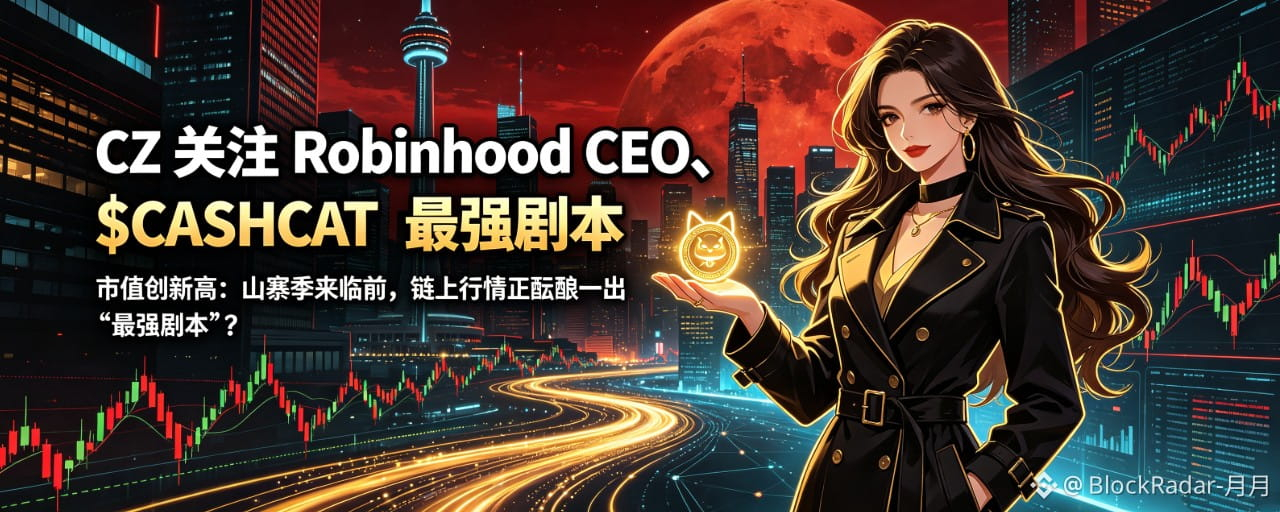
CZ Follows Robinhood CEO and $CASHCAT Hits a New Market Cap High: Before the Altcoin Season Arrives, On-Chain Markets Are Brewing a “Strongest Script”?Over the past 8 hours, while the big cake side has been cooling down after the frenzy, the on-chain side carries a different kind of flavor: opportunities really are more abundant, but what truly excites the old hands is probably still just the prelude.
Today, the leading holding token on the Robinhood chain, CASHCAT, has touched a market cap of $240 million, setting a new all-time high. At the same time, one move has ignited the imagination across the entire line: Binance founder CZ followed Robinhood’s CEO Vlad yesterday, and Vlad turned around to comment on a tweet from Musk about Mars—ending with a single line: “See you on Mars.” On one side, the US stock meme narrative is being positively affirmed by both Robinhood and CZ; on the other, unprecedented interaction signals have appeared between two top platforms. It’s hard not to wonder: next, will Binance and Robinhood open up mutual pathways for listing tokens?
CZ Follows Robinhood CEO and $CASHCAT Hits a New Market Cap High: Before the Altcoin Season Arrives, On-Chain Markets Are Brewing a “Strongest Script”?
Over the past 8 hours, while the big cake side has been cooling down after the frenzy, the on-chain side carries a different kind of flavor: opportunities really are more abundant, but what truly excites the old hands is probably still just the prelude.
Today, the leading holding token on the Robinhood chain, CASHCAT, has touched a market cap of $240 million, setting a new all-time high. At the same time, one move has ignited the imagination across the entire line: Binance founder CZ followed Robinhood’s CEO Vlad yesterday, and Vlad turned around to comment on a tweet from Musk about Mars—ending with a single line: “See you on Mars.” On one side, the US stock meme narrative is being positively affirmed by both Robinhood and CZ; on the other, unprecedented interaction signals have appeared between two top platforms. It’s hard not to wonder: next, will Binance and Robinhood open up mutual pathways for listing tokens?
Today, the leading holding token on the Robinhood chain, CASHCAT, has touched a market cap of $240 million, setting a new all-time high. At the same time, one move has ignited the imagination across the entire line: Binance founder CZ followed Robinhood’s CEO Vlad yesterday, and Vlad turned around to comment on a tweet from Musk about Mars—ending with a single line: “See you on Mars.” On one side, the US stock meme narrative is being positively affirmed by both Robinhood and CZ; on the other, unprecedented interaction signals have appeared between two top platforms. It’s hard not to wonder: next, will Binance and Robinhood open up mutual pathways for listing tokens?
233
Last night I整理 @Dusk_Foundation ’s partner roster and wanted to find licensed institutions outside Europe. I found that, in addition to NPEX, 21X, and Quantoz, Italy’s PlayMatika and Betpassion have also integrated with DuskPay—but they still fall within the EU. This geographical concentration made me pause for a long time before even getting to the table. I originally just wanted to map commercial progress, but I was pulled into a more fundamental issue: a chain that claims to be “global financial infrastructure” has, for now, only dug its compliance moat in Europe.
On the surface, Dusk is a privacy-compliant public chain. But the more I looked, the more it felt like its true core is a “digital mirror” of European financial regulation. Terms like MiCA, DLT Pilot, and MiFID II form the entire narrative foundation of Dusk. NPEX’s Dutch license, 21X’s DLT-TSS, and EURQ’s MiCA compliance—each one precisely corresponds to an EU regulation. Chainlink and Cordial Systems bring globalized technology and custody partnerships, but they are not licensed financial institutions, so they can’t replace the real barrier of licensing. The design is airtight in Brussels, but once you leave the EU, every license has to be recreated from scratch. #dusk
What makes me cautious is this: Europe’s compliance advantage is a moat within Europe, but outside Europe it could turn into a wall. The U.S. has the SEC and CFTC, and Asia has its own regulatory frameworks. If Dusk wants to enter those markets, it can’t simply reuse the EU compliance playbook—it has to rebuild the legal framework from the ground up and renegotiate licenses. And the center of gravity of global capital markets clearly isn’t in Europe—U.S. stocks, Asian bonds, Middle Eastern sovereign funds, all far beyond the scope Dusk can currently reach. Even more subtly, the privacy design depth of $DUSK is tightly bound to Europe’s data protection traditions; in other jurisdictions that may not be a positive, and sometimes it even requires additional explanation.
What I’m watching now is whether Dusk can abstract Europe’s compliance experience into a reusable technical architecture—so that licensed institutions elsewhere can integrate as quickly as plugging into a protocol, rather than having to go through an entirely new round of legal customization every time they enter a new jurisdiction. What I truly care about isn’t NPEX’s short-term €300M assets, but in the long run whether DUSK’s network effects can break out of Europe, or whether it will ultimately be trapped in a fortress of “the strictest compliance, but insufficient capital depth.”
Last night I整理 @Dusk ’s partner roster and wanted to find licensed institutions outside Europe. I found that, in addition to NPEX, 21X, and Quantoz, Italy’s PlayMatika and Betpassion have also integrated with DuskPay—but they still fall within the EU. This geographical concentration made me pause for a long time before even getting to the table. I originally just wanted to map commercial progress, but I was pulled into a more fundamental issue: a chain that claims to be “global financial infrastructure” has, for now, only dug its compliance moat in Europe.
On the surface, Dusk is a privacy-compliant public chain. But the more I looked, the more it felt like its true core is a “digital mirror” of European financial regulation. Terms like MiCA, DLT Pilot, and MiFID II form the entire narrative foundation of Dusk. NPEX’s Dutch license, 21X’s DLT-TSS, and EURQ’s MiCA compliance—each one precisely corresponds to an EU regulation. Chainlink and Cordial Systems bring globalized technology and custody partnerships, but they are not licensed financial institutions, so they can’t replace the real barrier of licensing. The design is airtight in Brussels, but once you leave the EU, every license has to be recreated from scratch. #dusk
What makes me cautious is this: Europe’s compliance advantage is a moat within Europe, but outside Europe it could turn into a wall. The U.S. has the SEC and CFTC, and Asia has its own regulatory frameworks. If Dusk wants to enter those markets, it can’t simply reuse the EU compliance playbook—it has to rebuild the legal framework from the ground up and renegotiate licenses. And the center of gravity of global capital markets clearly isn’t in Europe—U.S. stocks, Asian bonds, Middle Eastern sovereign funds, all far beyond the scope Dusk can currently reach. Even more subtly, the privacy design depth of $DUSK is tightly bound to Europe’s data protection traditions; in other jurisdictions that may not be a positive, and sometimes it even requires additional explanation.
What I’m watching now is whether Dusk can abstract Europe’s compliance experience into a reusable technical architecture—so that licensed institutions elsewhere can integrate as quickly as plugging into a protocol, rather than having to go through an entirely new round of legal customization every time they enter a new jurisdiction. What I truly care about isn’t NPEX’s short-term €300M assets, but in the long run whether DUSK’s network effects can break out of Europe, or whether it will ultimately be trapped in a fortress of “the strictest compliance, but insufficient capital depth.”
On the surface, Dusk is a privacy-compliant public chain. But the more I looked, the more it felt like its true core is a “digital mirror” of European financial regulation. Terms like MiCA, DLT Pilot, and MiFID II form the entire narrative foundation of Dusk. NPEX’s Dutch license, 21X’s DLT-TSS, and EURQ’s MiCA compliance—each one precisely corresponds to an EU regulation. Chainlink and Cordial Systems bring globalized technology and custody partnerships, but they are not licensed financial institutions, so they can’t replace the real barrier of licensing. The design is airtight in Brussels, but once you leave the EU, every license has to be recreated from scratch. #dusk
What makes me cautious is this: Europe’s compliance advantage is a moat within Europe, but outside Europe it could turn into a wall. The U.S. has the SEC and CFTC, and Asia has its own regulatory frameworks. If Dusk wants to enter those markets, it can’t simply reuse the EU compliance playbook—it has to rebuild the legal framework from the ground up and renegotiate licenses. And the center of gravity of global capital markets clearly isn’t in Europe—U.S. stocks, Asian bonds, Middle Eastern sovereign funds, all far beyond the scope Dusk can currently reach. Even more subtly, the privacy design depth of $DUSK is tightly bound to Europe’s data protection traditions; in other jurisdictions that may not be a positive, and sometimes it even requires additional explanation.
What I’m watching now is whether Dusk can abstract Europe’s compliance experience into a reusable technical architecture—so that licensed institutions elsewhere can integrate as quickly as plugging into a protocol, rather than having to go through an entirely new round of legal customization every time they enter a new jurisdiction. What I truly care about isn’t NPEX’s short-term €300M assets, but in the long run whether DUSK’s network effects can break out of Europe, or whether it will ultimately be trapped in a fortress of “the strictest compliance, but insufficient capital depth.”

119
Article
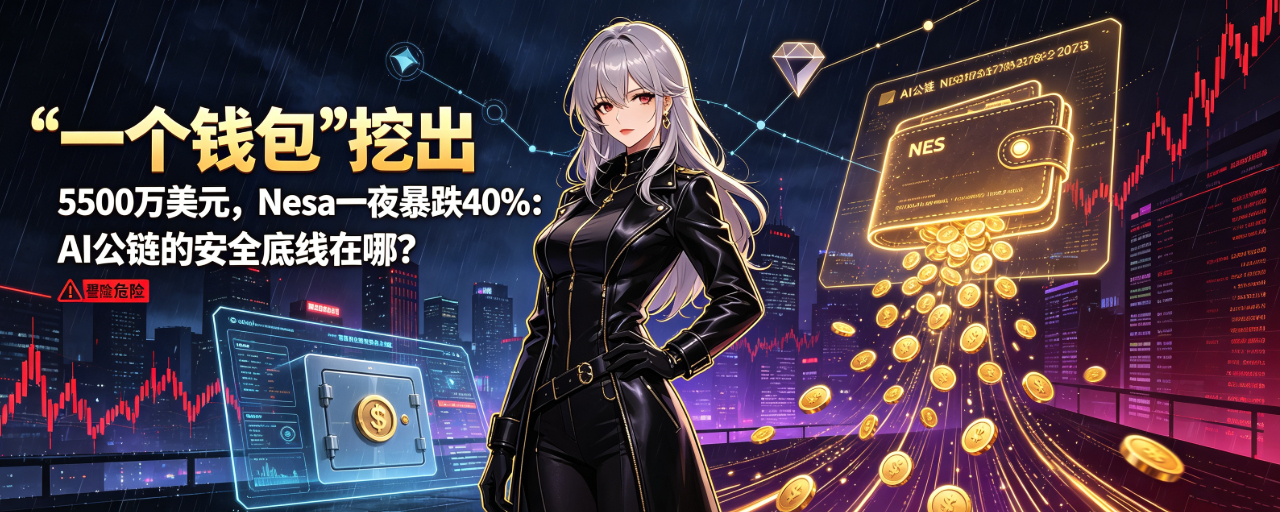
A wallet “mined” $55 million: Nesa crashes 40% overnight—where is the security baseline for an AI public chain?In the past 8 hours, the most hair-raising news in the crypto world is the collapse of an AI-related token. After Nesa’s token NES detected suspicious on-chain activity and large-scale sell-offs, its price plunged by as much as 40%. On-chain observers found that a certain wallet address had “mined” NES worth about $55 million, and then began dumping it on a decentralized exchange. To make matters worse, this address is still holding around $18 million worth of NES, and the selling pressure likely isn’t over yet.
If it were just a typical low-quality altcoin getting dumped, that would be nothing unusual. But considering it has already been listed on multiple mainstream exchanges, and the DeAI (decentralized AI) track is currently red-hot, this incident becomes a cautionary tale worth revisiting again and again.
A wallet “mined” $55 million: Nesa crashes 40% overnight—where is the security baseline for an AI public chain?
In the past 8 hours, the most hair-raising news in the crypto world is the collapse of an AI-related token. After Nesa’s token NES detected suspicious on-chain activity and large-scale sell-offs, its price plunged by as much as 40%. On-chain observers found that a certain wallet address had “mined” NES worth about $55 million, and then began dumping it on a decentralized exchange. To make matters worse, this address is still holding around $18 million worth of NES, and the selling pressure likely isn’t over yet.
If it were just a typical low-quality altcoin getting dumped, that would be nothing unusual. But considering it has already been listed on multiple mainstream exchanges, and the DeAI (decentralized AI) track is currently red-hot, this incident becomes a cautionary tale worth revisiting again and again.
If it were just a typical low-quality altcoin getting dumped, that would be nothing unusual. But considering it has already been listed on multiple mainstream exchanges, and the DeAI (decentralized AI) track is currently red-hot, this incident becomes a cautionary tale worth revisiting again and again.
2
2
783
Last night I opened the developer documentation for @Dusk_Foundation , looking for a beginner path for a third-party developer. In “Start here,” the official guidance recommends deploying contracts and bridging assets. But within the same set of docs, I also noticed entry points for products like Dusk Trade, Dusk Wallet, and Dusk Pay. I originally just wanted to see how external teams would integrate, but the setup of “the official team building an application layer themselves” really caught my attention, and I ended up getting absorbed for a long time.
On the surface, $DUSK is a privacy-compliant chain. But the more I looked, the more it seemed less like a pure chain and more like a case of vertical integration where the boundary between “protocol” and “application layer” is deliberately blurred: it not only provides the DuskDS consensus and the DuskEVM execution environment, but also personally steps in to build a trading platform, a wallet, and payment. The official documentation positions these products as “application layer sitting on top of the protocol,” and the protocol itself still emphasizes openness. DuskEVM is compatible with standard Solidity tooling, and Dusk Connect supports multi-wallet integration. But in practice, the official applications and the underlying protocol are being driven by the same entity—so the boundaries are far more blurred than the wording suggests.
What makes me cautious, though, is this: in the cold-start phase, vertical integration can indeed help quickly get the workflow running and give institutions an “out-of-the-box” demonstration. The ecosystem already has community projects such as Sozu staking, Pieswap DEX, and Dusk Domains, which suggests that third-party entry points aren’t completely closed. However, Dusk Trade and Dusk Pay are still in a pre-release or waitlist stage and haven’t truly begun large-scale operations yet. So it’s too early to claim that they have already secured an “official endorsement” position. What I keep thinking about is whether, in the long run, third-party developers will still have enough motivation to build alongside official products—rather than assuming that the official apps will inevitably receive priority access to NPEX licensing resources and liquidity entry points. This is only a reasonable hypothesis for now, not a confirmed hard priority.#dusk
So what I want to observe now is: once Dusk Trade and Dusk Pay truly go live, can Dusk transition from “officially demonstrated” to “a thriving third-party ecosystem”? I’m not primarily concerned with whether the official applications themselves can succeed. What I care about is whether, in the long term, the value of the DUSK token can be jointly grown by an open application ecosystem—rather than ultimately converging into “internal fuel” for just a few official products.
Last night I opened the developer documentation for @Dusk , looking for a beginner path for a third-party developer. In “Start here,” the official guidance recommends deploying contracts and bridging assets. But within the same set of docs, I also noticed entry points for products like Dusk Trade, Dusk Wallet, and Dusk Pay. I originally just wanted to see how external teams would integrate, but the setup of “the official team building an application layer themselves” really caught my attention, and I ended up getting absorbed for a long time.
On the surface, $DUSK is a privacy-compliant chain. But the more I looked, the more it seemed less like a pure chain and more like a case of vertical integration where the boundary between “protocol” and “application layer” is deliberately blurred: it not only provides the DuskDS consensus and the DuskEVM execution environment, but also personally steps in to build a trading platform, a wallet, and payment. The official documentation positions these products as “application layer sitting on top of the protocol,” and the protocol itself still emphasizes openness. DuskEVM is compatible with standard Solidity tooling, and Dusk Connect supports multi-wallet integration. But in practice, the official applications and the underlying protocol are being driven by the same entity—so the boundaries are far more blurred than the wording suggests.
What makes me cautious, though, is this: in the cold-start phase, vertical integration can indeed help quickly get the workflow running and give institutions an “out-of-the-box” demonstration. The ecosystem already has community projects such as Sozu staking, Pieswap DEX, and Dusk Domains, which suggests that third-party entry points aren’t completely closed. However, Dusk Trade and Dusk Pay are still in a pre-release or waitlist stage and haven’t truly begun large-scale operations yet. So it’s too early to claim that they have already secured an “official endorsement” position. What I keep thinking about is whether, in the long run, third-party developers will still have enough motivation to build alongside official products—rather than assuming that the official apps will inevitably receive priority access to NPEX licensing resources and liquidity entry points. This is only a reasonable hypothesis for now, not a confirmed hard priority.#dusk
So what I want to observe now is: once Dusk Trade and Dusk Pay truly go live, can Dusk transition from “officially demonstrated” to “a thriving third-party ecosystem”? I’m not primarily concerned with whether the official applications themselves can succeed. What I care about is whether, in the long term, the value of the DUSK token can be jointly grown by an open application ecosystem—rather than ultimately converging into “internal fuel” for just a few official products.
On the surface, $DUSK is a privacy-compliant chain. But the more I looked, the more it seemed less like a pure chain and more like a case of vertical integration where the boundary between “protocol” and “application layer” is deliberately blurred: it not only provides the DuskDS consensus and the DuskEVM execution environment, but also personally steps in to build a trading platform, a wallet, and payment. The official documentation positions these products as “application layer sitting on top of the protocol,” and the protocol itself still emphasizes openness. DuskEVM is compatible with standard Solidity tooling, and Dusk Connect supports multi-wallet integration. But in practice, the official applications and the underlying protocol are being driven by the same entity—so the boundaries are far more blurred than the wording suggests.
What makes me cautious, though, is this: in the cold-start phase, vertical integration can indeed help quickly get the workflow running and give institutions an “out-of-the-box” demonstration. The ecosystem already has community projects such as Sozu staking, Pieswap DEX, and Dusk Domains, which suggests that third-party entry points aren’t completely closed. However, Dusk Trade and Dusk Pay are still in a pre-release or waitlist stage and haven’t truly begun large-scale operations yet. So it’s too early to claim that they have already secured an “official endorsement” position. What I keep thinking about is whether, in the long run, third-party developers will still have enough motivation to build alongside official products—rather than assuming that the official apps will inevitably receive priority access to NPEX licensing resources and liquidity entry points. This is only a reasonable hypothesis for now, not a confirmed hard priority.#dusk
So what I want to observe now is: once Dusk Trade and Dusk Pay truly go live, can Dusk transition from “officially demonstrated” to “a thriving third-party ecosystem”? I’m not primarily concerned with whether the official applications themselves can succeed. What I care about is whether, in the long term, the value of the DUSK token can be jointly grown by an open application ecosystem—rather than ultimately converging into “internal fuel” for just a few official products.

1
1
118

Article
No code was broken line by line—yet $8.5 million was still stolen: did the governance flaw in Term Finance rip open DeFi’s most expensive wound?If last week’s crypto world was still intoxicated by the euphoria of “currency devaluation trading,” then this news is the cold, shadowy side behind the celebration. On August 23, a Sunday, the fixed-rate lending protocol Term Finance on Ethereum suffered a governance attack, and the strategy vault was drained of roughly $8.5 million. Afterward, security firms PeckShield and CertiK estimated that the attacker withdrew about 2,843 ETH—worth about $6.9 million at the time—along with 1.68 million USDC. The attacker then swapped the USDC into roughly 1.68 million DAI. Nearly two-thirds of the vault’s locked value evaporated overnight.
No code was broken line by line—yet $8.5 million was still stolen: did the governance flaw in Term Finance rip open DeFi’s most expensive wound?
If last week’s crypto world was still intoxicated by the euphoria of “currency devaluation trading,” then this news is the cold, shadowy side behind the celebration. On August 23, a Sunday, the fixed-rate lending protocol Term Finance on Ethereum suffered a governance attack, and the strategy vault was drained of roughly $8.5 million. Afterward, security firms PeckShield and CertiK estimated that the attacker withdrew about 2,843 ETH—worth about $6.9 million at the time—along with 1.68 million USDC. The attacker then swapped the USDC into roughly 1.68 million DAI. Nearly two-thirds of the vault’s locked value evaporated overnight.
205
Last night I opened the staking page for @Dusk_Foundation , and my original intention was simply to see what exactly the node was earning. The number of nodes, staking ratio, and annualized yield all looked decent enough. But when I clicked into “revenue sources” to confirm whether the rewards came from transaction fees or newly issued tokens, the official explanation only said “staking rewards” in four words, with no further breakdown. That blank space made me pause a little longer.
On the surface, Dusk is a privacy-compliant public chain, but the more I look at it, the more its current core feels like a transitional state: hiring security through token inflation, then using a security narrative to attract institutions, while institutions still haven’t really paid. The DuskDS mainnet has been running for about one year and seven months. Nodes do receive rewards, but the DuskEVM that would actually generate fee revenue is still on testnet. Each block reward equals newly issued DUSK plus all transaction fees in that block. In the current Stage 1, about 19.86 units of $DUSK are issued per block, and on-chain transactions over 24 hours are usually only a hundred or two, making fees so small they can be ignored. Staking yield is supported almost entirely by inflation.
What really made me wary is that inflation is not free security; it simply spreads the cost back across all token holders. The new coins received by stakers actually dilute the share of those who do not stake. It is like a restaurant with no customers yet using stored-value card money to pay the staff, while the balance in the card quietly shrinks. Just because the technology works does not mean the economics are healthy.
The official team is clearly aware of this, so they designed halvings every four years, with a plan to continue for 36 years and issue a total of 500 million coins. The early high inflation is packaged as “startup subsidies,” and the logic makes sense, but the premise is that transaction fees must rise enough within four years to take over. Otherwise, after the second-stage halving, node revenue will drop sharply, and either the security budget will shrink or the parameters will have to be adjusted. In essence, it is a race against time. #dusk
So now what I want to see more is whether, once DuskEVM באמת starts handling institutional transactions, the source of DUSK staking rewards can shift from being mainly “token issuance” to being mainly “transaction fees.” What I really care about is not how high the node’s annual yield is, but whether the subsidy from each four-year halving can last long enough to meet real economic activity before it runs out, so that the security mechanism can evolve from an “inflation engine” into an income system supported by real settlement.
Last night I opened the staking page for @Dusk , and my original intention was simply to see what exactly the node was earning. The number of nodes, staking ratio, and annualized yield all looked decent enough. But when I clicked into “revenue sources” to confirm whether the rewards came from transaction fees or newly issued tokens, the official explanation only said “staking rewards” in four words, with no further breakdown. That blank space made me pause a little longer.
On the surface, Dusk is a privacy-compliant public chain, but the more I look at it, the more its current core feels like a transitional state: hiring security through token inflation, then using a security narrative to attract institutions, while institutions still haven’t really paid. The DuskDS mainnet has been running for about one year and seven months. Nodes do receive rewards, but the DuskEVM that would actually generate fee revenue is still on testnet. Each block reward equals newly issued DUSK plus all transaction fees in that block. In the current Stage 1, about 19.86 units of $DUSK are issued per block, and on-chain transactions over 24 hours are usually only a hundred or two, making fees so small they can be ignored. Staking yield is supported almost entirely by inflation.
What really made me wary is that inflation is not free security; it simply spreads the cost back across all token holders. The new coins received by stakers actually dilute the share of those who do not stake. It is like a restaurant with no customers yet using stored-value card money to pay the staff, while the balance in the card quietly shrinks. Just because the technology works does not mean the economics are healthy.
The official team is clearly aware of this, so they designed halvings every four years, with a plan to continue for 36 years and issue a total of 500 million coins. The early high inflation is packaged as “startup subsidies,” and the logic makes sense, but the premise is that transaction fees must rise enough within four years to take over. Otherwise, after the second-stage halving, node revenue will drop sharply, and either the security budget will shrink or the parameters will have to be adjusted. In essence, it is a race against time. #dusk
So now what I want to see more is whether, once DuskEVM באמת starts handling institutional transactions, the source of DUSK staking rewards can shift from being mainly “token issuance” to being mainly “transaction fees.” What I really care about is not how high the node’s annual yield is, but whether the subsidy from each four-year halving can last long enough to meet real economic activity before it runs out, so that the security mechanism can evolve from an “inflation engine” into an income system supported by real settlement.
On the surface, Dusk is a privacy-compliant public chain, but the more I look at it, the more its current core feels like a transitional state: hiring security through token inflation, then using a security narrative to attract institutions, while institutions still haven’t really paid. The DuskDS mainnet has been running for about one year and seven months. Nodes do receive rewards, but the DuskEVM that would actually generate fee revenue is still on testnet. Each block reward equals newly issued DUSK plus all transaction fees in that block. In the current Stage 1, about 19.86 units of $DUSK are issued per block, and on-chain transactions over 24 hours are usually only a hundred or two, making fees so small they can be ignored. Staking yield is supported almost entirely by inflation.
What really made me wary is that inflation is not free security; it simply spreads the cost back across all token holders. The new coins received by stakers actually dilute the share of those who do not stake. It is like a restaurant with no customers yet using stored-value card money to pay the staff, while the balance in the card quietly shrinks. Just because the technology works does not mean the economics are healthy.
The official team is clearly aware of this, so they designed halvings every four years, with a plan to continue for 36 years and issue a total of 500 million coins. The early high inflation is packaged as “startup subsidies,” and the logic makes sense, but the premise is that transaction fees must rise enough within four years to take over. Otherwise, after the second-stage halving, node revenue will drop sharply, and either the security budget will shrink or the parameters will have to be adjusted. In essence, it is a race against time. #dusk
So now what I want to see more is whether, once DuskEVM באמת starts handling institutional transactions, the source of DUSK staking rewards can shift from being mainly “token issuance” to being mainly “transaction fees.” What I really care about is not how high the node’s annual yield is, but whether the subsidy from each four-year halving can last long enough to meet real economic activity before it runs out, so that the security mechanism can evolve from an “inflation engine” into an income system supported by real settlement.

153
Last night I opened the block explorer for @Dusk_Foundation and saw that the mainnet block height has already surpassed 3.28 million. I originally just wanted to check the uptime, but I got stuck on the number “3.28 million.” What exactly is stored in those blocks? The further I scroll down, the more I feel that this number is worth questioning more than any roadmap.
Many people view Dusk as a compliant privacy chain, or buy into the RWA narrative. But now I’m more inclined to think that its true core is a peculiar structure that “separates block production from economic activity”: the underlying DuskDS has been producing blocks stably for more than a year and a half, and consensus and node operations are fine. However, DuskEVM—the piece that actually carries institutional business—is still on the testnet; the Hedger is still in alpha; and Dusk Trade is still on the waitlist. Out of those 3.28 million blocks, how many are staking, transfers, internal testing—and how many involve the real circulation of licensed assets? The official hasn’t disclosed the structure, and that makes me uneasy. #dusk
What makes me cautious here is this: block height has never equaled economic depth. A chain can keep producing blocks thanks to nodes and staking, yet for a long time have no real external transaction demand. Technical soundness doesn’t mean the market exists. What I keep thinking about is that DuskDS’s private transactions, Moonlight’s public trading, and staking all exist—but if on-chain activity is heavily concentrated in staking and internal transfers, then the token value of $DUSK will still be tethered to “block production itself,” rather than to “what is actually put inside the blocks.”
So what I want to observe now is whether, after DuskEVM goes live on mainnet, the composition of transactions in the block explorer will change in a clear way. What I truly care about isn’t how fast the number 3.28 million can grow, but whether, in the long run, DUSK’s gas consumption can shift from “nodes and testing” to “real settlement by licensed institutions,” so that block height finally starts to reflect the density of economic activity, rather than merely proving that a chain is still alive.
Last night I opened the block explorer for @Dusk and saw that the mainnet block height has already surpassed 3.28 million. I originally just wanted to check the uptime, but I got stuck on the number “3.28 million.” What exactly is stored in those blocks? The further I scroll down, the more I feel that this number is worth questioning more than any roadmap.
Many people view Dusk as a compliant privacy chain, or buy into the RWA narrative. But now I’m more inclined to think that its true core is a peculiar structure that “separates block production from economic activity”: the underlying DuskDS has been producing blocks stably for more than a year and a half, and consensus and node operations are fine. However, DuskEVM—the piece that actually carries institutional business—is still on the testnet; the Hedger is still in alpha; and Dusk Trade is still on the waitlist. Out of those 3.28 million blocks, how many are staking, transfers, internal testing—and how many involve the real circulation of licensed assets? The official hasn’t disclosed the structure, and that makes me uneasy. #dusk
What makes me cautious here is this: block height has never equaled economic depth. A chain can keep producing blocks thanks to nodes and staking, yet for a long time have no real external transaction demand. Technical soundness doesn’t mean the market exists. What I keep thinking about is that DuskDS’s private transactions, Moonlight’s public trading, and staking all exist—but if on-chain activity is heavily concentrated in staking and internal transfers, then the token value of $DUSK will still be tethered to “block production itself,” rather than to “what is actually put inside the blocks.”
So what I want to observe now is whether, after DuskEVM goes live on mainnet, the composition of transactions in the block explorer will change in a clear way. What I truly care about isn’t how fast the number 3.28 million can grow, but whether, in the long run, DUSK’s gas consumption can shift from “nodes and testing” to “real settlement by licensed institutions,” so that block height finally starts to reflect the density of economic activity, rather than merely proving that a chain is still alive.
Many people view Dusk as a compliant privacy chain, or buy into the RWA narrative. But now I’m more inclined to think that its true core is a peculiar structure that “separates block production from economic activity”: the underlying DuskDS has been producing blocks stably for more than a year and a half, and consensus and node operations are fine. However, DuskEVM—the piece that actually carries institutional business—is still on the testnet; the Hedger is still in alpha; and Dusk Trade is still on the waitlist. Out of those 3.28 million blocks, how many are staking, transfers, internal testing—and how many involve the real circulation of licensed assets? The official hasn’t disclosed the structure, and that makes me uneasy. #dusk
What makes me cautious here is this: block height has never equaled economic depth. A chain can keep producing blocks thanks to nodes and staking, yet for a long time have no real external transaction demand. Technical soundness doesn’t mean the market exists. What I keep thinking about is that DuskDS’s private transactions, Moonlight’s public trading, and staking all exist—but if on-chain activity is heavily concentrated in staking and internal transfers, then the token value of $DUSK will still be tethered to “block production itself,” rather than to “what is actually put inside the blocks.”
So what I want to observe now is whether, after DuskEVM goes live on mainnet, the composition of transactions in the block explorer will change in a clear way. What I truly care about isn’t how fast the number 3.28 million can grow, but whether, in the long run, DUSK’s gas consumption can shift from “nodes and testing” to “real settlement by licensed institutions,” so that block height finally starts to reflect the density of economic activity, rather than merely proving that a chain is still alive.

136
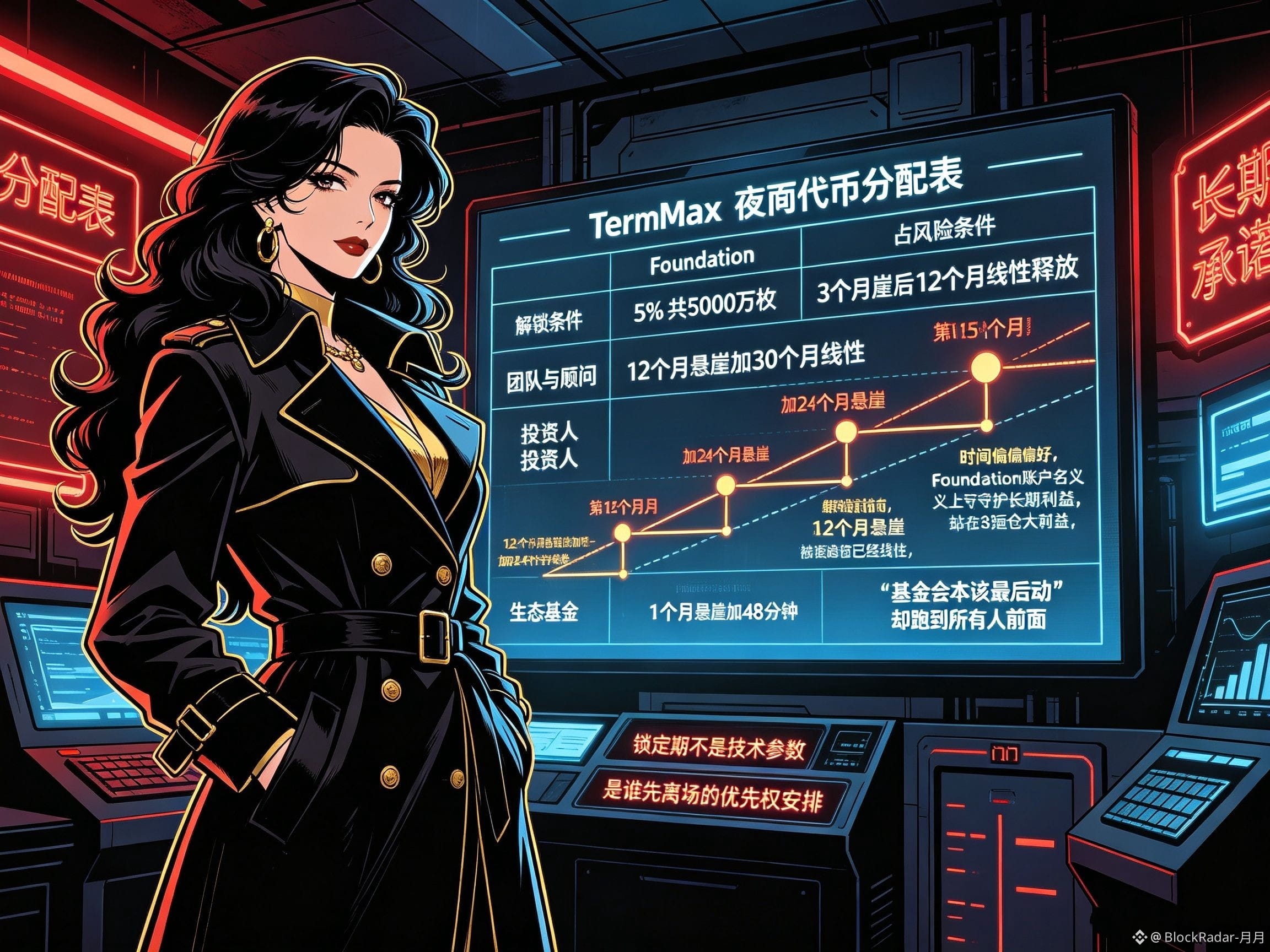
When I flipped to the token allocation table entry for @termmax , what first made me frown wasn’t the mechanism design—it was the name “Foundation.” In Section 3.2, it’s separated out as 5%, meaning 50 million tokens. The vesting condition is a 3-month cliff, followed by linear release over 12 months. Look at it in isolation and it’s not so bad. But once you put it back into the whole table, it just stands out: the team and advisors have a 12-month cliff plus 30 months of linear vesting; investors have a 12-month cliff plus 24 months; even the ecosystem fund has a 1-month cliff plus 48 months of linear vesting. Only this “Foundation,” which is supposed to uphold the protocol’s long-term interests in name, is the fastest among all institutional allocations—fully emptied in just 15 months.
The more I look, the more it feels like this kind of ordering is itself a leak of time preference. In token issuance, a lockup period isn’t really a technical parameter. It’s an arrangement of who gets to exit first. The team is locked longer, the advisors locked longer, the investors locked longer—only the Foundation is locked shorter. Yet it’s assigned the very portion that is least in need of liquidity: long-term development, governance, and sustaining the ecosystem. The money that should be the most “slow-moving” is given the most “nimble” exit terms. How does an account that should move last end up ahead of everyone else? #TermMax
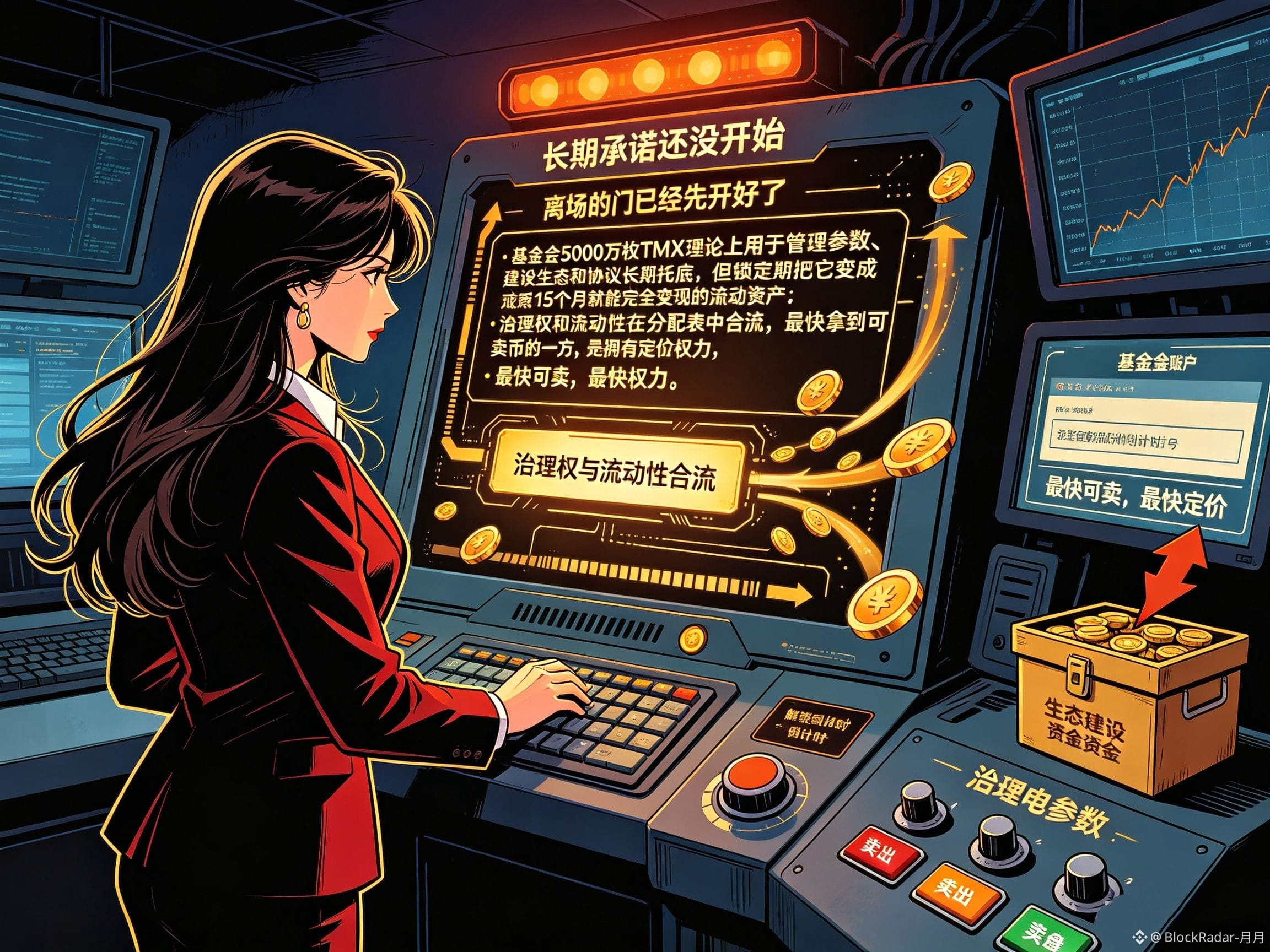
In this context, TMX’s role is even more worth thinking about. Ostensibly, it’s a governance token, and the Foundation’s 50 million tokens should, in theory, be used to steward parameters, build the ecosystem, and back the protocol’s long-term operations. But the lockup turns it into a liquid asset that can be fully cashed out by the 15th month. In this allocation, governance power and liquidity basically converge: whoever gets sellable coins fastest gets governance power that can be priced fastest. In other words, before any long-term commitment even begins, the door to exit has already been opened.
So whatever names are written on the allocation table, they can’t hide the timeline. If an account called “Foundation” unlocks completely before everyone else, then what we see isn’t a long-term commitment—it’s an exit option positioned at the very front, covered up by the name. Do you still think that can be called a foundation?
When I flipped to the token allocation table entry for @TermMax , what first made me frown wasn’t the mechanism design—it was the name “Foundation.” In Section 3.2, it’s separated out as 5%, meaning 50 million tokens. The vesting condition is a 3-month cliff, followed by linear release over 12 months. Look at it in isolation and it’s not so bad. But once you put it back into the whole table, it just stands out: the team and advisors have a 12-month cliff plus 30 months of linear vesting; investors have a 12-month cliff plus 24 months; even the ecosystem fund has a 1-month cliff plus 48 months of linear vesting. Only this “Foundation,” which is supposed to uphold the protocol’s long-term interests in name, is the fastest among all institutional allocations—fully emptied in just 15 months.
The more I look, the more it feels like this kind of ordering is itself a leak of time preference. In token issuance, a lockup period isn’t really a technical parameter. It’s an arrangement of who gets to exit first. The team is locked longer, the advisors locked longer, the investors locked longer—only the Foundation is locked shorter. Yet it’s assigned the very portion that is least in need of liquidity: long-term development, governance, and sustaining the ecosystem. The money that should be the most “slow-moving” is given the most “nimble” exit terms. How does an account that should move last end up ahead of everyone else? #TermMax
In this context, TMX’s role is even more worth thinking about. Ostensibly, it’s a governance token, and the Foundation’s 50 million tokens should, in theory, be used to steward parameters, build the ecosystem, and back the protocol’s long-term operations. But the lockup turns it into a liquid asset that can be fully cashed out by the 15th month. In this allocation, governance power and liquidity basically converge: whoever gets sellable coins fastest gets governance power that can be priced fastest. In other words, before any long-term commitment even begins, the door to exit has already been opened.
So whatever names are written on the allocation table, they can’t hide the timeline. If an account called “Foundation” unlocks completely before everyone else, then what we see isn’t a long-term commitment—it’s an exit option positioned at the very front, covered up by the name. Do you still think that can be called a foundation?
The more I look, the more it feels like this kind of ordering is itself a leak of time preference. In token issuance, a lockup period isn’t really a technical parameter. It’s an arrangement of who gets to exit first. The team is locked longer, the advisors locked longer, the investors locked longer—only the Foundation is locked shorter. Yet it’s assigned the very portion that is least in need of liquidity: long-term development, governance, and sustaining the ecosystem. The money that should be the most “slow-moving” is given the most “nimble” exit terms. How does an account that should move last end up ahead of everyone else? #TermMax
In this context, TMX’s role is even more worth thinking about. Ostensibly, it’s a governance token, and the Foundation’s 50 million tokens should, in theory, be used to steward parameters, build the ecosystem, and back the protocol’s long-term operations. But the lockup turns it into a liquid asset that can be fully cashed out by the 15th month. In this allocation, governance power and liquidity basically converge: whoever gets sellable coins fastest gets governance power that can be priced fastest. In other words, before any long-term commitment even begins, the door to exit has already been opened.
So whatever names are written on the allocation table, they can’t hide the timeline. If an account called “Foundation” unlocks completely before everyone else, then what we see isn’t a long-term commitment—it’s an exit option positioned at the very front, covered up by the name. Do you still think that can be called a foundation?

247
“Native issuance”: the line “corporate actions execute in code, no reconciliation required”—the image it brings to mind is a piece of paper that can distribute dividends by itself, paired with a machine that performs automatic transfers. But beside it there’s no judge announcing default, and no trustee sorting creditors by rank. It can pay interest, as long as someone first enters the parameters; it can’t hold a court session, because it’s an actuator, not a decider.
In the material @Dusk_Foundation , “corporate actions” appears three times: service actions, complex process automation, and executing in code without reconciliation. Break them apart: dividend payments, stock splits, and mergers are parameterized events—amounts, dates, and ratios are specified, and the code mechanically distributes. Default, restructuring, and extension are adjudicative events—decisions require assessing solvency, creditor tiering, and priority ordering, meaning someone has to step forward and say “no.” The former can go on-chain; the latter cannot be hard-coded. “No reconciliation” only holds for the mechanical leg; reconciliation for the adjudicative leg is deferred until the day the event truly occurs.
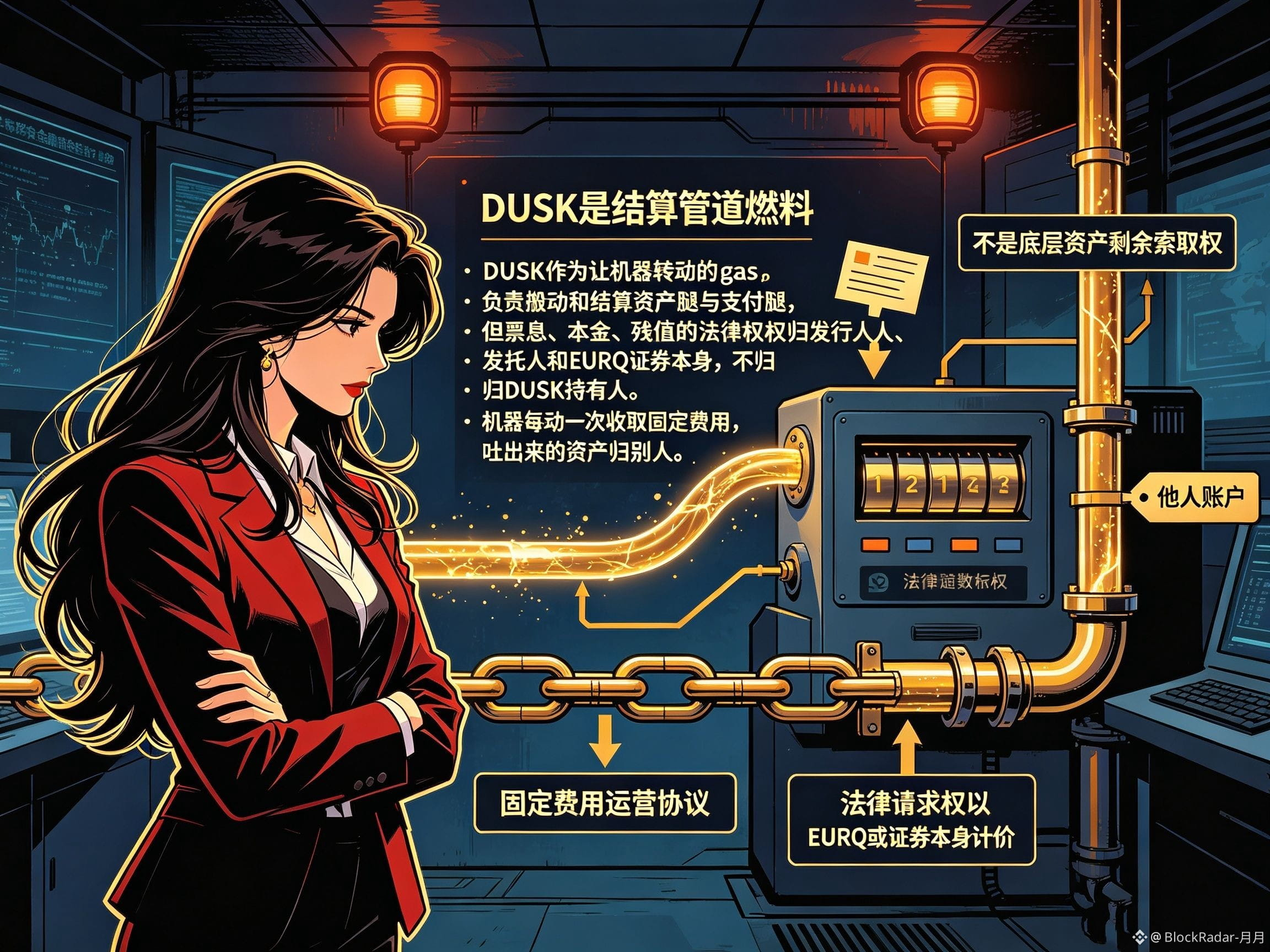
Position $DUSK is clear: it’s the gas that gets the machine running—the asset-moving leg and the payment leg. It doesn’t share rights out of coupon, principal, or residual value; those legal claims are denominated in EURQ or in securities terms, not DUSK. Each time the machine moves, it charges a fee and passes what’s left to someone else. This is an operating agreement with fixed fees; it’s not residual claim over the underlying assets.
The risk isn’t on the day the code makes a mistake—it’s on the day the code can’t make a mistake. If there’s actually a default or a restructuring, it’s the contract, the court, and the liquidator that decide who gets back how much—not the contract. At that time, “corporate actions execute in code” will be translated into “parameters are written by someone off-chain,” and that person will be the real counterparty. #dusk
I’m not denying automation—I’m only denying putting adjudication into the executor. Treat it in the budget as a settlement pipeline, not a substitute for claims. For exits, look at whether the parameters are written to a single address and whether write permissions change—don’t look at price fluctuations. Daily watch: the servicing module’s parameter-write permissions, the issuer’s authorized key scope, and the time gap between coupon or principal being received and the record on-chain. The machine might never make mistakes, but the company will always need to hold a court session.
“Native issuance”: the line “corporate actions execute in code, no reconciliation required”—the image it brings to mind is a piece of paper that can distribute dividends by itself, paired with a machine that performs automatic transfers. But beside it there’s no judge announcing default, and no trustee sorting creditors by rank. It can pay interest, as long as someone first enters the parameters; it can’t hold a court session, because it’s an actuator, not a decider.
In the material @Dusk , “corporate actions” appears three times: service actions, complex process automation, and executing in code without reconciliation. Break them apart: dividend payments, stock splits, and mergers are parameterized events—amounts, dates, and ratios are specified, and the code mechanically distributes. Default, restructuring, and extension are adjudicative events—decisions require assessing solvency, creditor tiering, and priority ordering, meaning someone has to step forward and say “no.” The former can go on-chain; the latter cannot be hard-coded. “No reconciliation” only holds for the mechanical leg; reconciliation for the adjudicative leg is deferred until the day the event truly occurs.
Position $DUSK is clear: it’s the gas that gets the machine running—the asset-moving leg and the payment leg. It doesn’t share rights out of coupon, principal, or residual value; those legal claims are denominated in EURQ or in securities terms, not DUSK. Each time the machine moves, it charges a fee and passes what’s left to someone else. This is an operating agreement with fixed fees; it’s not residual claim over the underlying assets.
The risk isn’t on the day the code makes a mistake—it’s on the day the code can’t make a mistake. If there’s actually a default or a restructuring, it’s the contract, the court, and the liquidator that decide who gets back how much—not the contract. At that time, “corporate actions execute in code” will be translated into “parameters are written by someone off-chain,” and that person will be the real counterparty. #dusk
I’m not denying automation—I’m only denying putting adjudication into the executor. Treat it in the budget as a settlement pipeline, not a substitute for claims. For exits, look at whether the parameters are written to a single address and whether write permissions change—don’t look at price fluctuations. Daily watch: the servicing module’s parameter-write permissions, the issuer’s authorized key scope, and the time gap between coupon or principal being received and the record on-chain. The machine might never make mistakes, but the company will always need to hold a court session.
In the material @Dusk , “corporate actions” appears three times: service actions, complex process automation, and executing in code without reconciliation. Break them apart: dividend payments, stock splits, and mergers are parameterized events—amounts, dates, and ratios are specified, and the code mechanically distributes. Default, restructuring, and extension are adjudicative events—decisions require assessing solvency, creditor tiering, and priority ordering, meaning someone has to step forward and say “no.” The former can go on-chain; the latter cannot be hard-coded. “No reconciliation” only holds for the mechanical leg; reconciliation for the adjudicative leg is deferred until the day the event truly occurs.
Position $DUSK is clear: it’s the gas that gets the machine running—the asset-moving leg and the payment leg. It doesn’t share rights out of coupon, principal, or residual value; those legal claims are denominated in EURQ or in securities terms, not DUSK. Each time the machine moves, it charges a fee and passes what’s left to someone else. This is an operating agreement with fixed fees; it’s not residual claim over the underlying assets.
The risk isn’t on the day the code makes a mistake—it’s on the day the code can’t make a mistake. If there’s actually a default or a restructuring, it’s the contract, the court, and the liquidator that decide who gets back how much—not the contract. At that time, “corporate actions execute in code” will be translated into “parameters are written by someone off-chain,” and that person will be the real counterparty. #dusk
I’m not denying automation—I’m only denying putting adjudication into the executor. Treat it in the budget as a settlement pipeline, not a substitute for claims. For exits, look at whether the parameters are written to a single address and whether write permissions change—don’t look at price fluctuations. Daily watch: the servicing module’s parameter-write permissions, the issuer’s authorized key scope, and the time gap between coupon or principal being received and the record on-chain. The machine might never make mistakes, but the company will always need to hold a court session.


116
I have a habit when reading project documents like @termmax : I always flip to the last page first. This time, what I found were two lines: Prepared by: Term Structure Labs Limited; Issuing Entity: Gradient Global Limited (BVI). One is responsible for writing the promises, the other for issuing the assets. The TMX you hold is, in legal bookkeeping terms, recorded under the latter’s name; but governance rights, staking yields, and fee sharing all depend on the code and operations maintained by the former to be realized.
That makes things a bit interesting. If you treat this entire TermMax document as a binary star system, the real problem is not which of the two bodies is brighter, but where the barycenter sits. Nominally, holders stand on the issuance side, meaning the company that minted the token; yet value creation and redemption all happen around the other body—the protocol operated by Term Structure Labs. Between the two sets of black-and-white words, the white paper says nothing about any pooling or guarantee arrangement, leaving only a signature line. The term “governance token” is written into the document with the default assumption that the issuer and operator are the same counterparty; that signature line quietly overturns that premise.
So TMX becomes a rather awkward thing: the unit of account belongs to the issuer, while the utility promise belongs to the operator. Staking, voting, revenue sharing—each right ultimately points to an entity that is not the issuer. Whose promise are you actually holding? I suspect most people have never really thought about that question. #TermMax
So don’t rush to call this a token issued by a single issuer. It is more like a binary structure with a shifted barycenter. Holders think they are betting against the project, but in reality they are dealing with two parties whose boundaries of obligation have not been clearly defined. And the barycenter that should truly bear the redemption obligation has not been written into any contract clause that could actually be enforced.
I have a habit when reading project documents like @TermMax : I always flip to the last page first. This time, what I found were two lines: Prepared by: Term Structure Labs Limited; Issuing Entity: Gradient Global Limited (BVI). One is responsible for writing the promises, the other for issuing the assets. The TMX you hold is, in legal bookkeeping terms, recorded under the latter’s name; but governance rights, staking yields, and fee sharing all depend on the code and operations maintained by the former to be realized.
That makes things a bit interesting. If you treat this entire TermMax document as a binary star system, the real problem is not which of the two bodies is brighter, but where the barycenter sits. Nominally, holders stand on the issuance side, meaning the company that minted the token; yet value creation and redemption all happen around the other body—the protocol operated by Term Structure Labs. Between the two sets of black-and-white words, the white paper says nothing about any pooling or guarantee arrangement, leaving only a signature line. The term “governance token” is written into the document with the default assumption that the issuer and operator are the same counterparty; that signature line quietly overturns that premise.
So TMX becomes a rather awkward thing: the unit of account belongs to the issuer, while the utility promise belongs to the operator. Staking, voting, revenue sharing—each right ultimately points to an entity that is not the issuer. Whose promise are you actually holding? I suspect most people have never really thought about that question. #TermMax
So don’t rush to call this a token issued by a single issuer. It is more like a binary structure with a shifted barycenter. Holders think they are betting against the project, but in reality they are dealing with two parties whose boundaries of obligation have not been clearly defined. And the barycenter that should truly bear the redemption obligation has not been written into any contract clause that could actually be enforced.
That makes things a bit interesting. If you treat this entire TermMax document as a binary star system, the real problem is not which of the two bodies is brighter, but where the barycenter sits. Nominally, holders stand on the issuance side, meaning the company that minted the token; yet value creation and redemption all happen around the other body—the protocol operated by Term Structure Labs. Between the two sets of black-and-white words, the white paper says nothing about any pooling or guarantee arrangement, leaving only a signature line. The term “governance token” is written into the document with the default assumption that the issuer and operator are the same counterparty; that signature line quietly overturns that premise.
So TMX becomes a rather awkward thing: the unit of account belongs to the issuer, while the utility promise belongs to the operator. Staking, voting, revenue sharing—each right ultimately points to an entity that is not the issuer. Whose promise are you actually holding? I suspect most people have never really thought about that question. #TermMax
So don’t rush to call this a token issued by a single issuer. It is more like a binary structure with a shifted barycenter. Holders think they are betting against the project, but in reality they are dealing with two parties whose boundaries of obligation have not been clearly defined. And the barycenter that should truly bear the redemption obligation has not been written into any contract clause that could actually be enforced.
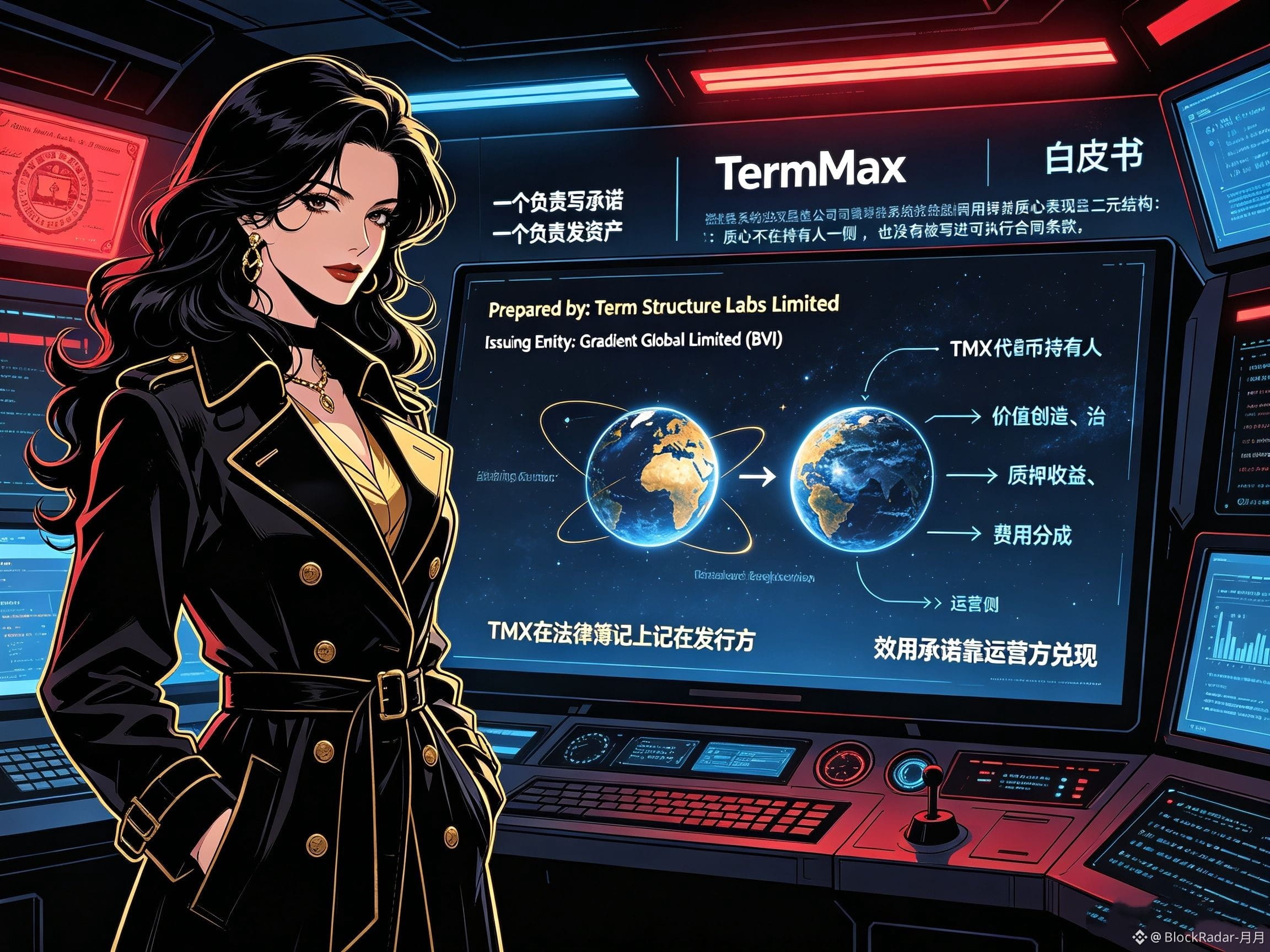
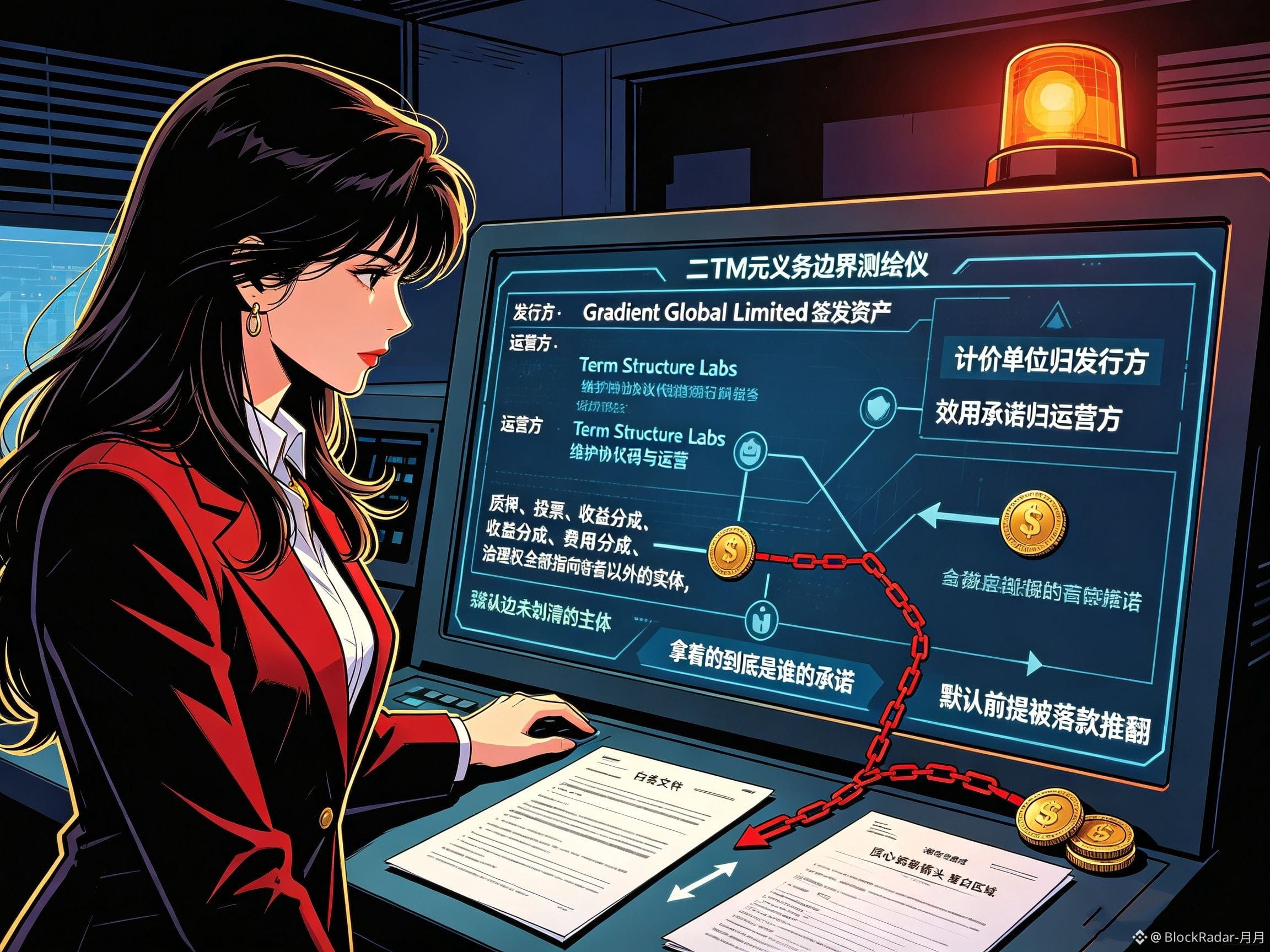

128
Log in to explore more content
Join global crypto users on Binance Square
⚡️ Get latest and useful information about crypto.
💬 Trusted by the world’s largest crypto exchange.
👍 Discover real insights from verified creators.
Email / Phone number
Trending Topics
BTCBreaks80K
156,910 views
2,503 Discussing
Surprise liquidations or liquidity hunt? The truth behind the $80K of Bitcoin 📉🚀
If you had Short positions around the $80,000 mark, you most likely felt the pressure from the last few hours. Many label this sudden rise as "manipulation without volume," but the futures market mechanics tell a completely different story.
Here’s what really happened behind the weekly candle:
1️⃣ Thin order book: When most of the market is positioned bearish (short), the sell limit orders above the price become very scarce. A moderate amount of buying volume is enough to sweep the stops.
2️⃣ Cascade effect (Short Squeeze): Once the shorts’ liquidation levels are hit, the exchange automatically executes market buys to close those losing positions. This wasn’t a "secret manipulator" pushing the price; it was the sellers’ own stop-losses funding the pump.
3️⃣ Weekly candle close: Algorithms and institutions typically look for closes above key moving averages before the candle flips to help sustain the trend.
Risk management takeaway: Never trade with leverage without a properly placed technical stop, and avoid going short when the market is overloaded with sell pressure.
What do you think? Do you believe we’re consolidating above $80K to seek new highs, or is a re-test of the $78,000 area coming? I’ll read your thoughts in the comments!
$BTC #BTC #BTCBreaks80K #BinanceSquar
Angelo_Coin
·0 Likes
·1.2k views
比特币突破8万
110,806 views
317 Discussing
BitcoinMarketCapTopsTesla
1,455 views
127 Discussing