
huyền09
169 Posts

huyền09
Report
Block User
14 Following
36 Followers
243 Liked
Posts
·
--
💛 New day, new opportunities to test your predictions! #BinancePick makes exploring prediction markets more engaging with exciting challenges and daily activities. Stay informed, trust your research, collect points, and enjoy the journey with Binance! 🚀🎯
💛 New day, new opportunities to test your predictions! #BinancePick makes exploring prediction markets more engaging with exciting challenges and daily activities. Stay informed, trust your research, collect points, and enjoy the journey with Binance! 🚀🎯
65
·
--
🚀 Make every day more exciting with #BinancePick ! Discover prediction markets, test your knowledge, follow market trends, and earn points through daily activities. Stay curious, keep participating, and enjoy every new challenge with Binance! 🎯💛
🚀 Make every day more exciting with #BinancePick ! Discover prediction markets, test your knowledge, follow market trends, and earn points through daily activities. Stay curious, keep participating, and enjoy every new challenge with Binance! 🎯💛
69
·
--
🎯 Every prediction is an opportunity to challenge yourself! With #BinancePick , explore prediction markets, complete daily missions, and earn points while improving your market insights. Keep learning, stay consistent, and enjoy the experience with Binance! 🚀💛
🎯 Every prediction is an opportunity to challenge yourself! With #BinancePick , explore prediction markets, complete daily missions, and earn points while improving your market insights. Keep learning, stay consistent, and enjoy the experience with Binance! 🚀💛
71
·
--
🔥 Looking for new ways to test your market knowledge? #BinancePick brings prediction markets and daily challenges together in one exciting experience. Make thoughtful predictions, complete missions, and collect points while learning along the way. Stay active and keep exploring! 🚀🎯
🔥 Looking for new ways to test your market knowledge? #BinancePick brings prediction markets and daily challenges together in one exciting experience. Make thoughtful predictions, complete missions, and collect points while learning along the way. Stay active and keep exploring! 🚀🎯
74
·
--
🚀 Turn your curiosity into a daily challenge with #BinancePick ! Explore prediction markets, share your insights, and collect points by completing tasks. Stay consistent, learn from every experience, and discover new opportunities along the way! 🎯💛
🚀 Turn your curiosity into a daily challenge with #BinancePick ! Explore prediction markets, share your insights, and collect points by completing tasks. Stay consistent, learn from every experience, and discover new opportunities along the way! 🎯💛
62
·
--
🔥 Ready for another exciting prediction challenge? #BinancePick offers a fun way to explore prediction markets, test your knowledge, and collect points through daily activities. Stay engaged, keep learning, and make every prediction count! 🚀🎯
🔥 Ready for another exciting prediction challenge? #BinancePick offers a fun way to explore prediction markets, test your knowledge, and collect points through daily activities. Stay engaged, keep learning, and make every prediction count! 🚀🎯
34
·
--
🚀 Discover new opportunities with #BinancePick Explore prediction markets, challenge your market insights, and earn points by completing daily tasks. Stay consistent, make thoughtful predictions, and keep learning every day. Every step counts! 🎯💛
🚀 Discover new opportunities with #BinancePick Explore prediction markets, challenge your market insights, and earn points by completing daily tasks. Stay consistent, make thoughtful predictions, and keep learning every day. Every step counts! 🎯💛
78
·
--
🎯 Every day brings a new chance to test your market knowledge! With #BinancePick , explore prediction markets, complete daily missions, and collect points along the way. Stay active, think strategically, and enjoy the journey with Binance! 🚀💛
🎯 Every day brings a new chance to test your market knowledge! With #BinancePick , explore prediction markets, complete daily missions, and collect points along the way. Stay active, think strategically, and enjoy the journey with Binance! 🚀💛
70
·
--
💛 Small steps can bring new opportunities! With #BinancePick , I can explore prediction markets, test my market insights, and earn points by completing daily tasks. Stay curious, make informed predictions, and keep building your rewards every day! 🚀🎯
💛 Small steps can bring new opportunities! With #BinancePick , I can explore prediction markets, test my market insights, and earn points by completing daily tasks. Stay curious, make informed predictions, and keep building your rewards every day! 🚀🎯
76
·
--
🚀 Looking for a fun way to explore prediction markets? #BinancePick is worth checking out! Make predictions, complete daily tasks, and collect points along the way. Stay consistent, sharpen your skills, and enjoy every opportunity! 🎯💛
🚀 Looking for a fun way to explore prediction markets? #BinancePick is worth checking out! Make predictions, complete daily tasks, and collect points along the way. Stay consistent, sharpen your skills, and enjoy every opportunity! 🎯💛
82
·
--
🎯 Every prediction is a new opportunity to explore the market! I'm joining #BinancePick to discover prediction markets, complete daily missions, and earn reward points. Stay active, keep learning, and enjoy the experience with Binance! 🚀💛
🎯 Every prediction is a new opportunity to explore the market! I'm joining #BinancePick to discover prediction markets, complete daily missions, and earn reward points. Stay active, keep learning, and enjoy the experience with Binance! 🚀💛
58
·
--
Ready to test your prediction skills? 🔥 Join Binance Pick, explore prediction markets, complete tasks, and collect points every day. Stay active, make smart predictions, and enjoy the journey! 🚀💛 #BinancePick
Ready to test your prediction skills? 🔥 Join Binance Pick, explore prediction markets, complete tasks, and collect points every day. Stay active, make smart predictions, and enjoy the journey! 🚀💛 #BinancePick
54
·
--
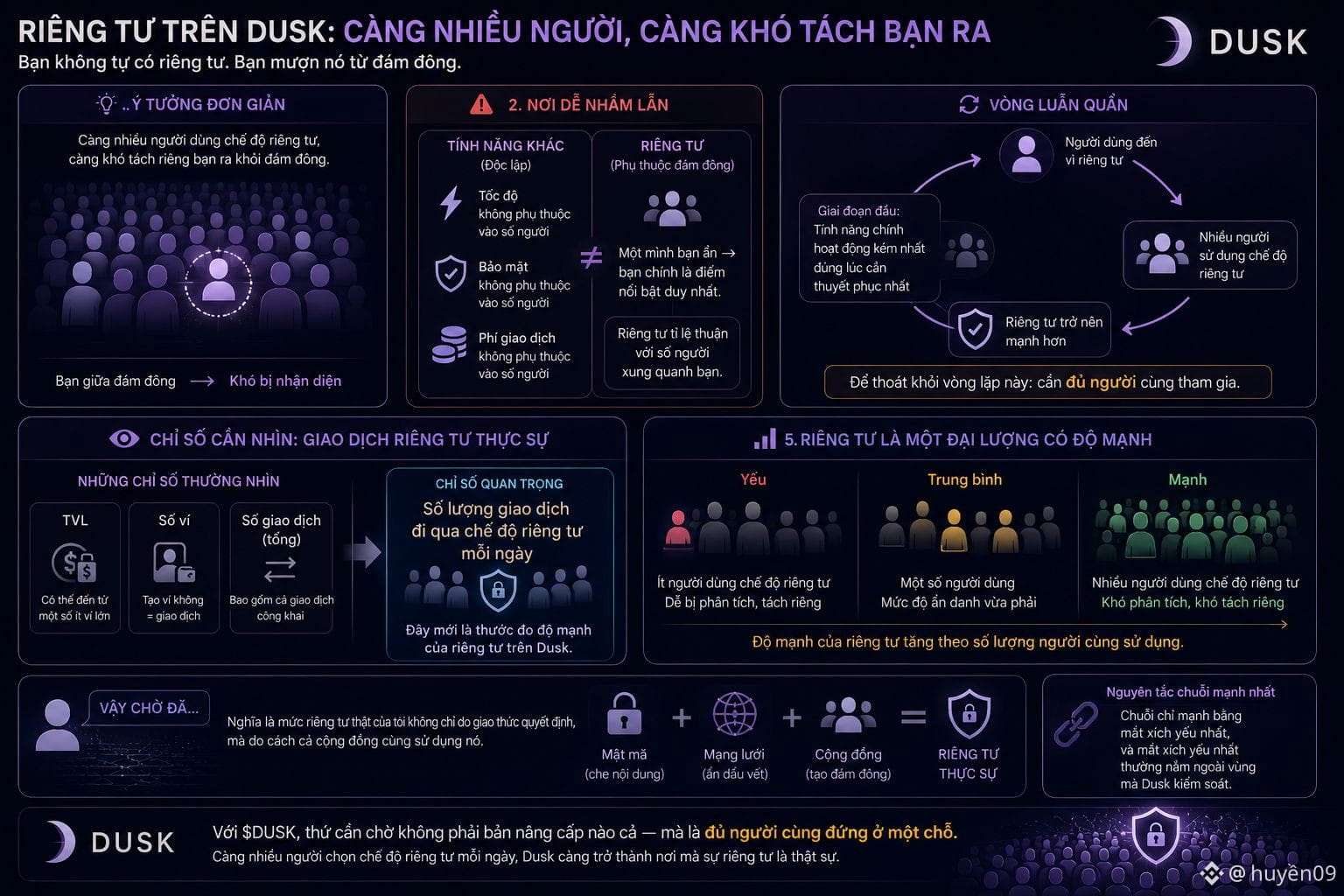
I kept thinking that when @Dusk_Foundation đ had already obscured my transaction from the crowd, then surely that would be enough. Because the idea is simple.
The more users share the same privacy setting, the harder it is to single any one person out. So why would the number of users matter that much to a technical feature?
It must be because privacy isn’t something you own. It’s something you borrow from others. And yes—that’s where I keep mixing two different things together. Every other feature in a chain works independently. Speed doesn’t depend on how many people are using it at the same time—if anything, it goes the other way. But privacy is proportional to the number of people around you. Alone, and hidden, you become the only standout. That’s where things get very real. It creates a vicious cycle.
Users come for privacy, but privacy is only good enough once many people have come. The early phase is always the stage where the main feature performs the worst—right when you need to persuade people the most.
So wait… which means the metric you should look at isn’t TVL or the number of wallets, but how many real transactions actually pass through the shielded side every day.
Turns out I’d been treating privacy as a feature that’s either on or off.
Actually, it’s a quantity with a certain strength—and that strength is decided by the community, not by the development team.
With $DUSK , there’s no upgrade you need to wait for—what you need is enough people standing in the same place.
#dusk $BTC $ETH
I kept thinking that when @Dusk đ had already obscured my transaction from the crowd, then surely that would be enough. Because the idea is simple.
The more users share the same privacy setting, the harder it is to single any one person out. So why would the number of users matter that much to a technical feature?
It must be because privacy isn’t something you own. It’s something you borrow from others. And yes—that’s where I keep mixing two different things together. Every other feature in a chain works independently. Speed doesn’t depend on how many people are using it at the same time—if anything, it goes the other way. But privacy is proportional to the number of people around you. Alone, and hidden, you become the only standout. That’s where things get very real. It creates a vicious cycle.
Users come for privacy, but privacy is only good enough once many people have come. The early phase is always the stage where the main feature performs the worst—right when you need to persuade people the most.
So wait… which means the metric you should look at isn’t TVL or the number of wallets, but how many real transactions actually pass through the shielded side every day.
Turns out I’d been treating privacy as a feature that’s either on or off.
Actually, it’s a quantity with a certain strength—and that strength is decided by the community, not by the development team.
With $DUSK , there’s no upgrade you need to wait for—what you need is enough people standing in the same place.
#dusk $BTC $ETH
The more users share the same privacy setting, the harder it is to single any one person out. So why would the number of users matter that much to a technical feature?
It must be because privacy isn’t something you own. It’s something you borrow from others. And yes—that’s where I keep mixing two different things together. Every other feature in a chain works independently. Speed doesn’t depend on how many people are using it at the same time—if anything, it goes the other way. But privacy is proportional to the number of people around you. Alone, and hidden, you become the only standout. That’s where things get very real. It creates a vicious cycle.
Users come for privacy, but privacy is only good enough once many people have come. The early phase is always the stage where the main feature performs the worst—right when you need to persuade people the most.
So wait… which means the metric you should look at isn’t TVL or the number of wallets, but how many real transactions actually pass through the shielded side every day.
Turns out I’d been treating privacy as a feature that’s either on or off.
Actually, it’s a quantity with a certain strength—and that strength is decided by the community, not by the development team.
With $DUSK , there’s no upgrade you need to wait for—what you need is enough people standing in the same place.
#dusk $BTC $ETH
222
·
--
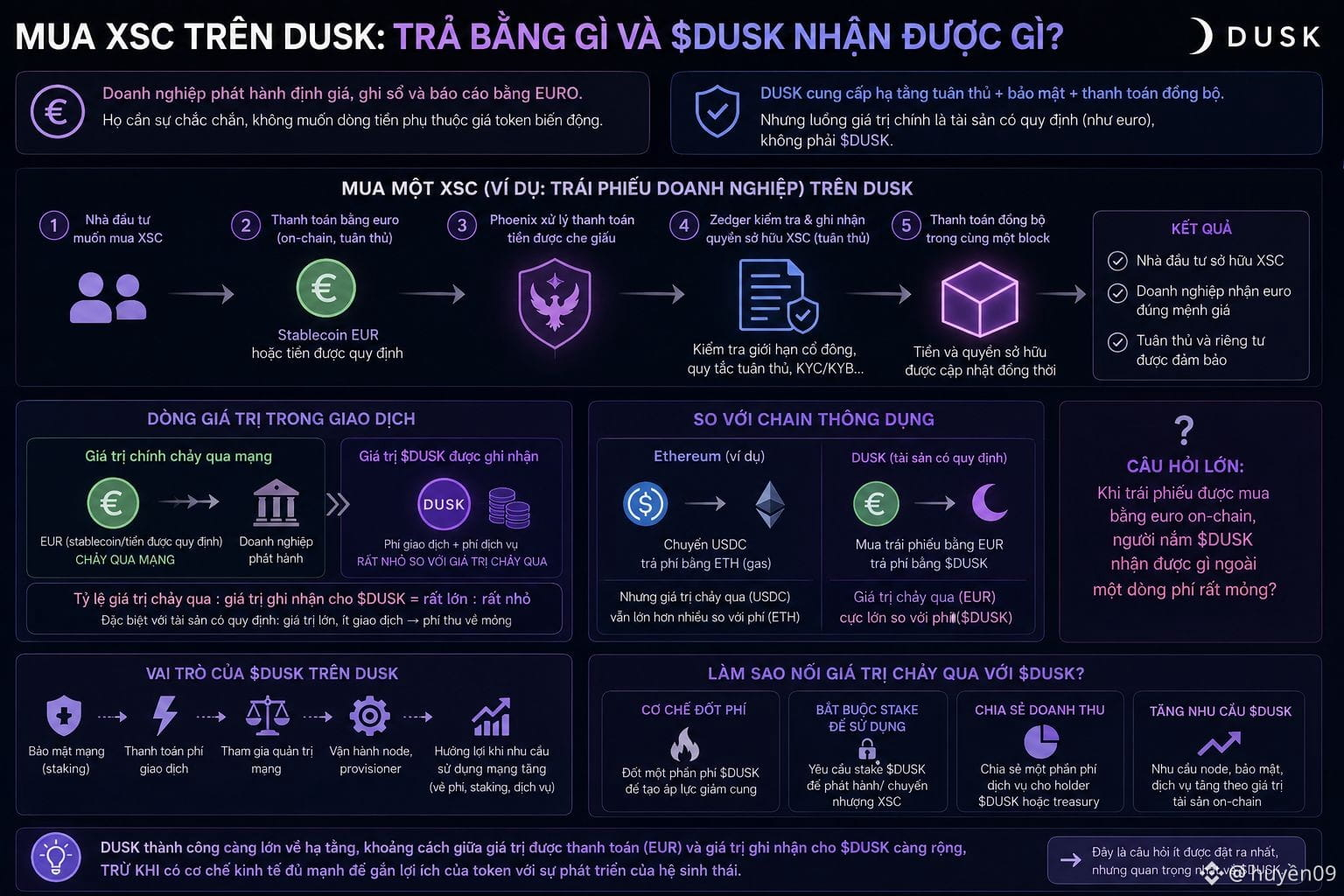
I kept thinking, when buying an XSC on @Dusk_Foundation , do I have to pay in DUSK? As an asset, as a payment currency—that would be it. Except the issuing company doesn’t think that way.
They price it in euro.
They record it in euro.
A corporate bond has a fixed face value, and no issuer wants the proceeds to fluctuate with the price of a token. That’s where my brain keeps trying to find a way to game the system.
Because if the payment side must be a euro stablecoin or some regulated form of money, then the network’s native token isn’t in the main value flow. It just sits at the margins, as a fee and for security. While what actually flows through the system is someone else’s asset.
So hold on.
That’s the model of almost every chain—Ethereum doesn’t take ETH when you transfer USDC; it only takes gas. But with a specialized network, the ratio between the value flowing through and the fees the network collects can be wildly different, because regulated assets are often large and transactions are relatively infrequent.
That’s the strange part.
The more successful the infrastructure is, the wider the gap between the value that’s paid and the value that gets accounted for the token—unless there’s a mechanism that ties the two together. Turns out I just assumed that the network’s token automatically benefits from everything running on that network.
And I think that’s one of the least asked questions about $DUSK when a bond is bought with euro on-chain: what does the token holder get, other than a very thin stream of fees.
#dusk $BTC $ETH
I kept thinking, when buying an XSC on @Dusk , do I have to pay in DUSK? As an asset, as a payment currency—that would be it. Except the issuing company doesn’t think that way.
They price it in euro.
They record it in euro.
A corporate bond has a fixed face value, and no issuer wants the proceeds to fluctuate with the price of a token. That’s where my brain keeps trying to find a way to game the system.
Because if the payment side must be a euro stablecoin or some regulated form of money, then the network’s native token isn’t in the main value flow. It just sits at the margins, as a fee and for security. While what actually flows through the system is someone else’s asset.
So hold on.
That’s the model of almost every chain—Ethereum doesn’t take ETH when you transfer USDC; it only takes gas. But with a specialized network, the ratio between the value flowing through and the fees the network collects can be wildly different, because regulated assets are often large and transactions are relatively infrequent.
That’s the strange part.
The more successful the infrastructure is, the wider the gap between the value that’s paid and the value that gets accounted for the token—unless there’s a mechanism that ties the two together. Turns out I just assumed that the network’s token automatically benefits from everything running on that network.
And I think that’s one of the least asked questions about $DUSK when a bond is bought with euro on-chain: what does the token holder get, other than a very thin stream of fees.
#dusk $BTC $ETH
They price it in euro.
They record it in euro.
A corporate bond has a fixed face value, and no issuer wants the proceeds to fluctuate with the price of a token. That’s where my brain keeps trying to find a way to game the system.
Because if the payment side must be a euro stablecoin or some regulated form of money, then the network’s native token isn’t in the main value flow. It just sits at the margins, as a fee and for security. While what actually flows through the system is someone else’s asset.
So hold on.
That’s the model of almost every chain—Ethereum doesn’t take ETH when you transfer USDC; it only takes gas. But with a specialized network, the ratio between the value flowing through and the fees the network collects can be wildly different, because regulated assets are often large and transactions are relatively infrequent.
That’s the strange part.
The more successful the infrastructure is, the wider the gap between the value that’s paid and the value that gets accounted for the token—unless there’s a mechanism that ties the two together. Turns out I just assumed that the network’s token automatically benefits from everything running on that network.
And I think that’s one of the least asked questions about $DUSK when a bond is bought with euro on-chain: what does the token holder get, other than a very thin stream of fees.
#dusk $BTC $ETH
171
·
--
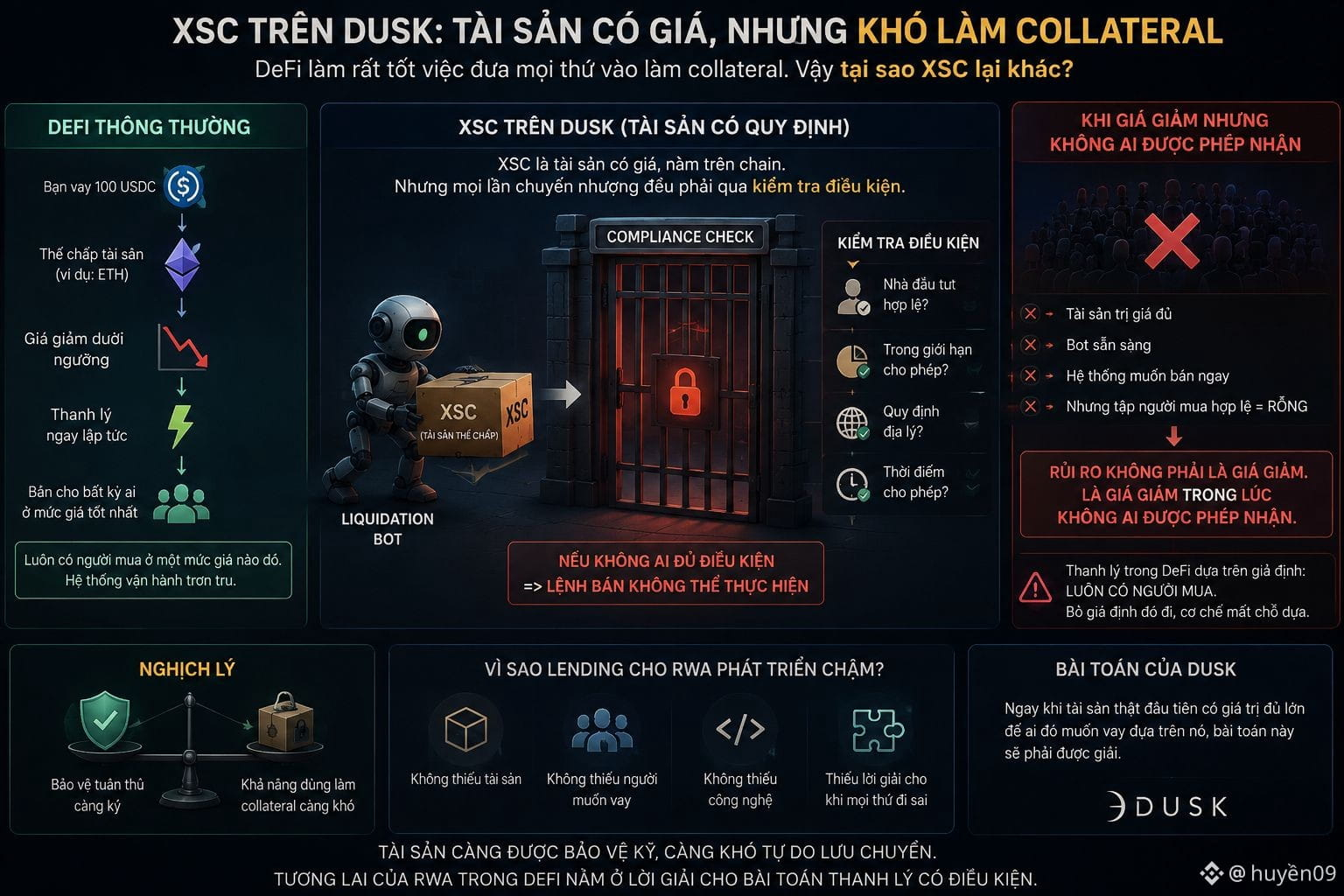
I kept thinking whether an XSC on @Dusk_Foundation could be used as collateral. Sounds obvious, right. It’s an asset, it has value, and it lives on-chain.
That’s exactly what DeFi does best—bring everything in as collateral. So why is this so hard? Turns out it’s because liquidation is a kind of transfer.
And every time an asset is transferred under certain rules, it must go through condition checks. Meaning: when the price drops and the system needs to sell your asset immediately, it cannot be sold to just anyone—it can only be sold to the valid party, within the permitted limits, at that moment. And that’s where I keep stumbling.
Liquidation in DeFi works thanks to the assumption that there’s always a buyer at some price. Remove that assumption and the whole mechanism loses its footing.
You might have assets worth enough, you might have the bots ready, and you still can’t execute the sell order because the pool of valid buyers is empty. So the risk here isn’t the price dropping. It’s the price dropping while nobody is allowed to receive the asset. That’s what explains why lending for RWA has developed much slower than expected.
It’s not because there aren’t enough assets, or not enough people who want to borrow, or not enough technology. It’s because the part that handles what happens when things go wrong doesn’t have a clean solution yet. That part still feels backwards. The more carefully an asset is protected from a compliance standpoint, the harder it is to use as collateral.
I think that’s the problem that $DUSK will have to face as soon as the first real asset with enough value comes along and someone wants to borrow against it.
#dusk $BTC $ETH
I kept thinking whether an XSC on @Dusk could be used as collateral. Sounds obvious, right. It’s an asset, it has value, and it lives on-chain.
That’s exactly what DeFi does best—bring everything in as collateral. So why is this so hard? Turns out it’s because liquidation is a kind of transfer.
And every time an asset is transferred under certain rules, it must go through condition checks. Meaning: when the price drops and the system needs to sell your asset immediately, it cannot be sold to just anyone—it can only be sold to the valid party, within the permitted limits, at that moment. And that’s where I keep stumbling.
Liquidation in DeFi works thanks to the assumption that there’s always a buyer at some price. Remove that assumption and the whole mechanism loses its footing.
You might have assets worth enough, you might have the bots ready, and you still can’t execute the sell order because the pool of valid buyers is empty. So the risk here isn’t the price dropping. It’s the price dropping while nobody is allowed to receive the asset. That’s what explains why lending for RWA has developed much slower than expected.
It’s not because there aren’t enough assets, or not enough people who want to borrow, or not enough technology. It’s because the part that handles what happens when things go wrong doesn’t have a clean solution yet. That part still feels backwards. The more carefully an asset is protected from a compliance standpoint, the harder it is to use as collateral.
I think that’s the problem that $DUSK will have to face as soon as the first real asset with enough value comes along and someone wants to borrow against it.
#dusk $BTC $ETH
That’s exactly what DeFi does best—bring everything in as collateral. So why is this so hard? Turns out it’s because liquidation is a kind of transfer.
And every time an asset is transferred under certain rules, it must go through condition checks. Meaning: when the price drops and the system needs to sell your asset immediately, it cannot be sold to just anyone—it can only be sold to the valid party, within the permitted limits, at that moment. And that’s where I keep stumbling.
Liquidation in DeFi works thanks to the assumption that there’s always a buyer at some price. Remove that assumption and the whole mechanism loses its footing.
You might have assets worth enough, you might have the bots ready, and you still can’t execute the sell order because the pool of valid buyers is empty. So the risk here isn’t the price dropping. It’s the price dropping while nobody is allowed to receive the asset. That’s what explains why lending for RWA has developed much slower than expected.
It’s not because there aren’t enough assets, or not enough people who want to borrow, or not enough technology. It’s because the part that handles what happens when things go wrong doesn’t have a clean solution yet. That part still feels backwards. The more carefully an asset is protected from a compliance standpoint, the harder it is to use as collateral.
I think that’s the problem that $DUSK will have to face as soon as the first real asset with enough value comes along and someone wants to borrow against it.
#dusk $BTC $ETH
1
201
·
--
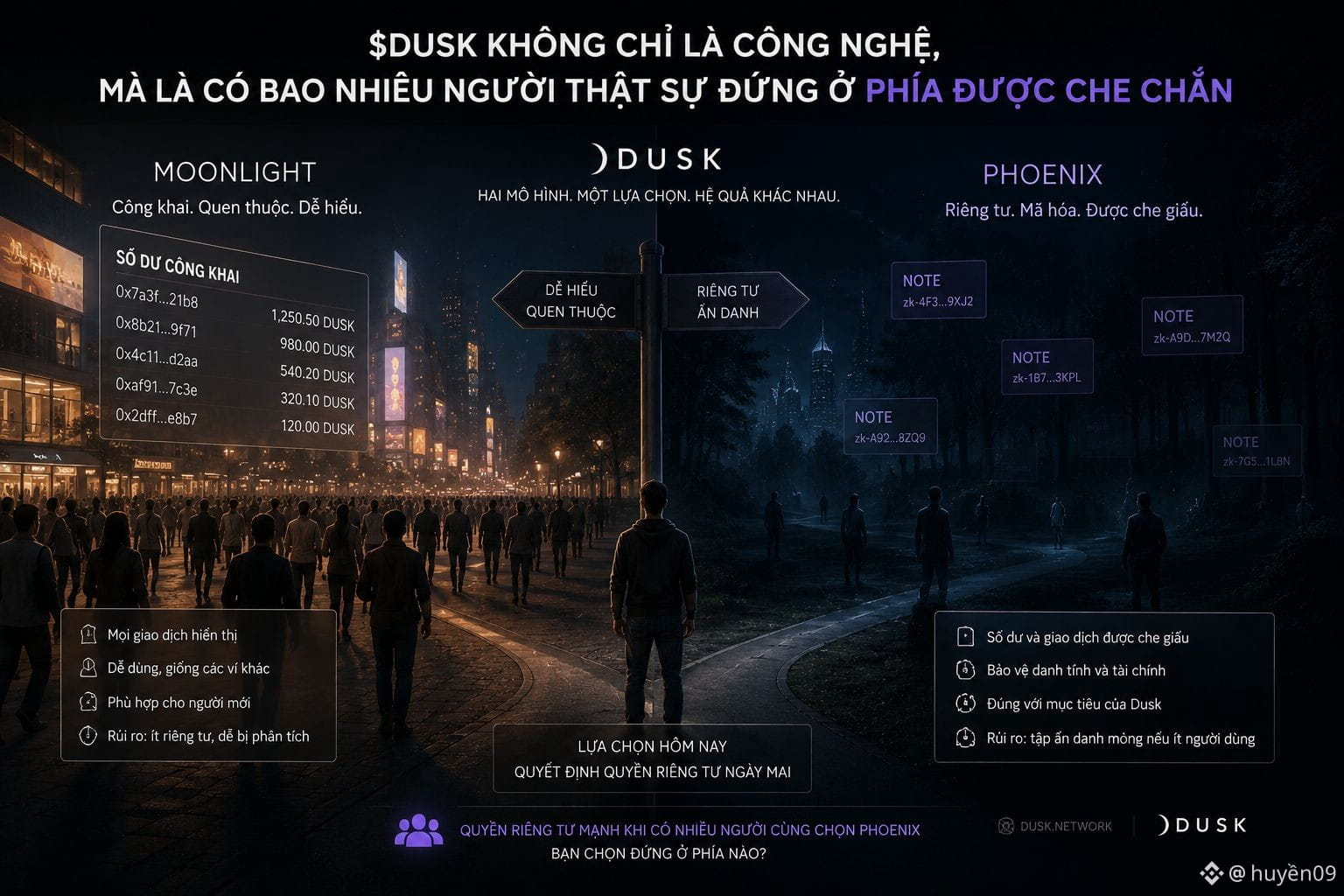
I keep thinking that if @Dusk_Foundation c has two parallel models, then one of them must be considered the default. Moonlight is there with the publicly visible balance—familiar, like every app I’ve ever used. Phoenix is there with the encoded notes, the output concealed—what this whole architecture was built to do.
So which one is the real one? That’s the part I keep mixing up. Because if Phoenix is the default, then Moonlight is just compatibility for people who aren’t used to it yet—a door you walk through, not a place to stay. And if Moonlight is the default, then privacy becomes an optional feature, and every optional feature in software history shares the same fate: very few people turn it on.
Turns out the design doesn’t answer that question. It leaves it open, and lets the user choose. It sounds very respectful. But choices without guidance in practice always lean toward what’s familiar. It doesn’t sound right, because I keep hoping that a private chain by default would place privacy in the default position. But it seems that’s something I’ve been adding to my own thoughts. And this is where I see the real risk: if most users stay on the public side because it’s the easier one to understand, then the anonymous side on the other side gets thinner.
And thin privacy is almost not privacy. If you’re hiding among a crowd of a few hundred people, how much can you actually hide? So the real question with $DUSK isn’t whether the technology is good—it’s how many people are truly standing on the shielded side.
#dusk $BTC $ETH
I keep thinking that if @Dusk c has two parallel models, then one of them must be considered the default. Moonlight is there with the publicly visible balance—familiar, like every app I’ve ever used. Phoenix is there with the encoded notes, the output concealed—what this whole architecture was built to do.
So which one is the real one? That’s the part I keep mixing up. Because if Phoenix is the default, then Moonlight is just compatibility for people who aren’t used to it yet—a door you walk through, not a place to stay. And if Moonlight is the default, then privacy becomes an optional feature, and every optional feature in software history shares the same fate: very few people turn it on.
Turns out the design doesn’t answer that question. It leaves it open, and lets the user choose. It sounds very respectful. But choices without guidance in practice always lean toward what’s familiar. It doesn’t sound right, because I keep hoping that a private chain by default would place privacy in the default position. But it seems that’s something I’ve been adding to my own thoughts. And this is where I see the real risk: if most users stay on the public side because it’s the easier one to understand, then the anonymous side on the other side gets thinner.
And thin privacy is almost not privacy. If you’re hiding among a crowd of a few hundred people, how much can you actually hide? So the real question with $DUSK isn’t whether the technology is good—it’s how many people are truly standing on the shielded side.
#dusk $BTC $ETH
So which one is the real one? That’s the part I keep mixing up. Because if Phoenix is the default, then Moonlight is just compatibility for people who aren’t used to it yet—a door you walk through, not a place to stay. And if Moonlight is the default, then privacy becomes an optional feature, and every optional feature in software history shares the same fate: very few people turn it on.
Turns out the design doesn’t answer that question. It leaves it open, and lets the user choose. It sounds very respectful. But choices without guidance in practice always lean toward what’s familiar. It doesn’t sound right, because I keep hoping that a private chain by default would place privacy in the default position. But it seems that’s something I’ve been adding to my own thoughts. And this is where I see the real risk: if most users stay on the public side because it’s the easier one to understand, then the anonymous side on the other side gets thinner.
And thin privacy is almost not privacy. If you’re hiding among a crowd of a few hundred people, how much can you actually hide? So the real question with $DUSK isn’t whether the technology is good—it’s how many people are truly standing on the shielded side.
#dusk $BTC $ETH
1
239
·
--
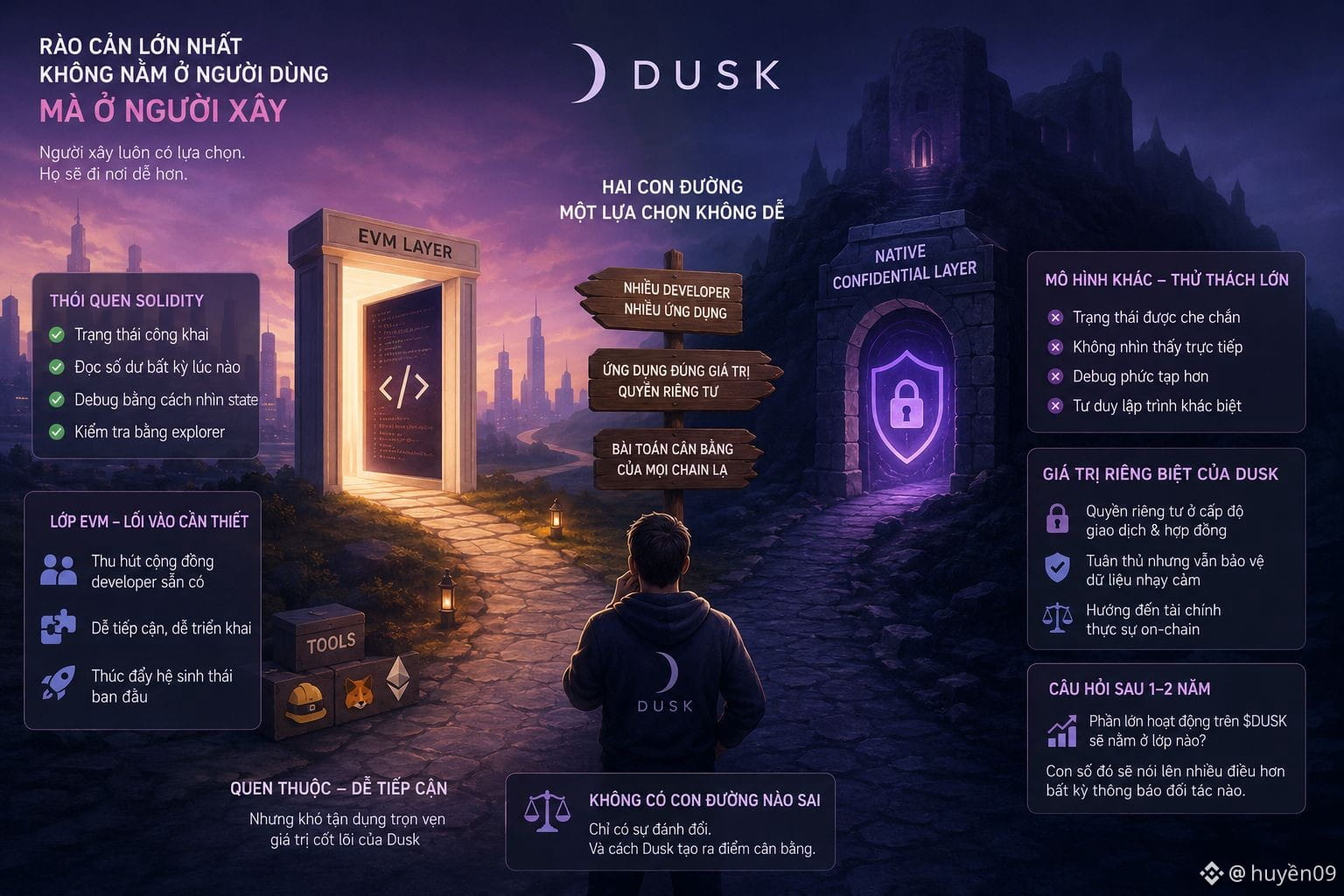
Sitting to do my creatorpad tasks, I went through the toolset meant for programmers from @Dusk_Foundation v and what remained was a pretty common reality: building applications on this chain is much harder. Not because the documentation is bad. But because the model is different.
If you’re familiar with Solidity, you’re familiar with public state—read any account balance anytime, debug by looking at state, verify again with an explorer. In an environment with part of it obscured, those reflexes don’t work. You can’t see what you’re processing.
Hold on… so the biggest hurdle here isn’t actually with end users. It’s with the builders.
And builders have a choice—they can always go work somewhere else that’s easier. That’s also why the EVM layer exists, and seen this way, it’s not some side feature. It’s an on-ramp for the whole group of developers that already exists out there. No matter how elegant a chain’s architecture is, if nobody writes applications on it, it’s only a pretty ledger.
But the trade-off is clear: what runs on the EVM layer struggles to fully leverage the very thing that makes the original chain valuable. You can have many developers, or you can have genuinely privacy-preserving applications—pull strongly in one direction and the other becomes thin. Not a criticism. Every chain with a strange model runs into this problem, and most of the time it’s solved in the exact same way.
Curious to look back a year or two from now: most activity on $DUSK will probably stay in the familiar layer or the specialized one. That number says more than any partner announcement.
#dusk $BTC $ETH
Sitting to do my creatorpad tasks, I went through the toolset meant for programmers from @Dusk v and what remained was a pretty common reality: building applications on this chain is much harder. Not because the documentation is bad. But because the model is different.
If you’re familiar with Solidity, you’re familiar with public state—read any account balance anytime, debug by looking at state, verify again with an explorer. In an environment with part of it obscured, those reflexes don’t work. You can’t see what you’re processing.
Hold on… so the biggest hurdle here isn’t actually with end users. It’s with the builders.
And builders have a choice—they can always go work somewhere else that’s easier. That’s also why the EVM layer exists, and seen this way, it’s not some side feature. It’s an on-ramp for the whole group of developers that already exists out there. No matter how elegant a chain’s architecture is, if nobody writes applications on it, it’s only a pretty ledger.
But the trade-off is clear: what runs on the EVM layer struggles to fully leverage the very thing that makes the original chain valuable. You can have many developers, or you can have genuinely privacy-preserving applications—pull strongly in one direction and the other becomes thin. Not a criticism. Every chain with a strange model runs into this problem, and most of the time it’s solved in the exact same way.
Curious to look back a year or two from now: most activity on $DUSK will probably stay in the familiar layer or the specialized one. That number says more than any partner announcement.
#dusk $BTC $ETH
If you’re familiar with Solidity, you’re familiar with public state—read any account balance anytime, debug by looking at state, verify again with an explorer. In an environment with part of it obscured, those reflexes don’t work. You can’t see what you’re processing.
Hold on… so the biggest hurdle here isn’t actually with end users. It’s with the builders.
And builders have a choice—they can always go work somewhere else that’s easier. That’s also why the EVM layer exists, and seen this way, it’s not some side feature. It’s an on-ramp for the whole group of developers that already exists out there. No matter how elegant a chain’s architecture is, if nobody writes applications on it, it’s only a pretty ledger.
But the trade-off is clear: what runs on the EVM layer struggles to fully leverage the very thing that makes the original chain valuable. You can have many developers, or you can have genuinely privacy-preserving applications—pull strongly in one direction and the other becomes thin. Not a criticism. Every chain with a strange model runs into this problem, and most of the time it’s solved in the exact same way.
Curious to look back a year or two from now: most activity on $DUSK will probably stay in the familiar layer or the specialized one. That number says more than any partner announcement.
#dusk $BTC $ETH
275
·
--
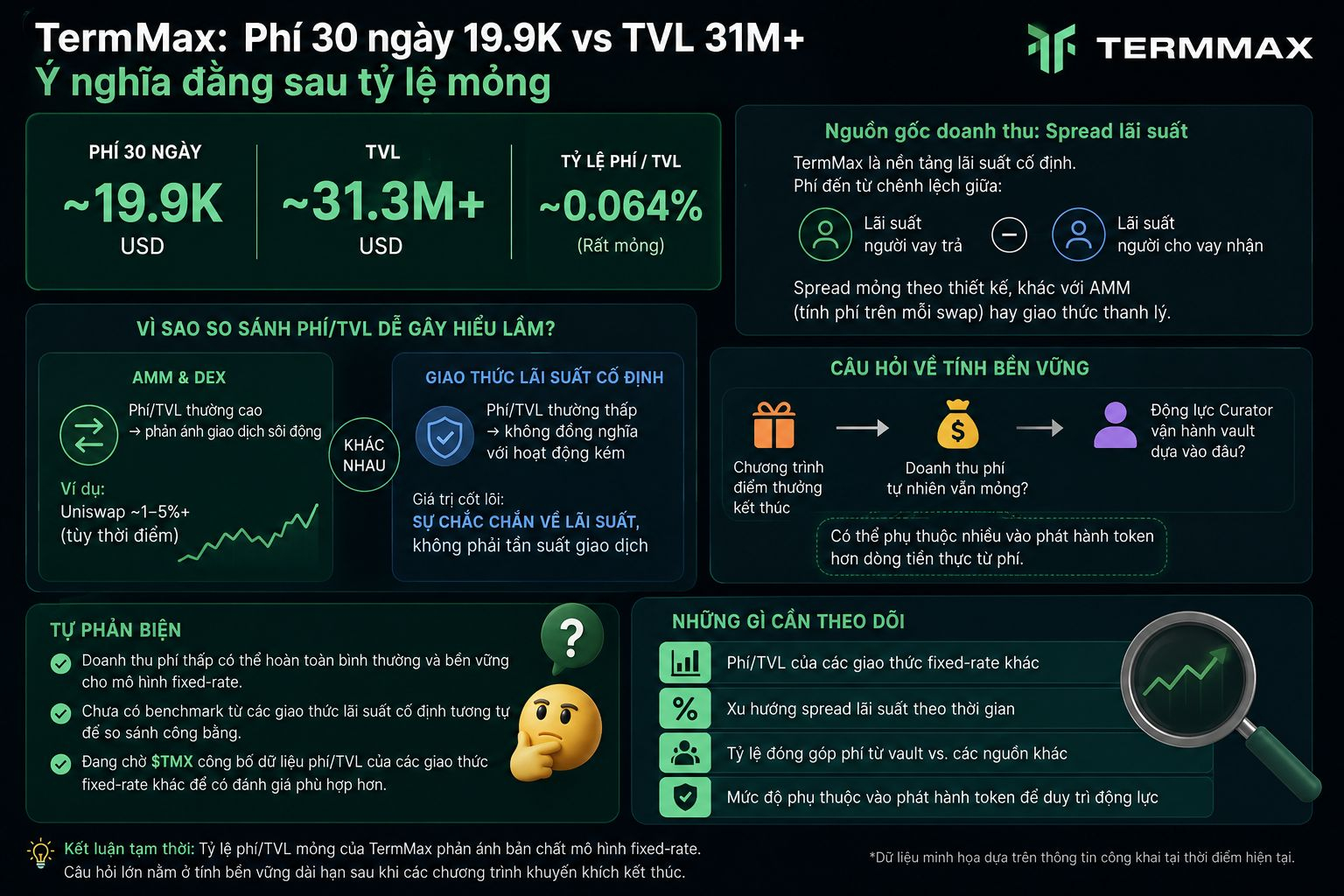
I noticed something when I tried to estimate a 30-day fee—around 19.9K—next to TermMax’s TVL of over 31 million, rather than just looking at each number in isolation.
The fee-to-TVL ratio is quite thin, but what’s interesting isn’t the small number—it’s what it implies about the true source of revenue. In a fixed-rate interest platform, the fee mainly comes from the spread between the interest rate borrowers pay and the interest rate lenders receive—by design, a thin spread, unlike protocols that charge fees per swap or liquidation.
This is what makes comparing TermMax with other DeFi protocols using the fee/TVL metric potentially misleading if you don’t have the right context. AMMs with high fee/TVL often reflect very active trading. But fixed-rate interest protocols with low fee/TVL don’t necessarily indicate weak activity—they may simply reflect the nature of the model, where value lies in the certainty of interest rates, not in the frequency of trades.
But this raises questions about the sustainability of @termmax after the points/bonus program ends—if fee revenue remains naturally thin, the incentive for a Curator to keep operating the vault may depend more on token emissions than on real cash flow from fees.
Counterpoint to myself: I might be applying the wrong evaluation framework—low fee revenue could be completely normal and sustainable for a fixed-rate model. I don’t yet have benchmarks from similar protocols to compare fairly.
I’m waiting to see whether TMX will publish fee/TVL data for other fixed-rate interest protocols so the comparison is appropriate, instead of self-matching against AMM benchmarks that rely on a fundamentally different revenue model.
#termmax $BTC $ETH
I noticed something when I tried to estimate a 30-day fee—around 19.9K—next to TermMax’s TVL of over 31 million, rather than just looking at each number in isolation.
The fee-to-TVL ratio is quite thin, but what’s interesting isn’t the small number—it’s what it implies about the true source of revenue. In a fixed-rate interest platform, the fee mainly comes from the spread between the interest rate borrowers pay and the interest rate lenders receive—by design, a thin spread, unlike protocols that charge fees per swap or liquidation.
This is what makes comparing TermMax with other DeFi protocols using the fee/TVL metric potentially misleading if you don’t have the right context. AMMs with high fee/TVL often reflect very active trading. But fixed-rate interest protocols with low fee/TVL don’t necessarily indicate weak activity—they may simply reflect the nature of the model, where value lies in the certainty of interest rates, not in the frequency of trades.
But this raises questions about the sustainability of @TermMax after the points/bonus program ends—if fee revenue remains naturally thin, the incentive for a Curator to keep operating the vault may depend more on token emissions than on real cash flow from fees.
Counterpoint to myself: I might be applying the wrong evaluation framework—low fee revenue could be completely normal and sustainable for a fixed-rate model. I don’t yet have benchmarks from similar protocols to compare fairly.
I’m waiting to see whether TMX will publish fee/TVL data for other fixed-rate interest protocols so the comparison is appropriate, instead of self-matching against AMM benchmarks that rely on a fundamentally different revenue model.
#termmax $BTC $ETH
The fee-to-TVL ratio is quite thin, but what’s interesting isn’t the small number—it’s what it implies about the true source of revenue. In a fixed-rate interest platform, the fee mainly comes from the spread between the interest rate borrowers pay and the interest rate lenders receive—by design, a thin spread, unlike protocols that charge fees per swap or liquidation.
This is what makes comparing TermMax with other DeFi protocols using the fee/TVL metric potentially misleading if you don’t have the right context. AMMs with high fee/TVL often reflect very active trading. But fixed-rate interest protocols with low fee/TVL don’t necessarily indicate weak activity—they may simply reflect the nature of the model, where value lies in the certainty of interest rates, not in the frequency of trades.
But this raises questions about the sustainability of @TermMax after the points/bonus program ends—if fee revenue remains naturally thin, the incentive for a Curator to keep operating the vault may depend more on token emissions than on real cash flow from fees.
Counterpoint to myself: I might be applying the wrong evaluation framework—low fee revenue could be completely normal and sustainable for a fixed-rate model. I don’t yet have benchmarks from similar protocols to compare fairly.
I’m waiting to see whether TMX will publish fee/TVL data for other fixed-rate interest protocols so the comparison is appropriate, instead of self-matching against AMM benchmarks that rely on a fundamentally different revenue model.
#termmax $BTC $ETH
243
·
--
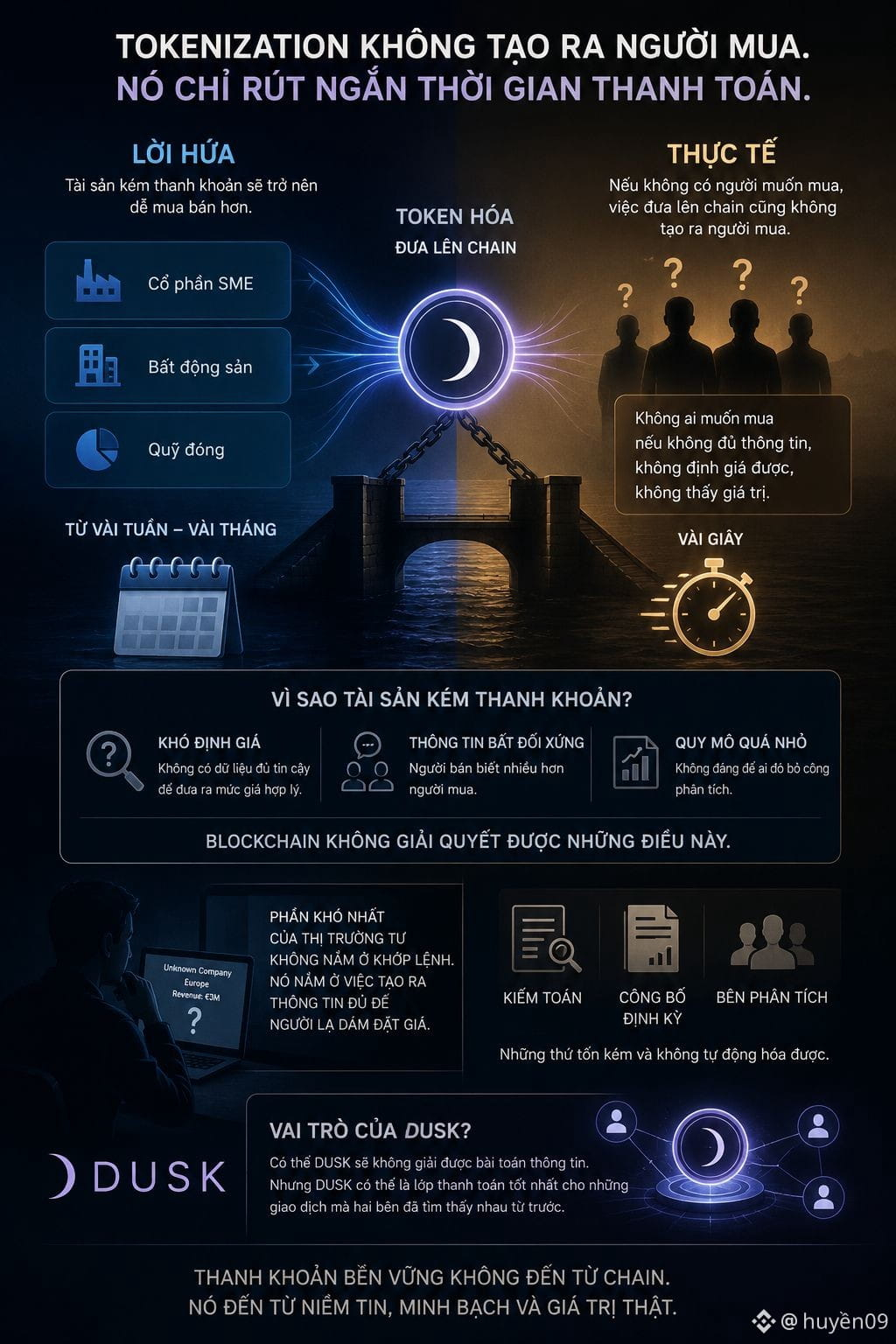
This week I looked into the secondary liquidity of @Dusk_Foundation v and one detail made me pause. The whole promise of tokenization rests on a single claim: illiquid assets will become easier to buy and sell. SME shares, real estate, closed-end funds—capital that used to have to wait month by month to find a buyer—can now be traded in a matter of seconds.
But tokenization doesn’t create buyers. It only shortens settlement time. If a small business in the Netherlands has no one who wants to buy its shares, then having those shares on-chain doesn’t make any buyers appear.
What made me stop… the reason these assets have been illiquid was never mainly because the infrastructure was slow. It’s because they’re hard to value, information is asymmetric, and the scale is so small that it’s not worth anyone’s time to analyze. None of that is solved by blockchain.
A small anecdote: I tried to think how I would value the shares of a European company with a few million euros in revenue that I’ve never even heard of. Hmm… I have no way to do it. And if I can’t value it, then I’m not really a buyer—no matter how fast the trade executes.
So the hardest part of private markets isn’t matching orders. It’s creating enough information for strangers to be willing to place a price. That’s the job of auditors, periodic reporting, and analysts—things that are costly and can’t be fully automated.
I’m curious how $DUSK will solve this problem, or whether it’ll accept a more modest role: building a better settlement layer for transactions where the two parties have already found each other in the first place.
#dusk $BTC $ETH
This week I looked into the secondary liquidity of @Dusk v and one detail made me pause. The whole promise of tokenization rests on a single claim: illiquid assets will become easier to buy and sell. SME shares, real estate, closed-end funds—capital that used to have to wait month by month to find a buyer—can now be traded in a matter of seconds.
But tokenization doesn’t create buyers. It only shortens settlement time. If a small business in the Netherlands has no one who wants to buy its shares, then having those shares on-chain doesn’t make any buyers appear.
What made me stop… the reason these assets have been illiquid was never mainly because the infrastructure was slow. It’s because they’re hard to value, information is asymmetric, and the scale is so small that it’s not worth anyone’s time to analyze. None of that is solved by blockchain.
A small anecdote: I tried to think how I would value the shares of a European company with a few million euros in revenue that I’ve never even heard of. Hmm… I have no way to do it. And if I can’t value it, then I’m not really a buyer—no matter how fast the trade executes.
So the hardest part of private markets isn’t matching orders. It’s creating enough information for strangers to be willing to place a price. That’s the job of auditors, periodic reporting, and analysts—things that are costly and can’t be fully automated.
I’m curious how $DUSK will solve this problem, or whether it’ll accept a more modest role: building a better settlement layer for transactions where the two parties have already found each other in the first place.
#dusk $BTC $ETH
But tokenization doesn’t create buyers. It only shortens settlement time. If a small business in the Netherlands has no one who wants to buy its shares, then having those shares on-chain doesn’t make any buyers appear.
What made me stop… the reason these assets have been illiquid was never mainly because the infrastructure was slow. It’s because they’re hard to value, information is asymmetric, and the scale is so small that it’s not worth anyone’s time to analyze. None of that is solved by blockchain.
A small anecdote: I tried to think how I would value the shares of a European company with a few million euros in revenue that I’ve never even heard of. Hmm… I have no way to do it. And if I can’t value it, then I’m not really a buyer—no matter how fast the trade executes.
So the hardest part of private markets isn’t matching orders. It’s creating enough information for strangers to be willing to place a price. That’s the job of auditors, periodic reporting, and analysts—things that are costly and can’t be fully automated.
I’m curious how $DUSK will solve this problem, or whether it’ll accept a more modest role: building a better settlement layer for transactions where the two parties have already found each other in the first place.
#dusk $BTC $ETH
199
·
--
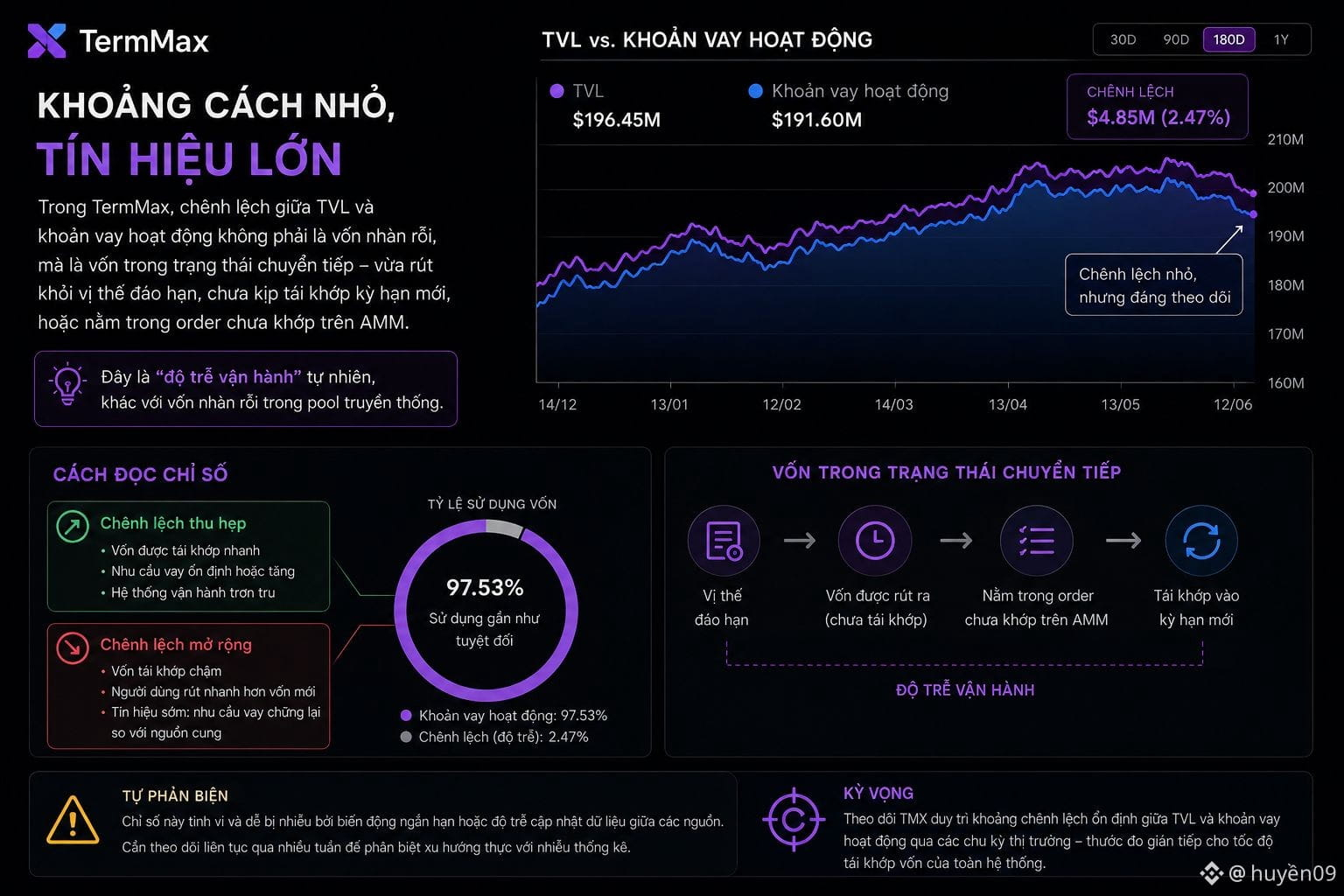
I notice something worth highlighting when comparing the almost absolute capital utilization of @termmax with a less observed metric: the distance between TVL and active loans—even if small—can still be worth a closer look rather than dismissed as an insignificant error.
That small gap does not necessarily mean “idle” capital in the traditional sense, because the TermMax model is not designed for this concept. More likely, it is capital in a transitional state—partly withdrawn from an expiring position, not yet re-matched into a new term, or sitting in an unfilled order on the AMM. This is a natural operational lag, fundamentally different from intentionally idle capital in a conventional pool.
This suggests an alternative way to read the protocol’s health: instead of only looking at absolute capital utilization ratios as a fixed strength, it may be important to track whether this gap widens or narrows over time. If the gap steadily grows, it could indicate that re-matching is slowing down—users withdraw faster than new capital arrives, or old capital is reallocated, an early signal that borrowing demand is stalling relative to liquidity supply.
Self-critique: this is a fairly subtle indicator, easily affected by short-term fluctuations or data-update latency between sources—so you need to monitor it continuously over multiple weeks to distinguish real trends from ordinary statistical noise.
I’m waiting to see whether TMX maintains a stable gap between TVL and active loans across different market cycles, as an indirect measure of the system-wide capital re-matching speed.
#termmax $BTC $ETH
I notice something worth highlighting when comparing the almost absolute capital utilization of @TermMax with a less observed metric: the distance between TVL and active loans—even if small—can still be worth a closer look rather than dismissed as an insignificant error.
That small gap does not necessarily mean “idle” capital in the traditional sense, because the TermMax model is not designed for this concept. More likely, it is capital in a transitional state—partly withdrawn from an expiring position, not yet re-matched into a new term, or sitting in an unfilled order on the AMM. This is a natural operational lag, fundamentally different from intentionally idle capital in a conventional pool.
This suggests an alternative way to read the protocol’s health: instead of only looking at absolute capital utilization ratios as a fixed strength, it may be important to track whether this gap widens or narrows over time. If the gap steadily grows, it could indicate that re-matching is slowing down—users withdraw faster than new capital arrives, or old capital is reallocated, an early signal that borrowing demand is stalling relative to liquidity supply.
Self-critique: this is a fairly subtle indicator, easily affected by short-term fluctuations or data-update latency between sources—so you need to monitor it continuously over multiple weeks to distinguish real trends from ordinary statistical noise.
I’m waiting to see whether TMX maintains a stable gap between TVL and active loans across different market cycles, as an indirect measure of the system-wide capital re-matching speed.
#termmax $BTC $ETH
That small gap does not necessarily mean “idle” capital in the traditional sense, because the TermMax model is not designed for this concept. More likely, it is capital in a transitional state—partly withdrawn from an expiring position, not yet re-matched into a new term, or sitting in an unfilled order on the AMM. This is a natural operational lag, fundamentally different from intentionally idle capital in a conventional pool.
This suggests an alternative way to read the protocol’s health: instead of only looking at absolute capital utilization ratios as a fixed strength, it may be important to track whether this gap widens or narrows over time. If the gap steadily grows, it could indicate that re-matching is slowing down—users withdraw faster than new capital arrives, or old capital is reallocated, an early signal that borrowing demand is stalling relative to liquidity supply.
Self-critique: this is a fairly subtle indicator, easily affected by short-term fluctuations or data-update latency between sources—so you need to monitor it continuously over multiple weeks to distinguish real trends from ordinary statistical noise.
I’m waiting to see whether TMX maintains a stable gap between TVL and active loans across different market cycles, as an indirect measure of the system-wide capital re-matching speed.
#termmax $BTC $ETH
4
3
323
Log in to explore more content
Join global crypto users on Binance Square
⚡️ Get latest and useful information about crypto.
💬 Trusted by the world’s largest crypto exchange.
👍 Discover real insights from verified creators.
Email / Phone number
Trending Topics
BTCRebounds80K
13,532 views
426 Discussing
$BTC LONG SETUP ... NEXT TARGET 81,923.14
Upper Range Breakout Observed Alongside Balanced Momentum Signals
Entry: 78,610.70 - 78,959.38 (Long)
TP1: 79,831.07
TP2: 80,877.11
Final TP: 81,923.14
SL: 77,739.01
Price expanded upward over the past twenty-four hours to trade above the peak of the last twenty four-hour candles. As the relative strength index remains neutral on the four-hour chart, traders monitor whether this level transitions into support.
As long as 78,610.70 holds, structure stays constructive
Must use stop loss while trading
Trade $BTC
Not financial advice. Always DYOR.
Like & Follow for Daily Trade Analytics & Insider News. @SarwatAK
#HotTrends #TechnicalAnalysis #BTCRebounds80K
SarwatAK
·0 Likes
·205 views
Binance98PercentReplenished
14,849 views
406 Discussing
USMidterms-WhatAreMarketsExpecting?
263,292 views
1,883 Discussing