
比特枫
348 Posts

比特枫
Report
Block User
趋势观察者!做趋势的朋友!每日分享实盘!4000U起步!公开收益/回撤/执行率!还有我想成为枫神
Frequent Trader
2.8 Years
15 Following
72 Followers
70 Liked
Posts
All
Quotes
·
--
🚨【Nvidia breaking news! Major uncertainty emerges over CEO Jensen Huang’s position; NVDA under pressure after hours!】
After the U.S. market closed on November 11, Nvidia suddenly became the market’s focus!
According to earlier media reports, Nvidia’s board is discussing whether CEO Jensen Huang should remain in his position.
📉 NVDA closed the regular session at $173.73, up 2.87%; it was later reported to have fallen about 8% at one point after hours.
⚠️【The most important distinction right now】
① Media reports: The board may be discussing changes to the company’s leadership.
② Official confirmation: No formal announcement has been seen confirming that Jensen Huang has been removed or resigned.
③ Market risk: If a CEO transition is ultimately confirmed, Nvidia may face uncertainty around succession planning and corporate governance.
📊【Market impact】
NVDA: Could continue to face near-term sentiment pressure.
QQQ, TQQQ: Nvidia carries significant weight in these funds, so share-price volatility could spill over into tech indexes.
AMD, AVGO: Could see capital rotate their way, but that does not mean orders have already shifted.
💡【My view】
Nvidia’s most important assets are not just its GPU technology, but also the strategy and ecosystem Jensen Huang has built over the long term.
If a major leadership change really does occur, it would not be surprising for the market to reassess the company’s valuation.
But until there is an official announcement, I won’t treat rumors as facts.
Key things to watch next: board announcements, leadership arrangements, and earnings guidance.
How much do you think NVDA would fall if Jensen Huang really left Nvidia?
📅 After the U.S. market close on November 11, 2026
Source: Earlier related reports from Reuters and the WSJ; the board’s decision and after-hours trading remain to be independently verified.
#NVDA #Nvidia #JensenHuang #QQQ #TQQQ #USStocks
538
·
--
Verified
🚨【Nvidia Hit by Sudden After-Hours Sell-Off! NVDA Fell Nearly 5% at One Point as Jensen Huang Faces Another Controversy!】
At the close of U.S. trading on November 11, Nvidia was up about 2.87%, but was suddenly hit by a sell-off after hours!
📉 NVDA close: $173.73
📉 Daily gain: +2.87%
📉 After hours: Reportedly fell nearly 5% at one point
What exactly happened?
① Media reports revealed a new controversy involving Jensen Huang's personal relationships, prompting concerns about corporate governance.
② An independent investigation involving Huang has not yet concluded, and the related allegations still require further verification.
③ Investors have begun to worry about management stability, weighing on short-term risk appetite.
【Market impact】
This drop did not follow a new earnings warning from Nvidia, and there is no evidence that GPU orders suddenly fell sharply.
But for tech giants that depend heavily on key executives, uncertainty around corporate governance can directly affect market valuations.
💡【My take】
I believe Nvidia's biggest short-term risk right now may not be AI demand, but market confidence in its management.
Over the long term, the factors that will truly determine the share price are still revenue, profits, AI capital expenditure, and chip competitiveness.
In the short term, keep an eye on the $168–170 range and the next earnings report.
If the fundamentals have not deteriorated, a pullback driven by market sentiment could present an opportunity; but if management risks continue to grow, the valuation could face further pressure.
Do you think NVDA's sharp after-hours drop is short-term panic or the beginning of a larger correction?
📅 After the U.S. market close on November 11, 2026
Source: Related reports from Axios and The New York Times, and market data. The after-hours decline reflects figures at the time of reporting and has yet to be confirmed against the latest market data.
#NVDA #Nvidia #JensenHuang #AI #USStocks
1.2k
·
--
🚨【Big news in the AI industry! Anthropic reportedly launches IPO plans, with seven tech giants set to invest $26 billion!】
AI competition is entering a new phase of all-out rivalry in capital and computing power!
According to the latest market reports, Anthropic plans to go public on Nasdaq under the proposed ticker symbol ANT.
💰【Seven tech giants reportedly considering investments】
• Google: $10 billion
• NVIDIA: $10 billion
• AMD: $2.5 billion
• Broadcom: $1 billion
• Micron: $1 billion
• Microsoft: $1 billion
• TSMC: $500 million
Total: $26 billion!
⚠️ These amounts refer to proposed placements reported earlier and should not be considered completed investments. The specific terms still need to be confirmed in official filings.
🔥【Why does this matter?】
This is more than news about one AI company's fundraising—it has implications for the entire AI supply chain:
① NVDA: GPU computing demand
② AMD, AVGO: AI chips and custom accelerators
③ MU: High-performance memory such as HBM and DRAM
④ TSMC: Advanced chip manufacturing
⑤ Google, Microsoft: Competition in cloud computing and AI ecosystems
📈【Market impact】
If the large-scale fundraising is completed successfully, it could help fund the construction of future AI data centers.
But the fundraising amount is not the same as chip orders, nor can it be directly equated with additional revenue for the companies listed above.
💡【My take】
The future of AI competition won't be decided by model capabilities alone.
Computing power, memory, energy, and access to capital will matter even more.
I'll continue to follow NVDA, MU, AMD, and AVGO.
MU in particular—if demand for AI inference continues to grow, HBM and server DRAM could be important beneficiaries.
However, what will ultimately determine long-term share-price performance is order conversion, profit growth, and valuation.
Who do you think will be the biggest winners in AI over the next three years: model companies or chip and memory suppliers?
📅 November 11, 2026
🔎 Source: Anthropic IPO and SEC filing information cited in earlier reports; specific placement terms remain to be verified.
#Anthropic #AI #NVDA #MU #AMD #GOOGL #Semiconductors
1
764
·
--
🚨 A stunning reversal in South Korea’s stock market! It plunged 4% intraday, then finished in positive territory!
🇰🇷 On November 4, South Korea’s stock market staged a V-shaped reversal!
📊 Key data for today:
• KOSPI: 5,683.80 points, up 0.62% at the close
• Intraday low: 5,421.72 points
• Samsung Electronics: 218,000 won, down 0.68%
• SK Hynix: 1.4 million won, down 0.14%
🔥 The most important thing to watch today wasn’t the gains, but the dramatic shift from panic selling to bargain hunting!
AMD’s latest earnings report showed:
• Q3 data center revenue grew 97% year over year
• Revenue is expected to grow more than 80% in 2027
• Demand for AI chips remains strong
Yet South Korean semiconductor stocks are still seeing major swings!
Why?
The market is trading on two expectations at the same time:
① Strong AI demand continues to benefit the HBM, DRAM, and broader memory supply chains.
② High AI valuations, regulatory uncertainty, and foreign investor outflows are fueling short-term selling.
💡 My take:
The AI industry’s fundamentals haven’t suddenly disappeared because stock prices plunged. But the market is no longer willing to pay high valuations for high growth without question.
Today’s V-shaped reversal in South Korea’s stock market suggests that buyers are stepping in at lower levels, but it’s still too early to confirm that the correction is over.
Key things to watch next:
🇺🇸 Can NVDA, AMD, and MU help stabilize U.S. semiconductor stocks?
📈 Can QQQ regain momentum, and will TQQQ continue to amplify volatility?
The real opportunity isn’t guessing the bottom—it’s waiting for capital flows and market trends to move back in sync!
#SouthKoreanStocks #SKHynix #SamsungElectronics #AMD #NVDA #MU #AI #QQQ #TQQQ
281
·
--
🚨 South Korea’s stock market strikes back! U.S. semiconductor stocks plunge 7.2%, but Korean stocks open lower and climb!
🇰🇷 On November 2, South Korea’s stock market stages a major reversal!
📊 Key intraday data (around 11:20 a.m. Korea time):
• KOSPI: 5,823.90 points, up 1.63%
• SK Hynix: +2.47%
• Samsung Electronics: +0.89%
The KOSPI opened down more than 1% at one point in the morning, then quickly turned positive.
📉 South Korea’s market last Friday:
• KOSPI: -3.48%
• SK Hynix: about -7.1%
• Samsung Electronics: about -3.0%
🇺🇸 A stark contrast with U.S. stocks:
• Nasdaq: -2.86%
• U.S. semiconductor index SOX: -7.20%
• Intel: about -28.6%
• AMD: about -10.9%
• NVDA: about -4.2%
🔥 Why is South Korea’s stock market rebounding?
① After last Friday’s sharp drop, investors have started buying the dip.
② South Korea’s semiconductor exports surged 259% year over year in October, showing that industry demand remains strongly supported.
③ The profitability of SK Hynix and Samsung in HBM and server memory remains a key market focus.
💡 My take:
The U.S. market is growing concerned about returns on AI investment, while the Korean market is starting to trade again on the real earnings potential of AI memory.
This may mean the semiconductor sector is diverging, rather than all AI stocks entering a downtrend.
But a one-day rebound doesn’t prove the correction is over.
Next, watch whether SK Hynix can continue to outperform Samsung, and whether MU, NVDA, and QQQ can stabilize in tonight’s U.S. session.
#SouthKoreanStocks #SKHynix #SamsungElectronics #HBM #USStocks #QQQ #TQQQ
272

·
--
🚨 Samsung’s Q3 profit hits an all-time high as Korean semiconductor stocks surge! Is the AI memory chip rally not over yet?
📊 Samsung Electronics $005930 official earnings:
• Revenue: KRW 195.3 trillion, a quarterly record
• Operating profit: KRW 107.4 trillion, an all-time record
• Semiconductor division revenue: KRW 147.1 trillion
• Semiconductor division operating profit: KRW 106.5 trillion
Demand for HBM, server DRAM, and enterprise SSDs remains strong.
🇰🇷 The Korean stock market has already reacted:
Closing prices on October 28:
📈 KOSPI: +6.63%, back above 6,000
📈 Samsung Electronics: +9.01%
📈 SK hynix: +10.89%
The rally continued in early trading on October 29, at around 9:29 a.m. Korea time:
• KOSPI: +1.24%
• Samsung: +1.6%
• SK hynix: +5.5%
My take:
Microsoft and Google are investing huge sums in AI infrastructure, while Samsung, SK hynix, and Micron are directly benefiting from demand for memory chips.
The market is starting to show a clear divergence:
AI giants are footing the capital spending bill, while memory chip makers are turning demand into profits.
This remains a positive signal for $MU, $NVDA, and the semiconductor supply chain.
But after such a sharp run-up, I won’t chase prices blindly.
Next, I’ll be watching whether Korean semiconductor stocks can hold their gains, and whether $QQQ and $TQQQ attract follow-through buying in the U.S. market.
Fundamentals determine the long-term direction; price determines the timing of a trade.
#Samsung #SKHynix #MU #NVDA #QQQ #TQQQ #AI #Semiconductors
1.1k
·
--
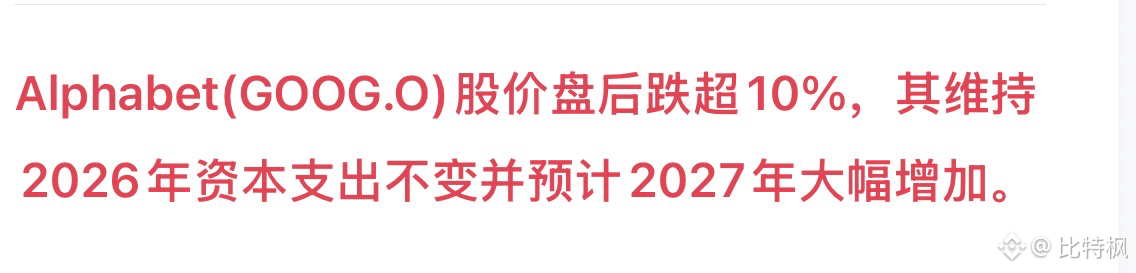
🚨 Alphabet $GOOGL extends its after-hours losses to more than 10%! QQQ faces pressure!
Google’s Q3 2026 revenue reached $127.58 billion, up about 25% year over year, but still slightly below market expectations.
More concerning:
The company maintained its 2026 capital expenditure plan and expects AI-related capital expenditures to increase significantly in 2027.
📉 The market reaction was immediate:
• $GOOGL briefly fell more than 10% after hours
• $MSFT beat earnings expectations and briefly rose 4.33% after hours
• $QQQ faces a test as the two major tech stocks move in opposite directions
My take:
The market hasn’t stopped believing in AI; it’s simply scrutinizing the returns on AI investments more closely.
Even if cloud business grows rapidly, continued increases in capital expenditures and pressure on free cash flow could still lead to a valuation reset.
For $QQQ and $TQQQ, which I’m watching:
The key thing to watch next is whether Microsoft’s gains can offset the pressure from Google’s decline after the regular market opens, and whether the Nasdaq 100 can hold key trend levels.
The long-term AI thesis may be unchanged, but in the short term, trades must respect price action.
Don’t try to call the bottom or chase rallies blindly. Keep following the trading system.
#GOOGL #MSFT #QQQ #TQQQ #AI #USStocks
77
·
--
Partly True
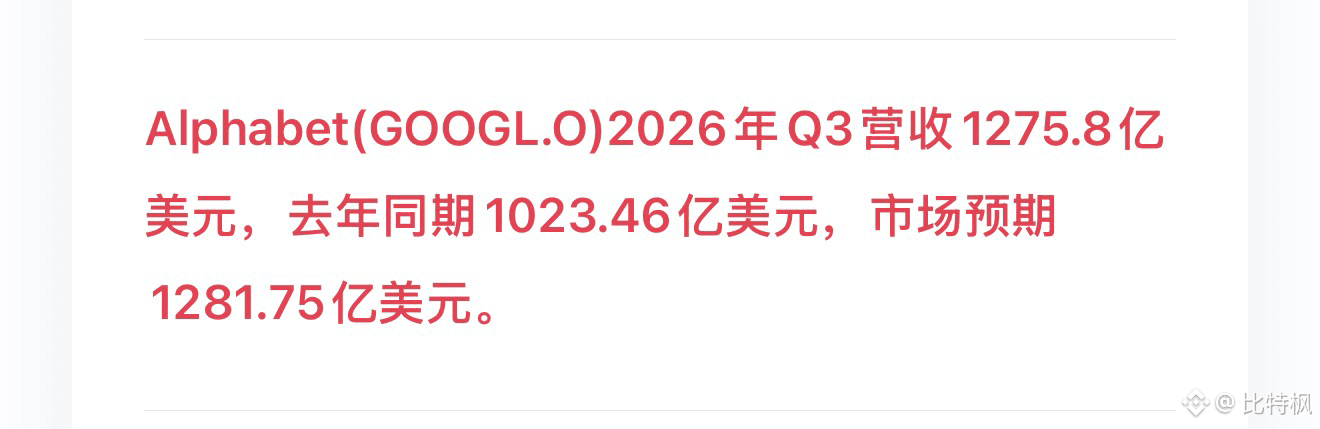
🚨 Google $GOOGL earnings are out, and the stock plunged 7.38% after hours!
Revenue continued to grow rapidly, but the stock faced significant selling pressure!
📊 Key Q3 2026 figures:
• Revenue: $127.58 billion
• Same period last year: $102.346 billion
• Year-over-year growth: 24.7%
• Market expectations: $128.175 billion
• Missed expectations by: approximately $595 million (0.46%)
📉 After-hours stock reaction:
$GOOGL last traded at $300.906
Down $23.984, or -7.38%!
Meanwhile, Microsoft $MSFT beat earnings expectations and rose as much as 4.33% after hours.
Both are AI tech giants, yet the market reacted very differently.
💡 My take:
Google's revenue grew nearly 25% year over year, but still fell short of market expectations.
This highlights one thing:
When expectations are high enough, growth alone is no longer enough—you have to keep exceeding expectations.
Next, keep an eye on Google Cloud, AI capital expenditures, and management's guidance.
For $QQQ and $TQQQ, the divergence in after-hours moves by these two tech giants could mean even greater short-term volatility.
A great company isn't necessarily a great buy at any price. Earnings are about fundamentals; trading is about trends.
#GOOGL #MSFT #QQQ #TQQQ #AI #USStocks
2.4k
·
--
Verified
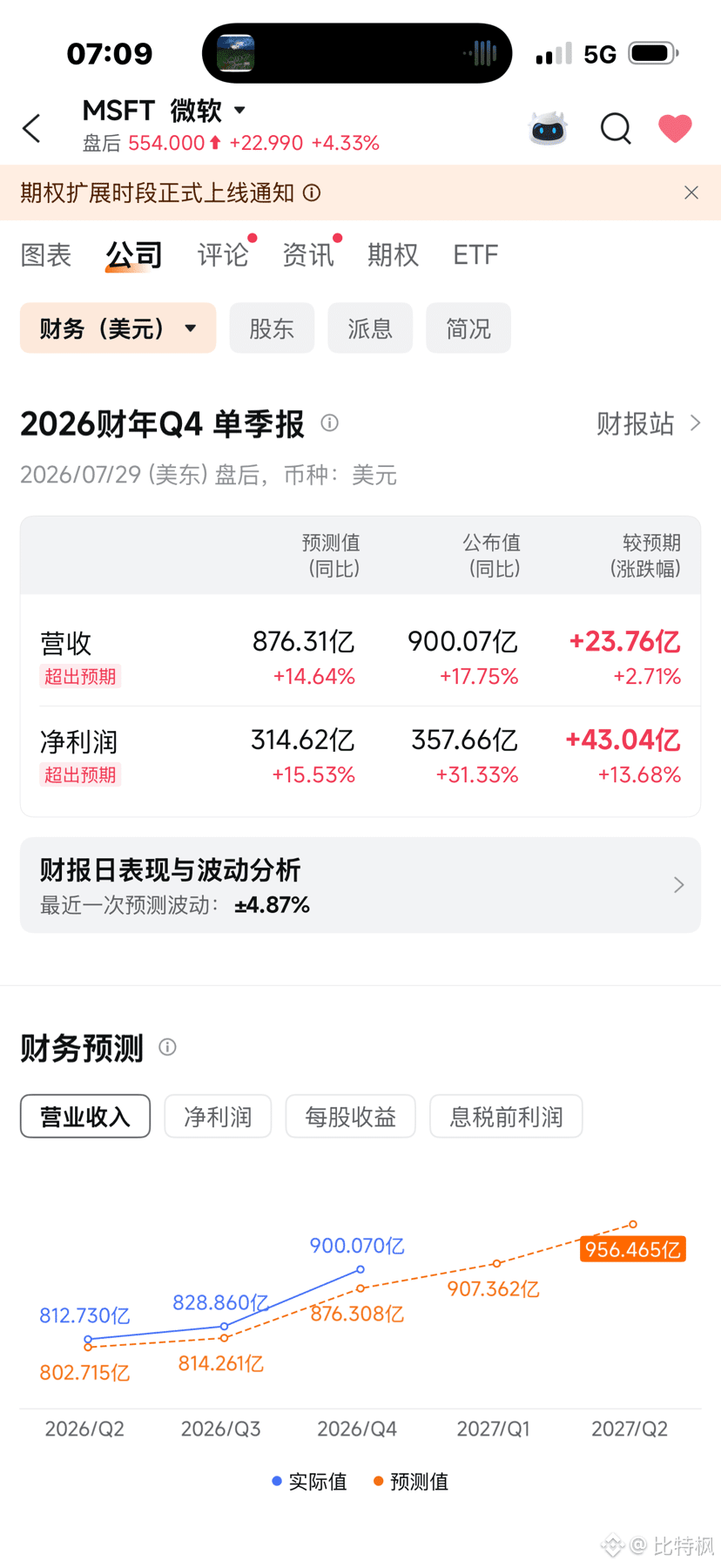
🚨 Microsoft beats earnings expectations; shares surge 4.33% after hours!
$MSFT is trading at $554 after hours, up $22.99, or +4.33%!
The market is responding to Microsoft's performance with real money.
📊 FY2027 Q1 earnings highlights:
• Revenue of $92.28 billion, above market expectations
• Adjusted EPS of $4.89, above market expectations
• Azure revenue grew 48%; demand for AI cloud computing remains strong
📈 My take:
Microsoft not only delivered an earnings report that beat expectations, but its share price also responded positively after hours.
This is a positive signal for $NVDA, $QQQ, $TQQQ, and the AI infrastructure supply chain.
But one thing to keep in mind:
An earnings beat is a fundamental positive, but a big after-hours gain doesn't guarantee the stock will keep rising the next day.
Next, watch whether the stock can hold onto its gains after the market opens, as well as management's guidance on AI capital expenditures and future growth.
I still stand by this: fundamentals determine direction; price determines the trade.
#MSFT #NVDA #QQQ #TQQQ #AI #USStockEarnings
762
·
--
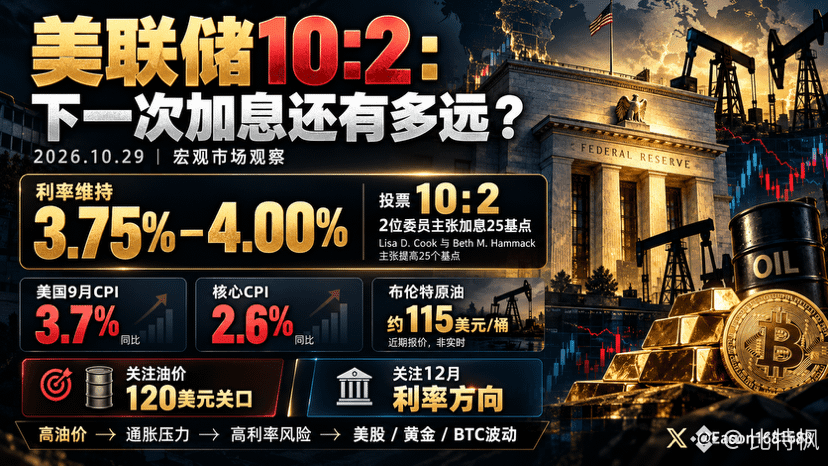
🚨 Latest Fed decision: Rates unchanged, but a hawkish signal!\n\n🇺🇸 In the early hours of October 29, the Fed announced its latest interest rate decision:\n\n▪️ Rates held steady at 3.75%–4.00%\n\n▪️ Vote: 10–2, with two members favoring a 25-basis-point hike\n\n▪️ U.S. September CPI: 3.7%; core CPI: 2.6%\n\n▪️ International crude oil prices remain elevated, near $115\n\n📊 My take:\n\nWhat markets really need to worry about now isn’t whether the Fed will cut rates, but whether it might keep raising them.\n\nThe conflict in the Middle East is ongoing, energy prices remain high, and the path for U.S. inflation to return to 2% is still a difficult one.\n\nIf high oil prices, high inflation, and high interest rates persist at the same time, that’s bad news for the Nasdaq, TQQQ, and BTC.\n\nGold may offer a safe haven, but it also faces pressure from the dollar and real interest rates.\n\nGoing forward, I’ll be watching two key signals:\n\n① Whether Brent crude breaks above $120\n\n② Whether the Fed raises rates again in December\n\nYou don’t need to predict everything when trading, but you do need to prepare for risks in advance.\n\nDo you think the Fed will raise rates in December?\n\n#FederalReserve #CPI #BTC #TQQQ #Gold
🚨 Latest Fed decision: Rates unchanged, but a hawkish signal!\n\n🇺🇸 In the early hours of October 29, the Fed announced its latest interest rate decision:\n\n▪️ Rates held steady at 3.75%–4.00%\n\n▪️ Vote: 10–2, with two members favoring a 25-basis-point hike\n\n▪️ U.S. September CPI: 3.7%; core CPI: 2.6%\n\n▪️ International crude oil prices remain elevated, near $115\n\n📊 My take:\n\nWhat markets really need to worry about now isn’t whether the Fed will cut rates, but whether it might keep raising them.\n\nThe conflict in the Middle East is ongoing, energy prices remain high, and the path for U.S. inflation to return to 2% is still a difficult one.\n\nIf high oil prices, high inflation, and high interest rates persist at the same time, that’s bad news for the Nasdaq, TQQQ, and BTC.\n\nGold may offer a safe haven, but it also faces pressure from the dollar and real interest rates.\n\nGoing forward, I’ll be watching two key signals:\n\n① Whether Brent crude breaks above $120\n\n② Whether the Fed raises rates again in December\n\nYou don’t need to predict everything when trading, but you do need to prepare for risks in advance.\n\nDo you think the Fed will raise rates in December?\n\n#FederalReserve #CPI #BTC #TQQQ #Gold
1.8k
·
--
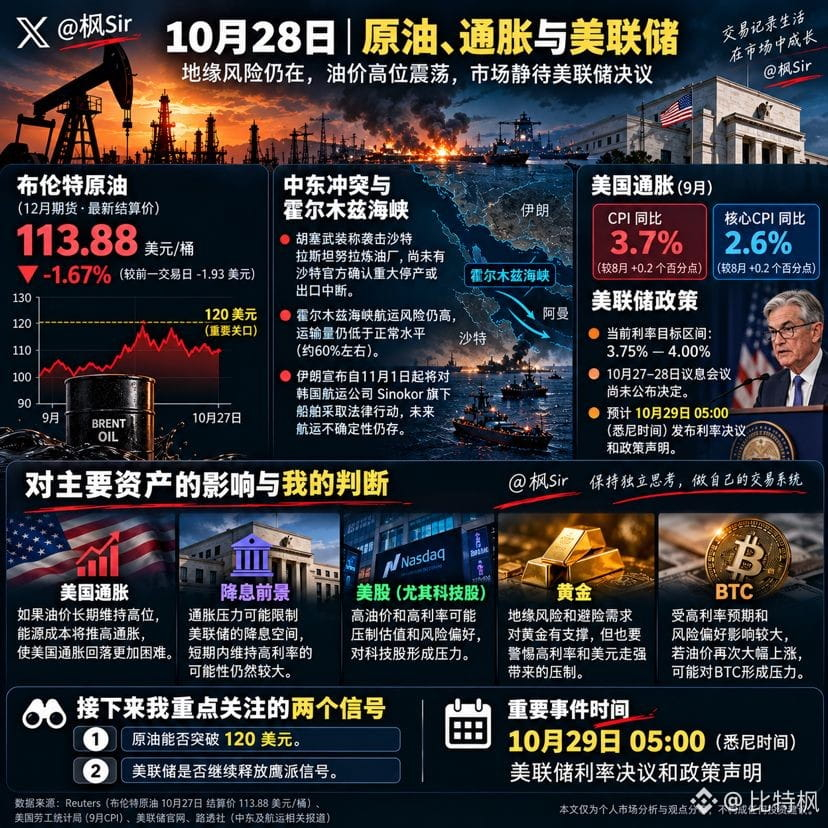
📊 October 28 | Crude Oil, Inflation, and the Fed
Brent crude’s latest settlement price was $113.88 per barrel, still below $120. The conflict in the Middle East continues, and shipping risks through the Strait of Hormuz remain unresolved.
U.S. CPI rose 3.7% year over year in September, while core CPI was 2.6%.
My assessment:
If oil prices stay elevated for an extended period, it will be harder for U.S. inflation to come down, limiting the Fed’s room to cut rates.
This could put pressure on U.S. tech stocks and BTC. Gold may benefit from safe-haven demand, but high interest rates could also weigh on it.
The Fed will announce its rate decision tomorrow at 5 a.m. (Sydney time).
I’ll be watching two key signals:
① Whether crude oil breaks above $120.
② Whether the Fed continues to send hawkish signals.
Rather than guess which way the market will move, I’d rather wait for key data to point the way.
#CrudeOil #CPI #Fed #BTC #Gold
724
Log in to explore more content
Join global crypto users on Binance Square
⚡️ Get latest and useful information about crypto.
💬 Trusted by the world’s largest crypto exchange.
👍 Discover real insights from verified creators.
Email / Phone number
Trending Topics
NvidiaEarningsTonight:AIStocks’NextMove?
4,192 views
120 Discussing
Nvidia Earnings Day: Interim CEO's First Appearance — Can the AI Story Hold?
Binance News
·4 Likes
·2.4k views
A Packed Week of Earnings and Data Tests Markets
93,186 views
516 Discussing
AnthropicIPOTestsInvestorAppetiteForAI
189,970 views
1,967 Discussing