
Majid ali 230
2.6k Posts

Majid ali 230
Report
Block User
Open Trade
Frequent Trader
11.3 Months
217 Following
3.9K+ Followers
1.6K+ Liked
Posts
Portfolio
All
Quotes
Live
The chart is telling a different story depending on the timeframe, and that’s exactly why I’m paying attention to BABY right now.
On the daily chart, price is sitting close to the same area that previously acted as support around 0.0109–0.0113. That level has already been tested more than once, but each bounce has been weaker than the last. Meanwhile, both the 30-minute and 4-hour charts show a clear sequence of lower highs after the sharp move to 0.01337. Momentum hasn’t disappeared overnight—it has been fading candle by candle.
What stands out to me isn’t the pullback itself. Volatile moves are common in meme-driven markets. The more interesting detail is how quickly buyers stopped following through after the breakout. A single explosive candle can attract attention, but sustained strength usually requires demand to keep stepping in. So far, that confirmation hasn’t appeared.
This is the part I keep coming back to: support is only meaningful if buyers defend it with conviction. If the current zone holds and higher lows begin to form on lower timeframes, the recent spike may look more like a reset than a reversal. But if this area breaks cleanly, the market could start treating the breakout as a short-lived liquidity event instead of the beginning of a new trend.
For now, I’m less interested in predicting the next big move than watching how price behaves around this support. Sometimes the reaction at one level tells you far more than the rally that came before it.
So the real question is: Will buyers finally defend this zone, or is the market preparing to discover a new floor?
@babylonlabs_io $BABY #baby
{spot}(BABYUSDT)
The chart is telling a different story depending on the timeframe, and that’s exactly why I’m paying attention to BABY right now.
On the daily chart, price is sitting close to the same area that previously acted as support around 0.0109–0.0113. That level has already been tested more than once, but each bounce has been weaker than the last. Meanwhile, both the 30-minute and 4-hour charts show a clear sequence of lower highs after the sharp move to 0.01337. Momentum hasn’t disappeared overnight—it has been fading candle by candle.
What stands out to me isn’t the pullback itself. Volatile moves are common in meme-driven markets. The more interesting detail is how quickly buyers stopped following through after the breakout. A single explosive candle can attract attention, but sustained strength usually requires demand to keep stepping in. So far, that confirmation hasn’t appeared.
This is the part I keep coming back to: support is only meaningful if buyers defend it with conviction. If the current zone holds and higher lows begin to form on lower timeframes, the recent spike may look more like a reset than a reversal. But if this area breaks cleanly, the market could start treating the breakout as a short-lived liquidity event instead of the beginning of a new trend.
For now, I’m less interested in predicting the next big move than watching how price behaves around this support. Sometimes the reaction at one level tells you far more than the rally that came before it.
So the real question is: Will buyers finally defend this zone, or is the market preparing to discover a new floor?
@BabylonLabs_io $BABY #baby
On the daily chart, price is sitting close to the same area that previously acted as support around 0.0109–0.0113. That level has already been tested more than once, but each bounce has been weaker than the last. Meanwhile, both the 30-minute and 4-hour charts show a clear sequence of lower highs after the sharp move to 0.01337. Momentum hasn’t disappeared overnight—it has been fading candle by candle.
What stands out to me isn’t the pullback itself. Volatile moves are common in meme-driven markets. The more interesting detail is how quickly buyers stopped following through after the breakout. A single explosive candle can attract attention, but sustained strength usually requires demand to keep stepping in. So far, that confirmation hasn’t appeared.
This is the part I keep coming back to: support is only meaningful if buyers defend it with conviction. If the current zone holds and higher lows begin to form on lower timeframes, the recent spike may look more like a reset than a reversal. But if this area breaks cleanly, the market could start treating the breakout as a short-lived liquidity event instead of the beginning of a new trend.
For now, I’m less interested in predicting the next big move than watching how price behaves around this support. Sometimes the reaction at one level tells you far more than the rally that came before it.
So the real question is: Will buyers finally defend this zone, or is the market preparing to discover a new floor?
@BabylonLabs_io $BABY #baby


4
2
82
·
--
Bearish
That is why I'm paying attention to Trustless Bitcoin Vaults from @babylonlabs_io . The biggest shift isn't higher yields or another Bitcoin narrative—it's the attempt to reduce trust assumptions while keeping BTC secured by Bitcoin through a Taproot-based vault and using cryptographic proofs to coordinate across networks. That's a very different design philosophy from simply wrapping assets and hoping the bridge remains the weakest link.
This is the detail that changed how I look at it. Infrastructure isn't interesting because it's flashy. It's interesting because it quietly determines who holds power when markets become volatile. If the security model is stronger from day one, every application built on top starts from a better foundation.
Most people focus on features. I'm watching assumptions. The projects that spend more effort removing trust than adding marketing are usually the ones worth following over multiple cycles, because strong infrastructure compounds in ways price charts can't immediately show.
We're still early enough that the biggest winners may not be the loudest narratives, but the protocols solving problems users don't fully appreciate until something breaks. For me, that's why Babylon's TBV stands out. The real innovation isn't moving Bitcoin—it's questioning whether we should ever have to give up control of it in the first place.
Will reducing trust assumptions become the standard for Bitcoin-powered DeFi, or remain a niche approach? That's the question I'm watching most.
@babylonlabs_io $BABY #baby
{spot}(BABYUSDT)
That is why I'm paying attention to Trustless Bitcoin Vaults from @BabylonLabs_io . The biggest shift isn't higher yields or another Bitcoin narrative—it's the attempt to reduce trust assumptions while keeping BTC secured by Bitcoin through a Taproot-based vault and using cryptographic proofs to coordinate across networks. That's a very different design philosophy from simply wrapping assets and hoping the bridge remains the weakest link.
This is the detail that changed how I look at it. Infrastructure isn't interesting because it's flashy. It's interesting because it quietly determines who holds power when markets become volatile. If the security model is stronger from day one, every application built on top starts from a better foundation.
Most people focus on features. I'm watching assumptions. The projects that spend more effort removing trust than adding marketing are usually the ones worth following over multiple cycles, because strong infrastructure compounds in ways price charts can't immediately show.
We're still early enough that the biggest winners may not be the loudest narratives, but the protocols solving problems users don't fully appreciate until something breaks. For me, that's why Babylon's TBV stands out. The real innovation isn't moving Bitcoin—it's questioning whether we should ever have to give up control of it in the first place.
Will reducing trust assumptions become the standard for Bitcoin-powered DeFi, or remain a niche approach? That's the question I'm watching most.
@BabylonLabs_io $BABY #baby
This is the detail that changed how I look at it. Infrastructure isn't interesting because it's flashy. It's interesting because it quietly determines who holds power when markets become volatile. If the security model is stronger from day one, every application built on top starts from a better foundation.
Most people focus on features. I'm watching assumptions. The projects that spend more effort removing trust than adding marketing are usually the ones worth following over multiple cycles, because strong infrastructure compounds in ways price charts can't immediately show.
We're still early enough that the biggest winners may not be the loudest narratives, but the protocols solving problems users don't fully appreciate until something breaks. For me, that's why Babylon's TBV stands out. The real innovation isn't moving Bitcoin—it's questioning whether we should ever have to give up control of it in the first place.
Will reducing trust assumptions become the standard for Bitcoin-powered DeFi, or remain a niche approach? That's the question I'm watching most.
@BabylonLabs_io $BABY #baby

3
1
91
·
--
Bearish
The part that keeps pulling me back isn't that Newton launched its Mainnet Beta. It's where the protocol chooses to intervene.
Most blockchain infrastructure waits until after a transaction is executed to detect problems. Newton's design shifts that logic forward by evaluating policies before settlement and producing verifiable attestations when those policies are satisfied. That sounds like a subtle architectural choice, but I think it changes the conversation from "monitoring" to "preventing." �
Magic Newton +1
This feels more important than the headline because automation is becoming normal. The more decisions wallets and AI agents make on our behalf, the less useful "we'll detect it later" becomes. If permissions, risk checks, and policy enforcement happen before assets move, the trust model starts looking very different. That's a harder problem than simply making transactions faster.
The other detail I'm watching is how this evolves during the Mainnet Beta. Official materials describe NEWT as supporting staking, protocol fees, and the authorization framework that powers verifiable onchain automation. Those pieces only become meaningful if developers actually build workflows that depend on them. �
Magic Newton +1
That's why I'm paying more attention to adoption of the authorization layer than short-term price action.
The real test isn't whether people use AI onchain. It's whether they trust automated actions enough to let them move real value under enforceable rules.
@NewtonProtocol $NEWT #Newt
{spot}(NEWTUSDT)
The part that keeps pulling me back isn't that Newton launched its Mainnet Beta. It's where the protocol chooses to intervene.
Most blockchain infrastructure waits until after a transaction is executed to detect problems. Newton's design shifts that logic forward by evaluating policies before settlement and producing verifiable attestations when those policies are satisfied. That sounds like a subtle architectural choice, but I think it changes the conversation from "monitoring" to "preventing." �
Magic Newton +1
This feels more important than the headline because automation is becoming normal. The more decisions wallets and AI agents make on our behalf, the less useful "we'll detect it later" becomes. If permissions, risk checks, and policy enforcement happen before assets move, the trust model starts looking very different. That's a harder problem than simply making transactions faster.
The other detail I'm watching is how this evolves during the Mainnet Beta. Official materials describe NEWT as supporting staking, protocol fees, and the authorization framework that powers verifiable onchain automation. Those pieces only become meaningful if developers actually build workflows that depend on them. �
Magic Newton +1
That's why I'm paying more attention to adoption of the authorization layer than short-term price action.
The real test isn't whether people use AI onchain. It's whether they trust automated actions enough to let them move real value under enforceable rules.
@NewtonProtocol $NEWT #Newt
Most blockchain infrastructure waits until after a transaction is executed to detect problems. Newton's design shifts that logic forward by evaluating policies before settlement and producing verifiable attestations when those policies are satisfied. That sounds like a subtle architectural choice, but I think it changes the conversation from "monitoring" to "preventing." �
Magic Newton +1
This feels more important than the headline because automation is becoming normal. The more decisions wallets and AI agents make on our behalf, the less useful "we'll detect it later" becomes. If permissions, risk checks, and policy enforcement happen before assets move, the trust model starts looking very different. That's a harder problem than simply making transactions faster.
The other detail I'm watching is how this evolves during the Mainnet Beta. Official materials describe NEWT as supporting staking, protocol fees, and the authorization framework that powers verifiable onchain automation. Those pieces only become meaningful if developers actually build workflows that depend on them. �
Magic Newton +1
That's why I'm paying more attention to adoption of the authorization layer than short-term price action.
The real test isn't whether people use AI onchain. It's whether they trust automated actions enough to let them move real value under enforceable rules.
@NewtonProtocol $NEWT #Newt

69
Article
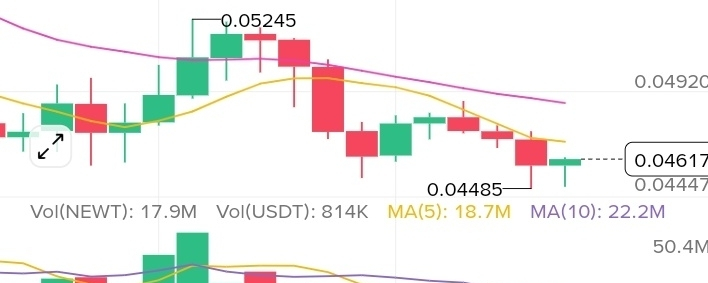
Reading a Weak Market: What the NEWTUSDT Chart Really Reveals Beyond the CandlesticksAt first glance, the NEWTUSDT daily chart looks unremarkable. Price is drifting lower, the moving averages are sloping downward, and volatility appears contained rather than dramatic. Many traders would stop there, label it "bearish," and move on. That conclusion is not necessarily wrong—but it misses the more interesting story.
Markets rarely communicate through a single candle. They reveal themselves through relationships: the relationship between price and trend, between participation and conviction, and between expectations and reality. Those relationships often matter far more than the latest red or green bar.
One detail that immediately stands out is the alignment of the moving averages. The shorter-term averages remain below the longer-term trend, and all of them continue pointing downward. This isn't simply a sign that price has fallen. It suggests that each new wave of trading has consistently accepted lower valuations than the one before it. In practical terms, buyers are still reacting to price rather than defining it. They are providing temporary support, not changing the market's direction.
An equally important observation is how weak rallies behave. Strong markets tend to reject lower prices quickly. They produce impulsive recoveries that force short sellers to cover and convince sidelined buyers to participate. Weak markets behave differently. Every bounce becomes an opportunity for existing holders to reduce exposure rather than increase it. As selling pressure appears on relatively small recoveries, the market slowly develops a staircase pattern where each recovery reaches a lower ceiling than the previous one.
The recent price action reflects exactly this kind of environment. There is no evidence of panic selling, yet there is also no indication that demand is becoming aggressive. Instead, the market seems comfortable trading within a gradually declining range. Ironically, this type of price action can be more dangerous than a sharp decline because it slowly drains optimism. Traders continue expecting a reversal while the trend quietly persists in the opposite direction.
Volume adds another layer to this picture. Although daily participation has not disappeared, it has become less effective. Volume alone never proves buying or selling pressure. What matters is what price accomplishes with that volume. When meaningful trading activity produces only small upward movement before sellers regain control, it often indicates that liquidity is being absorbed by stronger hands distributing positions rather than accumulating them.
Another overlooked feature is market psychology around local lows. Every time price approaches recent support, attention naturally increases. Many participants assume that because a level held previously, it should continue holding. Markets are not built around memory; they are built around current supply and demand. A support level weakens every time it is tested because each bounce consumes part of the available buying interest. If fresh demand does not replace exhausted buyers, the probability of a breakdown gradually increases.
Perhaps the most valuable lesson from this chart has little to do with technical indicators themselves. Indicators describe what has already happened. They rarely explain why participants are behaving the way they are. A declining moving average does not create a bearish market; it simply reflects weeks of sellers consistently accepting lower prices. Understanding this distinction changes how traders interpret signals. Instead of reacting mechanically whenever price crosses a line, experienced traders ask what collective behavior caused that line to move in the first place.
This distinction becomes especially important in cryptocurrency markets, where narratives often dominate short-term decision-making. New listings, ecosystem announcements, and social media enthusiasm can temporarily overwhelm technical weakness. Yet if those catalysts fail to attract sustained buying, the underlying trend usually reasserts itself once excitement fades. Technical structure ultimately reflects where real capital chooses to stay, not where temporary attention happens to focus.
The chart therefore illustrates something broader than a single token's performance. It demonstrates how trends gradually shape expectations. As prices decline, optimism turns into caution. Caution eventually becomes patience. Finally, patience gives way to indifference. Ironically, genuine trend reversals often begin only after this emotional transition has largely completed—not because indicators suddenly improve, but because selling pressure has quietly exhausted itself.
For traders, the most useful takeaway is not predicting the next candle. It is recognizing the current market environment. At present, the evidence favors a market that remains under seller control despite occasional relief rallies. Until price begins producing higher highs, higher lows, and stronger buying participation capable of overcoming the downward trend, every recovery should be viewed as a hypothesis rather than confirmation that a new bull phase has begun.
In financial markets, the hardest skill is not forecasting the future. It is accurately describing the present without allowing hope, fear, or recent experience to distort the evidence. This chart serves as a reminder that successful analysis is less about finding certainty and more about understanding the balance of probabilities hidden beneath seemingly ordinary price movements.
@NewtonProtocol $NEWT #Newt
Reading a Weak Market: What the NEWTUSDT Chart Really Reveals Beyond the Candlesticks
At first glance, the NEWTUSDT daily chart looks unremarkable. Price is drifting lower, the moving averages are sloping downward, and volatility appears contained rather than dramatic. Many traders would stop there, label it "bearish," and move on. That conclusion is not necessarily wrong—but it misses the more interesting story.
Markets rarely communicate through a single candle. They reveal themselves through relationships: the relationship between price and trend, between participation and conviction, and between expectations and reality. Those relationships often matter far more than the latest red or green bar.
One detail that immediately stands out is the alignment of the moving averages. The shorter-term averages remain below the longer-term trend, and all of them continue pointing downward. This isn't simply a sign that price has fallen. It suggests that each new wave of trading has consistently accepted lower valuations than the one before it. In practical terms, buyers are still reacting to price rather than defining it. They are providing temporary support, not changing the market's direction.
An equally important observation is how weak rallies behave. Strong markets tend to reject lower prices quickly. They produce impulsive recoveries that force short sellers to cover and convince sidelined buyers to participate. Weak markets behave differently. Every bounce becomes an opportunity for existing holders to reduce exposure rather than increase it. As selling pressure appears on relatively small recoveries, the market slowly develops a staircase pattern where each recovery reaches a lower ceiling than the previous one.
The recent price action reflects exactly this kind of environment. There is no evidence of panic selling, yet there is also no indication that demand is becoming aggressive. Instead, the market seems comfortable trading within a gradually declining range. Ironically, this type of price action can be more dangerous than a sharp decline because it slowly drains optimism. Traders continue expecting a reversal while the trend quietly persists in the opposite direction.
Volume adds another layer to this picture. Although daily participation has not disappeared, it has become less effective. Volume alone never proves buying or selling pressure. What matters is what price accomplishes with that volume. When meaningful trading activity produces only small upward movement before sellers regain control, it often indicates that liquidity is being absorbed by stronger hands distributing positions rather than accumulating them.
Another overlooked feature is market psychology around local lows. Every time price approaches recent support, attention naturally increases. Many participants assume that because a level held previously, it should continue holding. Markets are not built around memory; they are built around current supply and demand. A support level weakens every time it is tested because each bounce consumes part of the available buying interest. If fresh demand does not replace exhausted buyers, the probability of a breakdown gradually increases.
Perhaps the most valuable lesson from this chart has little to do with technical indicators themselves. Indicators describe what has already happened. They rarely explain why participants are behaving the way they are. A declining moving average does not create a bearish market; it simply reflects weeks of sellers consistently accepting lower prices. Understanding this distinction changes how traders interpret signals. Instead of reacting mechanically whenever price crosses a line, experienced traders ask what collective behavior caused that line to move in the first place.
This distinction becomes especially important in cryptocurrency markets, where narratives often dominate short-term decision-making. New listings, ecosystem announcements, and social media enthusiasm can temporarily overwhelm technical weakness. Yet if those catalysts fail to attract sustained buying, the underlying trend usually reasserts itself once excitement fades. Technical structure ultimately reflects where real capital chooses to stay, not where temporary attention happens to focus.
The chart therefore illustrates something broader than a single token's performance. It demonstrates how trends gradually shape expectations. As prices decline, optimism turns into caution. Caution eventually becomes patience. Finally, patience gives way to indifference. Ironically, genuine trend reversals often begin only after this emotional transition has largely completed—not because indicators suddenly improve, but because selling pressure has quietly exhausted itself.
For traders, the most useful takeaway is not predicting the next candle. It is recognizing the current market environment. At present, the evidence favors a market that remains under seller control despite occasional relief rallies. Until price begins producing higher highs, higher lows, and stronger buying participation capable of overcoming the downward trend, every recovery should be viewed as a hypothesis rather than confirmation that a new bull phase has begun.
In financial markets, the hardest skill is not forecasting the future. It is accurately describing the present without allowing hope, fear, or recent experience to distort the evidence. This chart serves as a reminder that successful analysis is less about finding certainty and more about understanding the balance of probabilities hidden beneath seemingly ordinary price movements.
@NewtonProtocol $NEWT #Newt
Markets rarely communicate through a single candle. They reveal themselves through relationships: the relationship between price and trend, between participation and conviction, and between expectations and reality. Those relationships often matter far more than the latest red or green bar.
One detail that immediately stands out is the alignment of the moving averages. The shorter-term averages remain below the longer-term trend, and all of them continue pointing downward. This isn't simply a sign that price has fallen. It suggests that each new wave of trading has consistently accepted lower valuations than the one before it. In practical terms, buyers are still reacting to price rather than defining it. They are providing temporary support, not changing the market's direction.
An equally important observation is how weak rallies behave. Strong markets tend to reject lower prices quickly. They produce impulsive recoveries that force short sellers to cover and convince sidelined buyers to participate. Weak markets behave differently. Every bounce becomes an opportunity for existing holders to reduce exposure rather than increase it. As selling pressure appears on relatively small recoveries, the market slowly develops a staircase pattern where each recovery reaches a lower ceiling than the previous one.
The recent price action reflects exactly this kind of environment. There is no evidence of panic selling, yet there is also no indication that demand is becoming aggressive. Instead, the market seems comfortable trading within a gradually declining range. Ironically, this type of price action can be more dangerous than a sharp decline because it slowly drains optimism. Traders continue expecting a reversal while the trend quietly persists in the opposite direction.
Volume adds another layer to this picture. Although daily participation has not disappeared, it has become less effective. Volume alone never proves buying or selling pressure. What matters is what price accomplishes with that volume. When meaningful trading activity produces only small upward movement before sellers regain control, it often indicates that liquidity is being absorbed by stronger hands distributing positions rather than accumulating them.
Another overlooked feature is market psychology around local lows. Every time price approaches recent support, attention naturally increases. Many participants assume that because a level held previously, it should continue holding. Markets are not built around memory; they are built around current supply and demand. A support level weakens every time it is tested because each bounce consumes part of the available buying interest. If fresh demand does not replace exhausted buyers, the probability of a breakdown gradually increases.
Perhaps the most valuable lesson from this chart has little to do with technical indicators themselves. Indicators describe what has already happened. They rarely explain why participants are behaving the way they are. A declining moving average does not create a bearish market; it simply reflects weeks of sellers consistently accepting lower prices. Understanding this distinction changes how traders interpret signals. Instead of reacting mechanically whenever price crosses a line, experienced traders ask what collective behavior caused that line to move in the first place.
This distinction becomes especially important in cryptocurrency markets, where narratives often dominate short-term decision-making. New listings, ecosystem announcements, and social media enthusiasm can temporarily overwhelm technical weakness. Yet if those catalysts fail to attract sustained buying, the underlying trend usually reasserts itself once excitement fades. Technical structure ultimately reflects where real capital chooses to stay, not where temporary attention happens to focus.
The chart therefore illustrates something broader than a single token's performance. It demonstrates how trends gradually shape expectations. As prices decline, optimism turns into caution. Caution eventually becomes patience. Finally, patience gives way to indifference. Ironically, genuine trend reversals often begin only after this emotional transition has largely completed—not because indicators suddenly improve, but because selling pressure has quietly exhausted itself.
For traders, the most useful takeaway is not predicting the next candle. It is recognizing the current market environment. At present, the evidence favors a market that remains under seller control despite occasional relief rallies. Until price begins producing higher highs, higher lows, and stronger buying participation capable of overcoming the downward trend, every recovery should be viewed as a hypothesis rather than confirmation that a new bull phase has begun.
In financial markets, the hardest skill is not forecasting the future. It is accurately describing the present without allowing hope, fear, or recent experience to distort the evidence. This chart serves as a reminder that successful analysis is less about finding certainty and more about understanding the balance of probabilities hidden beneath seemingly ordinary price movements.
@NewtonProtocol $NEWT #Newt
83

Article
Paid Partnership with @newton_xyz
I've spent a lot of time looking at blockchain infrastructure oveI've spent a lot of time looking at blockchain infrastructure over the years, and one pattern keeps repeating: we build faster networks, but we rarely improve how people actually coordinate value across them. Through that lens, Newton Protocol caught my attention for a different reason.
The interesting part isn't simply that the Newton Mainnet Beta exists. It's the design philosophy behind it. Most infrastructure conversations focus on throughput or lower fees, but those metrics only matter if they reduce friction for real users and developers. What makes an ecosystem sustainable is whether builders can create applications without constantly reinventing trust, automation, and coordination.
Newton Protocol appears to be moving toward a model where programmable coordination becomes part of the infrastructure instead of an afterthought. That may sound subtle, but it changes how developers think about building decentralized applications. Instead of treating automation as something layered on top, it becomes integrated into the protocol's foundation.
Mainnet Beta is also where architecture starts meeting reality. Test environments are useful, but public beta networks reveal how systems behave under genuine user activity, unexpected interactions, and continuous iteration. That's where assumptions get challenged and protocols either mature or expose the areas that still need refinement.
For me, the value isn't in short-term excitement. It's in watching whether a protocol creates better incentives for developers, stronger reliability for users, and an ecosystem that can evolve without sacrificing decentralization. Those are much harder problems than increasing transaction numbers, and they're ultimately the ones that determine long-term relevance.
I'll be watching how the Newton Mainnet Beta develops and how the community builds around it. Infrastructure succeeds when people stop talking about the infrastructure itself because it simply works—and that's the standard every serious protocol should aim_x$NEWT @NewtonProtocol #Newt
Paid Partnership with @newton_xyz I've spent a lot of time looking at blockchain infrastructure ove
I've spent a lot of time looking at blockchain infrastructure over the years, and one pattern keeps repeating: we build faster networks, but we rarely improve how people actually coordinate value across them. Through that lens, Newton Protocol caught my attention for a different reason.
The interesting part isn't simply that the Newton Mainnet Beta exists. It's the design philosophy behind it. Most infrastructure conversations focus on throughput or lower fees, but those metrics only matter if they reduce friction for real users and developers. What makes an ecosystem sustainable is whether builders can create applications without constantly reinventing trust, automation, and coordination.
Newton Protocol appears to be moving toward a model where programmable coordination becomes part of the infrastructure instead of an afterthought. That may sound subtle, but it changes how developers think about building decentralized applications. Instead of treating automation as something layered on top, it becomes integrated into the protocol's foundation.
Mainnet Beta is also where architecture starts meeting reality. Test environments are useful, but public beta networks reveal how systems behave under genuine user activity, unexpected interactions, and continuous iteration. That's where assumptions get challenged and protocols either mature or expose the areas that still need refinement.
For me, the value isn't in short-term excitement. It's in watching whether a protocol creates better incentives for developers, stronger reliability for users, and an ecosystem that can evolve without sacrificing decentralization. Those are much harder problems than increasing transaction numbers, and they're ultimately the ones that determine long-term relevance.
I'll be watching how the Newton Mainnet Beta develops and how the community builds around it. Infrastructure succeeds when people stop talking about the infrastructure itself because it simply works—and that's the standard every serious protocol should aim_x$NEWT @NewtonProtocol #Newt
The interesting part isn't simply that the Newton Mainnet Beta exists. It's the design philosophy behind it. Most infrastructure conversations focus on throughput or lower fees, but those metrics only matter if they reduce friction for real users and developers. What makes an ecosystem sustainable is whether builders can create applications without constantly reinventing trust, automation, and coordination.
Newton Protocol appears to be moving toward a model where programmable coordination becomes part of the infrastructure instead of an afterthought. That may sound subtle, but it changes how developers think about building decentralized applications. Instead of treating automation as something layered on top, it becomes integrated into the protocol's foundation.
Mainnet Beta is also where architecture starts meeting reality. Test environments are useful, but public beta networks reveal how systems behave under genuine user activity, unexpected interactions, and continuous iteration. That's where assumptions get challenged and protocols either mature or expose the areas that still need refinement.
For me, the value isn't in short-term excitement. It's in watching whether a protocol creates better incentives for developers, stronger reliability for users, and an ecosystem that can evolve without sacrificing decentralization. Those are much harder problems than increasing transaction numbers, and they're ultimately the ones that determine long-term relevance.
I'll be watching how the Newton Mainnet Beta develops and how the community builds around it. Infrastructure succeeds when people stop talking about the infrastructure itself because it simply works—and that's the standard every serious protocol should aim_x$NEWT @NewtonProtocol #Newt
72
Most people judge a blockchain by its token price. I prefer to judge it by how it behaves when real users start interacting with it.
That's why the Newton Mainnet Beta deserves attention. This is the phase where assumptions meet reality—performance, stability, developer experience, and community feedback all become measurable instead of theoretical. Networks that embrace this process usually build stronger foundations than those chasing short-term hype.
I'm watching @NewtonProtocol because sustainable ecosystems are created through continuous iteration, transparent improvements, and active builders—not marketing alone. If the team keeps refining the network based on real-world data, the long-term value proposition for the ecosystem becomes much more compelling.
Curious to see how the community helps shape the next chapter for $NEWT #Newt
{spot}(NEWTUSDT)
Most people judge a blockchain by its token price. I prefer to judge it by how it behaves when real users start interacting with it.
That's why the Newton Mainnet Beta deserves attention. This is the phase where assumptions meet reality—performance, stability, developer experience, and community feedback all become measurable instead of theoretical. Networks that embrace this process usually build stronger foundations than those chasing short-term hype.
I'm watching @NewtonProtocol because sustainable ecosystems are created through continuous iteration, transparent improvements, and active builders—not marketing alone. If the team keeps refining the network based on real-world data, the long-term value proposition for the ecosystem becomes much more compelling.
Curious to see how the community helps shape the next chapter for $NEWT #Newt
That's why the Newton Mainnet Beta deserves attention. This is the phase where assumptions meet reality—performance, stability, developer experience, and community feedback all become measurable instead of theoretical. Networks that embrace this process usually build stronger foundations than those chasing short-term hype.
I'm watching @NewtonProtocol because sustainable ecosystems are created through continuous iteration, transparent improvements, and active builders—not marketing alone. If the team keeps refining the network based on real-world data, the long-term value proposition for the ecosystem becomes much more compelling.
Curious to see how the community helps shape the next chapter for $NEWT #Newt

2
80
Article
V6The easiest trade to talk about is a breakout. The hardest one to understand is a market that refuses to choose a direction.
That's where I think XRP is today.
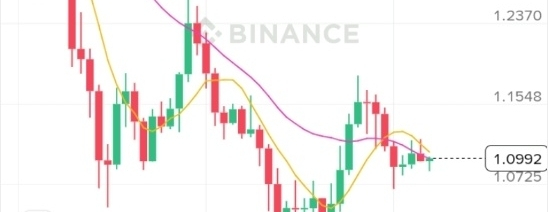
Looking at the daily chart, price has recovered from the recent low near $1.00, but every attempt to build momentum has faded before reaching the previous swing highs. Instead of trending, XRP is compressing. That isn't exciting, but it often reveals more about market psychology than a single explosive candle.
What stands out to me isn't the price itself—it's the relationship between the moving averages.
The short-term averages are beginning to flatten, while the 99-day moving average remains significantly higher. This tells me short-term sentiment is improving, but the longer-term trend hasn't fully shifted. Until those two start moving in the same direction, every rally has to prove itself.
This is the part I keep coming back to.
Many traders treat consolidation as "nothing happening." I see it differently. Consolidation is where the market decides whether recent buyers have enough conviction to absorb selling pressure without giving back the entire recovery.
Volume adds another layer to that story.
The strongest green candles during the rebound were accompanied by higher trading activity. More recently, volume has started to cool as price moves sideways. That doesn't automatically invalidate the recovery, but it does mean buyers haven't yet shown the level of commitment that usually supports a sustained trend.
That's why I'm watching volume just as closely as price.
One high-volume breakout above nearby resistance would tell me far more than several days of small green candles. Likewise, a loss of support on expanding volume would reveal that sellers are regaining control.
This feels more important than guessing the next price target.
Too many discussions around XRP focus on where price could go. I think the better question is whether the market is creating the conditions that make those targets realistic.
Right now, XRP isn't sending a strong bullish signal or a strong bearish one.
It's asking the market to make a decision.
Until participation increases and the structure becomes clearer, patience may be the most valuable position a trader can have.
So instead of asking, "When will XRP break out?" I'm asking a different question:
When the breakout finally comes, will the volume confirm it—or expose it as just another temporary move? @NewtonProtocol $NEWT #newt
V6
The easiest trade to talk about is a breakout. The hardest one to understand is a market that refuses to choose a direction.
That's where I think XRP is today.
Looking at the daily chart, price has recovered from the recent low near $1.00, but every attempt to build momentum has faded before reaching the previous swing highs. Instead of trending, XRP is compressing. That isn't exciting, but it often reveals more about market psychology than a single explosive candle.
What stands out to me isn't the price itself—it's the relationship between the moving averages.
The short-term averages are beginning to flatten, while the 99-day moving average remains significantly higher. This tells me short-term sentiment is improving, but the longer-term trend hasn't fully shifted. Until those two start moving in the same direction, every rally has to prove itself.
This is the part I keep coming back to.
Many traders treat consolidation as "nothing happening." I see it differently. Consolidation is where the market decides whether recent buyers have enough conviction to absorb selling pressure without giving back the entire recovery.
Volume adds another layer to that story.
The strongest green candles during the rebound were accompanied by higher trading activity. More recently, volume has started to cool as price moves sideways. That doesn't automatically invalidate the recovery, but it does mean buyers haven't yet shown the level of commitment that usually supports a sustained trend.
That's why I'm watching volume just as closely as price.
One high-volume breakout above nearby resistance would tell me far more than several days of small green candles. Likewise, a loss of support on expanding volume would reveal that sellers are regaining control.
This feels more important than guessing the next price target.
Too many discussions around XRP focus on where price could go. I think the better question is whether the market is creating the conditions that make those targets realistic.
Right now, XRP isn't sending a strong bullish signal or a strong bearish one.
It's asking the market to make a decision.
Until participation increases and the structure becomes clearer, patience may be the most valuable position a trader can have.
So instead of asking, "When will XRP break out?" I'm asking a different question:
When the breakout finally comes, will the volume confirm it—or expose it as just another temporary move? @NewtonProtocol $NEWT #newt
That's where I think XRP is today.
Looking at the daily chart, price has recovered from the recent low near $1.00, but every attempt to build momentum has faded before reaching the previous swing highs. Instead of trending, XRP is compressing. That isn't exciting, but it often reveals more about market psychology than a single explosive candle.
What stands out to me isn't the price itself—it's the relationship between the moving averages.
The short-term averages are beginning to flatten, while the 99-day moving average remains significantly higher. This tells me short-term sentiment is improving, but the longer-term trend hasn't fully shifted. Until those two start moving in the same direction, every rally has to prove itself.
This is the part I keep coming back to.
Many traders treat consolidation as "nothing happening." I see it differently. Consolidation is where the market decides whether recent buyers have enough conviction to absorb selling pressure without giving back the entire recovery.
Volume adds another layer to that story.
The strongest green candles during the rebound were accompanied by higher trading activity. More recently, volume has started to cool as price moves sideways. That doesn't automatically invalidate the recovery, but it does mean buyers haven't yet shown the level of commitment that usually supports a sustained trend.
That's why I'm watching volume just as closely as price.
One high-volume breakout above nearby resistance would tell me far more than several days of small green candles. Likewise, a loss of support on expanding volume would reveal that sellers are regaining control.
This feels more important than guessing the next price target.
Too many discussions around XRP focus on where price could go. I think the better question is whether the market is creating the conditions that make those targets realistic.
Right now, XRP isn't sending a strong bullish signal or a strong bearish one.
It's asking the market to make a decision.
Until participation increases and the structure becomes clearer, patience may be the most valuable position a trader can have.
So instead of asking, "When will XRP break out?" I'm asking a different question:
When the breakout finally comes, will the volume confirm it—or expose it as just another temporary move? @NewtonProtocol $NEWT #newt
2
103
·
--
Bullish
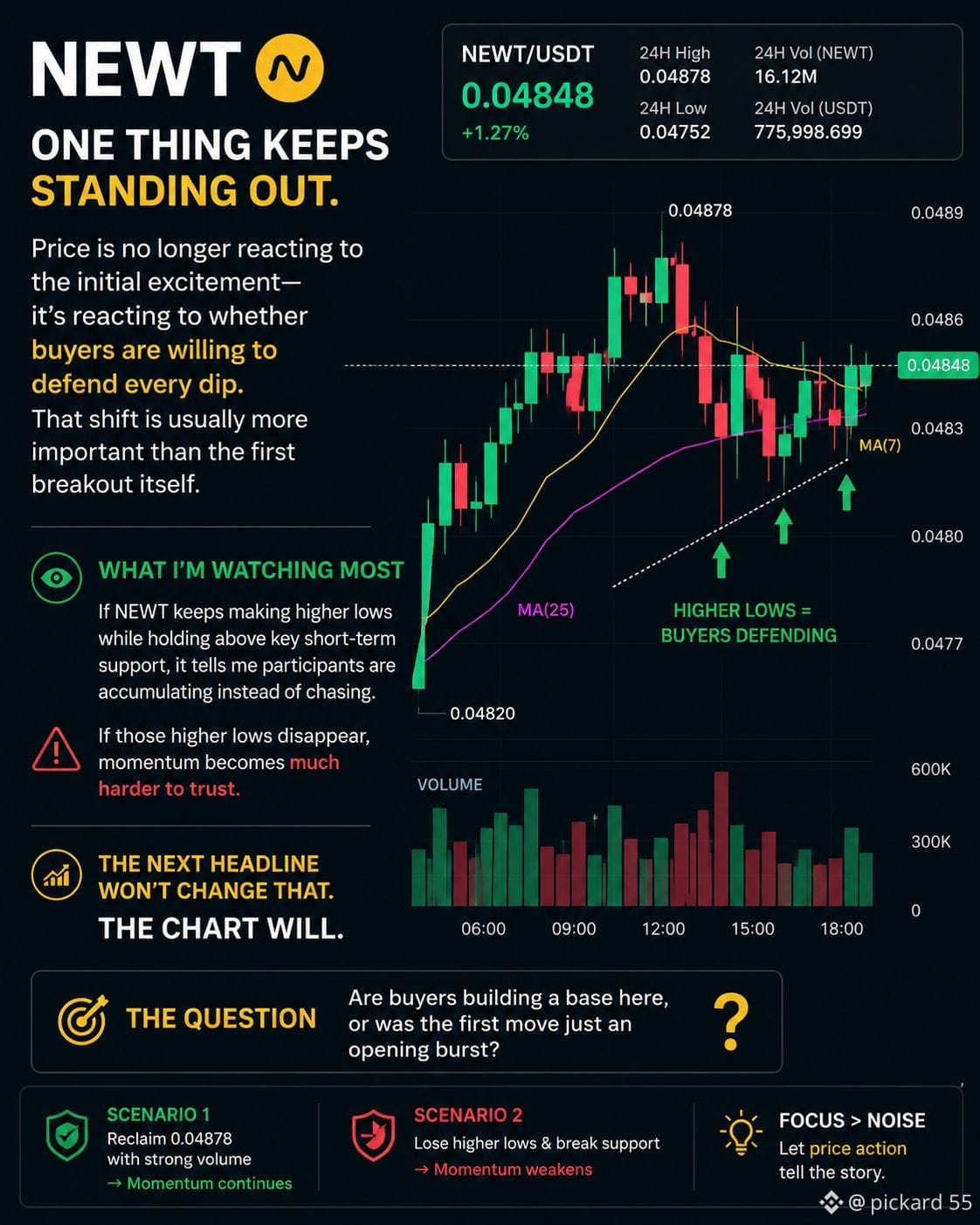
One thing about NEWT keeps standing out to me.
Price is no longer reacting to the initial excitement—it’s reacting to whether buyers are willing to defend every dip. That shift is usually more important than the first breakout itself.
This is what I’m watching most. If NEWT keeps making higher lows while holding above key short-term support, it tells me participants are accumulating instead of chasing. If those higher lows disappear, momentum becomes much harder to trust.
The next headline won't change that. The chart will.
Are buyers building a base here, or was the first move just an opening burst? That's the question I think matters most right now.@NewtonProtocol $NEWT #Newt
{spot}(NEWTUSDT)
One thing about NEWT keeps standing out to me.
Price is no longer reacting to the initial excitement—it’s reacting to whether buyers are willing to defend every dip. That shift is usually more important than the first breakout itself.
This is what I’m watching most. If NEWT keeps making higher lows while holding above key short-term support, it tells me participants are accumulating instead of chasing. If those higher lows disappear, momentum becomes much harder to trust.
The next headline won't change that. The chart will.
Are buyers building a base here, or was the first move just an opening burst? That's the question I think matters most right now.@NewtonProtocol $NEWT #Newt
Price is no longer reacting to the initial excitement—it’s reacting to whether buyers are willing to defend every dip. That shift is usually more important than the first breakout itself.
This is what I’m watching most. If NEWT keeps making higher lows while holding above key short-term support, it tells me participants are accumulating instead of chasing. If those higher lows disappear, momentum becomes much harder to trust.
The next headline won't change that. The chart will.
Are buyers building a base here, or was the first move just an opening burst? That's the question I think matters most right now.@NewtonProtocol $NEWT #Newt
3
78
NEWT/USDT Technical Analysis (15-Minute Chart)NEWT/USDT is currently trading around 0.0481 USDT with a modest gain of approximately 1.05%. After dropping to an intraday low near 0.0475, the price rebounded, suggesting buyers stepped in at lower levels.
The 7, 25, and 99-period moving averages are clustered around 0.0480, indicating the market is consolidating and has not yet established a strong trend. The recent green candles show short-term buying momentum, but the relatively low trading volume suggests that buyers still need stronger participation for a sustained breakout.
Key Levels
Resistance: 0.0482–0.0483
Support: 0.0478, followed by 0.0475
A decisive move above 0.0483 with higher volume could signal further upside. Conversely, if the price falls below 0.0478, it may revisit the 0.0475 support area.
Conclusion:
The chart currently reflects a short-term recovery within a consolidation phase. Traders may prefer to wait for a confirmed breakout above resistance or a bounce from support before considering a position. This is technical analysis only and not financial advice.
@NewtonProtocol $NEWT #Newt
{spot}(NEWTUSDT)
NEWT/USDT Technical Analysis (15-Minute Chart)
NEWT/USDT is currently trading around 0.0481 USDT with a modest gain of approximately 1.05%. After dropping to an intraday low near 0.0475, the price rebounded, suggesting buyers stepped in at lower levels.
The 7, 25, and 99-period moving averages are clustered around 0.0480, indicating the market is consolidating and has not yet established a strong trend. The recent green candles show short-term buying momentum, but the relatively low trading volume suggests that buyers still need stronger participation for a sustained breakout.
Key Levels
Resistance: 0.0482–0.0483
Support: 0.0478, followed by 0.0475
A decisive move above 0.0483 with higher volume could signal further upside. Conversely, if the price falls below 0.0478, it may revisit the 0.0475 support area.
Conclusion:
The chart currently reflects a short-term recovery within a consolidation phase. Traders may prefer to wait for a confirmed breakout above resistance or a bounce from support before considering a position. This is technical analysis only and not financial advice.
@NewtonProtocol $NEWT #Newt
The 7, 25, and 99-period moving averages are clustered around 0.0480, indicating the market is consolidating and has not yet established a strong trend. The recent green candles show short-term buying momentum, but the relatively low trading volume suggests that buyers still need stronger participation for a sustained breakout.
Key Levels
Resistance: 0.0482–0.0483
Support: 0.0478, followed by 0.0475
A decisive move above 0.0483 with higher volume could signal further upside. Conversely, if the price falls below 0.0478, it may revisit the 0.0475 support area.
Conclusion:
The chart currently reflects a short-term recovery within a consolidation phase. Traders may prefer to wait for a confirmed breakout above resistance or a bounce from support before considering a position. This is technical analysis only and not financial advice.
@NewtonProtocol $NEWT #Newt
5
1
84
$NEWT Price Holds Key Support While Newton Mainnet Beta Shapes the Bigger PictureThe current $NEWT price action tells an interesting story. After testing the 0.0455 area, buyers have repeatedly stepped in to defend that level, showing that demand hasn't disappeared despite today's decline. At the same time, the 15-minute chart shows price trading below the longer moving averages, suggesting that short-term momentum is still cautious. This isn't a trend reversal yet, but it is an area worth watching.
For me, the more important question isn't whether $NEWT gains a few percent today. It's whether the Newton Mainnet Beta continues attracting developers and users. Markets eventually price in real adoption, and infrastructure milestones often have a greater long-term impact than temporary volatility. If the ecosystem grows while support continues to hold, today's consolidation could simply become another step in the market's price discovery process.
That's why I'm following @NewtonProtocol beyond the chart. The Mainnet Beta is where technology meets real usage, and every improvement in stability, developer activity, and community participation adds another layer of confidence. Strong fundamentals don't eliminate volatility, but they can provide the foundation for sustainable growth once broader market sentiment improves.
For now, I'm watching whether buyers can reclaim the short-term moving averages with increasing volume. If that happens alongside positive ecosystem progress, it would be a healthier signal than a sharp price spike driven purely by speculation.
@NewtonProtocol $NEWT #newt
{spot}(NEWTUSDT)
$NEWT Price Holds Key Support While Newton Mainnet Beta Shapes the Bigger Picture
The current $NEWT price action tells an interesting story. After testing the 0.0455 area, buyers have repeatedly stepped in to defend that level, showing that demand hasn't disappeared despite today's decline. At the same time, the 15-minute chart shows price trading below the longer moving averages, suggesting that short-term momentum is still cautious. This isn't a trend reversal yet, but it is an area worth watching.
For me, the more important question isn't whether $NEWT gains a few percent today. It's whether the Newton Mainnet Beta continues attracting developers and users. Markets eventually price in real adoption, and infrastructure milestones often have a greater long-term impact than temporary volatility. If the ecosystem grows while support continues to hold, today's consolidation could simply become another step in the market's price discovery process.
That's why I'm following @NewtonProtocol beyond the chart. The Mainnet Beta is where technology meets real usage, and every improvement in stability, developer activity, and community participation adds another layer of confidence. Strong fundamentals don't eliminate volatility, but they can provide the foundation for sustainable growth once broader market sentiment improves.
For now, I'm watching whether buyers can reclaim the short-term moving averages with increasing volume. If that happens alongside positive ecosystem progress, it would be a healthier signal than a sharp price spike driven purely by speculation.
@NewtonProtocol $NEWT #newt
For me, the more important question isn't whether $NEWT gains a few percent today. It's whether the Newton Mainnet Beta continues attracting developers and users. Markets eventually price in real adoption, and infrastructure milestones often have a greater long-term impact than temporary volatility. If the ecosystem grows while support continues to hold, today's consolidation could simply become another step in the market's price discovery process.
That's why I'm following @NewtonProtocol beyond the chart. The Mainnet Beta is where technology meets real usage, and every improvement in stability, developer activity, and community participation adds another layer of confidence. Strong fundamentals don't eliminate volatility, but they can provide the foundation for sustainable growth once broader market sentiment improves.
For now, I'm watching whether buyers can reclaim the short-term moving averages with increasing volume. If that happens alongside positive ecosystem progress, it would be a healthier signal than a sharp price spike driven purely by speculation.
@NewtonProtocol $NEWT #newt
6
69
·
--
Bearish
I keep noticing that most conversations around AI in crypto stop at one question: Can an agent complete a transaction? I think that's the easy part.
The harder question is whether that agent can prove it followed the rules you gave it. That's why I've been paying closer attention to @NewtonProtocol and its Mainnet Beta than I expected.
From the official materials, Newton isn't just focused on automating onchain actions. It combines Trusted Execution Environments (TEEs) with Zero-Knowledge Proofs (ZKPs) so automated execution can remain verifiable while operating within user-defined permissions. That changes where I think the real value could emerge.
This is the detail I keep coming back to.
Crypto has spent years making transactions trustless. The next challenge may be making automation accountable. If users delegate actions to AI or automated agents, the question isn't simply whether execution is fast—it's whether every action stays inside clearly defined boundaries that can be verified.
That's also where the Mainnet Beta becomes more interesting than a typical network launch. A beta isn't just about proving the technology works. It's about seeing whether this model of programmable authorization can hold up in real-world conditions.
I'm less interested in short-term excitement around $NEWT than I am in whether this approach changes how people think about interacting with autonomous systems onchain. If it succeeds, we may end up talking less about "smart agents" and more about "verifiable agents."
Do you think the next major upgrade for Web3 is faster execution, or making automated decisions transparent enough that users can actually trust them?
@NewtonProtocol $NEWT #Newt
{spot}(NEWTUSDT)
I keep noticing that most conversations around AI in crypto stop at one question: Can an agent complete a transaction? I think that's the easy part.
The harder question is whether that agent can prove it followed the rules you gave it. That's why I've been paying closer attention to @NewtonProtocol and its Mainnet Beta than I expected.
From the official materials, Newton isn't just focused on automating onchain actions. It combines Trusted Execution Environments (TEEs) with Zero-Knowledge Proofs (ZKPs) so automated execution can remain verifiable while operating within user-defined permissions. That changes where I think the real value could emerge.
This is the detail I keep coming back to.
Crypto has spent years making transactions trustless. The next challenge may be making automation accountable. If users delegate actions to AI or automated agents, the question isn't simply whether execution is fast—it's whether every action stays inside clearly defined boundaries that can be verified.
That's also where the Mainnet Beta becomes more interesting than a typical network launch. A beta isn't just about proving the technology works. It's about seeing whether this model of programmable authorization can hold up in real-world conditions.
I'm less interested in short-term excitement around $NEWT than I am in whether this approach changes how people think about interacting with autonomous systems onchain. If it succeeds, we may end up talking less about "smart agents" and more about "verifiable agents."
Do you think the next major upgrade for Web3 is faster execution, or making automated decisions transparent enough that users can actually trust them?
@NewtonProtocol $NEWT #Newt
The harder question is whether that agent can prove it followed the rules you gave it. That's why I've been paying closer attention to @NewtonProtocol and its Mainnet Beta than I expected.
From the official materials, Newton isn't just focused on automating onchain actions. It combines Trusted Execution Environments (TEEs) with Zero-Knowledge Proofs (ZKPs) so automated execution can remain verifiable while operating within user-defined permissions. That changes where I think the real value could emerge.
This is the detail I keep coming back to.
Crypto has spent years making transactions trustless. The next challenge may be making automation accountable. If users delegate actions to AI or automated agents, the question isn't simply whether execution is fast—it's whether every action stays inside clearly defined boundaries that can be verified.
That's also where the Mainnet Beta becomes more interesting than a typical network launch. A beta isn't just about proving the technology works. It's about seeing whether this model of programmable authorization can hold up in real-world conditions.
I'm less interested in short-term excitement around $NEWT than I am in whether this approach changes how people think about interacting with autonomous systems onchain. If it succeeds, we may end up talking less about "smart agents" and more about "verifiable agents."
Do you think the next major upgrade for Web3 is faster execution, or making automated decisions transparent enough that users can actually trust them?
@NewtonProtocol $NEWT #Newt

69
Why Verifiable Automation Could Define the Next Era of BlockchainOne thing I find fascinating about blockchain infrastructure is that many people still measure success by transaction speed or total value locked. Those metrics matter, but they don't explain whether a network can support the next generation of intelligent applications. That is why I have been following @NewtonProtocol with genuine interest.
The launch of the Newton Mainnet Beta represents more than another milestone on a roadmap. It is an opportunity to observe how decentralized infrastructure can evolve into an environment where automation, security, and verifiable execution work together instead of competing with one another. In my view, this is the real challenge the industry has been trying to solve.
As AI becomes more capable, users will increasingly rely on software agents to perform tasks such as portfolio management, payments, research, and on-chain interactions. The missing piece has never been intelligence alone. It has been trust. If an autonomous agent executes an action, users need confidence that every decision can be verified, every permission is transparent, and every operation follows predefined rules. That is where protocols designed around verifiable automation begin to stand out.
Newton Mainnet Beta is interesting because it shifts attention from isolated transactions toward programmable trust. Instead of asking, "Can this action happen?" the better question becomes, "Can this action happen safely, transparently, and without requiring blind trust?" That subtle difference could define the next stage of blockchain adoption.
I also believe infrastructure projects deserve more attention than they usually receive. Applications often capture headlines, but reliable infrastructure creates the foundation that allows thousands of future applications to exist. Strong infrastructure compounds over time because developers build on confidence, not hype.
I'll be watching how the ecosystem develops, how builders experiment with autonomous workflows, and how the community contributes during this beta phase. If the protocol continues improving real-world usability while maintaining decentralization and verifiability, it could become an important building block for AI-powered Web3.
Looking forward to seeing how @NewtonProtocol continues to shape this vision. $NEWT #Newt @NewtonProtocol
{spot}(NEWTUSDT)
Why Verifiable Automation Could Define the Next Era of Blockchain
One thing I find fascinating about blockchain infrastructure is that many people still measure success by transaction speed or total value locked. Those metrics matter, but they don't explain whether a network can support the next generation of intelligent applications. That is why I have been following @NewtonProtocol with genuine interest.
The launch of the Newton Mainnet Beta represents more than another milestone on a roadmap. It is an opportunity to observe how decentralized infrastructure can evolve into an environment where automation, security, and verifiable execution work together instead of competing with one another. In my view, this is the real challenge the industry has been trying to solve.
As AI becomes more capable, users will increasingly rely on software agents to perform tasks such as portfolio management, payments, research, and on-chain interactions. The missing piece has never been intelligence alone. It has been trust. If an autonomous agent executes an action, users need confidence that every decision can be verified, every permission is transparent, and every operation follows predefined rules. That is where protocols designed around verifiable automation begin to stand out.
Newton Mainnet Beta is interesting because it shifts attention from isolated transactions toward programmable trust. Instead of asking, "Can this action happen?" the better question becomes, "Can this action happen safely, transparently, and without requiring blind trust?" That subtle difference could define the next stage of blockchain adoption.
I also believe infrastructure projects deserve more attention than they usually receive. Applications often capture headlines, but reliable infrastructure creates the foundation that allows thousands of future applications to exist. Strong infrastructure compounds over time because developers build on confidence, not hype.
I'll be watching how the ecosystem develops, how builders experiment with autonomous workflows, and how the community contributes during this beta phase. If the protocol continues improving real-world usability while maintaining decentralization and verifiability, it could become an important building block for AI-powered Web3.
Looking forward to seeing how @NewtonProtocol continues to shape this vision. $NEWT #Newt @NewtonProtocol
The launch of the Newton Mainnet Beta represents more than another milestone on a roadmap. It is an opportunity to observe how decentralized infrastructure can evolve into an environment where automation, security, and verifiable execution work together instead of competing with one another. In my view, this is the real challenge the industry has been trying to solve.
As AI becomes more capable, users will increasingly rely on software agents to perform tasks such as portfolio management, payments, research, and on-chain interactions. The missing piece has never been intelligence alone. It has been trust. If an autonomous agent executes an action, users need confidence that every decision can be verified, every permission is transparent, and every operation follows predefined rules. That is where protocols designed around verifiable automation begin to stand out.
Newton Mainnet Beta is interesting because it shifts attention from isolated transactions toward programmable trust. Instead of asking, "Can this action happen?" the better question becomes, "Can this action happen safely, transparently, and without requiring blind trust?" That subtle difference could define the next stage of blockchain adoption.
I also believe infrastructure projects deserve more attention than they usually receive. Applications often capture headlines, but reliable infrastructure creates the foundation that allows thousands of future applications to exist. Strong infrastructure compounds over time because developers build on confidence, not hype.
I'll be watching how the ecosystem develops, how builders experiment with autonomous workflows, and how the community contributes during this beta phase. If the protocol continues improving real-world usability while maintaining decentralization and verifiability, it could become an important building block for AI-powered Web3.
Looking forward to seeing how @NewtonProtocol continues to shape this vision. $NEWT #Newt @NewtonProtocol
4
83
·
--
Bearish
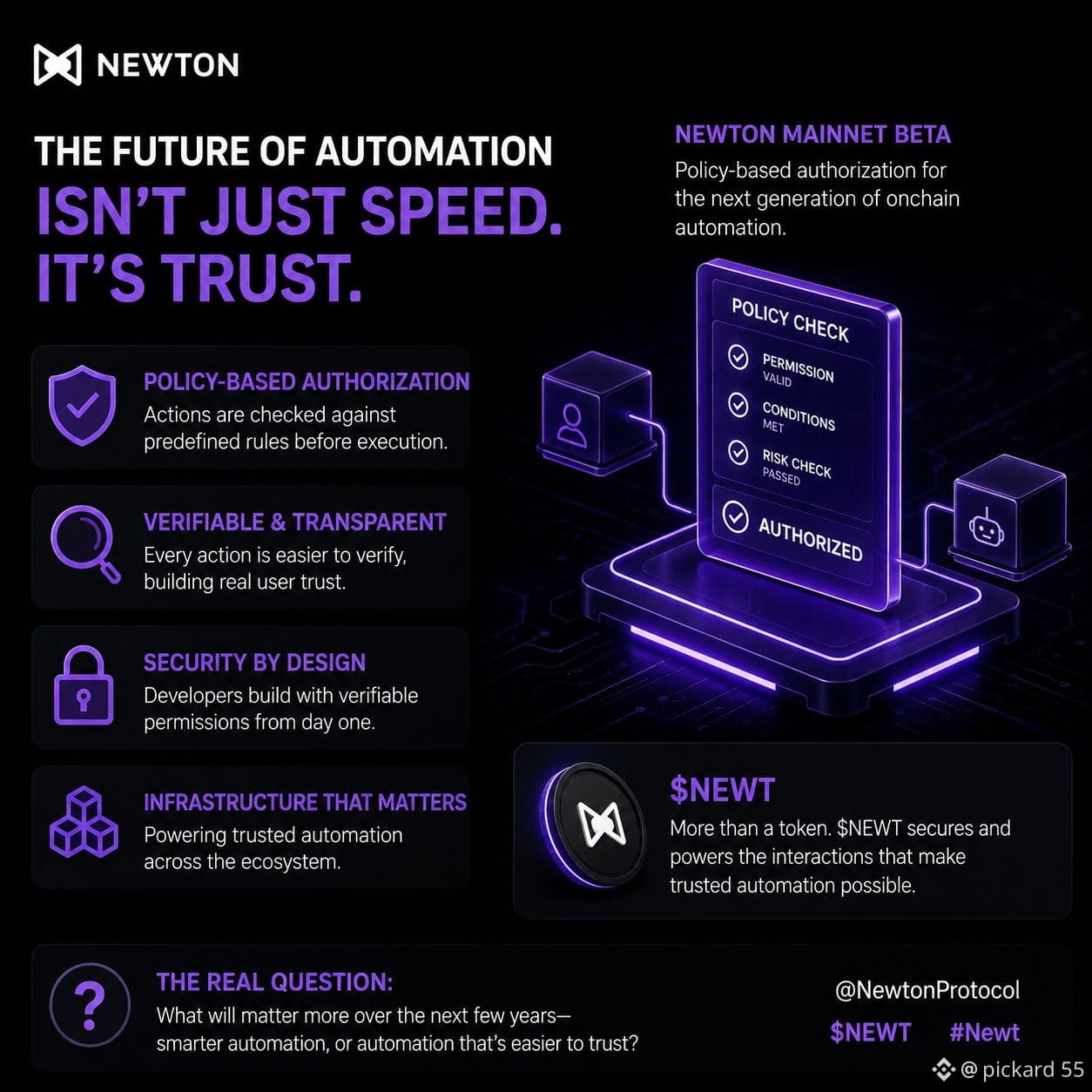
That’s why the direction of the Newton Mainnet Beta stood out to me. @NewtonProtocol isn't just focused on making automated actions possible. It's also building around policy-based authorization, where actions can be checked against predefined rules before they're executed.
This is the detail that changed how I look at the project.
As AI agents and automated apps become more common, speed alone won't be enough. The projects that earn long-term trust will likely be the ones that make every automated action more transparent and easier to verify.
I also think this gives $NEWT a more interesting role than many people realize. If trusted automation becomes a core part of the ecosystem, the infrastructure supporting those interactions becomes much more meaningful than a typical network token narrative.
I'm less interested in how many applications launch first.
I'm more interested in whether developers start designing with verifiable permissions from day one instead of adding security later.
That feels like the real test for Newton Mainnet Beta—and it's the reason I'm paying attention.
What do you think will matter more over the next few years: smarter automation, or automation that's easier to trust?
@NewtonProtocol $NEWT #Newt
{spot}(NEWTUSDT)
That’s why the direction of the Newton Mainnet Beta stood out to me. @NewtonProtocol isn't just focused on making automated actions possible. It's also building around policy-based authorization, where actions can be checked against predefined rules before they're executed.
This is the detail that changed how I look at the project.
As AI agents and automated apps become more common, speed alone won't be enough. The projects that earn long-term trust will likely be the ones that make every automated action more transparent and easier to verify.
I also think this gives $NEWT a more interesting role than many people realize. If trusted automation becomes a core part of the ecosystem, the infrastructure supporting those interactions becomes much more meaningful than a typical network token narrative.
I'm less interested in how many applications launch first.
I'm more interested in whether developers start designing with verifiable permissions from day one instead of adding security later.
That feels like the real test for Newton Mainnet Beta—and it's the reason I'm paying attention.
What do you think will matter more over the next few years: smarter automation, or automation that's easier to trust?
@NewtonProtocol $NEWT #Newt
This is the detail that changed how I look at the project.
As AI agents and automated apps become more common, speed alone won't be enough. The projects that earn long-term trust will likely be the ones that make every automated action more transparent and easier to verify.
I also think this gives $NEWT a more interesting role than many people realize. If trusted automation becomes a core part of the ecosystem, the infrastructure supporting those interactions becomes much more meaningful than a typical network token narrative.
I'm less interested in how many applications launch first.
I'm more interested in whether developers start designing with verifiable permissions from day one instead of adding security later.
That feels like the real test for Newton Mainnet Beta—and it's the reason I'm paying attention.
What do you think will matter more over the next few years: smarter automation, or automation that's easier to trust?
@NewtonProtocol $NEWT #Newt
3
72
Log in to explore more content
Join global crypto users on Binance Square
⚡️ Get latest and useful information about crypto.
💬 Trusted by the world’s largest crypto exchange.
👍 Discover real insights from verified creators.
Email / Phone number
Trending Topics
BOJRaisesRatesTo31YearHigh
146,800 views
2,257 Discussing
#BOJRaisesRatesTo31YearHigh
#BOJRaisesRatesTo31YearHigh 🇯🇵📈
The Bank of Japan has taken another major step by raising interest rates to their highest level in 31 years, putting global markets on alert. The move signals a continued shift away from Japan’s long-standing ultra-loose monetary policy. Higher Japanese rates could strengthen the yen, influence global bond yields, and potentially impact capital flows across financial markets. Crypto and risk assets may also react as investors reassess liquidity and risk exposure. Traders are now watching the BOJ’s next statements closely for clues about future rate decisions. Volatility could increase as markets digest the policy change and its potential global impact. #BOJ #Japan #Crypto #Markets #InterestRates $NVDAB
maqsoodahmed1
·1 Likes
·245 views
BuffettStepsDownAsBerkshireChairman
69,762 views
1,136 Discussing
XRPExchangeReservesHitSevenYearLow
76,380 views
1,033 Discussing