
中国扫地僧
3.6k Posts

中国扫地僧
Report
Block User
7 Following
52 Followers
46 Liked
Posts
·
--
Article
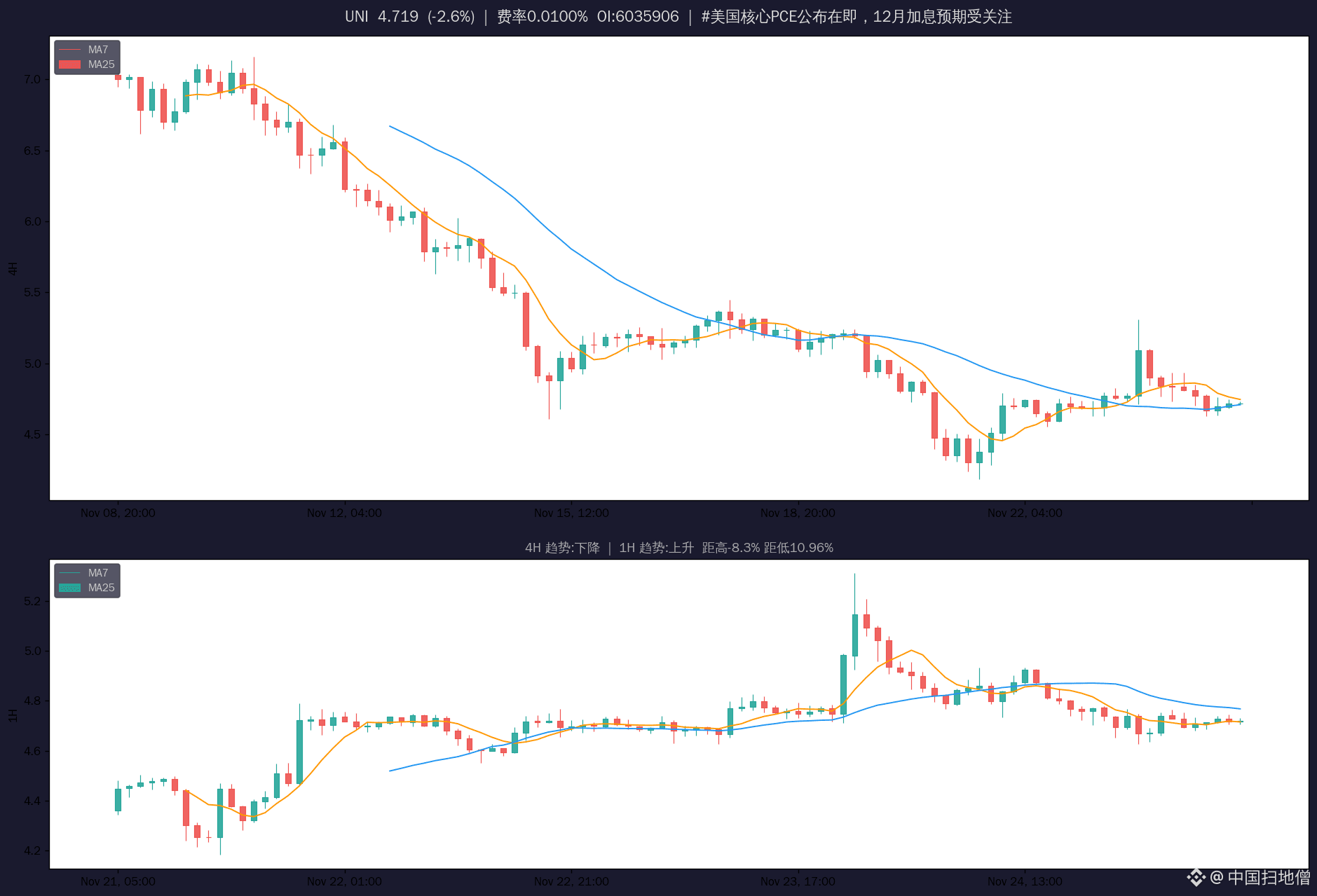
UNI Market Analysis 11/25With the U.S. core PCE release imminent, expectations of a December rate hike are unsettling risk appetite. UNI is under short-term pressure but has not broken key support; I favor a choppy but slightly bullish outlook while waiting for a clearer direction. The four-hour chart remains in a downtrend channel. At 4.719, the current price is down more than 2.6% from its 24-hour high and 33.25% below its four-hour high, while the one-hour chart has rebounded nearly 11% from its low—diverging short-term momentum from the medium-term trend. The top ten bid orders total 39,000, slightly exceeding the 32,000 in asks. The 0.01% funding rate indicates longs are paying a small premium, and open interest of 6.036 million tokens shows no notable reduction. Sentiment remains cautious. Strategy: consider a small long position on a pullback near 4.652, with a stop-loss at 4.588 and a target of 4.927. If price breaks above 4.933 on increased volume, add to the position in the direction of the breakout, with a stop-loss at 4.871. Keep each position to no more than 20% of your allocation, and exit immediately if support breaks.
UNI Market Analysis 11/25
With the U.S. core PCE release imminent, expectations of a December rate hike are unsettling risk appetite. UNI is under short-term pressure but has not broken key support; I favor a choppy but slightly bullish outlook while waiting for a clearer direction. The four-hour chart remains in a downtrend channel. At 4.719, the current price is down more than 2.6% from its 24-hour high and 33.25% below its four-hour high, while the one-hour chart has rebounded nearly 11% from its low—diverging short-term momentum from the medium-term trend. The top ten bid orders total 39,000, slightly exceeding the 32,000 in asks. The 0.01% funding rate indicates longs are paying a small premium, and open interest of 6.036 million tokens shows no notable reduction. Sentiment remains cautious. Strategy: consider a small long position on a pullback near 4.652, with a stop-loss at 4.588 and a target of 4.927. If price breaks above 4.933 on increased volume, add to the position in the direction of the breakout, with a stop-loss at 4.871. Keep each position to no more than 20% of your allocation, and exit immediately if support breaks.
·
--
Article
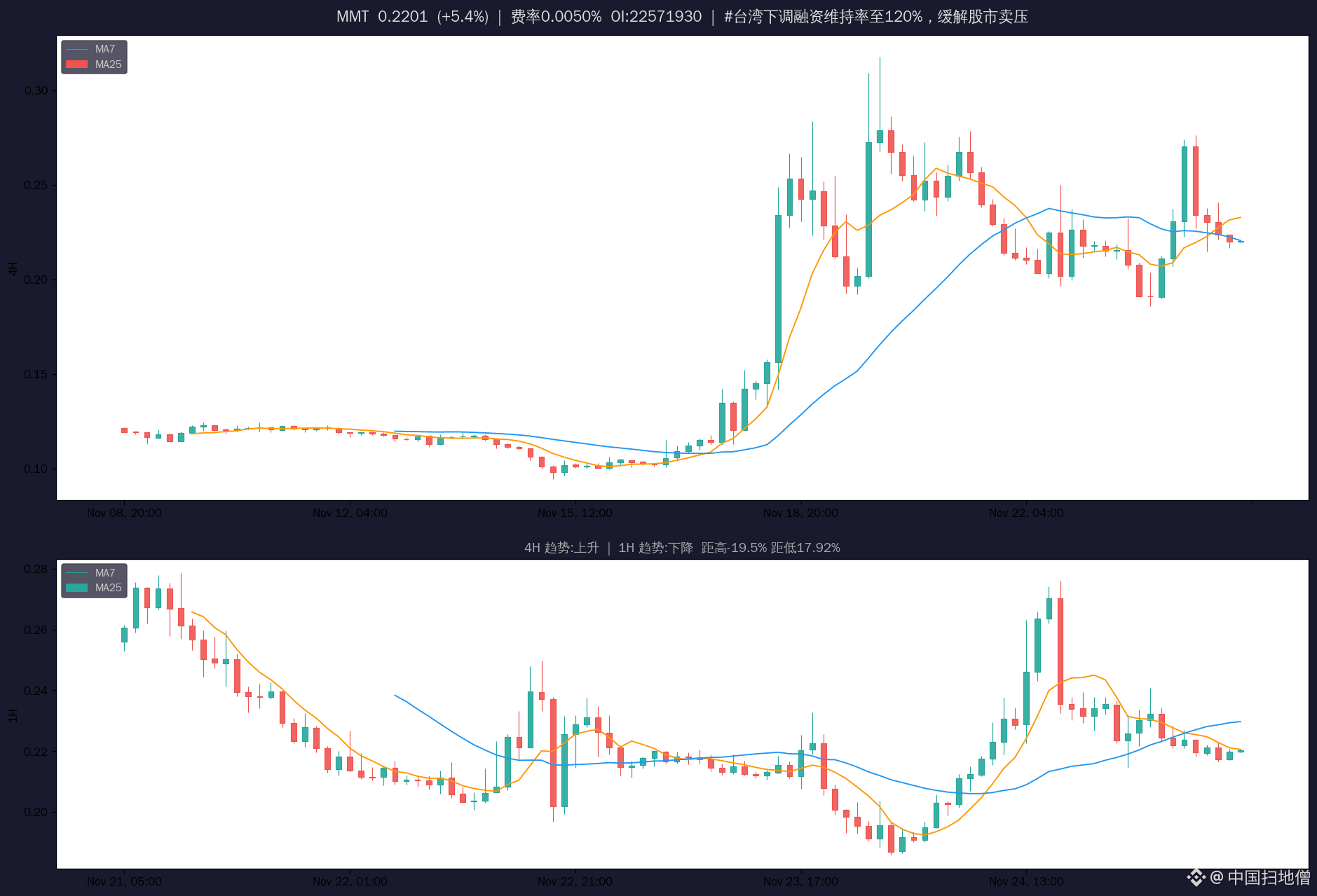
MMT Market Analysis 11/25Taiwan lowered the financing maintenance ratio to 120%, easing selling pressure in the stock market. A recovery in risk appetite spilled over into crypto markets, giving MMT a short-term window for a rebound. However, amid macroeconomic correlations, the recovery remains structural rather than a trend reversal. After gaining 5.4% in 24 hours, the price stood at 0.2201. The 1-hour chart is weakening, with a 19.50% pullback from the high, while the 4-hour chart remains in an uptrend. 0.207 is the key support for this move, with strong resistance at 0.2761. A buy/sell ratio of 1.17 indicates buyers have a slight edge. The funding rate is just 0.0050%, and open interest stands at 22.572 million, suggesting cautious sentiment without signs of overheating. As a strategy, consider placing a long order at 0.2135, with a stop-loss at 0.1985 and a target of 0.2585. If the price rises toward 0.2685 and encounters resistance, consider a small short position, with a stop-loss at 0.2815 and a target of 0.2245. Keep each position to no more than 20% and strictly adhere to stop-losses.
MMT Market Analysis 11/25
Taiwan lowered the financing maintenance ratio to 120%, easing selling pressure in the stock market. A recovery in risk appetite spilled over into crypto markets, giving MMT a short-term window for a rebound. However, amid macroeconomic correlations, the recovery remains structural rather than a trend reversal. After gaining 5.4% in 24 hours, the price stood at 0.2201. The 1-hour chart is weakening, with a 19.50% pullback from the high, while the 4-hour chart remains in an uptrend. 0.207 is the key support for this move, with strong resistance at 0.2761. A buy/sell ratio of 1.17 indicates buyers have a slight edge. The funding rate is just 0.0050%, and open interest stands at 22.572 million, suggesting cautious sentiment without signs of overheating. As a strategy, consider placing a long order at 0.2135, with a stop-loss at 0.1985 and a target of 0.2585. If the price rises toward 0.2685 and encounters resistance, consider a small short position, with a stop-loss at 0.2815 and a target of 0.2245. Keep each position to no more than 20% and strictly adhere to stop-losses.
9
·
--
Article
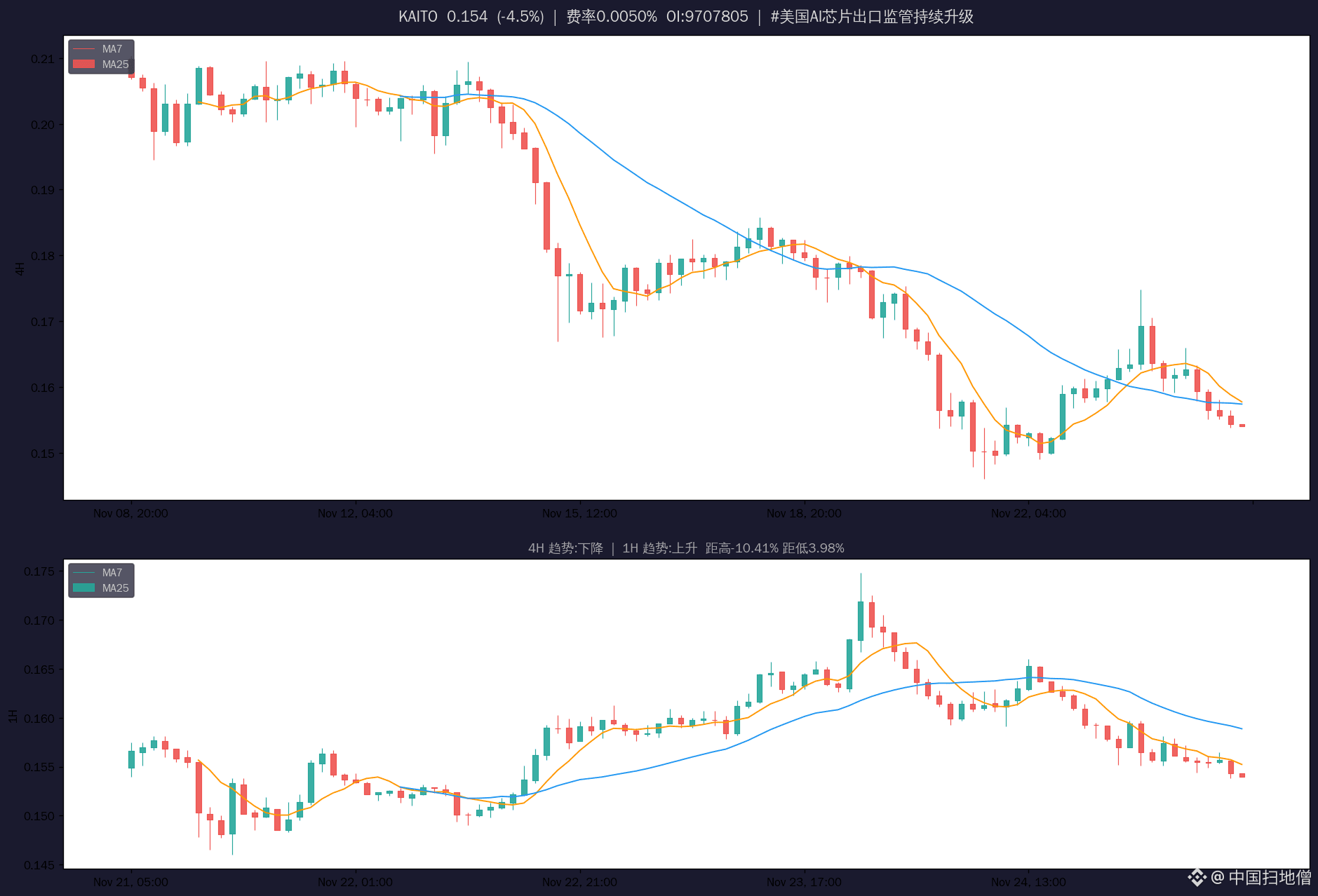
KAITO Market Analysis 11/25U.S. AI chip export controls continue to tighten, weighing on risk appetite. As a token tied to the AI narrative, KAITO is unlikely to be immune, so I favor a defensive stance in the short term. On the four-hour chart, it remains in a downtrend channel. At 0.154, the current price is just 2.94% above the low for this period, while 0.166 is clear resistance. Although it has rebounded on the one-hour chart, it has since fallen 10% from its high, putting the rebound’s strength in doubt. A buy/sell ratio of 1.22 shows buyers are in control; the funding rate is slightly positive and open interest stands at 9.708 million. Sentiment is not panicked, but there is little fresh buying interest. Trading volume is subdued at 17.684 million. Strategy: consider a small long position on a pullback to 0.1537, with a stop-loss at 0.1483 and a target of 0.1637. If it rallies to 0.1651 and meets resistance, consider reversing to a short, with a stop-loss at 0.1697 and a target of 0.1563. Keep each position to no more than 20% of your allocation, and exit immediately if support breaks.
KAITO Market Analysis 11/25
U.S. AI chip export controls continue to tighten, weighing on risk appetite. As a token tied to the AI narrative, KAITO is unlikely to be immune, so I favor a defensive stance in the short term. On the four-hour chart, it remains in a downtrend channel. At 0.154, the current price is just 2.94% above the low for this period, while 0.166 is clear resistance. Although it has rebounded on the one-hour chart, it has since fallen 10% from its high, putting the rebound’s strength in doubt. A buy/sell ratio of 1.22 shows buyers are in control; the funding rate is slightly positive and open interest stands at 9.708 million. Sentiment is not panicked, but there is little fresh buying interest. Trading volume is subdued at 17.684 million. Strategy: consider a small long position on a pullback to 0.1537, with a stop-loss at 0.1483 and a target of 0.1637. If it rallies to 0.1651 and meets resistance, consider reversing to a short, with a stop-loss at 0.1697 and a target of 0.1563. Keep each position to no more than 20% of your allocation, and exit immediately if support breaks.
15
·
--
Article
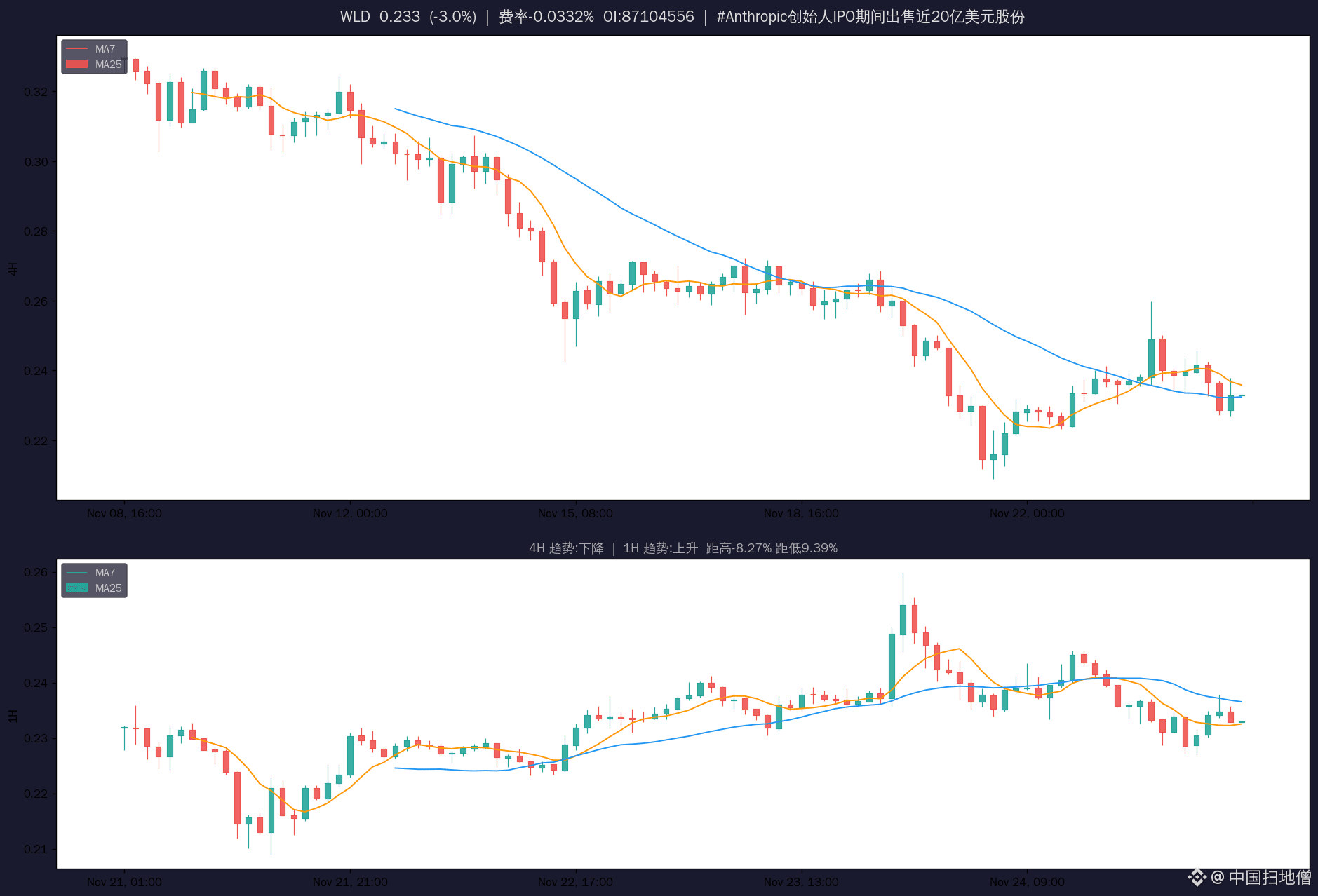
WLD Market Analysis 11/25#Anthropic创始人IPO期间出售近20亿美元股份 These high-level profit-taking moves by tech capital are subtly linked to the sentiment around AI narrative funding represented by WLD. My overall view: weak, choppy trading in the short term, with a directional move approaching. Looking at the market, the current price is 0.233, down 3.0% on the day. The 4-hour chart remains in a downtrend, 29.22% below its high, while the 1-hour chart has risen 9.39% from its low—a typical sign of range compression. Turnover of 263 million indicates that disagreement persists. In the top 10 levels, bids total 1.02 million versus 1.222 million in asks, for a ratio of 0.83, giving sellers a slight edge. Meanwhile, the funding rate of -0.0332% and open interest of 87.105 million in coin-margined contracts point to crowded shorts and the potential for a rebound. Strategy: place a long order at 0.2285, with a stop-loss at 0.2213 and a target of 0.2437, betting on a 1-hour breakout; alternatively, lightly short a rebound to 0.2412, with a stop-loss at 0.2468 and a target of 0.2308. Keep position size below 10% and exit immediately if support breaks.
WLD Market Analysis 11/25
#Anthropic创始人IPO期间出售近20亿美元股份 These high-level profit-taking moves by tech capital are subtly linked to the sentiment around AI narrative funding represented by WLD. My overall view: weak, choppy trading in the short term, with a directional move approaching. Looking at the market, the current price is 0.233, down 3.0% on the day. The 4-hour chart remains in a downtrend, 29.22% below its high, while the 1-hour chart has risen 9.39% from its low—a typical sign of range compression. Turnover of 263 million indicates that disagreement persists. In the top 10 levels, bids total 1.02 million versus 1.222 million in asks, for a ratio of 0.83, giving sellers a slight edge. Meanwhile, the funding rate of -0.0332% and open interest of 87.105 million in coin-margined contracts point to crowded shorts and the potential for a rebound. Strategy: place a long order at 0.2285, with a stop-loss at 0.2213 and a target of 0.2437, betting on a 1-hour breakout; alternatively, lightly short a rebound to 0.2412, with a stop-loss at 0.2468 and a target of 0.2308. Keep position size below 10% and exit immediately if support breaks.
2
·
--
Article
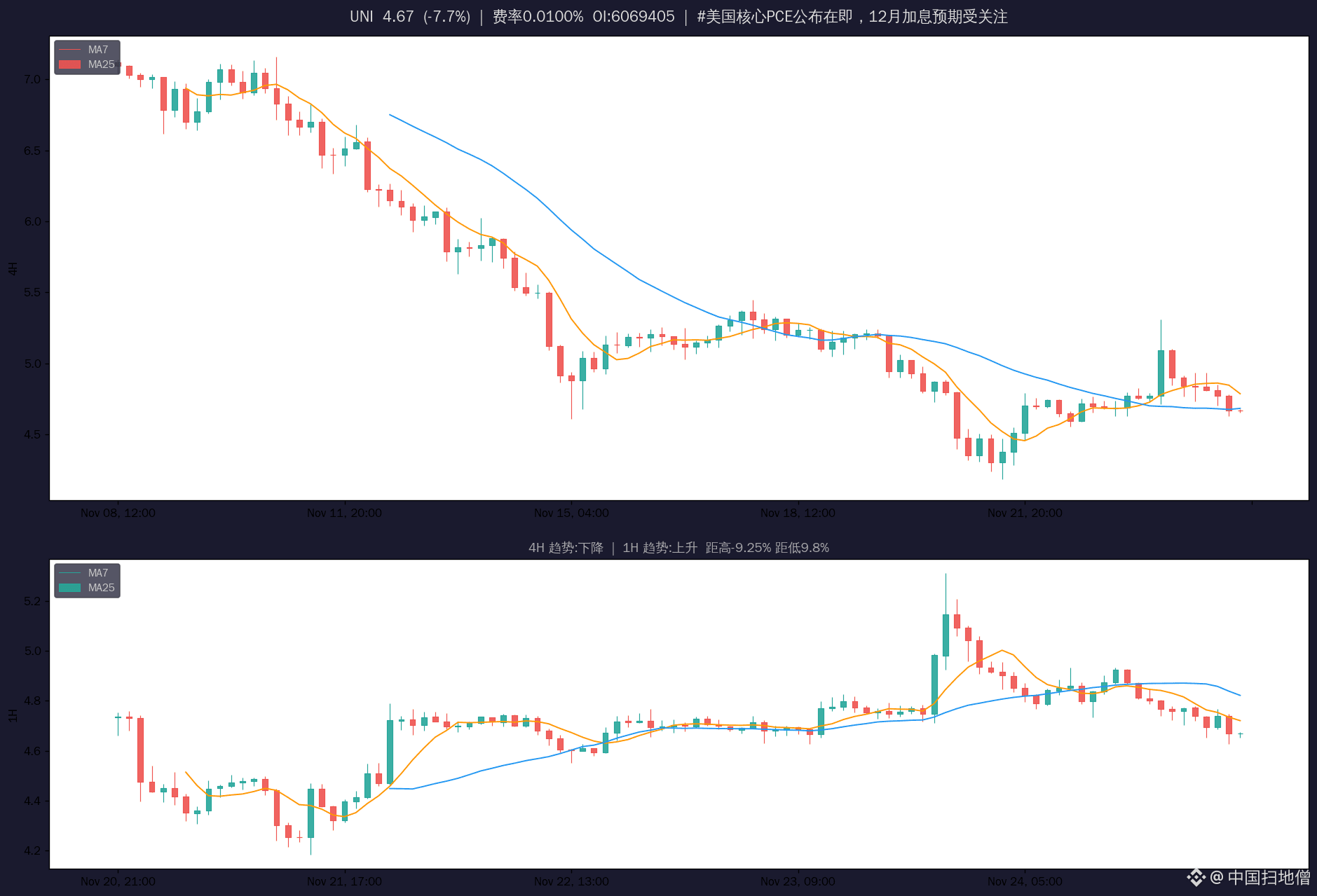
UNI Market Analysis 11/25With the U.S. core PCE report due soon, expectations for a December rate hike are weighing on risk appetite. As a high-beta asset, UNI is unlikely to be immune. My overall view is that the short-term rebound is a corrective bounce, not a reversal. In terms of flows and sentiment, after falling 7.7% in 24 hours, the funding rate is still at 0.01%, showing that longs remain willing to pay to hold their positions. Open interest of 6.069 million coin-denominated units suggests there has been no large-scale exit, and bulls and bears are still battling. Although the price has recovered on the one-hour chart, it remains 9.25% below the high; the four-hour downtrend structure is 34.18% below the high. Among the top ten orders, buy orders total 39,000 versus 36,000 in sell orders, giving buyers a slight edge. Dip-buying sentiment is beginning to emerge, but support remains limited. Strategy: consider a small long position on a pullback to 4.632, with a stop-loss at 4.585 and a target of 4.768. If the rebound is rejected at 4.795, consider reversing into a short, with a stop-loss at 4.842 and a target of 4.648. Keep any single position below 20% of your allocation, and exit decisively if the stop-loss is hit.
UNI Market Analysis 11/25
With the U.S. core PCE report due soon, expectations for a December rate hike are weighing on risk appetite. As a high-beta asset, UNI is unlikely to be immune. My overall view is that the short-term rebound is a corrective bounce, not a reversal. In terms of flows and sentiment, after falling 7.7% in 24 hours, the funding rate is still at 0.01%, showing that longs remain willing to pay to hold their positions. Open interest of 6.069 million coin-denominated units suggests there has been no large-scale exit, and bulls and bears are still battling. Although the price has recovered on the one-hour chart, it remains 9.25% below the high; the four-hour downtrend structure is 34.18% below the high. Among the top ten orders, buy orders total 39,000 versus 36,000 in sell orders, giving buyers a slight edge. Dip-buying sentiment is beginning to emerge, but support remains limited. Strategy: consider a small long position on a pullback to 4.632, with a stop-loss at 4.585 and a target of 4.768. If the rebound is rejected at 4.795, consider reversing into a short, with a stop-loss at 4.842 and a target of 4.648. Keep any single position below 20% of your allocation, and exit decisively if the stop-loss is hit.
11
·
--
Article
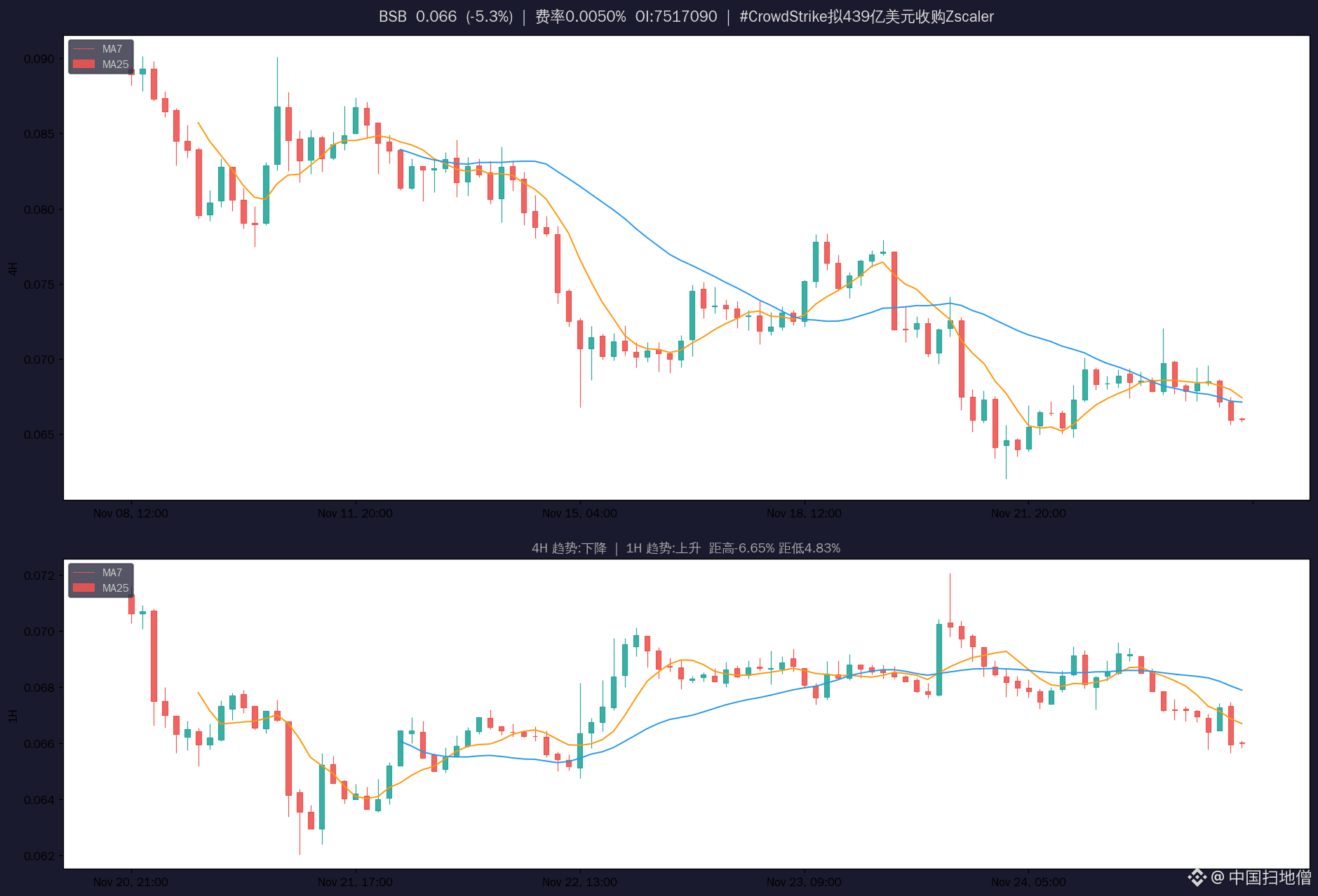
BSB Market Analysis 11/25CrowdStrike’s planned $43.9 billion acquisition of Zscaler has sparked speculation about consolidation in the security sector. Amid spillover from shifts in risk appetite, BSB is under short-term pressure. I believe the market is currently in a narrow range ahead of a potential trend reversal, with a directional move approaching. After falling 5.3% in 24 hours, the price found support at 0.06564. It has edged higher on the 1-hour timeframe, but remains in a downward channel on the 4-hour timeframe, with clear resistance 26.08% below the 4-hour high. The order book shows 6,182 buy orders versus 5,430 sell orders, and a buy/sell ratio of 1.14, indicating stronger buying support. The funding rate of 0.005% is relatively neutral, and open interest of 7.517 million shows no signs of panic-driven exits. Strategy: consider a small long position at 0.06585, with a stop-loss at 0.06432 and a target of 0.06975. If a rebound is rejected at 0.06893, consider reversing to a short position, with a stop-loss at 0.07012 and a target of 0.06621. Keep each position below 5% and strictly honor stop-losses.
BSB Market Analysis 11/25
CrowdStrike’s planned $43.9 billion acquisition of Zscaler has sparked speculation about consolidation in the security sector. Amid spillover from shifts in risk appetite, BSB is under short-term pressure. I believe the market is currently in a narrow range ahead of a potential trend reversal, with a directional move approaching. After falling 5.3% in 24 hours, the price found support at 0.06564. It has edged higher on the 1-hour timeframe, but remains in a downward channel on the 4-hour timeframe, with clear resistance 26.08% below the 4-hour high. The order book shows 6,182 buy orders versus 5,430 sell orders, and a buy/sell ratio of 1.14, indicating stronger buying support. The funding rate of 0.005% is relatively neutral, and open interest of 7.517 million shows no signs of panic-driven exits. Strategy: consider a small long position at 0.06585, with a stop-loss at 0.06432 and a target of 0.06975. If a rebound is rejected at 0.06893, consider reversing to a short position, with a stop-loss at 0.07012 and a target of 0.06621. Keep each position below 5% and strictly honor stop-losses.
·
--
Article
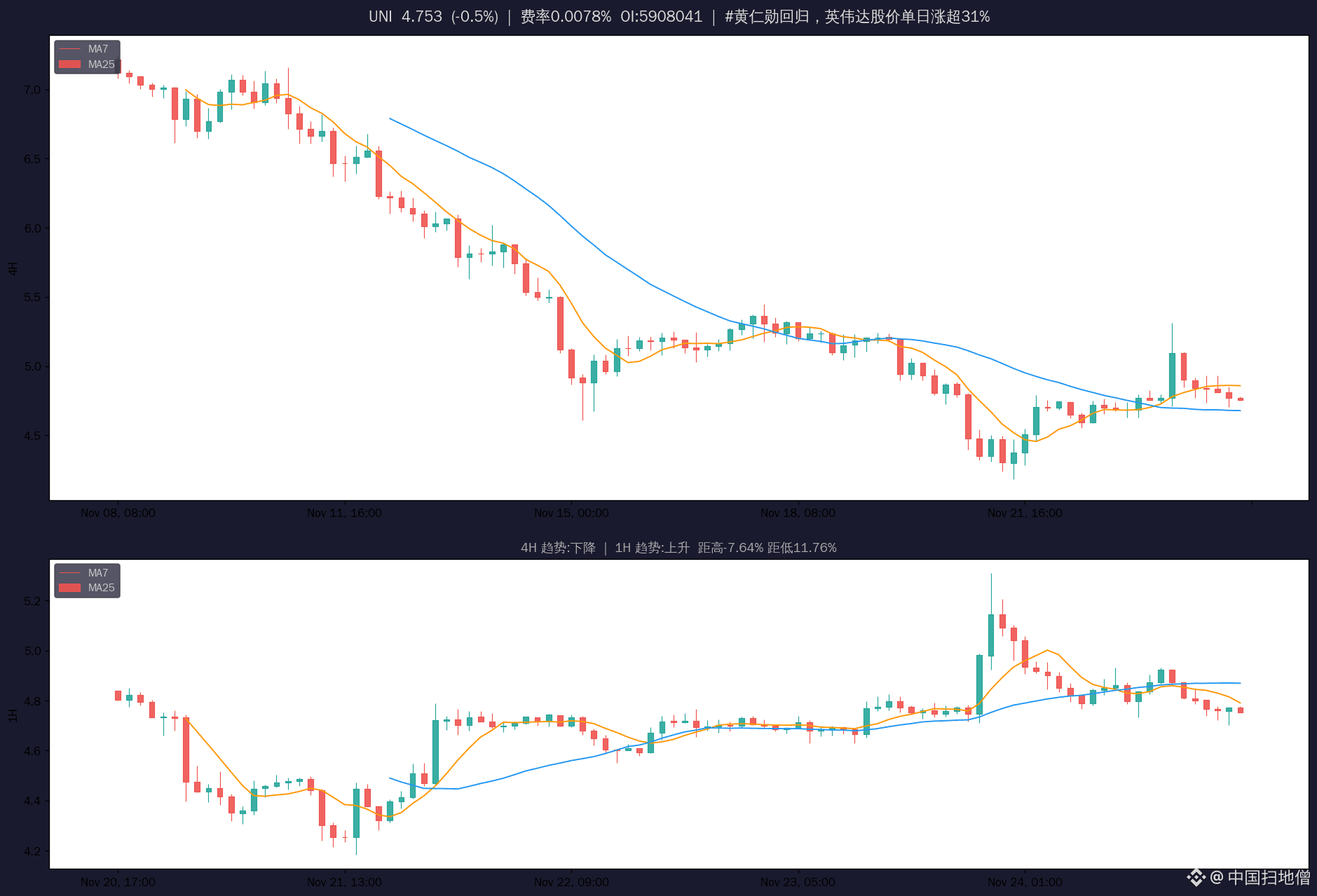
UNI Market Analysis 11/24Jensen Huang’s return boosted NVIDIA by more than 31% in a single day, reviving risk appetite. UNI, however, did not follow the rally, and I believe it remains in its own corrective phase. The current price is 4.753, down 0.5% over 24 hours. The high of 5.311 failed to hold, while the low of 4.703 forms short-term support. The four-hour trend is bearish, with price down 33.24% from the high. The one-hour chart shows a rebound, but price remains 7.64% below the high. Trading volume is 20.571 million, and the buy/sell ratio across the top 10 order-book levels is 1.11, giving buyers a slight edge. The funding rate is a fairly neutral 0.0078%, and open interest is 5.908 million; sentiment shows no extremes. Strategy: Consider a small long position on a pullback to 4.712, with a stop-loss at 4.658 and a target of 4.918. If the price rises to around 4.965 and meets resistance, consider a short position, with a stop-loss at 5.032 and a target of 4.806. Keep each position below 20% of your allocation, and exit immediately if the stop-loss is hit.
UNI Market Analysis 11/24
Jensen Huang’s return boosted NVIDIA by more than 31% in a single day, reviving risk appetite. UNI, however, did not follow the rally, and I believe it remains in its own corrective phase. The current price is 4.753, down 0.5% over 24 hours. The high of 5.311 failed to hold, while the low of 4.703 forms short-term support. The four-hour trend is bearish, with price down 33.24% from the high. The one-hour chart shows a rebound, but price remains 7.64% below the high. Trading volume is 20.571 million, and the buy/sell ratio across the top 10 order-book levels is 1.11, giving buyers a slight edge. The funding rate is a fairly neutral 0.0078%, and open interest is 5.908 million; sentiment shows no extremes. Strategy: Consider a small long position on a pullback to 4.712, with a stop-loss at 4.658 and a target of 4.918. If the price rises to around 4.965 and meets resistance, consider a short position, with a stop-loss at 5.032 and a target of 4.806. Keep each position below 20% of your allocation, and exit immediately if the stop-loss is hit.
·
--
Article
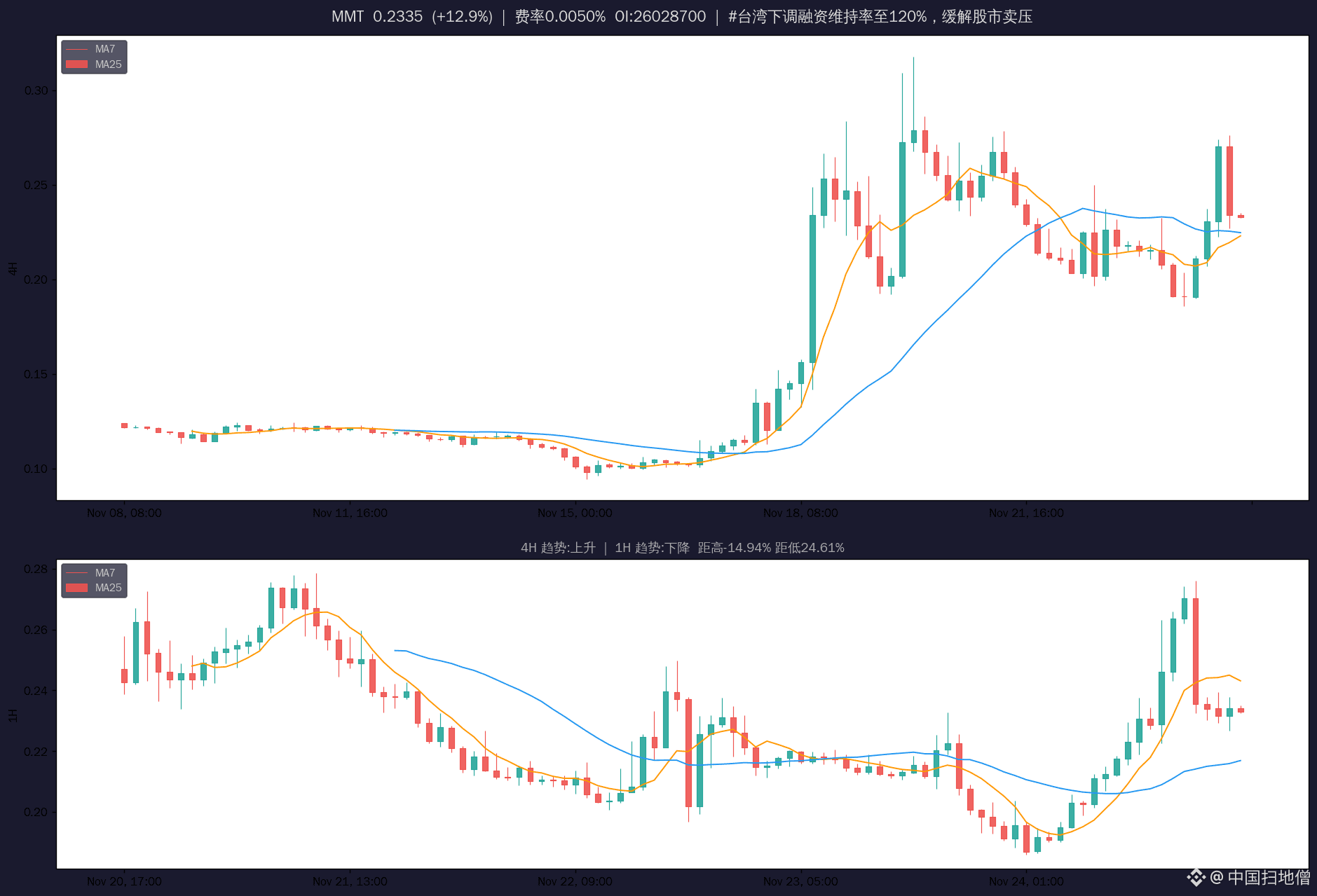
MMT Market Analysis 11/24Taiwan lowered the margin maintenance ratio to 120%, easing selling pressure in the stock market. The recovery in risk appetite is a short-term positive for highly volatile assets like MMT, but trading discipline means not chasing rallies—only entering after a confirmed pullback. After gaining 12.9% in 24 hours, it turned lower over the past hour and has fallen 14.94% from its high. The 4-hour trend is still up but appears overextended, so the risk of chasing is greater than the opportunity. The current price is 0.2335; the buy/sell ratio across the top 10 levels is 1.40, indicating buyers are in control. The funding rate of 0.0050% is relatively neutral, and open interest of 26.029 million shows no signs of extreme crowding. Strategy: lightly enter a long position on a pullback to 0.2197, with a stop-loss at 0.2073 and a target of 0.2531. If 0.2073 is breached, exit and wait—do not average down. Keep each position below 5%.
MMT Market Analysis 11/24
Taiwan lowered the margin maintenance ratio to 120%, easing selling pressure in the stock market. The recovery in risk appetite is a short-term positive for highly volatile assets like MMT, but trading discipline means not chasing rallies—only entering after a confirmed pullback. After gaining 12.9% in 24 hours, it turned lower over the past hour and has fallen 14.94% from its high. The 4-hour trend is still up but appears overextended, so the risk of chasing is greater than the opportunity. The current price is 0.2335; the buy/sell ratio across the top 10 levels is 1.40, indicating buyers are in control. The funding rate of 0.0050% is relatively neutral, and open interest of 26.029 million shows no signs of extreme crowding. Strategy: lightly enter a long position on a pullback to 0.2197, with a stop-loss at 0.2073 and a target of 0.2531. If 0.2073 is breached, exit and wait—do not average down. Keep each position below 5%.
·
--
Article
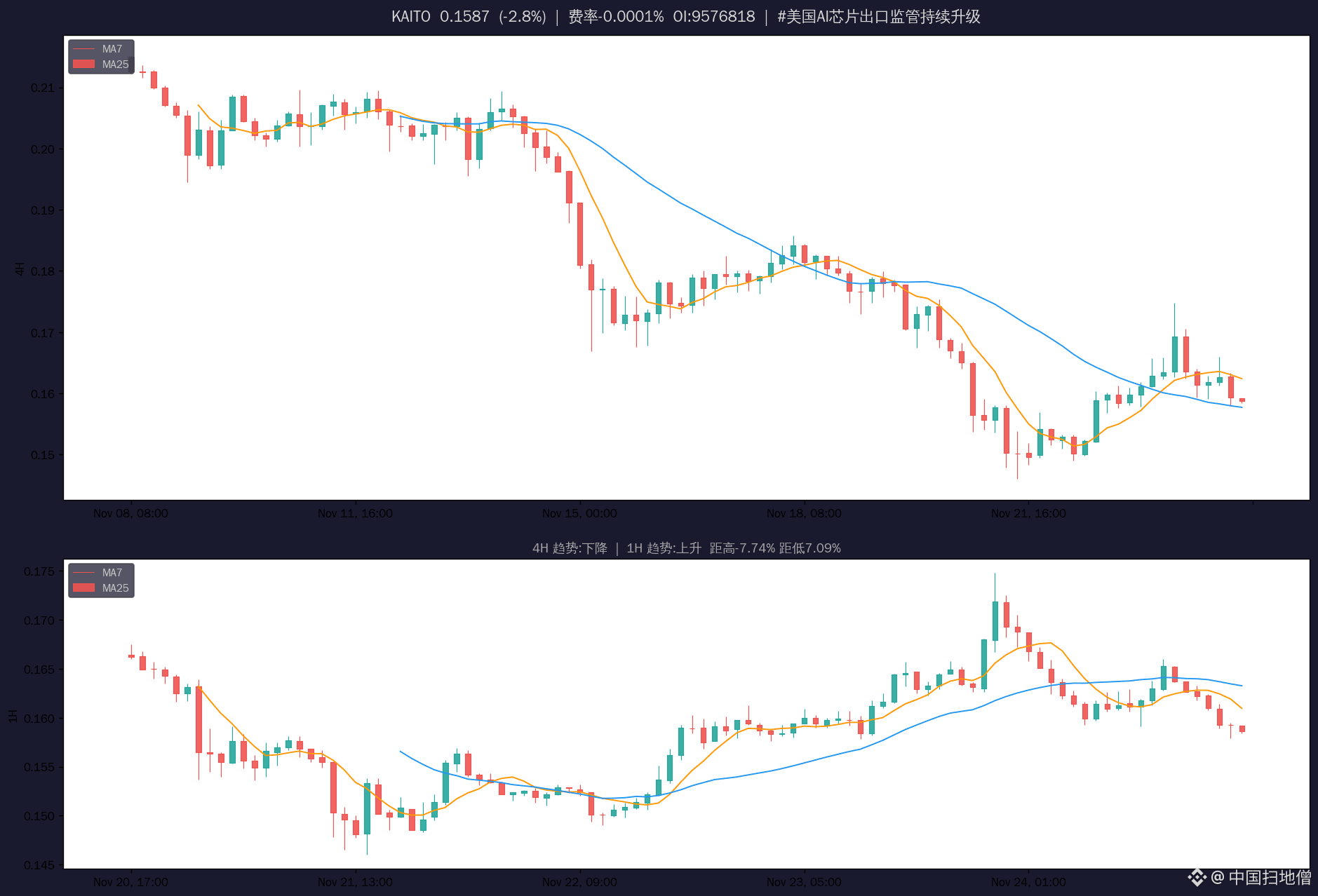
KAITO Market Analysis 11/24U.S. AI chip export controls continue to tighten, putting pressure on risk appetite that is spilling over into AI narrative tokens. KAITO is no exception. My view is bearish in the short term, favoring defense over offense. The four-hour downtrend remains intact. At 0.1587, the current price is down more than 25% from the four-hour high, and fell 2.8% intraday to 0.1579. Although it has rebounded on the one-hour chart, it remains 7.74% below the high. The funding rate of -0.0001% signals weak confidence among longs, open interest remains at 9.577 million with no increase, and the top-10-level buy/sell ratio of 1.10 shows only a slight buying advantage, making the strength of the rebound questionable. Strategy-wise, prioritize risk control: consider a small short position on a rebound to around 0.1663, with a stop-loss at 0.1712 and a target of 0.1523. If the price holds above 0.1608, a short-term long position is possible, with a stop-loss at 0.1562 and a target of 0.1691. Keep each position below 5% of the portfolio; exit immediately if support breaks, and don't hold on to losing positions.
KAITO Market Analysis 11/24
U.S. AI chip export controls continue to tighten, putting pressure on risk appetite that is spilling over into AI narrative tokens. KAITO is no exception. My view is bearish in the short term, favoring defense over offense. The four-hour downtrend remains intact. At 0.1587, the current price is down more than 25% from the four-hour high, and fell 2.8% intraday to 0.1579. Although it has rebounded on the one-hour chart, it remains 7.74% below the high. The funding rate of -0.0001% signals weak confidence among longs, open interest remains at 9.577 million with no increase, and the top-10-level buy/sell ratio of 1.10 shows only a slight buying advantage, making the strength of the rebound questionable. Strategy-wise, prioritize risk control: consider a small short position on a rebound to around 0.1663, with a stop-loss at 0.1712 and a target of 0.1523. If the price holds above 0.1608, a short-term long position is possible, with a stop-loss at 0.1562 and a target of 0.1691. Keep each position below 5% of the portfolio; exit immediately if support breaks, and don't hold on to losing positions.
·
--
Article
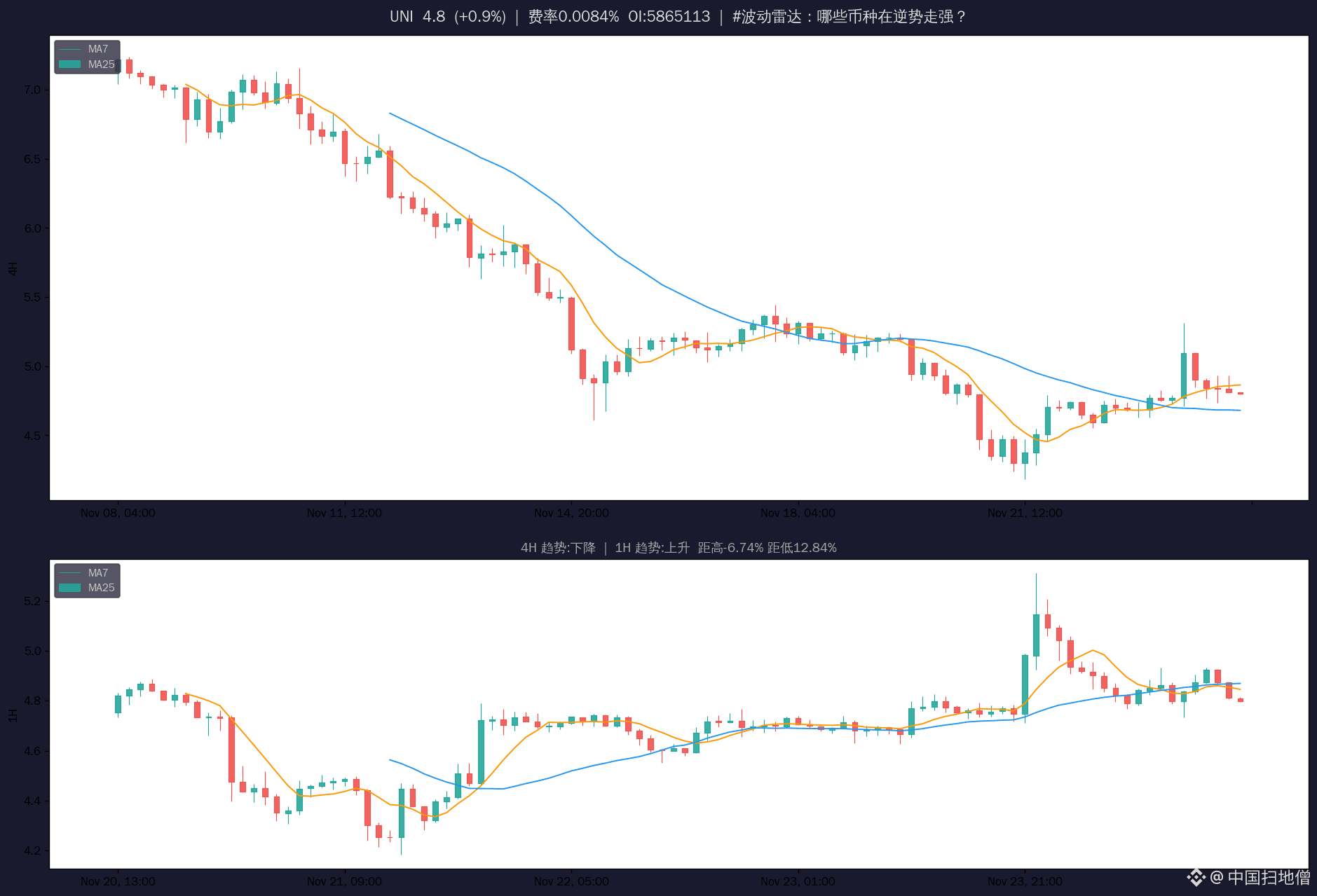
UNI Market Analysis 11/24The volatility radar picked up UNI on its list of assets strengthening against the trend. UNI closed up slightly by 0.9% today, showing some resilience in a weak market structure, though the rebound remains limited. Overall, this looks like a weak recovery rather than a reversal. Funding rates are a fairly neutral 0.0084%, and coin-margined open interest at 5.865 million shows no notable increase, suggesting cautious sentiment. The hourly trend is up, while the four-hour trend remains down. At 4.8, the price is 33.5% below the four-hour high. Resistance is at 5.13, with support at 4.77. The top ten buy orders total 39,000 versus 45,000 for sell orders, a ratio of 0.87, giving sellers a slight edge. Strategy: consider a small long position on a pullback to 4.77, with a stop-loss at 4.63 and a target of 5.13. If the price breaks below 4.71 on strong volume, exit and stay on the sidelines. Keep any single position below 10% of the portfolio.
UNI Market Analysis 11/24
The volatility radar picked up UNI on its list of assets strengthening against the trend. UNI closed up slightly by 0.9% today, showing some resilience in a weak market structure, though the rebound remains limited. Overall, this looks like a weak recovery rather than a reversal. Funding rates are a fairly neutral 0.0084%, and coin-margined open interest at 5.865 million shows no notable increase, suggesting cautious sentiment. The hourly trend is up, while the four-hour trend remains down. At 4.8, the price is 33.5% below the four-hour high. Resistance is at 5.13, with support at 4.77. The top ten buy orders total 39,000 versus 45,000 for sell orders, a ratio of 0.87, giving sellers a slight edge. Strategy: consider a small long position on a pullback to 4.77, with a stop-loss at 4.63 and a target of 5.13. If the price breaks below 4.71 on strong volume, exit and stay on the sidelines. Keep any single position below 10% of the portfolio.
9
·
--
Article
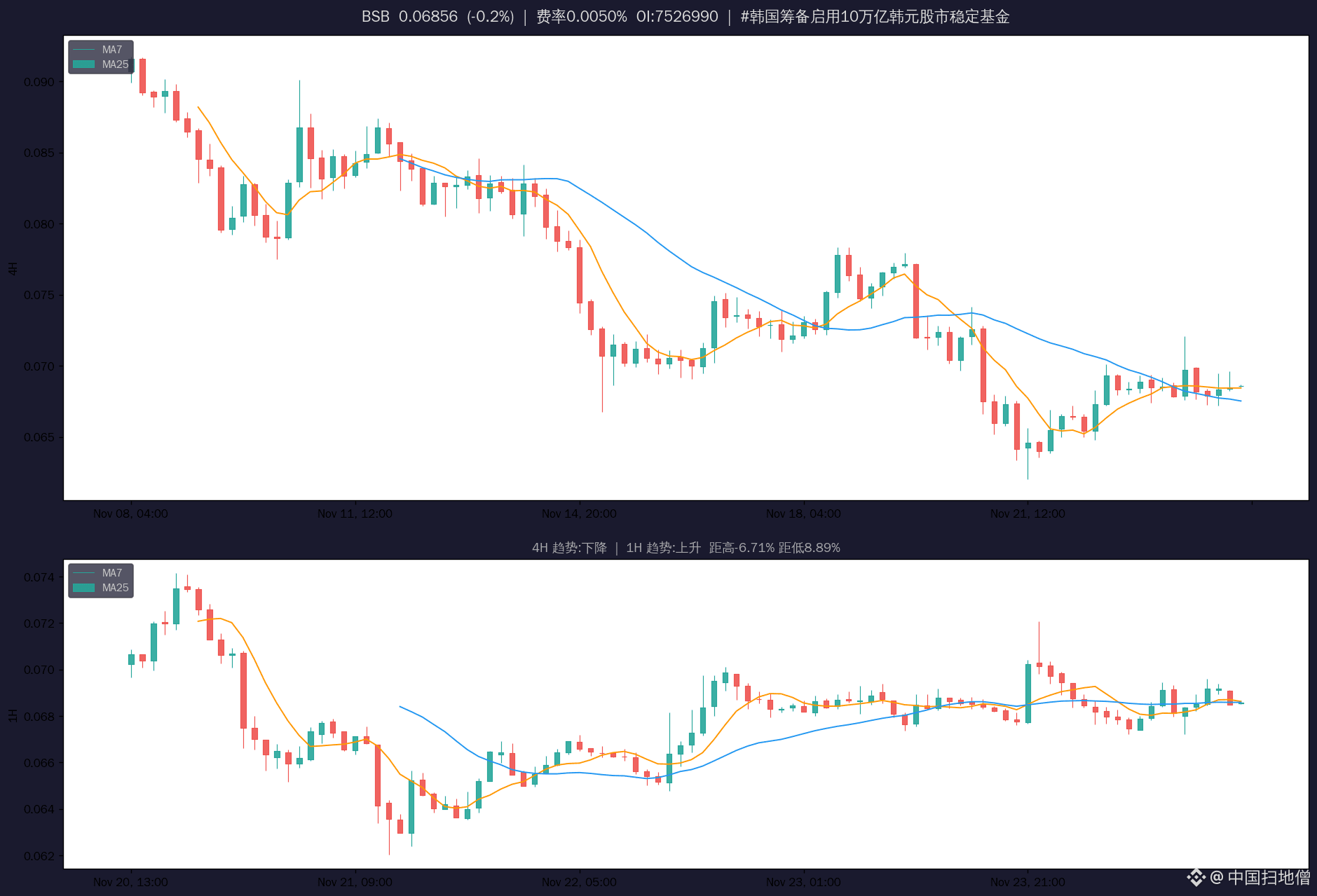
BSB Market Analysis 11/24South Korea is preparing to launch a 10 trillion won stock market stabilization fund. Expectations of a recovery in risk appetite are spilling over into crypto markets. Although BSB is not benefiting directly, sentiment is receiving support. I expect short-term choppy recovery rather than a one-way decline.
Capital flows and sentiment are the key issues right now: the price is 0.06856, down just 0.2% over 24 hours, while trading volume is only 682,000, indicating subdued activity. The funding rate of 0.0050% shows a slight long bias, but little willingness to pay; coin-margined open interest stands at 7.527 million coins, with no significant change, as both longs and shorts remain on the sidelines. In the top 10 order book levels, buy orders total 4,979 versus 998 sell orders, a buy/sell ratio of 4.99, indicating significantly greater depth on the bid side. The 1-hour trend is rising but remains 6.71% below its high; the 4-hour trend is falling and 25.14% below its high. The tug-of-war between short-term bulls and longer-term bears is clear, with resistance around 0.07163 and support around 0.06743.
BSB Market Analysis 11/24
South Korea is preparing to launch a 10 trillion won stock market stabilization fund. Expectations of a recovery in risk appetite are spilling over into crypto markets. Although BSB is not benefiting directly, sentiment is receiving support. I expect short-term choppy recovery rather than a one-way decline.
Capital flows and sentiment are the key issues right now: the price is 0.06856, down just 0.2% over 24 hours, while trading volume is only 682,000, indicating subdued activity. The funding rate of 0.0050% shows a slight long bias, but little willingness to pay; coin-margined open interest stands at 7.527 million coins, with no significant change, as both longs and shorts remain on the sidelines. In the top 10 order book levels, buy orders total 4,979 versus 998 sell orders, a buy/sell ratio of 4.99, indicating significantly greater depth on the bid side. The 1-hour trend is rising but remains 6.71% below its high; the 4-hour trend is falling and 25.14% below its high. The tug-of-war between short-term bulls and longer-term bears is clear, with resistance around 0.07163 and support around 0.06743.
1
·
--
Article
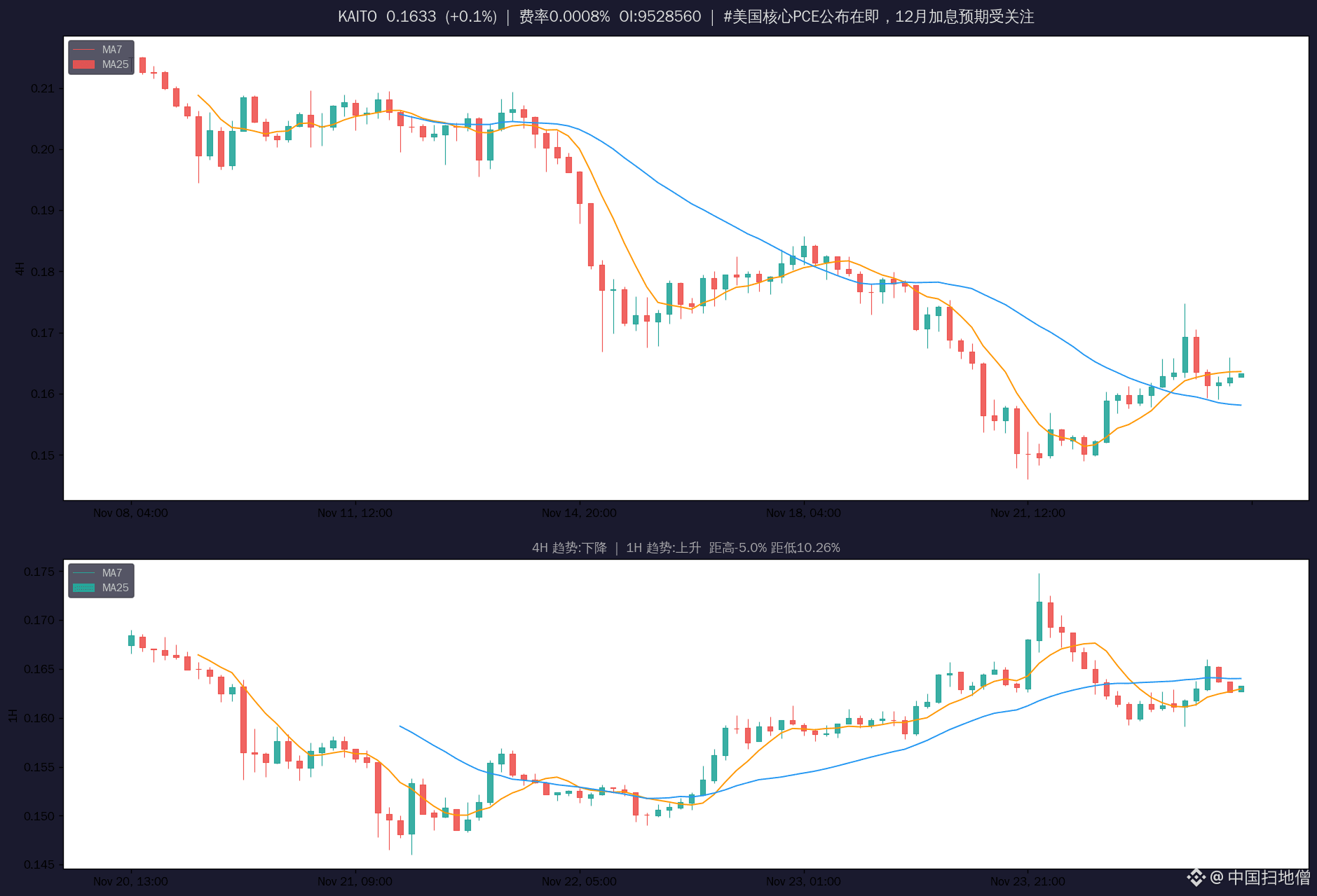
KAITO Market Analysis 11/24With the U.S. core PCE report due soon, expectations of a December rate hike are weighing on risk appetite. As a high-beta, small-cap coin, KAITO is particularly sensitive to liquidity expectations, so I lean toward a choppy-to-weak outlook ahead of the data. On the 4-hour chart, it remains in a downtrend channel. The current price of 0.1633 is down 24.05% from the high for this timeframe. However, the 1-hour chart has stabilized and rebounded, rising 10.26% from its low, suggesting some short-term recovery potential. The bid-to-ask ratio across the top 10 order-book levels is 0.96, giving sellers a slight edge. The funding rate is just 0.0008%, and open interest stands at 9.529 million, indicating cautious long sentiment without signs of overcrowding. For a trading strategy, consider placing a long order at 0.1593, with a stop-loss at 0.1547 and a target of 0.1739, aiming to capture a sentiment rebound after the data release. If the price rebounds to around 0.1749 and meets resistance, consider a small short position, with a stop-loss at 0.1793 and a target of 0.1611. Keep any single position below 5% of total capital. Volatility may increase around the data release, so be sure to use stop-losses.
KAITO Market Analysis 11/24
With the U.S. core PCE report due soon, expectations of a December rate hike are weighing on risk appetite. As a high-beta, small-cap coin, KAITO is particularly sensitive to liquidity expectations, so I lean toward a choppy-to-weak outlook ahead of the data. On the 4-hour chart, it remains in a downtrend channel. The current price of 0.1633 is down 24.05% from the high for this timeframe. However, the 1-hour chart has stabilized and rebounded, rising 10.26% from its low, suggesting some short-term recovery potential. The bid-to-ask ratio across the top 10 order-book levels is 0.96, giving sellers a slight edge. The funding rate is just 0.0008%, and open interest stands at 9.529 million, indicating cautious long sentiment without signs of overcrowding. For a trading strategy, consider placing a long order at 0.1593, with a stop-loss at 0.1547 and a target of 0.1739, aiming to capture a sentiment rebound after the data release. If the price rebounds to around 0.1749 and meets resistance, consider a small short position, with a stop-loss at 0.1793 and a target of 0.1611. Keep any single position below 5% of total capital. Volatility may increase around the data release, so be sure to use stop-losses.
·
--
Article
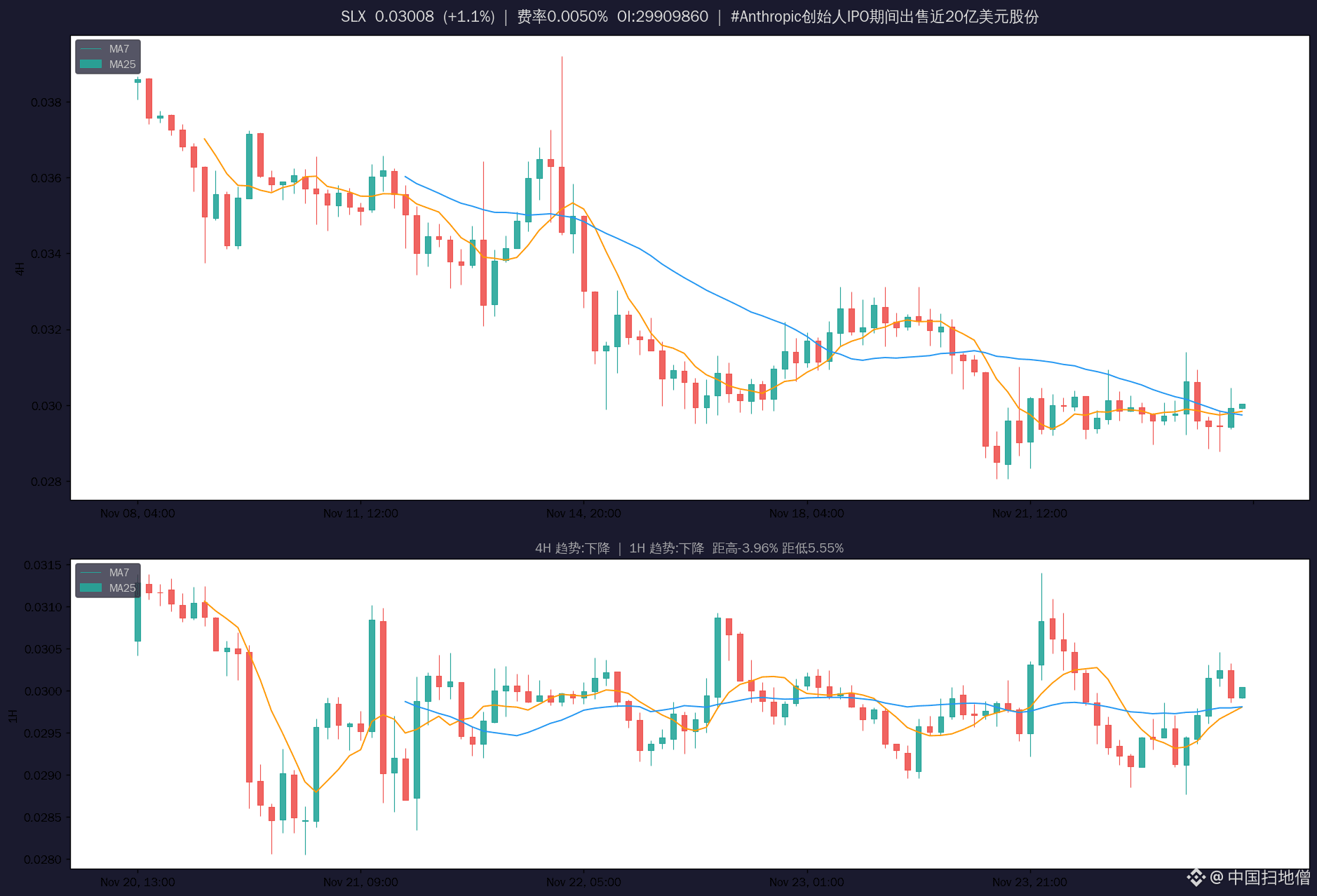
SLX Market Analysis 11/24Anthropic’s founder selling nearly $2 billion in shares during the IPO reflects investors’ tendency to accelerate profit-taking at elevated levels. This mirrors SLX’s current weak rebound, and my view is that the short-term outlook remains bearish. On the 4-hour chart, the price is down 22.16% from its high; on the 1-hour chart, it is 3.96% below the high and only 5.55% above the low, so the downward structure remains intact. The buy/sell strength ratio across the top 10 levels is 0.73, with 15,000 in sell orders outweighing 11,000 in buy orders. The funding rate of 0.0050% is neutral, and open interest at 29.91 million shows no obvious reduction, suggesting that the bulls have not yet given up, but buying support remains weak. Strategy: Consider a small short position if the price rebounds to 0.03035, with a stop-loss at 0.03105 and a target of 0.02885. If the price breaks above and holds 0.03115 on increased volume, switch to a short-term long position, with a stop-loss at 0.03045 and a target of 0.03205. Keep each position below 5% of your portfolio, and exit strictly if the price falls below 0.02877.
SLX Market Analysis 11/24
Anthropic’s founder selling nearly $2 billion in shares during the IPO reflects investors’ tendency to accelerate profit-taking at elevated levels. This mirrors SLX’s current weak rebound, and my view is that the short-term outlook remains bearish. On the 4-hour chart, the price is down 22.16% from its high; on the 1-hour chart, it is 3.96% below the high and only 5.55% above the low, so the downward structure remains intact. The buy/sell strength ratio across the top 10 levels is 0.73, with 15,000 in sell orders outweighing 11,000 in buy orders. The funding rate of 0.0050% is neutral, and open interest at 29.91 million shows no obvious reduction, suggesting that the bulls have not yet given up, but buying support remains weak. Strategy: Consider a small short position if the price rebounds to 0.03035, with a stop-loss at 0.03105 and a target of 0.02885. If the price breaks above and holds 0.03115 on increased volume, switch to a short-term long position, with a stop-loss at 0.03045 and a target of 0.03205. Keep each position below 5% of your portfolio, and exit strictly if the price falls below 0.02877.
5
Log in to explore more content
Join global crypto users on Binance Square
⚡️ Get latest and useful information about crypto.
💬 Trusted by the world’s largest crypto exchange.
👍 Discover real insights from verified creators.
Email / Phone number
Trending Topics
AnthropicBreaksBelowIPOPriceAmidAISlump
66,854 views
688 Discussing
TradFi News | Micron, Nvidia Lead AI Stock Slide as VIX Jumps Above 32 and Anthropic Falls Below IPO Price
Binance News
·19 Likes
·15.1k views
Bitcoin'sReboundFadesBelow$60K
117,316 views
400 Discussing
WillMarketsStageAThanksgivingReliefRally?
605,222 views
3,584 Discussing