
57号实验猫
1.2k Posts

57号实验猫
Report
Block User
Web3 / bStocks🔶20%返佣邀请码 BNB88R🔶请我喝奶茶,补充创作灵感🔶
Open Trade
High-Frequency Trader
8.6 Months
126 Following
813 Followers
3.5K+ Liked
Posts
Portfolio
All
Quotes
·
--
Verified
#韩国kospi下跌触发熔断 Starting November 9, South Korea will temporarily suspend the 140% financing-guarantee requirement for three months. The core logic is very simple and direct: break the negative feedback loop of “sharp drop → forced liquidations and margin calls → even steeper plunge.”
South Korea’s market-rescue policy is clear: it is forcibly giving the market painkillers. Retail investors won’t be forced to sell at fire-sale prices because of liquidations, and the broader market could rally sharply in the short term. But this merely pushes leverage risk back by three months; the fundamental problem is liquidity in U.S. tech stocks.
When tech stocks collapse, leveraged funds held by retail investors are especially vulnerable to forced liquidations that trigger a stampede. This time, the authorities have stepped in directly to backstop brokerages and retail investors, essentially freezing short-term selling pressure by force. In the near term, indiscriminate panic selling is likely to subside quickly, and the broader market will probably find a technical floor. But this is just defensive damage control, not a signal of a reversal. Whether the market can truly rebound in the medium term depends entirely on the performance of U.S. semiconductor stocks and the actual earnings of the global AI supply chain.
$KORU $MU $SKHYNIX

1
1
83
·
--
Verified
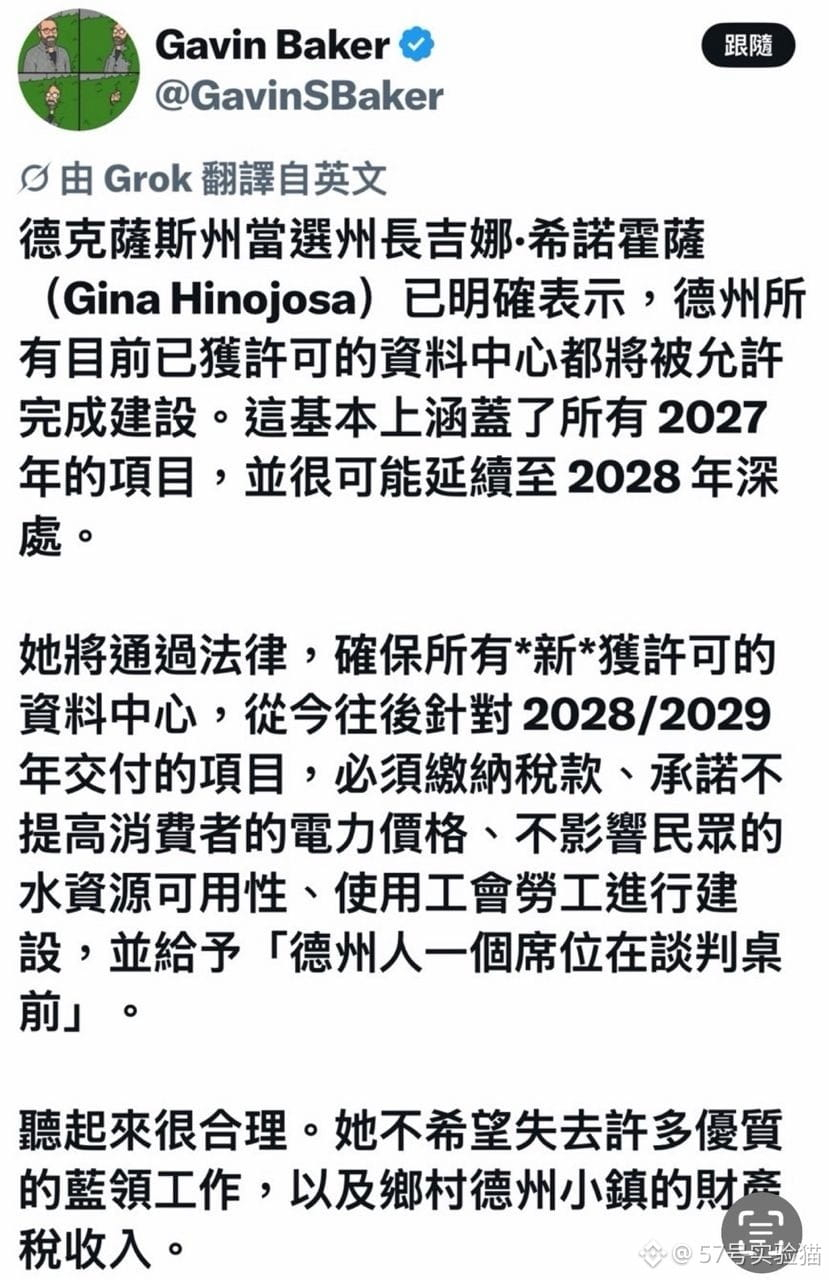
#美股遭遇2020年以来最严重抛售 Texas Governor-elect Gina Hinojosa has made it clear that all data centers currently permitted in Texas will be allowed to complete construction. This basically covers all projects in 2027, and will likely extend through the end of 2028.
She will pass a law ensuring that all newly permitted data centers, from now on, for projects slated for delivery in 2028/2029, must pay taxes, commit not to raise electricity prices for consumers, not affect the public’s access to water, use union labor for construction, and give “Texans a seat at the negotiating table.”
Sounds reasonable. She doesn’t want to lose the many good blue-collar jobs or the property tax revenue for small-town rural Texas. The U.S. market-wide sell-off marked its worst day since April 2025.
Conclusion: AI data centers are still going to get built!!! The governor knows how to draw candlestick charts too!!$SNDK $KORU $SOXL
{future}(KORUUSDT)
{future}(SNDKUSDT)
#美股遭遇2020年以来最严重抛售 Texas Governor-elect Gina Hinojosa has made it clear that all data centers currently permitted in Texas will be allowed to complete construction. This basically covers all projects in 2027, and will likely extend through the end of 2028.
She will pass a law ensuring that all newly permitted data centers, from now on, for projects slated for delivery in 2028/2029, must pay taxes, commit not to raise electricity prices for consumers, not affect the public’s access to water, use union labor for construction, and give “Texans a seat at the negotiating table.”
Sounds reasonable. She doesn’t want to lose the many good blue-collar jobs or the property tax revenue for small-town rural Texas. The U.S. market-wide sell-off marked its worst day since April 2025.
Conclusion: AI data centers are still going to get built!!! The governor knows how to draw candlestick charts too!!$SNDK $KORU $SOXL

4
1
2.6k
·
--
#币安10·30安全事件调查报告 This premeditated, despicable invasion by North Korean hackers has not only disrupted the order of the industry, but also wantonly plundered the assets of users across the entire network.
In the face of an attack involving massive funds, Binance demonstrated an unparalleled sense of responsibility and sheer strength. It did not shirk responsibility or delay payouts. Instead, it paid out in full, immediately, using enormous amounts of its own funds and SAFU reserves, and withstood an extreme test of liquidity.
A true industry leader is not one that never makes mistakes, but one with the ability and commitment to protect all users in times of disaster. Binance has proven, through its rock-solid payout efficiency, who is the most trustworthy cornerstone of the crypto world. Choose to stand with those who take responsibility, and Binance will surely rise from the ashes.
$HOT $AGT $CLANKER
{future}(CLANKERUSDT)
{future}(AGTUSDT)
{future}(HOTUSDT)
#币安10·30安全事件调查报告 This premeditated, despicable invasion by North Korean hackers has not only disrupted the order of the industry, but also wantonly plundered the assets of users across the entire network.
In the face of an attack involving massive funds, Binance demonstrated an unparalleled sense of responsibility and sheer strength. It did not shirk responsibility or delay payouts. Instead, it paid out in full, immediately, using enormous amounts of its own funds and SAFU reserves, and withstood an extreme test of liquidity.
A true industry leader is not one that never makes mistakes, but one with the ability and commitment to protect all users in times of disaster. Binance has proven, through its rock-solid payout efficiency, who is the most trustworthy cornerstone of the crypto world. Choose to stand with those who take responsibility, and Binance will surely rise from the ashes.
$HOT $AGT $CLANKER

2
2
414
·
--
Verified
#美国10月非农出炉:降息还有戏吗? 11We won't know until November 6. But last week, the Fed just held steady, keeping interest rates at 3.75% to 4.00%. We even saw the first instance in 34 years of regional Fed presidents and governors joining forces to dissent and call for a rate hike.
The core logic is clear:
A rate cut is off the table: If October payroll growth is strong, combined with PCE inflation at 3.1%, the Fed will stop cutting rates altogether in December. High interest rates will continue to weigh on tech stock valuations, while a resilient economy supports consumer and industrial stocks.
A rate cut is possible: Only if payroll growth falls well short of expectations and unemployment surges will preventing a recession take priority over fighting inflation for the Fed. At that point, Treasury yields will turn lower, and money will flow back into growth stocks.
Don't guess at the macro picture—understand the cost of capital. If interest rates don't fall, the stock market will see only sector rotation. Watch the labor force participation rate and wage growth figures released on November 6; those are the real tipping points that will determine how the valuations of the stocks you hold are reshaped.
$ARIA $LYN $EVAA
{future}(EVAAUSDT)
{future}(LYNUSDT)
{future}(ARIAUSDT)
#美国10月非农出炉:降息还有戏吗? 11We won't know until November 6. But last week, the Fed just held steady, keeping interest rates at 3.75% to 4.00%. We even saw the first instance in 34 years of regional Fed presidents and governors joining forces to dissent and call for a rate hike.
The core logic is clear:
A rate cut is off the table: If October payroll growth is strong, combined with PCE inflation at 3.1%, the Fed will stop cutting rates altogether in December. High interest rates will continue to weigh on tech stock valuations, while a resilient economy supports consumer and industrial stocks.
A rate cut is possible: Only if payroll growth falls well short of expectations and unemployment surges will preventing a recession take priority over fighting inflation for the Fed. At that point, Treasury yields will turn lower, and money will flow back into growth stocks.
Don't guess at the macro picture—understand the cost of capital. If interest rates don't fall, the stock market will see only sector rotation. Watch the labor force participation rate and wage growth figures released on November 6; those are the real tipping points that will determine how the valuations of the stocks you hold are reshaped.
$ARIA $LYN $EVAA

3
1
774
·
--
Verified
#币安已处理46.5亿美元提款 Binance had just resumed withdrawals yesterday, and processed $4.65 billion in withdrawals in just 9.5 hours, with net outflows of around $3.64 billion. Many people panicked at first, but look at the facts in the ledger: these outflows accounted for only about 2.2% of Binance’s $171 billion in assets under management. There was no bank run, and things remained stable overall.
The FBI has linked this hacking attack to a North Korean group, which made off with nearly $630 million. Binance is currently using its own funds to aggressively replenish its reserves in the spot and OTC markets, and its asset backing ratio has already climbed to 95%. Tokens are being withdrawn from exchanges in bulk to personal on-chain wallets, which has actually eased short-term selling pressure. No spin, no hype—the money can be withdrawn and received at any time, and all the data can be verified on-chain.
$ESPORTS $IDOL $LYN
{future}(LYNUSDT)
{future}(IDOLUSDT)
{future}(ESPORTSUSDT)
#币安已处理46.5亿美元提款 Binance had just resumed withdrawals yesterday, and processed $4.65 billion in withdrawals in just 9.5 hours, with net outflows of around $3.64 billion. Many people panicked at first, but look at the facts in the ledger: these outflows accounted for only about 2.2% of Binance’s $171 billion in assets under management. There was no bank run, and things remained stable overall.
The FBI has linked this hacking attack to a North Korean group, which made off with nearly $630 million. Binance is currently using its own funds to aggressively replenish its reserves in the spot and OTC markets, and its asset backing ratio has already climbed to 95%. Tokens are being withdrawn from exchanges in bulk to personal on-chain wallets, which has actually eased short-term selling pressure. No spin, no hype—the money can be withdrawn and received at any time, and all the data can be verified on-chain.
$ESPORTS $IDOL $LYN

2
1
458
·
--
#KOSPI下跌3.53%重回6000点下方
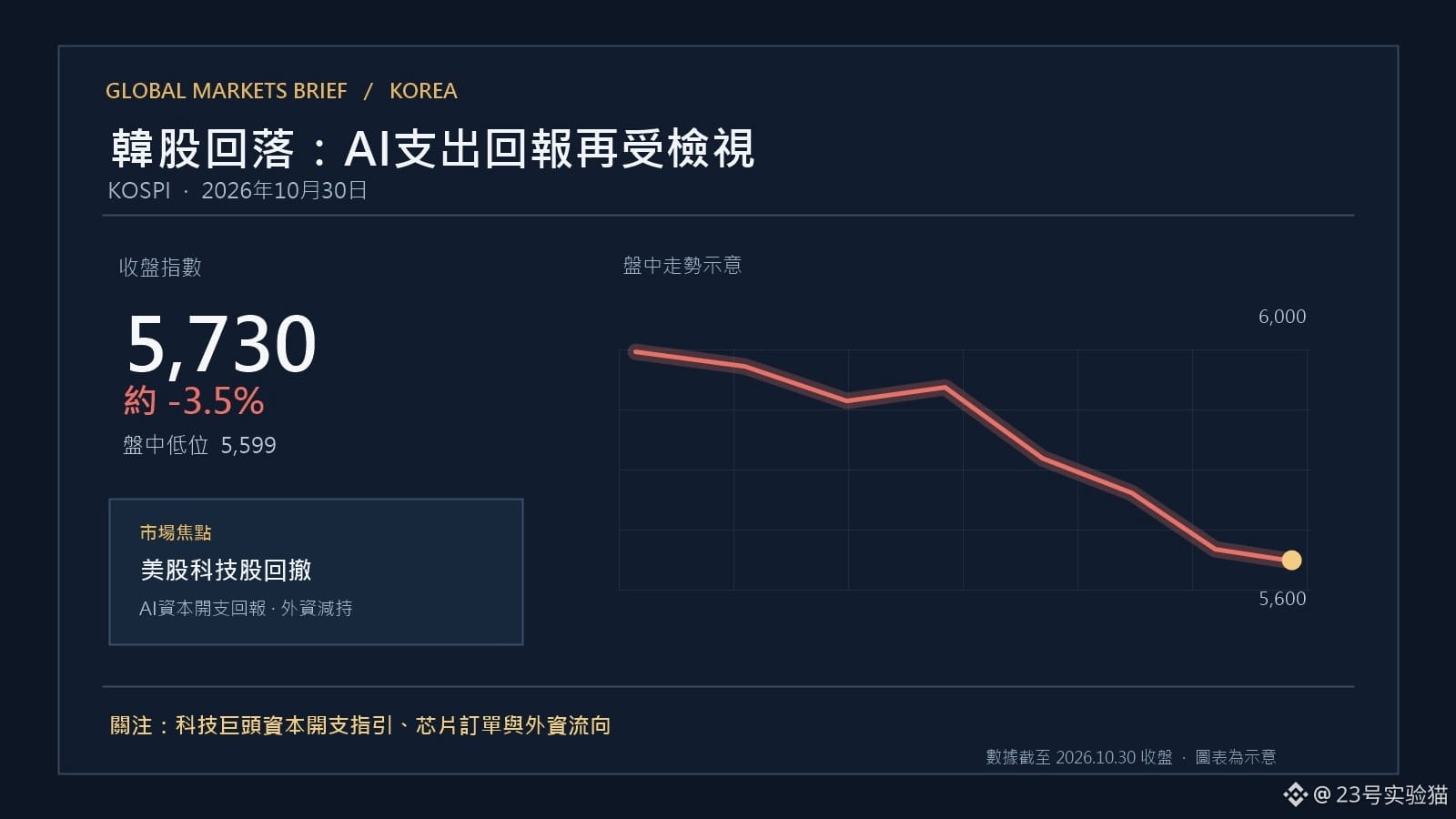
On October 30, the KOSPI closed down about 3.5% at 5,730 points, after briefly falling below 5,600 points intraday and triggering a sell-sidecar. Samsung Electronics fell 3.02%, SK hynix dropped 7.08%, and foreign investors recorded net sales of about 1.62 trillion won. On the surface, this was a pullback in chip stocks; underneath, following U.S. tech earnings, investors are once again asking when massive AI investments will translate into cash flow.
Semiconductor stocks carry significant weight in the Korean market, so when enthusiasm for AI cools, declines in leading stocks amplify pressure on the index. My view is that this looks more like a stress test of valuations and positioning, and cannot yet be equated directly with a reversal in AI demand. Going forward, watch the capital expenditure guidance of U.S. tech giants, chip orders, and foreign capital flows. If return expectations are revised down further, both Korean tech stocks and risk appetite in crypto markets could come under pressure, but the two will not necessarily move in lockstep.
$BIRB $IDOL $BEAMX
{future}(BEAMXUSDT)
#KOSPI下跌3.53%重回6000点下方
On October 30, the KOSPI closed down about 3.5% at 5,730 points, after briefly falling below 5,600 points intraday and triggering a sell-sidecar. Samsung Electronics fell 3.02%, SK hynix dropped 7.08%, and foreign investors recorded net sales of about 1.62 trillion won. On the surface, this was a pullback in chip stocks; underneath, following U.S. tech earnings, investors are once again asking when massive AI investments will translate into cash flow.
Semiconductor stocks carry significant weight in the Korean market, so when enthusiasm for AI cools, declines in leading stocks amplify pressure on the index. My view is that this looks more like a stress test of valuations and positioning, and cannot yet be equated directly with a reversal in AI demand. Going forward, watch the capital expenditure guidance of U.S. tech giants, chip orders, and foreign capital flows. If return expectations are revised down further, both Korean tech stocks and risk appetite in crypto markets could come under pressure, but the two will not necessarily move in lockstep.
$BIRB $IDOL $BEAMX
1
1.3k
·
--
Verified
#港元稳定币HKDAP将上线Solana
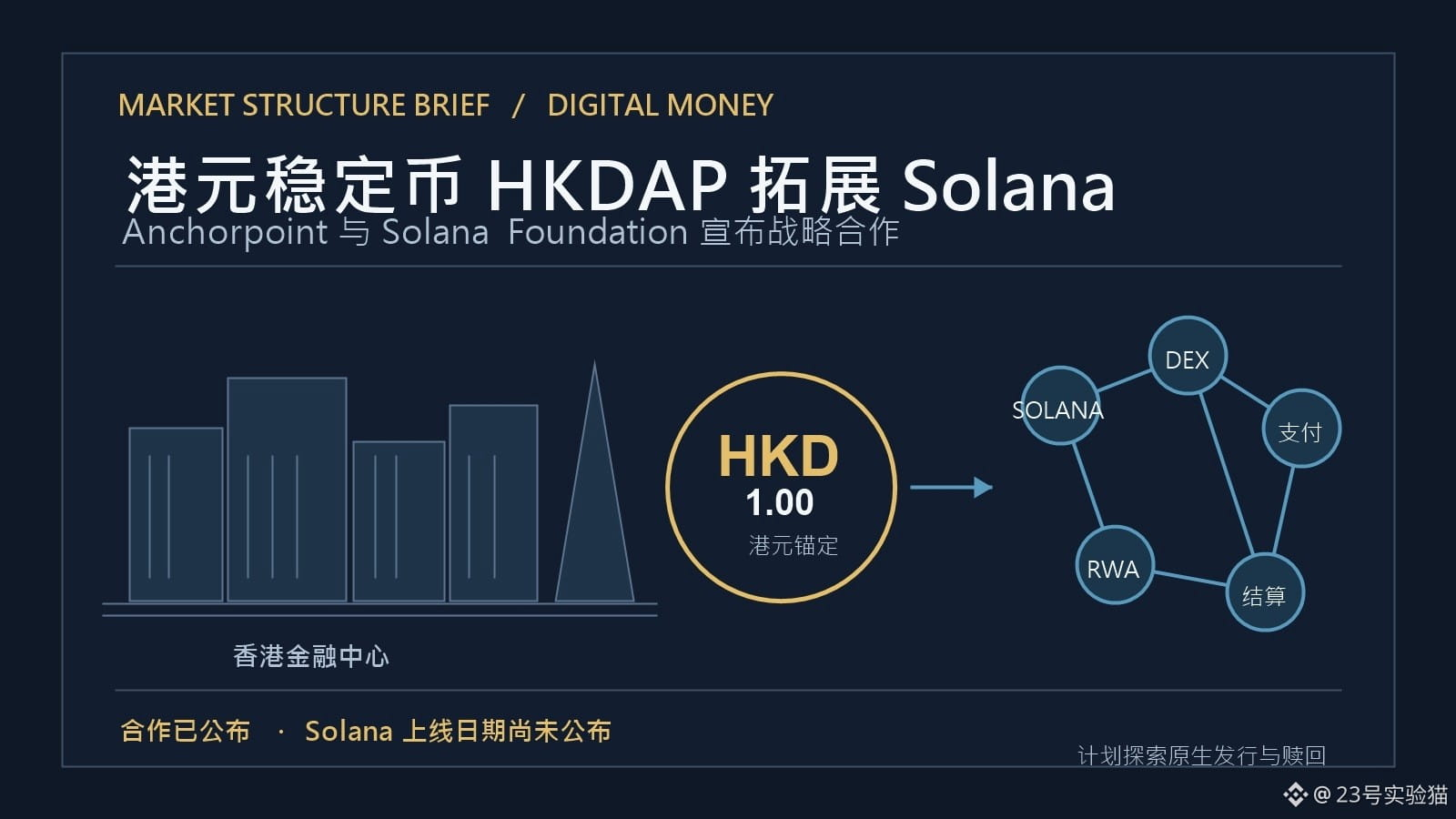
HKDAP, a Hong Kong dollar stablecoin, is being issued by Anchorpoint, a joint venture established by Standard Chartered, HKT, and Animoca Brands. On October 30, Anchorpoint and the Solana Foundation announced a partnership to explore native issuance and redemption on Solana; no launch date has been announced yet.
For Solana, if the plan is implemented, HKDAP could add a compliant Hong Kong dollar settlement option, giving cross-border payments, RWA tokenization, and on-chain gaming another way to settle in local currency. Whether a Hong Kong dollar stablecoin can unlock the ecosystem will depend on wallet integration, circulation, and real transactions—not the announcement itself.
My view is that this is more like a step toward extending compliant settlement onto a public blockchain by traditional financial institutions. The direction is significant, but a clear migration of funds is still some way off. In the short term, SOL will remain driven by the broader market and on-chain activity; going forward, watch the issuance timeline, redemption mechanism, and actual usage.
$PARTI $BEAMX $BIRB
{future}(BIRBUSDT)
#港元稳定币HKDAP将上线Solana
HKDAP, a Hong Kong dollar stablecoin, is being issued by Anchorpoint, a joint venture established by Standard Chartered, HKT, and Animoca Brands. On October 30, Anchorpoint and the Solana Foundation announced a partnership to explore native issuance and redemption on Solana; no launch date has been announced yet.
For Solana, if the plan is implemented, HKDAP could add a compliant Hong Kong dollar settlement option, giving cross-border payments, RWA tokenization, and on-chain gaming another way to settle in local currency. Whether a Hong Kong dollar stablecoin can unlock the ecosystem will depend on wallet integration, circulation, and real transactions—not the announcement itself.
My view is that this is more like a step toward extending compliant settlement onto a public blockchain by traditional financial institutions. The direction is significant, but a clear migration of funds is still some way off. In the short term, SOL will remain driven by the broader market and on-chain activity; going forward, watch the issuance timeline, redemption mechanism, and actual usage.
$PARTI $BEAMX $BIRB
1
2.5k
·
--
#Uniswap与a16z寻求伊利诺伊州DeFi税收豁免
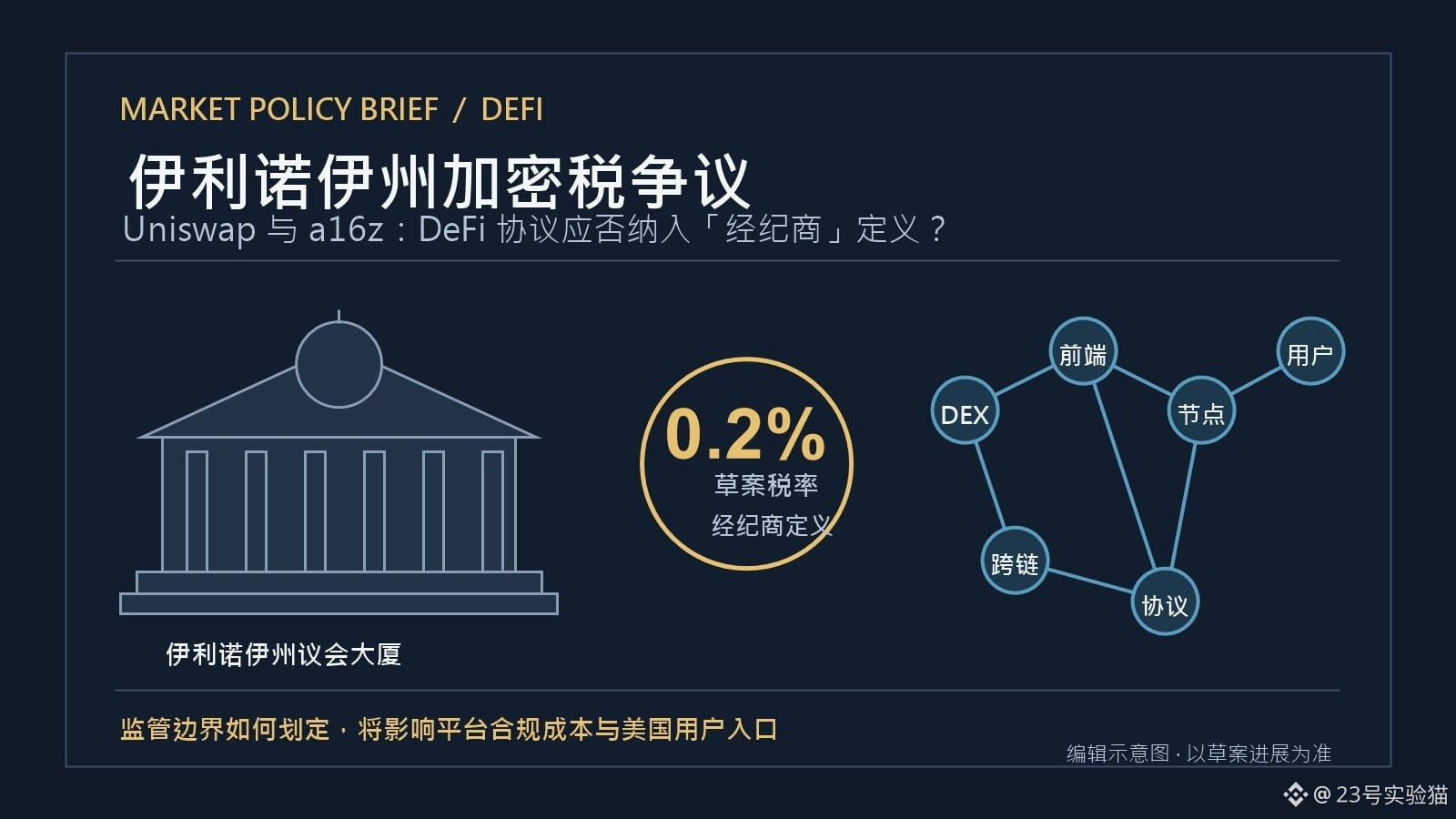
Illinois had originally planned to impose a 0.2% tax on certain digital asset brokerage activities, based on the value of the assets involved in each transaction. Groups including Uniswap and a16z are calling for clarification on how self-custody transfers, cross-chain bridges, and private-key records would be treated. Enforcement of the tax law has been postponed until July 2027, and the scope of the rules remains at the heart of the dispute.
What concerns me more than the tax rate is who will be classified as a “broker.” If frontend service providers are included, compliance pressures could first drive up operating costs, and some platforms might also restrict access from certain regions. My view is that in the short term, this will first affect access for U.S. users and project expectations; only in the long term might it change how DeFi is deployed.
$PARTI $BEAMX $BIRB
{future}(BIRBUSDT)
#Uniswap与a16z寻求伊利诺伊州DeFi税收豁免
Illinois had originally planned to impose a 0.2% tax on certain digital asset brokerage activities, based on the value of the assets involved in each transaction. Groups including Uniswap and a16z are calling for clarification on how self-custody transfers, cross-chain bridges, and private-key records would be treated. Enforcement of the tax law has been postponed until July 2027, and the scope of the rules remains at the heart of the dispute.
What concerns me more than the tax rate is who will be classified as a “broker.” If frontend service providers are included, compliance pressures could first drive up operating costs, and some platforms might also restrict access from certain regions. My view is that in the short term, this will first affect access for U.S. users and project expectations; only in the long term might it change how DeFi is deployed.
$PARTI $BEAMX $BIRB
1
1.5k
·
--
#谷歌财报能否守住基本盘 Q3 revenue was $127.5 billion, up 25% year over year. The core Search business contributed $63.4 billion, still up 12% year over year, though growth was indeed slower than in the previous few quarters.
The biggest changes this time were on both ends. One was cloud computing: revenue surged to $30.7 billion, doubling, while operating profit reached $11.1 billion. All the demand from businesses buying AI compute landed here.
The other was capital expenditure: $51.3 billion was poured into infrastructure in a single quarter, pushing free cash flow down to -$9 billion. Combined with mark-to-market losses on its investment in Anthropic, net income fell 25% for the quarter, and the stock dropped 10% after hours.
The core business is still bringing in cash, and cloud is surging—but the cost of investing in computing capacity has already arrived.
$IDOL $EVAA $INIT
{future}(INITUSDT)
{future}(EVAAUSDT)
{future}(IDOLUSDT)
#谷歌财报能否守住基本盘 Q3 revenue was $127.5 billion, up 25% year over year. The core Search business contributed $63.4 billion, still up 12% year over year, though growth was indeed slower than in the previous few quarters.
The biggest changes this time were on both ends. One was cloud computing: revenue surged to $30.7 billion, doubling, while operating profit reached $11.1 billion. All the demand from businesses buying AI compute landed here.
The other was capital expenditure: $51.3 billion was poured into infrastructure in a single quarter, pushing free cash flow down to -$9 billion. Combined with mark-to-market losses on its investment in Anthropic, net income fell 25% for the quarter, and the stock dropped 10% after hours.
The core business is still bringing in cash, and cloud is surging—but the cost of investing in computing capacity has already arrived.
$IDOL $EVAA $INIT

1
1
330
·
--
#泰国最高法院裁定比特币属财产 Someone on Koh Samui stole 2.48 BTC. The defendant stubbornly argued that cryptocurrency is virtual data, not property, in an attempt to avoid a robbery conviction. The court rejected the argument outright, sentenced him to 10 years in prison, and ordered him to return the original amount or pay its equivalent in cash.
This ruling establishes two crucial facts: First, stealing BTC is subject to the same criminal laws in Thailand as stealing gold, making the path to judicial recovery fully clear. Second, the central bank and the courts have drawn a clear distinction: cryptocurrency is not legal tender, but it is legitimate property because it has market value and can be controlled.
For on-chain asset compliance in Southeast Asia, this is one of the most practical judicial precedents.
$EVAA $BLESS $XPIN
{future}(XPINUSDT)
{future}(BLESSUSDT)
{future}(EVAAUSDT)
#泰国最高法院裁定比特币属财产 Someone on Koh Samui stole 2.48 BTC. The defendant stubbornly argued that cryptocurrency is virtual data, not property, in an attempt to avoid a robbery conviction. The court rejected the argument outright, sentenced him to 10 years in prison, and ordered him to return the original amount or pay its equivalent in cash.
This ruling establishes two crucial facts: First, stealing BTC is subject to the same criminal laws in Thailand as stealing gold, making the path to judicial recovery fully clear. Second, the central bank and the courts have drawn a clear distinction: cryptocurrency is not legal tender, but it is legitimate property because it has market value and can be controlled.
For on-chain asset compliance in Southeast Asia, this is one of the most practical judicial precedents.
$EVAA $BLESS $XPIN

3
1
566
·
--
Verified
#fomc会议 There was no update to the dot plot this time, so market attention was focused entirely on the policy statement and remarks at the press conference. Objectively, slowing core CPI and a cooling labor market provided grounds for pausing rate hikes, but energy prices kept headline inflation sticky.
The impact on stocks depends directly on Treasury yields. If interest rates stay higher for longer, high-valuation tech stocks will remain under pressure from discount rates, and capital will favor defensive sectors with strong cash flows. If later signals indicate that tightening is ending, long-term yields will fall and liquidity will flow back into growth stocks. The key will be upcoming PCE and GDP data; fundamentals will determine where capital ultimately goes.
$Q $AIN $BULLA
{future}(BULLAUSDT)
{future}(AINUSDT)
{future}(QUSDT)
#fomc会议 There was no update to the dot plot this time, so market attention was focused entirely on the policy statement and remarks at the press conference. Objectively, slowing core CPI and a cooling labor market provided grounds for pausing rate hikes, but energy prices kept headline inflation sticky.
The impact on stocks depends directly on Treasury yields. If interest rates stay higher for longer, high-valuation tech stocks will remain under pressure from discount rates, and capital will favor defensive sectors with strong cash flows. If later signals indicate that tightening is ending, long-term yields will fall and liquidity will flow back into growth stocks. The key will be upcoming PCE and GDP data; fundamentals will determine where capital ultimately goes.
$Q $AIN $BULLA

2
603
·
--
#anthropic预计今日公布s1招股书 If Anthropic goes public, will funds in AI-themed coins flow back into U.S. stocks?
Anthropic is expected to release its IPO filing, and the market’s focus is not just that “an AI giant is going public,” but also that the company has already demonstrated strong commercialization capabilities.
In the first half of this year, Anthropic generated approximately $16.28 billion in revenue, up about 1,300% year over year. Second-quarter revenue was approximately $11.56 billion, and operating profit turned positive at around $970 million. The large net loss on its books was mainly related to the fair-value remeasurement of convertible notes following an increase in the company’s valuation. This is a non-cash accounting change and does not fully reflect the operating cash flow of its core business.
If the IPO proceeds, it could affect the U.S. AI industry in two ways:
Long-term orders and expectations for AI demand at cloud and computing companies such as AWS, Google, and Nvidia may continue to attract attention.
However, a major AI IPO could also absorb some liquidity from the tech sector, potentially leading to a divergence in short-term fund flows.
For crypto markets, some funds have chased AI-themed coins in the past, partly because there were “no top-tier AI companies available for direct investment.” If Anthropic becomes a publicly traded company, some funds may flow back into U.S.-listed AI assets.
This would also invite more direct comparisons with on-chain AI projects: Projects with real products, users, revenue, and computing demand may have a stronger narrative foundation; projects that rely mainly on white papers and market hype, without real business data, may face greater valuation scrutiny.
Do you think Anthropic’s IPO will divert funds from AI tokens, or boost enthusiasm for the entire AI sector?
#Anthropic滚动12个月营收增长约1200%
$Q $BULLA $DOOD
{future}(DOODUSDT)
{future}(BULLAUSDT)
{future}(QUSDT)
#anthropic预计今日公布s1招股书 If Anthropic goes public, will funds in AI-themed coins flow back into U.S. stocks?
Anthropic is expected to release its IPO filing, and the market’s focus is not just that “an AI giant is going public,” but also that the company has already demonstrated strong commercialization capabilities.
In the first half of this year, Anthropic generated approximately $16.28 billion in revenue, up about 1,300% year over year. Second-quarter revenue was approximately $11.56 billion, and operating profit turned positive at around $970 million. The large net loss on its books was mainly related to the fair-value remeasurement of convertible notes following an increase in the company’s valuation. This is a non-cash accounting change and does not fully reflect the operating cash flow of its core business.
If the IPO proceeds, it could affect the U.S. AI industry in two ways:
Long-term orders and expectations for AI demand at cloud and computing companies such as AWS, Google, and Nvidia may continue to attract attention.
However, a major AI IPO could also absorb some liquidity from the tech sector, potentially leading to a divergence in short-term fund flows.
For crypto markets, some funds have chased AI-themed coins in the past, partly because there were “no top-tier AI companies available for direct investment.” If Anthropic becomes a publicly traded company, some funds may flow back into U.S.-listed AI assets.
This would also invite more direct comparisons with on-chain AI projects: Projects with real products, users, revenue, and computing demand may have a stronger narrative foundation; projects that rely mainly on white papers and market hype, without real business data, may face greater valuation scrutiny.
Do you think Anthropic’s IPO will divert funds from AI tokens, or boost enthusiasm for the entire AI sector?
#Anthropic滚动12个月营收增长约1200%
$Q $BULLA $DOOD

1
1
46
·
--
Verified
#富兰克林邓普顿申请股息转比特币etf The fund allocates about 95% of its underlying assets to stocks in the S&P 500 or Nasdaq 100, with the remaining 5% invested in Bitcoin. Instead of using cash dividends paid by the companies to buy back shares, it uses them to purchase Bitcoin directly on trading days. The holdings are subject to risk limits: at quarterly rebalancing, if BTC exceeds 5% of the portfolio, it is reduced to 4.5%; in extreme market conditions, if it rises to 20%, it must be forcibly brought back down to 4.5% within two days.
For the crypto sector, dividends paid by U.S.-listed companies have become a source of long-term, passive buying pressure for Bitcoin. Institutions and traditional investors can also gain exposure to crypto assets through U.S. stock market cash flows without changing the core of their asset allocation. For U.S. equities, this model adds a high-potential-yield channel to traditional blue-chip stocks and innovative companies. Traditional asset managers are linking dividends with crypto assets, further narrowing the divide between the two pools of capital.
$DOOD $BULLA $ARIA
{future}(ARIAUSDT)
{future}(BULLAUSDT)
{future}(DOODUSDT)
#富兰克林邓普顿申请股息转比特币etf The fund allocates about 95% of its underlying assets to stocks in the S&P 500 or Nasdaq 100, with the remaining 5% invested in Bitcoin. Instead of using cash dividends paid by the companies to buy back shares, it uses them to purchase Bitcoin directly on trading days. The holdings are subject to risk limits: at quarterly rebalancing, if BTC exceeds 5% of the portfolio, it is reduced to 4.5%; in extreme market conditions, if it rises to 20%, it must be forcibly brought back down to 4.5% within two days.
For the crypto sector, dividends paid by U.S.-listed companies have become a source of long-term, passive buying pressure for Bitcoin. Institutions and traditional investors can also gain exposure to crypto assets through U.S. stock market cash flows without changing the core of their asset allocation. For U.S. equities, this model adds a high-potential-yield channel to traditional blue-chip stocks and innovative companies. Traditional asset managers are linking dividends with crypto assets, further narrowing the divide between the two pools of capital.
$DOOD $BULLA $ARIA

2
1
30
·
--
#韩国推迟加密货币所得税 The possibility of another delay has resurfaced, but no formal decision has been made yet. The relevant tax subcommittee of South Korea’s National Assembly is expected to review the government’s tax reform plan on November 2. Reports say the ruling and opposition parties are discussing a further two-year delay due to insufficient tax preparations and the views of young voters. The National Tax Service’s current guidance still states that income tax on crypto assets will take effect on January 1, 2027. Therefore, for now, this should be viewed as a policy discussion, not as an approved delay. Follow-up attention should focus on the National Assembly’s review and government announcements; the actual arrangements will be subject to formal amendments to the law.
$APR $CAP $SKYAI
$APR $CAP $SKYAI

1
88
·
--
Verified
#美国下周将公布q3gdp和9月pce On October 28, the Fed will hold a rate-setting meeting, and on the 29th it will release the advance estimate of third-quarter GDP and September PCE. Markets expect GDP growth may come in below Q2’s 2.2%, while annual headline PCE could rise from 3.4% to 3.7%. Before the figures are released, rising oil prices and the 10-year Treasury yield nearing 5% have already heightened inflation concerns.
When looking at these figures, the key is how growth and prices combine. Stable GDP and cooling core PCE would make it easier for markets to accept that the economy remains resilient; if PCE runs hot, interest rates may stay higher for longer, putting pressure on valuation-sensitive U.S. stocks and crypto markets. Bitcoin’s near-term moves will also depend on the dollar, yields, and risk appetite. The data itself is just a moment; what the market is really trading is whether it will change the Fed’s next move.
$APR $CAP $SKYAI
{future}(SKYAIUSDT)
{future}(CAPUSDT)
{future}(APRUSDT)
#美国下周将公布q3gdp和9月pce On October 28, the Fed will hold a rate-setting meeting, and on the 29th it will release the advance estimate of third-quarter GDP and September PCE. Markets expect GDP growth may come in below Q2’s 2.2%, while annual headline PCE could rise from 3.4% to 3.7%. Before the figures are released, rising oil prices and the 10-year Treasury yield nearing 5% have already heightened inflation concerns.
When looking at these figures, the key is how growth and prices combine. Stable GDP and cooling core PCE would make it easier for markets to accept that the economy remains resilient; if PCE runs hot, interest rates may stay higher for longer, putting pressure on valuation-sensitive U.S. stocks and crypto markets. Bitcoin’s near-term moves will also depend on the dollar, yields, and risk appetite. The data itself is just a moment; what the market is really trading is whether it will change the Fed’s next move.
$APR $CAP $SKYAI

1
36
·
--
C I'm afraid of getting scammed, so I don't believe anything.
C I'm afraid of getting scammed, so I don't believe anything.


币安Binance华语
·
--
😈 “Once the market cap hits $1 million, guaranteed profits, bro!”
What would you do? ❓
A. Everyone in the group says so—there must be something to it 🚀
B. Take a chance! Maybe I’ll turn my bicycle into a motorcycle and wait for takeoff 😎
C. Hold on! Check the on-chain data first—don’t mistake empty promises for tokens locked up 🔍
⬇️ Follow, repost, and comment with your choice and why. 3 people will be randomly selected to receive 20U each. #币安安全星期四

1
41
Log in to explore more content
Join global crypto users on Binance Square
⚡️ Get latest and useful information about crypto.
💬 Trusted by the world’s largest crypto exchange.
👍 Discover real insights from verified creators.
Email / Phone number
Trending Topics
HKSFCToExpandRestrictedTitlesList
790 views
68 Discussing
#hksfctoexpandrestrictedtitleslist Hong Kong tightens oversight of financial and crypto namesThe Hong Kong Securities and Futures Commission (SFC) announced on November 6, 2026, the conclusion of its consultation on expanding the list of restricted financial names, with the aim of strengthening investor protection against unregulated entities using names that could create a false impression of institutional authorization. The initiative involves amending the Securities and Futures Ordinance (SFO) and incorporating equivalent provisions into the Anti-Money Laundering and Counter-Terrorist Financing Ordinance (AMLO). Terms that could be subject to restrictions include “crypto exchange,” “digital asset market,” “digital currency trading platform,” and “tokenised securities trading centre,” especially when their names suggest a nonexistent relationship with recognized trading platforms, clearing houses, or financial institutions. From a market microstructure and regulatory compliance perspective, the reform aims to reduce information asymmetry between financial operators and retail participants by limiting the risk that a business name could be interpreted as evidence of official oversight. The SFC will also introduce a mechanism to update the list of restricted terms more efficiently in response to the evolution of digital financial services and business models associated with virtual assets. However, the amendments will still need to be finalized and submitted for approval by Hong Kong’s Legislative Council, and are proposed to take effect six months after their enactment. The potential impact will focus on branding strategies, compliance costs, and the operating structures of financial entities and crypto platforms, fostering a transparent and orderly environment
Tim Berners-Lee WorldWideWeb The World Archie EFF ARPANET
·0 Likes
·24 views
JobsReportRaisesHikeOdds
591,029 views
3,706 Discussing
CPITestsDecemberRateOutlook
191,431 views
1,370 Discussing