
SollyCrypto Onchain
466 Posts
SollyCrypto Onchain
Report
Block User
I track crypto in real time, technicals, onchain data, fundamentals, all in one place. Actionable setups, not just opinions. Follow, read, decide, trade.
Frequent Trader
2.7 Years
24 Following
181 Followers
152 Liked
Posts
All
Videos
·
--
Bullish
NEAR Protocol has enabled private perps by default, hiding position ownership, powered by Hyperliquid.
Why this happened
Most onchain perps are transparent. Traders can see wallet exposure, sizing, and sometimes when a big account is in trouble. NEAR is pushing confidential-by-default positions so users can open perps from the account they already use without broadcasting ownership as clearly. Hyperliquid is powering the trading layer behind that product surface.
Why it matters
Privacy is a real trading feature, not only a philosophy. If leveraged traders can reduce the chance of getting hunted or copied, more serious size may be willing to use the venue. For $NEAR, this supports the private execution and intents narrative. For Hyperliquid, it is another distribution surface for its perps stack.
How it can benefit you
If you hold $NEAR, product upgrades that target active traders can support attention and ecosystem relevance. Privacy-by-default perps is a cleaner pitch than generic “DeFi is coming” marketing. $HYPE also gets a secondary lift as the powered-by venue.
How it can harm you
A feature launch is not guaranteed sticky volume. If traders test it and leave, the headline fades. People who buy only on “private perps” can get trapped after the first impulse move. Privacy tooling also has to stay reliable under stress, or trust drops fast.
SollyCrypto opinion
This should lean as a pump for $NEAR, with a smaller secondary lift for $HYPE. Private-by-default perps is a meaningful product differentiator if usage follows.
You treating private perps as real fuel for $NEAR, or waiting for volume to prove it?
Follow me, or you may not see the next one.
NEAR Protocol has enabled private perps by default, hiding position ownership, powered by Hyperliquid.
Why this happened
Most onchain perps are transparent. Traders can see wallet exposure, sizing, and sometimes when a big account is in trouble. NEAR is pushing confidential-by-default positions so users can open perps from the account they already use without broadcasting ownership as clearly. Hyperliquid is powering the trading layer behind that product surface.
Why it matters
Privacy is a real trading feature, not only a philosophy. If leveraged traders can reduce the chance of getting hunted or copied, more serious size may be willing to use the venue. For $NEAR, this supports the private execution and intents narrative. For Hyperliquid, it is another distribution surface for its perps stack.
How it can benefit you
If you hold $NEAR, product upgrades that target active traders can support attention and ecosystem relevance. Privacy-by-default perps is a cleaner pitch than generic “DeFi is coming” marketing. $HYPE also gets a secondary lift as the powered-by venue.
How it can harm you
A feature launch is not guaranteed sticky volume. If traders test it and leave, the headline fades. People who buy only on “private perps” can get trapped after the first impulse move. Privacy tooling also has to stay reliable under stress, or trust drops fast.
SollyCrypto opinion
This should lean as a pump for $NEAR, with a smaller secondary lift for $HYPE. Private-by-default perps is a meaningful product differentiator if usage follows.
You treating private perps as real fuel for $NEAR, or waiting for volume to prove it?
Follow me, or you may not see the next one.
Why this happened
Most onchain perps are transparent. Traders can see wallet exposure, sizing, and sometimes when a big account is in trouble. NEAR is pushing confidential-by-default positions so users can open perps from the account they already use without broadcasting ownership as clearly. Hyperliquid is powering the trading layer behind that product surface.
Why it matters
Privacy is a real trading feature, not only a philosophy. If leveraged traders can reduce the chance of getting hunted or copied, more serious size may be willing to use the venue. For $NEAR, this supports the private execution and intents narrative. For Hyperliquid, it is another distribution surface for its perps stack.
How it can benefit you
If you hold $NEAR, product upgrades that target active traders can support attention and ecosystem relevance. Privacy-by-default perps is a cleaner pitch than generic “DeFi is coming” marketing. $HYPE also gets a secondary lift as the powered-by venue.
How it can harm you
A feature launch is not guaranteed sticky volume. If traders test it and leave, the headline fades. People who buy only on “private perps” can get trapped after the first impulse move. Privacy tooling also has to stay reliable under stress, or trust drops fast.
SollyCrypto opinion
This should lean as a pump for $NEAR, with a smaller secondary lift for $HYPE. Private-by-default perps is a meaningful product differentiator if usage follows.
You treating private perps as real fuel for $NEAR, or waiting for volume to prove it?
Follow me, or you may not see the next one.


1
128
·
--
Bullish
XRP treasury company Evernorth raised $30M via convertible notes from South Korean institutional investor NH Investment & Securities. The deal is contingent on its SPAC merger closing, with proceeds earmarked for $XRP acquisition ahead of a Nasdaq listing under $XRPN.
Why this happened
Treasury-style companies raise capital to buy and hold a target asset, then list that strategy in public markets. Evernorth is doing that with $XRP. The Korean institutional note gives it dry powder for more $XRP buys if the SPAC merger closes. That is why the market reads this as potential future spot demand, not just a random financing headline.
Why it matters
$30M is not enough to reprice $XRP alone, but the structure matters. It is institutional capital aimed at direct $XRP acquisition, tied to a public-market vehicle. That supports the “XRP treasury / public wrapper” narrative and keeps institutional sponsorship in the conversation. Contingency is important too: if the merger fails, the notes do not fund the same way.
How it can benefit you
If you hold $XRP, extra dedicated buyers are constructive. Treasury vehicles can become steady demand when they raise and deploy capital. Traders who like institutional headlines may also treat this as mild sentiment support into the listing path.
How it can harm you
This is contingent financing, not guaranteed immediate market bids. People who buy only on “$30M for XRP” can get trapped if the SPAC process delays or the actual buys are slow. $30M is also small relative to total $XRP liquidity, so the direct price impact can be limited.
SollyCrypto opinion
This should lean as a mild pump for $XRP. Dedicated treasury capital for spot acquisition is constructive, but the SPAC contingency keeps it from being a hard catalyst.
You treating Evernorth’s raise as real $XRP demand, or waiting until the merger closes and buys hit?
Follow me, or you may not see the next one.
XRP treasury company Evernorth raised $30M via convertible notes from South Korean institutional investor NH Investment & Securities. The deal is contingent on its SPAC merger closing, with proceeds earmarked for $XRP acquisition ahead of a Nasdaq listing under $XRPN.
Why this happened
Treasury-style companies raise capital to buy and hold a target asset, then list that strategy in public markets. Evernorth is doing that with $XRP. The Korean institutional note gives it dry powder for more $XRP buys if the SPAC merger closes. That is why the market reads this as potential future spot demand, not just a random financing headline.
Why it matters
$30M is not enough to reprice $XRP alone, but the structure matters. It is institutional capital aimed at direct $XRP acquisition, tied to a public-market vehicle. That supports the “XRP treasury / public wrapper” narrative and keeps institutional sponsorship in the conversation. Contingency is important too: if the merger fails, the notes do not fund the same way.
How it can benefit you
If you hold $XRP, extra dedicated buyers are constructive. Treasury vehicles can become steady demand when they raise and deploy capital. Traders who like institutional headlines may also treat this as mild sentiment support into the listing path.
How it can harm you
This is contingent financing, not guaranteed immediate market bids. People who buy only on “$30M for XRP” can get trapped if the SPAC process delays or the actual buys are slow. $30M is also small relative to total $XRP liquidity, so the direct price impact can be limited.
SollyCrypto opinion
This should lean as a mild pump for $XRP. Dedicated treasury capital for spot acquisition is constructive, but the SPAC contingency keeps it from being a hard catalyst.
You treating Evernorth’s raise as real $XRP demand, or waiting until the merger closes and buys hit?
Follow me, or you may not see the next one.
Why this happened
Treasury-style companies raise capital to buy and hold a target asset, then list that strategy in public markets. Evernorth is doing that with $XRP. The Korean institutional note gives it dry powder for more $XRP buys if the SPAC merger closes. That is why the market reads this as potential future spot demand, not just a random financing headline.
Why it matters
$30M is not enough to reprice $XRP alone, but the structure matters. It is institutional capital aimed at direct $XRP acquisition, tied to a public-market vehicle. That supports the “XRP treasury / public wrapper” narrative and keeps institutional sponsorship in the conversation. Contingency is important too: if the merger fails, the notes do not fund the same way.
How it can benefit you
If you hold $XRP, extra dedicated buyers are constructive. Treasury vehicles can become steady demand when they raise and deploy capital. Traders who like institutional headlines may also treat this as mild sentiment support into the listing path.
How it can harm you
This is contingent financing, not guaranteed immediate market bids. People who buy only on “$30M for XRP” can get trapped if the SPAC process delays or the actual buys are slow. $30M is also small relative to total $XRP liquidity, so the direct price impact can be limited.
SollyCrypto opinion
This should lean as a mild pump for $XRP. Dedicated treasury capital for spot acquisition is constructive, but the SPAC contingency keeps it from being a hard catalyst.
You treating Evernorth’s raise as real $XRP demand, or waiting until the merger closes and buys hit?
Follow me, or you may not see the next one.

1
343
·
--
Bullish
New York Life Investment Management, with about $807B under management, is bringing its first tokenized fund to Avalanche through Centrifuge.
Why this happened
Big asset managers are testing real onchain fund distribution, not just research notes. NY Life’s investment arm is putting a tokenized fund on Avalanche via Centrifuge so eligible investors can access an institutional strategy in tokenized form. Avalanche gets the chain deployment. Centrifuge provides the tokenization rails.
Why it matters
This is not a random meme partnership. An $807B manager bringing its first tokenized fund onchain is a serious RWA signal. It supports Avalanche’s push as a home for institutional tokenized products and strengthens the broader “real funds are moving onchain” story. For $AVAX, that kind of name recognition matters. For the RWA sector, it shows traditional managers are still expanding experiments into live products.
How it can benefit you
If you hold $AVAX, institutional fund deployments help the network’s credibility and long-term usage narrative. Traders often bid chains that keep landing regulated or traditional-finance product launches. It also keeps Avalanche in the RWA conversation next to other settlement networks.
How it can harm you
A first tokenized fund is not the same as massive immediate AUM onchain. Access may be limited to eligible investors, and growth can be slow. People who buy only on the $807B headline can get trapped if the market prices the news faster than actual onchain usage appears. One fund launch does not rewire the whole market.
SollyCrypto opinion
This should lean as a pump for $AVAX. An $807B manager’s first tokenized fund landing via Centrifuge is high-quality institutional news. Constructive for the RWA narrative too.
You treating this NY Life deployment as real fuel for $AVAX, or waiting for fund size to show onchain first?
Follow me, or you may not see the next one.
New York Life Investment Management, with about $807B under management, is bringing its first tokenized fund to Avalanche through Centrifuge.
Why this happened
Big asset managers are testing real onchain fund distribution, not just research notes. NY Life’s investment arm is putting a tokenized fund on Avalanche via Centrifuge so eligible investors can access an institutional strategy in tokenized form. Avalanche gets the chain deployment. Centrifuge provides the tokenization rails.
Why it matters
This is not a random meme partnership. An $807B manager bringing its first tokenized fund onchain is a serious RWA signal. It supports Avalanche’s push as a home for institutional tokenized products and strengthens the broader “real funds are moving onchain” story. For $AVAX, that kind of name recognition matters. For the RWA sector, it shows traditional managers are still expanding experiments into live products.
How it can benefit you
If you hold $AVAX, institutional fund deployments help the network’s credibility and long-term usage narrative. Traders often bid chains that keep landing regulated or traditional-finance product launches. It also keeps Avalanche in the RWA conversation next to other settlement networks.
How it can harm you
A first tokenized fund is not the same as massive immediate AUM onchain. Access may be limited to eligible investors, and growth can be slow. People who buy only on the $807B headline can get trapped if the market prices the news faster than actual onchain usage appears. One fund launch does not rewire the whole market.
SollyCrypto opinion
This should lean as a pump for $AVAX. An $807B manager’s first tokenized fund landing via Centrifuge is high-quality institutional news. Constructive for the RWA narrative too.
You treating this NY Life deployment as real fuel for $AVAX, or waiting for fund size to show onchain first?
Follow me, or you may not see the next one.
Why this happened
Big asset managers are testing real onchain fund distribution, not just research notes. NY Life’s investment arm is putting a tokenized fund on Avalanche via Centrifuge so eligible investors can access an institutional strategy in tokenized form. Avalanche gets the chain deployment. Centrifuge provides the tokenization rails.
Why it matters
This is not a random meme partnership. An $807B manager bringing its first tokenized fund onchain is a serious RWA signal. It supports Avalanche’s push as a home for institutional tokenized products and strengthens the broader “real funds are moving onchain” story. For $AVAX, that kind of name recognition matters. For the RWA sector, it shows traditional managers are still expanding experiments into live products.
How it can benefit you
If you hold $AVAX, institutional fund deployments help the network’s credibility and long-term usage narrative. Traders often bid chains that keep landing regulated or traditional-finance product launches. It also keeps Avalanche in the RWA conversation next to other settlement networks.
How it can harm you
A first tokenized fund is not the same as massive immediate AUM onchain. Access may be limited to eligible investors, and growth can be slow. People who buy only on the $807B headline can get trapped if the market prices the news faster than actual onchain usage appears. One fund launch does not rewire the whole market.
SollyCrypto opinion
This should lean as a pump for $AVAX. An $807B manager’s first tokenized fund landing via Centrifuge is high-quality institutional news. Constructive for the RWA narrative too.
You treating this NY Life deployment as real fuel for $AVAX, or waiting for fund size to show onchain first?
Follow me, or you may not see the next one.

5
1.1k
·
--
Bearish
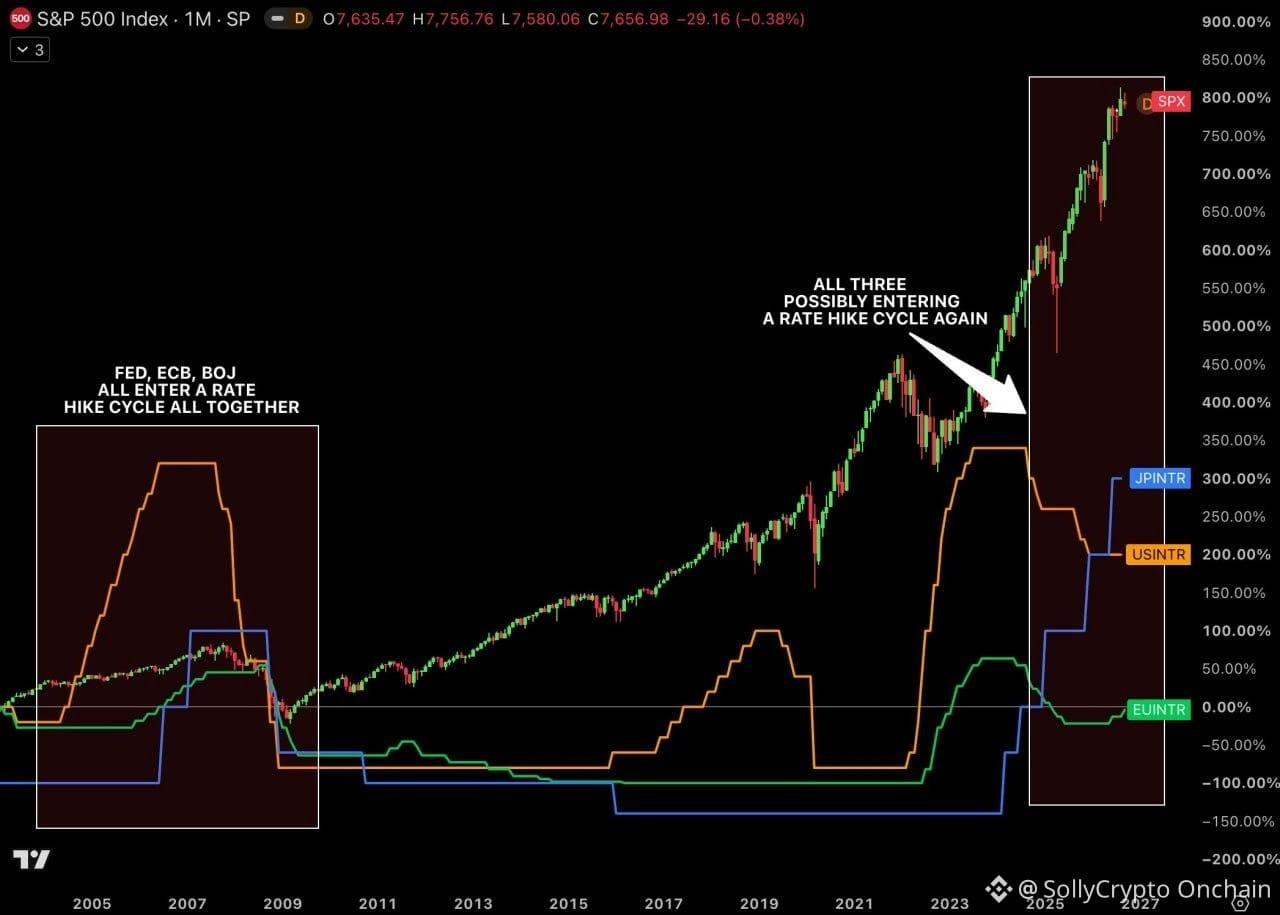
For the first time since 2006, the Fed, the ECB, and the Bank of Japan may raise interest rates simultaneously. The ECB already hiked on September 10, the Fed is 86% likely to follow suit on September 16, and the Bank of Japan is set to do the same on September 18.
⚠️ The driver behind this hawkish monetary policy is accelerating inflation, fueled by oil sitting above $100 and surging demand for AI chips and memory.
Japan is the largest holder of US Treasuries ($1.1T) and a prime provider of global market liquidity thanks to its ultra-low rates. However, Japan's era of negative rates is definitively over; more capital is staying onshore rather than flowing into global markets.
It’s premature to call this a rerun of the 2008 crisis, a true collapse requires a catalyst, and markets today are far better equipped to handle shocks than they were two decades ago.
💬 The primary risk remains protracted global inflation, which could force the Fed, the ECB, and the BoJ to kick off a fresh cycle of coordinated rate hikes. If that happens, the bull market will likely have to be put on hold until at least 2027.#FedSEPProjects2026RateAt4.1%
For the first time since 2006, the Fed, the ECB, and the Bank of Japan may raise interest rates simultaneously. The ECB already hiked on September 10, the Fed is 86% likely to follow suit on September 16, and the Bank of Japan is set to do the same on September 18.
⚠️ The driver behind this hawkish monetary policy is accelerating inflation, fueled by oil sitting above $100 and surging demand for AI chips and memory.
Japan is the largest holder of US Treasuries ($1.1T) and a prime provider of global market liquidity thanks to its ultra-low rates. However, Japan's era of negative rates is definitively over; more capital is staying onshore rather than flowing into global markets.
It’s premature to call this a rerun of the 2008 crisis, a true collapse requires a catalyst, and markets today are far better equipped to handle shocks than they were two decades ago.
💬 The primary risk remains protracted global inflation, which could force the Fed, the ECB, and the BoJ to kick off a fresh cycle of coordinated rate hikes. If that happens, the bull market will likely have to be put on hold until at least 2027.#FedSEPProjects2026RateAt4.1%
⚠️ The driver behind this hawkish monetary policy is accelerating inflation, fueled by oil sitting above $100 and surging demand for AI chips and memory.
Japan is the largest holder of US Treasuries ($1.1T) and a prime provider of global market liquidity thanks to its ultra-low rates. However, Japan's era of negative rates is definitively over; more capital is staying onshore rather than flowing into global markets.
It’s premature to call this a rerun of the 2008 crisis, a true collapse requires a catalyst, and markets today are far better equipped to handle shocks than they were two decades ago.
💬 The primary risk remains protracted global inflation, which could force the Fed, the ECB, and the BoJ to kick off a fresh cycle of coordinated rate hikes. If that happens, the bull market will likely have to be put on hold until at least 2027.#FedSEPProjects2026RateAt4.1%
1
67
·
--
Bullish
Ripple has enabled AI agent payments in $XRP and RLUSD through Stripe and Tempo’s payments protocol.
Why this happened
AI agents need a way to pay for data, compute, APIs, and other digital services without a human approving every step. Ripple is plugging $XRP and RLUSD into that machine-payments stack so developers can make agents transact on XRPL rails. Stripe and Tempo’s protocol gives the standard. Ripple is making sure its assets are inside it.
Why it matters
This is about future payment demand, not only old retail transfers. If AI agents start paying for services automatically, the rails they use can pick up real volume over time. Putting $XRP and RLUSD into that conversation keeps Ripple inside the AI x payments narrative, which is one of the stronger utility stories in the market right now.
How it can benefit you
If you hold $XRP, AI payment support adds another usage path beyond pure speculation. Narrative traders often bid tokens linked to AI and payments crossovers, especially when a major fintech name like Stripe is in the same frame. RLUSD also benefits as a stable option inside the same toolkit.
How it can harm you
Developer support is not the same as massive live agent volume today. People who buy only on “AI payments” headlines can get trapped if usage stays small at first. This is an enabling step. The market may still wait for proof of sustained flow before giving it a full re-rating.
SollyCrypto opinion
This should lean as a mild pump for $XRP. AI agent payments through a serious protocol standard is constructive. Not instant moonshot fuel, but the direction is positive.
You treating AI agent payments as real upside for $XRP, or waiting for actual volume first?
Follow me, or you may not see the next one.
Ripple has enabled AI agent payments in $XRP and RLUSD through Stripe and Tempo’s payments protocol.
Why this happened
AI agents need a way to pay for data, compute, APIs, and other digital services without a human approving every step. Ripple is plugging $XRP and RLUSD into that machine-payments stack so developers can make agents transact on XRPL rails. Stripe and Tempo’s protocol gives the standard. Ripple is making sure its assets are inside it.
Why it matters
This is about future payment demand, not only old retail transfers. If AI agents start paying for services automatically, the rails they use can pick up real volume over time. Putting $XRP and RLUSD into that conversation keeps Ripple inside the AI x payments narrative, which is one of the stronger utility stories in the market right now.
How it can benefit you
If you hold $XRP, AI payment support adds another usage path beyond pure speculation. Narrative traders often bid tokens linked to AI and payments crossovers, especially when a major fintech name like Stripe is in the same frame. RLUSD also benefits as a stable option inside the same toolkit.
How it can harm you
Developer support is not the same as massive live agent volume today. People who buy only on “AI payments” headlines can get trapped if usage stays small at first. This is an enabling step. The market may still wait for proof of sustained flow before giving it a full re-rating.
SollyCrypto opinion
This should lean as a mild pump for $XRP. AI agent payments through a serious protocol standard is constructive. Not instant moonshot fuel, but the direction is positive.
You treating AI agent payments as real upside for $XRP, or waiting for actual volume first?
Follow me, or you may not see the next one.
Why this happened
AI agents need a way to pay for data, compute, APIs, and other digital services without a human approving every step. Ripple is plugging $XRP and RLUSD into that machine-payments stack so developers can make agents transact on XRPL rails. Stripe and Tempo’s protocol gives the standard. Ripple is making sure its assets are inside it.
Why it matters
This is about future payment demand, not only old retail transfers. If AI agents start paying for services automatically, the rails they use can pick up real volume over time. Putting $XRP and RLUSD into that conversation keeps Ripple inside the AI x payments narrative, which is one of the stronger utility stories in the market right now.
How it can benefit you
If you hold $XRP, AI payment support adds another usage path beyond pure speculation. Narrative traders often bid tokens linked to AI and payments crossovers, especially when a major fintech name like Stripe is in the same frame. RLUSD also benefits as a stable option inside the same toolkit.
How it can harm you
Developer support is not the same as massive live agent volume today. People who buy only on “AI payments” headlines can get trapped if usage stays small at first. This is an enabling step. The market may still wait for proof of sustained flow before giving it a full re-rating.
SollyCrypto opinion
This should lean as a mild pump for $XRP. AI agent payments through a serious protocol standard is constructive. Not instant moonshot fuel, but the direction is positive.
You treating AI agent payments as real upside for $XRP, or waiting for actual volume first?
Follow me, or you may not see the next one.

1
115
·
--
Bullish
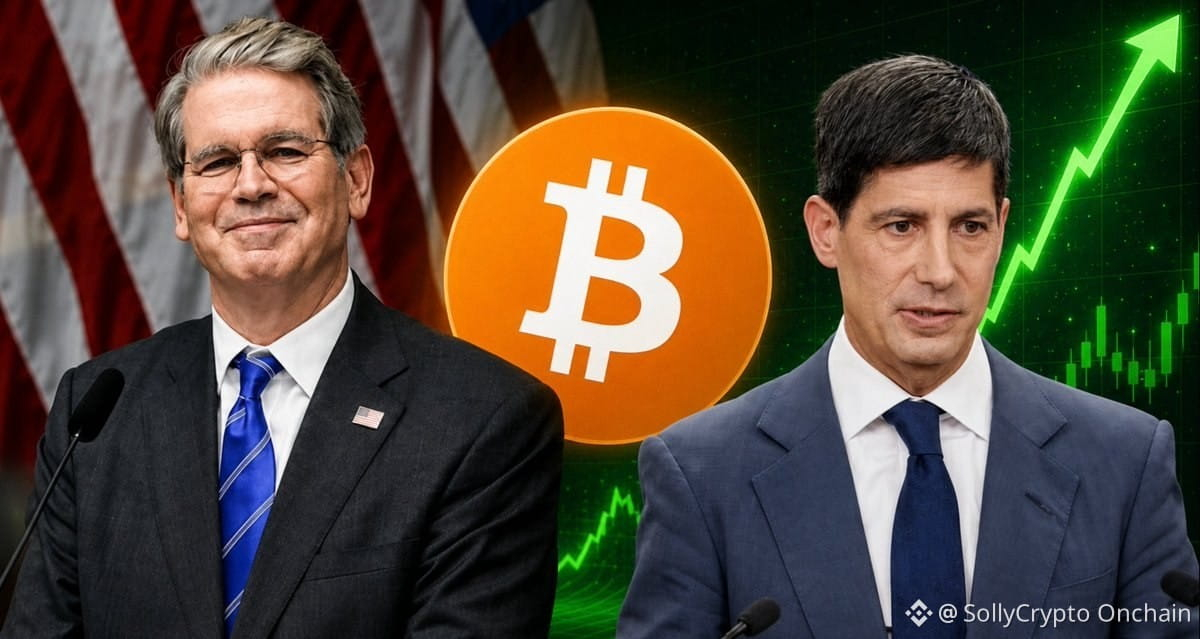
IS $16.7B NEXT WEEK STEALTH QE?
About $16.74 billion is set to enter the system next week: $4.243 billion from the Fed and $12.5 billion in Treasury buybacks.
Some are calling it stealth QE and saying Bitcoin has been front-running this liquidity all month. Official channels are adding cash while markets remain sensitive to every dollar.
Liquidity is coming. The only question is how much of it has already been priced in.
Has the front-run done most of the work, or is there still room once the cash lands?
IS $16.7B NEXT WEEK STEALTH QE?
About $16.74 billion is set to enter the system next week: $4.243 billion from the Fed and $12.5 billion in Treasury buybacks.
Some are calling it stealth QE and saying Bitcoin has been front-running this liquidity all month. Official channels are adding cash while markets remain sensitive to every dollar.
Liquidity is coming. The only question is how much of it has already been priced in.
Has the front-run done most of the work, or is there still room once the cash lands?
About $16.74 billion is set to enter the system next week: $4.243 billion from the Fed and $12.5 billion in Treasury buybacks.
Some are calling it stealth QE and saying Bitcoin has been front-running this liquidity all month. Official channels are adding cash while markets remain sensitive to every dollar.
Liquidity is coming. The only question is how much of it has already been priced in.
Has the front-run done most of the work, or is there still room once the cash lands?
93
·
--
Bullish
WILL SCHWAB LISTINGS HELP SOL AVAX LINK?
Charles Schwab plans to add $SOL, $AVAX and $LINK trading to Schwab Crypto in the coming months. The platform currently only offers Bitcoin and Ethereum.
The expansion gives Schwab’s large traditional investor base direct access to three more established tokens without leaving the platform.
More legacy brokerage distribution for liquid altcoins. Listings expected in the coming months.
WILL SCHWAB LISTINGS HELP SOL AVAX LINK?
Charles Schwab plans to add $SOL, $AVAX and $LINK trading to Schwab Crypto in the coming months. The platform currently only offers Bitcoin and Ethereum.
The expansion gives Schwab’s large traditional investor base direct access to three more established tokens without leaving the platform.
More legacy brokerage distribution for liquid altcoins. Listings expected in the coming months.
Charles Schwab plans to add $SOL, $AVAX and $LINK trading to Schwab Crypto in the coming months. The platform currently only offers Bitcoin and Ethereum.
The expansion gives Schwab’s large traditional investor base direct access to three more established tokens without leaving the platform.
More legacy brokerage distribution for liquid altcoins. Listings expected in the coming months.


1
166
·
--
Bullish
IS RIPPLE MOVING INTO STOCK TRADING
Ripple Prime just launched Delta One, its first clear expansion into stock trading for institutional clients. The new business lets hedge funds, asset managers and other institutions execute total return swaps on U.S.-listed equities, indices and digital assets through a single counterparty.
This is a meaningful step beyond the crypto-native products Ripple is known for. Delta One sits inside the existing Ripple Prime platform, which already offers prime brokerage, clearing and financing across FX, derivatives, fixed income and digital assets. Adding equities exposure under the same roof means clients can cross-margin and manage risk across traditional and digital markets without opening multiple relationships.
Total return swaps are a familiar tool for institutions that want price exposure without holding the underlying shares. By offering them on both stocks and digital assets, Ripple Prime is positioning itself as a multi-asset prime broker rather than a pure crypto venue. The timing also lines up with broader institutional demand for platforms that can handle both on-chain and traditional exposure in one place.
For $XRP and the wider Ripple ecosystem the move is indirect but supportive of the institutional narrative. It shows the company continuing to build out regulated, traditional-finance adjacent services rather than staying only in pure crypto settlement. Whether the Delta One book grows into a meaningful revenue line will depend on uptake from the hedge-fund and asset-manager community, but the strategic direction is clear.
Ripple is no longer just a crypto payments and liquidity firm. With Delta One it is actively competing for institutional equity derivatives flow.
IS RIPPLE MOVING INTO STOCK TRADING
Ripple Prime just launched Delta One, its first clear expansion into stock trading for institutional clients. The new business lets hedge funds, asset managers and other institutions execute total return swaps on U.S.-listed equities, indices and digital assets through a single counterparty.
This is a meaningful step beyond the crypto-native products Ripple is known for. Delta One sits inside the existing Ripple Prime platform, which already offers prime brokerage, clearing and financing across FX, derivatives, fixed income and digital assets. Adding equities exposure under the same roof means clients can cross-margin and manage risk across traditional and digital markets without opening multiple relationships.
Total return swaps are a familiar tool for institutions that want price exposure without holding the underlying shares. By offering them on both stocks and digital assets, Ripple Prime is positioning itself as a multi-asset prime broker rather than a pure crypto venue. The timing also lines up with broader institutional demand for platforms that can handle both on-chain and traditional exposure in one place.
For $XRP and the wider Ripple ecosystem the move is indirect but supportive of the institutional narrative. It shows the company continuing to build out regulated, traditional-finance adjacent services rather than staying only in pure crypto settlement. Whether the Delta One book grows into a meaningful revenue line will depend on uptake from the hedge-fund and asset-manager community, but the strategic direction is clear.
Ripple is no longer just a crypto payments and liquidity firm. With Delta One it is actively competing for institutional equity derivatives flow.
Ripple Prime just launched Delta One, its first clear expansion into stock trading for institutional clients. The new business lets hedge funds, asset managers and other institutions execute total return swaps on U.S.-listed equities, indices and digital assets through a single counterparty.
This is a meaningful step beyond the crypto-native products Ripple is known for. Delta One sits inside the existing Ripple Prime platform, which already offers prime brokerage, clearing and financing across FX, derivatives, fixed income and digital assets. Adding equities exposure under the same roof means clients can cross-margin and manage risk across traditional and digital markets without opening multiple relationships.
Total return swaps are a familiar tool for institutions that want price exposure without holding the underlying shares. By offering them on both stocks and digital assets, Ripple Prime is positioning itself as a multi-asset prime broker rather than a pure crypto venue. The timing also lines up with broader institutional demand for platforms that can handle both on-chain and traditional exposure in one place.
For $XRP and the wider Ripple ecosystem the move is indirect but supportive of the institutional narrative. It shows the company continuing to build out regulated, traditional-finance adjacent services rather than staying only in pure crypto settlement. Whether the Delta One book grows into a meaningful revenue line will depend on uptake from the hedge-fund and asset-manager community, but the strategic direction is clear.
Ripple is no longer just a crypto payments and liquidity firm. With Delta One it is actively competing for institutional equity derivatives flow.
1
128
·
--
Bullish
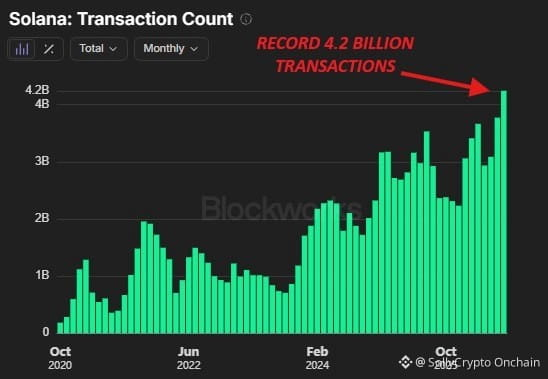
Solana just posted a record 4.2 billion onchain transactions in July, up 13.5% from the previous month. That is an increase of roughly 2 billion transactions compared with December 2025, or about 91% growth in half a year. The surge arrived alongside a sharp price move, with $SOL climbing around 40% in eight days to levels last seen in early February.
Tokenized assets are part of the story. The broader RWA market cap has pushed above $38 billion and Solana continues to capture a meaningful share of that activity. Jupiter alone now handles about 71% of DEX aggregator volume on the chain, which concentrates a large portion of trading flow through a single venue and keeps transaction counts elevated.
The wider crypto market has added roughly $580 billion in market cap since August 16. Onchain trading activity across the board has returned to levels that look like cycle highs again. Solana’s July numbers sit at the center of that rebound: more transactions, higher DEX volume, and growing use of the chain for both speculative trading and tokenized real-world assets.
Record transaction counts do not automatically equal sustainable demand. Some of the activity is still driven by high-frequency trading, bots, and short-term speculative flows that can disappear as quickly as they arrived. At the same time, the combination of price strength, RWA growth, and dominant aggregator volume suggests the chain is capturing real usage rather than pure empty block spam.
For $SOL the immediate read is constructive. Networks that post new activity highs while price is rising tend to attract more attention and more capital. The risk is the usual one: if the broader market cools or if a large share of the transactions proves transient, the numbers can reverse. For now the data shows Solana handling more real economic activity than it has in previous months and doing so while the token itself is re-rating higher.
Onchain activity is back at record levels. Solana is one of the clearest beneficiaries of that return.
Solana just posted a record 4.2 billion onchain transactions in July, up 13.5% from the previous month. That is an increase of roughly 2 billion transactions compared with December 2025, or about 91% growth in half a year. The surge arrived alongside a sharp price move, with $SOL climbing around 40% in eight days to levels last seen in early February.
Tokenized assets are part of the story. The broader RWA market cap has pushed above $38 billion and Solana continues to capture a meaningful share of that activity. Jupiter alone now handles about 71% of DEX aggregator volume on the chain, which concentrates a large portion of trading flow through a single venue and keeps transaction counts elevated.
The wider crypto market has added roughly $580 billion in market cap since August 16. Onchain trading activity across the board has returned to levels that look like cycle highs again. Solana’s July numbers sit at the center of that rebound: more transactions, higher DEX volume, and growing use of the chain for both speculative trading and tokenized real-world assets.
Record transaction counts do not automatically equal sustainable demand. Some of the activity is still driven by high-frequency trading, bots, and short-term speculative flows that can disappear as quickly as they arrived. At the same time, the combination of price strength, RWA growth, and dominant aggregator volume suggests the chain is capturing real usage rather than pure empty block spam.
For $SOL the immediate read is constructive. Networks that post new activity highs while price is rising tend to attract more attention and more capital. The risk is the usual one: if the broader market cools or if a large share of the transactions proves transient, the numbers can reverse. For now the data shows Solana handling more real economic activity than it has in previous months and doing so while the token itself is re-rating higher.
Onchain activity is back at record levels. Solana is one of the clearest beneficiaries of that return.
Tokenized assets are part of the story. The broader RWA market cap has pushed above $38 billion and Solana continues to capture a meaningful share of that activity. Jupiter alone now handles about 71% of DEX aggregator volume on the chain, which concentrates a large portion of trading flow through a single venue and keeps transaction counts elevated.
The wider crypto market has added roughly $580 billion in market cap since August 16. Onchain trading activity across the board has returned to levels that look like cycle highs again. Solana’s July numbers sit at the center of that rebound: more transactions, higher DEX volume, and growing use of the chain for both speculative trading and tokenized real-world assets.
Record transaction counts do not automatically equal sustainable demand. Some of the activity is still driven by high-frequency trading, bots, and short-term speculative flows that can disappear as quickly as they arrived. At the same time, the combination of price strength, RWA growth, and dominant aggregator volume suggests the chain is capturing real usage rather than pure empty block spam.
For $SOL the immediate read is constructive. Networks that post new activity highs while price is rising tend to attract more attention and more capital. The risk is the usual one: if the broader market cools or if a large share of the transactions proves transient, the numbers can reverse. For now the data shows Solana handling more real economic activity than it has in previous months and doing so while the token itself is re-rating higher.
Onchain activity is back at record levels. Solana is one of the clearest beneficiaries of that return.
1
74
·
--
Bullish
BNB Chain just activated the Pasteur hard fork. The upgrade tightens bridge and validator security while allowing blocks to carry more transactions at the same 450-millisecond speed.
On the security side the changes are practical. Duplicate validator entries get rejected during bridge verification. Old keys lose power after rotation. Restricted addresses are blocked from certain governance actions. These fixes close off attack paths that have hurt other chains before. Bridges remain one of the riskiest parts of any network, so hardening the checks is a real improvement rather than cosmetic work.
On the capacity side the fork adjusts block building so more of the available gas limit can actually be used. Test environments showed a clear rise in effective throughput without speeding up the block time or raising the gas ceiling. That gives the network more room during busy periods without adding new stability risks.
This is infrastructure work, not a tokenomics change or hype event. Safer bridges and fuller blocks help users and builders over time. The market will still care more about actual activity and fees than the upgrade itself, but each improvement that reduces risk and improves efficiency adds a small lasting edge.
The fork is live. Nodes that upgraded are already running the new rules. The benefits will show up gradually as the network handles real traffic under the tighter parameters.
BNB Chain just activated the Pasteur hard fork. The upgrade tightens bridge and validator security while allowing blocks to carry more transactions at the same 450-millisecond speed.
On the security side the changes are practical. Duplicate validator entries get rejected during bridge verification. Old keys lose power after rotation. Restricted addresses are blocked from certain governance actions. These fixes close off attack paths that have hurt other chains before. Bridges remain one of the riskiest parts of any network, so hardening the checks is a real improvement rather than cosmetic work.
On the capacity side the fork adjusts block building so more of the available gas limit can actually be used. Test environments showed a clear rise in effective throughput without speeding up the block time or raising the gas ceiling. That gives the network more room during busy periods without adding new stability risks.
This is infrastructure work, not a tokenomics change or hype event. Safer bridges and fuller blocks help users and builders over time. The market will still care more about actual activity and fees than the upgrade itself, but each improvement that reduces risk and improves efficiency adds a small lasting edge.
The fork is live. Nodes that upgraded are already running the new rules. The benefits will show up gradually as the network handles real traffic under the tighter parameters.
On the security side the changes are practical. Duplicate validator entries get rejected during bridge verification. Old keys lose power after rotation. Restricted addresses are blocked from certain governance actions. These fixes close off attack paths that have hurt other chains before. Bridges remain one of the riskiest parts of any network, so hardening the checks is a real improvement rather than cosmetic work.
On the capacity side the fork adjusts block building so more of the available gas limit can actually be used. Test environments showed a clear rise in effective throughput without speeding up the block time or raising the gas ceiling. That gives the network more room during busy periods without adding new stability risks.
This is infrastructure work, not a tokenomics change or hype event. Safer bridges and fuller blocks help users and builders over time. The market will still care more about actual activity and fees than the upgrade itself, but each improvement that reduces risk and improves efficiency adds a small lasting edge.
The fork is live. Nodes that upgraded are already running the new rules. The benefits will show up gradually as the network handles real traffic under the tighter parameters.

1
95
·
--
Bearish
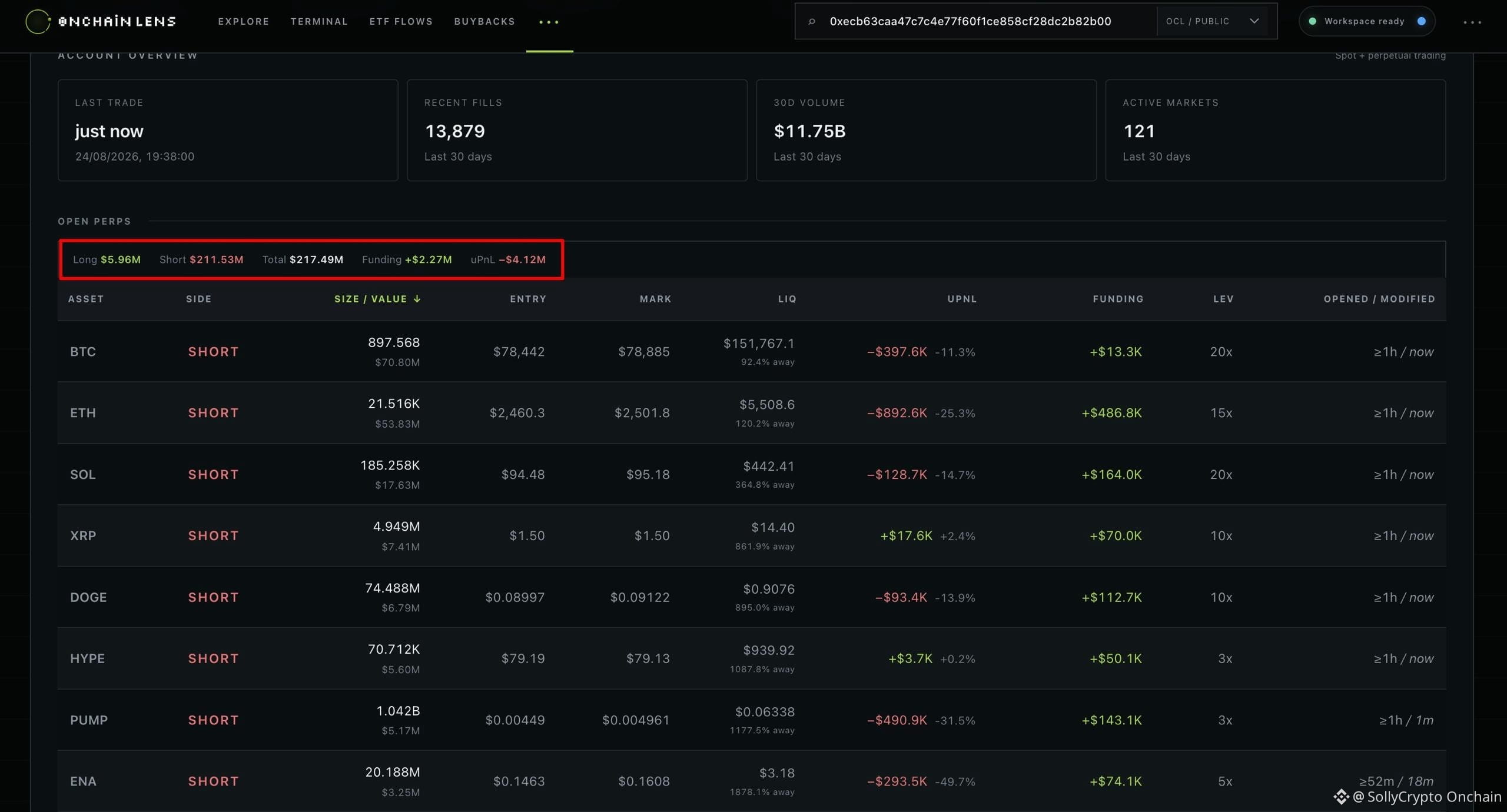
Wintermute has increased its Hyperliquid short book from $190.77 million to $211.53 million. At the same time the firm cut its $HYPE short roughly in half, from $11.43 million down to $5.60 million.
The current top positions are concentrated in the majors: $BTC at $70.80 million, $ETH at $53.83 million, $SOL at $17.63 million, $XRP at $7.41 million and $DOGE at $6.79 million. Combined unrealized PnL sits at –$4.12 million while funding collected so far is +$2.27 million.
The overall direction of the book remains clearly bearish even after the reduction in the $HYPE short. Adding more than $20 million in additional short exposure while the market has been volatile shows the firm is willing to keep leaning against the recent strength. The funding income provides a partial offset to the mark-to-market loss, but the net position is still underwater on an unrealized basis.
Large market-maker short books on Hyperliquid are watched closely because they can reflect both proprietary views and hedging of broader inventory or client flow. The increase to $211.53 million keeps Wintermute among the more visible directional short entities on the platform. How the book evolves from here, especially if price continues to move against it or if more shorts are added, will be the next data point.
Wintermute has increased its Hyperliquid short book from $190.77 million to $211.53 million. At the same time the firm cut its $HYPE short roughly in half, from $11.43 million down to $5.60 million.
The current top positions are concentrated in the majors: $BTC at $70.80 million, $ETH at $53.83 million, $SOL at $17.63 million, $XRP at $7.41 million and $DOGE at $6.79 million. Combined unrealized PnL sits at –$4.12 million while funding collected so far is +$2.27 million.
The overall direction of the book remains clearly bearish even after the reduction in the $HYPE short. Adding more than $20 million in additional short exposure while the market has been volatile shows the firm is willing to keep leaning against the recent strength. The funding income provides a partial offset to the mark-to-market loss, but the net position is still underwater on an unrealized basis.
Large market-maker short books on Hyperliquid are watched closely because they can reflect both proprietary views and hedging of broader inventory or client flow. The increase to $211.53 million keeps Wintermute among the more visible directional short entities on the platform. How the book evolves from here, especially if price continues to move against it or if more shorts are added, will be the next data point.
The current top positions are concentrated in the majors: $BTC at $70.80 million, $ETH at $53.83 million, $SOL at $17.63 million, $XRP at $7.41 million and $DOGE at $6.79 million. Combined unrealized PnL sits at –$4.12 million while funding collected so far is +$2.27 million.
The overall direction of the book remains clearly bearish even after the reduction in the $HYPE short. Adding more than $20 million in additional short exposure while the market has been volatile shows the firm is willing to keep leaning against the recent strength. The funding income provides a partial offset to the mark-to-market loss, but the net position is still underwater on an unrealized basis.
Large market-maker short books on Hyperliquid are watched closely because they can reflect both proprietary views and hedging of broader inventory or client flow. The increase to $211.53 million keeps Wintermute among the more visible directional short entities on the platform. How the book evolves from here, especially if price continues to move against it or if more shorts are added, will be the next data point.

1
189
·
--
Bearish
Ceffu moved 3.706 million $TRUMP worth about $9.27 million from its custody hot wallet to Binance roughly five hours ago. Transfers of this size from a custody platform into the exchange are commonly read as preparation to sell or to make the tokens available for institutional flow.
Ceffu operates as a custody and settlement layer linked to the broader Binance ecosystem. When tokens leave its hot wallet and land directly on Binance, the coins become immediately usable for trading, lending, or client settlement. In the case of a memecoin like $TRUMP, the most frequent interpretation is that the supply is being positioned for distribution rather than long-term storage.
$9.27 million is large enough to matter for short-term order book dynamics on $TRUMP, especially if the tokens are sold in a relatively short window. It is not large enough on its own to dictate the longer-term trend, but repeated custody-to-exchange flows of this type tend to add steady supply pressure. The market has already seen multiple instances of team or custody-linked $TRUMP moving onto exchanges in recent months, so this print fits an existing pattern rather than arriving as a one-off surprise.
Custody transfers are not always pure market sells. Sometimes the coins are being staged for OTC settlement, collateral, or internal rebalancing. Still, the destination is Binance and the asset is $TRUMP, so the default assumption until proven otherwise is that the tokens are closer to the market than they were inside custody.
The flow is confirmed and the size is clear. How quickly the coins are absorbed or sold will show up in price action and volume over the next sessions.
Ceffu moved 3.706 million $TRUMP worth about $9.27 million from its custody hot wallet to Binance roughly five hours ago. Transfers of this size from a custody platform into the exchange are commonly read as preparation to sell or to make the tokens available for institutional flow.
Ceffu operates as a custody and settlement layer linked to the broader Binance ecosystem. When tokens leave its hot wallet and land directly on Binance, the coins become immediately usable for trading, lending, or client settlement. In the case of a memecoin like $TRUMP, the most frequent interpretation is that the supply is being positioned for distribution rather than long-term storage.
$9.27 million is large enough to matter for short-term order book dynamics on $TRUMP, especially if the tokens are sold in a relatively short window. It is not large enough on its own to dictate the longer-term trend, but repeated custody-to-exchange flows of this type tend to add steady supply pressure. The market has already seen multiple instances of team or custody-linked $TRUMP moving onto exchanges in recent months, so this print fits an existing pattern rather than arriving as a one-off surprise.
Custody transfers are not always pure market sells. Sometimes the coins are being staged for OTC settlement, collateral, or internal rebalancing. Still, the destination is Binance and the asset is $TRUMP, so the default assumption until proven otherwise is that the tokens are closer to the market than they were inside custody.
The flow is confirmed and the size is clear. How quickly the coins are absorbed or sold will show up in price action and volume over the next sessions.
Ceffu operates as a custody and settlement layer linked to the broader Binance ecosystem. When tokens leave its hot wallet and land directly on Binance, the coins become immediately usable for trading, lending, or client settlement. In the case of a memecoin like $TRUMP, the most frequent interpretation is that the supply is being positioned for distribution rather than long-term storage.
$9.27 million is large enough to matter for short-term order book dynamics on $TRUMP, especially if the tokens are sold in a relatively short window. It is not large enough on its own to dictate the longer-term trend, but repeated custody-to-exchange flows of this type tend to add steady supply pressure. The market has already seen multiple instances of team or custody-linked $TRUMP moving onto exchanges in recent months, so this print fits an existing pattern rather than arriving as a one-off surprise.
Custody transfers are not always pure market sells. Sometimes the coins are being staged for OTC settlement, collateral, or internal rebalancing. Still, the destination is Binance and the asset is $TRUMP, so the default assumption until proven otherwise is that the tokens are closer to the market than they were inside custody.
The flow is confirmed and the size is clear. How quickly the coins are absorbed or sold will show up in price action and volume over the next sessions.

1
123
·
--
Bearish
Phantom will stop supporting Sui on September 24, twenty months after adding it. Users must move $SUI to another wallet or swap it before the deadline.
Sui TVL has fallen 82% from its $2.58B peak to around $469M. The wallet decision adds to signs of declining network activity.
Assets stay on-chain but become unusable inside Phantom after the cutoff.
Phantom will stop supporting Sui on September 24, twenty months after adding it. Users must move $SUI to another wallet or swap it before the deadline.
Sui TVL has fallen 82% from its $2.58B peak to around $469M. The wallet decision adds to signs of declining network activity.
Assets stay on-chain but become unusable inside Phantom after the cutoff.
Sui TVL has fallen 82% from its $2.58B peak to around $469M. The wallet decision adds to signs of declining network activity.
Assets stay on-chain but become unusable inside Phantom after the cutoff.


1
102
·
--
Bearish
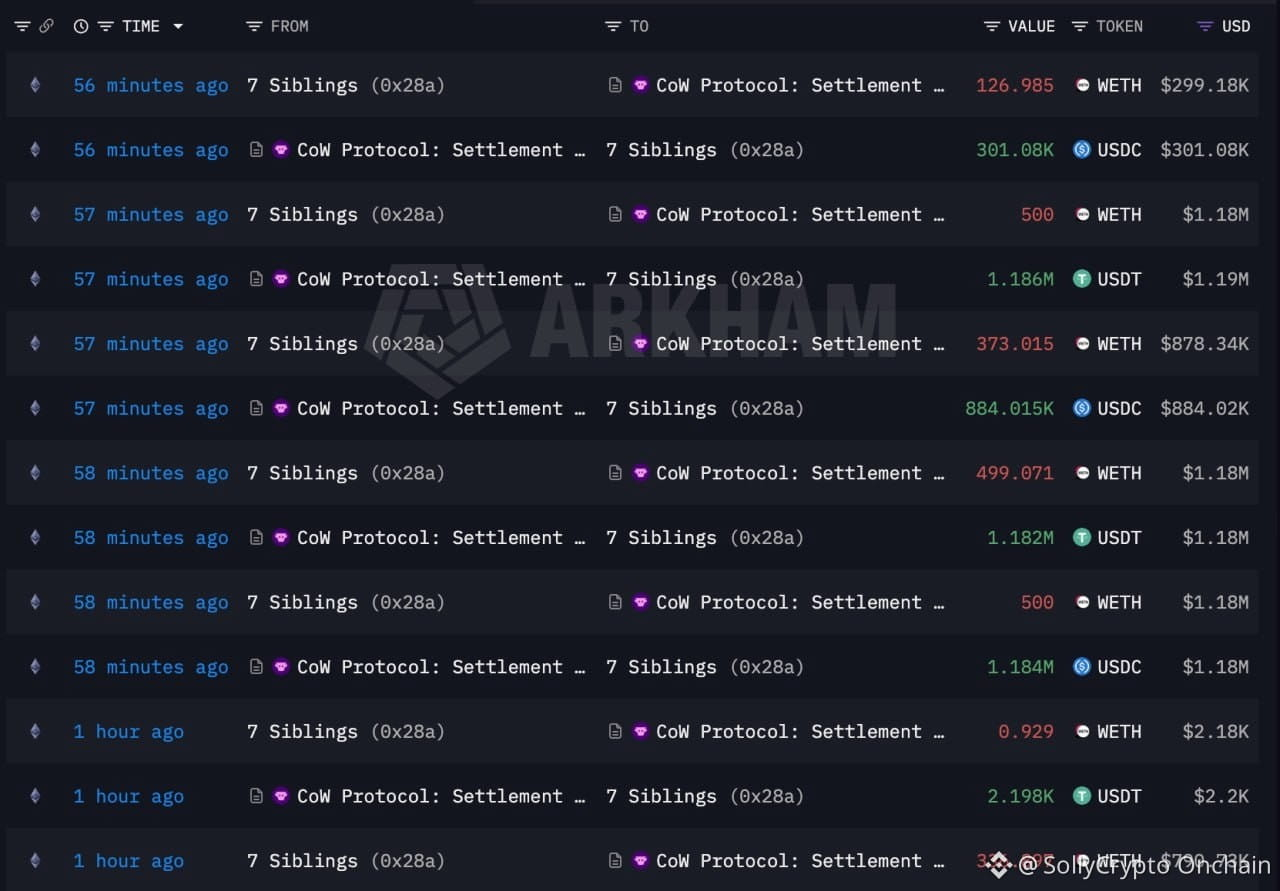
Some big wallets are selling into the strength. 7 Siblings just sold 14,000 $ETH worth $32.85 million at an average of $2,346.
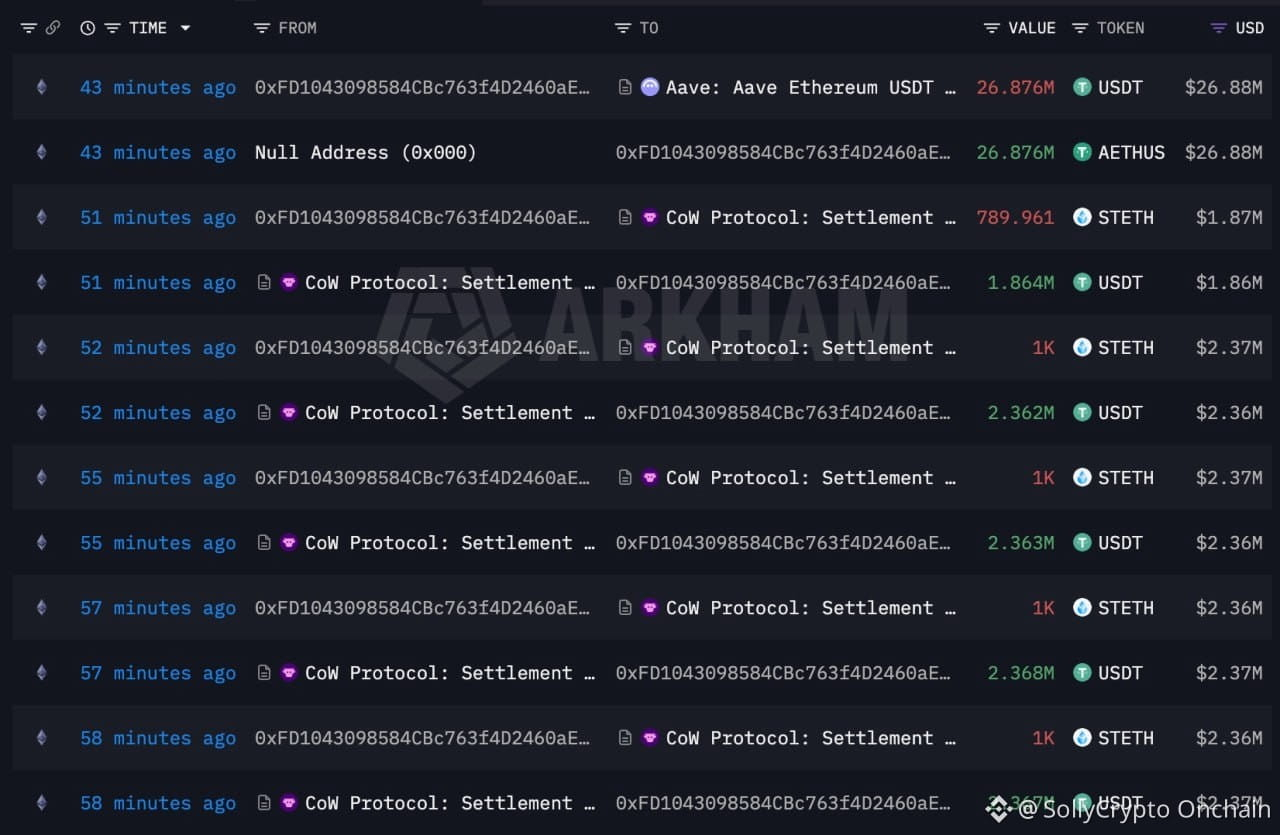
Whale 0xFD10 also sold 11,252 $stETH ($26.5M) plus 1,824 $ETH ($4.26M) and took 30.78 million $USDT.
Combined, that is over $63 million in $ETH-related supply hitting the market from two known wallets. The timing looks like classic strength-selling rather than panic.
This is mixed-signal on-chain flow. Clear distribution from these addresses, but not yet large enough on its own to reverse the broader structure. Still worth watching if more holders start doing the same.
Do these sales into the rally look like healthy profit-taking or early distribution?
#SollyCrypto #ETH #WhaleAlert #OnChainAnalysis
Some big wallets are selling into the strength. 7 Siblings just sold 14,000 $ETH worth $32.85 million at an average of $2,346.
Whale 0xFD10 also sold 11,252 $stETH ($26.5M) plus 1,824 $ETH ($4.26M) and took 30.78 million $USDT.
Combined, that is over $63 million in $ETH-related supply hitting the market from two known wallets. The timing looks like classic strength-selling rather than panic.
This is mixed-signal on-chain flow. Clear distribution from these addresses, but not yet large enough on its own to reverse the broader structure. Still worth watching if more holders start doing the same.
Do these sales into the rally look like healthy profit-taking or early distribution?
#SollyCrypto #ETH #WhaleAlert #OnChainAnalysis
Whale 0xFD10 also sold 11,252 $stETH ($26.5M) plus 1,824 $ETH ($4.26M) and took 30.78 million $USDT.
Combined, that is over $63 million in $ETH-related supply hitting the market from two known wallets. The timing looks like classic strength-selling rather than panic.
This is mixed-signal on-chain flow. Clear distribution from these addresses, but not yet large enough on its own to reverse the broader structure. Still worth watching if more holders start doing the same.
Do these sales into the rally look like healthy profit-taking or early distribution?
#SollyCrypto #ETH #WhaleAlert #OnChainAnalysis
1
99
·
--
Bearish
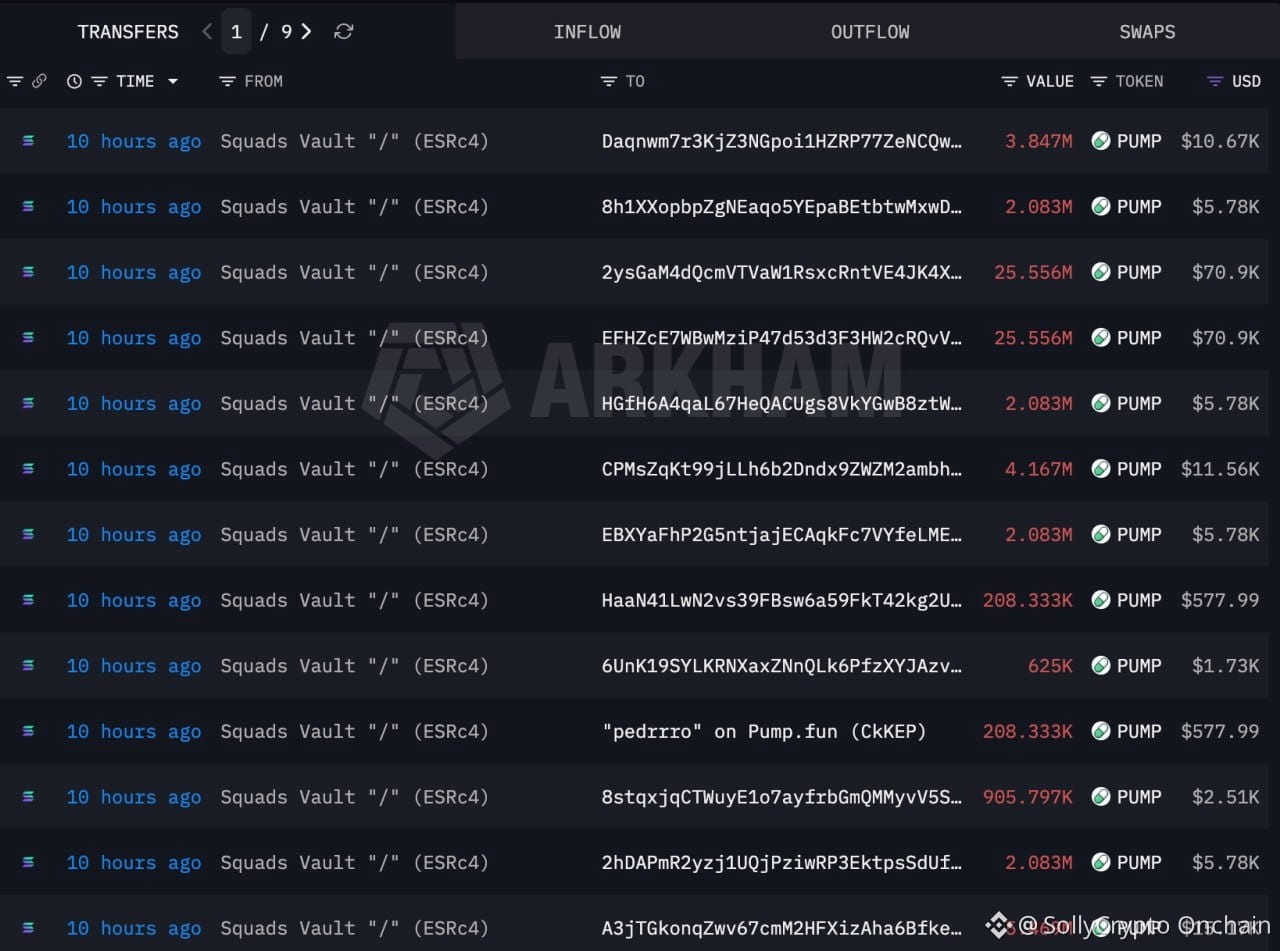
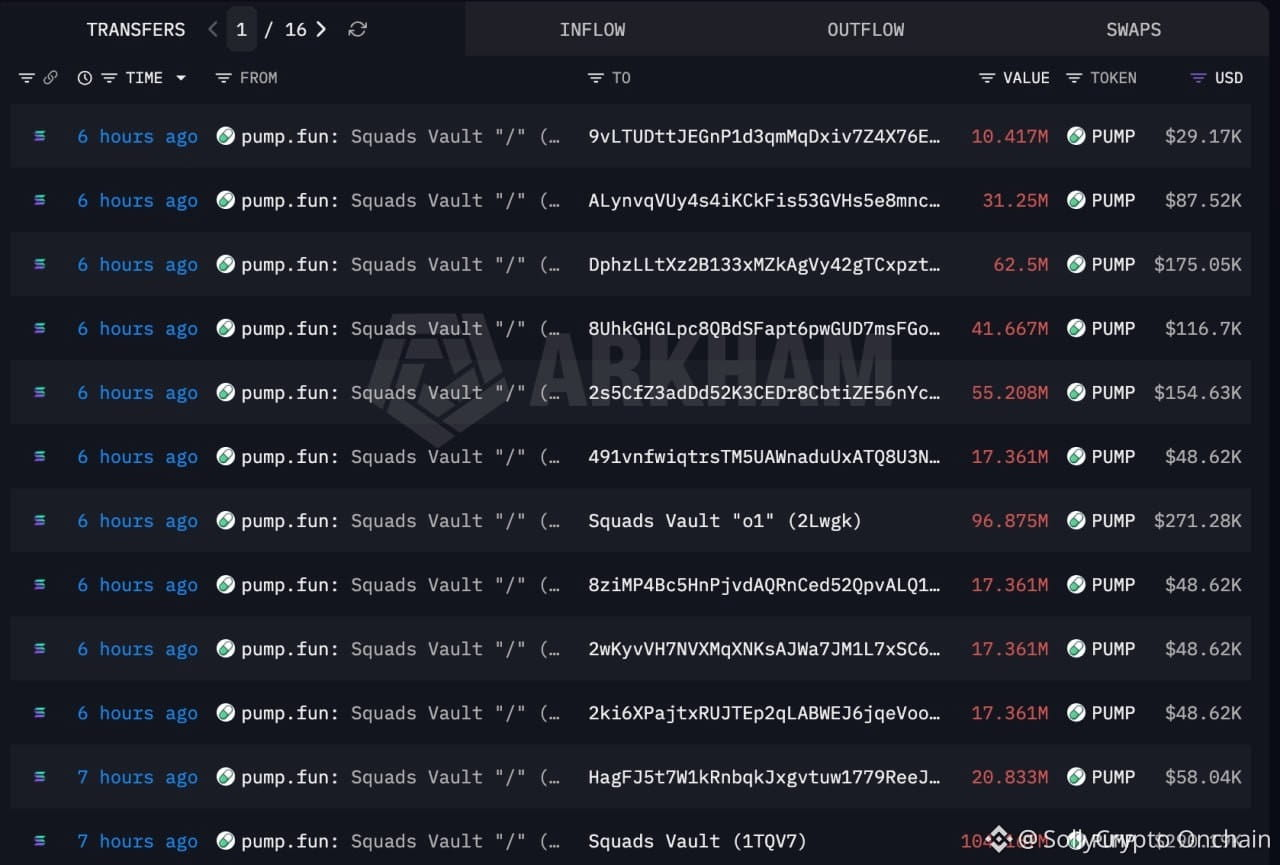
Pump.fun unlocked another 4.85B $PUMP (~$13.6M) today.
This isn't a surprise dump, PUMP runs on fully transparent, on-chain vesting since TGE, community and ecosystem tokens release monthly on a fixed calendar anyone can check in advance. Historically, these unlocks have shown relatively low volatility in the following days, the market's had over a year to learn PUMP's rhythm and largely price it in ahead of time. Pump.fun also runs buybacks funded by trading fees, using half of net platform revenue to buy back and burn tokens, some organic supply pressure working against the unlock schedule.
The real thing worth tracking isn't this single release, it's the trend. PUMP's circulating supply keeps climbing steadily toward full dilution over the next few years, and whether buyback demand can keep pace with that schedule long-term is the actual question, not any one unlock in isolation.
Does a predictable, well-telegraphed unlock like this even move the needle for you anymore, or does supply dilution matter regardless of how expected it is?
#PUMP #PumpFun #SollyCrypto
Pump.fun unlocked another 4.85B $PUMP (~$13.6M) today.
This isn't a surprise dump, PUMP runs on fully transparent, on-chain vesting since TGE, community and ecosystem tokens release monthly on a fixed calendar anyone can check in advance. Historically, these unlocks have shown relatively low volatility in the following days, the market's had over a year to learn PUMP's rhythm and largely price it in ahead of time. Pump.fun also runs buybacks funded by trading fees, using half of net platform revenue to buy back and burn tokens, some organic supply pressure working against the unlock schedule.
The real thing worth tracking isn't this single release, it's the trend. PUMP's circulating supply keeps climbing steadily toward full dilution over the next few years, and whether buyback demand can keep pace with that schedule long-term is the actual question, not any one unlock in isolation.
Does a predictable, well-telegraphed unlock like this even move the needle for you anymore, or does supply dilution matter regardless of how expected it is?
#PUMP #PumpFun #SollyCrypto
This isn't a surprise dump, PUMP runs on fully transparent, on-chain vesting since TGE, community and ecosystem tokens release monthly on a fixed calendar anyone can check in advance. Historically, these unlocks have shown relatively low volatility in the following days, the market's had over a year to learn PUMP's rhythm and largely price it in ahead of time. Pump.fun also runs buybacks funded by trading fees, using half of net platform revenue to buy back and burn tokens, some organic supply pressure working against the unlock schedule.
The real thing worth tracking isn't this single release, it's the trend. PUMP's circulating supply keeps climbing steadily toward full dilution over the next few years, and whether buyback demand can keep pace with that schedule long-term is the actual question, not any one unlock in isolation.
Does a predictable, well-telegraphed unlock like this even move the needle for you anymore, or does supply dilution matter regardless of how expected it is?
#PUMP #PumpFun #SollyCrypto
115
·
--
Bearish
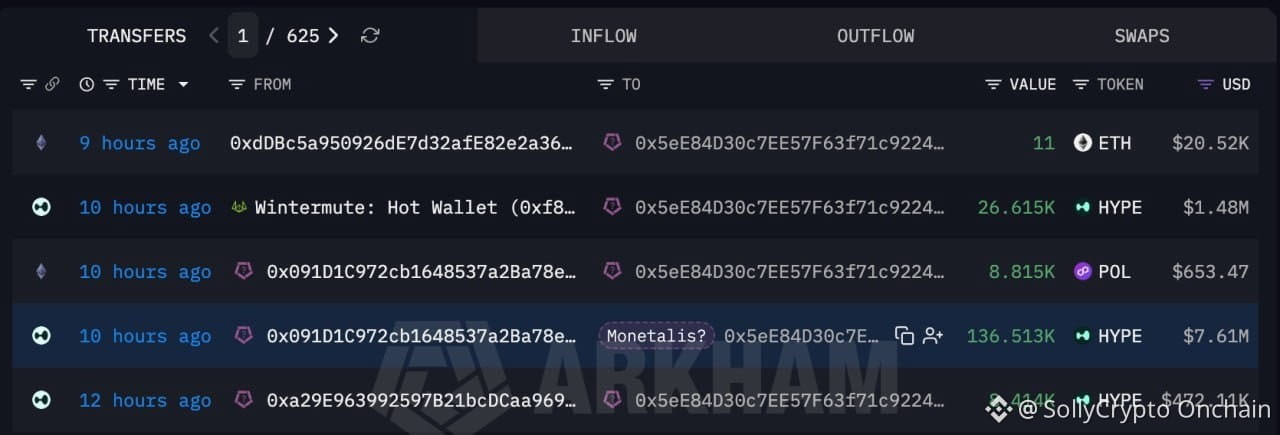
Wallets linked to Monetalis sold 3.72M $UNI ($13M) through Cumberland, then bought 171,543 $HYPE ($9.56M).
This isn't a random swap, Monetalis has a real track record here. This same fund built a $44.96M UNI position via OTC deals back in November 2025, and has also held meaningful ETH and AAVE stakes alongside it, this is a diversified institutional player that actively rotates, not a buy-and-forget holder. Selling a chunk of a position they spent months building to buy into HYPE instead is a real statement about where they see better relative value right now.
Worth the caution too, HYPE's own recent price action has been choppy, institutional unstaking waves from funds like Multicoin and Paradigm pulled the token below $60 recently on privacy-driven wallet rotations, not necessarily selling. Monetalis buying into that same environment could mean they see the pullback as opportunity, or it could mean more crowded institutional money is about to compete for the same exit door later.
Sophisticated capital rotating out of UNI into HYPE, smart positioning or a warning sign for UNI holders?
#UNI #HYPE #Monetalis #SollyCrypto
Wallets linked to Monetalis sold 3.72M $UNI ($13M) through Cumberland, then bought 171,543 $HYPE ($9.56M).
This isn't a random swap, Monetalis has a real track record here. This same fund built a $44.96M UNI position via OTC deals back in November 2025, and has also held meaningful ETH and AAVE stakes alongside it, this is a diversified institutional player that actively rotates, not a buy-and-forget holder. Selling a chunk of a position they spent months building to buy into HYPE instead is a real statement about where they see better relative value right now.
Worth the caution too, HYPE's own recent price action has been choppy, institutional unstaking waves from funds like Multicoin and Paradigm pulled the token below $60 recently on privacy-driven wallet rotations, not necessarily selling. Monetalis buying into that same environment could mean they see the pullback as opportunity, or it could mean more crowded institutional money is about to compete for the same exit door later.
Sophisticated capital rotating out of UNI into HYPE, smart positioning or a warning sign for UNI holders?
#UNI #HYPE #Monetalis #SollyCrypto
This isn't a random swap, Monetalis has a real track record here. This same fund built a $44.96M UNI position via OTC deals back in November 2025, and has also held meaningful ETH and AAVE stakes alongside it, this is a diversified institutional player that actively rotates, not a buy-and-forget holder. Selling a chunk of a position they spent months building to buy into HYPE instead is a real statement about where they see better relative value right now.
Worth the caution too, HYPE's own recent price action has been choppy, institutional unstaking waves from funds like Multicoin and Paradigm pulled the token below $60 recently on privacy-driven wallet rotations, not necessarily selling. Monetalis buying into that same environment could mean they see the pullback as opportunity, or it could mean more crowded institutional money is about to compete for the same exit door later.
Sophisticated capital rotating out of UNI into HYPE, smart positioning or a warning sign for UNI holders?
#UNI #HYPE #Monetalis #SollyCrypto
145
·
--
Bullish
THIS WALLET HAS BEEN QUIETLY BUYING HYPE FOR TWO MONTHS STRAIGHT
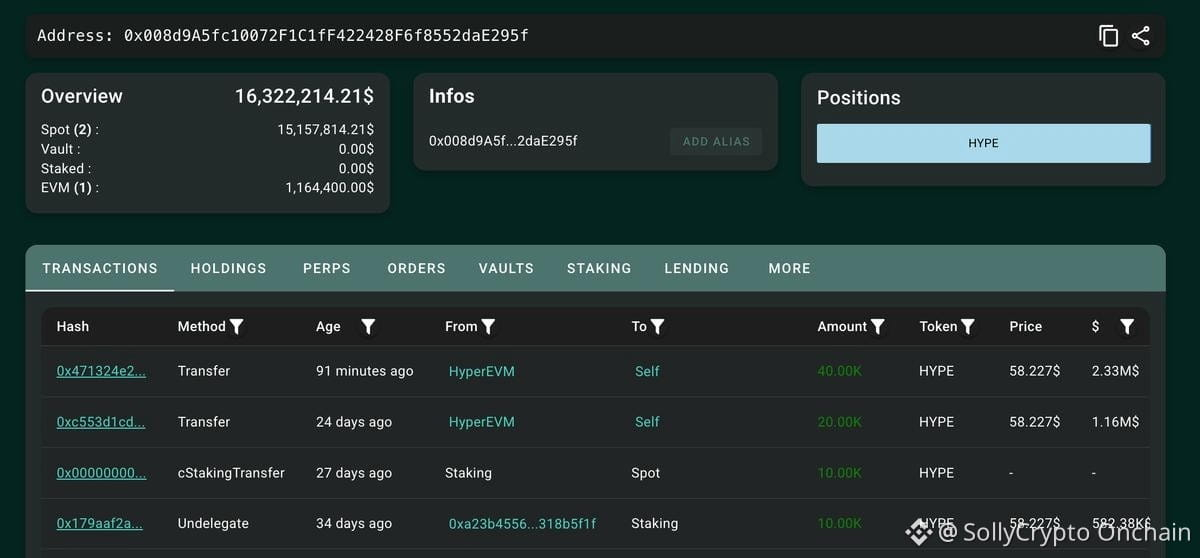
A whale just received another 40K $HYPE (~$2.3M) from Coinbase. This isn't a one-off, the same wallet has now pulled together 260K HYPE, worth roughly $15.1M, sourced steadily through Coinbase, Bybit, and other venues over the past two months.
Here's what makes this pattern worth watching closely, this wallet isn't alone. Similar slow-drip accumulation has shown up repeatedly this year, a16z building a $90M+ position, Bitwise staking $114M through its ETF, other whales pulling $55M-$65M off exchanges in single sessions. The common thread across nearly all of them, tokens get moved off exchanges and often straight into staking, meaning they're not sitting on order books waiting to be sold.
Two months of steady, patient buying is a very different signal than a single large purchase. It suggests this isn't someone chasing a pump, it's someone building a position methodically regardless of short-term price noise.
Does slow, disciplined accumulation like this convince you more than a single flashy whale buy, or does size still matter more than pattern to you?
#HYPE #Hyperliquid #Whale #SollyCrypto
THIS WALLET HAS BEEN QUIETLY BUYING HYPE FOR TWO MONTHS STRAIGHT
A whale just received another 40K $HYPE (~$2.3M) from Coinbase. This isn't a one-off, the same wallet has now pulled together 260K HYPE, worth roughly $15.1M, sourced steadily through Coinbase, Bybit, and other venues over the past two months.
Here's what makes this pattern worth watching closely, this wallet isn't alone. Similar slow-drip accumulation has shown up repeatedly this year, a16z building a $90M+ position, Bitwise staking $114M through its ETF, other whales pulling $55M-$65M off exchanges in single sessions. The common thread across nearly all of them, tokens get moved off exchanges and often straight into staking, meaning they're not sitting on order books waiting to be sold.
Two months of steady, patient buying is a very different signal than a single large purchase. It suggests this isn't someone chasing a pump, it's someone building a position methodically regardless of short-term price noise.
Does slow, disciplined accumulation like this convince you more than a single flashy whale buy, or does size still matter more than pattern to you?
#HYPE #Hyperliquid #Whale #SollyCrypto
A whale just received another 40K $HYPE (~$2.3M) from Coinbase. This isn't a one-off, the same wallet has now pulled together 260K HYPE, worth roughly $15.1M, sourced steadily through Coinbase, Bybit, and other venues over the past two months.
Here's what makes this pattern worth watching closely, this wallet isn't alone. Similar slow-drip accumulation has shown up repeatedly this year, a16z building a $90M+ position, Bitwise staking $114M through its ETF, other whales pulling $55M-$65M off exchanges in single sessions. The common thread across nearly all of them, tokens get moved off exchanges and often straight into staking, meaning they're not sitting on order books waiting to be sold.
Two months of steady, patient buying is a very different signal than a single large purchase. It suggests this isn't someone chasing a pump, it's someone building a position methodically regardless of short-term price noise.
Does slow, disciplined accumulation like this convince you more than a single flashy whale buy, or does size still matter more than pattern to you?
#HYPE #Hyperliquid #Whale #SollyCrypto
1
168
·
--
Bearish
METAPLANET IS SITTING ON A $1.4B PAPER LOSS AND STILL NOT SELLING
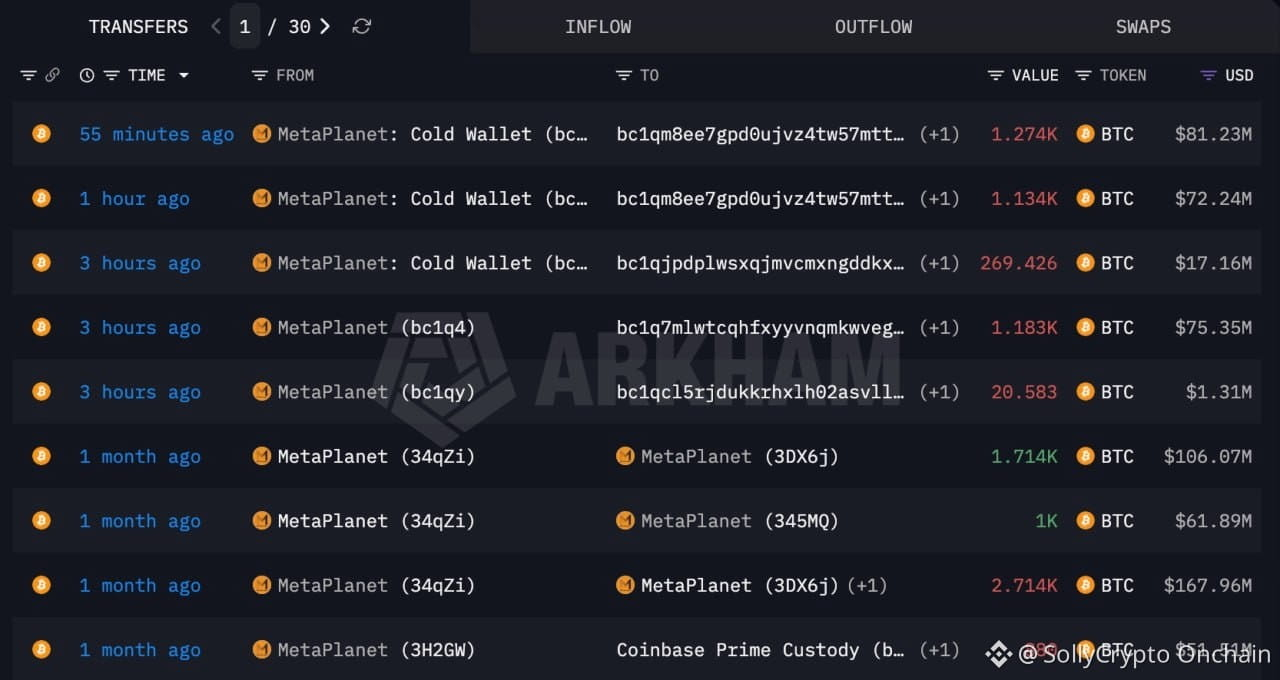
Metaplanet moved 3,881 $BTC (~$247.3M) in the past 3 hours. The company holds 43,000 BTC total, bought at an average price of $96,191, and is currently down $1.4B, a 34% unrealized loss on the entire position.
Here's the part that makes this different from panic, Metaplanet has been buying through drawdowns like this the entire time, not just holding through them. Their own strategy tracker has shown unrealized losses swinging from $490M to over $1.6B across recent quarters, and every time, the company kept adding rather than trimming. The target is still 210,000 BTC by 2027, meaning at current pace they're not even a quarter of the way there yet.
That doesn't make a $1.4B paper loss painless. Corporate treasuries still answer to shareholders, and Metaplanet's stock has taken real hits alongside the BTC markdown. But a transfer this size from a company that's institutionally committed to a multi-year accumulation target reads very differently than the same transfer from an anonymous wallet with no disclosed strategy.
Would you have the conviction to keep buying through a billion-dollar-plus paper loss, or does that number change your read on the strategy?
#Bitcoin #Metaplanet #SollyCrypto
METAPLANET IS SITTING ON A $1.4B PAPER LOSS AND STILL NOT SELLING
Metaplanet moved 3,881 $BTC (~$247.3M) in the past 3 hours. The company holds 43,000 BTC total, bought at an average price of $96,191, and is currently down $1.4B, a 34% unrealized loss on the entire position.
Here's the part that makes this different from panic, Metaplanet has been buying through drawdowns like this the entire time, not just holding through them. Their own strategy tracker has shown unrealized losses swinging from $490M to over $1.6B across recent quarters, and every time, the company kept adding rather than trimming. The target is still 210,000 BTC by 2027, meaning at current pace they're not even a quarter of the way there yet.
That doesn't make a $1.4B paper loss painless. Corporate treasuries still answer to shareholders, and Metaplanet's stock has taken real hits alongside the BTC markdown. But a transfer this size from a company that's institutionally committed to a multi-year accumulation target reads very differently than the same transfer from an anonymous wallet with no disclosed strategy.
Would you have the conviction to keep buying through a billion-dollar-plus paper loss, or does that number change your read on the strategy?
#Bitcoin #Metaplanet #SollyCrypto
Metaplanet moved 3,881 $BTC (~$247.3M) in the past 3 hours. The company holds 43,000 BTC total, bought at an average price of $96,191, and is currently down $1.4B, a 34% unrealized loss on the entire position.
Here's the part that makes this different from panic, Metaplanet has been buying through drawdowns like this the entire time, not just holding through them. Their own strategy tracker has shown unrealized losses swinging from $490M to over $1.6B across recent quarters, and every time, the company kept adding rather than trimming. The target is still 210,000 BTC by 2027, meaning at current pace they're not even a quarter of the way there yet.
That doesn't make a $1.4B paper loss painless. Corporate treasuries still answer to shareholders, and Metaplanet's stock has taken real hits alongside the BTC markdown. But a transfer this size from a company that's institutionally committed to a multi-year accumulation target reads very differently than the same transfer from an anonymous wallet with no disclosed strategy.
Would you have the conviction to keep buying through a billion-dollar-plus paper loss, or does that number change your read on the strategy?
#Bitcoin #Metaplanet #SollyCrypto

80
·
--
Bearish
A wallet tied to the Lighter team sent 1.87M $LIT (~$4.57M) to a fresh address.
Here's why this one deserves more scrutiny than a routine team transfer. Lighter has already faced a real transparency investigation, analysts flagged $7.18M in coordinated sales from wallets that received a suspiciously uniform airdrop split shortly after TGE, calling it deliberate rather than organic activity. The founder has also had to publicly clarify before, on a live Twitter Space, that a prior 250M LIT transfer wasn't a dump, it was fund custody. So "fresh wallet" movements from this team carry a track record the community is already watching closely.
That doesn't automatically mean this transfer is a sale. Team custody moves are normal at any project. But given Lighter's specific history, the burden of proof here sits differently than it would for a team with a clean track record.
Given what's already happened with this project, are you giving this one the benefit of the doubt, or treating it as a warning sign?
#LIT #Lighter #OnChain #SollyCrypto
A wallet tied to the Lighter team sent 1.87M $LIT (~$4.57M) to a fresh address.
Here's why this one deserves more scrutiny than a routine team transfer. Lighter has already faced a real transparency investigation, analysts flagged $7.18M in coordinated sales from wallets that received a suspiciously uniform airdrop split shortly after TGE, calling it deliberate rather than organic activity. The founder has also had to publicly clarify before, on a live Twitter Space, that a prior 250M LIT transfer wasn't a dump, it was fund custody. So "fresh wallet" movements from this team carry a track record the community is already watching closely.
That doesn't automatically mean this transfer is a sale. Team custody moves are normal at any project. But given Lighter's specific history, the burden of proof here sits differently than it would for a team with a clean track record.
Given what's already happened with this project, are you giving this one the benefit of the doubt, or treating it as a warning sign?
#LIT #Lighter #OnChain #SollyCrypto
Here's why this one deserves more scrutiny than a routine team transfer. Lighter has already faced a real transparency investigation, analysts flagged $7.18M in coordinated sales from wallets that received a suspiciously uniform airdrop split shortly after TGE, calling it deliberate rather than organic activity. The founder has also had to publicly clarify before, on a live Twitter Space, that a prior 250M LIT transfer wasn't a dump, it was fund custody. So "fresh wallet" movements from this team carry a track record the community is already watching closely.
That doesn't automatically mean this transfer is a sale. Team custody moves are normal at any project. But given Lighter's specific history, the burden of proof here sits differently than it would for a team with a clean track record.
Given what's already happened with this project, are you giving this one the benefit of the doubt, or treating it as a warning sign?
#LIT #Lighter #OnChain #SollyCrypto

1
173
·
--
Bearish
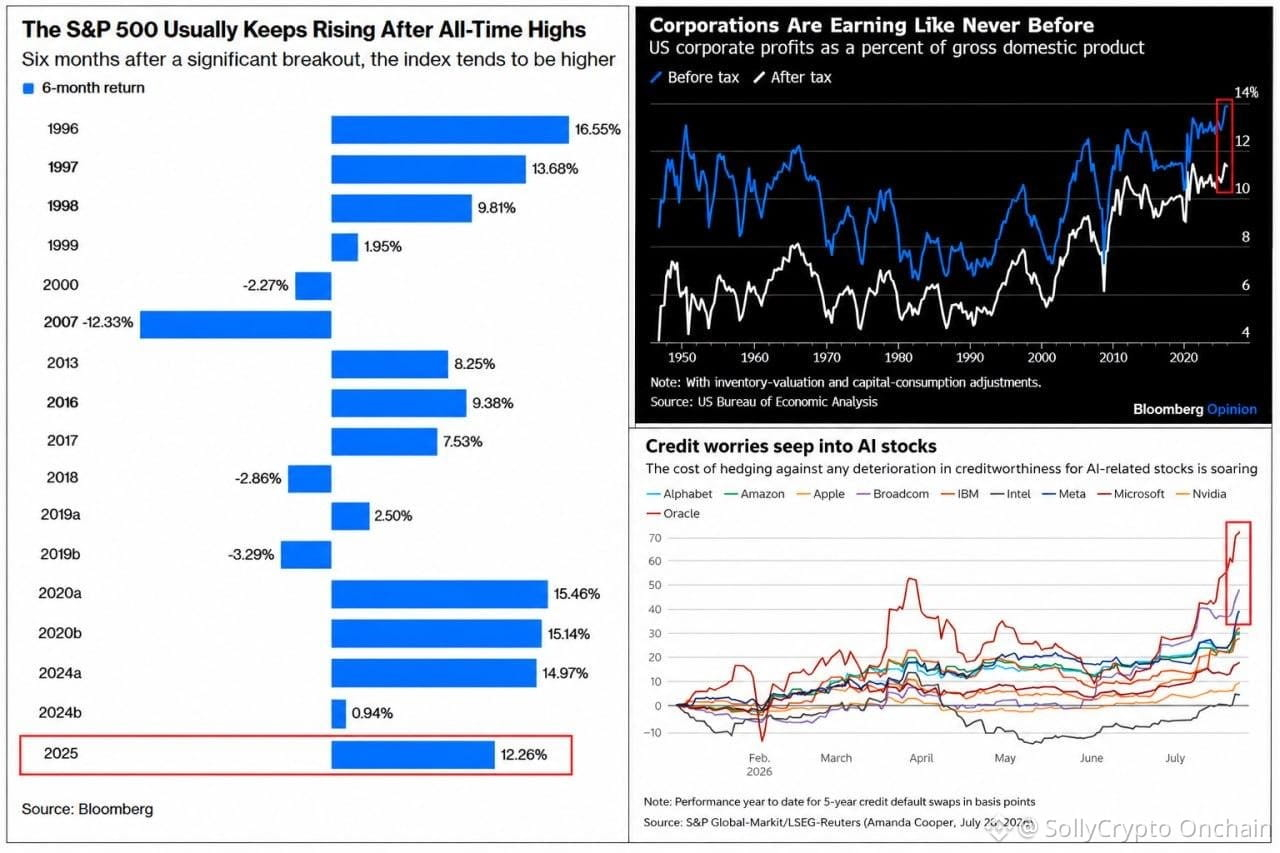
Over the past 30 years, the S&P 500 has continued to rise after reaching an ATH (All-Time High) in 13 out of 17 cases – gaining an average of +6.3% over the following six months. That is precisely what Wall Street bankers are pricing into their forecasts: between 7,900 and 8,100 points by the end of the year 🔼
The story about the AI bubble being a major risk factor doesn't look convincing, as U.S. pre-tax corporate profits as a percentage of GDP have hit a record 14%. The numbers behind company stock growth may look bubble-like, but unlike in 2000, there is a solid underlying foundation in the form of hundreds of billions in investments and revenue.
PrimeXBT.
However, the S&P 500's path to 8,000 won't necessarily be a straight line. Here is what could go wrong:
▶️ U.S. autumn congressional midterm/special elections, which traditionally trigger a market correction
▶️ Escalation in the Middle East if the war spreads across the entire region. Today, Yemeni Houthis struck Saudi Arabia again
▶️ A revaluation of the AI sector, despite strong revenues, Big Tech has issued $200 billion in debt bonds since the start of the year (double the amount for the whole of 2025)
Where does BTC go in that scenario? If triggered, any of these factors could easily push the crypto market to a bottom below $55k. The subsequent resolution of these issues, however, could be the very positive catalyst that puts an end to the crypto winter 🤑#SheinToStartHKIPOBookbuildingAsSoonAsNextWeek #TrumpDemandsCompensationFromIran
Over the past 30 years, the S&P 500 has continued to rise after reaching an ATH (All-Time High) in 13 out of 17 cases – gaining an average of +6.3% over the following six months. That is precisely what Wall Street bankers are pricing into their forecasts: between 7,900 and 8,100 points by the end of the year 🔼
The story about the AI bubble being a major risk factor doesn't look convincing, as U.S. pre-tax corporate profits as a percentage of GDP have hit a record 14%. The numbers behind company stock growth may look bubble-like, but unlike in 2000, there is a solid underlying foundation in the form of hundreds of billions in investments and revenue.
PrimeXBT.
However, the S&P 500's path to 8,000 won't necessarily be a straight line. Here is what could go wrong:
▶️ U.S. autumn congressional midterm/special elections, which traditionally trigger a market correction
▶️ Escalation in the Middle East if the war spreads across the entire region. Today, Yemeni Houthis struck Saudi Arabia again
▶️ A revaluation of the AI sector, despite strong revenues, Big Tech has issued $200 billion in debt bonds since the start of the year (double the amount for the whole of 2025)
Where does BTC go in that scenario? If triggered, any of these factors could easily push the crypto market to a bottom below $55k. The subsequent resolution of these issues, however, could be the very positive catalyst that puts an end to the crypto winter 🤑#SheinToStartHKIPOBookbuildingAsSoonAsNextWeek #TrumpDemandsCompensationFromIran
The story about the AI bubble being a major risk factor doesn't look convincing, as U.S. pre-tax corporate profits as a percentage of GDP have hit a record 14%. The numbers behind company stock growth may look bubble-like, but unlike in 2000, there is a solid underlying foundation in the form of hundreds of billions in investments and revenue.
PrimeXBT.
However, the S&P 500's path to 8,000 won't necessarily be a straight line. Here is what could go wrong:
▶️ U.S. autumn congressional midterm/special elections, which traditionally trigger a market correction
▶️ Escalation in the Middle East if the war spreads across the entire region. Today, Yemeni Houthis struck Saudi Arabia again
▶️ A revaluation of the AI sector, despite strong revenues, Big Tech has issued $200 billion in debt bonds since the start of the year (double the amount for the whole of 2025)
Where does BTC go in that scenario? If triggered, any of these factors could easily push the crypto market to a bottom below $55k. The subsequent resolution of these issues, however, could be the very positive catalyst that puts an end to the crypto winter 🤑#SheinToStartHKIPOBookbuildingAsSoonAsNextWeek #TrumpDemandsCompensationFromIran
1
82
Log in to explore more content
Join global crypto users on Binance Square
⚡️ Get latest and useful information about crypto.
💬 Trusted by the world’s largest crypto exchange.
👍 Discover real insights from verified creators.
Email / Phone number
Trending Topics
BTCBreaks80K
13,255 views
439 Discussing
🚨 BITCOIN $80K IS BACK IN FOCUS! 🔥
BTC is pushing toward the $80,000 psychological resistance after reclaiming the $78K zone. A clean breakout and hold above $80K could bring $82K–$85K into focus next. 📈
But traders need to watch the rejection zone carefully — losing $77K–$78K could trigger another pullback.
🎯 Key levels:
• 🔥 Breakout: $80K
• 🚀 Next zone: $82K–$85K
• ⚠️ Support: $77K–$78K
$80K isn’t just a number — it’s the level bulls need to conquer.
Are we about to see the next BTC breakout? 👇
#bitcoin #BTC #BinanceSquare #btcbreaks80k
$BTC
ASHFAQ NAEEM
·3 Likes
·3.9k views
比特币突破8万
21,042 views
73 Discussing
BuffettBecomesBerkshireChairmanEmeritus
278 views
57 Discussing