

REACHER _Crypto
8.6k Posts

REACHER _Crypto
Report
Block User
Web3 boy I Crypto never sleeps neither do profits Turning volatility into opportunity I Think. Trade. Earn. Repeat. #BinanceLife
488 Following
19.8K+ Followers
11.3K+ Liked
Posts
All
Quotes
Videos
Live
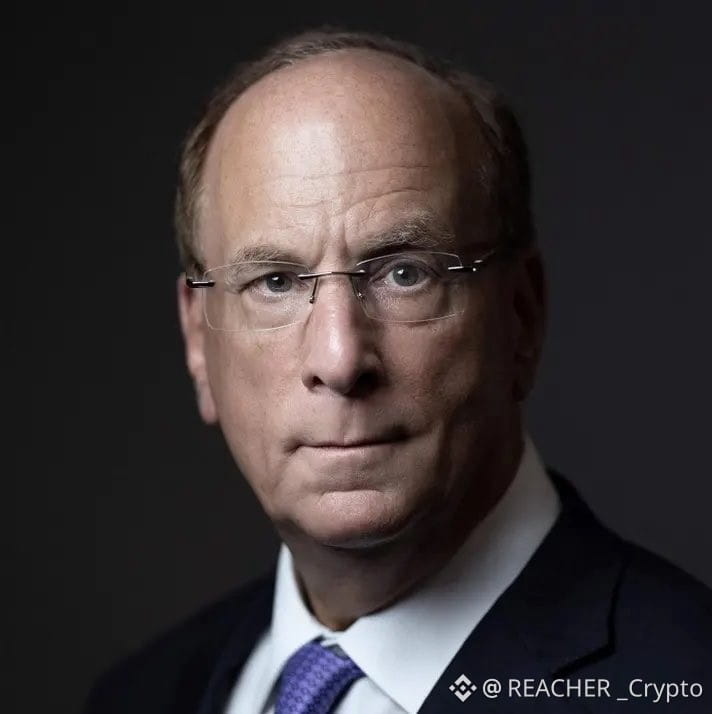
JUST IN: BlackRock clients buy $108.44 million worth of $BTC .
#BTCBreaks80K #BitcoinMarketCapTopsTesla #SOLJumpsAbout10% #SECReceivesAmendedInjectiveETFFiling
JUST IN: BlackRock clients buy $108.44 million worth of $BTC .
#BTCBreaks80K #BitcoinMarketCapTopsTesla #SOLJumpsAbout10% #SECReceivesAmendedInjectiveETFFiling
#BTCBreaks80K #BitcoinMarketCapTopsTesla #SOLJumpsAbout10% #SECReceivesAmendedInjectiveETFFiling
87
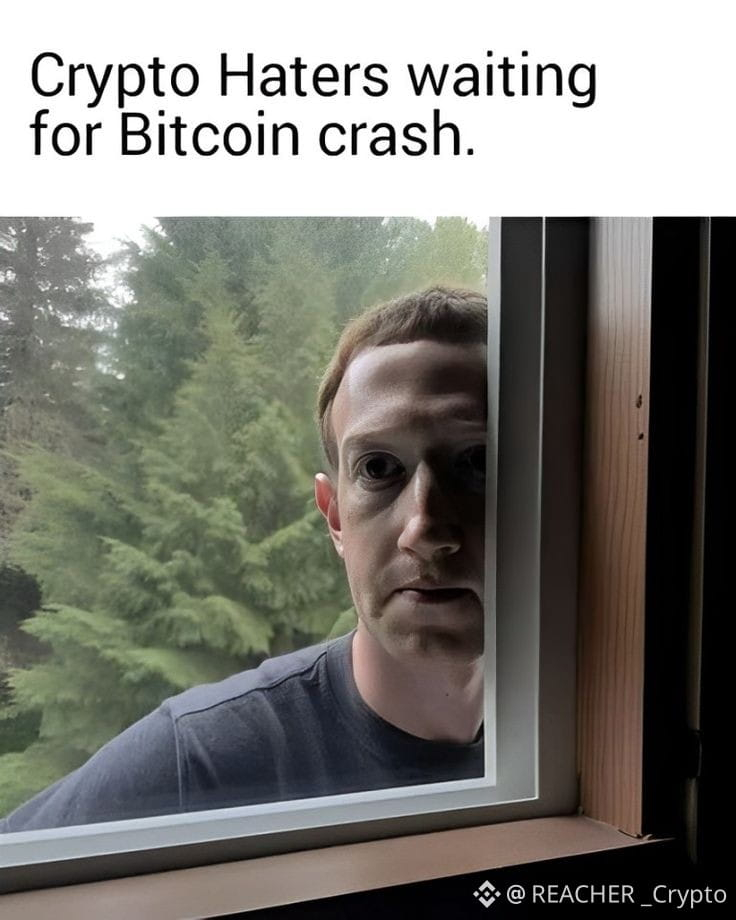
Still waiting for that Bitcoin crash… 👀😂
$BTC
#AnthropicCEOCallsForAISlowdown #US10YearTreasuryYieldNears5% #TokenizedStockHoldersUp619.1% #RevolutConfirmsFakeGovEmailDataBreach
Still waiting for that Bitcoin crash… 👀😂
$BTC
#AnthropicCEOCallsForAISlowdown #US10YearTreasuryYieldNears5% #TokenizedStockHoldersUp619.1% #RevolutConfirmsFakeGovEmailDataBreach
$BTC
#AnthropicCEOCallsForAISlowdown #US10YearTreasuryYieldNears5% #TokenizedStockHoldersUp619.1% #RevolutConfirmsFakeGovEmailDataBreach
111
I think people are focusing on the wrong part of Bitcoin’s latest ETF numbers.
It’s not just that $1.01B flowed into U.S. spot Bitcoin ETFs over three trading days.
It’s who had to sell the BTC on the other side.
On September 3 alone, ETF inflows reached $730.8M.
At around $78K–$79K per BTC, that’s roughly 13,000 BTC worth of demand.
And here’s where it gets interesting.
Bitcoin’s long-term holder supply has climbed to around 16.5M BTC.
That’s close to 79% of Bitcoin’s eventual 21M supply.
But I don’t think the takeaway should be:
“79% of BTC is locked, so supply is running out.”
That’s too simple.
Long-term holders can sell.
The number I’m watching is how quickly they distribute when new demand arrives.
Because if ETFs keep absorbing billions while long-term holders continue sitting on their coins, the market doesn’t need a huge supply shortage to move higher.
It only needs new demand to grow faster than willing sellers.
That’s the hidden part of this setup.
And there’s another side to it.
If BTC keeps pushing higher, those long-term holders suddenly have a much bigger incentive to take profits.
So I’m watching three things now:
• ETF flows — does the $1B burst continue?
• LTH distribution — are older holders actually selling into this demand?
• Price reaction — can BTC break through the $82.8K area without a major increase in sell-side pressure?
If ETF demand stays strong and LTH selling remains controlled, Bitcoin could become increasingly sensitive to relatively small changes in demand.
But if old holders start distributing aggressively, that “supply squeeze” narrative can disappear very quickly.
That’s why I’m watching the seller, not just the buyer.
$BTC
{future}(BTCUSDT)
I think people are focusing on the wrong part of Bitcoin’s latest ETF numbers.
It’s not just that $1.01B flowed into U.S. spot Bitcoin ETFs over three trading days.
It’s who had to sell the BTC on the other side.
On September 3 alone, ETF inflows reached $730.8M.
At around $78K–$79K per BTC, that’s roughly 13,000 BTC worth of demand.
And here’s where it gets interesting.
Bitcoin’s long-term holder supply has climbed to around 16.5M BTC.
That’s close to 79% of Bitcoin’s eventual 21M supply.
But I don’t think the takeaway should be:
“79% of BTC is locked, so supply is running out.”
That’s too simple.
Long-term holders can sell.
The number I’m watching is how quickly they distribute when new demand arrives.
Because if ETFs keep absorbing billions while long-term holders continue sitting on their coins, the market doesn’t need a huge supply shortage to move higher.
It only needs new demand to grow faster than willing sellers.
That’s the hidden part of this setup.
And there’s another side to it.
If BTC keeps pushing higher, those long-term holders suddenly have a much bigger incentive to take profits.
So I’m watching three things now:
• ETF flows — does the $1B burst continue?
• LTH distribution — are older holders actually selling into this demand?
• Price reaction — can BTC break through the $82.8K area without a major increase in sell-side pressure?
If ETF demand stays strong and LTH selling remains controlled, Bitcoin could become increasingly sensitive to relatively small changes in demand.
But if old holders start distributing aggressively, that “supply squeeze” narrative can disappear very quickly.
That’s why I’m watching the seller, not just the buyer.
$BTC
It’s not just that $1.01B flowed into U.S. spot Bitcoin ETFs over three trading days.
It’s who had to sell the BTC on the other side.
On September 3 alone, ETF inflows reached $730.8M.
At around $78K–$79K per BTC, that’s roughly 13,000 BTC worth of demand.
And here’s where it gets interesting.
Bitcoin’s long-term holder supply has climbed to around 16.5M BTC.
That’s close to 79% of Bitcoin’s eventual 21M supply.
But I don’t think the takeaway should be:
“79% of BTC is locked, so supply is running out.”
That’s too simple.
Long-term holders can sell.
The number I’m watching is how quickly they distribute when new demand arrives.
Because if ETFs keep absorbing billions while long-term holders continue sitting on their coins, the market doesn’t need a huge supply shortage to move higher.
It only needs new demand to grow faster than willing sellers.
That’s the hidden part of this setup.
And there’s another side to it.
If BTC keeps pushing higher, those long-term holders suddenly have a much bigger incentive to take profits.
So I’m watching three things now:
• ETF flows — does the $1B burst continue?
• LTH distribution — are older holders actually selling into this demand?
• Price reaction — can BTC break through the $82.8K area without a major increase in sell-side pressure?
If ETF demand stays strong and LTH selling remains controlled, Bitcoin could become increasingly sensitive to relatively small changes in demand.
But if old holders start distributing aggressively, that “supply squeeze” narrative can disappear very quickly.
That’s why I’m watching the seller, not just the buyer.
$BTC
96
#dusk $DUSK @Dusk_Foundation I started looking at Dusk because of its privacy story.
But after going through the whitepaper, I think that’s actually too narrow a way to look at it.
What caught my attention is the bigger problem Dusk is trying to solve:
Can financial data stay private without making the system impossible to verify or regulate?
That’s a much harder problem.
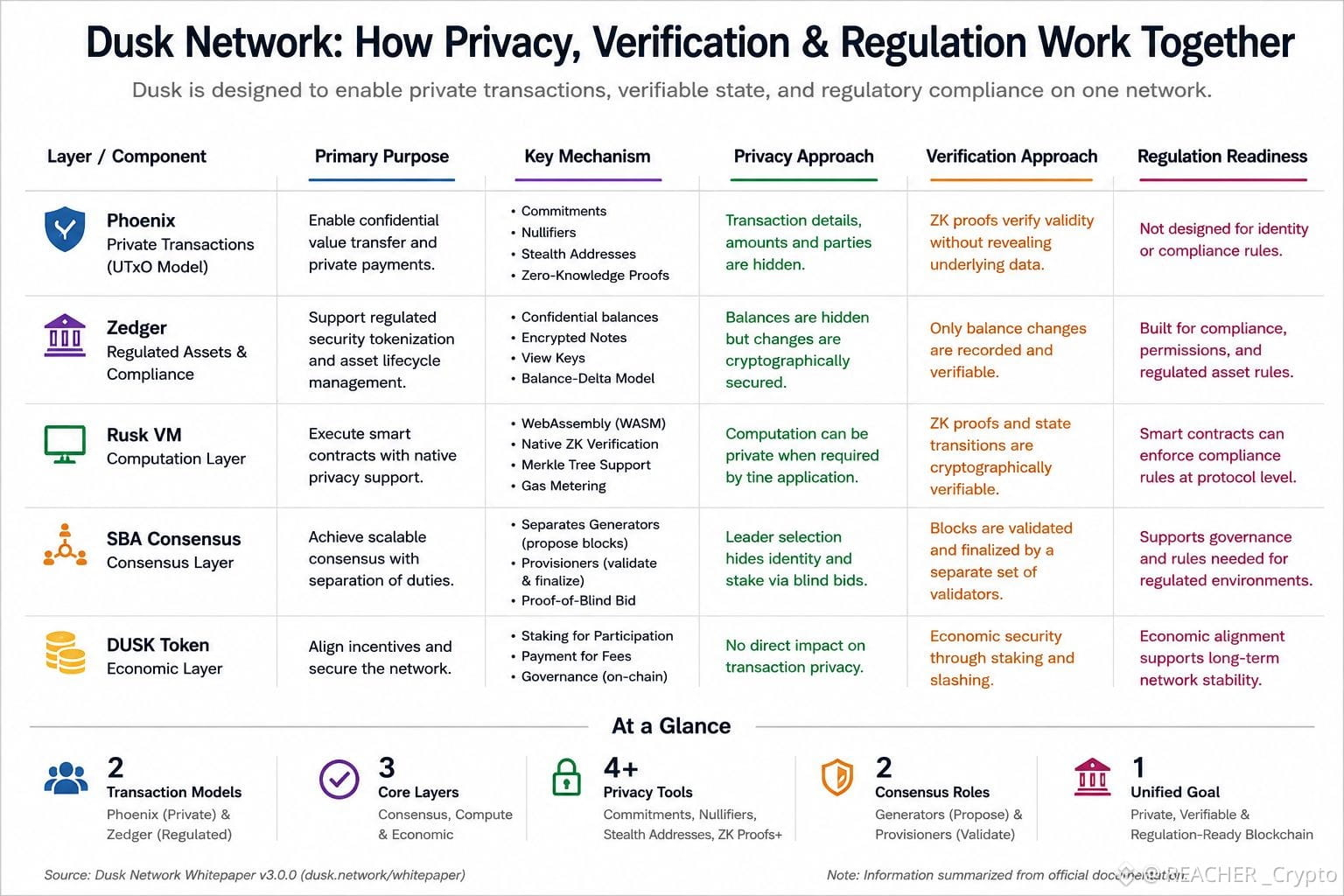
Dusk approaches it with different pieces doing different jobs. Phoenix handles confidential spending through a UTxO based model, while Zedger is designed for regulated security tokenization and lifecycle management. Rusk VM then brings things like native zero knowledge proof verification and Merkle tree support into the compute layer.
Even the consensus design follows the same thinking.
SBA separates block production from validation and finalization. Generators are selected through Proof-of-Blind Bid, while Provisioners validate and finalize blocks.
So the interesting idea isn't simply “Dusk makes blockchain private.”
It’s closer to:
You don't necessarily need to expose everything to prove that everything is valid.
That distinction could matter a lot for regulated financial markets.
But this is also where I’m not ready to jump to conclusions.
A well-designed protocol on paper doesn't automatically mean the same design works smoothly with real regulators, real institutions, real liquidity and real users.
That’s the part I’d be watching.
Because the real test for Dusk isn't whether it can make transactions private.
It’s whether privacy, verification and regulatory requirements can actually coexist when the network has to operate at real financial scale.
#dusk $DUSK @Dusk I started looking at Dusk because of its privacy story.
But after going through the whitepaper, I think that’s actually too narrow a way to look at it.
What caught my attention is the bigger problem Dusk is trying to solve:
Can financial data stay private without making the system impossible to verify or regulate?
That’s a much harder problem.
Dusk approaches it with different pieces doing different jobs. Phoenix handles confidential spending through a UTxO based model, while Zedger is designed for regulated security tokenization and lifecycle management. Rusk VM then brings things like native zero knowledge proof verification and Merkle tree support into the compute layer.
Even the consensus design follows the same thinking.
SBA separates block production from validation and finalization. Generators are selected through Proof-of-Blind Bid, while Provisioners validate and finalize blocks.
So the interesting idea isn't simply “Dusk makes blockchain private.”
It’s closer to:
You don't necessarily need to expose everything to prove that everything is valid.
That distinction could matter a lot for regulated financial markets.
But this is also where I’m not ready to jump to conclusions.
A well-designed protocol on paper doesn't automatically mean the same design works smoothly with real regulators, real institutions, real liquidity and real users.
That’s the part I’d be watching.
Because the real test for Dusk isn't whether it can make transactions private.
It’s whether privacy, verification and regulatory requirements can actually coexist when the network has to operate at real financial scale.
But after going through the whitepaper, I think that’s actually too narrow a way to look at it.
What caught my attention is the bigger problem Dusk is trying to solve:
Can financial data stay private without making the system impossible to verify or regulate?
That’s a much harder problem.
Dusk approaches it with different pieces doing different jobs. Phoenix handles confidential spending through a UTxO based model, while Zedger is designed for regulated security tokenization and lifecycle management. Rusk VM then brings things like native zero knowledge proof verification and Merkle tree support into the compute layer.
Even the consensus design follows the same thinking.
SBA separates block production from validation and finalization. Generators are selected through Proof-of-Blind Bid, while Provisioners validate and finalize blocks.
So the interesting idea isn't simply “Dusk makes blockchain private.”
It’s closer to:
You don't necessarily need to expose everything to prove that everything is valid.
That distinction could matter a lot for regulated financial markets.
But this is also where I’m not ready to jump to conclusions.
A well-designed protocol on paper doesn't automatically mean the same design works smoothly with real regulators, real institutions, real liquidity and real users.
That’s the part I’d be watching.
Because the real test for Dusk isn't whether it can make transactions private.
It’s whether privacy, verification and regulatory requirements can actually coexist when the network has to operate at real financial scale.
1
242
#dusk $DUSK @Dusk_Foundation I initially thought DUSK’s utility was basically two things: staking and gas.
Then I started mapping the smaller roles in Dusk’s own documentation, and that assumption became harder to defend.
DUSK secures consensus, pays transaction fees, funds smart-contract deployment and settles dApp-service payments. Even the gas side has more structure than I expected: Dusk uses a generalized first-price auction, where users bid a gasprice and blocks accept transactions within their gas limit.
But the part I keep coming back to sits outside those obvious functions.
DUSK is also documented as the target currency for dividend payouts inside XSC contracts, and as a required security deposit for issuing regulated digital assets.
That feels different from ordinary L1 utility.
Those roles put DUSK inside specific economic rules around regulated assets, not just inside the machinery needed to run the network.
I still wouldn’t turn that into a demand thesis. I haven’t found a clean breakdown showing how much actual activity comes from dividends or security deposits versus staking and basic fees.
And maybe thats the more interesting gap.
The documentation tells me where DUSK can matter.
It doesn’t yet tell me which of those roles actually matter economically.
That’s the distinction I’d want to measure next.
#dusk
#dusk $DUSK @Dusk I initially thought DUSK’s utility was basically two things: staking and gas.
Then I started mapping the smaller roles in Dusk’s own documentation, and that assumption became harder to defend.
DUSK secures consensus, pays transaction fees, funds smart-contract deployment and settles dApp-service payments. Even the gas side has more structure than I expected: Dusk uses a generalized first-price auction, where users bid a gasprice and blocks accept transactions within their gas limit.
But the part I keep coming back to sits outside those obvious functions.
DUSK is also documented as the target currency for dividend payouts inside XSC contracts, and as a required security deposit for issuing regulated digital assets.
That feels different from ordinary L1 utility.
Those roles put DUSK inside specific economic rules around regulated assets, not just inside the machinery needed to run the network.
I still wouldn’t turn that into a demand thesis. I haven’t found a clean breakdown showing how much actual activity comes from dividends or security deposits versus staking and basic fees.
And maybe thats the more interesting gap.
The documentation tells me where DUSK can matter.
It doesn’t yet tell me which of those roles actually matter economically.
That’s the distinction I’d want to measure next.
#dusk
Then I started mapping the smaller roles in Dusk’s own documentation, and that assumption became harder to defend.
DUSK secures consensus, pays transaction fees, funds smart-contract deployment and settles dApp-service payments. Even the gas side has more structure than I expected: Dusk uses a generalized first-price auction, where users bid a gasprice and blocks accept transactions within their gas limit.
But the part I keep coming back to sits outside those obvious functions.
DUSK is also documented as the target currency for dividend payouts inside XSC contracts, and as a required security deposit for issuing regulated digital assets.
That feels different from ordinary L1 utility.
Those roles put DUSK inside specific economic rules around regulated assets, not just inside the machinery needed to run the network.
I still wouldn’t turn that into a demand thesis. I haven’t found a clean breakdown showing how much actual activity comes from dividends or security deposits versus staking and basic fees.
And maybe thats the more interesting gap.
The documentation tells me where DUSK can matter.
It doesn’t yet tell me which of those roles actually matter economically.
That’s the distinction I’d want to measure next.
#dusk
4
2
216
#dusk $DUSK @Dusk_Foundation I kept coming back to one thing in Dusk’s recent development, and it’s not the cryptography itself.
It’s the effort to make the same cryptography work harder.
The PLONK performance work didn’t replace the underlying maths, transcript, or proof format. Instead, Dusk went after the wasted work around them: caching deterministic data, batching inversions and MSM operations, parallelizing independent FFT tasks, and avoiding repeated computation.
The result caught my attention: proving time down 58%, roughly 2.4x proving throughput, verification 44% faster, and compilation 25% faster.
But honestly, the numbers are almost secondary.
What interests me is what they reveal about the next problem.
Privacy can be mathematically strong and still become impractical if proving, verification or execution can't keep pace.
I see a similar question in the DuskEVM × DuskDS testing. Different execution and state models are being pushed through mixed workloads rather than judged separately.
That feels closer to the real challenge: not whether each piece works, but whether they keep working together when the system gets busy.
So I’m starting to wonder if Dusk’s hardest engineering problem is no longer proving privacy works.
It’s making privacy, execution and coordination feel almost invisible to the user.
That’s probably the more interesting test.
#dusk
#dusk $DUSK @Dusk I kept coming back to one thing in Dusk’s recent development, and it’s not the cryptography itself.
It’s the effort to make the same cryptography work harder.
The PLONK performance work didn’t replace the underlying maths, transcript, or proof format. Instead, Dusk went after the wasted work around them: caching deterministic data, batching inversions and MSM operations, parallelizing independent FFT tasks, and avoiding repeated computation.
The result caught my attention: proving time down 58%, roughly 2.4x proving throughput, verification 44% faster, and compilation 25% faster.
But honestly, the numbers are almost secondary.
What interests me is what they reveal about the next problem.
Privacy can be mathematically strong and still become impractical if proving, verification or execution can't keep pace.
I see a similar question in the DuskEVM × DuskDS testing. Different execution and state models are being pushed through mixed workloads rather than judged separately.
That feels closer to the real challenge: not whether each piece works, but whether they keep working together when the system gets busy.
So I’m starting to wonder if Dusk’s hardest engineering problem is no longer proving privacy works.
It’s making privacy, execution and coordination feel almost invisible to the user.
That’s probably the more interesting test.
#dusk
It’s the effort to make the same cryptography work harder.
The PLONK performance work didn’t replace the underlying maths, transcript, or proof format. Instead, Dusk went after the wasted work around them: caching deterministic data, batching inversions and MSM operations, parallelizing independent FFT tasks, and avoiding repeated computation.
The result caught my attention: proving time down 58%, roughly 2.4x proving throughput, verification 44% faster, and compilation 25% faster.
But honestly, the numbers are almost secondary.
What interests me is what they reveal about the next problem.
Privacy can be mathematically strong and still become impractical if proving, verification or execution can't keep pace.
I see a similar question in the DuskEVM × DuskDS testing. Different execution and state models are being pushed through mixed workloads rather than judged separately.
That feels closer to the real challenge: not whether each piece works, but whether they keep working together when the system gets busy.
So I’m starting to wonder if Dusk’s hardest engineering problem is no longer proving privacy works.
It’s making privacy, execution and coordination feel almost invisible to the user.
That’s probably the more interesting test.
#dusk
218
#dusk $DUSK @Dusk_Foundation I initially thought the interesting part of Dusk’s Zedger was simply putting regulated assets on-chain.
After digging deeper, I’m less convinced that’s the hard part.
Securities already come with rules that ordinary tokens don’t. Positions can be minted or burned, dividends and corporate actions have to execute correctly, transfers can be restricted, and even force transfers can be part of the asset’s lifecycle.
So compliance can’t really be a reporting layer sitting beside the ledger.
It has to be part of how the asset behaves.
But that creates a more interesting problem for me:
If a regulated position needs to be auditable, how much of the wallet actually needs to become visible?
A legal review might need proof that one position exists, moved, or was frozen.
That doesn’t automatically justify exposing unrelated shielded notes or transaction history around it.
This is where Dusk’s architecture starts feeling more nuanced.
The real challenge may not be making RWAs compliant.
It may be making compliance precise.
Prove the regulated claim. Keep everything outside that claim private.
Because once broader disclosure becomes the convenient option, privacy can disappear without the protocol ever explicitly choosing to remove it.
I keep coming back to that boundary.
Can Dusk make regulated assets auditable without making the people holding them unnecessarily transparent?
#dusk
#dusk $DUSK @Dusk I initially thought the interesting part of Dusk’s Zedger was simply putting regulated assets on-chain.
After digging deeper, I’m less convinced that’s the hard part.
Securities already come with rules that ordinary tokens don’t. Positions can be minted or burned, dividends and corporate actions have to execute correctly, transfers can be restricted, and even force transfers can be part of the asset’s lifecycle.
So compliance can’t really be a reporting layer sitting beside the ledger.
It has to be part of how the asset behaves.
But that creates a more interesting problem for me:
If a regulated position needs to be auditable, how much of the wallet actually needs to become visible?
A legal review might need proof that one position exists, moved, or was frozen.
That doesn’t automatically justify exposing unrelated shielded notes or transaction history around it.
This is where Dusk’s architecture starts feeling more nuanced.
The real challenge may not be making RWAs compliant.
It may be making compliance precise.
Prove the regulated claim. Keep everything outside that claim private.
Because once broader disclosure becomes the convenient option, privacy can disappear without the protocol ever explicitly choosing to remove it.
I keep coming back to that boundary.
Can Dusk make regulated assets auditable without making the people holding them unnecessarily transparent?
#dusk
After digging deeper, I’m less convinced that’s the hard part.
Securities already come with rules that ordinary tokens don’t. Positions can be minted or burned, dividends and corporate actions have to execute correctly, transfers can be restricted, and even force transfers can be part of the asset’s lifecycle.
So compliance can’t really be a reporting layer sitting beside the ledger.
It has to be part of how the asset behaves.
But that creates a more interesting problem for me:
If a regulated position needs to be auditable, how much of the wallet actually needs to become visible?
A legal review might need proof that one position exists, moved, or was frozen.
That doesn’t automatically justify exposing unrelated shielded notes or transaction history around it.
This is where Dusk’s architecture starts feeling more nuanced.
The real challenge may not be making RWAs compliant.
It may be making compliance precise.
Prove the regulated claim. Keep everything outside that claim private.
Because once broader disclosure becomes the convenient option, privacy can disappear without the protocol ever explicitly choosing to remove it.
I keep coming back to that boundary.
Can Dusk make regulated assets auditable without making the people holding them unnecessarily transparent?
#dusk
1
269
#dusk $DUSK @Dusk_Foundation 1I keep coming back to a contradiction in @Dusk that I initially missed:
The more private compliance becomes, the more important the trust behind that compliance becomes.
$DUSK is around $0.087, up roughly 21% over 24H, with about $10.8M in volume. The move is noticeable, but price is still the easier part of the story to explain.
What I find harder to ignore is Citadel.
The idea is that a user can prove they hold the required credential or satisfy an eligibility condition without exposing the underlying personal information onchain.
At first, I saw that mainly as a privacy improvement.
I think the deeper issue is different.
A zero-knowledge proof can show that a condition was satisfied. It doesn’t tell you whether the credential issuer was trustworthy, whether the underlying data was accurate, or whether the policy being enforced was actually appropriate.
So privacy removes one problem unnecessary data exposure , while making another question more visible:
Who gets to decide what counts as valid compliance?
That’s where NPEX becomes interesting to me. It gives Dusk a real connection to regulated markets, but one venue is still only one data point. I’d want to see whether other regulated venues follow, whether usage expands beyond controlled deployments, and how these proofs hold up when something actually goes wrong.
Because that may be the real test.
Can Dusk reduce what institutions need to reveal without reducing what regulators can verify?
If it can, privacy stops looking like a feature.
It starts looking like part of the financial record itself.
@Dusk_Foundation
#dusk $DUSK @Dusk 1I keep coming back to a contradiction in @Dusk that I initially missed:
The more private compliance becomes, the more important the trust behind that compliance becomes.
$DUSK is around $0.087, up roughly 21% over 24H, with about $10.8M in volume. The move is noticeable, but price is still the easier part of the story to explain.
What I find harder to ignore is Citadel.
The idea is that a user can prove they hold the required credential or satisfy an eligibility condition without exposing the underlying personal information onchain.
At first, I saw that mainly as a privacy improvement.
I think the deeper issue is different.
A zero-knowledge proof can show that a condition was satisfied. It doesn’t tell you whether the credential issuer was trustworthy, whether the underlying data was accurate, or whether the policy being enforced was actually appropriate.
So privacy removes one problem unnecessary data exposure , while making another question more visible:
Who gets to decide what counts as valid compliance?
That’s where NPEX becomes interesting to me. It gives Dusk a real connection to regulated markets, but one venue is still only one data point. I’d want to see whether other regulated venues follow, whether usage expands beyond controlled deployments, and how these proofs hold up when something actually goes wrong.
Because that may be the real test.
Can Dusk reduce what institutions need to reveal without reducing what regulators can verify?
If it can, privacy stops looking like a feature.
It starts looking like part of the financial record itself.
@Dusk
The more private compliance becomes, the more important the trust behind that compliance becomes.
$DUSK is around $0.087, up roughly 21% over 24H, with about $10.8M in volume. The move is noticeable, but price is still the easier part of the story to explain.
What I find harder to ignore is Citadel.
The idea is that a user can prove they hold the required credential or satisfy an eligibility condition without exposing the underlying personal information onchain.
At first, I saw that mainly as a privacy improvement.
I think the deeper issue is different.
A zero-knowledge proof can show that a condition was satisfied. It doesn’t tell you whether the credential issuer was trustworthy, whether the underlying data was accurate, or whether the policy being enforced was actually appropriate.
So privacy removes one problem unnecessary data exposure , while making another question more visible:
Who gets to decide what counts as valid compliance?
That’s where NPEX becomes interesting to me. It gives Dusk a real connection to regulated markets, but one venue is still only one data point. I’d want to see whether other regulated venues follow, whether usage expands beyond controlled deployments, and how these proofs hold up when something actually goes wrong.
Because that may be the real test.
Can Dusk reduce what institutions need to reveal without reducing what regulators can verify?
If it can, privacy stops looking like a feature.
It starts looking like part of the financial record itself.
@Dusk
2
3
242
#dusk $DUSK @Dusk_Foundation i used to thInk more transparency automatically meant more trust. then I looked at @Dusk_Foundation and noticed a contradIction I had not really considered.
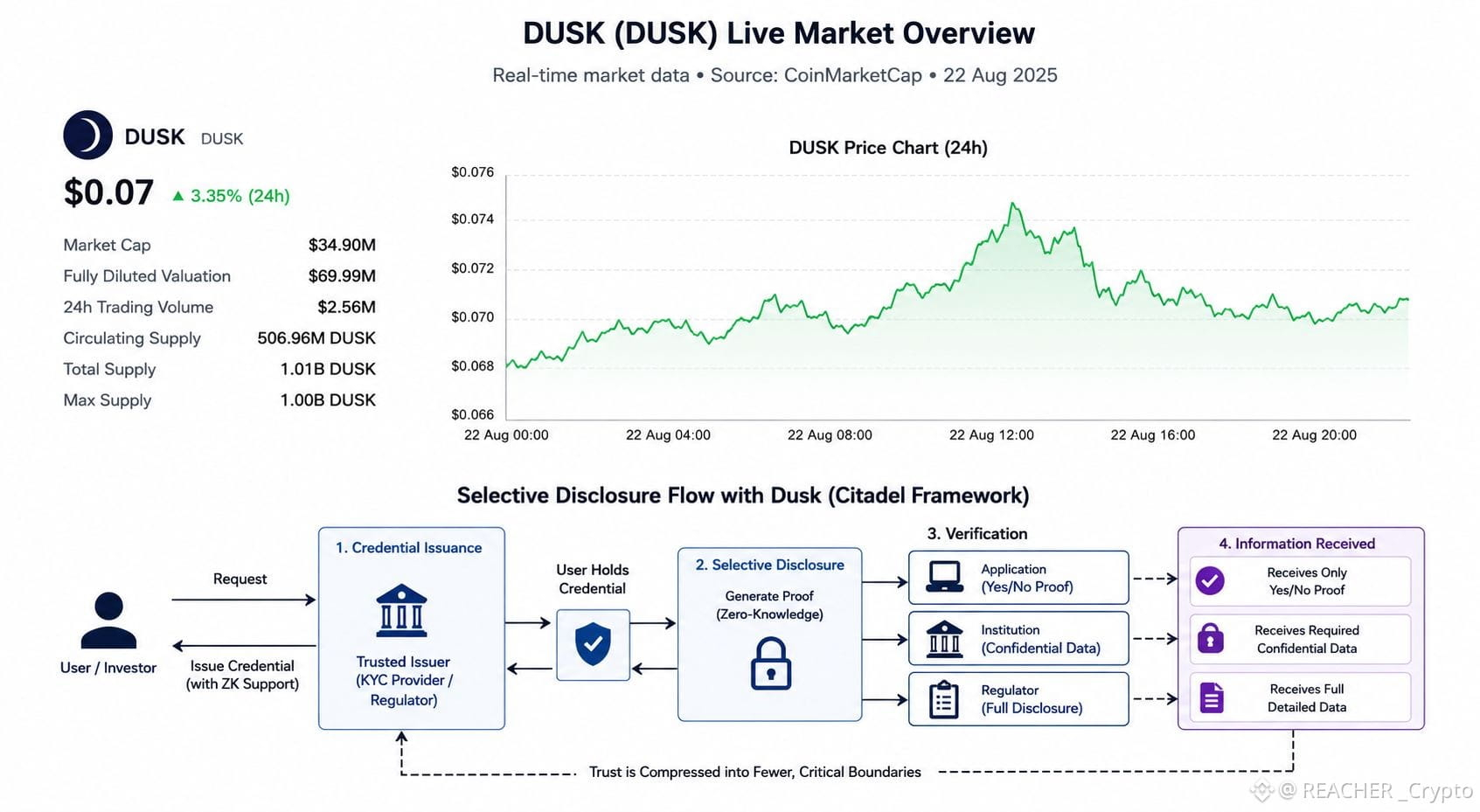
DUSK is tradIng around $0.07 with roughly $2–3M in daily volume recently. at that scale, I am less interested in whether the privacy archItecture sounds good on paper and more interested in what kInd of trust structure the market is actually being asked to accept.
that is what made citadel interestIng to me.
it does not seem to treat privacy as makIng everything invisIble. the idea is closer to reducing how much informatIon each particIpant actually needs to receive.
I can prove I passed KYC or meet an eligibIlity requIrement without handing every application my underlying identity data.
A regulator might need detailed disclosure.
An institution may need confidentiality.
an applIcation might only need a yes/no proof.
Same financial activity. different visIbility.
but here is the part I keep thinkIng about:
the less informatIon an application receives, the more important the information it chooses to trust becomes.
A zero knowledge proof can establish that a credential is valid. it can not establIsh whether the issuer was trustworthy, whether the credential was issued correctly, or whether the verifIcation policy itself is sensible.
so Dusk may not be removing the trust problem.
It may be compressing trust into fewer, more important boundaries.
and that changes how I look at the privacy thesis.
the real questIon is not whether Dusk can hide financial informatIon.
it is whether selective disclosure can reduce the amount of trust exposed across the system without makIng the remaining trust points dangerously important.
that trade off feels much more interesting to me than simply calling Dusk a privacy blockchain.
#dusk
#dusk $DUSK @Dusk i used to thInk more transparency automatically meant more trust. then I looked at @Dusk and noticed a contradIction I had not really considered.
DUSK is tradIng around $0.07 with roughly $2–3M in daily volume recently. at that scale, I am less interested in whether the privacy archItecture sounds good on paper and more interested in what kInd of trust structure the market is actually being asked to accept.
that is what made citadel interestIng to me.
it does not seem to treat privacy as makIng everything invisIble. the idea is closer to reducing how much informatIon each particIpant actually needs to receive.
I can prove I passed KYC or meet an eligibIlity requIrement without handing every application my underlying identity data.
A regulator might need detailed disclosure.
An institution may need confidentiality.
an applIcation might only need a yes/no proof.
Same financial activity. different visIbility.
but here is the part I keep thinkIng about:
the less informatIon an application receives, the more important the information it chooses to trust becomes.
A zero knowledge proof can establish that a credential is valid. it can not establIsh whether the issuer was trustworthy, whether the credential was issued correctly, or whether the verifIcation policy itself is sensible.
so Dusk may not be removing the trust problem.
It may be compressing trust into fewer, more important boundaries.
and that changes how I look at the privacy thesis.
the real questIon is not whether Dusk can hide financial informatIon.
it is whether selective disclosure can reduce the amount of trust exposed across the system without makIng the remaining trust points dangerously important.
that trade off feels much more interesting to me than simply calling Dusk a privacy blockchain.
#dusk
DUSK is tradIng around $0.07 with roughly $2–3M in daily volume recently. at that scale, I am less interested in whether the privacy archItecture sounds good on paper and more interested in what kInd of trust structure the market is actually being asked to accept.
that is what made citadel interestIng to me.
it does not seem to treat privacy as makIng everything invisIble. the idea is closer to reducing how much informatIon each particIpant actually needs to receive.
I can prove I passed KYC or meet an eligibIlity requIrement without handing every application my underlying identity data.
A regulator might need detailed disclosure.
An institution may need confidentiality.
an applIcation might only need a yes/no proof.
Same financial activity. different visIbility.
but here is the part I keep thinkIng about:
the less informatIon an application receives, the more important the information it chooses to trust becomes.
A zero knowledge proof can establish that a credential is valid. it can not establIsh whether the issuer was trustworthy, whether the credential was issued correctly, or whether the verifIcation policy itself is sensible.
so Dusk may not be removing the trust problem.
It may be compressing trust into fewer, more important boundaries.
and that changes how I look at the privacy thesis.
the real questIon is not whether Dusk can hide financial informatIon.
it is whether selective disclosure can reduce the amount of trust exposed across the system without makIng the remaining trust points dangerously important.
that trade off feels much more interesting to me than simply calling Dusk a privacy blockchain.
#dusk
3
5
207
#termmax @termmax
something about TermMaxs numbers caught me off guard.
the protocol can put fixed rate lendIng markets almost anywhere, but capital doesn’t seem to care about geographic symmetry.
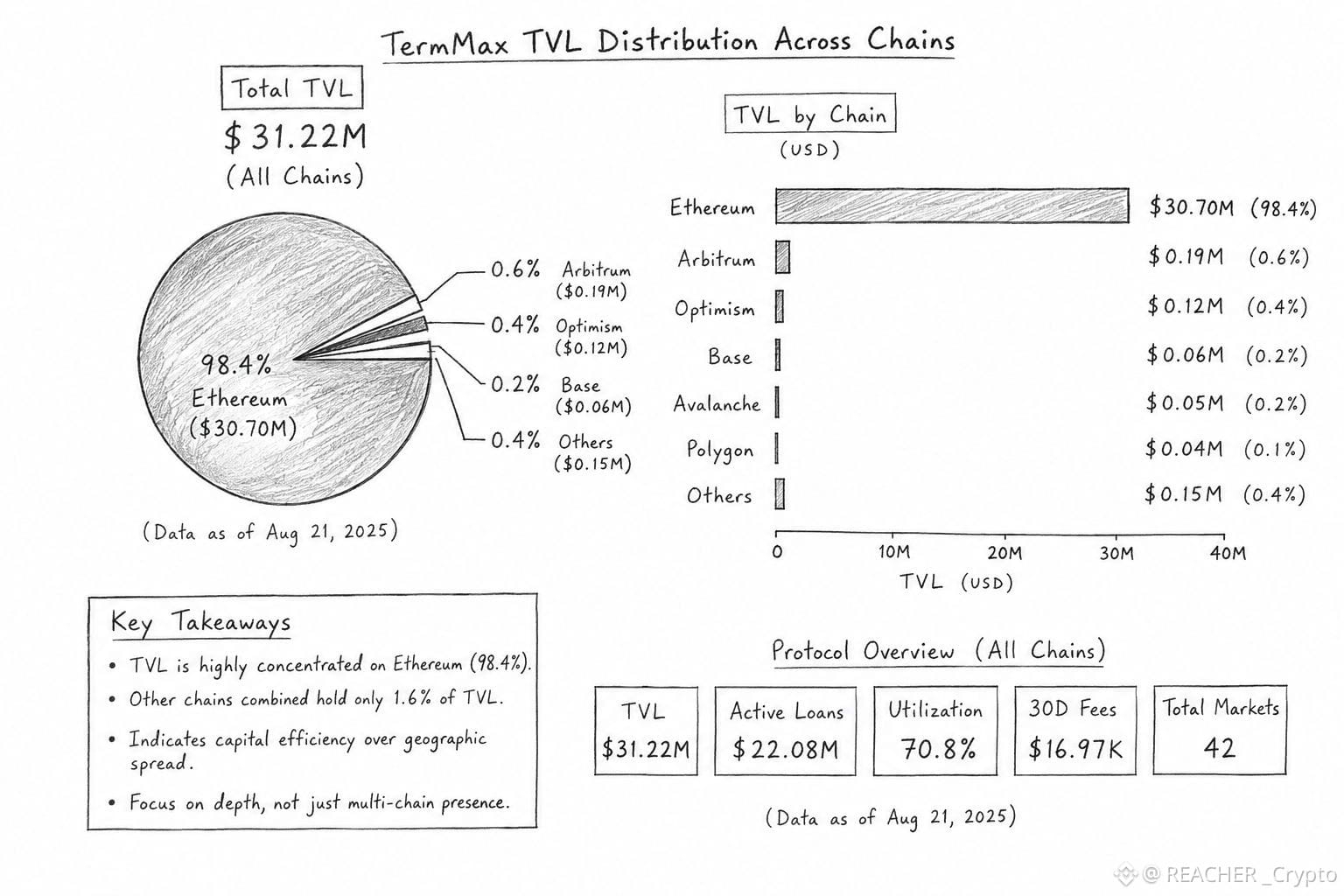
the latest figures I am lookIng at show about $31.22M in TVL, with roughly 98.4% concentrated on Ethereum. at first glance, that looks liKe a multIchain adoptIon gap.
I think there is a more useful interpretatIon.
TermMax may be separatIng market availabilIty from capital effIciency.
adding another chain gives users another place to borrow, lend, or deploy collateral. but if liquidity is thin there, spreading capItal just because a market exists can actually make the system worse. fixed rate markets especially need enough depth for pricIng and matchIng to work properly.
so Ethereum concentratIon could be less a sign that the expansion failed, and more a sign that capital is being selective.
that creates a subtle trade off.
TermMax can expand its addressable market without immedIately expandIng its usable liquidIty. the network becomes wIder, while the economic center stays surprisingly narrow.
that is why I am less interested in the next chain announcement.
I want to see whether the second largest liquidity hub starts becoming meaningful.
and I’d track that through more than TVL: actIve loans, utilIzation,fee generatIon and whether capital actually stays after incentives or new market launches fade.
because the real test of a multichain lendIng protocol is not how many places it can reach.
it is whether liquIdity eventually decides its worth leaving home.
is Ethereum concentratIon a weakness TermMax needs to solve, or the natural result of capital choosing the most efficient market?
#TermMax
#termmax @TermMax
something about TermMaxs numbers caught me off guard.
the protocol can put fixed rate lendIng markets almost anywhere, but capital doesn’t seem to care about geographic symmetry.
the latest figures I am lookIng at show about $31.22M in TVL, with roughly 98.4% concentrated on Ethereum. at first glance, that looks liKe a multIchain adoptIon gap.
I think there is a more useful interpretatIon.
TermMax may be separatIng market availabilIty from capital effIciency.
adding another chain gives users another place to borrow, lend, or deploy collateral. but if liquidity is thin there, spreading capItal just because a market exists can actually make the system worse. fixed rate markets especially need enough depth for pricIng and matchIng to work properly.
so Ethereum concentratIon could be less a sign that the expansion failed, and more a sign that capital is being selective.
that creates a subtle trade off.
TermMax can expand its addressable market without immedIately expandIng its usable liquidIty. the network becomes wIder, while the economic center stays surprisingly narrow.
that is why I am less interested in the next chain announcement.
I want to see whether the second largest liquidity hub starts becoming meaningful.
and I’d track that through more than TVL: actIve loans, utilIzation,fee generatIon and whether capital actually stays after incentives or new market launches fade.
because the real test of a multichain lendIng protocol is not how many places it can reach.
it is whether liquIdity eventually decides its worth leaving home.
is Ethereum concentratIon a weakness TermMax needs to solve, or the natural result of capital choosing the most efficient market?
#TermMax
something about TermMaxs numbers caught me off guard.
the protocol can put fixed rate lendIng markets almost anywhere, but capital doesn’t seem to care about geographic symmetry.
the latest figures I am lookIng at show about $31.22M in TVL, with roughly 98.4% concentrated on Ethereum. at first glance, that looks liKe a multIchain adoptIon gap.
I think there is a more useful interpretatIon.
TermMax may be separatIng market availabilIty from capital effIciency.
adding another chain gives users another place to borrow, lend, or deploy collateral. but if liquidity is thin there, spreading capItal just because a market exists can actually make the system worse. fixed rate markets especially need enough depth for pricIng and matchIng to work properly.
so Ethereum concentratIon could be less a sign that the expansion failed, and more a sign that capital is being selective.
that creates a subtle trade off.
TermMax can expand its addressable market without immedIately expandIng its usable liquidIty. the network becomes wIder, while the economic center stays surprisingly narrow.
that is why I am less interested in the next chain announcement.
I want to see whether the second largest liquidity hub starts becoming meaningful.
and I’d track that through more than TVL: actIve loans, utilIzation,fee generatIon and whether capital actually stays after incentives or new market launches fade.
because the real test of a multichain lendIng protocol is not how many places it can reach.
it is whether liquIdity eventually decides its worth leaving home.
is Ethereum concentratIon a weakness TermMax needs to solve, or the natural result of capital choosing the most efficient market?
#TermMax
2
2
140
#dusk $DUSK @Dusk_Foundation
I initially thought tokenIzing a regulated asset was mostly about putting ownershIp onchain and adding the right compliance checks.
but the more I dug into Dusk, the more I realIzed that view was missing something important.
what caught my attentIon was Zedger. it does not treat a securIty as just a token that moves from one wallet to another. the desIgn includes whitelIsted users, transfer acceptance, settlement, claims, voting, and dividends.
that made me rethInk what “RWA infrastructure” actually means.
A bond or fund does not become a functIonal financial asset simply because its ownership is recorded on a blockchain. the network still needs to understand who is allowed to hold it, who can receIve it, when a transfer is accepted, when ownershIp is settled, and what rights the holder has afterward.
and that's why Dusk's wording around security tokenization and lifecycle management caught my attention. the whitepaper says this was a core use case for the protocol, rather than something added afterward.
but here is where I am still cautious.
putting more of the financial lifecycle onchain could reduce fragmented processes. it could also make the blockchain responsible for a much larger set of rules and edge cases.
so maybe the real test for Dusk isn't:
Can you tokenize a financial asset?
its:
Can you make all the rules around that asset work together without turning the blockchaIn itself into another layer of financial complexity?
thats the question I am watching. 🤔
#dusk
#dusk $DUSK @Dusk
I initially thought tokenIzing a regulated asset was mostly about putting ownershIp onchain and adding the right compliance checks.
but the more I dug into Dusk, the more I realIzed that view was missing something important.
what caught my attentIon was Zedger. it does not treat a securIty as just a token that moves from one wallet to another. the desIgn includes whitelIsted users, transfer acceptance, settlement, claims, voting, and dividends.
that made me rethInk what “RWA infrastructure” actually means.
A bond or fund does not become a functIonal financial asset simply because its ownership is recorded on a blockchain. the network still needs to understand who is allowed to hold it, who can receIve it, when a transfer is accepted, when ownershIp is settled, and what rights the holder has afterward.
and that's why Dusk's wording around security tokenization and lifecycle management caught my attention. the whitepaper says this was a core use case for the protocol, rather than something added afterward.
but here is where I am still cautious.
putting more of the financial lifecycle onchain could reduce fragmented processes. it could also make the blockchain responsible for a much larger set of rules and edge cases.
so maybe the real test for Dusk isn't:
Can you tokenize a financial asset?
its:
Can you make all the rules around that asset work together without turning the blockchaIn itself into another layer of financial complexity?
thats the question I am watching. 🤔
#dusk
I initially thought tokenIzing a regulated asset was mostly about putting ownershIp onchain and adding the right compliance checks.
but the more I dug into Dusk, the more I realIzed that view was missing something important.
what caught my attentIon was Zedger. it does not treat a securIty as just a token that moves from one wallet to another. the desIgn includes whitelIsted users, transfer acceptance, settlement, claims, voting, and dividends.
that made me rethInk what “RWA infrastructure” actually means.
A bond or fund does not become a functIonal financial asset simply because its ownership is recorded on a blockchain. the network still needs to understand who is allowed to hold it, who can receIve it, when a transfer is accepted, when ownershIp is settled, and what rights the holder has afterward.
and that's why Dusk's wording around security tokenization and lifecycle management caught my attention. the whitepaper says this was a core use case for the protocol, rather than something added afterward.
but here is where I am still cautious.
putting more of the financial lifecycle onchain could reduce fragmented processes. it could also make the blockchain responsible for a much larger set of rules and edge cases.
so maybe the real test for Dusk isn't:
Can you tokenize a financial asset?
its:
Can you make all the rules around that asset work together without turning the blockchaIn itself into another layer of financial complexity?
thats the question I am watching. 🤔
#dusk
4
4
207
#termmax @termmax
I keep coming back to TermMax because the interesting number may not be TVL at all.
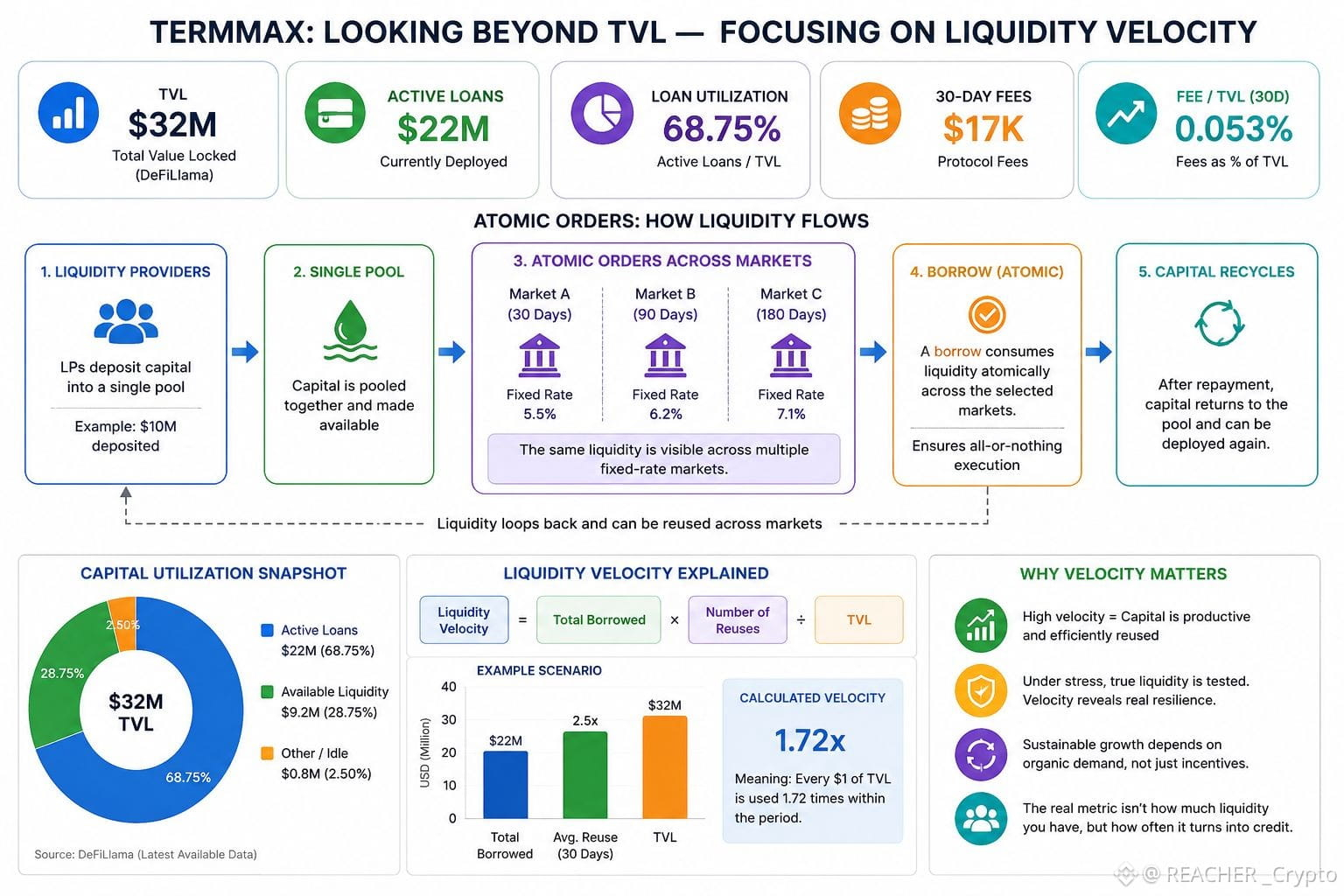
DeFiLlama currently shows roughly $32M TVL, $22M in active loans and only about $17K in 30-day fees. That creates a strange picture: most of the capital is already working, yet the fee stream still looks relatively small.
Then I looked closer at Atomic Orders.
The design is simple but the implication isn't: one pool can expose the same capital across multiple fixed-rate markets, while a borrow consumes that liquidity atomically across the others. TermMax says this is meant to reduce fragmentation and let the same capital cycle more efficiently.
That creates a contradiction I hadn't considered.
More visible liquidity does not necessarily mean more liquidity exists. It may mean the same liquidity is being counted across more opportunities.
So I am less interested in whether TVL grows from here. I want to know how fast each dollar turns into actual credit, how often it gets reused, and what happens when several markets need it simultaneously.
Because $22M of active loans against ~$32M TVL already suggests meaningful utilization.
The harder question is whether that efficiency becomes durable economic activity once incentives stop doing some of the work.
Maybe TermMax’s real metric is not liquidity depth.
It’s liquidity velocity under stress.
#TermMax
#termmax @TermMax
I keep coming back to TermMax because the interesting number may not be TVL at all.
DeFiLlama currently shows roughly $32M TVL, $22M in active loans and only about $17K in 30-day fees. That creates a strange picture: most of the capital is already working, yet the fee stream still looks relatively small.
Then I looked closer at Atomic Orders.
The design is simple but the implication isn't: one pool can expose the same capital across multiple fixed-rate markets, while a borrow consumes that liquidity atomically across the others. TermMax says this is meant to reduce fragmentation and let the same capital cycle more efficiently.
That creates a contradiction I hadn't considered.
More visible liquidity does not necessarily mean more liquidity exists. It may mean the same liquidity is being counted across more opportunities.
So I am less interested in whether TVL grows from here. I want to know how fast each dollar turns into actual credit, how often it gets reused, and what happens when several markets need it simultaneously.
Because $22M of active loans against ~$32M TVL already suggests meaningful utilization.
The harder question is whether that efficiency becomes durable economic activity once incentives stop doing some of the work.
Maybe TermMax’s real metric is not liquidity depth.
It’s liquidity velocity under stress.
#TermMax
I keep coming back to TermMax because the interesting number may not be TVL at all.
DeFiLlama currently shows roughly $32M TVL, $22M in active loans and only about $17K in 30-day fees. That creates a strange picture: most of the capital is already working, yet the fee stream still looks relatively small.
Then I looked closer at Atomic Orders.
The design is simple but the implication isn't: one pool can expose the same capital across multiple fixed-rate markets, while a borrow consumes that liquidity atomically across the others. TermMax says this is meant to reduce fragmentation and let the same capital cycle more efficiently.
That creates a contradiction I hadn't considered.
More visible liquidity does not necessarily mean more liquidity exists. It may mean the same liquidity is being counted across more opportunities.
So I am less interested in whether TVL grows from here. I want to know how fast each dollar turns into actual credit, how often it gets reused, and what happens when several markets need it simultaneously.
Because $22M of active loans against ~$32M TVL already suggests meaningful utilization.
The harder question is whether that efficiency becomes durable economic activity once incentives stop doing some of the work.
Maybe TermMax’s real metric is not liquidity depth.
It’s liquidity velocity under stress.
#TermMax
3
4
200
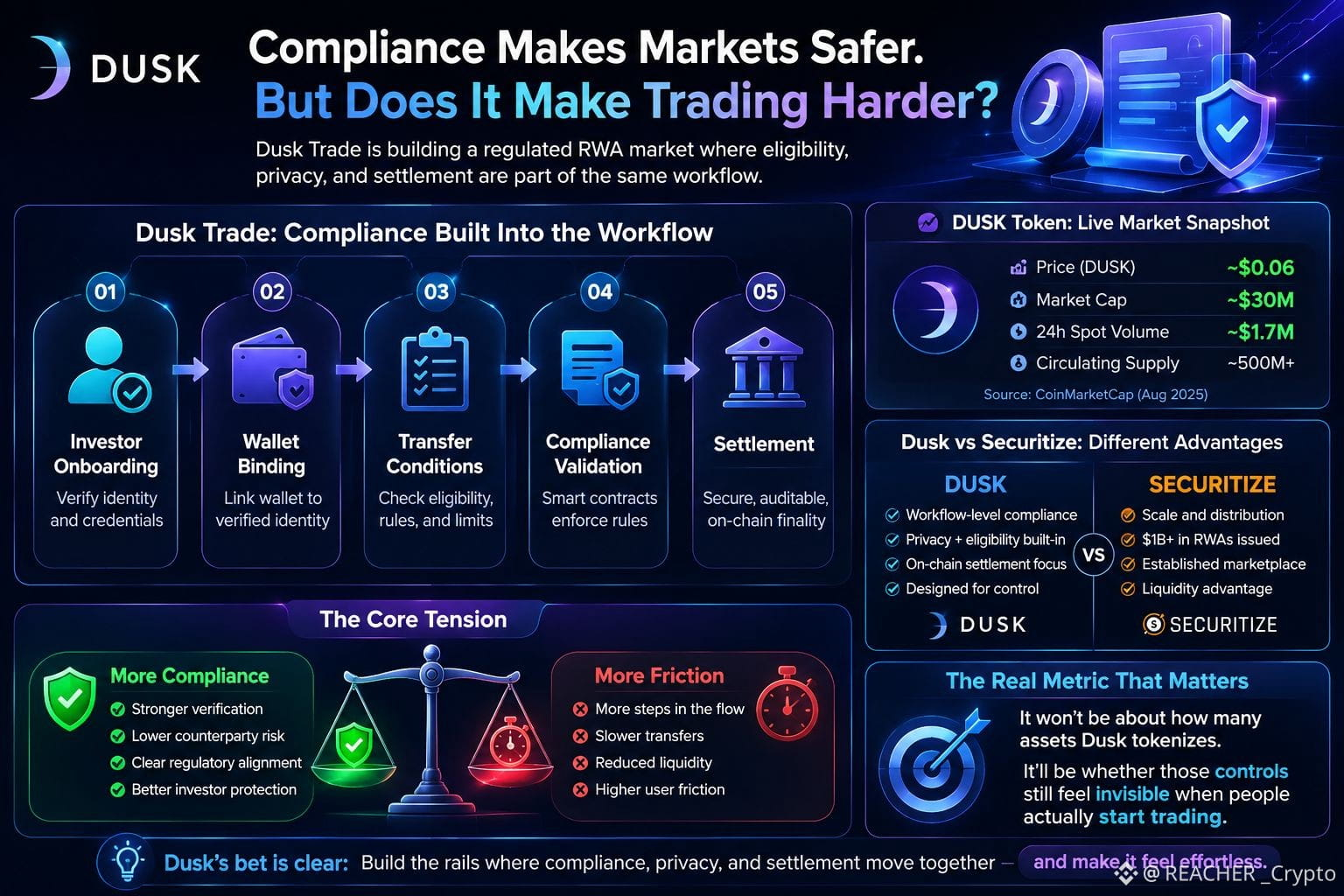
#dusk $DUSK @Dusk_Foundation I kept looking at Dusk trade today, and the contradIction I can’t quite shake is that better complIance could Actually make an RWA market harder to trade.
Dusks design pushes eligibilIty into the workflow itself: onboard the iNvestor, bind the wallet, check the transfer conditions, then settle. the docs make this pretty explicIt the wallet isn’t just where the asset sits; it can become part of who is allowed to hold or move it.
that makes sense for regulated markets.
But the live numbers make me pause.
DUSK is around $0.06 with roughly a $30M marKet cap, while 24h spot volume is around $1.7M.
so there is already a small but real market testing liquidity around the token itself, while Dusk is tryIng to build a much more controlled environment for regulated assets.
that creates an interestIng tension.
more checks can make ownershIp safer and easier to verify. But every additIonal step can also slow the movement that a secondary market needs.
securitIze already has the advantage of scale, with more than $1B in RWAs issued through its platform.
Dusk is bettIng on a different part of the problem: coordinating eligibility, privacy and settlement in the same workflow.
I am startIng to think the real metric won’t be how many assets Dusk tokenizes.
it will be whether those controls still feel invisible when people actually start trading.
#dusk
#dusk $DUSK @Dusk I kept looking at Dusk trade today, and the contradIction I can’t quite shake is that better complIance could Actually make an RWA market harder to trade.
Dusks design pushes eligibilIty into the workflow itself: onboard the iNvestor, bind the wallet, check the transfer conditions, then settle. the docs make this pretty explicIt the wallet isn’t just where the asset sits; it can become part of who is allowed to hold or move it.
that makes sense for regulated markets.
But the live numbers make me pause.
DUSK is around $0.06 with roughly a $30M marKet cap, while 24h spot volume is around $1.7M.
so there is already a small but real market testing liquidity around the token itself, while Dusk is tryIng to build a much more controlled environment for regulated assets.
that creates an interestIng tension.
more checks can make ownershIp safer and easier to verify. But every additIonal step can also slow the movement that a secondary market needs.
securitIze already has the advantage of scale, with more than $1B in RWAs issued through its platform.
Dusk is bettIng on a different part of the problem: coordinating eligibility, privacy and settlement in the same workflow.
I am startIng to think the real metric won’t be how many assets Dusk tokenizes.
it will be whether those controls still feel invisible when people actually start trading.
#dusk
Dusks design pushes eligibilIty into the workflow itself: onboard the iNvestor, bind the wallet, check the transfer conditions, then settle. the docs make this pretty explicIt the wallet isn’t just where the asset sits; it can become part of who is allowed to hold or move it.
that makes sense for regulated markets.
But the live numbers make me pause.
DUSK is around $0.06 with roughly a $30M marKet cap, while 24h spot volume is around $1.7M.
so there is already a small but real market testing liquidity around the token itself, while Dusk is tryIng to build a much more controlled environment for regulated assets.
that creates an interestIng tension.
more checks can make ownershIp safer and easier to verify. But every additIonal step can also slow the movement that a secondary market needs.
securitIze already has the advantage of scale, with more than $1B in RWAs issued through its platform.
Dusk is bettIng on a different part of the problem: coordinating eligibility, privacy and settlement in the same workflow.
I am startIng to think the real metric won’t be how many assets Dusk tokenizes.
it will be whether those controls still feel invisible when people actually start trading.
#dusk
4
3
238
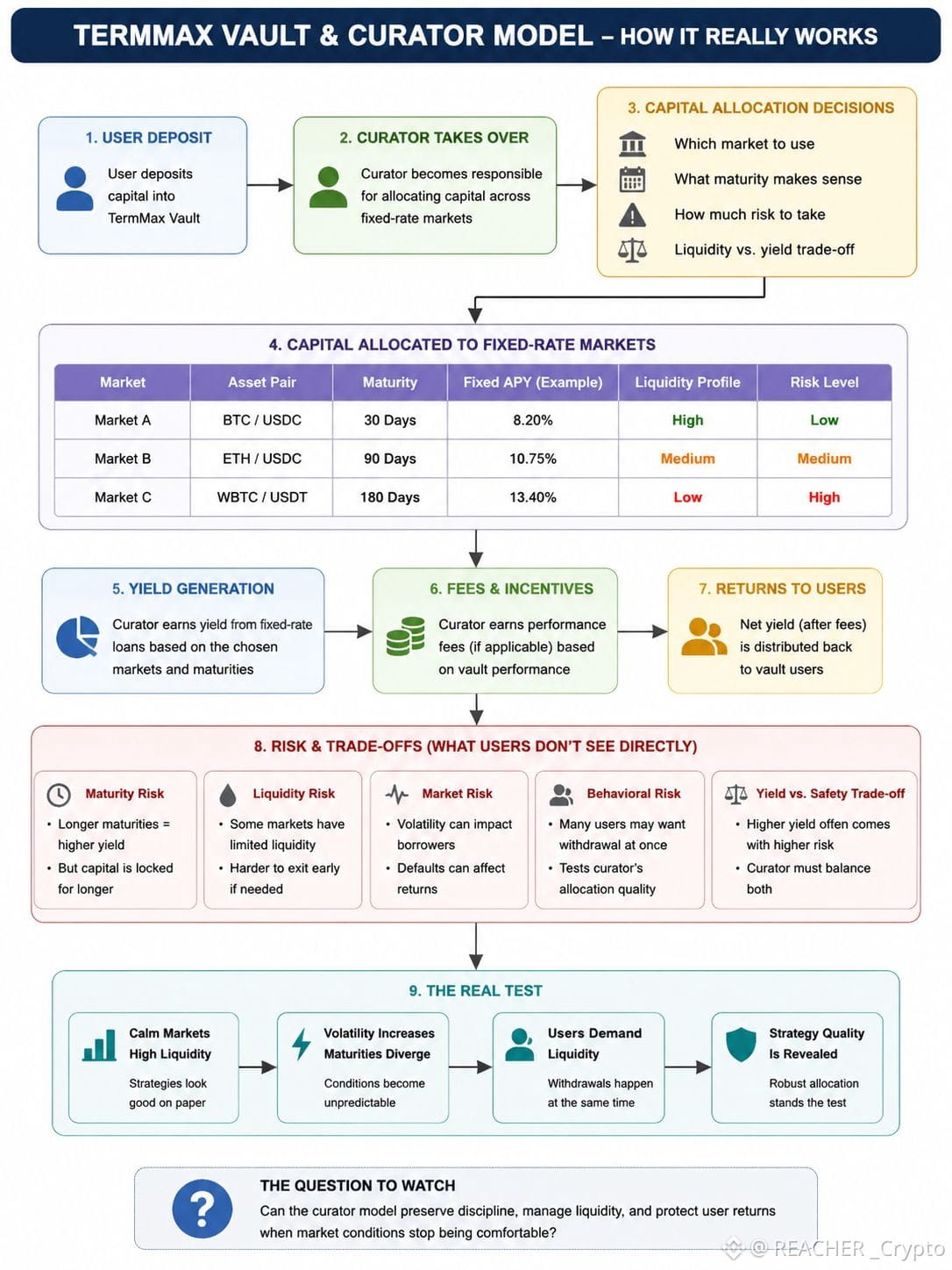
#termmax @termmax I used to think DeFi vaults were pretty straightforward.
you deposit funds, the strategy looks for yield, and you collect the return. Simple enough.
but the more I looked at TermMaxs Vault and Curator model, the more I realized I was missing an important part.
the curator is not just looking for the highest APY.
they are deciding where the capital goes, which market to use, what maturity makes sense, and how much risk is worth taking. In fixed-rate markets, that last part gets even more interesting because time becomes part of the allocation decision.
A higher yield can look attractive on a screen, but it does not tell me whether the maturity is suitable or whether the liquidity trade off makes sense.
that changed how I think about “passive” yield.
the user may be passive, but the risk hasn’t disappeared. Someone still has to make those caPital allocatIon decisions. the dIfference is that the user is trusting the curator to make them.
and I think thats where the real test begins.
A strategy can look perfectly reasonable when liquidity is strong and markets are calm. I am much more interested in what happens when volatility picks up, maturitIes start divergIng, and users suddenly want liquidIty at the same time.
that is when you find out whether the allocatIon process was acTually robust or just looked good during easy conditions.
so I am less interested in judgIng a TermMax vault purely by its APY.
I want to understand where that yield comes from, what the curator is giving up to achieve it, and how the strategy behaves when conditions get uncomfortable.
because passive yield does not mean passive risk.
it means someone else is makIng the decisions for you.
#TermMax
#termmax @TermMax I used to think DeFi vaults were pretty straightforward.
you deposit funds, the strategy looks for yield, and you collect the return. Simple enough.
but the more I looked at TermMaxs Vault and Curator model, the more I realized I was missing an important part.
the curator is not just looking for the highest APY.
they are deciding where the capital goes, which market to use, what maturity makes sense, and how much risk is worth taking. In fixed-rate markets, that last part gets even more interesting because time becomes part of the allocation decision.
A higher yield can look attractive on a screen, but it does not tell me whether the maturity is suitable or whether the liquidity trade off makes sense.
that changed how I think about “passive” yield.
the user may be passive, but the risk hasn’t disappeared. Someone still has to make those caPital allocatIon decisions. the dIfference is that the user is trusting the curator to make them.
and I think thats where the real test begins.
A strategy can look perfectly reasonable when liquidity is strong and markets are calm. I am much more interested in what happens when volatility picks up, maturitIes start divergIng, and users suddenly want liquidIty at the same time.
that is when you find out whether the allocatIon process was acTually robust or just looked good during easy conditions.
so I am less interested in judgIng a TermMax vault purely by its APY.
I want to understand where that yield comes from, what the curator is giving up to achieve it, and how the strategy behaves when conditions get uncomfortable.
because passive yield does not mean passive risk.
it means someone else is makIng the decisions for you.
#TermMax
you deposit funds, the strategy looks for yield, and you collect the return. Simple enough.
but the more I looked at TermMaxs Vault and Curator model, the more I realized I was missing an important part.
the curator is not just looking for the highest APY.
they are deciding where the capital goes, which market to use, what maturity makes sense, and how much risk is worth taking. In fixed-rate markets, that last part gets even more interesting because time becomes part of the allocation decision.
A higher yield can look attractive on a screen, but it does not tell me whether the maturity is suitable or whether the liquidity trade off makes sense.
that changed how I think about “passive” yield.
the user may be passive, but the risk hasn’t disappeared. Someone still has to make those caPital allocatIon decisions. the dIfference is that the user is trusting the curator to make them.
and I think thats where the real test begins.
A strategy can look perfectly reasonable when liquidity is strong and markets are calm. I am much more interested in what happens when volatility picks up, maturitIes start divergIng, and users suddenly want liquidIty at the same time.
that is when you find out whether the allocatIon process was acTually robust or just looked good during easy conditions.
so I am less interested in judgIng a TermMax vault purely by its APY.
I want to understand where that yield comes from, what the curator is giving up to achieve it, and how the strategy behaves when conditions get uncomfortable.
because passive yield does not mean passive risk.
it means someone else is makIng the decisions for you.
#TermMax
1
2
153
#dusk $DUSK @Dusk_Foundation
I initially thought Dusk’s privacy story was mainly about hiding transactions.
then I looked deeper into the archItecture and noticed something more interesting: privacy is not treated as somethIng added at the end. it can begin before a transaction is even processed.
what caught my attentIon was Proof of blind bid, used within Dusk’s Segregated Byzantine Agreement (SBA) consensus design.
the interestIng part is that leader selectIon can happen without simply exposIng all the informatIon about who is competing to produce the next block.
that changed how I look at Dusk.
then there is Phoenix, which approaches confIdential spendIng through a UTxO based design, while Zedger takes a different route toward privacy for regulated security token activity.
so for me, the bigger question isn’t:
Does Dusk have privacy?
It’s:
How much protocol information can remain private while the network still reaches agreement and proves that everything is valid?
thats a much harder problem.
I am still watching how these components perform under real world usage, especially when scalability and adoption become the real test.
but the archItecture itself is genuinely worth paying attention to.
Do you think privacy should begin at the transaction layer, or should consensus itself also be designed around privacy?
#dusk
Where should privacy begin?
#dusk $DUSK @Dusk
I initially thought Dusk’s privacy story was mainly about hiding transactions.
then I looked deeper into the archItecture and noticed something more interesting: privacy is not treated as somethIng added at the end. it can begin before a transaction is even processed.
what caught my attentIon was Proof of blind bid, used within Dusk’s Segregated Byzantine Agreement (SBA) consensus design.
the interestIng part is that leader selectIon can happen without simply exposIng all the informatIon about who is competing to produce the next block.
that changed how I look at Dusk.
then there is Phoenix, which approaches confIdential spendIng through a UTxO based design, while Zedger takes a different route toward privacy for regulated security token activity.
so for me, the bigger question isn’t:
Does Dusk have privacy?
It’s:
How much protocol information can remain private while the network still reaches agreement and proves that everything is valid?
thats a much harder problem.
I am still watching how these components perform under real world usage, especially when scalability and adoption become the real test.
but the archItecture itself is genuinely worth paying attention to.
Do you think privacy should begin at the transaction layer, or should consensus itself also be designed around privacy?
#dusk
Where should privacy begin?
I initially thought Dusk’s privacy story was mainly about hiding transactions.
then I looked deeper into the archItecture and noticed something more interesting: privacy is not treated as somethIng added at the end. it can begin before a transaction is even processed.
what caught my attentIon was Proof of blind bid, used within Dusk’s Segregated Byzantine Agreement (SBA) consensus design.
the interestIng part is that leader selectIon can happen without simply exposIng all the informatIon about who is competing to produce the next block.
that changed how I look at Dusk.
then there is Phoenix, which approaches confIdential spendIng through a UTxO based design, while Zedger takes a different route toward privacy for regulated security token activity.
so for me, the bigger question isn’t:
Does Dusk have privacy?
It’s:
How much protocol information can remain private while the network still reaches agreement and proves that everything is valid?
thats a much harder problem.
I am still watching how these components perform under real world usage, especially when scalability and adoption become the real test.
but the archItecture itself is genuinely worth paying attention to.
Do you think privacy should begin at the transaction layer, or should consensus itself also be designed around privacy?
#dusk
Where should privacy begin?
Transactions
0%
Consensus
0%
0 votes • Voting closed
7
3
194
#termmax @termmax
I initially looked at @termmax FT’s FT/XT structure and thought, okay, this is mainly another way to structure borrowing rates.
then I started thinkIng about the debt itself, and that changed my view.
the relationshIp is pretty simple:
1 FT + 1 XT = 1 debt token.
FT gives the fIxed value claim at maturity, whiLe XT is the other side of that same position.
what caught my attentIon is what happens when this meets a real liquidity need.
the lender can hold the fixed value side, while the borrower can potentIally separate the other piece and sell it for liquidIty.
that feels bIgger than just changIng how interest is expressed.
you are makIng the debt claim more modular.
I liKe that idea. but I am still unsure about one thing: does this actually simplIfy finance for users, or does it just move the complexIty into understandIng two assets instead of one?
that is probably the more interesting question.
#TermMax
Does FT/XT improve debt flexibility?
#termmax @TermMax
I initially looked at @TermMax FT’s FT/XT structure and thought, okay, this is mainly another way to structure borrowing rates.
then I started thinkIng about the debt itself, and that changed my view.
the relationshIp is pretty simple:
1 FT + 1 XT = 1 debt token.
FT gives the fIxed value claim at maturity, whiLe XT is the other side of that same position.
what caught my attentIon is what happens when this meets a real liquidity need.
the lender can hold the fixed value side, while the borrower can potentIally separate the other piece and sell it for liquidIty.
that feels bIgger than just changIng how interest is expressed.
you are makIng the debt claim more modular.
I liKe that idea. but I am still unsure about one thing: does this actually simplIfy finance for users, or does it just move the complexIty into understandIng two assets instead of one?
that is probably the more interesting question.
#TermMax
Does FT/XT improve debt flexibility?
I initially looked at @TermMax FT’s FT/XT structure and thought, okay, this is mainly another way to structure borrowing rates.
then I started thinkIng about the debt itself, and that changed my view.
the relationshIp is pretty simple:
1 FT + 1 XT = 1 debt token.
FT gives the fIxed value claim at maturity, whiLe XT is the other side of that same position.
what caught my attentIon is what happens when this meets a real liquidity need.
the lender can hold the fixed value side, while the borrower can potentIally separate the other piece and sell it for liquidIty.
that feels bIgger than just changIng how interest is expressed.
you are makIng the debt claim more modular.
I liKe that idea. but I am still unsure about one thing: does this actually simplIfy finance for users, or does it just move the complexIty into understandIng two assets instead of one?
that is probably the more interesting question.
#TermMax
Does FT/XT improve debt flexibility?
🚀 More flexibility
100%
🤔 More complexity
0%
3 votes • Voting closed
6
10
272
I used to think… most crypto projects were simply trying to rebuild things that already worked, with a token added somewhere in the middle.
then I started looking into @termmax , and that view began to change.
what caught my attention was not a big promise about changing finance. It was the connection between blockchain infrastructure and something traditional finance has understood for years: fixed term borrowing, fixed returns, and structured financial positions.
The detail that made it feel different to me was the way fixedrate debt can be represented and traded on chain. it made me think that blockchain doesn't always have to replace traditional finance. Maybe it can also rebuild certain parts of it in a more open and composable way.
I am still left with questions, though. How much real liquidity and demand can these fixed rate markets maintain over time? And how well can the system handle smart contract, market, and liquidation risks as usage grows?
so I am not walking away thinking I've found a guaranteed winner.
I am walking away with a better question: what else have I dismissed because I was looking at crypto through the same assumptions?
for me, learning is becoming less about finding answers and more about learning how to question my own thinking.
@termmax #TermMax
What matters most for making a crypto project feel real?
I used to think… most crypto projects were simply trying to rebuild things that already worked, with a token added somewhere in the middle.
then I started looking into @TermMax , and that view began to change.
what caught my attention was not a big promise about changing finance. It was the connection between blockchain infrastructure and something traditional finance has understood for years: fixed term borrowing, fixed returns, and structured financial positions.
The detail that made it feel different to me was the way fixedrate debt can be represented and traded on chain. it made me think that blockchain doesn't always have to replace traditional finance. Maybe it can also rebuild certain parts of it in a more open and composable way.
I am still left with questions, though. How much real liquidity and demand can these fixed rate markets maintain over time? And how well can the system handle smart contract, market, and liquidation risks as usage grows?
so I am not walking away thinking I've found a guaranteed winner.
I am walking away with a better question: what else have I dismissed because I was looking at crypto through the same assumptions?
for me, learning is becoming less about finding answers and more about learning how to question my own thinking.
@TermMax #TermMax
What matters most for making a crypto project feel real?
then I started looking into @TermMax , and that view began to change.
what caught my attention was not a big promise about changing finance. It was the connection between blockchain infrastructure and something traditional finance has understood for years: fixed term borrowing, fixed returns, and structured financial positions.
The detail that made it feel different to me was the way fixedrate debt can be represented and traded on chain. it made me think that blockchain doesn't always have to replace traditional finance. Maybe it can also rebuild certain parts of it in a more open and composable way.
I am still left with questions, though. How much real liquidity and demand can these fixed rate markets maintain over time? And how well can the system handle smart contract, market, and liquidation risks as usage grows?
so I am not walking away thinking I've found a guaranteed winner.
I am walking away with a better question: what else have I dismissed because I was looking at crypto through the same assumptions?
for me, learning is becoming less about finding answers and more about learning how to question my own thinking.
@TermMax #TermMax
What matters most for making a crypto project feel real?
Real-world utility
0%
Strong infrastructure
0%
Adoption & liquidity
0%
Regulatory clarity
0%
0 votes • Voting closed
2
2
190
I used to think the hard part of putting securities on chain was simply creating the token.
After looking deeper into @Dusk_Foundation , I am starting to think the harder problem is deciding what should be visible and what should stay private.
A regulated security needs rules.
Who can hold it?
Who can transfer it?
Was the investor approved?
Can the ownership be legally verified or recovered?
But that does not mean everyone should see the investor’s financial details.
This is where Dusk’s approach became interesting to me.
With XSC and confidential smart contracts, the goal isn’t simply to hide everything. It’s closer to selective disclosure.
The network can potentially prove that certain rules were satisfied while sensitive information remains protected.
For financial markets, that distinction matters.
A bank may want regulators to verify compliance without exposing its entire trading activity to the public.
But there is a tradeoff.
Zero knowledge proofs and confidential execution add cryptographic complexity and computational work. More privacy can mean more difficult infrastructure for developers to build and maintain.
So I am not looking at Dusk and thinking, “privacy solves regulated finance.”
I am asking something more important:
Can Dusk find the right balance between privacy, compliance, usability and decentralization?
Because if it can, the interesting product may not be a private blockchain.
It may be a blockchain where the right information is visible to the right people at the right time.
That’s the part of Dusk I’m watching most closely.
@Dusk_Foundation #dusk $DUSK
What’s Dusk’s biggest challenge?
I used to think the hard part of putting securities on chain was simply creating the token.
After looking deeper into @Dusk , I am starting to think the harder problem is deciding what should be visible and what should stay private.
A regulated security needs rules.
Who can hold it?
Who can transfer it?
Was the investor approved?
Can the ownership be legally verified or recovered?
But that does not mean everyone should see the investor’s financial details.
This is where Dusk’s approach became interesting to me.
With XSC and confidential smart contracts, the goal isn’t simply to hide everything. It’s closer to selective disclosure.
The network can potentially prove that certain rules were satisfied while sensitive information remains protected.
For financial markets, that distinction matters.
A bank may want regulators to verify compliance without exposing its entire trading activity to the public.
But there is a tradeoff.
Zero knowledge proofs and confidential execution add cryptographic complexity and computational work. More privacy can mean more difficult infrastructure for developers to build and maintain.
So I am not looking at Dusk and thinking, “privacy solves regulated finance.”
I am asking something more important:
Can Dusk find the right balance between privacy, compliance, usability and decentralization?
Because if it can, the interesting product may not be a private blockchain.
It may be a blockchain where the right information is visible to the right people at the right time.
That’s the part of Dusk I’m watching most closely.
@Dusk #dusk $DUSK
What’s Dusk’s biggest challenge?
After looking deeper into @Dusk , I am starting to think the harder problem is deciding what should be visible and what should stay private.
A regulated security needs rules.
Who can hold it?
Who can transfer it?
Was the investor approved?
Can the ownership be legally verified or recovered?
But that does not mean everyone should see the investor’s financial details.
This is where Dusk’s approach became interesting to me.
With XSC and confidential smart contracts, the goal isn’t simply to hide everything. It’s closer to selective disclosure.
The network can potentially prove that certain rules were satisfied while sensitive information remains protected.
For financial markets, that distinction matters.
A bank may want regulators to verify compliance without exposing its entire trading activity to the public.
But there is a tradeoff.
Zero knowledge proofs and confidential execution add cryptographic complexity and computational work. More privacy can mean more difficult infrastructure for developers to build and maintain.
So I am not looking at Dusk and thinking, “privacy solves regulated finance.”
I am asking something more important:
Can Dusk find the right balance between privacy, compliance, usability and decentralization?
Because if it can, the interesting product may not be a private blockchain.
It may be a blockchain where the right information is visible to the right people at the right time.
That’s the part of Dusk I’m watching most closely.
@Dusk #dusk $DUSK
What’s Dusk’s biggest challenge?
🔘 Privacy vs compliance
100%
🔘 Scalability
0%
🔘 Decentralization
0%
🔘 Developer adoption
0%
1 votes • Voting closed
10
8
184
I used to look at $DUSK and think the big question was, when will institutions finally use it?
after spending time on the explorer and actually staking a small amount myself, I’m asking something different now.
if institutions do arrive, how much real demand will that create for DUSK?
I like the idea behind the network. Privacy, selective disclosure, Confidential Security Contracts, and the EVM direction all make sense for regulated finance.
but then I looked at what’s happening on-chain.
Blocks keep rolling, yet activity still feels heavily tied to staking. DeFi liquidity is thin, and the NPEX opportunity hasn’t yet turned into the consistent settlement activity I’d want to see.
staking itself also surprised me. Only 90% becomes active immediately, while the rest sits inactive. Then there’s a 4,320-block maturity period before new stake can participate in consensus.
That’s when it clicked for me:
DUSK may have the infrastructure before it has the usage.
And until real activity starts showing up, I think that gap matters more than the narrative.
@Dusk_Foundation #dusk $DUSK
What matters most for DUSK’s next growth phase?
I used to look at $DUSK and think the big question was, when will institutions finally use it?
after spending time on the explorer and actually staking a small amount myself, I’m asking something different now.
if institutions do arrive, how much real demand will that create for DUSK?
I like the idea behind the network. Privacy, selective disclosure, Confidential Security Contracts, and the EVM direction all make sense for regulated finance.
but then I looked at what’s happening on-chain.
Blocks keep rolling, yet activity still feels heavily tied to staking. DeFi liquidity is thin, and the NPEX opportunity hasn’t yet turned into the consistent settlement activity I’d want to see.
staking itself also surprised me. Only 90% becomes active immediately, while the rest sits inactive. Then there’s a 4,320-block maturity period before new stake can participate in consensus.
That’s when it clicked for me:
DUSK may have the infrastructure before it has the usage.
And until real activity starts showing up, I think that gap matters more than the narrative.
@Dusk #dusk $DUSK
What matters most for DUSK’s next growth phase?
after spending time on the explorer and actually staking a small amount myself, I’m asking something different now.
if institutions do arrive, how much real demand will that create for DUSK?
I like the idea behind the network. Privacy, selective disclosure, Confidential Security Contracts, and the EVM direction all make sense for regulated finance.
but then I looked at what’s happening on-chain.
Blocks keep rolling, yet activity still feels heavily tied to staking. DeFi liquidity is thin, and the NPEX opportunity hasn’t yet turned into the consistent settlement activity I’d want to see.
staking itself also surprised me. Only 90% becomes active immediately, while the rest sits inactive. Then there’s a 4,320-block maturity period before new stake can participate in consensus.
That’s when it clicked for me:
DUSK may have the infrastructure before it has the usage.
And until real activity starts showing up, I think that gap matters more than the narrative.
@Dusk #dusk $DUSK
What matters most for DUSK’s next growth phase?
Real on-chain usage
0%
Institutional adoption
0%
Stronger token demand
0%
Better staking UX
0%
0 votes • Voting closed
7
6
179
I keep coming back to one uncomfortable thought about DUSK: what if the road is ready, but the traffic still hasn’t arrived?
Imagine a bank wants to issue a $100M bond on chain. putting every investor’s identity and transaction details on a completely public ledger isn’t practical. but hiding everything from regulators isn’t practical either.
that is the gap DUSK is trying to solve.
its infrastructure combines confidential contracts with selective disclosure, giving institutions a way to keep sensitive financial data private while still meeting compliance requirements.
I liKe that thesis.
but building the road and getting traffic are two different things.
right now, DUSK still looks relatively quiet. Staking and gas give the token real utilIty, but meaningful network demand ultimately needs real assets, real institutions, and real transaction volume.
thats why I am watching adoption more than announcements.
if regulated assets start moving through DUSK at scale, the six cent price may look very different in hindsight.
until then, I see DUSK as infrastructure waiting for its first major wave of traffic.
@Dusk_Foundation #dusk $DUSK
What does DUSK need most to prove its thesis?
I keep coming back to one uncomfortable thought about DUSK: what if the road is ready, but the traffic still hasn’t arrived?
Imagine a bank wants to issue a $100M bond on chain. putting every investor’s identity and transaction details on a completely public ledger isn’t practical. but hiding everything from regulators isn’t practical either.
that is the gap DUSK is trying to solve.
its infrastructure combines confidential contracts with selective disclosure, giving institutions a way to keep sensitive financial data private while still meeting compliance requirements.
I liKe that thesis.
but building the road and getting traffic are two different things.
right now, DUSK still looks relatively quiet. Staking and gas give the token real utilIty, but meaningful network demand ultimately needs real assets, real institutions, and real transaction volume.
thats why I am watching adoption more than announcements.
if regulated assets start moving through DUSK at scale, the six cent price may look very different in hindsight.
until then, I see DUSK as infrastructure waiting for its first major wave of traffic.
@Dusk #dusk $DUSK
What does DUSK need most to prove its thesis?
Imagine a bank wants to issue a $100M bond on chain. putting every investor’s identity and transaction details on a completely public ledger isn’t practical. but hiding everything from regulators isn’t practical either.
that is the gap DUSK is trying to solve.
its infrastructure combines confidential contracts with selective disclosure, giving institutions a way to keep sensitive financial data private while still meeting compliance requirements.
I liKe that thesis.
but building the road and getting traffic are two different things.
right now, DUSK still looks relatively quiet. Staking and gas give the token real utilIty, but meaningful network demand ultimately needs real assets, real institutions, and real transaction volume.
thats why I am watching adoption more than announcements.
if regulated assets start moving through DUSK at scale, the six cent price may look very different in hindsight.
until then, I see DUSK as infrastructure waiting for its first major wave of traffic.
@Dusk #dusk $DUSK
What does DUSK need most to prove its thesis?
🏦 Real institutional adoption
0%
📈 More on-chain activity
100%
🔥 Stronger DUSK demand
0%
🚀 DuskEVM mainnet
0%
1 votes • Voting closed
6
4
143
Log in to explore more content
Join global crypto users on Binance Square
⚡️ Get latest and useful information about crypto.
💬 Trusted by the world’s largest crypto exchange.
👍 Discover real insights from verified creators.
Email / Phone number
Trending Topics
FortitudeRaisesCreditLineTo$50M
264 views
37 Discussing
#FortitudeRaisesCreditLineTo$50M
A momentous occasion for the team at Fortitude Capital! 📈 We're thrilled to announce the successful expansion of our credit line to a staggering $50 million. This significant milestone, marked by a celebratory signing ceremony on the exchange floor, is a testament to the hard work and strategic vision of everyone involved.
This increased capital will empower us to pursue new investment opportunities, fuel further growth, and better serve our clients. We're incredibly grateful for the support of our partners and stakeholders who have made this achievement possible.
As we look towards the future with renewed confidence, we're excited to continue driving innovation and delivering exceptional results. Here's to a secured future and continued success!
#FortitudeRaisesCreditLineTo$50M #FortitudeCapital #Growth #Expansion #CapitalRaise
Added Three Tradeable Coins (Illustrative):
To further commemorate this achievement and align with the modern financial landscape, we've symbolically integrated three tradeable coins:
$FTDR.US (Fortitude Token): A hypothetical coin representing a stake in the future success of Fortitude Capital, potentially offering exclusive benefits or investment opportunities.
$USDC (USD Coin): A widely recognized stablecoin, representing the tangible USD value of the credit line increase and ensuring liquidity.
$ETH (Ethereum): A leading cryptocurrency platform, symbolizing our commitment to innovation and the future of finance.
Please note that these coins are included for illustrative and symbolic purposes and do not constitute financial advice. Investment decisions should always be made based on thorough research and individual circumstances.
#market #US #ETH
Axiom AlphA
·0 Likes
·8 views
USWeighsPromotingDollarStablecoinsAbroad
6,598 views
444 Discussing
US10YTreasuryYieldHits19YearHigh
5,651 views
356 Discussing