
shaaam
754 Posts

shaaam
Report
Block User
4.7K+ Following
1.6K+ Followers
1.0K+ Liked
Posts
All
Quotes
Live
·
--
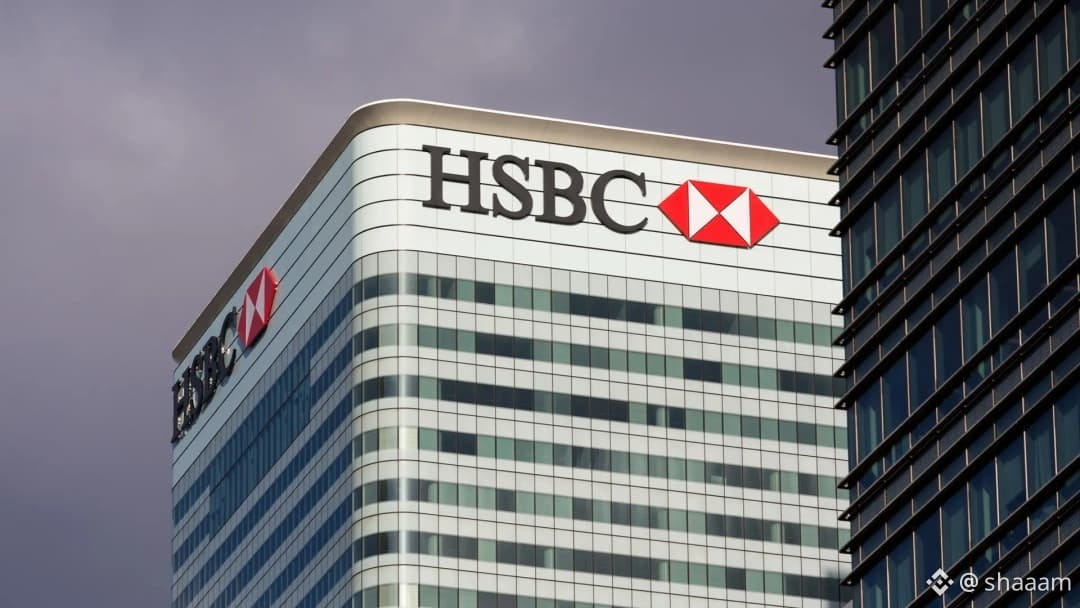
Ripple brings Wall Street into 24/7 stock bets, but HSBC warns markets are still thin
Institutions can trade through Ripple Prime and post RLUSD as collateral. Finding enough buyers and sellers for large positions could prove harder.
Ripple brings Wall Street into 24/7 stock bets, but HSBC warns markets are still thin
Institutions can trade through Ripple Prime and post RLUSD as collateral. Finding enough buyers and sellers for large positions could prove harder.
Institutions can trade through Ripple Prime and post RLUSD as collateral. Finding enough buyers and sellers for large positions could prove harder.
86
·
--
Strategy's price chart is about to flash a major bullish signal weeks after bitcoin did
{future}(BTCUSDT)
$BTC
Strategy's price chart is about to flash a major bullish signal weeks after bitcoin did
$BTC
$BTC
112
·
--
#nil $NIL @nillionnetwork 🤩😍
{future}(NILUSDT)
What is Nillion (NIL) - The Future of Blind Computing?*
Everyone talks about blockchains that store data. Nillion is building a network that _doesn't_ store data, but still computes on it. Interesting, right?
*So what is Nillion?*
Nillion is a decentralized network for *Blind Computing*. It allows AI and data to be processed without ever revealing the actual data.
Think of it like this: You can use your private data for trading, health, or AI, but the network never sees your data. This is possible with their tech called *Nil Message Compute (NMC)*.
*Why is Nillion Getting Hype?*
1. *Not Just Another L1:* Nillion is not competing with Ethereum or Solana. It's a computation network that other blockchains can use.
2. *Real Privacy Use Cases:* Private AI agents, private DePIN, encrypted order books for DeFi, secure health data sharing.
3. *Strong Backing:* Backed by Hack VC, HashKey, and other top VCs. Raised $50M+.
#nil $NIL @Nillion 🤩😍
What is Nillion (NIL) - The Future of Blind Computing?*
Everyone talks about blockchains that store data. Nillion is building a network that _doesn't_ store data, but still computes on it. Interesting, right?
*So what is Nillion?*
Nillion is a decentralized network for *Blind Computing*. It allows AI and data to be processed without ever revealing the actual data.
Think of it like this: You can use your private data for trading, health, or AI, but the network never sees your data. This is possible with their tech called *Nil Message Compute (NMC)*.
*Why is Nillion Getting Hype?*
1. *Not Just Another L1:* Nillion is not competing with Ethereum or Solana. It's a computation network that other blockchains can use.
2. *Real Privacy Use Cases:* Private AI agents, private DePIN, encrypted order books for DeFi, secure health data sharing.
3. *Strong Backing:* Backed by Hack VC, HashKey, and other top VCs. Raised $50M+.
1
1
92
·
--
#nil
---
The Future of Blind Computing?*
Everyone talks about blockchains that store data. Nillion is building a network that _doesn't_ store data, but still computes on it. Interesting, right?
*So what is Nillion?*
Nillion is a decentralized network for *Blind Computing*. It allows AI and data to be processed without ever revealing the actual data.
103
·
--

Article
Hashi launches with $500 million for Bitcoin loans: the collateral stays on the Bitcoin chainMysten Labs is launching a network on the Sui blockchain through which Bitcoin serves as collateral for loans without leaving the Bitcoin chain. More than $500 million is committed; terms, starting liquidity and the schedule remain open.
Hold Bitcoin and need cash and you long had only one option: sell. Since October 9, 2026 a second variant is on the table. Mysten Labs, the development firm behind the Sui blockchain, is launching Hashi, a network through which Bitcoin serves as collateral for loans without leaving the Bitcoin blockchain. More than $500 million in capital commitments from over twenty partners stands behind it, according to The launch runs in phases through October.
For investors in Europe this is, to begin with, news about a product you will not find in your banking app. It becomes interesting at three points: the question of whom you entrust your Bitcoin to, the tax question around the holding period, and the risk that every collateralised loan carries. Bitcoin trades on Sunday at $83,906, or €74,816.
Hashi launches on Sui: Mysten Labs gathers more than $500 million in commitments
Hashi is a network for Bitcoin finance built by Mysten Labs. Bitcoin finance here simply means that Bitcoin already held is put up as security for borrowing instead of sitting unused in a wallet. The loan is paid out in other assets on the Sui chain, not in Bitcoin itself.
The figure travelling through the reports is $500 million. That number comes from the announcement and describes capital committed by more than twenty partners from the industry. The rollout begins in October and proceeds in stages rather than on a single date.
Hashi launches with $500 million for Bitcoin loans: the collateral stays on the Bitcoin chain
Mysten Labs is launching a network on the Sui blockchain through which Bitcoin serves as collateral for loans without leaving the Bitcoin chain. More than $500 million is committed; terms, starting liquidity and the schedule remain open.
Hold Bitcoin and need cash and you long had only one option: sell. Since October 9, 2026 a second variant is on the table. Mysten Labs, the development firm behind the Sui blockchain, is launching Hashi, a network through which Bitcoin serves as collateral for loans without leaving the Bitcoin blockchain. More than $500 million in capital commitments from over twenty partners stands behind it, according to The launch runs in phases through October.
For investors in Europe this is, to begin with, news about a product you will not find in your banking app. It becomes interesting at three points: the question of whom you entrust your Bitcoin to, the tax question around the holding period, and the risk that every collateralised loan carries. Bitcoin trades on Sunday at $83,906, or €74,816.
Hashi launches on Sui: Mysten Labs gathers more than $500 million in commitments
Hashi is a network for Bitcoin finance built by Mysten Labs. Bitcoin finance here simply means that Bitcoin already held is put up as security for borrowing instead of sitting unused in a wallet. The loan is paid out in other assets on the Sui chain, not in Bitcoin itself.
The figure travelling through the reports is $500 million. That number comes from the announcement and describes capital committed by more than twenty partners from the industry. The rollout begins in October and proceeds in stages rather than on a single date.
2
209
·
--
Sui Foundation’s $30 million investment in DATA moves its network to SuiSui Foundation’s $30 million investment in DATA Network pairs funding with a blockchain migration: the AI training data protocol will move to Sui and retire its independent chain. The partnership also brings its data infrastructure to Walrus, with the aim of expanding access to rights-cleared training material for AI labs.
Sui Foundation’s investment in DATA Network
The investment will make Sui Foundation the network’s largest institutional stakeholder, DATA Foundation said. It forms part of a strategic partnership covering both the protocol’s move to Sui and its integration with onchain storage platform Walrus.
DATA Foundation, which supports the network, shifted its focus in June from general intellectual property infrastructure to AI training data. The agreement brings that infrastructure onto Sui rather than maintaining it on a separate blockchain.
How DATA Network and its token will migrate
DATA Network will receive an upgrade to operate natively as a protocol on Sui. Its standalone blockchain will be retired once the transition is complete.
The existing DATA token will transfer at a one-to-one ratio. According to Crypto.news, the joint announcement states that holders will keep economic benefits and governance rights at least equal to what they currently have, while locked tokens and already-established vesting schedules will remain unaffected.
DATA Foundation plans to publish a detailed migration schedule before the upgrade, along with instructions for token holders.
Walrus storage and Trace’s AI data registry
Walrus will serve as the default storage layer for applications operated by DATA Foundation. Sui Foundation’s investment in DATA Network supports a partnership intended to scale the AI training data supply chain and give labs access to real-world material they have permission to use.
The network’s Trace registry, launched in June, records where training data comes from and the rights governing its use. It also settles payments to the people who contribute that data.
According to DATA Foundation’s statement, Trace has registered more than 250 million contributions since launch and handles an average of more than 3 million receipts daily.
Sui Foundation’s $30 million investment in DATA moves its network to Sui
Sui Foundation’s $30 million investment in DATA Network pairs funding with a blockchain migration: the AI training data protocol will move to Sui and retire its independent chain. The partnership also brings its data infrastructure to Walrus, with the aim of expanding access to rights-cleared training material for AI labs.
Sui Foundation’s investment in DATA Network
The investment will make Sui Foundation the network’s largest institutional stakeholder, DATA Foundation said. It forms part of a strategic partnership covering both the protocol’s move to Sui and its integration with onchain storage platform Walrus.
DATA Foundation, which supports the network, shifted its focus in June from general intellectual property infrastructure to AI training data. The agreement brings that infrastructure onto Sui rather than maintaining it on a separate blockchain.
How DATA Network and its token will migrate
DATA Network will receive an upgrade to operate natively as a protocol on Sui. Its standalone blockchain will be retired once the transition is complete.
The existing DATA token will transfer at a one-to-one ratio. According to Crypto.news, the joint announcement states that holders will keep economic benefits and governance rights at least equal to what they currently have, while locked tokens and already-established vesting schedules will remain unaffected.
DATA Foundation plans to publish a detailed migration schedule before the upgrade, along with instructions for token holders.
Walrus storage and Trace’s AI data registry
Walrus will serve as the default storage layer for applications operated by DATA Foundation. Sui Foundation’s investment in DATA Network supports a partnership intended to scale the AI training data supply chain and give labs access to real-world material they have permission to use.
The network’s Trace registry, launched in June, records where training data comes from and the rights governing its use. It also settles payments to the people who contribute that data.
According to DATA Foundation’s statement, Trace has registered more than 250 million contributions since launch and handles an average of more than 3 million receipts daily.
1
83
·
--

Article
XRP Flashes 4-Hour TD Sequential Buy Signal After Drop From $1.53$XRP flashes a fresh four-hour TD Sequential buy signal after falling from $1.53 toward $1.39, putting a potential short-term rebound into focus.
$XRP has printed a fresh TD Sequential buy signal on the four-hour chart after falling from the $1.53 region toward $1.39.
$XRP’s four-hour chart shows a TD Sequential buy signal near $1.409 after price fell from the $1.53 area toward $1.39. An earlier sell signal appeared near the recent local high.
The setup follows an earlier TD Sequential sell signal that appeared close to the recent local high before price turned lower.
The chart places $XRP near $1.409, with the latest decline erasing roughly 9% from the recent peak.
Selling pressure has remained persistent across several four-hour candles, taking $XRP through $1.48 and $1.45 before price reached the $1.39 area.
TD Sequential Flips From Sell to Buy
The TD Sequential indicator is designed to identify periods when a trend may be approaching exhaustion.
On the current chart, a “9” buy signal has now appeared near the latest candles. In this setup, the ninth candle can suggest that the existing move is becoming stretched enough for a pause or reversal attempt to develop.
The earlier signal adds context.
A previous “9” sell signal formed close to the $1.52-$1.53 area. $XRP subsequently rolled over and moved steadily lower, eventually reaching $1.39.
The indicator has now flipped in the opposite direction after that decline.
This does not confirm that $XRP has already established a durable bottom, but it puts the possibility of a short-term low or relief rebound back into focus.
$1.39 Is the First Level Bulls Need to Hold
The latest downside wick reached the $1.39 area, making it the nearest support visible on the four-hour setup.
If buyers continue defending this level, the first recovery area sits around $1.45.
Above that, $XRP would need to reclaim $1.48, followed by the broader $1.50-$1.53 resistance zone where the selloff began.
That sequence matters because a bounce from $1.39 would still need to recover several broken levels before the short-term structure meaningfully improves.
On the other side, a sustained move below $1.39 would weaken the immediate reversal setup and show that sellers remain in control despite the TD Sequential buy signal.
For now, the chart leaves $XRP at a clear inflection point: the indicator is signaling possible exhaustion after a sharp decline, but price still needs to prove that the $1.39 area can hold.
XRP Flashes 4-Hour TD Sequential Buy Signal After Drop From $1.53
$XRP flashes a fresh four-hour TD Sequential buy signal after falling from $1.53 toward $1.39, putting a potential short-term rebound into focus.
$XRP has printed a fresh TD Sequential buy signal on the four-hour chart after falling from the $1.53 region toward $1.39.
$XRP’s four-hour chart shows a TD Sequential buy signal near $1.409 after price fell from the $1.53 area toward $1.39. An earlier sell signal appeared near the recent local high.
The setup follows an earlier TD Sequential sell signal that appeared close to the recent local high before price turned lower.
The chart places $XRP near $1.409, with the latest decline erasing roughly 9% from the recent peak.
Selling pressure has remained persistent across several four-hour candles, taking $XRP through $1.48 and $1.45 before price reached the $1.39 area.
TD Sequential Flips From Sell to Buy
The TD Sequential indicator is designed to identify periods when a trend may be approaching exhaustion.
On the current chart, a “9” buy signal has now appeared near the latest candles. In this setup, the ninth candle can suggest that the existing move is becoming stretched enough for a pause or reversal attempt to develop.
The earlier signal adds context.
A previous “9” sell signal formed close to the $1.52-$1.53 area. $XRP subsequently rolled over and moved steadily lower, eventually reaching $1.39.
The indicator has now flipped in the opposite direction after that decline.
This does not confirm that $XRP has already established a durable bottom, but it puts the possibility of a short-term low or relief rebound back into focus.
$1.39 Is the First Level Bulls Need to Hold
The latest downside wick reached the $1.39 area, making it the nearest support visible on the four-hour setup.
If buyers continue defending this level, the first recovery area sits around $1.45.
Above that, $XRP would need to reclaim $1.48, followed by the broader $1.50-$1.53 resistance zone where the selloff began.
That sequence matters because a bounce from $1.39 would still need to recover several broken levels before the short-term structure meaningfully improves.
On the other side, a sustained move below $1.39 would weaken the immediate reversal setup and show that sellers remain in control despite the TD Sequential buy signal.
For now, the chart leaves $XRP at a clear inflection point: the indicator is signaling possible exhaustion after a sharp decline, but price still needs to prove that the $1.39 area can hold.
4
1.1k
·
--

Article
Ethereum Price Forecast: ETH drops below $2,500 as rising Treasury yields trigger selling pressureEthereum price today: $2,470
Ethereum declined below $2,500 on Thursday following rising oil prices and US Treasury yields.ETH ETFs recorded $565 million in outflows over seven straight days, while exchange reserves spiked.ETH could find support at the $2,355 and 100-day EMA convergence after breaching the 50-day EMA.
Ethereum (ETH) fell below $2,500 on Thursday, down nearly 4% and extending losses for a third consecutive day.
The decline follows rising Oil prices and US Treasury yields over the past few days. The 10Y Note Yield reached a 24-year high at 5.35%, and the 30Y Note Yield climbed above 5.70% earlier in the day, sparking major distributions in the crypto market. Yields eased to 5.23% and 5.60%, respectively, after President Trump noted in a Truth Social post that the US will not attack Iran "at any time prior" to the US midterm elections on November 3.
ETH sell-off intensifies as distribution climbs across all cohorts
Institutional and retail selling pressure has intensified following the latest developments.
US spot ETH exchange-traded funds (ETFs) have yet to see inflows this week after posting net outflows of $160.7 million on Wednesday, according to SoSoValue data. That marks seven consecutive days of net outflows worth roughly $565 million.
At the same time, the rate at which coins are flowing into exchanges has accelerated this week. Ethereum exchange reserves have ticked up by roughly 132K ETH since Monday. In the past two weeks, those figures have climbed to 233K ETH.
Historically, an increase in an asset's exchange reserves often coincides with increased selling pressure, as seen in ETH over the past few days.
The selling is likely distributed across all wallet cohorts. During the two weeks, whales or wallets with a balance of 10K-100K ETH have offloaded 151K ETH.
Retail investors or wallets holding 1K-10K ETH and 100-1K ETH depleted their collective balance by roughly 276K ETH.
On the derivatives side, Ethereum is leading the crypto market in liquidations, with $351.6 million in liquidated positions over the past 24 hours, per Coinglass data. Long and short liquidations accounted for $294.6 million and $57 million, respectively.
Ethereum technical outlook: ETH's next support is at $2,355 and 100-day EMA convergence
On the daily chart, ETH is retreating from last week’s highs and sitting back under the short-term Exponential Moving Averages. After declining below the 20- and 50-day EMAs at $2,631 and $2,502, price holds above the 100-day EMA at $2,338, which offers underlying trend support. The move hints at a neutral-to-bearish near-term tone.
The 14-day Relative Strength Index (RSI) at 37 leans toward weak momentum, while the Stochastic near 18 suggests oversold conditions that could slow further downside, rather than guarantee an immediate rebound.
On the downside, initial support appears at the horizontal level near $2,355, followed by the 100-day EMA. A daily close below this cluster would expose deeper floors at $2,204 and $1,972.
On the topside, immediate resistance is now located at the horizontal barrier at $2,548. Above this, a broader supply zone is formed by the 20-day EMA and the $2,636 horizontal level, before the $2,781 key hurdle.
Ethereum Price Forecast: ETH drops below $2,500 as rising Treasury yields trigger selling pressure
Ethereum price today: $2,470
Ethereum declined below $2,500 on Thursday following rising oil prices and US Treasury yields.ETH ETFs recorded $565 million in outflows over seven straight days, while exchange reserves spiked.ETH could find support at the $2,355 and 100-day EMA convergence after breaching the 50-day EMA.
Ethereum (ETH) fell below $2,500 on Thursday, down nearly 4% and extending losses for a third consecutive day.
The decline follows rising Oil prices and US Treasury yields over the past few days. The 10Y Note Yield reached a 24-year high at 5.35%, and the 30Y Note Yield climbed above 5.70% earlier in the day, sparking major distributions in the crypto market. Yields eased to 5.23% and 5.60%, respectively, after President Trump noted in a Truth Social post that the US will not attack Iran "at any time prior" to the US midterm elections on November 3.
ETH sell-off intensifies as distribution climbs across all cohorts
Institutional and retail selling pressure has intensified following the latest developments.
US spot ETH exchange-traded funds (ETFs) have yet to see inflows this week after posting net outflows of $160.7 million on Wednesday, according to SoSoValue data. That marks seven consecutive days of net outflows worth roughly $565 million.
At the same time, the rate at which coins are flowing into exchanges has accelerated this week. Ethereum exchange reserves have ticked up by roughly 132K ETH since Monday. In the past two weeks, those figures have climbed to 233K ETH.
Historically, an increase in an asset's exchange reserves often coincides with increased selling pressure, as seen in ETH over the past few days.
The selling is likely distributed across all wallet cohorts. During the two weeks, whales or wallets with a balance of 10K-100K ETH have offloaded 151K ETH.
Retail investors or wallets holding 1K-10K ETH and 100-1K ETH depleted their collective balance by roughly 276K ETH.
On the derivatives side, Ethereum is leading the crypto market in liquidations, with $351.6 million in liquidated positions over the past 24 hours, per Coinglass data. Long and short liquidations accounted for $294.6 million and $57 million, respectively.
Ethereum technical outlook: ETH's next support is at $2,355 and 100-day EMA convergence
On the daily chart, ETH is retreating from last week’s highs and sitting back under the short-term Exponential Moving Averages. After declining below the 20- and 50-day EMAs at $2,631 and $2,502, price holds above the 100-day EMA at $2,338, which offers underlying trend support. The move hints at a neutral-to-bearish near-term tone.
The 14-day Relative Strength Index (RSI) at 37 leans toward weak momentum, while the Stochastic near 18 suggests oversold conditions that could slow further downside, rather than guarantee an immediate rebound.
On the downside, initial support appears at the horizontal level near $2,355, followed by the 100-day EMA. A daily close below this cluster would expose deeper floors at $2,204 and $1,972.
On the topside, immediate resistance is now located at the horizontal barrier at $2,548. Above this, a broader supply zone is formed by the 20-day EMA and the $2,636 horizontal level, before the $2,781 key hurdle.
57
·
--
Crypto crumbles as anniversary of flash crash nears
It was October 10, 2025, when bitcoin plunged from about $122,000 to $105,000, with much of the decline occurring within minutes.
Crypto crumbles as anniversary of flash crash nears
It was October 10, 2025, when bitcoin plunged from about $122,000 to $105,000, with much of the decline occurring within minutes.
It was October 10, 2025, when bitcoin plunged from about $122,000 to $105,000, with much of the decline occurring within minutes.
88
·
--
Verified
Important Ripple News and XRP Price Update: October 8XRP was predicted to break out this week, but the actual move is quite disappointing for the bulls.
The past week or so has been quite eventful for the broader Ripple and XRP ecosystem, with new partnerships and developments concerning both the company and the underlying asset behind it.
We will review the key points in this article and outline some reasons behind the native token’s price slump.
Big Win on Wall Street, Another in Korea
But before we dive into XRP’s price moves, let’s examine some of the big news coming this week. Ripple strengthened its partnership with the Wall Street giant Brevan Howard by enhancing access to multi-asset prime brokerage amid rising demand and integrated investment infrastructure.
Ripple Prime will streamline operations for the Wall Street entity across several asset classes, including traditional and crypto, to improve capital efficiency. The collaboration follows Ripple’s $500 million investment round in 2025, in which Brevan Howard was among the participants, marking a significant evolution in their relationship post-SEC settlement.
The second piece of major macro news comes from the other side of the world, South Korea. Meritz Securities partnered with Ripple to improve its digital asset infrastructure in the country, focusing on custody and tokenization. The agreement aims to align with the evolving local market and regulatory landscape and follows Ripple’s broader expansion in Korea, including deals with K Bank and Kyobo Life Insurance.
Important Ripple News and XRP Price Update: October 8
XRP was predicted to break out this week, but the actual move is quite disappointing for the bulls.
The past week or so has been quite eventful for the broader Ripple and XRP ecosystem, with new partnerships and developments concerning both the company and the underlying asset behind it.
We will review the key points in this article and outline some reasons behind the native token’s price slump.
Big Win on Wall Street, Another in Korea
But before we dive into XRP’s price moves, let’s examine some of the big news coming this week. Ripple strengthened its partnership with the Wall Street giant Brevan Howard by enhancing access to multi-asset prime brokerage amid rising demand and integrated investment infrastructure.
Ripple Prime will streamline operations for the Wall Street entity across several asset classes, including traditional and crypto, to improve capital efficiency. The collaboration follows Ripple’s $500 million investment round in 2025, in which Brevan Howard was among the participants, marking a significant evolution in their relationship post-SEC settlement.
The second piece of major macro news comes from the other side of the world, South Korea. Meritz Securities partnered with Ripple to improve its digital asset infrastructure in the country, focusing on custody and tokenization. The agreement aims to align with the evolving local market and regulatory landscape and follows Ripple’s broader expansion in Korea, including deals with K Bank and Kyobo Life Insurance.
5
1.3k
·
--
Trump bought up to $25 million in Meta and millions in SpaceX debt in AugustPresident Donald Trump disclosed more than 500 securities transactions in August, including a purchase of up to $25 million in Meta stock and an investment of as much as $5 million in SpaceX debt two days before he signed a sweeping policy aimed at expanding U.S. commercial space transportation, according to a newly released financial disclosure.
The 517 purchases and sales totaled roughly $74.3 million to $273.3 million, according to a CNBC analysis of Trump’s August financial disclosure, which reports each item in a range of value. Purchases accounted for at least $44.2 million and sales at least $30.1 million, CNBC calculated.
The 18-page filing shows Trump’s portfolio remained highly active, even as trading slowed from June and July, when he disclosed more than 1,000 transactions in each month.
The largest transaction was an Aug. 21 purchase of between $5 million and $25 million in Meta shares, amid a broader portfolio reshuffling that day. Trump also reported buying between $1 million and $5 million each of AT&T, ConocoPhillips, Abbott Laboratories, Netflix and Chevron the same day.
On the sell side, on Aug. 21, he unloaded between $1 million and $5 million each of Advanced Micro Devices and Church & Dwight, along with stakes worth between $500,001 and $1 million in companies including Boeing, Home Depot, T-Mobile, Datadog, Dell Technologies, Palo Alto Networks and Nvidia.
The filing also shows a sizable new investment in SpaceX.
On Aug. 18, Trump’s accounts purchased between $1 million and $5 million in senior unsecured notes issued by Elon Musk’s rocket and satellite company, carrying a 5.35% interest rate and maturing in July 2031.
Two days later, Trump signed a national space transportation policy calling for the U.S. to support more than 1,000 launches and reentries annually by 2030. The policy directs federal agencies to facilitate commercial access to federal launch facilities and encourage private investment and public-private partnerships in space infrastructure.
SpaceX is a major Pentagon contractor and NASA launch provider, putting it in a prime position to benefit from policies aimed at expanding the U.S. commercial launch market.
Trump had already invested in SpaceX, but on a far smaller scale, buying $15,001 to $50,000 in shares in both June — the month of its IPO — and July and selling $1,001 to $15,000 in July.
The White House and SpaceX did not immediately respond to CNBC’s requests for comment.
The White House has repeatedly defended the activity, saying independent advisors manage the portfolio without input from Trump or his family. Recent presidents, by contrast, have generally divested individual stocks or relied on blind trusts or diversified funds to avoid potential conflicts.
The new filing does not reveal the precise size of Trump’s investments because federal disclosures report transactions in broad value ranges rather than exact amounts. But heavy trading has become a hallmark of Trump’s second term.
His 2025 annual financial disclosure showed more than 21,000 securities trades across eight accounts holding at least $858 million, compared with just 86 stock transactions disclosed during his first year in office in 2017.
The August disclosure also shows continued investments across some of the country’s largest publicly traded companies. Trump reported purchases of between $1 million and $5 million each in Microsoft, McDonald’s and Comcast on Aug. 10
Later, on Aug. 26, Trump’s portfolio bought between $15,001 and $50,000 of Tyson Foods on the same day he signed a proclamation temporarily expanding low-tariff imports of lean beef trimmings by 300,000 metric tons.
The move, aimed at easing elevated beef prices, took effect Sept. 1 for up to 90 days. Trump had signaled plans to address beef prices before the Tyson trade, and the disclosure does not show whether the Tyson purchase came before or after he signed the proclamation.
Trump’s account also continued buying municipal debt, a pattern that has emerged repeatedly in his disclosures. The August filing includes dozens of municipal securities tied to state and local governments, schools, hospitals, housing authorities and other public entities.
Trump bought up to $25 million in Meta and millions in SpaceX debt in August
President Donald Trump disclosed more than 500 securities transactions in August, including a purchase of up to $25 million in Meta stock and an investment of as much as $5 million in SpaceX debt two days before he signed a sweeping policy aimed at expanding U.S. commercial space transportation, according to a newly released financial disclosure.
The 517 purchases and sales totaled roughly $74.3 million to $273.3 million, according to a CNBC analysis of Trump’s August financial disclosure, which reports each item in a range of value. Purchases accounted for at least $44.2 million and sales at least $30.1 million, CNBC calculated.
The 18-page filing shows Trump’s portfolio remained highly active, even as trading slowed from June and July, when he disclosed more than 1,000 transactions in each month.
The largest transaction was an Aug. 21 purchase of between $5 million and $25 million in Meta shares, amid a broader portfolio reshuffling that day. Trump also reported buying between $1 million and $5 million each of AT&T, ConocoPhillips, Abbott Laboratories, Netflix and Chevron the same day.
On the sell side, on Aug. 21, he unloaded between $1 million and $5 million each of Advanced Micro Devices and Church & Dwight, along with stakes worth between $500,001 and $1 million in companies including Boeing, Home Depot, T-Mobile, Datadog, Dell Technologies, Palo Alto Networks and Nvidia.
The filing also shows a sizable new investment in SpaceX.
On Aug. 18, Trump’s accounts purchased between $1 million and $5 million in senior unsecured notes issued by Elon Musk’s rocket and satellite company, carrying a 5.35% interest rate and maturing in July 2031.
Two days later, Trump signed a national space transportation policy calling for the U.S. to support more than 1,000 launches and reentries annually by 2030. The policy directs federal agencies to facilitate commercial access to federal launch facilities and encourage private investment and public-private partnerships in space infrastructure.
SpaceX is a major Pentagon contractor and NASA launch provider, putting it in a prime position to benefit from policies aimed at expanding the U.S. commercial launch market.
Trump had already invested in SpaceX, but on a far smaller scale, buying $15,001 to $50,000 in shares in both June — the month of its IPO — and July and selling $1,001 to $15,000 in July.
The White House and SpaceX did not immediately respond to CNBC’s requests for comment.
The White House has repeatedly defended the activity, saying independent advisors manage the portfolio without input from Trump or his family. Recent presidents, by contrast, have generally divested individual stocks or relied on blind trusts or diversified funds to avoid potential conflicts.
The new filing does not reveal the precise size of Trump’s investments because federal disclosures report transactions in broad value ranges rather than exact amounts. But heavy trading has become a hallmark of Trump’s second term.
His 2025 annual financial disclosure showed more than 21,000 securities trades across eight accounts holding at least $858 million, compared with just 86 stock transactions disclosed during his first year in office in 2017.
The August disclosure also shows continued investments across some of the country’s largest publicly traded companies. Trump reported purchases of between $1 million and $5 million each in Microsoft, McDonald’s and Comcast on Aug. 10
Later, on Aug. 26, Trump’s portfolio bought between $15,001 and $50,000 of Tyson Foods on the same day he signed a proclamation temporarily expanding low-tariff imports of lean beef trimmings by 300,000 metric tons.
The move, aimed at easing elevated beef prices, took effect Sept. 1 for up to 90 days. Trump had signaled plans to address beef prices before the Tyson trade, and the disclosure does not show whether the Tyson purchase came before or after he signed the proclamation.
Trump’s account also continued buying municipal debt, a pattern that has emerged repeatedly in his disclosures. The August filing includes dozens of municipal securities tied to state and local governments, schools, hospitals, housing authorities and other public entities.
442
·
--
Verified
XRP price dips near $1.45 despite $3.14M inflows into U.S. spot XRP ETFs on Oct. 7XRP's price dropped about 3.9% from $1.52 to $1.46 on Oct. 6-7, even as U.S. spot XRP ETFs saw $3.14 million in net inflows, led by Bitwise's $10.55 million inflow. Despite these positive fund flows, XRP's price decline suggests ETF activity did not directly drive the price. Technical analysis points to $1.40 as support and $1.4850 as resistance, with a possible false breakdown if prices hold above these levels. Additionally, Evernorth Holdings plans a business combination with Armada Acquisition Corp. II, aiming for Nasdaq trading under ticker XRPN around Oct. 12, while the XRP Ledger upgrade is set to activate on Oct. 9 pending validator support.
XRP price movement provides context for cryptocurrency trends on Pluang. As of Oct 07, 2026 18:23 WIB, only 6 of 50 major cryptocurrencies rose while 43 fell. Notable movers include BAL at Rp16.297 with +11.14%, ENJ at Rp528 with -10.87%, and UNI at Rp142.226 with -10.28%.
XRP price dips near $1.45 despite $3.14M inflows into U.S. spot XRP ETFs on Oct. 7
XRP's price dropped about 3.9% from $1.52 to $1.46 on Oct. 6-7, even as U.S. spot XRP ETFs saw $3.14 million in net inflows, led by Bitwise's $10.55 million inflow. Despite these positive fund flows, XRP's price decline suggests ETF activity did not directly drive the price. Technical analysis points to $1.40 as support and $1.4850 as resistance, with a possible false breakdown if prices hold above these levels. Additionally, Evernorth Holdings plans a business combination with Armada Acquisition Corp. II, aiming for Nasdaq trading under ticker XRPN around Oct. 12, while the XRP Ledger upgrade is set to activate on Oct. 9 pending validator support.
XRP price movement provides context for cryptocurrency trends on Pluang. As of Oct 07, 2026 18:23 WIB, only 6 of 50 major cryptocurrencies rose while 43 fell. Notable movers include BAL at Rp16.297 with +11.14%, ENJ at Rp528 with -10.87%, and UNI at Rp142.226 with -10.28%.
XRP price movement provides context for cryptocurrency trends on Pluang. As of Oct 07, 2026 18:23 WIB, only 6 of 50 major cryptocurrencies rose while 43 fell. Notable movers include BAL at Rp16.297 with +11.14%, ENJ at Rp528 with -10.87%, and UNI at Rp142.226 with -10.28%.
1
1.2k
·
--
Article
XRP News Today: Will Clearpool’s XRPL Lending Boost XRP Demand?Not directly. Under the planned setup, each party has a clear role:
Clearpool: provides the lending platformCicada Partners: audits and underwrites borrowersRipple: participates as a limited partnerHex Trust: handles custody and compliance
All financing is planned in RLUSD, Ripple’s dollar stablecoin, not XRP. So the expansion does not create the same direct demand for the XRP token.
The lending framework also depends on two new XRPL standards, XLS-65 and XLS-66. Both were in Devnet testing in early October. They need approval from 80% of validators before going live on mainnet.
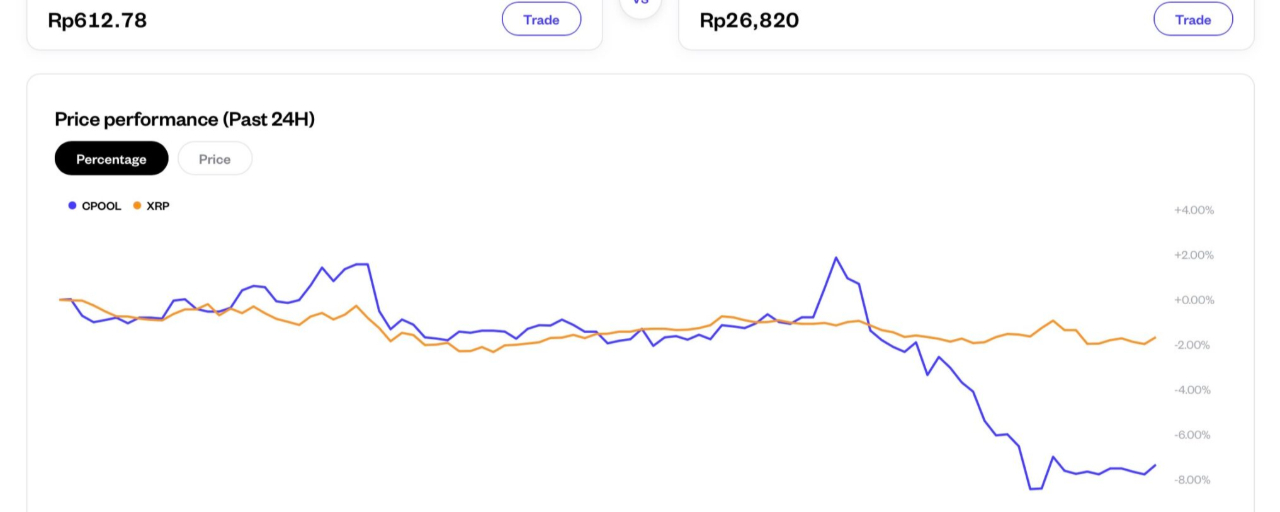
XRP itself is drifting lower. It trades near $1.49, down about 1.7% over 24 hours, with a market cap of about $94.4 billion. The four-hour chart shows XRP stuck between $1.45 and $1.55 since September 25.
CPOOL trades near $0.0366. That followed a breakout from a year-long range between roughly $0.013 and $0.020.
The token sat above its medium-term moving average near $0.0282. The next major resistance zone stands near $0.101
XRP News Today: Will Clearpool’s XRPL Lending Boost XRP Demand?
Not directly. Under the planned setup, each party has a clear role:
Clearpool: provides the lending platformCicada Partners: audits and underwrites borrowersRipple: participates as a limited partnerHex Trust: handles custody and compliance
All financing is planned in RLUSD, Ripple’s dollar stablecoin, not XRP. So the expansion does not create the same direct demand for the XRP token.
The lending framework also depends on two new XRPL standards, XLS-65 and XLS-66. Both were in Devnet testing in early October. They need approval from 80% of validators before going live on mainnet.
XRP itself is drifting lower. It trades near $1.49, down about 1.7% over 24 hours, with a market cap of about $94.4 billion. The four-hour chart shows XRP stuck between $1.45 and $1.55 since September 25.
CPOOL trades near $0.0366. That followed a breakout from a year-long range between roughly $0.013 and $0.020.
The token sat above its medium-term moving average near $0.0282. The next major resistance zone stands near $0.101
1
139
·
--
Clearpool Vote Backs XRPL Expansion With 1.125B CLEAR PlanIn XRP news today, Clearpool’s community has approved an expansion to the XRP Ledger and a 1:1 swap of its Ethereum-based CPOOL token for a new CLEAR token. The Snapshot vote passed on October 5 with 97.16% in favor and 2.84% against. The migration is targeted for Q4 2026.
At the center of the plan are a larger 1.125 billion-token supply and a pledge to use half of protocol fees to buy back and burn CLEAR.
Clearpool Vote Backs XRPL Expansion With 1.125B CLEAR Plan
In XRP news today, Clearpool’s community has approved an expansion to the XRP Ledger and a 1:1 swap of its Ethereum-based CPOOL token for a new CLEAR token. The Snapshot vote passed on October 5 with 97.16% in favor and 2.84% against. The migration is targeted for Q4 2026.
At the center of the plan are a larger 1.125 billion-token supply and a pledge to use half of protocol fees to buy back and burn CLEAR.
At the center of the plan are a larger 1.125 billion-token supply and a pledge to use half of protocol fees to buy back and burn CLEAR.
163
·
--
Verified

Article
Crypto News Today: Remittix Reveals Final RTX Price and Confirms November 24 LaunchCrypto news is full of price targets, but Remittix has put two specific milestones on the calendar: a $0.46 final RTX presale tier and a planned November 24 token debut. The project has also invited 1,000 existing holders to test initial EUR and USD PayFi options. Buyers can now watch a payment product develop alongside the launch countdown.
Remittix aims to give people one app for holding crypto, trading it and receiving fiat through a compatible bank route. If those products begin bringing users back regularly, the RTX case could become much larger than a final presale price. That is why the first customer tests matter so much in the weeks before exchange trading.
Crypto News Today: Why the RTX Milestones Matter
Remittix reports over $32 million raised from more than 40,000 presale participants toward a $36 million hard cap. The announced $0.46 final tier gives its sale a visible next stage, and November 24 provides a planned debut date for the token.
The product calendar adds depth. An iOS wallet has more than 10,000 reported downloads, while Remittix Markets has exceeded $50 million in cumulative trading volume. That volume measures trades rather than revenue, but it shows a live venue attracting activity before the exchange launch.
Crypto News Today: Remittix Reveals Final RTX Price and Confirms November 24 Launch
Crypto news is full of price targets, but Remittix has put two specific milestones on the calendar: a $0.46 final RTX presale tier and a planned November 24 token debut. The project has also invited 1,000 existing holders to test initial EUR and USD PayFi options. Buyers can now watch a payment product develop alongside the launch countdown.
Remittix aims to give people one app for holding crypto, trading it and receiving fiat through a compatible bank route. If those products begin bringing users back regularly, the RTX case could become much larger than a final presale price. That is why the first customer tests matter so much in the weeks before exchange trading.
Crypto News Today: Why the RTX Milestones Matter
Remittix reports over $32 million raised from more than 40,000 presale participants toward a $36 million hard cap. The announced $0.46 final tier gives its sale a visible next stage, and November 24 provides a planned debut date for the token.
The product calendar adds depth. An iOS wallet has more than 10,000 reported downloads, while Remittix Markets has exceeded $50 million in cumulative trading volume. That volume measures trades rather than revenue, but it shows a live venue attracting activity before the exchange launch.
342
·
--
Article
Crypto Today: Bitcoin rally slows while Ethereum and XRP extend recovery amid slowing ETF inflowsBitcoin’s upside cools, with short-term support at $85,000 and resistance below $88,000 as institutional demand wanes.Ethereum builds momentum for another breakout, trading above $2,700 despite $138 million in ETF outflows last week.XRP steadies above $1.52 as bulls extend the recovery despite slowing weekly ETF inflows.
Bitcoin (BTC) is narrowly consolidating while trading above $86,000 at the time of writing on Monday. The largest cryptocurrency by market capitalization is also holding in a broader range, with short-term support at $85,000 and resistance at $88,000.
Altcoins, on the other hand, show a positive outlook, with Ethereum (ETH) edging higher above $2,700 while Ripple (XRP) steadies above $1.52. The path of least resistance remains upward, with buyers taking on more risk.
Broadly, risk appetite in the crypto market is firmly positive, as reflected in the Fear & Greed Index, holding at 70 in Greed territory on Monday, up from 65 the day before. If this bullish outlook holds, buyers will take control of the trend, raising the odds that the recent rally extends.
Bitcoin and XRP ETFs draw inflows as Ethereum funds flip to outflows
Bitcoin spot Exchange-Traded Funds (ETFs) extended the bullish streak for three consecutive weeks, with $241 million in inflows through Friday. This was a major setback from the previous week’s $2.4 billion in inflows, suggesting possible buyer exhaustion as BTC struggles to clear resistance at $88,000. Steady institutional support reinforces the larger bullish picture, while outflows imply fading risk-on sentiment.
Ethereum spot ETFs, unlike Bitcoin, closed last week in the negative with outflows totaling $138 million, according to SoSoValue. The US-listed ETFs had recorded notable inflows of $690 m million in the week ending September 25. Despite the outflows, cumulative inflows stand at $13.8 billion, with net assets at $17.5 billion, affirming that investors retain a long-term outlook on Ethereum.
XRP spot ETFs extended their bullish streak last week with approximately $5million in inflows through Friday. According to SoSoValue, this marks the 12th consecutive week of inflows. Cumulatively, inflows total $1.8 billion, while net assets average $1.7 billion.
Technical analysis: Bitcoin ranges as support holds
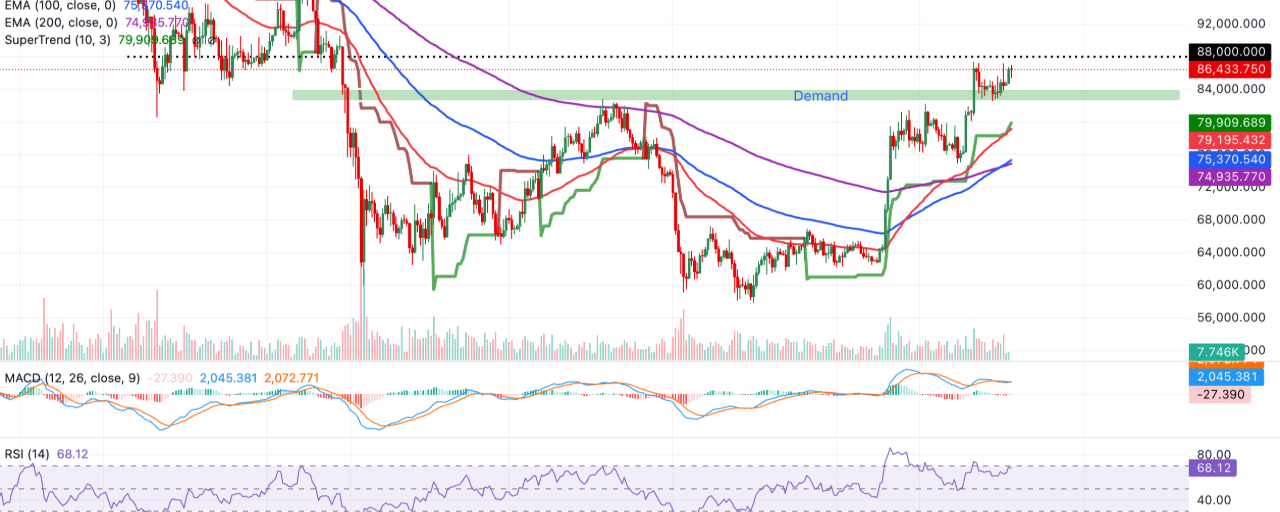
Ethereum trades at $86,428, maintaining a bullish near-term bias despite supply at $88,000 capping upside. Meanwhile, the spot price holds well above the 50-day, 100-day and 200-day Exponential Moving Averages (EMAs) clustered between roughly $74,900 and $79,200.
The SuperTrend line at $79,910 reinforces this underlying demand zone, while a firm Relative Strength Index (RSI) around 68 suggests strong but approaching overbought momentum. At the same time, the Moving Average Convergence Divergence (MACD) remains slightly negative, hinting that upside traction is slowing rather than reversing.
On the downside, initial support lies at the SuperTrend level, closely followed by the 50-day EMA at $79,195, forming a key short-term floor. Below this area, the 100-day EMA at $75,370 and the 200-day EMA at $74,936 constitute a deeper structural demand band. Only a decisive break beneath these averages would threaten the prevailing bullish outlook and open the way for a broader corrective phase.
Altcoins technical analysis: Ethereum and XRP extend gains
Ethereum trades at $2,727, maintaining a bullish near-term bias as price holds well above a rising cluster of EMAs. The 50-day EMA at $2,494, together with the SuperTrend base at $2,483, underpins the advance and suggests dips remain supported within the current uptrend.
The RSI at 64 stays in constructive territory without being overbought, while the MACD indicator, still marginally below zero, hints that bullish momentum is improving but not yet fully mature.
Initial support lies at the 50-day EMA near $2,494, closely backed by the SuperTrend line at $2,483, forming a dense demand zone for any pullback. Below this cluster, the 100-day EMA at $2,322 and the 200-day EMA at $2,290 provide deeper trend-supportive levels that would likely attract buyers if tested.
With no nearby overhead indicator resistances on the daily chart, the focus remains on how well ETH can defend these successive supports to extend the prevailing bullish structure.
XRP, meanwhile, trades at $1.52, holding a bullish near-term bias as price extends above the key EMAs. The 50-day EMA at $1.40 and the 200-day EMA at $1.38 sit well below the market, hinting at a constructive underlying trend, while the 100-day EMA at $1.33 and the SuperTrend line at $1.30 reinforce a broad support layer.
Momentum remains favorable, with the RSI at 59 staying in positive territory but shy of overbought, and the MACD showing a modestly negative reading, suggesting a pause within an overall improving upswing rather than a decisive reversal.
Initial technical support emerges around the 50-day EMA at $1.40, followed by the 200-day EMA near $1.38, both levels likely to attract dip-buying if price retreats. Deeper support lies at the 100-day EMA at $1.33 and the SuperTrend base around $1.30, where a break would materially weaken the prevailing bullish structure.
With resistance levels on the daily chart remaining undefined, the pair appears poised for further upside unless renewed selling pressure or waning momentum materializes. The technical setup currently supports consolidation above the clustered EMAs, preserving the potential for additional gains as long as $1.40 is maintained on a closing basis.
Crypto Today: Bitcoin rally slows while Ethereum and XRP extend recovery amid slowing ETF inflows
Bitcoin’s upside cools, with short-term support at $85,000 and resistance below $88,000 as institutional demand wanes.Ethereum builds momentum for another breakout, trading above $2,700 despite $138 million in ETF outflows last week.XRP steadies above $1.52 as bulls extend the recovery despite slowing weekly ETF inflows.
Bitcoin (BTC) is narrowly consolidating while trading above $86,000 at the time of writing on Monday. The largest cryptocurrency by market capitalization is also holding in a broader range, with short-term support at $85,000 and resistance at $88,000.
Altcoins, on the other hand, show a positive outlook, with Ethereum (ETH) edging higher above $2,700 while Ripple (XRP) steadies above $1.52. The path of least resistance remains upward, with buyers taking on more risk.
Broadly, risk appetite in the crypto market is firmly positive, as reflected in the Fear & Greed Index, holding at 70 in Greed territory on Monday, up from 65 the day before. If this bullish outlook holds, buyers will take control of the trend, raising the odds that the recent rally extends.
Bitcoin and XRP ETFs draw inflows as Ethereum funds flip to outflows
Bitcoin spot Exchange-Traded Funds (ETFs) extended the bullish streak for three consecutive weeks, with $241 million in inflows through Friday. This was a major setback from the previous week’s $2.4 billion in inflows, suggesting possible buyer exhaustion as BTC struggles to clear resistance at $88,000. Steady institutional support reinforces the larger bullish picture, while outflows imply fading risk-on sentiment.
Ethereum spot ETFs, unlike Bitcoin, closed last week in the negative with outflows totaling $138 million, according to SoSoValue. The US-listed ETFs had recorded notable inflows of $690 m million in the week ending September 25. Despite the outflows, cumulative inflows stand at $13.8 billion, with net assets at $17.5 billion, affirming that investors retain a long-term outlook on Ethereum.
XRP spot ETFs extended their bullish streak last week with approximately $5million in inflows through Friday. According to SoSoValue, this marks the 12th consecutive week of inflows. Cumulatively, inflows total $1.8 billion, while net assets average $1.7 billion.
Technical analysis: Bitcoin ranges as support holds
Ethereum trades at $86,428, maintaining a bullish near-term bias despite supply at $88,000 capping upside. Meanwhile, the spot price holds well above the 50-day, 100-day and 200-day Exponential Moving Averages (EMAs) clustered between roughly $74,900 and $79,200.
The SuperTrend line at $79,910 reinforces this underlying demand zone, while a firm Relative Strength Index (RSI) around 68 suggests strong but approaching overbought momentum. At the same time, the Moving Average Convergence Divergence (MACD) remains slightly negative, hinting that upside traction is slowing rather than reversing.
On the downside, initial support lies at the SuperTrend level, closely followed by the 50-day EMA at $79,195, forming a key short-term floor. Below this area, the 100-day EMA at $75,370 and the 200-day EMA at $74,936 constitute a deeper structural demand band. Only a decisive break beneath these averages would threaten the prevailing bullish outlook and open the way for a broader corrective phase.
Altcoins technical analysis: Ethereum and XRP extend gains
Ethereum trades at $2,727, maintaining a bullish near-term bias as price holds well above a rising cluster of EMAs. The 50-day EMA at $2,494, together with the SuperTrend base at $2,483, underpins the advance and suggests dips remain supported within the current uptrend.
The RSI at 64 stays in constructive territory without being overbought, while the MACD indicator, still marginally below zero, hints that bullish momentum is improving but not yet fully mature.
Initial support lies at the 50-day EMA near $2,494, closely backed by the SuperTrend line at $2,483, forming a dense demand zone for any pullback. Below this cluster, the 100-day EMA at $2,322 and the 200-day EMA at $2,290 provide deeper trend-supportive levels that would likely attract buyers if tested.
With no nearby overhead indicator resistances on the daily chart, the focus remains on how well ETH can defend these successive supports to extend the prevailing bullish structure.
XRP, meanwhile, trades at $1.52, holding a bullish near-term bias as price extends above the key EMAs. The 50-day EMA at $1.40 and the 200-day EMA at $1.38 sit well below the market, hinting at a constructive underlying trend, while the 100-day EMA at $1.33 and the SuperTrend line at $1.30 reinforce a broad support layer.
Momentum remains favorable, with the RSI at 59 staying in positive territory but shy of overbought, and the MACD showing a modestly negative reading, suggesting a pause within an overall improving upswing rather than a decisive reversal.
Initial technical support emerges around the 50-day EMA at $1.40, followed by the 200-day EMA near $1.38, both levels likely to attract dip-buying if price retreats. Deeper support lies at the 100-day EMA at $1.33 and the SuperTrend base around $1.30, where a break would materially weaken the prevailing bullish structure.
With resistance levels on the daily chart remaining undefined, the pair appears poised for further upside unless renewed selling pressure or waning momentum materializes. The technical setup currently supports consolidation above the clustered EMAs, preserving the potential for additional gains as long as $1.40 is maintained on a closing basis.
172
·
--
Trump creates a new Super Intelligence Force
US President Donald Trump has also announced a new federal initiative focused on artificial intelligence.
Trump named Director of National Intelligence Jay Clayton to lead the new “Super Intelligence Force,” which will coordinate the federal government’s efforts to keep the United States ahead in advanced AI.
The group will also include Federal Trade Commission Chairman Andrew Ferguson, Office of Personnel Management Director Scott Kupor and Emil Michael, the Pentagon’s undersecretary for research and engineering and chief technology officer.
Trump said the force will work across the government and with outside stakeholders, including technology companies, infrastructure providers, consumers and public-interest groups.
The initiative is not directly a crypto policy move, but it matters for the broader digital-asset industry. AI and blockchain are increasingly overlapping through autonomous agents, onchain applications and automated financial systems, making US policy around advanced AI increasingly relevant to the wider technology sector.😀
93
·
--

Article
Three XRP Ledger Upgrades Could Go Live Within 48 HoursThe XRP Ledger is approaching one of its busiest upgrade windows of 2026, with three amendments potentially activating within less than 18 hours of each other on Oct. 8 and Oct. 9.
The current activation schedule puts PermissionDelegationV1_1 first at approximately 21:25 UTC on Oct. 8, followed by fixBatchV1_2 around 14:12 UTC and BatchV1_1 around 14:46 UTC on Oct. 9, provided validator support remains above the required threshold.
The changes affect very different parts of XRPL. The official XRPL amendment documentation describes PermissionDelegationV1_1 as granular account authorization, while BatchV1_1 introduces atomic groups of transactions that can be processed together.
Oct. 8 Could Bring Bank-Style Account Controls
PermissionDelegationV1_1 would allow an XRPL account to give another account specific powers without handing over its master keys.
That could let an institution separate compliance, payments and operational responsibilities across multiple accounts. The structure is particularly relevant for banks, stablecoin issuers and other organizations where one wallet should not control every function.
The feature is already approaching its revised activation date after an earlier dip in validator support reset its countdown. Its institutional account-control model could now become available on Oct. 8 if majority support holds.
Oct. 9 Could Bring Batch, and Its Security Fix
The second day is centered on Batch transactions.
BatchV1_1 lets users combine up to eight transactions into a single operation, enabling structures where multiple steps can succeed together or fail together. That functionality has attracted interest for settlement, atomic swaps and more complex institutional transactions.
Its activation was originally expected in September before validator support dropped below the required level, pushing the BatchV1_1 countdown to Oct. 9.
But BatchV1_1 will arrive alongside an additional safeguard. XRPL developers released xrpld 3.4.1 as an emergency security update, introducing fixBatchV1_2 after identifying security-sensitive protocol issues. Servers that remain outdated when the amendment activates risk becoming amendment blocked.
That emergency security release makes Oct. 9 more consequential than a normal feature launch.
Three XRP Ledger Upgrades Could Go Live Within 48 Hours
The XRP Ledger is approaching one of its busiest upgrade windows of 2026, with three amendments potentially activating within less than 18 hours of each other on Oct. 8 and Oct. 9.
The current activation schedule puts PermissionDelegationV1_1 first at approximately 21:25 UTC on Oct. 8, followed by fixBatchV1_2 around 14:12 UTC and BatchV1_1 around 14:46 UTC on Oct. 9, provided validator support remains above the required threshold.
The changes affect very different parts of XRPL. The official XRPL amendment documentation describes PermissionDelegationV1_1 as granular account authorization, while BatchV1_1 introduces atomic groups of transactions that can be processed together.
Oct. 8 Could Bring Bank-Style Account Controls
PermissionDelegationV1_1 would allow an XRPL account to give another account specific powers without handing over its master keys.
That could let an institution separate compliance, payments and operational responsibilities across multiple accounts. The structure is particularly relevant for banks, stablecoin issuers and other organizations where one wallet should not control every function.
The feature is already approaching its revised activation date after an earlier dip in validator support reset its countdown. Its institutional account-control model could now become available on Oct. 8 if majority support holds.
Oct. 9 Could Bring Batch, and Its Security Fix
The second day is centered on Batch transactions.
BatchV1_1 lets users combine up to eight transactions into a single operation, enabling structures where multiple steps can succeed together or fail together. That functionality has attracted interest for settlement, atomic swaps and more complex institutional transactions.
Its activation was originally expected in September before validator support dropped below the required level, pushing the BatchV1_1 countdown to Oct. 9.
But BatchV1_1 will arrive alongside an additional safeguard. XRPL developers released xrpld 3.4.1 as an emergency security update, introducing fixBatchV1_2 after identifying security-sensitive protocol issues. Servers that remain outdated when the amendment activates risk becoming amendment blocked.
That emergency security release makes Oct. 9 more consequential than a normal feature launch.
81
·
--
Dogecoin gets DeFi testnet as DogeOS bets miners will eventually secure its apps
DogeOS wants to turn DOGE into more than a payments and speculation asset, but its applications still rely on selected operators rather than Dogecoin miners.
Dogecoin gets DeFi testnet as DogeOS bets miners will eventually secure its apps
DogeOS wants to turn DOGE into more than a payments and speculation asset, but its applications still rely on selected operators rather than Dogecoin miners.
DogeOS wants to turn DOGE into more than a payments and speculation asset, but its applications still rely on selected operators rather than Dogecoin miners.

48
Log in to explore more content
Join global crypto users on Binance Square
⚡️ Get latest and useful information about crypto.
💬 Trusted by the world’s largest crypto exchange.
👍 Discover real insights from verified creators.
Email / Phone number
Trending Topics
Binance98PercentReplenished
236 views
117 Discussing
Security Incident | Recovery Update #7: 98% of Stolen Assets Replenished and New PoR Snapshot With Expanded Coverage (2026-11-04)
Binance Announcement
·81 Likes
·176k views
USMidterms-WhatAreMarketsExpecting?
193,216 views
1,534 Discussing
USOctoberNFP-AreRateCutsStillPossible
309,552 views
2,459 Discussing