
Mr R_W3C
93 Posts

Mr R_W3C
Report
Block User
公众号:Web3C
聚焦Web3领域,投研、推广、社区合作。
Occasional Trader
2.8 Years
17 Following
32 Followers
52 Liked
Posts
All
Quotes
·
--
$RIVER has fallen below 1U, and liquidity is terrible. Has the team abandoned the project?
It plunged from a year-to-date high of nearly $90 to $0.92, a drop of almost 99%, leaving a circulating market cap of just $18 million. Spot market depth is very thin, so a large order can easily drive the price down. That’s a fact.
But the bigger issue is the supply structure:
The total supply is 100 million, but less than 20 million are currently circulating. Tokens allocated to investors, the team, and the ecosystem are still being unlocked, and there were also problems with the Pts-to-token conversion mechanism. Selling pressure has persisted, while buyers haven’t kept up.
#satUSD still has about 87 million tokens in circulation, and the protocol hasn’t stopped being updated completely. S6 just wrapped up,
But judging by the results, the narrative and actual growth haven’t been enough to support the price. Holders who bought at the top, combined with expectations of further unlocks, have shattered market confidence.
Falling below $1 is fundamentally a sign that demand can’t keep up with supply and dilution. Thin liquidity has simply amplified the volatility.
If TVL and real usage don’t improve significantly, $1U will most likely become strong resistance rather than support.
{future}(RIVERUSDT)
$RIVER has fallen below 1U, and liquidity is terrible. Has the team abandoned the project?
It plunged from a year-to-date high of nearly $90 to $0.92, a drop of almost 99%, leaving a circulating market cap of just $18 million. Spot market depth is very thin, so a large order can easily drive the price down. That’s a fact.
But the bigger issue is the supply structure:
The total supply is 100 million, but less than 20 million are currently circulating. Tokens allocated to investors, the team, and the ecosystem are still being unlocked, and there were also problems with the Pts-to-token conversion mechanism. Selling pressure has persisted, while buyers haven’t kept up.
#satUSD still has about 87 million tokens in circulation, and the protocol hasn’t stopped being updated completely. S6 just wrapped up,
But judging by the results, the narrative and actual growth haven’t been enough to support the price. Holders who bought at the top, combined with expectations of further unlocks, have shattered market confidence.
Falling below $1 is fundamentally a sign that demand can’t keep up with supply and dilution. Thin liquidity has simply amplified the volatility.
If TVL and real usage don’t improve significantly, $1U will most likely become strong resistance rather than support.
3
·
--
A triple shock next Wednesday: elections + nonfarm payrolls + tech earnings—will markets turn upside down?
#币安将恢复第一阶段提现
Next week, markets will focus on the intersection of U.S. politics and economic data, with volatility potentially rising significantly.
· November 2: Apple Q4 earnings; ISM Manufacturing PMI.
· November 3: U.S. midterm elections; AMD Q3 earnings; JOLTS job openings report.
· November 4: ISM Services PMI.
· November 5: Initial and continuing jobless claims, offering a gauge of labor market tightness.
· November 6: October nonfarm payrolls, with attention on whether employment cools further and the implications for the path of rate cuts in December.
If the election results in a divided government, it could support risk assets in the short term. Weak payrolls would favor tech growth stocks, while strong payrolls would reinforce expectations of higher interest rates. Apple and AMD earnings will be a test of the AI narrative. CPI will be released on November 10.
Trading suggestions
· $BTC : Watch support at 76,000. If it breaks, consider staying on the sidelines with a small position or reducing exposure in stages; trim long positions on a rebound near 81,000.
· For U.S. stocks, keep positions under control. Wait for tech earnings to come out before deciding on direction, and first watch whether Apple can hold above 340.
· Oil is around $103 at $CL . If payrolls are weak and there is no new geopolitical upside, watch support near $100. Resistance around $105 is significant, so focus on selling into rallies and buying dips in the short term.
1
435
·
--
Bullish
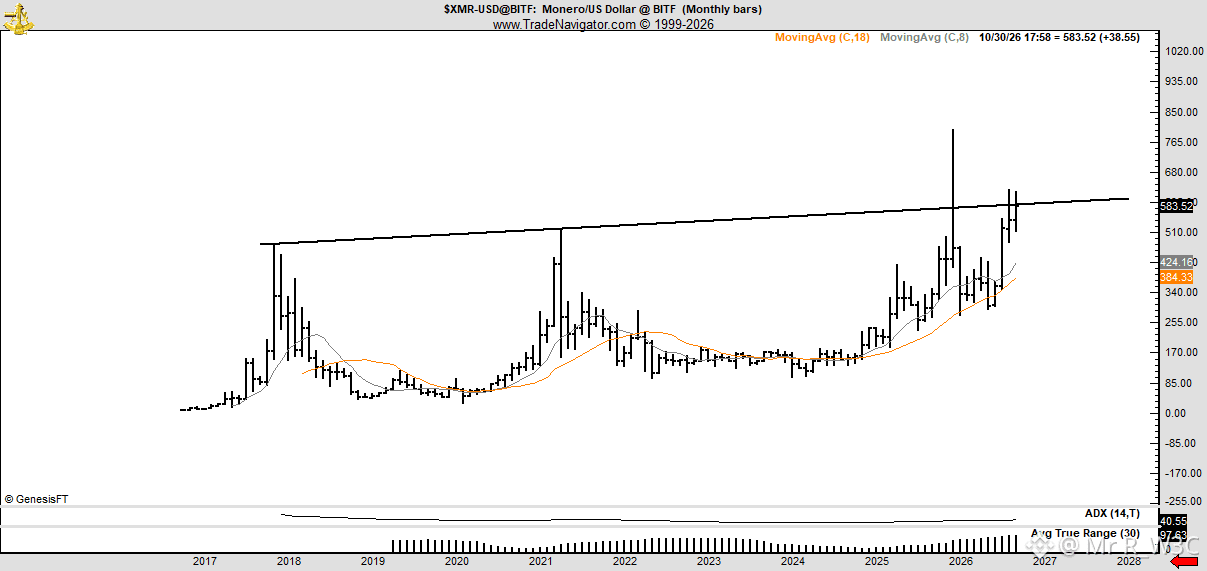
Don’t focus only on ZEC! Monero (XMR) may be gearing up for a major move
Renowned trader Peter Brandt shared a chart this morning, pointing out:
XMR’s monthly chart pattern looks highly similar to silver’s before its surge to $125—after a long consolidation, it repeatedly tested key resistance at 500–600, while the moving averages turned bullish, potentially setting the stage for a similar breakout.
I think the main reasons to be bullish on Monero are:
1. Strong technical structure:
Overhead supply has been largely absorbed. Brandt says it’s his favorite chart among altcoins, with a structure similar to silver’s before its major bull run.
2. Genuine demand for privacy:
It’s anonymous by default, and ransomware operators and hackers favor XMR. Recent on-chain money-laundering incidents have further highlighted its irreplaceable value.
3. Independent resilience:
It often strengthens against the trend within the privacy sector. In 2026, it set an ATH near $800, and after a pullback around $580, it remains in an uptrend.
4. Relative advantages:
Compared with ZEC and others, XMR offers more thorough privacy. Delisting pressure remains, but its real-world use cases are more compelling.
$XMR Price analysis:
In the short term, watch support at 570–580 and resistance at 600–630. A decisive breakout could open the way to the previous high and beyond.
The long-term structure is bullish, but be mindful of regulatory and volatility risks.
{future}(XMRUSDT)
Don’t focus only on ZEC! Monero (XMR) may be gearing up for a major move
Renowned trader Peter Brandt shared a chart this morning, pointing out:
XMR’s monthly chart pattern looks highly similar to silver’s before its surge to $125—after a long consolidation, it repeatedly tested key resistance at 500–600, while the moving averages turned bullish, potentially setting the stage for a similar breakout.
I think the main reasons to be bullish on Monero are:
1. Strong technical structure:
Overhead supply has been largely absorbed. Brandt says it’s his favorite chart among altcoins, with a structure similar to silver’s before its major bull run.
2. Genuine demand for privacy:
It’s anonymous by default, and ransomware operators and hackers favor XMR. Recent on-chain money-laundering incidents have further highlighted its irreplaceable value.
3. Independent resilience:
It often strengthens against the trend within the privacy sector. In 2026, it set an ATH near $800, and after a pullback around $580, it remains in an uptrend.
4. Relative advantages:
Compared with ZEC and others, XMR offers more thorough privacy. Delisting pressure remains, but its real-world use cases are more compelling.
$XMR Price analysis:
In the short term, watch support at 570–580 and resistance at 600–630. A decisive breakout could open the way to the previous high and beyond.
The long-term structure is bullish, but be mindful of regulatory and volatility risks.
161
·
--
Bullish
Trump is once again using word games to steer the narrative, hyping negotiations that haven’t materialized as an “immediate ceasefire.”
The market is trading ahead of events—watch for short-term swings.
On the 11th, Trump posted that an energy ceasefire between Russia and Ukraine had taken effect immediately and that both sides had agreed.
But Zelenskyy said this was news to him; Ukraine had only said, “If Russia stops too, we’ll stop.” Russia has yet to confirm anything.
And even after Trump’s announcement, Russian forces continued attacking Ukrainian power plants, making him look foolish.
Clearly, Trump wants to use this round of talks with Russia to increase diesel supply and temporarily ease sanctions, while pressuring Ukraine to stop striking refineries—turning oil prices into a tool of domestic politics.
Brent $BZ fell back to around 103 after his statement.
This is a short-term, sentiment-driven pullback, not a reversal in fundamentals.
Diesel futures fell even harder, suggesting the market has priced in a potential increase in supply ahead of time.
But we need to understand that what can sustainably bring prices down is a substantive ceasefire and a recovery in supply—not a social media post.
Trust between Russia and Ukraine is low, and history keeps repeating itself; Middle East risks remain unresolved—the Houthis continue attacking Saudi airports and facilities, oil tankers in the Strait of Hormuz were attacked again over the weekend, and Iran is tightening controls.
If the ceasefire falls through and the Middle East escalates again, prices will rebound quickly.
The outlook for oil remains bullish; any dip is an opportunity.
Go long immediately if Brent falls below 100, with an upside target of 105–110.
$BTC $ETH : You can open a short at the resistance above to capture a short-term pullback.
{future}(BZUSDT)
Trump is once again using word games to steer the narrative, hyping negotiations that haven’t materialized as an “immediate ceasefire.”
The market is trading ahead of events—watch for short-term swings.
On the 11th, Trump posted that an energy ceasefire between Russia and Ukraine had taken effect immediately and that both sides had agreed.
But Zelenskyy said this was news to him; Ukraine had only said, “If Russia stops too, we’ll stop.” Russia has yet to confirm anything.
And even after Trump’s announcement, Russian forces continued attacking Ukrainian power plants, making him look foolish.
Clearly, Trump wants to use this round of talks with Russia to increase diesel supply and temporarily ease sanctions, while pressuring Ukraine to stop striking refineries—turning oil prices into a tool of domestic politics.
Brent $BZ fell back to around 103 after his statement.
This is a short-term, sentiment-driven pullback, not a reversal in fundamentals.
Diesel futures fell even harder, suggesting the market has priced in a potential increase in supply ahead of time.
But we need to understand that what can sustainably bring prices down is a substantive ceasefire and a recovery in supply—not a social media post.
Trust between Russia and Ukraine is low, and history keeps repeating itself; Middle East risks remain unresolved—the Houthis continue attacking Saudi airports and facilities, oil tankers in the Strait of Hormuz were attacked again over the weekend, and Iran is tightening controls.
If the ceasefire falls through and the Middle East escalates again, prices will rebound quickly.
The outlook for oil remains bullish; any dip is an opportunity.
Go long immediately if Brent falls below 100, with an upside target of 105–110.
$BTC $ETH : You can open a short at the resistance above to capture a short-term pullback.
44
·
--
Bearish
Doubled in 7 days, but don’t rush to chase it: 127 million tokens are on their way to being unlocked!$STRK
This STRK rally is a bet on future technological leadership, but the market has already turned “under consideration” into “about to happen.”
Starknet plans to transition from an Ethereum L2 to an independent L1, with a goal of achieving a quantum-resistant network by 2027.
This narrative is certainly compelling. If the threat from quantum computing draws closer faster than expected, having control over the pace of your own security upgrades will matter even more.
But keep in mind:
Considering a transition is not the same as making a formal decision, and a quantum-resistance target does not mean the technical overhaul is complete.
Becoming an L1 also means taking responsibility for consensus, security, and ecosystem development. Execution is the real test.
In the short term, the more immediate risk is token supply.
Around 127 million STRK tokens are set to unlock around October 15. With the narrative heating up alongside new supply, volatility could increase further.
My advice:
Don’t chase a series of sharp gains. First, see whether the market can absorb selling pressure around the unlock.
If trading volume surges during a rally but the price stalls near the highs, beware of investors taking profits on the positive news.
If the price pulls back on lower volume and holds key support, then consider building a position in stages.
Keep an eye on three things next:
Whether a formal proposal for the L1 transition is submitted, whether the quantum-resistance roadmap makes tangible progress, and whether the price can hold steady after the unlock.
A compelling narrative can fuel a sharp rally, but ultimately, how far it goes depends on execution and genuine buying demand.#strk
{future}(STRKUSDT)
Doubled in 7 days, but don’t rush to chase it: 127 million tokens are on their way to being unlocked!$STRK
This STRK rally is a bet on future technological leadership, but the market has already turned “under consideration” into “about to happen.”
Starknet plans to transition from an Ethereum L2 to an independent L1, with a goal of achieving a quantum-resistant network by 2027.
This narrative is certainly compelling. If the threat from quantum computing draws closer faster than expected, having control over the pace of your own security upgrades will matter even more.
But keep in mind:
Considering a transition is not the same as making a formal decision, and a quantum-resistance target does not mean the technical overhaul is complete.
Becoming an L1 also means taking responsibility for consensus, security, and ecosystem development. Execution is the real test.
In the short term, the more immediate risk is token supply.
Around 127 million STRK tokens are set to unlock around October 15. With the narrative heating up alongside new supply, volatility could increase further.
My advice:
Don’t chase a series of sharp gains. First, see whether the market can absorb selling pressure around the unlock.
If trading volume surges during a rally but the price stalls near the highs, beware of investors taking profits on the positive news.
If the price pulls back on lower volume and holds key support, then consider building a position in stages.
Keep an eye on three things next:
Whether a formal proposal for the L1 transition is submitted, whether the quantum-resistance roadmap makes tangible progress, and whether the price can hold steady after the unlock.
A compelling narrative can fuel a sharp rally, but ultimately, how far it goes depends on execution and genuine buying demand.#strk
51
·
--
Was a Ledger hardware wallet tampered with? The $86 million mystery—and the real danger is the trust chain!
#Ledger确认用户设备遭植入未授权硬件
My take:
The most concerning thing about this incident isn’t that hardware wallets are unsafe. It’s that you may think you bought a device through an official channel, but still can’t be sure it wasn’t tampered with between leaving the factory and reaching you.
Ledger has confirmed that one device involved in the incident contained an unauthorized hardware implant. However, it has not yet been confirmed whether the suspected $86 million in losses is all connected to it.
This is also a reminder that the security of a hardware wallet depends on more than its chip and code: the supply chain can also be an entry point for attacks. No matter how secure the device itself is, your assets could still be stolen if the initialization process is compromised or your recovery phrase has been exposed.
If you bought a device through CryptoBilis within the past 90 days and haven’t initialized it yet, don’t use it for now. If you’ve already activated one, promptly check for risks through official channels and consider transferring your assets to a wallet created with a brand-new recovery phrase. The new recovery phrase must be generated on a trusted device. Never enter your old recovery phrase on a website or send it to customer support.
As members of the crypto community, we should pay attention not only to the total losses, but also to the range of affected devices, the attack vector, and whether official channels can establish more reliable tamper-proof verification.
Remember: The essence of self-custody isn’t just hiding your private keys—it’s ensuring that from the moment they’re generated, they remain in your hands alone.
$BTC
{future}(BTCUSDT)
$ETH
{future}(ETHUSDT)
Was a Ledger hardware wallet tampered with? The $86 million mystery—and the real danger is the trust chain!
#Ledger确认用户设备遭植入未授权硬件
My take:
The most concerning thing about this incident isn’t that hardware wallets are unsafe. It’s that you may think you bought a device through an official channel, but still can’t be sure it wasn’t tampered with between leaving the factory and reaching you.
Ledger has confirmed that one device involved in the incident contained an unauthorized hardware implant. However, it has not yet been confirmed whether the suspected $86 million in losses is all connected to it.
This is also a reminder that the security of a hardware wallet depends on more than its chip and code: the supply chain can also be an entry point for attacks. No matter how secure the device itself is, your assets could still be stolen if the initialization process is compromised or your recovery phrase has been exposed.
If you bought a device through CryptoBilis within the past 90 days and haven’t initialized it yet, don’t use it for now. If you’ve already activated one, promptly check for risks through official channels and consider transferring your assets to a wallet created with a brand-new recovery phrase. The new recovery phrase must be generated on a trusted device. Never enter your old recovery phrase on a website or send it to customer support.
As members of the crypto community, we should pay attention not only to the total losses, but also to the range of affected devices, the attack vector, and whether official channels can establish more reliable tamper-proof verification.
Remember: The essence of self-custody isn’t just hiding your private keys—it’s ensuring that from the moment they’re generated, they remain in your hands alone.
$BTC
$ETH
157
·
--
BTC and ETH ETFs continue to see outflows, so why is the XRP ETF bucking the trend and attracting inflows?
What exactly do investors see in it?
BTC and ETH ETFs have seen net outflows for several consecutive days recently, with combined outflows of about $1.29 billion from October 5–9. Meanwhile, the XRP ETF saw net inflows of about $8.17 million on October 8, bringing cumulative net inflows to about $1.8 billion.
Why are investors drawn specifically to $XRP ?
I think there are three main reasons:
First, the Ripple-SEC lawsuit is essentially over, reducing regulatory uncertainty;
Second, XRP has previously lagged behind, creating expectations of a catch-up rally;
Third, the cross-border payments narrative gives it an investment case distinct from BTC and ETH.
This suggests that some capital is shifting away from major assets toward investments with independent catalysts.
Technically, $XRP is currently consolidating weakly near $1.40.
The $1.32–$1.38 range is an important support zone, while $1.50–$1.53 is key resistance.
A breakout on strong volume could open the way to a further test of $1.60–$1.70;
if support fails, however, watch for a further decline.
My view:
XRP is worth watching, but inflows are a signal—not confirmation of a bull market.
The key things to watch next are whether the ETF can continue attracting inflows and whether the price can break convincingly above $1.50.
A confluence of capital flows, price action, and market sentiment would be stronger evidence of a trend reversal.
#XRP账本修复可增发XRP的漏洞 #XRP财库公司Evernorth完成SPAC合并
87
·
--
Down over 13% in a single day: ZEC’s privacy narrative isn’t dead, but buyers are starting to pull back!
$ZEC , which surged toward $1,700 throughout September, has now pulled back by about 30%. Grayscale’s ZCSH has also started seeing sustained outflows.
In the week ending October 2, ZCSH saw net outflows of about $93.56 million; on October 8, another $18.66 million flowed out. The ETF, which had been steadily absorbing supply, is now becoming selling pressure the market needs to digest.
Add in liquidations of leveraged longs and a weakening BTC, and ZEC’s current pullback is about more than just profit-taking.
My view right now:
$ZEC is bearish in the short term, but that doesn’t mean the privacy sector is over.
ZEC’s optional privacy features, ETF access, and institutional interest still have value, and the NU7 upgrade is still moving forward.
But these are medium-term factors—they can’t directly offset the outflows happening right now.
Key things to watch next:
First, whether the $1,110–$1,200 range can hold;
Second, when ZCSH’s net outflows start to ease noticeably.
If the price finds a floor and ETF outflows cool, this may just be a supply reset after a sharp rally;
if outflows continue and key support gives way, a deeper pullback is a risk.
The privacy narrative is still alive, but ZEC will need new buyers to prove it can rally again.
#ZECUSDT #比特币跌破8.1万美元
{future}(ZECUSDT)
Down over 13% in a single day: ZEC’s privacy narrative isn’t dead, but buyers are starting to pull back!
$ZEC , which surged toward $1,700 throughout September, has now pulled back by about 30%. Grayscale’s ZCSH has also started seeing sustained outflows.
In the week ending October 2, ZCSH saw net outflows of about $93.56 million; on October 8, another $18.66 million flowed out. The ETF, which had been steadily absorbing supply, is now becoming selling pressure the market needs to digest.
Add in liquidations of leveraged longs and a weakening BTC, and ZEC’s current pullback is about more than just profit-taking.
My view right now:
$ZEC is bearish in the short term, but that doesn’t mean the privacy sector is over.
ZEC’s optional privacy features, ETF access, and institutional interest still have value, and the NU7 upgrade is still moving forward.
But these are medium-term factors—they can’t directly offset the outflows happening right now.
Key things to watch next:
First, whether the $1,110–$1,200 range can hold;
Second, when ZCSH’s net outflows start to ease noticeably.
If the price finds a floor and ETF outflows cool, this may just be a supply reset after a sharp rally;
if outflows continue and key support gives way, a deeper pullback is a risk.
The privacy narrative is still alive, but ZEC will need new buyers to prove it can rally again.
#ZECUSDT #比特币跌破8.1万美元
238
·
--
At Basecamp, Sui pushed tunnels to a peak of 40.61 million TPS—it's definitely well suited for AI.
The official positioning is that this layer serves as the throughput layer for the AI agent economy: humans can't use this kind of speed, but agents can.
Despite such a major bullish catalyst, $SUI not only failed to rise, but fell quite a bit.
$SUI The current price is around $1.13, still roughly 80% below the all-time high of $5.35.
My view is that macro factors dragged the price down first; the narrative hasn't been priced in yet.
I'm bullish not because the mainnet is already running at 40 million TPS, but because agent payments need channels with near-zero marginal costs. Sui keeps channel opening and closing on the mainnet, while intermediate interactions happen off-chain.
Next, let's see whether $1.10 can hold.
If it does, the first target is the previous high of $1.19–$1.23; a breakout on rising volume would put the next target around $1.26. #Sui创4060万TPS纪录
{future}(SUIUSDT)
At Basecamp, Sui pushed tunnels to a peak of 40.61 million TPS—it's definitely well suited for AI.
The official positioning is that this layer serves as the throughput layer for the AI agent economy: humans can't use this kind of speed, but agents can.
Despite such a major bullish catalyst, $SUI not only failed to rise, but fell quite a bit.
$SUI The current price is around $1.13, still roughly 80% below the all-time high of $5.35.
My view is that macro factors dragged the price down first; the narrative hasn't been priced in yet.
I'm bullish not because the mainnet is already running at 40 million TPS, but because agent payments need channels with near-zero marginal costs. Sui keeps channel opening and closing on the mainnet, while intermediate interactions happen off-chain.
Next, let's see whether $1.10 can hold.
If it does, the first target is the previous high of $1.19–$1.23; a breakout on rising volume would put the next target around $1.26. #Sui创4060万TPS纪录
306
·
--
Abstract is shutting down its chain, and $PENGU faces a major test: Can Pudgy Penguins keep rising without a chain?
Now that Abstract has announced it’s shutting down, was your first reaction also, “That’s bearish for PENGU”?
But I don’t think that’s necessarily the case.
At its core, Abstract was an experiment in a “consumer chain”: it had users, transactions, partnerships with major brands, and even reached hundreds of thousands of users and billions of dollars in transaction volume. In the end, though, it still found that there was plenty of activity, but not enough revenue to sustain a public blockchain.
So Igloo chose to shut down the chain rather than keep burning money and issuing tokens to keep it alive.
This also means PENGU can no longer be valued on the basis of “on-chain narratives.”
Ultimately, whether PENGU is truly valuable comes down to the Pudgy Penguins brand itself.
How well are the toys selling?
Can IP licensing continue to expand?
Is there sustained demand for the NFTs?
These are the things that make up PENGU’s true fundamentals.
So my view is: bearish in the short term, but not necessarily bad news in the medium term.
In the short term, Abstract points and airdrop expectations have fallen through, and the broader market is weak, so it’s no surprise that PENGU is taking a hit.
But over a longer time horizon, Igloo will no longer have to keep pouring money into a loss-making chain. Instead, it can refocus its resources on the Pudgy Penguins brand, IP licensing, and the PENGU ecosystem.
Without Abstract, points, an airdrop, or even the story of “the next chain,” can PENGU still attract users and capital? That’s what PENGU really needs to prove next.
So don’t turn bearish on PENGU just because the chain is shutting down.
Keep an eye on whether Igloo can deliver real brand growth and commercialization metrics over the next 1–3 months.
A chain can shut down, but if the penguins can keep making money and breaking into the mainstream, the PENGU story may not be over after all.
{future}(PENGUUSDT)
Abstract is shutting down its chain, and $PENGU faces a major test: Can Pudgy Penguins keep rising without a chain?
Now that Abstract has announced it’s shutting down, was your first reaction also, “That’s bearish for PENGU”?
But I don’t think that’s necessarily the case.
At its core, Abstract was an experiment in a “consumer chain”: it had users, transactions, partnerships with major brands, and even reached hundreds of thousands of users and billions of dollars in transaction volume. In the end, though, it still found that there was plenty of activity, but not enough revenue to sustain a public blockchain.
So Igloo chose to shut down the chain rather than keep burning money and issuing tokens to keep it alive.
This also means PENGU can no longer be valued on the basis of “on-chain narratives.”
Ultimately, whether PENGU is truly valuable comes down to the Pudgy Penguins brand itself.
How well are the toys selling?
Can IP licensing continue to expand?
Is there sustained demand for the NFTs?
These are the things that make up PENGU’s true fundamentals.
So my view is: bearish in the short term, but not necessarily bad news in the medium term.
In the short term, Abstract points and airdrop expectations have fallen through, and the broader market is weak, so it’s no surprise that PENGU is taking a hit.
But over a longer time horizon, Igloo will no longer have to keep pouring money into a loss-making chain. Instead, it can refocus its resources on the Pudgy Penguins brand, IP licensing, and the PENGU ecosystem.
Without Abstract, points, an airdrop, or even the story of “the next chain,” can PENGU still attract users and capital? That’s what PENGU really needs to prove next.
So don’t turn bearish on PENGU just because the chain is shutting down.
Keep an eye on whether Igloo can deliver real brand growth and commercialization metrics over the next 1–3 months.
A chain can shut down, but if the penguins can keep making money and breaking into the mainstream, the PENGU story may not be over after all.
275
·
--
Verified
Until the strait issue is fully resolved, the lower oil prices fall, the more I go long!
Brent has pulled back from above $102 to around $98 over the past two days, and I think this is an opportunity to go long.
The main reason for this pullback is that the market is using restored exports and releases from reserves to temporarily offset the risk premium associated with the two straits.
Brent $BZ is currently around $99.5, while $CL is around $88.
Middle Eastern crude exports have recovered to more than 80% of prewar levels;
The G7 also plans to release around 100 million barrels of crude oil and refined products.
But this is only a supply-side buffer, not a resolution of the risks facing the straits.
Traffic through the Strait of Hormuz remains unstable, and tankers have been attacked recently. A new round of fighting has also broken out near the Bab el-Mandeb Strait, with Saudi-backed Yemeni government forces and Houthi forces continuing to clash.
My view is clear:
As long as the Strait of Hormuz and the Bab el-Mandeb Strait have not truly returned to stability, every dip in oil prices is an opportunity to go long.
In the short term, I’m looking at $102–$105.
If there are coordinated attacks on ships or a significant disruption to shipping, Brent could surge toward $108–$110.
As long as the straits issue remains unresolved, talk of negotiations is just hot air. These positive developments may briefly affect oil prices,
but they cannot change the fundamental problem. If oil prices dare to fall, just keep going long!
{future}(CLUSDT)
{future}(BZUSDT)
Until the strait issue is fully resolved, the lower oil prices fall, the more I go long!
Brent has pulled back from above $102 to around $98 over the past two days, and I think this is an opportunity to go long.
The main reason for this pullback is that the market is using restored exports and releases from reserves to temporarily offset the risk premium associated with the two straits.
Brent $BZ is currently around $99.5, while $CL is around $88.
Middle Eastern crude exports have recovered to more than 80% of prewar levels;
The G7 also plans to release around 100 million barrels of crude oil and refined products.
But this is only a supply-side buffer, not a resolution of the risks facing the straits.
Traffic through the Strait of Hormuz remains unstable, and tankers have been attacked recently. A new round of fighting has also broken out near the Bab el-Mandeb Strait, with Saudi-backed Yemeni government forces and Houthi forces continuing to clash.
My view is clear:
As long as the Strait of Hormuz and the Bab el-Mandeb Strait have not truly returned to stability, every dip in oil prices is an opportunity to go long.
In the short term, I’m looking at $102–$105.
If there are coordinated attacks on ships or a significant disruption to shipping, Brent could surge toward $108–$110.
As long as the straits issue remains unresolved, talk of negotiations is just hot air. These positive developments may briefly affect oil prices,
but they cannot change the fundamental problem. If oil prices dare to fall, just keep going long!
2
683
Log in to explore more content
Join global crypto users on Binance Square
⚡️ Get latest and useful information about crypto.
💬 Trusted by the world’s largest crypto exchange.
👍 Discover real insights from verified creators.
Email / Phone number
Trending Topics
BinanceWithdrawalScamWarning
1,841 views
159 Discussing
Binance Warns Users of Withdrawal Scams as Services Resume: It Will Never Charge Fees, Sell Queue Spots or Ask You to Move Funds to a “Vault”
Binance News
·1 Likes
·2.1k views
USMidtermElections
545,263 views
2,719 Discussing
USOctoberNFP-AreRateCutsStillPossible
9,386 views
263 Discussing