

SuckerRn
73 Posts

SuckerRn
Report
Block User
搬砖养仓|早期加密机会研究。专注币安生态、潜力项目与代币估值。关注市场忽略了什么,研究上涨逻辑,也记录判断失误。不追所有热点,只做有依据的研究。DYOR|不构成投资建议。
Open Trade

BNCB Holder
High-Frequency Trader
7.4 Years
4 Following
3.1K+ Followers
1.5K+ Liked
Posts
Portfolio
All
Videos
PINNED
·
--
Binance Unofficial Benefits Officer Fan Rewards
I’m working toward becoming Binance’s “Unofficial Benefits Officer.” Rewards will be offered in stages based on follower count:
1. Fewer than 10,000 followers: Random giveaways of meme coins or small amounts of smaller coins.
2. Leave a comment: Randomly receive 1.88 USDT as a “Coca-Cola airdrop.”
3. 10,000 or more followers: Unlock the BNC shareholder reward. Friends who comment may randomly receive a free BNCB airdrop.
4. 100,000 or more followers: Unlock the SOL reward. Followers who comment may randomly receive a free SOL airdrop.
5. 1 million or more followers: Unlock the BNB reward.
6. 10 million or more followers: Unlock ETH, and maybe even BTC rewards.
Note: This is my personal idea for an “Unofficial Benefits Officer” role and does not represent an official Binance campaign. Specific rewards will be subject to rules announced later. To qualify for any reward, simply leave a comment under this post or another post. Random airdrops will be given out at unpredictable times each day (of course, if I become financially independent, the reward milestones will accelerate dramatically).
$BNB $BTC
{spot}(BNBUSDT)
Binance Unofficial Benefits Officer Fan Rewards
I’m working toward becoming Binance’s “Unofficial Benefits Officer.” Rewards will be offered in stages based on follower count:
1. Fewer than 10,000 followers: Random giveaways of meme coins or small amounts of smaller coins.
2. Leave a comment: Randomly receive 1.88 USDT as a “Coca-Cola airdrop.”
3. 10,000 or more followers: Unlock the BNC shareholder reward. Friends who comment may randomly receive a free BNCB airdrop.
4. 100,000 or more followers: Unlock the SOL reward. Followers who comment may randomly receive a free SOL airdrop.
5. 1 million or more followers: Unlock the BNB reward.
6. 10 million or more followers: Unlock ETH, and maybe even BTC rewards.
Note: This is my personal idea for an “Unofficial Benefits Officer” role and does not represent an official Binance campaign. Specific rewards will be subject to rules announced later. To qualify for any reward, simply leave a comment under this post or another post. Random airdrops will be given out at unpredictable times each day (of course, if I become financially independent, the reward milestones will accelerate dramatically).
$BNB $BTC

Good luck
From SuckerRn
Fully Claimed
103
8
148
1.3k
·
--
The hackers never leftFrom October 29 to 30, 2026, Binance experienced an unusually large security incident, though its impact was ultimately substantially mitigated. The core facts are these: multiple hot wallets were anomalously “swept” within a very short period, with the outflow initially tracked at tens of billions of dollars. However, major stablecoin issuers quickly froze most of the funds involved. CZ estimated the actual net loss at slightly over $1 billion, and Binance pledged to cover it in full.
Unusual outflows: Multiple hot wallets swept in quick succession
The incident began at approximately 4:24 a.m. Taipei time on October 30 (20:24 UTC on October 29), when a hot wallet labeled “Binance 14” by Binance triggered a sweep transaction, transferring approximately 167,464 ETH and 63 ERC-20 tokens in a single transaction, including about 1.615 billion USDT, then valued at approximately $2.5 billion.
The hackers never left
From October 29 to 30, 2026, Binance experienced an unusually large security incident, though its impact was ultimately substantially mitigated. The core facts are these: multiple hot wallets were anomalously “swept” within a very short period, with the outflow initially tracked at tens of billions of dollars. However, major stablecoin issuers quickly froze most of the funds involved. CZ estimated the actual net loss at slightly over $1 billion, and Binance pledged to cover it in full.
Unusual outflows: Multiple hot wallets swept in quick succession
The incident began at approximately 4:24 a.m. Taipei time on October 30 (20:24 UTC on October 29), when a hot wallet labeled “Binance 14” by Binance triggered a sweep transaction, transferring approximately 167,464 ETH and 63 ERC-20 tokens in a single transaction, including about 1.615 billion USDT, then valued at approximately $2.5 billion.
10
1
14
3.3k
·
--
Some Thoughts on the Predict AirdropAfter years of working on project launches, I’ve increasingly come to feel that the hardest part of an airdrop has never been “how to distribute it,” but “how the market will interpret it afterward.” When Predict.fun announced its PREDICT launch plan, the narrative was clear: more than half allocated to the ecosystem and community, long lockups for early supporters and core contributors, only 16% circulating at TGE, and two airdrop options—claim 35% immediately or lock for a year to receive 100%. Low circulation creates scarcity, long lockups defer selling pressure, and the choice between the two screens for “loyalty.” The intent is easy to understand.
In the prediction-market sector, Kalshi and Polymarket have already established a duopoly in plain sight. Predict.fun has $1.8 billion in cumulative trading volume, 130,000 users, and $1.092 billion in trading volume during the World Cup. Its monthly share has also climbed from 0.15% to 22.81%, but its absolute scale still makes it a challenger. It needs a token structure that can stabilize the early price while telling a story about community. But there is no automatic pipeline connecting product metrics to token value. Platform revenue is around $9 million, while the derivatives market had already priced in an FDV of about $1.4 billion before TGE. That gap cannot be bridged by a 16% circulating supply or a 12-month lockup. Lockups control the timing of supply; they can’t answer “why hold?” If people hold PREDICT only because the circulating supply is small and they can’t sell for now, rather than because they want to use the platform, then the unlock will be a stress test.
Some Thoughts on the Predict Airdrop
After years of working on project launches, I’ve increasingly come to feel that the hardest part of an airdrop has never been “how to distribute it,” but “how the market will interpret it afterward.” When Predict.fun announced its PREDICT launch plan, the narrative was clear: more than half allocated to the ecosystem and community, long lockups for early supporters and core contributors, only 16% circulating at TGE, and two airdrop options—claim 35% immediately or lock for a year to receive 100%. Low circulation creates scarcity, long lockups defer selling pressure, and the choice between the two screens for “loyalty.” The intent is easy to understand.
In the prediction-market sector, Kalshi and Polymarket have already established a duopoly in plain sight. Predict.fun has $1.8 billion in cumulative trading volume, 130,000 users, and $1.092 billion in trading volume during the World Cup. Its monthly share has also climbed from 0.15% to 22.81%, but its absolute scale still makes it a challenger. It needs a token structure that can stabilize the early price while telling a story about community. But there is no automatic pipeline connecting product metrics to token value. Platform revenue is around $9 million, while the derivatives market had already priced in an FDV of about $1.4 billion before TGE. That gap cannot be bridged by a 16% circulating supply or a 12-month lockup. Lockups control the timing of supply; they can’t answer “why hold?” If people hold PREDICT only because the circulating supply is small and they can’t sell for now, rather than because they want to use the platform, then the unlock will be a stress test.
In the prediction-market sector, Kalshi and Polymarket have already established a duopoly in plain sight. Predict.fun has $1.8 billion in cumulative trading volume, 130,000 users, and $1.092 billion in trading volume during the World Cup. Its monthly share has also climbed from 0.15% to 22.81%, but its absolute scale still makes it a challenger. It needs a token structure that can stabilize the early price while telling a story about community. But there is no automatic pipeline connecting product metrics to token value. Platform revenue is around $9 million, while the derivatives market had already priced in an FDV of about $1.4 billion before TGE. That gap cannot be bridged by a 16% circulating supply or a 12-month lockup. Lockups control the timing of supply; they can’t answer “why hold?” If people hold PREDICT only because the circulating supply is small and they can’t sell for now, rather than because they want to use the platform, then the unlock will be a stress test.
23
1
21
1.8k
·
--
Leave a comment below the previous video for a chance to win a random Coca-Cola giveaway. $BTC
Leave a comment below the previous video for a chance to win a random Coca-Cola giveaway. $BTC
Good luck
From SuckerRn
Fully Claimed
91
80
2.1k
·
--
Whenever I'm feeling upset, I like watching these cleaning videos. They're especially therapeutic, and after everything is tidied up, I feel so much better.$NVDAB #股票财报季
Whenever I'm feeling upset, I like watching these cleaning videos. They're especially therapeutic, and after everything is tidied up, I feel so much better.$NVDAB #股票财报季
44
4
34
752
·
--
The secret to building wealth is actually just three steps:
Step 1: Sign up for Binance and enter this market full of opportunities.
Step 2: Find an asset truly worth holding for the long term.
Step 3: Buy it, then patiently wait for time to provide the answer.
Trade less, fuss less, and let your emotions get the better of you less often.
What truly sets people apart financially often isn’t how hard they work, but whether they can make the right choice in the right place—and stick with it long enough.
Of course, the hardest part has never been waiting. It’s choosing the right asset and getting through the waiting period.
Choose the right direction, and leave the rest to time. 🚀
By the way, you haven’t signed up for your own smart wallet yet, have you?
27
2
36
8.7k
·
--
This is crazy—I woke up to find I’d gained so many followers.
To make it easier for everyone to get some free money, I’ll randomly pick comments on this post to receive extra airdrop rewards. Of course, you can also just claim a small red packet.$BTC $SOL
This is crazy—I woke up to find I’d gained so many followers.
To make it easier for everyone to get some free money, I’ll randomly pick comments on this post to receive extra airdrop rewards. Of course, you can also just claim a small red packet.$BTC $SOL
To make it easier for everyone to get some free money, I’ll randomly pick comments on this post to receive extra airdrop rewards. Of course, you can also just claim a small red packet.$BTC $SOL
留言有机会获得可口可乐空投
From SuckerRn
Fully Claimed
65
5
81
1.4k
·
--
I also want to achieve financial freedom sooner, so that there's only one thing left for me to do in life: keep sending red envelopes to my fans. 😅😅😅
Good luck
I also want to achieve financial freedom sooner, so that there's only one thing left for me to do in life: keep sending red envelopes to my fans. 😅😅😅
Good luck
Good luck
good luck
From SuckerRn
Fully Claimed
91
3
104
1.5k
·
--
I hope everyone comes to Binance to make money, not lose it.
May the God of Wealth always be by your side.
Good night.
I hope everyone comes to Binance to make money, not lose it.
May the God of Wealth always be by your side.
Good night.
May the God of Wealth always be by your side.
Good night.
看您运气
From SuckerRn
107
3
212
1.5k
·
--
My apologies—I didn’t prepare enough money for the red envelopes.
I’ll add a little more now.
My apologies—I didn’t prepare enough money for the red envelopes.
I’ll add a little more now.
I’ll add a little more now.
依然随机,看您运气
From SuckerRn
Fully Claimed
131
4
102
2.3k
·
--
I can't stand it when my fans don't receive red envelopes.
I can't stand it when my fans don't receive red envelopes.
这次是随机的了,看运气
From SuckerRn
Fully Claimed
37
1
60
1.4k
·
--
This post says just one thing!
Binance is a platform that lets you make money!
This post says just one thing!
Binance is a platform that lets you make money!
Binance is a platform that lets you make money!
让你赚钱的Binance!
From SuckerRn
Fully Claimed
16
1
28
231
·
--
Some money is yours for the taking if you just bend down and pick it up. Be patient and wait for the flowers to bloom.
Some money is yours for the taking if you just bend down and pick it up. Be patient and wait for the flowers to bloom.
22
1
17
729
·
--
Verified
I believe $BNCB could be an opportunity worth paying close attention to.
It’s not just another ordinary speculative project. It’s a tokenized stock associated with Nasdaq-listed company BNC (CEA Industries), backed by the corresponding shares held in custody by the issuer.
My reasoning is simple:
1️⃣ The BNB ecosystem continues to grow, and institutional investors are looking for new ways to participate.
2️⃣ The convergence of traditional stocks and crypto markets, combined with 24/7 trading, opens up new possibilities.
3️⃣ If the price can regain strength, market sentiment and inflows could provide additional upside.
🎯 First target: $15.15
I see it as a potential opportunity worth researching, rather than something to chase blindly just because it’s trending.
Of course, tokenized stocks aren’t the same as ordinary cryptocurrencies, and their prices aren’t guaranteed to always track the underlying shares. The target price is my personal expectation, not a guaranteed return.
DYOR. Opportunities always favor those who do their research early.
$BNCB
5
13
4.7k
·
--
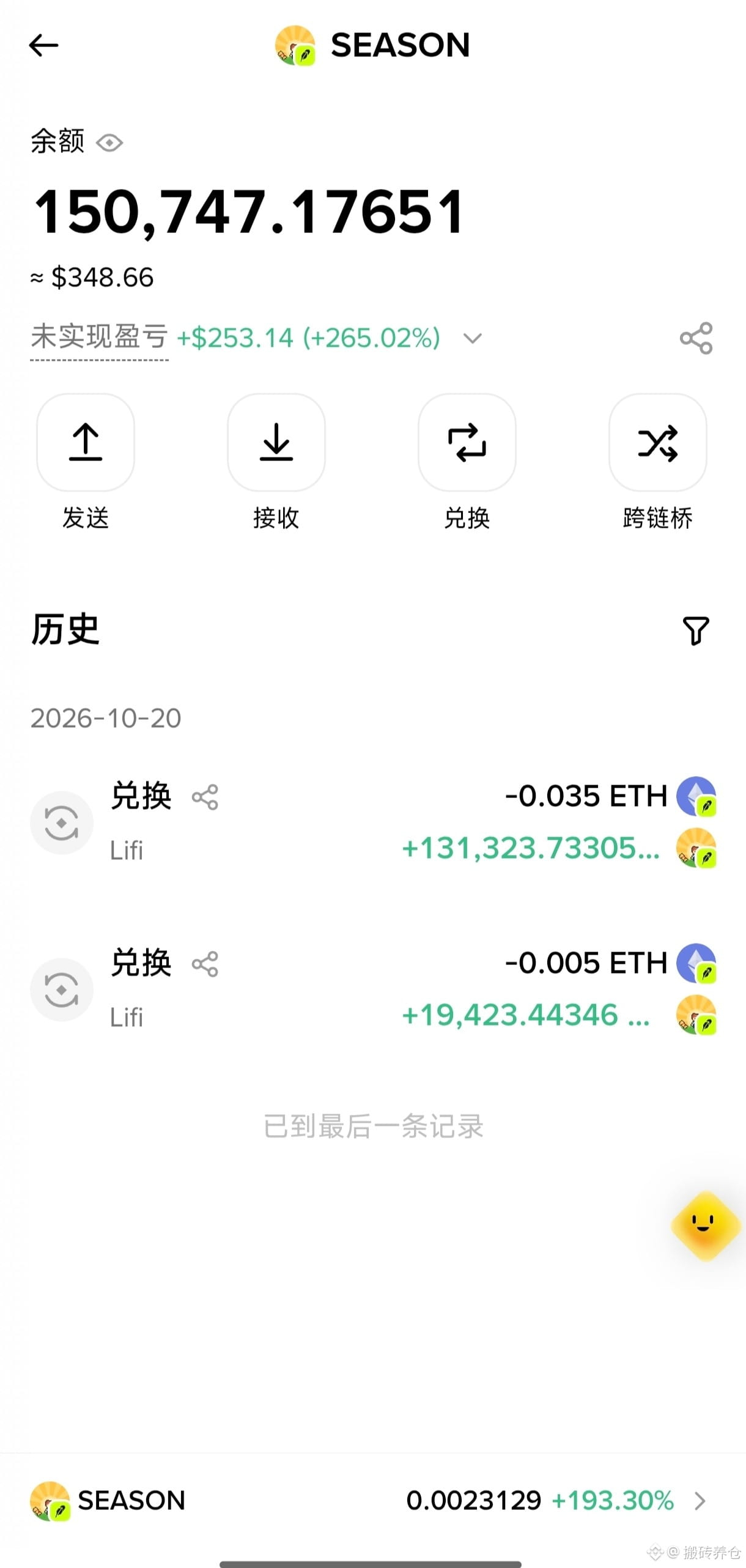
🎮 SEASON: A GameFi project worth watching on Robinhood Chain!
While everyone is chasing meme coins, SEASON is exploring a different path: farm management, resource production, battles, and on-chain trading.
🔥 Real gameplay
🔥 Token-burning mechanism
🔥 Potential upside from the growth of the Robinhood Chain ecosystem
What’s really worth watching isn’t how much it has already risen, but whether it can attract real players and build a sustainable in-game economy.
If the product and ecosystem take off together, this niche project could have a very different valuation in the future.
Do your research early and keep an eye on it. The next 10x opportunity may be hiding where no one is looking.
#SEASON #GameFi #RobinhoodChain
2
4
81
·
--
Binance AI Wallet: Ushering in a New Era of Web3 Intelligence
As artificial intelligence and blockchain technology become increasingly integrated, the digital asset industry is undergoing a new transformation. The emergence of Binance AI Wallet is not merely an upgrade to traditional wallet features—it also represents Web3’s shift from an era of manual operation to one powered by intelligent agents.
Traditional wallets require users to manually check their assets, swap tokens, and interact on-chain. AI wallets, by contrast, aim to understand users’ needs through natural language and, within the scope of granted permissions, call tools and carry out tasks—making complex on-chain operations simpler and more efficient.
The core value of Binance AI Wallet lies in moving AI beyond information analysis and into real-world execution. It has the potential to help users manage assets more efficiently, streamline trading, and open up new possibilities for developers building automated on-chain applications.
Of course, greater intelligence does not mean zero risk. AI can make mistakes, and on-chain transactions are irreversible, so permission management, fund security, and risk controls remain essential.
In the long run, combining AI and blockchain is not just a technological innovation—it could also reshape how people interact with digital assets.
In the Web3 of the future, users may do more than operate wallets themselves: they may set goals and have AI help carry them out, while security mechanisms continue to protect the boundaries of their assets. This is what makes Binance AI Wallet worth paying attention to.
3
361
·
--
Verified
About DNAOn October 16, NeoSoul (DNA) officially launched on Binance Alpha, bringing its narrative of combining AI Agents with on-chain trading to the market. Unlike projects that issue tokens based solely on the AI concept, NeoSoul aims to address a more specific question: As AI begins to analyze information autonomously, execute trades, and even manage funds, how can the market determine whether an Agent is reliable?
That is also what makes DNA worth paying attention to. However, understanding the project requires looking beyond its Binance Alpha launch: Can its product generate real demand? What did its investors see in it? And what supply-and-demand dynamics will the token face after launch?
About DNA
On October 16, NeoSoul (DNA) officially launched on Binance Alpha, bringing its narrative of combining AI Agents with on-chain trading to the market. Unlike projects that issue tokens based solely on the AI concept, NeoSoul aims to address a more specific question: As AI begins to analyze information autonomously, execute trades, and even manage funds, how can the market determine whether an Agent is reliable?
That is also what makes DNA worth paying attention to. However, understanding the project requires looking beyond its Binance Alpha launch: Can its product generate real demand? What did its investors see in it? And what supply-and-demand dynamics will the token face after launch?
That is also what makes DNA worth paying attention to. However, understanding the project requires looking beyond its Binance Alpha launch: Can its product generate real demand? What did its investors see in it? And what supply-and-demand dynamics will the token face after launch?
5
1k
·
--
What makes BNCB worth watching isn’t just its price—it’s the changes taking place in traditional stocks
Many people who study cryptocurrency keep their eyes on BTC, ETH, and various popular meme coins, while overlooking a trend that is changing the structure of the market: bringing real-world assets (RWAs) on-chain.
BNCB is a case worth examining.
It is a tokenized product tied to shares of CEA Industries. The core idea is to bring the economic exposure of traditional stocks onto the blockchain, allowing eligible users to participate in the relevant market through digital assets. It is not an ordinary public-chain token, nor can it simply be equated with directly holding traditional shares.
I believe there are three things about BNCB that are truly worth watching.
First, the way people trade is changing.
Traditional stock markets have fixed trading hours, while blockchain assets can offer more flexible trading mechanisms. Combining the two could make global asset trading more convenient.
Second, the value of RWAs ultimately depends on real demand.
Tokenization is only the first step. What truly determines whether a project can go the distance is the quality of the underlying asset, the issuance and custody mechanisms, trading liquidity, and whether investors have clear and reliable protections for their rights and interests.
Third, the newer the narrative, the more important it is to understand the risks.
BNCB does not mean its price is bound to rise. It faces risks including volatility in the underlying stock, divergence between the token and stock prices, insufficient liquidity, and regulatory restrictions. The convenience of trading on a blockchain also does not mean that all the rights associated with traditional securities are automatically available.
My view is clear:
RWAs are worth studying over the long term, but the outlook for the sector should not be equated directly with the investment value of any individual token.
What may truly be worth watching in the next market cycle is not just which assets rise the fastest, but which ones can connect real-world value, transparent rights, and sustained market demand.
When it comes to BNCB, are you more optimistic about the RWA trend it represents, or more concerned about the liquidity and investor-rights issues surrounding tokenized assets?
5
991
Log in to explore more content
Join global crypto users on Binance Square
⚡️ Get latest and useful information about crypto.
💬 Trusted by the world’s largest crypto exchange.
👍 Discover real insights from verified creators.
Email / Phone number
Trending Topics
UniswapA16zSeekDeFiExemptionFromIllinoisCryptoTax
154 views
109 Discussing
UNISWAP & a16z PUSH BACK AGAINST CRYPTO TAX RULES — IS DeFi AT A TURNING POINT?
Crypto Pulse Hub
·1 Likes
·20 views
HKDollarStablecoinHKDAPToLaunchOnSolana
0 views
0 Discussing
$1.5BInLeveragedCryptoBetsLiquidated
10,311 views
149 Discussing