
丰浪Bit
138 Posts

丰浪Bit
Report
Block User
15 Following
41 Followers
45 Liked
Posts
All
Quotes
·
--
Bearish
#btc Closed the long position at breakeven for now; the rebound wasn't as strong as expected. The broader downtrend isn't over yet. I'll wait and see after the U.S. stock market opens tonight.
#btc Closed the long position at breakeven for now; the rebound wasn't as strong as expected. The broader downtrend isn't over yet. I'll wait and see after the U.S. stock market opens tonight.
2
262
·
--
Bearish
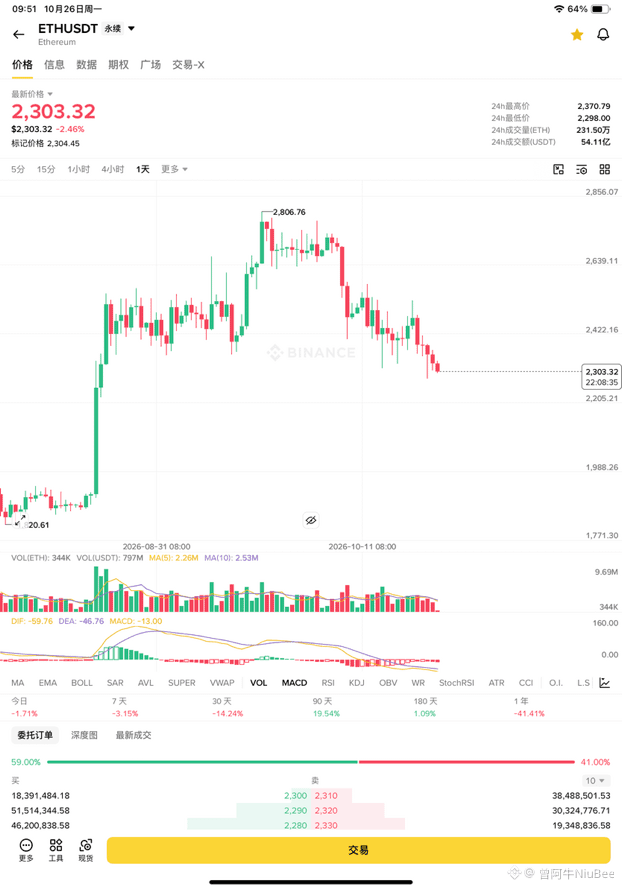
#ethusdt is getting ready for the waterfall and is about to enter the vacuum zone.
#ethusdt is getting ready for the waterfall and is about to enter the vacuum zone.
1
174
·
--
#币安神算子 Compete for a share of the 1,000,000 USDC prize pool with your skills—check in and post daily to join the action!
Binance Square community, here’s a major event currently underway: “Binance Pick.” The total prize pool can reach up to 1,000,000 USDC. It’s simple: complete tasks to earn points → use points to make predictions → climb the leaderboard and share the rewards. Whether you’re a trading pro or a beginner, there’s a prize pool for you to join.
Binance Square community, here’s a major event currently underway: “Binance Pick.” The total prize pool can reach up to 1,000,000 USDC. It’s simple: complete tasks to earn points → use points to make predictions → climb the leaderboard and share the rewards. Whether you’re a trading pro or a beginner, there’s a prize pool for you to join.

66
·
--
“AI automated trading” — the first reaction isn’t excitement. It’s to first wonder whether it could get out of control.This market loves talking about automation so much.
Automatically watch the market, automatically run strategies, automatically rebalance, automatically execute.
It sounds so comfortable—like you don’t have to watch the market, and the machine will make money on its own.
But when it comes to trading, what you fear most isn’t being slow.
What I fear most is making a mistake and not stopping.
When people make a mistake, they will stop and think about it to some extent.
It feels awful when you overdo it. If the market is off, you hesitate. If you keep making mistakes in a row, you pause.
AI Agents are different. It has no emotions and won’t reflect.
As long as permissions are granted and the conditions are triggered, it may keep executing.
“AI automated trading” — the first reaction isn’t excitement. It’s to first wonder whether it could get out of control.
This market loves talking about automation so much.
Automatically watch the market, automatically run strategies, automatically rebalance, automatically execute.
It sounds so comfortable—like you don’t have to watch the market, and the machine will make money on its own.
But when it comes to trading, what you fear most isn’t being slow.
What I fear most is making a mistake and not stopping.
When people make a mistake, they will stop and think about it to some extent.
It feels awful when you overdo it. If the market is off, you hesitate. If you keep making mistakes in a row, you pause.
AI Agents are different. It has no emotions and won’t reflect.
As long as permissions are granted and the conditions are triggered, it may keep executing.
4
1
74
·
--
#newt $NEWT
To be honest, what’s most appealing about AI automated trading is that it’s convenient—and what’s most frightening about it is also that it’s convenient.
If a person places the wrong order, at least they’ll pause and doubt themselves.
An AI Agent, if it has permissions and keeps executing end to end, if the parameters are wrong, the path is wrong, or the market conditions change, it might still keep running.
So when looking at Newton Protocol, I don’t just look to see whether it’s an AI hot topic.
What’s truly worth watching in the Newton Mainnet Beta is whether it can make authorization, rules, and pre-execution checks work together.
The focus of $NEWT isn’t just automation—it’s whether there are boundaries once AI actually starts moving money.
@NewtonProtocol
83
·
--
I’m more concerned about how the system handles things when AI fails.
Nowadays, many AI projects talk about capability.
Analyzing.
Executing.
Automatically running strategies.
Saving users time.
Of course those are important, but I’m more concerned with another question:
When it fails, how will the system handle it?
Because errors in trading are all too normal.
Markets change, data gets delayed, strategies become invalid, parameters can be written wrong, and the on-chain environment won’t keep cooperating with you forever.
If an AI Agent only looks smart when the wind is at its back, then it’s not very meaningful.
What’s truly hard is fighting the headwind.
When the strategy is wrong, can it stop?
When permissions are exceeded, can it be blocked?
Can it recognize exceptional paths?
Before execution, are there rules that scan again?
So on this @NewtonProtocol track, what I’m looking at isn’t “AI is here again.”
The truly valuable part of Newton Protocol and Newton Mainnet Beta—the part worth unpacking—is that it aims to turn the authorization and checks before AI auto-execution into a set of rule-based workflow.
This doesn’t sound as exciting.
But I think it’s very practical.
Whether $NEWT can move beyond the initial activity hype also depends on whether there’s real demand for this direction.
If, in the future, on-chain strategies, AI Agents, and automated trading become more common, then how failures are handled may be more important than just whether it runs fast.
When the wind is favorable, everyone looks like a pro.
Whether, when things go wrong, you can still be stopped by rules—that’s the real thing.
@NewtonProtocol $NEWT #Newt
23
·
--
If AI is really going to go on-chain, the first lesson isn’t about making money.
It’s about following the rules.
When many people talk about AI Agents, they immediately think about returns.
Automated trading, automated rebalancing, automated arbitrage—sounds exciting.
But on-chain isn’t a game test server.
Once you give it permissions and it broadcasts trades, the money involved is real money.
It’s not like getting a question wrong or generating an image incorrectly.
That’s why when I look at @NewtonProtocol now, I focus more on the deeper, lower-layer things in the Newton Mainnet Beta.
How authorization should be done.
How to pass the rules.
How to check before executing.
What the Agent can do, and what it can’t.
It’s not about waiting for it to finish running and then doing a retrospective—it's about tightening the boundaries before it even makes a move.
This kind of topic may not be ideal for telling a story.
And it may not be instantly thrilling to look at.
But when AI Agents start connecting wallets, strategies, and DeFi protocols, this might be the most important layer.
If Newton Protocol can get this whole workflow running smoothly, the discussion around $NEWT won’t just be an AI trend.
As on-chain automation keeps moving forward, the security problems will be impossible to bypass.
Everyone wants AI that can make money.
But before you let it touch funds, first check whether it will follow the rules.
@NewtonProtocol $NEWT #Newt
108
·
--
Whenever I see the words “fully automatic making money,” I instinctively wrinkle my brow.
It’s not that automation is useless.
It’s just that in trading, anything that sounds too easy usually won’t be easy in the end.
Back then, many strategies looked great in backtests.
Once they went live and started running, everything showed up: slippage, latency, liquidity, trading fees, abnormal prices—all of it.
What’s even more troublesome is that if an AI Agent connects a wallet, it doesn’t just give you advice—it will actually carry out the actions.
That’s not “chat” anymore.
That’s moving money.
So when it comes to something like the Newton Protocol, I don’t think you can look at it only through an AI lens.
The real focus should be on several very old-school questions:
Are there boundaries for permissions?
Are there checks before execution?
Are the rules hard-coded into the process?
If something goes wrong, can it stop?
If Newton Mainnet Beta can surface and test these things in a real environment, it would be more useful than listening to a hundred AI narratives.
@NewtonProtocol I’ll watch this direction for a while.
$NEWT is the same—I’m not rushing to conclusions.
What’s truly worth watching isn’t whether it has short-term hype, but whether the market will start to need this kind of underlying “rules for AI to execute” layer.
Whether AI can make money—let’s not talk about that yet.
At the very least, don’t let it be especially diligent and lose money for you when it’s wrong.
@NewtonProtocol $NEWT #Newt
9
·
--
AI Agents aren’t afraid of being dumb; they’re afraid of being too obedient
Honestly, I used to think the biggest problem with AI agents was that they “weren’t smart enough.”
Then I thought about it—no.
What’s truly scary is that they may be too obedient.
Give it a permission, and it runs according to that permission.
Give it a strategy, and it executes exactly as the strategy says.
If you write the parameters wrong, it won’t remind you, “Hey buddy, did you accidentally slip your hand?”
It will only very seriously carry out the erroneous execution to the end.
In trading, what’s most feared is something like this.
When people lose money, they hesitate, they pause, they scold themselves a couple times.
Machines won’t.
It only understands rules. The problem is that many so-called automated strategies don’t actually write the rules out completely.
So this time, when I look at @NewtonProtocol, I’m actually less concerned about how powerful it claims its AI is.
If Newton Protocol is truly interesting, it should be about asking a few things clearly before the AI really starts moving wallets:
How much money can it move?
Which protocols can it touch?
Under what circumstances must it stop?
Should abnormal paths be blocked?
If the strategy goes off course, who is responsible?
I’ll keep an eye on the Newton Mainnet Beta.
If it can get those “not sexy but life-or-death” things—authorization, rules, and pre-execution checks—working, then $NEWT is at least not just hopping on AI hype.
AI Agents aren’t lacking in intelligence.
What’s missing is something that can pull it back before it makes a mistake.
@NewtonProtocol $NEWT #Newt
109
·
--
The truly terrifying thing isn’t that AI makes wrong judgments.
It’s that when it makes a mistake, it can still automatically do things for you.
This sounds a bit scary, but eventually, on-chain, it will inevitably get to this point.
In the past, when using AI, at most you’d ask it what it thinks about a project or how to analyze the market.
If it answered wrong, you’d scold it and just turn it off.
But if an AI Agent connects to your wallet, strategy, permissions, and automated trading, the nature changes.
It’s not giving advice.
It’s moving money.
One parameter set wrong, one strategy running off course, one risk identification failure—if there aren’t permission checks before execution, the end result could directly become an on-chain loss.
So for the Newton Protocol direction, I think the most worth watching isn’t “how smart AI is.”
It’s whether Newton Mainnet Beta can make AI execution bounded—
Whether it can limit its permissions.
Whether it can check its behavior.
Whether it can have rules pass first before anything is truly executed.
That’s what’s more interesting about @NewtonProtocol.
If discussions about $NEWT stay only at the level of AI hype, it’s easy for the attention to come quickly and go just as fast.
But if, in the future, AI Agents really start taking over more on-chain operations, the permission layer and validation layer won’t be just decoration—they’ll be the foundation.
The most dangerous part of AI isn’t that it can’t think.
It’s that once it starts acting on the user’s behalf, the user doesn’t even know whether it will stop.
@NewtonProtocol $NEWT #Newt
11
3
99
·
--
Before handing your wallet to an AI, ask it whether it has brakes.
Many AI projects today talk about automatic trading, automatic strategies, and automatic execution.
It sounds awesome—like you don’t have to watch the charts, and the AI can make money on its own.
But seasoned players know that the worst part of trading isn’t “not knowing how to do it.”
The worst part is when you make a mistake and can’t stop.
If a human places the wrong order, at least they can react.
If an AI Agent gets wallet permissions and there are no rules limiting it, it’s not helping you trade automatically—it’s helping you automatically magnify the mistake.
So this time I’m looking at @NewtonProtocol—the question isn’t whether it’s just another AI concept.
What matters is whether, in the Newton Mainnet Beta, Newton Protocol can make “pre-execution checks” work.
For example: spending limits, the scope of authorizations, risk boundaries, and what the strategy can and can’t do.
These things don’t sound sexy on a whitepaper—but when real money moves on-chain, they matter far more than a slogan like “AI automatically makes money.”
After $NEWT , whether there’s ongoing discussion shouldn’t be judged only by event hype.
You should see whether the market truly needs a rules layer that puts brakes on AI Agents.
Whether AI can make money can wait.
The first step is whether it can be constrained.
@NewtonProtocol $NEWT #Newt
75
·
--
The better AI gets, the easier it is for retail investors to get completely exposed
In the past, trading would lose money. A lot of the time, it was chasing rising prices and selling off when things fell.
Now there’s a new kind of risk: handing your positions, strategy, stop-loss, and preferences all over to AI—and then trusting the answers it gives.
It looks convenient.
But when you think it through, it’s a bit scary.
Position sizing is your account’s temperament.
Stop-loss is your emotional bottom line.
Strategy is your trading habit.
Once these are fed to a black box for the long term, the better the AI understands you, the greater the risk.
So when you look at @OpenGradient, don’t just ask whether it’s an AI concept.
What really matters is whether OpenGradient Chat can make “using AI” more controllable: how the model reasons, whether the results can be verified, and whether users are only given an answer that looks smart but can’t be checked.
Whether there’s continued discussion after $OPG doesn’t depend on how hot the AI narrative is.
It depends on whether OpenGradient can make ordinary users believe: in the future, using AI won’t mean dumping data into a black box and hoping for the best—it will mean doing inference on a more open, more verifiable infrastructure.
The most dangerous thing about AI isn’t that it isn’t smart enough.
It’s that it’s too smart, and users don’t know what they’ve handed over.
That’s exactly what OpenGradient is worth keeping an eye on.
@OpenGradient $OPG #OPG

3
1
96
·
--
The scariest part of AI isn’t getting the answer wrong—it’s getting it wrong in a way that looks exactly like the real thing.
When AI gets something wrong, its tone is especially confident.
Especially when it’s used to analyze projects, organize data, or assess risk—many answers look logically complete and use professional language, but ordinary users can’t see what’s actually happening underneath or how those conclusions were derived.
This is the real, unavoidable problem with AI + Crypto.
If AI were only a chat tool, making mistakes would at most waste time.
But once AI starts participating in trade decisions, strategy analysis, on-chain data interpretation, or even project risk control, the question of “can it be verified” becomes critical.
So look at @OpenGradient—the focus isn’t just that another AI narrative has appeared.
It’s that it wants to put model hosting, reasoning, and verification into the same underlying infrastructure, so AI results aren’t merely “seemingly reasonable,” but can actually be checked, confirmed, and traced.
If OpenGradient Chat can help users not only get answers, but also understand more clearly how trustworthy the reasoning behind those answers is, then the $OPG discussion has real-world traction.
Otherwise, the stronger the AI gets, the bigger the black box becomes—and users end up feeling even less at ease.
In the future, AI won’t be short of models that can talk.
What it lacks are models that can stand up to verification after they speak.
@OpenGradient $OPG #OPG
90
·
--
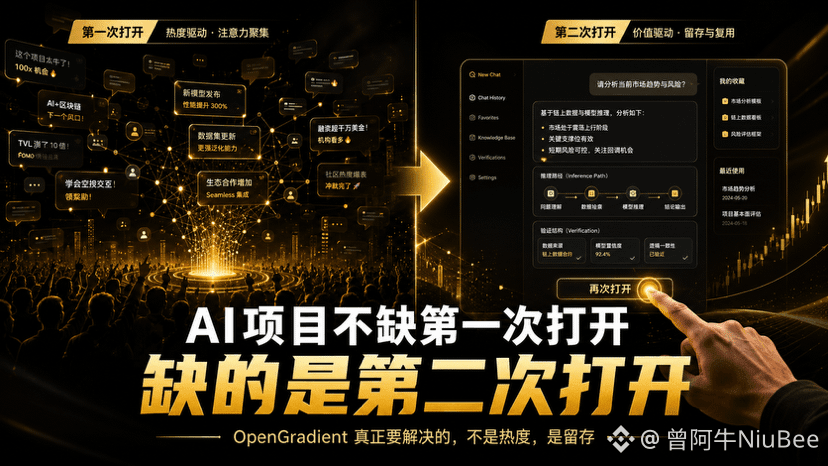
#opg $OPG AI Project's biggest issue: Users can't be bothered to come back for a second time.
The main challenge with AI + Crypto right now isn’t the lack of discussion.
It’s that while there’s plenty of chatter, the actual users sticking around are few and far between.
Many projects seem buzzing at first glance:
Big concepts, trendy buzzwords, models, computing power, inference, validation — they can talk the talk.
But once users dive in, if they don't feel like “this thing can seriously solve my issue,” they’re not likely to return.
So what OpenGradient really needs to tackle is more than just AI narratives.
It’s about whether OpenGradient Chat can give users a reason to hit that second open.
If the inference experience is smooth, the results are trustworthy, and the model validation is clear, then discussions around $OPG won't just be about hype.
Conversely, if users are only there to complete a task and then bounce, it’s tough to retain them after the buzz.
AI projects aren’t short on first-time visits.
What they lack is those all-important second visits.
@OpenGradient $OPG #OPG
84
Log in to explore more content
Join global crypto users on Binance Square
⚡️ Get latest and useful information about crypto.
💬 Trusted by the world’s largest crypto exchange.
👍 Discover real insights from verified creators.
Email / Phone number
Trending Topics
AnthropicToDebutAfter$83IPOPricing
15,333 views
185 Discussing
Stock Futures Hold Near Flat as Anthropic Prices IPO at $83 Ahead of Debut
Binance News
·8 Likes
·7.8k views
BTCRemainsUnderPressureAfterHawkishFOMCMinutes
57,463 views
1,481 Discussing
NvidiaBoardReportedlySplitOverHuang’sReturn
19,065 views
737 Discussing