
Odds I Trade
196 Posts

Odds I Trade
Report
Block User
📈 Trading | Investing | Financial Literacy ODDS — TRADE THE PROBABILITY

BNB Holder
Frequent Trader
4.4 Years
0 Following
52 Followers
136 Liked
Posts
·
--
Bearish
🧑💻 OpenAI’s pocket hacker
As Elon Musk might joke: Every day is a zero-day.
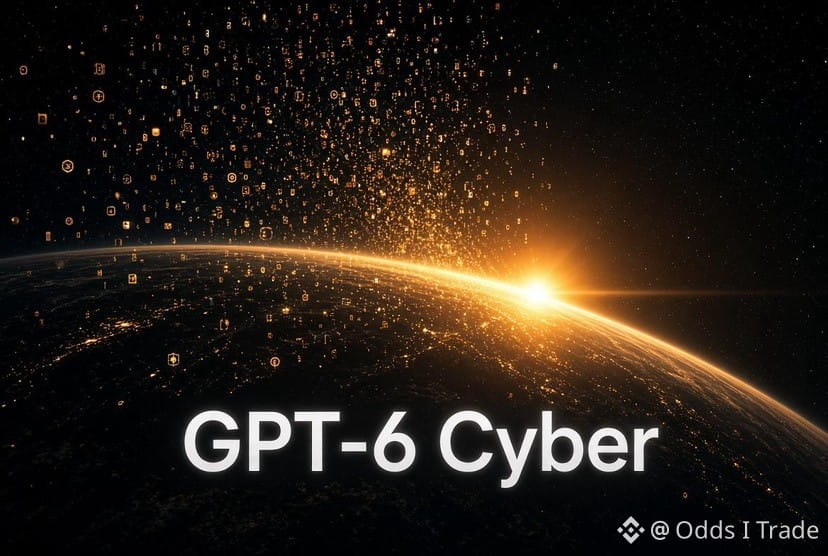
OpenAI has unveiled GPT-6 Cyber — a specialized cybersecurity model that doesn’t just find vulnerabilities, but can also create working exploits and suggest fixes.
And the results are truly impressive:
🔸 Firefox: The model found 81 previously unknown, high-severity vulnerabilities. Mozilla is already rolling out fixes.
🔸 Linux: GPT-6 Cyber reproduced 1,724 kernel vulnerabilities and developed working exploits for 948 of them. According to OpenAI, 588 of the issues were previously unknown. Another 304 critical findings were shared with developers along with proposed patches.
🔸 95% success rate: In tests involving the exploitation of vulnerabilities in remote systems, the model completed 95% of the tasks. The standard GPT-6 Astra refused all tasks in this test.
But there’s a catch: the model received the highest risk rating — Critical — in the cybersecurity category. So access is currently limited to vetted professionals and organizations through the Daybreak Red program.
The irony is that one and the same tool could help plug hundreds of security holes — or give attackers new ways to strike.
— ODDS 🟠
#Aİ #CyberSecurity #OpenAI
1
309
·
--
🇺🇸 The Democrats’ victory gave the American market a boost.
Stock indexes responded with gains:
📈 Dow Jones: +2.68%
📈 S&P 500: +1.67%
📈 Nasdaq: +2.31%
Investors are counting on Trump’s decisions being restrained and a possible de-escalation of the conflict with Iran.
BTC also recovered after falling below $76,000 and returned above $80,500. More than $550 million in shorts were liquidated in 24 hours.
The next major liquidity cluster is above $82,000. But the key question is whether BTC can hold above $80,000 after the short squeeze.
My focus right now is on the $80–82K zone. The next move will show whether buyers have enough strength.
— ODDS 🟠
#ODDS #Bitcoin #Crypto #Market

1
99
·
--
Bearish
🤯 Binance wasn’t hacked overnight. It all started with a fake job interview.
Hackers gradually gained access to employees’ computers by posing as employers and AI tool developers.
One engineer downloaded malware along with a test assignment. The attackers used it to penetrate deeper into Binance’s internal infrastructure—all the way to the transaction-signing system.
An important lesson: even the biggest crypto platforms are vulnerable not only because of their code, but also because of human factors.
Sometimes, one careless download is all it takes.
Do you check what exactly you’re installing on your devices?
— ODDS
#Odds #Binance #crypto #Cybersecurity
1
621
·
--
Bearish
☕ The crypto market is starting the day without optimism.
BTC can’t recover, ETFs are seeing outflows, and the stock market is also under pressure.
What’s interesting:
🔸 Mercado Bitcoin was hacked for $38 million.
🔸 The CFTC published new guidelines for the crypto market.
🔸 Strategy is buying BTC again — another 811 coins.
🔸 BitMine increased its ETH holdings to 4.9% of its supply.
While the market is nervous, big players keep accumulating. But this isn’t a signal of a reversal just yet.
Are you waiting for a recovery or getting ready for a further decline?
— ODDS
2
255
·
--
💰 Where does Binance get billions to cover losses like these?
After a massive $6.3 billion hack, Binance said it had already compensated for about 95% of the stolen assets using corporate reserves, the SAFU fund, and the futures insurance fund.
What’s interesting is that the biggest crypto companies earn money in very different ways:
📊 Binance — $5–10.7 billion a year
Tether — $5.96 billion
Coinbase — $5.65 billion
Circle — $2.38 billion
Exchanges earn money from fees and other services, while stablecoin issuers earn primarily from returns on their reserves.
But there’s a catch: a company’s high revenue doesn’t necessarily mean high net profit. And high earnings for a crypto project don’t mean its token will automatically rise in price.
For me, the main lesson here is different: even large platforms carry risks, and trusting an exchange shouldn’t mean keeping all your assets on it.
After stories like these, do you trust Binance more, or do you prefer to hold your assets yourself? 👇
— ODDS
#ODDS #fomcвідстеження Binance #crypto #криптовалюта #Investments
1
116
·
--
Bullish
Sometimes one thought can make you look at money in a completely different way.
Poverty isn’t something anyone wants to romanticize.
When you’re constantly thinking about how to pay the bills, whether your money will last until payday, and what you’ll do if something unexpected happens, it’s hard to feel free. Financial problems take away not only your money, but also your peace of mind, energy, and ability to think about the future.
That’s why I don’t believe in pretty sayings like “money doesn’t matter.” When you don’t have enough to cover your basic needs, it matters. A lot.
But there’s another side to it.
You can spend your whole life chasing a bigger salary, a more expensive car, a better apartment—and still never feel like you have enough.
Maybe the real goal isn’t to become the richest person, but to build a life where money gives you peace of mind, freedom of choice, and confidence about the future.
It’s okay to want more. It’s also okay to appreciate what you already have.
The main thing is not to let the pursuit of a better life take life itself away from you.
What do you think: how can we find a balance between wanting to earn more and being content with what we have? 👇
$BTC $ETH

3
313
·
--
Article
Scrooge McDuck knew more about money than we thought.🦆 You know what’s interesting? As a kid, I looked at Scrooge McDuck and thought: if only I had that much gold!
A huge vault, mountains of coins, and the ability to buy almost anything you want. It seemed like that was true wealth.
But now I look at this story a little differently. 👀
Maybe the most interesting thing here isn’t even his gold, but the habits behind it.
Scrooge McDuck knew more about money than we thought.
🦆 You know what’s interesting? As a kid, I looked at Scrooge McDuck and thought: if only I had that much gold!
A huge vault, mountains of coins, and the ability to buy almost anything you want. It seemed like that was true wealth.
But now I look at this story a little differently. 👀
Maybe the most interesting thing here isn’t even his gold, but the habits behind it.
A huge vault, mountains of coins, and the ability to buy almost anything you want. It seemed like that was true wealth.
But now I look at this story a little differently. 👀
Maybe the most interesting thing here isn’t even his gold, but the habits behind it.
1
2
998
·
--
ZEC, DASH, and LIT lead the declines. But is this already a reversal? 👀
After a strong rally, the market often does what it does best — takes some of the profits back.
Today, these coins were hit by a correction:
🔻 LIT — -25%
🔻 ZEC — -20%
🔻 DASH — -17%
And all three coins have their own unique features.
🔎 ZEC and DASH are part of the privacy segment. Their core idea is to ensure transaction privacy. However, private mode isn’t enabled automatically — users choose the relevant transaction type themselves.
🔎 LIT is the token of the L2 exchange Lighter. It’s used within the ecosystem, and some of the platform’s fees go toward buying back LIT on the market.
But that’s not the most interesting thing right now.
For now, the decline looks more like a technical correction after a strong impulse than a fundamental trend change.
If demand returns during the pullback, these coins could certainly try to make another move up.
But if the correction turns into a breakdown in market structure, then the scenario will be completely different.
So right now, what’s more interesting than simply watching which coin fell the most is seeing where buyers show up again.
What interests you most after a correction like this?
$ZEC $DASH $LIT
2
443
·
--
70% of blockchains didn’t earn even $1 in fees in a day 🧐
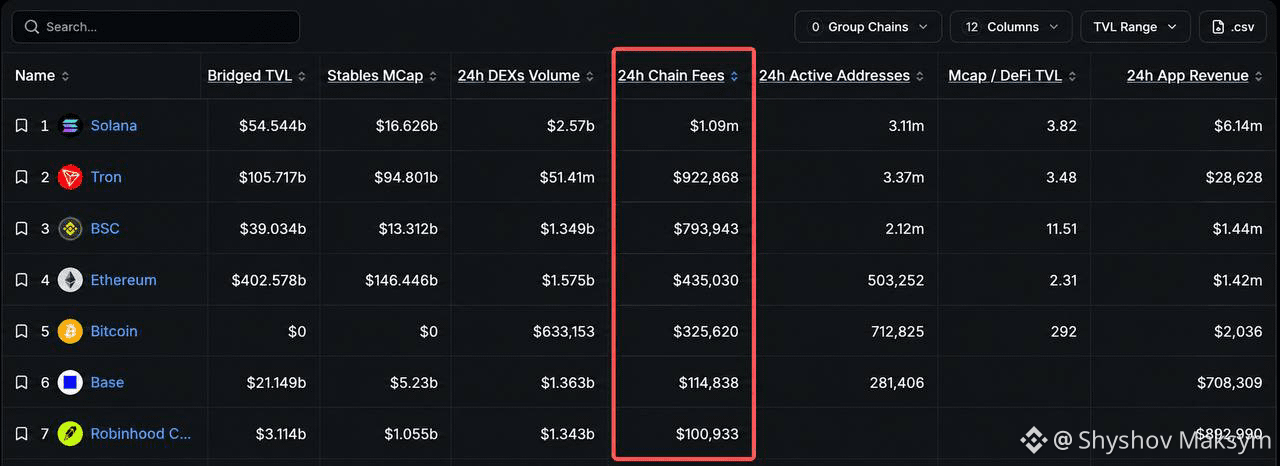
Interesting stats from DeFiLlama.
As of October 3, the service was tracking 558 blockchains. And the numbers are quite telling:
➖ 514 networks earned less than $1,000 in Chain Fees
➖ 443 — less than $10
➖ 399 — $0 altogether
More than 70% of blockchains earned no fees at all in a day.
And only 7 networks earned more than $100,000 in a day:
🥇 Solana — $1.09 million
🥈 Tron — $922.9K
BNB Chain — $793.9K
Ethereum — $435K
Bitcoin — $325.6K
Base — $114.8K
Robinhood Chain — $100.9K
But there’s an important detail here 👇
Chain Fees ≠ App Fees.
Chain Fees are the fees users pay directly to the underlying network for transactions.
Apps running on the network can earn significantly more.
For example, in a day, the Robinhood Chain network earned around $100K, while app fees exceeded $4 million.
So looking at just one figure isn’t enough.
But these stats do make you think:
How many of the existing blockchains actually have economic activity, and how many exist mostly on paper?
To me, this is a good example of why, when analyzing a crypto project, you should look beyond the chart.
Fundamental analysis helps you understand whether there’s a real economy behind a token.
2
1.1k
·
--
The Wealth Paradox: Why You Need to Focus on One Thing First, and Only Then DiversifyThere’s one paradox in the world of finance that many people don’t notice.
In financial literacy courses, they teach: “Don’t put all your eggs in one basket.”
And that’s good advice. But does it work at every stage of your financial journey?
Perhaps this is where most people make a mistake: they try to preserve capital that they haven’t created yet.
The Wealth Paradox: Why You Need to Focus on One Thing First, and Only Then Diversify
There’s one paradox in the world of finance that many people don’t notice.
In financial literacy courses, they teach: “Don’t put all your eggs in one basket.”
And that’s good advice. But does it work at every stage of your financial journey?
Perhaps this is where most people make a mistake: they try to preserve capital that they haven’t created yet.
In financial literacy courses, they teach: “Don’t put all your eggs in one basket.”
And that’s good advice. But does it work at every stage of your financial journey?
Perhaps this is where most people make a mistake: they try to preserve capital that they haven’t created yet.
2
201
·
--
Bullish
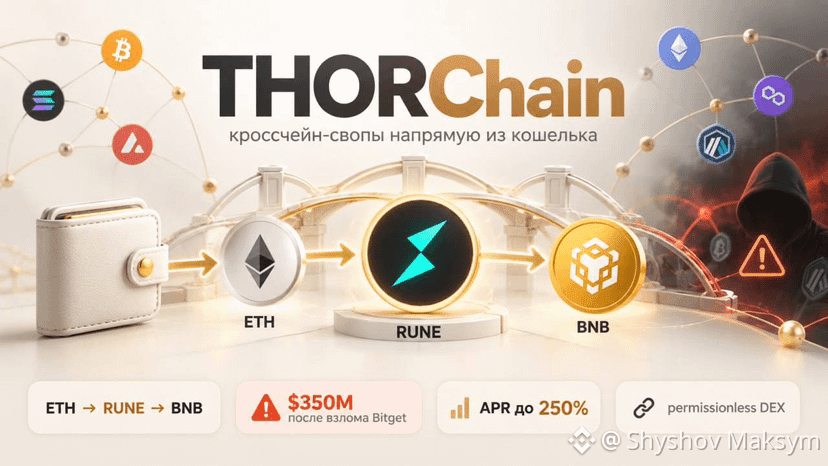
🔄 THORChain: a protocol even hackers use
Most DEXs allow exchanging assets only within a single blockchain or through their wrapped versions.
But there’s a protocol that enables swapping native assets from different networks directly from your wallet — THORChain.
At the core is the RUNE token, which secures the network and is used in liquidity pools.
For example, swapping ETH for BNB happens via the route:
ETH → RUNE → BNB
In this case, users don’t need to independently execute two swaps — everything happens within a single swap through a compatible wallet.
After the Bitget hack, attackers withdrew over $350 million and used the protocol to exchange a significant portion of the stolen assets. This made further tracking and blocking more difficult.
Unlike many other services, THORChain did not block the addresses associated with the attack.
As a result, the protocol processed a large volume of transactions and generated substantial fee income. Against this backdrop, the APR on RUNE bonding at one point reached 250% per year.
⚖️ The interesting part here isn’t morality, but the very nature of decentralization.
THORChain clearly demonstrates how this principle works in practice.
1
2
399
·
--
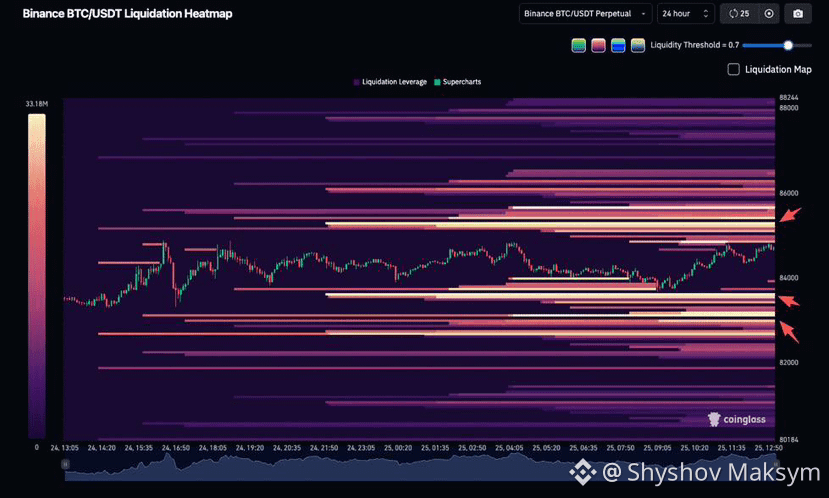
₿ Where can Bitcoin accelerate? Let’s look at the liquidation map.
Price doesn’t always move randomly. Sometimes a clear mechanism lies behind a strong impulse—liquidation of leveraged positions.
Coinglass’s Liquidation Heatmap shows areas where large volumes of liquidations may be concentrated. The brighter the zone, the more positions could be forcibly closed if the price reaches it.
Right now, two main directions stand out:
🔼 $85,300–86,000 — a zone of potential short liquidations.
🔽 $83,300–83,700 and $82,600–83,100 — zones of potential long liquidations.
Why does this matter?
Forced position closures can create additional market pressure and speed up price movement. For example, short liquidations involve buying back the asset, which can push the price even higher.
But there’s a catch 👇
A liquidation map is not a forecast and not a guarantee that price will move to a specific level.
These zones aren’t ordinary limit orders, and their volume changes depending on positions being opened and closed.
That’s why I treat the Heatmap as an additional tool that works best together with market structure, key levels, and Open Interest.
And do you use the Liquidation Heatmap in your analysis? 👀
$BTC
3
2
3.2k
·
--
Bearish
🚨 Bitget confirms hack totaling ~$351 million
Yesterday I wrote about suspicious activity involving Bitget wallets. Now the exchange has officially confirmed the incident.
According to Bitget:
• some hot/warm wallets were affected
• losses are estimated at $351.6 million
• cold wallets remained untouched
• Bitget says users’ funds are safe
• the loss is fully covered by the User Protection Fund, which has over $464 million
• withdrawals have been temporarily suspended while checks are conducted
So the most unpleasant part right now isn’t the hack itself, but the fact that withdrawals are still closed.
By the way, I also put my USDT up for withdrawal yesterday. Today the exchange canceled it 😅
Now we just have to wait for withdrawals to be reopened.
And for me, this is another reminder:
6–7% annual returns are not “free money.” There’s always a platform risk behind it.
Let’s keep an eye on it 👀
1
129
·
--
Bearish
🚨 Something is happening with Bitget
Unusual transfers of funds related to Bitget wallets have been noticed on the network. According to preliminary data, it’s approximately $183 million.
So far, this has not been confirmed as a hack—Bitget has not officially stated that the exchange has been compromised. But the situation is evolving.
If you have a significant amount on Bitget, maybe now isn’t the worst time to remind yourself of a simple rule:
an exchange ≠ your wallet.
Don’t panic, but also don’t ignore these signals. 👀
We’re monitoring the situation.
1
91
·
--
💰 You have $100,000. What do you do?
1️⃣ Quit your job and live for yourself
2️⃣ Invest and keep working
3️⃣ Try to turn them into $1,000,000 or blow it all to 0
4️⃣ Buy a car, an apartment, and forget about investing
Or your option in the comments 👀
I’m curious—what would you really do?
💰 You have $100,000. What do you do?
1️⃣ Quit your job and live for yourself
2️⃣ Invest and keep working
3️⃣ Try to turn them into $1,000,000 or blow it all to 0
4️⃣ Buy a car, an apartment, and forget about investing
Or your option in the comments 👀
I’m curious—what would you really do?
1️⃣ Quit your job and live for yourself
2️⃣ Invest and keep working
3️⃣ Try to turn them into $1,000,000 or blow it all to 0
4️⃣ Buy a car, an apartment, and forget about investing
Or your option in the comments 👀
I’m curious—what would you really do?

1
91
·
--
Bullish
🧠 One indicator won’t make you a profitable trader
RSI showed oversold — buy?
MACD crossed — long?
You saw a pattern — entry?
Not quite.
For me, it’s much more important not to find one “magic” instrument, but to learn how to recognize patterns across multiple factors.
Structure + level + price reaction + volume — when several independent factors point in the same direction, that’s much stronger for me than blindly trusting a single signal.
It’s like in life: when one person tells you the same thing, you can be skeptical.
But when the same is confirmed by several more people — you start to think. 😄
Trading works for me about the same way: the more quality factors converge in one place, the more interesting the scenario.
You don’t need to know 20 indicators.
Better to perfectly know 4–5 factors and understand how they work individually and together. 📊
1
122
·
--
Bullish
📊 Trading probability | POL/USDT 📈
Bias: Long
The structure and trend remain bullish. Yes, the price is currently slightly below the EMA200, so the timing isn’t perfect, but overall the picture for me still remains long.
📍 POI: 0.07496–0.07532
If the price reacts from the zone and confirms the move, I’ll consider a Long.
🎯 TP: 0.08048
Target is to sweep liquidity from above.
🛑 SL: 0.07393
Invalidation of the scenario — a break of the structural level.
Polygon continues developing its network — at the end of July, the Ithaca upgrade was released, which improves the reliability of the network and the stability of payments. (Polygon Labs)
Technical analysis is more interesting right now than fundamentals, so the main thing is whether the market confirms the scenario. 👀
How do you like POL in the current zone?
$POL
{future}(POLUSDT)
📊 Trading probability | POL/USDT 📈
Bias: Long
The structure and trend remain bullish. Yes, the price is currently slightly below the EMA200, so the timing isn’t perfect, but overall the picture for me still remains long.
📍 POI: 0.07496–0.07532
If the price reacts from the zone and confirms the move, I’ll consider a Long.
🎯 TP: 0.08048
Target is to sweep liquidity from above.
🛑 SL: 0.07393
Invalidation of the scenario — a break of the structural level.
Polygon continues developing its network — at the end of July, the Ithaca upgrade was released, which improves the reliability of the network and the stability of payments. (Polygon Labs)
Technical analysis is more interesting right now than fundamentals, so the main thing is whether the market confirms the scenario. 👀
How do you like POL in the current zone?
$POL
2
202
Log in to explore more content
Join global crypto users on Binance Square
⚡️ Get latest and useful information about crypto.
💬 Trusted by the world’s largest crypto exchange.
👍 Discover real insights from verified creators.
Email / Phone number
Trending Topics
BinanceReopensWithdrawalsForHYPE&APT
4,728 views
145 Discussing
#BinanceReopensWithdrawalsForHYPE&APT
🚨🔥 BINANCE WITHDRAWALS ARE BACK! HYPE & APT GET THE GREEN LIGHT 🟢💰
After days of uncertainty, Binance has reportedly reopened withdrawals for HYPE 🟣 and APT 🔵, giving holders a much needed reason to breathe again. 😮💨😂
The situation followed Binance’s security related restrictions that temporarily affected withdrawals for several assets. Naturally, crypto Twitter reacted like someone had unplugged the internet. 📉😱📱
But now, HYPE and APT are back in the withdrawal zone. 🚀🏦
For HYPE holders, this is especially significant. Hyperliquid has become one of the most closely watched decentralized trading ecosystems, so restored withdrawal access removes a major layer of uncertainty. 🧠⚡
APT holders also get some relief as Aptos withdrawals resume. The bigger picture, however, is more interesting. Binance appears to be taking a gradual approach to restoring affected assets rather than simply flipping every withdrawal switch at once. 🔐🛡️
That may be frustrating for traders, but from a security perspective, slow and careful is probably better than fast and reckless. Nobody wants Binance saying, “Good news, withdrawals are back!” only to discover the hackers are also celebrating. 😂💀
The lesson here is simple: exchange liquidity is convenient, but custody comes with counterparty risk. 🏦⚠️ Your coins may be yours in theory, but while they sit on an exchange, access ultimately depends on the exchange’s systems and policies.
HYPE and APT getting the green light is encouraging. 🟢🚀
Now everyone is watching the remaining assets and asking the billion dollar question:
WHO’S NEXT? 👀💰🔥
Crypto never sleeps… apparently neither does Binance’s IT department. 😂🤖
$HYPE $APT
Philboom
·0 Likes
·185 views
SouthKoreaDraftLawTargets15To20%ShareholderCap
8,999 views
130 Discussing
TradFiForBeginners
119,255 views
1,194 Discussing