
KT_BNB
73 Posts

KT_BNB
 Square Verified
Report
Block User
Everything about Crypto
57 Following
212 Followers
220 Liked
Posts
PINNED
·
--
CZ posts this and says “Soon.” 👀
Maybe the hint is already in front of us.
BNB Chain has:
- ultra-low fees
- ~0.45s block times
- millions of daily users
- strong DEX activity
- tokenized real-world assets moving onchain
- #Binance as one of the biggest distribution gateways in crypto
- BNB supply still being reduced through burns
1. ETH has liquidity.
2. SOL has culture.
3. BNB Chain has distribution + speed + low cost + users.
Maybe “Soon” means the market is about to pay attention again.
One hint, @cz_binance? 🔶

6
1
18
15k
·
--
Partly True
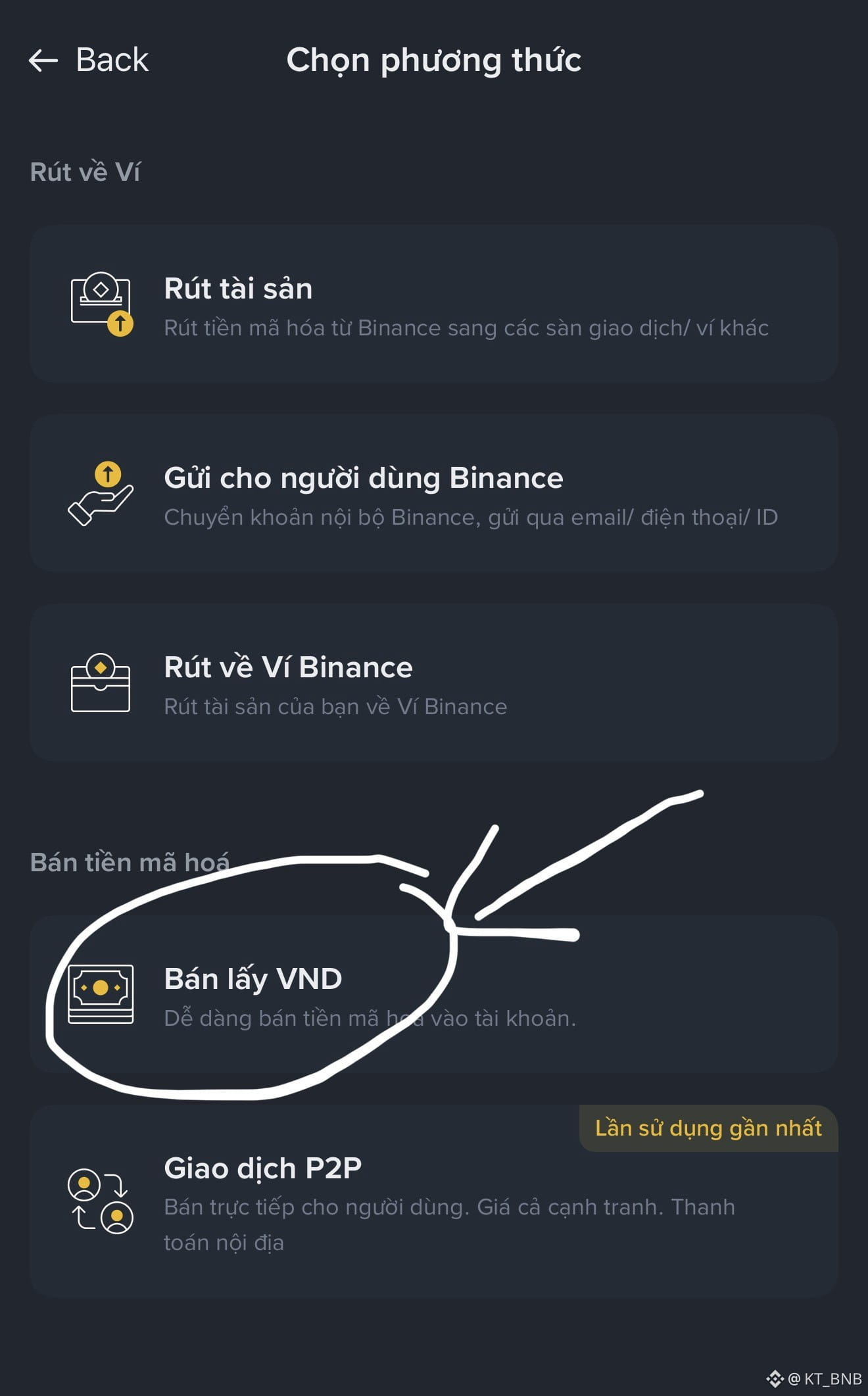
Update #Binance just added a “Sell for VND” option!!!
It’s right there in the withdrawal section, guys.
No more worrying about your bank account being frozen, since this process doesn’t go through a merchant intermediary like traditional P2P.
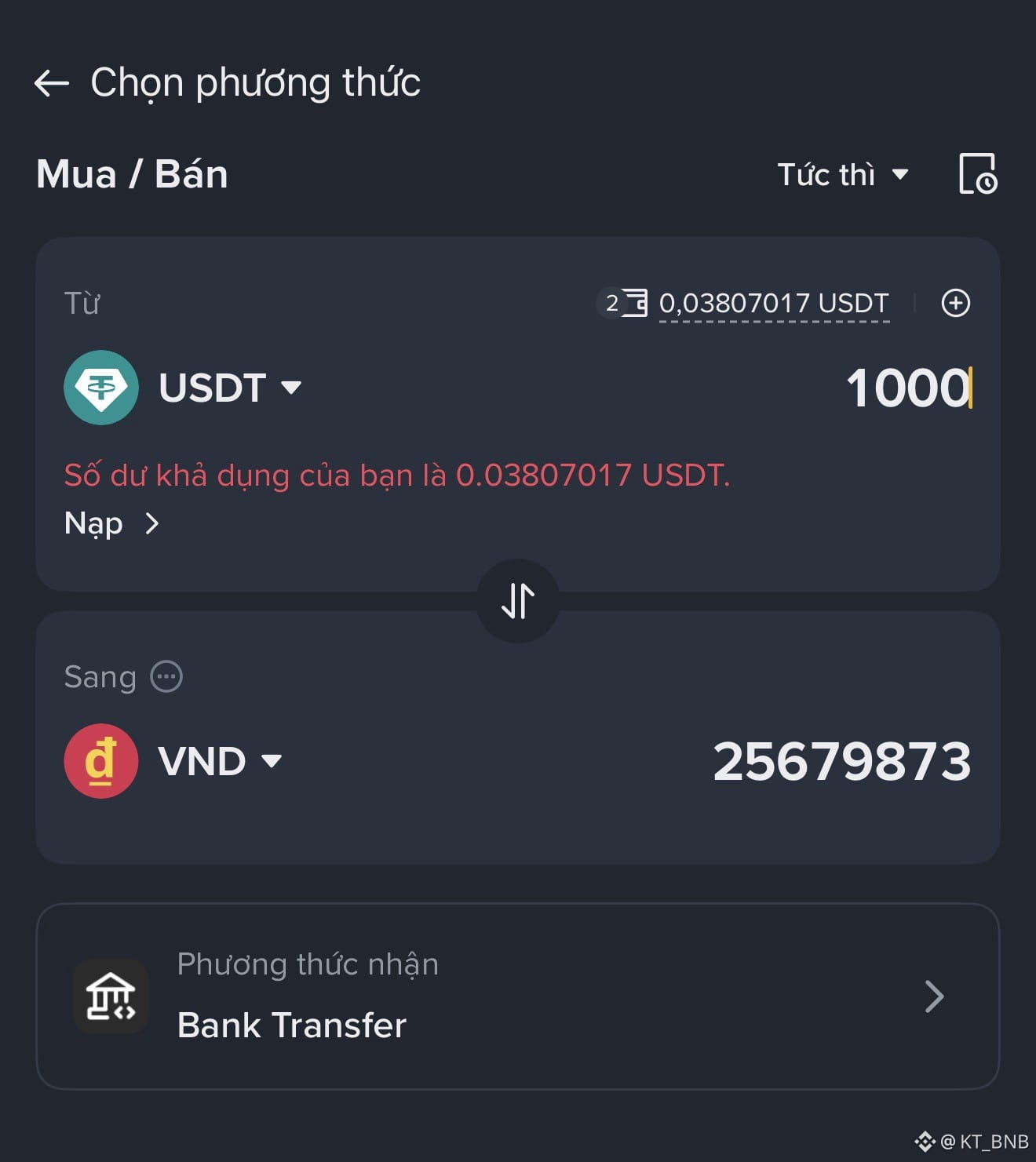
- Current P2P rate: 26,043 VND
- Rate under “Sell for VND”: 25,679 VND
=> Difference: ~1.3%
In return, it’s safer than P2P with merchants because the funds come from a single partner that Binance has already vetted.
The exchange really is quick with updates. With all the bank account freezes going on lately, they’ve rolled out a whole new system to make things as convenient as possible for everyone.
14
1
20
22.7k
·
--
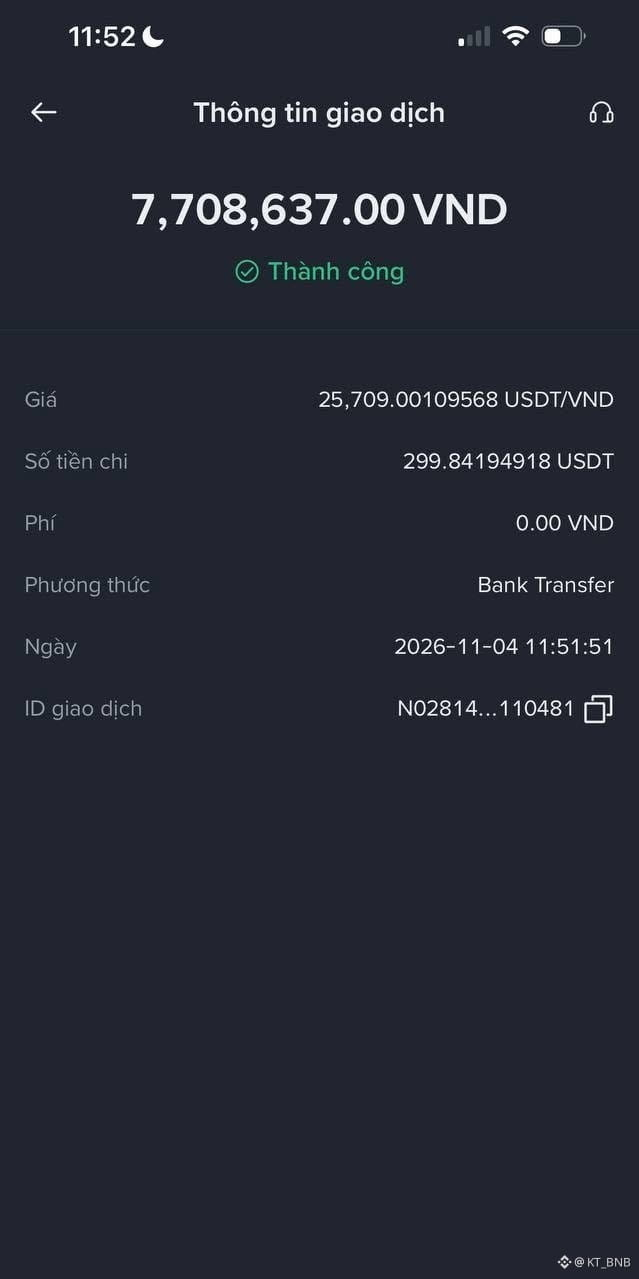
Just tested the feature for withdrawing USDT from #Binance straight to VND and into a bank account.
It’s fast and smooth—tap once and the money arrives right away, without anxiously waiting for some dodgy partner to unlock it.
The downside is that the rate is a little lower. The rate shown under “Receiving method” looks better than P2P, but in practice it’s about 1.5–2% lower than P2P if you do it manually.
28
22
37.4k
·
--
TRON Continues to Dominate Stablecoin Volume
TRON has pulled significantly ahead in stablecoin activity. From January to September 2026, it processed roughly $1.6 trillion in adjusted stablecoin volume, far more than Ethereum, Solana, or any other network.
The gap remains wide, with TRON handling the large majority of real transfers.
In September, the network accounted for about 73% of global stablecoin transaction volume. It also holds the largest share of circulating USDT, which has made it the primary settlement layer for digital dollars.
Low fees and fast confirmation times have driven this adoption, particularly for everyday transfers and payments in emerging markets.
While many other chains focus on different use cases and narratives, TRON has concentrated on practical utility: moving value cheaply and reliably at scale.
The result is sustained usage rather than temporary hype. Its position as the leading stablecoin rail looks well established for now, backed by real activity instead of speculation alone.
Good job @justinsuntron
1
172
·
--
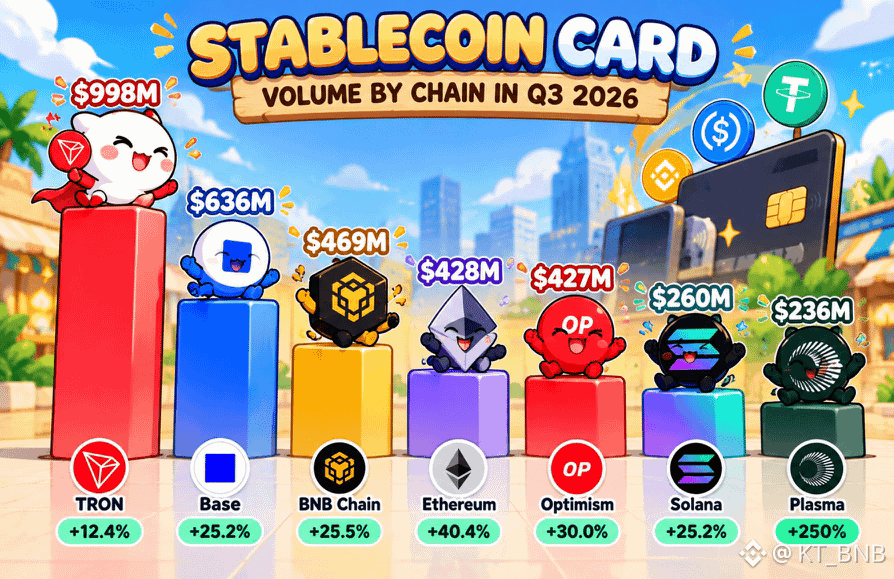
$4.3 BILLION in Stablecoin Card Volume.
Crypto Is Becoming Money People Actually Spend.
While everyone is busy watching token prices, stablecoins are quietly taking over real-world payments.
Q3 2026 numbers tell an interesting story. 👇
📊 Stablecoin Card Volume:
Q2: $3.24B
Q3: $4.31B (+33%)
TRON: $998M (23.2%) 🥇
Base: $636M 🥈
BNB Chain: $469M 🥉
Plasma: $236M (+250%)
But here's what caught my attention:
1️⃣ TRON is winning where it matters.
@trondao leads the market with nearly $1B in quarterly card volume.
That's no coincidence. TRON has spent years building USDT liquidity, affordable transfers, and global payment infrastructure.
Its network also processed over $2.2T in stablecoin settlements during Q3.
2️⃣ Plasma is the one to watch.
@Plasma grew 3.5x in a single quarter, outperforming the broader market by a huge margin.
It's still much smaller than TRON, but that kind of growth deserves attention.
3️⃣ The market is getting more competitive.
TRON, @base, and @BNBCHAIN still control 48.8% of card volume, down from 54.6% in Q2.
Their volumes are growing, but smaller networks are expanding even faster.
My biggest takeaway?
The next big crypto adoption story might not be another DeFi protocol, meme coin, or new L1.
It might be something much simpler:
Earn in stablecoins. Hold in stablecoins. Spend anywhere with a card.
Most people won't care which blockchain processes their payment.
They'll care about fees, speed, reliability, and whether their card actually works.
That's where the real competition begins.
Crypto doesn't need everyone to become a trader. It needs to become useful to everyone.
Good job @justinsuntron!
1
191
·
--
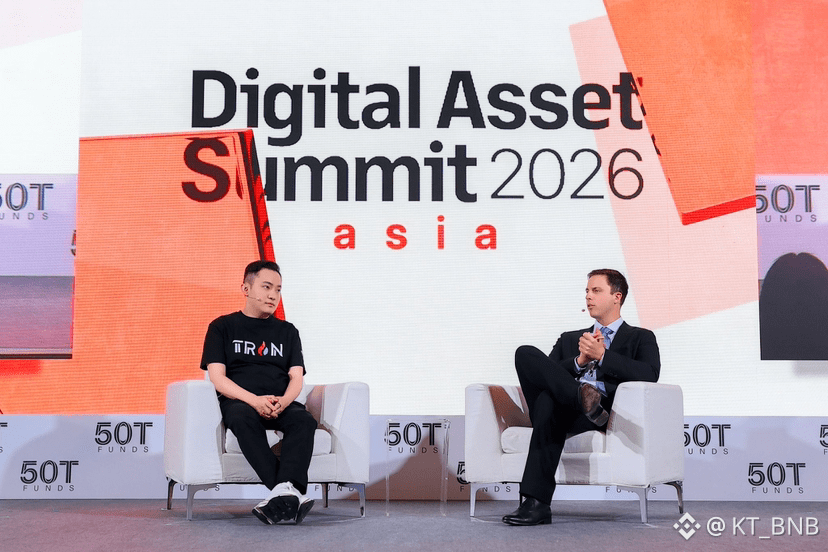
Justin Sun may be right: stablecoins are still just getting started. 🔻
From TOKEN2049 Singapore to DAS Asia. Tron keeps pushing the same message -> stablecoins still have a much bigger chapter ahead.
While the market chases the next narrative. Tron keeps building around payments, transfers, liquidity and global distribution.
The next stablecoin race won’t be won by hype.
It’ll be won by whoever owns the rails.
And TRON clearly wants to be one of them.
@justinsuntron
3
1
445
·
--
One year later.
Did the planche land before 50?
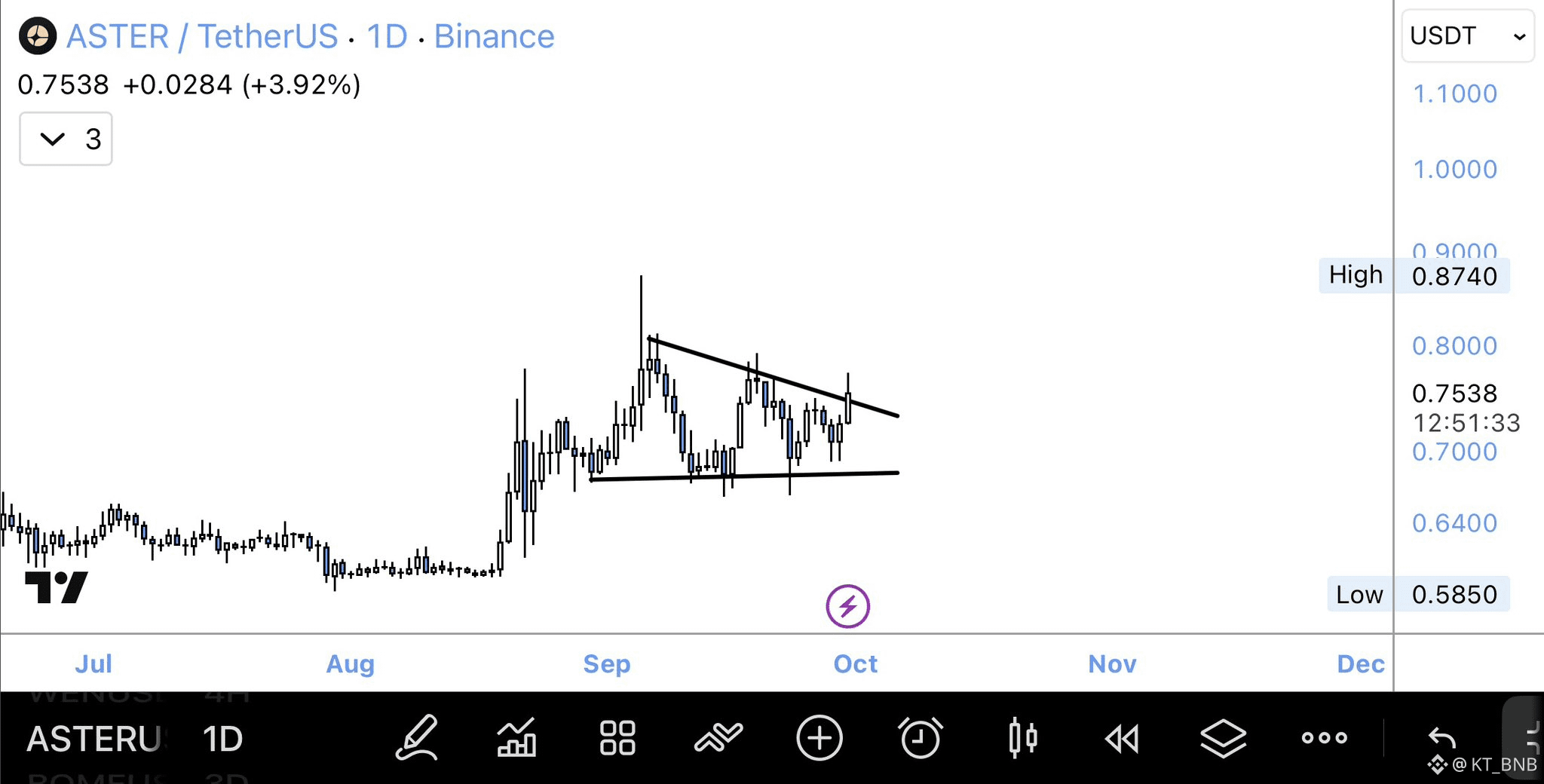
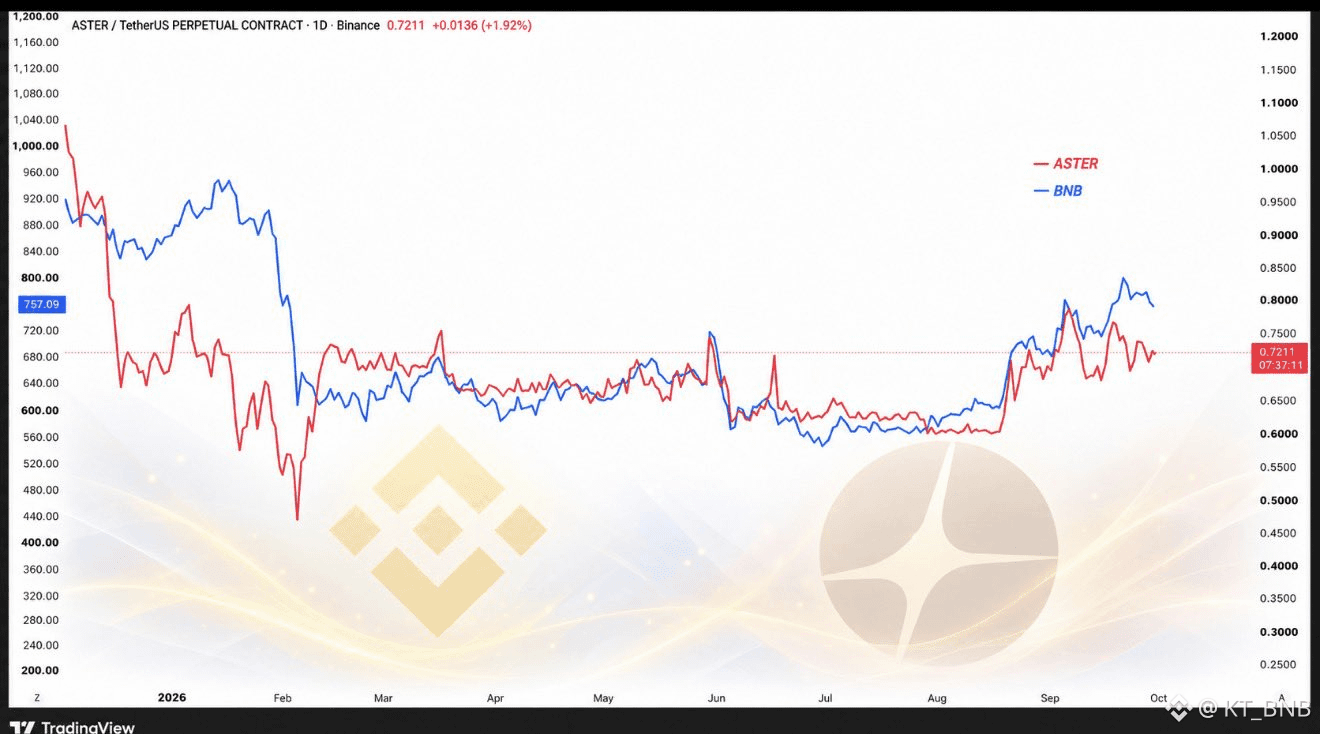
Took the $ASTER break like you said. Came back to hidden orders, private accounts, an L1, and OTC.
Health first.
Bags second.
Product never took a break.
$BNB @CZ
One year later.
Did the planche land before 50?
Took the $ASTER break like you said. Came back to hidden orders, private accounts, an L1, and OTC.
Health first.
Bags second.
Product never took a break.
$BNB @CZ
Did the planche land before 50?
Took the $ASTER break like you said. Came back to hidden orders, private accounts, an L1, and OTC.
Health first.
Bags second.
Product never took a break.
$BNB @CZ
3
8
2.7k
·
--
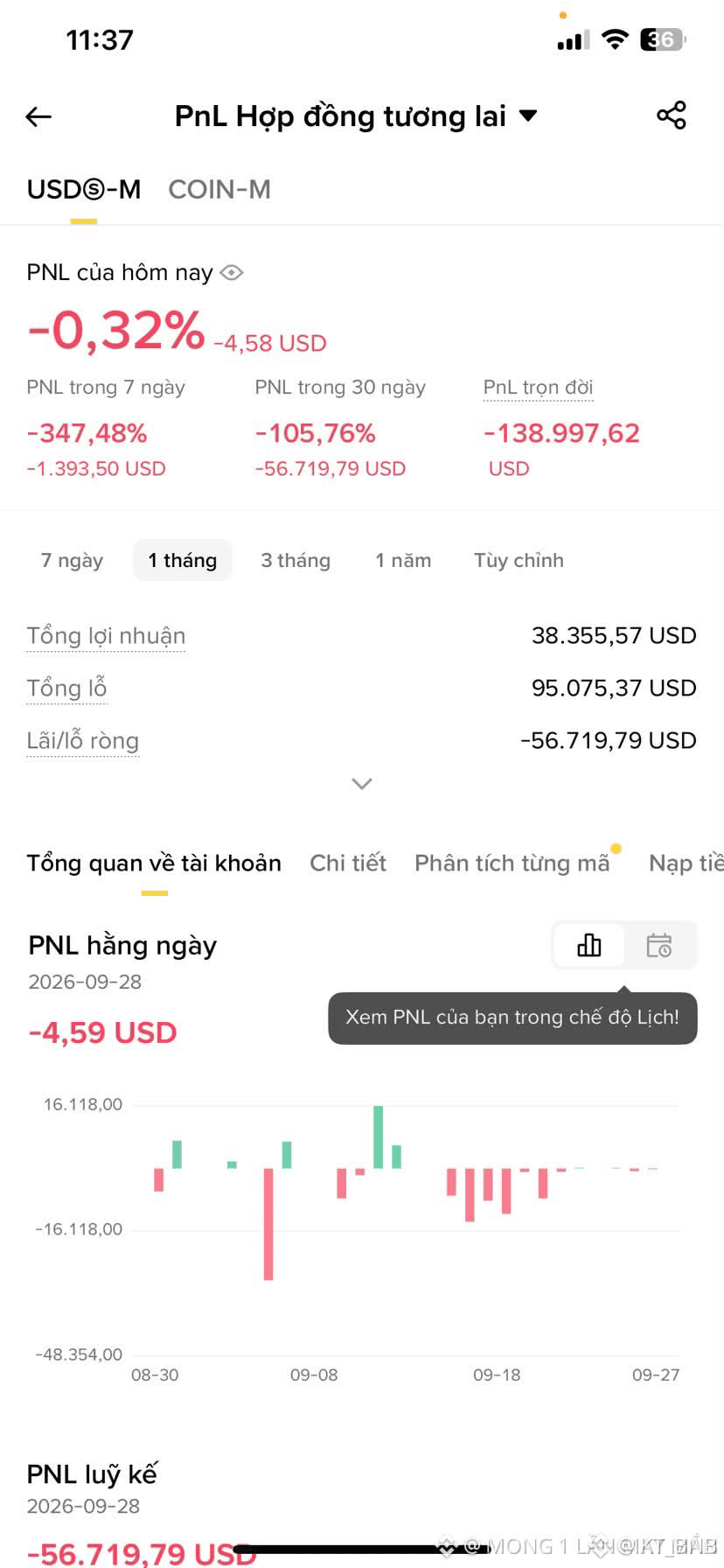
My friend told me to go uptrend and go short because he doesn’t have confidence in altcoins. He said altcoins are a pump-and-dump scheme—sooner or later they’ll go to zero. But unfortunately, altcoin proved him wrong and he got completely liquidated (SML), proving the opposite.
My friend told me to go uptrend and go short because he doesn’t have confidence in altcoins. He said altcoins are a pump-and-dump scheme—sooner or later they’ll go to zero. But unfortunately, altcoin proved him wrong and he got completely liquidated (SML), proving the opposite.
1
4
566
·
--
Just comment "Bnb" 👇🏼
And join my group: [https://app.binance.com/uni-qr/VbnWUAJi](https://app.binance.com/uni-qr/VbnWUAJi)
I see so many of you love Bnb more than everything
So I'm giving it more -> Follow me
Just comment "Bnb" 👇🏼
And join my group: https://app.binance.com/uni-qr/VbnWUAJi
I see so many of you love Bnb more than everything
So I'm giving it more -> Follow me
And join my group: https://app.binance.com/uni-qr/VbnWUAJi
I see so many of you love Bnb more than everything
So I'm giving it more -> Follow me
77
2
7
77
·
--
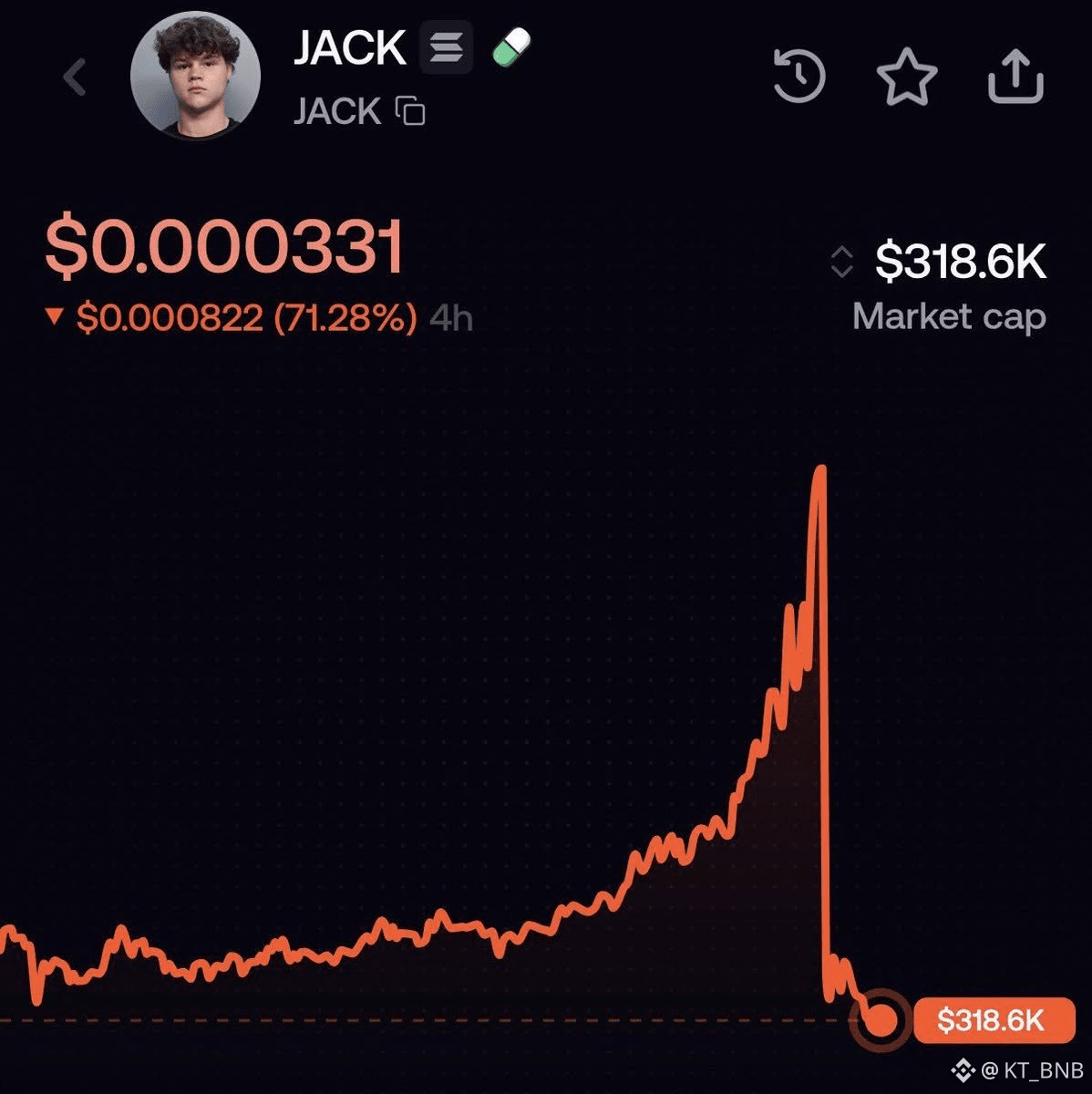
Another case of a celebrity shilling a coin, then Rugpool.
Jack Doherty - an American YouTuber has just earned over $200k ~5 billion VND from a memecoin.
- Until when will the "online community" learn a lesson ???
The simple method is to buy the $JACK memecoin during a livestream and call on the online community to pump the price.
After the market cap rose to around 2M$ th, he sold all his coins and made over $200k.
A classic crypto story involving presidents, singers, KOLs,... getting everyone to pay up.
2
1.5k
·
--
It’s KT again giving away $BNB , not some random coin like BTTC, PEPE… 😎
How to get it:
- Join: [https://app.binance.com/uni-qr/7y45DoMN](https://app.binance.com/uni-qr/7y45DoMN)
- Comment “BNB” 👇🏼
That’s it. 🎁
It’s KT again giving away $BNB , not some random coin like BTTC, PEPE… 😎
How to get it:
- Join: https://app.binance.com/uni-qr/7y45DoMN
- Comment “BNB” 👇🏼
That’s it. 🎁
How to get it:
- Join: https://app.binance.com/uni-qr/7y45DoMN
- Comment “BNB” 👇🏼
That’s it. 🎁
179
8
15
179
·
--
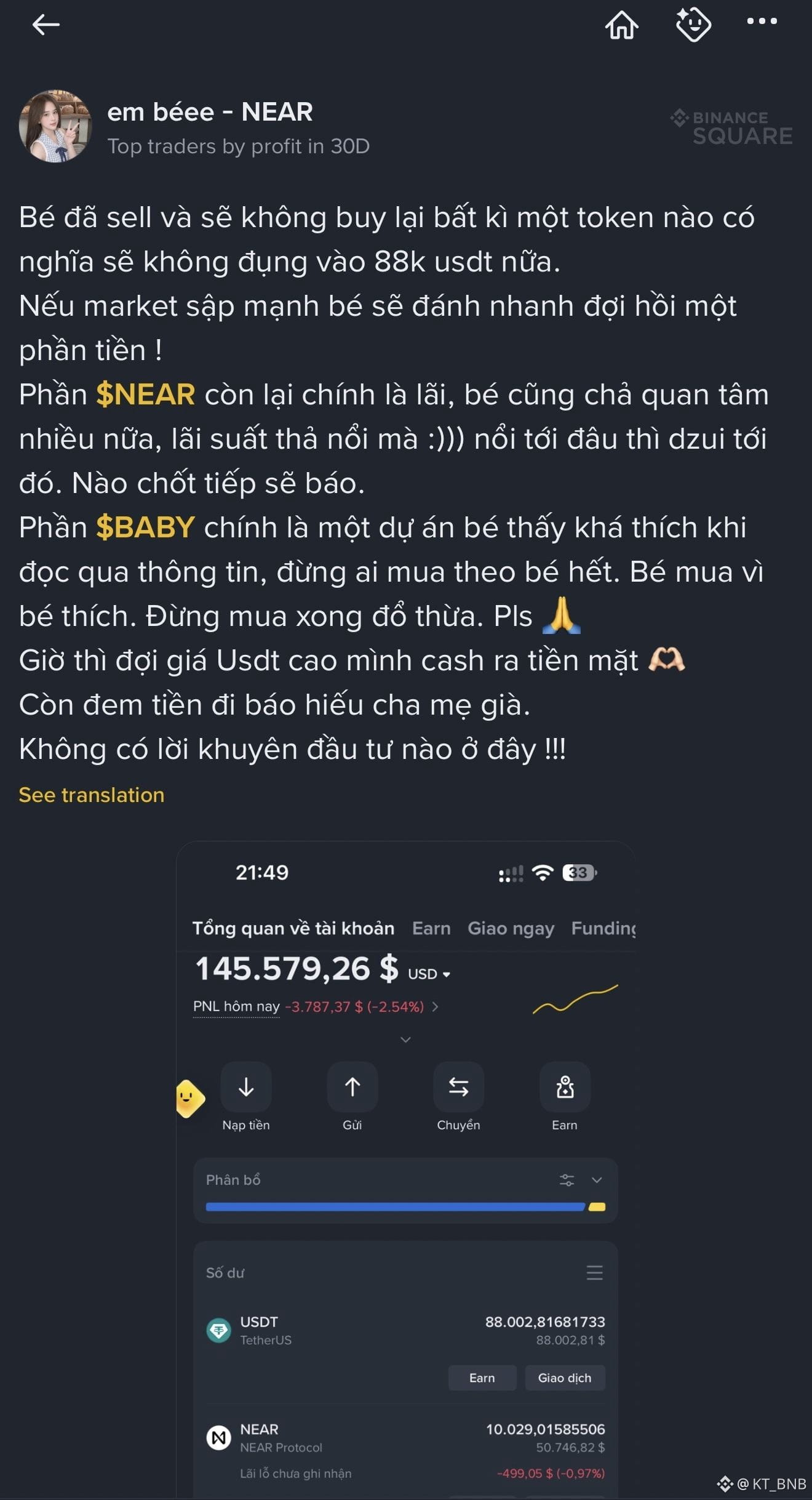
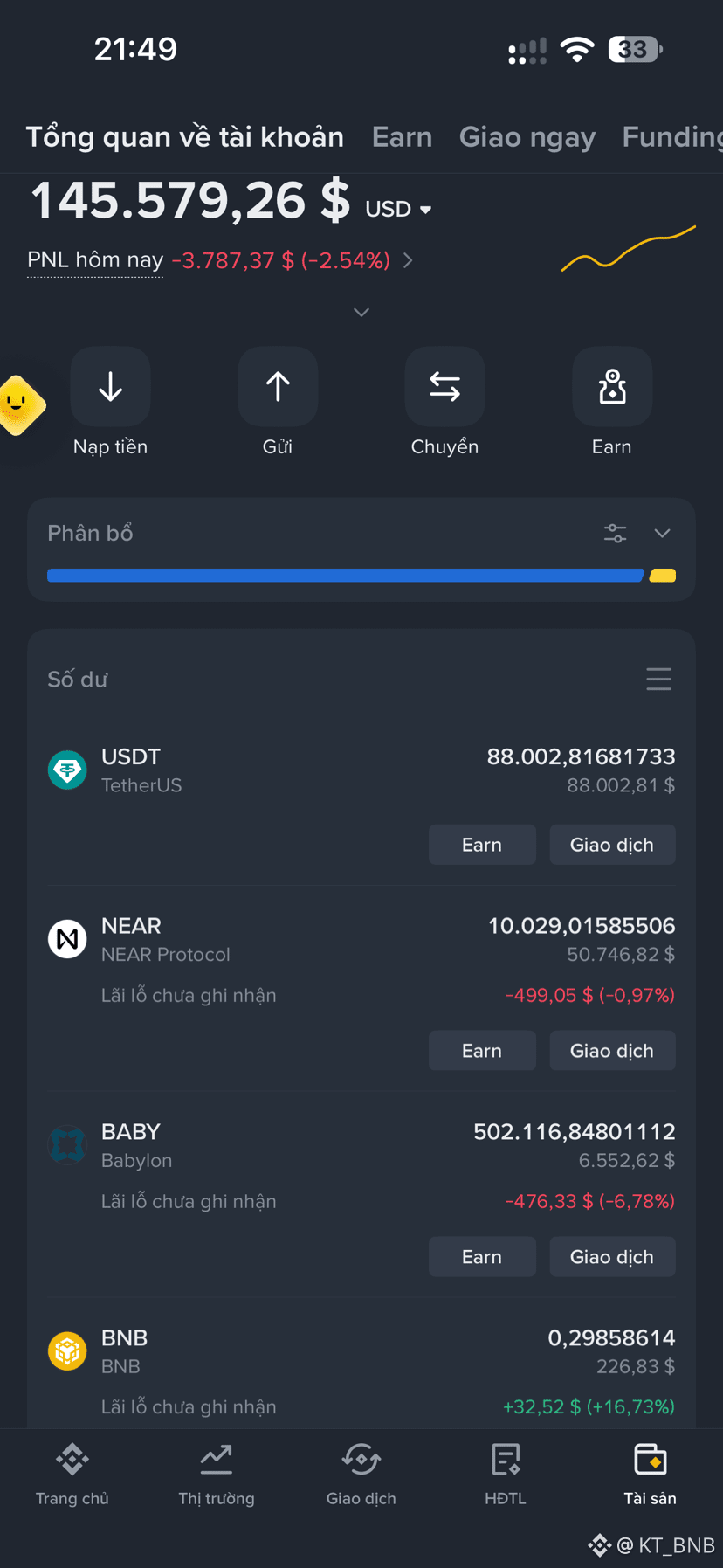
If betting $NEAR yields a billion in profit, then the little one Near has started allocating to buy $BABY already, everyone.
If this bet pumps big, then it’s exactly the vibe of Em bé—straight-up playing coins.
With $88k already available and allocating it all to Baby, this little one is definitely a ruthless Whale—no joke.
If this bet pumps big, then it’s exactly the vibe of Em bé—straight-up playing coins.
With $88k already available and allocating it all to Baby, this little one is definitely a ruthless Whale—no joke.
1
2
875
·
--
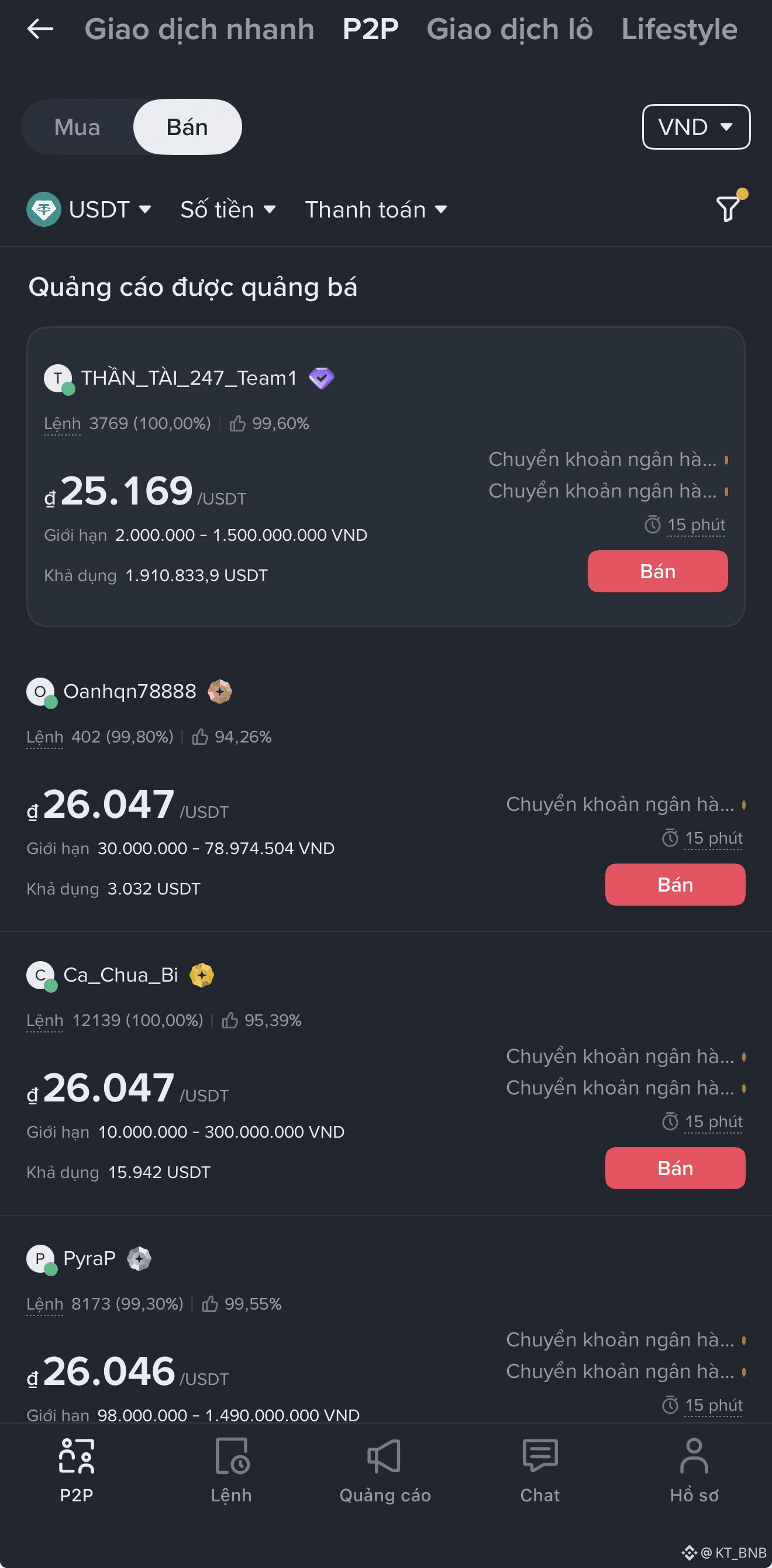
Long time no see Rate $USDT > 26,000 VND kkk
These days, fellow coin investors must be hoping for the rate to go back up to 27,000-28,000.
Feeling a big profit & selling the dollar at a high rate is so euphoric, everyone try to make the most when you find a market segment to cash out.
Long time no see Rate $USDT > 26,000 VND kkk
These days, fellow coin investors must be hoping for the rate to go back up to 27,000-28,000.
Feeling a big profit & selling the dollar at a high rate is so euphoric, everyone try to make the most when you find a market segment to cash out.
These days, fellow coin investors must be hoping for the rate to go back up to 27,000-28,000.
Feeling a big profit & selling the dollar at a high rate is so euphoric, everyone try to make the most when you find a market segment to cash out.
2
137
·
--
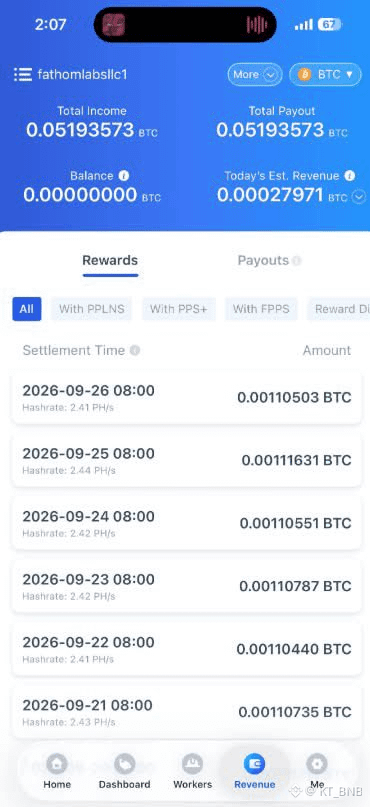
1 Chinese friend is operating 10 Bitcoin mining machines
Today is day 47
In total, 0.05193573 BTC has been mined.
With the current BTC price of $83,931.84, this amount of $BTC is equivalent to about 4.359 $USDT
August electricity cost is 456.75 USDT
Can this rig still keep pulling resources, guys?
1 Chinese friend is operating 10 Bitcoin mining machines
Today is day 47
In total, 0.05193573 BTC has been mined.
With the current BTC price of $83,931.84, this amount of $BTC is equivalent to about 4.359 $USDT
August electricity cost is 456.75 USDT
Can this rig still keep pulling resources, guys?
Today is day 47
In total, 0.05193573 BTC has been mined.
With the current BTC price of $83,931.84, this amount of $BTC is equivalent to about 4.359 $USDT
August electricity cost is 456.75 USDT
Can this rig still keep pulling resources, guys?
2
390
·
--
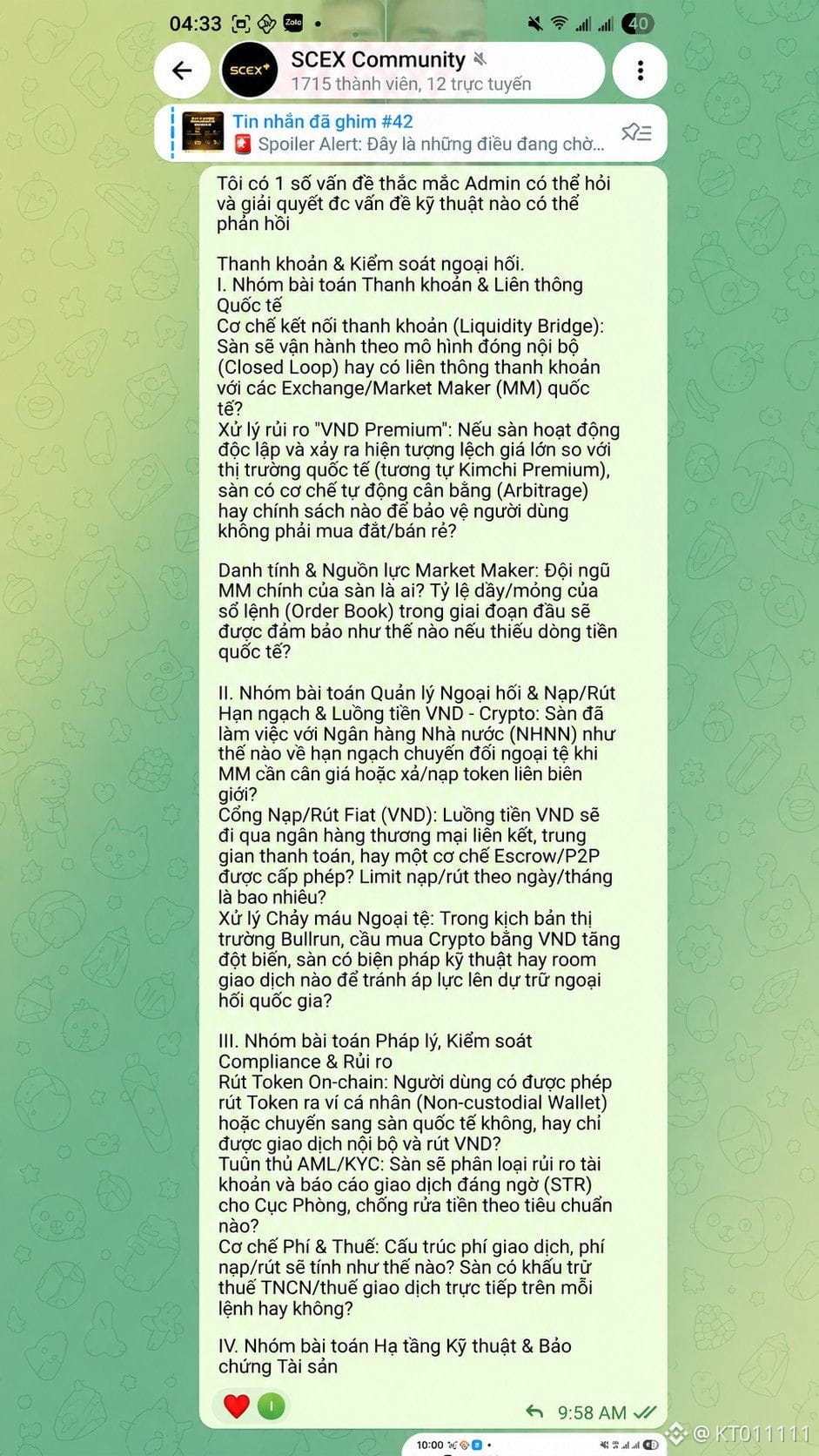
🇻🇳 Too many questions for VN exchanges before the launch date??
But after reading, it’s clear that these are all urgent questions and users need to have them clarified before the exchange goes into operation.
When all questions are answered and safety proofs can be provided, the launch will not be delayed.
Safety is not only for users but also for the VND itself.
3
8
16.6k
·
--
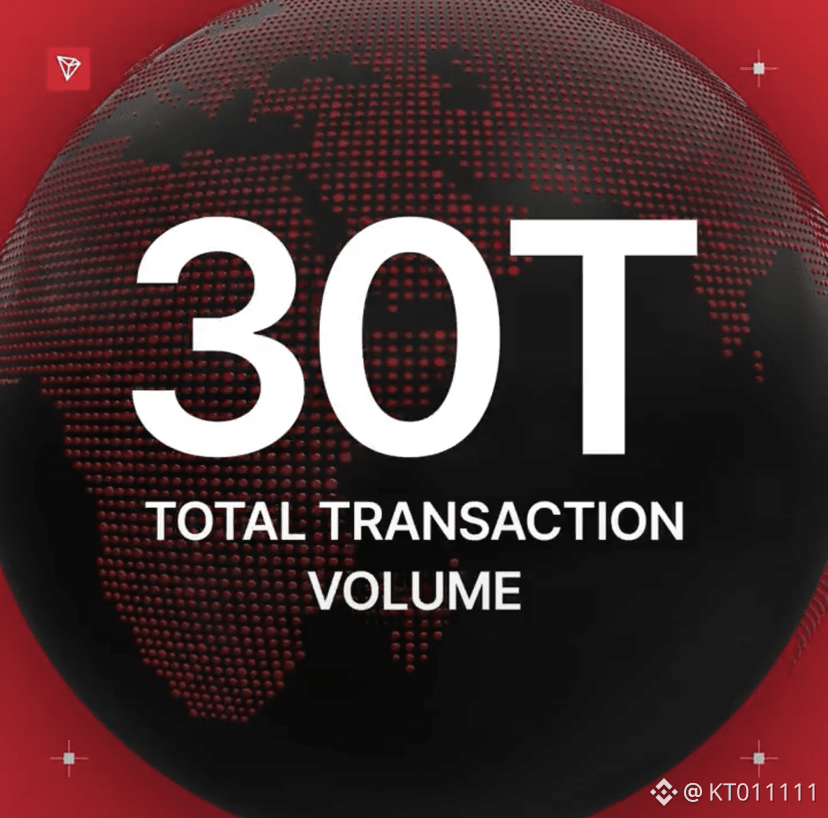
$30 TRILLION in 8 years!
Congratulations to Tron!
That’s the scale Tron has processed onchain.🔻
For perspective, that’s comparable to the entire annual output of the U.S. economy in 2025.
But the bigger story isn’t just the number.
Tron has quietly become one of crypto’s most important settlement layers especially for stablecoins and global payments.
• Massive transaction volume
• Strong stablecoin dominance
• Global user base
• 24/7 permissionless settlement
Crypto talks a lot about “real-world adoption.”
@trondao is already processing it at global scale.
2
94
·
--
Mathematics deserves more than recognition. It deserves real commitment.
That’s why the #JustinSunPrize stands out.
Backed by a personal commitment from @justinsuntron, the Prize now has $10M placed on TRON and publicly verifiable onchain a strong signal that support for mathematics can be transparent, measurable, and real.
This is what makes it so compelling:
- support for mathematical breakthroughs
- formal verification of results
- and now, transparent onchain rewards
It’s a great example of how blockchain transparency can extend far beyond finance and start supporting scientific progress in a meaningful way.
Awards are distributed by the prize operator in USDT (TRC20) or USDC (ERC20), subject to the Prize rules.
In a space where transparency matters, this is a powerful message:
Proof onchain. Impact beyond crypto.

1
147
·
--
When mentioning major awards in mathematics, many people will immediately think of the Fields Medal, often dubbed the “Nobel Prize of Mathematics.”
But at the present time, as AI becomes increasingly involved in reasoning, proving, and solving difficult problems, the way mathematical solutions are awarded may also be starting to change.
Recently, @justinsuntron announced the Justin Sun Prize.
From the name, it sounds like a traditional award, but the way it works is quite similar to the “bounty” style in crypto.
Simply put:
A difficult problem is posted
→ Justin Sun sets a bounty
→ anyone can participate in finding a solution, including AI
→ if the solution is recognized by the mathematical community, it is then moved into a form that a machine can verify.
Only when the entire proof has been confirmed by a machine to be correct will the reward be officially unlocked.
What I find quite interesting is that the prize is split into two very clear parts.
One person finds the solution.
Another person can handle “formalization,” meaning turning that solution into a format that computers can read and verify.
Of course, the same person can do both.
And there’s no rule that the solver must be human. Justin Sun is direct about this: whether it’s humans, AI, or even a combination of both working together doesn’t matter—so long as the final proof is correct.
This is also the point that makes it quite different from many traditional mathematics awards.
The Fields Medal is only awarded once every four years and has an age limit. With this model, each problem almost becomes its own separate bounty.

1
325
·
--
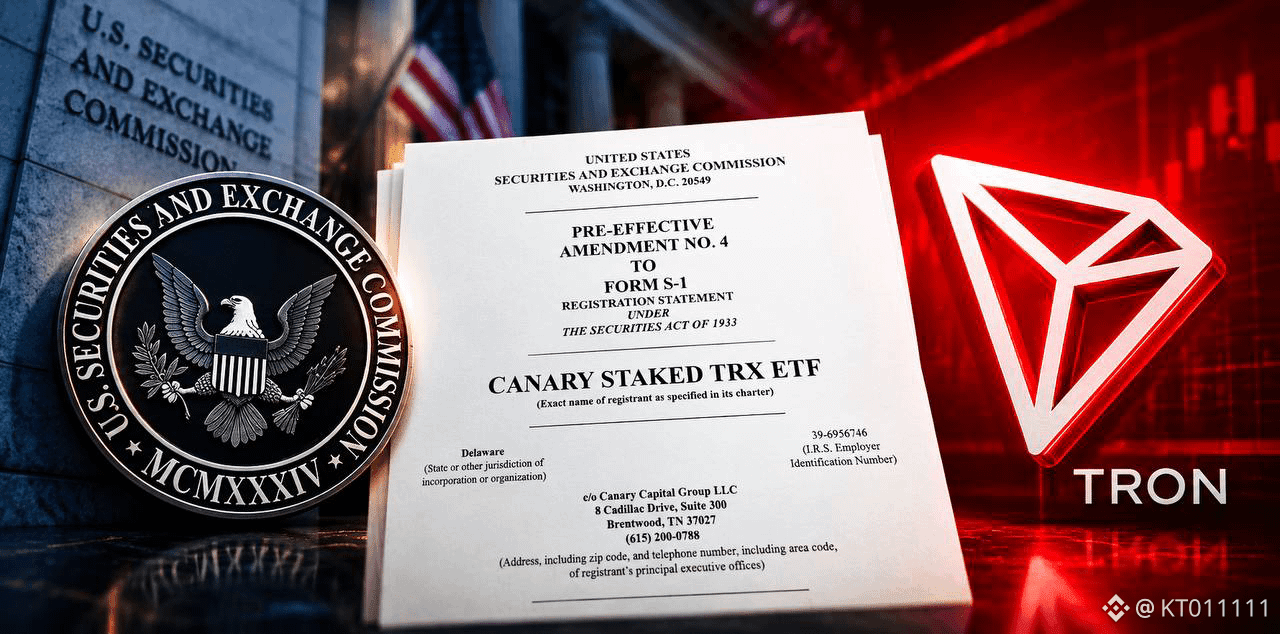
Tron is about to undergo a major test with TradFi capital flows.
Canary Funds is preparing to launch a Tron ETF with staking ($TRXS).
What’s noteworthy is that the ETF not only makes it easier for investors to access $TRX, but staking also turns it into a yield-generating asset—potentially more attractive to institutional capital flows.
Tron already has clear utility thanks to the large volume of USDT and stablecoins circulating on the network.
But the network’s utility is not necessarily going to translate into demand for the token.
$TRXS could be the bridge between the two.
If AUM rises sharply, the fund will need to accumulate more $TRX; and if those TRX continue to be staked, the actual circulating supply in the market could also be reduced.
Therefore, what to watch after the ETF launch isn’t the first candle.
Instead, it’s how AUM grows, whether inflows are sustainable, and whether TradFi truly wants to hold TRX long-term.
If the answer is yes, Tron’s narrative could shift from:
“a chain used more and more” → “an asset that traditional capital wants to hold.”
1
82
Log in to explore more content
Join global crypto users on Binance Square
⚡️ Get latest and useful information about crypto.
💬 Trusted by the world’s largest crypto exchange.
👍 Discover real insights from verified creators.
Email / Phone number
Trending Topics
BTCRebounds80K
72,386 views
737 Discussing
BITCOIN UPDATE I’M STILL BEARISH, AND HERE’S WHY! 🚨⚠️
As you all witnessed, BTC bounced back from the $75,700 area and touched $81K. First, the market trapped long traders, and then it trapped short traders.
I’m still bearish. First of all, as everyone knows, Democrats won today’s US midterm elections, and in my view, this outcome is bearish for the market.
The market can remain volatile in the short term and trap as many traders as it wants, but that doesn’t change the overall market outlook.
There are several important upcoming events, including US Non Farm Payrolls (November 6), US CPI Inflation (November 10), US PPI (November 13), US Retail Sales (November 17), FOMC Meeting Minutes (November 18), US PCE Inflation (November 25), Federal Reserve interest rate expectations, the US Dollar Index (DXY), Treasury Yields, Nasdaq performance, Bitcoin ETF flows, and ongoing( Iran ) Israel geopolitical developments. All of these could have a significant impact on Bitcoin and the overall crypto market.
But don’t get too carried away by Bitcoin’s recent movement. Technically speaking, there hasn’t been any major bullish move yet. Yesterday, BTC was trading between $80K and $82K, and even today, it’s still around the same range.
If you want to turn bullish, that’s entirely your choice.
In my previous post, I clearly explained that BTC had technical support in the $75K / $76K zone, and the price bounced from that support and made its way back towards $80K. But this wasn’t something I had failed to mention before. In fact, I repeatedly mentioned in my posts that BTC could move towards $80K, $81K, or even $82K.
Despite that, I’m still bearish.
And I don’t have just one reason to support my bearish outlook. I have several reasons, which I’ve already explained in my previous posts.
For now, I’ll continue to wait for BTC to drop below $74K, which I believe could happen very soon. In my view, such a correction is also necessary for the market.
Anyone looking for crypto guidance just let me know.
#BTCRebounds80K
Strategic Adviser
·30 Likes
·33.8k views
Binance98PercentReplenished
42,382 views
572 Discussing
USMidterms-WhatAreMarketsExpecting?
354,793 views
2,097 Discussing