
JellyCrypto
9 Posts

JellyCrypto
Report
Block User
0 Following
16 Followers
47 Liked
Posts
·
--
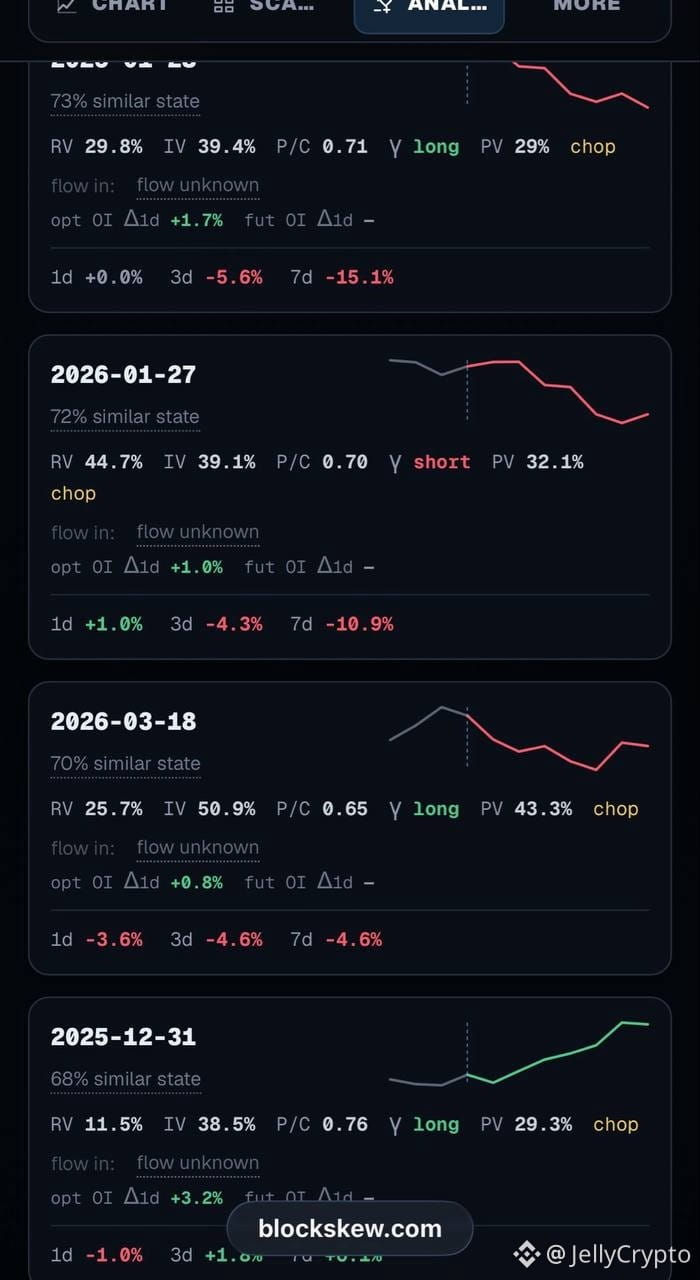
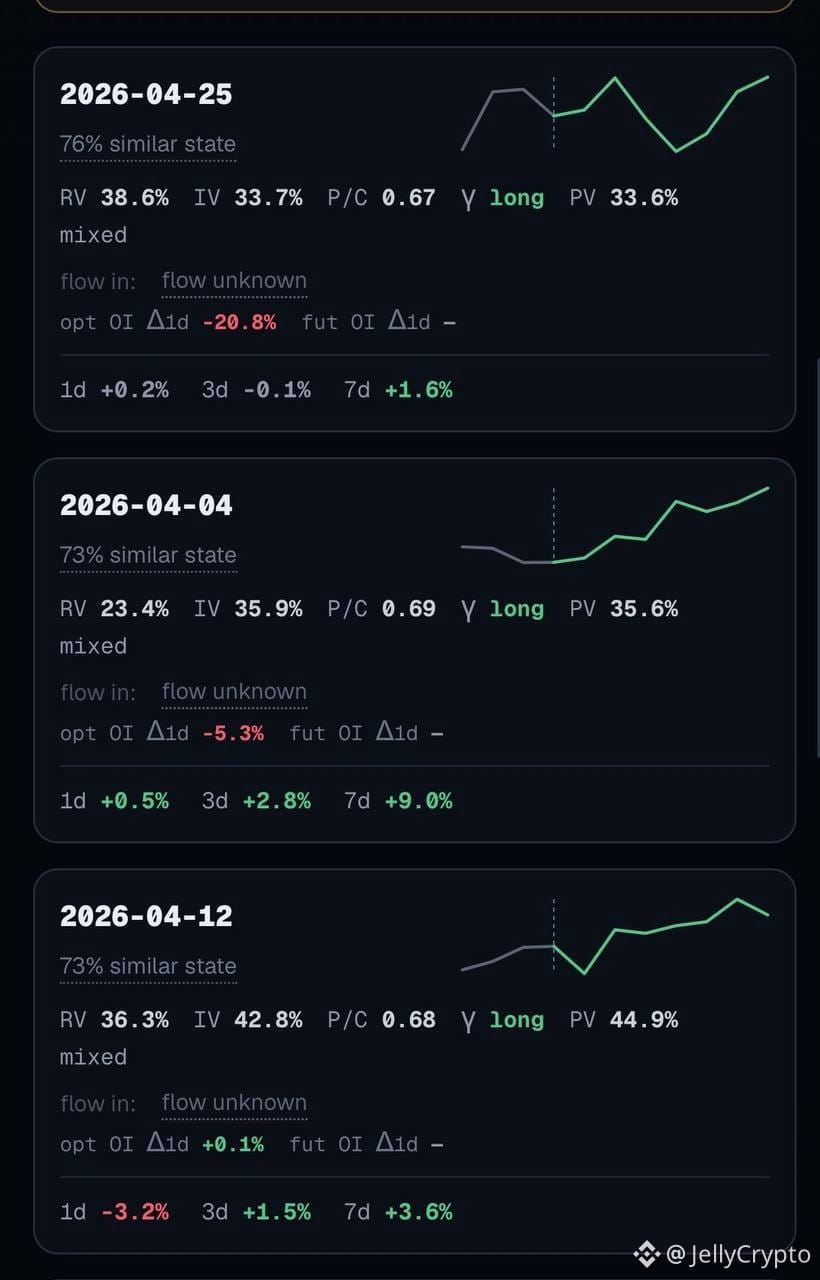
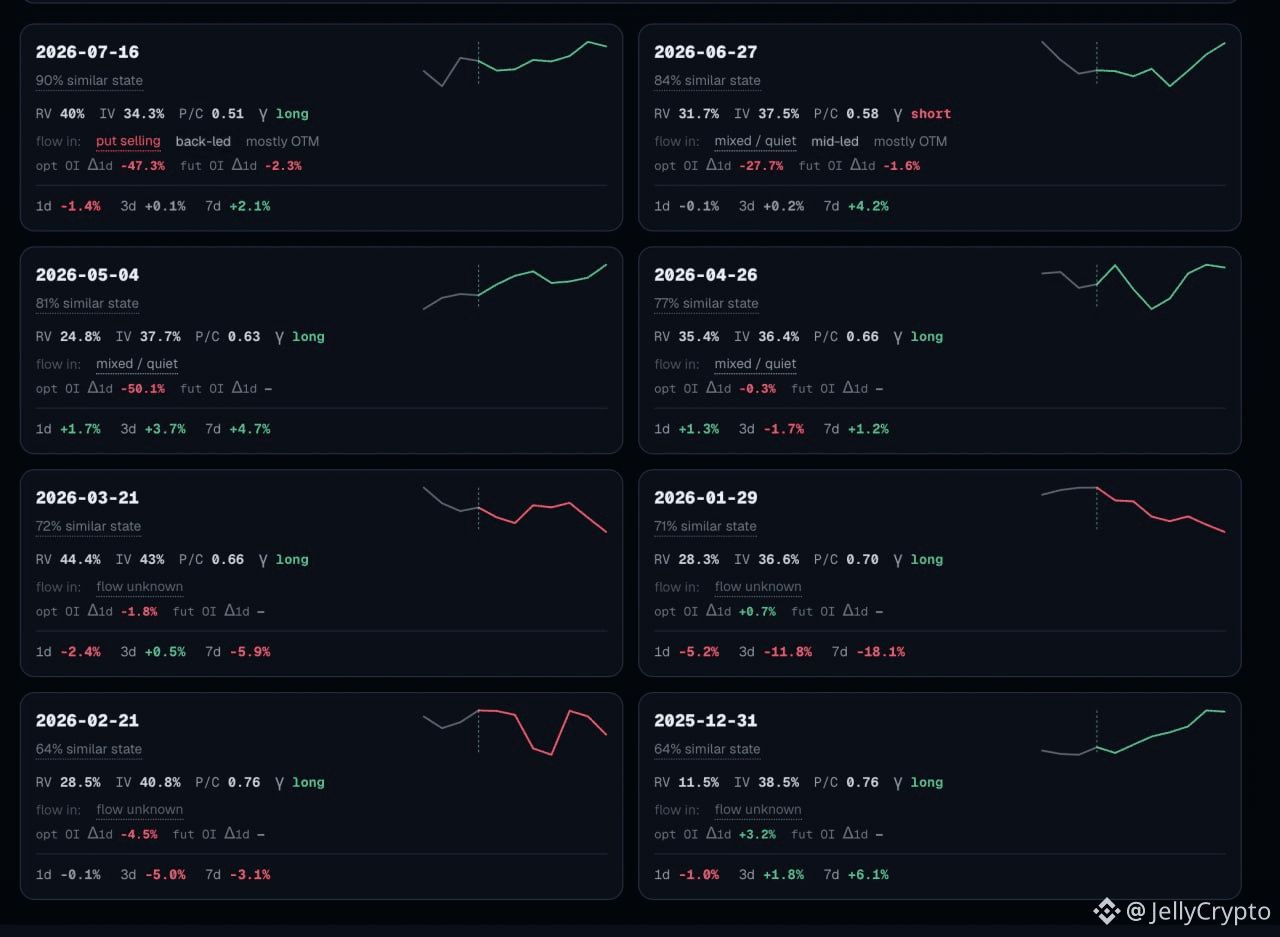
my system comparing the current market setup in BTC to extreme bottom or further downside phases
Dead-cat scenario in Jan (short-put forced selling starts) vs
March–April new liquidity (IBIT calls & hedging + STRC buying
Since the leading narrative right now is Clarity Act, it would be good to compare coming flows in relation to that.
It seems right that the current range is a major inflection point.
#BTC #bitcoin #CLARITYAct #crypto #nerdtape
my system comparing the current market setup in BTC to extreme bottom or further downside phases
Dead-cat scenario in Jan (short-put forced selling starts) vs
March–April new liquidity (IBIT calls & hedging + STRC buying
Since the leading narrative right now is Clarity Act, it would be good to compare coming flows in relation to that.
It seems right that the current range is a major inflection point.
#BTC #bitcoin #CLARITYAct #crypto #nerdtape
Dead-cat scenario in Jan (short-put forced selling starts) vs
March–April new liquidity (IBIT calls & hedging + STRC buying
Since the leading narrative right now is Clarity Act, it would be good to compare coming flows in relation to that.
It seems right that the current range is a major inflection point.
#BTC #bitcoin #CLARITYAct #crypto #nerdtape
176
·
--
2
121
·
--

Article
Saudi Arabia and BitcoinTL;DR: Connect the dots from Venezuela to the Red Sea, and a different war comes into view — one that runs on oil, not silicon. A trader's read.
Putting coins down for a day to write an op-ed. I was reading the news yesterday and a picture came into focus.
Trump announced that Saudi Arabia's civilian nuclear program comes with a condition: join the Abraham Accords. Shake hands with Israel, or no reactors.
The timing is what caught my eye. Look at where Saudi Arabia is standing right now. This week the Houthis hit Saudi tankers in the Red Sea. Riyadh suspended Red Sea shipments. Oil broke $100.
Cornered on every side — and that's exactly when the invoice arrives.
1. Why Saudi's insurance policy turned out to be worthless
The Saudis did buy insurance. Last year they signed a mutual defense pact with Pakistan — a nuclear power as a backstop. Sounded ironclad.
Then the leaked text of the pact told a different story. Pakistan explicitly carved its nukes out of its obligations, and kept the right to refuse any counterattack beyond Saudi territory.
They bought the policy. Then they opened the fine print, and it was all exclusion clauses.
To be fair, when Iranian missiles hit Saudi soil in April, Pakistani forces did show up. They showed up — but the part that mattered, the nuclear umbrella, was never in the contract to begin with. Maybe not quite a stab in the back, but it was the moment Riyadh confirmed it can't get through this alone.
And who happens to be standing at the door at exactly that moment? Washington. Coincidence?
2. Connect the dots
Step back and look at this year as a whole, and there's an interesting pattern.
January — the US strikes Venezuela. Maduro's capture is announced, oil convulses.
March — Iran is next. Its oil flows start getting squeezed.
All through the first half — long after Zelensky was sidelined and dropped out of the headlines, Ukraine kept hitting Russian refineries. Nearly 200 strikes. Over 40% of Russia's refining capacity disabled.
And now July — Saudi Arabia being pulled into the American camp.
What do these four countries have in common?
They're all China's gas station.
A House Select Committee report spelled it out — China is effectively the sole clearing market for sanctioned crude from Iran, Russia, and Venezuela. Hoovering up cheap sanctioned barrels saved China on its energy bill, and that money presumably went somewhere else.
So maybe these aren't four unrelated wars. Maybe it's one operation: shutting off China's gas stations, one by one.
Chip export controls are the headline — but isn't the main event energy?
3. Why energy? Because of AI
Remember what Aschenbrenner laid out — the guy who wrote Situational Awareness, now running a fund by the same name? The AI race is ultimately a compute race, and compute is ultimately electricity.
And as it happens, yesterday, from the other side of the Pacific, DeepSeek's Liang Wenfeng said the exact same thing. While raising $7.3B, what he said was — the US-China gap isn't technology or talent, it's computing resources. Eighteen months behind, and compute is what decides it.
Both sides, same conclusion. The bottleneck in the AI war isn't algorithms, it's resources.
Chips are half of that resource. The other half is electricity. And behind electricity sits a nation's entire energy bill.
Let me be fair about one thing — Chinese data centers don't run on Venezuelan crude. China's grid is mainly coal and renewables. But when a country's total energy import bill jumps, that burden gets passed on somewhere. The savings from cheap sanctioned oil disappear, and if $100 oil means burning more money on energy security, there's less ammunition to pour into AI.
America can't make Chinese engineers stupid. But it can make Chinese electricity expensive.
4. Through a crypto trader's eyes
Why am I writing about this? Because — ironically — every time one of these dots landed, coins convulsed.
Bitcoin made its first dead-cat bounce of the year back in January with Venezuela, and the market is wobbling again this week with oil above $100.
The reason is simple. Energy shocks are inflation fear, inflation fear is rates, rates are liquidity. And Bitcoin is a liquidity thermometer.
And one more thing — Bitcoin mining is literally an industry that converts electricity into money, right? When the energy map gets redrawn, the hashrate map gets redrawn with it. Energy is never someone else's story for us.
Our eyes are anchored to shiny technology and rising prices. But underneath, there's a hand blocking and rerouting the flows.
When chip news drops, everyone watches Nvidia. These days I watch the map — where the pipelines are getting shut.
Politics will do politics, wars will do wars. Our job is just to watch where it all shows up in the flows.
Thanks for reading.
Find me on X: JellyCrypto
Saudi Arabia and Bitcoin
TL;DR: Connect the dots from Venezuela to the Red Sea, and a different war comes into view — one that runs on oil, not silicon. A trader's read.
Putting coins down for a day to write an op-ed. I was reading the news yesterday and a picture came into focus.
Trump announced that Saudi Arabia's civilian nuclear program comes with a condition: join the Abraham Accords. Shake hands with Israel, or no reactors.
The timing is what caught my eye. Look at where Saudi Arabia is standing right now. This week the Houthis hit Saudi tankers in the Red Sea. Riyadh suspended Red Sea shipments. Oil broke $100.
Cornered on every side — and that's exactly when the invoice arrives.
1. Why Saudi's insurance policy turned out to be worthless
The Saudis did buy insurance. Last year they signed a mutual defense pact with Pakistan — a nuclear power as a backstop. Sounded ironclad.
Then the leaked text of the pact told a different story. Pakistan explicitly carved its nukes out of its obligations, and kept the right to refuse any counterattack beyond Saudi territory.
They bought the policy. Then they opened the fine print, and it was all exclusion clauses.
To be fair, when Iranian missiles hit Saudi soil in April, Pakistani forces did show up. They showed up — but the part that mattered, the nuclear umbrella, was never in the contract to begin with. Maybe not quite a stab in the back, but it was the moment Riyadh confirmed it can't get through this alone.
And who happens to be standing at the door at exactly that moment? Washington. Coincidence?
2. Connect the dots
Step back and look at this year as a whole, and there's an interesting pattern.
January — the US strikes Venezuela. Maduro's capture is announced, oil convulses.
March — Iran is next. Its oil flows start getting squeezed.
All through the first half — long after Zelensky was sidelined and dropped out of the headlines, Ukraine kept hitting Russian refineries. Nearly 200 strikes. Over 40% of Russia's refining capacity disabled.
And now July — Saudi Arabia being pulled into the American camp.
What do these four countries have in common?
They're all China's gas station.
A House Select Committee report spelled it out — China is effectively the sole clearing market for sanctioned crude from Iran, Russia, and Venezuela. Hoovering up cheap sanctioned barrels saved China on its energy bill, and that money presumably went somewhere else.
So maybe these aren't four unrelated wars. Maybe it's one operation: shutting off China's gas stations, one by one.
Chip export controls are the headline — but isn't the main event energy?
3. Why energy? Because of AI
Remember what Aschenbrenner laid out — the guy who wrote Situational Awareness, now running a fund by the same name? The AI race is ultimately a compute race, and compute is ultimately electricity.
And as it happens, yesterday, from the other side of the Pacific, DeepSeek's Liang Wenfeng said the exact same thing. While raising $7.3B, what he said was — the US-China gap isn't technology or talent, it's computing resources. Eighteen months behind, and compute is what decides it.
Both sides, same conclusion. The bottleneck in the AI war isn't algorithms, it's resources.
Chips are half of that resource. The other half is electricity. And behind electricity sits a nation's entire energy bill.
Let me be fair about one thing — Chinese data centers don't run on Venezuelan crude. China's grid is mainly coal and renewables. But when a country's total energy import bill jumps, that burden gets passed on somewhere. The savings from cheap sanctioned oil disappear, and if $100 oil means burning more money on energy security, there's less ammunition to pour into AI.
America can't make Chinese engineers stupid. But it can make Chinese electricity expensive.
4. Through a crypto trader's eyes
Why am I writing about this? Because — ironically — every time one of these dots landed, coins convulsed.
Bitcoin made its first dead-cat bounce of the year back in January with Venezuela, and the market is wobbling again this week with oil above $100.
The reason is simple. Energy shocks are inflation fear, inflation fear is rates, rates are liquidity. And Bitcoin is a liquidity thermometer.
And one more thing — Bitcoin mining is literally an industry that converts electricity into money, right? When the energy map gets redrawn, the hashrate map gets redrawn with it. Energy is never someone else's story for us.
Our eyes are anchored to shiny technology and rising prices. But underneath, there's a hand blocking and rerouting the flows.
When chip news drops, everyone watches Nvidia. These days I watch the map — where the pipelines are getting shut.
Politics will do politics, wars will do wars. Our job is just to watch where it all shows up in the flows.
Thanks for reading.
Find me on X: JellyCrypto
Putting coins down for a day to write an op-ed. I was reading the news yesterday and a picture came into focus.
Trump announced that Saudi Arabia's civilian nuclear program comes with a condition: join the Abraham Accords. Shake hands with Israel, or no reactors.
The timing is what caught my eye. Look at where Saudi Arabia is standing right now. This week the Houthis hit Saudi tankers in the Red Sea. Riyadh suspended Red Sea shipments. Oil broke $100.
Cornered on every side — and that's exactly when the invoice arrives.
1. Why Saudi's insurance policy turned out to be worthless
The Saudis did buy insurance. Last year they signed a mutual defense pact with Pakistan — a nuclear power as a backstop. Sounded ironclad.
Then the leaked text of the pact told a different story. Pakistan explicitly carved its nukes out of its obligations, and kept the right to refuse any counterattack beyond Saudi territory.
They bought the policy. Then they opened the fine print, and it was all exclusion clauses.
To be fair, when Iranian missiles hit Saudi soil in April, Pakistani forces did show up. They showed up — but the part that mattered, the nuclear umbrella, was never in the contract to begin with. Maybe not quite a stab in the back, but it was the moment Riyadh confirmed it can't get through this alone.
And who happens to be standing at the door at exactly that moment? Washington. Coincidence?
2. Connect the dots
Step back and look at this year as a whole, and there's an interesting pattern.
January — the US strikes Venezuela. Maduro's capture is announced, oil convulses.
March — Iran is next. Its oil flows start getting squeezed.
All through the first half — long after Zelensky was sidelined and dropped out of the headlines, Ukraine kept hitting Russian refineries. Nearly 200 strikes. Over 40% of Russia's refining capacity disabled.
And now July — Saudi Arabia being pulled into the American camp.
What do these four countries have in common?
They're all China's gas station.
A House Select Committee report spelled it out — China is effectively the sole clearing market for sanctioned crude from Iran, Russia, and Venezuela. Hoovering up cheap sanctioned barrels saved China on its energy bill, and that money presumably went somewhere else.
So maybe these aren't four unrelated wars. Maybe it's one operation: shutting off China's gas stations, one by one.
Chip export controls are the headline — but isn't the main event energy?
3. Why energy? Because of AI
Remember what Aschenbrenner laid out — the guy who wrote Situational Awareness, now running a fund by the same name? The AI race is ultimately a compute race, and compute is ultimately electricity.
And as it happens, yesterday, from the other side of the Pacific, DeepSeek's Liang Wenfeng said the exact same thing. While raising $7.3B, what he said was — the US-China gap isn't technology or talent, it's computing resources. Eighteen months behind, and compute is what decides it.
Both sides, same conclusion. The bottleneck in the AI war isn't algorithms, it's resources.
Chips are half of that resource. The other half is electricity. And behind electricity sits a nation's entire energy bill.
Let me be fair about one thing — Chinese data centers don't run on Venezuelan crude. China's grid is mainly coal and renewables. But when a country's total energy import bill jumps, that burden gets passed on somewhere. The savings from cheap sanctioned oil disappear, and if $100 oil means burning more money on energy security, there's less ammunition to pour into AI.
America can't make Chinese engineers stupid. But it can make Chinese electricity expensive.
4. Through a crypto trader's eyes
Why am I writing about this? Because — ironically — every time one of these dots landed, coins convulsed.
Bitcoin made its first dead-cat bounce of the year back in January with Venezuela, and the market is wobbling again this week with oil above $100.
The reason is simple. Energy shocks are inflation fear, inflation fear is rates, rates are liquidity. And Bitcoin is a liquidity thermometer.
And one more thing — Bitcoin mining is literally an industry that converts electricity into money, right? When the energy map gets redrawn, the hashrate map gets redrawn with it. Energy is never someone else's story for us.
Our eyes are anchored to shiny technology and rising prices. But underneath, there's a hand blocking and rerouting the flows.
When chip news drops, everyone watches Nvidia. These days I watch the map — where the pipelines are getting shut.
Politics will do politics, wars will do wars. Our job is just to watch where it all shows up in the flows.
Thanks for reading.
Find me on X: JellyCrypto
3
39
·
--
Article
Who borrowed $400M in 20 minutes — without a bank?TL;DR: 5 PM KST on 7/23, someone borrowed $400M on Deribit in 20 minutes. Not a bank, not a loan — options.
Taking a break from CLARITY today for something different. I dug up a piece of data almost nobody looks at.
A strange block just printed in Deribit BTC options. $430M went through in the same structure over 20 minutes. Open interest on all four legs rose by exactly 300 together — meaning it was one package, put together in a single shot.
But this isn't a directional bet. Someone actually borrowed money.
1. Box spread? That's really a loan
Combine four options a specific way — buy and sell calls and puts at two strikes — and you get a fixed amount at expiry no matter where price goes. Regardless of direction. That's a box spread.
A fixed amount at expiry? Then this isn't a bet, it's a money transaction. Pay premium now and receive more at expiry = you lent money. Receive now and pay back more at expiry = you borrowed. Zero directional exposure, zero gamma. A pure funding instrument.
That block yesterday — the seller is the one borrowing. A market maker (MM) funding itself.
2. Why borrow through options
Here's the core of it. Banks don't extend credit to crypto desks. On-chain lending is overcollateralized — you have to post more than you borrow — so it's expensive. So where do these desks fund cheaply? The box.
And the implied rate on this block is interesting. Around 4% annualized. Almost the same as short-term US rates.
What that means is — borrowing money in crypto costs about what the US government pays. The crypto credit premium is basically zero. Flip it around, and it means there's so much idle stablecoin sitting around that it's lining up to earn even 4%. Crypto is doing exactly what TradFi does with SPX boxes.
3. "So that's a bearish signal?" — No
Let's clear this misread up right here. There's $400M worth of puts in it, so isn't that downside hedging? No.
A box is delta zero. The deep-ITM leg and the deep-OTM leg offset each other, so there's no directional exposure. The big premium attached to the puts is just intrinsic value, not a directional bet. Gamma is zero too, so there's no dealer hedging pushing the market around.
Reading this as "big puts = crash hedge" takes you in the exact opposite direction from what the data says. This isn't direction, it's funding.
4. So what does it tell us?
Two things.
One — an MM scrambled together $400M of two-month (September expiry) inventory funding in 20 minutes. It isn't directional, but they're getting ready to absorb some big flow or volatility. It's indirect evidence for "something's coming by September," not for "which way."Two — and this is what I'm actually chasing. Where this cheap money goes.
5. Circumstantial: this money looks like it's headed to DeFi (not confirmed yet)
Honestly, this is still a hypothesis. But the picture is starting to form.
If you can fund at 4%, lending that money out above 4% is free carry. Where? DeFi lending markets like Morpho or Aave.
The circumstantial pieces:
USDC is flowing heavily into Morpho and Aerodrome right now.
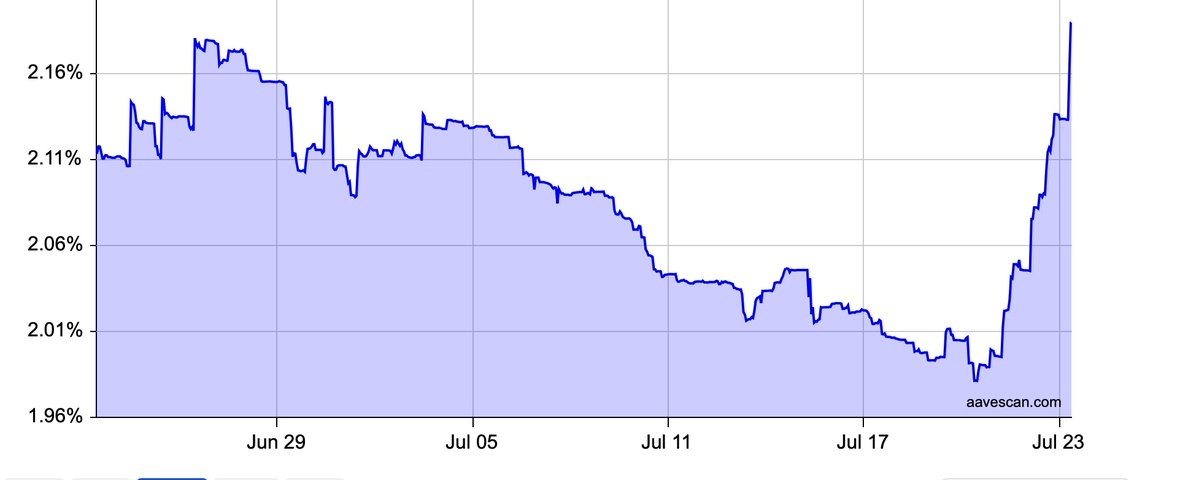
Aave borrow rates spiked suddenly today. Circumstantial evidence that the lending market is heating up.Morpho has half of Aave's TVL but has overtaken it on fees (as of this week). A signal that borrow demand is concentrating on Morpho.
But to confirm this, we'd need on-chain prints of money moving from a Deribit wallet into a Morpho vault, or Morpho supply rates getting compressed right after the inflow. I haven't seen that far yet. So this is circumstantial, not fact. I'm not going to force a conclusion.
6. What you should actually take from this
This isn't a price prediction. It's looking at the plumbing.
While everyone else is drawing lines on charts, data like box-implied rates tells you how much money is sloshing around in CeFi and how easy funding is — before price does. Almost nobody watches this indicator.
What it's saying right now is — money is abundant, funding is cheap, and it's getting ready to move. Direction not yet decided.
Oh, one warning. Don't read this and go "I'll fund at 4% with a box and farm DeFi carry too." Deribit is European-style, so there's no early assignment risk — but copy this with American-style options (like SPY) and you'll get assigned early and blow up your account like the 2019 Robinhood box-spread blowups. This is desk infrastructure, not something retail should be touching.
The plumbing will do what plumbing does — we just watch where it leaks.
Thanks for reading.
I post these reads first on X — JellyCrypto.
Who borrowed $400M in 20 minutes — without a bank?
TL;DR: 5 PM KST on 7/23, someone borrowed $400M on Deribit in 20 minutes. Not a bank, not a loan — options.
Taking a break from CLARITY today for something different. I dug up a piece of data almost nobody looks at.
A strange block just printed in Deribit BTC options. $430M went through in the same structure over 20 minutes. Open interest on all four legs rose by exactly 300 together — meaning it was one package, put together in a single shot.
But this isn't a directional bet. Someone actually borrowed money.
1. Box spread? That's really a loan
Combine four options a specific way — buy and sell calls and puts at two strikes — and you get a fixed amount at expiry no matter where price goes. Regardless of direction. That's a box spread.
A fixed amount at expiry? Then this isn't a bet, it's a money transaction. Pay premium now and receive more at expiry = you lent money. Receive now and pay back more at expiry = you borrowed. Zero directional exposure, zero gamma. A pure funding instrument.
That block yesterday — the seller is the one borrowing. A market maker (MM) funding itself.
2. Why borrow through options
Here's the core of it. Banks don't extend credit to crypto desks. On-chain lending is overcollateralized — you have to post more than you borrow — so it's expensive. So where do these desks fund cheaply? The box.
And the implied rate on this block is interesting. Around 4% annualized. Almost the same as short-term US rates.
What that means is — borrowing money in crypto costs about what the US government pays. The crypto credit premium is basically zero. Flip it around, and it means there's so much idle stablecoin sitting around that it's lining up to earn even 4%. Crypto is doing exactly what TradFi does with SPX boxes.
3. "So that's a bearish signal?" — No
Let's clear this misread up right here. There's $400M worth of puts in it, so isn't that downside hedging? No.
A box is delta zero. The deep-ITM leg and the deep-OTM leg offset each other, so there's no directional exposure. The big premium attached to the puts is just intrinsic value, not a directional bet. Gamma is zero too, so there's no dealer hedging pushing the market around.
Reading this as "big puts = crash hedge" takes you in the exact opposite direction from what the data says. This isn't direction, it's funding.
4. So what does it tell us?
Two things.
One — an MM scrambled together $400M of two-month (September expiry) inventory funding in 20 minutes. It isn't directional, but they're getting ready to absorb some big flow or volatility. It's indirect evidence for "something's coming by September," not for "which way."Two — and this is what I'm actually chasing. Where this cheap money goes.
5. Circumstantial: this money looks like it's headed to DeFi (not confirmed yet)
Honestly, this is still a hypothesis. But the picture is starting to form.
If you can fund at 4%, lending that money out above 4% is free carry. Where? DeFi lending markets like Morpho or Aave.
The circumstantial pieces:
USDC is flowing heavily into Morpho and Aerodrome right now.
Aave borrow rates spiked suddenly today. Circumstantial evidence that the lending market is heating up.Morpho has half of Aave's TVL but has overtaken it on fees (as of this week). A signal that borrow demand is concentrating on Morpho.
But to confirm this, we'd need on-chain prints of money moving from a Deribit wallet into a Morpho vault, or Morpho supply rates getting compressed right after the inflow. I haven't seen that far yet. So this is circumstantial, not fact. I'm not going to force a conclusion.
6. What you should actually take from this
This isn't a price prediction. It's looking at the plumbing.
While everyone else is drawing lines on charts, data like box-implied rates tells you how much money is sloshing around in CeFi and how easy funding is — before price does. Almost nobody watches this indicator.
What it's saying right now is — money is abundant, funding is cheap, and it's getting ready to move. Direction not yet decided.
Oh, one warning. Don't read this and go "I'll fund at 4% with a box and farm DeFi carry too." Deribit is European-style, so there's no early assignment risk — but copy this with American-style options (like SPY) and you'll get assigned early and blow up your account like the 2019 Robinhood box-spread blowups. This is desk infrastructure, not something retail should be touching.
The plumbing will do what plumbing does — we just watch where it leaks.
Thanks for reading.
I post these reads first on X — JellyCrypto.
Taking a break from CLARITY today for something different. I dug up a piece of data almost nobody looks at.
A strange block just printed in Deribit BTC options. $430M went through in the same structure over 20 minutes. Open interest on all four legs rose by exactly 300 together — meaning it was one package, put together in a single shot.
But this isn't a directional bet. Someone actually borrowed money.
1. Box spread? That's really a loan
Combine four options a specific way — buy and sell calls and puts at two strikes — and you get a fixed amount at expiry no matter where price goes. Regardless of direction. That's a box spread.
A fixed amount at expiry? Then this isn't a bet, it's a money transaction. Pay premium now and receive more at expiry = you lent money. Receive now and pay back more at expiry = you borrowed. Zero directional exposure, zero gamma. A pure funding instrument.
That block yesterday — the seller is the one borrowing. A market maker (MM) funding itself.
2. Why borrow through options
Here's the core of it. Banks don't extend credit to crypto desks. On-chain lending is overcollateralized — you have to post more than you borrow — so it's expensive. So where do these desks fund cheaply? The box.
And the implied rate on this block is interesting. Around 4% annualized. Almost the same as short-term US rates.
What that means is — borrowing money in crypto costs about what the US government pays. The crypto credit premium is basically zero. Flip it around, and it means there's so much idle stablecoin sitting around that it's lining up to earn even 4%. Crypto is doing exactly what TradFi does with SPX boxes.
3. "So that's a bearish signal?" — No
Let's clear this misread up right here. There's $400M worth of puts in it, so isn't that downside hedging? No.
A box is delta zero. The deep-ITM leg and the deep-OTM leg offset each other, so there's no directional exposure. The big premium attached to the puts is just intrinsic value, not a directional bet. Gamma is zero too, so there's no dealer hedging pushing the market around.
Reading this as "big puts = crash hedge" takes you in the exact opposite direction from what the data says. This isn't direction, it's funding.
4. So what does it tell us?
Two things.
One — an MM scrambled together $400M of two-month (September expiry) inventory funding in 20 minutes. It isn't directional, but they're getting ready to absorb some big flow or volatility. It's indirect evidence for "something's coming by September," not for "which way."Two — and this is what I'm actually chasing. Where this cheap money goes.
5. Circumstantial: this money looks like it's headed to DeFi (not confirmed yet)
Honestly, this is still a hypothesis. But the picture is starting to form.
If you can fund at 4%, lending that money out above 4% is free carry. Where? DeFi lending markets like Morpho or Aave.
The circumstantial pieces:
USDC is flowing heavily into Morpho and Aerodrome right now.
Aave borrow rates spiked suddenly today. Circumstantial evidence that the lending market is heating up.Morpho has half of Aave's TVL but has overtaken it on fees (as of this week). A signal that borrow demand is concentrating on Morpho.
But to confirm this, we'd need on-chain prints of money moving from a Deribit wallet into a Morpho vault, or Morpho supply rates getting compressed right after the inflow. I haven't seen that far yet. So this is circumstantial, not fact. I'm not going to force a conclusion.
6. What you should actually take from this
This isn't a price prediction. It's looking at the plumbing.
While everyone else is drawing lines on charts, data like box-implied rates tells you how much money is sloshing around in CeFi and how easy funding is — before price does. Almost nobody watches this indicator.
What it's saying right now is — money is abundant, funding is cheap, and it's getting ready to move. Direction not yet decided.
Oh, one warning. Don't read this and go "I'll fund at 4% with a box and farm DeFi carry too." Deribit is European-style, so there's no early assignment risk — but copy this with American-style options (like SPY) and you'll get assigned early and blow up your account like the 2019 Robinhood box-spread blowups. This is desk infrastructure, not something retail should be touching.
The plumbing will do what plumbing does — we just watch where it leaks.
Thanks for reading.
I post these reads first on X — JellyCrypto.
2
103
·
--
Article
The Clarity Act and Prediction Market Imbalance — Could Fear Become an Opportunity?TL;DR The probability of the Clarity Act passing currently looks quite low. But for someone, this could be an opportunity.
Before diving in, here’s the setup.
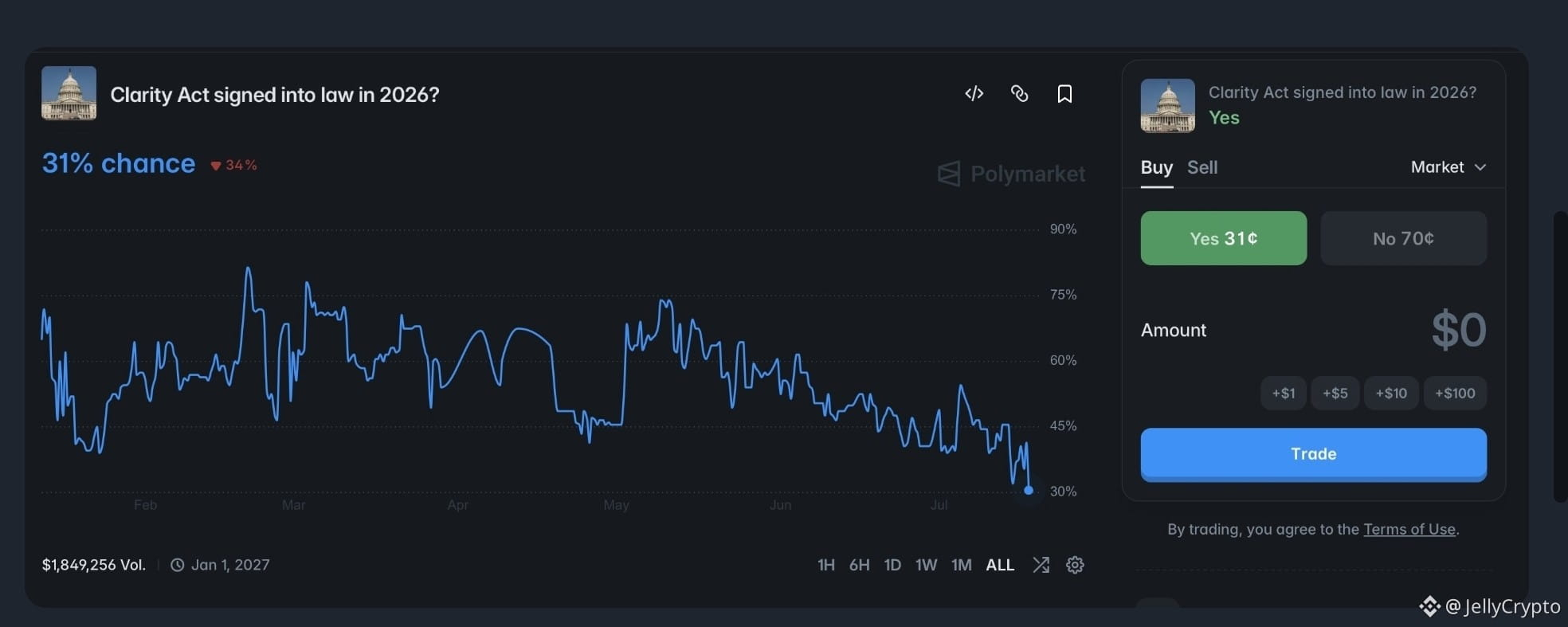
According to Polymarket, the odds of the Clarity Act being signed into law in 2026 have dropped to 31% (down 34% recently). The trend is clearly downward.As time runs out, prediction market probabilities decay naturally, much like theta decay in options. Once the August recess begins, that decay could accelerate.However, prediction markets don’t have a Black-Scholes-style pricing model. In extreme fear phases, prices can overshoot well below the actual probability because of liquidity imbalances.If it gets pushed down to the 3-5% range, that doesn’t necessarily mean “failure is confirmed.” It could simply be a liquidity vacuum. This is where a positive expected value setup could emerge.Note: Accessing or trading on Polymarket from Korea is illegal. This article is purely for market structure study and entertainment purposes — not investment advice.
[Attach Polymarket chart: "Clarity Act signed into law in 2026?"]
In February, the pass probability was close to 90%. Now it’s threatening to break below 30%.
The downward slope has been getting steeper and steeper.
Here’s the current situation summarized:
The Senate Banking Committee already passed the bill in May (15-9).However, after Trump’s personal crypto income disclosure (around $1.4 billion scale), the ethics clause regarding conflicts of interest became the biggest remaining hurdle.It ultimately failed to pass before the July 4 recess.On July 15, there were reports that Trump personally met with senators to negotiate this clause.Looking at the Senate calendar, the remaining 3 weeks in July + about 1 week in August is effectively the last realistic window. After that, it enters midterm election season and the legislative schedule gets paralyzed.
In other words, regardless of whether it “passes or not,” the actual time available to pass it keeps shrinking. This is the core point.
Honestly, I’ve been watching this bill drama for months now and it’s getting a bit tiring lol. Still, from a trading perspective, it’s an interesting zone, so I wanted to break it down.
1. Probability decaying like theta
If you’ve traded options before, you know that as expiration approaches, time value decays naturally even without any events.
Prediction markets (binary options) work the same way.
As long as the condition is “pass within 2026,” the shrinking calendar means the probability will structurally get suppressed even without negative news.
Entering the August recess = a period of rapid time value decay.
After that, midterm election season means the Senate won’t have any bandwidth left for this bill.
If the current trend continues, once we cross into August, there’s a high chance the probability gets suppressed significantly again.
2. But prediction markets have no “theoretical price”
Options have Black-Scholes (or variants), so market makers have a theoretical fair value to anchor around. This prevents prices from deviating too extremely even in panic.
Prediction markets like Polymarket have no such standardized pricing model.
The price is simply whatever the people sitting on the order book decide.
In a fear-driven phase, if there are only sellers and almost no liquidity to absorb them, the price can trade significantly below the actual probability.
This is the structural imbalance in prediction markets.
3. That’s why I’m watching the 3-5% zone
I believe if time pressure + surface-level negative headlines (like “ethics clause negotiations collapse”) pile up, we could easily see the 2026 pass probability drop below 10%. In extreme cases, even down to 3-5%.
And this zone could be an opportunity for someone.
If you provide liquidity when the market has panic-priced it down to this level, you can get a setup with quite attractive risk/reward.
Why?
Assume headlines come out making it sound like the Clarity Act is “effectively dead” as it heads into recess.Trump would likely blame the Senate (he’s already been clashing with them over the ethics clause).With the November Senate midterm elections coming up, if even once during the campaign period Republican-leaning sentiment forms? Or if Trump says he’ll push it through this year?Then that 3% contract — which was basically priced as dead (“no chance of passing in 2026”) — could get re-rated to 20% → 40% → 50%.
A scenario where a 3% contract doesn’t even get halved on the downside but has the potential to 10x+… that’s a zone where the asymmetry becomes very interesting.
4. But this isn’t about the bill’s prospects
Just because intrinsic value rises doesn’t mean it will actually settle there.
To be honest, I’m not a legislative expert, and I don’t really care whether the Clarity Act passes or not. What I’m looking at is purely the dislocation between price and intrinsic value.
Whether there’s a zone where expected value is asymmetrically favorable compared to the risk — that’s the only thing I’m watching.
Since prediction markets are ultimately a branch of binary options, I wanted to share how you can approach them with this kind of thinking.
Disclaimer Note that in Korea, accessing or trading on Polymarket is reportedly illegal (I just found this out today). Please treat this as reference only and always check the laws in your jurisdiction.
This article is my personal opinion and a market structure study for fun. It is not financial advice. Under Korean law, it could even be viewed as gambling rather than investing.
Coiners, have a good weekend. Let’s keep watching next week.
Read more of our articles on X : https://x.com/JellyCrypto
The Clarity Act and Prediction Market Imbalance — Could Fear Become an Opportunity?
TL;DR The probability of the Clarity Act passing currently looks quite low. But for someone, this could be an opportunity.
Before diving in, here’s the setup.
According to Polymarket, the odds of the Clarity Act being signed into law in 2026 have dropped to 31% (down 34% recently). The trend is clearly downward.As time runs out, prediction market probabilities decay naturally, much like theta decay in options. Once the August recess begins, that decay could accelerate.However, prediction markets don’t have a Black-Scholes-style pricing model. In extreme fear phases, prices can overshoot well below the actual probability because of liquidity imbalances.If it gets pushed down to the 3-5% range, that doesn’t necessarily mean “failure is confirmed.” It could simply be a liquidity vacuum. This is where a positive expected value setup could emerge.Note: Accessing or trading on Polymarket from Korea is illegal. This article is purely for market structure study and entertainment purposes — not investment advice.
[Attach Polymarket chart: "Clarity Act signed into law in 2026?"]
In February, the pass probability was close to 90%. Now it’s threatening to break below 30%.
The downward slope has been getting steeper and steeper.
Here’s the current situation summarized:
The Senate Banking Committee already passed the bill in May (15-9).However, after Trump’s personal crypto income disclosure (around $1.4 billion scale), the ethics clause regarding conflicts of interest became the biggest remaining hurdle.It ultimately failed to pass before the July 4 recess.On July 15, there were reports that Trump personally met with senators to negotiate this clause.Looking at the Senate calendar, the remaining 3 weeks in July + about 1 week in August is effectively the last realistic window. After that, it enters midterm election season and the legislative schedule gets paralyzed.
In other words, regardless of whether it “passes or not,” the actual time available to pass it keeps shrinking. This is the core point.
Honestly, I’ve been watching this bill drama for months now and it’s getting a bit tiring lol. Still, from a trading perspective, it’s an interesting zone, so I wanted to break it down.
1. Probability decaying like theta
If you’ve traded options before, you know that as expiration approaches, time value decays naturally even without any events.
Prediction markets (binary options) work the same way.
As long as the condition is “pass within 2026,” the shrinking calendar means the probability will structurally get suppressed even without negative news.
Entering the August recess = a period of rapid time value decay.
After that, midterm election season means the Senate won’t have any bandwidth left for this bill.
If the current trend continues, once we cross into August, there’s a high chance the probability gets suppressed significantly again.
2. But prediction markets have no “theoretical price”
Options have Black-Scholes (or variants), so market makers have a theoretical fair value to anchor around. This prevents prices from deviating too extremely even in panic.
Prediction markets like Polymarket have no such standardized pricing model.
The price is simply whatever the people sitting on the order book decide.
In a fear-driven phase, if there are only sellers and almost no liquidity to absorb them, the price can trade significantly below the actual probability.
This is the structural imbalance in prediction markets.
3. That’s why I’m watching the 3-5% zone
I believe if time pressure + surface-level negative headlines (like “ethics clause negotiations collapse”) pile up, we could easily see the 2026 pass probability drop below 10%. In extreme cases, even down to 3-5%.
And this zone could be an opportunity for someone.
If you provide liquidity when the market has panic-priced it down to this level, you can get a setup with quite attractive risk/reward.
Why?
Assume headlines come out making it sound like the Clarity Act is “effectively dead” as it heads into recess.Trump would likely blame the Senate (he’s already been clashing with them over the ethics clause).With the November Senate midterm elections coming up, if even once during the campaign period Republican-leaning sentiment forms? Or if Trump says he’ll push it through this year?Then that 3% contract — which was basically priced as dead (“no chance of passing in 2026”) — could get re-rated to 20% → 40% → 50%.
A scenario where a 3% contract doesn’t even get halved on the downside but has the potential to 10x+… that’s a zone where the asymmetry becomes very interesting.
4. But this isn’t about the bill’s prospects
Just because intrinsic value rises doesn’t mean it will actually settle there.
To be honest, I’m not a legislative expert, and I don’t really care whether the Clarity Act passes or not. What I’m looking at is purely the dislocation between price and intrinsic value.
Whether there’s a zone where expected value is asymmetrically favorable compared to the risk — that’s the only thing I’m watching.
Since prediction markets are ultimately a branch of binary options, I wanted to share how you can approach them with this kind of thinking.
Disclaimer Note that in Korea, accessing or trading on Polymarket is reportedly illegal (I just found this out today). Please treat this as reference only and always check the laws in your jurisdiction.
This article is my personal opinion and a market structure study for fun. It is not financial advice. Under Korean law, it could even be viewed as gambling rather than investing.
Coiners, have a good weekend. Let’s keep watching next week.
Read more of our articles on X : https://x.com/JellyCrypto
Before diving in, here’s the setup.
According to Polymarket, the odds of the Clarity Act being signed into law in 2026 have dropped to 31% (down 34% recently). The trend is clearly downward.As time runs out, prediction market probabilities decay naturally, much like theta decay in options. Once the August recess begins, that decay could accelerate.However, prediction markets don’t have a Black-Scholes-style pricing model. In extreme fear phases, prices can overshoot well below the actual probability because of liquidity imbalances.If it gets pushed down to the 3-5% range, that doesn’t necessarily mean “failure is confirmed.” It could simply be a liquidity vacuum. This is where a positive expected value setup could emerge.Note: Accessing or trading on Polymarket from Korea is illegal. This article is purely for market structure study and entertainment purposes — not investment advice.
[Attach Polymarket chart: "Clarity Act signed into law in 2026?"]
In February, the pass probability was close to 90%. Now it’s threatening to break below 30%.
The downward slope has been getting steeper and steeper.
Here’s the current situation summarized:
The Senate Banking Committee already passed the bill in May (15-9).However, after Trump’s personal crypto income disclosure (around $1.4 billion scale), the ethics clause regarding conflicts of interest became the biggest remaining hurdle.It ultimately failed to pass before the July 4 recess.On July 15, there were reports that Trump personally met with senators to negotiate this clause.Looking at the Senate calendar, the remaining 3 weeks in July + about 1 week in August is effectively the last realistic window. After that, it enters midterm election season and the legislative schedule gets paralyzed.
In other words, regardless of whether it “passes or not,” the actual time available to pass it keeps shrinking. This is the core point.
Honestly, I’ve been watching this bill drama for months now and it’s getting a bit tiring lol. Still, from a trading perspective, it’s an interesting zone, so I wanted to break it down.
1. Probability decaying like theta
If you’ve traded options before, you know that as expiration approaches, time value decays naturally even without any events.
Prediction markets (binary options) work the same way.
As long as the condition is “pass within 2026,” the shrinking calendar means the probability will structurally get suppressed even without negative news.
Entering the August recess = a period of rapid time value decay.
After that, midterm election season means the Senate won’t have any bandwidth left for this bill.
If the current trend continues, once we cross into August, there’s a high chance the probability gets suppressed significantly again.
2. But prediction markets have no “theoretical price”
Options have Black-Scholes (or variants), so market makers have a theoretical fair value to anchor around. This prevents prices from deviating too extremely even in panic.
Prediction markets like Polymarket have no such standardized pricing model.
The price is simply whatever the people sitting on the order book decide.
In a fear-driven phase, if there are only sellers and almost no liquidity to absorb them, the price can trade significantly below the actual probability.
This is the structural imbalance in prediction markets.
3. That’s why I’m watching the 3-5% zone
I believe if time pressure + surface-level negative headlines (like “ethics clause negotiations collapse”) pile up, we could easily see the 2026 pass probability drop below 10%. In extreme cases, even down to 3-5%.
And this zone could be an opportunity for someone.
If you provide liquidity when the market has panic-priced it down to this level, you can get a setup with quite attractive risk/reward.
Why?
Assume headlines come out making it sound like the Clarity Act is “effectively dead” as it heads into recess.Trump would likely blame the Senate (he’s already been clashing with them over the ethics clause).With the November Senate midterm elections coming up, if even once during the campaign period Republican-leaning sentiment forms? Or if Trump says he’ll push it through this year?Then that 3% contract — which was basically priced as dead (“no chance of passing in 2026”) — could get re-rated to 20% → 40% → 50%.
A scenario where a 3% contract doesn’t even get halved on the downside but has the potential to 10x+… that’s a zone where the asymmetry becomes very interesting.
4. But this isn’t about the bill’s prospects
Just because intrinsic value rises doesn’t mean it will actually settle there.
To be honest, I’m not a legislative expert, and I don’t really care whether the Clarity Act passes or not. What I’m looking at is purely the dislocation between price and intrinsic value.
Whether there’s a zone where expected value is asymmetrically favorable compared to the risk — that’s the only thing I’m watching.
Since prediction markets are ultimately a branch of binary options, I wanted to share how you can approach them with this kind of thinking.
Disclaimer Note that in Korea, accessing or trading on Polymarket is reportedly illegal (I just found this out today). Please treat this as reference only and always check the laws in your jurisdiction.
This article is my personal opinion and a market structure study for fun. It is not financial advice. Under Korean law, it could even be viewed as gambling rather than investing.
Coiners, have a good weekend. Let’s keep watching next week.
Read more of our articles on X : https://x.com/JellyCrypto
1
6
9.5k
Log in to explore more content
Join global crypto users on Binance Square
⚡️ Get latest and useful information about crypto.
💬 Trusted by the world’s largest crypto exchange.
👍 Discover real insights from verified creators.
Email / Phone number
Trending Topics
AppleDebutsFoldablePhone
17,129 views
354 Discussing
$BTC
Apple just released a foldable phone
Apple fans are calculating installments
Old “weak hands” are figuring out how many BTC
Brothers
Apple finally can’t hold it back anymore
Its first foldable phone
iPhone Duo
Starts at 15,999 yuan in mainland China
The top configuration goes straight up to 26,499
I swear—when I saw the price
my first reaction wasn’t “too expensive”
It was, “Quick, open the exchange and calculate.”
Based on the current coin price,
this phone is about 0.025 BTC
0.025 BTC
Doesn’t sound like much, right?
But go look at history.
When the iPhone 4s launched back then,
the price translated to 162 BTC
iPhone 6 was 1.7 BTC
iPhone 13 was 0.018 BTC
iPhone 17 was 0.007 BTC
Got the trend now?
It’s not that your money is growing
It’s Bitcoin diluting Apple’s pricing for you
What’s interesting is that at the event itself,
Apple’s stock price rode a roller coaster.
It got hit at the open—then it bounced back.
By the close, it finished down slightly.
Whether the market thinks this high-priced foldable phone can sell big—
there’s quite a split 😂😂
But brothers,
don’t see Apple releasing a new phone and start imagining that “tech bull run” is here.
The big-bag (BTC) needs to follow the trend
Apple doesn’t have a direct capital pipeline to the crypto market.
No matter how many phones it sells,
not a single automatic cent flows into crypto.
This is only a hardware tailwind on the consumer side,
not the big logic that directly pushes BTC higher.
BTC’s pricing main driver is still
the Fed cutting rates and US Treasury yields.
Apple’s new product is just a small industry hotspot.
It can only boost sector sentiment in the short term.
It can’t change the big market’s overall trend.
If you were already planning to change your phone,
and you also happen to have some spare money worth 0.025 BTC in hand
Would you buy it?
#appledebutsfoldablephone
孔大锤
·3 Likes
·2.4k views
IranSaysReadyToEscalateWarWithUS
0 views
0 Discussing
EUExtendsCentralContactPointToCASPs
2,908 views
100 Discussing