
heisme
15 Posts

heisme
Report
Block User
Daily Crypto Market & Macro
0 Following
1 Followers
0 Liked
Posts
·
--
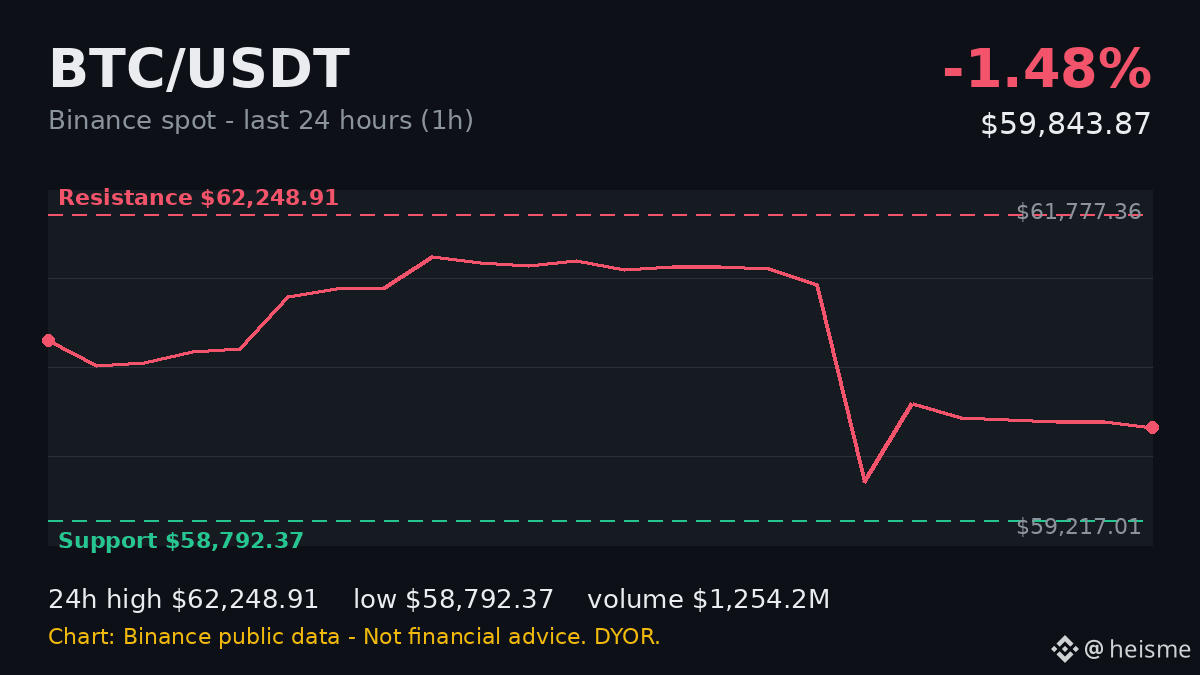
$5.39 billion walked out the door. That is how much US spot Bitcoin ETFs have bled in November — the worst month on record, according to SoSoValue data. And yet Bitcoin is fighting to hold $60,000.
So is this capitulation, or just the start of something worse?
JPMorgan thinks it is the former. Its analysts flagged signs of capitulation this week: Strategy's valuation against its Bitcoin holdings has sunk to a record low, and its mNAV measure fell to 0.88x before recovering to 0.94x. BlackRock's IBIT kept recording outflows even during Bitcoin's brief recovery, and the outflow pace is now faster than the May–June flush. Bitcoin is also trading below JPMorgan's estimated $86,000 production cost, squeezing higher-cost miners.
Meanwhile, CoinShares notes Bitcoin's daily RSI recently fell to around 17 — close to the levels seen around the 2022 trough and among the most oversold readings in Bitcoin's history. After dipping below $58,000 on a hotter-than-expected core PCE print, $BTC recovered toward $60,000 and was on course to end a seven-week losing streak, per CoinDesk.
My stance: cautiously constructive, not euphoric. Capitulation signals plus a historically oversold RSI say the sellers are exhausted, not that buyers have returned. ETF flows are still pointing the wrong way, and a close back below $58,000 would reopen the trapdoor. The Swiss debut of Europe's only active spot Bitcoin ETF (BBIT) shows long-term institutional plumbing is still being built — even as short-term money flees.
Watch next: whether ETF outflows slow, $BTC holds $58,000, and what the Fed signals on rates after that hot inflation print. $BNB and the wider market will follow Bitcoin's lead either way.
Do you think November's record outflows mark the bottom — or is there one more leg down?
#Bitcoin #CryptoMarket #ETF
Follow for daily market + macro breakdowns
Not financial advice. DYOR.

62
·
--
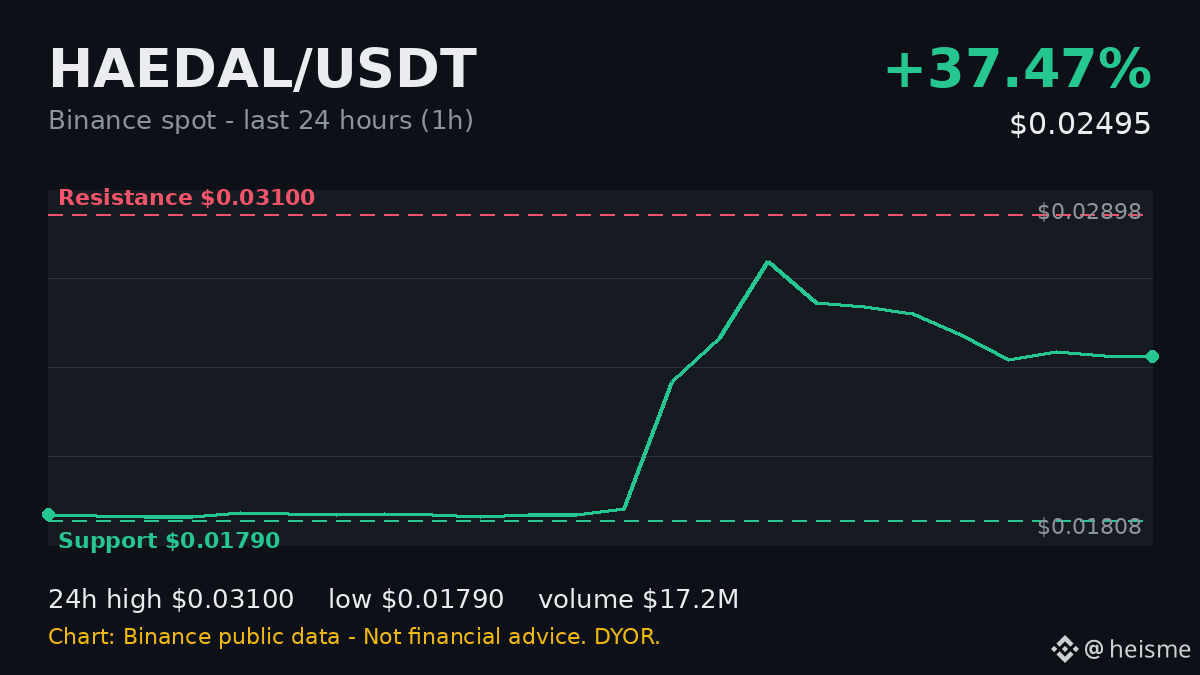
A single exchange listing just did what months of building couldn't — Haedal ($HAEDAL) is up 37% in 24 hours, and the move has a real trigger behind it.
Upbit, South Korea's largest exchange, opened HAEDAL/KRW trading today at 12:20 KST. Korean won pairs open a token to one of the most active retail markets in crypto, and the market reacted fast: HAEDAL spiked 50% to ~$0.028, and 24h spot volume on Binance jumped to $17.2M — roughly 4,800% above its recent daily average. It now trades near $0.025, range $0.0179–$0.031.
Haedal is a liquid staking protocol on Sui, and this wasn't purely a headline trade: the token is already up ~48% this week, so buyers were circling before the announcement.
My stance is cautious, not euphoric. A KRW listing is a genuine catalyst — real new demand and liquidity — which puts this in a different category from no-news pumps. But listing pumps fade fast once the first Korean buying wave is absorbed, and HAEDAL has an overhang: team releases of ~8.33M tokens a month start in late November, ~150M total through April 2028. New supply meeting fading hype has punished plenty of listing rallies.
Meanwhile $BTC is up just 1.27% at $61,578 and $BNB 1.97% at $563.93 — this is a coin-specific story, not a rising tide. Resistance is $0.031, support $0.0179. Holding the mid-$0.02s keeps the story alive; a slide toward $0.018 says the market has moved on.
Listings can change a token's trajectory — or just its Tuesday. Which one is this?
#HAEDAL #Upbit #Sui
Follow for daily market + macro breakdowns.
Not financial advice. DYOR.
A single exchange listing just did what months of building couldn't — Haedal ($HAEDAL ) is up 37% in 24 hours, and the move has a real trigger behind it.
Upbit, South Korea's largest exchange, opened HAEDAL/KRW trading today at 12:20 KST. Korean won pairs open a token to one of the most active retail markets in crypto, and the market reacted fast: HAEDAL spiked 50% to ~$0.028, and 24h spot volume on Binance jumped to $17.2M — roughly 4,800% above its recent daily average. It now trades near $0.025, range $0.0179–$0.031.
Haedal is a liquid staking protocol on Sui, and this wasn't purely a headline trade: the token is already up ~48% this week, so buyers were circling before the announcement.
My stance is cautious, not euphoric. A KRW listing is a genuine catalyst — real new demand and liquidity — which puts this in a different category from no-news pumps. But listing pumps fade fast once the first Korean buying wave is absorbed, and HAEDAL has an overhang: team releases of ~8.33M tokens a month start in late November, ~150M total through April 2028. New supply meeting fading hype has punished plenty of listing rallies.
Meanwhile $BTC is up just 1.27% at $61,578 and $BNB 1.97% at $563.93 — this is a coin-specific story, not a rising tide. Resistance is $0.031, support $0.0179. Holding the mid-$0.02s keeps the story alive; a slide toward $0.018 says the market has moved on.
Listings can change a token's trajectory — or just its Tuesday. Which one is this?
#HAEDAL #Upbit #Sui
Follow for daily market + macro breakdowns.
Not financial advice. DYOR.

103
·
--
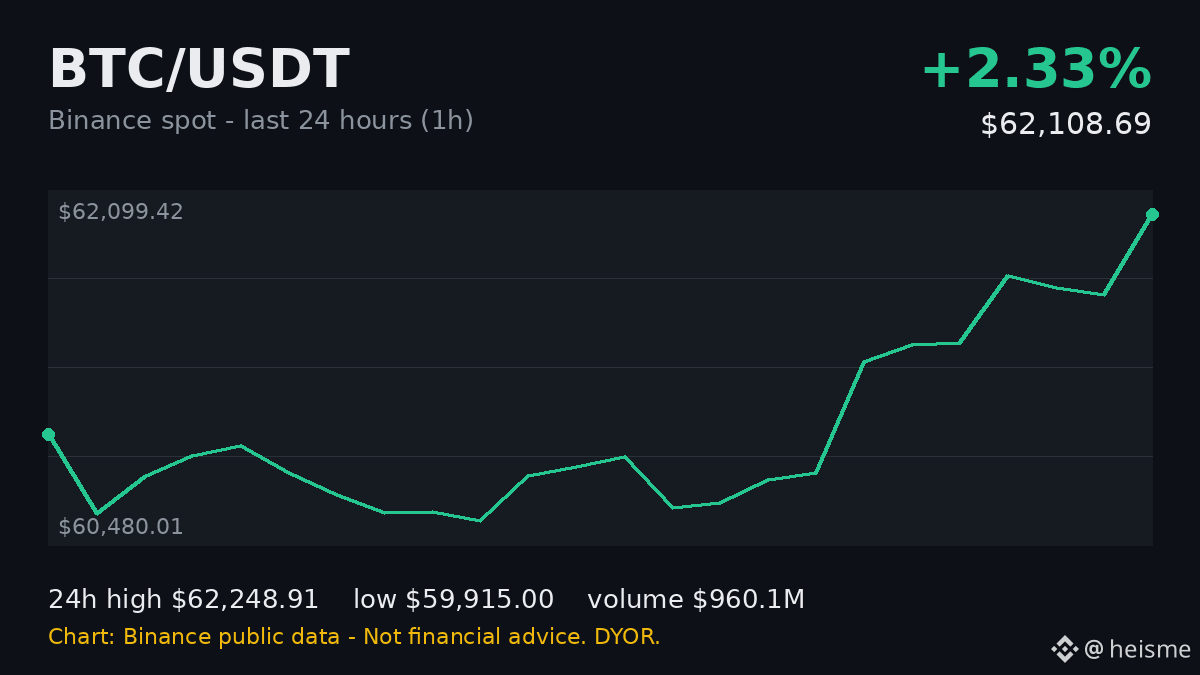
US spot Bitcoin ETFs just posted their worst month on record. According to CoinDesk, November net outflows reached $5.39 billion, beating the previous monthly record of $4.51 billion set in June and putting 2026 on track for the first calendar year of net outflows since the products launched in January 2024. The selling has been relentless: seven straight sessions of outflows, including $453 million on November 26 alone, according to The Defiant.
The trigger is macro. October core PCE inflation rose to 3.3% year on year, above the 3.2% expected, while third-quarter GDP was revised up to 4.3%. Traders now price a December Fed rate hike as the near-certain outcome, with CME FedWatch putting the odds close to 95%, according to ChainCatcher. Higher-for-longer rates have hit $BTC harder than stocks: Bitcoin is down about 25% since October 28, while the Nasdaq 100 has fallen roughly 10%.
$BTC is holding above $60,000 after rebounding from around $57,000, with the Fear and Greed Index at 12, deep in extreme fear. $BNB and the wider market are caught in the same risk-off mood, and stablecoin supply fell $14.75 billion in November, its steepest monthly drop since 2022, according to Crypto Briefing.
What to watch next: around $7.6 billion in $BTC and $ETH options expire today, and the FOMC blackout begins November 28. Whether ETF flows turn after the expiry will say a lot about the next leg.
Not financial advice. DYOR.
55
·
--
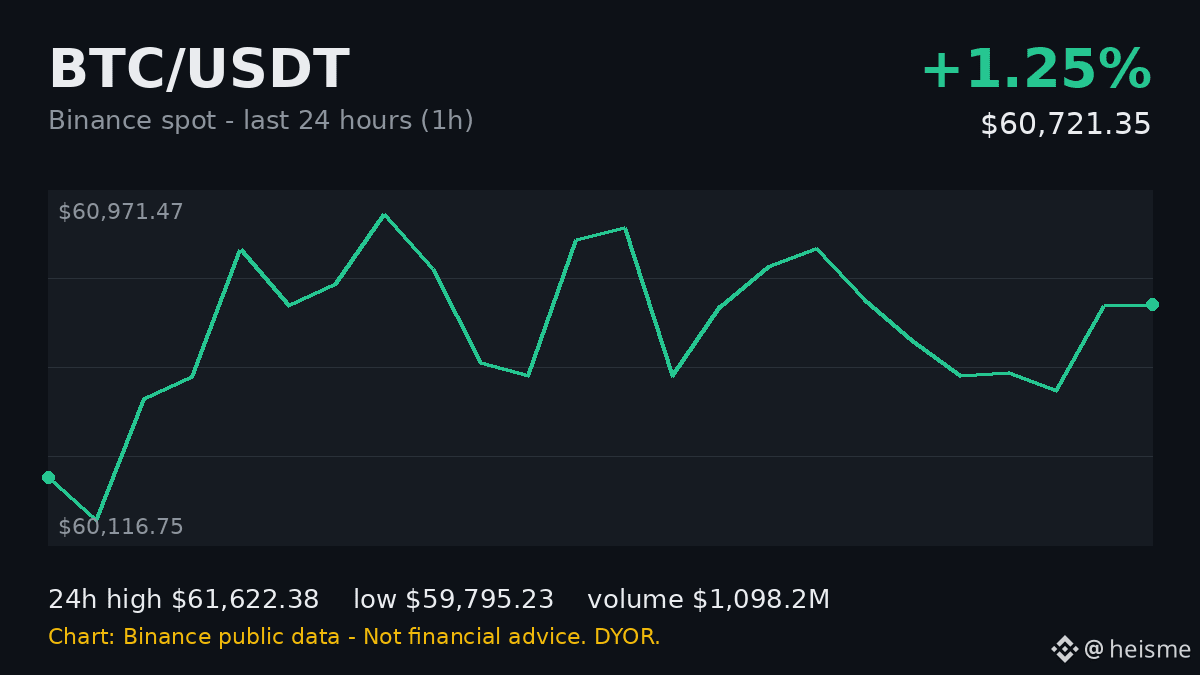
Washington just moved a step closer to putting America's Bitcoin reserve into law. According to CoinDesk, the House Financial Services Committee formally reported H.R. 8957, the American Reserve Modernization Act of 2026, on November 24, placing it on the House Union Calendar — which makes the bill eligible for a vote by the full House. The bill would direct the Treasury to set up a Strategic Bitcoin Reserve and a separate Digital Asset Stockpile within 180 days of becoming law, and it bars the government from selling, swapping or pledging reserve Bitcoin for at least 20 years.
That 20-year lock is the part that matters most for $BTC: it would turn the government's seized Bitcoin from a potential source of selling pressure into a long-term hold, tightening the effective supply story. The bill also covers other government-held crypto in a separate stockpile, so the wider market and $BNB are watching the same vote. But the clock is the catch: Congress ends on January 3, 2027, and no floor vote has been scheduled yet, while Polymarket traders give the reserve about a 4% chance of becoming law this year.
What to watch next: whether House leaders schedule a floor vote in December, and any signal from the Senate. The direction of travel is constructive for Bitcoin, but this is a long way from law.
Not financial advice. DYOR.
Washington just moved a step closer to putting America's Bitcoin reserve into law. According to CoinDesk, the House Financial Services Committee formally reported H.R. 8957, the American Reserve Modernization Act of 2026, on November 24, placing it on the House Union Calendar — which makes the bill eligible for a vote by the full House. The bill would direct the Treasury to set up a Strategic Bitcoin Reserve and a separate Digital Asset Stockpile within 180 days of becoming law, and it bars the government from selling, swapping or pledging reserve Bitcoin for at least 20 years.
That 20-year lock is the part that matters most for $BTC : it would turn the government's seized Bitcoin from a potential source of selling pressure into a long-term hold, tightening the effective supply story. The bill also covers other government-held crypto in a separate stockpile, so the wider market and $BNB are watching the same vote. But the clock is the catch: Congress ends on January 3, 2027, and no floor vote has been scheduled yet, while Polymarket traders give the reserve about a 4% chance of becoming law this year.
What to watch next: whether House leaders schedule a floor vote in December, and any signal from the Senate. The direction of travel is constructive for Bitcoin, but this is a long way from law.
Not financial advice. DYOR.
29
·
--
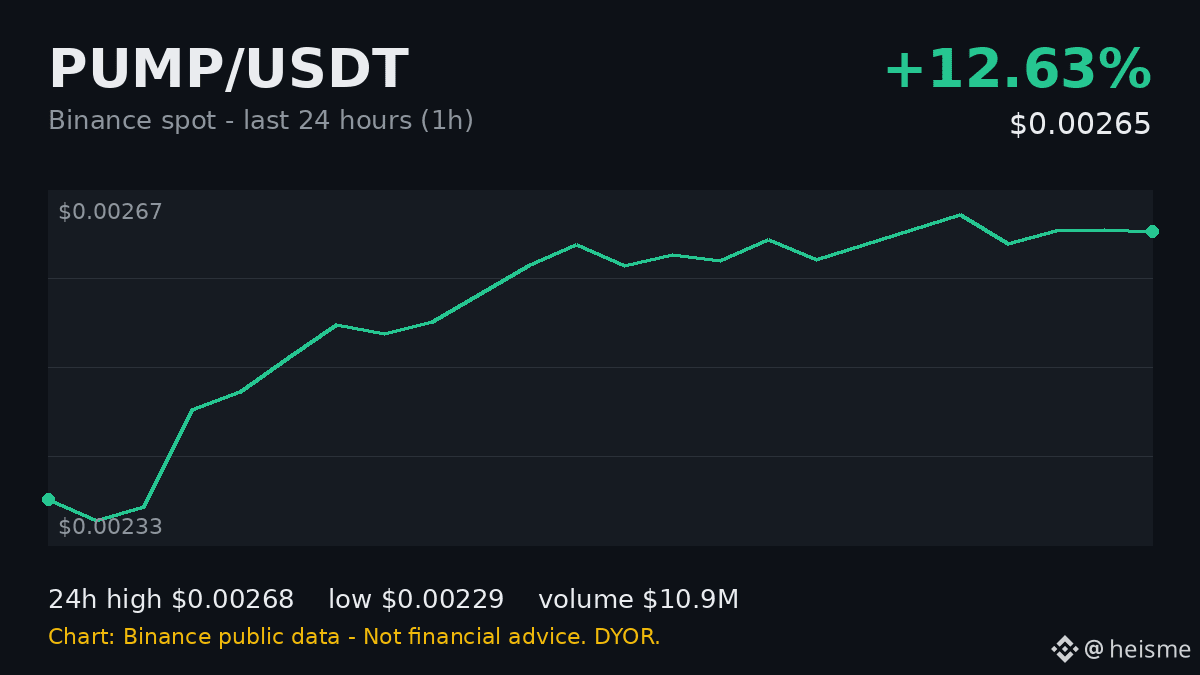
$PUMP is the standout mover among Binance's larger tokens today, climbing about 12.6% over the past 24 hours to trade near $0.00265, with roughly $11 million of spot volume behind the move. The token touched an intraday high of $0.00268 after dipping to $0.00229, and the bounce comes on a day when the wider market is also recovering.
Two things are giving traders something to talk about. OKX is running an X Drops campaign distributing 82 million PUMP tokens, worth around $200,000, until 30 November. Separately, Coinranking reports Pump.fun has burned about $370 million worth of repurchased PUMP — roughly 36% of the circulating supply — and committed half of its net revenue to further buybacks for a year.
The move fits the broader bounce: $BTC has reclaimed $60,000, rising about 3.6% after dipping to $57,300 on hot US inflation data, while $BNB is up about 2.4% to near $553. Even so, sentiment remains fragile — the Fear and Greed Index still reads 11, deep in extreme fear.
The risk side matters here. $PUMP is still down roughly 39% over the past 30 days and far below its September high near $0.009, so today's gain is a rebound inside a much larger downtrend. The $0.00268 intraday high is the near-term level to watch, with support near $0.00235. A token tied to memecoin launchpad activity can reverse fast, so size any exposure with that in mind.
Not financial advice. DYOR.
147
·
--
US inflation came in hotter than expected — and crypto felt it immediately. According to Reuters, the Bureau of Economic Analysis reported on Wednesday that the PCE price index, the Federal Reserve's preferred inflation gauge, rose 3.8% year on year in October, while core PCE climbed to 3.3%, above the 3.2% economists had expected. Markets now price a December rate hike as near-certain, with CME's FedWatch tool showing traders betting on a 25-basis-point move at the December 8-9 meeting, and another increase expected in January.
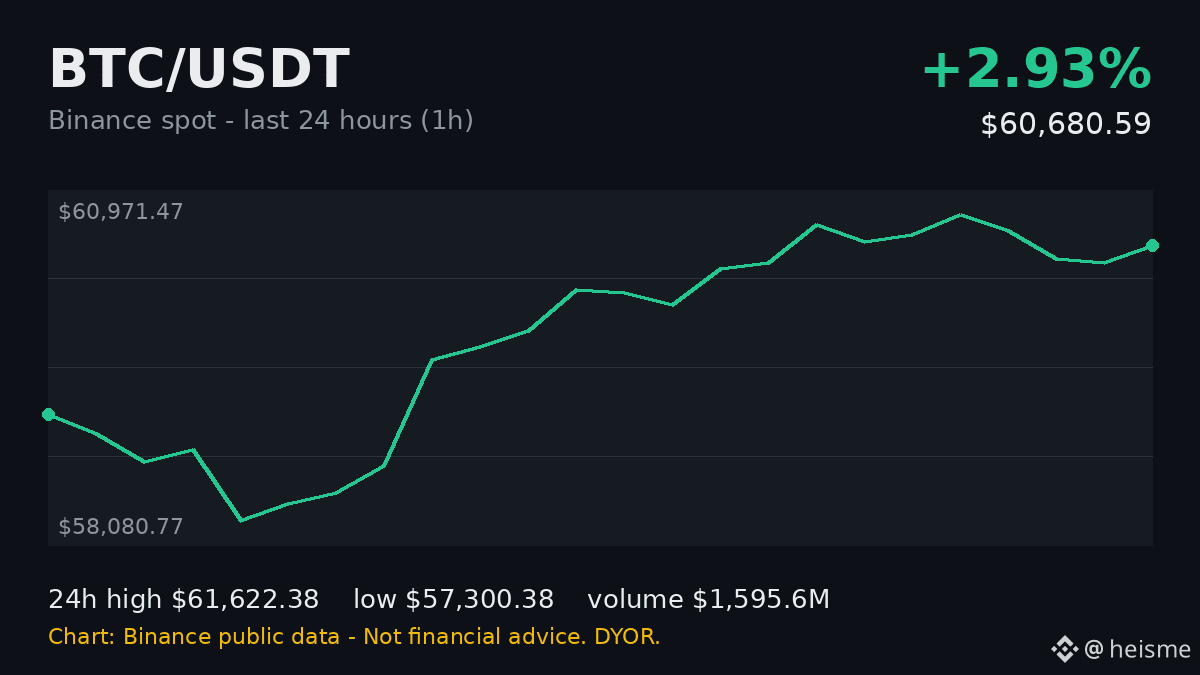
$BTC dropped below $58,000 on the news before recovering above $60,000, a reminder that rate-hike expectations hit risk assets fast. The pressure is already visible in flows: according to SoSoValue data cited by KuCoin, US spot Bitcoin ETFs have now logged six straight sessions of net outflows, taking November's total to roughly $4.94 billion — the largest monthly outflow since the products launched. $BNB and the wider market tracked Bitcoin's swing, with the Fear & Greed Index sitting at 11, deep in extreme fear territory.
What to watch next: the Fed's December 8-9 meeting and the tone of the press conference, the November 27 BTC monthly options expiry, and whether ETF outflows slow once the hike is priced in. A hawkish surprise could extend the pressure; a softer message could steady the market.
Not financial advice. DYOR.
61
·
--
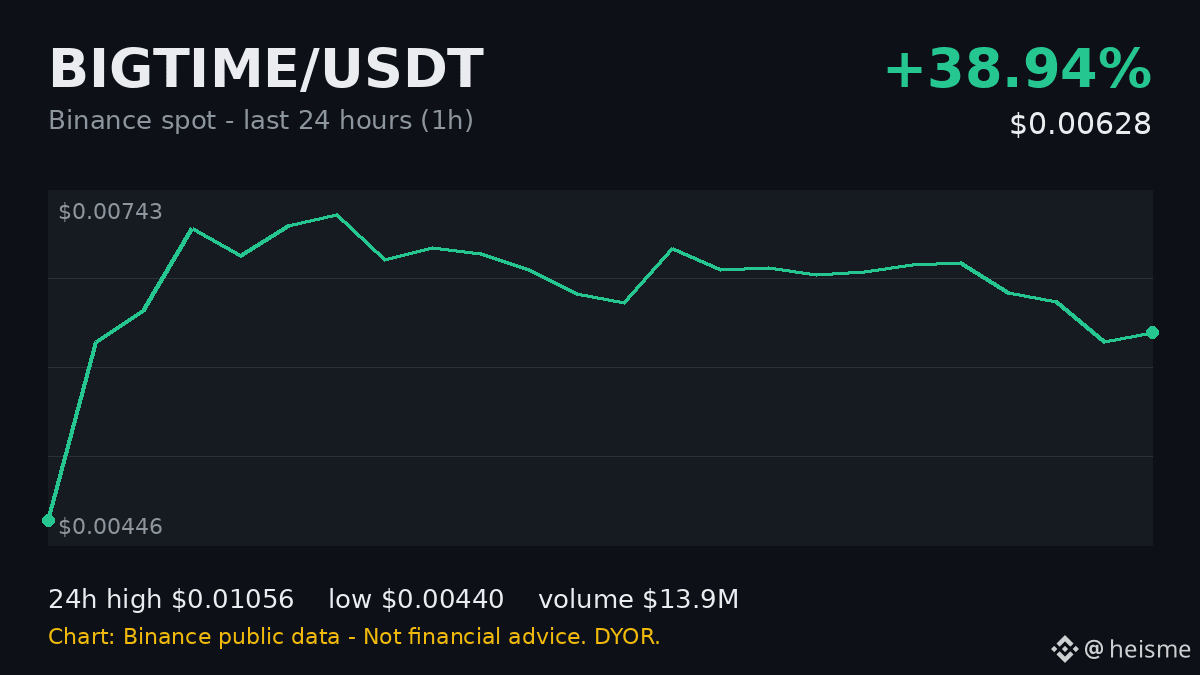
$BIGTIME is the standout mover of the past 24 hours, up around 39% to about $0.0063, far outpacing a broader market that is itself recovering — $BTC is up about 2.7% near $60,800 and $BNB is up around 3.2% near $558.
To be clear, there is no verified new announcement from the Big Time project behind this move. The rally looks flow-driven: the token bounced hard off an all-time low near $0.0038 set just days ago, short positions were squeezed as the price jumped, and trading volume surged many times above its recent daily average, with heavy activity on Korean exchange Upbit. That combination can push a thin token very fast in either direction.
The chart tells the same story. $BIGTIME spiked as high as about $0.0106 in the past day before pulling back to around $0.0063, so much of the day's gain has already been given back from the peak. The levels to watch are support near $0.0046 and resistance near $0.0073.
There is also a real supply risk ahead: around 600 million tokens — roughly a fifth of circulating supply — are reported to unlock around 30 November, with some reports putting the date at 3 December. If recipients sell into this market, that could add serious pressure.
A sharp bounce off the lows is not the same as a trend change, and with a big unlock days away, this one deserves caution rather than chasing.
Not financial advice. DYOR.
402
·
--
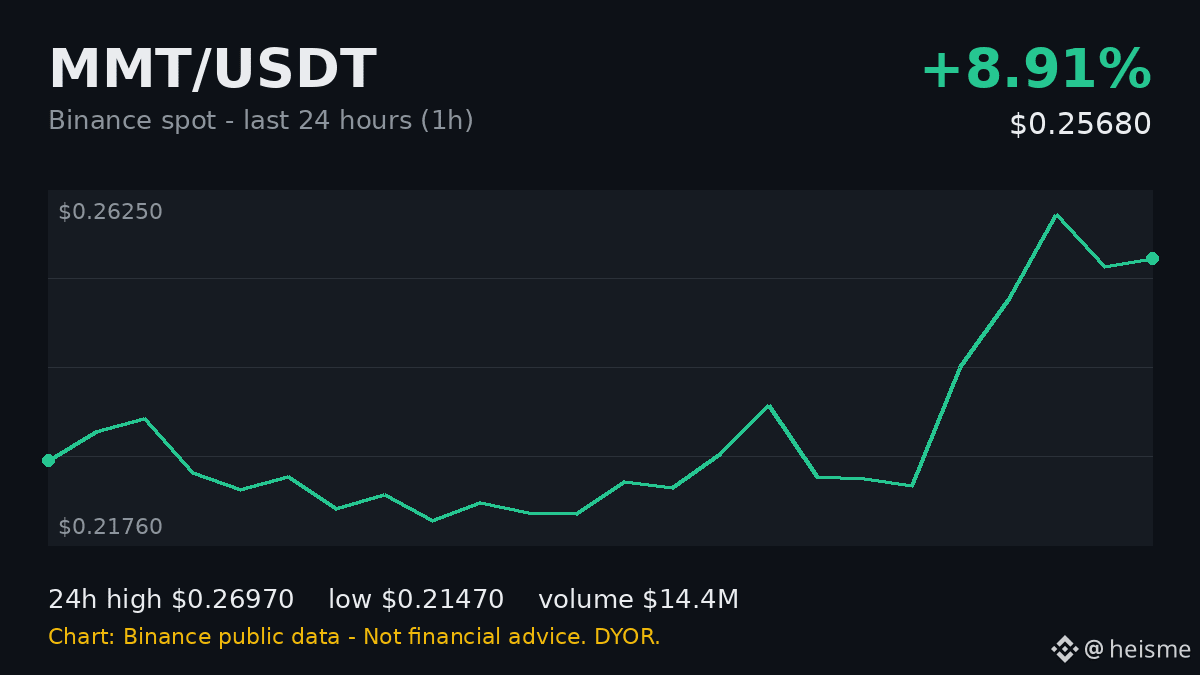
Momentum ($MMT) is the day's outlier on Binance, up around 8.9% in 24 hours to roughly $0.256 while most of the market is in the red. Spot volume of about $14.4 million is modest by majors' standards but meaningful for a token of this size, and the move came against a weak tape: $BTC is down about 3% and trading under $60,000 near $59,100, while $BNB is down roughly 2%.
What stands out is the divergence. $MMT has traded in a wide $0.215 to $0.270 band over the past day, and the week's pattern has been choppy rather than one clean trend — the token fell sharply on 23 November before recovering. No verified announcement explains today's buying; market commentary describes it as coin-specific flow rather than a response to a project update, so the honest read is momentum-driven interest, not a catalyst trade.
That matters for risk. A token up roughly 55% in a week that can drop double digits in a day can reverse just as fast, especially with the broader market in extreme fear and US PCE inflation data due today, an event already moving $BTC and risk assets. Anyone watching $MMT should weigh the divergence against that backdrop and size any interest accordingly.
Not financial advice. DYOR.
Momentum ($MMT ) is the day's outlier on Binance, up around 8.9% in 24 hours to roughly $0.256 while most of the market is in the red. Spot volume of about $14.4 million is modest by majors' standards but meaningful for a token of this size, and the move came against a weak tape: $BTC is down about 3% and trading under $60,000 near $59,100, while $BNB is down roughly 2%.
What stands out is the divergence. $MMT has traded in a wide $0.215 to $0.270 band over the past day, and the week's pattern has been choppy rather than one clean trend — the token fell sharply on 23 November before recovering. No verified announcement explains today's buying; market commentary describes it as coin-specific flow rather than a response to a project update, so the honest read is momentum-driven interest, not a catalyst trade.
That matters for risk. A token up roughly 55% in a week that can drop double digits in a day can reverse just as fast, especially with the broader market in extreme fear and US PCE inflation data due today, an event already moving $BTC and risk assets. Anyone watching $MMT should weigh the divergence against that backdrop and size any interest accordingly.
Not financial advice. DYOR.
220
·
--
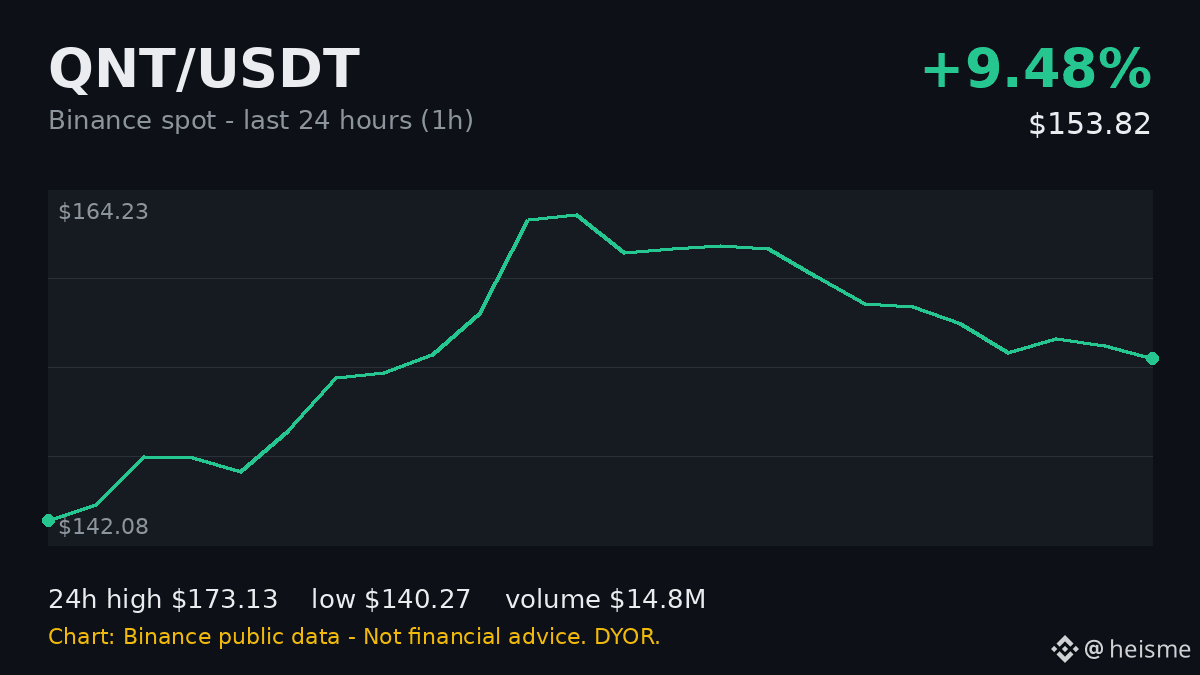
Quant's $QNT is the day's standout among large caps, up around 9% in 24 hours to near $154 after bouncing from a low near $140, with 24-hour spot volume above $14 million. The move looks technical rather than news-driven: the token broke back above the $144–$147 area that traders had been watching after sliding to about $127 on 21 November, and it is now testing the $157 zone, with the 24-hour high near $173 as the next reference point. On-chain data adds some colour: exchange balances have fallen to a yearly low while holder numbers keep climbing, which suggests fewer coins are sitting on exchanges ready to sell.
The background story is familiar rather than new. Quant's interoperability tech was picked by The Clearing House in September for its tokenised-deposit network, due to open to institutions in the first half of 2027, and UK banks in the tokenised-deposit pilots run on a platform Quant built. That narrative is being recycled as the price recovers, not confirmed by a fresh announcement.
The wider market is not helping much: $BTC is hovering near $60,000, still down sharply on the month, and $BNB is flat to slightly lower. A rebound that runs on technicals and a recycled story can fade fast if Bitcoin slips again, and $QNT remains well below its late-October highs near $224. Watch whether the $147–$150 area holds on any pullback.
Not financial advice. DYOR.
177
Log in to explore more content
Join global crypto users on Binance Square
⚡️ Get latest and useful information about crypto.
💬 Trusted by the world’s largest crypto exchange.
👍 Discover real insights from verified creators.
Email / Phone number
Trending Topics
EvolveAtBinanceBlockchainWeek
1.5M views
16,209 Discussing
Binance Blockchain Week is officially underway! 🌍
On November 28–29, whether you’re in Bangkok or joining from afar, tune in to the livestreams and join the conversation on Binance Square!
Here’s what’s in store 👇
📺 Watch the main stage live
Tune in throughout both days as industry speakers share their perspectives on this year’s theme, “Evolve” From technological innovation to real-world applications, explore what’s next for crypto.
⚔️ Watch two trading competitions
The Aster Open Qualifier and the Binance Trading Master Tournament will both be streamed live. Tune in to follow the traders in action.
🏆 Watch The Blockchain 100 Awards Ceremony
The Blockchain 100 list was selected by the community. Join us in celebrating the creators and the ideas they share!
💬 Join the community conversation
Use #EvolveAtBinanceBlockchainWeek in a post with a photo to share what you’re looking forward to, your views on the industry, or your favorite moments from the event.
The event page is now live! Subscribe to all livestreams with one click so you don’t miss a moment 👏
Binance Blockchain Week
·328 Likes
·286.1k views
ChainflipVaultTheftHaltsProtocol
8,336 views
159 Discussing
VitalikWantsWalletChipDesignsOpened
15,933 views
268 Discussing