

HammadAli2148
7.7k Posts

HammadAli2148
Report
Block User
Like, comment &share my post_let's grow together X Twitter Account: @HammadAli812945
Open Trade
Frequent Trader
2.1 Years
760 Following
17.1K+ Followers
13.2K+ Liked
Posts
Portfolio
All
Quotes
Live
Verified
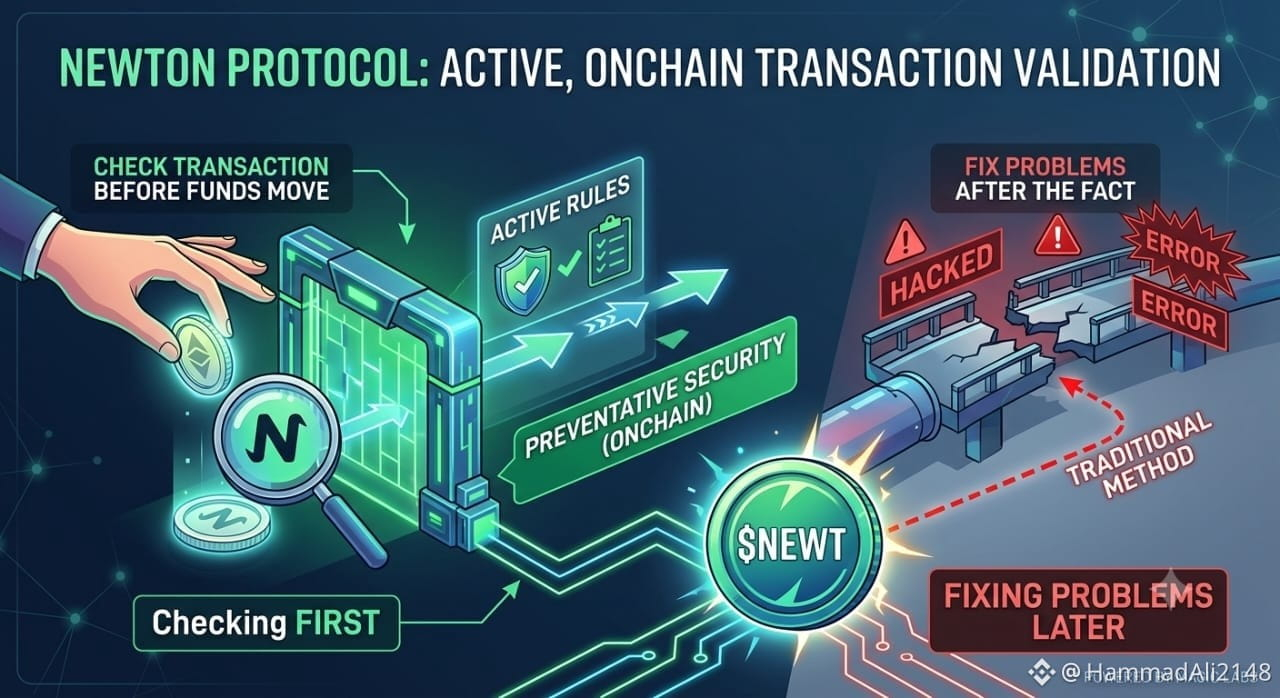
Many people think blockchain security starts after a transaction is finished. @NewtonProtocol is trying a different idea. It checks a transaction before your funds move. If the transaction follows the active rules, it goes through. If not, it can be stopped before it is completed.
The Newton Mainnet Beta is now live, and I like this simple approach. It helps DeFi vaults apply their own rules directly onchain instead of only checking what already happened. The Newton Vault SDK also brings compliance, identity, security, and risk checks together in one place, making the process easier for builders.
Magic Labs, the team behind Newton Protocol, has already helped power millions of wallets and supports a huge developer community. That gives me confidence as the network grows beyond DeFi into areas like stablecoins, RWAs, and AI agents.
I believe systems that check first instead of fixing problems later can make Web3 safer for everyone. $NEWT is the token that powers this growing ecosystem.
What feature of Newton Protocol interests you the most? #Newt
#newt $NEWT
{future}(NEWTUSDT)
Many people think blockchain security starts after a transaction is finished. @NewtonProtocol is trying a different idea. It checks a transaction before your funds move. If the transaction follows the active rules, it goes through. If not, it can be stopped before it is completed.
The Newton Mainnet Beta is now live, and I like this simple approach. It helps DeFi vaults apply their own rules directly onchain instead of only checking what already happened. The Newton Vault SDK also brings compliance, identity, security, and risk checks together in one place, making the process easier for builders.
Magic Labs, the team behind Newton Protocol, has already helped power millions of wallets and supports a huge developer community. That gives me confidence as the network grows beyond DeFi into areas like stablecoins, RWAs, and AI agents.
I believe systems that check first instead of fixing problems later can make Web3 safer for everyone. $NEWT is the token that powers this growing ecosystem.
What feature of Newton Protocol interests you the most? #Newt
#newt $NEWT
The Newton Mainnet Beta is now live, and I like this simple approach. It helps DeFi vaults apply their own rules directly onchain instead of only checking what already happened. The Newton Vault SDK also brings compliance, identity, security, and risk checks together in one place, making the process easier for builders.
Magic Labs, the team behind Newton Protocol, has already helped power millions of wallets and supports a huge developer community. That gives me confidence as the network grows beyond DeFi into areas like stablecoins, RWAs, and AI agents.
I believe systems that check first instead of fixing problems later can make Web3 safer for everyone. $NEWT is the token that powers this growing ecosystem.
What feature of Newton Protocol interests you the most? #Newt
#newt $NEWT
5
2
144
⚽🔥 Football fever is here! Who’s your pick to dominate the pitch and lift the trophy? Every match brings excitement, surprises, and unforgettable moments. Share your predictions, support your favorite team, and join the action!
🏆 My prediction: We’ll see some major upsets and plenty of goals this tournament!
Who are you backing to win it all? 👇
#BinancePickAndWin #Football #WorldCup2026 #Soccer #MatchPrediction #FootballFans #Champion #SportsCommunity ⚽🏆🔥
⚽🔥 Football fever is here! Who’s your pick to dominate the pitch and lift the trophy? Every match brings excitement, surprises, and unforgettable moments. Share your predictions, support your favorite team, and join the action!
🏆 My prediction: We’ll see some major upsets and plenty of goals this tournament!
Who are you backing to win it all? 👇
#BinancePickAndWin #Football #WorldCup2026 #Soccer #MatchPrediction #FootballFans #Champion #SportsCommunity ⚽🏆🔥
🏆 My prediction: We’ll see some major upsets and plenty of goals this tournament!
Who are you backing to win it all? 👇
#BinancePickAndWin #Football #WorldCup2026 #Soccer #MatchPrediction #FootballFans #Champion #SportsCommunity ⚽🏆🔥
79
⚽🏆 Football fever is here! The road to World Cup 2026 has begun, and every match brings excitement, passion, and unforgettable moments. Who do you think will lift the trophy and become the next world champion? 🌍🔥
I'm backing my favorite team and making my predictions with #BinancePickAndWin. Join the fun, share your picks, and let's enjoy the beautiful game together! ⚽🎉
#Football #WorldCup2026 #BinancePickAndWin #SoccerFans #FootballPrediction
⚽🏆 Football fever is here! The road to World Cup 2026 has begun, and every match brings excitement, passion, and unforgettable moments. Who do you think will lift the trophy and become the next world champion? 🌍🔥
I'm backing my favorite team and making my predictions with #BinancePickAndWin. Join the fun, share your picks, and let's enjoy the beautiful game together! ⚽🎉
#Football #WorldCup2026 #BinancePickAndWin #SoccerFans #FootballPrediction
I'm backing my favorite team and making my predictions with #BinancePickAndWin. Join the fun, share your picks, and let's enjoy the beautiful game together! ⚽🎉
#Football #WorldCup2026 #BinancePickAndWin #SoccerFans #FootballPrediction
1
203
BNB.build has gathered all the Binance Square red envelopes, updated in real-time. 200 red envelopes every day!
BNB.build has gathered all the Binance Square red envelopes, updated in real-time. 200 red envelopes every day!
85
Yesterday, I had a pretty good run on BNB.build. This platform syncs all the bonuses from Binance Square in real-time. By the end of the day, I snagged 139 of them, which was really awesome.
Yesterday, I had a pretty good run on BNB.build. This platform syncs all the bonuses from Binance Square in real-time. By the end of the day, I snagged 139 of them, which was really awesome.
1
85
Just found this bnb.build thing, even the red envelopes in the square can be snagged.
Just found this bnb.build thing, even the red envelopes in the square can be snagged.
155
🎉🧧 GIVEAWAY TIME FOR OUR AMAZING COMMUNITY! 🧧🎉
Thank you for all your incredible support! It's time to give back with a special giveaway. 🚀
How to join: ✅ Follow us ✅ Share this post ✅ Comment “Good Luck!”
🎁 Winners will be selected randomly.
Best of luck to everyone! 🍀🧧
🎉🧧 GIVEAWAY TIME FOR OUR AMAZING COMMUNITY! 🧧🎉
Thank you for all your incredible support! It's time to give back with a special giveaway. 🚀
How to join: ✅ Follow us ✅ Share this post ✅ Comment “Good Luck!”
🎁 Winners will be selected randomly.
Best of luck to everyone! 🍀🧧
Thank you for all your incredible support! It's time to give back with a special giveaway. 🚀
How to join: ✅ Follow us ✅ Share this post ✅ Comment “Good Luck!”
🎁 Winners will be selected randomly.
Best of luck to everyone! 🍀🧧
35
1
206
⚽🔥 Football fever is here! The road to glory begins as teams battle for the biggest prize in world football. Who will lift the trophy and make history? 🏆
My prediction: Passion, drama, unforgettable goals, and plenty of surprises await fans around the globe! 🌍⚽
Who are you supporting this World Cup? 👇
#WorldCup2026 #football
#BinancePickAndWin
$BTC
{future}(BTCUSDT)
$BNB
{future}(BNBUSDT)
$ETH
{future}(ETHUSDT)
⚽🔥 Football fever is here! The road to glory begins as teams battle for the biggest prize in world football. Who will lift the trophy and make history? 🏆
My prediction: Passion, drama, unforgettable goals, and plenty of surprises await fans around the globe! 🌍⚽
Who are you supporting this World Cup? 👇
#WorldCup2026 #football
#BinancePickAndWin
$BTC
$BNB
$ETH
My prediction: Passion, drama, unforgettable goals, and plenty of surprises await fans around the globe! 🌍⚽
Who are you supporting this World Cup? 👇
#WorldCup2026 #football
#BinancePickAndWin
$BTC
$BNB
$ETH

81
Excited for the 2026 World Cup Group Stage!
[Click here For join](https://www.binance.com/activity/pick-and-win/2026-football-challenge?ref=986862068)
Just made my picks in the Binance Football Challenge 🔥
Mexico vs South Africa: I’m going Under 2.5 goals (NO on 3+ goals)
Korea Republic vs Czechia: YES on at least one clean sheet
These openers are usually cagey and tactical. Who else is playing the challenge? Let’s chase those BNB rewards together!
#BinancePickAndWin
#BinancePickAndWin
Excited for the 2026 World Cup Group Stage!
Click here For join
Just made my picks in the Binance Football Challenge 🔥
Mexico vs South Africa: I’m going Under 2.5 goals (NO on 3+ goals)
Korea Republic vs Czechia: YES on at least one clean sheet
These openers are usually cagey and tactical. Who else is playing the challenge? Let’s chase those BNB rewards together!
#BinancePickAndWin
#BinancePickAndWin
Click here For join
Just made my picks in the Binance Football Challenge 🔥
Mexico vs South Africa: I’m going Under 2.5 goals (NO on 3+ goals)
Korea Republic vs Czechia: YES on at least one clean sheet
These openers are usually cagey and tactical. Who else is playing the challenge? Let’s chase those BNB rewards together!
#BinancePickAndWin
#BinancePickAndWin

1
237
Binance 20,000$ RedPacket
✅Quiz Link :- [Click here](https://www.binance.com/en/survey/6ad98352d85747b49f07b11517046a3e)
Answer:-
1- yes
2- mena
3- The first real purchase using Bitcoin
4- Laszlo Hanyecz
5- 2 pizzas
Binance 20,000$ RedPacket
✅Quiz Link :- Click here
Answer:-
1- yes
2- mena
3- The first real purchase using Bitcoin
4- Laszlo Hanyecz
5- 2 pizzas
✅Quiz Link :- Click here
Answer:-
1- yes
2- mena
3- The first real purchase using Bitcoin
4- Laszlo Hanyecz
5- 2 pizzas

4
529
Three tokens everyone on BNB Chain is watching right now 👇
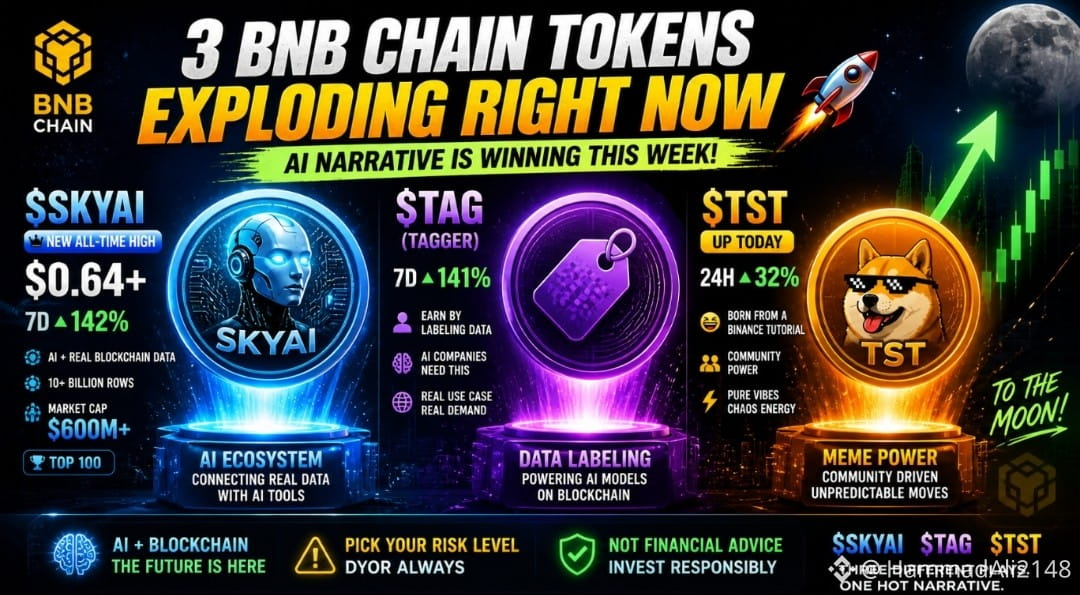
$SKYAI just hit a new all-time high near $0.52 and is up 142% in 7 days. It's an AI ecosystem that connects real blockchain data — over 10 billion rows — with AI tools. The market cap is already past $440M and it's sitting in the top 100. This one has real tech behind it.
$TAG (Tagger) is another AI gem quietly exploding — up 141% in 7 days too. It basically lets people earn by labeling data that AI companies need to train their models. Think of it like gig work but on blockchain. Real use case, real demand.
$TST — the accidental token born from a Binance tutorial video — is bouncing again today, up 32% in 24 hours. No deep story here, just pure community vibes and chaos energy 😅
AI narrative is clearly winning this week. SKYAI and TAG have actual products. TST has meme power.
Pick your risk level — but all three are moving.
DYOR always. Not financial advice.
#BTCSurpasses$80K #TrumpUnveilsPlanToEscortHormuzShips #EthereumFoundationSellsETHtoBitmineAgain
{future}(SKYAIUSDT)
{future}(TAGUSDT)
{future}(TSTUSDT)
Three tokens everyone on BNB Chain is watching right now 👇
$SKYAI just hit a new all-time high near $0.52 and is up 142% in 7 days. It's an AI ecosystem that connects real blockchain data — over 10 billion rows — with AI tools. The market cap is already past $440M and it's sitting in the top 100. This one has real tech behind it.
$TAG (Tagger) is another AI gem quietly exploding — up 141% in 7 days too. It basically lets people earn by labeling data that AI companies need to train their models. Think of it like gig work but on blockchain. Real use case, real demand.
$TST — the accidental token born from a Binance tutorial video — is bouncing again today, up 32% in 24 hours. No deep story here, just pure community vibes and chaos energy 😅
AI narrative is clearly winning this week. SKYAI and TAG have actual products. TST has meme power.
Pick your risk level — but all three are moving.
DYOR always. Not financial advice.
#BTCSurpasses$80K #TrumpUnveilsPlanToEscortHormuzShips #EthereumFoundationSellsETHtoBitmineAgain
$SKYAI just hit a new all-time high near $0.52 and is up 142% in 7 days. It's an AI ecosystem that connects real blockchain data — over 10 billion rows — with AI tools. The market cap is already past $440M and it's sitting in the top 100. This one has real tech behind it.
$TAG (Tagger) is another AI gem quietly exploding — up 141% in 7 days too. It basically lets people earn by labeling data that AI companies need to train their models. Think of it like gig work but on blockchain. Real use case, real demand.
$TST — the accidental token born from a Binance tutorial video — is bouncing again today, up 32% in 24 hours. No deep story here, just pure community vibes and chaos energy 😅
AI narrative is clearly winning this week. SKYAI and TAG have actual products. TST has meme power.
Pick your risk level — but all three are moving.
DYOR always. Not financial advice.
#BTCSurpasses$80K #TrumpUnveilsPlanToEscortHormuzShips #EthereumFoundationSellsETHtoBitmineAgain
2
566
Article
Three Tokens You Might Be Sleeping On Right Now — $SKYAI, $NAORIS, and $TACOkay so real talk — the crypto market right now feels like that moment before a storm where everything goes quiet. Bitcoin is doing its thing, and everyone's staring at the big charts. But while all that happens, a few smaller tokens are quietly making serious moves. I've been watching three of them closely this week and I want to break them down for you in plain language — no fluff, no rocket emojis every three words, just what's actually going on.
Let's get into it.
$SKYAI — The AI Token That Woke Up From the Dead
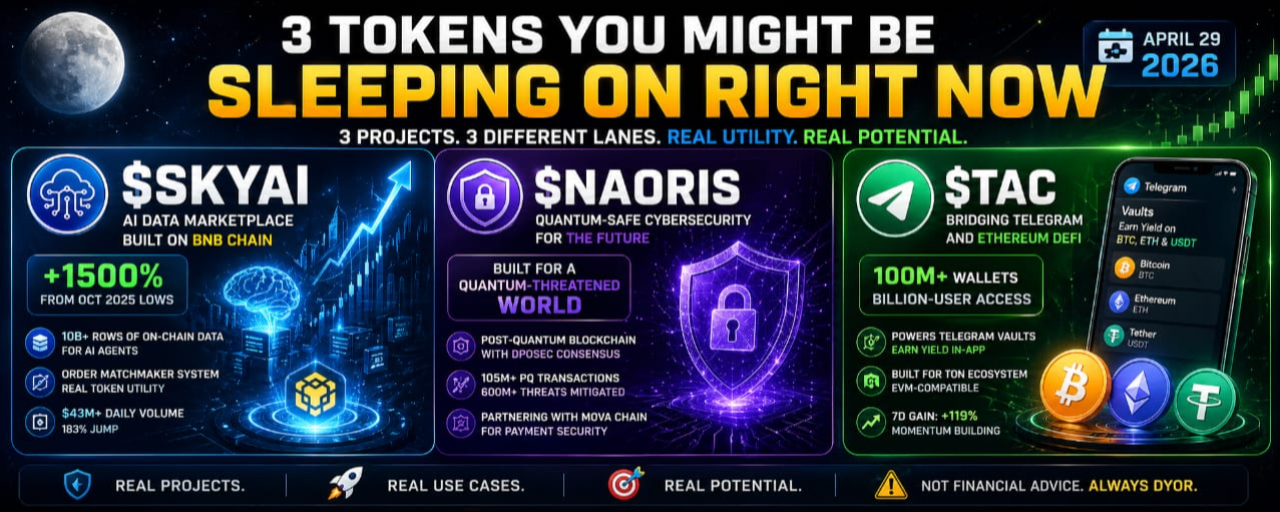
If you told me last October that a token sitting at $0.01 would climb all the way past $0.25 by April 2026, I'd have laughed. But that's exactly what SKYAI did. Back in October 2025, SKYAI was trading at just $0.014. Fast forward to late April 2026, and it hit over $0.25, which means anyone who held through that dark period made over 1,500% on their money. (Blockchain Magazine)
But here's what I think is more interesting than the price — what does SKYAI actually do?
SKYAI is basically an all-in-one AI system built on a protocol called MCP — Model Context Protocol. What it does is create a special data service that AI systems (called LLMs or Large Language Models) can actually use to read live blockchain data. It supports data from BNB Chain and Solana, and we're talking over 10 billion rows of on-chain information that AI agents can plug into. (CoinMarketCap)
Think of it like this — imagine you have a really smart assistant, but it can't see anything happening on the blockchain. SKYAI gives that assistant eyes. It can check token prices, track wallets, read transactions — all in real time. And there's a marketplace being built where people can rent out their data services and earn SKYAI tokens for doing it.
The team is also building something called an Order Matchmaker system — a decentralized marketplace where people post service requests with rewards, and developers can match and earn SKYAI tokens by fulfilling those requests. This is real token utility, not just hype. (CoinMarketCap)
The trading volume has been wild — over $43 million in a single day recently, which is a 183% jump from the day before. That kind of volume doesn't happen by accident. (CoinGecko)
One thing to keep in mind though — this token has also crashed 33% in a single day before. Back in April, it dropped hard and fast, with major selling pressure concentrated in a short time window, likely from large holders taking profits. (Blockchain Magazine) So it's not for the faint hearted. But the project itself has real legs if the AI narrative stays hot.
$NAORIS — The Token Built for a World Where Hackers Have Quantum Computers
This one is a bit different. While SKYAI is riding the AI wave, NAORIS is playing in the cybersecurity lane — specifically, protecting us from quantum computer attacks. That sounds very sci-fi but it's becoming a real concern that governments and big companies are already spending money to solve.
Naoris Protocol is built on its own post-quantum blockchain and uses something called a dPoSec consensus mechanism — basically a way of validating data that's designed to be secure even if quantum computers try to break it. It's built to protect Web2 systems (like normal company websites and apps) and Web3 (crypto apps) at the same time. (CoinMarketCap)
Here's why this matters: quantum computers, when they get powerful enough, can break the kind of encryption that currently protects your bank account, your emails, and your crypto wallet. Nvidia's CEO Jensen Huang has already warned this could be a real problem by 2028-2029. The US government has set a 2030 deadline for agencies to start migrating to quantum-resistant security. (CoinMarketCap) Naoris wants to be the solution that companies and governments use.
The token launched on Binance Alpha and perps trading pairs back in July 2025, and the team has been processing over 105 million post-quantum transactions and mitigating over 600 million threats on the testnet. (CoinMarketCap) That's not small numbers.
They're also working with Mova Chain to integrate Naoris' security layer directly into payment systems — think card transactions and financial settlement infrastructure becoming quantum-safe. (CoinMarketCap)
The price right now is around $0.065-$0.087 depending on where you check, sitting well below its all-time high of $0.15. The fully diluted valuation is around $265 million, but the current circulating market cap is much smaller at around $40 million (CoinGecko) — which means there's still a lot of supply to unlock over time. Something to factor in before jumping in.
But the narrative here is strong and honestly underappreciated. Security is boring until something gets hacked. Then everyone wants a piece of it.
$TAC — The Quiet Bridge Between Telegram and DeFi
Okay and this one might be the sneakiest of the three. TAC is building a bridge between the world of Ethereum apps and Telegram's massive user base. And I mean massive — TAC is the first EVM-compatible blockchain built specifically for the TON ecosystem and Telegram. With over 100 million wallets on TON and direct access to Telegram's billion-user base, they're not starting from zero like most blockchains do. The users are already there. (CoinMarketCap)
By February 2026, TAC was already powering the backend of Telegram's new self-custodial "Vaults" feature, which lets regular Telegram users earn yield on Bitcoin, Ethereum, and USDT directly inside the Telegram app — without needing to set up a separate wallet or use a different app. (CoinMarketCap)
That's genuinely huge. Most DeFi projects spend years trying to get people to download a wallet, learn how to use a bridge, understand gas fees... TAC just gave all of that to people inside an app they already check 20 times a day.
The Telegram Vaults feature is powered by TAC infrastructure, with lending protocol Morpho and strategy provider Re7 also involved — and it makes DeFi accessible to people who would have never touched it otherwise. (CoinMarketCap)
The token is trading around $0.014-$0.015 right now with a market cap of roughly $40-45 million. It's had a rough stretch after its launch highs, but the 7-day gain has been over 119% recently, showing the market is starting to pay attention again. (CoinGecko)
So What's the Takeaway?
These three tokens are all in different lanes. SKYAI is riding the AI infrastructure trend. NAORIS is betting on the future of cybersecurity. TAC is quietly building the entry point for a billion Telegram users into DeFi.
None of them are "safe" investments. Crypto never is. But all three have a real story behind them, not just hype. And right now, that's rarer than you'd think.
Do your own research, don't put in money you can't afford to lose, and watch how these projects develop over the next few months. The ones that survive the boring parts usually win.
Not financial advice. Always DYOR. Stay safe out there
#BTCDropsBelow$77K #BhutanTransfers102BTC #AftermathFinanceBreach #PolymarketDeniesDataBreach #BinanceLaunchesGoldvs.BTCTradingCompetition
{future}(SKYAIUSDT)
{future}(NAORISUSDT)
{future}(TACUSDT)
Three Tokens You Might Be Sleeping On Right Now — $SKYAI, $NAORIS, and $TAC
Okay so real talk — the crypto market right now feels like that moment before a storm where everything goes quiet. Bitcoin is doing its thing, and everyone's staring at the big charts. But while all that happens, a few smaller tokens are quietly making serious moves. I've been watching three of them closely this week and I want to break them down for you in plain language — no fluff, no rocket emojis every three words, just what's actually going on.
Let's get into it.
$SKYAI — The AI Token That Woke Up From the Dead
If you told me last October that a token sitting at $0.01 would climb all the way past $0.25 by April 2026, I'd have laughed. But that's exactly what SKYAI did. Back in October 2025, SKYAI was trading at just $0.014. Fast forward to late April 2026, and it hit over $0.25, which means anyone who held through that dark period made over 1,500% on their money. (Blockchain Magazine)
But here's what I think is more interesting than the price — what does SKYAI actually do?
SKYAI is basically an all-in-one AI system built on a protocol called MCP — Model Context Protocol. What it does is create a special data service that AI systems (called LLMs or Large Language Models) can actually use to read live blockchain data. It supports data from BNB Chain and Solana, and we're talking over 10 billion rows of on-chain information that AI agents can plug into. (CoinMarketCap)
Think of it like this — imagine you have a really smart assistant, but it can't see anything happening on the blockchain. SKYAI gives that assistant eyes. It can check token prices, track wallets, read transactions — all in real time. And there's a marketplace being built where people can rent out their data services and earn SKYAI tokens for doing it.
The team is also building something called an Order Matchmaker system — a decentralized marketplace where people post service requests with rewards, and developers can match and earn SKYAI tokens by fulfilling those requests. This is real token utility, not just hype. (CoinMarketCap)
The trading volume has been wild — over $43 million in a single day recently, which is a 183% jump from the day before. That kind of volume doesn't happen by accident. (CoinGecko)
One thing to keep in mind though — this token has also crashed 33% in a single day before. Back in April, it dropped hard and fast, with major selling pressure concentrated in a short time window, likely from large holders taking profits. (Blockchain Magazine) So it's not for the faint hearted. But the project itself has real legs if the AI narrative stays hot.
$NAORIS — The Token Built for a World Where Hackers Have Quantum Computers
This one is a bit different. While SKYAI is riding the AI wave, NAORIS is playing in the cybersecurity lane — specifically, protecting us from quantum computer attacks. That sounds very sci-fi but it's becoming a real concern that governments and big companies are already spending money to solve.
Naoris Protocol is built on its own post-quantum blockchain and uses something called a dPoSec consensus mechanism — basically a way of validating data that's designed to be secure even if quantum computers try to break it. It's built to protect Web2 systems (like normal company websites and apps) and Web3 (crypto apps) at the same time. (CoinMarketCap)
Here's why this matters: quantum computers, when they get powerful enough, can break the kind of encryption that currently protects your bank account, your emails, and your crypto wallet. Nvidia's CEO Jensen Huang has already warned this could be a real problem by 2028-2029. The US government has set a 2030 deadline for agencies to start migrating to quantum-resistant security. (CoinMarketCap) Naoris wants to be the solution that companies and governments use.
The token launched on Binance Alpha and perps trading pairs back in July 2025, and the team has been processing over 105 million post-quantum transactions and mitigating over 600 million threats on the testnet. (CoinMarketCap) That's not small numbers.
They're also working with Mova Chain to integrate Naoris' security layer directly into payment systems — think card transactions and financial settlement infrastructure becoming quantum-safe. (CoinMarketCap)
The price right now is around $0.065-$0.087 depending on where you check, sitting well below its all-time high of $0.15. The fully diluted valuation is around $265 million, but the current circulating market cap is much smaller at around $40 million (CoinGecko) — which means there's still a lot of supply to unlock over time. Something to factor in before jumping in.
But the narrative here is strong and honestly underappreciated. Security is boring until something gets hacked. Then everyone wants a piece of it.
$TAC — The Quiet Bridge Between Telegram and DeFi
Okay and this one might be the sneakiest of the three. TAC is building a bridge between the world of Ethereum apps and Telegram's massive user base. And I mean massive — TAC is the first EVM-compatible blockchain built specifically for the TON ecosystem and Telegram. With over 100 million wallets on TON and direct access to Telegram's billion-user base, they're not starting from zero like most blockchains do. The users are already there. (CoinMarketCap)
By February 2026, TAC was already powering the backend of Telegram's new self-custodial "Vaults" feature, which lets regular Telegram users earn yield on Bitcoin, Ethereum, and USDT directly inside the Telegram app — without needing to set up a separate wallet or use a different app. (CoinMarketCap)
That's genuinely huge. Most DeFi projects spend years trying to get people to download a wallet, learn how to use a bridge, understand gas fees... TAC just gave all of that to people inside an app they already check 20 times a day.
The Telegram Vaults feature is powered by TAC infrastructure, with lending protocol Morpho and strategy provider Re7 also involved — and it makes DeFi accessible to people who would have never touched it otherwise. (CoinMarketCap)
The token is trading around $0.014-$0.015 right now with a market cap of roughly $40-45 million. It's had a rough stretch after its launch highs, but the 7-day gain has been over 119% recently, showing the market is starting to pay attention again. (CoinGecko)
So What's the Takeaway?
These three tokens are all in different lanes. SKYAI is riding the AI infrastructure trend. NAORIS is betting on the future of cybersecurity. TAC is quietly building the entry point for a billion Telegram users into DeFi.
None of them are "safe" investments. Crypto never is. But all three have a real story behind them, not just hype. And right now, that's rarer than you'd think.
Do your own research, don't put in money you can't afford to lose, and watch how these projects develop over the next few months. The ones that survive the boring parts usually win.
Not financial advice. Always DYOR. Stay safe out there
#BTCDropsBelow$77K #BhutanTransfers102BTC #AftermathFinanceBreach #PolymarketDeniesDataBreach #BinanceLaunchesGoldvs.BTCTradingCompetition
Let's get into it.
$SKYAI — The AI Token That Woke Up From the Dead
If you told me last October that a token sitting at $0.01 would climb all the way past $0.25 by April 2026, I'd have laughed. But that's exactly what SKYAI did. Back in October 2025, SKYAI was trading at just $0.014. Fast forward to late April 2026, and it hit over $0.25, which means anyone who held through that dark period made over 1,500% on their money. (Blockchain Magazine)
But here's what I think is more interesting than the price — what does SKYAI actually do?
SKYAI is basically an all-in-one AI system built on a protocol called MCP — Model Context Protocol. What it does is create a special data service that AI systems (called LLMs or Large Language Models) can actually use to read live blockchain data. It supports data from BNB Chain and Solana, and we're talking over 10 billion rows of on-chain information that AI agents can plug into. (CoinMarketCap)
Think of it like this — imagine you have a really smart assistant, but it can't see anything happening on the blockchain. SKYAI gives that assistant eyes. It can check token prices, track wallets, read transactions — all in real time. And there's a marketplace being built where people can rent out their data services and earn SKYAI tokens for doing it.
The team is also building something called an Order Matchmaker system — a decentralized marketplace where people post service requests with rewards, and developers can match and earn SKYAI tokens by fulfilling those requests. This is real token utility, not just hype. (CoinMarketCap)
The trading volume has been wild — over $43 million in a single day recently, which is a 183% jump from the day before. That kind of volume doesn't happen by accident. (CoinGecko)
One thing to keep in mind though — this token has also crashed 33% in a single day before. Back in April, it dropped hard and fast, with major selling pressure concentrated in a short time window, likely from large holders taking profits. (Blockchain Magazine) So it's not for the faint hearted. But the project itself has real legs if the AI narrative stays hot.
$NAORIS — The Token Built for a World Where Hackers Have Quantum Computers
This one is a bit different. While SKYAI is riding the AI wave, NAORIS is playing in the cybersecurity lane — specifically, protecting us from quantum computer attacks. That sounds very sci-fi but it's becoming a real concern that governments and big companies are already spending money to solve.
Naoris Protocol is built on its own post-quantum blockchain and uses something called a dPoSec consensus mechanism — basically a way of validating data that's designed to be secure even if quantum computers try to break it. It's built to protect Web2 systems (like normal company websites and apps) and Web3 (crypto apps) at the same time. (CoinMarketCap)
Here's why this matters: quantum computers, when they get powerful enough, can break the kind of encryption that currently protects your bank account, your emails, and your crypto wallet. Nvidia's CEO Jensen Huang has already warned this could be a real problem by 2028-2029. The US government has set a 2030 deadline for agencies to start migrating to quantum-resistant security. (CoinMarketCap) Naoris wants to be the solution that companies and governments use.
The token launched on Binance Alpha and perps trading pairs back in July 2025, and the team has been processing over 105 million post-quantum transactions and mitigating over 600 million threats on the testnet. (CoinMarketCap) That's not small numbers.
They're also working with Mova Chain to integrate Naoris' security layer directly into payment systems — think card transactions and financial settlement infrastructure becoming quantum-safe. (CoinMarketCap)
The price right now is around $0.065-$0.087 depending on where you check, sitting well below its all-time high of $0.15. The fully diluted valuation is around $265 million, but the current circulating market cap is much smaller at around $40 million (CoinGecko) — which means there's still a lot of supply to unlock over time. Something to factor in before jumping in.
But the narrative here is strong and honestly underappreciated. Security is boring until something gets hacked. Then everyone wants a piece of it.
$TAC — The Quiet Bridge Between Telegram and DeFi
Okay and this one might be the sneakiest of the three. TAC is building a bridge between the world of Ethereum apps and Telegram's massive user base. And I mean massive — TAC is the first EVM-compatible blockchain built specifically for the TON ecosystem and Telegram. With over 100 million wallets on TON and direct access to Telegram's billion-user base, they're not starting from zero like most blockchains do. The users are already there. (CoinMarketCap)
By February 2026, TAC was already powering the backend of Telegram's new self-custodial "Vaults" feature, which lets regular Telegram users earn yield on Bitcoin, Ethereum, and USDT directly inside the Telegram app — without needing to set up a separate wallet or use a different app. (CoinMarketCap)
That's genuinely huge. Most DeFi projects spend years trying to get people to download a wallet, learn how to use a bridge, understand gas fees... TAC just gave all of that to people inside an app they already check 20 times a day.
The Telegram Vaults feature is powered by TAC infrastructure, with lending protocol Morpho and strategy provider Re7 also involved — and it makes DeFi accessible to people who would have never touched it otherwise. (CoinMarketCap)
The token is trading around $0.014-$0.015 right now with a market cap of roughly $40-45 million. It's had a rough stretch after its launch highs, but the 7-day gain has been over 119% recently, showing the market is starting to pay attention again. (CoinGecko)
So What's the Takeaway?
These three tokens are all in different lanes. SKYAI is riding the AI infrastructure trend. NAORIS is betting on the future of cybersecurity. TAC is quietly building the entry point for a billion Telegram users into DeFi.
None of them are "safe" investments. Crypto never is. But all three have a real story behind them, not just hype. And right now, that's rarer than you'd think.
Do your own research, don't put in money you can't afford to lose, and watch how these projects develop over the next few months. The ones that survive the boring parts usually win.
Not financial advice. Always DYOR. Stay safe out there
#BTCDropsBelow$77K #BhutanTransfers102BTC #AftermathFinanceBreach #PolymarketDeniesDataBreach #BinanceLaunchesGoldvs.BTCTradingCompetition
2
439
Three tokens making moves today 👀
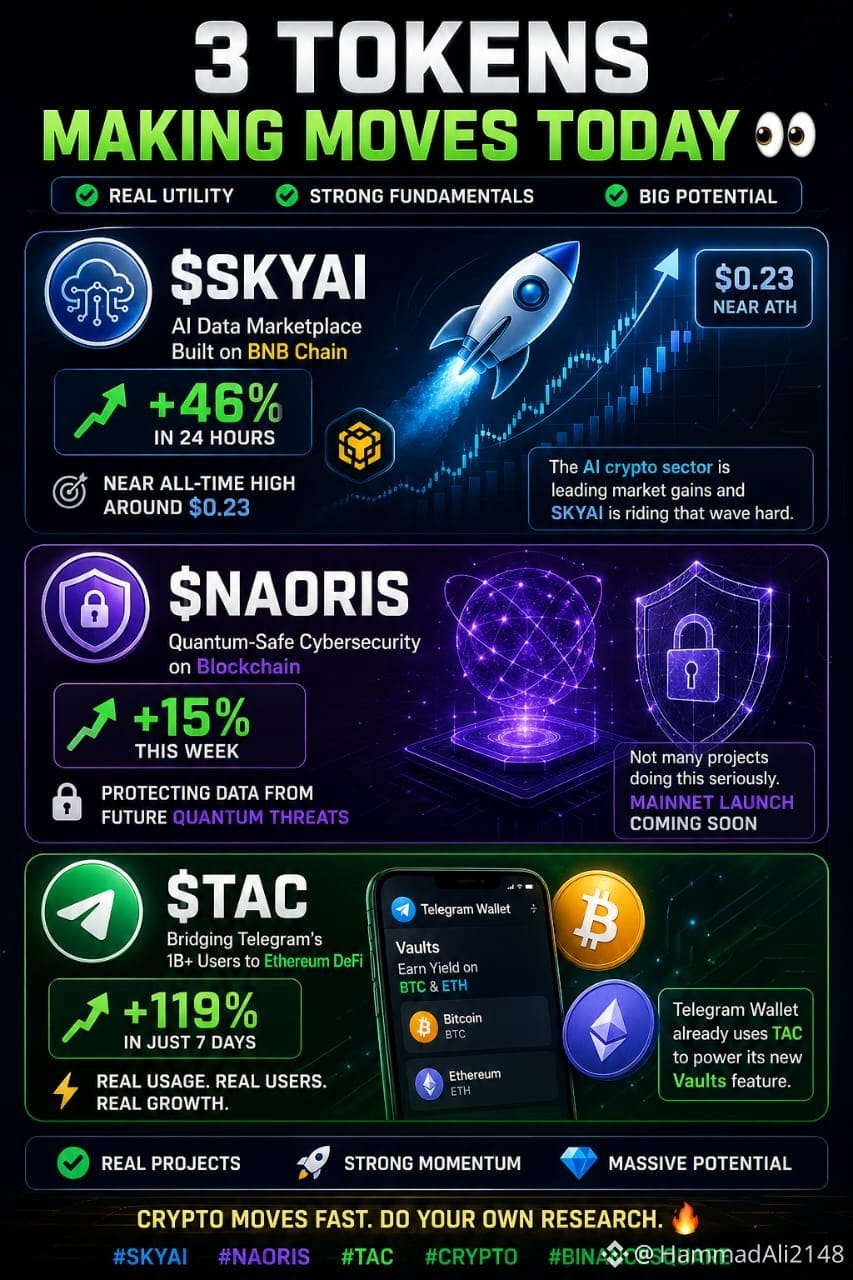
$SKYAI just pumped 46% in 24 hours and is sitting near its all-time high around $0.23. It's an AI data marketplace built on BNB Chain — real utility, not just hype. The AI crypto sector is leading market gains right now, and SKYAI is riding that wave hard.
$NAORIS is quietly up 15% this week. This one is building quantum-safe cybersecurity on blockchain — basically protecting your data from future quantum computer attacks. Not many projects doing this seriously. Mainnet launch is coming soon, which could be a big price catalyst.
$TAC had a wild week — up 119% in just 7 days. It connects Telegram's billion-user base to Ethereum DeFi. Telegram Wallet already uses TAC to power its new Vaults feature where users earn yield on BTC and ETH. That's actual real usage right now, not just promises.
All three have real things going on behind the price moves. Still do your own research — crypto moves fast. 🔥
#SKYAI #NAORIS #TAC #Crypto #BinanceSquare
{future}(TACUSDT)
{future}(SKYAIUSDT)
{future}(NAORISUSDT)
Three tokens making moves today 👀
$SKYAI just pumped 46% in 24 hours and is sitting near its all-time high around $0.23. It's an AI data marketplace built on BNB Chain — real utility, not just hype. The AI crypto sector is leading market gains right now, and SKYAI is riding that wave hard.
$NAORIS is quietly up 15% this week. This one is building quantum-safe cybersecurity on blockchain — basically protecting your data from future quantum computer attacks. Not many projects doing this seriously. Mainnet launch is coming soon, which could be a big price catalyst.
$TAC had a wild week — up 119% in just 7 days. It connects Telegram's billion-user base to Ethereum DeFi. Telegram Wallet already uses TAC to power its new Vaults feature where users earn yield on BTC and ETH. That's actual real usage right now, not just promises.
All three have real things going on behind the price moves. Still do your own research — crypto moves fast. 🔥
#SKYAI #NAORIS #TAC #Crypto #BinanceSquare
$SKYAI just pumped 46% in 24 hours and is sitting near its all-time high around $0.23. It's an AI data marketplace built on BNB Chain — real utility, not just hype. The AI crypto sector is leading market gains right now, and SKYAI is riding that wave hard.
$NAORIS is quietly up 15% this week. This one is building quantum-safe cybersecurity on blockchain — basically protecting your data from future quantum computer attacks. Not many projects doing this seriously. Mainnet launch is coming soon, which could be a big price catalyst.
$TAC had a wild week — up 119% in just 7 days. It connects Telegram's billion-user base to Ethereum DeFi. Telegram Wallet already uses TAC to power its new Vaults feature where users earn yield on BTC and ETH. That's actual real usage right now, not just promises.
All three have real things going on behind the price moves. Still do your own research — crypto moves fast. 🔥
#SKYAI #NAORIS #TAC #Crypto #BinanceSquare
2
543
Article
Pixels Is Not Just a Game Anymore — It's Building the Future of Web3 GamingThere is something really interesting happening in the Web3 gaming space right now, and if you have not been paying attention to @pixels , then honestly you are missing one of the most exciting stories in crypto gaming this year.
Most people still think of Pixels as that cute little farming game where you walk around a pixel-art world, grow crops, craft things, and hang out with other players online. And yes, it started out that way — but what it has become in 2025 is something entirely different and far more ambitious than anyone expected when it first launched.
Let me break this down in the simplest way I can, because this story deserves to be told properly.
It Began With a Simple Idea — Make Gaming Actually Worth Your Time
The team behind Pixels spent four years building and running their ecosystem. Four years of watching what works, what does not, where players drop off, where money leaks out of the system, and how to keep real people coming back day after day. During that entire time, they were quietly building something in the background that most people outside the core community never heard about — an internal tool that tracked player behavior, deployed rewards smartly, and kept the game economy healthy.
That internal tool is now called Stacked, and they have just opened it up to the entire world.
Stacked is not a buzzword or a whitepaper promise — it is a live, working AI-powered platform that game studios can now plug into their own games through an SDK integration. What it does is genuinely remarkable. Instead of giving every single player the same rewards and hoping for the best, Stacked watches how each player behaves and then sends them personalized offers and incentives at exactly the right moment. Think of it like having a smart assistant running inside your game economy, one that notices when a veteran player has gone quiet for a month and automatically reaches out to bring them back with something meaningful.
The numbers they shared from their own ecosystem are hard to ignore. When they used the Stacked AI engine to target players who had not spent anything in over 30 days, they saw a 178% increase in those players actually converting to spend, a 129% increase in active days, and a 131% return on reward spend. And the most impressive part is that none of this required any manual work, no human sitting there building segments or writing campaigns one by one. The AI handled everything.
Then Came the $PIXEL Staking System — and the Community Went Wild
Right around the same time that Stacked was being built out, the team launched PIXEL staking on May 1st, 2025, and what happened next genuinely surprised even longtime followers of the project. Within just over a month after launch, the community had staked over 100 million PIXEL tokens across the ecosystem, with more than 5 million PIXEL distributed back as staking rewards to participants.
But here is what makes this staking system different from what you have seen in other projects, because this is important to understand. This is not the typical "lock your tokens, get a number, forget about it" kind of staking. The way PIXEL staking works is that when you stake your tokens into a specific game, you are actually helping that game grow. You are directing resources and visibility toward it. And when that game performs well — when real players come in, spend, and engage — you earn more as a staker. Both the player and the developer win together, which is a completely different model from what most DeFi staking looks like.
Three games are currently in the $PIXEL staking ecosystem: the core Pixels game itself, Pixel Dungeons, and Forgotten Runiverse. Sleepagotchi was also recently integrated, and it pulled in 8 million PIXEL staked during its very first week alone. Each game has its own mechanics, its own reward rates, and its own way of giving back to the community.
The metric that the Pixels team uses to measure all of this is called RORS — Return on Reward Spend — and it is their north star for making sure the system stays sustainable over the long term. Games with higher RORS attract more stakers because they are proving they can deliver real value back into the ecosystem instead of just burning through reward budgets.
vPIXEL Is Coming, and It Matters More Than You Think
One of the biggest upcoming additions to the PIXEL ecosystem is a new token called vPIXEL. It is backed one-to-one by PIXEL, meaning every vPIXEL in existence has a real PIXEL locked behind it. But unlike PIXEL, you cannot trade vPIXEL or send it to other players — it is a spend-only token designed to work inside the game and across partner games without any fees.
The reason this matters is not just about utility inside the game. Because vPIXEL cannot be freely traded or sold, it creates a regulatory-friendly model that could potentially open up Pixels to mobile app stores and even allow credit card purchases in the future. That is a bridge between traditional Web2 players and the Web3 world that very few gaming projects have managed to build in a practical way.
What Pixels Is Actually Trying to Do
When you step back and look at everything together — Stacked, the staking system, vPIXEL, the growing list of partner games, the cross-chain architecture built to work beyond just the Ronin blockchain — what you see is a team that is trying to own the entire Web3 gaming vertical, not just be a single popular game.
The vision is to become the infrastructure layer that other game developers come to when they want to build something sustainable in Web3. If Stacked can do for other studios what it has done for Pixels internally, then the PIXEL token is not just fueling one game — it is powering an entire publishing and rewards network.
Over 176 million PIXEL have now been staked by more than 10,000 users, and the ecosystem keeps growing every single week with new game integrations, new events, and new ways to earn and spend inside this world.
Conclusion — This Is the Kind of Project That Deserves Attention Right Now
Pixels started as a farming game. It became a platform. And now, with the launch of Stacked and the expansion of the PIXEL staking ecosystem, it is positioning itself as one of the most seriously built and community-driven projects in the entire Web3 gaming space. The team is not making promises without proof — they have four years of data, millions of daily active users, and $25 million in real ecosystem revenue to back up everything they are building.
If you care about where Web3 gaming is actually headed, and you want to be part of an ecosystem that is growing with real users and real value at its core, then watching @pixels and PIXEL closely right now is one of the smartest things you can do.
#pixel
{future}(PIXELUSDT)
Pixels Is Not Just a Game Anymore — It's Building the Future of Web3 Gaming
There is something really interesting happening in the Web3 gaming space right now, and if you have not been paying attention to @Pixels , then honestly you are missing one of the most exciting stories in crypto gaming this year.
Most people still think of Pixels as that cute little farming game where you walk around a pixel-art world, grow crops, craft things, and hang out with other players online. And yes, it started out that way — but what it has become in 2025 is something entirely different and far more ambitious than anyone expected when it first launched.
Let me break this down in the simplest way I can, because this story deserves to be told properly.
It Began With a Simple Idea — Make Gaming Actually Worth Your Time
The team behind Pixels spent four years building and running their ecosystem. Four years of watching what works, what does not, where players drop off, where money leaks out of the system, and how to keep real people coming back day after day. During that entire time, they were quietly building something in the background that most people outside the core community never heard about — an internal tool that tracked player behavior, deployed rewards smartly, and kept the game economy healthy.
That internal tool is now called Stacked, and they have just opened it up to the entire world.
Stacked is not a buzzword or a whitepaper promise — it is a live, working AI-powered platform that game studios can now plug into their own games through an SDK integration. What it does is genuinely remarkable. Instead of giving every single player the same rewards and hoping for the best, Stacked watches how each player behaves and then sends them personalized offers and incentives at exactly the right moment. Think of it like having a smart assistant running inside your game economy, one that notices when a veteran player has gone quiet for a month and automatically reaches out to bring them back with something meaningful.
The numbers they shared from their own ecosystem are hard to ignore. When they used the Stacked AI engine to target players who had not spent anything in over 30 days, they saw a 178% increase in those players actually converting to spend, a 129% increase in active days, and a 131% return on reward spend. And the most impressive part is that none of this required any manual work, no human sitting there building segments or writing campaigns one by one. The AI handled everything.
Then Came the $PIXEL Staking System — and the Community Went Wild
Right around the same time that Stacked was being built out, the team launched PIXEL staking on May 1st, 2025, and what happened next genuinely surprised even longtime followers of the project. Within just over a month after launch, the community had staked over 100 million PIXEL tokens across the ecosystem, with more than 5 million PIXEL distributed back as staking rewards to participants.
But here is what makes this staking system different from what you have seen in other projects, because this is important to understand. This is not the typical "lock your tokens, get a number, forget about it" kind of staking. The way PIXEL staking works is that when you stake your tokens into a specific game, you are actually helping that game grow. You are directing resources and visibility toward it. And when that game performs well — when real players come in, spend, and engage — you earn more as a staker. Both the player and the developer win together, which is a completely different model from what most DeFi staking looks like.
Three games are currently in the $PIXEL staking ecosystem: the core Pixels game itself, Pixel Dungeons, and Forgotten Runiverse. Sleepagotchi was also recently integrated, and it pulled in 8 million PIXEL staked during its very first week alone. Each game has its own mechanics, its own reward rates, and its own way of giving back to the community.
The metric that the Pixels team uses to measure all of this is called RORS — Return on Reward Spend — and it is their north star for making sure the system stays sustainable over the long term. Games with higher RORS attract more stakers because they are proving they can deliver real value back into the ecosystem instead of just burning through reward budgets.
vPIXEL Is Coming, and It Matters More Than You Think
One of the biggest upcoming additions to the PIXEL ecosystem is a new token called vPIXEL. It is backed one-to-one by PIXEL, meaning every vPIXEL in existence has a real PIXEL locked behind it. But unlike PIXEL, you cannot trade vPIXEL or send it to other players — it is a spend-only token designed to work inside the game and across partner games without any fees.
The reason this matters is not just about utility inside the game. Because vPIXEL cannot be freely traded or sold, it creates a regulatory-friendly model that could potentially open up Pixels to mobile app stores and even allow credit card purchases in the future. That is a bridge between traditional Web2 players and the Web3 world that very few gaming projects have managed to build in a practical way.
What Pixels Is Actually Trying to Do
When you step back and look at everything together — Stacked, the staking system, vPIXEL, the growing list of partner games, the cross-chain architecture built to work beyond just the Ronin blockchain — what you see is a team that is trying to own the entire Web3 gaming vertical, not just be a single popular game.
The vision is to become the infrastructure layer that other game developers come to when they want to build something sustainable in Web3. If Stacked can do for other studios what it has done for Pixels internally, then the PIXEL token is not just fueling one game — it is powering an entire publishing and rewards network.
Over 176 million PIXEL have now been staked by more than 10,000 users, and the ecosystem keeps growing every single week with new game integrations, new events, and new ways to earn and spend inside this world.
Conclusion — This Is the Kind of Project That Deserves Attention Right Now
Pixels started as a farming game. It became a platform. And now, with the launch of Stacked and the expansion of the PIXEL staking ecosystem, it is positioning itself as one of the most seriously built and community-driven projects in the entire Web3 gaming space. The team is not making promises without proof — they have four years of data, millions of daily active users, and $25 million in real ecosystem revenue to back up everything they are building.
If you care about where Web3 gaming is actually headed, and you want to be part of an ecosystem that is growing with real users and real value at its core, then watching @Pixels and PIXEL closely right now is one of the smartest things you can do.
#pixel
Most people still think of Pixels as that cute little farming game where you walk around a pixel-art world, grow crops, craft things, and hang out with other players online. And yes, it started out that way — but what it has become in 2025 is something entirely different and far more ambitious than anyone expected when it first launched.
Let me break this down in the simplest way I can, because this story deserves to be told properly.
It Began With a Simple Idea — Make Gaming Actually Worth Your Time
The team behind Pixels spent four years building and running their ecosystem. Four years of watching what works, what does not, where players drop off, where money leaks out of the system, and how to keep real people coming back day after day. During that entire time, they were quietly building something in the background that most people outside the core community never heard about — an internal tool that tracked player behavior, deployed rewards smartly, and kept the game economy healthy.
That internal tool is now called Stacked, and they have just opened it up to the entire world.
Stacked is not a buzzword or a whitepaper promise — it is a live, working AI-powered platform that game studios can now plug into their own games through an SDK integration. What it does is genuinely remarkable. Instead of giving every single player the same rewards and hoping for the best, Stacked watches how each player behaves and then sends them personalized offers and incentives at exactly the right moment. Think of it like having a smart assistant running inside your game economy, one that notices when a veteran player has gone quiet for a month and automatically reaches out to bring them back with something meaningful.
The numbers they shared from their own ecosystem are hard to ignore. When they used the Stacked AI engine to target players who had not spent anything in over 30 days, they saw a 178% increase in those players actually converting to spend, a 129% increase in active days, and a 131% return on reward spend. And the most impressive part is that none of this required any manual work, no human sitting there building segments or writing campaigns one by one. The AI handled everything.
Then Came the $PIXEL Staking System — and the Community Went Wild
Right around the same time that Stacked was being built out, the team launched PIXEL staking on May 1st, 2025, and what happened next genuinely surprised even longtime followers of the project. Within just over a month after launch, the community had staked over 100 million PIXEL tokens across the ecosystem, with more than 5 million PIXEL distributed back as staking rewards to participants.
But here is what makes this staking system different from what you have seen in other projects, because this is important to understand. This is not the typical "lock your tokens, get a number, forget about it" kind of staking. The way PIXEL staking works is that when you stake your tokens into a specific game, you are actually helping that game grow. You are directing resources and visibility toward it. And when that game performs well — when real players come in, spend, and engage — you earn more as a staker. Both the player and the developer win together, which is a completely different model from what most DeFi staking looks like.
Three games are currently in the $PIXEL staking ecosystem: the core Pixels game itself, Pixel Dungeons, and Forgotten Runiverse. Sleepagotchi was also recently integrated, and it pulled in 8 million PIXEL staked during its very first week alone. Each game has its own mechanics, its own reward rates, and its own way of giving back to the community.
The metric that the Pixels team uses to measure all of this is called RORS — Return on Reward Spend — and it is their north star for making sure the system stays sustainable over the long term. Games with higher RORS attract more stakers because they are proving they can deliver real value back into the ecosystem instead of just burning through reward budgets.
vPIXEL Is Coming, and It Matters More Than You Think
One of the biggest upcoming additions to the PIXEL ecosystem is a new token called vPIXEL. It is backed one-to-one by PIXEL, meaning every vPIXEL in existence has a real PIXEL locked behind it. But unlike PIXEL, you cannot trade vPIXEL or send it to other players — it is a spend-only token designed to work inside the game and across partner games without any fees.
The reason this matters is not just about utility inside the game. Because vPIXEL cannot be freely traded or sold, it creates a regulatory-friendly model that could potentially open up Pixels to mobile app stores and even allow credit card purchases in the future. That is a bridge between traditional Web2 players and the Web3 world that very few gaming projects have managed to build in a practical way.
What Pixels Is Actually Trying to Do
When you step back and look at everything together — Stacked, the staking system, vPIXEL, the growing list of partner games, the cross-chain architecture built to work beyond just the Ronin blockchain — what you see is a team that is trying to own the entire Web3 gaming vertical, not just be a single popular game.
The vision is to become the infrastructure layer that other game developers come to when they want to build something sustainable in Web3. If Stacked can do for other studios what it has done for Pixels internally, then the PIXEL token is not just fueling one game — it is powering an entire publishing and rewards network.
Over 176 million PIXEL have now been staked by more than 10,000 users, and the ecosystem keeps growing every single week with new game integrations, new events, and new ways to earn and spend inside this world.
Conclusion — This Is the Kind of Project That Deserves Attention Right Now
Pixels started as a farming game. It became a platform. And now, with the launch of Stacked and the expansion of the PIXEL staking ecosystem, it is positioning itself as one of the most seriously built and community-driven projects in the entire Web3 gaming space. The team is not making promises without proof — they have four years of data, millions of daily active users, and $25 million in real ecosystem revenue to back up everything they are building.
If you care about where Web3 gaming is actually headed, and you want to be part of an ecosystem that is growing with real users and real value at its core, then watching @Pixels and PIXEL closely right now is one of the smartest things you can do.
#pixel
25
21
474
Article
Why @Pixels and the $PIXEL Stacked Ecosystem Are Quietly Building Something BigMost people in crypto are always chasing the next big thing — the next moon, the next 100x, the next hype cycle that disappears in two weeks. But every once in a while, if you actually pay attention and look a little closer, you find a project that is not chasing anything at all, because it is too busy actually building something real. That project, right now, in 2026, is @pixels — and if you have not been paying attention to what they are doing with their $PIXEL Stacked ecosystem, you are honestly missing one of the most thoughtful stories in the entire Web3 gaming space.
Let me set the scene for you. A few years ago, almost everyone who tried to build a play-to-earn game made the same mistake — they built a hype machine with a token attached to it, called it a game, and then watched everything collapse the moment the token price dropped. Players left, tokens crashed, and the whole space got a reputation for being a scam disguised as fun. @pixels watched all of that happen too, and instead of repeating those same mistakes, they decided to actually solve the problem from the inside out.
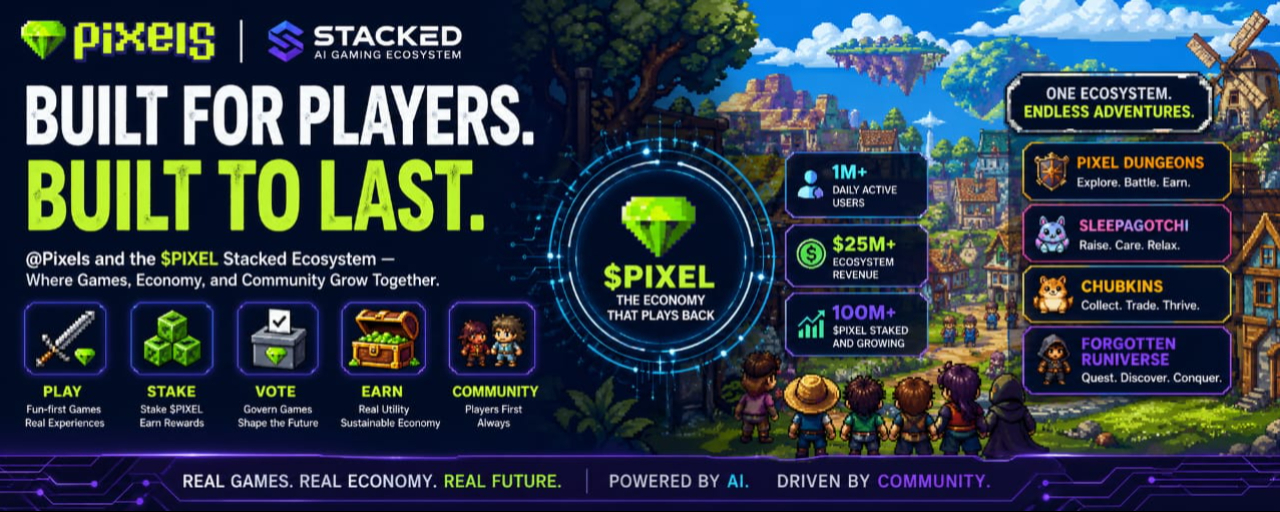
What makes @pixels different is that it was built as a real game first — an open-world farming and exploration experience running on the Ronin Network, where players can genuinely enjoy themselves without needing to spend money or hold tokens just to enter. The $PIXEL token was never meant to be a get-rich-quick ticket; it was designed as the backbone of an entire economy, where you use it to mint NFTs, join Guilds, buy VIP Battle Passes, unlock premium in-game features, and eventually participate in governance of the whole community treasury. That is not a whitepaper promise — that is a live, working system with over one million daily active users and more than $25 million in revenue already generated from the ecosystem.
But the really exciting part of what @pixels has done recently is the launch of Stacked — and this is where things get genuinely interesting. Stacked is an AI-powered platform that was originally built as an internal tool just to help @pixels manage their own game economy, and it worked so well that they turned it into a product that any Web3 game studio can now use. Think of it as an AI game economist that sits inside your game, watches how every player behaves in real time, and then figures out exactly the right moment to offer the right reward to keep that player engaged and spending. When @pixels tested this on their own veteran players who had not spent anything in over 30 days, they saw a 178% increase in conversion to spend, a 129% jump in active days, and a 131% return on reward spend — and none of it required a team of data scientists sitting behind the scenes managing everything manually.
The Stacked ecosystem is also where the PIXEL staking system lives and breathes. Right now, stakers are not just earning passive rewards — they are actually helping decide which games inside the Pixels universe receive resources and token emissions. This is a genuinely decentralized publishing model, where the community uses their staked PIXEL as votes that shape which games grow and which ones need to improve. The ecosystem already crossed 100 million PIXEL tokens staked, and the multi-game world keeps expanding — with Pixel Dungeons, Sleepagotchi, Chubkins, and Forgotten Runiverse all now part of the ecosystem where you can stake, earn, play, and spend your tokens across different experiences without having to juggle multiple wallets or confusing platforms.
For anyone who has been frustrated by Web3 gaming in the past, @pixels and the Stacked ecosystem feel like the answer to a question the space has been asking for years — can you build a game economy that actually rewards real players, creates real utility, and stays sustainable without relying on constant hype? Based on everything happening right now, the answer from the PIXEL ecosystem looks like a very confident yes.
This is not financial advice, but it is a genuine observation: the projects that survive long-term in crypto are the ones that are too busy building to stop and beg for attention. Pixels is exactly that kind of project, and the Stacked ecosystem is the clearest proof of it yet.
#pixel
Why @Pixels and the $PIXEL Stacked Ecosystem Are Quietly Building Something Big
Most people in crypto are always chasing the next big thing — the next moon, the next 100x, the next hype cycle that disappears in two weeks. But every once in a while, if you actually pay attention and look a little closer, you find a project that is not chasing anything at all, because it is too busy actually building something real. That project, right now, in 2026, is @Pixels — and if you have not been paying attention to what they are doing with their $PIXEL Stacked ecosystem, you are honestly missing one of the most thoughtful stories in the entire Web3 gaming space.
Let me set the scene for you. A few years ago, almost everyone who tried to build a play-to-earn game made the same mistake — they built a hype machine with a token attached to it, called it a game, and then watched everything collapse the moment the token price dropped. Players left, tokens crashed, and the whole space got a reputation for being a scam disguised as fun. @Pixels watched all of that happen too, and instead of repeating those same mistakes, they decided to actually solve the problem from the inside out.
What makes @Pixels different is that it was built as a real game first — an open-world farming and exploration experience running on the Ronin Network, where players can genuinely enjoy themselves without needing to spend money or hold tokens just to enter. The $PIXEL token was never meant to be a get-rich-quick ticket; it was designed as the backbone of an entire economy, where you use it to mint NFTs, join Guilds, buy VIP Battle Passes, unlock premium in-game features, and eventually participate in governance of the whole community treasury. That is not a whitepaper promise — that is a live, working system with over one million daily active users and more than $25 million in revenue already generated from the ecosystem.
But the really exciting part of what @Pixels has done recently is the launch of Stacked — and this is where things get genuinely interesting. Stacked is an AI-powered platform that was originally built as an internal tool just to help @Pixels manage their own game economy, and it worked so well that they turned it into a product that any Web3 game studio can now use. Think of it as an AI game economist that sits inside your game, watches how every player behaves in real time, and then figures out exactly the right moment to offer the right reward to keep that player engaged and spending. When @Pixels tested this on their own veteran players who had not spent anything in over 30 days, they saw a 178% increase in conversion to spend, a 129% jump in active days, and a 131% return on reward spend — and none of it required a team of data scientists sitting behind the scenes managing everything manually.
The Stacked ecosystem is also where the PIXEL staking system lives and breathes. Right now, stakers are not just earning passive rewards — they are actually helping decide which games inside the Pixels universe receive resources and token emissions. This is a genuinely decentralized publishing model, where the community uses their staked PIXEL as votes that shape which games grow and which ones need to improve. The ecosystem already crossed 100 million PIXEL tokens staked, and the multi-game world keeps expanding — with Pixel Dungeons, Sleepagotchi, Chubkins, and Forgotten Runiverse all now part of the ecosystem where you can stake, earn, play, and spend your tokens across different experiences without having to juggle multiple wallets or confusing platforms.
For anyone who has been frustrated by Web3 gaming in the past, @Pixels and the Stacked ecosystem feel like the answer to a question the space has been asking for years — can you build a game economy that actually rewards real players, creates real utility, and stays sustainable without relying on constant hype? Based on everything happening right now, the answer from the PIXEL ecosystem looks like a very confident yes.
This is not financial advice, but it is a genuine observation: the projects that survive long-term in crypto are the ones that are too busy building to stop and beg for attention. Pixels is exactly that kind of project, and the Stacked ecosystem is the clearest proof of it yet.
#pixel
Let me set the scene for you. A few years ago, almost everyone who tried to build a play-to-earn game made the same mistake — they built a hype machine with a token attached to it, called it a game, and then watched everything collapse the moment the token price dropped. Players left, tokens crashed, and the whole space got a reputation for being a scam disguised as fun. @Pixels watched all of that happen too, and instead of repeating those same mistakes, they decided to actually solve the problem from the inside out.
What makes @Pixels different is that it was built as a real game first — an open-world farming and exploration experience running on the Ronin Network, where players can genuinely enjoy themselves without needing to spend money or hold tokens just to enter. The $PIXEL token was never meant to be a get-rich-quick ticket; it was designed as the backbone of an entire economy, where you use it to mint NFTs, join Guilds, buy VIP Battle Passes, unlock premium in-game features, and eventually participate in governance of the whole community treasury. That is not a whitepaper promise — that is a live, working system with over one million daily active users and more than $25 million in revenue already generated from the ecosystem.
But the really exciting part of what @Pixels has done recently is the launch of Stacked — and this is where things get genuinely interesting. Stacked is an AI-powered platform that was originally built as an internal tool just to help @Pixels manage their own game economy, and it worked so well that they turned it into a product that any Web3 game studio can now use. Think of it as an AI game economist that sits inside your game, watches how every player behaves in real time, and then figures out exactly the right moment to offer the right reward to keep that player engaged and spending. When @Pixels tested this on their own veteran players who had not spent anything in over 30 days, they saw a 178% increase in conversion to spend, a 129% jump in active days, and a 131% return on reward spend — and none of it required a team of data scientists sitting behind the scenes managing everything manually.
The Stacked ecosystem is also where the PIXEL staking system lives and breathes. Right now, stakers are not just earning passive rewards — they are actually helping decide which games inside the Pixels universe receive resources and token emissions. This is a genuinely decentralized publishing model, where the community uses their staked PIXEL as votes that shape which games grow and which ones need to improve. The ecosystem already crossed 100 million PIXEL tokens staked, and the multi-game world keeps expanding — with Pixel Dungeons, Sleepagotchi, Chubkins, and Forgotten Runiverse all now part of the ecosystem where you can stake, earn, play, and spend your tokens across different experiences without having to juggle multiple wallets or confusing platforms.
For anyone who has been frustrated by Web3 gaming in the past, @Pixels and the Stacked ecosystem feel like the answer to a question the space has been asking for years — can you build a game economy that actually rewards real players, creates real utility, and stays sustainable without relying on constant hype? Based on everything happening right now, the answer from the PIXEL ecosystem looks like a very confident yes.
This is not financial advice, but it is a genuine observation: the projects that survive long-term in crypto are the ones that are too busy building to stop and beg for attention. Pixels is exactly that kind of project, and the Stacked ecosystem is the clearest proof of it yet.
#pixel
26
23
260
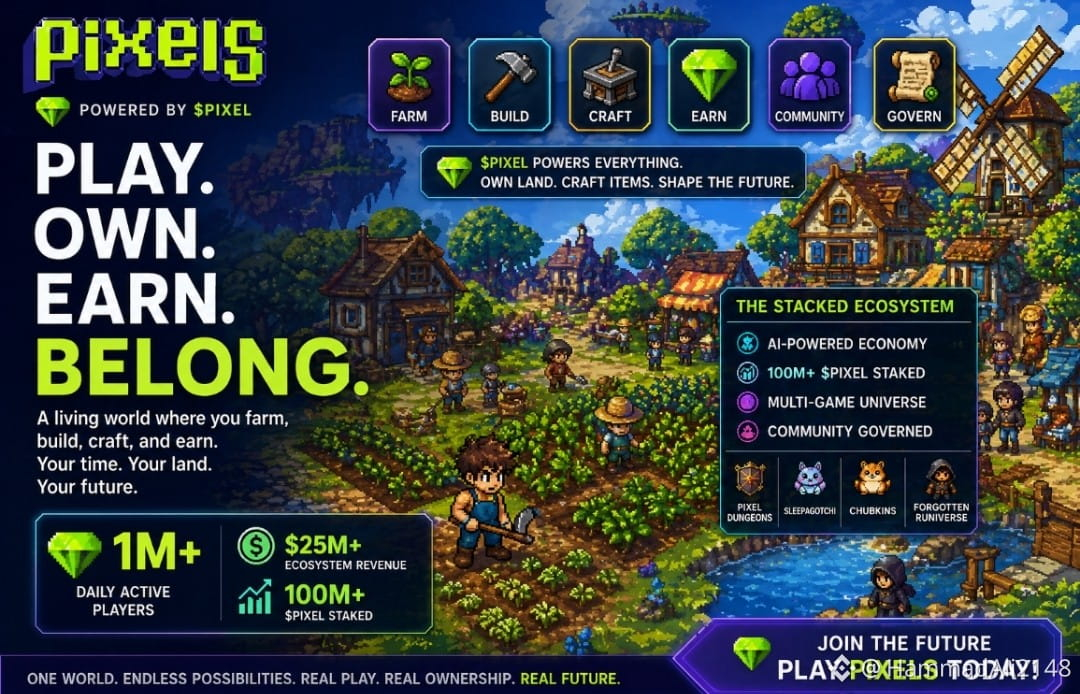
If you haven't explored @pixels yet, you are genuinely missing out on something that feels completely different from every other blockchain game out there — this is a living world where you farm, build, craft, and earn in ways that actually feel meaningful and rewarding every single day. The $PIXEL L token powers everything inside the game, from owning land to crafting resources and making real decisions as part of a growing community. What makes the Stacked ecosystem truly special is how every single piece connects together into one breathing world where your time and effort become real ownership and real value. Pixels is not just another game — it is where the future of play and ownership is already happening right now. #pixel $PIXEL
{future}(PIXELUSDT)
If you haven't explored @Pixels yet, you are genuinely missing out on something that feels completely different from every other blockchain game out there — this is a living world where you farm, build, craft, and earn in ways that actually feel meaningful and rewarding every single day. The $PIXEL L token powers everything inside the game, from owning land to crafting resources and making real decisions as part of a growing community. What makes the Stacked ecosystem truly special is how every single piece connects together into one breathing world where your time and effort become real ownership and real value. Pixels is not just another game — it is where the future of play and ownership is already happening right now. #pixel $PIXEL
31
25
486
Article
When a Game Starts Thinking Like an Economist — The Pixels Story Nobody Is TellingLet me take you back to something simple first. You know those old farming games where you wake up, water your crops, sell them, and the loop just never ends? That feeling of doing the same thing over and over without it ever really meaning anything? That is exactly the problem Pixels decided to solve, and the way they solved it is genuinely one of the most interesting stories happening in web3 gaming right now.
@pixels did not just build a game. They built an entire world on the Ronin Network where farming, exploring, building, and connecting with other players actually means something real. And at the center of all of it sits one thing — $PIXEL .
Now here is where the story gets interesting because most people only know the surface level stuff. They know PIXEL is the token, they know you can trade it, they know it lives on Ronin. But what most people completely miss is what Pixels has been quietly building underneath all of that — a system so smart it almost feels like the game has its own brain.
The Old Problem With Play to Earn Games
Every single web3 game before Pixels had the same disease. Players would come in, grind hard, earn tokens as fast as they could, dump everything on the market, and leave. The early players made money, the late players got hurt, and the game died. This happened again and again and again. Axie Infinity went through it. Dozens of games went through it. The whole play to earn narrative almost collapsed because of this exact pattern.
Pixels saw this and said no. They actually sat down and thought about what makes an economy healthy, not just what makes a game fun for two weeks. And the answer they came to was actually quite simple — if you want a game economy to survive, the people playing it need to put more back in than they take out.
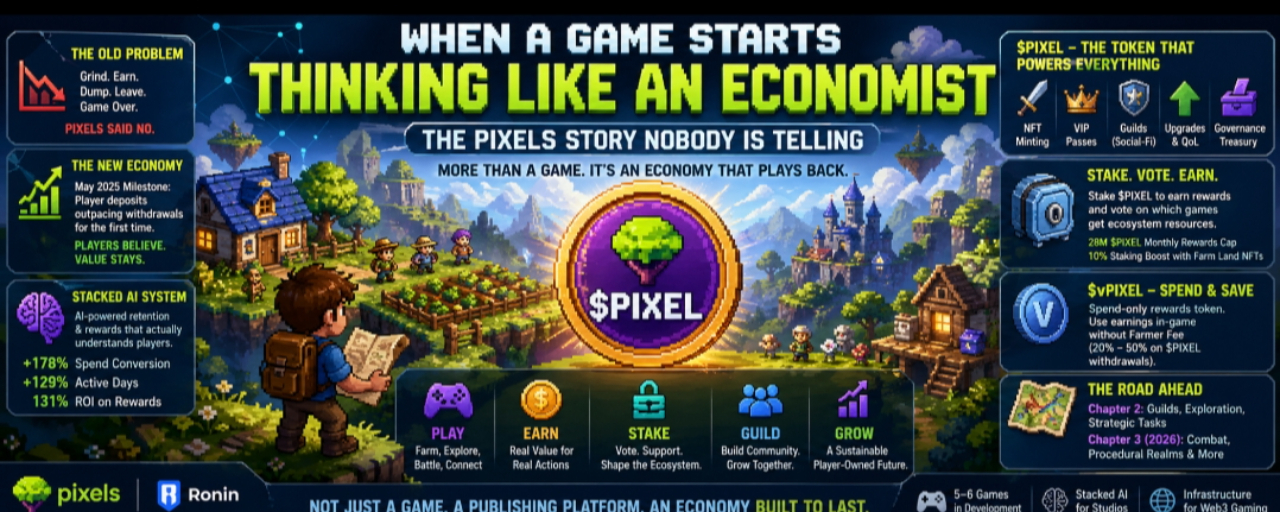
In May 2025, Pixels hit a milestone that most gaming projects never reach — player deposits into the economy started outpacing withdrawals for the first time. Think about what that actually means. Players were choosing to keep their value inside the game rather than cash out. That is not something you can fake or manufacture. That only happens when people genuinely believe in what they are part of.
What Stacked Actually Is And Why It Matters
Pixels recently launched something called Stacked — an AI-powered engagement and rewards platform built for game studios to manage player retention and monetization. What makes this different is that it was not built in a boardroom by people guessing what players want. It was built over four years of live experience inside the Pixels ecosystem itself, an ecosystem that crossed one million daily active users and generated over $25 million in revenue.
Here is the simple version of what Stacked does. Imagine you have not played Pixels in a month. Instead of the game just forgetting about you, Stacked's AI notices that you are gone, figures out what kind of player you were, and sends you a personalized offer that actually makes sense for you specifically. Not a generic popup. Not a mass email. Something built around your actual behavior.
When Pixels tested this on veteran players who had been inactive for over 30 days, the results were striking — conversion to spend went up by 178%, active days increased by 129%, and return on reward spend came in at 131%. And all of this happened without any manual work or a data science team sitting behind the scenes managing it.That is not a small number. That is the kind of result that changes how an entire industry thinks about keeping players engaged.
The founder of Pixels, Luke Barwikowski, put it directly when he said most reward systems treat every player the same and optimize for the wrong things, and that Stacked is built to reward actions that actually matter — coming back, progressing, spending, and contributing to a healthy economy. The Token That Does Everything
Now let's talk about PIXEL itself because this is where things come together in a really elegant way.
PIXEL is the native utility and governance token of the entire Pixels ecosystem. It is used for NFT minting, purchasing VIP Battle Passes, joining Guilds which are the social-fi feature at the heart of community building, quality of life upgrades inside the game, and eventually governance of the community treasury where token holders get a real say in the direction of the project.
But the staking system is what really locks this all together.
When you stake PIXEL, you are not just earning passive rewards. You are actually voting with your stake on which games inside the Pixels ecosystem deserve resources and support. Instead of a traditional validator model, stakers participate directly in deciding which games grow and which games get attention from the ecosystem. That is a genuinely new idea in how a gaming platform can be governed.
The monthly ecosystem rewards are currently capped at 28 million PIXEL per month as of early 2026, and if you own Farm Land NFTs, you get a 10% staking power boost on up to 100,000 PIXEL per land.
And there is something else being introduced called $vPIXEL. This is a spend-only reward token that lets players withdraw their earnings and use them inside the game without paying the Farmer Fee, which can otherwise run between 20% and 50% on direct PIXEL withdrawals. It is a clever design because it keeps value circulating inside the ecosystem instead of leaking out constantly.
Chapter 2 and What Comes Next
Pixels is also phasing out its older inflationary currency called $BERRY and consolidating everything around PIXEL as the single token powering the economy. The upcoming Chapter 2 update will bring guilds, exploration, and a brand new task system that requires players to actually think strategically about how they earn token rewards.
And in 2026, the ecosystem has already moved into Chapter 3 development, introducing combat mechanics and procedurally generated Exploration Realms designed to keep long-term players engaged far beyond the early farming loop.This is a project that is not standing still. Every update is connected to the token. Every new feature feeds back into why PIXEL actually has value.
The Bigger Picture — A Publishing Platform, Not Just a Game
This is the part that most people have not caught onto yet. Pixels is evolving into a multi-game platform with five to six games in active development, and PIXEL can be staked across all of these different games.What started as one farming game is quietly becoming the infrastructure for an entire ecosystem of web3 games, each one powered by the same token and the same staking model.
Stacked is now available to external game studios as well, meaning any developer can plug into the same AI-powered retention system that helped Pixels reach its numbers. That is a completely different kind of moat than most gaming tokens have. When your technology becomes the backbone other studios build on top of, your token stops being just a gaming token and starts becoming infrastructure.
Compare this to a token like $ORCA which built deep liquidity infrastructure on Solana so that other protocols could plug in and use it, or $AGT which found its value through powering underlying agent tooling that others built on top of. Pixels and PIXEL are doing something similar in the gaming vertical — the token is not just for players, it is for the entire layer of studios and developers that want to build sustainable game economies.
Why This Moment Feels Different
Most gaming tokens are easy to dismiss. They pump when the game is hyped, they dump when the players leave, and the cycle repeats. What Pixels has built with Stacked, with the staking model, with $vPIXEL, and with the transition to a clean single-token economy is something that actually tries to break that cycle for real.
The economics are designed to reward people who stay, not people who extract. The AI layer is designed to keep players in the game longer than they would otherwise stay. The staking model gives the community actual ownership over which games win inside the ecosystem. And the technology is now being offered to other studios, which creates a reason for the ecosystem to keep growing even after the current wave of attention fades.
That does not mean there are no risks. Token unlocks still create selling pressure. New games are still unproven. The broader market can go sideways anytime. But the foundation being built here is more serious than what most gaming projects have attempted.
Conclusion
The honest take on Pixels and PIXEL right now is this — it is one of the few gaming projects where the more you dig into how the system actually works, the more interesting it gets. The surface looks like a farming game. The inside looks like a carefully designed economic engine with AI on top of it, a staking model that actually incentivizes quality, and a roadmap that keeps expanding what the token is needed for.
If you have been sleeping on what @pixels is building, this is probably a good time to look twice. Not because the price is going anywhere specific tomorrow, but because the infrastructure being laid down here is genuinely different from what came before it.
#pixel
{future}(ORCAUSDT)
{future}(PIXELUSDT)
When a Game Starts Thinking Like an Economist — The Pixels Story Nobody Is Telling
Let me take you back to something simple first. You know those old farming games where you wake up, water your crops, sell them, and the loop just never ends? That feeling of doing the same thing over and over without it ever really meaning anything? That is exactly the problem Pixels decided to solve, and the way they solved it is genuinely one of the most interesting stories happening in web3 gaming right now.
@Pixels did not just build a game. They built an entire world on the Ronin Network where farming, exploring, building, and connecting with other players actually means something real. And at the center of all of it sits one thing — $PIXEL .
Now here is where the story gets interesting because most people only know the surface level stuff. They know PIXEL is the token, they know you can trade it, they know it lives on Ronin. But what most people completely miss is what Pixels has been quietly building underneath all of that — a system so smart it almost feels like the game has its own brain.
The Old Problem With Play to Earn Games
Every single web3 game before Pixels had the same disease. Players would come in, grind hard, earn tokens as fast as they could, dump everything on the market, and leave. The early players made money, the late players got hurt, and the game died. This happened again and again and again. Axie Infinity went through it. Dozens of games went through it. The whole play to earn narrative almost collapsed because of this exact pattern.
Pixels saw this and said no. They actually sat down and thought about what makes an economy healthy, not just what makes a game fun for two weeks. And the answer they came to was actually quite simple — if you want a game economy to survive, the people playing it need to put more back in than they take out.
In May 2025, Pixels hit a milestone that most gaming projects never reach — player deposits into the economy started outpacing withdrawals for the first time. Think about what that actually means. Players were choosing to keep their value inside the game rather than cash out. That is not something you can fake or manufacture. That only happens when people genuinely believe in what they are part of.
What Stacked Actually Is And Why It Matters
Pixels recently launched something called Stacked — an AI-powered engagement and rewards platform built for game studios to manage player retention and monetization. What makes this different is that it was not built in a boardroom by people guessing what players want. It was built over four years of live experience inside the Pixels ecosystem itself, an ecosystem that crossed one million daily active users and generated over $25 million in revenue.
Here is the simple version of what Stacked does. Imagine you have not played Pixels in a month. Instead of the game just forgetting about you, Stacked's AI notices that you are gone, figures out what kind of player you were, and sends you a personalized offer that actually makes sense for you specifically. Not a generic popup. Not a mass email. Something built around your actual behavior.
When Pixels tested this on veteran players who had been inactive for over 30 days, the results were striking — conversion to spend went up by 178%, active days increased by 129%, and return on reward spend came in at 131%. And all of this happened without any manual work or a data science team sitting behind the scenes managing it.That is not a small number. That is the kind of result that changes how an entire industry thinks about keeping players engaged.
The founder of Pixels, Luke Barwikowski, put it directly when he said most reward systems treat every player the same and optimize for the wrong things, and that Stacked is built to reward actions that actually matter — coming back, progressing, spending, and contributing to a healthy economy. The Token That Does Everything
Now let's talk about PIXEL itself because this is where things come together in a really elegant way.
PIXEL is the native utility and governance token of the entire Pixels ecosystem. It is used for NFT minting, purchasing VIP Battle Passes, joining Guilds which are the social-fi feature at the heart of community building, quality of life upgrades inside the game, and eventually governance of the community treasury where token holders get a real say in the direction of the project.
But the staking system is what really locks this all together.
When you stake PIXEL, you are not just earning passive rewards. You are actually voting with your stake on which games inside the Pixels ecosystem deserve resources and support. Instead of a traditional validator model, stakers participate directly in deciding which games grow and which games get attention from the ecosystem. That is a genuinely new idea in how a gaming platform can be governed.
The monthly ecosystem rewards are currently capped at 28 million PIXEL per month as of early 2026, and if you own Farm Land NFTs, you get a 10% staking power boost on up to 100,000 PIXEL per land.
And there is something else being introduced called $vPIXEL. This is a spend-only reward token that lets players withdraw their earnings and use them inside the game without paying the Farmer Fee, which can otherwise run between 20% and 50% on direct PIXEL withdrawals. It is a clever design because it keeps value circulating inside the ecosystem instead of leaking out constantly.
Chapter 2 and What Comes Next
Pixels is also phasing out its older inflationary currency called $BERRY and consolidating everything around PIXEL as the single token powering the economy. The upcoming Chapter 2 update will bring guilds, exploration, and a brand new task system that requires players to actually think strategically about how they earn token rewards.
And in 2026, the ecosystem has already moved into Chapter 3 development, introducing combat mechanics and procedurally generated Exploration Realms designed to keep long-term players engaged far beyond the early farming loop.This is a project that is not standing still. Every update is connected to the token. Every new feature feeds back into why PIXEL actually has value.
The Bigger Picture — A Publishing Platform, Not Just a Game
This is the part that most people have not caught onto yet. Pixels is evolving into a multi-game platform with five to six games in active development, and PIXEL can be staked across all of these different games.What started as one farming game is quietly becoming the infrastructure for an entire ecosystem of web3 games, each one powered by the same token and the same staking model.
Stacked is now available to external game studios as well, meaning any developer can plug into the same AI-powered retention system that helped Pixels reach its numbers. That is a completely different kind of moat than most gaming tokens have. When your technology becomes the backbone other studios build on top of, your token stops being just a gaming token and starts becoming infrastructure.
Compare this to a token like $ORCA which built deep liquidity infrastructure on Solana so that other protocols could plug in and use it, or $AGT which found its value through powering underlying agent tooling that others built on top of. Pixels and PIXEL are doing something similar in the gaming vertical — the token is not just for players, it is for the entire layer of studios and developers that want to build sustainable game economies.
Why This Moment Feels Different
Most gaming tokens are easy to dismiss. They pump when the game is hyped, they dump when the players leave, and the cycle repeats. What Pixels has built with Stacked, with the staking model, with $vPIXEL, and with the transition to a clean single-token economy is something that actually tries to break that cycle for real.
The economics are designed to reward people who stay, not people who extract. The AI layer is designed to keep players in the game longer than they would otherwise stay. The staking model gives the community actual ownership over which games win inside the ecosystem. And the technology is now being offered to other studios, which creates a reason for the ecosystem to keep growing even after the current wave of attention fades.
That does not mean there are no risks. Token unlocks still create selling pressure. New games are still unproven. The broader market can go sideways anytime. But the foundation being built here is more serious than what most gaming projects have attempted.
Conclusion
The honest take on Pixels and PIXEL right now is this — it is one of the few gaming projects where the more you dig into how the system actually works, the more interesting it gets. The surface looks like a farming game. The inside looks like a carefully designed economic engine with AI on top of it, a staking model that actually incentivizes quality, and a roadmap that keeps expanding what the token is needed for.
If you have been sleeping on what @Pixels is building, this is probably a good time to look twice. Not because the price is going anywhere specific tomorrow, but because the infrastructure being laid down here is genuinely different from what came before it.
#pixel
@Pixels did not just build a game. They built an entire world on the Ronin Network where farming, exploring, building, and connecting with other players actually means something real. And at the center of all of it sits one thing — $PIXEL .
Now here is where the story gets interesting because most people only know the surface level stuff. They know PIXEL is the token, they know you can trade it, they know it lives on Ronin. But what most people completely miss is what Pixels has been quietly building underneath all of that — a system so smart it almost feels like the game has its own brain.
The Old Problem With Play to Earn Games
Every single web3 game before Pixels had the same disease. Players would come in, grind hard, earn tokens as fast as they could, dump everything on the market, and leave. The early players made money, the late players got hurt, and the game died. This happened again and again and again. Axie Infinity went through it. Dozens of games went through it. The whole play to earn narrative almost collapsed because of this exact pattern.
Pixels saw this and said no. They actually sat down and thought about what makes an economy healthy, not just what makes a game fun for two weeks. And the answer they came to was actually quite simple — if you want a game economy to survive, the people playing it need to put more back in than they take out.
In May 2025, Pixels hit a milestone that most gaming projects never reach — player deposits into the economy started outpacing withdrawals for the first time. Think about what that actually means. Players were choosing to keep their value inside the game rather than cash out. That is not something you can fake or manufacture. That only happens when people genuinely believe in what they are part of.
What Stacked Actually Is And Why It Matters
Pixels recently launched something called Stacked — an AI-powered engagement and rewards platform built for game studios to manage player retention and monetization. What makes this different is that it was not built in a boardroom by people guessing what players want. It was built over four years of live experience inside the Pixels ecosystem itself, an ecosystem that crossed one million daily active users and generated over $25 million in revenue.
Here is the simple version of what Stacked does. Imagine you have not played Pixels in a month. Instead of the game just forgetting about you, Stacked's AI notices that you are gone, figures out what kind of player you were, and sends you a personalized offer that actually makes sense for you specifically. Not a generic popup. Not a mass email. Something built around your actual behavior.
When Pixels tested this on veteran players who had been inactive for over 30 days, the results were striking — conversion to spend went up by 178%, active days increased by 129%, and return on reward spend came in at 131%. And all of this happened without any manual work or a data science team sitting behind the scenes managing it.That is not a small number. That is the kind of result that changes how an entire industry thinks about keeping players engaged.
The founder of Pixels, Luke Barwikowski, put it directly when he said most reward systems treat every player the same and optimize for the wrong things, and that Stacked is built to reward actions that actually matter — coming back, progressing, spending, and contributing to a healthy economy. The Token That Does Everything
Now let's talk about PIXEL itself because this is where things come together in a really elegant way.
PIXEL is the native utility and governance token of the entire Pixels ecosystem. It is used for NFT minting, purchasing VIP Battle Passes, joining Guilds which are the social-fi feature at the heart of community building, quality of life upgrades inside the game, and eventually governance of the community treasury where token holders get a real say in the direction of the project.
But the staking system is what really locks this all together.
When you stake PIXEL, you are not just earning passive rewards. You are actually voting with your stake on which games inside the Pixels ecosystem deserve resources and support. Instead of a traditional validator model, stakers participate directly in deciding which games grow and which games get attention from the ecosystem. That is a genuinely new idea in how a gaming platform can be governed.
The monthly ecosystem rewards are currently capped at 28 million PIXEL per month as of early 2026, and if you own Farm Land NFTs, you get a 10% staking power boost on up to 100,000 PIXEL per land.
And there is something else being introduced called $vPIXEL. This is a spend-only reward token that lets players withdraw their earnings and use them inside the game without paying the Farmer Fee, which can otherwise run between 20% and 50% on direct PIXEL withdrawals. It is a clever design because it keeps value circulating inside the ecosystem instead of leaking out constantly.
Chapter 2 and What Comes Next
Pixels is also phasing out its older inflationary currency called $BERRY and consolidating everything around PIXEL as the single token powering the economy. The upcoming Chapter 2 update will bring guilds, exploration, and a brand new task system that requires players to actually think strategically about how they earn token rewards.
And in 2026, the ecosystem has already moved into Chapter 3 development, introducing combat mechanics and procedurally generated Exploration Realms designed to keep long-term players engaged far beyond the early farming loop.This is a project that is not standing still. Every update is connected to the token. Every new feature feeds back into why PIXEL actually has value.
The Bigger Picture — A Publishing Platform, Not Just a Game
This is the part that most people have not caught onto yet. Pixels is evolving into a multi-game platform with five to six games in active development, and PIXEL can be staked across all of these different games.What started as one farming game is quietly becoming the infrastructure for an entire ecosystem of web3 games, each one powered by the same token and the same staking model.
Stacked is now available to external game studios as well, meaning any developer can plug into the same AI-powered retention system that helped Pixels reach its numbers. That is a completely different kind of moat than most gaming tokens have. When your technology becomes the backbone other studios build on top of, your token stops being just a gaming token and starts becoming infrastructure.
Compare this to a token like $ORCA which built deep liquidity infrastructure on Solana so that other protocols could plug in and use it, or $AGT which found its value through powering underlying agent tooling that others built on top of. Pixels and PIXEL are doing something similar in the gaming vertical — the token is not just for players, it is for the entire layer of studios and developers that want to build sustainable game economies.
Why This Moment Feels Different
Most gaming tokens are easy to dismiss. They pump when the game is hyped, they dump when the players leave, and the cycle repeats. What Pixels has built with Stacked, with the staking model, with $vPIXEL, and with the transition to a clean single-token economy is something that actually tries to break that cycle for real.
The economics are designed to reward people who stay, not people who extract. The AI layer is designed to keep players in the game longer than they would otherwise stay. The staking model gives the community actual ownership over which games win inside the ecosystem. And the technology is now being offered to other studios, which creates a reason for the ecosystem to keep growing even after the current wave of attention fades.
That does not mean there are no risks. Token unlocks still create selling pressure. New games are still unproven. The broader market can go sideways anytime. But the foundation being built here is more serious than what most gaming projects have attempted.
Conclusion
The honest take on Pixels and PIXEL right now is this — it is one of the few gaming projects where the more you dig into how the system actually works, the more interesting it gets. The surface looks like a farming game. The inside looks like a carefully designed economic engine with AI on top of it, a staking model that actually incentivizes quality, and a roadmap that keeps expanding what the token is needed for.
If you have been sleeping on what @Pixels is building, this is probably a good time to look twice. Not because the price is going anywhere specific tomorrow, but because the infrastructure being laid down here is genuinely different from what came before it.
#pixel
19
13
355
Most gaming tokens are just hype with no real economy behind them. You buy the token, price pumps, then dumps and you're left holding nothing. That's what happened with so many projects. But when I actually spent time inside Pixels, something felt different.
Pixels is not just a token play. It's a whole world where you farm, craft, build, and earn — and everything you do actually connects to the economy. The $PIXEL token is tied to real in-game activity, not just speculation. When people talk about $ORCA or $AGT , those are tokens where the value mostly depends on traders. Pixels flips that — the players drive the value because the game gives them real reasons to use and hold PIXEL.
The Stacked ecosystem makes this even stronger. It's not one loose game floating around — it's a connected experience where your progress, your land, your resources all actually matter inside the world.
This is why @pixels stands out right now. Real utility, real gameplay, real economy.
@pixels #pixel #PIXEL/USDT
{future}(ORCAUSDT)
{future}(PIXELUSDT)
{future}(AGTUSDT)
Most gaming tokens are just hype with no real economy behind them. You buy the token, price pumps, then dumps and you're left holding nothing. That's what happened with so many projects. But when I actually spent time inside Pixels, something felt different.
Pixels is not just a token play. It's a whole world where you farm, craft, build, and earn — and everything you do actually connects to the economy. The $PIXEL token is tied to real in-game activity, not just speculation. When people talk about $ORCA or $AGT , those are tokens where the value mostly depends on traders. Pixels flips that — the players drive the value because the game gives them real reasons to use and hold PIXEL.
The Stacked ecosystem makes this even stronger. It's not one loose game floating around — it's a connected experience where your progress, your land, your resources all actually matter inside the world.
This is why @Pixels stands out right now. Real utility, real gameplay, real economy.
@Pixels #pixel #PIXEL/USDT
Pixels is not just a token play. It's a whole world where you farm, craft, build, and earn — and everything you do actually connects to the economy. The $PIXEL token is tied to real in-game activity, not just speculation. When people talk about $ORCA or $AGT , those are tokens where the value mostly depends on traders. Pixels flips that — the players drive the value because the game gives them real reasons to use and hold PIXEL.
The Stacked ecosystem makes this even stronger. It's not one loose game floating around — it's a connected experience where your progress, your land, your resources all actually matter inside the world.
This is why @Pixels stands out right now. Real utility, real gameplay, real economy.
@Pixels #pixel #PIXEL/USDT
14
8
360
The Game That Is Actually Building Something Real | @Pixels $PIXEL #pixelLet me be honest with you for a second because I think most people in crypto are sleeping on what Pixels is actually doing right now and it is a lot more than just a farming game.
Most people discovered Pixels because it looked cute and pixel art is nostalgic and the farming gameplay reminded them of Stardew Valley or Harvest Moon. You jump in, plant some crops, explore the world, do some quests and you think okay this is fun but is this actually a real project with a future. That is the question I want to answer today because after looking at everything happening inside the Pixels ecosystem right now the answer is genuinely yes and here is why.
Pixels started on Polygon and then made a very smart move to the Ronin Network which is the same chain that powers Axie Infinity. That migration was not random. Ronin is built specifically for gaming and it means faster transactions lower fees and a community that already understands web3 gaming. That single decision showed that the team behind Pixels actually knows what they are doing because they picked infrastructure that fits the game not infrastructure that just sounded cool at the time.
Now lets talk about $PIXEL because this token is not just a meme or a reward for playing. It is the actual heartbeat of the entire ecosystem. Every NFT that gets minted in the Pixels world is minted using PIXEL. If you want to join a Guild which is one of the most exciting social features they have built you need PIXEL. If you want a VIP Battle Pass for exclusive content and features you pay in PIXEL. If you want to unlock premium quality of life upgrades inside the game you spend PIXEL. And eventually PIXEL will be used to govern a community treasury which means holders will literally vote on the direction of the game itself. This is not a token that just sits in your wallet and you hope it pumps. This is a token with real reasons to exist inside a living breathing ecosystem.
One of the biggest updates that changed how I see this project is the shift away from the old $BERRY currency. Pixels used to have a dual currency model where $BERRY was the inflationary in game coin and PIXEL was the premium layer. The problem with inflationary tokens in games is that everyone earns them and nobody really wants to hold them and eventually the whole economy gets sick. Pixels recognized this problem early and they are fixing it by consolidating to a single PIXEL token economy. This is exactly the kind of decision that separates projects that think long term from projects that just want to keep numbers high for a few months.
And then there is Stacked which might honestly be the most underrated thing the Pixels team has built. Stacked is an AI powered engagement and rewards platform that Pixels developed over four years of actually running a live game with real players. Think about that for a moment. They did not build a product and then try to sell it. They ran their game, learned from over one million daily active users, generated more than twenty five million dollars in revenue and then turned those lessons into a platform that any game studio in the world can now access. When they used the AI engine to go back to veteran players who had not spent money in over thirty days they saw a one hundred and seventy eight percent increase in people actually spending. A hundred and twenty nine percent more active days from those same players. And a hundred and thirty one percent return on every reward dollar they spent. Those numbers are not projections. They are real results from inside the Pixels game itself. Stacked is now live inside Pixels, Pixel Dungeons and a game called Chubkins. This is a team that builds things that actually work.
Now here is what makes the PIXEL staking system so interesting and why it matters for anyone paying attention to where web3 gaming is going. Pixels is building what they call a decentralized publishing model. Instead of having a big company decide which games get resources and which ones get ignored the staking system lets PIXEL holders actually support the games they believe in. You stake your PIXEL to a game and that game gets a bigger reward pool. The more the community believes in a game the more support that game receives. Phase one is already live and it is beta mode with handpicked games. Phase two will make rewards dynamic based on staking volume. Phase three opens the doors to any game that hits a minimum activity threshold. Phase four is where it gets really interesting because the ecosystem will start supporting more tokens like USDC for user acquisition once the economics are healthy enough. And on top of all this there is a new spend only reward token called $vPIXEL coming soon that lets players spend inside the ecosystem without worrying about Farmer Fees. This is a complete economy being built layer by layer with actual thought behind every decision.
Now you might be wondering how does this compare to other things happening in crypto right now. You look at something like $BSB which has been making moves in the BNB ecosystem or $HYPER which has been talked about a lot in gaming circles and what stands out about Pixels compared to both of them is that Pixels has a real product with real users that has already generated real revenue over multiple years. The ecosystem is not theoretical. It is already running and the team is now expanding it outward to other studios through Stacked. That combination of a working game plus an AI platform plus a consolidating token economy plus a staking system that gives holders actual power is something very few projects in the entire space can actually claim right now.
Chapter 2 of the Pixels game is also coming and it brings guilds in a bigger way, exploration mechanics and a completely new task system that will require players to actually think strategically about how they earn PIXEL rewards. This is important because it means the game is getting harder in the right way. When earning tokens requires thought and effort the people who earn them are more invested in the ecosystem and the token has more genuine demand behind it.
The total supply of PIXEL is five billion tokens and right now about two point seven billion are in circulation. There are still unlocks coming but the key thing to watch is whether the in game economy keeps deposits higher than withdrawals. That milestone was first hit in May 2025 and it was a massive signal that the economy was actually becoming healthy. When players are putting more into the game than they are taking out it means people genuinely want to participate and not just farm and dump.
To sum everything up Pixels is not just a game. It is a platform. It is an AI company. It is a publishing model for web3 games. It is a staking ecosystem where your PIXEL token actually does something meaningful. And every single piece of this was built from real experience running a real game with real players who spend real money. In a space full of projects that promise everything before building anything Pixels went and built everything before making the promises. That is rare and that is exactly why I think PIXEL and the Pixels ecosystem deserves way more attention than it is getting right now.
@pixels #pixel
{future}(BSBUSDT)
{future}(PIXELUSDT)
{future}(HYPERUSDT)
The Game That Is Actually Building Something Real | @Pixels $PIXEL #pixel
Let me be honest with you for a second because I think most people in crypto are sleeping on what Pixels is actually doing right now and it is a lot more than just a farming game.
Most people discovered Pixels because it looked cute and pixel art is nostalgic and the farming gameplay reminded them of Stardew Valley or Harvest Moon. You jump in, plant some crops, explore the world, do some quests and you think okay this is fun but is this actually a real project with a future. That is the question I want to answer today because after looking at everything happening inside the Pixels ecosystem right now the answer is genuinely yes and here is why.
Pixels started on Polygon and then made a very smart move to the Ronin Network which is the same chain that powers Axie Infinity. That migration was not random. Ronin is built specifically for gaming and it means faster transactions lower fees and a community that already understands web3 gaming. That single decision showed that the team behind Pixels actually knows what they are doing because they picked infrastructure that fits the game not infrastructure that just sounded cool at the time.
Now lets talk about $PIXEL because this token is not just a meme or a reward for playing. It is the actual heartbeat of the entire ecosystem. Every NFT that gets minted in the Pixels world is minted using PIXEL. If you want to join a Guild which is one of the most exciting social features they have built you need PIXEL. If you want a VIP Battle Pass for exclusive content and features you pay in PIXEL. If you want to unlock premium quality of life upgrades inside the game you spend PIXEL. And eventually PIXEL will be used to govern a community treasury which means holders will literally vote on the direction of the game itself. This is not a token that just sits in your wallet and you hope it pumps. This is a token with real reasons to exist inside a living breathing ecosystem.
One of the biggest updates that changed how I see this project is the shift away from the old $BERRY currency. Pixels used to have a dual currency model where $BERRY was the inflationary in game coin and PIXEL was the premium layer. The problem with inflationary tokens in games is that everyone earns them and nobody really wants to hold them and eventually the whole economy gets sick. Pixels recognized this problem early and they are fixing it by consolidating to a single PIXEL token economy. This is exactly the kind of decision that separates projects that think long term from projects that just want to keep numbers high for a few months.
And then there is Stacked which might honestly be the most underrated thing the Pixels team has built. Stacked is an AI powered engagement and rewards platform that Pixels developed over four years of actually running a live game with real players. Think about that for a moment. They did not build a product and then try to sell it. They ran their game, learned from over one million daily active users, generated more than twenty five million dollars in revenue and then turned those lessons into a platform that any game studio in the world can now access. When they used the AI engine to go back to veteran players who had not spent money in over thirty days they saw a one hundred and seventy eight percent increase in people actually spending. A hundred and twenty nine percent more active days from those same players. And a hundred and thirty one percent return on every reward dollar they spent. Those numbers are not projections. They are real results from inside the Pixels game itself. Stacked is now live inside Pixels, Pixel Dungeons and a game called Chubkins. This is a team that builds things that actually work.
Now here is what makes the PIXEL staking system so interesting and why it matters for anyone paying attention to where web3 gaming is going. Pixels is building what they call a decentralized publishing model. Instead of having a big company decide which games get resources and which ones get ignored the staking system lets PIXEL holders actually support the games they believe in. You stake your PIXEL to a game and that game gets a bigger reward pool. The more the community believes in a game the more support that game receives. Phase one is already live and it is beta mode with handpicked games. Phase two will make rewards dynamic based on staking volume. Phase three opens the doors to any game that hits a minimum activity threshold. Phase four is where it gets really interesting because the ecosystem will start supporting more tokens like USDC for user acquisition once the economics are healthy enough. And on top of all this there is a new spend only reward token called $vPIXEL coming soon that lets players spend inside the ecosystem without worrying about Farmer Fees. This is a complete economy being built layer by layer with actual thought behind every decision.
Now you might be wondering how does this compare to other things happening in crypto right now. You look at something like $BSB which has been making moves in the BNB ecosystem or $HYPER which has been talked about a lot in gaming circles and what stands out about Pixels compared to both of them is that Pixels has a real product with real users that has already generated real revenue over multiple years. The ecosystem is not theoretical. It is already running and the team is now expanding it outward to other studios through Stacked. That combination of a working game plus an AI platform plus a consolidating token economy plus a staking system that gives holders actual power is something very few projects in the entire space can actually claim right now.
Chapter 2 of the Pixels game is also coming and it brings guilds in a bigger way, exploration mechanics and a completely new task system that will require players to actually think strategically about how they earn PIXEL rewards. This is important because it means the game is getting harder in the right way. When earning tokens requires thought and effort the people who earn them are more invested in the ecosystem and the token has more genuine demand behind it.
The total supply of PIXEL is five billion tokens and right now about two point seven billion are in circulation. There are still unlocks coming but the key thing to watch is whether the in game economy keeps deposits higher than withdrawals. That milestone was first hit in May 2025 and it was a massive signal that the economy was actually becoming healthy. When players are putting more into the game than they are taking out it means people genuinely want to participate and not just farm and dump.
To sum everything up Pixels is not just a game. It is a platform. It is an AI company. It is a publishing model for web3 games. It is a staking ecosystem where your PIXEL token actually does something meaningful. And every single piece of this was built from real experience running a real game with real players who spend real money. In a space full of projects that promise everything before building anything Pixels went and built everything before making the promises. That is rare and that is exactly why I think PIXEL and the Pixels ecosystem deserves way more attention than it is getting right now.
@Pixels #pixel
Most people discovered Pixels because it looked cute and pixel art is nostalgic and the farming gameplay reminded them of Stardew Valley or Harvest Moon. You jump in, plant some crops, explore the world, do some quests and you think okay this is fun but is this actually a real project with a future. That is the question I want to answer today because after looking at everything happening inside the Pixels ecosystem right now the answer is genuinely yes and here is why.
Pixels started on Polygon and then made a very smart move to the Ronin Network which is the same chain that powers Axie Infinity. That migration was not random. Ronin is built specifically for gaming and it means faster transactions lower fees and a community that already understands web3 gaming. That single decision showed that the team behind Pixels actually knows what they are doing because they picked infrastructure that fits the game not infrastructure that just sounded cool at the time.
Now lets talk about $PIXEL because this token is not just a meme or a reward for playing. It is the actual heartbeat of the entire ecosystem. Every NFT that gets minted in the Pixels world is minted using PIXEL. If you want to join a Guild which is one of the most exciting social features they have built you need PIXEL. If you want a VIP Battle Pass for exclusive content and features you pay in PIXEL. If you want to unlock premium quality of life upgrades inside the game you spend PIXEL. And eventually PIXEL will be used to govern a community treasury which means holders will literally vote on the direction of the game itself. This is not a token that just sits in your wallet and you hope it pumps. This is a token with real reasons to exist inside a living breathing ecosystem.
One of the biggest updates that changed how I see this project is the shift away from the old $BERRY currency. Pixels used to have a dual currency model where $BERRY was the inflationary in game coin and PIXEL was the premium layer. The problem with inflationary tokens in games is that everyone earns them and nobody really wants to hold them and eventually the whole economy gets sick. Pixels recognized this problem early and they are fixing it by consolidating to a single PIXEL token economy. This is exactly the kind of decision that separates projects that think long term from projects that just want to keep numbers high for a few months.
And then there is Stacked which might honestly be the most underrated thing the Pixels team has built. Stacked is an AI powered engagement and rewards platform that Pixels developed over four years of actually running a live game with real players. Think about that for a moment. They did not build a product and then try to sell it. They ran their game, learned from over one million daily active users, generated more than twenty five million dollars in revenue and then turned those lessons into a platform that any game studio in the world can now access. When they used the AI engine to go back to veteran players who had not spent money in over thirty days they saw a one hundred and seventy eight percent increase in people actually spending. A hundred and twenty nine percent more active days from those same players. And a hundred and thirty one percent return on every reward dollar they spent. Those numbers are not projections. They are real results from inside the Pixels game itself. Stacked is now live inside Pixels, Pixel Dungeons and a game called Chubkins. This is a team that builds things that actually work.
Now here is what makes the PIXEL staking system so interesting and why it matters for anyone paying attention to where web3 gaming is going. Pixels is building what they call a decentralized publishing model. Instead of having a big company decide which games get resources and which ones get ignored the staking system lets PIXEL holders actually support the games they believe in. You stake your PIXEL to a game and that game gets a bigger reward pool. The more the community believes in a game the more support that game receives. Phase one is already live and it is beta mode with handpicked games. Phase two will make rewards dynamic based on staking volume. Phase three opens the doors to any game that hits a minimum activity threshold. Phase four is where it gets really interesting because the ecosystem will start supporting more tokens like USDC for user acquisition once the economics are healthy enough. And on top of all this there is a new spend only reward token called $vPIXEL coming soon that lets players spend inside the ecosystem without worrying about Farmer Fees. This is a complete economy being built layer by layer with actual thought behind every decision.
Now you might be wondering how does this compare to other things happening in crypto right now. You look at something like $BSB which has been making moves in the BNB ecosystem or $HYPER which has been talked about a lot in gaming circles and what stands out about Pixels compared to both of them is that Pixels has a real product with real users that has already generated real revenue over multiple years. The ecosystem is not theoretical. It is already running and the team is now expanding it outward to other studios through Stacked. That combination of a working game plus an AI platform plus a consolidating token economy plus a staking system that gives holders actual power is something very few projects in the entire space can actually claim right now.
Chapter 2 of the Pixels game is also coming and it brings guilds in a bigger way, exploration mechanics and a completely new task system that will require players to actually think strategically about how they earn PIXEL rewards. This is important because it means the game is getting harder in the right way. When earning tokens requires thought and effort the people who earn them are more invested in the ecosystem and the token has more genuine demand behind it.
The total supply of PIXEL is five billion tokens and right now about two point seven billion are in circulation. There are still unlocks coming but the key thing to watch is whether the in game economy keeps deposits higher than withdrawals. That milestone was first hit in May 2025 and it was a massive signal that the economy was actually becoming healthy. When players are putting more into the game than they are taking out it means people genuinely want to participate and not just farm and dump.
To sum everything up Pixels is not just a game. It is a platform. It is an AI company. It is a publishing model for web3 games. It is a staking ecosystem where your PIXEL token actually does something meaningful. And every single piece of this was built from real experience running a real game with real players who spend real money. In a space full of projects that promise everything before building anything Pixels went and built everything before making the promises. That is rare and that is exactly why I think PIXEL and the Pixels ecosystem deserves way more attention than it is getting right now.
@Pixels #pixel
13
15
386
Log in to explore more content
Join global crypto users on Binance Square
⚡️ Get latest and useful information about crypto.
💬 Trusted by the world’s largest crypto exchange.
👍 Discover real insights from verified creators.
Email / Phone number