
染宝
32 Posts

染宝
Report
Block User
BP-93369E923449
Open Trade
High-Frequency Trader
8.8 Years
22 Following
59 Followers
27 Liked
Posts
Portfolio
All
Quotes

·
--
1
1

Crypto麻子新
·
--
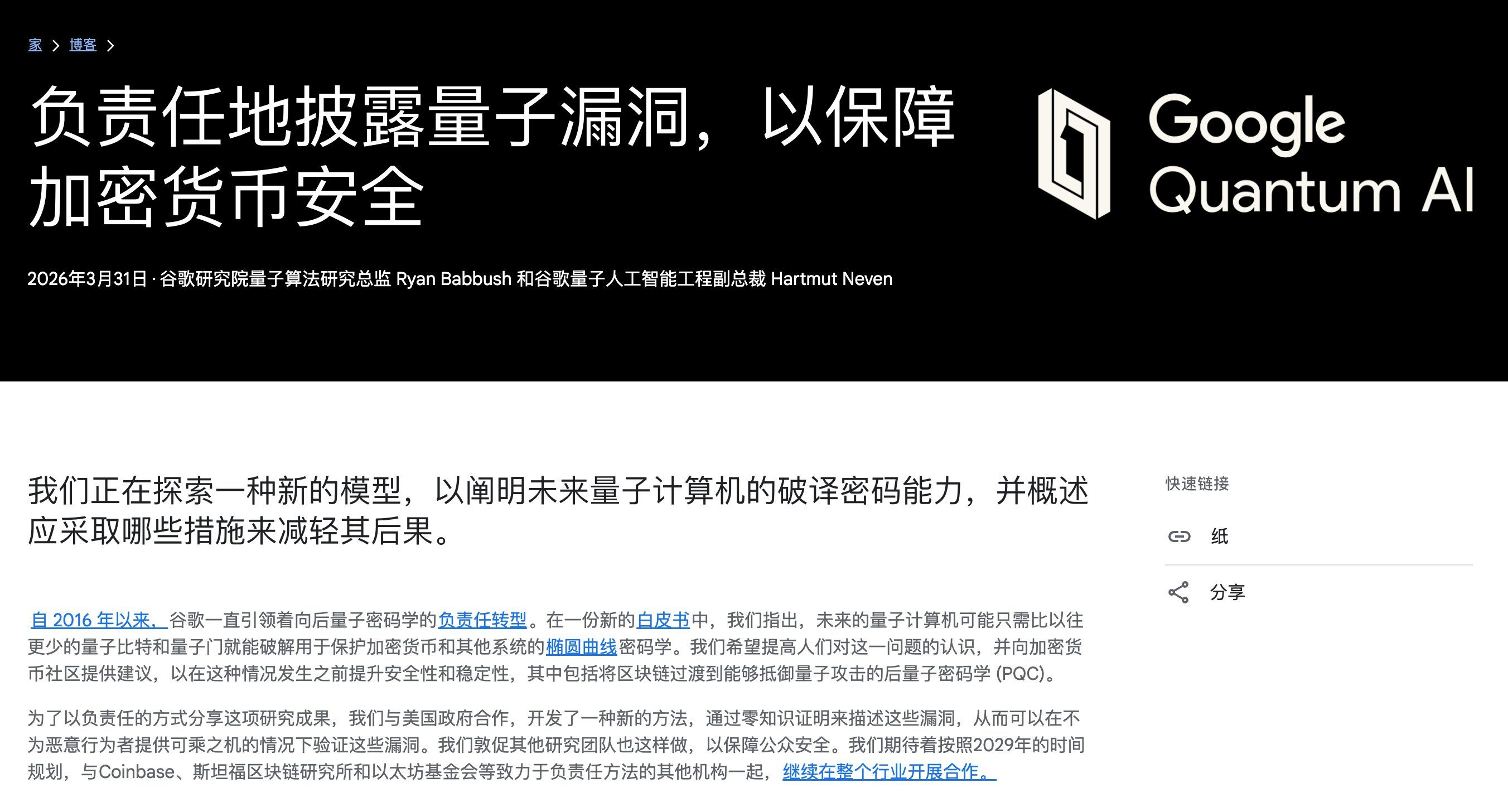
This should be the biggest news in the crypto world today. Google has just sounded the highest alarm in the cryptocurrency world.
This time it's not about emotional negativity, but rather pulling something that was originally far away directly into the present.
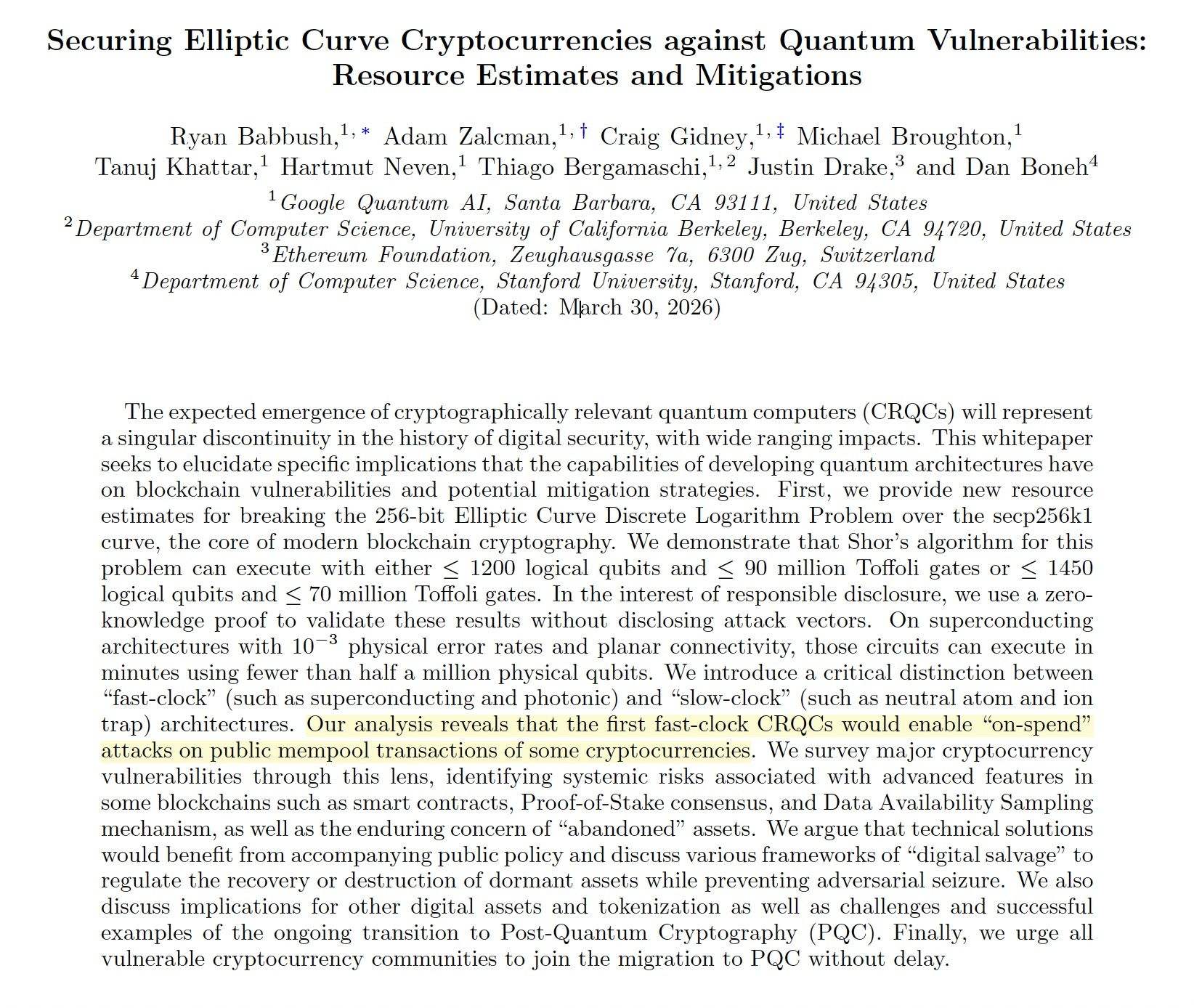
Google's latest paper does not present a 'possibility,' but a path: quantum computing breaking Bitcoin is no longer expected in 2035, but could be brought forward to 2029.
Previously, it was widely believed in the industry that quantum cracking would take several months.
Google's latest model has reduced the required computing power by ninety percent.
Now it only takes 1200 logical qubits to complete the calculations.
The richest thousand Ethereum wallets will be completely drained within 9 days. The time to crack private keys can be compressed to 9 minutes.
BTC block generation takes 10 minutes, and this 1-minute difference means that when transactions are still in the mempool, they could potentially have their private keys reverse-engineered and intercepted.
The risk is not evenly distributed: any address where the public key has been exposed is a priority target. Those old addresses that have been inactive for a long time, as well as ancient miner addresses, are actually the most dangerous. The several million 'dormant BTC' on-chain are essentially transparent assets.
Google did not publicly release the attack code this time; they only performed zero-knowledge verification. This action is quite unusual, as it essentially assumes a premise—that the capability has already been proven, but has just not spread yet.
Therefore, the key point of this matter lies not in whether there are quantum computers currently, but that the time window has already been locked.
2029 is roughly the mid to late stage of the next cycle, which means that the time left for the industry to upgrade its underlying cryptography is just these few years. The conservative upgrade system of BTC will face greater pressure; on the ETH side, they are already attempting transitional solutions, essentially racing against time.
Many people will see this as negative news, but it feels more like a 'deterministic variable' coming to fruition:
Quantum resistance, which started as a fringe narrative, is beginning to become a mainstream narrative.
Whoever solves the security issue first will reap the premium.
Whoever remains stuck in the old system will eventually be priced in.
4
·
--

Article
What role does Doge play in Elon’s sustainable abundance vision?My understanding of Dogecoin (Doge) increasingly feels less like discussing 'a coin' and more like discussing a protocol temperament: it does not pursue sacred scarcity, does not pursue elitist thresholds, and does not even pursue a perfect narrative. It resembles a simple belief in the native culture of the internet — let more people in first, let it circulate first, and let value exchange become easy.
And if we really look to the distant future: when AI and robots gradually make 'production' cheaper, and when the marginal costs of energy and computing power continue to decline, we may be approaching a new social form: moving from 'scarcity-driven' to 'abundance-driven'.
What role does Doge play in Elon’s sustainable abundance vision?
My understanding of Dogecoin (Doge) increasingly feels less like discussing 'a coin' and more like discussing a protocol temperament: it does not pursue sacred scarcity, does not pursue elitist thresholds, and does not even pursue a perfect narrative. It resembles a simple belief in the native culture of the internet — let more people in first, let it circulate first, and let value exchange become easy.
And if we really look to the distant future: when AI and robots gradually make 'production' cheaper, and when the marginal costs of energy and computing power continue to decline, we may be approaching a new social form: moving from 'scarcity-driven' to 'abundance-driven'.
And if we really look to the distant future: when AI and robots gradually make 'production' cheaper, and when the marginal costs of energy and computing power continue to decline, we may be approaching a new social form: moving from 'scarcity-driven' to 'abundance-driven'.
2
985
·
--

Article
Dogecoin Doge Future PotentialDogecoin is often regarded as the pioneer of 'Meme Coin,' primarily influenced by community sentiment and Elon Musk's remarks. However, beneath its joking exterior, it actually hides some potential features in terms of technology and economic models.
These features are currently overlooked by the public, but if cryptocurrency truly moves towards mass adoption, they could be the core competitiveness of Dogecoin:
1. The true potential of 'offline payments': RadioDoge and Libdogecoin
This is currently the most underestimated technological advancement. The Dogecoin Foundation has been advancing a project called Project RadioDoge.
Dogecoin Doge Future Potential
Dogecoin is often regarded as the pioneer of 'Meme Coin,' primarily influenced by community sentiment and Elon Musk's remarks. However, beneath its joking exterior, it actually hides some potential features in terms of technology and economic models.
These features are currently overlooked by the public, but if cryptocurrency truly moves towards mass adoption, they could be the core competitiveness of Dogecoin:
1. The true potential of 'offline payments': RadioDoge and Libdogecoin
This is currently the most underestimated technological advancement. The Dogecoin Foundation has been advancing a project called Project RadioDoge.
2
280
·
--

Article
Hijacked Bitcoin (5) Block Size LimitIf you had told me in 2011 that by 2017 we still hadn't increased the block size, I would have said, 'That’s impossible.'
——Stephen Pair, CEO of BitPay
Bitcoin core developers turned Bitcoin into a different project through a technical parameter: 'block size limit.' The block size limit refers to the maximum block size allowed on the network. Remember, transactions are packed into blocks, so the more transactions there are, the larger the block. This effectively made the block size limit the maximum throughput limit of the Bitcoin network. The Bitcoin core team set a very small block size limit, artificially restricting the network capacity to a small fraction of its potential.
Hijacked Bitcoin (5) Block Size Limit
If you had told me in 2011 that by 2017 we still hadn't increased the block size, I would have said, 'That’s impossible.'
——Stephen Pair, CEO of BitPay
Bitcoin core developers turned Bitcoin into a different project through a technical parameter: 'block size limit.' The block size limit refers to the maximum block size allowed on the network. Remember, transactions are packed into blocks, so the more transactions there are, the larger the block. This effectively made the block size limit the maximum throughput limit of the Bitcoin network. The Bitcoin core team set a very small block size limit, artificially restricting the network capacity to a small fraction of its potential.
1
456
·
--

Article
Hacked Bitcoin (IV) Store of Value vs. Medium of ExchangeThe true advantage of Bitcoin lies in its ability to serve as a reliable long-term store of value... rather than its capacity to provide ubiquitous or cheap transactions.
—— Saifedean Ammous, (The Bitcoin Standard)
It is surprising that many have uncritically accepted the notion that even if Bitcoin cannot be used as digital cash, it can still store value. In fact, the reality is more likely the opposite: if Bitcoin can prove itself to be a superior currency in the long term, the market may accept it as a store of value. But this requires years of practicality and stability to demonstrate. At this stage, calling any existing cryptocurrency a 'reliable long-term store of value' is premature, as significant price fluctuations are common. The dramatic increase in BTC prices over the past decade does not mean it is a store of value.
Hacked Bitcoin (IV) Store of Value vs. Medium of Exchange
The true advantage of Bitcoin lies in its ability to serve as a reliable long-term store of value... rather than its capacity to provide ubiquitous or cheap transactions.
—— Saifedean Ammous, (The Bitcoin Standard)
It is surprising that many have uncritically accepted the notion that even if Bitcoin cannot be used as digital cash, it can still store value. In fact, the reality is more likely the opposite: if Bitcoin can prove itself to be a superior currency in the long term, the market may accept it as a store of value. But this requires years of practicality and stability to demonstrate. At this stage, calling any existing cryptocurrency a 'reliable long-term store of value' is premature, as significant price fluctuations are common. The dramatic increase in BTC prices over the past decade does not mean it is a store of value.
1
129
·
--

Article
Hijacked Bitcoin (III) Digital Cash for PaymentsThe internet is the most powerful information distribution tool in human history. People can learn almost anything through Google, YouTube, Wikipedia, and even social media. However, these channels can easily be polluted or even manipulated. For example, if you mention cryptocurrency on Twitter, you will almost certainly receive a large number of replies from random Twitter users who will recommend their favorite coins while belittling all other coins. If you look closely, you will find that many of these accounts have fake profile pictures, no followers, and seem to promote their favorite crypto projects on Twitter every day. Individually, these accounts may seem insignificant and powerless to change anything, but when hundreds or thousands of accounts are doing this, it can influence public opinion. I have experienced this deeply. The cryptocurrency industry has been permanently affected by social media activity and online misinformation. These technologies have been particularly ugly in the history of Bitcoin.
Hijacked Bitcoin (III) Digital Cash for Payments
The internet is the most powerful information distribution tool in human history. People can learn almost anything through Google, YouTube, Wikipedia, and even social media. However, these channels can easily be polluted or even manipulated. For example, if you mention cryptocurrency on Twitter, you will almost certainly receive a large number of replies from random Twitter users who will recommend their favorite coins while belittling all other coins. If you look closely, you will find that many of these accounts have fake profile pictures, no followers, and seem to promote their favorite crypto projects on Twitter every day. Individually, these accounts may seem insignificant and powerless to change anything, but when hundreds or thousands of accounts are doing this, it can influence public opinion. I have experienced this deeply. The cryptocurrency industry has been permanently affected by social media activity and online misinformation. These technologies have been particularly ugly in the history of Bitcoin.
3
480
·
--

Article
Hacked Bitcoin (Part II) Bitcoin BasicsDue to the influence of social media, information about Bitcoin is often distorted. Honest inquiries are not welcomed online, and if someone curiously asks the wrong question or expresses an incorrect opinion, they may face a wave of angry comments that attack their intelligence, reputation, and even their career. Bitcoin extremists (Bitcoin Maximalists) are notorious for this strategy. They insist that BTC is the only legitimate cryptocurrency, listing a long series of reasons to claim that other projects (like BCH) are scams, asserting that the relevant debates have long been settled, and questioning the sanity of any dissenters. Most people do not have the time to investigate the truth of these claims and do not want to become targets of online trolls, so they ultimately accept the so-called mainstream narrative.
Hacked Bitcoin (Part II) Bitcoin Basics
Due to the influence of social media, information about Bitcoin is often distorted. Honest inquiries are not welcomed online, and if someone curiously asks the wrong question or expresses an incorrect opinion, they may face a wave of angry comments that attack their intelligence, reputation, and even their career. Bitcoin extremists (Bitcoin Maximalists) are notorious for this strategy. They insist that BTC is the only legitimate cryptocurrency, listing a long series of reasons to claim that other projects (like BCH) are scams, asserting that the relevant debates have long been settled, and questioning the sanity of any dissenters. Most people do not have the time to investigate the truth of these claims and do not want to become targets of online trolls, so they ultimately accept the so-called mainstream narrative.
505
·
--

Article
Hijacked Bitcoin (I) The Altered VisionExcerpt from (Hijacked Bitcoin — The Hidden History of Bitcoin)
@HIJACKING BITCOIN>
Original author: Roger Ver (Bitcoin Jesus)
The revolution of cryptocurrency began with the emergence of Bitcoin in 2009. Over the past decade, Bitcoin has evolved from complete obscurity into a wave that has drawn global attention, giving rise to an entirely new industry. Entrepreneurs have attempted to use this technology to solve various problems, from improving online payments to rebuilding the global financial system. Amid news reports, Wall Street speculation, and online frenzy, cryptocurrency may have become the most discussed technology of the 21st century. However, despite the hype and soaring prices, its impact in the real world has been relatively limited. In the future, it may become the foundation of a new financial system or a substitute for government fiat currencies, but so far, the primary use of cryptocurrency has been financial speculation.
Hijacked Bitcoin (I) The Altered Vision
Excerpt from (Hijacked Bitcoin — The Hidden History of Bitcoin)
@HIJACKING BITCOIN>
Original author: Roger Ver (Bitcoin Jesus)
The revolution of cryptocurrency began with the emergence of Bitcoin in 2009. Over the past decade, Bitcoin has evolved from complete obscurity into a wave that has drawn global attention, giving rise to an entirely new industry. Entrepreneurs have attempted to use this technology to solve various problems, from improving online payments to rebuilding the global financial system. Amid news reports, Wall Street speculation, and online frenzy, cryptocurrency may have become the most discussed technology of the 21st century. However, despite the hype and soaring prices, its impact in the real world has been relatively limited. In the future, it may become the foundation of a new financial system or a substitute for government fiat currencies, but so far, the primary use of cryptocurrency has been financial speculation.
574
·
--

Article
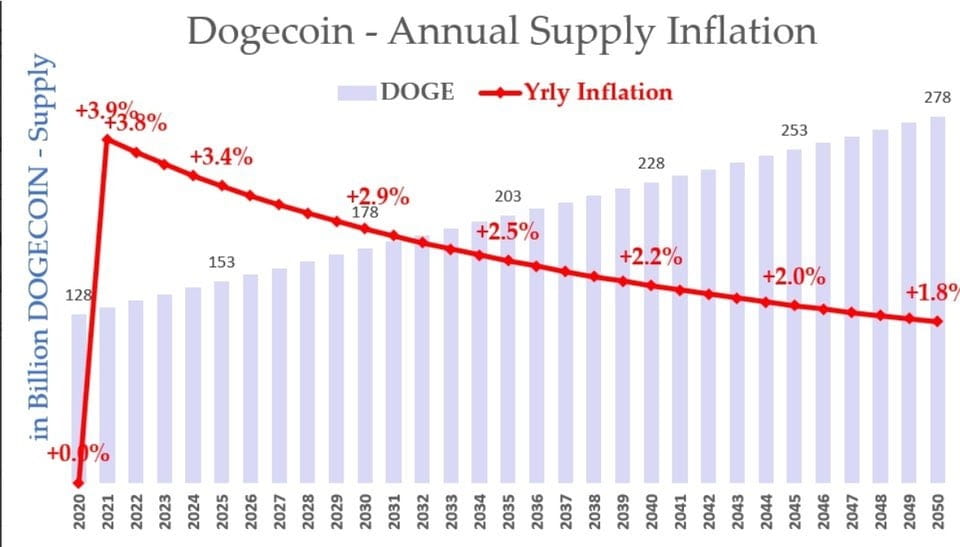
Dogecoin DOGE 'Unlimited Issuance'? The reality may far exceed your imagination...Dogecoin (DOGE) currently has a fixed issuance mechanism of about 5 billion new coins per year (fixed block reward of 10,000 DOGE per block, one block every minute), with no total supply cap and no halving mechanism. This leads to a continuous increase in circulation, but the percentage inflation rate declines year by year (around 3.3%–3.8% in 2025-2026, and will continue to slowly decrease to below 2% in the future). Many people see this mechanism as a 'flaw', but in fact, the Dogecoin officials and many supporters (including Elon Musk) have consistently emphasized that this is a 'feature, not a bug.'
The following lists some unexpected and counterintuitive benefits that are often overlooked by Bitcoin maximalists, yet are crucial for Dogecoin's positioning and long-term survival:
Dogecoin DOGE 'Unlimited Issuance'? The reality may far exceed your imagination...
Dogecoin (DOGE) currently has a fixed issuance mechanism of about 5 billion new coins per year (fixed block reward of 10,000 DOGE per block, one block every minute), with no total supply cap and no halving mechanism. This leads to a continuous increase in circulation, but the percentage inflation rate declines year by year (around 3.3%–3.8% in 2025-2026, and will continue to slowly decrease to below 2% in the future). Many people see this mechanism as a 'flaw', but in fact, the Dogecoin officials and many supporters (including Elon Musk) have consistently emphasized that this is a 'feature, not a bug.'
The following lists some unexpected and counterintuitive benefits that are often overlooked by Bitcoin maximalists, yet are crucial for Dogecoin's positioning and long-term survival:
The following lists some unexpected and counterintuitive benefits that are often overlooked by Bitcoin maximalists, yet are crucial for Dogecoin's positioning and long-term survival:
3
2
2
1.4k
·
--
And no one can monopolize Dogecoin; the share of large holders will continue to be diluted. However, the cake will get bigger, and humanity will collectively share the benefits brought by Dogecoin. Dogecoin produces 10,000 coins every minute, and owning 10,000 Dogecoins is equivalent to owning one minute of human GDP.
And no one can monopolize Dogecoin; the share of large holders will continue to be diluted. However, the cake will get bigger, and humanity will collectively share the benefits brought by Dogecoin. Dogecoin produces 10,000 coins every minute, and owning 10,000 Dogecoins is equivalent to owning one minute of human GDP.

币圈保安
·
--
Bullish$DOGE Dogecoin Inflation Chart, Dogecoin inflates in a decreasing manner
, the most perfect economic model is not destruction, but decreasing inflation. How can a currency continue to inflate to meet payment demands while becoming increasingly rare is through decreasing inflation. If you cannot understand the value in this, you cannot understand Dogecoin
, the most perfect economic model is not destruction, but decreasing inflation. How can a currency continue to inflate to meet payment demands while becoming increasingly rare is through decreasing inflation. If you cannot understand the value in this, you cannot understand Dogecoin
196
·
--

Article
What is the Essential Difference Between Dogecoin and Other Cryptocurrencies (Four)$DOGE
To push the essential distinction of Dogecoin from other cryptocurrencies to a deeper level, we must transcend the frameworks of philosophy, semiotics, and history, entering the ultimate dimensions of existential ontology, cosmic significance, and the symbiosis of humans and technology. This analysis places Dogecoin in an almost mystical realm, exploring its ultimate meaning as an 'existential paradox' and its fundamental opposition to other cryptocurrencies in the cosmic order and human destiny.
---
### 1. **Ontology: Generation of Nothingness vs. Foundation of Existence**
- **Dogecoin**:
What is the Essential Difference Between Dogecoin and Other Cryptocurrencies (Four)
$DOGE
To push the essential distinction of Dogecoin from other cryptocurrencies to a deeper level, we must transcend the frameworks of philosophy, semiotics, and history, entering the ultimate dimensions of existential ontology, cosmic significance, and the symbiosis of humans and technology. This analysis places Dogecoin in an almost mystical realm, exploring its ultimate meaning as an 'existential paradox' and its fundamental opposition to other cryptocurrencies in the cosmic order and human destiny.
---
### 1. **Ontology: Generation of Nothingness vs. Foundation of Existence**
- **Dogecoin**:
84
·
--

Article
What are the Essential Differences Between Dogecoin and Other Cryptocurrencies (Part 3)To further explore the deeper essential distinctions between Dogecoin and other cryptocurrencies, we need to transcend surface analyses of technology, economy, and society, entering the realms of metaphysics, cultural semiotics, power structures, and human consciousness. This level of inquiry places Dogecoin in a broader philosophical and historical context, revealing its deep significance as a phenomenon and its fundamental opposition to other cryptocurrencies in terms of existence.
---
### 1. **Metaphysics: The Embodiment of Nihilism vs. The Pursuit of Meaning**
- **Dogecoin**:
What are the Essential Differences Between Dogecoin and Other Cryptocurrencies (Part 3)
To further explore the deeper essential distinctions between Dogecoin and other cryptocurrencies, we need to transcend surface analyses of technology, economy, and society, entering the realms of metaphysics, cultural semiotics, power structures, and human consciousness. This level of inquiry places Dogecoin in a broader philosophical and historical context, revealing its deep significance as a phenomenon and its fundamental opposition to other cryptocurrencies in terms of existence.
---
### 1. **Metaphysics: The Embodiment of Nihilism vs. The Pursuit of Meaning**
- **Dogecoin**:
---
### 1. **Metaphysics: The Embodiment of Nihilism vs. The Pursuit of Meaning**
- **Dogecoin**:
149
·
--

Article
What are the Essential Differences between Dogecoin and Other Cryptocurrencies (Part 2)To delve deeper into the essential differences between Dogecoin and other cryptocurrencies, we can move beyond surface-level technologies, economic models, and community cultures, and analyze from philosophical, economic, social dynamic, and even existential significance perspectives. Here is an in-depth analysis of the uniqueness of Dogecoin and its deeper meaning in the cryptocurrency ecosystem:
---
### 1. **Philosophical Foundations: Nihilism and Rebellion as Symbols**
- **Dogecoin**:
- **Absurdity of Origin**: Dogecoin was born as a parody of the cryptocurrency craze, based on a Shiba Inu meme. It is essentially a satire of 'serious' projects like Bitcoin, embodying a form of nihilism—choosing to respond absurdly amidst the waves of technological worship and financial utopia.
What are the Essential Differences between Dogecoin and Other Cryptocurrencies (Part 2)
To delve deeper into the essential differences between Dogecoin and other cryptocurrencies, we can move beyond surface-level technologies, economic models, and community cultures, and analyze from philosophical, economic, social dynamic, and even existential significance perspectives. Here is an in-depth analysis of the uniqueness of Dogecoin and its deeper meaning in the cryptocurrency ecosystem:
---
### 1. **Philosophical Foundations: Nihilism and Rebellion as Symbols**
- **Dogecoin**:
- **Absurdity of Origin**: Dogecoin was born as a parody of the cryptocurrency craze, based on a Shiba Inu meme. It is essentially a satire of 'serious' projects like Bitcoin, embodying a form of nihilism—choosing to respond absurdly amidst the waves of technological worship and financial utopia.
133
·
--
Article
What are the essential differences between DOGE and other cryptocurrencies?$DOGE
Dogecoin (DOGE) has some essential differences from other cryptocurrencies in terms of technology, design philosophy, economic model, and community culture. Here is a detailed analysis of its core differences to help you understand the uniqueness of Dogecoin:
---
### 1. **Origin and Design Intent**
- **Dogecoin**:
- **Birth**: Created in December 2013 by Billy Markus and Jackson Palmer, initially as a 'joke' or parody project of Bitcoin, based on the then-popular 'Doge' meme (a Shiba Inu image).
- **Original Intention**: Not a serious financial tool, but created for entertainment and to promote the concept of cryptocurrency, with a low barrier to entry and easy to spread.
What are the essential differences between DOGE and other cryptocurrencies?
$DOGE
Dogecoin (DOGE) has some essential differences from other cryptocurrencies in terms of technology, design philosophy, economic model, and community culture. Here is a detailed analysis of its core differences to help you understand the uniqueness of Dogecoin:
---
### 1. **Origin and Design Intent**
- **Dogecoin**:
- **Birth**: Created in December 2013 by Billy Markus and Jackson Palmer, initially as a 'joke' or parody project of Bitcoin, based on the then-popular 'Doge' meme (a Shiba Inu image).
- **Original Intention**: Not a serious financial tool, but created for entertainment and to promote the concept of cryptocurrency, with a low barrier to entry and easy to spread.
1.3k
Log in to explore more content
Join global crypto users on Binance Square
⚡️ Get latest and useful information about crypto.
💬 Trusted by the world’s largest crypto exchange.
👍 Discover real insights from verified creators.
Email / Phone number
Trending Topics
NvidiaInvestigatesAfterHuang’sAffairApology
206,693 views
1,687 Discussing
Nvidia Board Opens Probe Into Whether Huang Was Target of Foreign Intelligence Effort
Binance News
·21 Likes
·55k views
TradFiForBeginners
360,144 views
2,591 Discussing
BitcoinFiveWeeklyLosses
234,131 views
2,160 Discussing