
GAS WOLF
8.9k Posts

GAS WOLF
I’m driven by purpose. I’m building something bigger than a moment..
Open Trade
High-Frequency Trader
1.9 Years
152 Following
22.1K+ Followers
18.4K+ Liked
Posts
Portfolio
All
Quotes
Live
$DEBIT is showing strong momentum after a +23.7% move, but the 1-minute chart is currently consolidating around $1.557.
Entry Zone: $1.550–$1.558
TP1: $1.570
TP2: $1.578
TP3: $1.585
SL: $1.548
Key level: $1.562. A clean breakout and hold above it could open the path toward the higher targets.
Entry Zone: $1.550–$1.558
TP1: $1.570
TP2: $1.578
TP3: $1.585
SL: $1.548
Key level: $1.562. A clean breakout and hold above it could open the path toward the higher targets.
$DOS is showing a short-term bounce after dropping to $0.28574, with price recovering toward $0.28736.
Entry Zone: $0.2865–$0.2880
TP1: $0.2895
TP2: $0.2920
TP3: $0.2960
SL: $0.2848
The immediate test is around $0.2888–$0.2895. A clean break and hold above that area could give the bounce more room to run.
If $0.2857 breaks again, the bullish setup weakens significantly.
Entry Zone: $0.2865–$0.2880
TP1: $0.2895
TP2: $0.2920
TP3: $0.2960
SL: $0.2848
The immediate test is around $0.2888–$0.2895. A clean break and hold above that area could give the bounce more room to run.
If $0.2857 breaks again, the bullish setup weakens significantly.
$COOKIE is holding a potentially interesting continuation zone.
Entry: 0.0120–0.0135
TP1: 0.0148
TP2: 0.0162
TP3: 0.0185
SL: 0.0105
A sustained hold above 0.012 could keep the bullish structure intact.$COOKIE
Entry: 0.0120–0.0135
TP1: 0.0148
TP2: 0.0162
TP3: 0.0185
SL: 0.0105
A sustained hold above 0.012 could keep the bullish structure intact.$COOKIE
$GIGGLE continues to attract momentum after its strong move.
Entry: 38.50–41.50
TP1: 45.50
TP2: 52.00
TP3: 60.00
SL: 34.00
This is a momentum setup, so waiting for a dip can offer better risk control than chasing.
$GIGGLE
Entry: 38.50–41.50
TP1: 45.50
TP2: 52.00
TP3: 60.00
SL: 34.00
This is a momentum setup, so waiting for a dip can offer better risk control than chasing.
$GIGGLE
$OPG is attempting a breakout from its recent structure.
Entry: 0.0940–0.1010
TP1: 0.112
TP2: 0.128
TP3: 0.150
SL: 0.0820
A clean hold above resistance would strengthen the bullish setup.
Entry: 0.0940–0.1010
TP1: 0.112
TP2: 0.128
TP3: 0.150
SL: 0.0820
A clean hold above resistance would strengthen the bullish setup.
$BROCCOLI714 is moving aggressively with strong short-term momentum.
Entry: 0.0185–0.0205
TP1: 0.0225
TP2: 0.0250
TP3: 0.0290
SL: 0.0165
Low-priced momentum trades can move fast both ways. Confirmation matters.
$BROCCOLI714
Entry: 0.0185–0.0205
TP1: 0.0225
TP2: 0.0250
TP3: 0.0290
SL: 0.0165
Low-priced momentum trades can move fast both ways. Confirmation matters.
$BROCCOLI714
$PEPE is trading around 0.00000391, up 2.09%.
Trade Setup: Entry: 0.00000370–0.00000395 Targets: 0.00000430 / 0.00000480 / 0.00000550 Stop Loss: 0.00000330 Bias: Bullish R:R: ~1:2.5
Small-cap volatility makes position sizing especially important here. The setup remains constructive while the 0.00000370 region holds, with 0.00000430 as the first upside checkpoint.
These are chart-based educational setups from the supplied snapshot, not financial advice. Levels can change quickly as price moves.$PEPE
Trade Setup: Entry: 0.00000370–0.00000395 Targets: 0.00000430 / 0.00000480 / 0.00000550 Stop Loss: 0.00000330 Bias: Bullish R:R: ~1:2.5
Small-cap volatility makes position sizing especially important here. The setup remains constructive while the 0.00000370 region holds, with 0.00000430 as the first upside checkpoint.
These are chart-based educational setups from the supplied snapshot, not financial advice. Levels can change quickly as price moves.$PEPE
$DOGE is holding around 0.08907 after a 2.89% gain.
Trade Setup: Entry: 0.087–0.090 Targets: 0.094 / 0.102 / 0.110 Stop Loss: 0.080 Bias: Bullish R:R: ~1:2.4
The 0.087 area is the important support zone. Holding it keeps the path toward 0.094 open, while a clean breakout could accelerate the move.
$DOGE
Trade Setup: Entry: 0.087–0.090 Targets: 0.094 / 0.102 / 0.110 Stop Loss: 0.080 Bias: Bullish R:R: ~1:2.4
The 0.087 area is the important support zone. Holding it keeps the path toward 0.094 open, while a clean breakout could accelerate the move.
$DOGE
$TUT is trading around 0.04856, down 4.60%.
Trade Setup: Entry: 0.047–0.050 Targets: 0.043 / 0.038 / 0.033 Stop Loss: 0.055 Bias: Bearish R:R: ~1:2.2
Lower highs are keeping pressure on the chart. A rejection from the 0.047–0.050 region could favor continuation toward 0.043 and 0.038.$TUT
Trade Setup: Entry: 0.047–0.050 Targets: 0.043 / 0.038 / 0.033 Stop Loss: 0.055 Bias: Bearish R:R: ~1:2.2
Lower highs are keeping pressure on the chart. A rejection from the 0.047–0.050 region could favor continuation toward 0.043 and 0.038.$TUT
$HEMI is showing the strongest percentage move among these names, up 37.76% at 0.01047.
Trade Setup: Entry: 0.0098–0.0105 Targets: 0.0118 / 0.0132 / 0.0150 Stop Loss: 0.0085 Bias: Bullish R:R: ~1:2.8
Strong momentum, but after a 37% move, pullback risk is high. The setup becomes more attractive if price consolidates rather than immediately extending vertically.$HEMI
Trade Setup: Entry: 0.0098–0.0105 Targets: 0.0118 / 0.0132 / 0.0150 Stop Loss: 0.0085 Bias: Bullish R:R: ~1:2.8
Strong momentum, but after a 37% move, pullback risk is high. The setup becomes more attractive if price consolidates rather than immediately extending vertically.$HEMI
$ENA is trading near 0.1695 with a strong +17.87% move.
Trade Setup: Entry: 0.162–0.170 Targets: 0.185 / 0.205 / 0.225 Stop Loss: 0.150 Bias: Bullish R:R: ~1:2.5
The key is 0.170. A confirmed break and hold above that level could extend the current momentum toward 0.185 and 0.205.$ENA
Trade Setup: Entry: 0.162–0.170 Targets: 0.185 / 0.205 / 0.225 Stop Loss: 0.150 Bias: Bullish R:R: ~1:2.5
The key is 0.170. A confirmed break and hold above that level could extend the current momentum toward 0.185 and 0.205.$ENA
$ONG is the clear laggard here, down 43.08% around 0.12680.
Trade Setup: Entry: 0.124–0.130 Targets: 0.110 / 0.098 / 0.085 Stop Loss: 0.145 Bias: Bearish R:R: ~1:2.3
This is a defensive setup rather than a momentum chase. If the 0.124–0.130 area fails to hold, downside continuation becomes the cleaner scenario.$ONG
Trade Setup: Entry: 0.124–0.130 Targets: 0.110 / 0.098 / 0.085 Stop Loss: 0.145 Bias: Bearish R:R: ~1:2.3
This is a defensive setup rather than a momentum chase. If the 0.124–0.130 area fails to hold, downside continuation becomes the cleaner scenario.$ONG
$BMT is one of the strongest movers on the board, up 22.18% at 0.02617.
Trade Setup: Entry: 0.024–0.026 Targets: 0.029 / 0.032 / 0.036 Stop Loss: 0.021 Bias: Bullish R:R: ~1:2.6
Momentum is strong, but volatility is elevated. A pullback into 0.024–0.026 would be preferable to entering after an extended candle.$BMT
Trade Setup: Entry: 0.024–0.026 Targets: 0.029 / 0.032 / 0.036 Stop Loss: 0.021 Bias: Bullish R:R: ~1:2.6
Momentum is strong, but volatility is elevated. A pullback into 0.024–0.026 would be preferable to entering after an extended candle.$BMT
$XRP is trading around 1.4531 after gaining 3.50%.
Trade Setup: Entry: 1.40–1.46 Targets: 1.55 / 1.70 / 1.85 Stop Loss: 1.30 Bias: Bullish R:R: ~1:2.3
The 1.46 area is the immediate trigger. Holding above it could bring 1.55 into focus, while losing 1.40 weakens the setup.$XRP
Trade Setup: Entry: 1.40–1.46 Targets: 1.55 / 1.70 / 1.85 Stop Loss: 1.30 Bias: Bullish R:R: ~1:2.3
The 1.46 area is the immediate trigger. Holding above it could bring 1.55 into focus, while losing 1.40 weakens the setup.$XRP
$SOL is showing stronger momentum at 109.19, up 9.49%.
Trade Setup: Entry: 105–109 Targets: 115 / 123 / 132 Stop Loss: 98 Bias: Bullish R:R: ~1:2.7
SOL has already made a strong move, so chasing is risky. A controlled retest around the entry zone would provide a cleaner setup.
Trade Setup: Entry: 105–109 Targets: 115 / 123 / 132 Stop Loss: 98 Bias: Bullish R:R: ~1:2.7
SOL has already made a strong move, so chasing is risky. A controlled retest around the entry zone would provide a cleaner setup.
$ETH is around 2,515, currently up 0.85%.
Trade Setup: Entry: 2,460–2,520 Targets: 2,650 / 2,780 / 2,950 Stop Loss: 2,320 Bias: Bullish R:R: ~1:2.4
The important level is 2,520. A sustained move above it could shift momentum toward 2,650 and beyond.
Trade Setup: Entry: 2,460–2,520 Targets: 2,650 / 2,780 / 2,950 Stop Loss: 2,320 Bias: Bullish R:R: ~1:2.4
The important level is 2,520. A sustained move above it could shift momentum toward 2,650 and beyond.
$BTC is sitting around 80,285.61, up 2.03%.
Trade Setup: Entry: 79,000–80,000 Targets: 82,000 / 84,500 / 87,000 Stop Loss: 77,200 Bias: Bullish R:R: ~1:2.6
Holding the 79K area keeps the bullish structure intact. A clean move above 82K could open the door toward the higher targets.
Trade Setup: Entry: 79,000–80,000 Targets: 82,000 / 84,500 / 87,000 Stop Loss: 77,200 Bias: Bullish R:R: ~1:2.6
Holding the 79K area keeps the bullish structure intact. A clean move above 82K could open the door toward the higher targets.
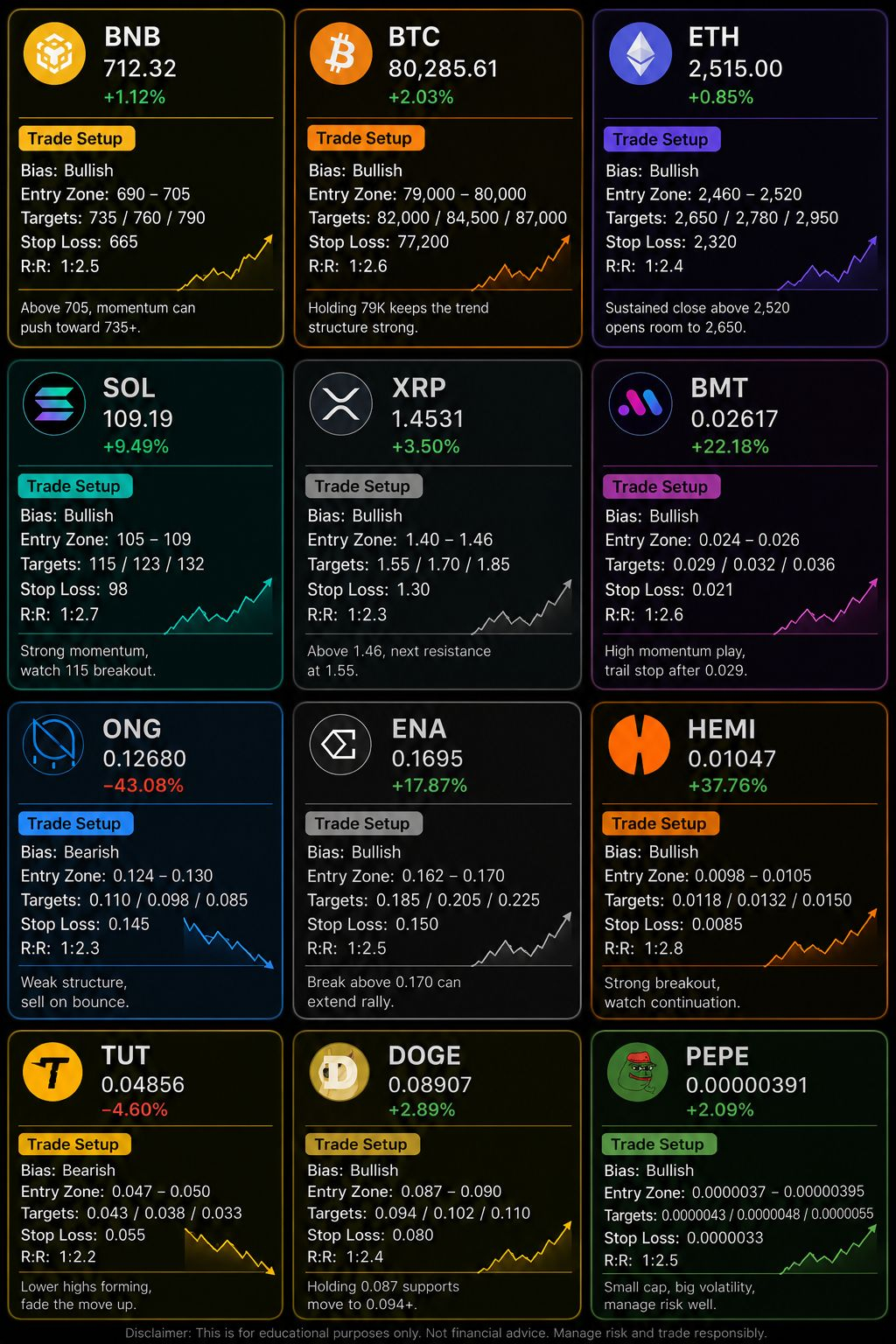
$BNB is trading around 712.32 with a modest +1.12% move.
Trade Setup: Entry: 690–705 Targets: 735 / 760 / 790 Stop Loss: 665 Bias: Bullish R:R: ~1:2.5
Above 705, momentum could strengthen toward 735+. The key is whether buyers can defend the entry zone on any pullback.
Trade Setup: Entry: 690–705 Targets: 735 / 760 / 790 Stop Loss: 665 Bias: Bullish R:R: ~1:2.5
Above 705, momentum could strengthen toward 735+. The key is whether buyers can defend the entry zone on any pullback.
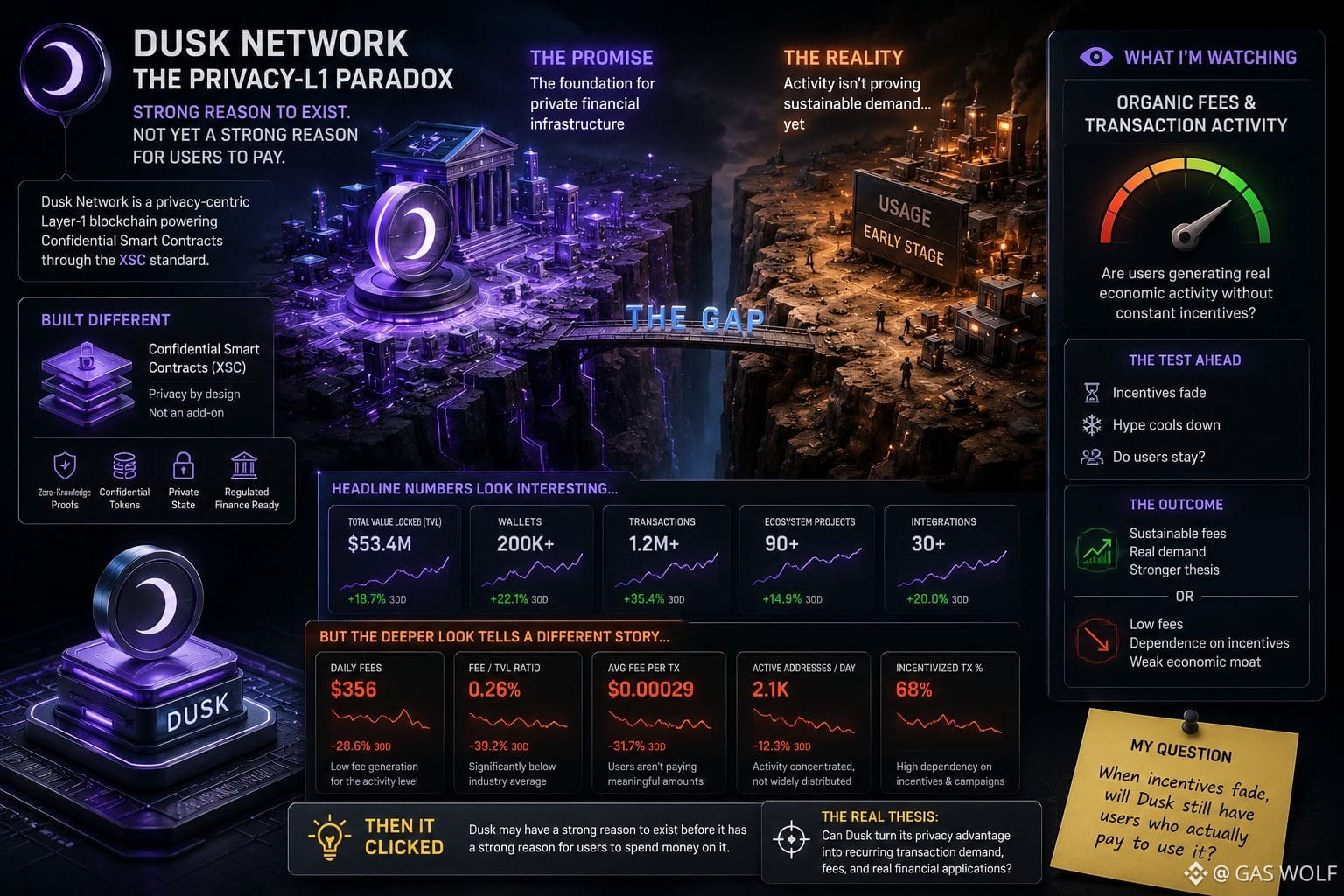
I kept digging into Dusk because the privacy-L1 angle sounds a lot more interesting than the usual “another blockchain” story.
What caught my attention was the architecture itself. Dusk is building around confidential smart contracts and its XSC standard, which is a pretty serious bet on privacy becoming useful for financial markets rather than just a nice feature.
At first, that felt obviously bullish.
Then I stopped looking at the tech and started looking for the thing that actually matters: economic activity.
That’s where the picture gets less clean.
A network can have clever infrastructure, new wallets, integrations and a growing ecosystem, but none of that tells me whether people are consistently willing to pay to use it.
I had to reread the docs after staring at the data for a while, because the contradiction is easy to miss: Dusk may have a strong reason to exist before it has a strong reason for users to spend money on it.
Then it clicked.
The real thesis isn’t “privacy is important.” I already believe that.
The thesis is whether Dusk can turn that privacy advantage into recurring transaction demand, fees and actual financial applications that stick around after incentives or launch-driven activity cool off.
That’s the part I’m not ready to call proven yet.
So I’m watching one thing closely: organic fee generation relative to network activity.
If usage keeps growing without needing constant incentives, the architecture starts looking much more valuable.
If it doesn’t, then maybe Dusk is solving a problem that makes perfect technical sense… but still hasn’t found enough people willing to pay for it.
$BTR
#dusk $DUSK @Dusk
$BMT
What caught my attention was the architecture itself. Dusk is building around confidential smart contracts and its XSC standard, which is a pretty serious bet on privacy becoming useful for financial markets rather than just a nice feature.
At first, that felt obviously bullish.
Then I stopped looking at the tech and started looking for the thing that actually matters: economic activity.
That’s where the picture gets less clean.
A network can have clever infrastructure, new wallets, integrations and a growing ecosystem, but none of that tells me whether people are consistently willing to pay to use it.
I had to reread the docs after staring at the data for a while, because the contradiction is easy to miss: Dusk may have a strong reason to exist before it has a strong reason for users to spend money on it.
Then it clicked.
The real thesis isn’t “privacy is important.” I already believe that.
The thesis is whether Dusk can turn that privacy advantage into recurring transaction demand, fees and actual financial applications that stick around after incentives or launch-driven activity cool off.
That’s the part I’m not ready to call proven yet.
So I’m watching one thing closely: organic fee generation relative to network activity.
If usage keeps growing without needing constant incentives, the architecture starts looking much more valuable.
If it doesn’t, then maybe Dusk is solving a problem that makes perfect technical sense… but still hasn’t found enough people willing to pay for it.
$BTR
#dusk $DUSK @Dusk
$BMT
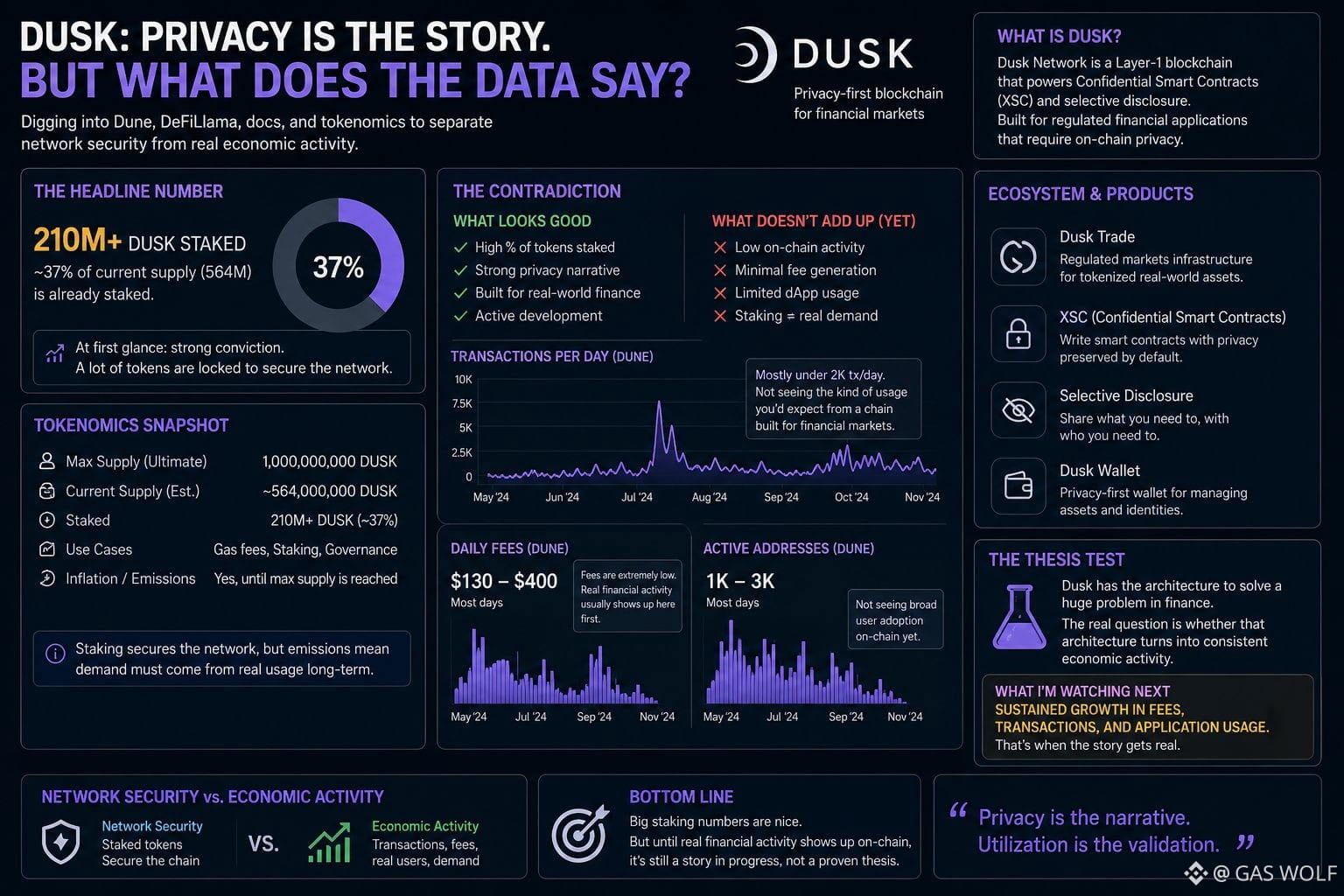
I’ve been digging into Dusk for a while, and honestly, the privacy angle is what pulled me in first.
It makes sense. If you’re trying to bring real financial markets on-chain, you probably don’t want every trade, position, and balance sitting in public for everyone to inspect.
Dusk is built around that problem with confidential smart contracts and selective disclosure.
Sounds pretty compelling.
But then I started looking at the token side, and that’s where I paused.
A lot of DUSK is staked. At first, I saw that as a strong signal. People are locking up their tokens to help secure the network, so clearly there’s some conviction there.
Then I thought about what staking actually tells me.
It tells me people are securing the chain.
It doesn’t necessarily tell me that people are using the chain.
That difference is easy to miss.
For Dusk, I think the real test is whether all this infrastructure eventually turns into actual financial activity: more transactions, more fees, more applications, and ultimately real users doing things that require privacy.
That’s the part I’m not willing to assume yet.
The technology is interesting because the problem it’s trying to solve is very real. But having the right architecture and getting institutions to actually use it are two completely different milestones.
So I’m not watching the staking number as closely anymore.
I’m watching the boring stuff: fees, transactions, and application usage.
If those start moving meaningfully, then the Dusk thesis gets a lot more interesting.
Until then, I’m still digging.
$ONG
#dusk $DUSK @Dusk
$TMX
It makes sense. If you’re trying to bring real financial markets on-chain, you probably don’t want every trade, position, and balance sitting in public for everyone to inspect.
Dusk is built around that problem with confidential smart contracts and selective disclosure.
Sounds pretty compelling.
But then I started looking at the token side, and that’s where I paused.
A lot of DUSK is staked. At first, I saw that as a strong signal. People are locking up their tokens to help secure the network, so clearly there’s some conviction there.
Then I thought about what staking actually tells me.
It tells me people are securing the chain.
It doesn’t necessarily tell me that people are using the chain.
That difference is easy to miss.
For Dusk, I think the real test is whether all this infrastructure eventually turns into actual financial activity: more transactions, more fees, more applications, and ultimately real users doing things that require privacy.
That’s the part I’m not willing to assume yet.
The technology is interesting because the problem it’s trying to solve is very real. But having the right architecture and getting institutions to actually use it are two completely different milestones.
So I’m not watching the staking number as closely anymore.
I’m watching the boring stuff: fees, transactions, and application usage.
If those start moving meaningfully, then the Dusk thesis gets a lot more interesting.
Until then, I’m still digging.
$ONG
#dusk $DUSK @Dusk
$TMX
Log in to explore more content