
布鲁斯陈
188 Posts

布鲁斯陈
Report
Block User
区块链、Web3、深入探索者,顶级一二级资源,财经行业新人。
54 Following
202 Followers
135 Liked
Posts
All
Videos
·
--
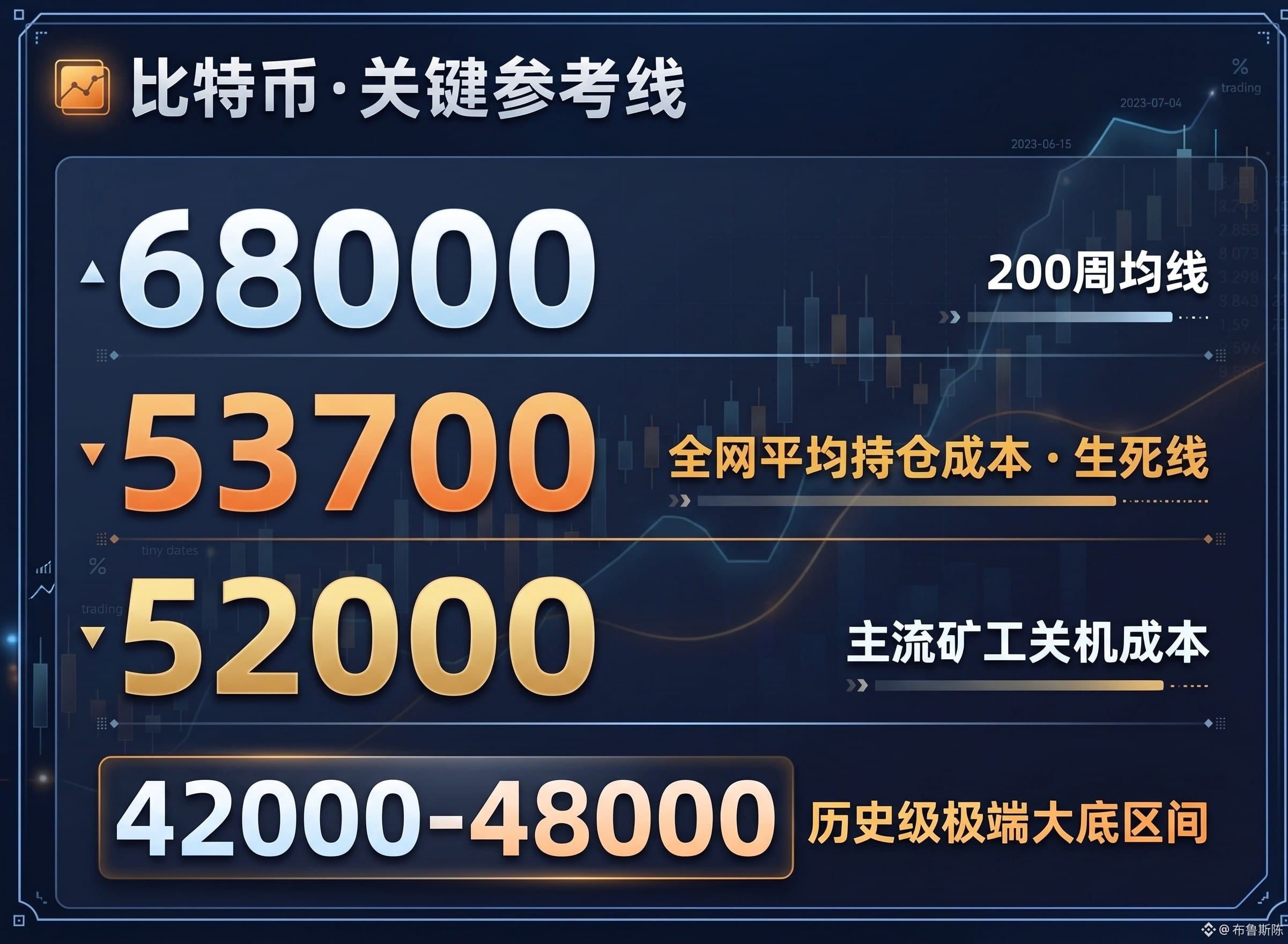
I recently took an in-depth look back at the on-chain average cost basis for $BTC and the bottom ranges of past bear markets. Putting the data together makes the key support levels in the current market very clear.
First, the four most important cost-based support levels right now (from highest to lowest):
First support level (200-week moving average): around $68,000
Second support level (network-wide average holding cost / Realized Price): around $53,700
Third support level (shutdown cost for major miners): around $52,000
Historic extreme bottom range: $42,000–$48,000
Looking back at the past few major bear markets, the pattern each time Bitcoin formed a true bottom has been remarkably consistent:
Price has to fall below the network-wide average holding cost, wiping out the last remaining unrealized gains in the market. Only when the entire network is underwater and major miners are forced to shut down and capitulate can potential selling pressure in the market truly be exhausted.
Back to the current market, the logic is clear:
Early signals are here: The on-chain MVRV indicator has now fallen to around 1.1, suggesting that most of the market bubble has already been squeezed out and triggering an early bottom-watch signal.
Key battleground ($52,000–$53,700): $53,700 is the network-wide breakeven level, and $52,000 is the miners’ lifeline. If prices can stabilize here, that would mark a typical cycle bottom.
Extreme capitulation scenario ($42,000–$48,000): If an extreme macro or liquidity black swan triggers a cascade, then based on the 10%–20% drop below the network-wide cost basis seen in previous bear markets, the historic extreme bottom would be between $42,000 and $48,000. This level would not only wipe out all unrealized gains, but also decisively breach the miners’ shutdown threshold, making it a golden opportunity to accumulate in batches with confidence.
Personal strategy reference: Rather than betting on the exact bottom, it may be better to split your dip-buying funds into several portions, establish a starter position around $53,700, and save the larger allocation for an extreme wick below $48,000.
(Note: The data above is based on publicly available on-chain metric statistics and is intended only to discuss cycle dynamics and trading strategies. It does not constitute investment advice.)
$BTC
·
--
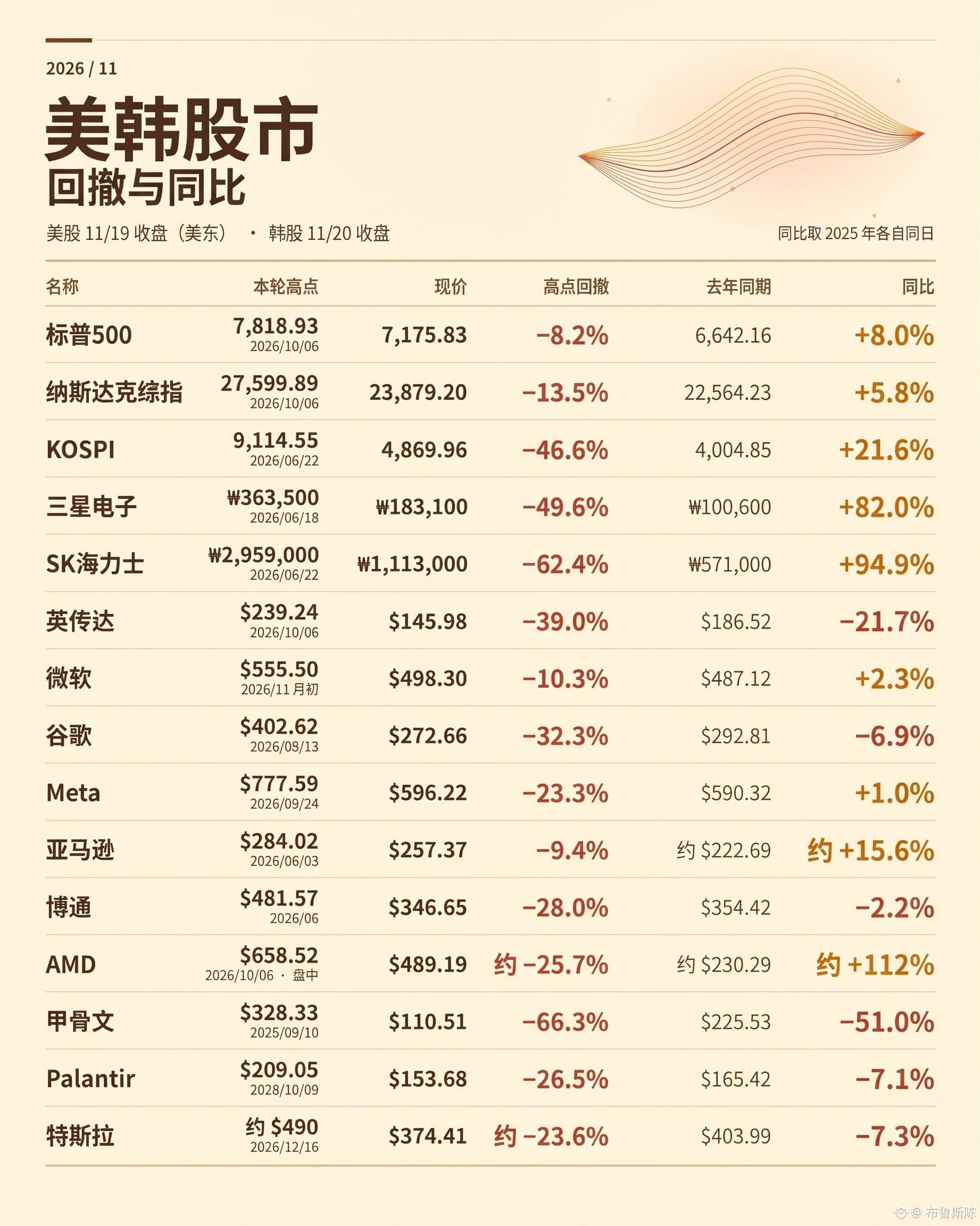
整理数据时发现两个很残酷的现实
情绪退潮比想象中更快:前期涨得越猛的算力、存储龙头,杀估值的时候回撤幅度也越惨。
去年同期转跌是个重要心理关口:意味着过去一年任何时间点追高进场的资金,目前几乎全线被套。
现在全市场都在问同一个问题:黄金底真的来了吗?还是说这只是半山腰?最美的夏天还会来吗?
$NVDA
整理数据时发现两个很残酷的现实
情绪退潮比想象中更快:前期涨得越猛的算力、存储龙头,杀估值的时候回撤幅度也越惨。
去年同期转跌是个重要心理关口:意味着过去一年任何时间点追高进场的资金,目前几乎全线被套。
现在全市场都在问同一个问题:黄金底真的来了吗?还是说这只是半山腰?最美的夏天还会来吗?
$NVDA
情绪退潮比想象中更快:前期涨得越猛的算力、存储龙头,杀估值的时候回撤幅度也越惨。
去年同期转跌是个重要心理关口:意味着过去一年任何时间点追高进场的资金,目前几乎全线被套。
现在全市场都在问同一个问题:黄金底真的来了吗?还是说这只是半山腰?最美的夏天还会来吗?
$NVDA
1
1
1.6k
·
--
Confirmed! In a recent interview, Dario Amodei was directly called out by the host: “You’re Jensen Huang’s public opponent on the issue of chip exports.” He answered without hesitation: Yes!
The host put the pointed question to him directly:
“NVIDIA is an important investor in your company, but you’ve consistently opposed Jensen Huang, arguing against exports of advanced chips to China. What do you make of this controversy?”
Dario didn’t dodge the question at all. He responded frankly:
“Yeah. We’ve worked with NVIDIA for a long time, including on data centers. But of course, we don’t always agree with our partners’ policy views. We have our own beliefs and positions based on the direction of technological development, and we’ll continue to stand by them. Some of our partners disagree.”
In plain English: business is business, and principles are principles. Even if you’re a major investor, I won’t compromise on what matters most!
#Antropic #黄仁勋
59
·
--
Today, Anthropic, the company behind Claude (ticker symbol ANT), officially rang the Nasdaq opening bell, raising $81.3 billion and setting a record for the largest IPO in U.S. history. Shares surged more than 34% at the opening on their first day of trading, putting the company’s total valuation on the verge of $1.5 trillion!
At the bell-ringing ceremony, CEO Dario Amodei made a startling prediction with a straight face: future powerful AI models could compress a century of human scientific and medical progress into just ten years!
From protein folding and novel drug design to cancer genetics and clinical trial management, frontline scientists have already found that Claude is dramatically shortening research cycles that once took years—to a fraction of the time they used to take.
“I believe that collaboration between sufficiently powerful AI and humans could compress a century of progress into ten years.” Although he carefully added that “these are only early results for now,” with the capital ammunition of a $1.5 trillion valuation at the ready, the era of medical miracles seems to have been brought right before our eyes.$ANTB #Anthropic创纪录上市,1.5万亿美元市值合理吗?
1
166
·
--
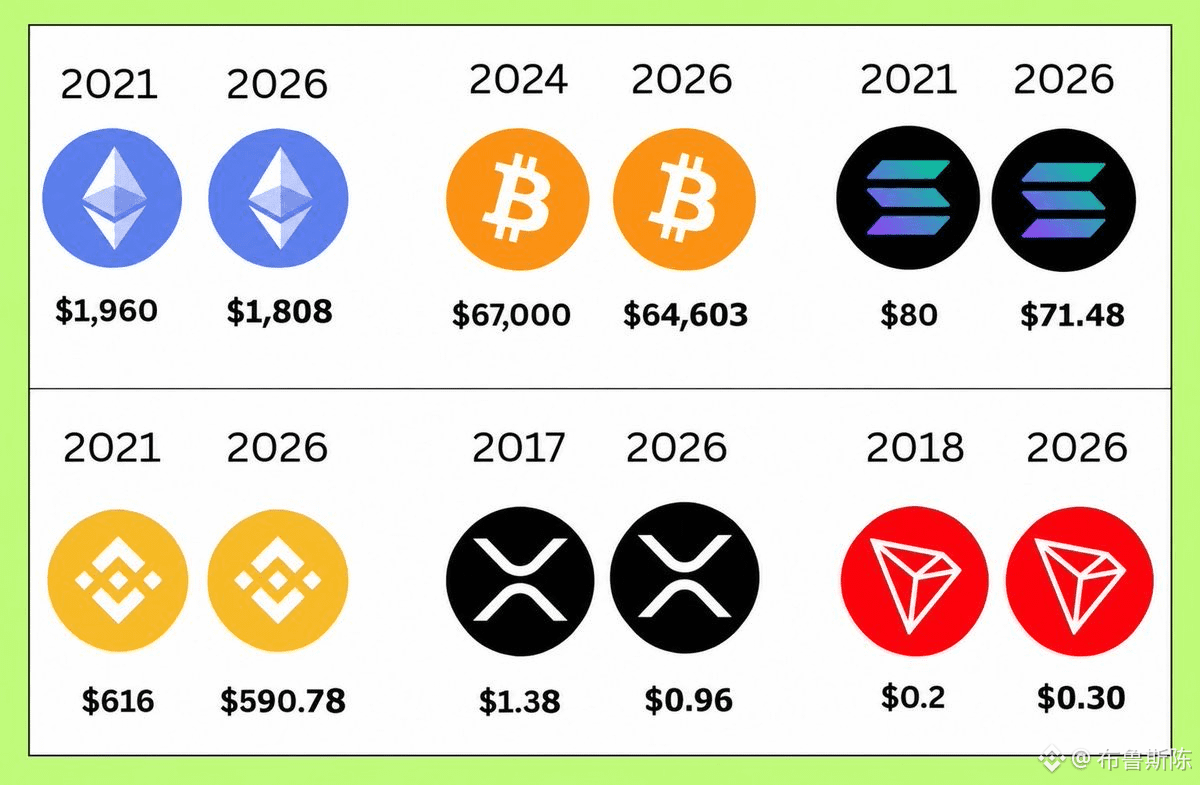
I didn't expect that after all these years, the best performer would be Brother Sun's $TRX .
I didn't expect that after all these years, the best performer would be Brother Sun's $TRX .
1
994
·
--
Verified
How Duan Yongping Avoided NVIDIA’s 31% Plunge: Covered Call and Sell Put Strategies in Practice
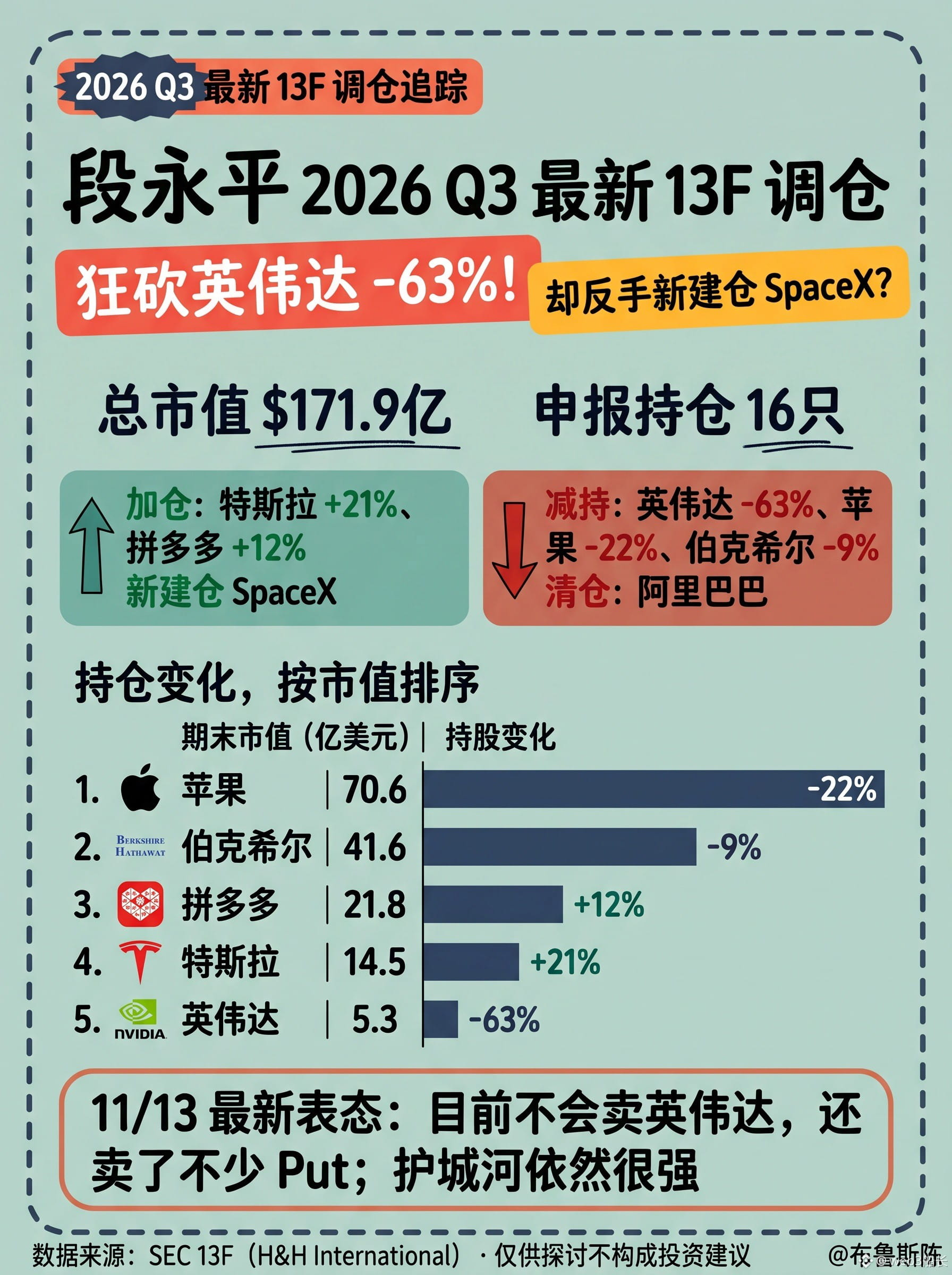
The best strategies are often simple. When Duan Yongping’s 2026 Q3 13F report came out last night, everyone wondered whether he had somehow gotten insider information in advance. After all, he had just cut his NVIDIA position by 63% in Q3, and barely a month later, Jensen Huang was suddenly caught up in a resignation controversy and the stock plunged more than 31%. The timing seemed almost too uncanny.
But when you put together his comments on Xueqiu and his options trades, there’s no “seeing the future”—just the kind of absolute discipline every trader should have:
Selling at the top? Actually, passive assignment through Covered Calls
At the height of AI euphoria in Q1 this year, he bought as many as 13.84 million shares. But once the stock started surging in Q2, he began consistently selling call options (Covered Calls) at elevated prices. When the stock rose above the strike price, the shares were automatically assigned. Essentially, he thought the stock had gotten ahead of its fundamentals in the short term, so he collected the premiums and locked in profits according to plan—without trying to catch the very last bite.
Buying the dip instead of running after the plunge? Collecting premiums with Sell Puts during the panic
After NVIDIA plunged more than 31%, he not only held on to the remaining 3% of his position, but also quietly sold put options (Sell Puts) as implied volatility (IV) and option premiums surged, preparing to buy the shares back at a lower price with a greater margin of safety. In his words: “The price has already reflected all of that. I want to see whether the company can get through the crisis.” (Those who trade crypto options or dual-currency investments should be very familiar with the idea of selling puts to collect premiums during a panic.)
Where did all that cash from the sales go?
The 13F shows that in Q3 he not only reduced his holdings in NVIDIA, Google (-41.5%), and Apple (-21.76%), but also fully exited Alibaba and stablecoin giant Circle (CRCL). He put much of the freed-up capital into PDD Holdings (adding nearly 2.97 million shares, making it his third-largest holding) and Tesla (adding nearly 700,000 shares)—on one side, a consumer leader with powerful cash flow; on the other, Elon Musk’s ecosystem, with its competitive advantages in robotics and aerospace.
There’s no need to assume anyone can predict the future. What matters is the discipline to lock in profits amid euphoria and step in to buy during panic.
(Note: The data is compiled from publicly available SEC 13F filings and public statements. This is for discussion of trading strategies only and is not investment advice.)
#NVDA
2
7.3k
·
--
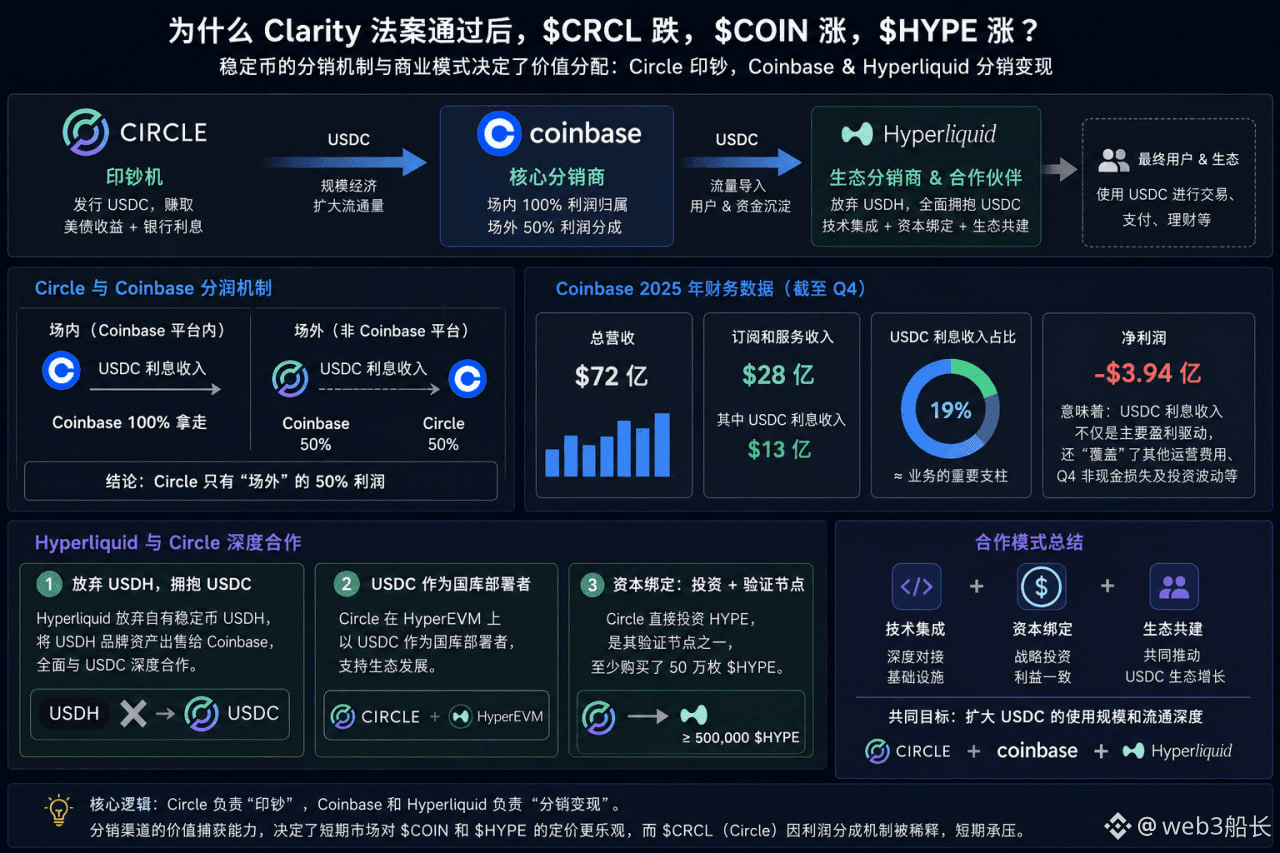
One chart to understand the hype surge reasons $HYPE #Hyperliquid
One chart to understand the hype surge reasons $HYPE #Hyperliquid
2
349
·
--
The final stage of Bitcoin's total supply: 95% has been mined, the endgame of 114 years of 'stock game' is set
1. The ultimate evolution of scarcity: annual inflation rate officially drops below 1%
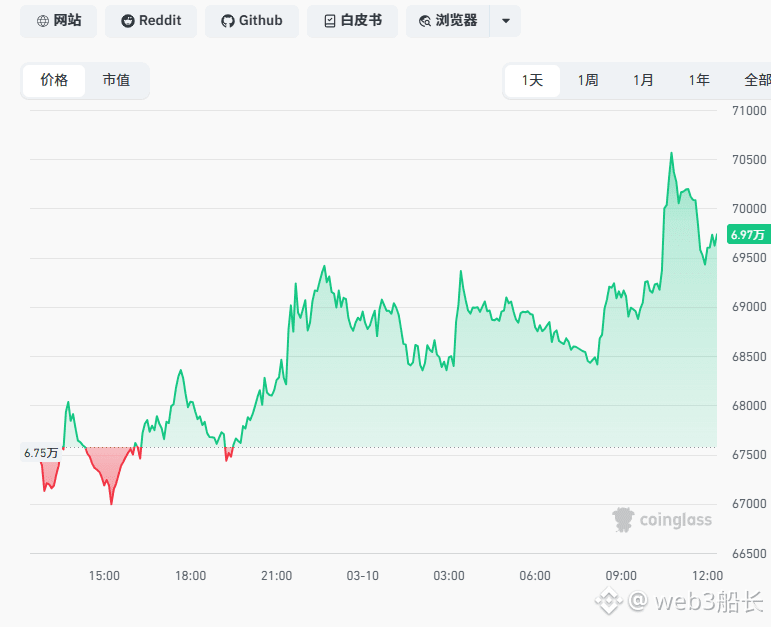
As of March 9, 2026, the circulation of Bitcoin exceeds 20 million, meaning that 95.24% of the 21 million cap has entered the market.
Non-linear output: The first 20 million took 17 years, and the remaining less than 1 million will be slowly produced over 114 years, until 2140.
Surpassing gold: With the block reward reduced to 3.125, Bitcoin's annualized inflation rate has dropped below 1%. Compared to an average annual mining rate of about 1.5% for gold, Bitcoin has established the highest transparency 'digital scarcity' status in human history.
2. The truth about effective circulation: exhausted liquidity and institutional plunder
When discussing the total supply, a key fact is: on-paper supply does not equal effective circulation.
Permanently vanished chips: It is estimated that about 2.3 million to 3.7 million BTC are permanently unusable due to lost private keys and other reasons, with the actual effective supply only between 16 million to 17.7 million.
Holder game: Currently, about 61% of Bitcoin has not moved for over a year, and exchange balances have dropped to a historic low of 2.4 million. Amid the massive absorption by spot ETFs and the sharp reduction in new supply, liquidity is falling into a state of extreme tightening.
3. The thrilling leap of mining: transitioning from 'block rewards' to 'fee-driven'
The 20 million milestone marks the official countdown for miners' income model.
Incentive mechanism transformation: By the 2040s, daily new output will be below 30. Mining must complete a structural transition from relying on block subsidies to fully relying on transaction fees within the next few decades.
Evolution of financial settlement layer: Bitcoin must evolve from a mere 'store of value' to a 'financial settlement layer', enhancing the gold content of each block through the improvement of ecological prosperity, such as Lightning Network and inscription protocol.
Practical strategies and thoughts:
Valuation undervaluation: Although long-term indicators show Bitcoin is at historical highs, considering the continuous shrinkage of effective supply, the scarcity premium has not been fully priced in.
Ecological focus: Changes in miners' income structure will spur the explosion of Bitcoin Layer 2 and related infrastructure, which is also the underlying logic worth long-term attention for new infrastructure such as @FabricFND and $ROBO .
{spot}(BTCUSDT)
The final stage of Bitcoin's total supply: 95% has been mined, the endgame of 114 years of 'stock game' is set
1. The ultimate evolution of scarcity: annual inflation rate officially drops below 1%
As of March 9, 2026, the circulation of Bitcoin exceeds 20 million, meaning that 95.24% of the 21 million cap has entered the market.
Non-linear output: The first 20 million took 17 years, and the remaining less than 1 million will be slowly produced over 114 years, until 2140.
Surpassing gold: With the block reward reduced to 3.125, Bitcoin's annualized inflation rate has dropped below 1%. Compared to an average annual mining rate of about 1.5% for gold, Bitcoin has established the highest transparency 'digital scarcity' status in human history.
2. The truth about effective circulation: exhausted liquidity and institutional plunder
When discussing the total supply, a key fact is: on-paper supply does not equal effective circulation.
Permanently vanished chips: It is estimated that about 2.3 million to 3.7 million BTC are permanently unusable due to lost private keys and other reasons, with the actual effective supply only between 16 million to 17.7 million.
Holder game: Currently, about 61% of Bitcoin has not moved for over a year, and exchange balances have dropped to a historic low of 2.4 million. Amid the massive absorption by spot ETFs and the sharp reduction in new supply, liquidity is falling into a state of extreme tightening.
3. The thrilling leap of mining: transitioning from 'block rewards' to 'fee-driven'
The 20 million milestone marks the official countdown for miners' income model.
Incentive mechanism transformation: By the 2040s, daily new output will be below 30. Mining must complete a structural transition from relying on block subsidies to fully relying on transaction fees within the next few decades.
Evolution of financial settlement layer: Bitcoin must evolve from a mere 'store of value' to a 'financial settlement layer', enhancing the gold content of each block through the improvement of ecological prosperity, such as Lightning Network and inscription protocol.
Practical strategies and thoughts:
Valuation undervaluation: Although long-term indicators show Bitcoin is at historical highs, considering the continuous shrinkage of effective supply, the scarcity premium has not been fully priced in.
Ecological focus: Changes in miners' income structure will spur the explosion of Bitcoin Layer 2 and related infrastructure, which is also the underlying logic worth long-term attention for new infrastructure such as @Fabric Foundation and $ROBO .
256
·
--
What is BTW? Backed by Binance, a deep dissection of the hundredfold logic of native BTC DeFi infrastructure
1. Technical Narrative: Completely liberating the trillion-dollar BTC liquidity with 'pure bloodlines'
Bitway ($BTW) is by no means an air meme, but is positioned as a Layer 1 infrastructure native to Bitcoin. Its core moat lies in:
Decentralizing cross-chain bridges: Allowing native BTC to directly participate in on-chain lending and payments without having to wrap it as wBTC, completely avoiding the security risks of cross-chain bridges.
Flagship empowerment: BitwayFinance, as the world's first non-custodial lending protocol for native BTC, addresses the long-standing pain point in the Bitcoin ecosystem of 'having assets but no liquidity.'
Top-tier background: With a pure Binance Labs gene, it has successfully been selected for the YZiLabs EASY Residency incubation program and received strategic investment. Behind the 207.19% full-cycle increase is the strongest fundamental narrative of native Bitcoin DeFi.
2. Token Economics: An underestimated valuation pit of 50 million USD
Supply Structure: Total supply of 10 billion tokens, with the first phase circulating about 2 billion tokens (20% share).
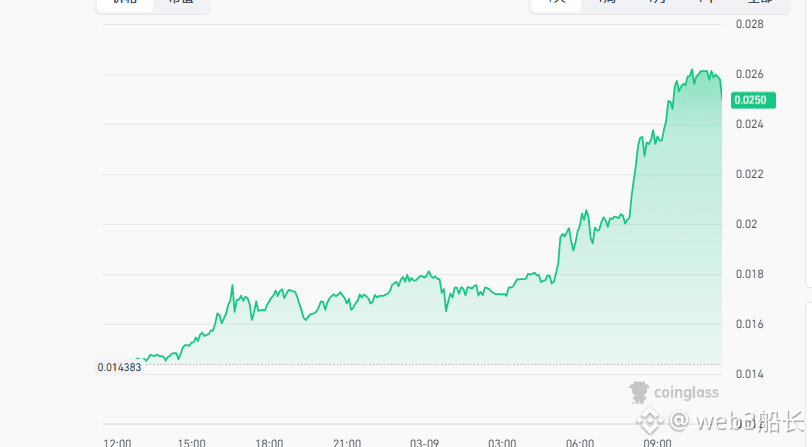
Market Cap Insight: At 0.0253 USD, the initial circulating market cap is only about 55 to 57 million USD, with a fully diluted valuation (FDV) of about 260 million USD.
Practical Value: BTW carries core functions such as gas fee payments, node staking, liquidity incentives, and governance rights. In the infrastructure L1 track, it currently remains in a significant valuation pit.
3. Trading Recommendations: Building path under strong spot logic
Liquidity Screening: Spot trading volume has exceeded 50 million USD, with liquidity concentrated on BingX and MEXC. Given its Binance incubation background, future expectations of listing on first-tier exchanges present the greatest premium dividends.
Rejecting Blind High Pursuits: Early Alpha or Booster participants have extremely high floating profits, and one must be cautious of profit-taking.
Grid Defense: It is recommended to divide funds into 3-5 portions, waiting for emotional cooling after a rapid rise, and gradually buy into spot positions at key support levels, becoming friends with time.
$BTW #BTW
{alpha}(560x444045b0ee1ee319a660a5e3d604ca0ffa35acaa)
What is BTW? Backed by Binance, a deep dissection of the hundredfold logic of native BTC DeFi infrastructure
1. Technical Narrative: Completely liberating the trillion-dollar BTC liquidity with 'pure bloodlines'
Bitway ($BTW ) is by no means an air meme, but is positioned as a Layer 1 infrastructure native to Bitcoin. Its core moat lies in:
Decentralizing cross-chain bridges: Allowing native BTC to directly participate in on-chain lending and payments without having to wrap it as wBTC, completely avoiding the security risks of cross-chain bridges.
Flagship empowerment: BitwayFinance, as the world's first non-custodial lending protocol for native BTC, addresses the long-standing pain point in the Bitcoin ecosystem of 'having assets but no liquidity.'
Top-tier background: With a pure Binance Labs gene, it has successfully been selected for the YZiLabs EASY Residency incubation program and received strategic investment. Behind the 207.19% full-cycle increase is the strongest fundamental narrative of native Bitcoin DeFi.
2. Token Economics: An underestimated valuation pit of 50 million USD
Supply Structure: Total supply of 10 billion tokens, with the first phase circulating about 2 billion tokens (20% share).
Market Cap Insight: At 0.0253 USD, the initial circulating market cap is only about 55 to 57 million USD, with a fully diluted valuation (FDV) of about 260 million USD.
Practical Value: BTW carries core functions such as gas fee payments, node staking, liquidity incentives, and governance rights. In the infrastructure L1 track, it currently remains in a significant valuation pit.
3. Trading Recommendations: Building path under strong spot logic
Liquidity Screening: Spot trading volume has exceeded 50 million USD, with liquidity concentrated on BingX and MEXC. Given its Binance incubation background, future expectations of listing on first-tier exchanges present the greatest premium dividends.
Rejecting Blind High Pursuits: Early Alpha or Booster participants have extremely high floating profits, and one must be cautious of profit-taking.
Grid Defense: It is recommended to divide funds into 3-5 portions, waiting for emotional cooling after a rapid rise, and gradually buy into spot positions at key support levels, becoming friends with time.
$BTW #BTW
12
Log in to explore more content
Join global crypto users on Binance Square
⚡️ Get latest and useful information about crypto.
💬 Trusted by the world’s largest crypto exchange.
👍 Discover real insights from verified creators.
Email / Phone number