
MC-ky
171 Posts

MC-ky
Report
Block User
Occasional Trader
1.7 Years
36 Following
71 Followers
31 Liked
Posts
All
Quotes
·
--
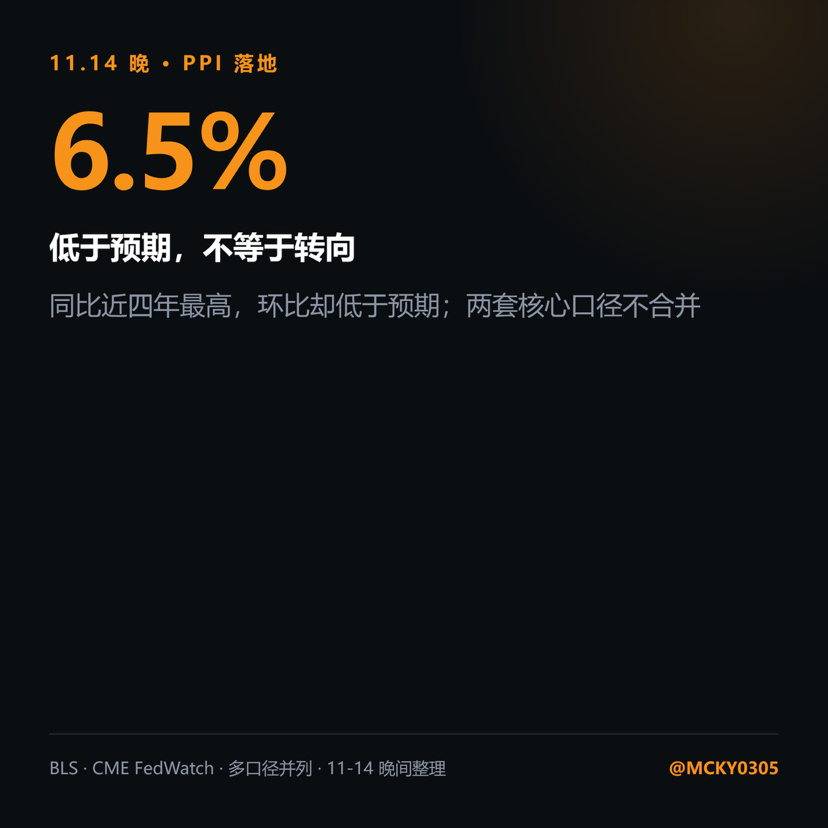
6.6% didn’t arrive; 6.5% did.
The two drafts last night stated the forecast: October PPI at 6.6% year over year and +0.4% month over month. Tonight’s figures came in at 6.5% year over year and +0.3% month over month, both below expectations. But officials also said the annual increase was the largest since November 2022. Below expectations doesn’t mean a reversal; first, be clear about which figure came in low.
The core figure needs another layer of breakdown. One report says that “excluding food, energy, and trade services,” it was +0.5% month over month and +4.9% over 12 months; others say that “excluding food and energy,” it was +0.3% month over month and 5.0% year over year, with the previous figure also revised from 0.7% to 0.8%. Different exclusions mean different denominators, so you can’t subtract them—and don’t rush to say core inflation cooled too.
For the same data, there are at least four sets of rate-hike odds: 89.7%, 93.4%, and 88.5%, while another figure of 84.7% was recorded before the release; one source also directly says that “25 basis points are fully priced in.” The times and sources differ, so don’t add them up or present them as odds that kept rising. The day’s rally in equity futures and gold and silver, alongside one report saying the 10-year Treasury yield fell and another saying it rose to 5.125%, reflects events occurring around the same time, not cause and effect.
For BTC, Saturday’s readings also differ: weak trading around 68.5K, a headline saying it fell below 67,000, and the 11-13 figures of 69,376 and 69,050. The timestamps differ, so none should be presented as the current price. ETF outflows—-1.854 billion on 11-14, -10.7 billion over one week, -23.5 billion over two weeks, and about -23.5 billion for IBIT over 11 consecutive trading days—have different starting dates and sources, so they can’t be added together either.
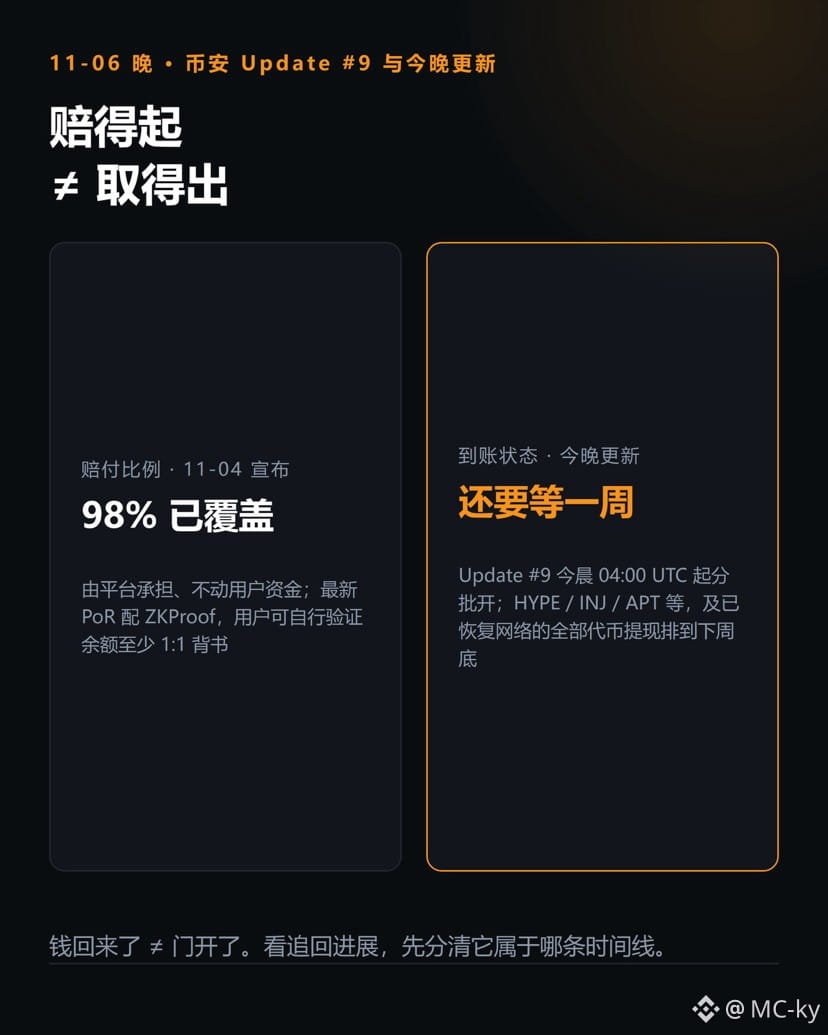
Don’t confuse the two updates: Binance said today that a zero-knowledge proof has been generated, allowing users to independently verify 1:1 reserves; it also said that 87 network withdrawals were restored this week, with the rest targeted for restoration by the end of next week. Verifiability doesn’t mean funds have been recovered, nor that all withdrawals are back online.
Still ahead: Nvidia’s earnings on 11-17, the minutes on 11-18, PCE on 11-25, the rate decision on 12-09, and the CPI report resuming year-over-year comparisons on 12-10. One data point is in; the answers are still to come.
66
·
--
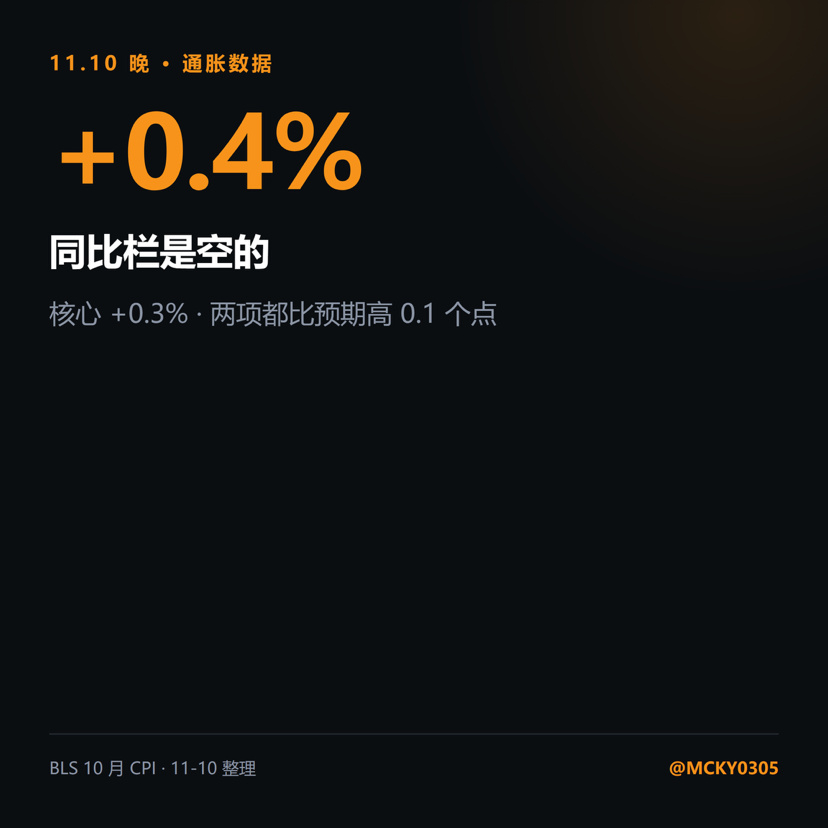
📌 On November 10, the U.S. Bureau of Labor Statistics released October CPI: the overall index rose 0.4% month over month, and core CPI rose 0.3%. Both were 0.1 percentage point above market expectations. The report included neither overall nor core year-over-year figures. The agency explained that complete prices were not collected during the federal government shutdown in October 2025, leaving no comparable base, so it did not publish annual increases.
🔍 “Year-over-year figures not published” and “year-over-year change was zero” are two completely different things. Year-over-year compares October this year with October last year. The figure for last year is missing, so the subtraction cannot be done; the result is not zero. The seasonally adjusted month-over-month figures were released as usual. They measure the change between two consecutive months and do not require data from the same month last year. So this report can answer “How much did prices rise from last month to this month?” but not “How much higher are they than a year ago?” Treating these as two answers to the same question means reading the wrong cell.
⚠️ Three points you can verify for yourself: First, 0.4% and 0.3% are the published figures; 0.3% and 0.2% are the expectations; and 3.8% and 2.7%, which circulated before the release, are estimates by institutions of annual increases, not official figures. Second, neither estimates nor the “increase so far this year” cited by media can replace an actual published year-over-year figure. Third, PPI is due Friday and the minutes are due November 18. Neither will provide the missing year-over-year figures, so don’t wait for the wrong release.
A missing cell doesn’t mean the value in it is zero; it just means that this time, no one can fill it in.
59
·
--
Bitcoin has been stuck below $76,000 this week, nearing its fifth losing week—but altcoins are looking much worse.
NEAR, Bitcoin Cash, Hyperliquid, and Stellar are down more than 10% this week. ETH and BNB have fallen less, while TRON and Zcash are actually up. This divergence doesn’t mean the market is stabilizing; it means big money is selectively pulling out.
More concerning is that the money the market needs most—on-chain liquidity—is shrinking. Some data shows stablecoin supply contracted by about $5 billion in a week, while trading volumes on major exchanges halved. Without fresh liquidity, any rebound is just a hollow rally. When trading volume halves, even small orders can move prices, so account for more slippage with stop-losses and limit orders.
Weekend market depth is thin. Monday brings the hard data: ETF flows, CPI expectations, and whether stablecoins are flowing back in.
Are you watching the charts this weekend, or tuning out completely? $BTC
{spot}(BTCUSDT)
Bitcoin has been stuck below $76,000 this week, nearing its fifth losing week—but altcoins are looking much worse.
NEAR, Bitcoin Cash, Hyperliquid, and Stellar are down more than 10% this week. ETH and BNB have fallen less, while TRON and Zcash are actually up. This divergence doesn’t mean the market is stabilizing; it means big money is selectively pulling out.
More concerning is that the money the market needs most—on-chain liquidity—is shrinking. Some data shows stablecoin supply contracted by about $5 billion in a week, while trading volumes on major exchanges halved. Without fresh liquidity, any rebound is just a hollow rally. When trading volume halves, even small orders can move prices, so account for more slippage with stop-losses and limit orders.
Weekend market depth is thin. Monday brings the hard data: ETF flows, CPI expectations, and whether stablecoins are flowing back in.
Are you watching the charts this weekend, or tuning out completely? $BTC
234
·
--
Verified
Binance says its reserves are 1:1. This time, you don’t have to take its word for it—you can check for yourself.
The latest version of its PoR includes ZKProof, allowing users to verify whether their balances are backed at least 1:1. That’s different from simply “taking a look at an audit report”: an audit report shows that a snapshot at a particular point in time checks out, while zero-knowledge proofs let everyone verify their own data without making the entire ledger public or trusting a third party.
But there are three things it doesn’t prove:
First, it proves that balances are backed, not that withdrawals are available right now. Update #9 is still rolling out in phases, and some assets won’t be available until next weekend.
Second, it proves what’s on the asset side, not that the liabilities are complete—this assumes that the snapshot included every user’s balance.
Third, it proves things only at the time of verification, not every minute afterward.
The takeaway: verifiable ≠ withdrawable, and ≠ immune to problems.
For ordinary users, there are two concrete things you can do today: go to the PoR page, find your balance, run a verification, and save a screenshot; then check whether the tokens you hold are on the recovery list. Do these separately—don’t lump them together as “I’m safe now.”
Have you verified your balance? Where did you get stuck?
1.5k
·
--
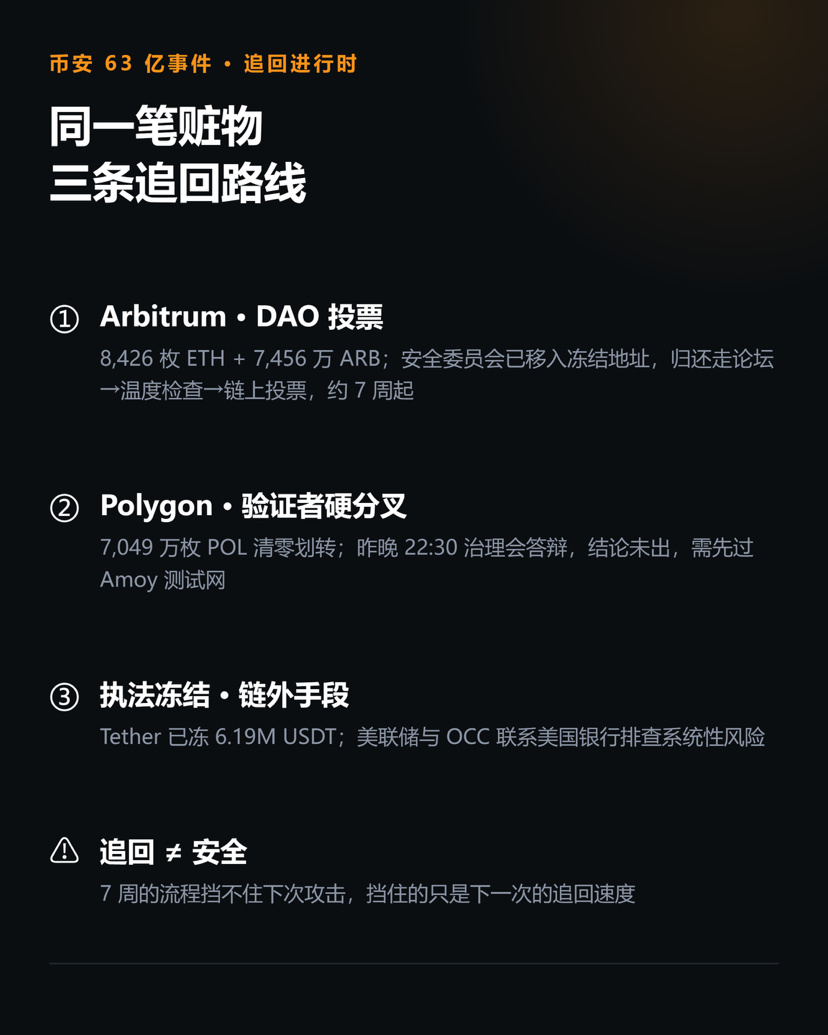
📌 The same batch of stolen assets now has three recovery efforts underway at once.
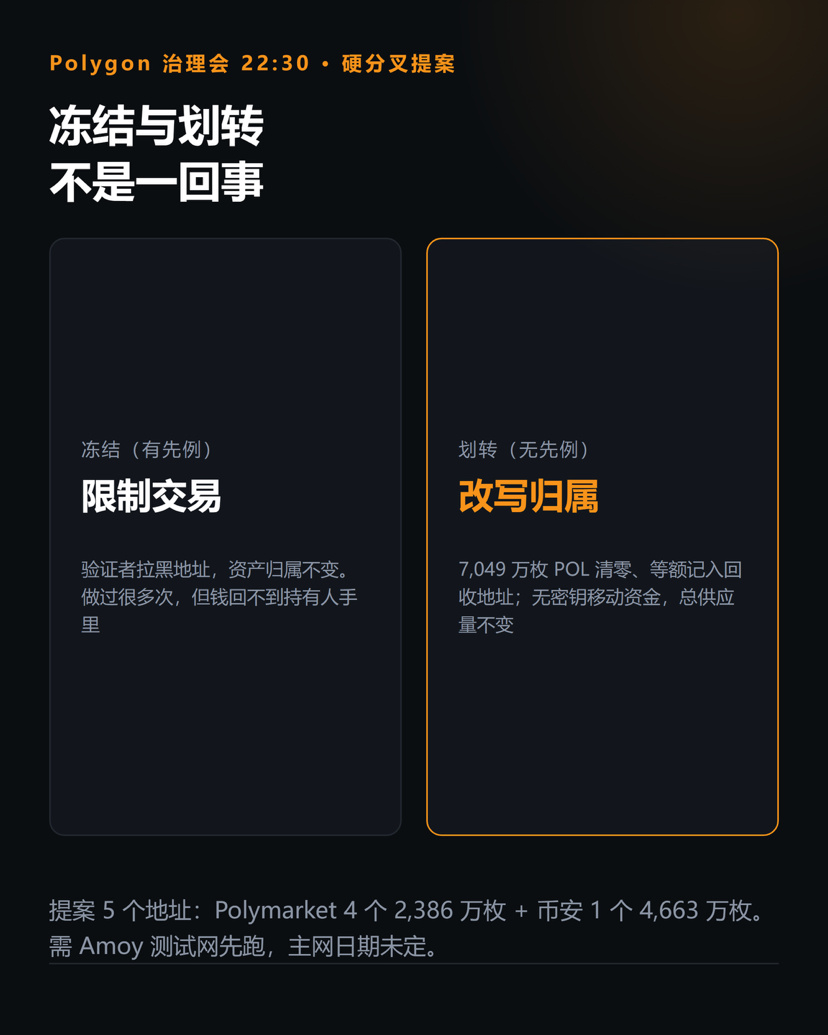
🔍 The first is on Arbitrum: Binance submitted a proposal to the governance forum seeking the return of 8,426 frozen ETH and 74.56 million ARB. It must go through forum discussion, a Snapshot temperature check, and an on-chain vote, with the process expected to take at least seven weeks. The second is on Polygon: a validator hard fork proposal was presented at last night’s governance meeting, but no decision has been reached yet. The third is the most traditional: law enforcement freezes. Tether has already frozen the stolen USDT.
The three approaches reflect three different degrees of decentralization: on Arbitrum, the Security Council acts first and the DAO vote wraps things up; on Polygon, all validators must act together; and with USDT, law enforcement uses an off-chain tool. For the same money, each chain is running it through its most rigorous process—this isn’t inefficiency; it’s each chain publicly testing its own commitments.
⚠️ A reminder: recovery is a remedy after an incident, not a security mechanism. A seven-week voting process won’t stop the next attack; it only affects how quickly the next recovery can happen.
#Binance #Arbitrum
304
·
--
Binance revoked all API keys associated with SignalPlus tonight.
This wasn’t because something went wrong at Binance. The third-party options platform itself reported a “potential security issue.” Binance acted decisively: revoke all the keys first, then ask users to check their positions and open orders themselves.
Anyone who uses third-party tools should take a moment to check their own list of authorized apps.
SignalPlus isn’t some small-time operation: it has a Hong Kong-based team, was founded in 2021, has raised a total of $73 million, and just completed a $50 million Series B in 2026. Its website lists ISO 27001, SOC 2, and A+ penetration-testing credentials. Even with all those certifications, a “potential security issue” can still arise. That shows certifications prove that processes have been followed—not that there are no vulnerabilities today.
More importantly, consider what an API key allows. It’s one of the most underestimated forms of authorization in this industry: many people enabled trading permissions to run a strategy, and even turned on withdrawals while they were at it, then never checked again. The strategy stopped long ago, but the key is still active.
Three things you can do right now: First, log in to the exchange and check your positions and unfilled orders—don’t rely only on the third-party interface. Second, don’t reconnect to SignalPlus until it confirms the issue has been fixed. Third, always enable IP whitelisting for new keys and grant only the minimum permissions needed.
CZ put it more bluntly: if you’ve used it on other exchanges, revoke access there now too.
The $6.3 billion incident taught us that “internal permissions can be pried open layer by layer.” This time, the reminder is about the door on the outside.
1
1
806
·
--
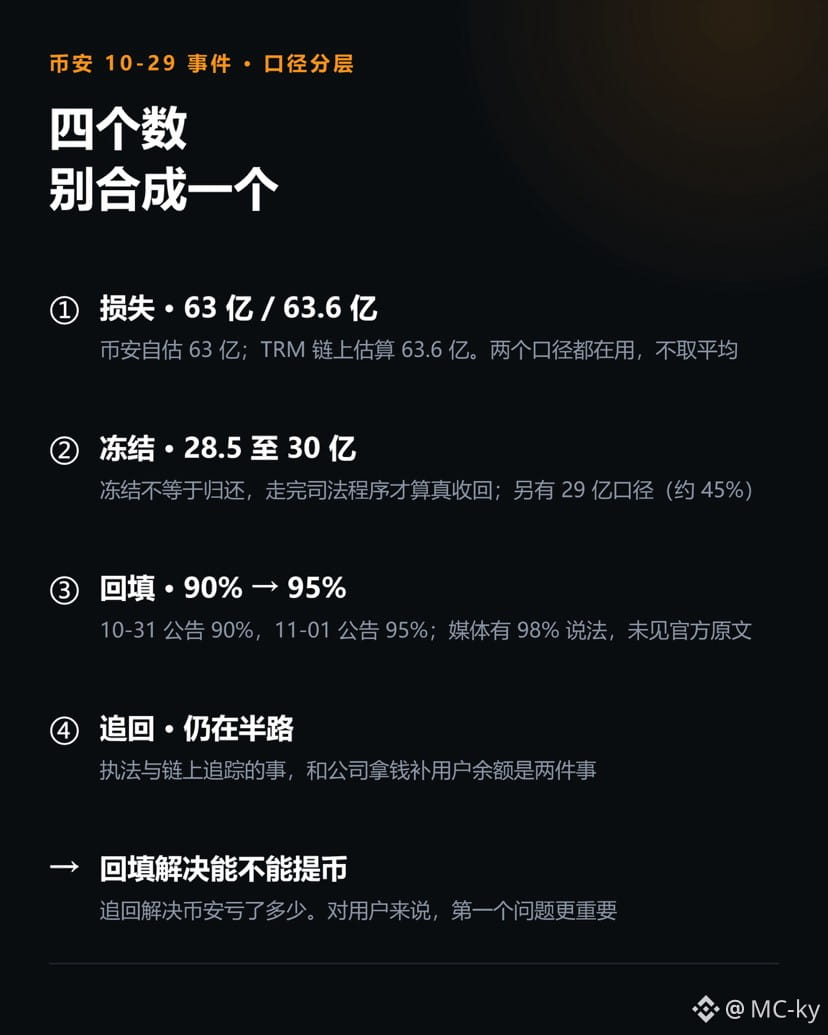
📌 First, let’s clarify one thing: in the Binance incident, losses, frozen funds, and reimbursement are three different figures. Mixing them up can lead to exactly the opposite conclusion.
🔍 The figures currently being cited are: approximately $6.3 billion in affected assets (Binance’s own estimate), approximately $6.36 billion (TRM’s on-chain estimate); $2.85 billion to $3 billion frozen; and reimbursement rates of 90% (announcement on 10-31) → 95% (announcement on 11-01) → 98% (as of 10-31, according to media reports). Each figure has its own source and refers to a different point in time, so they shouldn’t be combined into one.
The key distinction is between “reimbursement” and “recovery”: reimbursement means Binance uses its own funds to restore users’ balances—the money has already left the company’s books. Recovery means retrieving the stolen assets from the hackers, which involves law enforcement and on-chain tracing. The former has already happened; the latter is still underway.
⚠️ Two reminders: when you see statements like “95% recovered,” check the original source first—most of the time, they’re referring to reimbursement, not recovery. And when you see “$2.9 billion frozen,” remember that freezing doesn’t mean the funds have been returned; that only counts once the legal process is complete.
Reimbursement determines whether you can withdraw your funds; recovery determines how much Binance has lost. For users like us, the first question matters more. For the industry as a whole, the second is what matters for the balance sheet.
86
·
--
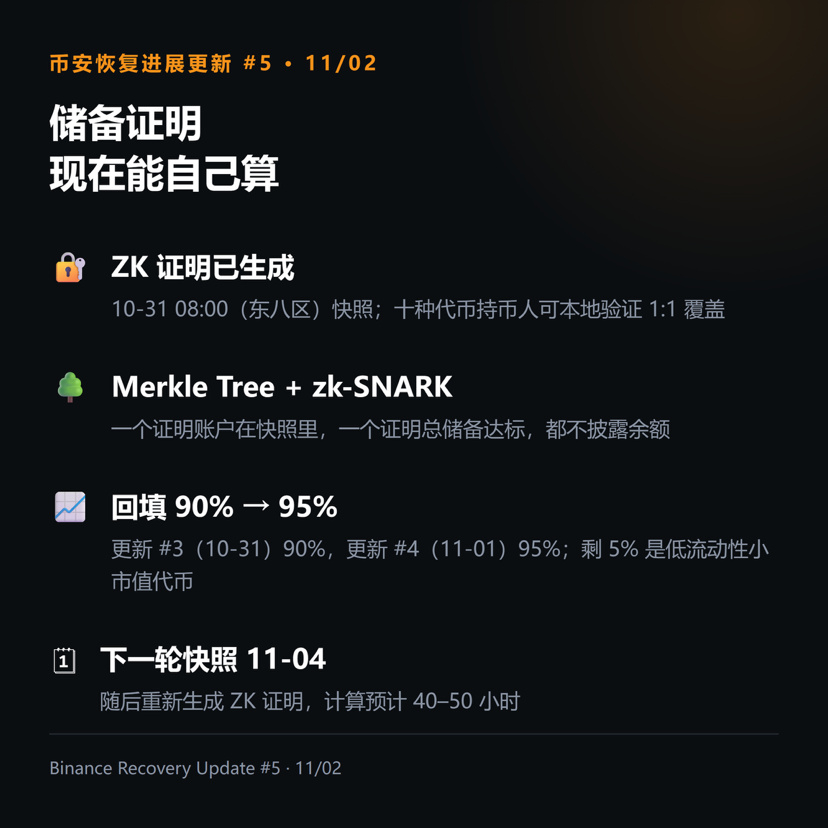
📌 Trust in the wake of the Binance incident took a substantive step toward being restored today: a complete ZK proof for the 10-31 08:00 (UTC+8) snapshot has been generated. Holders of the ten tokens can download the verification tool themselves and run it locally to confirm whether their account balances are covered 1:1.
🔍 The significance of this step is that it turns “Do you trust us?” into “Can you verify it?” The Merkle Tree proves that your account was included in the snapshot, while zk-SNARK proves that total reserves meet the required level. Neither requires anyone’s balance to be made public. The technology itself isn’t new, but this is the first time it has been used in crisis communications by an exchange with $171 billion in assets.
Consider two other figures alongside this: the coverage ratio has risen from 90% in the 10-31 announcement to 95% in the 11-1 announcement. The remaining 5% consists of tokens outside the top ten by market cap, with lower liquidity. In the nine and a half hours after withdrawals reopened, net outflows totaled $3.64 billion, or 2.1% of AUM, before subsequently falling.
⚠️ Two reminders: download the verification tool and run it locally yourself—a green check mark on a webpage doesn’t count. The next snapshot will be generated on 11-4, and ZK computation is expected to take 40 to 50 hours. Reports during that interim period will all be based on the old snapshot.
59
·
--
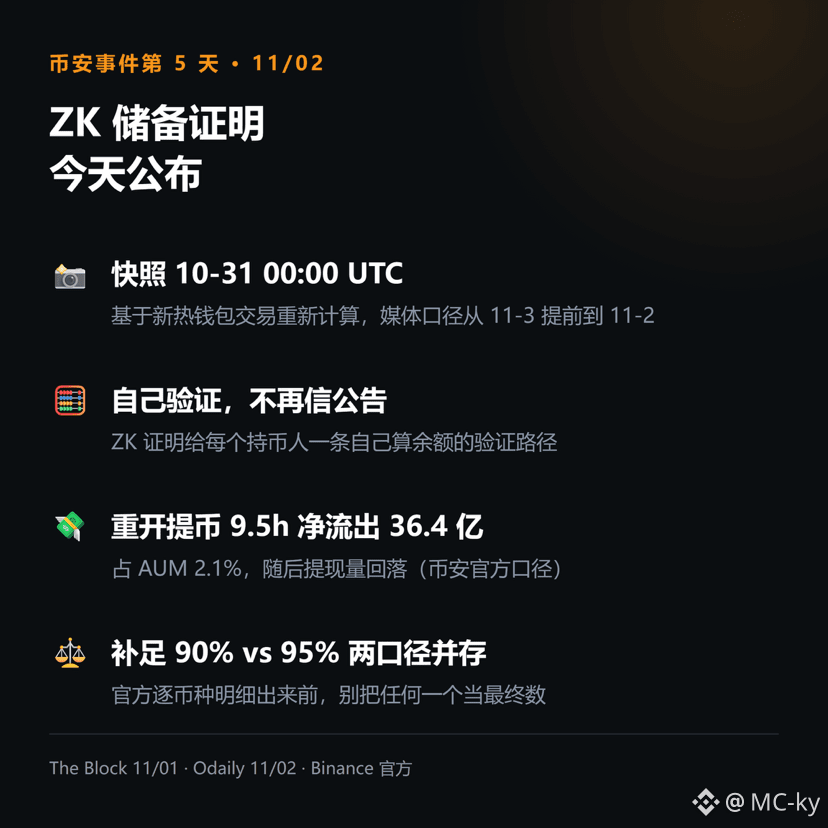
📌 The final piece in the Binance incident’s aftermath fell into place today: the complete ZK Proof of Reserves based on the 10-31 snapshot, with the public announcement brought forward to 11-2.
🔍 The difference between a ZK proof and an ordinary announcement is verifiability: it doesn’t ask you to trust Binance; it gives every holder a way to verify the figures for themselves. Reserve transparency goes from “trust us, this is how much we have” to “you can calculate how much we have.”
The data from a few days ago is also worth considering in the same context: in the first nine and a half hours after withdrawals reopened, net outflows totaled $3.64 billion, or 2.1% of total assets under management. Withdrawal volumes then declined. The fact that things stabilized after 2% flowed out suggests most users weren’t looking to move their funds—they wanted an answer they could verify.
⚠️ Two reminders: the report reflects the snapshot date, not the publication date; the 90% and 95% reserve coverage figures are still being reported in parallel. Until the official breakdown by coin is released, don’t treat either figure as final.
98
·
--
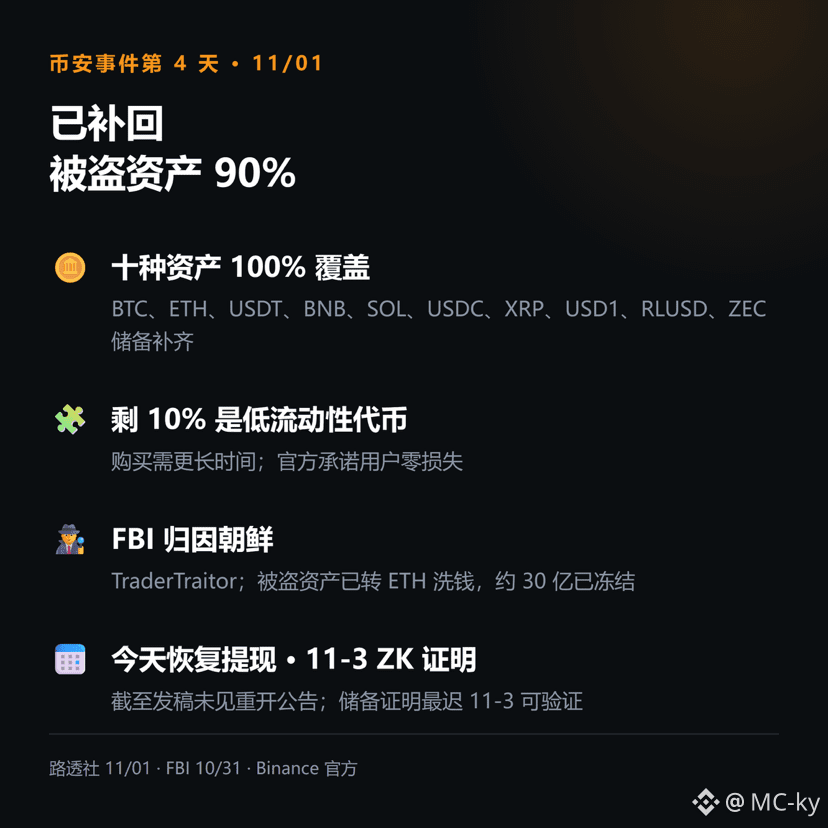
Day four of the Binance incident, and progress is faster than on any of the first three days: 90% of the stolen assets have been replenished, and reserves fully cover ten major assets (BTC, ETH, USDT, BNB, SOL, USDC, XRP, USD1, RLUSD, ZEC); the remaining 10% consists of low-liquidity tokens that are still being bought. The FBI has officially attributed the attack to North Korea’s TraderTraitor, and the laundering route has shifted to ETH. SAFU deployment is nearing completion, with a commitment to replenish it to about $1 billion.
Withdrawals were scheduled to resume today, but no official announcement had been made by the time of publication. The complete ZK proof of reserves is due no later than 11-3.
⚠️ Important distinction: 90% has been “replenished,” not “recovered”—the replacement assets were bought with Binance’s own funds. Whether the roughly $3 billion in frozen hacker assets will be recovered is a separate matter.
365
·
--
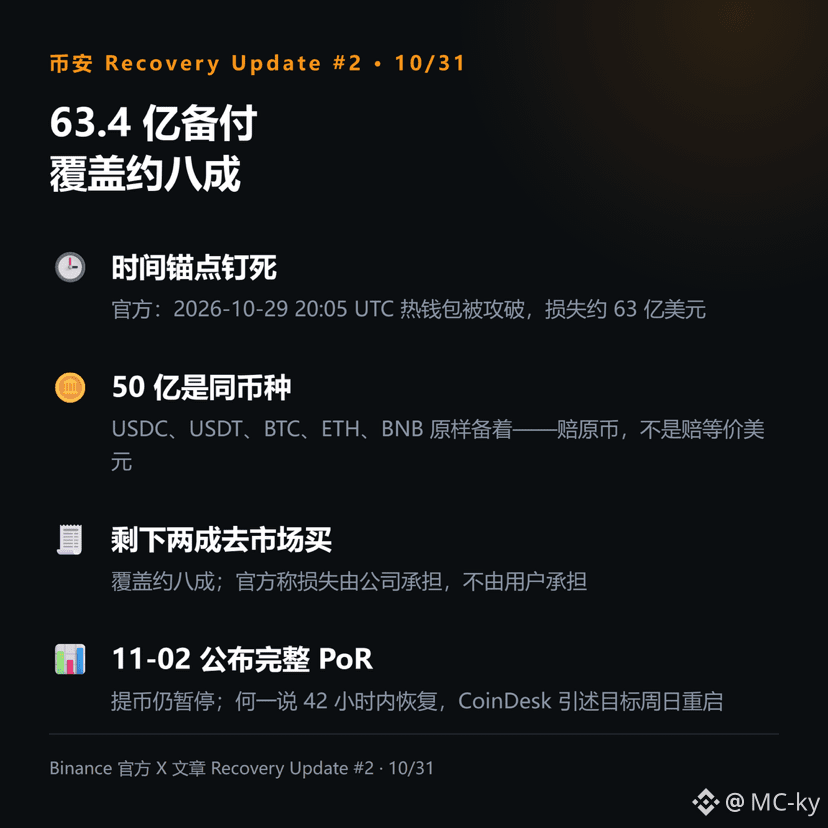
Binance officially released its second incident review today, pinning down the timeline: at 20:05 UTC on 2026-10-29, the hot wallet was compromised, resulting in losses of about $6.3 billion.
Three latest updates:
1. Compensation. The company has set aside $6.34 billion in funds, including $5 billion held in the original form and denominations (USDC, USDT, BTC, ETH, and BNB), covering about 80% of the losses. The remaining 20% will be purchased on the market and over the counter. Compensation will be in the original assets, not an equivalent amount in dollars.
2. Withdrawals. They remain suspended. He Yi said in a video that they would resume within 42 hours; the target cited by CoinDesk is a restart on Sunday. Both timelines are being reported, so refer to the official announcement.
3. Proof of Reserves. The complete PoR will be published no later than November 2. It will be the first independently verifiable ledger since the incident.
On-chain, TRM says the hacker still controls about $2.4 billion in BTC and ETH. Recovery efforts are ongoing, so don’t treat “$3 billion frozen” as the end of the story.
I’ll keep updating as new information comes in.
482
·
--
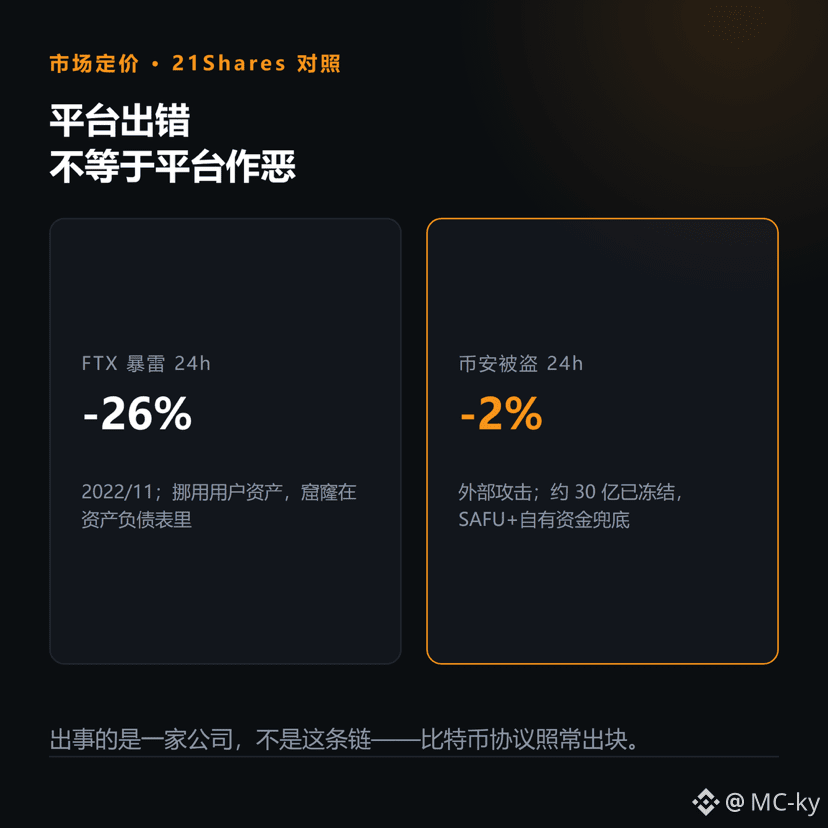
In the 24 hours after the Binance incident, BTC fell about 2%. When FTX collapsed, the comparable figure was 26%.
21Shares’ comparison is worth a closer look. FTX misappropriated customer assets, leaving a hole in its balance sheet, and users could only flee; this time, it was an external attack, with about $3 billion already frozen. Binance has pledged to cover all losses using its SAFU fund and its own capital—the SAFU fund holds 15,000 BTC, worth about $1.18 billion at $78,509 per BTC, enough to cover roughly 36% of the unfrozen losses, with the company’s funds covering the rest.
The market prices platform failures and platform misconduct very differently.
This also explains why Bitcoin itself barely fell: a company was affected, not the blockchain. The protocol has no idea what happened at the exchange; it just keeps producing blocks as usual.
494
·
--
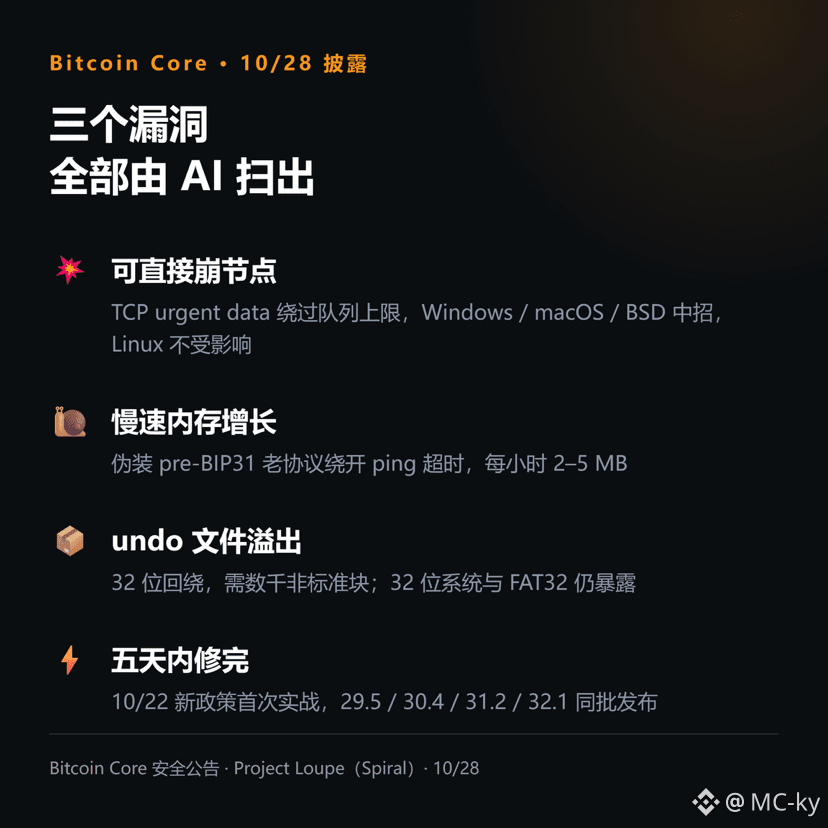
Bitcoin’s node software patched three vulnerabilities yesterday, and all three were first found by AI.
📌 What was found: Spiral’s Project Loupe uses large language models to automate code scanning. It uncovered three vulnerabilities, which developer Gregory Sanders verified before reporting them to the Bitcoin Core security team. Two could let malicious nodes exhaust memory. The most serious could crash nodes running on Windows, macOS, and BSD—Linux is unaffected because it uses a different socket-monitoring mechanism.
📌 How serious were they? The project rated the first two medium severity and the third low. The third involved a 32-bit overflow in an undo file and would take thousands of nonstandard blocks to trigger—close to a month’s worth of the entire network’s output. The docs put it plainly: 64-bit systems are basically not vulnerable, but nodes running on 32-bit systems or using FAT32 storage remain exposed even after upgrading.
📌 The process was faster, too: On October 22, Bitcoin Core changed its policy. For vulnerabilities that are “easy to find with an LLM,” fixes must be prepared as soon as possible for all supported branches, and an announcement should be issued as soon as the fixes are ready—no more waiting through the standard embargo period. Five days later, four point releases (29.5, 30.4, 31.2, and 32.1) and three announcements came out together. This was the new policy’s first real-world test.
📌 One detail: Another developer, L0rinc, independently found one of the memory vulnerabilities within a week of its discovery by AI scanning. The policy makers’ words were roughly: if two people have found it, assume a third person already has it.
If you run a node, especially on Windows or macOS, you should upgrade now. This isn’t investment advice; it’s operations advice.
$BTC #bitcoin
AI helping open-source projects find bugs—is that a good thing or a new risk?
{spot}(BTCUSDT)
Bitcoin’s node software patched three vulnerabilities yesterday, and all three were first found by AI.
📌 What was found: Spiral’s Project Loupe uses large language models to automate code scanning. It uncovered three vulnerabilities, which developer Gregory Sanders verified before reporting them to the Bitcoin Core security team. Two could let malicious nodes exhaust memory. The most serious could crash nodes running on Windows, macOS, and BSD—Linux is unaffected because it uses a different socket-monitoring mechanism.
📌 How serious were they? The project rated the first two medium severity and the third low. The third involved a 32-bit overflow in an undo file and would take thousands of nonstandard blocks to trigger—close to a month’s worth of the entire network’s output. The docs put it plainly: 64-bit systems are basically not vulnerable, but nodes running on 32-bit systems or using FAT32 storage remain exposed even after upgrading.
📌 The process was faster, too: On October 22, Bitcoin Core changed its policy. For vulnerabilities that are “easy to find with an LLM,” fixes must be prepared as soon as possible for all supported branches, and an announcement should be issued as soon as the fixes are ready—no more waiting through the standard embargo period. Five days later, four point releases (29.5, 30.4, 31.2, and 32.1) and three announcements came out together. This was the new policy’s first real-world test.
📌 One detail: Another developer, L0rinc, independently found one of the memory vulnerabilities within a week of its discovery by AI scanning. The policy makers’ words were roughly: if two people have found it, assume a third person already has it.
If you run a node, especially on Windows or macOS, you should upgrade now. This isn’t investment advice; it’s operations advice.
$BTC #bitcoin
AI helping open-source projects find bugs—is that a good thing or a new risk?
417
·
--
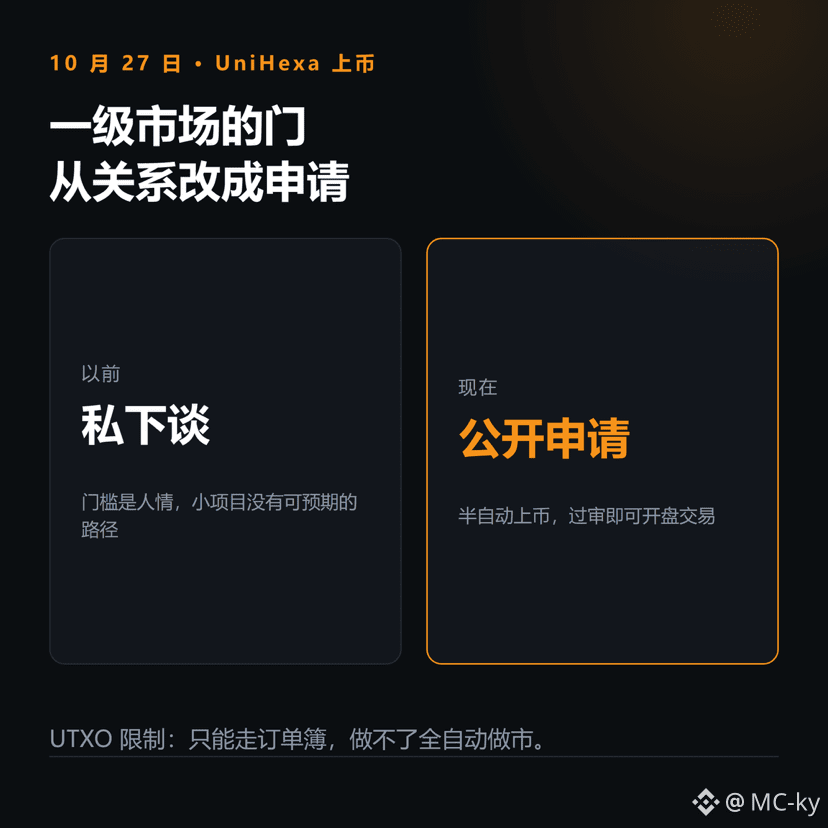
The primary market in the Bitcoin ecosystem changed its rules tonight.
UniHexa is introducing semi-automated token listings: projects can submit applications publicly, without having to privately network their way in. Native assets like BRC-20 and Runes will be able to start trading faster.
📌 The key is where the line is drawn with “semi-automated.” Because of how UTXOs work, it can’t offer fully automated market making like Ethereum#—it has to use an order book. That means listings are faster, but liquidity depth depends on real people placing orders. Speed and depth have always been at odds. #
📌 The old barrier was “who you know.” Now it’s “who applies and who gets approved.” Once the rules are written down, small projects finally have a predictable path forward—for them, that’s more valuable than adding ten more trading pairs.
📌 For market makers, the thing to watch next isn’t listing speed, but how partially filled orders are handled: whether a half-filled order goes back into the queue or has to be signed again will determine whether liquidity can really be put on the book.
$BTC #Bitcoin
Do you think the order-book model can work in the Bitcoin ecosystem?
472
·
--
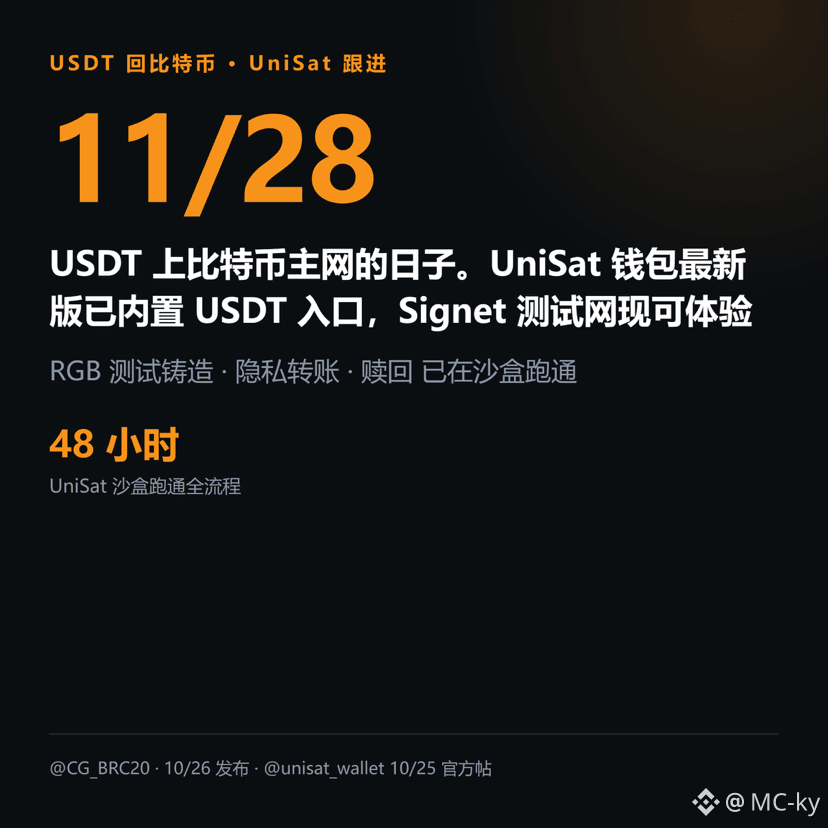
After the UniSat Wallet update, USDT now has a spot on the wallet’s home screen. It’s still on the Signet testnet, but with the mainnet launch on November 28, we’re just over a month away.
📌 What happened: Utexo is bringing USDT back to Bitcoin using the RGB protocol, and UniSat was quick to follow suit—the sandbox got test minting, private transfers, and redemption up and running in 48 hours, and the latest wallet version has added a dedicated entry point.
📌 My take: Stablecoins have never lacked blockchains; what they lack is “an accessible way to use them that people can trust.” This time, the entry point is built into a wallet followed by 189,000 people. For the first time, the Bitcoin ecosystem has a USDT transfer interface people can use day to day. The fees are clearly laid out: a 0.1% commission plus a 0.5 USDT base fee.
Over the next month, $BTC isn’t the only thing to watch—it’s whether RGB’s “keep the ledger off-chain” approach can catch on with everyday users.
Would you transfer stablecoins on the Bitcoin network, or stick with where you are now?
#Bitcoin #USDT #BTC
127
·
--
Today, we finally have official figures on USDT returning to Bitcoin.
Utexo has opened early access to Utexo Mint, with a public launch on November 28. But access is limited to verified institutions—exchanges, wallets, market makers, OTC desks, and trading firms. Retail users can’t mint, and unverified accounts have a minting cap of 100 USDT.
First, let’s clear up a widespread misconception: this isn’t Tether issuing more USDT on Bitcoin. It’s a bridge—USDT0 is locked on Arbitrum, while a pegged version is created on Bitcoin through lock-and-mint. The total supply stays the same; only the chain on which USDT can appear changes.
📌 The fees are transparent: during the launch period, there’s a 0.1% commission plus a 0.5 USDT base fee, excluding network fees and the cross-chain fee. Clear pricing is better than vague promises.
📌 The privacy angle deserves a closer look. RGB keeps transaction amounts and counterparties off-chain, leaving only commitments on-chain. It also helps avoid address reuse. Utexo cites quantum computing as the reason, tying privacy to future security. But don’t mistake this for complete anonymity: AML monitoring is handled by Crystal Intelligence, and the source of all incoming USDT is screened. Anonymity means “not publicly visible,” not “invisible to regulators.”
📌 The timeline needs to be viewed in two stages: November 28 is phase one, when the service becomes available through partner wallets and exchanges; the Lightning Network comes in phase two, in Q1 2027. That’s a gap of almost six months.
$BTC #bitcoin
How many retail users do you think will actually be able to mint USDT themselves on November 28?
{spot}(BTCUSDT)
Today, we finally have official figures on USDT returning to Bitcoin.
Utexo has opened early access to Utexo Mint, with a public launch on November 28. But access is limited to verified institutions—exchanges, wallets, market makers, OTC desks, and trading firms. Retail users can’t mint, and unverified accounts have a minting cap of 100 USDT.
First, let’s clear up a widespread misconception: this isn’t Tether issuing more USDT on Bitcoin. It’s a bridge—USDT0 is locked on Arbitrum, while a pegged version is created on Bitcoin through lock-and-mint. The total supply stays the same; only the chain on which USDT can appear changes.
📌 The fees are transparent: during the launch period, there’s a 0.1% commission plus a 0.5 USDT base fee, excluding network fees and the cross-chain fee. Clear pricing is better than vague promises.
📌 The privacy angle deserves a closer look. RGB keeps transaction amounts and counterparties off-chain, leaving only commitments on-chain. It also helps avoid address reuse. Utexo cites quantum computing as the reason, tying privacy to future security. But don’t mistake this for complete anonymity: AML monitoring is handled by Crystal Intelligence, and the source of all incoming USDT is screened. Anonymity means “not publicly visible,” not “invisible to regulators.”
📌 The timeline needs to be viewed in two stages: November 28 is phase one, when the service becomes available through partner wallets and exchanges; the Lightning Network comes in phase two, in Q1 2027. That’s a gap of almost six months.
$BTC #bitcoin
How many retail users do you think will actually be able to mint USDT themselves on November 28?
156
·
--
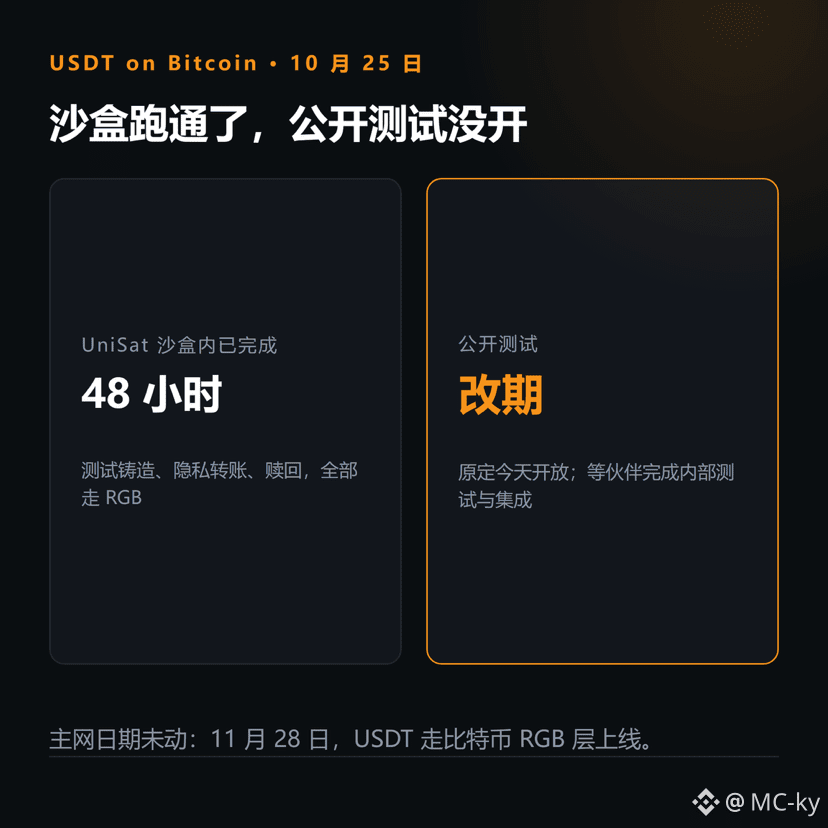
The USDT Signet public test that was scheduled to open today is off.
CG’s explanation two hours ago: they only realized at the last minute that, before mainnet launch, all key partners—other wallets and exchanges—must complete internal testing and integration.
On the same day, UniSat announced six hours ago that they’d completed the entire process in the Signet sandbox: test minting, private transfers, and redemption, all using RGB. The transaction flow has been verified, and key integrations have been finalized.
One team has everything working, while the other is calling it off. At first glance, that seems contradictory, but it actually points to the real bottleneck before mainnet: it’s not the technology—it’s everyone else’s progress.
📌 One thing worth highlighting separately is “private transfers.” If USDT on Bitcoin is just for transfers, it’s no different from other chains. Private transfers are what make RGB’s model a genuinely fitting use case.
📌 The date hasn’t changed: mainnet on November 28.
$BTC $USDT #bitcoin
Do you think we’ll see the first USDT transfer outside the sandbox, initiated by a third-party wallet, before the end of the month?
{spot}(BTCUSDT)
The USDT Signet public test that was scheduled to open today is off.
CG’s explanation two hours ago: they only realized at the last minute that, before mainnet launch, all key partners—other wallets and exchanges—must complete internal testing and integration.
On the same day, UniSat announced six hours ago that they’d completed the entire process in the Signet sandbox: test minting, private transfers, and redemption, all using RGB. The transaction flow has been verified, and key integrations have been finalized.
One team has everything working, while the other is calling it off. At first glance, that seems contradictory, but it actually points to the real bottleneck before mainnet: it’s not the technology—it’s everyone else’s progress.
📌 One thing worth highlighting separately is “private transfers.” If USDT on Bitcoin is just for transfers, it’s no different from other chains. Private transfers are what make RGB’s model a genuinely fitting use case.
📌 The date hasn’t changed: mainnet on November 28.
$BTC $USDT #bitcoin
Do you think we’ll see the first USDT transfer outside the sandbox, initiated by a third-party wallet, before the end of the month?
191
·
--
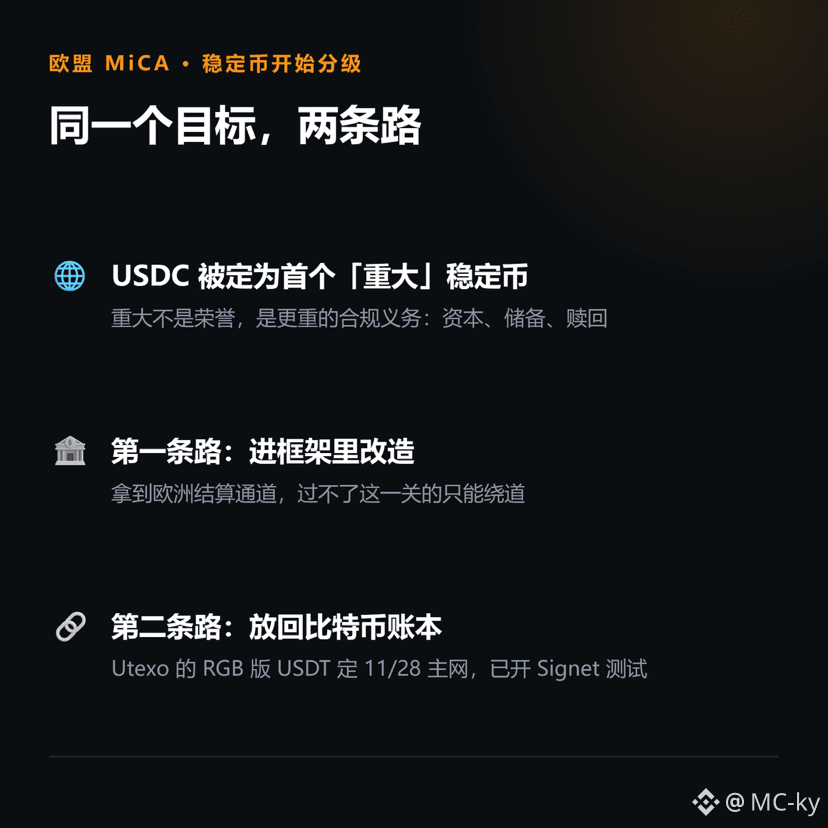
The EU’s designation of USDC as the first “significant” stablecoin under MiCA has a bigger impact on the Bitcoin ecosystem than on USDC itself.
“Significant” isn’t an honor—it means heavier compliance obligations: capital requirements, reserve disclosures, redemption safeguards. Nothing can be skipped. Stablecoins that pass this test effectively get a legal pass to operate in Europe; those that don’t will have to find another way.
Two paths are unfolding at the same time. One is to bring stablecoins into a compliance framework and adapt them to it—that’s the path USDC is taking. The other is to bring them back to Bitcoin’s own ledger. Utexo’s RGB version of USDT is slated for mainnet on November 28, using Tether’s USDT0. Signet testing opened on 10/22, and UniSat says users will be able to try the beta on 10/25.
The keyword for the first path is “approved”; for the second, it’s “settle it yourself.” Both are needed, but if the compliance list changes again one day, only the latter won’t have to wait for permission.
$BTC #fractalbitcoin
Now that stablecoin issuers are subject to tiered regulation, would you rather keep your money in a custodial account or hold your own private keys on-chain?
513
·
--
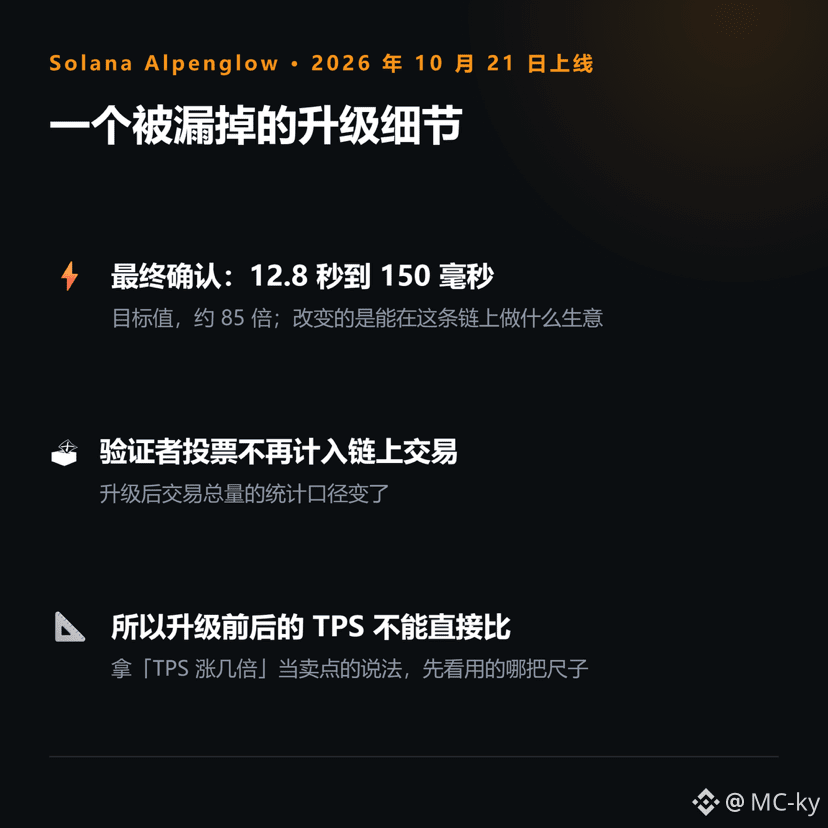
#Solana This upgrade has everyone talking about “150 milliseconds,” but almost no one is sharing the line that could really change how you evaluate it: validator votes will no longer count as on-chain transactions.
The implication is straightforward: TPS and total transaction counts before and after the upgrade can’t be compared directly. Next time someone touts “TPS is up several times,” ask which yardstick they’re using.
The real substance is the other half: finality is targeted to drop from about 12.8 seconds to 150 milliseconds—85 times faster. This doesn’t change “how powerful the performance is”; it changes “who can do business on this chain.” Payments, stablecoin transfers, and market-making settlements all hinge on confirmation times.
It’s perfectly normal that the price hasn’t moved. Infrastructure takes quarters to show results, not a week. $SOL
Which matters more to you: finality, or how much real-world settlement it can actually handle?
202
·
--
USDT is set to return to Bitcoin on November 28 via the RGB protocol.
Utexo is making it happen, not Tether itself. It uses Tether’s USDT0 under the hood, and early testing opened on October 22. Exchanges, wallets, and market makers can test minting, transfers, and redemptions in the Signet sandbox. The public beta is scheduled for November 28, with Phase 2 planned for Q1 2027, connecting to the Lightning Network.
This lines up with UniSat’s three-phase roadmap from October 16: start with wallets and UniScan, then move on to UniHexa for trading Bitcoin-native assets.
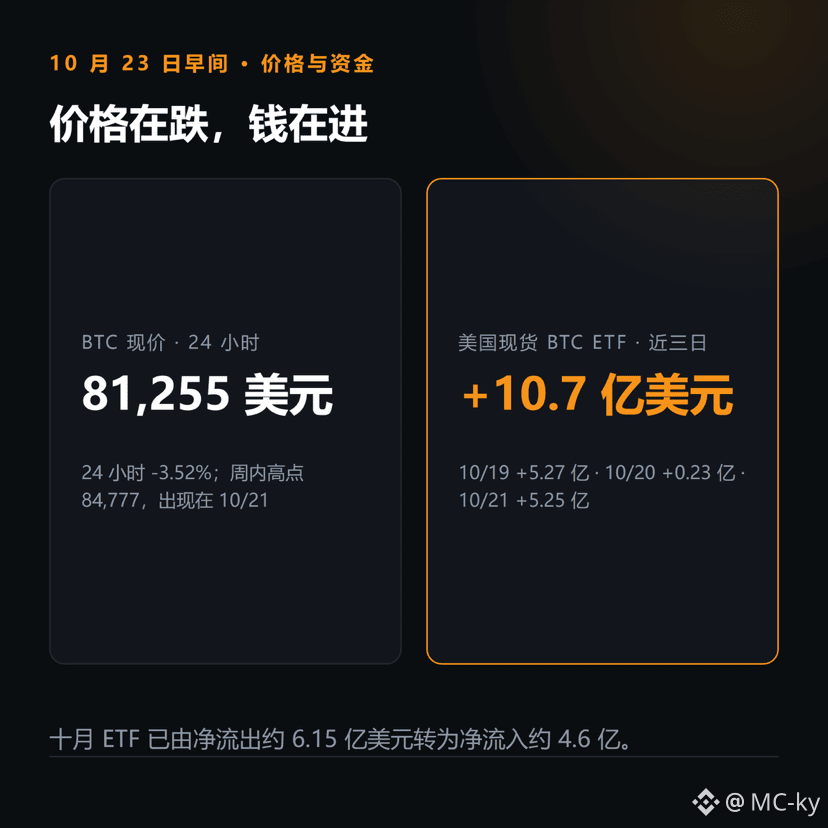
A quick look at this morning’s market: BTC is at $81,255, down 3.5% over 24 hours. Its weekly high is still the $84,777 it hit on October 21. But ETFs have seen $1.07 billion in net inflows over three days, pulling October back into net inflows after net outflows. Price and capital flows are already out of sync.
My take: the real challenge isn’t getting USDT onto Bitcoin—it’s indexing. The community has been pushing for OpenSea to support Ordinals and Runes. OpenSea’s OS2 covers 19 chains, but not Bitcoin; Magic Eden, on the other hand, has exited. What can be issued on-chain stopped being the bottleneck a long time ago. The question is who will keep the books.
$BTC What do you think will change first once USDT arrives: pricing or liquidity?
{spot}(BTCUSDT)
USDT is set to return to Bitcoin on November 28 via the RGB protocol.
Utexo is making it happen, not Tether itself. It uses Tether’s USDT0 under the hood, and early testing opened on October 22. Exchanges, wallets, and market makers can test minting, transfers, and redemptions in the Signet sandbox. The public beta is scheduled for November 28, with Phase 2 planned for Q1 2027, connecting to the Lightning Network.
This lines up with UniSat’s three-phase roadmap from October 16: start with wallets and UniScan, then move on to UniHexa for trading Bitcoin-native assets.
A quick look at this morning’s market: BTC is at $81,255, down 3.5% over 24 hours. Its weekly high is still the $84,777 it hit on October 21. But ETFs have seen $1.07 billion in net inflows over three days, pulling October back into net inflows after net outflows. Price and capital flows are already out of sync.
My take: the real challenge isn’t getting USDT onto Bitcoin—it’s indexing. The community has been pushing for OpenSea to support Ordinals and Runes. OpenSea’s OS2 covers 19 chains, but not Bitcoin; Magic Eden, on the other hand, has exited. What can be issued on-chain stopped being the bottleneck a long time ago. The question is who will keep the books.
$BTC What do you think will change first once USDT arrives: pricing or liquidity?
100
Log in to explore more content
Join global crypto users on Binance Square
⚡️ Get latest and useful information about crypto.
💬 Trusted by the world’s largest crypto exchange.
👍 Discover real insights from verified creators.
Email / Phone number
Trending Topics
IsAnthropic’s$1.5TMarketCapJustified?
5,500 views
55 Discussing
Anthropic Set to Open at $105 in Record Nasdaq Debut
Binance News
·8 Likes
·7.2k views
BTCRemainsUnderPressureAfterHawkishFOMCMinutes
190,673 views
1,927 Discussing
NvidiaBoardReportedlySplitOverHuang’sReturn
93,420 views
1,031 Discussing